
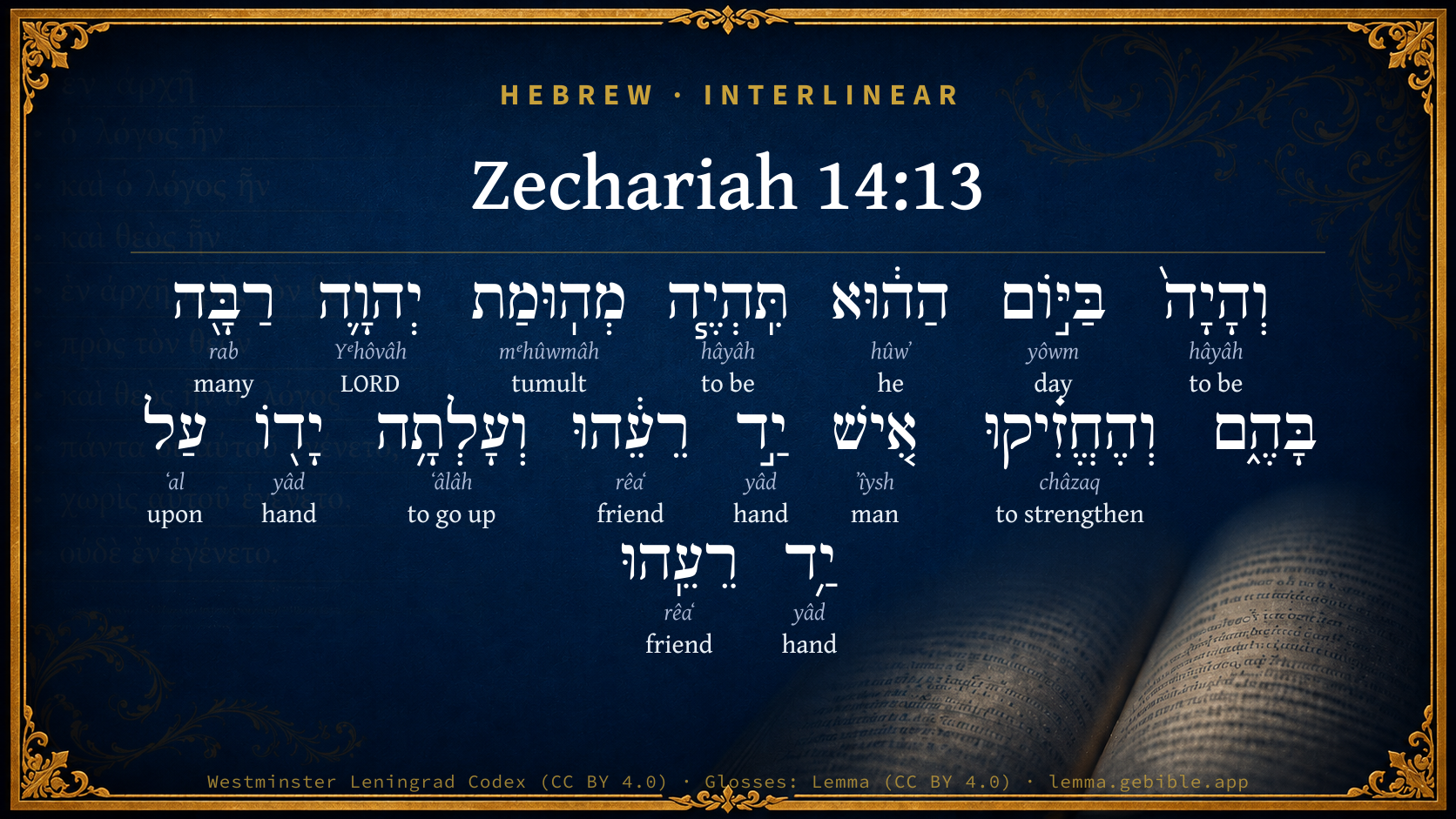
Zechariah 14:13

Hebrew (Westminster Leningrad Codex) Zechariah 14:13 appears in the Hebrew Old Testament. The text above is from the Westminster Leningrad Codex. Each word links to its Strong’s number, a concise gloss, and parsing drawn from the Open Scriptures Hebrew Bible morphology. Click any word for its full Brown-Driver-Briggs (BDB) entry.
Download image
Cite this verse

Zechariah 14:13 (World English Bible). Public Domain. Lemma interlinear Bible study tool, https://lemma.gebible.app/v/zechariah/14/13.

Show BibTeX & RIS
BibTeX
RIS
English Translation
It will happen in that day, that a great panic from Yahweh will be among them; and they will lay hold everyone on the hand of his neighbor, and his hand will rise up against the hand of his neighbor.
World English Bible · Public Domain
Download a study sheet

One document with this verse’s original text, its word-by-word gloss line, the meaning frame, cross-references with their text, attributed commentary, and full source and license credits — printable, and it pastes into notes with its structure intact.

This verse Autodidact and up

Study sheet (.html) Plain text (.txt)

A passage Seminary Student

Up to 50 verses in one chapter. A passage sheet keeps up to 6 commentary sources and 12 cross-references per verse, in the order this page ranks them, and says so on the sheet whenever that leaves anything out. Ask for a single verse and you get the Autodidact verse sheet above.

Everything on this page stays free to read, with no account — the sheet is a download of what is already on screen, not access to it.

Want to remove ads? Support Godless Engineer
Compare translations 3

The same verse in 3 English versions, stacked beneath the original-language interlinear above. Click any original word for its lexicon entry.

Each is an independent rendering of the whole verse — the interlinear is not word-aligned to these translations.

Highlighted words mark where these versions differ — a whole-verse word diff, not a word-by-word alignment.

  • World English Bible Public Domain
    It will happen in that day, that a great panic from Yahweh will be among them; and they will lay hold everyone on the hand of his neighbor, and his hand will rise up against the hand of his neighbor.
  • King James Version Public Domain
    And it shall come to pass in that day, that a great tumult from the LORD shall be among them; and they shall lay hold every one on the hand of his neighbour, and his hand shall rise up against the hand of his neighbour.
  • unfoldingWord Literal Text CC BY-SA 4.0
    On that day that great fear from Yahweh will come among them. Each one will seize the hand of another, and the hand of one will be raised up against the hand of another.

unfoldingWord Literal Text — © unfoldingWord, licensed CC BY-SA 4.0. Word-aligned USFM3 via Door43 (git.door43.org/unfoldingWord/en_ult).

Versions to compare (up to 4)

3 of 4 selected

Show all 18 translations

Every available English version of this verse, each an independent rendering of the whole verse.

  • World English Bible Public Domain
    It will happen in that day, that a great panic from Yahweh will be among them; and they will lay hold everyone on the hand of his neighbor, and his hand will rise up against the hand of his neighbor.
  • Berean Standard Bible Public Domain
    On that day a great panic from the LORD will come upon them, so that each will seize the hand of another, and the hand of one will rise against the other.
  • Majority Standard Bible Public Domain
    On that day a great panic from the LORD will come upon them, so that each will seize the hand of another, and the hand of one will rise against the other.
  • King James Version Public Domain
    And it shall come to pass in that day, that a great tumult from the LORD shall be among them; and they shall lay hold every one on the hand of his neighbour, and his hand shall rise up against the hand of his neighbour.
  • American Standard Version (1901) Public Domain
    And it shall come to pass in that day, that a great tumult from Jehovah shall be among them; and they shall lay hold every one on the hand of his neighbor, and his hand shall rise up against the hand of his neighbor.
  • Revised Version (1885) Public Domain
    And it shall come to pass in that day, that a great tumult from the LORD shall be among them; and they shall lay hold every one on the hand of his neighbour, and his hand shall rise up against the hand of his neighbour.
  • Geneva Bible (1599) Public Domain
    But in that day a great tumult of the Lord shall be among them, and euery one shall take the hande of his neighbour, and his hande shall rise vp against the hand of his neighbour.
  • Douay-Rheims (1899) Public Domain
    In that day there shall be a great tumult from the Lord among them: and a man shall take the hand of his neighbour, and his hand shall be clasped upon his neighbour's hand.
  • Young's Literal Translation Public Domain
    And it hath come to pass, in that day, A great destruction `from' Jehovah is among them, And they have seized each the hand of his neighbour, And gone up hath his hand against the hand of his neighbour.
  • Literal Standard Version CC BY-SA 4.0
    And it has come to pass in that day, || A great destruction [from] YHWH is among them, || And they have each seized the hand of his neighbor, || And his hand has gone up against the hand of his neighbor.
  • Unlocked Literal Bible CC BY-SA 4.0
    On that day that great fear from Yahweh will come among them. Each one will seize the hand of another, and the hand of one will be raised up against the hand of another.
  • unfoldingWord Literal Text CC BY-SA 4.0
    On that day that great fear from Yahweh will come among them. Each one will seize the hand of another, and the hand of one will be raised up against the hand of another.
  • Darby Bible Public Domain
    And it shall come to pass in that day [that] a great panic from Jehovah shall be among them; and they shall lay hold every one on the hand of his neighbour, and his hand shall rise up against the hand of his neighbour.
  • World Messianic Bible Public Domain
    It will happen in that day that a great panic from the LORD will be among them; and they will each seize the hand of his neighbor, and his hand will rise up against the hand of his neighbor.
  • Webster's Bible Public Domain
    And it shall come to pass in that day, that a great tumult from the LORD shall be among them; and they shall lay hold every one on the hand of his neighbor, and his hand shall rise up against the hand of his neighbor.
  • Free Bible Version CC BY-SA 4.0
    On that day the Lord will strike them with a terrible panic, and they will seize one another, and fight hand-to-hand.
  • Bible in Basic English Public Domain
    And it will be on that day that a great fear will be sent among them from the Lord; and everyone will take his neighbour's hand, and every man's hand will be lifted against his neighbour's.
  • JPS Tanakh (1917) Public Domain
    And it shall come to pass in that day, that a great tumult from the LORD shall be among them; and they shall lay hold every one on the hand of his neighbour, and his hand shall rise up against the hand of his neighbour.

Literal Standard Version (2020), Covenant Press — licensed CC BY-SA 4.0. Text via the HelloAO Bible API (eBible.org). Unlocked Literal Bible (unfoldingWord) — licensed CC BY-SA 4.0. Text via the HelloAO Bible API (eBible.org). unfoldingWord Literal Text — © unfoldingWord, licensed CC BY-SA 4.0. Word-aligned USFM3 via Door43 (git.door43.org/unfoldingWord/en_ult). Free Bible Version, Dr. Jonathan Gallagher — licensed CC BY-SA 4.0. Text via the HelloAO Bible API (eBible.org).

Word by word

More ways to search: Search by grammar → Find every occurrence → Compare this word →

Practice this passage: Drill this verse → Learn its vocabulary →

מְהֽוּמַת
mᵉhûwmâh
H4103
“tumult of”
Noun, Common, Feminine, Singular, Construct
Part of Speech
Noun
Type
Common
Gender
Feminine
Number
Singular
State
Construct
Full BDB Definition

Origin: from H1949

TWOT: 486a

tumult, confusion, disquietude, discomfiture, destruction, trouble, vexed, vexation - tumult, confusion, disturbance, turmoil, disquietude, panic - discomfiture
  1. וְהָיָה֙ hâyâh H1961 “and · to be” Conjunction + Verb, Qal, Sequential Perfect, 3rd Person, Masculine, Singular
  2. בַּיּ֣וֹם yôwm H3117 “in/at the · day” Preposition, Determined + Noun, Common, Masculine, Singular, Absolute
  3. הַה֔וּא hûwʼ H1931 “the · he” Particle, Definite Article + Pronoun, Personal, 3rd Person, Masculine, Singular
  4. תִּֽהְיֶ֧ה hâyâh H1961 “to be” Verb, Qal, Imperfect, 3rd Person, Feminine, Singular
  5. יְהוָ֛ה Yᵉhôvâh H3068 “LORD” Noun, Proper
  6. רַבָּ֖ה rab H7227 “many” Adjective, Adjective, Feminine, Singular, Absolute
  7. וְהֶחֱזִ֗יקוּ châzaq H2388 “and · to strengthen” Conjunction + Verb, Hiphil, Sequential Perfect, 3rd Person, Common, Plural
  8. אִ֚ישׁ ʼîysh H376 “man” Noun, Common, Masculine, Singular, Absolute
  9. יַ֣ד yâd H3027 “hand of” Noun, Common, Both, Singular, Construct
  10. רֵעֵ֔הוּ rêaʻ H7453 “friend · his” Noun, Common, Masculine, Singular, Construct + Suffix, Personal, 3rd Person, Masculine, Singular
  11. וְעָלְתָ֥ה ʻâlâh H5927 “and · to go up” Conjunction + Verb, Qal, Sequential Perfect, 3rd Person, Feminine, Singular
  12. יָד֖וֹ yâd H3027 “hand · his” Noun, Common, Both, Singular, Construct + Suffix, Personal, 3rd Person, Masculine, Singular
  13. עַל ʻal H5921 “upon” Preposition
  14. יַ֥ד yâd H3027 “hand of” Noun, Common, Both, Singular, Construct
  15. רֵעֵֽהוּ rêaʻ H7453 “friend · his” Noun, Common, Masculine, Singular, Construct + Suffix, Personal, 3rd Person, Masculine, Singular

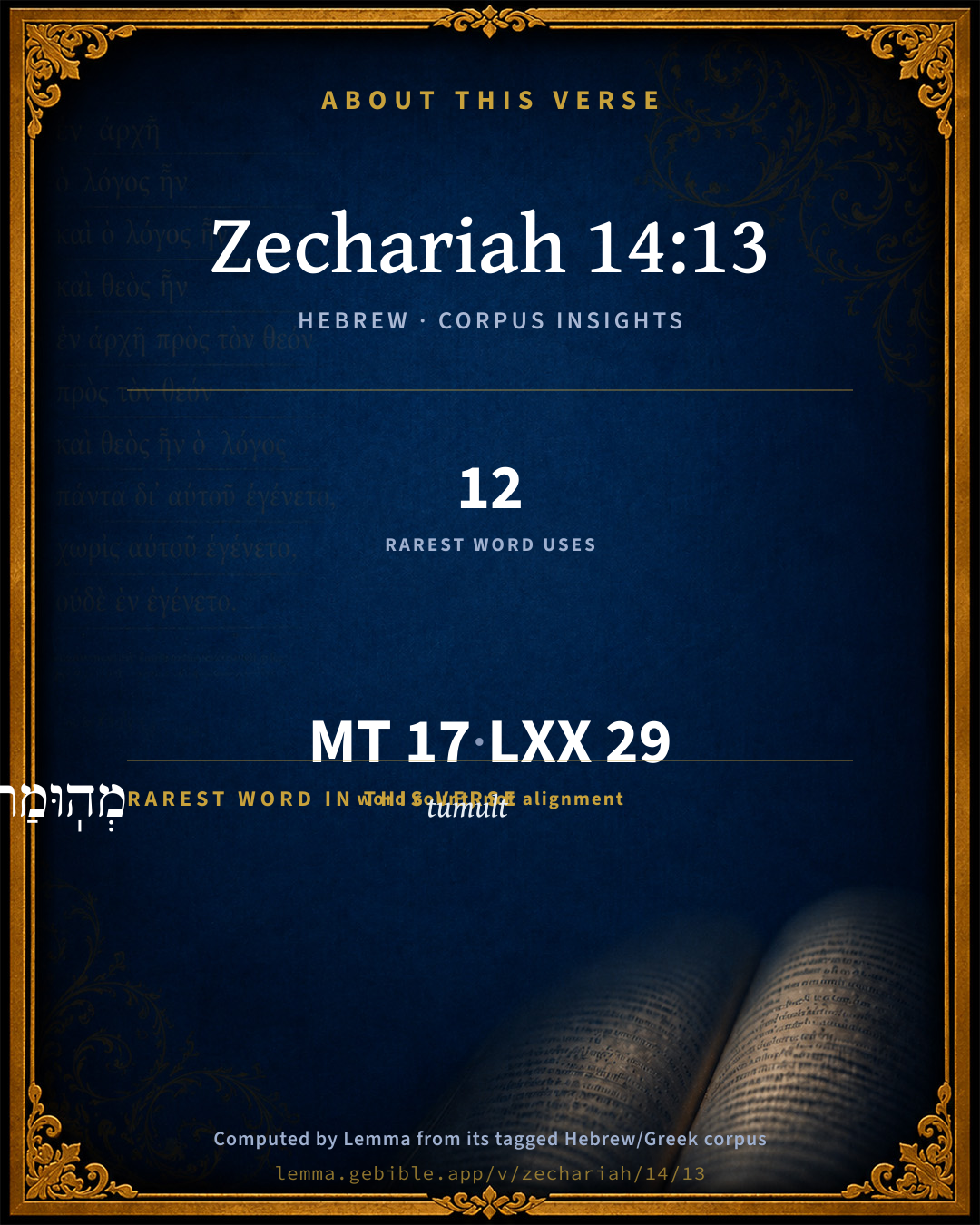
About this verse

These counts appear in no published source. They are computed here, from the morphology-tagged text and Lemma’s own curated glosses. What Lemma adds →

17
words
12
distinct lemmas
Prophets
section

Notable vocabulary

The rarest word here is מְהֽוּמַת tumult H4103 — appearing just 12 times in the whole Hebrew Bible.

Shared distinctive vocabulary

מְהֽוּמַת tumult H4103 occurs in 12 verses of the Hebrew Bible. Also found in:

Grammatical profile

  • 4 verbs
  • 9 nouns
  • 1 adjective
  • 1 pronoun
  • 2 prepositions

Verb forms

  • וְהָיָה֙ Qal · Sequential Perfect
  • תִּֽהְיֶ֧ה Qal · Imperfect
  • וְהֶחֱזִ֗יקוּ Hiphil · Sequential Perfect
  • וְעָלְתָ֥ה Qal · Sequential Perfect

Repetition

Words recur within this verse — often emphatic in Hebrew:

  • יַ֣ד hand H3027 ×3
  • וְהָיָה֙ to be H1961 ×2
  • רֵעֵ֔הוּ friend H7453 ×2

Hebrew & Septuagint length

In English translation the verse runs 40 words from the Hebrew and 40 from the Septuagint (LXX English) — the same length.

A rough comparison of the two English renderings, which tokenize alike — not a word-level alignment.

Word counts can differ between the Hebrew and the Greek without any difference in meaning — e.g. the Hebrew direct-object marker אֵת has no separate Greek word, and Greek often adds the article ὁ.

In the original languages it is 17 Hebrew tokens and 29 Greek tokens — but the two are counted differently (Hebrew bundles its prefixes and suffixes into one token; the Greek is in lemma form), so that isn’t a like-for-like length.

Cross-references

7

Topical passages linked to Zechariah 14:13 in the Treasury of Scripture Knowledge — connected by theme and wording, ordered by reader-vote popularity; previews shown in the World English Bible.

  • Judges 7:22 They blew the three hundred trumpets, and Yahweh set every man's sword against his fellow, and against all the host; and the host fled as far as Beth-shittah toward Zererah, as far as the border of Abel Meholah, by Tabbath.
  • Ezekiel 38:21 I will call for a sword against him to all my mountains, says the Lord Yahweh: every man's sword shall be against his brother.
  • Zechariah 12:4 In that day," says Yahweh, "I will strike every horse with terror, and his rider with madness; and I will open my eyes on the house of Judah, and will strike every horse of the peoples with blindness.
  • 1 Samuel 14:15–23 There was a trembling in the camp, in the field, and among all the people; the garrison, and the spoilers, they also trembled; and the earth quaked: so there was an exceeding great trembling.
  • 2 Chronicles 20:22–24 When they began to sing and to praise, Yahweh set liers-in-wait against the children of Ammon, Moab, and Mount Seir, who had come against Judah; and they were struck.
  • Zechariah 11:6 For I will no more pity the inhabitants of the land," says Yahweh; "but, behold, I will deliver the men everyone into his neighbor's hand, and into the hand of his king. They will strike the land, and out of their hand I will not deliver them."
  • Revelation 17:12–17 The ten horns that you saw are ten kings who have received no kingdom as yet, but they receive authority as kings, with the beast, for one hour.

Cross-references courtesy of OpenBible.info (CC BY 4.0).

Hebrew and Greek witnesses Masoretic Hebrew ↔ Greek Septuagint

The same verse in the two great witnesses to the Old Testament, shown verse-for-verse.

These are two independent witnesses, not word-aligned to each other, and the Septuagint is shown in lemma (dictionary) form.

Hebrew Zechariah 14:13 Masoretic · Westminster Leningrad Codex

וְהָיָה֙ בַּיּ֣וֹם הַה֔וּא תִּֽהְיֶ֧ה מְהֽוּמַת יְהוָ֛ה רַבָּ֖ה בָּהֶ֑ם וְהֶחֱזִ֗יקוּ אִ֚ישׁ יַ֣ד רֵעֵ֔הוּ וְעָלְתָ֥ה יָד֖וֹ עַל יַ֥ד רֵעֵֽהוּ

It will happen in that day, that a great panic from Yahweh will be among them; and they will lay hold everyone on the hand of his neighbor, and his hand will rise up against the hand of his neighbor.

World English Bible · Public Domain

Greek LXX Zechariah 14:13 Septuagint · lemma form

καί εἰμί ἐν ὁ ἡμέρα ἐκεῖνος ἔκστασις κύριος ἐπί αὐτός μέγας καί ἐπιλαμβάνω ἕκαστος ὁ χείρ ὁ πλησίον αὐτός καί συνπλέκω ὁ χείρ αὐτός πρός χείρ ὁ πλησίον αὐτός

And there shall be in that day a great panic from the Lord upon them; and they shall lay hold every man of the hand of his neighbor, and his hand shall be clasped with the hand of his neighbor.

LXX2012 (modern English Septuagint) · Public Domain

On this verse, John Gill's Exposition discusses the Septuagint’s reading. Read the note in Commentary ↓

Hebrew: Westminster Leningrad Codex (CC BY 4.0). Greek: Septuagint (public domain); English from LXX2012 (modern English Septuagint) (Public Domain). How the Septuagint differs from the Hebrew →

Targum (Aramaic paraphrase)

1

The Targum is the ancient Jewish Aramaic paraphrase of the Hebrew Scriptures — an interpretive translation, not the Hebrew text itself. Onkelos (literal) and Pseudo-Jonathan (expansive) render the Torah, and Jonathan the Prophets. Coverage is partial: where no permissively-licensed English translation exists for a verse, only the Aramaic is shown. This is verse-level text, not a word-by-word alignment to the Hebrew.

  1. Targum Jonathan Prophets (Joshua–Malachi)
    וִיהֵי בְּעִדָנָא הַהִיא יְהֵי שִׁגוּשׁ קַטְלָא קֳדָם יְיָ סַגִי בְּהוֹן וְיִתְקְפוּן גְבַר בְּיַד חַבְרֵיהּ וְתִתְּלַשׁ יְדֵיהּ עִם יְדָא דְחַבְרֵיהּ:

    (no public-domain English translation for this verse)

    Targum Jonathan — Aramaic: “Mikraot Gedolot” (public domain). English: “Sefaria Community Translation” (CC0 1.0 (public-domain dedication)); “London "Chaldee Paraphrase," 1871” (public domain). Text via Sefaria.

Commentary

Notes on Zechariah 14:13 from classic Christian and Jewish commentators (each source and its license shown beneath its notes). The classic Christian expositions comment on the surrounding passage and are grouped to its opening verse, so a note may address several verses; the Jewish commentaries on the Tanakh (Rashi and others) are per-verse, so they appear only where the commentator wrote on this verse.

Lemma curates 59 commentaries, every one of them public domain or Creative Commons licensed, each selected and text-cleaned for this edition rather than reprinted as found. About our sources →

Trapp's Complete Commentary

John Trapp

Zec 14:13 And it shall come to pass in that day, [that] a great tumult from the LORD shall be among them; and they shall lay hold every one on the hand of his neighbour, and his hand shall rise up against the hand of his neighbour.

Ver. 13. A great tumult from the Lord shall be among them] He shall frighten them, as he did the Philistines, by a sound of a going in the tops of the mulberry trees, 2Sa 5:24, and the Syrians by a marching noise in the air, causing a panic terror, 2Ki 7:6. Therefore some render it, Erit strepitus vel fragor Domini magnus in eis, so 1Sa 7:10; cf. 1Sa 2:10. Or, he shall exasperate and embitter them one against another; as he did Abimelech and the men of Shechem, by sending an evil spirit between them, Jdg 9:23, that is, by letting loose Satan upon them, that old manslayer, that coal kindler and mischief-maker of the world; and this in a way of just revenge for their treacherous conspiracy against the house of Gideon. Thus God first divided, and then destroyed, the Midianites, by setting every one’s sword against his fellow, Jdg 7:23. So he dealt by the Philistines, 1Sa 14:15; 1Sa 14:20. So the kings of Syria and Egypt, that succeeded Alexander, and were enemies to the Jews, destroyed one another; so did the primitive persecutors, the Turk and the Persian, the Spaniard and the French. In the year 1526 Charles V, emperor of Germany, set at liberty his prisoner Francis, King of France, upon this condition, among others, that they should join their forces and do their utmost to suppress and root out the Lutheran heresy; that is, the truth of the gospel, out of both their dominions (Scultet. Annal.). But soon after they fell at variance among themselves (the Pope blowing the bellows), whereby the Church had her halcyons, sic canes lingunt ulcera Lazari. so the digs licked the sore of Lazarus.

Shall take the hand of his neighbour] As those younkers {a} of Helcath-hazzurim did, that sheathed their swords in their fellows’ bowels. 2Sa 2:16

{a} A young man generally, in early use esp. a gay or fashionable young man ŒD

John Trapp, A Commentary or Exposition upon All the Books of the Old and New Testament (1647–1656) — public domain. Text from a community e-Sword module.

Tyndale Open Study Notes

Tyndale Open Resources

14:13 The day of the Lord will bring terror to God’s enemies (12:4; see Isa 22:5).

Tyndale Open Study Notes — © Tyndale Open Resources, licensed CC BY-SA 4.0. Text via the HelloAO Bible API.

Geneva Bible (1599)

Geneva Bible translators

To hurt and oppress him.

God will not only raise up war without, but sedition at home to try them.

Geneva Bible (1599) marginal notes — public domain. Text via Bolls.life.

Jamieson, Fausset & Brown

Robert Jamieson, A. R. Fausset & David Brown

tumult--consternation (Zac 12:4; Sa1 14:15, Sa1 14:20).

lay hold . . . on . . . hand of . . . neighbour--instinctively grasping it, as if thereby to be safer, but in vain [MENOCHIUS]. Rather, in order to assail "his neighbor" [CALVIN], (Eze 38:21). Sin is the cause of all quarrels on earth. It will cause endless quarrels in hell (Jam 3:15-16).

Jamieson, Fausset & Brown — Commentary Critical and Explanatory on the Whole Bible (1871) — public domain (CC PDM 1.0). Text via the HelloAO Bible API.

Adam Clarke's Commentary

Verse 13. A great tumult from the Lord] Among those enemies of his Church, who shall engage and destroy each other.

Adam Clarke's Commentary on the Bible (1810–1826) — public domain. Text from a community e-Sword/MySword module.

John Calvin's Commentaries

The Prophet seems again to be inconsistent with himself; for after having declared that God would be the defender of his people, so as to destroy and consume all people for their sake, he now adds that there would be intestine discords, by which the Jews would wilfully consume one another; while yet there is nothing more improbable than that the people, who live under God’s protection, should so divide themselves into factions, as to perish miserably without any outward enemy. But these things do not ill accord, provided we bear in mind what I have already said — that these things are to be taken in a different sense; for the Prophet at one time warns the faithful of the evils which were impending, lest being shaken by their suddenness, they should despond; at another time he promises them a happy condition, for they would ever be the objects of God’s care. So then we may explain the matter thus — “Though enemies on every side should unite and conspire against you, though they should hasten with great fury and rage to destroy you, and though a vast member at home, and domestic enemies from the bosom of your city, should rise up against you, yet God will prevail against them, and all your enemies shall at length be for your good and benefit.”

This then is the reason why Zechariah blends together what seems to be wholly inconsistent. It was necessary to know both these things — that the faithful might be fully persuaded that God watched over their safety, for it was his purpose to defend the holy city, and to be its perpetual guardian — and then, that they might also be prepared in their minds to bear many trials and troubles, lest they should promise to themselves a joyful state, and thus indulge in carnal security. Having now explained the Prophet’s intention, we must briefly notice the words.

He says that there would be a great tumult from Jehovah among them. This no doubt refers to the Jews; for the Prophet shows that they would be not only exposed to external injuries, but also to another evil — that they would arm themselves against one another, as though they would tear out their own bowels. A tumult, he says, shall be among them, which is the extreme of evils that can happen to a city or people; for no danger is nearer than when they who ought as one man to unite strength and courage to repel an enemy, rage internally against themselves.

But this passage deserves special notice, as here is described to us the condition of the Church, such as it is to be until the end of the world; for though the Prophet speaks here of the intermediate time between the return of the people and the coming of Christ, yet he paints for us a living representation, by which we can see that the Church is never to be free or exempt from this evil — that it cannot drive away or put to flight domestic enemies. And we must also observe, that this tumult, as he says, would be from Jehovah He means that whenever the Church is rent, and sects burst forth, and many hypocrites and ungodly men, who for a time pretend to be God’s true servants, furiously assail true religion — whenever these things arise, the Prophet means that they do not happen by chance, but that they are God’s judgments, in order to prove the faith of his people, and to humble his Church, and also to give to his people a victory and a crown. However this may be, though their own ambition rouses heretics, and all the ungodly, to disturb the Church, and though the devil excites them by his own fans, yet God sits in the chief place, and whatever commotions rage in the Church proceed from him. Hence Paul says that heresies must be, that those who are approved may become manifest. (1 Corinthians 11:19.) Certainly this is not the object of the devil; but Paul shows that it is the high purpose of God, so that he may distinguish by severe trial between his sincere servants and hypocrites; for he not only permits tumults to arise, but even stirs them up. And hence also we learn, that nothing is better than to flee to him when ungodly men race and distort our peace; for he can easily by a nod silence those commotions which he excites.

He adds, Every one shall lay hold on the hand of his companion, and rise up (or perish) shall his hand against the hand of his neighbor. This passage may admit of a twofold meaning. The first is, that every one for the sake of obtaining help will lay hold on the hand of his neighbor, and yet without any advantage, for his own hand would perish, that is, he who sought aid for his friend could not support himself: and this is the meaning given by many interpreters; as though the Prophet had said, that the state of things would be so desperate, that every one would be constrained to seek help from his friend, and yet could not obtain what he desired, for while attempting to lay hold on the hand of his friend, he would find that he could not grasp it. But a different meaning would better correspond with the next verse, — that every one would violently lay hold on the hand of his neighbor, and his hand would rise up against the hand of his neighbor. I think then that this part is added as explanatory, — that when God raised tumults among the Jews, every one would start forward to act violently against his neighbor, and raise up his hand to hurt him: for it follows —

John Calvin's Commentaries (1540-1563) — public domain. Text from the Calvin Translation Society English edition (1840s-50s) via the Christian Classics Ethereal Library (ccel.org). Calvin's coverage is partial (roughly two-thirds of the Bible); uncommented books and verses are honest gaps, never fabricated. The 19th-century editor's footnotes and remarks are omitted so the notes are faithfully Calvin's own voice.

The Cambridge Bible for Schools and Colleges

gen. ed. J. J. S. Perowne

13. tumult] Comp. 1Sa_14:20, where the same word is rendered “discomfiture,” and where, as also in Jdg_7:22; 2Ch_20:23, the foes are described, as here, as fighting against one another in their panic.

The Cambridge Bible for Schools and Colleges (gen. ed. J. J. S. Perowne; Cambridge University Press, 1878–1918) — public domain. Text from a community e-Sword module.

John Gill's Exposition

And it shall come to pass in that day,.... When the vials are pouring out:

that a great tumult from the Lord shall be among them; the Targum renders it, a great tumult, or noise of killing; and the Septuagint, an ecstasy: it refers to the earthquake, and the slaughter of seven thousand men of name, and the fright upon that, Rev 11:13

and they shall lay hold everyone on the hand of his neighbour, and shall rise up against the hand of his neighbour; there will be a revolution, upon this tumult, in several of the antichristian states; and the kings of them shall hate the whore, make her desolate, eat her flesh, and burn her with fire, Rev 17:16 or, "his hand shall be cut off by the hand of his neighbour" (u); see Zac 11:17, the power of antichrist shall be destroyed by neighbouring Christian princes.

(u) "et succidetur manus ejus super manum amici sui", Pagninus. So Aben Ezra, and R. Sol. Urbin. Ohel Moed, fol. 43. 1.

John Gill's Exposition of the Whole Bible (1746–1763) — public domain (CC PDM 1.0). Text via the HelloAO Bible API.

Albert Barnes' Notes on the Bible

A great tumult - And panic fear, such as God said He would send upon the Canaanites before Israel Deu 7:23, or on Israel itself, if disobedient Deu 28:20; or which fell on the Philistines after Jonathan’s capture of the garrison at Michmash, when every man’s “sword was against his fellow” . There is no real unity, except in God; elsewhere, since each seeks his own, all must be impregnated with mutual suspicion, ready at any moment to be fanned into a flame; as when, at the blowing of Gideon’s trumpets, “the Lord set every man’s sword against his fellow” Jdg 7:22; or when, at Jehoshaphat’s prayer, “the children of Ammon and Moab stood up against the inhabitants of Mount Seir, utterly to slay and destroy; and when they had made an end of the inhabitants of Seir, every one helped to destroy another” 2Ch 20:32.

And they shall lay hold, every one on the hand of his neighbor - Every one shall be every one’s foe. Each shall, in this tumultuous throng, grasp the other’s hand, mastering him powerfully. “And his hand shall rise up against the hand of his neighbor,” as was prophesied of Ishmael, “his hand will be against every man, and every man’s hand against him” Gen 16:12.

Albert Barnes' Notes on the Bible (1834–1885) — public domain. Text from a community e-Sword/MySword module.

Haydock's Catholic Bible Commentary

Them. The Church shall be alarmed at these wars, seeing enemies on all sides. But those days shall be shortened, Matthew xxiv. 21. --- Hand. Christians shall assist each other; or rather the nearest relations will persecute them, Matthew x. 21, 36. (Calmet)

George Leo Haydock (1774–1849), Haydock's Catholic Family Bible and Commentary, 1859 edition — public domain. Excludes Psalms (Douay-Rheims chapter numbering differs from Protestant) and Deuterocanonical books (Catholic canon only).

Matthew Poole's English Annotations

In that day; when God punisheth those that invaded and wasted Jerusalem, his church.

A great tumult; confusion, vexation, and inclination to turn all upside down.

From the Lord; from the just displeasure of God, and in revenge on them for troubling his people.

Shall be among them, the bloody, cruel, and insatiable enemies of Jerusalem.

His hand shall rise up against the hand of his neighbour; from murmurs and grudgings one against another, they shall at last run into civil wars, and fight one with another, and so destroy themselves, and revenge Jerusalem. As they did, Jdg 7:22; 9:23.

Matthew Poole's English Annotations on the Holy Bible (1683–1685) — public domain. Text from a community e-Sword/MySword module.

Whedon's Commentary on the Bible

Daniel D. Whedon

13. Additional disaster will result from a panic into which the enemies are thrown; then the terrified soldiers will turn their weapons against one another (compare Jdg_7:22; 1Sa_14:20; 2Ch_20:23).

A great tumult from Jehovah — Jehovah will cause the tumult or confusion through the blow described in Zec_14:12.

Lay hold… on the hand — Seize, to destroy.

His hand shall rise up — The hand is said to rise up because it holds the weapon; equivalent to “he shall rise up against his neighbor.”

Daniel D. Whedon (gen. ed.), Commentary on the Old and New Testaments (1874–1909) — public domain. Text from a community e-Sword module.

The Pulpit Commentary

A great tumult from the Lord. (Zec_12:4) A general panic or confusion sent by the Lord, such as befell the Midianites (Jud_1:7:22) and the Philistines, (1Sa_14:20) which ends in mutual slaughter. They shall lay hold every one, etc. In this general panic each shall seize his neighbour"s hand in fierce contention. The next clause gives the same meaning. (comp. Zec_11:6)

The Pulpit Commentary (1880–1919), ed. H.D.M. Spence-Jones & Joseph S. Exell — public domain. Text from a community e-Sword module.

John Wesley's Explanatory Notes

A great tumult - Confusion. Shall rise up - From murmurs one against another they shall at last run into civil wars, and so destroy themselves, and revenge Jerusalem.

John Wesley, Explanatory Notes Upon the Whole Bible (1754–1765) — public domain. Text via the GEBible commentary corpus.

Rashi

Rabbi Shlomo Yitzchaki (Rashi)

there will be great consternation, sent by the Lord upon them to confuse their wisdom, to bring them about to madness.

each one will seize the hand of the other He will seize him to slay him.

and his hand shall rise up Whoever is stronger is victorious.

Rashi on the Tanakh — English translations: “The Judaica Press complete Tanach with Rashi, translated by A. J. Rosenberg” (CC BY 4.0); “Pentateuch with Rashi's commentary by M. Rosenbaum and A.M. Silbermann, 1929-1934” (public domain); “The Metsudah Tanach series, Lakewood, N.J” (CC BY 4.0); and “The Book of Joshua, Metsudah Publications, 1997” (CC BY 4.0). Text via Sefaria.

Lesson kit

Teaching starters — assembled from the data on this page, not authored interpretation. Every prompt links to the verse data it draws on. Edit before teaching.

Zechariah, in the Prophets, opens this verse with 17 words (12 distinct Hebrew lemmas). Its most distinctive word is mᵉhûwmâh (“tumult”). A historical commentator’s framing appears above. Read the whole chapter for the surrounding context.

Discussion questions

  1. What does “tumult” (mᵉhûwmâh) contribute to the verse as a whole?
  2. Deuteronomy 7:23 shares the word «tumult» with this verse. How do the two illuminate each other?
  3. “hand” occurs 3× in this one verse. What is the effect of the repetition?
  4. These translations render this verse differently; the difference is in the English rendering, not the original. What questions does that raise?
  5. The verb «וְהָיָה֙» is Qal Sequential Perfect. How does its form color the action?
  6. Reading how Trapp's Complete Commentary and Tyndale Open Study Notes read this verse, where do the two commentators agree and where do they part?

Things to notice

Reading settings

Reading text

Shown beneath each verse's original-language words.

Old Testament
Old Testament edition

Read the OT as the Masoretic Hebrew (MT) or the Greek Septuagint (LXX).

English shown for the Greek Septuagint (in the Hebrew ↔ Greek comparison).

Comparing translations? Open the Compare panel on any verse page to stack up to four side by side.