
Proverbs 17:18

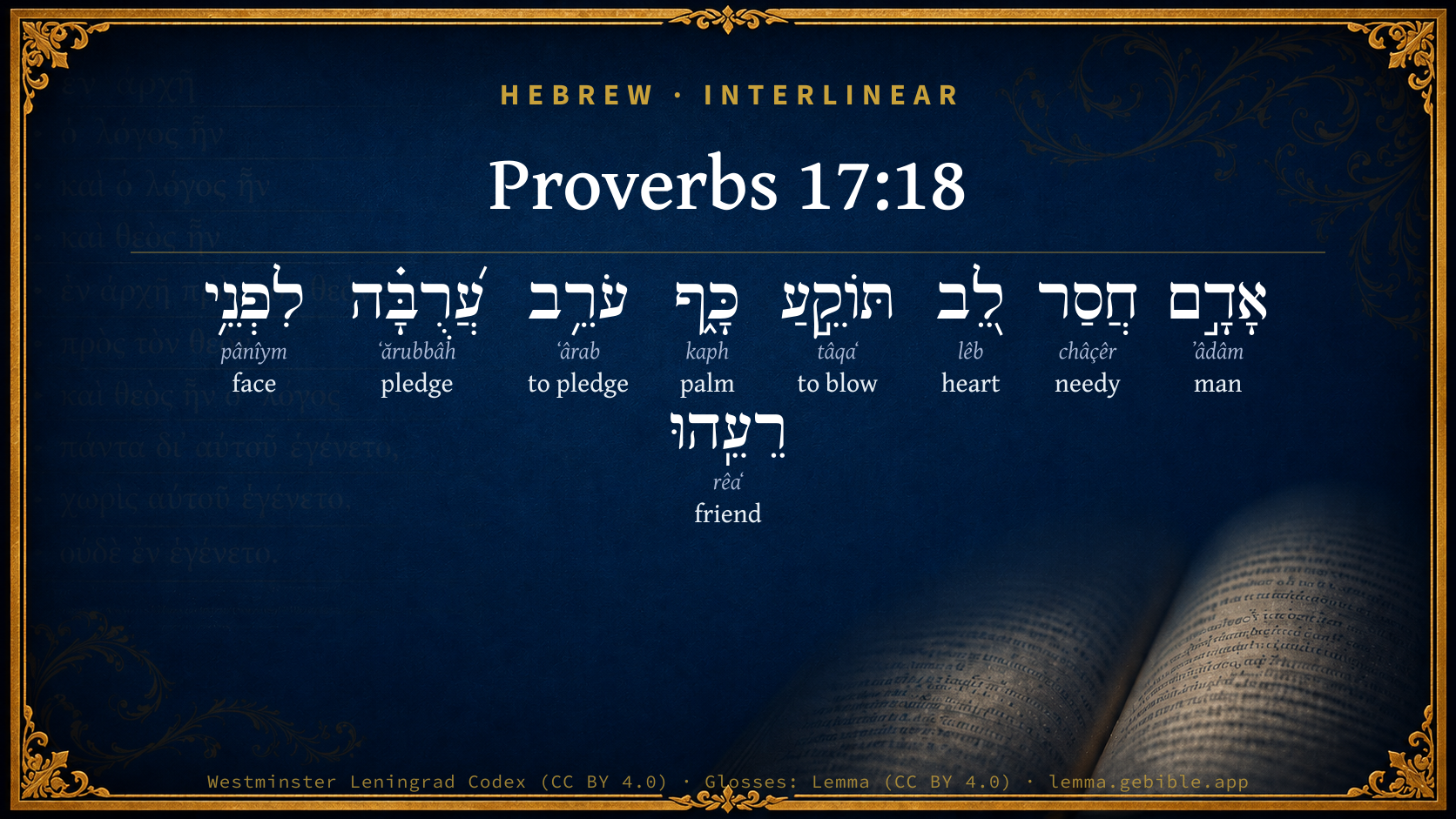
Hebrew (Westminster Leningrad Codex) Proverbs 17:18 appears in the Hebrew Old Testament. The text above is from the Westminster Leningrad Codex. Each word links to its Strong’s number, a concise gloss, and parsing drawn from the Open Scriptures Hebrew Bible morphology. Click any word for its full Brown-Driver-Briggs (BDB) entry.
Download image
Cite this verse

Proverbs 17:18 (World English Bible). Public Domain. Lemma interlinear Bible study tool, https://lemma.gebible.app/v/proverbs/17/18.

Show BibTeX & RIS
BibTeX
RIS
English Translation
A man void of understanding strikes hands, And becomes collateral in the presence of his neighbor.
World English Bible · Public Domain
Download a study sheet

One document with this verse’s original text, its word-by-word gloss line, the meaning frame, cross-references with their text, attributed commentary, and full source and license credits — printable, and it pastes into notes with its structure intact.

This verse Autodidact and up

Study sheet (.html) Plain text (.txt)

A passage Seminary Student

Up to 50 verses in one chapter. A passage sheet keeps up to 6 commentary sources and 12 cross-references per verse, in the order this page ranks them, and says so on the sheet whenever that leaves anything out. Ask for a single verse and you get the Autodidact verse sheet above.

Everything on this page stays free to read, with no account — the sheet is a download of what is already on screen, not access to it.

Want to remove ads? Support Godless Engineer
Compare translations 3

The same verse in 3 English versions, stacked beneath the original-language interlinear above. Click any original word for its lexicon entry.

Each is an independent rendering of the whole verse — the interlinear is not word-aligned to these translations.

Highlighted words mark where these versions differ — a whole-verse word diff, not a word-by-word alignment.

  • World English Bible Public Domain
    A man void of understanding strikes hands, And becomes collateral in the presence of his neighbor.
  • King James Version Public Domain
    A man void of understanding striketh hands, and becometh surety in the presence of his friend.
  • unfoldingWord Literal Text CC BY-SA 4.0
    A man lacking of heart one who clasps a palm, pledging a pledge to the face of his neighbor.

unfoldingWord Literal Text — © unfoldingWord, licensed CC BY-SA 4.0. Word-aligned USFM3 via Door43 (git.door43.org/unfoldingWord/en_ult).

Versions to compare (up to 4)

3 of 4 selected

Show all 18 translations

Every available English version of this verse, each an independent rendering of the whole verse.

  • World English Bible Public Domain
    A man void of understanding strikes hands, And becomes collateral in the presence of his neighbor.
  • Berean Standard Bible Public Domain
    A man lacking judgment strikes hands in pledge and puts up security for his neighbor.
  • Majority Standard Bible Public Domain
    A man lacking judgment strikes hands in pledge and puts up security for his neighbor.
  • King James Version Public Domain
    A man void of understanding striketh hands, and becometh surety in the presence of his friend.
  • American Standard Version (1901) Public Domain
    A man void of understanding striketh hands, And becometh surety in the presence of his neighbor.
  • Revised Version (1885) Public Domain
    A man void of understanding striketh hands, and becometh surety in the presence of his neighbour.
  • Geneva Bible (1599) Public Domain
    A man destitute of vnderstanding, toucheth the hande, and becommeth suretie for his neighbour.
  • Douay-Rheims (1899) Public Domain
    A foolish man will clap hands, when he is surety for his friend.
  • Young's Literal Translation Public Domain
    A man lacking heart is striking hands, A surety he becometh before his friend.
  • Literal Standard Version CC BY-SA 4.0
    A man lacking heart is striking hands, || He becomes a guarantor before his friend.
  • Unlocked Literal Bible CC BY-SA 4.0
    A man having no sense makes binding promises and becomes responsible for his neighbor's debts.
  • unfoldingWord Literal Text CC BY-SA 4.0
    A man lacking of heart one who clasps a palm, pledging a pledge to the face of his neighbor.
  • Darby Bible Public Domain
    A senseless man striketh hands, becoming surety for his neighbour.
  • World Messianic Bible Public Domain
    A man void of understanding strikes hands, and becomes collateral in the presence of his neighbor.
  • Webster's Bible Public Domain
    A man void of understanding striketh hands, and becometh surety in the presence of his friend.
  • Free Bible Version CC BY-SA 4.0
    It's not a wise idea to make a pledge and guarantee a neighbor's debt.
  • Bible in Basic English Public Domain
    A man without sense gives his hand in an agreement, and makes himself responsible before his neighbour.
  • JPS Tanakh (1917) Public Domain
    A man void of understanding is he that striketh hands, and becometh surety in the presence of his neighbour.

Literal Standard Version (2020), Covenant Press — licensed CC BY-SA 4.0. Text via the HelloAO Bible API (eBible.org). Unlocked Literal Bible (unfoldingWord) — licensed CC BY-SA 4.0. Text via the HelloAO Bible API (eBible.org). unfoldingWord Literal Text — © unfoldingWord, licensed CC BY-SA 4.0. Word-aligned USFM3 via Door43 (git.door43.org/unfoldingWord/en_ult). Free Bible Version, Dr. Jonathan Gallagher — licensed CC BY-SA 4.0. Text via the HelloAO Bible API (eBible.org).

Word by word

More ways to search: Search by grammar → Find every occurrence → Compare this word →

Practice this passage: Drill this verse → Learn its vocabulary →

About this verse

These counts appear in no published source. They are computed here, from the morphology-tagged text and Lemma’s own curated glosses. What Lemma adds →

9
words
9
distinct lemmas
Wisdom
section

Notable vocabulary

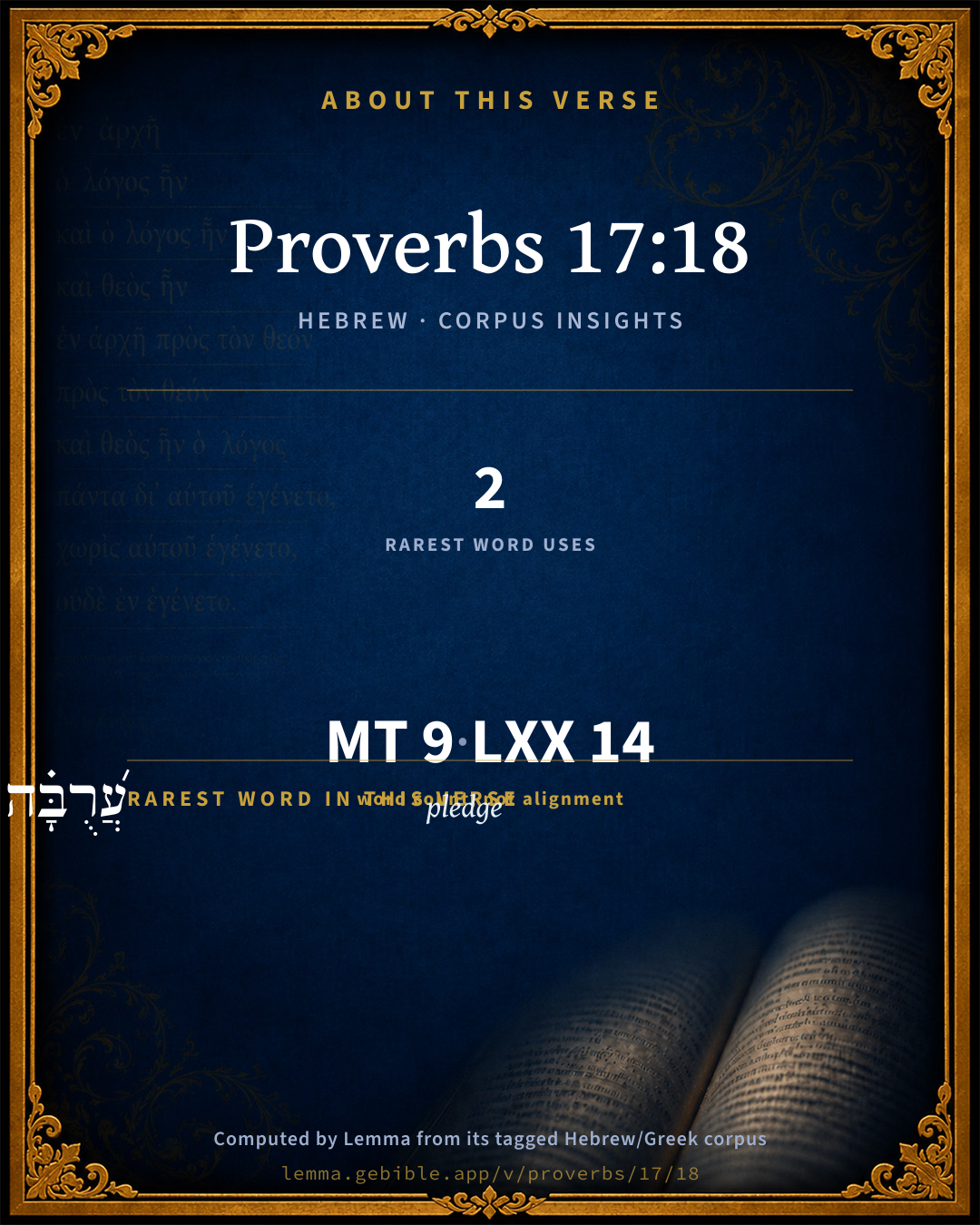
The rarest word here is עֲ֝רֻבָּ֗ה pledge H6161 — appearing just 2 times in the whole Hebrew Bible.

Shared distinctive vocabulary

עֲ֝רֻבָּ֗ה pledge H6161 occurs in 2 verses of the Hebrew Bible. Also found in:

Grammatical profile

  • 2 verbs
  • 6 nouns
  • 1 adjective

Verb forms

  • תּוֹקֵ֣עַ Qal · Participle Active
  • עֹרֵ֥ב Qal · Participle Active

Hebrew & Septuagint length

In English translation the verse runs 16 words from the Hebrew and 22 from the Septuagint (LXX English) — closely comparable.

A rough comparison of the two English renderings, which tokenize alike — not a word-level alignment.

Word counts can differ between the Hebrew and the Greek without any difference in meaning — e.g. the Hebrew direct-object marker אֵת has no separate Greek word, and Greek often adds the article ὁ.

In the original languages it is 9 Hebrew tokens and 14 Greek tokens — but the two are counted differently (Hebrew bundles its prefixes and suffixes into one token; the Greek is in lemma form), so that isn’t a like-for-like length.

Cross-references

5

Topical passages linked to Proverbs 17:18 in the Treasury of Scripture Knowledge — connected by theme and wording, ordered by reader-vote popularity; previews shown in the World English Bible.

  • Proverbs 11:15 He who is collateral for a stranger will suffer for it, But he who refuses pledges of collateral is secure.
  • Proverbs 6:1–5 My son, if you have become collateral for your neighbor, If you have struck your hands in pledge for a stranger;
  • Proverbs 22:26–27 Don't you be one of those who strike hands, Of those who are collateral for debts.
  • Proverbs 20:16 Take the garment of one who puts up collateral for a stranger; And hold him in pledge for a wayward woman.
  • Proverbs 22:16 Whoever oppresses the poor for his own increase and whoever gives to the rich, Both come to poverty.

Cross-references courtesy of OpenBible.info (CC BY 4.0).

Hebrew and Greek witnesses Masoretic Hebrew ↔ Greek Septuagint

The same verse in the two great witnesses to the Old Testament, shown verse-for-verse.

These are two independent witnesses, not word-aligned to each other, and the Septuagint is shown in lemma (dictionary) form.

Hebrew Proverbs 17:18 Masoretic · Westminster Leningrad Codex

אָדָ֣ם חֲסַר לֵ֭ב תּוֹקֵ֣עַ כָּ֑ף עֹרֵ֥ב עֲ֝רֻבָּ֗ה לִפְנֵ֥י רֵעֵֽהוּ

A man void of understanding strikes hands, And becomes collateral in the presence of his neighbor.

World English Bible · Public Domain

Greek LXX Proverbs 17:18 Septuagint · lemma form

ἀνήρ ἄφρων ἐπικροτέω καί ἐπιχαίρω ἑαυτοῦ ὡς καί ὁ ἐγγυάω ἐγγύη ὁ ἑαυτοῦ φίλος

A foolish man applauds and rejoices over himself, as he also that becomes surety would make himself responsible for his own friends.

LXX2012 (modern English Septuagint) · Public Domain

On this verse, The Pulpit Commentary discusses the Septuagint’s reading. Read the note in Commentary ↓

Hebrew: Westminster Leningrad Codex (CC BY 4.0). Greek: Septuagint (public domain); English from LXX2012 (modern English Septuagint) (Public Domain). How the Septuagint differs from the Hebrew →

Commentary

Notes on Proverbs 17:18 from classic Christian and Jewish commentators (each source and its license shown beneath its notes). The classic Christian expositions comment on the surrounding passage and are grouped to its opening verse, so a note may address several verses; the Jewish commentaries on the Tanakh (Rashi and others) are per-verse, so they appear only where the commentator wrote on this verse.

Lemma curates 59 commentaries, every one of them public domain or Creative Commons licensed, each selected and text-cleaned for this edition rather than reprinted as found. About our sources →

Trapp's Complete Commentary

John Trapp

Pro 17:18 A man void of understanding striketh hands, [and] becometh surety in the presence of his friend.

Ver. 18. A man void of understanding striketh hands.] Of the folly and misery of rash suretyship, see Pro 6:1-3 {See Trapp on "Pro 6:1"} {See Trapp on "Pro 6:2"} {See Trapp on "Pro 6:3"}

In the presence of his friend.] Or, Before his friend; that is, before his friend do it, who was better able, and more obliged. Thus like a woodcock he puts his neck into the gin, his foot into the stocks as the drunkard; and then hath time enough to come in with the fool’s "Had I wist," and to say, as the lion did when taken in the toil, Si praescivissem: If I had foreseen this. But why should there he among men any such Epimetheus, such a post master, an after wit?

John Trapp, A Commentary or Exposition upon All the Books of the Old and New Testament (1647–1656) — public domain. Text from a community e-Sword module.

Joseph Benson's Commentary

Pro 17:18. A man, &c., striketh hands — In token of his becoming surety; of which phrase, and the thing intended by it, see notes on Pro 6:1; Pro 11:15. This proverb is fitly placed after that in Pro 17:17, to intimate that although the laws of friendship oblige us to love and help our friends in trouble as far as we are able, yet they do not oblige us to become surety for them rashly, and above what we are able to pay, for by that means we should make ourselves unable to do good, either to them, or to others, or to ourselves.

Joseph Benson's Commentary on the Old and New Testaments (1811–1818) — public domain. Text from a community e-Sword module.

Tyndale Open Study Notes

Tyndale Open Resources

17:18 The essence of this message is repeated in 6:1-5; 11:15; 20:16; 22:26; 27:13.

Tyndale Open Study Notes — © Tyndale Open Resources, licensed CC BY-SA 4.0. Text via the HelloAO Bible API.

Geneva Bible (1599)

Geneva Bible translators

Read Prov. 6:1.

Geneva Bible (1599) marginal notes — public domain. Text via Bolls.life.

Matthew Henry's Commentary

Though Solomon had commended friendship in adversity (Pro 17:17), yet let not any, under pretence of being generous to their friends, be unjust to their families and wrong them; one part of our duty must be made to consist with another. Note, 1. It is a piece of wisdom to keep out of debt as much as may be, especially to dread suretiship. There may be a just occasion for a man to pass his word for his friend in his absence, till he come to engage himself; but to be surety in the presence of his friend, when he is upon the spot, supposes that his own word will not be taken, he being deemed insolvent or dishonest, and then who can with safety pass his word for him? 2. Those that are void of understanding are commonly taken in this snare, to the prejudice of their families, and therefore ought not to be trusted too far with their own affairs, but to be under direction.

Matthew Henry's Commentary on the Whole Bible (1708–1710) — public domain (CC PDM 1.0). Text via the HelloAO Bible API.

Jamieson, Fausset & Brown

Robert Jamieson, A. R. Fausset & David Brown

(Compare Pro 6:1-5; Pro 11:15).

in the presence, &c.--that is, he either fails to consult his friend, or to follow his advice.

Jamieson, Fausset & Brown — Commentary Critical and Explanatory on the Whole Bible (1871) — public domain (CC PDM 1.0). Text via the HelloAO Bible API.

Adam Clarke's Commentary

Verse 18. Striketh hands] Striking each other's hands, or shaking hands, was anciently the form in concluding a contract. See Clarke on Pr 6:1.

Adam Clarke's Commentary on the Bible (1810–1826) — public domain. Text from a community e-Sword/MySword module.

Ellicott's Commentary for English Readers

(18) In the presence of his friend.—Or, With his neighbour. (For the same warning, comp. Pro_6:1, sqq.)

A Bible Commentary for English Readers, edited by Charles John Ellicott (1878–1897) — public domain. Text from a community e-Sword module.

The Cambridge Bible for Schools and Colleges

gen. ed. J. J. S. Perowne

18. understanding] Lit. heart, as in Pro_17:16.

surety] See Pro_6:1 note.

The Cambridge Bible for Schools and Colleges (gen. ed. J. J. S. Perowne; Cambridge University Press, 1878–1918) — public domain. Text from a community e-Sword module.

John Gill's Exposition

A man void of understanding striketh hands,.... With his friend's creditor, and becomes surety for him; and thereby acts a very unwise part, and shows himself to want understanding, by taking such a step, which may prove the ruin of himself and family: for though a man may and should love his friend at all times; yet he is not obliged, under a notion of friendship, to injure himself and his family, or to run the risk of it; if he does, it is a plain case he wants wisdom and discretion, see Pro 6:1;

and becometh surety in the presence of his friend; not the creditor, but the debtor; and to pass his word for him, when he is present, shows that his own word will not be taken; and that he is either thought to be in bad circumstances, and incapable of payment at the proper time; or else that he is a bad man, of dishonest principles, and will not; and in either case it is not advisable to become surety for such a man: and besides, doing it in his presence may make him more careless and unconcerned about making good his payment or contract at the appointed time, when he knows his friend is engaged him.

John Gill's Exposition of the Whole Bible (1746–1763) — public domain (CC PDM 1.0). Text via the HelloAO Bible API.

Albert Barnes' Notes on the Bible

Compare the marginal reference. Since nothing is nobler than the self-sacrifice of the true friend Pro 17:17, so nothing is more contemptible than the weakness which allows itself to be sacrificed for the sake of worthless associates.

In the presence of his friend - i. e., “On behalf of” or “to his friend for some third person.”

Albert Barnes' Notes on the Bible (1834–1885) — public domain. Text from a community e-Sword/MySword module.

Haydock's Catholic Bible Commentary

Hands. Through joy, or as a mark of his consent.

George Leo Haydock (1774–1849), Haydock's Catholic Family Bible and Commentary, 1859 edition — public domain. Excludes Psalms (Douay-Rheims chapter numbering differs from Protestant) and Deuterocanonical books (Catholic canon only).

Matthew Poole's English Annotations

Striketh hands, in token of his becoming surety; of which phrase, and of the thing itself, see on Pro 6:1; 11:15. His friend: the friend here is either,

1. Before and to the creditor. Or rather,

2. Before, and with, and for the debtor, for whom, as being his friend, he becomes surety, as the manner of friends is. See on Pro 6:3. And this proverb is fitly placed after that, Pro 17:17, to intimate, that although the laws of friendship oblige us to love and help our friends in trouble as far as we are able, yet they do not oblige us to become surety for them rashly, and above what we are able to pay, for by that means we make ourselves unable to do good either to them, or to others, or to ourselves.

Matthew Poole's English Annotations on the Holy Bible (1683–1685) — public domain. Text from a community e-Sword/MySword module.

Whedon's Commentary on the Bible

Daniel D. Whedon

18. Striketh hands — Becomes surety. (See note on Pro_6:13; Pro_11:15)

In the presence of his friend — That is, in behalf of, or to, his friends for some third person. Thus the Speaker’s Commentary, which thinks the reappearance of this warning is suggested by the previous verse.

Daniel D. Whedon (gen. ed.), Commentary on the Old and New Testaments (1874–1909) — public domain. Text from a community e-Sword module.

The Pulpit Commentary

A man void of understanding (Hebrew, heart) striketh hands; clinches the bargain which makes him responsible. (see on suretyship, Pro_6:1, etc.; and note, Pro_20:16) Becometh surety in the presence of his friend; to his friend for some third party. What is here censured is the weakness which, for the sake of perhaps worthless companions, lets itself be hampered and endangered by others" obligations. For, as our adage runs, he that is surety for another is never sure himself. The Septuagint takes the "striking of hands" to be a sign of joy (Vulgate, plaudet manibus), "The foolish man claps (epikrotei ) and rejoices in himself, so also he who pledges himself for his friend."

The Pulpit Commentary (1880–1919), ed. H.D.M. Spence-Jones & Joseph S. Exell — public domain. Text from a community e-Sword module.

John Wesley's Explanatory Notes

Friend - Debtor, for whom being his friend, he becomes surety.

John Wesley, Explanatory Notes Upon the Whole Bible (1754–1765) — public domain. Text via the GEBible commentary corpus.

Bridges on Proverbs

Charles Bridges

10 A divine sentence (Diviniation, 18 A man void of understanding†a (heart, Marg.) striketh hands, and becometh surety in the presence of his friend.

Though we are to feel ourselves born for adversity, ever ready to "bear one another’s burdens" (Gal 6:2 ): yet we must not befriend our brother at the risk or expense of injustice to our family. We have therefore another warning against imprudent suretyship. (Pro 6:1-5 ; Pro 11:15 .) Beware of striking hands in agreement without ascertaining, whether we can fulfill our engagement, or whether our friend is not equally able to fulfill it himself. This shews a man void of understanding; specially to do this in the presence of his friend. For why is not his word taken, but from the suspicion of insolvency or dishonesty? A prodigal, thoughtless kindness may gain us a popular name. But the principle, closely examined, will be found to be another form of selfishness. There is no true benevolence in rash engagements, which may involve our name and family in disgrace or ruin. True indeed — had not those hands that were nailed to the cross, been stricken in suretyship, the handwriting that was against us could never have been canceled. (Col 2:14 .) Yet the eternal counsel is no pattern for our simple folly. Nor is infinite love combined with perfect wisdom, a plea for our rash generosity. Religion, though it warns its professors against imprudence, yet too often unjustly bears the blame of them. If we would adorn the Christian profession, and avoid occasions of stumbling to the ungodly, we must "provide for honest things, not only in the sight of the Lord, but also in the sight of man." (2Co 8:20-21 .)

Footnotes:

†a Pro 7:7 ; Pro 10:13 ; Pro 11:12 ; Pro 15:21 ; Pro 24:30 . ’It denotes the want of all the faculties of the soul, through ignorance, carelessness, and the prevalence of evil propensities of various kinds.’ Scott on Pro 11:12 .

Charles Bridges, An Exposition of the Book of Proverbs (1846) — public domain. Text from a community e-Sword module.

Kretzmann's Popular Commentary

Paul E. Kretzmann

v. 18. A man void of understanding, lacking in common sense, striketh hands, pledging himself and his goods foolishly, and becometh surety in the presence of his friend. cf Pro 6:1-5; Pro 11:15.

Paul E. Kretzmann, Popular Commentary of the Bible (1921–1924) — public domain. Text from a community e-Sword module.

Rashi

Rabbi Shlomo Yitzchaki (Rashi)

A person without sense clasps hands [This refers to] surety of money. Another explanation: He clasps with the wicked to go in their ways, while he is already a guarantor for his friend. He already accepted surety for the Holy One, blessed be He, to keep His commandments.

Rashi on the Tanakh — English translations: “The Judaica Press complete Tanach with Rashi, translated by A. J. Rosenberg” (CC BY 4.0); “Pentateuch with Rashi's commentary by M. Rosenbaum and A.M. Silbermann, 1929-1934” (public domain); “The Metsudah Tanach series, Lakewood, N.J” (CC BY 4.0); and “The Book of Joshua, Metsudah Publications, 1997” (CC BY 4.0). Text via Sefaria.

Lesson kit

Teaching starters — assembled from the data on this page, not authored interpretation. Every prompt links to the verse data it draws on. Edit before teaching.

Proverbs, in the Wisdom, opens this verse with 9 words (9 distinct Hebrew lemmas). Its most distinctive word is ʻărubbâh (“pledge”). A historical commentator’s framing appears above. Read the whole chapter for the surrounding context.

Discussion questions

  1. The word ʻărubbâh carries the sense “pledge.” How does it shape the verse?
  2. 1 Samuel 17:18 shares the word «pledge» with this verse. How do the two illuminate each other?
  3. The translations on this page render this verse differently — a whole-verse word diff, not a word-by-word alignment. What might account for the different wordings?
  4. The verb «תּוֹקֵ֣עַ» is Qal Participle Active. How does its form color the action?
  5. Reading how Trapp's Complete Commentary and Joseph Benson's Commentary read this verse, where do the two commentators agree and where do they part?

Things to notice

Reading settings

Reading text

Shown beneath each verse's original-language words.

Old Testament
Old Testament edition

Read the OT as the Masoretic Hebrew (MT) or the Greek Septuagint (LXX).

English shown for the Greek Septuagint (in the Hebrew ↔ Greek comparison).

Comparing translations? Open the Compare panel on any verse page to stack up to four side by side.