
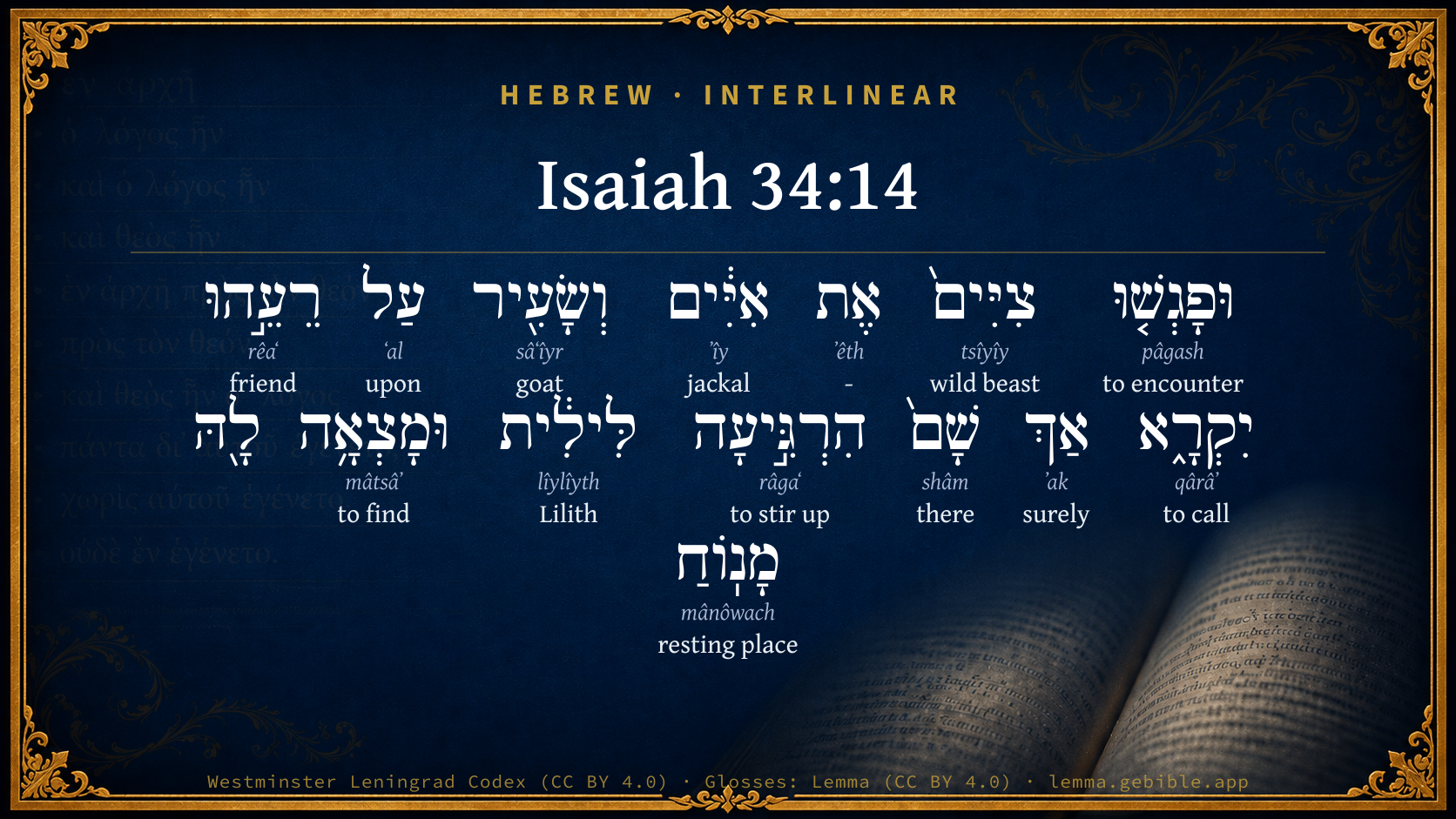
Isaiah 34:14

Hebrew (Westminster Leningrad Codex) Isaiah 34:14 appears in the Hebrew Old Testament. The text above is from the Westminster Leningrad Codex. Each word links to its Strong’s number, a concise gloss, and parsing drawn from the Open Scriptures Hebrew Bible morphology. Click any word for its full Brown-Driver-Briggs (BDB) entry.
Download image
Cite this verse

Isaiah 34:14 (World English Bible). Public Domain. Lemma interlinear Bible study tool, https://lemma.gebible.app/v/isaiah/34/14.

Show BibTeX & RIS
BibTeX
RIS
English Translation
The wild animals of the desert shall meet with the wolves, and the wild goat shall cry to his fellow; yes, the night-monster shall settle there, and shall find her a place of rest.
World English Bible · Public Domain
Highlights
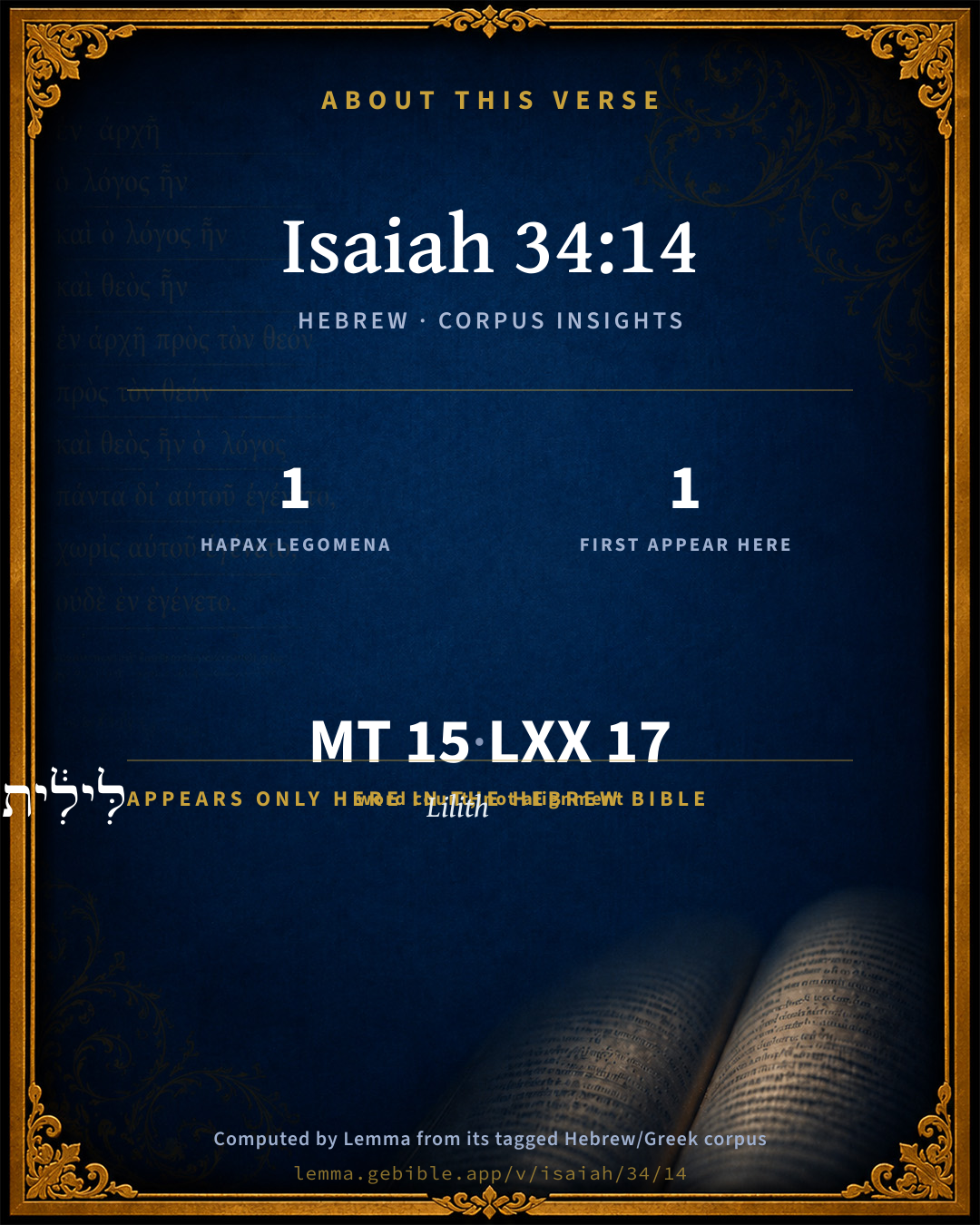
  • 1 hapax legomenon — only here in the Hebrew Bible
  • 1 first appearance in the Hebrew Bible
Full analysis ↓
Download a study sheet

One document with this verse’s original text, its word-by-word gloss line, the meaning frame, cross-references with their text, attributed commentary, and full source and license credits — printable, and it pastes into notes with its structure intact.

This verse Autodidact and up

Study sheet (.html) Plain text (.txt)

A passage Seminary Student

Up to 50 verses in one chapter. A passage sheet keeps up to 6 commentary sources and 12 cross-references per verse, in the order this page ranks them, and says so on the sheet whenever that leaves anything out. Ask for a single verse and you get the Autodidact verse sheet above.

Everything on this page stays free to read, with no account — the sheet is a download of what is already on screen, not access to it.

Want to remove ads? Support Godless Engineer
Compare translations 3

The same verse in 3 English versions, stacked beneath the original-language interlinear above. Click any original word for its lexicon entry.

Each is an independent rendering of the whole verse — the interlinear is not word-aligned to these translations.

Highlighted words mark where these versions differ — a whole-verse word diff, not a word-by-word alignment.

  • World English Bible Public Domain
    The wild animals of the desert shall meet with the wolves, and the wild goat shall cry to his fellow; yes, the night-monster shall settle there, and shall find her a place of rest.
  • King James Version Public Domain
    The wild beasts of the desert shall also meet with the wild beasts of the island, and the satyr shall cry to his fellow; the screech owl also shall rest there, and find for herself a place of rest.
  • unfoldingWord Literal Text CC BY-SA 4.0
    And desert creatures will meet hyenas, and the wild goat will call to his companion. Indeed, the night creature will settle there and find for itself a resting place.

unfoldingWord Literal Text — © unfoldingWord, licensed CC BY-SA 4.0. Word-aligned USFM3 via Door43 (git.door43.org/unfoldingWord/en_ult).

Versions to compare (up to 4)

3 of 4 selected

Show all 18 translations

Every available English version of this verse, each an independent rendering of the whole verse.

  • World English Bible Public Domain
    The wild animals of the desert shall meet with the wolves, and the wild goat shall cry to his fellow; yes, the night-monster shall settle there, and shall find her a place of rest.
  • Berean Standard Bible Public Domain
    The desert creatures will meet with hyenas, and one wild goat will call to another. There the night creature will settle and find her place of repose.
  • Majority Standard Bible Public Domain
    The desert creatures will meet with hyenas, and one wild goat will call to another. There the night creature will settle and find her place of repose.
  • King James Version Public Domain
    The wild beasts of the desert shall also meet with the wild beasts of the island, and the satyr shall cry to his fellow; the screech owl also shall rest there, and find for herself a place of rest.
  • American Standard Version (1901) Public Domain
    And the wild beasts of the desert shall meet with the wolves, and the wild goat shall cry to his fellow; yea, the night-monster shall settle there, and shall find her a place of rest.
  • Revised Version (1885) Public Domain
    And the wild beasts of the desert shall meet with the wolves, and the satyr shall cry to his fellow; yea, the night-monster shall settle there, and shall find her a place of rest.
  • Geneva Bible (1599) Public Domain
    There shall meete also Ziim and Iim, and the Satyre shall cry to his fellow, and the shricheowle shall rest there, and shall finde for her selfe a quiet dwelling.
  • Douay-Rheims (1899) Public Domain
    And demons and monsters shall meet, and the hairy ones shall cry out one to another, there hath the lamia lain down, and found rest for herself.
  • Young's Literal Translation Public Domain
    And met have Ziim with Aiim, And the goat for its companion calleth, Only there rested hath the night-owl, And hath found for herself a place of rest.
  • Literal Standard Version CC BY-SA 4.0
    And desert-dwellers have met with howlers, || And the goat calls for its companion, || Surely the night-owl has rested there, || And has found a place of rest for herself.
  • Unlocked Literal Bible CC BY-SA 4.0
    The wild animals and the hyenas will meet there, and the wild goats will cry to one another. Nocturnal animals will settle there and find for themselves a place of rest.
  • unfoldingWord Literal Text CC BY-SA 4.0
    And desert creatures will meet hyenas, and the wild goat will call to his companion. Indeed, the night creature will settle there and find for itself a resting place.
  • Darby Bible Public Domain
    And there shall the beasts of the desert meet with the jackals, and the wild goat shall cry to his fellow; the lilith also shall settle there, and find for herself a place of rest.
  • World Messianic Bible Public Domain
    The wild animals of the desert will meet with the wolves, and the wild goat will cry to his fellow. Yes, the night creature shall settle there, and shall find herself a place of rest.
  • Webster's Bible Public Domain
    The wild beasts of the desert shall also meet with the wild beasts of the isle, and the satyr shall cry to his fellow; the screech-owl also shall rest there, and find for herself a place of rest.
  • Free Bible Version CC BY-SA 4.0
    It will be a meeting place for desert animals and hyenas, and wild goats will call to each other there. Night animals will settle there and find a place to rest.
  • Bible in Basic English Public Domain
    And the beasts of the waste places will come together with the jackals, and the evil spirits will be crying to one another, even the night-spirit will come and make her resting-place there.
  • JPS Tanakh (1917) Public Domain
    And the wild-cats shall meet with the jackals, and the satyr shall cry to his fellow; yea, the night-monster shall repose there, and shall find her a place of rest.

Literal Standard Version (2020), Covenant Press — licensed CC BY-SA 4.0. Text via the HelloAO Bible API (eBible.org). Unlocked Literal Bible (unfoldingWord) — licensed CC BY-SA 4.0. Text via the HelloAO Bible API (eBible.org). unfoldingWord Literal Text — © unfoldingWord, licensed CC BY-SA 4.0. Word-aligned USFM3 via Door43 (git.door43.org/unfoldingWord/en_ult). Free Bible Version, Dr. Jonathan Gallagher — licensed CC BY-SA 4.0. Text via the HelloAO Bible API (eBible.org).

Word by word

More ways to search: Search by grammar → Find every occurrence → Compare this word →

Practice this passage: Drill this verse → Learn its vocabulary →

לִּילִ֔ית
lîylîyth
H3917
“Lilith”
Noun, Common, Feminine, Singular, Absolute
Part of Speech
Noun
Type
Common
Gender
Feminine
Number
Singular
State
Absolute
Full BDB Definition

Origin: from H3915

TWOT: 1112

" Lilith" , name of a female goddess known as a night demon who haunts the desolate places of Edom - might be a nocturnal animal that inhabits desolate places
  1. וּפָגְשׁ֤וּ pâgash H6298 “and · to encounter” Conjunction + Verb, Qal, Sequential Perfect, 3rd Person, Common, Plural
  2. צִיִּים֙ tsîyîy H6728 “wild beasts” Noun, Common, Masculine, Plural, Absolute
  3. אֶת ʼêth H853 “-” Particle, Direct Object
  4. אִיִּ֔ים ʼîy H338 “jackals” Noun, Common, Masculine, Plural, Absolute
  5. וְשָׂעִ֖יר sâʻîyr H8163 “and · goat” Conjunction + Noun, Common, Masculine, Singular, Absolute
  6. עַל ʻal H5921 “upon” Preposition
  7. רֵעֵ֣הוּ rêaʻ H7453 “friend · his” Noun, Common, Masculine, Singular, Construct + Suffix, Personal, 3rd Person, Masculine, Singular
  8. יִקְרָ֑א qârâʼ H7121 “to call” Verb, Qal, Imperfect, 3rd Person, Masculine, Singular
  9. אַךְ ʼak H389 “surely” Particle, Accusative
  10. שָׁם֙ shâm H8033 “there” Adverb
  11. הִרְגִּ֣יעָה râgaʻ H7280 “to stir up” Verb, Hiphil, Perfect, 3rd Person, Feminine, Singular
  12. וּמָצְאָ֥ה mâtsâʼ H4672 “and · to find” Conjunction + Verb, Qal, Sequential Perfect, 3rd Person, Feminine, Singular
  13. מָנֽוֹחַ mânôwach H4494 “resting place” Noun, Common, Both, Singular, Absolute

About this verse

These counts appear in no published source. They are computed here, from the morphology-tagged text and Lemma’s own curated glosses. What Lemma adds →

15
words
14
distinct lemmas
Prophets
section

Notable vocabulary

1 hapax legomenon — a word that appears only here in the entire Hebrew Bible:

  • לִּילִ֔ית Lilith H3917

First appearance in Scripture

This word makes its first canonical appearance in the Hebrew Bible here:

  • לִּילִ֔ית Lilith H3917

Shared distinctive vocabulary

אִיִּ֔ים jackal H338 occurs in 3 verses of the Hebrew Bible. Also found in:

Grammatical profile

  • 4 verbs
  • 6 nouns
  • 2 prepositions
  • 1 adverb
  • 2 particles

Verb forms

  • וּפָגְשׁ֤וּ Qal · Sequential Perfect
  • יִקְרָ֑א Qal · Imperfect
  • הִרְגִּ֣יעָה Hiphil · Perfect
  • וּמָצְאָ֥ה Qal · Sequential Perfect

Hebrew & Septuagint length

In English translation the verse runs 34 words from the Hebrew and 26 from the Septuagint (LXX English) — closely comparable.

A rough comparison of the two English renderings, which tokenize alike — not a word-level alignment.

Word counts can differ between the Hebrew and the Greek without any difference in meaning — e.g. the Hebrew direct-object marker אֵת has no separate Greek word, and Greek often adds the article ὁ.

In the original languages it is 15 Hebrew tokens and 17 Greek tokens — but the two are counted differently (Hebrew bundles its prefixes and suffixes into one token; the Greek is in lemma form), so that isn’t a like-for-like length.

Cross-references

1

Topical passages linked to Isaiah 34:14 in the Treasury of Scripture Knowledge — connected by theme and wording, ordered by reader-vote popularity; previews shown in the World English Bible.

  • Isaiah 13:21–22 But wild animals of the desert shall lie there; and their houses shall be full of doleful creatures; and ostriches shall dwell there, and wild goats shall dance there.

Cross-references courtesy of OpenBible.info (CC BY 4.0).

Hebrew and Greek witnesses Masoretic Hebrew ↔ Greek Septuagint

The same verse in the two great witnesses to the Old Testament, shown verse-for-verse.

These are two independent witnesses, not word-aligned to each other, and the Septuagint is shown in lemma (dictionary) form.

Hebrew Isaiah 34:14 Masoretic · Westminster Leningrad Codex

וּפָגְשׁ֤וּ צִיִּים֙ אֶת אִיִּ֔ים וְשָׂעִ֖יר עַל רֵעֵ֣הוּ יִקְרָ֑א אַךְ שָׁם֙ הִרְגִּ֣יעָה לִּילִ֔ית וּמָצְאָ֥ה לָ֖הּ מָנֽוֹחַ

The wild animals of the desert shall meet with the wolves, and the wild goat shall cry to his fellow; yes, the night-monster shall settle there, and shall find her a place of rest.

World English Bible · Public Domain

Greek LXX Isaiah 34:14 Septuagint · lemma form

καί συνἀντάω δαιμόνιον ὀνοκένταυρος καί βοάω ἕτερος πρός ὁ ἕτερος ἐκεῖ ἀναπαύω ὀνοκένταυρος εὑρίσκω γάρ ἑαυτοῦ ἀνάπαυσις

And devils shall meet with satyrs, and they shall cry one to the other: there shall satyrs rest, having found for themselves a place of rest.

LXX2012 (modern English Septuagint) · Public Domain

On this verse, Albert Barnes' Notes on the Bible discusses the Septuagint’s reading. Read the note in Commentary ↓

Hebrew: Westminster Leningrad Codex (CC BY 4.0). Greek: Septuagint (public domain); English from LXX2012 (modern English Septuagint) (Public Domain). How the Septuagint differs from the Hebrew →

Targum (Aramaic paraphrase)

1

The Targum is the ancient Jewish Aramaic paraphrase of the Hebrew Scriptures — an interpretive translation, not the Hebrew text itself. Onkelos (literal) and Pseudo-Jonathan (expansive) render the Torah, and Jonathan the Prophets. Coverage is partial: where no permissively-licensed English translation exists for a verse, only the Aramaic is shown. This is verse-level text, not a word-by-word alignment to the Hebrew.

  1. Targum Jonathan Prophets (Joshua–Malachi)
    וִיעַרְעָן תַּמְוָן בַּחְתוּלִין וְשֵׁידִין חַד עִם חַבְרֵהּ יְחַיְכוּן בְּרַם תַּמָן יִשְׁרְיָן לִילִין וְיִשְׁכְּחָן לְהֶן נְיָה:

    And there shall meet one another, martens and wild cats, and demons, each shall sport with its companion: verily dryads shall dwell there, and they shall find rest for themselves.

    Targum Jonathan — Aramaic: “Mikraot Gedolot” (public domain). English: “Sefaria Community Translation” (CC0 1.0 (public-domain dedication)); “London "Chaldee Paraphrase," 1871” (public domain). Text via Sefaria.

Commentary

Notes on Isaiah 34:14 from classic Christian and Jewish commentators (each source and its license shown beneath its notes). The classic Christian expositions comment on the surrounding passage and are grouped to its opening verse, so a note may address several verses; the Jewish commentaries on the Tanakh (Rashi and others) are per-verse, so they appear only where the commentator wrote on this verse.

Lemma curates 59 commentaries, every one of them public domain or Creative Commons licensed, each selected and text-cleaned for this edition rather than reprinted as found. About our sources →

Trapp's Complete Commentary

John Trapp

Isa 34:14 The wild beasts of the desert shall also meet with the wild beasts of the island, and the satyr shall cry to his fellow; the screech owl also shall rest there, and find for herself a place of rest.

Ver. 14. The wild beasts of the desert.] Heb., Ziim et jiim. See Isa 13:21-22, where these monstrous creatures are said to dance: whence Basil noteth, that men learned of devils to dance, and another {a} saith that a dance is a circle, the centre whereof is the devil, the circumference all his angels.

And the satyr shall cry to his fellow.] Heb., The rough or hairy one. Chald., Daemones inter se colludent, the devils shall play among themselves; Satan is a rough harsh spirit; so are his. See Lev 17:7.

{a} Conr. Clingius.

John Trapp, A Commentary or Exposition upon All the Books of the Old and New Testament (1647–1656) — public domain. Text from a community e-Sword module.

Geneva Bible (1599)

Geneva Bible translators

Read Isa. 13:21.

Geneva Bible (1599) marginal notes — public domain. Text via Bolls.life.

Jamieson, Fausset & Brown

Robert Jamieson, A. R. Fausset & David Brown

wild beasts of the desert . . . island--rather, "wild cats . . . jackals" (Isa 13:21).

screech owl--rather, "the night specter"; in Jewish superstition a female, elegantly dressed, that carried off children by night. The text does not assert the existence of such objects of superstition, but describes the place as one which superstition would people with such beings.

Jamieson, Fausset & Brown — Commentary Critical and Explanatory on the Whole Bible (1871) — public domain (CC PDM 1.0). Text via the HelloAO Bible API.

Adam Clarke's Commentary

Verse 14. The wild beasts of the desert] ציים tsiyim, the mountain cats. - Bochart.

Wild beasts of the island] איים aiyim, the jackals.

The satyr] שעיר seir, the hairy one, probably the he-goat.

The screech owl] לילית lilith, the night-bird, the night-raven, nyctycorax, from ליל layil, or לילה lailah, the night.

Adam Clarke's Commentary on the Bible (1810–1826) — public domain. Text from a community e-Sword/MySword module.

Ellicott's Commentary for English Readers

(14) The wild beasts of the desert . . .—Better, wild cats or hyenas shall meet wolves. The nouns that follow belong, apparently, to the region of mythical zoology. The English “satyr” expresses fairly enough the idea of a “demon-brute” haunting the waste places of the palaces of Edom, while the “screech-owl” is the Lilith, the she-vampire, who appears in the legends of the Talmud as having been Adam’s first wife, who left him and was turned into a demon. With the later Jews, Lilith, as sucking the blood of children, was the bugbear of the nursery. Night-vampire would, perhaps, be the best rendering.

A Bible Commentary for English Readers, edited by Charles John Ellicott (1878–1897) — public domain. Text from a community e-Sword module.

The Cambridge Bible for Schools and Colleges

gen. ed. J. J. S. Perowne

14. wild beasts the desert … wild beasts of the island … satyr] See on ch. Isa_13:21 f.

the shrich owl] The Hebr. is Lîlîth, a fem. formation from Iáil “night.” Render with Cheyne: the night-hag. Lilith appears to be a creation of the Babylonian demonology. “This Lilith plays a great part in the Talmudic demonology; the cabalistic Rabbis forged a whole legend in which this spirit is said to have taken a feminine form to deceive Adam, and to have united herself to him.” (Lenormant, Chaldæan Magic, Engl. Tr. p. 38.) She is mentioned in the Bible only here.

find for herself a place of rest] On the restlessness of evil spirits, cf. Mat_12:43, “walketh through dry places, seeking rest.”

The Cambridge Bible for Schools and Colleges (gen. ed. J. J. S. Perowne; Cambridge University Press, 1878–1918) — public domain. Text from a community e-Sword module.

John Gill's Exposition

The wild beasts of the desert shall also meet with the wild beasts of the islands,.... In Rome, and take up their abode there; of these creatures, the first of which the Targum renders monstrous ones, and the latter wild cats; see Gill on Isa 13:22,

and the satyr shall cry to his fellow; or the "hairy" one (r); from which word the goat has its name; and these creatures are described by the ancients as half goats and half men; of which See Gill on Isa 13:21. The Targum renders it demons; and with this well agrees the account of Babylon or Rome as fallen, that it shall be the habitation of, devils, and the hold of every foul spirit, Rev 18:2,

the screech owl also shall rest there, and find for herself a place of rest; there being no inhabitants to disturb her. By the name "Lilith", it appears to be a night bird, which flies and is heard in the night. The Jews call a she demon by this name, which, they say (s), has a human face, and has wings, and destroys children as soon as born; and therefore the Jews, especially in Germany, write upon the four corners of the bed of a new mother, Adam, Eve, out Lilith (t); the same with the Lamia of the Romans; and so the Vulgate Latin here renders it.

(r) "pilosus", a "capillus." (s) T. Bab. Nidda, fol. 24. 2. (t) Vid. Buxtorf. Lex. Rab. col. 1140.

John Gill's Exposition of the Whole Bible (1746–1763) — public domain (CC PDM 1.0). Text via the HelloAO Bible API.

Albert Barnes' Notes on the Bible

The wild beasts of the desert - There is in the original here a paronomasia, which cannot be conveyed in a translation. The word rendered, ‘wild beasts of the desert’ (ציים tsı̂yı̂ym), is rendered by the Septuagint, δαιμόνια daimonia, ‘demons.’ On the meaning of the word, see the note at Isa 13:21.

The wild beasts of the island - Margin, ‘Ijim.’ Hebrew, איּים 'ı̂yym (see the note at Isa 13:22). Probably the term denotes the jackal. Gesenius supposes it is so called from its howl, or nocturnal cry - from an Arabia word signifying to howl.

And the satyr - (see the note at Isa 13:21).

Shall cry to his fellow - A most striking description of the desolation, when all that is heard among the ruins shall be the doleful cry of wild beasts.

The screech-owl - Margin, ‘Night-monster.’ The word לילית lı̂ylı̂yt (from ליל layil, night) properly denotes a night-spectre - a creature of Jewish superstition. The rabbis describe it in the form of a female elegantly dressed that lay in wait for children at night - either to carry them off, or to murder them. The Greeks had a similar idea respecting the female ἔμπουτα empouta, and this idea corresponds to the Roman fables respecting the Lamice, and Striges, and to the Arabic notions of the Ghules, whom they described as female monsters that dwell in deserts, and tear men to pieces (see Gesenius, Com. in loc; and Bochart, Hieroz. ii. 831). The margin in our version expresses the correct idea. All this is descriptive of utter and perpetual desolation - of a land that should be full of old ruins, and inhabited by the animals that usually make such ruins their abode.

Albert Barnes' Notes on the Bible (1834–1885) — public domain. Text from a community e-Sword/MySword module.

Haydock's Catholic Bible Commentary

Monsters. Literally, "Ass-centaurs." (Haydock) --- Hebrew, "fishermen shall find islands," chap. xiii. 21. --- Ones. Goats. --- Lamia. Hebrew lilith. Chaldean, "owl," the bird of Minerva, or the Moon, which the Arabs style Alilat. (Calmet) --- Dicodorus (20) relates that Lamia was an African queen, who having last her children, was changed into a beast, and destroyed all the children she could catch; and the Jews deal still more in fables, (Calmet0 asserting that Lilith was the first wife of Adam, &c. (Buxtorf. Syn. 2.)

George Leo Haydock (1774–1849), Haydock's Catholic Family Bible and Commentary, 1859 edition — public domain. Excludes Psalms (Douay-Rheims chapter numbering differs from Protestant) and Deuterocanonical books (Catholic canon only).

Matthew Poole's English Annotations

The satyr shall cry to his fellow: See Poole "Isa 13:21". See Poole "Isa 13:22".

The screech owl also shall rest there, because there shall be no men left to disturb or affright them, Isa 17:2.

Matthew Poole's English Annotations on the Holy Bible (1683–1685) — public domain. Text from a community e-Sword/MySword module.

Whedon's Commentary on the Bible

Daniel D. Whedon

14. The desert animals, (ziim,) hyenas, for example, (TRISTRAM’S Natural History,) there come in contact with the howlers, (ijim,) jackals, called an island creature from its dwelling near the coast, and all inhabited, fertile spots.

The satyr — Shaggy, fabulous animals, supposed to inhabit desert thickets, and hence called wood devils — objected to by Alexander only because fabulous, but without reason here, for Isaiah employs the term poetically, basing his use of it upon Lev_17:7, “And they shall no more offer their sacrifices unto devils,” as the Hebrews had been accustomed to while resident in Egypt. It is the same word in the original, שׂעירים, (s’irim,) rendered here “satyr,” and, in Lev_17:7, “devils.” The word means the hairy ones, shaggy animals. The goat was an object of worship in Egypt, according to Herodotus (ii, 46,) and from the shaggy, rough he-goat, sprang those ideal beings supposed to bear a resemblance to the goat, such as figured in the mythology of Greece at an early period, (when the Egyptian and Grecian religions began to mix,) under the names Pan, Satyr, Selene, etc. Real they doubtless were to the ignorant Israelites when in bondage, but ideal, hateful, and forbidding, both to Moses and Isaiah. No doubt Isaiah gave not the least countenance to them as facts in nature, but poetically used the word to express what was ideally horrible to every mind he addressed. The same is to be said of the screech owl, or some nightly sounding creature, though many expositors, and Delitzsch among them, favour the meaning of nocturnal spectres. The superstitions brought from Egypt lingered with the people of Israel till Monotheism in a large measure expelled them from the popular mind. Nevertheless, later in Jewish history, a crop of legends sprung out of them, and were easily moulded into those of Persian origin; and to this day, with the Arabs, the idea is persistent of still existing devils or ghuls and spectres in the desert. The mirages, the exciting air, and the monotony of desert landscapes generally, are very favourable to the persistence of such superstitions. See SPRINGER’S Leben und Lehre des Mohammed.

Daniel D. Whedon (gen. ed.), Commentary on the Old and New Testaments (1874–1909) — public domain. Text from a community e-Sword module.

The Pulpit Commentary

Wild beasts of the desert... wild beasts of the island. In the original, tsiyim and iyim and "howlers probably jackals and wolves, or wolves and hyenas." The satyr. (see the comment on Isa_13:21) The screech owl The word here used, lilith, occurs only in this place. It may be doubted whether any bird, or other animal, is meant. Lilit was the name of a female demon, or wicked fairy, in whom the Assyrians believed a being thought to vex and persecute her victims in their sleep. The word is probably a derivative from leilah, night, and designates" the spirit of the night a mischievous being, who took advantage of the darkness to play fantastic tricks. A Jewish legend made Lilith the first wife of Adam, and said that, having pronounced the Divine Name as a charm, she was changed into a devil. It was her special delight to murder young children (Buxtorf, "Lex. Rabbin.," ad roe.). The prophets, when they employ poetic imagery, are not tied down to fact, but are free to use the beliefs of their contemporaries in order to heighten the force of their descriptions.

The Pulpit Commentary (1880–1919), ed. H.D.M. Spence-Jones & Joseph S. Exell — public domain. Text from a community e-Sword module.

J. A. Alexander on Isaiah

Joseph Addison Alexander

“And wild (or desert) creatures shall (there) meet with howling creatures.” The verb sometimes means to meet or encounter in the sense of attacking (Exo 4:24; Hos 13:8) but here it seems to have the general sense of falling in with. These lonely creatures, as they traverse Idumea, shall encounter none but creatures like themselves “And the shaggy monster shall call to his fellow.” For the true sense of satyrs, see the comment on the plural form as it occurs in Isa 13:21. The interpretation most consistent with itself and with the etymology is that given above, ‘shaggy monsters’, on the ground that it corresponds better with the general descriptive meaning which, as we have seen above, most probably belongs to the words in the preceding clause. If that clause speaks of wild and howling beasts, and not of any one class exclusively, it is more natural that this should speak of shaggy monsters generally than of goats. “Only there reposes the night-monster and finds for herself a resting-place.” If the terms used above represent the animals occupying Idumea, first as belonging to the wilderness, then as distinguished by their fierce or melancholy cries, and then as shaggy in appearance, nothing can be more natural than that the fourth epithet should also be expressive of their habits as a class, and no such epithet could well be more appropriate than that of nocturnal or belonging to the night.

Joseph Addison Alexander, The Prophecies of Isaiah (1846–1847; New York: Scribner, 1870–1878) — public domain. Text from a community e-Sword module.

Rashi

Rabbi Shlomo Yitzchaki (Rashi)

And martens shall meet cats And martens shall meet with cats. In this matter Jonathan rendered it. תַּמְוָן is נִמִּיּוֹת (martrines in O.F.), martens.

and a satyr A demon.

rests (הִרְגִּיעָה) an expression related to מַרְגּוֹעַ, rest.

lilith The name of a female demon.

Rashi on the Tanakh — English translations: “The Judaica Press complete Tanach with Rashi, translated by A. J. Rosenberg” (CC BY 4.0); “Pentateuch with Rashi's commentary by M. Rosenbaum and A.M. Silbermann, 1929-1934” (public domain); “The Metsudah Tanach series, Lakewood, N.J” (CC BY 4.0); and “The Book of Joshua, Metsudah Publications, 1997” (CC BY 4.0). Text via Sefaria.

Ibn Ezra

Rabbi Abraham ibn Ezra

ציים The wild beasts of the desert.

איים Kites. It is the plural of אַיָה (Lev. 11:14), although it has the masculine termination.ים.

שעירים An animal, similar to the wild goat.

הרגיעה Shall rest.

לילית The screech owl. A bird that flies abroad by night.

Ibn Ezra on the Tanakh — English translations: “Sefaria Community Translation” (CC0 1.0 (public-domain dedication)); “Yalkut, Sifsei Chachomim Chumash, Metsudah Publications, 2009” (CC BY 4.0); and “Commentary of Ibn Ezra on Isaiah - trans. by M. Friedlander, 1873” (public domain). Text via Sefaria.

Lesson kit

Teaching starters — assembled from the data on this page, not authored interpretation. Every prompt links to the verse data it draws on. Edit before teaching.

Isaiah, in the Prophets, opens this verse with 15 words (14 distinct Hebrew lemmas). Its most distinctive word is lîylîyth (“Lilith”). A historical commentator’s framing appears above. Read the whole chapter for the surrounding context.

Discussion questions

  1. How does “Lilith” (lîylîyth) shape what this verse is saying?
  2. 1 word here appears nowhere else in the Hebrew Bible. Why might the author reach for such rare wording?
  3. This is the first place “Lilith” appears in Scripture (first appears here). What does its debut here establish?
  4. How does Isaiah 13:22, which shares the word «jackal», read alongside this verse?
  5. These translations render this verse differently. What is at stake in choosing one wording over another?
  6. «וּפָגְשׁ֤וּ» is a Qal Sequential Perfect verb. How does that grammatical form shape the action described?
  7. Compare how Trapp's Complete Commentary and Geneva Bible (1599) read this verse. Where do they agree or differ?

Things to notice

Reading settings

Reading text

Shown beneath each verse's original-language words.

Old Testament
Old Testament edition

Read the OT as the Masoretic Hebrew (MT) or the Greek Septuagint (LXX).

English shown for the Greek Septuagint (in the Hebrew ↔ Greek comparison).

Comparing translations? Open the Compare panel on any verse page to stack up to four side by side.