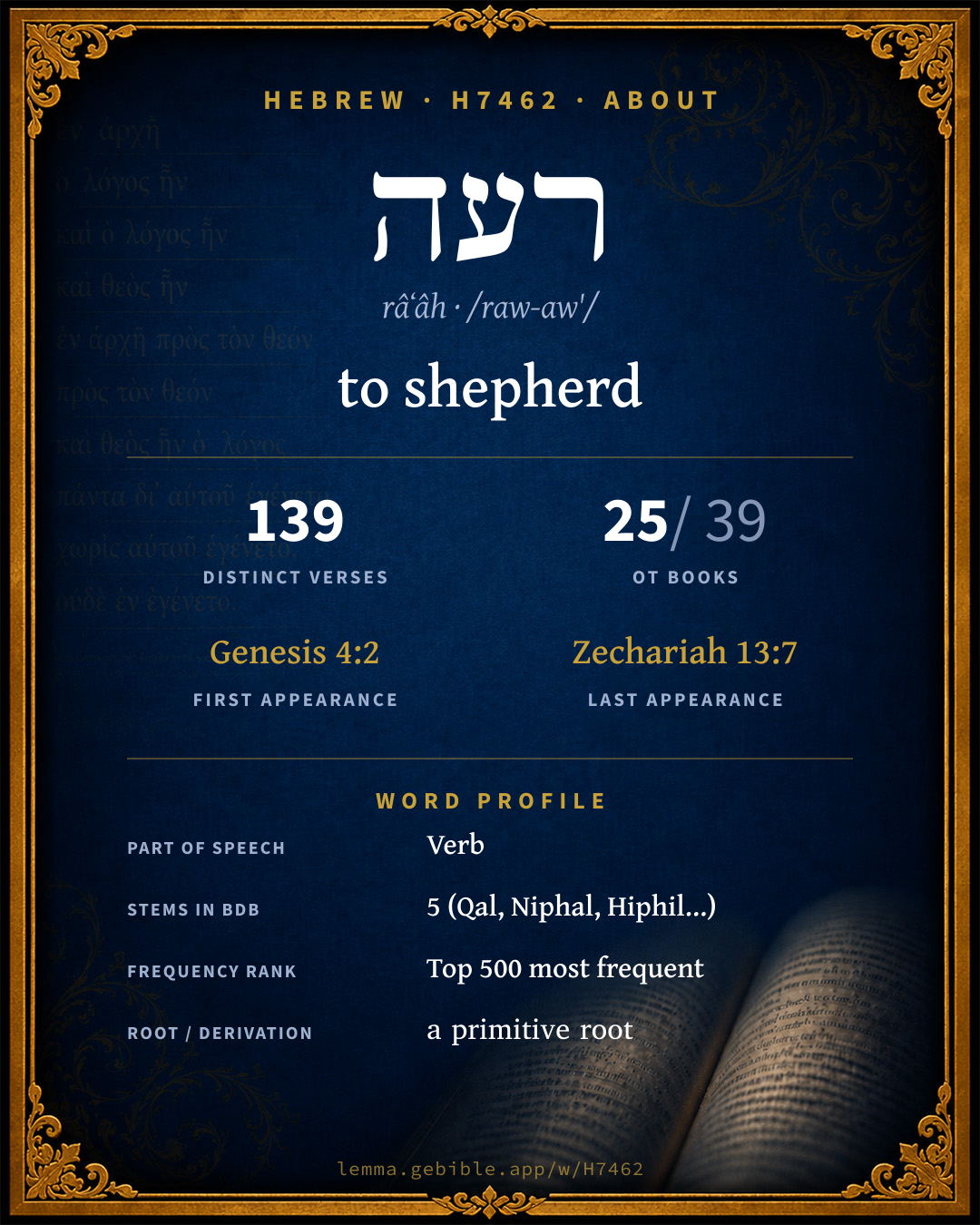
רָעָה
to shepherd
‘to shepherd’ is one of 3 main senses fuller range ↓
Full lexicon entry — Brown-Driver-Briggs (BDB)
From Brown-Driver-Briggs (BDB)
Where this word appears
See every Qal verb in the Hebrew Bible →
Grammar key — what these labels mean
Part of speech
- Verb
- An action or state-of-being word.
- Noun
- A naming word — a person, place, thing, or idea.
Noun type
- Proper
- A name of a specific person, place, or people (e.g. Abraham, Zion, Israel).
Stem
- Qal
- The basic, simple active stem — the plain form of the verb (“he wrote”). Here: ‘trans.’
- Piel
- An intensive or resultative active stem. Here: ‘be a special friend’
- Hithpael
- The reflexive or reciprocal stem (the subject acts on itself).
Form
- Participle Active
- A verbal adjective expressing ongoing or characteristic action (“writing / one who writes”).
- Infinitive Construct
- A bound verbal noun, frequently with prepositions (“to write / in writing”).
- Imperfect
- An incomplete, ongoing, or future action (“he will / would write”).
- Sequential Perfect
- A perfect with prefixed waw continuing a preceding imperfect or command (waw-consecutive perfect).
- Sequential Imperfect
- An imperfect with prefixed waw — the standard past-narrative form (waw-consecutive imperfect).
- Jussive
- A third- or second-person volitional form expressing wish or command (“let him write”).
- Perfect
- A completed action or state — Hebrew marks aspect (completeness) more than strict tense (“he wrote”).
- Imperative
- A direct command (“write!”).
State
- Absolute
- The independent form of a noun, not bound to a following word.
- Construct
- A noun bound to a following noun in a possessive / “of” relationship (the construct chain).
Person
- 3rd Person
- The one spoken about (“he / she / it / they”).
- 1st Person
- The speaker (“I / we”).
- 2nd Person
- The one addressed (“you”).
Gender
- Masculine
- Grammatically masculine.
- Common
- Either gender — not distinguished for this form.
- Feminine
- Grammatically feminine.
Number
- Plural
- More than one (in Hebrew, generally three or more).
- Singular
- One.
Grammatical forms 29 distinct
- Verb, Qal, Participle Active, Masculine, Plural, Absolute 41 times (25%)
- Verb, Qal, Participle Active, Masculine, Singular, Absolute 37 times (23%)
- Verb, Qal, Imperfect, 3rd Person, Masculine, Plural 9 times (5%)
- Verb, Qal, Imperfect, 3rd Person, Masculine, Singular 9 times (5%)
- Verb, Qal, Participle Active, Masculine, Plural, Construct 9 times (5%)
- Verb, Qal, Infinitive Construct 8 times (5%)
- Verb, Qal, Sequential Perfect, 3rd Person, Common, Plural 6 times (4%)
- Verb, Qal, Imperfect, 1st Person, Common, Singular 5 times (3%)
+21 more forms (40 occurrences)
Parsed forms decoded from the imported morphology (morphhb / Westminster Leningrad Codex — WLC text public domain, morphhb tagging CC BY 4.0), counted across 164 parsed occurrences — not distinct verses.
Every verse where H7462 appears — 139 distinct verses across 25 books. Click any verse to open its interlinear word-by-word view. Verse text shown in the World English Bible for context — . Each verse’s Hebrew form is shown with its reference; the English is not keyword-highlighted, since the data carries no word-level English alignment. Use “Compare translations” on any verse to read it across multiple English versions. This concordance covers the Hebrew Bible; Septuagint (Greek Old Testament) occurrences are not indexed here.
Genesis 17 verses
- Genesis 4:2 רֹ֣עֵה Qal ptcp.act ms cs Again she gave birth, to Cain's brother Abel. Abel was a keeper of sheep, but Cain was a tiller of the ground.
- Genesis 29:7 רְעֽוּ Qal impv 2mp He said, "Behold, it is still the middle of the day, not time to gather the cattle together. Water the sheep, and go and feed them."
- Genesis 29:9 רֹעָ֖ה Qal ptcp.act fs While he was yet speaking with them, Rachel came with her father's sheep, for she kept them.
- Genesis 30:31 אֶרְעֶ֥ה Qal impf 1cs He said, "What shall I give you?" Jacob said, "You shall not give me anything. If you will do this thing for me, I will again feed your flock and keep it.
- Genesis 30:36 רֹעֶ֛ה Qal ptcp.act ms He set three days' journey between himself and Jacob, and Jacob fed the rest of Laban's flocks.
- Genesis 36:24 בִּ/רְעֹת֥/וֹ prep + Qal inf.cs + sfx pers 3ms These are the children of Zibeon: Aiah and Anah. This is Anah who found the hot springs in the wilderness, as he fed the donkeys of Zibeon his father.
- Genesis 37:2 רֹעֶ֤ה Qal ptcp.act ms This is the history of the generations of Jacob. Joseph, being seventeen years old, was feeding the flock with his brothers. He was a boy with the sons of Bilhah and Zilpah, his father's wives. Joseph brought an evil report of them to their father.
- Genesis 37:12 לִ/רְע֛וֹת prep + Qal inf.cs His brothers went to feed their father's flock in Shechem.
- Genesis 37:13 רֹעִ֣ים Qal ptcp.act mp Israel said to Joseph, "Aren't your brothers feeding the flock in Shechem? Come, and I will send you to them." He said to him, "Here I am."
- Genesis 37:16 רֹעִֽים Qal ptcp.act mp He said, "I am looking for my brothers. Tell me, please, where they are feeding the flock."
- Genesis 41:2 וַ/תִּרְעֶ֖ינָה conj + Qal wimpf 3fp Behold, there came up out of the river seven cattle, well-favored and fat-fleshed, and they fed in the reed-grass.
- Genesis 41:18 וַ/תִּרְעֶ֖ינָה conj + Qal wimpf 3fp and, behold, there came up out of the river seven cattle, fat-fleshed and well-favored. They fed in the reed-grass,
- Genesis 46:32 רֹ֣עֵי Qal ptcp.act mp cs These men are shepherds, for they have been keepers of cattle, and they have brought their flocks, and their herds, and all that they have.'
- Genesis 46:34 רֹ֥עֵה Qal ptcp.act ms cs that you shall say, 'Your servants have been keepers of cattle from our youth even until now, both we, and our fathers:' that you may dwell in the land of Goshen; for every shepherd is an abomination to the Egyptians."
- Genesis 47:3 רֹעֵ֥ה Qal ptcp.act ms cs Pharaoh said to his brothers, "What is your occupation?" They said to Pharaoh, "Your servants are shepherds, both we, and our fathers."
- Genesis 48:15 הָ/רֹעֶ֣ה ptcl def.art + Qal ptcp.act ms He blessed Joseph, and said, "The God before whom my fathers Abraham and Isaac did walk, the God who has fed me all my life long to this day,
- Genesis 49:24 רֹעֶ֖ה Qal ptcp.act ms But his bow abode in strength, The arms of his hands were made strong, By the hands of the Mighty One of Jacob, (From there is the shepherd, the stone of Israel),
Exodus 4 verses
- Exodus 2:17 הָ/רֹעִ֖ים ptcl def.art + Qal ptcp.act mp The shepherds came and drove them away; but Moses stood up and helped them, and watered their flock.
- Exodus 2:19 הָ/רֹעִ֑ים ptcl def.art + Qal ptcp.act mp They said, "An Egyptian delivered us out of the hand of the shepherds, and moreover he drew water for us, and watered the flock."
- Exodus 3:1 רֹעֶ֛ה Qal ptcp.act ms Now Moses was keeping the flock of Jethro, his father-in-law, the priest of Midian, and he led the flock to the back of the wilderness, and came to God's mountain, to Horeb.
- Exodus 34:3 יִרְע֔וּ Qal juss 3mp No one shall come up with you; neither let anyone be seen throughout all the mountain; neither let the flocks nor herds feed before that mountain."
Numbers 2 verses
- Numbers 14:33 רֹעִ֤ים Qal ptcp.act mp Your children shall be wanderers in the wilderness forty years, and shall bear your prostitution, until your dead bodies be consumed in the wilderness.
- Numbers 27:17 רֹעֶֽה Qal ptcp.act ms who may go out before them, and who may come in before them, and who may lead them out, and who may bring them in; that the congregation of Yahweh not be as sheep which have no shepherd.
Judges 1 verse
1 Samuel 6 verses
- 1 Samuel 16:11 רֹעֶ֖ה Qal ptcp.act ms Samuel said to Jesse, Are here all your children? He said, There remains yet the youngest, and, behold, he is keeping the sheep. Samuel said to Jesse, Send and get him; for we will not sit down until he come here.
- 1 Samuel 17:15 לִ/רְע֛וֹת prep + Qal inf.cs Now David went back and forth from Saul to feed his father's sheep at Bethlehem.
- 1 Samuel 17:34 רֹעֶ֨ה Qal ptcp.act ms David said to Saul, Your servant was keeping his father's sheep; and when there came a lion, or a bear, and took a lamb out of the flock,
- 1 Samuel 17:40 הָ/רֹעִ֧ים ptcl def.art + Qal ptcp.act mp He took his staff in his hand, and chose him five smooth stones out of the brook, and put them in the shepherd's bag which he had, even in his wallet; and his sling was in his hand: and he drew near to the Philistine.
- 1 Samuel 25:7 הָ/רֹעִ֤ים ptcl def.art + Qal ptcp.act mp Now I have heard that you have shearers: your shepherds have now been with us, and we did them no hurt, neither was there anything missing to them, all the while they were in Carmel.
- 1 Samuel 25:16 רֹעִ֥ים Qal ptcp.act mp they were a wall to us both by night and by day, all the while we were with them keeping the sheep.
2 Samuel 2 verses
- 2 Samuel 5:2 תִרְעֶ֤ה Qal impf 2ms In times past, when Saul was king over us, it was you who led out and brought in Israel: and Yahweh said to you, You shall be shepherd of my people Israel, and you shall be prince over Israel.
- 2 Samuel 7:7 לִ/רְע֛וֹת prep + Qal inf.cs In all places in which I have walked with all the children of Israel, spoke I a word with any of the tribes of Israel, whom I commanded to be shepherd of my people Israel, saying, Why have you not built me a house of cedar?
1 Kings 1 verse
2 Kings 1 verse
1 Chronicles 3 verses
- 1 Chronicles 11:2 תִרְעֶ֤ה Qal impf 2ms In times past, even when Saul was king, it was you who led out and brought in Israel: and Yahweh your God said to you, You shall be shepherd of my people Israel, and you shall be prince over my people Israel.
- 1 Chronicles 17:6 לִ/רְע֥וֹת prep + Qal inf.cs In all places in which I have walked with all Israel, spoke I a word with any of the judges of Israel, whom I commanded to be shepherd of my people, saying, Why have you not built me a house of cedar?
- 1 Chronicles 27:29 הָ/רֹעִ֣ים ptcl def.art + Qal ptcp.act mp and over the herds that fed in Sharon was Shitrai the Sharonite: and over the herds that were in the valleys was Shaphat the son of Adlai:
2 Chronicles 1 verse
Job 3 verses
- Job 1:14 רֹע֥וֹת Qal ptcp.act fp that there came a messenger to Job, and said, "The oxen were plowing, and the donkeys feeding beside them,
- Job 24:2 וַ/יִּרְעֽוּ conj + Qal wimpf 3mp There are people who remove the landmarks. They violently take away flocks, and feed them.
- Job 24:21 רֹעֶ֣ה Qal ptcp.act ms He devours the barren who don't bear. He shows no kindness to the widow.
Psalms 8 verses
- Psalms 23:1 רֹ֝עִ֗/י Qal ptcp.act ms cs + sfx pers 1cs Yahweh is my shepherd: I shall lack nothing.
- Psalms 28:9 וּֽ/רְעֵ֥/ם conj + Qal impv 2ms + sfx pers 3mp Save your people, And bless your inheritance. Be their shepherd also, And bear them up forever.
- Psalms 37:3 וּ/רְעֵ֥ה conj + Qal impv 2ms Trust in Yahweh, and do good. Dwell in the land, and enjoy safe pasture.
- Psalms 49:14 יִ֫רְעֵ֥/ם Qal impf 3ms + sfx pers 3mp They are appointed as a flock for Sheol. Death shall be their shepherd. The upright shall have dominion over them in the morning. Their beauty shall decay in Sheol, Far from their mansion.
- Psalms 78:71 לִ֭/רְעוֹת prep + Qal inf.cs From following the ewes that have their young, He brought him to be the shepherd of Jacob, his people, And Israel, his inheritance.
- Psalms 78:72 וַ֭/יִּרְעֵ/ם conj + Qal wimpf 3ms + sfx pers 3mp So he was their shepherd according to the integrity of his heart, And guided them by the skillfulness of his hands.
- Psalms 80:1 רֹ֘עֵ֤ה Qal ptcp.act ms cs Hear us, Shepherd of Israel, You who lead Joseph like a flock, You who sit above the cherubim, shine forth.
- Psalms 80:13 יִרְעֶֽ/נָּה Qal impf 3ms + sfx pers 3fs The boar out of the wood ravages it. The wild animals of the field feed on it.
Proverbs 6 verses
- Proverbs 10:21 יִרְע֣וּ Qal impf 3mp The lips of the righteous feed many, But the foolish die for lack of understanding.
- Proverbs 13:20 וְ/רֹעֶ֖ה conj + Qal ptcp.act ms One who walks with wise men grows wise, But a companion of fools suffers harm.
- Proverbs 15:14 יִרְעֶ֥ה Qal impf 3ms The heart of one who has understanding seeks knowledge, But the mouths of fools feed on folly.
- Proverbs 22:24 תִּ֭תְרַע Hithpael juss 2ms Don't befriend a hot-tempered man, And don't associate with one who harbors anger:
- Proverbs 28:7 וְ/רֹעֶה conj + Qal ptcp.act ms Whoever keeps the law is a wise son; But he who is a companion of gluttons shames his father.
- Proverbs 29:3 וְ/רֹעֶ֥ה conj + Qal ptcp.act ms Whoever loves wisdom brings joy to his father; But a companion of prostitutes squanders his wealth.
Ecclesiastes 1 verse
Song of Solomon 6 verses
- Song of Solomon 1:7 תִרְעֶ֔ה Qal impf 2ms Tell me, you whom my soul loves, Where you graze your flock, Where you rest them at noon; For why should I be as one who is veiled Beside the flocks of your companions? Lover
- Song of Solomon 1:8 וּ/רְעִי֙ הָ/רֹעִֽים conj + Qal impv 2fs ptcl def.art + Qal ptcp.act mp If you don't know, most beautiful among women, Follow the tracks of the sheep. Graze your young goats beside the shepherds' tents.
- Song of Solomon 2:16 הָ/רֹעֶ֖ה ptcl def.art + Qal ptcp.act ms My beloved is mine, and I am his. He browses among the lilies.
- Song of Solomon 4:5 הָ/רוֹעִ֖ים ptcl def.art + Qal ptcp.act mp Your two breasts are like two fawns That are twins of a roe, Which feed among the lilies.
- Song of Solomon 6:2 לִ/רְעוֹת֙ prep + Qal inf.cs My beloved has gone down to his garden, To the beds of spices, To feed in the gardens, and to gather lilies.
- Song of Solomon 6:3 הָ/רֹעֶ֖ה ptcl def.art + Qal ptcp.act ms I am my beloved's, and my beloved is mine. He browses among the lilies,
Isaiah 14 verses
- Isaiah 5:17 וְ/רָע֥וּ conj + Qal wpf 3cp Then the lambs will graze as in their pasture, And strangers will eat the ruins of the rich.
- Isaiah 11:7 תִּרְעֶ֔ינָה Qal impf 3fp The cow and the bear shall feed; their young ones shall lie down together; and the lion shall eat straw like the ox.
- Isaiah 13:20 וְ/רֹעִ֖ים conj + Qal ptcp.act mp It shall never be inhabited, neither shall it be lived in from generation to generation: neither shall the Arabian pitch tent there; neither shall shepherds make their flocks to lie down there.
- Isaiah 14:30 וְ/רָעוּ֙ conj + Qal wpf 3cp The firstborn of the poor shall feed, and the needy shall lie down in safety; and I will kill your root with famine, and your remnant shall be killed.
- Isaiah 27:10 יִרְעֶ֥ה Qal impf 3ms For the fortified city is solitary, a habitation deserted and forsaken, like the wilderness: there shall the calf feed, and there shall he lie down, and consume the branches of it.
- Isaiah 30:23 יִרְעֶ֥ה Qal impf 3ms He will give the rain for your seed, with which you shall sow the ground; and bread of the increase of the ground, and it shall be fat and plenteous. In that day shall your cattle feed in large pastures;
- Isaiah 31:4 רֹעִ֔ים Qal ptcp.act mp For thus says Yahweh to me, As the lion and the young lion growling over his prey, if a multitude of shepherds are called forth against him, will not be dismayed at their voice, nor abase himself for the noise of them: so will Yahweh of Hosts come down to fight on Mount Zion, and on the hill of it.
- Isaiah 40:11 כְּ/רֹעֶה֙ יִרְעֶ֔ה prep + Qal ptcp.act ms Qal impf 3ms He will feed his flock like a shepherd, he will gather the lambs in his arm, and carry them in his bosom, [and] will gently lead those who have their young.
- Isaiah 44:20 רֹעֶ֣ה Qal ptcp.act ms He feeds on ashes; a deceived heart has turned him aside; and he can't deliver his soul, nor say, Is there not a lie in my right hand?
- Isaiah 49:9 יִרְע֔וּ Qal impf 3mp saying to those who are bound, Go forth; to those who are in darkness, Show yourselves. They shall feed in the ways, and on all bare heights shall be their pasture.
- Isaiah 56:11 רֹעִ֔ים Qal ptcp.act mp Yes, the dogs are greedy, they can never have enough; and these are shepherds who can't understand: they have all turned to their own way, each one to his gain, from every quarter.
- Isaiah 61:5 וְ/רָע֖וּ conj + Qal wpf 3cp Strangers shall stand and feed your flocks, and foreigners shall be your plowmen and your vine-dressers.
- Isaiah 63:11 רֹעֵ֣י Qal ptcp.act mp cs Then he remembered the days of old, Moses [and] his people, [saying], Where is he who brought them up out of the sea with the shepherds of his flock? where is he who put his holy Spirit in the midst of them?
- Isaiah 65:25 יִרְע֣וּ Qal impf 3mp The wolf and the lamb shall feed together, and the lion shall eat straw like the ox; and dust shall be the serpent's food. They shall not hurt nor destroy in all my holy mountain, says Yahweh.
Jeremiah 22 verses
- Jeremiah 2:8 וְ/הָ/רֹעִ֖ים conj + ptcl def.art + Qal ptcp.act mp The priests didn't say, Where is Yahweh? and those who handle the law didn't know me: the rulers also transgressed against me, and the prophets prophesied by Baal, and walked after things that do not profit.
- Jeremiah 2:16 יִרְע֖וּ/ךְ Qal impf 3mp + sfx pers 2fs The children also of Memphis and Tahpanhes have broken the crown of your head.
- Jeremiah 3:15 רֹעִ֖ים וְ/רָע֥וּ Qal ptcp.act mp conj + Qal wpf 3cp and I will give you shepherds according to my heart, who shall feed you with knowledge and understanding.
- Jeremiah 6:3 רֹעִ֖ים רָע֖וּ Qal ptcp.act mp Qal pf 3cp Shepherds with their flocks shall come to her; they shall pitch their tents against her round about; they shall feed everyone in his place.
- Jeremiah 10:21 הָֽ/רֹעִ֔ים ptcl def.art + Qal ptcp.act mp For the shepherds are become brutish, and have not inquired of Yahweh: therefore they have not prospered, and all their flocks are scattered.
- Jeremiah 12:10 רֹעִ֤ים Qal ptcp.act mp Many shepherds have destroyed my vineyard, they have trodden my portion under foot, they have made my pleasant portion a desolate wilderness.
- Jeremiah 17:16 מֵ/רֹעֶ֣ה prep + Qal ptcp.act ms As for me, I have not hurried from being a shepherd after you; neither have I desired the woeful day; you know: that which came out of my lips was before your face.
- Jeremiah 22:22 רֹעַ֨יִ/ךְ֙ תִּרְעֶה Qal ptcp.act mp cs + sfx pers 2fs Qal impf 3fs The wind shall feed all your shepherds, and your lovers shall go into captivity: surely then shall you be ashamed and confounded for all your wickedness.
- Jeremiah 23:1 רֹעִ֗ים Qal ptcp.act mp Woe to the shepherds who destroy and scatter the sheep of my pasture! says Yahweh.
- Jeremiah 23:2 הָ/רֹעִים֮ הָ/רֹעִ֣ים ptcl def.art + Qal ptcp.act mp ptcl def.art + Qal ptcp.act mp Therefore thus says Yahweh, the God of Israel, against the shepherds who feed my people: You have scattered my flock, and driven them away, and have not visited them; behold, I will visit on you the evil of your doings, says Yahweh.
- Jeremiah 23:4 רֹעִ֖ים וְ/רָע֑וּ/ם Qal ptcp.act mp conj + Qal wpf 3cp + sfx pers 3mp I will set up shepherds over them, who shall feed them; and they shall fear no more, nor be dismayed, neither shall any be lacking, says Yahweh.
- Jeremiah 25:34 הָ/רֹעִ֜ים ptcl def.art + Qal ptcp.act mp Wail, you shepherds, and cry; and wallow [in ashes], you principal of the flock; for the days of your slaughter and of your dispersions are fully come, and you shall fall like a goodly vessel.
- Jeremiah 25:35 הָֽ/רֹעִ֑ים ptcl def.art + Qal ptcp.act mp The shepherds shall have no way to flee, nor the principal of the flock to escape.
- Jeremiah 25:36 הָֽ/רֹעִ֔ים ptcl def.art + Qal ptcp.act mp A voice of the cry of the shepherds, and the wailing of the principal of the flock! for Yahweh lays waste their pasture.
- Jeremiah 31:10 כְּ/רֹעֶ֥ה prep + Qal ptcp.act ms Hear the word of Yahweh, you nations, and declare it in the isles afar off; and say, He who scattered Israel will gather him, and keep him, as shepherd does his flock.
- Jeremiah 33:12 רֹעִ֔ים Qal ptcp.act mp Thus says Yahweh of Hosts: Yet again shall there be in this place, which is waste, without man and without animal, and in all the cities of it, a habitation of shepherds causing their flocks to lie down.
- Jeremiah 43:12 הָֽ/רֹעֶה֙ ptcl def.art + Qal ptcp.act ms I will kindle a fire in the houses of the gods of Egypt; and he shall burn them, and carry them away captive: and he shall array himself with the land of Egypt, as a shepherd puts on his garment; and he shall go forth from there in peace.
- Jeremiah 49:19 רֹעֶ֔ה Qal ptcp.act ms Behold, he shall come up like a lion from the pride of the Jordan against the strong habitation: for I will suddenly make them run away from it; and whoever is chosen, him will I appoint over it: for who is like me? and who will appoint me a time? and who is the shepherd who will stand before me?
- Jeremiah 50:6 רֹעֵי/הֶ֣ם Qal ptcp.act mp cs + sfx pers 3mp My people have been lost sheep: their shepherds have caused them to go astray; they have turned them away on the mountains; they have gone from mountain to hill; they have forgotten their resting-place.
- Jeremiah 50:19 וְ/רָעָ֥ה conj + Qal wpf 3ms I will bring Israel again to his pasture, and he shall feed on Carmel and Bashan, and his soul shall be satisfied on the hills of Ephraim and in Gilead.
- Jeremiah 50:44 רֹעֶ֔ה Qal ptcp.act ms Behold, [the enemy] shall come up like a lion from the pride of the Jordan against the strong habitation: for I will suddenly make them run away from it; and whoever is chosen, him will I appoint over it: for who is like me? and who will appoint me a time? and who is the shepherd who can stand before me?
- Jeremiah 51:23 רֹעֶ֣ה Qal ptcp.act ms and with you will I break in pieces the shepherd and his flock; and with you will I break in pieces the farmer and his yoke [of oxen]; and with you will I break in pieces governors and deputies.
Ezekiel 16 verses
- Ezekiel 34:2 רוֹעֵ֣י לָ/רֹעִ֜ים רֹעֵֽי רֹעִ֣ים יִרְע֖וּ הָ/רֹעִֽים Qal ptcp.act mp cs prep det + Qal ptcp.act mp Qal ptcp.act mp cs Qal ptcp.act mp Qal impf 3mp ptcl def.art + Qal ptcp.act mp Son of man, prophesy against the shepherds of Israel, prophesy, and tell them, even to the shepherds, Thus says the Lord Yahweh: Woe to the shepherds of Israel who feed themselves! Shouldn't the shepherds feed the sheep?
- Ezekiel 34:3 תִרְעֽוּ Qal impf 2mp You eat the fat, and you clothe you with the wool, you kill the fatlings; but you don't feed the sheep.
- Ezekiel 34:5 רֹעֶ֑ה Qal ptcp.act ms They were scattered, because there was no shepherd; and they became food to all the animals of the field, and were scattered.
- Ezekiel 34:7 רֹעִ֔ים Qal ptcp.act mp Therefore, you shepherds, hear the word of Yahweh:
- Ezekiel 34:8 רֹעֶ֔ה רֹעַ֖/י וַ/יִּרְע֤וּ הָֽ/רֹעִים֙ רָעֽוּ Qal ptcp.act ms Qal ptcp.act mp cs + sfx pers 1cs conj + Qal wimpf 3mp ptcl def.art + Qal ptcp.act mp Qal pf 3cp As I live, says the Lord Yahweh, surely because my sheep became a prey, and my sheep became food to all the animals of the field, because there was no shepherd, neither did my shepherds search for my sheep, but the shepherds fed themselves, and didn't feed my sheep;
- Ezekiel 34:9 הָֽ/רֹעִ֔ים ptcl def.art + Qal ptcp.act mp therefore, you shepherds, hear the word of Yahweh:
- Ezekiel 34:10 הָ/רֹעִ֜ים מֵ/רְע֣וֹת יִרְע֥וּ הָ/רֹעִ֖ים ptcl def.art + Qal ptcp.act mp prep + Qal inf.cs Qal impf 3mp ptcl def.art + Qal ptcp.act mp Thus says the Lord Yahweh: Behold, I am against the shepherds; and I will require my sheep at their hand, and cause them to cease from feeding the sheep; neither shall the shepherds feed themselves any more; and I will deliver my sheep from their mouth, that they may not be food for them.
- Ezekiel 34:12 רֹעֶ֨ה Qal ptcp.act ms As a shepherd seeks out his flock in the day that he is among his sheep that are scattered abroad, so will I seek out my sheep; and I will deliver them out of all places where they have been scattered in the cloudy and dark day.
- Ezekiel 34:13 וּ/רְעִיתִי/ם֙ conj + Qal wpf 1cs + sfx pers 3mp I will bring them out from the peoples, and gather them from the countries, and will bring them into their own land; and I will feed them on the mountains of Israel, by the watercourses, and in all the inhabited places of the country.
- Ezekiel 34:14 אֶרְעֶ֣ה תִּרְעֶ֖ינָה Qal impf 1cs Qal impf 3fp I will feed them with good pasture; and on the mountains of the height of Israel shall their fold be: there shall they lie down in a good fold; and on fat pasture shall they feed on the mountains of Israel.
- Ezekiel 34:15 אֶרְעֶ֤ה Qal impf 1cs I myself will be the shepherd of my sheep, and I will cause them to lie down, says the Lord Yahweh.
- Ezekiel 34:16 אֶרְעֶ֥/נָּה Qal impf 1cs + sfx pers 3fs I will seek that which was lost, and will bring back that which was driven away, and will bind up that which was broken, and will strengthen that which was sick: but the fat and the strong I will destroy; I will feed them in justice.
- Ezekiel 34:18 תִּרְע֔וּ Qal impf 2mp Seems it a small thing to you to have fed on the good pasture, but you must tread down with your feet the residue of your pasture? and to have drunk of the clear waters, but you must foul the residue with your feet?
- Ezekiel 34:19 תִּרְעֶ֔ינָה Qal impf 3fp As for my sheep, they eat that which you have trodden with your feet, and they drink that which you have fouled with your feet.
- Ezekiel 34:23 רֹעֶ֤ה וְ/רָעָ֣ה יִרְעֶ֣ה לְ/רֹעֶֽה Qal ptcp.act ms conj + Qal wpf 3ms Qal impf 3ms prep + Qal ptcp.act ms I will set up one shepherd over them, and he shall feed them, even my servant David; he shall feed them, and he shall be their shepherd.
- Ezekiel 37:24 וְ/רוֹעֶ֥ה conj + Qal ptcp.act ms My servant David shall be king over them; and they all shall have one shepherd: they shall also walk in my ordinances, and observe my statutes, and do them.
Hosea 3 verses
- Hosea 4:16 יִרְעֵ֣/ם Qal impf 3ms + sfx pers 3mp For Israel has behaved extremely stubbornly, like a stubborn heifer. Then how will Yahweh feed them like a lamb in a meadow.
- Hosea 9:2 יִרְעֵ֑/ם Qal impf 3ms + sfx pers 3mp The threshing floor and the winepress won't feed them, And the new wine will fail her.
- Hosea 12:1 רֹעֶ֥ה Qal ptcp.act ms Ephraim feeds on wind, And chases the east wind. He continually multiplies lies and desolation. They make a covenant with Assyria, And oil is carried into Egypt.
Amos 2 verses
- Amos 1:2 הָ/רֹעִ֔ים ptcl def.art + Qal ptcp.act mp He said: "Yahweh will roar from Zion, And utter his voice from Jerusalem; And the pastures of the shepherds will mourn, And the top of Carmel will wither."
- Amos 3:12 הָ/רֹעֶ֜ה ptcl def.art + Qal ptcp.act ms Thus says Yahweh: "As the shepherd rescues out of the mouth of the lion two legs, Or a piece of an ear, So shall the children of Israel be rescued who sit in Samaria on the corner of a couch, And on the silken cushions of a bed."
Jonah 1 verse
Micah 4 verses
- Micah 5:4 וְ/רָעָה֙ conj + Qal wpf 3ms He shall stand, and shall shepherd in the strength of Yahweh, In the majesty of the name of Yahweh his God: And they will live, for then he will be great to the ends of the earth.
- Micah 5:5 רֹעִ֔ים Qal ptcp.act mp He will be our peace when Assyria invades our land, And when he marches through our fortresses, Then we will raise against him seven shepherds, And eight leaders of men.
- Micah 5:6 וְ/רָע֞וּ conj + Qal wpf 3cp They will rule the land of Assyria with the sword, And the land of Nimrod in its gates. He will deliver us from the Assyrian, When he invades our land, And when he marches within our border.
- Micah 7:14 רְעֵ֧ה יִרְע֥וּ Qal impv 2ms Qal impf 3mp Shepherd your people with your staff, The flock of your heritage, Who dwell by themselves in a forest, In the midst of fertile pasture land, let them feed; In Bashan and Gilead, as in the days of old.
Nahum 1 verse
Zephaniah 3 verses
- Zephaniah 2:6 רֹעִ֖ים Qal ptcp.act mp The sea coast will be pastures, with cottages for shepherds and folds for flocks.
- Zephaniah 2:7 יִרְע֑וּ/ן Qal impf 3mp + sfx n The coast will be for the remnant of the house of Judah. They will find pasture. In the houses of Ashkelon, they will lie down in the evening, for Yahweh, their God, will visit them, and restore them.
- Zephaniah 3:13 יִרְע֥וּ Qal impf 3mp The remnant of Israel will not do iniquity, nor speak lies, neither will a deceitful tongue be found in their mouth, for they will feed and lie down, and no one will make them afraid."
Zechariah 11 verses
- Zechariah 10:2 רֹעֶֽה Qal ptcp.act ms For the teraphim have spoken vanity, and the diviners have seen a lie; And they have told false dreams. They comfort in vain. Therefore they go their way like sheep. They are oppressed, because there is no shepherd.
- Zechariah 10:3 הָֽ/רֹעִים֙ ptcl def.art + Qal ptcp.act mp My anger is kindled against the shepherds, And I will punish the male goats; For Yahweh of Hosts has visited his flock, the house of Judah, And will make them as his horse in the battle that he is proud of.
- Zechariah 11:3 הָ/רֹעִ֔ים ptcl def.art + Qal ptcp.act mp A voice of the wailing of the shepherds! For their glory is destroyed: a voice of the roaring of young lions! For the pride of the Jordan is ruined.
- Zechariah 11:4 רְעֵ֖ה Qal impv 2ms Thus says Yahweh my God: "Feed the flock of slaughter.
- Zechariah 11:5 וְ/רֹ֣עֵי/הֶ֔ם conj + Qal ptcp.act mp cs + sfx pers 3mp Their buyers slaughter them, and go unpunished. Those who sell them say, 'Blessed be Yahweh, for I am rich;' and their own shepherds don't pity them.
- Zechariah 11:7 וָֽ/אֶרְעֶה֙ וָ/אֶרְעֶ֖ה conj + Qal wimpf 1cs conj + Qal wimpf 1cs So I fed the flock of slaughter, especially the oppressed of the flock. I took for myself two staffs. The one I called "Favor," and the other I called "Union," and I fed the flock.
- Zechariah 11:8 הָ/רֹעִ֖ים ptcl def.art + Qal ptcp.act mp I cut off the three shepherds in one month; for my soul was weary of them, and their soul also loathed me.
- Zechariah 11:9 אֶרְעֶ֖ה Qal impf 1cs Then I said, "I will not feed you. That which dies, let it die; and that which is to be cut off, let it be cut off; and let those who are left eat each other's flesh."
- Zechariah 11:15 רֹעֶ֥ה Qal ptcp.act ms Yahweh said to me, "Take for yourself yet again the equipment of a foolish shepherd.
- Zechariah 11:16 רֹעֶ֜ה Qal ptcp.act ms For, behold, I will raise up a shepherd in the land, who will not visit those who are cut off, neither will seek those who are scattered, nor heal that which is broken, nor feed that which is sound; but he will eat the flesh of the fat sheep, and will tear their hoofs in pieces.
- Zechariah 13:7 הָֽ/רֹעֶה֙ ptcl def.art + Qal ptcp.act ms "Awake, sword, against my shepherd, And against the man who is close to me," says Yahweh of Hosts. Strike the shepherd, and the sheep will be scattered; And I will turn my hand against the little ones.
About this entry
At a glance — auto-summarized from this page’s data, not written by a person. Every figure links to its source below. This summary describes the numbers; it doesn’t interpret them.
רעה (râʻâh) is a Hebrew verb most often rendered “to shepherd.” As a verb its force shifts by stem, across 5 stems (Qal, Niphal, and more). It turns up in 139 verses across 25 books, a common footprint. Scripture first uses it in Genesis 4:2. It clusters with מרע, מרעה and מרעית under a shared root. For the data behind this summary, explore the sense tree and the renderings breakdown below.
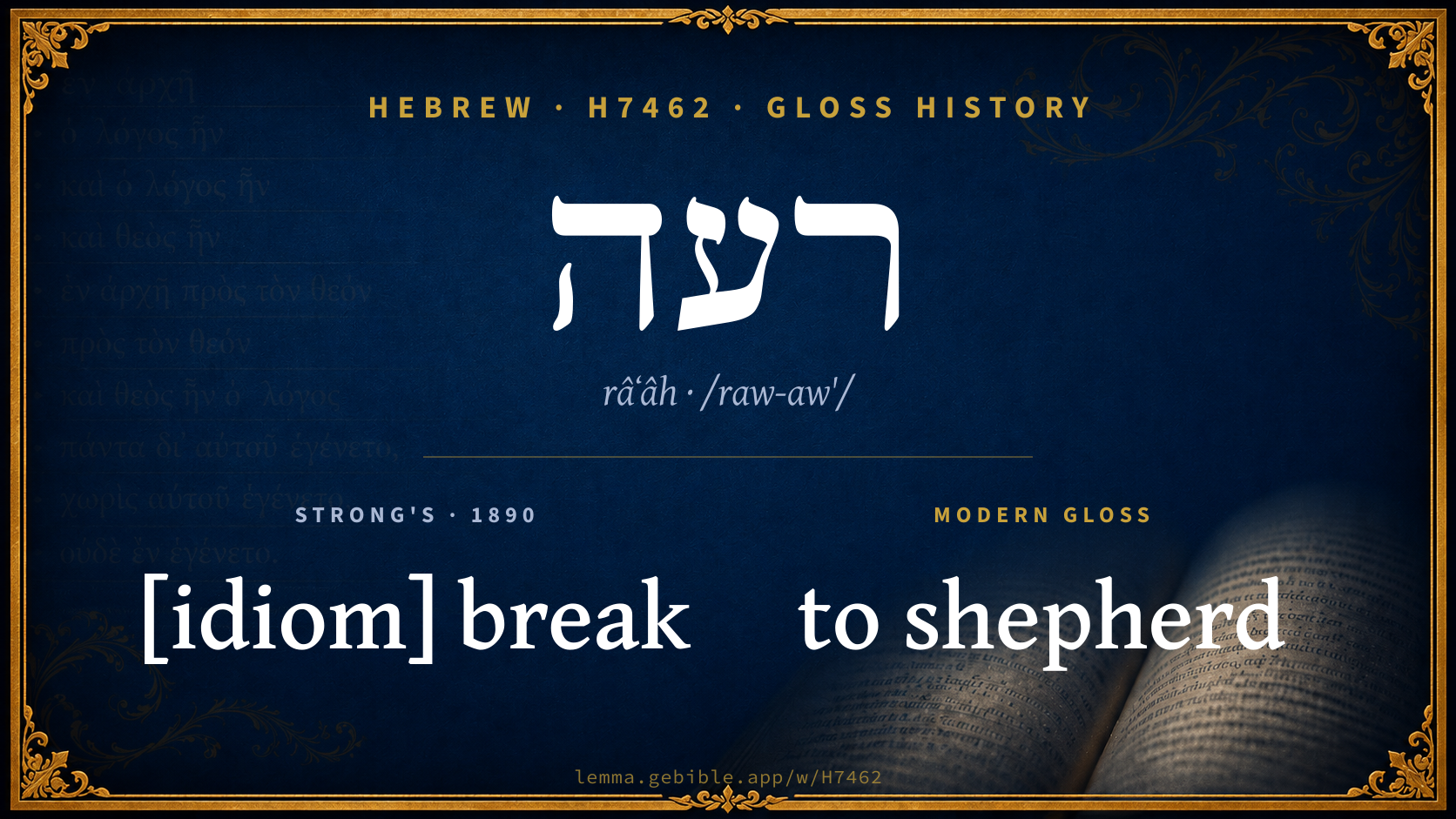
Gloss history
Strong's 1890 vs modern scholarship
About this word
Strong's H7462 catalogs a Hebrew word from the Hebrew Old Testament.
These counts are not copied from any lexicon or concordance. They are computed here, from the morphology-tagged Hebrew Old Testament. What Lemma adds →
- 139
- distinct verses
- The word appears in 139 distinct verses.
- 25 / 39
- OT books
- The word appears in 25 of 39 Old Testament books.
- #279
- by frequency
- Top 500 most frequent Hebrew words (rank 279 of 8,640 Hebrew words by occurrence).
View all 139 occurrences in the concordance →
By section of the Old Testament
By traditional corpus
Conventional, traditional groupings — biblical authorship is debated, so this is a traditional corpus grouping, not an authorship claim. Each share is this word’s portion of its verses in that division of the Hebrew canon. Each figure is a share of the word’s 139 distinct verses.
- Prophets (Nevi'im) 88 verses · 63%
- Writings (Ketuvim) 28 verses · 20%
- Torah (Pentateuch) 23 verses · 17%
How translations render this word
Counts come from each version’s own published word-to-Strong’s tagging or interlinear alignment — an approximate guide to how each version renders this word, not a word-level alignment the data otherwise carries. Because each total is that version’s own tagged count, the per-version totals vary from one another and need not match the appearance or distinct-verse counts above. These counts may also differ from a printed concordance because Lemma counts each distinctly tagged rendering and does not collapse phrase taggings into a single head-word total. This is a fixed set of word-tagged versions (KJV, ASV, BSB, ULT) and does not change with the reading translation you choose elsewhere. Each version’s license is shown beside its name below (and on Sources).
BDB lists this Strong’s number as 4 distinct words (homographs). Each count above pools all of them and is not split by sense — see the Senses section below. A low-frequency rendering may belong to a different one of those words, not the primary meaning.
- King James Version†: Feed 26×, Shepherds 17×, Shepherd 12×
- American Standard Version†: Shepherds 21×, Feed 16×, Shepherd 10×
- Berean Standard Bible†: Shepherds 32×, Shepherd 31×, Herdsmen 6×
- unfoldingWord Literal Text†: Shepherds 33×, Shepherd 22×, Will graze 6×
King James Version Public Domain
Renders H7462 across 172† tagged occurrences — most commonly:
Plus other, less common renderings. Plus 68 renderings that appear only once — usually multi-word phrases or single function words the recovered tagging swept in, not distinct renderings. Not rendered by a distinct English word in 1 further occurrence.
American Standard Version Public Domain
Renders H7462 across 171† tagged occurrences — most commonly:
Plus other, less common renderings. Plus 66 renderings that appear only once — usually multi-word phrases or single function words the recovered tagging swept in, not distinct renderings.
Berean Standard Bible Public Domain
Renders H7462 across 170† tagged occurrences — most commonly:
Plus other, less common renderings. Plus 52 renderings that appear only once — usually multi-word phrases or single function words the recovered tagging swept in, not distinct renderings. Not rendered by a distinct English word in 5 further occurrences.
unfoldingWord Literal Text CC BY-SA 4.0
Renders H7462 across 166† tagged occurrences — most commonly:
Plus other, less common renderings. Plus 61 renderings that appear only once — usually multi-word phrases or single function words the recovered tagging swept in, not distinct renderings.
19 senses and sub-senses in the full BDB
Hebrew verbs can shift meaning by stem (binyan): Qal is the basic action, Niphal is often passive or reflexive, Piel often intensifies or makes it factitive, and Hiphil is typically causative. The senses below are grouped under the stem BDB assigns to each. This entry also uses Hithpael (reflexive or reciprocal).
What do BDB’s symbols mean?
BDB uses these scholarly abbreviations:
| Symbol | Meaning |
|---|---|
| 𝔊 | the Septuagint (the ancient Greek translation, LXX) |
| 𝔙 | the Vulgate (the Latin translation) |
| 𝔖 | the Syriac version (the Peshitta) |
| 𝔗 | the Targum (the Aramaic translation) |
| ψ | the Psalms |
| √ | root (the underlying root or stem) |
| ‖ | parallel passage (a synonymous or contrasted parallel) |
| † | the dagger: every passage where the word occurs is cited |
The 19 senses and sub-senses the full Brown-Driver-Briggs lexicon distinguishes for this word, in lexicon order (not ranked by frequency), with BDB’s own verbatim wording and sub-sense lettering. Shown in Hebrew script with BDB’s own scholarly abbreviations. The condensed entry is in the Lexicon Entry tab. See also the Forms in the corpus table below.
רעה I pasture, tend, graze (Assyrian rêʾû vb. pasture, n. ruler, TelAm. ruh̬i (as Canaanism) WklNo. 181, 11
Qal
- Pf. 3 ms. consec. וְרָעָה Mi 5:3 +, 1 s. sf. consec. וּרְעִיתִים Ez 34:13, 3 pl. sf. consec. וְרָעוּם Je 23:4, etc.; Impf. 3 ms. יִרְעֶה Is 27:10 +, juss. יֵרַע Jb 20:26, sf. יִעֶנָּה ψ 80:14, וַיִּרְעֵם ψ 78:72 (וַיִּר׳ Hiph. van d. H.), etc.; Imv. ms. רְעֵה Mi 7:14 +, sf. רְעֵם ψ 28:9; fs. רְעִי Ct 1:8; mpl. רְעוּ Gn 29:7; Inf. cstr. לִרְעוֹת 37:12 +, etc.; Pt. רֹעֶה 30:36 +, sf. רֹעִי ψ 23:1 +; fs. רֹעָה Gn 29:9 Pr 25:19, etc.;— e.g. Micah 5:3
- 1. trans.
- a. pasture, tend (pascere), lit., c. acc. צֹאן Gn 30:31, 36; 37:12 (all J), Ex 3:1 (E), 1 S 17:15; 25:16 Is 61:5, acc. of asses Gn 36:24 (P), kids Ct 1:8; acc. (צפּאן) om. Gn 29:7; 37:13 (ב loc.) v 16 (all J), Ct 1:7 (‖ חִרְבִּיץ), Jb 24:2 (𝔊 Me Siegf Bu וְרֹעוֹ);—metaph. גֹּרֶן וָיֶקֶב לֹא יִרְעֵם Ho 9:2, but read יֵדָעֵם 𝔊 We Now GASm; מָוֶת יִרְעֵם ψ 49:15. e.g. Genesis 30:31
- b. fig. of י׳, acc. pers., Gn 48:15 (E) God, who shepherded me; c. acc. of people, as flock Ho 4:16 Is 40:11 Mi 7:14 (בְּשִׁבְטֶ֑ן), Ez 34:13 (pregn., c. אֶל loc.), v 14, 15 (+ הִרְבִּיץ), v 16 ψ 28:9. e.g. Genesis 48:15
- c. fig. of ruler, and teacher, acc. of people, as flock, 2 S 5:2 = 1 Ch 11:2; 2 S 7:7 = 1 Ch 17:6, ψ 78:72 Je 3:15; 23:2, 4; Ez 34:2, 3, 8, 10, 23(×2); Zc 11:4, 7(×2), 9; of guiding, שִׂפְתֵי צַדִּיק יִרְעוּ רַבִּים Pr 10:21; c. ב of people ψ 78:71; abs. Mi 5:3; c. acc. pers. reflex. pastured (fed, enriched) themselves Ez 34:2, 8, 10 e.g. 2 Samuel 5:2
- d. especially pt. רֹעֶח, etc., as subst. = shepherd, herdsman: (1) lit., רֹעֵה צֹאן Gn 4:2; 46:32, 34; 47:3 (all J), רֹעֶח בַּצּ׳ 37:2 (E), 1 S 16:11; 17:34; רֹעֵי מִקְנֶה Gn 13:7(×2) (J); (ה)ר׳ alone, sg. Am 3:12 + 7 times (all in sim.); רֹעָה shepherdess, Gn 29:9 (J); כִּלִי רֹעֶה אֱוִילִי Zc 11:15 (v. כְּלִי 2 c), as symbol; pl. (הָ)רֹעִים Am 1:2; Ex 2:17, 19 (J), 1 S 21:8 (אַבִּיר הָר׳; Gr Dr Bu Kit Löhr א׳ הָרָצִים; 𝔊 LagBN 45 HPS אֹבִּיל הָעֲיָרִים, but cf. We) + 8 times + Is 31:4 (sim.), 38:12 (read רֹעִים for רֹעִי Perles29 Du CheHpt cf. Di), cf. (sf.) Gn 13:8(×2) (J); כְּלִי הָרֹעִים 1 S 17:40 (v. כְּלִי 3);—בֵּית־עֵקֶד הָרֹעִים, v. p. 112. (2) fig. of ruler (as often Assyrian; cf. Gk. (Homer) ποιμένα λαῶν), abs. sg. Je 17:16 fig. of prophet (but Aq Symm 𝔖 Gie Du Co מֵרָעָה). Zc 10:2; 11:16; 13:7b + 8 times Je Ez; sf. of י׳, דֹעִי Is 44:28 (of Cyrus), Zc 13:7a (read רֹעִי הָאֱוִילִי We Now GASm); abs. pl. Is 56:11; Je 2:8; 3:15; Mi 5:4 Zc 10:3; 11:5, 8 + 18 times Je Ez 34, + (of Assyrian leaders) Na 3:18; רֹעֵי יִשׂ׳ Ez 34:2; רֹעֵי צֹאנוֹ Is 63:11 (but read רֹעֵה [of Moses] 𝔊 𝔗 Di Du al.). (3) epith. of י׳: י׳ רֹעִי ψ 23:1, רֹעֵה יִשׂ׳ 80:2, רֹעֶה אֶבֶן יִשׂ׳, Gn 49:24 (poem in J; read cstr. רֹעֵה, cf. Comm.); מֵרֹעֶה אֶחָד Ec 12:11 DeWild, president of assembly of sages Siegf SS e.g. Genesis 4:2
- 2. intrans. feed, graze:
- a. lit. of cows, sheep, etc.: c. ב loc. Gn 41:2, 18 (E), 1 Ch 27:29; c. acc. of pasture Is 30:23; c. עַל loc. Zp 2:7 (עֲלֵי הַיָּם for MT עֲלֵיהֶם, v. Now); אֶל־מוּל loc. Ex 34:3 (J); abs. Is 5:17; 11:7 (‖ רבץ; but v. II. רעה infr.) 27:10 (‖ id.), 65:25 Jon 3:7; Jb 1:14. e.g. Genesis 41:2
- b. fig. of idolater, Is 44:20 he feedeth on ashes (acc.); cf. Ho 12:2 Ephr. feedeth on wind (acc.); פִּי כְסִילִים יִר׳ אִוֶּלֶת Pr 15:14 (so Vrss Qr; Kt פני for פי) the mouth of fools feeds on folly (Toy; Buhl √ II. רעה, Gerber 162 sub III. רעה); in Ct, c. ב loc., fig. of lover Ct 2:16; 6:2, 3; of breasts (like gazelles) 4:5. e.g. Isaiah 44:20
- c. fig., of Isr. as flock Is 14:30 (‖ רבץ), read (י—ַ)בְּכָרִי in my pasture(s), for MT בְּכוֹרֵי, Koppe Ew Di Du (otherwise CheHpt., cf. Marti); Zp 3:13 (‖ id.); c. עַל־דְּרָכִים Is 49:9; c. acc. of pasture-land Je 50:19; Mi 7:14; Ez 34:14b (+ אֶל loc.), v 18, 19; hence crop, strip, i.e. devastate, of conqueror, c. acc. of land Mi 5:5, cf. אֶת־יָדוֹ Je 6:3; so יִרְעוּךְ קָדְקֹד 2:16; acc. of Isr. under fig. of vine (subj. foes, as beasts) ψ 80:14. e.g. Isaiah 14:30
- d. subj. wind, c. acc. pers. Je 22:22, i.e. drive them away; subj. fire, c. acc. rei, יֵרַע Jb 20:26, but read perhaps יֵרָע, Niph. (Ol Di Hoffm Siegf Bu; otherwise Du).—רֹעֶה עֲקָרָה 24:21 is difficult; Bu הֵרַע for ר׳; more radical conj. in Du. e.g. Jeremiah 22:22
Niphal
- poss. Jb 20:26, v. 2 d supr. e.g. Job 20:26
Hiphil
- ψ 78:72 van d. H., v. 1 c supr. e.g. Psalms 78:72
רעה II ob. associate with (cf. Schulthess69 ff. but also NöZMG liv (1900), 154 f.
Qal
- Imv. ms. וּרְעֵה אֱמוּנָה ψ 37:3 cherish faithfulness (Hup-Now RV Che Du Dr); > feed securely (Bae; i. רעה; feed on (his) faithfulness Am RV); Pt. רֹעֶה כְסִילִים Pr 13:20 one associating with fools, so ר׳ זֹלְלִים 28:7, ר׳ זוֹנוֹת 29:3 (Thes al. think these fig. from I. רעה, v. 2 b). e.g. Psalms 37:3
Hithpael
- 2 ms. אַל־תִּתְרַע אֶת־בַּעַל אָ֑ף Pr 22:24 do not make companionship with a bad-tempered man; perhaps also 3 fpl. תִּתְרָעֶינָה Is 11:7 (LagOr i. 21; Deceased Wife’s Sister 399 Brd Du CheHpt) cow and bear shall be each other’s companions; + Inf. cstr. הִתְרָעֹת Pr 18:24 (Toy, for MT הִתְרֹעֵעַ) there are [יֵשׁ for אִישׁ] friends (merely) to be companions (v. II. רעע ad fin.). e.g. Proverbs 22:24
רעה III denom.
Piel
- be a special friend;—Pf. 3 ms. מֵרֵעֵהוּ אֲשֶׁר רֵעָה לוֹ Ju 14:20 his comrade who had been ‘best man’ (GFM) to him. e.g. Judges 14:20
רעה IV evil, misery, distress, injury
- 1. evil, misery, distress: פַּחַד רָעָה Pr 1:33, באה (ה)רעה Ez 7:5(×2); c. עַל Is 47:11 (read באה for בא), Je 5:12 + 5 times; c. אֶל Je 2:3; 51:60; †הביא רעה Je 4:6 1 K 21:29; + אֶל 2 S 17:14 + 8 times K Je; + עַל 1 K 9:9 = 2 Ch 7:22, Je 19:3 + 6 times Je + 8 times; + אֶל et על Je 19:15; 36:31; יוֹם רעה 17:17, 18 + 5 times; יְמֵי הרעה †Ec 12:1 (i.e., spring days, fatal to old people, Wetzst in De Koh. 447); רָעוֹת evils Dt 31:17(×2), 21 (JE), 32:23 (poem), ψ 34:20; 40:13; 88:4; עֵת רָעָה Am 5:13; Je 2:27, 28 + 5 times; †ראה ברעה Nu 11:15 (JE) Ob 13; Est 8:6; †ראה רעה Je 44:17 ψ 90:15; Pr 22:3 = 27:12; †יפול ברעה 17:20; 28:14; †בְּרָעָה Je 44:29 (J) Pr 14:32; 24:16; Ne 1:3; 1 Ch 7:23 ψ 107:26; ברעותיכם 141:5; נִחַם עַל רָעָה Ex 32:12, 14 (J) Je 8:6 + 6 times; c. אֶל 2 S 24:16; Je 26:3, 13, 19; 42:10. e.g. Proverbs 1:33
- 2. evil, injury, wrong: †עשׂה רעה 2 S 12:18; Je 26:19; 41:11; c. עִם Gn 26:29 (J) Ju 15:3; 2 S 13:16; c. את Ju 11:27; c. ל 1 S 6:9; 1 K 2:44 + 4 times; c. אֶל Je 44:7; obj. of vbs. חשׁב Gn 50:20 (E) Je 36:3; 48:2 + 7 times; †חרשׁ 1 S 23:9; Pr 3:29; הֵשִׁיב Gn 50:15 (E) Ju 9:56, 57 + 4 times; †גמל Gn 50:17 (E) 1 S 24:18 (17); Is 3:9; Pr 3:30; בקשׁ Nu 35:23 (P); 1 S 24:10 (9); 25:26 + 4 times; †שׁלּם Gn 44:4 (J); Je 18:20; 51:24 ψ 35:12; 38:21; לְרָעָה for harm Gn 31:52; Ex 23:2 (E); Dt 29:20; Ju 2:15; 2 S 18:32; Je 21:10 + 8 times Je, Am 9:4; Zc 1:15; Pr 6:18; Ec 5:12; בְּרָעָתֶ֑ךָ 2 S 16:8 in thy mischief; בְּרָעָה Ex 32:12 (J) for mischief; רָעָה רַבָּה Ec 2:21; רָעָה חוֹלָה Ec 5:12, 15. e.g. 2 Samuel 12:18
- 3. ethical evil, 1 S 12:17, 19; 24:12; 26:18; Is 47:10; Je 2:19 + 13 times Je, + 18 times, + foll.: עָשָׂה (הָ)רָעָה Gn 39:9; Dt 31:18 (J) + 5 times + Je 18:10 (Kt, but Qr רע); מַעֲשֵׂה רעה Ec 8:11; אהב רעה Mi 3:2 (Kt); שׁוּב מרעה Je 18:8; 23:14; 44:5; בִּעֵר רעה מ׳ Ju 20:13 (v ii. רַע 3); מִפְּנֵי רָעָה Je 7:12; 44:3; מפני רָעַת רעתכם Ho 10:15; בגלל ר׳ Je 11:17; על כל ר׳ 1:16; 32:32; 33:5; מֵר׳ ψ 107:34 Je 12:4; אַנְשֵׁי רָעָה Pr 24:1. e.g. 1 Samuel 12:17
Senses from the full Brown-Driver-Briggs lexicon (Brown, Driver, Briggs; Oxford 1906 — public domain), digitized via Sefaria, supplemented by the OpenScriptures HebrewLexicon (CC BY 4.0). Full attribution on Sources.
Word origin
I. vb. pasture, tend, graze (Assyrian rêʾû vb. pasture, n. ruler, TelAm. ruh̬i (as Canaanism) WklNo. 181, 11; Arabic رَدَى, Ethiopic ርዕየ Aramaic רְעָא, ܪܥܳܐ, all = BH);—
II. vb. prob. associate with (cf. Schulthess69 ff. but also NöZMG liv (1900), 154 f.; Assyrian ruʾa, ruttu, neighbour, fellow (m. et f.; cf. JägerBAS i.483, 486); so Bed. أُرْعُوَّةٌ master, owner, WallinZMG v (1851), 9 JayakarJA xxi. 851; Ethiopic መርዓ: marriage; Arabic رَاعِى, راعيها, Ethiopic አርዑት: yoke; NH רֵעוּת friendship is from BH רֵעַ);—
IV. n.f. evil, misery, distress, injury;—abs. ר׳ Gn 26:29 +; cstr. רָעַת 6:5 +; sf. רָֽעָתִי ψ 35:4 +; רָעָֽתְךָ 1 K 2:44 +; רָֽעָתֵכִי Je 11:15 (text dub.); רָֽעַתְכֶם 1 S 12:17, etc.; pl. רָעוֹת Dt 31:17 +; רָעֹת Je 44:9 Ex 23:2; sf. רָעוֹתֵיכֶם 1 S 10:19 +, etc.;—
— Brown-Driver-Briggs (Oxford 1906, public domain), digitized via Sefaria, supplemented by the OpenScriptures HebrewLexicon (CC BY 4.0). See Sources.
Origin: a primitive root
Jastrow Dictionary
A second Hebrew/Aramaic lexicon for comparison, covering Aramaic and post-biblical (Talmudic, Targumic, Midrashic) usage that the biblical-Hebrew BDB does not. Matched by lemma rather than by Strong’s number, so a lemma may carry more than one Jastrow headword (shown separately below), and the entries cover usage well beyond the Bible.
רָעָה
- evil, v. רַע.
רָעָה ²
- to feed, v. רעי.
רעי
- (b. h.) [to join, arrange, cmp. דבר,] to lead, pasture, feed; (neut. verb) to graze. Ex. R. s. 2 כשהיה משה … רוֹעֶה צאנו וכ׳ when Moses … was feeding Jethro’s flock in the desert &c.; חייך אתה תִרְעֶה וכ׳ as thou livest, thou shalt lead my flock, Israel. Ib. והיה מוציא הקטנים לִרְעוֹת כדי שיִרְעוּ וכ׳ he (David) took out the young first that they might eat the tender grass &c. Yoma VI, 1 יִרְעֶה עד שיסתאב, v. סָאַב; Bekh. II, 9 ירעו עד וכ׳; a. fr.
- to lead to pasture, feed. Erub. 17ᵃ; B. Kam. 81ᵃ top שיהו מַרְעִין וכ׳, v. חוֹרֶשׁ; a. e.
- (v. Jud. XIV, 20) to associate, make a friend, companion. Cant. R. to II, 9 (ref. to רעיתי, ib. 10) בתו של יצחק שריעה אותי וייפה אותי וכ׳ the daughter of Isaac who declared me (the Lord) his friend and beautified me (the faith in God) on the altar. Lam. R. introd. (R. Josh. 1) שתָּרֵיעַ לקבל וכ׳ (some ed. שתָּרֵיעוּ; from רעע, v. רֵיעַ) that thou (you) form a partnership &c., v. שָׂרַע. e.g. Judges 14:20
A Dictionary of the Targumim, the Talmud Babli and Yerushalmi, and the Midrashic Literature (Marcus Jastrow; London, Luzac, 1903) — Public Domain. Digitized via Sefaria. Digitized via Sefaria. Full attribution on Sources.
Forms in the corpus
The 119 distinct written forms H7462 takes in the Hebrew Bible, most frequent first — each parse links to that stem’s occurrences in the concordance. Hebrew forms include their vowel points and cantillation, so a single lemma takes many written forms.
The 60 most common forms are shown; 59 rarer forms follow in the full concordance.
Same root — word family
Other BDB entries built from the same root as H7462, grouped by Strong’s listed origin. These share a root / origin per the lexicon — not necessarily a shared meaning. Each links to that word’s own entry.
Derived from this word
- מרע mêrêaʻ H4828 friend
- מרעה mirʻeh H4829 pasture
- מרעית mirʻîyth H4830 pasturage
- רע rêaʻ H7453 friend
- רע rêaʻ H7454 thought
- רעה rêʻeh H7463 friend
- רעות rᵉʻûwth H7468 companion
- רעות rᵉʻûwth H7469 longing
- רעי rᵉʻîy H7471 pasture
- רעי rôʻîy H7473 shepherd
- רעיון raʻyôwn H7475 longing
Compare all same-root words → Showing 4 of 12 — not the complete family. They share a root, not necessarily a meaning.
Septuagint verse parallels
This word appears in 131 verses that also exist in the Greek Old Testament (Septuagint), out of the 139 Hebrew verses it occurs in. You can read those verses in Greek by switching the Old Testament edition to the Septuagint.
Read these verses in the Septuagint
- Genesis 4:2
- Exodus 2:17
- Numbers 14:33
- Judges 14:20
- 1 Samuel 16:11
- 2 Samuel 5:2
- 1 Kings 22:17
- 2 Kings 10:12
- 1 Chronicles 11:2
- 2 Chronicles 18:16
- Job 1:14
- Psalms 23:1
This is a verse-level parallel only — the same verses exist in both the Hebrew and Greek Old Testaments. No word-level Hebrew↔Greek correspondence is claimed: the data carries no such alignment, so no Greek word is shown as this Hebrew word’s translation. Coverage is not total — the Septuagint omits the deuterocanon and renumbers the Psalms, so some Hebrew verses have no direct Greek parallel.