
Proverbs 6:29

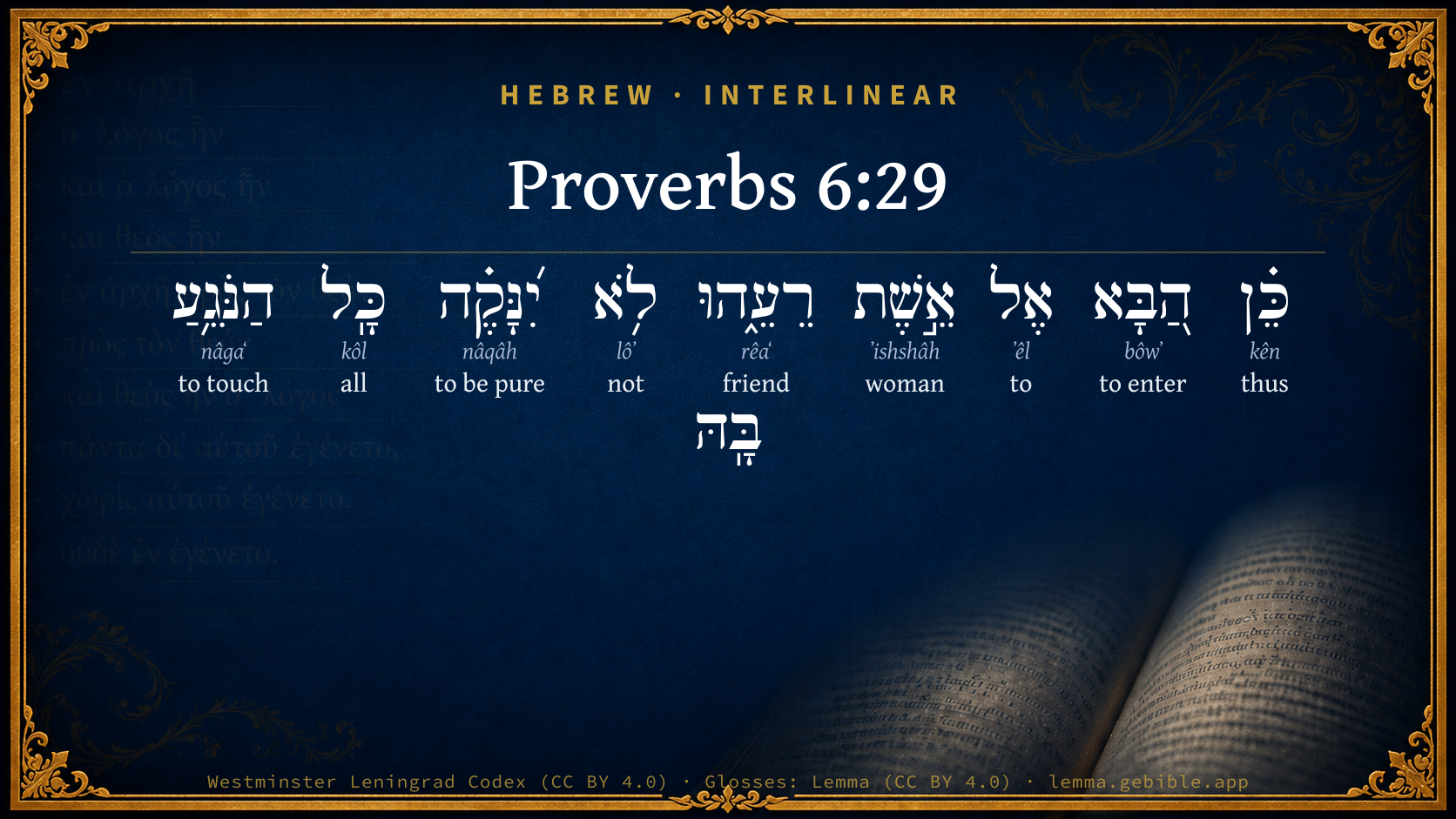
Hebrew (Westminster Leningrad Codex) Proverbs 6:29 appears in the Hebrew Old Testament. The text above is from the Westminster Leningrad Codex. Each word links to its Strong’s number, a concise gloss, and parsing drawn from the Open Scriptures Hebrew Bible morphology. Click any word for its full Brown-Driver-Briggs (BDB) entry.
Download image
Cite this verse

Proverbs 6:29 (World English Bible). Public Domain. Lemma interlinear Bible study tool, https://lemma.gebible.app/v/proverbs/6/29.

Show BibTeX & RIS
BibTeX
RIS
English Translation
So is he who goes in to his neighbor's wife. Whoever touches her will not be unpunished.
World English Bible · Public Domain
Download a study sheet

One document with this verse’s original text, its word-by-word gloss line, the meaning frame, cross-references with their text, attributed commentary, and full source and license credits — printable, and it pastes into notes with its structure intact.

This verse Autodidact and up

Study sheet (.html) Plain text (.txt)

A passage Seminary Student

Up to 50 verses in one chapter. A passage sheet keeps up to 6 commentary sources and 12 cross-references per verse, in the order this page ranks them, and says so on the sheet whenever that leaves anything out. Ask for a single verse and you get the Autodidact verse sheet above.

Everything on this page stays free to read, with no account — the sheet is a download of what is already on screen, not access to it.

Want to remove ads? Support Godless Engineer
Compare translations 3

The same verse in 3 English versions, stacked beneath the original-language interlinear above. Click any original word for its lexicon entry.

Each is an independent rendering of the whole verse — the interlinear is not word-aligned to these translations.

Highlighted words mark where these versions differ — a whole-verse word diff, not a word-by-word alignment.

  • World English Bible Public Domain
    So is he who goes in to his neighbor's wife. Whoever touches her will not be unpunished.
  • King James Version Public Domain
    So he that goeth in to his neighbour's wife; whosoever toucheth her shall not be innocent.
  • unfoldingWord Literal Text CC BY-SA 4.0
    So is the one going to the wife of his neighbor: Every one who touches her will not remain blameless.

unfoldingWord Literal Text — © unfoldingWord, licensed CC BY-SA 4.0. Word-aligned USFM3 via Door43 (git.door43.org/unfoldingWord/en_ult).

Versions to compare (up to 4)

3 of 4 selected

Show all 18 translations

Every available English version of this verse, each an independent rendering of the whole verse.

  • World English Bible Public Domain
    So is he who goes in to his neighbor's wife. Whoever touches her will not be unpunished.
  • Berean Standard Bible Public Domain
    So is he who sleeps with another man’s wife; no one who touches her will go unpunished.
  • Majority Standard Bible Public Domain
    So is he who sleeps with another man’s wife; no one who touches her will go unpunished.
  • King James Version Public Domain
    So he that goeth in to his neighbour's wife; whosoever toucheth her shall not be innocent.
  • American Standard Version (1901) Public Domain
    So he that goeth in to his neighbor's wife; Whosoever toucheth her shall not be unpunished.
  • Revised Version (1885) Public Domain
    So he that goeth in to his nieghbour’s wife; whosoever toucheth her shall not be unpunished.
  • Geneva Bible (1599) Public Domain
    So he that goeth in to his neighbours wife, shall not be innocent, whosoeuer toucheth her.
  • Douay-Rheims (1899) Public Domain
    So he that goeth in to his neighbour's wife, shall not be clean when he shall touch her.
  • Young's Literal Translation Public Domain
    So `is' he who hath gone in unto the wife of his neighbour, None who doth touch her is innocent.
  • Literal Standard Version CC BY-SA 4.0
    So [is] he who has gone in to the wife of his neighbor, || None who touches her is innocent.
  • Unlocked Literal Bible CC BY-SA 4.0
    So is the man who sleeps with his neighbor's wife; the one who sleeps with her will not go unpunished.
  • unfoldingWord Literal Text CC BY-SA 4.0
    So is the one going to the wife of his neighbor: Every one who touches her will not remain blameless.
  • Darby Bible Public Domain
    So he that goeth in to his neighbour's wife: whosoever toucheth her shall not be innocent.
  • World Messianic Bible Public Domain
    So is he who goes in to his neighbor’s wife. Whoever touches her will not be unpunished.
  • Webster's Bible Public Domain
    So he that goeth in to his neighbor's wife; whoever toucheth her shall not be innocent.
  • Free Bible Version CC BY-SA 4.0
    It's the same for anyone who sleeps with another man's wife. No one who touches her will remain unpunished.
  • Bible in Basic English Public Domain
    So it is with him who goes in to his neighbour's wife; he who has anything to do with her will not go free from punishment.
  • JPS Tanakh (1917) Public Domain
    So he that goeth in to his neighbour's wife; whosoever toucheth her shall not go unpunished.

Literal Standard Version (2020), Covenant Press — licensed CC BY-SA 4.0. Text via the HelloAO Bible API (eBible.org). Unlocked Literal Bible (unfoldingWord) — licensed CC BY-SA 4.0. Text via the HelloAO Bible API (eBible.org). unfoldingWord Literal Text — © unfoldingWord, licensed CC BY-SA 4.0. Word-aligned USFM3 via Door43 (git.door43.org/unfoldingWord/en_ult). Free Bible Version, Dr. Jonathan Gallagher — licensed CC BY-SA 4.0. Text via the HelloAO Bible API (eBible.org).

Word by word

More ways to search: Search by grammar → Find every occurrence → Compare this word →

Practice this passage: Drill this verse → Learn its vocabulary →

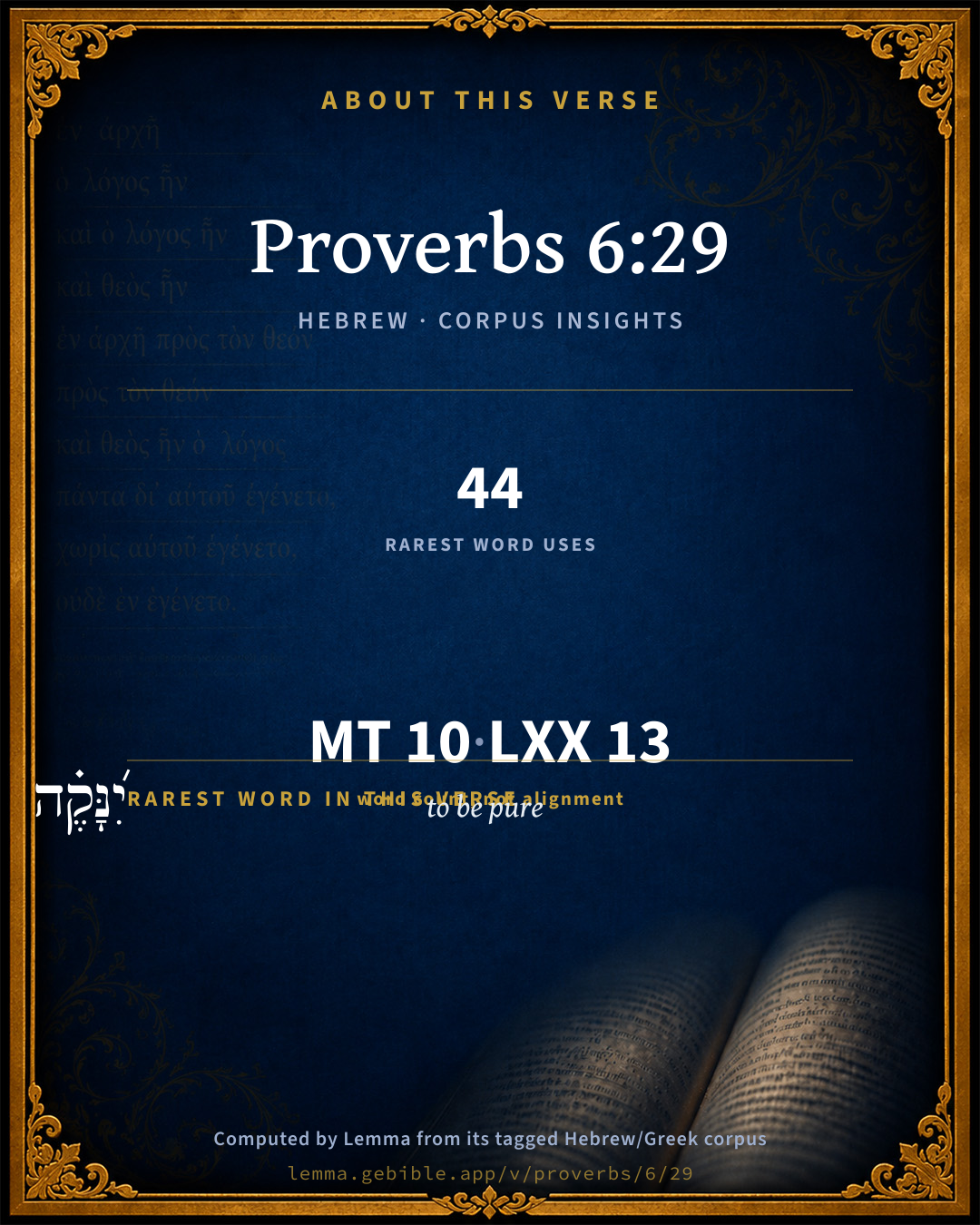
יִ֝נָּקֶ֗ה
nâqâh
H5352
“to be pure”
Verb, Niphal, Imperfect, 3rd Person, Masculine, Singular
Part of Speech
Verb
Stem
Niphal
Form
Imperfect
Person
3rd Person
Gender
Masculine
Number
Singular
Full BDB Definition

Origin: a primitive root

TWOT: 1412

to be empty, be clear, be pure, be free, be innocent, be desolate, be cut off - (Qal) to be empty, be clean, be pure - (Niphal) - to be cleaned out, be purged out - to be clean, be free from guilt, be innocent - to be free, be exempt from punishment - to be free, be exempt from obligation - (Piel) - to hold innocent, acquit - to leave unpunished
  1. כֵּ֗ן kên H3651 “thus” Particle, Demonstrative
  2. הַ֭בָּא bôwʼ H935 “the · entering” Particle, Definite Article + Verb, Qal, Participle Active, Masculine, Singular, Absolute
  3. אֶל ʼêl H413 “to” Preposition
  4. אֵ֣שֶׁת ʼishshâh H802 “woman of” Noun, Common, Feminine, Singular, Construct
  5. רֵעֵ֑הוּ rêaʻ H7453 “friend · his” Noun, Common, Masculine, Singular, Construct + Suffix, Personal, 3rd Person, Masculine, Singular
  6. לֹ֥א lôʼ H3808 “not” Particle, Negative
  7. כָּֽל kôl H3605 “all of” Noun, Common, Masculine, Singular, Construct
  8. הַנֹּגֵ֥עַ nâgaʻ H5060 “the · touching” Particle, Definite Article + Verb, Qal, Participle Active, Masculine, Singular, Absolute

About this verse

These counts appear in no published source. They are computed here, from the morphology-tagged text and Lemma’s own curated glosses. What Lemma adds →

10
words
9
distinct lemmas
Wisdom
section

Shared distinctive vocabulary

יִ֝נָּקֶ֗ה to be pure H5352 occurs in 33 verses of the Hebrew Bible. Also found in:

Grammatical profile

  • 3 verbs
  • 3 nouns
  • 2 prepositions
  • 2 particles

Verb forms

  • הַ֭בָּא Qal · Participle Active
  • יִ֝נָּקֶ֗ה Niphal · Imperfect
  • הַנֹּגֵ֥עַ Qal · Participle Active

Hebrew & Septuagint length

In English translation the verse runs 17 words from the Hebrew and 22 from the Septuagint (LXX English) — closely comparable.

A rough comparison of the two English renderings, which tokenize alike — not a word-level alignment.

Word counts can differ between the Hebrew and the Greek without any difference in meaning — e.g. the Hebrew direct-object marker אֵת has no separate Greek word, and Greek often adds the article ὁ.

In the original languages it is 10 Hebrew tokens and 13 Greek tokens — but the two are counted differently (Hebrew bundles its prefixes and suffixes into one token; the Greek is in lemma form), so that isn’t a like-for-like length.

Cross-references

12

Topical passages linked to Proverbs 6:29 in the Treasury of Scripture Knowledge — connected by theme and wording, ordered by reader-vote popularity; previews shown in the World English Bible.

  • 1 Corinthians 7:1 Now concerning the things about which you wrote to me: it is good for a man not to touch a woman.
  • Leviticus 20:10 "'The man who commits adultery with another man's wife, even he who commits adultery with his neighbor's wife, the adulterer and the adulteress shall surely be put to death.
  • 2 Samuel 12:9–10 Why have you despised the word of Yahweh, to do that which is evil in his sight? You have struck Uriah the Hittite with the sword, and have taken his wife to be your wife, and have slain him with the sword of the children of Ammon.
  • Ezekiel 22:11 One has committed abomination with his neighbor's wife; and another has lewdly defiled his daughter-in-law; and another in you has humbled his sister, his father's daughter.
  • Malachi 3:5 I will come near to you to judgment; and I will be a swift witness against the sorcerers, and against the adulterers, and against the perjurers, and against those who oppress the hireling in his wages, the widow, and the fatherless, and who deprive the foreigner of justice, and don't fear me," says Yahweh of Hosts.
  • Genesis 12:18–19 Pharaoh called Abram, and said, "What is this that you have done to me? Why didn't you tell me that she was your wife?
  • Genesis 26:10–11 Abimelech said, "What is this you have done to us? One of the people might easily have lain with your wife, and you would have brought guilt on us!"
  • 2 Samuel 11:3–4 David send and inquired after the woman. One said, Is not this Bathsheba, the daughter of Eliam, the wife of Uriah the Hittite?
  • 2 Samuel 16:21 Ahithophel said to Absalom, Go in to your father's concubines, that he has left to keep the house; and all Israel will hear that you are abhorred of your father: then will the hands of all who are with you be strong.
  • Proverbs 16:5 Everyone who is proud in heart is an abomination to Yahweh: They shall assuredly not be unpunished.
  • Jeremiah 5:8–9 They were as fed horses roaming at large; everyone neighed after his neighbor's wife.
  • Genesis 20:4–7 Now Abimelech had not come near her. He said, "Lord, will you kill even a righteous nation?

Cross-references courtesy of OpenBible.info (CC BY 4.0).

Hebrew and Greek witnesses Masoretic Hebrew ↔ Greek Septuagint

The same verse in the two great witnesses to the Old Testament, shown verse-for-verse.

These are two independent witnesses, not word-aligned to each other, and the Septuagint is shown in lemma (dictionary) form.

Hebrew Proverbs 6:29 Masoretic · Westminster Leningrad Codex

כֵּ֗ן הַ֭בָּא אֶל אֵ֣שֶׁת רֵעֵ֑הוּ לֹ֥א יִ֝נָּקֶ֗ה כָּֽל הַנֹּגֵ֥עַ בָּֽהּ

So is he who goes in to his neighbor's wife. Whoever touches her will not be unpunished.

World English Bible · Public Domain

Greek LXX Proverbs 6:29 Septuagint · lemma form

οὕτως ὁ εἰςἔρχομαι πρός γυνή ὕπανδρος οὐ ἀθῳόω οὐδέ πᾶς ὁ ἅπτομαι αὐτός

So is he that goes in to a married woman; he shall not be held guiltless, neither any one that touches her.

LXX2012 (modern English Septuagint) · Public Domain

On this verse, The Pulpit Commentary discusses the Septuagint’s reading. Read the note in Commentary ↓

Hebrew: Westminster Leningrad Codex (CC BY 4.0). Greek: Septuagint (public domain); English from LXX2012 (modern English Septuagint) (Public Domain). How the Septuagint differs from the Hebrew →

Commentary

Notes on Proverbs 6:29 from classic Christian and Jewish commentators (each source and its license shown beneath its notes). The classic Christian expositions comment on the surrounding passage and are grouped to its opening verse, so a note may address several verses; the Jewish commentaries on the Tanakh (Rashi and others) are per-verse, so they appear only where the commentator wrote on this verse.

Lemma curates 59 commentaries, every one of them public domain or Creative Commons licensed, each selected and text-cleaned for this edition rather than reprinted as found. About our sources →

Trapp's Complete Commentary

John Trapp

Pro 6:29 So he that goeth in to his neighbour’s wife; whosoever toucheth her shall not be innocent.

Ver. 29. So he that goeth in to his neighbour’s wife.] That suspiciously converseth with her alone, though haply with no intent of corrupting her. Joseph shunned the company of his mistress; he would not be with her alone. {Gen 39:10} Chambering and secret familiarity with women is forbidden, as a deed of darkness and dishonesty. {Rom 13:13} How much more, then, wanton touches and dalliance! Sit not at all with another man’s wife; sit not down upon the bed with her, saith Siracides (chap. 9). Christ’s disciples marvelled that he talked with the woman of Samaria, solus cum sola, - saith Beza. {Joh 4:27} But he might do that which we must beware of lest concupiscence kindle. Abraham might see Sodom burning, but Lot might not look that way.

Shall not be innocent.] Shall not be held so, howsoever he shall suffer in his name, be he never so honest - besides that hereby he tempts the devil to tempt him to uncleanness. Now the proverb is, Oculus et lama non patiuntur iocos, A man’s eye and his name will bear no jest. And he was no fool that said, Negligere quid de se quisque sentiat, non solum arrogantis est, sed et dissoluti. He is not only a proud but a lewd person, that takes no thought what others think and talk of him. "Provide," we must, "for things honest, not only before the Lord, but also before men." {2Co 8:20-21}

John Trapp, A Commentary or Exposition upon All the Books of the Old and New Testament (1647–1656) — public domain. Text from a community e-Sword module.

Adam Clarke's Commentary

Verse 29. So he that goeth in to his neighbour's wife] As sure as he who takes fire into his bosom, or who walks upon live coals, is burnt thereby; so sure he that seduces his neighbour's wife shall be guilty. That is, he shall be punished.

Adam Clarke's Commentary on the Bible (1810–1826) — public domain. Text from a community e-Sword/MySword module.

Ellicott's Commentary for English Readers

(29) Shall not be innocent.—That is to say, unpunished.

A Bible Commentary for English Readers, edited by Charles John Ellicott (1878–1897) — public domain. Text from a community e-Sword module.

The Cambridge Bible for Schools and Colleges

gen. ed. J. J. S. Perowne

29. innocent] So R.V. marg.; but as the object here is to deter from the sin by insisting on its consequences, it is better to render, with R.V. text, unpunished.

The Cambridge Bible for Schools and Colleges (gen. ed. J. J. S. Perowne; Cambridge University Press, 1878–1918) — public domain. Text from a community e-Sword module.

John Gill's Exposition

Men do not despise a thief, if he steal,.... They do not discommend or reproach him for it, or fix a mark of infamy upon him, or expose him to public shame by whipping him; but rather excuse him and pity him when it appears what his case is, what put him upon it, and that he had no other intention in it than to do as follows;

to satisfy his soul; his craving appetite for food, having nothing to eat, nor no other way of getting any: the words should be supplied thus, "for he does this to satisfy his soul"; or, as the Syriac version, "for he steals to satisfy his soul": and so they are a reason why men do not despise him, nor use him ill, because it is done with no other view; not with a wicked design to hurt his neighbour, nor with a covetous intent to increase his own substance in an unlawful way, but only to satisfy nature in distress; and another reason follows, or the former confirmed;

when he is hungry; or for "he is hungry" (s); pressed with famine; the temptation is great, nature urges him to it; and though it is criminal, men in such cases wilt not bear hard upon him for it. The Targum is,

"it is not to be wondered at in a thief that he should steal to satisfy his soul when it is hungry.''

The Vulgate Latin version is,

"it is not a great fault when anyone steals, for he steals to fill a hungry soul;''

it is a fault, but it is not a very heinous one, at least it is not so heinous as adultery, for the sake of which it is mentioned, and with which it is compared: the design of the instance is to show the adultery is far greater than that; and yet in our age we see that the one is severely punished even with death for trifling things, when the other goes unpunished.

(s) "quia esurit", Cocceius, Michaelis.

John Gill's Exposition of the Whole Bible (1746–1763) — public domain (CC PDM 1.0). Text via the HelloAO Bible API.

Haydock's Catholic Bible Commentary

Clean. Or be left unpunished. No crime disturbs the order of society so much, nor is pardoned with more difficulty.

George Leo Haydock (1774–1849), Haydock's Catholic Family Bible and Commentary, 1859 edition — public domain. Excludes Psalms (Douay-Rheims chapter numbering differs from Protestant) and Deuterocanonical books (Catholic canon only).

Matthew Poole's English Annotations

That goeth in to his neighbour’s wife; that lieth with her, as the phrase signifies, Gen 19:31; 29:21,23, &c. Toucheth her, i.e. hath carnal knowledge of her, as this word is used, Gen 20:6; 1Co 7:1, and in Terence, and other writers.

Shall not be innocent; shall be punished as a malefactor, either by God or man.

Matthew Poole's English Annotations on the Holy Bible (1683–1685) — public domain. Text from a community e-Sword/MySword module.

The Pulpit Commentary

So he that goeth in to his neighbour"s wife; whosoever toucheth her shall not be innocent. It is as great a folly to suppose that an adulterer will escape punishment as to imagine that no injury will follow where fire has been applied. Delitzsch illustrates this verse by a passage from Pythagoras"s maxim ("Eclog.," 100, 39), To eiv pur kai eiv gunaika empesein ison uparcei Goeth in; Hebrew, habba el; i.e. has intercourse with, as in Gen_6:4 Gen_19:31 Gen_38:9 Psa_51:2. The same in force as "toucheth." Shall not be innocent; Hebrew, lo-yinnakeh; i.e. poena vacuus, "exempt from punishment," or shall be unpunished (Delitzsch, Zockler, Gesenius); cf. Pro_11:21, "The wicked shall not be unpunished (lo yinnakeh)" ashore. The verb nakah signifies rimarily "to be pure;" Bothe Vulgate tenders non erit mundus," he will not be pure;" but the LXX observes the secondary meaning of the verb, ouk aywwyhsetai , non erit innoxius, "he shall not be let go unpunished," the Alexandrine verb aywow . Certain and the very heaviest punishment shall come upon him. (see also Pro_17:5 Jer_25:29 Jer_49:12) With this explanation agree Gejerus and Vatablus.

The Pulpit Commentary (1880–1919), ed. H.D.M. Spence-Jones & Joseph S. Exell — public domain. Text from a community e-Sword module.

Rashi

Rabbi Shlomo Yitzchaki (Rashi)

to his neighbor’s wife According to its apparent meaning, and it can also be expounded upon as referring to the idolatry of the pagans.

Rashi on the Tanakh — English translations: “The Judaica Press complete Tanach with Rashi, translated by A. J. Rosenberg” (CC BY 4.0); “Pentateuch with Rashi's commentary by M. Rosenbaum and A.M. Silbermann, 1929-1934” (public domain); “The Metsudah Tanach series, Lakewood, N.J” (CC BY 4.0); and “The Book of Joshua, Metsudah Publications, 1997” (CC BY 4.0). Text via Sefaria.

Lesson kit

Teaching starters — assembled from the data on this page, not authored interpretation. Every prompt links to the verse data it draws on. Edit before teaching.

Proverbs, in the Wisdom, opens this verse with 10 words (9 distinct Hebrew lemmas). Its most distinctive word is nâqâh (“to be pure”). A historical commentator’s framing appears above. Read the whole chapter for the surrounding context.

Discussion questions

  1. The word nâqâh carries the sense “to be pure.” How does it shape the verse?
  2. Genesis 24:8 shares the word «to be pure» with this verse. How do the two illuminate each other?
  3. These translations render this verse differently; the difference is in the English rendering, not the original. What questions does that raise?
  4. The verb «הַ֭בָּא» is Qal Participle Active. How does its form color the action?
  5. Reading how Trapp's Complete Commentary and Adam Clarke's Commentary read this verse, where do the two commentators agree and where do they part?

Things to notice

Reading settings

Reading text

Shown beneath each verse's original-language words.

Old Testament
Old Testament edition

Read the OT as the Masoretic Hebrew (MT) or the Greek Septuagint (LXX).

English shown for the Greek Septuagint (in the Hebrew ↔ Greek comparison).

Comparing translations? Open the Compare panel on any verse page to stack up to four side by side.