Jeremiah 23:30

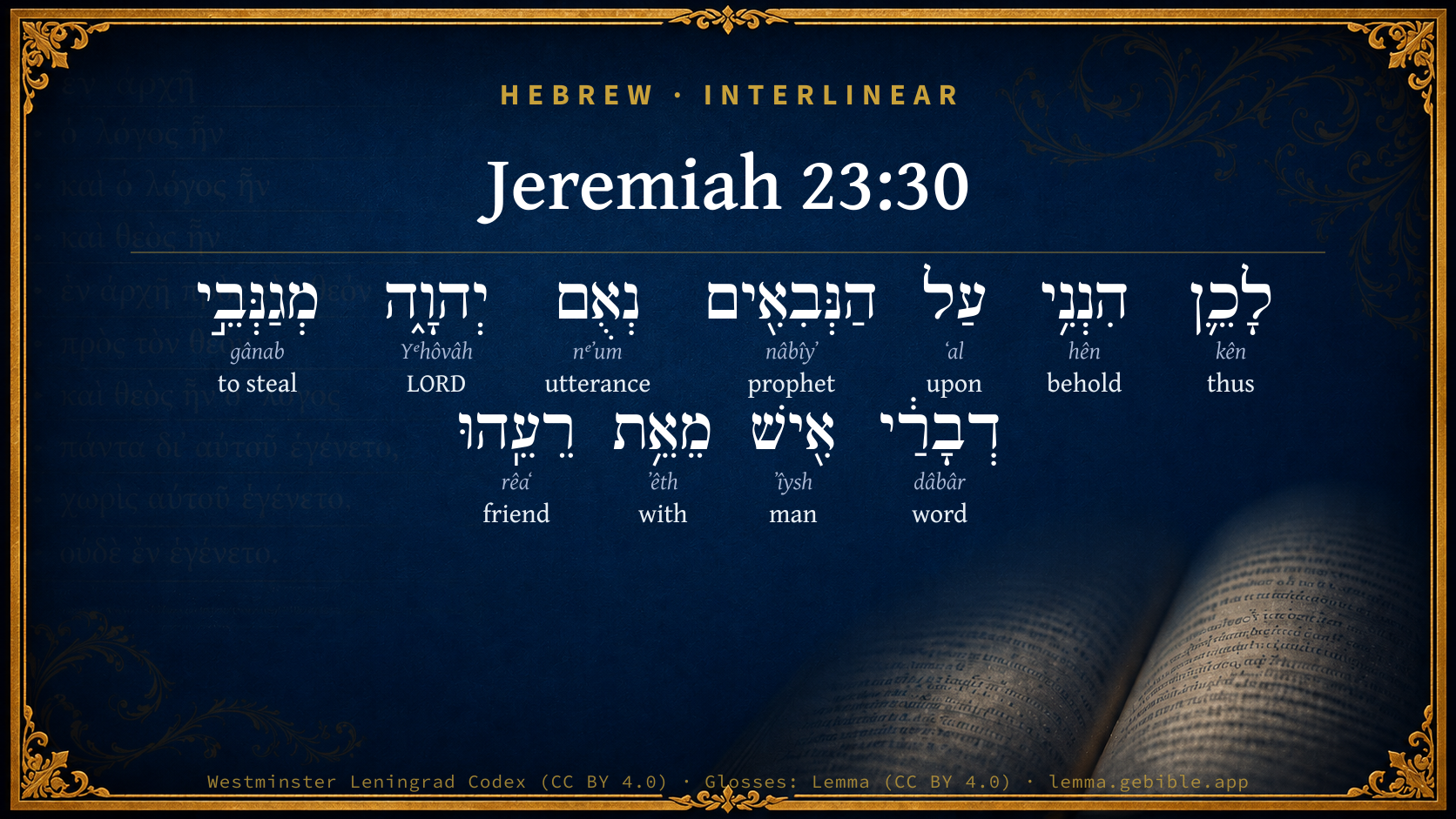
Hebrew (Westminster Leningrad Codex) Jeremiah 23:30 appears in the Hebrew Old Testament. The text above is from the Westminster Leningrad Codex. Each word links to its Strong’s number, a concise gloss, and parsing drawn from the Open Scriptures Hebrew Bible morphology. Click any word for its full Brown-Driver-Briggs (BDB) entry.
Download image
Cite this verse

Jeremiah 23:30 (World English Bible). Public Domain. Lemma interlinear Bible study tool, https://lemma.gebible.app/v/jeremiah/23/30.

Show BibTeX & RIS
BibTeX
RIS
English Translation
Therefore, behold, I am against the prophets, says Yahweh, who steal my words everyone from his neighbor.
World English Bible · Public Domain
Download a study sheet

One document with this verse’s original text, its word-by-word gloss line, the meaning frame, cross-references with their text, attributed commentary, and full source and license credits — printable, and it pastes into notes with its structure intact.

This verse Autodidact and up

Study sheet (.html) Plain text (.txt)

A passage Seminary Student

Up to 50 verses in one chapter. A passage sheet keeps up to 6 commentary sources and 12 cross-references per verse, in the order this page ranks them, and says so on the sheet whenever that leaves anything out. Ask for a single verse and you get the Autodidact verse sheet above.

Everything on this page stays free to read, with no account — the sheet is a download of what is already on screen, not access to it.

Want to remove ads? Support Godless Engineer
Compare translations 3

The same verse in 3 English versions, stacked beneath the original-language interlinear above. Click any original word for its lexicon entry.

Each is an independent rendering of the whole verse — the interlinear is not word-aligned to these translations.

Highlighted words mark where these versions differ — a whole-verse word diff, not a word-by-word alignment.

  • World English Bible Public Domain
    Therefore, behold, I am against the prophets, says Yahweh, who steal my words everyone from his neighbor.
  • King James Version Public Domain
    Therefore, behold, I am against the prophets, saith the LORD, that steal my words every one from his neighbour.
  • unfoldingWord Literal Text CC BY-SA 4.0
    “Therefore, behold, I against the prophets”—the declaration of Yahweh—“the ones stealing my words, a man from his neighbor.

unfoldingWord Literal Text — © unfoldingWord, licensed CC BY-SA 4.0. Word-aligned USFM3 via Door43 (git.door43.org/unfoldingWord/en_ult).

Versions to compare (up to 4)

3 of 4 selected

Show all 18 translations

Every available English version of this verse, each an independent rendering of the whole verse.

  • World English Bible Public Domain
    Therefore, behold, I am against the prophets, says Yahweh, who steal my words everyone from his neighbor.
  • Berean Standard Bible Public Domain
    “Therefore behold,” declares the LORD, “I am against the prophets who steal from one another words they attribute to Me.”
  • Majority Standard Bible Public Domain
    “Therefore behold,” declares the LORD, “I am against the prophets who steal from one another words they attribute to Me.”
  • King James Version Public Domain
    Therefore, behold, I am against the prophets, saith the LORD, that steal my words every one from his neighbour.
  • American Standard Version (1901) Public Domain
    Therefore, behold, I am against the prophets, saith Jehovah, that steal my words every one from his neighbor.
  • Revised Version (1885) Public Domain
    Therefore, behold, I am against the prophets, saith the LORD, that steal my words every one from his neighbour.
  • Geneva Bible (1599) Public Domain
    Therefore beholde, I will come against the prophets, saieth the Lord, that steale my word euerie one from his neighbour.
  • Douay-Rheims (1899) Public Domain
    Therefore behold I am against the prophets, saith the Lord: who steal my words every one from his neighbor.
  • Young's Literal Translation Public Domain
    Therefore, lo, I `am' against the prophets, An affirmation of Jehovah, Stealing My words each from his neighbour.
  • Literal Standard Version CC BY-SA 4.0
    Therefore, behold, I [am] against the prophets,” || A declaration of YHWH, || “Each stealing My words from his neighbor.
  • Unlocked Literal Bible CC BY-SA 4.0
    So see, I am against the prophets—this is Yahweh's declaration—anyone who steals words from another person and says they come from me.
  • unfoldingWord Literal Text CC BY-SA 4.0
    “Therefore, behold, I against the prophets”—the declaration of Yahweh—“the ones stealing my words, a man from his neighbor.
  • Darby Bible Public Domain
    Therefore, behold, I am against the prophets, saith Jehovah, that steal my words every one from his neighbour.
  • World Messianic Bible Public Domain
    “Therefore behold, I am against the prophets,” says the LORD, “who each steal my words from his neighbor.
  • Webster's Bible Public Domain
    Therefore behold, I am against the prophets, saith the LORD, that steal my words every one from his neighbor.
  • Free Bible Version CC BY-SA 4.0
    Pay attention to this, declares the Lord. I'm opposed to those prophets who steal words from one another and then say it's a message from me.
  • Bible in Basic English Public Domain
    For this cause I am against the prophets, says the Lord, who take my words, every one from his neighbour.
  • JPS Tanakh (1917) Public Domain
    Therefore, behold, I am against the prophets, saith the LORD, that steal My words every one from his neighbour.

Literal Standard Version (2020), Covenant Press — licensed CC BY-SA 4.0. Text via the HelloAO Bible API (eBible.org). Unlocked Literal Bible (unfoldingWord) — licensed CC BY-SA 4.0. Text via the HelloAO Bible API (eBible.org). unfoldingWord Literal Text — © unfoldingWord, licensed CC BY-SA 4.0. Word-aligned USFM3 via Door43 (git.door43.org/unfoldingWord/en_ult). Free Bible Version, Dr. Jonathan Gallagher — licensed CC BY-SA 4.0. Text via the HelloAO Bible API (eBible.org).

Word by word

More ways to search: Search by grammar → Find every occurrence → Compare this word →

Practice this passage: Drill this verse → Learn its vocabulary →

מְגַנְּבֵ֣י
gânab
H1589
“stealing”
Verb, Piel, Participle Active, Masculine, Plural, Construct
Part of Speech
Verb
Stem
Piel
Form
Participle Active
Gender
Masculine
Number
Plural
State
Construct
Full BDB Definition

Origin: a primitive root

TWOT: 364

to steal, steal away, carry away - (Qal) to steal - (Niphal) to be stolen - (Piel) to steal away - (Pual) to be stolen away, be brought by stealth - (Hithpael) to go by stealth, steal away
  1. לָכֵ֛ן kên H3651 “to/for · thus” Preposition + Adverb
  2. הִנְנִ֥י hên H2005 “behold · me” Particle, Demonstrative + Suffix, Personal, 1st Person, Common, Singular
  3. עַל ʻal H5921 “upon” Preposition
  4. הַנְּבִאִ֖ים nâbîyʼ H5030 “the · prophets” Particle, Definite Article + Noun, Common, Masculine, Plural, Absolute
  5. נְאֻם nᵉʼum H5002 “utterance of” Noun, Common, Masculine, Singular, Construct
  6. יְהוָ֑ה Yᵉhôvâh H3068 “LORD” Noun, Proper
  7. דְבָרַ֔י dâbâr H1697 “words · my” Noun, Common, Masculine, Plural, Construct + Suffix, Personal, 1st Person, Common, Singular
  8. אִ֖ישׁ ʼîysh H376 “man” Noun, Common, Masculine, Singular, Absolute
  9. מֵאֵ֥ת ʼêth H854 “from · with” Preposition + Preposition
  10. רֵעֵֽהוּ rêaʻ H7453 “friend · his” Noun, Common, Masculine, Singular, Construct + Suffix, Personal, 3rd Person, Masculine, Singular

About this verse

These counts appear in no published source. They are computed here, from the morphology-tagged text and Lemma’s own curated glosses. What Lemma adds →

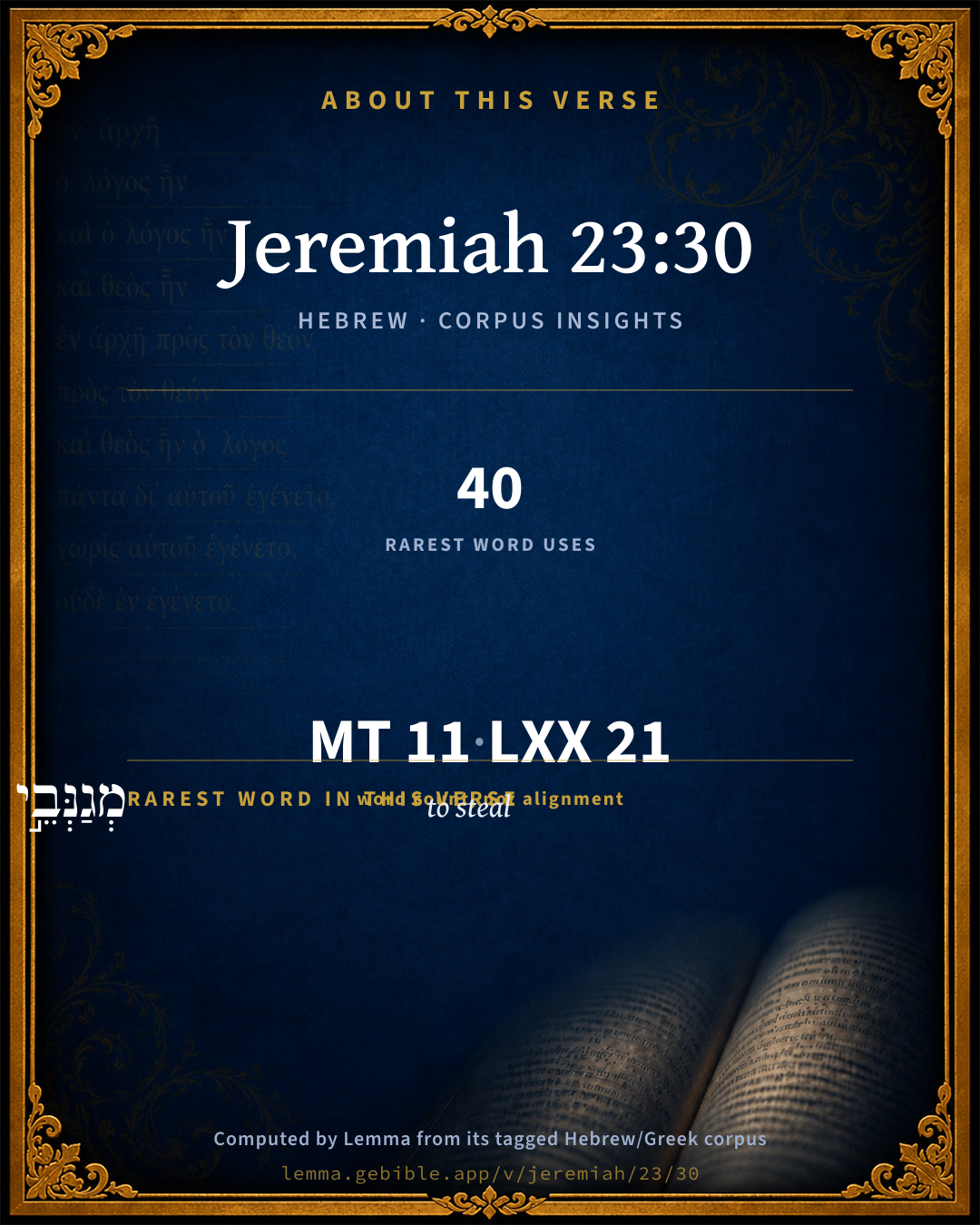
11
words
11
distinct lemmas
Prophets
section

Shared distinctive vocabulary

מְגַנְּבֵ֣י to steal H1589 occurs in 36 verses of the Hebrew Bible. Also found in:

Grammatical profile

  • 1 verb
  • 6 nouns
  • 2 prepositions
  • 1 adverb
  • 1 particle

Verb forms

  • מְגַנְּבֵ֣י Piel · Participle Active

Hebrew & Septuagint length

In the original languages it is 11 Hebrew tokens and 21 Greek tokens — but the two are counted differently (Hebrew bundles its prefixes and suffixes into one token; the Greek is in lemma form), so that isn’t a like-for-like length.

Cross-references

12

Topical passages linked to Jeremiah 23:30 in the Treasury of Scripture Knowledge — connected by theme and wording, ordered by reader-vote popularity; previews shown in the World English Bible.

  • Deuteronomy 18:20 But the prophet, who shall speak a word presumptuously in my name, which I have not commanded him to speak, or who shall speak in the name of other gods, that same prophet shall die.
  • Ezekiel 13:8 Therefore thus says the Lord Yahweh: Because you have spoken falsehood, and seen lies, therefore, behold, I am against you, says the Lord Yahweh.
  • Jeremiah 14:14–15 Then Yahweh said to me, The prophets prophesy lies in my name; I didn't send them, neither have I commanded them, neither spoke I to them: they prophesy to you a lying vision, and divination, and a thing of nothing, and the deceit of their own heart.
  • Psalms 34:16 Yahweh's face is against those who do evil, To cut off the memory of them from the earth.
  • Ezekiel 13:20 Therefore thus says the Lord Yahweh: Behold, I am against your pillows, with which you there hunt the souls to make [them] fly, and I will tear them from your arms; and I will let the souls go, even the souls who you hunt to make [them] fly.
  • Ezekiel 15:7 I will set my face against them; they shall go forth from the fire, but the fire shall devour them; and you shall know that I am Yahweh, when I set my face against them.
  • 1 Peter 3:12 For the eyes of the Lord are on the righteous, And his ears open to their prayer; But the face of the Lord is against those who do evil."
  • Leviticus 20:3 I also will set my face against that person, and will cut him off from among his people because he has given of his seed to Molech, to defile my sanctuary, and to profane my holy name.
  • Leviticus 26:17 I will set my face against you, and you will be struck before your enemies. Those who hate you will rule over you; and you will flee when no one pursues you.
  • Deuteronomy 29:20 Yahweh will not pardon him, but then the anger of Yahweh and his jealousy will smoke against that man, and all the curse that is written in this book shall lie on him, and Yahweh will blot out his name from under the sky.
  • Jeremiah 44:11 Therefore thus says Yahweh of Hosts, the God of Israel: Behold, I will set my face against you for evil, even to cut off all Judah.
  • Jeremiah 44:29 This shall be the sign to you, says Yahweh, that I will punish you in this place, that you may know that my words shall surely stand against you for evil:

Cross-references courtesy of OpenBible.info (CC BY 4.0).

Hebrew and Greek witnesses Masoretic Hebrew ↔ Greek Septuagint

The same verse in the two great witnesses to the Old Testament, shown verse-for-verse.

These are two independent witnesses, not word-aligned to each other, and the Septuagint is shown in lemma (dictionary) form.

Hebrew Jeremiah 23:30 Masoretic · Westminster Leningrad Codex

לָכֵ֛ן הִנְנִ֥י עַל הַנְּבִאִ֖ים נְאֻם יְהוָ֑ה מְגַנְּבֵ֣י דְבָרַ֔י אִ֖ישׁ מֵאֵ֥ת רֵעֵֽהוּ

Therefore, behold, I am against the prophets, says Yahweh, who steal my words everyone from his neighbor.

World English Bible · Public Domain

Greek LXX Structure differs

In the Septuagint, Jeremiah is about an eighth shorter than the Hebrew and arranges its material differently — the Oracles Against the Nations (Hebrew chapters 46–51) appear in the middle of the Greek book, after 25:13. Because the chapter and verse boundaries do not line up, a verse-for-verse comparison with the Hebrew is not shown.

A verse-for-verse comparison isn’t shown here because the chapters and verses don’t line up. Switch to the LXX edition with the MT / LXX toggle above to read the Greek directly.

Hebrew: Westminster Leningrad Codex (CC BY 4.0). Greek: Septuagint (public domain); English from a public-domain English Septuagint. How the Septuagint differs from the Hebrew →

Targum (Aramaic paraphrase)

1

The Targum is the ancient Jewish Aramaic paraphrase of the Hebrew Scriptures — an interpretive translation, not the Hebrew text itself. Onkelos (literal) and Pseudo-Jonathan (expansive) render the Torah, and Jonathan the Prophets. Coverage is partial: where no permissively-licensed English translation exists for a verse, only the Aramaic is shown. This is verse-level text, not a word-by-word alignment to the Hebrew.

  1. Targum Jonathan Prophets (Joshua–Malachi)
    בְּכֵן הָא אֲנָא שְׁלַח רוּגְזִי עַל נְבִיֵי שִׁקְרָא אֲמַר יְיָ מְגַנְבִין פִּתְגָמֵי גְבַר מִן חַבְרֵיהּ:

    (no public-domain English translation for this verse)

    Targum Jonathan — Aramaic: “Mikraot Gedolot” (public domain). English: “Sefaria Community Translation” (CC0 1.0 (public-domain dedication)); “London "Chaldee Paraphrase," 1871” (public domain). Text via Sefaria.

Commentary

Notes on Jeremiah 23:30 from classic Christian and Jewish commentators (each source and its license shown beneath its notes). The classic Christian expositions comment on the surrounding passage and are grouped to its opening verse, so a note may address several verses; the Jewish commentaries on the Tanakh (Rashi and others) are per-verse, so they appear only where the commentator wrote on this verse.

Lemma curates 59 commentaries, every one of them public domain or Creative Commons licensed, each selected and text-cleaned for this edition rather than reprinted as found. About our sources →

Adam Clarke's Commentary

Verse 30. I am against the prophets] Three cases are mentioned here which excited God's disapprobation:

1. The prophets who stole the word from their neighbour; who associated with the true prophets, got some intelligence from them, and then went and published it as a revelation which themselves had received, Jer 23:30.

2. The prophets who used their tongues; הלקחים לשונם hallokechim leshonam, who lick or smooth with their tongues - gave their own counsels as Divine revelations, flattering them in their sins, and promising peace, when God had not spoken; and prefaced them, "Thus saith the Lord," Jer 23:31.

3. The prophets who made up false stories, which they termed prophecies, revealed to them in dreams; and thus caused the people to err, Jer 23:32.

Adam Clarke's Commentary on the Bible (1810–1826) — public domain. Text from a community e-Sword/MySword module.

Trapp's Complete Commentary

John Trapp

Jer 23:30 Therefore, behold, I [am] against the prophets, saith the LORD, that steal my words every one from his neighbour.

Ver. 30. Behold, I am against those prophets.] Heb., Behold, I against, by an angry aposiopesis. {a}

That steal my word every one from his neighbour.] That filch it, either by hiding it from others, as the Popish doctors do from the common people, or by wresting it to the defence of their false doctrines, as Marcion the heretic, whom, therefore, Tertullian fitly calleth Murem Ponticum, the rat of Pontus, for his gnawing and tawing of the Scriptures, to bring them to his purpose. Or, by a fraudulent imitating of God’s true prophets, taking up their parables, and making use of their expressions, such as are, Thus saith the Lord; Grace be to you and peace, &c. Wasps also have their combs as well as bees; and apes will be doing as they see men to do. Or, lastly, by causing the people to forget and lose the good that they had once learned of the true prophets. This we see daily done by the cunning fetches and flatteries of the seducers of our times, causing many to lose the things that they had wrought. {2Jn 1:8}

{a} A rhetorical artifice, in which the speaker comes to a sudden halt, as if unable or unwilling to proceed.

John Trapp, A Commentary or Exposition upon All the Books of the Old and New Testament (1647–1656) — public domain. Text from a community e-Sword module.

Joseph Benson's Commentary

Jer 23:30-32. Behold, I am against the prophets that steal my words, &c. — “That imitate the true prophets, speaking in my name, as they do, and saying, Thus saith the Lord, (see Jer 23:31,) and using their words, but applying them to their own purpose: or, it may be, adding their own inventions to them.” So Lowth. Others paraphrase the verse thus, “That conspire together what to say to deceive the people, and to steal what they say one from another.” Or, perhaps the meaning rather is, That utter, as revelations made to themselves, things which they have learned, and, as it were, stolen from others. That use their tongues, &c. — That take their own tongues, as Blaney renders it, and say, He (the Lord) hath said. “The phrase of taking their own tongue,” he observes: “is, I think, very easily to be understood of those who, without any inspiration, took upon them to deliver messages to the people, and pretended that they came from God.” I am against them that prophesy false dreams — False things, under the notion of revelations made to them in their sleep. And cause my people to err — To wander from the right way; by their lies, and by their lightness — By their groundless assertions, their folly, their rashness and inconsistency with themselves: or, by the flatteries of their preaching, soothing men up in their sins, and by the looseness and lewdness of their conversation encouraging them to persist in them. Yet I sent them not, &c. — They are not my messengers, nor is what they say my message. Therefore they shall not profit this people at all — All the profit they aim at communicating is to make the people easy, but they shall not be able to do even that; for my providences will be such as will fill them with painful apprehensions and distressing fears. Some read the clause, They do not profit this people, considering the words as implying more than they express, namely, that these false prophets not only did the people no good, but did them a great deal of hurt. Observe, reader, none can expect God’s blessing upon their ministry who are not called and sent of God. And those that corrupt the word of God, while they pretend to preach it, are so far from edifying the church, that they do it the greatest mischief imaginable.

Joseph Benson's Commentary on the Old and New Testaments (1811–1818) — public domain. Text from a community e-Sword module.

Tyndale Open Study Notes

Tyndale Open Resources

23:30-32 The Lord rebuked and opposed the prophets who spoke lies in his name.

Tyndale Open Study Notes — © Tyndale Open Resources, licensed CC BY-SA 4.0. Text via the HelloAO Bible API.

Geneva Bible (1599)

Geneva Bible translators

Which set forth in my Name that which I have not commanded.

Geneva Bible (1599) marginal notes — public domain. Text via Bolls.life.

Jamieson, Fausset & Brown

Robert Jamieson, A. R. Fausset & David Brown

steal my words--a twofold plagiarism; one steals from the other, and all steal words from Jehovah's true prophets, but misapply them (see Jer 28:2; Joh 10:1; Rev 22:19).

Jamieson, Fausset & Brown — Commentary Critical and Explanatory on the Whole Bible (1871) — public domain (CC PDM 1.0). Text via the HelloAO Bible API.

John Calvin's Commentaries

Jeremiah returns again to the false teachers, who were the authors of all the evils; for they fascinated the people with their flatteries, so that every regard for sound and heavenly doctrine was almost extinguished. But while God declares that he is an avenger against them, he does not exempt the people from punishment. We indeed know that a just reward was rendered to the reprobate, when God let loose the reins to the ministers of Satan with impunity to deceive them. But as the people acquiesced in those false allurements, while Jeremiah so severely reproved the false teachers, he reminds the people how foolishly they betook themselves under the shadow of those men, thinking themselves to be safe.

He says, first, Behold, I am, against the prophets, who steal my words every one from his neighbor. Many explain this verse as though God condemned the false prophets, who borrowed something from the true prophets, so that they might be their rivals and as it were their apes; and no doubt the ungodly teachers had ever from the beginning made some assumptions, that they might be deemed God’s servants. But it seems, however, a forced view, that they stole words from the true prophets, for the words express what is different, that they stole every one from his friend Jeremiah would not have called God’s faithful servants by this name. I rather think that their secret arts are here pointed out, that they secretly and designedly conspired among themselves, and then that they spread abroad their own figments according to their usual manner. For the ungodly and the perfidious, that they might obtain credit among the simple and unwary, consulted together and devised all their measures craftily, that they might not be immediately found out; and thus one took from the other what he afterwards announced and published. And this is what Jeremiah calls stealing, because they secretly consulted, and then declared to the people what they agreed upon among themselves; and they did this as though every one had derived his oracle from heaven. I have, therefore, no doubt but that the Prophet condemns these hidden consultations when he says that every one stole from his neighhour.

We indeed see the same thing now under the Papacy, for the monks and unprincipled men of the same character have their own false doctrines; and when they ascend the pulpit, every one speaks as though he was endued with some special gift; and yet they steal every one from his friend, for they are like the soothsayers or the magi, who concocted among themselves their own falsehoods, and only brought out what they deemed necessary to delude the common people. This, then, was one of the vices which the Prophet shews prevailed among the false teachers, — that no one attended to the voice of God, but that every one took furtively from his friend what he afterwards openly proclaimed.

John Calvin's Commentaries (1540-1563) — public domain. Text from the Calvin Translation Society English edition (1840s-50s) via the Christian Classics Ethereal Library (ccel.org). Calvin's coverage is partial (roughly two-thirds of the Bible); uncommented books and verses are honest gaps, never fabricated. The 19th-century editor's footnotes and remarks are omitted so the notes are faithfully Calvin's own voice.

Ellicott's Commentary for English Readers

(30) That steal my words . . .—Another note of the counterfeit prophet is found in the want of any living personal originality. The oracles of the dreamers were patchworks of plagiarism, and they borrowed, not as men might do legitimately, and as Jeremiah himself did, from the words of the great teachers of the past, but from men of their own time, false and unreal as themselves. What we should call the “clique” of false prophets went on repeating each other’s phrases with a wearisome iteration. In “my words” we have, probably, the fact that, in part also, they decked out their teaching with the borrowed plumes of phrases from true prophets.

A Bible Commentary for English Readers, edited by Charles John Ellicott (1878–1897) — public domain. Text from a community e-Sword module.

The Cambridge Bible for Schools and Colleges

gen. ed. J. J. S. Perowne

30. steal my words] They have themselves no revelation to impart, and therefore proclaim as their own that which has been said by the really inspired.

30–32. See introd. summary to section.

The Cambridge Bible for Schools and Colleges (gen. ed. J. J. S. Perowne; Cambridge University Press, 1878–1918) — public domain. Text from a community e-Sword module.

John Gill's Exposition

Therefore, behold, I am against the prophets, saith the Lord,.... The false prophets, with whom the Lord was displeased; he set himself against them, and was determined to bring wrath and ruin on them. So the Targum,

"therefore, behold, I send my fury against the false prophets;''

that steal my word, or "words" (q),

everyone from his neighbour; either from the true prophets; beginning their prophecies as they did, with a "thus saith the Lord"; and mingling some words and phrases used by them, the better to ingratiate themselves among the people, and that they might be taken for the prophets of the Lord; as Pelagius, Austin says, used the word "grace", the better to hide his sentiments, and cause them the more easily to be received by the people: or from the false prophets; they privately meeting, and consulting, and agreeing together what they should say to the people, as if they were the words of the Lord: or else from the people themselves; lessening their esteem for the words of the Lord; making them negligent of them and indifferent to them; and causing them to forget what they had heard and received.

(q) "verba mea", Munster, Pagniuus, Montanus, Schmidt.

John Gill's Exposition of the Whole Bible (1746–1763) — public domain (CC PDM 1.0). Text via the HelloAO Bible API.

Albert Barnes' Notes on the Bible

Jeremiah gives in succession the main characteristics of the teaching of the false prophets. The first is that they steal God’s words from one another. Having no message from God, they try to imitate the true prophets.

Albert Barnes' Notes on the Bible (1834–1885) — public domain. Text from a community e-Sword/MySword module.

Haydock's Catholic Bible Commentary

CHAPTER XXIII.

Neighbour, causing those whom I have sent to be disregarded.

George Leo Haydock (1774–1849), Haydock's Catholic Family Bible and Commentary, 1859 edition — public domain. Excludes Psalms (Douay-Rheims chapter numbering differs from Protestant) and Deuterocanonical books (Catholic canon only).

Matthew Poole's English Annotations

There are various opinions as to what the prophet meaneth here by those prophets that stole the Lord’s words from their neighbours. Some, by their

neighbour, understanding the true prophets, from whom they stole those forms of speech, Thus saith the Lord, or, The word of the Lord, or, The burden of the Lord. Or some of the matter which they prophesied, though they mixed it with their own lies and deceits. Others by neighbours understanding their associates, think that these false prophets conspired together what to say to deceive the people, and so stole what they said one from another: or, the generality of the people, from whom they are said to steal the Lord’s word because they withheld it from them injuriously; or by their arts and flatteries brought men out of love with or fear of the words of the Lord, which had by the true prophets been delivered to them.

Matthew Poole's English Annotations on the Holy Bible (1683–1685) — public domain. Text from a community e-Sword/MySword module.

Whedon's Commentary on the Bible

Daniel D. Whedon

30-32. Some of the leading characteristics of false prophets are here grouped together. a) They steal my words every one from his neighbour; which has been aptly described as a twofold plagiarism — one steals from another, but all from God’s true prophets. b) They say, He saith. They give out their sayings as God’s. c) They have pretended revelations — prophesy false dreams. d) Finally and fatally, they cause my people to err by their lies, and by their lightness — That is, their boastful pretensions.

Daniel D. Whedon (gen. ed.), Commentary on the Old and New Testaments (1874–1909) — public domain. Text from a community e-Sword module.

The Pulpit Commentary

Vers. 30-32. The punishment solemnly introduced by a three times repeated, Behold, I am against, etc., corresponding to three several features of the conduct of the false prophets. First we are told that the prophets steal my words every one from his neighbor. The latter part of the phrase reminds us of ver. 27, but the neighbor in this case must mean, at any rate primarily, a fellow-prophet, one who has really received a revelation at first-hand from Jehovah. The "false prophets," not trusting to their "dreams" alone, listen greedily to the discourses of men like Jeremiah, not with a view to spiritual profit, but to making their own utterances more effective. We must remember that they lived by their prophesying. (Mic_3:5)

The Pulpit Commentary (1880–1919), ed. H.D.M. Spence-Jones & Joseph S. Exell — public domain. Text from a community e-Sword module.

John Wesley's Explanatory Notes

That steal - That conspire together what to say to deceive the people, and so steal what they say one from another.

John Wesley, Explanatory Notes Upon the Whole Bible (1754–1765) — public domain. Text via the GEBible commentary corpus.

Rashi

Rabbi Shlomo Yitzchaki (Rashi)

those who steal My wards from one another They have spies who spy upon the true prophets, who listen to their expression with which they prophesy and say false prophecies with that same expression, as Hananiah son of Azzur did. He heard Jeremiah prophesying in the upper marketplace, “Behold I break the bow of Elam,” and he prophesied in the lower marketplace, “I have broken the yoke of the king of Babylon” (28:2), as our Rabbis wrote in Sanhedrin 89a.

Rashi on the Tanakh — English translations: “The Judaica Press complete Tanach with Rashi, translated by A. J. Rosenberg” (CC BY 4.0); “Pentateuch with Rashi's commentary by M. Rosenbaum and A.M. Silbermann, 1929-1934” (public domain); “The Metsudah Tanach series, Lakewood, N.J” (CC BY 4.0); and “The Book of Joshua, Metsudah Publications, 1997” (CC BY 4.0). Text via Sefaria.

Lesson kit

Teaching starters — assembled from the data on this page, not authored interpretation. Every prompt links to the verse data it draws on. Edit before teaching.

Jeremiah, in the Prophets, opens this verse with 11 words (11 distinct Hebrew lemmas). Its most distinctive word is gânab (“to steal”). A historical commentator’s framing appears above. Read the whole chapter for the surrounding context.

Discussion questions

  1. How does “to steal” (gânab) shape what this verse is saying?
  2. How does Genesis 30:33, which shares the word «to steal», read alongside this verse?
  3. These translations render this verse differently. What is at stake in choosing one wording over another?
  4. «מְגַנְּבֵ֣י» is a Piel Participle Active verb. How does that grammatical form shape the action described?
  5. Compare how Adam Clarke's Commentary and Trapp's Complete Commentary read this verse. Where do they agree or differ?

Things to notice

Reading settings

Reading text

Shown beneath each verse's original-language words.

Old Testament
Old Testament edition

Read the OT as the Masoretic Hebrew (MT) or the Greek Septuagint (LXX).

English shown for the Greek Septuagint (in the Hebrew ↔ Greek comparison).

Comparing translations? Open the Compare panel on any verse page to stack up to four side by side.