
1 Kings 16:11

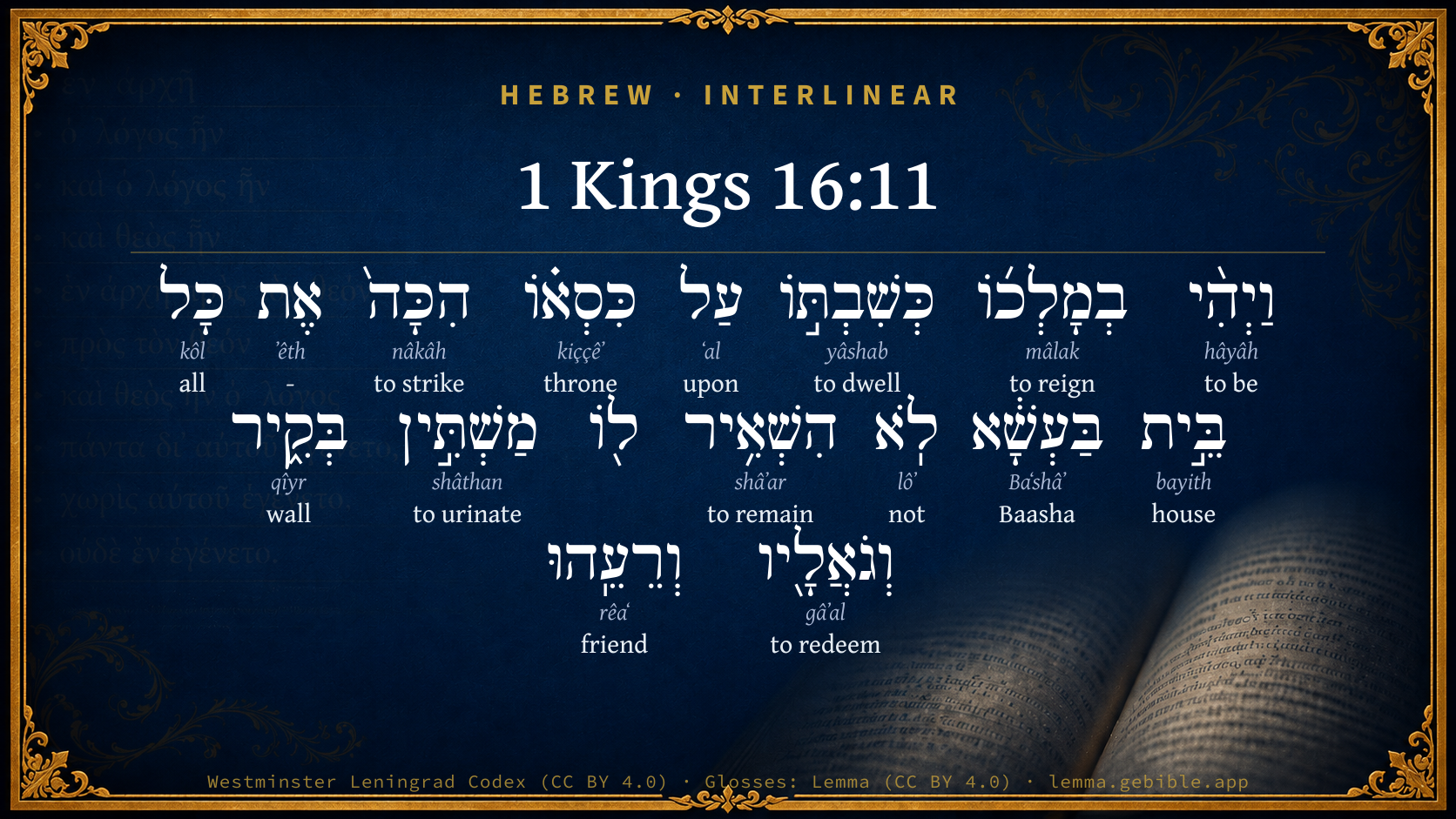
Hebrew (Westminster Leningrad Codex) 1 Kings 16:11 appears in the Hebrew Old Testament. The text above is from the Westminster Leningrad Codex. Each word links to its Strong’s number, a concise gloss, and parsing drawn from the Open Scriptures Hebrew Bible morphology. Click any word for its full Brown-Driver-Briggs (BDB) entry.
Download image
Cite this verse

1 Kings 16:11 (World English Bible). Public Domain. Lemma interlinear Bible study tool, https://lemma.gebible.app/v/1-kings/16/11.

Show BibTeX & RIS
BibTeX
RIS
English Translation
It happened, when he began to reign, as soon as he sat on his throne, that he struck all the house of Baasha: he didn't leave him a single man-child, neither of his relatives, nor of his friends.
World English Bible · Public Domain
Download a study sheet

One document with this verse’s original text, its word-by-word gloss line, the meaning frame, cross-references with their text, attributed commentary, and full source and license credits — printable, and it pastes into notes with its structure intact.

This verse Autodidact and up

Study sheet (.html) Plain text (.txt)

A passage Seminary Student

Up to 50 verses in one chapter. A passage sheet keeps up to 6 commentary sources and 12 cross-references per verse, in the order this page ranks them, and says so on the sheet whenever that leaves anything out. Ask for a single verse and you get the Autodidact verse sheet above.

Everything on this page stays free to read, with no account — the sheet is a download of what is already on screen, not access to it.

Want to remove ads? Support Godless Engineer
Compare translations 3

The same verse in 3 English versions, stacked beneath the original-language interlinear above. Click any original word for its lexicon entry.

Each is an independent rendering of the whole verse — the interlinear is not word-aligned to these translations.

Highlighted words mark where these versions differ — a whole-verse word diff, not a word-by-word alignment.

  • World English Bible Public Domain
    It happened, when he began to reign, as soon as he sat on his throne, that he struck all the house of Baasha: he didn't leave him a single man-child, neither of his relatives, nor of his friends.
  • King James Version Public Domain
    And it came to pass, when he began to reign, as soon as he sat on his throne, that he slew all the house of Baasha: he left him not one that pisseth against a wall, neither of his kinsfolk, nor of his friends.
  • unfoldingWord Literal Text CC BY-SA 4.0
    And it happened that when he reigned, as soon as he sat on his throne, he struck all of the house of Baasha. He did not leave to him one pissing against a wall, both his kinsmen and his friend.

unfoldingWord Literal Text — © unfoldingWord, licensed CC BY-SA 4.0. Word-aligned USFM3 via Door43 (git.door43.org/unfoldingWord/en_ult).

Versions to compare (up to 4)

3 of 4 selected

Show all 18 translations

Every available English version of this verse, each an independent rendering of the whole verse.

  • World English Bible Public Domain
    It happened, when he began to reign, as soon as he sat on his throne, that he struck all the house of Baasha: he didn't leave him a single man-child, neither of his relatives, nor of his friends.
  • Berean Standard Bible Public Domain
    As soon as Zimri began to reign and was seated on the throne, he struck down the entire household of Baasha. He did not leave a single male, whether a kinsman or friend.
  • Majority Standard Bible Public Domain
    As soon as Zimri began to reign and was seated on the throne, he struck down the entire household of Baasha. He did not leave a single male, whether a kinsman or friend.
  • King James Version Public Domain
    And it came to pass, when he began to reign, as soon as he sat on his throne, that he slew all the house of Baasha: he left him not one that pisseth against a wall, neither of his kinsfolk, nor of his friends.
  • American Standard Version (1901) Public Domain
    And it came to pass, when he began to reign, as soon as he sat on his throne, that he smote all the house of Baasha: he left him not a single man-child, neither of his kinsfolks, nor of his friends.
  • Revised Version (1885) Public Domain
    And it came to pass, when he began to reign, as soon as he sat on his throne, that he smote all the house of Baasha: he left him not a single man child, neither of his kinsfolks, nor of his friends.
  • Geneva Bible (1599) Public Domain
    And when he was King, and sate on his throne, he slew al the house of Baasha, not leauing thereof one to pisse against a wall, neither of his kinsfolkes nor of his friendes.
  • Douay-Rheims (1899) Public Domain
    And when he was king and sat upon his throne, he slew all the house of Baasa, and he left not one thereof to piss against a wall, and all his kinsfolks and friends.
  • Young's Literal Translation Public Domain
    and it cometh to pass in his reigning, at his sitting on his throne, he hath smitten the whole house of Baasha; he hath not left to him any sitting on the wall, and of his redeemers, and of his friends.
  • Literal Standard Version CC BY-SA 4.0
    and it comes to pass in his reigning, at his sitting on his throne, he has struck the whole house of Baasha; he has not left to him any sitting on the wall, and of his redeemers, and of his friends.
  • Unlocked Literal Bible CC BY-SA 4.0
    When Zimri began to reign and was seated on his throne, he killed all the family of Baasha. He did not leave alive a single male belonging to Baasha's relatives or friends.
  • unfoldingWord Literal Text CC BY-SA 4.0
    And it happened that when he reigned, as soon as he sat on his throne, he struck all of the house of Baasha. He did not leave to him one pissing against a wall, both his kinsmen and his friend.
  • Darby Bible Public Domain
    And it came to pass when he began to reign, as soon as he sat on his throne, he slew all the house of Baasha: he left him not a male, neither of his kinsmen nor of his friends.
  • World Messianic Bible Public Domain
    When he began to reign, as soon as he sat on his throne, he attacked all the house of Baasha. He didn’t leave him a single one who urinates on a wall among his relatives or his friends.
  • Webster's Bible Public Domain
    And it came to pass, when he began to reign, as soon as he sat on his throne, that he slew all the house of Baasha: he left him not one male, neither of his kinsman, nor of his friends.
  • Free Bible Version CC BY-SA 4.0
    As soon as he became king and was installed on his throne, he killed all of Baasha's family. He did not leave a single male alive, whether of his relatives or of his friends.
  • Bible in Basic English Public Domain
    And straight away when he became king and took his place on the seat of the kingdom, he put to death all the family of Baasha: not one male child of his relations or his friends kept his life.
  • JPS Tanakh (1917) Public Domain
    And it came to pass, when he began to reign, as soon as he sat on his throne, that he smote all the house of Baasa; he left him not a single man-child, neither of his kinsfolks, nor of his friends.

Literal Standard Version (2020), Covenant Press — licensed CC BY-SA 4.0. Text via the HelloAO Bible API (eBible.org). Unlocked Literal Bible (unfoldingWord) — licensed CC BY-SA 4.0. Text via the HelloAO Bible API (eBible.org). unfoldingWord Literal Text — © unfoldingWord, licensed CC BY-SA 4.0. Word-aligned USFM3 via Door43 (git.door43.org/unfoldingWord/en_ult). Free Bible Version, Dr. Jonathan Gallagher — licensed CC BY-SA 4.0. Text via the HelloAO Bible API (eBible.org).

Word by word

More ways to search: Search by grammar → Find every occurrence → Compare this word →

Practice this passage: Drill this verse → Learn its vocabulary →

מַשְׁתִּ֣ין
shâthan
H8366
“urinating”
Verb, Hiphil, Participle Active, Masculine, Singular, Absolute
Part of Speech
Verb
Stem
Hiphil
Form
Participle Active
Gender
Masculine
Number
Singular
State
Absolute
Full BDB Definition

Origin: a primitive root

TWOT: 2377

(Hiphil) to urinate - one who urinates (used as a designation of a male)
  1. וַיְהִ֨י hâyâh H1961 “and · to be” Conjunction + Verb, Qal, Sequential Imperfect, 3rd Person, Masculine, Singular
  2. בְמָלְכ֜וֹ mâlak H4427 “in/at · to reign · him” Preposition + Verb, Qal, Infinitive Construct + Suffix, Personal, 3rd Person, Masculine, Singular
  3. כְּשִׁבְתּ֣וֹ yâshab H3427 “like/as · to dwell · him” Preposition + Verb, Qal, Infinitive Construct + Suffix, Personal, 3rd Person, Masculine, Singular
  4. עַל ʻal H5921 “upon” Preposition
  5. כִּסְא֗וֹ kiççêʼ H3678 “throne · his” Noun, Common, Masculine, Singular, Construct + Suffix, Personal, 3rd Person, Masculine, Singular
  6. הִכָּה֙ nâkâh H5221 “to strike” Verb, Hiphil, Perfect, 3rd Person, Masculine, Singular
  7. אֶת ʼêth H853 “-” Particle, Direct Object
  8. כָּל kôl H3605 “all of” Noun, Common, Masculine, Singular, Construct
  9. בֵּ֣ית bayith H1004 “house of” Noun, Common, Masculine, Singular, Construct
  10. בַּעְשָׁ֔א Baʻshâʼ H1201 “Baasha” Noun, Proper
  11. לֹֽא lôʼ H3808 “not” Particle, Negative
  12. הִשְׁאִ֥יר shâʼar H7604 “to remain” Verb, Hiphil, Perfect, 3rd Person, Masculine, Singular
  13. בְּקִ֑יר qîyr H7023 “in/at · wall” Preposition + Noun, Common, Masculine, Singular, Absolute
  14. וְגֹאֲלָ֖יו gâʼal H1350 “and · redeeming · him” Conjunction + Verb, Qal, Participle Active, Masculine, Plural, Construct + Suffix, Personal, 3rd Person, Masculine, Singular
  15. וְרֵעֵֽהוּ rêaʻ H7453 “and · friend · his” Conjunction + Noun, Common, Masculine, Singular, Construct + Suffix, Personal, 3rd Person, Masculine, Singular

About this verse

These counts appear in no published source. They are computed here, from the morphology-tagged text and Lemma’s own curated glosses. What Lemma adds →

17
words
16
distinct lemmas
Historical
section

Notable vocabulary

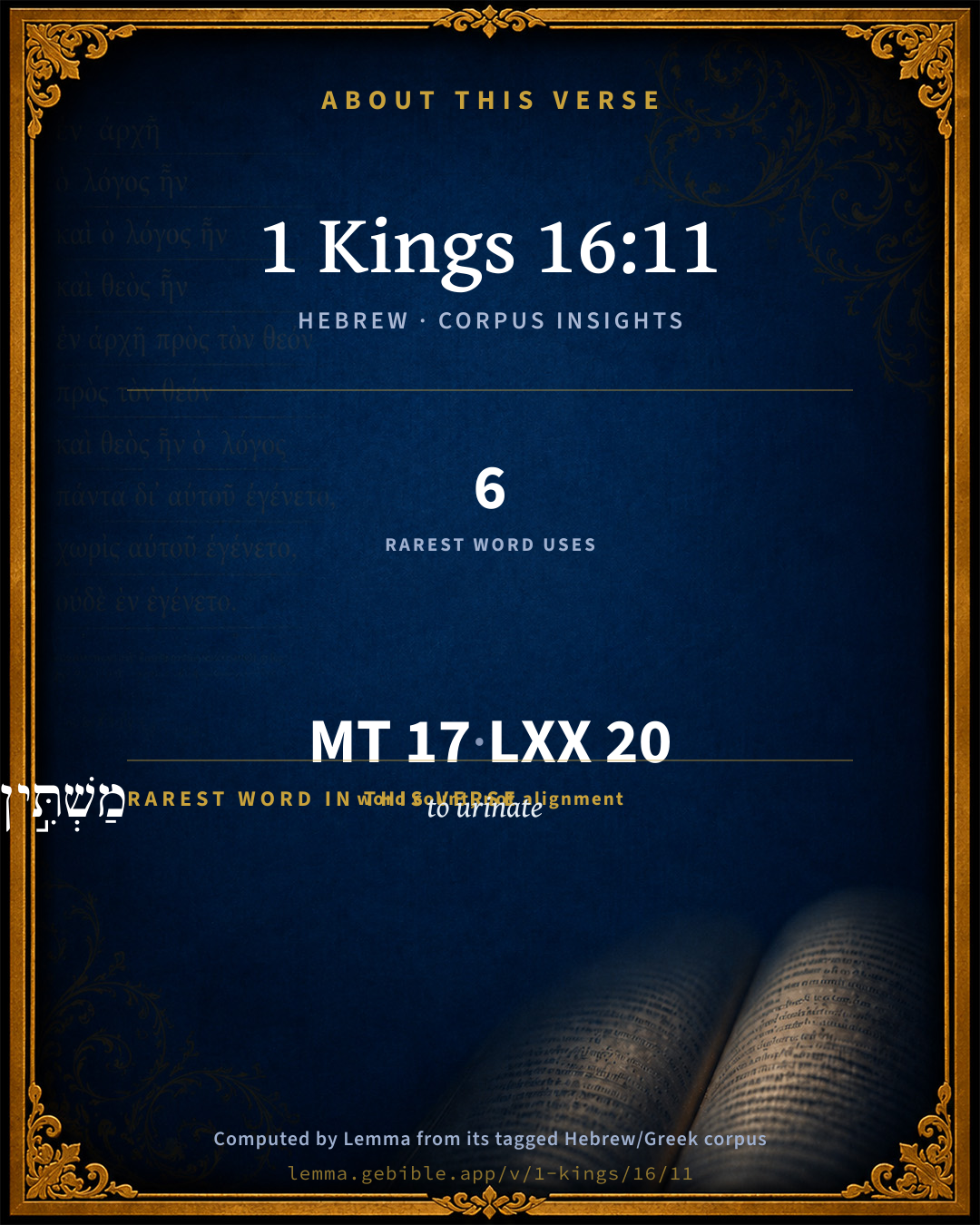
The rarest word here is מַשְׁתִּ֣ין to urinate H8366 — appearing just 6 times in the whole Hebrew Bible.

Shared distinctive vocabulary

מַשְׁתִּ֣ין to urinate H8366 occurs in 6 verses of the Hebrew Bible. Also found in:

Grammatical profile

  • 7 verbs
  • 6 nouns
  • 2 prepositions
  • 2 particles

Verb forms

  • וַיְהִ֨י Qal · Sequential Imperfect
  • בְמָלְכ֜וֹ Qal · Infinitive Construct
  • כְּשִׁבְתּ֣וֹ Qal · Infinitive Construct
  • הִכָּה֙ Hiphil · Perfect
  • הִשְׁאִ֥יר Hiphil · Perfect
  • מַשְׁתִּ֣ין Hiphil · Participle Active
  • וְגֹאֲלָ֖יו Qal · Participle Active

Hebrew & Septuagint length

In English translation the verse runs 38 words from the Hebrew and 14 from the Septuagint (LXX English) — the Septuagint runs noticeably shorter here. See the side-by-side →

A rough comparison of the two English renderings, which tokenize alike — not a word-level alignment.

Word counts can differ between the Hebrew and the Greek without any difference in meaning — e.g. the Hebrew direct-object marker אֵת has no separate Greek word, and Greek often adds the article ὁ.

In the original languages it is 17 Hebrew tokens and 20 Greek tokens — but the two are counted differently (Hebrew bundles its prefixes and suffixes into one token; the Greek is in lemma form), so that isn’t a like-for-like length.

Cross-references

6

Topical passages linked to 1 Kings 16:11 in the Treasury of Scripture Knowledge — connected by theme and wording, ordered by reader-vote popularity; previews shown in the World English Bible.

  • 1 Samuel 25:22 God do so to the enemies of David, and more also, if I leave of all that belongs to him by the morning light so much as one man-child.
  • 1 Kings 15:29 It happened that, as soon as he was king, he struck all the house of Jeroboam: he didn't leave to Jeroboam any who breathed, until he had destroyed him; according to the saying of Yahweh, which he spoke by his servant Ahijah the Shilonite;
  • 1 Kings 16:3 behold, I will utterly sweep away Baasha and his house; and I will make your house like the house of Jeroboam the son of Nebat.
  • Judges 1:7 Adoni-bezek said, "Seventy kings, having their thumbs and their great toes cut off, gathered [their food] under my table: as I have done, so God has requited me." They brought him to Jerusalem, and he died there.
  • 1 Samuel 25:34 For in very deed, as Yahweh, the God of Israel, lives, who has withheld me from hurting you, except you had hurried and come to meet me, surely there wouldn't have been left to Nabal by the morning light so much as one man-child.
  • 1 Kings 14:10 therefore, behold, I will bring evil on the house of Jeroboam, and will cut off from Jeroboam every man-child, him who is shut up and him who is left at large in Israel, and will utterly sweep away the house of Jeroboam, as a man sweeps away dung, until it be all gone.

Cross-references courtesy of OpenBible.info (CC BY 4.0).

Hebrew and Greek witnesses Masoretic Hebrew ↔ Greek Septuagint

The same verse in the two great witnesses to the Old Testament, shown verse-for-verse.

Here the Septuagint runs noticeably shorter than the Hebrew — LXX2012 (modern English Septuagint) 14 words vs World English Bible 38. A rough length comparison of the two English translations, not a word-level alignment — read both below.

These are two independent witnesses, not word-aligned to each other, and the Septuagint is shown in lemma (dictionary) form.

Hebrew 1 Kings 16:11 Masoretic · Westminster Leningrad Codex

וַיְהִ֨י בְמָלְכ֜וֹ כְּשִׁבְתּ֣וֹ עַל כִּסְא֗וֹ הִכָּה֙ אֶת כָּל בֵּ֣ית בַּעְשָׁ֔א לֹֽא הִשְׁאִ֥יר ל֖וֹ מַשְׁתִּ֣ין בְּקִ֑יר וְגֹאֲלָ֖יו וְרֵעֵֽהוּ

It happened, when he began to reign, as soon as he sat on his throne, that he struck all the house of Baasha: he didn't leave him a single man-child, neither of his relatives, nor of his friends.

World English Bible · Public Domain

Greek LXX 1 Kings 16:11 Septuagint · lemma form

καί γίγνομαι ἐν ὁ βασιλεύω αὐτός ἐν ὁ καταἵζω αὐτός ἐπί ὁ θρόνος αὐτός καί πατάσσω ὅλος ὁ οἶκος βαασα

And it came to pass when he reigned, when he sat upon his throne,

LXX2012 (modern English Septuagint) · Public Domain

On this verse, The Cambridge Bible for Schools and Colleges discusses the Septuagint’s reading. Read the note in Commentary ↓

Hebrew: Westminster Leningrad Codex (CC BY 4.0). Greek: Septuagint (public domain); English from LXX2012 (modern English Septuagint) (Public Domain). How the Septuagint differs from the Hebrew →

Targum (Aramaic paraphrase)

1

The Targum is the ancient Jewish Aramaic paraphrase of the Hebrew Scriptures — an interpretive translation, not the Hebrew text itself. Onkelos (literal) and Pseudo-Jonathan (expansive) render the Torah, and Jonathan the Prophets. Coverage is partial: where no permissively-licensed English translation exists for a verse, only the Aramaic is shown. This is verse-level text, not a word-by-word alignment to the Hebrew.

  1. Targum Jonathan Prophets (Joshua–Malachi)
    וַהֲוָה בְּמִמְלְכֵיהּ כְּמִתְבֵי עַל כּוּרְסֵיהּ קְטַל יַת כָּל בֵּית בַּעְשָׁא לָא אַשְׁאַר לֵיהּ יָדַע מַדָע וְקָרִיבוֹהִי וְחַבְרוֹהִי:

    (no public-domain English translation for this verse)

    Targum Jonathan — Aramaic: “Mikraot Gedolot” (public domain). English: “Sefaria Community Translation” (CC0 1.0 (public-domain dedication)); “London "Chaldee Paraphrase," 1871” (public domain). Text via Sefaria.

Commentary

Notes on 1 Kings 16:11 from classic Christian and Jewish commentators (each source and its license shown beneath its notes). The classic Christian expositions comment on the surrounding passage and are grouped to its opening verse, so a note may address several verses; the Jewish commentaries on the Tanakh (Rashi and others) are per-verse, so they appear only where the commentator wrote on this verse.

Lemma curates 59 commentaries, every one of them public domain or Creative Commons licensed, each selected and text-cleaned for this edition rather than reprinted as found. About our sources →

Trapp's Complete Commentary

John Trapp

1Ki 16:11 And it came to pass, when he began to reign, as soon as he sat on his throne, [that] he slew all the house of Baasha: he left him not one that pisseth against a wall, neither of his kinsfolks, nor of his friends.

Ver. 11. As soon as he sat on his throne.] He laid about him lustily: for the seven days’ space only of his reign.

Neither of his kinsfolks nor of friends.] As resolving to leave never a rub to lie in the way that might binder the true running of his bowl.

John Trapp, A Commentary or Exposition upon All the Books of the Old and New Testament (1647–1656) — public domain. Text from a community e-Sword module.

Joseph Benson's Commentary

1Ki 16:11-13. He slew all the house of Baasha, &c. — He not only destroyed all that were descended from Baasha, as Baasha had destroyed the families of Jeroboam, but he extended the destruction, and increased it, as Abarbinel speaks, for he killed all that were of kin to Baasha, with all his friends, which Baasha did not when he seized the kingdom from Jeroboam. According to the word of the Lord — Thus fulfilling the divine threatening, but undesignedly by him, and merely for his own ends. In provoking the Lord to anger with their vanities — Idols, called vanities, because they are but imaginary deities, and mere nothings, having no power to do either good or hurt.

Joseph Benson's Commentary on the Old and New Testaments (1811–1818) — public domain. Text from a community e-Sword module.

The Expositor's Bible

THE KINGS OF ISRAEL FROM ZIMRI TO AHAB

1Ki_16:11-34

As far as we can understand from our meager authorities-and we have no independent source of information-we infer that Elah, son of the powerful Baasha, was a self-indulgent weakling. The army of Israel was encamped against Gibbethon-originally a Levitical town of the Kohathites, in the territory of Dan-which they hoped to wrest from the Philistines. It was during the interminable and intermittent siege of this town that Nadab, the son of Jeroboam, had been murdered. Whatever may have been his sins, he was in his proper place leading the armies of Israel. Elah was not there, but in his beautiful palace at Tirzah. It was probably contempt for his incapacity and the bad example of Baashas successful revolt, that tempted Zimri to murder him as he was drinking himself drunk in the house of his chamberlain Arza. Zimri was a commander of half the chariots, and probably thinking that he could secure the throne by a coup de main he slew not only Elah, but every male member of his family. To extinguish any possibility: of vengeance, he even massacred all who were known to be friends of the royal house. It was a consummate crime, and it was followed by swift and condign judgment. Through that sea of blood Zimri only succeeded in wading to one weeks royalty, followed by a shameful and agonizing death. We are told that he did evil in the sight of the Lord by following the sin of Jeroboams calf-worship. The phrase must be here something of a formula, for in seven days he could hardly have achieved a religious revolution, and every other king of Israel, some of whom have long and prosperous reigns, maintained the unauthorized worship. But Zimris atrocious revolt had been so ill-considered that it furnished a proverb of the terrible fate of rebels. {2Ki_9:31} He had not even attempted to secure the assent of the army at Gibbethon. No sooner did the news reach the camp than the soldiers tumultuously refused to accept Zimri as king, and elected Omri their captain. Omri instantly broke up the camp, and led them to besiege the new king in Tirzah. Zimri saw that his cause was hopeless, and took refuge in the fortress (birah) attached to the palace. When he saw that even there he could not maintain himself, he preferred speedy death to slow starvation or falling into the hands of his rival. He set fire to the palace, and, like Sardanapalus, perished in the flames.

The swift suppression of his treason did not save the unhappy kingdom from anarchy and civil war. However popular Omri might be with the army, he was unacceptable to a large part of the people. They chose as their king a certain Tibni, son of Ginath, who was supported by a powerful brother named Joram. For four years the contest was continued. At the end of that time Tibni and Joram were conquered and killed, and Omri began his sole reign, which lasted eight years longer.

He founded the most conspicuous dynasty of Israel, and so completely identified his name with the Northern Kingdom that it was known to the Assyrians as Beit-Khumri, or "the House of Omri." They even speak of Jehu the destroyer of Omris dynasty, as "the son of Omri."

Incidental allusions in the annals of his son show that Omri was engaged in incessant wars against Syria. He was unsuccessful, and Benhadad robbed him of Ramoth Gilead and other cities, enforcing the right of Syrians to have streets of their own even in his new capital of Samaria. On the other hand, he was greatly successful on the southeast against the Moabites and their warrior-king Chemosh-Gad, the father of Mesha.

Few details of either war have come down to us. {1Ki_20:34} We learn, however, from the famous Moabite stone that he began his assault on Moab by the capture of Mediba, several miles south of Heshbon, overran the country, made the king a vassal, and imposed on Moab the enormous annual tribute of 100,000 sheep and 100,000 rams. {2Ki_3:4} Mesha in his inscription records that Omri "oppressed Moab many days," and attributed this to the fact that Chemosh was angry with his chosen people. He stamped his impress deep upon his subjects. It must have been to him that the alliance with the Tyrians was due, which in his sons reign produced consequences so momentous. He "did worse we are told than all the kings that were before him." {1Ki_16:25} Although he is only charged with walking in the way of Jeroboam, the indignant manner in which the prophet Micah speaks of "the statutes of Omri" as still being kept, {Mic_6:16} seems to prove that his influence on religion was condemned by the prophetic order on special grounds. It is clear that he was a sovereign of far greater eminence and importance than we might suppose from the meagerness of his annals as here preserved; indeed, for thirty-four years after his accession the history of the Southern Kingdom becomes a mere appendix to that of the Northern. One conspicuous service he rendered to his subjects by providing them with the city which became their permanent and famous capital. This he did in the sixth year of his reign. The burning of the fortress-palace of Tirzah, and the rapidity with which the town had succumbed to its besiegers, may have led him to look out for a site, which was central, strong, and beautiful. His choice was so prescient that the new royal residence superseded not only Penuel and Tirzah, but even Shechem. It was, says Dean Stanley, "as though Versailles had taken the place of Paris, or Windsor of London?" He fixed his eye on an oblong hill, with long flat summit, which rose in the midst of a wide valley encircled with hills, near the edge of the plain of Sharon, and six miles northwest of Shechem. Its beauty is still the admiration of the traveler in Palestine. It gave point to the apostrophe of Isaiah: "Woe to the crown of pride, to the drunkards of Ephraim, whose glorious beauty is a fading flower, which is on the head of the fat valleys of them that are overcome with wine! The crown of pride, the drunkards of Ephraim, shall be trodden under foot: and the fading flower of his glorious adornment, which is on the head of the fat valley, shall become as a fading flower and as an early fig." {Isa_28:1-4} All around it the low hills and rich ravines were clothed with fertility. They recall more nearly than any other scene in Palestine the green fields and parks of England

It commanded a full view of the sea and the plain of Sharon on the one band, and of the vale of Shechem on the other. The town sloped down from the summit of this hill; a broad wall with a terraced top ran round it. "In front of the gates was a wide open space or threshing floor, where the kings of Samaria sat on great occasions. The inferior houses were built of white brick, with rafters of sycamore, the grandeur of hewn stones and Isa_9:9-10. Its soft, rounded, oblong platform was, as it were, a vast luxurious couch, in which the nobles securely rested, propped and cushioned up on both sides, as in the cherished corner of a rich divan."

Far more important in the eyes of Omri than its beauty was the natural strength of its position. It did not possess the impregnable majesty of Jerusalem, but its height and isolation, permitting of strong fortifications, enabled it to baffle the besieging hosts of the Aramaeans in B.C. 901 and in B.C. 892. For three long years it held out against the mighty Assyrians under Sargon and Shalmanezer. Its capture in B.C. 721 involved the ruin of the whole kingdom in its fall, {1Ki_20:1; 2Ki_6:24} Nebuchadnezzar took it in B.C. 554 after a siege of thirteen years. In later centuries it partially recovered. Alexander the Great took it, and massacred many of its inhabitants B.C. 332. John Hyrcanus, who took it after a years siege, tried to demolish it in B.C. 129. After various fortunes it was splendidly rebuilt by Herod the Great, who called it Sebaste, in honor of Augustus. It still exists under the name of Sebastiyeh.

When Omri chose it for his residence it belonged to a certain Shemer, who, according to Epiphanius, was a descendant of the ancient Perizzites or Girgashites. The king paid for this hill the large sum of two talents of silver, and called it Shomeron. The name means "a watch tower," and was appropriate both from its commanding position and because it echoed the name of its old possessor.

The new capital marked a new epoch. It superseded as completely as Jerusalem had done the old local shrines endeared by the immemorial sanctity of their traditions; but as its origin was purely political it acted unfavorably on the religion of the people. It became a city of idolatry and of luxurious wealth; a city in which Baal-worship with its ritual pomp threw into the shade the worship of Jehovah; a city in which corrupted nobles, lolling at wine feasts on rich divans in their palaces inlaid with ivory, sold the righteous for silver and the needy for a pair of shoes. Of Omri we are told no more. After a reign of twelve years he slept with his fathers, and was buried in the city which was to be for so many centuries a memorial of his fame.

The name of Omri marks a new epoch. He is the first Jewish king whose name is alluded to in Assyrian inscriptions. Assyria had emerged into importance in the twelfth century before Christ under Tiglath-Pileser I, but during the eleventh and down to the middle of the tenth century it had sunk into inactivity. Assurbanipal, the father of Shalmanezer II (884-860), enlarged his dominions to the Mediterranean westwards and to Lebanon southwards. In 870, when Ahab was king, the Assyrian warriors had exacted tribute from Tyre, Sidon, and Bibles. It is not impossible that Omri also had paid tribute, and it has even been conjectured that it was to Assyrian help that he owed his throne. The Book of Kings only alludes to the valor of this warrior-king in the one word his might; but it is evident from other indications that he had a stormy and checkered reign.

William Robertson Nicoll, ed., The Expositor's Bible (London: Hodder & Stoughton, 1887–1910) — public domain. 65 of 66 books (1 Corinthians is not separately keyed, as that volume carries no machine-parseable verse references); section-level commentary keyed to the opening verse. Introductory and overview sections not keyed to a specific passage are excluded.

Tyndale Open Study Notes

Tyndale Open Resources

16:11-12 Zimri’s execution of all the family . . . relatives and friends . . . of Baasha was swift and merciless. While Zimri carried out the Lord’s sentence against the dynasty of Baasha, he doubtless did so for selfish reasons: to keep them from taking revenge on him or using their power or influence to organize their own coup.

Tyndale Open Study Notes — © Tyndale Open Resources, licensed CC BY-SA 4.0. Text via the HelloAO Bible API.

Adam Clarke's Commentary

Verse 11. He slew all the house of Baasha] He endeavoured to exterminate his race, and blot out his memory; and the Jews say, when such a matter is determined, they not only destroy the house of the person himself, but the five neighbouring houses, that the memory of such a person may perish from the earth.

Adam Clarke's Commentary on the Bible (1810–1826) — public domain. Text from a community e-Sword/MySword module.

The Cambridge Bible for Schools and Colleges

gen. ed. J. J. S. Perowne

11. that he slew] R.V. smote. The verb is the same that is constantly so rendered in all these descriptions. Zimri made a complete end, he left not a single man child.

he left … house of Baasha] All this passage is left out by the LXX.

The Cambridge Bible for Schools and Colleges (gen. ed. J. J. S. Perowne; Cambridge University Press, 1878–1918) — public domain. Text from a community e-Sword module.

John Gill's Exposition

Now the rest of the acts of Elah, and all that he did, are they not written in the book of the chronicles of the kings of Israel? See Kg1 16:5.

.

1 Kings 16:15

kg1 16:15

kg1 16:15

kg1 16:15In the twenty and seventh year of Asa king of Judah did Zimri reign seven days in Tirzah, &c. Until the army under Omri came and took the palace, and destroyed him:

and the people were encamped against Gibbethon, which belongeth to the Philistines; it was besieged in Nadab's time, but upon his death, by Baasha, the siege was raised; or however, if then taken, it was recovered by the Philistines, and now besieged again by the Israelites, see Kg1 15:27.

John Gill's Exposition of the Whole Bible (1746–1763) — public domain (CC PDM 1.0). Text via the HelloAO Bible API.

Albert Barnes' Notes on the Bible

Neither of his kinsfolks, nor of his friends - Zimri’s measures were of much more than ordinary severity. Not only was the royal family extirpated, but the friends of the king, his councillors and favorite officers, were put to death. Omri, as having been in the confidence of the late monarch, would naturally fear for himself, and resolve to take the course which promised him at least a chance of safety.

Albert Barnes' Notes on the Bible (1834–1885) — public domain. Text from a community e-Sword/MySword module.

Haydock's Catholic Bible Commentary

Wall. See 1 Kings xxv. 22. --- Friends, from whom he had any thing to fear. (Menochius)

George Leo Haydock (1774–1849), Haydock's Catholic Family Bible and Commentary, 1859 edition — public domain. Excludes Psalms (Douay-Rheims chapter numbering differs from Protestant) and Deuterocanonical books (Catholic canon only).

Matthew Poole's English Annotations

Kinsfolks, Heb. avengers; to whom it belonged to revenge his death: see Num 35:12.

Nor of his friends; his confidants and familiar acquaintance, such as were most likely to hinder his settlement in the throne, and to avenge their friend’s quarrel.

Matthew Poole's English Annotations on the Holy Bible (1683–1685) — public domain. Text from a community e-Sword/MySword module.

The Pulpit Commentary

The Reign of Zimri.

And it came to pass when he began to reign, as soon as he sate on his throne, that he slew all the house of Baasha see note on ch. 15:29. The LXX Vat. omits the rest of this verse and the first clause ofver. 12: he left him not one that pisseth against a wall i.e., not a boy. See ch. 14:10 note, neither of Heb. and his kinsfolks The laeGO is strictly the person to whom

(1) the right of redemption (Lev_25:26; Ruth, passim) and

(2) the duty of avenging blood (Num_35:19) belonged.

And this being the next of kin, (Rth_2:12, Rth_2:13) the word came to mean near relative, kinsman, as here; cf. Rth_2:20. All the same, it discloses to us Zimri"s object, which was to destroy the avenger of blood. And it shows (in connexion with ver. 16) that none of Baasha"s children, if he had other children, had gone to the war, nor of his friends. Zimri went a step farther than Baasha had gone. He was not content with extirpating the royal family, but put to death the partizans of the house, all who would be likely to sympathize with Elah or to resent his murder.

The Pulpit Commentary (1880–1919), ed. H.D.M. Spence-Jones & Joseph S. Exell — public domain. Text from a community e-Sword module.

John Wesley's Explanatory Notes

Kinfolks - Hebrew. avengers; to whom it belonged to revenge his death.

John Wesley, Explanatory Notes Upon the Whole Bible (1754–1765) — public domain. Text via the GEBible commentary corpus.

Scofield Reference Notes

C. I. Scofield

kinsfolks Heb. "goel," Redemp. (Kinsman type). (See Scofield "Isa 59:20").

The Scofield Reference Bible (1917 edition), notes by C. I. Scofield — public domain. Text from a community e-Sword module.

unfoldingWord translationNotes

Door43 World Missions Community

He did not leave alive a single male

This means that he killed all the men and boys. AT: "He did not leave even one male alive"

the word of Yahweh

"the message of Yahweh" or "Yahweh's message"

which he spoke against Baasha by Jehu the prophet

Speaking "by" a prophet represents telling a prophet to speak and the prophet speaking. AT: "that Yahweh told Jehu the prophet to speak against Baasha" (See: Idiom)

they had led Israel to sin

Leading people to do something represents influencing them to do it. AT: "they had influenced Israel to sin" (See: Metaphor)

they had led Israel to sin

Here the word "Israel" refers to the ten northern tribes of Israel. Baasha and Elah had been their king.

they provoked Yahweh, the God of Israel, to anger with their idols

God became angry with the people because they worshiped idols. The meaning of this can be made clear. AT: "they made Yahweh, the God of Israel, angry because they worshiped idols" (See: Assumed Knowledge and Implicit Information)

the God of Israel

Here the word "Israel" refers to all of the twelve tribes descended from Jacob.

translationWords

throne

life

Yahweh

God

Israel

false god

unfoldingWord translationNotes — © Distant Shores Media and the Door43 World Missions Community, licensed CC BY-SA 4.0. Source: git.door43.org/Door43/en_tn.

Rashi

Rabbi Shlomo Yitzchaki (Rashi)

Nor any of his relatives or friends. [Targum Yonoson rendered, “neither] his kinfolk nor his friends.”

Rashi on the Tanakh — English translations: “The Judaica Press complete Tanach with Rashi, translated by A. J. Rosenberg” (CC BY 4.0); “Pentateuch with Rashi's commentary by M. Rosenbaum and A.M. Silbermann, 1929-1934” (public domain); “The Metsudah Tanach series, Lakewood, N.J” (CC BY 4.0); and “The Book of Joshua, Metsudah Publications, 1997” (CC BY 4.0). Text via Sefaria.

Lesson kit

Teaching starters — assembled from the data on this page, not authored interpretation. Every prompt links to the verse data it draws on. Edit before teaching.

1 Kings, in the Historical, opens this verse with 17 words (16 distinct Hebrew lemmas). Its most distinctive word is shâthan (“to urinate”). The Greek Septuagint runs shorter here. A historical commentator’s framing appears above. Read the whole chapter for the surrounding context.

Discussion questions

  1. How does “to urinate” (shâthan) shape what this verse is saying?
  2. 1 Samuel 25:22 shares the word «to urinate» with this verse. How do the two illuminate each other?
  3. Compared with the Hebrew, the Septuagint runs shorter here. What questions does that raise?
  4. These translations render this verse differently; the difference is in the English rendering, not the original. What questions does that raise?
  5. The verb «וַיְהִ֨י» is Qal Sequential Imperfect. How does its form color the action?
  6. Reading how Trapp's Complete Commentary and Joseph Benson's Commentary read this verse, where do the two commentators agree and where do they part?

Things to notice

Reading settings

Reading text

Shown beneath each verse's original-language words.

Old Testament
Old Testament edition

Read the OT as the Masoretic Hebrew (MT) or the Greek Septuagint (LXX).

English shown for the Greek Septuagint (in the Hebrew ↔ Greek comparison).

Comparing translations? Open the Compare panel on any verse page to stack up to four side by side.