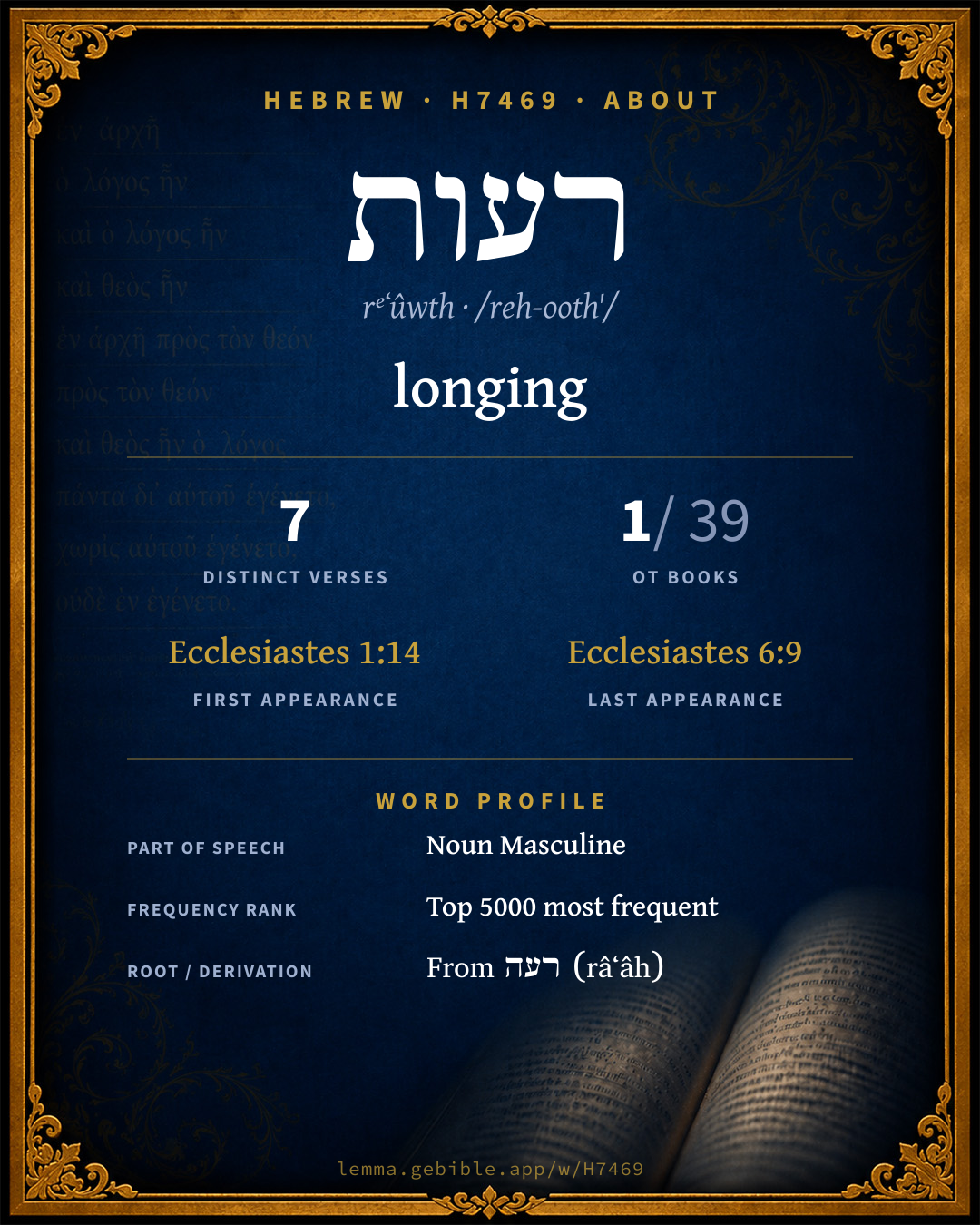
רְעוּת
longing
Full lexicon entry — Brown-Driver-Briggs (BDB)
From Brown-Driver-Briggs (BDB)
Where this word appears
Grammar key — what these labels mean
Noun type
- Common
- A common noun — a general class of person, place, or thing (“king,” “city,” “water”), not a specific name.
State
- Construct
- A noun bound to a following noun in a possessive / “of” relationship (the construct chain).
Gender
- Feminine
- Grammatically feminine.
Number
- Singular
- One.
Every verse where H7469 appears — 7 distinct verses across 1 book. Click any verse to open its interlinear word-by-word view. Verse text shown in the World English Bible for context — . Each verse’s Hebrew form is shown with its reference; the English is not keyword-highlighted, since the data carries no word-level English alignment. Use “Compare translations” on any verse to read it across multiple English versions. This concordance covers the Hebrew Bible; Septuagint (Greek Old Testament) occurrences are not indexed here.
Ecclesiastes 7 verses
- Ecclesiastes 1:14 וּ/רְע֥וּת conj + n c fs cs I have seen all the works that are done under the sun; and, behold, all is vanity and a chasing after wind.
- Ecclesiastes 2:11 וּ/רְע֣וּת conj + n c fs cs Then I looked at all the works that my hands had worked, and at the labor that I had labored to do; and, behold, all was vanity and a chasing after wind, and there was no profit under the sun.
- Ecclesiastes 2:17 וּ/רְע֥וּת conj + n c fs cs So I hated life, because the work that is worked under the sun was grievous to me; for all is vanity and a chasing after wind.
- Ecclesiastes 2:26 וּ/רְע֥וּת conj + n c fs cs For to the man who pleases him, God gives wisdom, knowledge, and joy; but to the sinner he gives travail, to gather and to heap up, that he may give to him who pleases God. This also is vanity and a chasing after wind.
- Ecclesiastes 4:4 וּ/רְע֥וּת conj + n c fs cs Then I saw all the labor and achievement that is the envy of a man's neighbor. This also is vanity and a striving after wind.
- Ecclesiastes 4:6 וּ/רְע֥וּת conj + n c fs cs Better is a handful, with quietness, than two handfuls with labor and chasing after wind.
- Ecclesiastes 6:9 וּ/רְע֥וּת conj + n c fs cs Better is the sight of the eyes than the wandering of the desire. This also is vanity and a chasing after wind.
About this entry
At a glance — auto-summarized from this page’s data, not written by a person. Every figure links to its source below. This summary describes the numbers; it doesn’t interpret them.
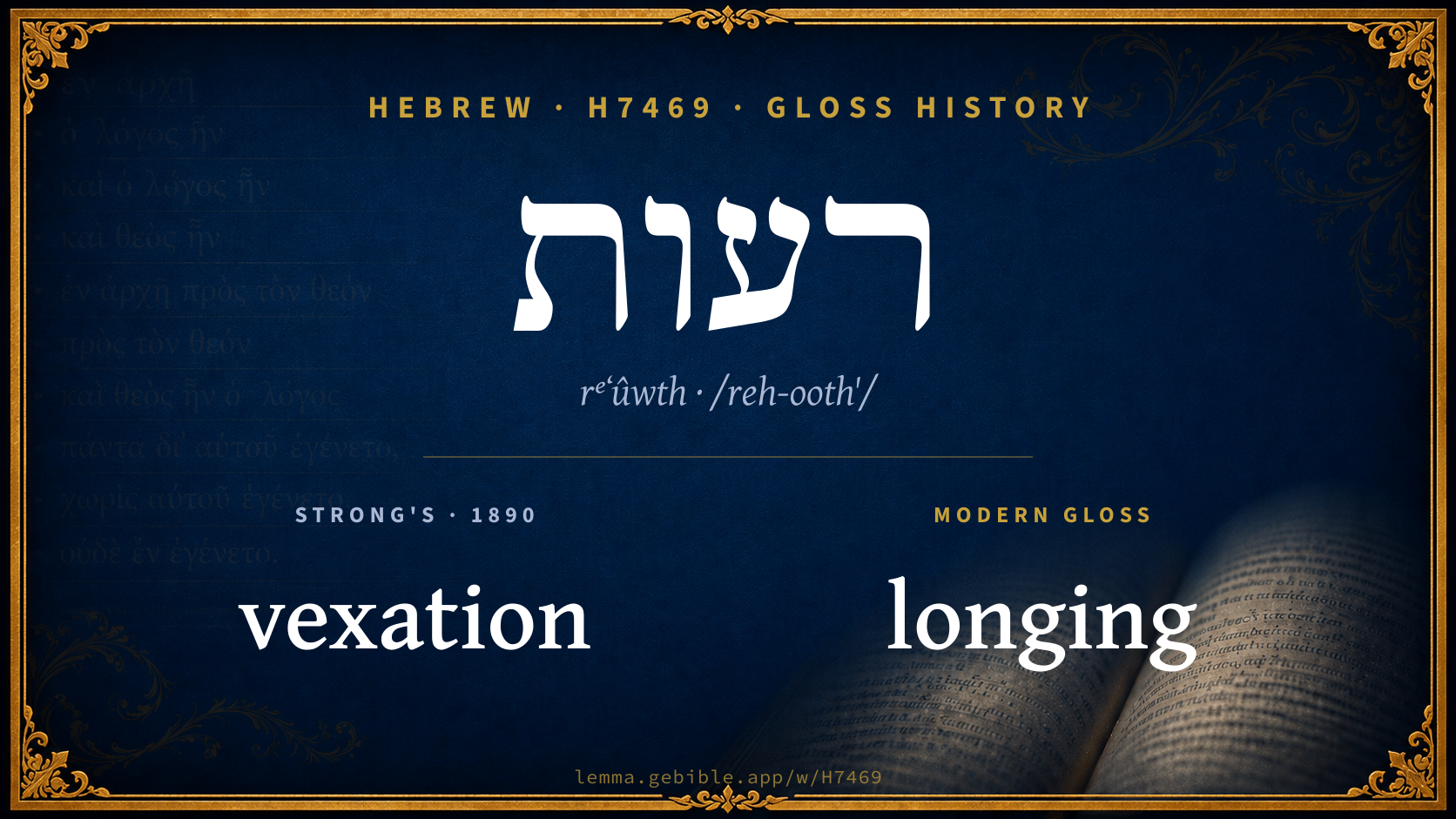
At its core, רעות (rᵉʻûwth) means “longing.” Its uses cluster heavily in Ecclesiastes (100% of all occurrences). Spanning 7 verses in 1 book, it ranks among the uncommon words of the Hebrew Bible. It first appears in Ecclesiastes 1:14. Its English rendering has broadened — “vexation” classically, “pursuit” (Berean Standard Bible) and “pursuit of” (unfoldingWord Literal Text) in modern versions; see the renderings breakdown. Each statement above links to its evidence; the full detail follows below.
Gloss history
Strong's 1890 vs modern scholarship
About this word
Strong's H7469 catalogs a Hebrew word from the Hebrew Old Testament.
These counts are not copied from any lexicon or concordance. They are computed here, from the morphology-tagged Hebrew Old Testament. What Lemma adds →
- 7
- distinct verses
- The word appears in 7 distinct verses.
- 1 / 39
- OT books
- The word appears in 1 of 39 Old Testament books.
- #2,835
- by frequency
- Top 5000 most frequent Hebrew words (rank 2,835 of 8,640 Hebrew words by occurrence).
View all 7 occurrences in the concordance →
Most concentrated in
- Ecclesiastes 7 verses 100%
By section of the Old Testament
By traditional corpus
Conventional, traditional groupings — biblical authorship is debated, so this is a traditional corpus grouping, not an authorship claim. Each share is this word’s portion of its verses in that division of the Hebrew canon. Each figure is a share of the word’s 7 distinct verses.
- Writings (Ketuvim) 7 verses · 100%
How translations render this word
Counts come from each version’s own published word-to-Strong’s tagging or interlinear alignment — an approximate guide to how each version renders this word, not a word-level alignment the data otherwise carries. Because each total is that version’s own tagged count, the per-version totals vary from one another and need not match the appearance or distinct-verse counts above. These counts may also differ from a printed concordance because Lemma counts each distinctly tagged rendering and does not collapse phrase taggings into a single head-word total. This is a fixed set of word-tagged versions (KJV, ASV, BSB, ULT) and does not change with the reading translation you choose elsewhere. Each version’s license is shown beside its name below (and on Sources).
- King James Version: Vexation 7×
- American Standard Version: Striving 4×
- Berean Standard Bible: Pursuit 7×
- unfoldingWord Literal Text: Pursuit of 7×
King James Version Public Domain
Renders H7469 across 7 tagged occurrences — most commonly:
American Standard Version Public Domain
Renders H7469 across 7 tagged occurrences — most commonly:
Plus 3 renderings that appear only once — usually multi-word phrases or single function words the recovered tagging swept in, not distinct renderings.
Berean Standard Bible Public Domain
Renders H7469 across 7 tagged occurrences — most commonly:
unfoldingWord Literal Text CC BY-SA 4.0
Renders H7469 across 7 tagged occurrences — most commonly:
Senses in BDB
The 1 sense BDB distinguishes for this word, in lexicon order (not ranked by frequency or importance). The full entry — with sub-senses — is in the Lexicon Entry tab.
- longing, striving
Word origin
רְעוּת n.f. longing, striving
— Brown-Driver-Briggs (Oxford 1906, public domain), digitized via Sefaria, supplemented by the OpenScriptures HebrewLexicon (CC BY 4.0). See Sources.
Derived from רעה (râʻâh) (H7462) — to shepherd.
Jastrow Dictionary
A second Hebrew/Aramaic lexicon for comparison, covering Aramaic and post-biblical (Talmudic, Targumic, Midrashic) usage that the biblical-Hebrew BDB does not. Matched by lemma rather than by Strong’s number, so a lemma may carry more than one Jastrow headword (shown separately below), and the entries cover usage well beyond the Bible.
רֵיעוּת
- (denom. of רֵיעַ) friendship, sociability. Y. Ber. IV, 7ᵈ bot. Keth. 8ᵃ. Yeb. 14ᵇ חיבה ור׳ … זה בזה they (the Hillelites and the Shammaites) lived with one another in love and friendship; a. e.
רַע I
- [shaken,] weak, sick; bad; (noun) evil. Ber. 7ᵃ מפני מה … ורע לו why is there a righteous man who fares well, and another righteous man who fares badly? Ib. 23ᵃ (ref. to Koh. IV, 17) בין טוב לרע וכ׳ they cannot distinguish between good and evil, and want to offer a sacrifice before me? Kidd. 40ᵃ (ref. to Is. III, 11) וכי יש רשע רע ויש שאינו רע is there a bad wicked man and a wicked man that is not bad?; רע לשמים ורע לבריות וכ׳ one bad in his relation to heaven (irreligious) and bad to men is a bad wicked man &c. Ohol. XVIII, 6 שכחן רע whose strength is feeble, v. כֹּחַ. Ab. II, 9 חבר רע a bad companion; לב רע a bad heart; a. v. fr.—Fem. רָעָה bad; (noun) evil. Ib., a. fr. עין ר׳, v. עַיִן. Sabb. 11ᵃ כל ד׳ ולא אשה ר׳ any evil, only not a bad wife. Ber. 61ᵃ אחת … ואחת יועצתו לר׳ one (kidney) counsels for good, the other for evil. Y. Shek. I, beg. 45ᵈ לטובה … לר׳ וכ׳ for a good purpose—‘every liberal-hearted’ (Ex. XXXV, 22), for a bad purpose—‘the whole people’ (ib. XXXII, 3). Hor. 10ᵇ אפי׳ טובתם … ר׳ היא וכ׳ even the good which wicked men do is an evil with the righteous (they do not enjoy it); Yeb. 103ᵃ sq. Koh. R. to V, 12, v. חוֹלָה I. Ber. l. c. (ref. to Koh. IV, 17) אל תהי … אם על ר׳ הם מביאים be not like the fools who sin and offer a sacrifice, not knowing whether they offer it for the good they have done or for the evil; a. v. fr.—Pl. רָעִים; רָעוֹת. Keth. 110ᵇ (quot. fr. Ben Sira) כל ימי עני ר׳ all the days of a poor man are bad; Snh. 101ᵃ. Y. Ber. V, 8ᵈ bot., v. חָצַף. Ex. R. s. 42 (ref. to Jer. II, 13) ושתי ר׳ עשו לבד have they committed no more than two evils?; a. v. fr. e.g. Ecclesiastes 4:17
רְעוּת
- (v. רֵעַ) friend, neighbor; another. Pirké d’R. El. ch. XXXIV ואבני … אשה מאת רְעוּתָהּ and the gravestones are separated from one another.
רֵעוּת
- , v. sub. רֵיע׳.
A Dictionary of the Targumim, the Talmud Babli and Yerushalmi, and the Midrashic Literature (Marcus Jastrow; London, Luzac, 1903) — Public Domain. Digitized via Sefaria. Digitized via Sefaria. Full attribution on Sources.
Forms in the corpus
The 2 distinct written forms H7469 takes in the Hebrew Bible, most frequent first — each parse links to that state’s occurrences in the concordance. Hebrew forms include their vowel points and cantillation, so a single lemma takes many written forms.
| Form | Parsing | Example | Uses |
|---|---|---|---|
| וּ/רְע֥וּת | Noun, Common, Feminine, Singular, Construct | Ecclesiastes 1:14 | 6 |
| וּ/רְע֣וּת | Noun, Common, Feminine, Singular, Construct | Ecclesiastes 2:11 | 1 |
Same root — word family
Other BDB entries built from the same root as H7469, grouped by Strong’s listed origin. These share a root / origin per the lexicon — not necessarily a shared meaning. Each links to that word’s own entry.
Derives from
Shares the same root
- מרע mêrêaʻ H4828 friend
- מרעה mirʻeh H4829 pasture
- מרעית mirʻîyth H4830 pasturage
- רע rêaʻ H7453 friend
- רע rêaʻ H7454 thought
- רעה rêʻeh H7463 friend
- רעות rᵉʻûwth H7468 companion
- רעי rᵉʻîy H7471 pasture
- רעי rôʻîy H7473 shepherd
- רעיון raʻyôwn H7475 longing
Derived from this word
Compare all same-root words → Showing 4 of 13 — not the complete family. They share a root, not necessarily a meaning.
Septuagint verse parallels
This word appears in 7 verses that also exist in the Greek Old Testament (Septuagint), out of the 7 Hebrew verses it occurs in. You can read those verses in Greek by switching the Old Testament edition to the Septuagint.
Read these verses in the Septuagint
This is a verse-level parallel only — the same verses exist in both the Hebrew and Greek Old Testaments. No word-level Hebrew↔Greek correspondence is claimed: the data carries no such alignment, so no Greek word is shown as this Hebrew word’s translation. Coverage is not total — the Septuagint omits the deuterocanon and renumbers the Psalms, so some Hebrew verses have no direct Greek parallel.