
Deuteronomy 19:11

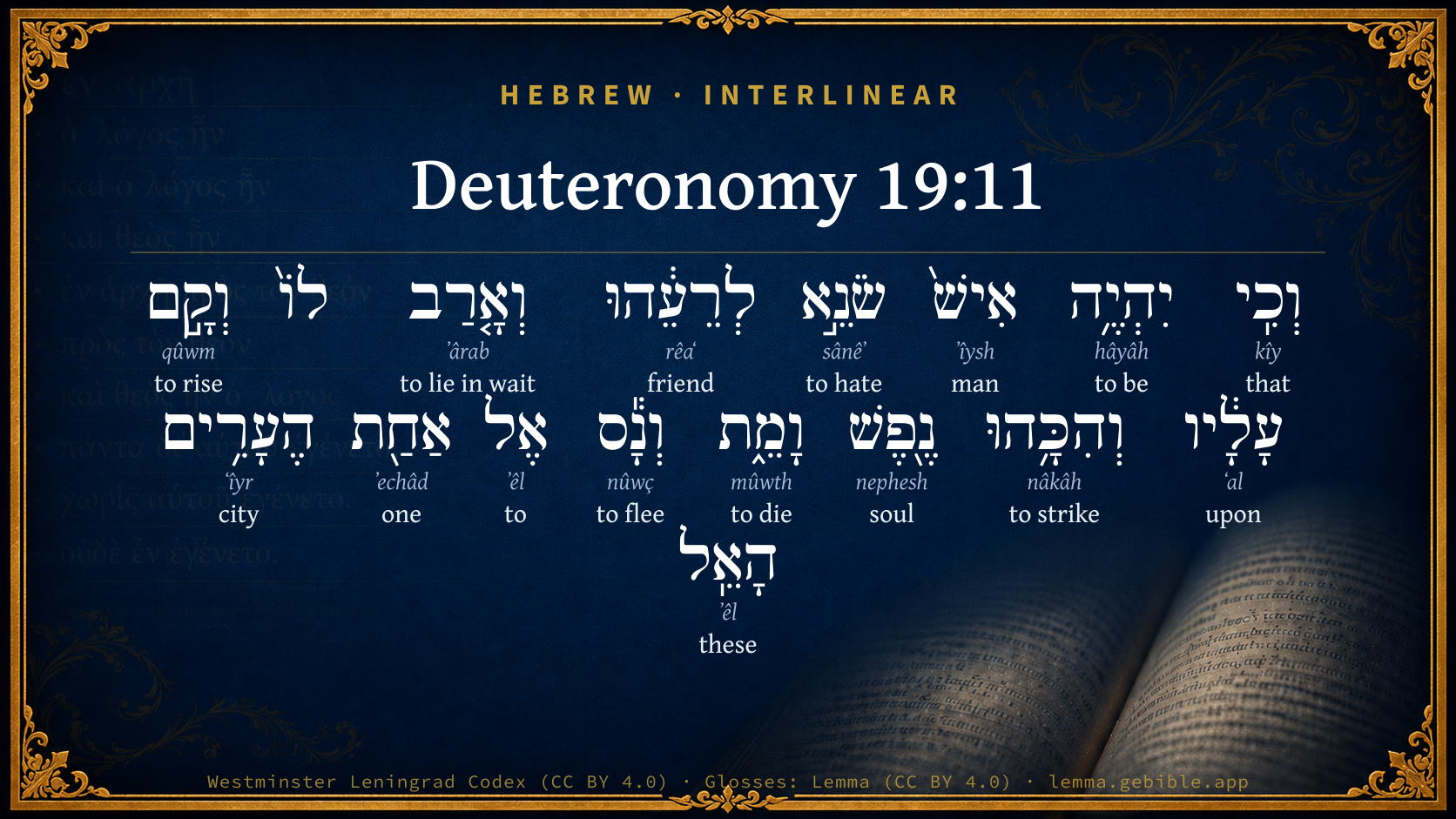
Hebrew (Westminster Leningrad Codex) Deuteronomy 19:11 appears in the Hebrew Old Testament. The text above is from the Westminster Leningrad Codex. Each word links to its Strong’s number, a concise gloss, and parsing drawn from the Open Scriptures Hebrew Bible morphology. Click any word for its full Brown-Driver-Briggs (BDB) entry.
Download image
Cite this verse

Deuteronomy 19:11 (World English Bible). Public Domain. Lemma interlinear Bible study tool, https://lemma.gebible.app/v/deuteronomy/19/11.

Show BibTeX & RIS
BibTeX
RIS
English Translation
But if any man hate his neighbor, and lie in wait for him, and rise up against him, and strike him mortally so that he dies, and he flee into one of these cities;
World English Bible · Public Domain
Highlights
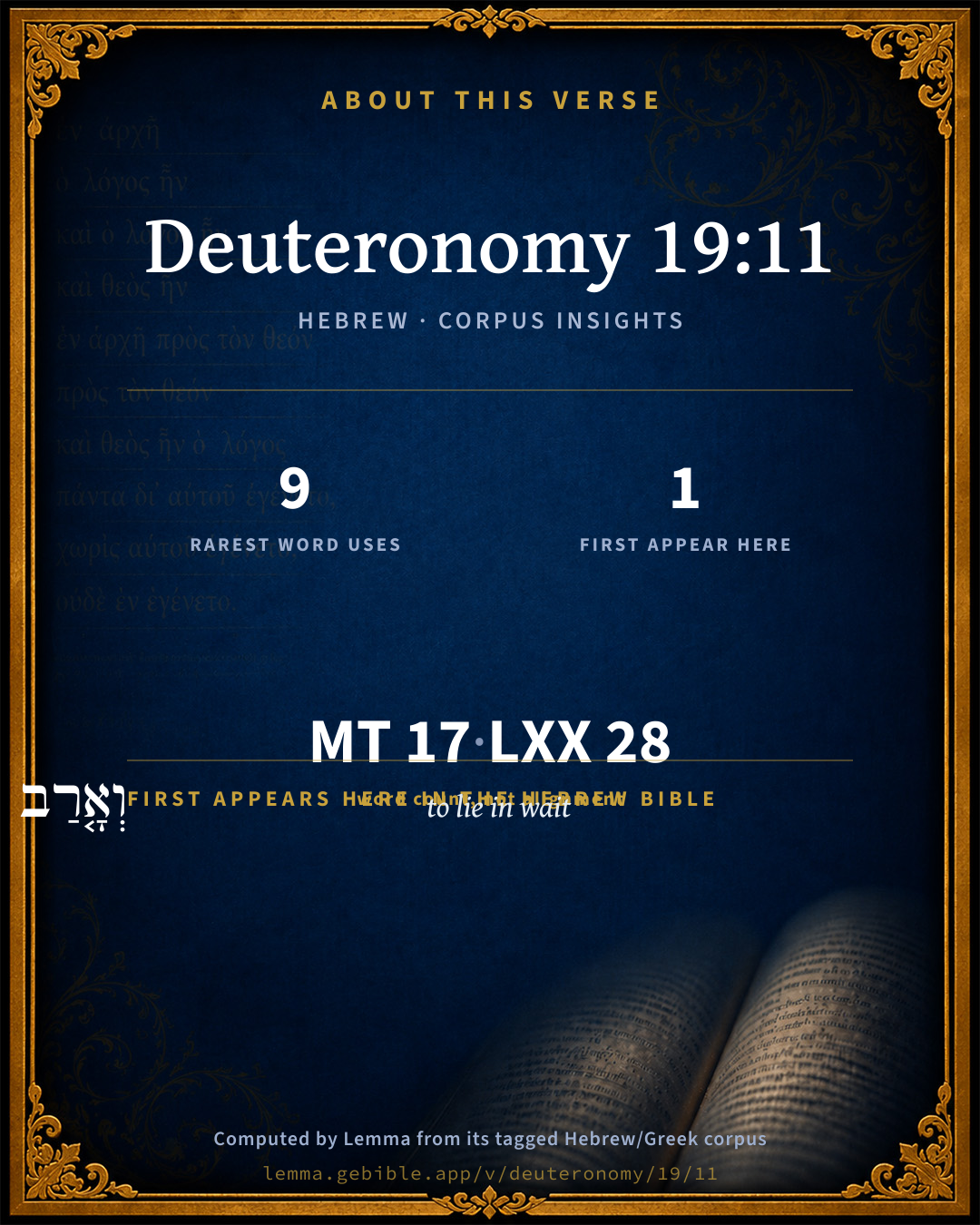
  • 1 first appearance in the Hebrew Bible
Full analysis ↓
Download a study sheet

One document with this verse’s original text, its word-by-word gloss line, the meaning frame, cross-references with their text, attributed commentary, and full source and license credits — printable, and it pastes into notes with its structure intact.

This verse Autodidact and up

Study sheet (.html) Plain text (.txt)

A passage Seminary Student

Up to 50 verses in one chapter. A passage sheet keeps up to 6 commentary sources and 12 cross-references per verse, in the order this page ranks them, and says so on the sheet whenever that leaves anything out. Ask for a single verse and you get the Autodidact verse sheet above.

Everything on this page stays free to read, with no account — the sheet is a download of what is already on screen, not access to it.

Want to remove ads? Support Godless Engineer
Compare translations 3

The same verse in 3 English versions, stacked beneath the original-language interlinear above. Click any original word for its lexicon entry.

Each is an independent rendering of the whole verse — the interlinear is not word-aligned to these translations.

Highlighted words mark where these versions differ — a whole-verse word diff, not a word-by-word alignment.

  • World English Bible Public Domain
    But if any man hate his neighbor, and lie in wait for him, and rise up against him, and strike him mortally so that he dies, and he flee into one of these cities;
  • King James Version Public Domain
    But if any man hate his neighbor, and lie in wait for him, and rise up against him, and smite him mortally that he die, and fleeth into one of these cities:
  • unfoldingWord Literal Text CC BY-SA 4.0
    And if there is a man who hates his neighbor and ambushes him and rises up against him and strikes him the life, and he dies, and he flees into one of these cities,

unfoldingWord Literal Text — © unfoldingWord, licensed CC BY-SA 4.0. Word-aligned USFM3 via Door43 (git.door43.org/unfoldingWord/en_ult).

Versions to compare (up to 4)

3 of 4 selected

Show all 18 translations

Every available English version of this verse, each an independent rendering of the whole verse.

  • World English Bible Public Domain
    But if any man hate his neighbor, and lie in wait for him, and rise up against him, and strike him mortally so that he dies, and he flee into one of these cities;
  • Berean Standard Bible Public Domain
    If, however, a man hates his neighbor and lies in wait, attacks him and kills him, and then flees to one of these cities,
  • Majority Standard Bible Public Domain
    If, however, a man hates his neighbor and lies in wait, attacks him and kills him, and then flees to one of these cities,
  • King James Version Public Domain
    But if any man hate his neighbor, and lie in wait for him, and rise up against him, and smite him mortally that he die, and fleeth into one of these cities:
  • American Standard Version (1901) Public Domain
    But if any man hate his neighbor, and lie in wait for him, and rise up against him, and smite him mortally so that he dieth, and he flee into one of these cities;
  • Revised Version (1885) Public Domain
    But if any man hate his neighbour, and lie in wait for him, and rise up against him, and smite him mortally that he die; and he flee into one of these cities:
  • Geneva Bible (1599) Public Domain
    But if a man hate his neighbour, and lay waite for him, and rise against him, and smite any man that he die, and flee vnto any of these cities,
  • Douay-Rheims (1899) Public Domain
    But if any man hating his neighbour, lie in wait for his life, and rise and strike him, and he die, and he flee to one of the cities aforesaid,
  • Young's Literal Translation Public Domain
    `And when a man is hating his neighbour, and hath lain in wait for him, and risen against him, and smitten him -- the life, and he hath died, and he hath fled unto one of these cities,
  • Literal Standard Version CC BY-SA 4.0
    And when a man is hating his neighbor, and has lain in wait for him, and risen against him, and struck his life, and he has died, then he has fled to one of these cities,
  • Unlocked Literal Bible CC BY-SA 4.0
    But if anyone hates his neighbor, lies in wait for him, rises up against him, and mortally wounds him so that he dies, and if he then flees into one of these cities—
  • unfoldingWord Literal Text CC BY-SA 4.0
    And if there is a man who hates his neighbor and ambushes him and rises up against him and strikes him the life, and he dies, and he flees into one of these cities,
  • Darby Bible Public Domain
    But if a man hate his neighbour, and lie in wait for him, and rise up against him, and smite him mortally that he die, and he flee into one of these cities,
  • World Messianic Bible Public Domain
    But if any man hates his neighbor, lies in wait for him, rises up against him, strikes him mortally so that he dies, and he flees into one of these cities;
  • Webster's Bible Public Domain
    But if any man shall hate his neighbor, and lie in wait for him, and rise up against him, and smite him mortally, that he dieth, and he shall flee into one of these cities:
  • Free Bible Version CC BY-SA 4.0
    On the other hand, if a man hates someone, hides in wait, and attacks and kills them, and then the killer runs to one of the sanctuary towns,
  • Bible in Basic English Public Domain
    But if any man has hate for his neighbour, and waiting for him secretly makes an attack on him and gives him a blow causing his death, and then goes in flight to one of these towns;
  • JPS Tanakh (1917) Public Domain
    But if any man hate his neighbour, and lie in wait for him, and rise up against him, and smite him mortally that he die; and he flee into one of these cities;

Literal Standard Version (2020), Covenant Press — licensed CC BY-SA 4.0. Text via the HelloAO Bible API (eBible.org). Unlocked Literal Bible (unfoldingWord) — licensed CC BY-SA 4.0. Text via the HelloAO Bible API (eBible.org). unfoldingWord Literal Text — © unfoldingWord, licensed CC BY-SA 4.0. Word-aligned USFM3 via Door43 (git.door43.org/unfoldingWord/en_ult). Free Bible Version, Dr. Jonathan Gallagher — licensed CC BY-SA 4.0. Text via the HelloAO Bible API (eBible.org).

Word by word

More ways to search: Search by grammar → Find every occurrence → Compare this word →

Practice this passage: Drill this verse → Learn its vocabulary →

הָאֵֽל
ʼêl
H411
“the · these”
Particle, Definite Article + Pronoun, Demonstrative, Common, Plural
Part of Speech
Particle + Pronoun
Type
Demonstrative
Gender
Common
Number
Plural
Full BDB Definition

Origin: a demonstrative particle (only in a plural sense)

TWOT: 92

these, those
  1. וְכִֽי kîy H3588 “and · that” Conjunction + Conjunction
  2. יִהְיֶ֥ה hâyâh H1961 “to be” Verb, Qal, Imperfect, 3rd Person, Masculine, Singular
  3. אִישׁ֙ ʼîysh H376 “man” Noun, Common, Masculine, Singular, Absolute
  4. שֹׂנֵ֣א sânêʼ H8130 “hating” Verb, Qal, Participle Active, Masculine, Singular, Absolute
  5. לְרֵעֵ֔הוּ rêaʻ H7453 “to/for · friend · his” Preposition + Noun, Common, Masculine, Singular, Construct + Suffix, Personal, 3rd Person, Masculine, Singular
  6. וְאָ֤רַב ʼârab H693 “and · to lie in wait” Conjunction + Verb, Qal, Sequential Perfect, 3rd Person, Masculine, Singular
  7. וְקָ֣ם qûwm H6965 “and · to rise” Conjunction + Verb, Qal, Sequential Perfect, 3rd Person, Masculine, Singular
  8. עָלָ֔יו ʻal H5921 “upon · him” Preposition + Suffix, Personal, 3rd Person, Masculine, Singular
  9. וְהִכָּ֥הוּ nâkâh H5221 “and · to strike · him” Conjunction + Verb, Hiphil, Sequential Perfect, 3rd Person, Masculine, Singular + Suffix, Personal, 3rd Person, Masculine, Singular
  10. נֶ֖פֶשׁ nephesh H5315 “soul” Noun, Common, Both, Singular, Absolute
  11. וָמֵ֑ת mûwth H4191 “and · to die” Conjunction + Verb, Qal, Sequential Perfect, 3rd Person, Masculine, Singular
  12. וְנָ֕ס nûwç H5127 “and · to flee” Conjunction + Verb, Qal, Sequential Perfect, 3rd Person, Masculine, Singular
  13. אֶל ʼêl H413 “to” Preposition
  14. אַחַ֖ת ʼechâd H259 “one” Adjective, Cardinal number, Feminine, Singular, Absolute
  15. הֶעָרִ֥ים ʻîyr H5892 “the · cities” Particle, Definite Article + Noun, Common, Feminine, Plural, Absolute

About this verse

These counts appear in no published source. They are computed here, from the morphology-tagged text and Lemma’s own curated glosses. What Lemma adds →

17
words
16
distinct lemmas
Pentateuch
section

Notable vocabulary

The rarest word here is הָאֵֽל these H411 — appearing just 9 times in the whole Hebrew Bible.

First appearance in Scripture

This word makes its first canonical appearance in the Hebrew Bible here:

  • וְאָ֤רַב to lie in wait H693

Shared distinctive vocabulary

הָאֵֽל these H411 occurs in 9 verses of the Hebrew Bible. Also found in:

Grammatical profile

  • 7 verbs
  • 4 nouns
  • 1 adjective
  • 1 pronoun
  • 3 prepositions
  • 1 conjunction

Verb forms

  • יִהְיֶ֥ה Qal · Imperfect
  • שֹׂנֵ֣א Qal · Participle Active
  • וְאָ֤רַב Qal · Sequential Perfect
  • וְקָ֣ם Qal · Sequential Perfect
  • וְהִכָּ֥הוּ Hiphil · Sequential Perfect
  • וָמֵ֑ת Qal · Sequential Perfect
  • וְנָ֕ס Qal · Sequential Perfect

Hebrew & Septuagint length

In English translation the verse runs 34 words from the Hebrew and 39 from the Septuagint (LXX English) — closely comparable.

A rough comparison of the two English renderings, which tokenize alike — not a word-level alignment.

Word counts can differ between the Hebrew and the Greek without any difference in meaning — e.g. the Hebrew direct-object marker אֵת has no separate Greek word, and Greek often adds the article ὁ.

In the original languages it is 17 Hebrew tokens and 28 Greek tokens — but the two are counted differently (Hebrew bundles its prefixes and suffixes into one token; the Greek is in lemma form), so that isn’t a like-for-like length.

Cross-references

6

Topical passages linked to Deuteronomy 19:11 in the Treasury of Scripture Knowledge — connected by theme and wording, ordered by reader-vote popularity; previews shown in the World English Bible.

  • Numbers 35:16–21 But if he struck him with an instrument of iron, so that he died, he is a murderer: the murderer shall surely be put to death.
  • Deuteronomy 27:24 Cursed be he who strikes his neighbor in secret. All the people shall say, Amen.
  • Genesis 9:6 Whoever sheds man's blood, by man will his blood be shed, for in the image of God made he man.
  • Exodus 21:12–14 "One who strikes a man so that he dies shall surely be put to death,
  • Numbers 35:24 then the congregation shall judge between the striker and the avenger of blood according to these ordinances;
  • Proverbs 28:17 A man who is tormented by life blood will be a fugitive until death; No one will support him.

Cross-references courtesy of OpenBible.info (CC BY 4.0).

Hebrew and Greek witnesses Masoretic Hebrew ↔ Greek Septuagint

The same verse in the two great witnesses to the Old Testament, shown verse-for-verse.

These are two independent witnesses, not word-aligned to each other, and the Septuagint is shown in lemma (dictionary) form.

Hebrew Deuteronomy 19:11 Masoretic · Westminster Leningrad Codex

וְכִֽי יִהְיֶ֥ה אִישׁ֙ שֹׂנֵ֣א לְרֵעֵ֔הוּ וְאָ֤רַב לוֹ֙ וְקָ֣ם עָלָ֔יו וְהִכָּ֥הוּ נֶ֖פֶשׁ וָמֵ֑ת וְנָ֕ס אֶל אַחַ֖ת הֶעָרִ֥ים הָאֵֽל

But if any man hate his neighbor, and lie in wait for him, and rise up against him, and strike him mortally so that he dies, and he flee into one of these cities;

World English Bible · Public Domain

Greek LXX Deuteronomy 19:11 Septuagint · lemma form

ἐάν δέ γίγνομαι ἄνθρωπος μισέω ὁ πλησίον καί ἐνεδρεύω αὐτός καί ἐπι ἀναἵστημι ἐπί αὐτός καί πατάσσω αὐτός ψυχή καί ἀποθνήσκω καί φεύγω εἰς εἷς ὁ πόλις οὗτος

But if there should be in you a man hating his neighbor, and he should lay wait for him, and rise up against him, and strike him, that he die, and he should flee to one of these cities,

LXX2012 (modern English Septuagint) · Public Domain

Hebrew: Westminster Leningrad Codex (CC BY 4.0). Greek: Septuagint (public domain); English from LXX2012 (modern English Septuagint) (Public Domain). How the Septuagint differs from the Hebrew →

Targum (Aramaic paraphrase)

2

The Targum is the ancient Jewish Aramaic paraphrase of the Hebrew Scriptures — an interpretive translation, not the Hebrew text itself. Onkelos (literal) and Pseudo-Jonathan (expansive) render the Torah, and Jonathan the Prophets. Coverage is partial: where no permissively-licensed English translation exists for a verse, only the Aramaic is shown. This is verse-level text, not a word-by-word alignment to the Hebrew.

  1. Targum Onkelos Torah (Genesis–Deuteronomy)
    וַאֲרֵי יְהֵי גְבַר סָנֵי לְחַבְרֵהּ וְיִכְמַן לֵהּ וִיקוּם עֲלוֹהִי וְיִמְחִנֵהּ נְפָשׁ וִימוּת וְיֵעִרוֹק לַחֲדָא מִן קִרְוַיָא הָאִלֵין

    (no public-domain English translation for this verse)

    Targum Onkelos — Aramaic: “Onkelos Genesis” (public domain); “Onkelos Exodus” (public domain); “Onkelos Leviticus” (public domain); “Onkelos Numbers” (public domain); “Onkelos Deuteronomy” (public domain). English: “Sefaria Community Translation” (CC0 1.0 (public-domain dedication)); “J.W. Etheridge. The Targums of Onkelos and Jonathan Ben Uzziel on the Pentateuch. London: Longmans, Green, 1862” (public domain). Text via Sefaria.

  2. Targum Pseudo-Jonathan Torah (Genesis–Deuteronomy)
    וַאֲרוּם יְהֵי גְּבַר סָנֵי לְחַבְרֵיהּ וְיִכְמוֹן עֲלֵיהּ בְּטוּמְרָא וִיקוּם עֲלוֹי וְיִקְטְלִינֵיהּ נְפָשׁ וִימוּת וְיַעֲרוֹק לַחֲדָא מִן קִרְוַיָא הָאִלֵּין

    But if a man with enmity against his neighbour shall lay wait for him in secret, to destroy his life, and he die, then should he flee into one of those cities,

    Targum Pseudo-Jonathan — Aramaic: “Targum Jonathan on Genesis” (public domain); “Targum Jonathan on Exodus” (public domain); “Targum Jonathan on Leviticus” (public domain); “Targum Jonathan on Numbers” (public domain); “Targum Jonathan on Deuteronomy” (public domain). English: “The Targum of Jonathan ben Uzziel, trans. J. W. Etheridge, London, 1862” (public domain). Text via Sefaria.

Commentary

Notes on Deuteronomy 19:11 from classic Christian and Jewish commentators (each source and its license shown beneath its notes). The classic Christian expositions comment on the surrounding passage and are grouped to its opening verse, so a note may address several verses; the Jewish commentaries on the Tanakh (Rashi and others) are per-verse, so they appear only where the commentator wrote on this verse.

Lemma curates 59 commentaries, every one of them public domain or Creative Commons licensed, each selected and text-cleaned for this edition rather than reprinted as found. About our sources →

Trapp's Complete Commentary

John Trapp

Deu 19:11 But if any man hate his neighbour, and lie in wait for him, and rise up against him, and smite him mortally that he die, and fleeth into one of these cities:

Ver. 11. But if any man hate his neighbour.] As Cain did Abel, as Esau Jacob, as Absalom Amnon; as Dr Story did Queen Elizabeth, whom he cursed daily in his grace at board; {a} as Tyrone did the English, strangling some of his own men for no other reason but because they fed on English bread; howbeit he never spake of the queen but with honour; yea, the profane wretch styled himself cousin to God, enemy to all the world, and friend to the Queen of England. {b}

{a} A.D. 1567. - Ibid.

{b} Speed.

John Trapp, A Commentary or Exposition upon All the Books of the Old and New Testament (1647–1656) — public domain. Text from a community e-Sword module.

Tyndale Open Study Notes

Tyndale Open Resources

19:11 The Hebrew term rendered is hostile (literally is a hater) indicates a constant and long-standing hateful attitude, which constituted evidence that the killer was predisposed to commit a crime and therefore probably did it.

Tyndale Open Study Notes — © Tyndale Open Resources, licensed CC BY-SA 4.0. Text via the HelloAO Bible API.

Adam Clarke's Commentary

Verse 11. If any man hate his neighbour] See Clarke on Ex 21:13.

Adam Clarke's Commentary on the Bible (1810–1826) — public domain. Text from a community e-Sword/MySword module.

The Cambridge Bible for Schools and Colleges

gen. ed. J. J. S. Perowne

11. But if any man hate his neighbour, etc.] The wilful murderer must not escape through the provision of protection for the innocent slayer.

and lie in wait] Cp. E, Exo_21:14. For mortally see Deu_19:6.

The Cambridge Bible for Schools and Colleges (gen. ed. J. J. S. Perowne; Cambridge University Press, 1878–1918) — public domain. Text from a community e-Sword module.

John Gill's Exposition

Then the elders of his city shall send and fetch him thence,.... The Targum of Jonathan is,"the wise men of his city,''the sanhedrim, or court of judicature, or at least the civil magistrates of that city, to which such a murderer belonged, had a power to send to the city of refuge whither he was fled, and demand the delivering of him up to them, that his case might be tried before them, and it might appear whether he was a proper person to receive the benefit of the city of refuge or not, and if not, to pass sentence of death upon him, and see it executed as follows:

and deliver him into the hand of the avenger of blood, that he may die; that is, after the examination and trial of him, and when he is found guilty, and sentence is passed upon him, then he was to be delivered into the hands of the avenger of blood, to be the executioner of that sentence.

John Gill's Exposition of the Whole Bible (1746–1763) — public domain (CC PDM 1.0). Text via the HelloAO Bible API.

Whedon's Commentary on the Bible

Daniel D. Whedon

11-13. But if any man hate — The appointment of cities of refuge was a merciful provision for the security of those who unintentionally should shed blood. The usage in the time of Moses evidently was the carrying out rigorously the law of retaliation. But if life had been taken without malice this provision for cities of refuge afforded a place of escape from the avenger of blood. But they were not to be places of refuge for murderers. They were not to protect those who had slain their fellow-men through hatred or for gain. Such guilty ones were to be taken from the cities by the magistrates and given up to the avenger of blood. Human life was sacred among the Hebrews. We see how carefully it was protected, how stringent was the legislation. Moses made provision for the protection of property also.

Daniel D. Whedon (gen. ed.), Commentary on the Old and New Testaments (1874–1909) — public domain. Text from a community e-Sword module.

The Pulpit Commentary

Vers. 11-13. These cities, however, were not to be places of refuge for murderers, for those who from hatred and with wicked intent had slain others; if such fled to one of these cities, they were not to be suffered to remain there; the elders of their own city were to require them to be delivered up, that the avenger might put them to death. (Num_35:16-33, etc.) In the earlier legislation, it is enacted that the congregation shall judge in such matters, and that by their decision it should be determined in any case whether the person who had slain another was to be allowed to remain in a city of refuge or be delivered over to the avenger of blood. With this the ordinance here is not inconsistent; the elders were not to act as judges, but merely as magistrates, to apprehend the man and bring him to trial.

Vers. 11-13. Lex talionis.

The refuge provided by mercy is open to abuse. The perversity of man will poison the streams from the heavenly fountain. But in this city of peace none shall abide except those who have clean hands. False hopes are doomed to crushing disappointment. Even from the gate of heaven there is a back way to the prison-house of hell. The man of blood eventually destroys himself.

I HATRED IS INGENIOUS IN ACCOMPLISHING ITS NEFARIOUS ENDS. Hatred has an insatiable appetite. It drives a man in whom it dwells, as with a slave-master"s whip, to do its base behests. It robs him of his sleep at night, that he may lie in ambush for some innocent victim. All day long he is driven to most odious tasks by this spirit of mischief. Without interruption, hatred holds its busy conclave in the dark caverns of the soul, and presses into service every faculty of the man, until it has clutched its prey.

II THE MURDEROUS MAN FLATTERS HIMSELF THAT HE SHALL BE SAFE. He is conscious that vengeance is in store for him. No sooner is the deed done than cowardly fear seizes him. The righteousness of God has fleet-footed detectives in its service. Nevertheless, cunning falsehood comes to him as the devil"s comforter. Though his hands be stained through and through with blood, he will wear gloves of innocence, a mask of pretence. It were a nobler thing to brave the matter out, and defy all opposition. But this the sinner cannot do. He quails before the omniscient eye; and, however insecure the hiding-place, he cheats himself with the hope of escape. Guilty as his conscience affirms him to be, he seeks a place among the innocent. For the sinner no refuge can be found. The earth shall cast him out.

III THE POWER OF DEATH IS A SOVEREIGN FUNCTION OF THE STATE. "The elders of his city shall send and fetch him thence." Human life is too precious to be placed at the disposal of private revenge; therefore the chief province of the state politic is to protect life against violence. Unbiased natures are the only proper judges of right and wrong. Justice will speak only in the calm atmosphere of sincerity and truth. The representative power of the whole community is the only power which fully suffices to vindicate the claims of righteousness. This is God"s vicegerent upon the earth. Hence magistrates are described as "gods.

IV RIGHTEOUSNESS IS NOBLER THAN PITY. There are circumstances in which Pity must not speak a time for her to be silent. "Thine eye shall not pity." There are some situations in which her presence would be out of place, her action injurious. But Righteousness must never be absent. The very atmosphere in God"s kingdom is penetrated with her vital breath. Her scepter is the scepter of God, and exerts a potent influence over every department of human life. Righteousness is the soul"s proper robe, and without it she can nowhere fitly appear. All true prosperity is the fruit of righteousness. It cannot go well with any nation, nor with any man, until guilt is put away. Even compassion for others must be a righteous compassion. D.

The Pulpit Commentary (1880–1919), ed. H.D.M. Spence-Jones & Joseph S. Exell — public domain. Text from a community e-Sword module.

unfoldingWord translationNotes

Door43 World Missions Community

his neighbor

Here "neighbor" means any person in general.

lies in wait for him

The full meaning of this statement can be made explicit. AT: "hides and waits in order to kill him" or "plans to kill him" (See: Assumed Knowledge and Implicit Information)

rises up against him

This is an idiom. AT: "attacks him" (See: Idiom)

mortally wounds him so that he dies

"hurts him so that he dies" or "and kills him"

must send and bring him back from there

"must send someone to get him and bring him back from the city that he escaped to"

turn him over

This is an idiom. AT: "give him over" (See: Idiom)

into the hand of the responsible relative

Here "the hand" represents the authority of someone. AT: "to the authority of the responsible relative" or "to the responsible relative" (See: Metonymy)

the responsible relative

This is the relative of the person who was killed. This relative is responsible for punishing the murderer.

he may die

"the murderer may die" or "the responsible relative may execute the murderer"

Your eye must not pity him

Here "your eye" represents the whole person. AT: "Do not show him mercy" or "Do not feel sorry for him" (See: Synecdoche)

you must eradicate the bloodguilt from Israel

Here "bloodguilt" represents the guilt for murdering an innocent person. AT: "you must execute the murderer so that the people of Israel will not be guilty for the death of an innocent person" (See: Metonymy)

from Israel

Here "Israel" refers to the people of Israel. (See: Metonymy)

translationWords

neighbor

die

elder

send

hand

Israel

unfoldingWord translationNotes — © Distant Shores Media and the Door43 World Missions Community, licensed CC BY-SA 4.0. Source: git.door43.org/Door43/en_tn.

Rashi

Rabbi Shlomo Yitzchaki (Rashi)

וכי יהיה איש שנא לרעהו BUT IF A MAN HATE HIS FELLOW [AND LIE IN WAIT FOR HIM] — It is through his hatred that he comes to such a point as to “lie in wait for him”. From here they (the Rabbis) derived their statement: If a man transgresses a light command he will in the end transgress a weighty command; — because he transgressed the command (Leviticus 19:17) “Thou shalt not hate thy brother in thine heart”, he will in the end come to such a point as to shed blood. It is for this reason that it is stated here, apparently redundantly, “but if a man hate his fellow [and lie in wait for him]”, for it ought to have written only: “But if a man rise up and lie in wait for his fellow and smite him mortally” (Sifrei Devarim 186:2).

Rashi on the Tanakh — English translations: “The Judaica Press complete Tanach with Rashi, translated by A. J. Rosenberg” (CC BY 4.0); “Pentateuch with Rashi's commentary by M. Rosenbaum and A.M. Silbermann, 1929-1934” (public domain); “The Metsudah Tanach series, Lakewood, N.J” (CC BY 4.0); and “The Book of Joshua, Metsudah Publications, 1997” (CC BY 4.0). Text via Sefaria.

Lesson kit

Teaching starters — assembled from the data on this page, not authored interpretation. Every prompt links to the verse data it draws on. Edit before teaching.

Deuteronomy, in the Pentateuch, opens this verse with 17 words (16 distinct Hebrew lemmas). Its most distinctive word is ʼêl (“these”). A historical commentator’s framing appears above. Read the whole chapter for the surrounding context.

Discussion questions

  1. The word ʼêl carries the sense “these.” How does it shape the verse?
  2. This is the first place “to lie in wait” appears in Scripture (first appears here). What does its debut here establish?
  3. How does Genesis 19:8, which shares the word «these», read alongside this verse?
  4. The translations on this page render this verse differently — a whole-verse word diff, not a word-by-word alignment. What might account for the different wordings?
  5. «יִהְיֶ֥ה» is a Qal Imperfect verb. How does that grammatical form shape the action described?
  6. Compare how Trapp's Complete Commentary and Tyndale Open Study Notes read this verse. Where do they agree or differ?

Things to notice

Reading settings

Reading text

Shown beneath each verse's original-language words.

Old Testament
Old Testament edition

Read the OT as the Masoretic Hebrew (MT) or the Greek Septuagint (LXX).

English shown for the Greek Septuagint (in the Hebrew ↔ Greek comparison).

Comparing translations? Open the Compare panel on any verse page to stack up to four side by side.