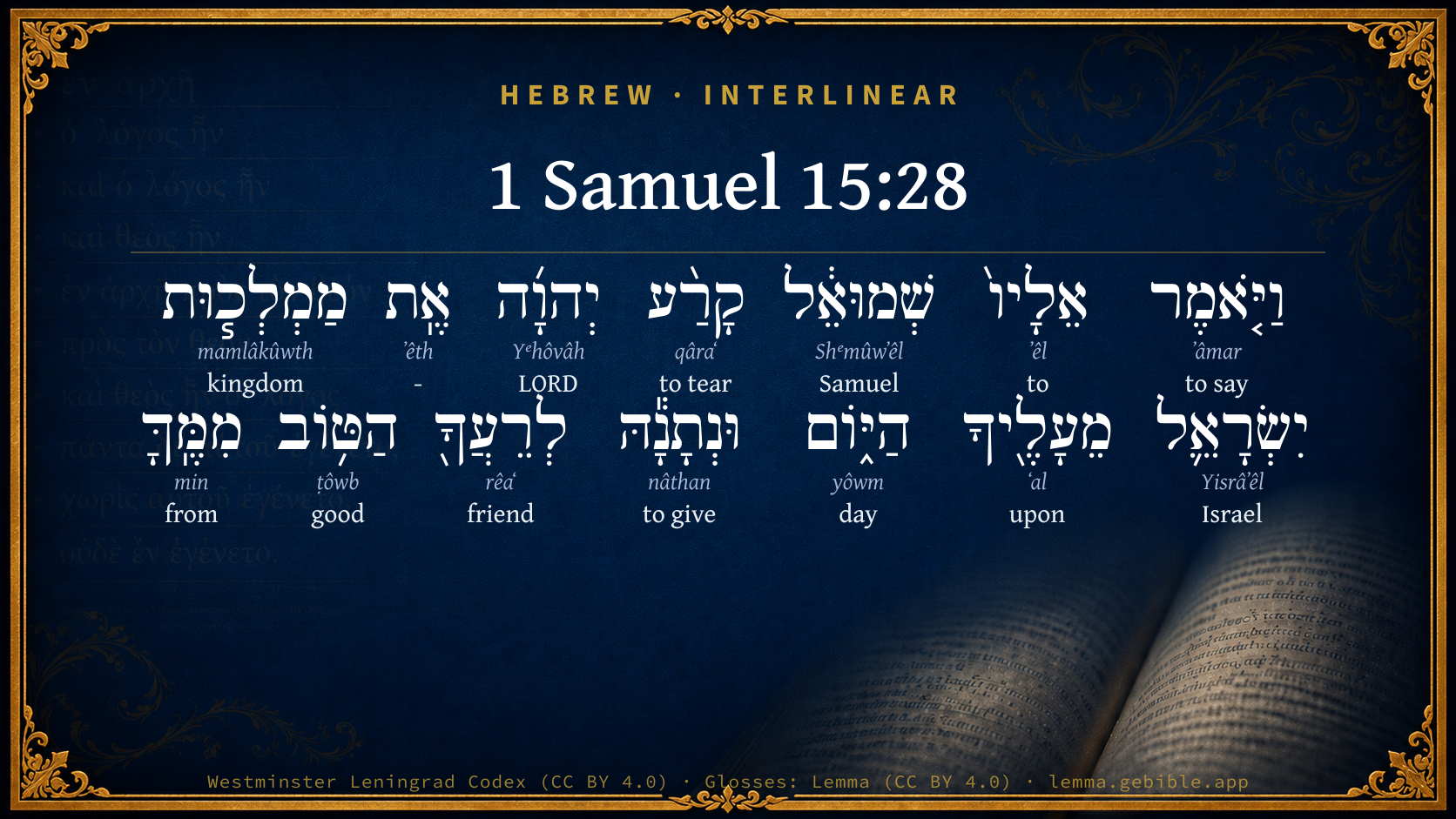
1 Samuel 15:28

Hebrew (Westminster Leningrad Codex) 1 Samuel 15:28 appears in the Hebrew Old Testament. The text above is from the Westminster Leningrad Codex. Each word links to its Strong’s number, a concise gloss, and parsing drawn from the Open Scriptures Hebrew Bible morphology. Click any word for its full Brown-Driver-Briggs (BDB) entry.
Download image
Cite this verse

1 Samuel 15:28 (World English Bible). Public Domain. Lemma interlinear Bible study tool, https://lemma.gebible.app/v/1-samuel/15/28.

Show BibTeX & RIS
BibTeX
RIS
English Translation
Samuel said to him, Yahweh has torn the kingdom of Israel from you this day, and has given it to a neighbor of yours who is better than you.
World English Bible · Public Domain
Download a study sheet

One document with this verse’s original text, its word-by-word gloss line, the meaning frame, cross-references with their text, attributed commentary, and full source and license credits — printable, and it pastes into notes with its structure intact.

This verse Autodidact and up

Study sheet (.html) Plain text (.txt)

A passage Seminary Student

Up to 50 verses in one chapter. A passage sheet keeps up to 6 commentary sources and 12 cross-references per verse, in the order this page ranks them, and says so on the sheet whenever that leaves anything out. Ask for a single verse and you get the Autodidact verse sheet above.

Everything on this page stays free to read, with no account — the sheet is a download of what is already on screen, not access to it.

Want to remove ads? Support Godless Engineer
Compare translations 3

The same verse in 3 English versions, stacked beneath the original-language interlinear above. Click any original word for its lexicon entry.

Each is an independent rendering of the whole verse — the interlinear is not word-aligned to these translations.

Highlighted words mark where these versions differ — a whole-verse word diff, not a word-by-word alignment.

  • World English Bible Public Domain
    Samuel said to him, Yahweh has torn the kingdom of Israel from you this day, and has given it to a neighbor of yours who is better than you.
  • King James Version Public Domain
    And Samuel said unto him, The LORD hath rent the kingdom of Israel from thee this day, and hath given it to a neighbor of thine, that is better than thou.
  • unfoldingWord Literal Text CC BY-SA 4.0
    And Samuel said to him, “Yahweh has torn the kingdom of Israel from upon you today, and he has given it to your fellow, better than you.

unfoldingWord Literal Text — © unfoldingWord, licensed CC BY-SA 4.0. Word-aligned USFM3 via Door43 (git.door43.org/unfoldingWord/en_ult).

Versions to compare (up to 4)

3 of 4 selected

Show all 18 translations

Every available English version of this verse, each an independent rendering of the whole verse.

  • World English Bible Public Domain
    Samuel said to him, Yahweh has torn the kingdom of Israel from you this day, and has given it to a neighbor of yours who is better than you.
  • Berean Standard Bible Public Domain
    So Samuel said to him, “The LORD has torn the kingdom of Israel from you today and has given it to your neighbor who is better than you.
  • Majority Standard Bible Public Domain
    So Samuel said to him, “The LORD has torn the kingdom of Israel from you today and has given it to your neighbor who is better than you.
  • King James Version Public Domain
    And Samuel said unto him, The LORD hath rent the kingdom of Israel from thee this day, and hath given it to a neighbor of thine, that is better than thou.
  • American Standard Version (1901) Public Domain
    And Samuel said unto him, Jehovah hath rent the kingdom of Israel from thee this day, and hath given it to a neighbor of thine, that is better than thou.
  • Revised Version (1885) Public Domain
    And Samuel said unto him, The LORD hath rent the kingdom of Israel from thee this day, and hath given it to a neighbour of thine, that is better than thou.
  • Geneva Bible (1599) Public Domain
    Then Samuel saide vnto him, The Lord hath rent the kingdome of Israel from thee this day, and hath giuen it to thy neighbour, that is better then thou.
  • Douay-Rheims (1899) Public Domain
    And Samuel said to him: The Lord hath rent the kingdom of Israel from thee this day, and hath given it to thy neighbour who is better than thee.
  • Young's Literal Translation Public Domain
    And Samuel saith unto him, `Jehovah hath rent the kingdom of Israel from thee to-day, and given it to thy neighbour who is better than thou;
  • Literal Standard Version CC BY-SA 4.0
    And Samuel says to him, “YHWH has torn the kingdom of Israel from you today, and given it to your neighbor who is better than you;
  • Unlocked Literal Bible CC BY-SA 4.0
    Samuel said to him, “Yahweh has torn the kingdom of Israel from you today and has given it to a neighbor of yours, one who is better than you.
  • unfoldingWord Literal Text CC BY-SA 4.0
    And Samuel said to him, “Yahweh has torn the kingdom of Israel from upon you today, and he has given it to your fellow, better than you.
  • Darby Bible Public Domain
    Then Samuel said to him, Jehovah has rent the kingdom of Israel from thee to-day, and has given it to thy neighbour, who is better than thou.
  • World Messianic Bible Public Domain
    Samuel said to him, “The LORD has torn the kingdom of Israel from you today, and has given it to a neighbor of yours who is better than you.
  • Webster's Bible Public Domain
    And Samuel said to him, The LORD hath rent the kingdom of Israel from thee this day, and hath given it to a neighbor of thine, that is better than thou.
  • Free Bible Version CC BY-SA 4.0
    Samuel said to him, “The Lord has ripped the kingdom of Israel away from you today and has given it to your neighbor—someone who is better than you!
  • Bible in Basic English Public Domain
    And Samuel said to him, The Lord has taken away the kingdom of Israel from you this day by force, and has given it to a neighbour of yours who is better than you.
  • JPS Tanakh (1917) Public Domain
    And Samuel said unto him: 'The LORD hath rent the kingdom of Israel from thee this day, and hath given it to a neighbour of thine, that is better than thou.

Literal Standard Version (2020), Covenant Press — licensed CC BY-SA 4.0. Text via the HelloAO Bible API (eBible.org). Unlocked Literal Bible (unfoldingWord) — licensed CC BY-SA 4.0. Text via the HelloAO Bible API (eBible.org). unfoldingWord Literal Text — © unfoldingWord, licensed CC BY-SA 4.0. Word-aligned USFM3 via Door43 (git.door43.org/unfoldingWord/en_ult). Free Bible Version, Dr. Jonathan Gallagher — licensed CC BY-SA 4.0. Text via the HelloAO Bible API (eBible.org).

Word by word

More ways to search: Search by grammar → Find every occurrence → Compare this word →

Practice this passage: Drill this verse → Learn its vocabulary →

מַמְלְכ֧וּת
mamlâkûwth
H4468
“kingdom of”
Noun, Common, Feminine, Singular, Construct
Part of Speech
Noun
Type
Common
Gender
Feminine
Number
Singular
State
Construct
Full BDB Definition

Origin: a form of H4467 and equiv. to it

TWOT: 1199g

kingdom, dominion, reign, sovereignty - kingdom - dominion, royal power - reign
  1. וַיֹּ֤אמֶר ʼâmar H559 “and · to say” Conjunction + Verb, Qal, Sequential Imperfect, 3rd Person, Masculine, Singular
  2. אֵלָיו֙ ʼêl H413 “to · him” Preposition + Suffix, Personal, 3rd Person, Masculine, Singular
  3. שְׁמוּאֵ֔ל Shᵉmûwʼêl H8050 “Samuel” Noun, Proper
  4. קָרַ֨ע qâraʻ H7167 “to tear” Verb, Qal, Perfect, 3rd Person, Masculine, Singular
  5. יְהוָ֜ה Yᵉhôvâh H3068 “LORD” Noun, Proper
  6. אֶֽת ʼêth H853 “-” Particle, Direct Object
  7. יִשְׂרָאֵ֛ל Yisrâʼêl H3478 “Israel” Noun, Proper
  8. מֵעָלֶ֖יךָ ʻal H5921 “from · upon · you” Preposition + Preposition + Suffix, Personal, 2nd Person, Masculine, Singular
  9. הַיּ֑וֹם yôwm H3117 “the · day” Particle, Definite Article + Noun, Common, Masculine, Singular, Absolute
  10. וּנְתָנָ֕הּ nâthan H5414 “and · to give · her” Conjunction + Verb, Qal, Perfect, 3rd Person, Masculine, Singular + Suffix, Personal, 3rd Person, Feminine, Singular
  11. לְרֵעֲךָ֖ rêaʻ H7453 “to/for · friend · your” Preposition + Noun, Common, Masculine, Singular, Construct + Suffix, Personal, 2nd Person, Masculine, Singular
  12. הַטּ֥וֹב ṭôwb H2896 “the · good” Particle, Definite Article + Adjective, Adjective, Masculine, Singular, Absolute
  13. מִמֶּֽךָּ min H4480 “from · you” Preposition + Suffix, Personal, 2nd Person, Masculine, Singular

About this verse

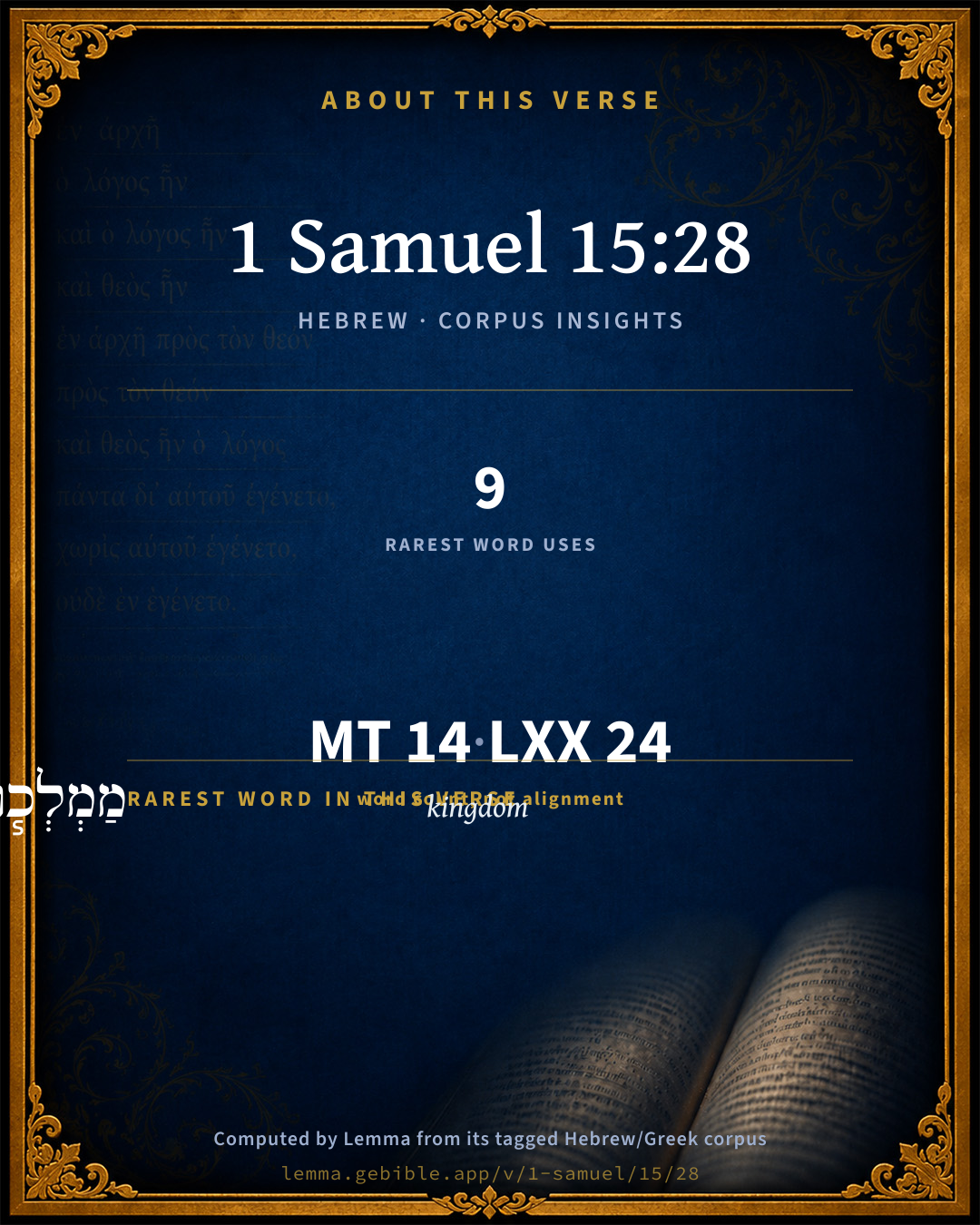
These counts appear in no published source. They are computed here, from the morphology-tagged text and Lemma’s own curated glosses. What Lemma adds →

14
words
14
distinct lemmas
Historical
section

Notable vocabulary

The rarest word here is מַמְלְכ֧וּת kingdom H4468 — appearing just 9 times in the whole Hebrew Bible.

Shared distinctive vocabulary

מַמְלְכ֧וּת kingdom H4468 occurs in 9 verses of the Hebrew Bible. Also found in:

Grammatical profile

  • 3 verbs
  • 6 nouns
  • 1 adjective
  • 3 prepositions
  • 1 particle

Verb forms

  • וַיֹּ֤אמֶר Qal · Sequential Imperfect
  • קָרַ֨ע Qal · Perfect
  • וּנְתָנָ֕הּ Qal · Perfect

Hebrew & Septuagint length

In English translation the verse runs 29 words from the Hebrew and 31 from the Septuagint (LXX English) — closely comparable.

A rough comparison of the two English renderings, which tokenize alike — not a word-level alignment.

Word counts can differ between the Hebrew and the Greek without any difference in meaning — e.g. the Hebrew direct-object marker אֵת has no separate Greek word, and Greek often adds the article ὁ.

In the original languages it is 14 Hebrew tokens and 24 Greek tokens — but the two are counted differently (Hebrew bundles its prefixes and suffixes into one token; the Greek is in lemma form), so that isn’t a like-for-like length.

Cross-references

11

Topical passages linked to 1 Samuel 15:28 in the Treasury of Scripture Knowledge — connected by theme and wording, ordered by reader-vote popularity; previews shown in the World English Bible.

  • 1 Samuel 28:17–18 Yahweh has done to you, as he spoke by me: and Yahweh has torn the kingdom out of your hand, and given it to your neighbor, even to David.
  • Acts 13:22 When he had removed him, he raised up David to be their king, to whom he also testified, 'I have found David the son of Jesse, a man after my heart, who will do all my will.'
  • 1 Samuel 2:7–8 Yahweh makes poor, and makes rich: He brings low, he also lifts up.
  • 1 Samuel 13:14 But now your kingdom shall not continue: Yahweh has sought him a man after his own heart, and Yahweh has appointed him to be prince over his people, because you have not kept that which Yahweh commanded you.
  • 1 Samuel 16:12 He sent, and brought him in. Now he was ruddy, and withal of a beautiful face, and goodly to look on. Yahweh said, Arise, anoint him; for this is he.
  • 1 Kings 11:30–31 Ahijah laid hold of the new garment that was on him, and tore it in twelve pieces.
  • Jeremiah 27:5–6 I have made the earth, the men and the animals that are on the surface of the earth, by my great power and by my outstretched arm; and I give it to whom it seems right to me.
  • Daniel 4:17 The sentence is by the decree of the watchers, and the demand by the word of the holy ones; to the intent that the living may know that the Most High rules in the kingdom of men, and gives it to whoever he will, and sets up over it the lowest of men.
  • Daniel 4:32 and you shall be driven from men; and they dwelling shall be with the animals of the field; you shall be made to eat grass as oxen; and seven times shall pass over you; until you know that the Most High rules in the kingdom of men, and gives it to whoever he will.
  • John 19:11 Jesus answered, "You would have no power at all against me, unless it were given to you from above. Therefore he who delivered me to you has greater sin."
  • Romans 13:1 Let every soul be in subjection to the higher authorities, for there is no authority except from God, and those who exist are ordained by God.

Cross-references courtesy of OpenBible.info (CC BY 4.0).

Hebrew and Greek witnesses Masoretic Hebrew ↔ Greek Septuagint

The same verse in the two great witnesses to the Old Testament, shown verse-for-verse.

These are two independent witnesses, not word-aligned to each other, and the Septuagint is shown in lemma (dictionary) form.

Hebrew 1 Samuel 15:28 Masoretic · Westminster Leningrad Codex

וַיֹּ֤אמֶר אֵלָיו֙ שְׁמוּאֵ֔ל קָרַ֨ע יְהוָ֜ה אֶֽת מַמְלְכ֧וּת יִשְׂרָאֵ֛ל מֵעָלֶ֖יךָ הַיּ֑וֹם וּנְתָנָ֕הּ לְרֵעֲךָ֖ הַטּ֥וֹב מִמֶּֽךָּ

Samuel said to him, Yahweh has torn the kingdom of Israel from you this day, and has given it to a neighbor of yours who is better than you.

World English Bible · Public Domain

Greek LXX 1 Samuel 15:28 Septuagint · lemma form

καί εἶπον πρός αὐτός σαμουηλ διαῥήγνυμι κύριος ὁ βασιλεία ἰσραήλ ἐκ χείρ σύ σήμερον καί δίδωμι αὐτός ὁ πλησίον σύ ὁ ἀγαθός ὑπέρ σύ

And Samuel said to him, The Lord has torn your kingdom from Israel out of your hand this day, and will give it to your neighbor who is better than you.

LXX2012 (modern English Septuagint) · Public Domain

Hebrew: Westminster Leningrad Codex (CC BY 4.0). Greek: Septuagint (public domain); English from LXX2012 (modern English Septuagint) (Public Domain). How the Septuagint differs from the Hebrew →

Targum (Aramaic paraphrase)

1

The Targum is the ancient Jewish Aramaic paraphrase of the Hebrew Scriptures — an interpretive translation, not the Hebrew text itself. Onkelos (literal) and Pseudo-Jonathan (expansive) render the Torah, and Jonathan the Prophets. Coverage is partial: where no permissively-licensed English translation exists for a verse, only the Aramaic is shown. This is verse-level text, not a word-by-word alignment to the Hebrew.

  1. Targum Jonathan Prophets (Joshua–Malachi)
    וַאֲמַר לֵיהּ שְׁמוּאֵל אַעֲדִי יְיָ יַת מַלְכוּתָא דְיִשְׂרָאֵל מִנָךְ יוֹמָא דֵין וְיַהֲבָהּ לְחַבְרָךְ דְתַקֵן עוֹבָדֵיהּ מִנָךְ:

    (no public-domain English translation for this verse)

    Targum Jonathan — Aramaic: “Mikraot Gedolot” (public domain). English: “Sefaria Community Translation” (CC0 1.0 (public-domain dedication)); “London "Chaldee Paraphrase," 1871” (public domain). Text via Sefaria.

Commentary

Notes on 1 Samuel 15:28 from classic Christian and Jewish commentators (each source and its license shown beneath its notes). The classic Christian expositions comment on the surrounding passage and are grouped to its opening verse, so a note may address several verses; the Jewish commentaries on the Tanakh (Rashi and others) are per-verse, so they appear only where the commentator wrote on this verse.

Lemma curates 59 commentaries, every one of them public domain or Creative Commons licensed, each selected and text-cleaned for this edition rather than reprinted as found. About our sources →

Trapp's Complete Commentary

John Trapp

1Sa 15:28 And Samuel said unto him, The LORD hath rent the kingdom of Israel from thee this day, and hath given it to a neighbour of thine, [that is] better than thou.

Ver. 28. The Lord hath rent the kingdom.] And given it to the man that shall hereafter tear off the skirt of thy garment, as Lyra here noteth out of the Rabbins, whence also Saul said then, "And now behold I know well that thou shalt surely be king," &c. {1Sa 24:20}

John Trapp, A Commentary or Exposition upon All the Books of the Old and New Testament (1647–1656) — public domain. Text from a community e-Sword module.

Joseph Benson's Commentary

1Sa 15:28-29. The Lord hath rent the kingdom from thee — Hath declared his firm resolution of laying aside thy family, and will soon actually take away thy life and thy kingly power. Also the Strength of Israel — Who is perfectly able to bring to pass all his purposes, and to make good all his declarations; will not lie — He gives God his title, to show the reason why he neither can nor will lie. For lying generally proceeds from a man’s weakness and inability to accomplish his designs, as he thinks, without it. But God needs no such artifices: he can do whatsoever he pleaseth by his absolute power. Nor repent — Change his counsel and purpose, which is also an effect of weakness and imperfection, either of wisdom or power. So that this word is not here used in the sense it is 1Sa 15:11, and in several other passages, as Gen 6:6; Exo 32:14; 2Sa 24:16; Jer 26:19; in all which, and many others, it signifies a change of God’s proceedings, and of his method of dealing with persons.

Joseph Benson's Commentary on the Old and New Testaments (1811–1818) — public domain. Text from a community e-Sword module.

Tyndale Open Study Notes

Tyndale Open Resources

15:28 Saul soon discovered who this someone else was (18:8-9; cp. ch 16).

Tyndale Open Study Notes — © Tyndale Open Resources, licensed CC BY-SA 4.0. Text via the HelloAO Bible API.

Geneva Bible (1599)

Geneva Bible translators

That is, to David.

Geneva Bible (1599) marginal notes — public domain. Text via Bolls.life.

Ellicott's Commentary for English Readers

(28) The Lord hath rent the kingdom.—The prophet at once looks upon the garment torn by the passionate vehemence of the king, as an omen for the future, and uses the rent vesture as a symbol, to show Saul that thus had the Lord on that day rent the kingdom from him.

A neighbour of thine.—It had not yet been revealed to the seer who was to replace the rebellious king, so he simply refers to the future anointed one quite indefinitely as “a neighbour.”

A Bible Commentary for English Readers, edited by Charles John Ellicott (1878–1897) — public domain. Text from a community e-Sword module.

John Gill's Exposition

And Samuel said unto him, the Lord hath rent the kingdom of Israel from thee this day,.... Seeing his mantle rent by Saul, he took occasion from thence to predict, and no doubt it was impressed on his mind by the Spirit of God, that his kingdom should be in a like manner rent from him, on account of his own evil conduct and behaviour; and from this day forward he might expect it; the sentence was gone forth from God, and it would not be reversed; and by a like sign was signified the rending of the ten tribes from the kingdom of Solomon in his son Rehoboam, Kg1 11:30,

and hath given it to a neighbour of thine, that is better than thou; who was David, a man after God's own heart, that would fulfil his will, who was more holy, just, and wise than Saul; whose works were better and righter than his, as the Targum; who was an Israelite, of the same nation and religion as he, and so his neighbour; and though he was not of the same tribe, yet of a neighbouring tribe; Benjamin, and Judah, of which tribe David was, joining closely to one another. It is highly probable that at this time Samuel knew not personally who he was that was designed to be made king in his room, though under the direction of the Spirit of God he thus describes him; for after this he is bid to go to Jesse's family, from thence to anoint a king, and several passed before him ere the Lord pointed out the proper person to him.

John Gill's Exposition of the Whole Bible (1746–1763) — public domain (CC PDM 1.0). Text via the HelloAO Bible API.

Matthew Poole's English Annotations

Samuel makes use of the emergent occasion, as a sign, to signify and confirm his former prediction.

A neighbour of thine; either another man, or another Israelite; for the word neighbour is used both ways; or rather, one of the neighbouring tribe, even Judah, whose inheritance did not only join to that of Benjamin, but was partly mixed with it.

Matthew Poole's English Annotations on the Holy Bible (1683–1685) — public domain. Text from a community e-Sword/MySword module.

unfoldingWord translationNotes

Door43 World Missions Community

Yahweh has torn the kingdom of Israel

This refers back to when Saul tore Samuel's robe in 1 Samuel 15:27. This can be made explicit. AT: "Just as you tore my robe, Yahweh has torn the kingdom of Israel" (See: Assumed Knowledge and Implicit Information)

has given it to a neighbor of yours, one who is better than you

God had already decided who would be the next king after Saul.

the Strength of Israel

Here Yahweh is referred to as "the Strength of Israel" because he gives strength to the Israelites. AT: "Yahweh, who is the strength of Israel" (See: Idiom and Metonymy)

will not lie nor change his mind

This is stated as a negative to emphasize that God tells the truth. This can be stated in positive form. AT: "will always tell the truth and do what he says" (See: Litotes)

his mind

This refers to his thoughts and decisions. AT: "what he has decided to do" (See: Metonymy)

he is not a man, that he should change his mind

This is stated as a negative to emphasize that God is trustworthy. This can be stated in positive form. AT: "he is God, and will do what he says he will do" (See: Litotes)

translationWords

kingdom

neighbor

mind

unfoldingWord translationNotes — © Distant Shores Media and the Door43 World Missions Community, licensed CC BY-SA 4.0. Source: git.door43.org/Door43/en_tn.

Lesson kit

Teaching starters — assembled from the data on this page, not authored interpretation. Every prompt links to the verse data it draws on. Edit before teaching.

1 Samuel, in the Historical, opens this verse with 14 words (14 distinct Hebrew lemmas). Its most distinctive word is mamlâkûwth (“kingdom”). A historical commentator’s framing appears above. Read the whole chapter for the surrounding context.

Discussion questions

  1. What does “kingdom” (mamlâkûwth) contribute to the verse as a whole?
  2. Joshua 13:12 shares the word «kingdom» with this verse. How do the two illuminate each other?
  3. The translations on this page render this verse differently — a whole-verse word diff, not a word-by-word alignment. What might account for the different wordings?
  4. The verb «וַיֹּ֤אמֶר» is Qal Sequential Imperfect. How does its form color the action?
  5. Reading how Trapp's Complete Commentary and Joseph Benson's Commentary read this verse, where do the two commentators agree and where do they part?

Things to notice

Reading settings

Reading text

Shown beneath each verse's original-language words.

Old Testament
Old Testament edition

Read the OT as the Masoretic Hebrew (MT) or the Greek Septuagint (LXX).

English shown for the Greek Septuagint (in the Hebrew ↔ Greek comparison).

Comparing translations? Open the Compare panel on any verse page to stack up to four side by side.