1 Samuel 28:17

Hebrew (Westminster Leningrad Codex) 1 Samuel 28:17 appears in the Hebrew Old Testament. The text above is from the Westminster Leningrad Codex. Each word links to its Strong’s number, a concise gloss, and parsing drawn from the Open Scriptures Hebrew Bible morphology. Click any word for its full Brown-Driver-Briggs (BDB) entry.
Download image
Cite this verse

1 Samuel 28:17 (World English Bible). Public Domain. Lemma interlinear Bible study tool, https://lemma.gebible.app/v/1-samuel/28/17.

Show BibTeX & RIS
BibTeX
RIS
English Translation
Yahweh has done to you, as he spoke by me: and Yahweh has torn the kingdom out of your hand, and given it to your neighbor, even to David.
World English Bible · Public Domain
Download a study sheet

One document with this verse’s original text, its word-by-word gloss line, the meaning frame, cross-references with their text, attributed commentary, and full source and license credits — printable, and it pastes into notes with its structure intact.

This verse Autodidact and up

Study sheet (.html) Plain text (.txt)

A passage Seminary Student

Up to 50 verses in one chapter. A passage sheet keeps up to 6 commentary sources and 12 cross-references per verse, in the order this page ranks them, and says so on the sheet whenever that leaves anything out. Ask for a single verse and you get the Autodidact verse sheet above.

Everything on this page stays free to read, with no account — the sheet is a download of what is already on screen, not access to it.

Want to remove ads? Support Godless Engineer
Compare translations 3

The same verse in 3 English versions, stacked beneath the original-language interlinear above. Click any original word for its lexicon entry.

Each is an independent rendering of the whole verse — the interlinear is not word-aligned to these translations.

Highlighted words mark where these versions differ — a whole-verse word diff, not a word-by-word alignment.

  • World English Bible Public Domain
    Yahweh has done to you, as he spoke by me: and Yahweh has torn the kingdom out of your hand, and given it to your neighbor, even to David.
  • King James Version Public Domain
    And the LORD hath done to him, as he spake by me: for the LORD hath rent the kingdom out of thine hand, and given it to thy neighbor, even to David:
  • unfoldingWord Literal Text CC BY-SA 4.0
    Now Yahweh has done for himself just as he spoke by my hand. For Yahweh has torn the kingdom from your hand and has given it to your fellow, to David.

unfoldingWord Literal Text — © unfoldingWord, licensed CC BY-SA 4.0. Word-aligned USFM3 via Door43 (git.door43.org/unfoldingWord/en_ult).

Versions to compare (up to 4)

3 of 4 selected

Show all 18 translations

Every available English version of this verse, each an independent rendering of the whole verse.

  • World English Bible Public Domain
    Yahweh has done to you, as he spoke by me: and Yahweh has torn the kingdom out of your hand, and given it to your neighbor, even to David.
  • Berean Standard Bible Public Domain
    He has done exactly what He spoke through me: The LORD has torn the kingship out of your hand and given it to your neighbor David.
  • Majority Standard Bible Public Domain
    He has done exactly what He spoke through me: The LORD has torn the kingdom out of your hand and given it to your neighbor David.
  • King James Version Public Domain
    And the LORD hath done to him, as he spake by me: for the LORD hath rent the kingdom out of thine hand, and given it to thy neighbor, even to David:
  • American Standard Version (1901) Public Domain
    And Jehovah hath done unto thee, as he spake by me: and Jehovah hath rent the kingdom out of thy hand, and given it to thy neighbor, even to David.
  • Revised Version (1885) Public Domain
    And the LORD hath wrought for himself, as he spake by me: and the LORD hath rent the kingdom out of thine hand, and given it to thy neighbour, even to David.
  • Geneva Bible (1599) Public Domain
    Euen the Lord hath done to him, as hee spake by mine hande: for the Lord will rent the kingdome out of thine hande, and giue it thy neighbour Dauid.
  • Douay-Rheims (1899) Public Domain
    For the Lord will do to thee as he spoke by me, and he will rend thy kingdom out of thy hand, and will give it to thy neighbour David:
  • Young's Literal Translation Public Domain
    And Jehovah doth for Himself as He hath spoken by my hand, and Jehovah rendeth the kingdom out of thy hand, and giveth it to thy neighbour -- to David.
  • Literal Standard Version CC BY-SA 4.0
    And YHWH does for Himself as He has spoken by my hand, and YHWH tears the kingdom out of your hand, and gives it to your neighbor—to David.
  • Unlocked Literal Bible CC BY-SA 4.0
    Yahweh has done to you what he said he would. Yahweh has torn the kingdom out of your hand and he has given it to someone else—to David.
  • unfoldingWord Literal Text CC BY-SA 4.0
    Now Yahweh has done for himself just as he spoke by my hand. For Yahweh has torn the kingdom from your hand and has given it to your fellow, to David.
  • Darby Bible Public Domain
    And Jehovah has done for himself as he spoke by me; and Jehovah has rent the kingdom out of thy hand, and given it to thy neighbour, to David.
  • World Messianic Bible Public Domain
    The LORD has done to you as he spoke by me. The LORD has torn the kingdom out of your hand and given it to your neighbor, even to David.
  • Webster's Bible Public Domain
    And the LORD hath done to him, as he spoke by me: for the LORD hath rent the kingdom out of thy hand, and given it to thy neighbor, even to David:
  • Free Bible Version CC BY-SA 4.0
    “The Lord has done to you exactly what he said through me, for the Lord has ripped the kingdom from you and has given it to your neighbor, David.
  • Bible in Basic English Public Domain
    And the Lord himself has done what I said: the Lord has taken the kingdom out of your hand and given it to your neighbour David;
  • JPS Tanakh (1917) Public Domain
    And the LORD hath wrought for Himself; as He spoke by me; and the LORD hath rent the kingdom out of thy hand, and given it to thy neighbour, even to David.

Literal Standard Version (2020), Covenant Press — licensed CC BY-SA 4.0. Text via the HelloAO Bible API (eBible.org). Unlocked Literal Bible (unfoldingWord) — licensed CC BY-SA 4.0. Text via the HelloAO Bible API (eBible.org). unfoldingWord Literal Text — © unfoldingWord, licensed CC BY-SA 4.0. Word-aligned USFM3 via Door43 (git.door43.org/unfoldingWord/en_ult). Free Bible Version, Dr. Jonathan Gallagher — licensed CC BY-SA 4.0. Text via the HelloAO Bible API (eBible.org).

Word by word

More ways to search: Search by grammar → Find every occurrence → Compare this word →

Practice this passage: Drill this verse → Learn its vocabulary →

וַיִּקְרַ֨ע
qâraʻ
H7167
“and · to tear”
Conjunction + Verb, Qal, Sequential Imperfect, 3rd Person, Masculine, Singular
Part of Speech
Conjunction + Verb
Stem
Qal
Form
Sequential Imperfect
Person
3rd Person
Gender
Masculine
Number
Singular
Full BDB Definition

Origin: a primitive root

TWOT: 2074

to tear, tear in pieces - (Qal) - to tear, rend - to tear away or out - to tear, rend asunder - to make wide or large (of eyes) - to rend open (of heavens) - to tear, rend (of wild beasts) - (Niphal) to be rent, be split asunder
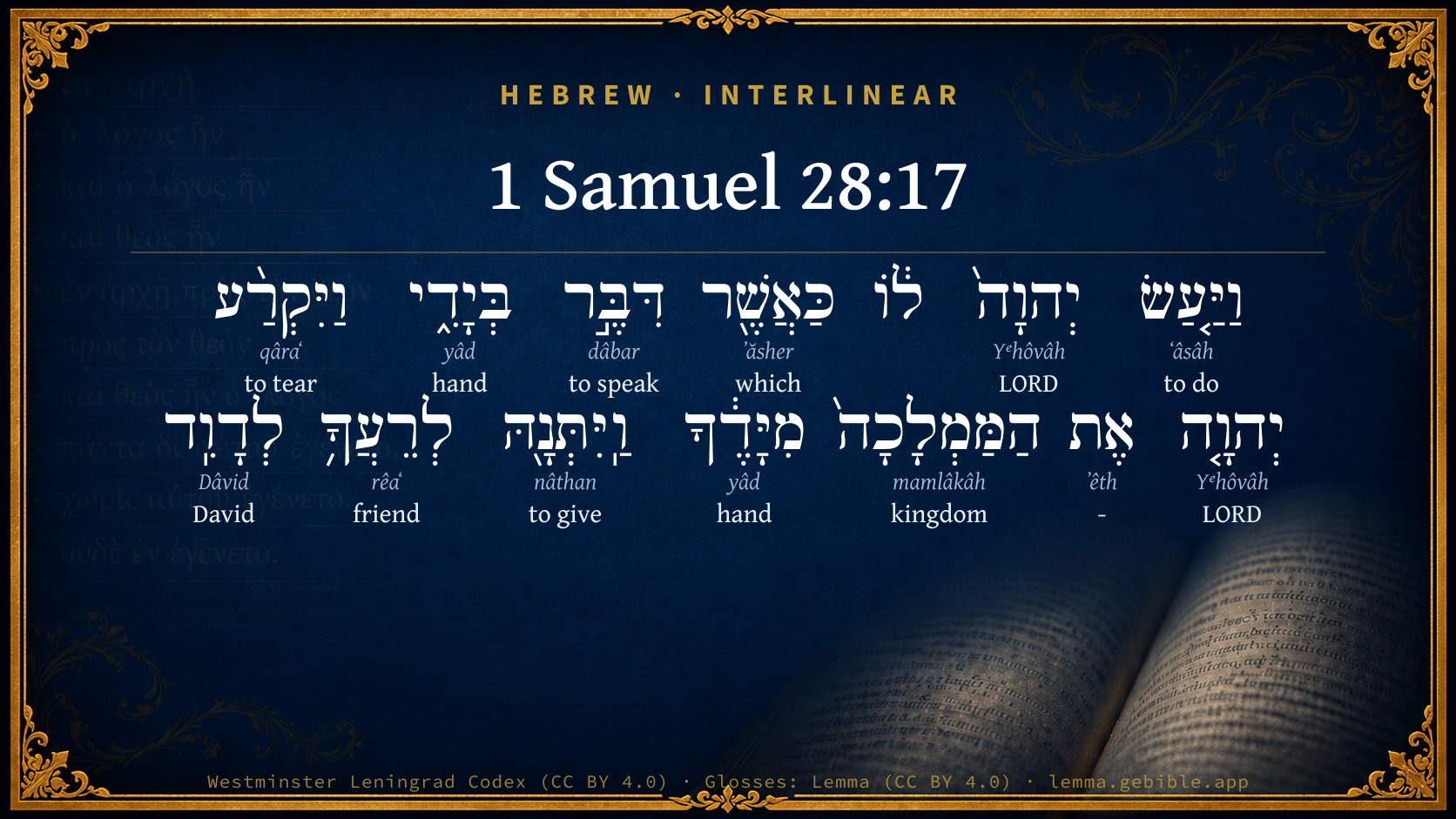
  1. וַיַּ֤עַשׂ ʻâsâh H6213 “and · to do” Conjunction + Verb, Qal, Sequential Imperfect, 3rd Person, Masculine, Singular
  2. יְהוָה֙ Yᵉhôvâh H3068 “LORD” Noun, Proper
  3. כַּאֲשֶׁ֖ר ʼăsher H834 “like/as · which” Preposition + Particle, Relative
  4. דִּבֶּ֣ר dâbar H1696 “to speak” Verb, Piel, Perfect, 3rd Person, Masculine, Singular
  5. בְּיָדִ֑י yâd H3027 “in/at · hand · my” Preposition + Noun, Common, Both, Singular, Construct + Suffix, Personal, 1st Person, Common, Singular
  6. יְהוָ֤ה Yᵉhôvâh H3068 “LORD” Noun, Proper
  7. אֶת ʼêth H853 “-” Particle, Direct Object
  8. הַמַּמְלָכָה֙ mamlâkâh H4467 “the · kingdom” Particle, Definite Article + Noun, Common, Feminine, Singular, Absolute
  9. מִיָּדֶ֔ךָ yâd H3027 “from · hand · your” Preposition + Noun, Common, Both, Singular, Construct + Suffix, Personal, 2nd Person, Masculine, Singular
  10. וַֽיִּתְּנָ֖הּ nâthan H5414 “and · to give · her” Conjunction + Verb, Qal, Sequential Imperfect, 3rd Person, Masculine, Singular + Suffix, Personal, 3rd Person, Feminine, Singular
  11. לְרֵעֲךָ֥ rêaʻ H7453 “to/for · friend · your” Preposition + Noun, Common, Masculine, Singular, Construct + Suffix, Personal, 2nd Person, Masculine, Singular
  12. לְדָוִֽד Dâvid H1732 “to/for · David” Preposition + Noun, Proper

About this verse

These counts appear in no published source. They are computed here, from the morphology-tagged text and Lemma’s own curated glosses. What Lemma adds →

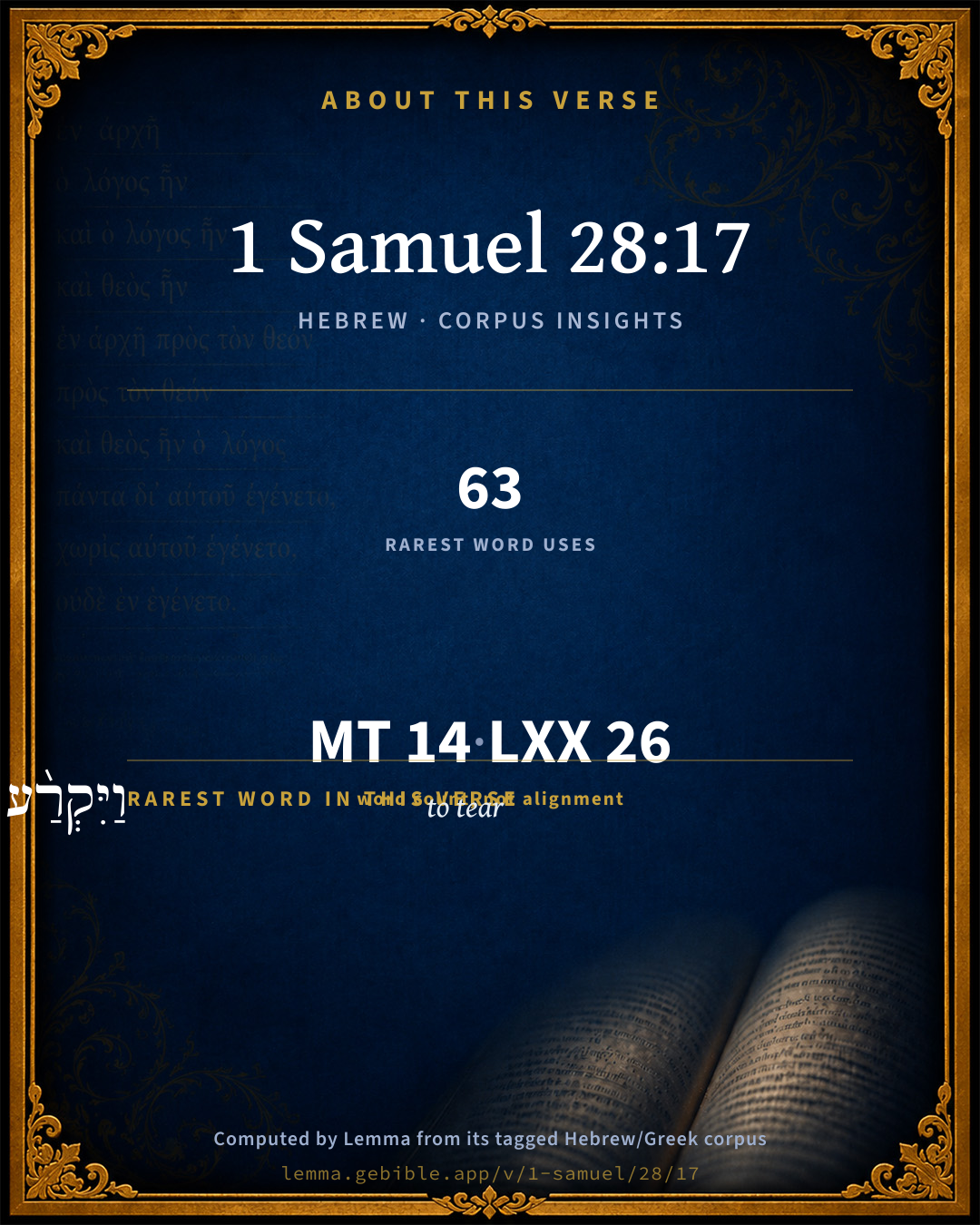
14
words
11
distinct lemmas
Historical
section

Grammatical profile

  • 4 verbs
  • 7 nouns
  • 1 preposition
  • 2 particles

Verb forms

  • וַיַּ֤עַשׂ Qal · Sequential Imperfect
  • דִּבֶּ֣ר Piel · Perfect
  • וַיִּקְרַ֨ע Qal · Sequential Imperfect
  • וַֽיִּתְּנָ֖הּ Qal · Sequential Imperfect

Repetition

Words recur within this verse — often emphatic in Hebrew:

  • יְהוָה֙ LORD H3068 ×2
  • בְּיָדִ֑י hand H3027 ×2

Hebrew & Septuagint length

In English translation the verse runs 29 words from the Hebrew and 32 from the Septuagint (LXX English) — closely comparable.

A rough comparison of the two English renderings, which tokenize alike — not a word-level alignment.

Word counts can differ between the Hebrew and the Greek without any difference in meaning — e.g. the Hebrew direct-object marker אֵת has no separate Greek word, and Greek often adds the article ὁ.

In the original languages it is 14 Hebrew tokens and 26 Greek tokens — but the two are counted differently (Hebrew bundles its prefixes and suffixes into one token; the Greek is in lemma form), so that isn’t a like-for-like length.

Cross-references

5

Topical passages linked to 1 Samuel 28:17 in the Treasury of Scripture Knowledge — connected by theme and wording, ordered by reader-vote popularity; previews shown in the World English Bible.

  • 1 Samuel 15:27–29 As Samuel turned about to go away, [Saul] laid hold on the skirt of his robe, and it tore.
  • 1 Samuel 13:13–14 Samuel said to Saul, You have done foolishly; you have not kept the commandment of Yahweh your God, which he commanded you: for now would Yahweh have established your kingdom on Israel forever.
  • 1 Samuel 16:13 Then Samuel took the horn of oil, and anointed him in the midst of his brothers: and the Spirit of Yahweh came mightily on David from that day forward. So Samuel rose up, and went to Ramah.
  • 1 Samuel 24:20 Now, behold, I know that you shall surely be king, and that the kingdom of Israel shall be established in your hand.
  • Proverbs 16:4 Yahweh has made everything for its own end-- Yes, even the wicked for the day of evil.

Cross-references courtesy of OpenBible.info (CC BY 4.0).

Hebrew and Greek witnesses Masoretic Hebrew ↔ Greek Septuagint

The same verse in the two great witnesses to the Old Testament, shown verse-for-verse.

These are two independent witnesses, not word-aligned to each other, and the Septuagint is shown in lemma (dictionary) form.

Hebrew 1 Samuel 28:17 Masoretic · Westminster Leningrad Codex

וַיַּ֤עַשׂ יְהוָה֙ ל֔וֹ כַּאֲשֶׁ֖ר דִּבֶּ֣ר בְּיָדִ֑י וַיִּקְרַ֨ע יְהוָ֤ה אֶת הַמַּמְלָכָה֙ מִיָּדֶ֔ךָ וַֽיִּתְּנָ֖הּ לְרֵעֲךָ֥ לְדָוִֽד

Yahweh has done to you, as he spoke by me: and Yahweh has torn the kingdom out of your hand, and given it to your neighbor, even to David.

World English Bible · Public Domain

Greek LXX 1 Samuel 28:17 Septuagint · lemma form

καί ποιέω κύριος σύ καθώς λαλέω ἐν χείρ ἐγώ καί διαῥήγνυμι κύριος ὁ βασιλεία σύ ἐκ χείρ σύ καί δίδωμι αὐτός ὁ πλησίον σύ ὁ δαυίδ

And the Lord has done to you, as the Lord spoke by me; and the Lord will rend your kingdom out of your hand, and will give it to your neighbor David.

LXX2012 (modern English Septuagint) · Public Domain

On this verse, Adam Clarke's Commentary discusses the Septuagint’s reading. Read the note in Commentary ↓

Hebrew: Westminster Leningrad Codex (CC BY 4.0). Greek: Septuagint (public domain); English from LXX2012 (modern English Septuagint) (Public Domain). How the Septuagint differs from the Hebrew →

Targum (Aramaic paraphrase)

1

The Targum is the ancient Jewish Aramaic paraphrase of the Hebrew Scriptures — an interpretive translation, not the Hebrew text itself. Onkelos (literal) and Pseudo-Jonathan (expansive) render the Torah, and Jonathan the Prophets. Coverage is partial: where no permissively-licensed English translation exists for a verse, only the Aramaic is shown. This is verse-level text, not a word-by-word alignment to the Hebrew.

  1. Targum Jonathan Prophets (Joshua–Malachi)
    וַעֲבַד יְיָ לֵיהּ כְּמָא דְמַלֵיל בִּידִי וְאַעֲדֵי יְיָ יַת מַלְכוּתָא מִנָךְ וְיַהֲבָהּ לְחַבְרָךְ לְדָוִד:

    (no public-domain English translation for this verse)

    Targum Jonathan — Aramaic: “Mikraot Gedolot” (public domain). English: “Sefaria Community Translation” (CC0 1.0 (public-domain dedication)); “London "Chaldee Paraphrase," 1871” (public domain). Text via Sefaria.

Commentary

Notes on 1 Samuel 28:17 from classic Christian and Jewish commentators (each source and its license shown beneath its notes). The classic Christian expositions comment on the surrounding passage and are grouped to its opening verse, so a note may address several verses; the Jewish commentaries on the Tanakh (Rashi and others) are per-verse, so they appear only where the commentator wrote on this verse.

Lemma curates 59 commentaries, every one of them public domain or Creative Commons licensed, each selected and text-cleaned for this edition rather than reprinted as found. About our sources →

Trapp's Complete Commentary

John Trapp

1Sa 28:17 And the LORD hath done to him, as he spake by me: for the LORD hath rent the kingdom out of thine hand, and given it to thy neighbour, [even] to David:

Ver. 17. And the Lord hath done to him,] i.e., To him you knew of, to David his darling. Or, The Lord hath done for himself, that is, for the accomplishment of his own counsels.

John Trapp, A Commentary or Exposition upon All the Books of the Old and New Testament (1647–1656) — public domain. Text from a community e-Sword module.

Joseph Benson's Commentary

1Sa 28:17-18. The Lord hath rent the kingdom out of thy hand, &c. — Here the prophet foretels that Saul should that day be stripped of the kingdom, and that it should be given to David. Then follows what nothing but infinite, unerring prescience could predict; an exact, minute, precise account of all the circumstances of the then depending event! Because thou obeyedst not the voice of the Lord — Saul’s sin in killing the Lord’s priests, and in seeking to kill David, is not here mentioned, because the decree of taking the kingdom from him was passed before those sins were committed. Delaney asks here, “Would an impostor” (for such this apparition must have been, if it were not Samuel) “have been so very zealous for a strict observance of the law and commands of God; and so rigid in pronouncing divine vengeance upon the violation of them; and in the depth of his cunning have limited that vengeance to time, place, and person; and all this at no greater distance than the next day? These suppositions are too wild to be seriously confuted; they are the very reverse of what should and would have been done on such an occasion, had imposture interfered in it. Every one knows the business of impostors is to flatter, to delude, to deceive, to answer doubtfully; to promise good and put off the evil; it was this woman’s business in a particular manner to act thus. Had she promised Saul victory, and the success had answered, she was sure of considerable advantage. He, who could have no benefit from priests or from prophets, would, doubtless, have had her in high honour, and with good reason. If he died in the battle, all was safe; and even if he escaped and was worsted, what she said would at least have been taken for an indication of good wishes to the king and to his people; and so would be more likely to escape any after inquiry. Whereas, if she prognosticated evil to the royal race, she was sure of destruction, if the event did not at once justify and save her.”

Joseph Benson's Commentary on the Old and New Testaments (1811–1818) — public domain. Text from a community e-Sword module.

Tyndale Open Study Notes

Tyndale Open Resources

28:17 torn the kingdom from you: See 15:28.

Tyndale Open Study Notes — © Tyndale Open Resources, licensed CC BY-SA 4.0. Text via the HelloAO Bible API.

Geneva Bible (1599)

Geneva Bible translators

Or, ministry.

That is, to David.

Geneva Bible (1599) marginal notes — public domain. Text via Bolls.life.

Adam Clarke's Commentary

Verse 17. The Lord hath done to him] I believe these words are spoken of Saul; and as they are spoken to him, it seems evident that him should be thee. The Vulgate has tibi, the Septuagint σοι, to THEE: and this is the reading of five of Kennicott's and De Rossi's MSS., as well as of both the Bibles printed at Venice in 1518, where we read לך lecha, to THEE, instead of לו lo, to HIM.

As he spake by me] Here was no illusion; none but Samuel could say this.

Adam Clarke's Commentary on the Bible (1810–1826) — public domain. Text from a community e-Sword/MySword module.

Ellicott's Commentary for English Readers

(17) And the Lord hath done to him.—Render, as in margin of the English Version, the Lord hath done or performed for Himself. The LXX. and Vulg. here needlessly change the text into, “the Lord hath done to thee.”

And given it to thy neighbour . . . David.—An evil spirit personating Samuel would not have spoken thus; he would not have wished to help David, “the man after God’s own heart,” to the throne of Israel; nor would an evil spirit have spoken in such solemn terms of the punishment due to rebellion against God.—Bishop Wordsworth, who argues against the supposition that the shade of Samuel was an evil spirit.

A Bible Commentary for English Readers, edited by Charles John Ellicott (1878–1897) — public domain. Text from a community e-Sword module.

The Cambridge Bible for Schools and Colleges

gen. ed. J. J. S. Perowne

17. to him] i.e. if the Sept. reading is adopted in 1Sa_28:16, to David: or it may refer to God, and mean “for himself,” in fulfilment of His will. But the Sept. and Vulg. read “to thee.”

as he spake by me] See 1Sa_15:28.

The Cambridge Bible for Schools and Colleges (gen. ed. J. J. S. Perowne; Cambridge University Press, 1878–1918) — public domain. Text from a community e-Sword module.

John Gill's Exposition

And the Lord hath done to him,.... To David, Saul's enemy, as he insinuated he was:

as he spake by me; pretending to be the true Samuel, and wearing the guise of him, he speaks his very words, which he was well acquainted with, and could deliver exactly as he did:

for the Lord hath rent the kingdom out of thine hand, and given it to thy neighbour; which words are expressed by Samuel, Sa1 15:28,

even unto David; which is added by the apparition, by way of explanation, interpreting the words of David; which he might safely venture to do, seeing such a train of circumstances had occurred since the delivery of these words, which plainly made it appear he was intended.

John Gill's Exposition of the Whole Bible (1746–1763) — public domain (CC PDM 1.0). Text via the HelloAO Bible API.

Albert Barnes' Notes on the Bible

To him - Better, “for Himself,” as in the margin.

Albert Barnes' Notes on the Bible (1834–1885) — public domain. Text from a community e-Sword/MySword module.

Haydock's Catholic Bible Commentary

To thee. Hebrew, "to him." This was only a repetition of what Samuel had before denounced, chap. xv. 28. If the evil spirit spoke this, he was not guilty of falsehood, nor more than [in] Matthew viii. 29. (Calmet) --- But would he dare so often to repeat the name of the Lord? (Haydock) --- Could he know what would happen to Saul, &c., the next day? (Worthington)

George Leo Haydock (1774–1849), Haydock's Catholic Family Bible and Commentary, 1859 edition — public domain. Excludes Psalms (Douay-Rheims chapter numbering differs from Protestant) and Deuterocanonical books (Catholic canon only).

Matthew Poole's English Annotations

The Lord hath done to him, i.e. to David, as it is explained in the following words; the pronoun relative put before the noun to which it belongs, as is usual in the Hebrew text, as Psa 87; 105:19; Pro 7:7,8; Jer 40:5. Otherwise, to him is put for to thee; such changes of persons being frequent among the Hebrews. Otherwise, for himself, i. e. for the accomplishment of his counsel, and prediction, and oath, and for the glory of his justice and holiness.

As he spake by me: still he nourisheth this persuasion in Saul, that it was the true Samuel that spake to him.

Matthew Poole's English Annotations on the Holy Bible (1683–1685) — public domain. Text from a community e-Sword/MySword module.

Whedon's Commentary on the Bible

Daniel D. Whedon

17. The Lord hath done to him — Rather, for himself, as in the margin; that is, for the accomplishment of his own purposes. The Septuagint and Vulgate have thought to correct the text by reading to thee, instead of to him.

As he spake by me — See 1Sa_15:18; 1Sa_15:26; 1Sa_15:28. These words, let it be noticed, were the last oracles Samuel uttered in Saul’s hearing, (compare 1Sa_15:35,) and they seem to have been ringing in his ears ever since that last solemn meeting with the prophet. What sufficient reason can be given for Samuel’s coming from the bosom of Abraham to repeat these words to Saul, who already had them deeply imprinted on his memory? If Lazarus could not revisit the world to warn the living of their danger because they had Moses and the prophets, (Luk_16:31,) still less can we suppose that a sainted prophet would be permitted to return and repeat to an incorrigible transgressor the very words of his earthly ministry.

Daniel D. Whedon (gen. ed.), Commentary on the Old and New Testaments (1874–1909) — public domain. Text from a community e-Sword module.

The Pulpit Commentary

Vers. 17-19. Jehovah hath done to him. Rather, "hath wrought for himself;" but the LXX, Vulgate, and some MSS. read "hath done to thee, as in ver. 18. As he spake by me. See 1Sa_15:28. Saul"s rebellion is there said, in ver. 23, to be a crime as great as the witchcraft which he was at that time so zealously punishing; here, where the sentence is being carried into execution, Saul has himself become guilty of what in his better hours he so abominated. Jehovah will also deliver Israel with thee. Rather, "will deliver Israel also with thee," i.e. the nation is to share thy punishment. Tomorrow shalt thou and thy sons be with me. Ie. shall be dead. Whence this voice came it is difficult to say. St. Augustine thought that the woman really conjured up a demon, who took the form of Samuel. Maimonides treats the whole as the effect of Saul"s diseased imagination; while many modern commentators regard it as a well played piece of jugglery on the part of the woman, who recognised Saul at once on his entrance, but professed not to know him till his name was revealed to her by the pretended apparition, in whose name she reproached him for his crimes, announced to him, what now all were convinced of, that David was to be his successor, and foretold his defeat and death. In the face of such a passage as Deu_18:10-12 we cannot believe that the Bible would set before us an instance of witchcraft employed with the Divine sanction for holy purposes; but we can easily believe that the woman would gladly take a bitter revenge on the man who had cruelly put to death all persons reputed to have such powers as those to which she laid claim. The object of the narrative is plainly to set before us the completeness of Saul"s moral downfall and debasement. Here is the man endowed with so many and so great gifts of genius, and who in so many things started so well and behaved so nobly, the victim of a despairing melancholy; his conscience is blackened with the wholesale massacre of the priesthood, his imagination is ever brooding over the sick fancy of treason plotted by his son-in-law, whom now he supposes to be in the Philistine camp; his enemies have invaded his territory in extraordinary numbers and upon new ground; to him it seems as if they have come to dethrone him and place his crown on David"s head. In this dire extremity his one wish is to pry into futurity and learn his fate. There is no submission to God, no sorrow for disobedience, no sign of even a wish for amendment; it is to unholy arts that he looks, simply that he may know what a few more hours will make known to all. Neglecting his duties as a general and king, instead of making wise preparation for the coming fight, he disguises himself, takes a dangerous and wearisome journey round the enemies" camp, arrives at his destination by night, and, exhausted with hunger and mental agitation, seeks there for the knowledge unattainable in any upright manner from a reputed witch. He has rejected God, lost all the strength and comfort of true religion, and is become the victim of abject superstition. Whether he were the victim also of the woman"s arts, or of his own sick fantasy, is not a matter of much consequence; the interest of the narrative lies in the revelation it makes to us of Saul"s mental and moral state; and scarcely is there in the whole of Scripture anything more tragic than this narrative, or any more intense picture of the depth of degradation to which a noble but perverse intellect is capable of falling.

The Pulpit Commentary (1880–1919), ed. H.D.M. Spence-Jones & Joseph S. Exell — public domain. Text from a community e-Sword module.

John Wesley's Explanatory Notes

To him - To David.

John Wesley, Explanatory Notes Upon the Whole Bible (1754–1765) — public domain. Text via the GEBible commentary corpus.

Rashi

Rabbi Shlomo Yitzchaki (Rashi)

To your fellow, to Dovid. But during his lifetime, he [Shmuel] did not mention his name [Dovid] to him, only 'and He gave it to your fellow who is better than you' because he feared that he [Shaul], might kill him, because he had anointed him [Dovid] as king.

Rashi on the Tanakh — English translations: “The Judaica Press complete Tanach with Rashi, translated by A. J. Rosenberg” (CC BY 4.0); “Pentateuch with Rashi's commentary by M. Rosenbaum and A.M. Silbermann, 1929-1934” (public domain); “The Metsudah Tanach series, Lakewood, N.J” (CC BY 4.0); and “The Book of Joshua, Metsudah Publications, 1997” (CC BY 4.0). Text via Sefaria.

Lesson kit

Teaching starters — assembled from the data on this page, not authored interpretation. Every prompt links to the verse data it draws on. Edit before teaching.

1 Samuel, in the Historical, opens this verse with 14 words (11 distinct Hebrew lemmas). Its most distinctive word is qâraʻ (“to tear”). A historical commentator’s framing appears above. Read the whole chapter for the surrounding context.

Discussion questions

  1. How does “to tear” (qâraʻ) shape what this verse is saying?
  2. 1 Samuel 15:27–29 shares this passage’s theme. How do the two illuminate each other?
  3. “LORD” occurs 2× in this one verse. What is the effect of the repetition?
  4. These translations render this verse differently; the difference is in the English rendering, not the original. What questions does that raise?
  5. The verb «וַיַּ֤עַשׂ» is Qal Sequential Imperfect. How does its form color the action?
  6. Reading how Trapp's Complete Commentary and Joseph Benson's Commentary read this verse, where do the two commentators agree and where do they part?

Things to notice

Reading settings

Reading text

Shown beneath each verse's original-language words.

Old Testament
Old Testament edition

Read the OT as the Masoretic Hebrew (MT) or the Greek Septuagint (LXX).

English shown for the Greek Septuagint (in the Hebrew ↔ Greek comparison).

Comparing translations? Open the Compare panel on any verse page to stack up to four side by side.