
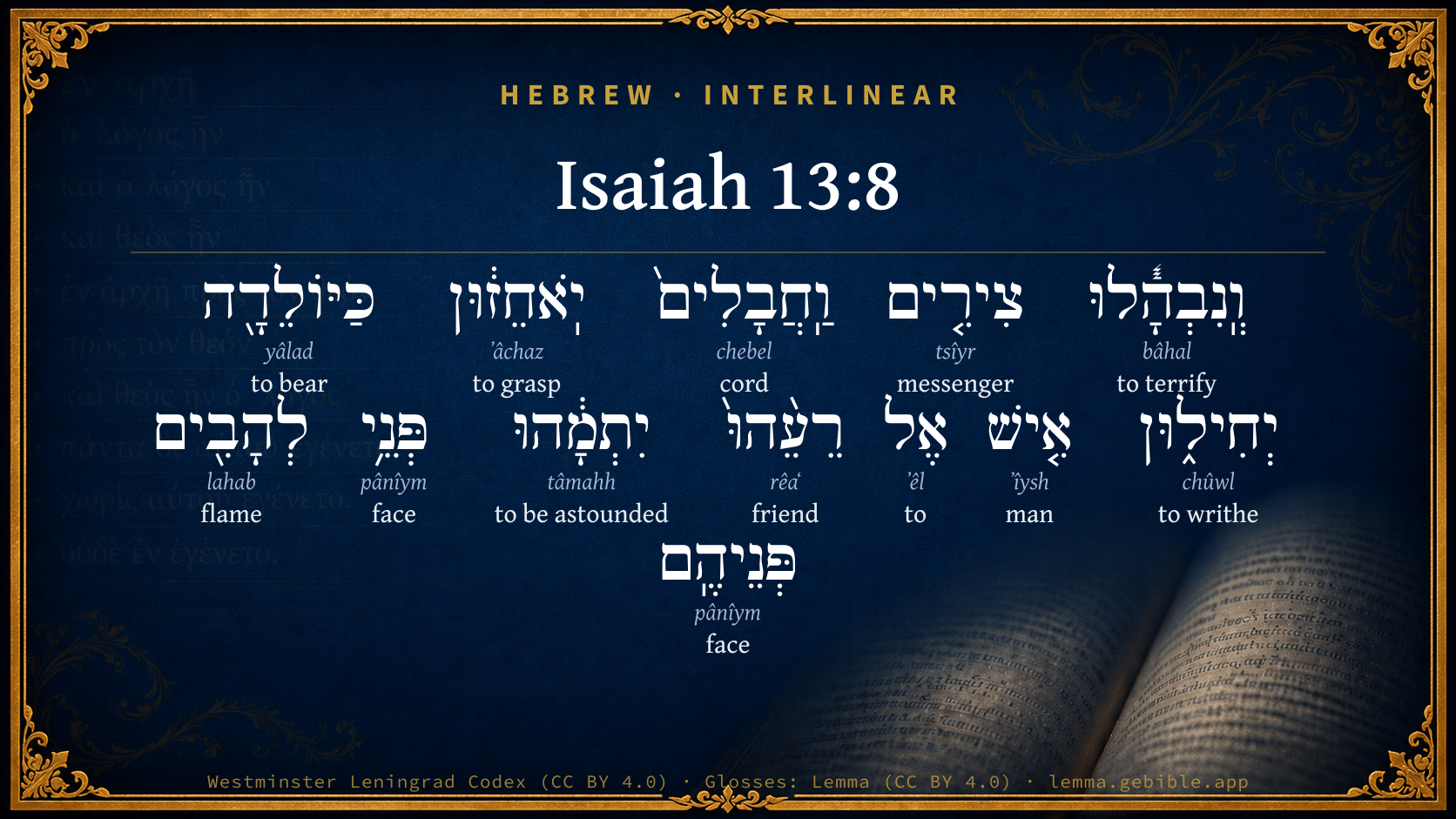
Isaiah 13:8

Hebrew (Westminster Leningrad Codex) Isaiah 13:8 appears in the Hebrew Old Testament. The text above is from the Westminster Leningrad Codex. Each word links to its Strong’s number, a concise gloss, and parsing drawn from the Open Scriptures Hebrew Bible morphology. Click any word for its full Brown-Driver-Briggs (BDB) entry.
Download image
Cite this verse

Isaiah 13:8 (World English Bible). Public Domain. Lemma interlinear Bible study tool, https://lemma.gebible.app/v/isaiah/13/8.

Show BibTeX & RIS
BibTeX
RIS
English Translation
and they shall be dismayed; pangs and sorrows shall take hold [of them]; they shall be in pain as a woman in travail: they shall look in amazement one at another; their faces [shall be] faces of flame.
World English Bible · Public Domain
Download a study sheet

One document with this verse’s original text, its word-by-word gloss line, the meaning frame, cross-references with their text, attributed commentary, and full source and license credits — printable, and it pastes into notes with its structure intact.

This verse Autodidact and up

Study sheet (.html) Plain text (.txt)

A passage Seminary Student

Up to 50 verses in one chapter. A passage sheet keeps up to 6 commentary sources and 12 cross-references per verse, in the order this page ranks them, and says so on the sheet whenever that leaves anything out. Ask for a single verse and you get the Autodidact verse sheet above.

Everything on this page stays free to read, with no account — the sheet is a download of what is already on screen, not access to it.

Want to remove ads? Support Godless Engineer
Compare translations 3

The same verse in 3 English versions, stacked beneath the original-language interlinear above. Click any original word for its lexicon entry.

Each is an independent rendering of the whole verse — the interlinear is not word-aligned to these translations.

Highlighted words mark where these versions differ — a whole-verse word diff, not a word-by-word alignment.

  • World English Bible Public Domain
    and they shall be dismayed; pangs and sorrows shall take hold [of them]; they shall be in pain as a woman in travail: they shall look in amazement one at another; their faces [shall be] faces of flame.
  • King James Version Public Domain
    And they shall be afraid: pangs and sorrows shall take hold of them; they shall be in pain as a woman that travaileth: they shall be amazed one at another; their faces shall be as flames.
  • unfoldingWord Literal Text CC BY-SA 4.0
    And they will be terrified; pangs and agonies will seize them; they will writhe like one birthing. A man will marvel to his friend; their faces faces of flames.

unfoldingWord Literal Text — © unfoldingWord, licensed CC BY-SA 4.0. Word-aligned USFM3 via Door43 (git.door43.org/unfoldingWord/en_ult).

Versions to compare (up to 4)

3 of 4 selected

Show all 18 translations

Every available English version of this verse, each an independent rendering of the whole verse.

  • World English Bible Public Domain
    and they shall be dismayed; pangs and sorrows shall take hold [of them]; they shall be in pain as a woman in travail: they shall look in amazement one at another; their faces [shall be] faces of flame.
  • Berean Standard Bible Public Domain
    Terror, pain, and anguish will seize them; they will writhe like a woman in labor. They will look at one another, their faces flushed with fear.
  • Majority Standard Bible Public Domain
    Terror, pain, and anguish will seize them; they will writhe like a woman in labor. They will look at one another, their faces flushed with fear.
  • King James Version Public Domain
    And they shall be afraid: pangs and sorrows shall take hold of them; they shall be in pain as a woman that travaileth: they shall be amazed one at another; their faces shall be as flames.
  • American Standard Version (1901) Public Domain
    and they shall be dismayed; pangs and sorrows shall take hold `of them'; they shall be in pain as a woman in travail: they shall look in amazement one at another; their faces `shall be' faces of flame.
  • Revised Version (1885) Public Domain
    and they shall be dismayed; pangs and sorrows shall take hold of them; they shall be in pain as a woman in travail: they shall be amazed one at another; their faces shall be faces of flame.
  • Geneva Bible (1599) Public Domain
    And they shalbe afraid: anguish and sorowe shall take them, and they shall haue paine, as a woman that trauaileth: euery one shall be amased at his neighbour, and their faces shalbe like flames of fire.
  • Douay-Rheims (1899) Public Domain
    And shall be broken. Gripings and pains shall take hold of them, they shall be in pain as a woman in labour. Every one shall be amazed at his neighbour, their countenances shall be as faces burnt.
  • Young's Literal Translation Public Domain
    And they have been troubled, Pains and pangs they take, As a travailing woman they are pained, A man at his friend they marvel, The appearance of flames -- their faces!
  • Literal Standard Version CC BY-SA 4.0
    And they have been troubled, || Pains and pangs take them, || They are pained as a travailing woman, || A man marvels at his friend, || The appearance of flames—their faces!
  • Unlocked Literal Bible CC BY-SA 4.0
    They will be terrified; pain and agony will seize them, like a woman in labor. They will look in astonishment at one another; their faces will be aflame.
  • unfoldingWord Literal Text CC BY-SA 4.0
    And they will be terrified; pangs and agonies will seize them; they will writhe like one birthing. A man will marvel to his friend; their faces faces of flames.
  • Darby Bible Public Domain
    and they shall be terrified: pangs and sorrows shall take hold of them, they shall writhe as a woman that travaileth; they shall be amazed one at another, their faces shall be as flames.
  • World Messianic Bible Public Domain
    They will be dismayed. Pangs and sorrows will seize them. They will be in pain like a woman in labor. They will look in amazement one at another. Their faces will be faces of flame.
  • Webster's Bible Public Domain
    And they shall be afraid: pangs and sorrows shall take hold of them; they shall be in pain as a woman that travaileth: they shall be amazed one at another; their faces shall be as flames.
  • Free Bible Version CC BY-SA 4.0
    They will be terrified; pain and anguish will seize them; they will suffer like a woman giving birth. They will look in shock at each other, their faces burning in fear.
  • Bible in Basic English Public Domain
    Their hearts will be full of fear; pains and sorrows will overcome them; they will be in pain like a woman in childbirth; they will be shocked at one another; their faces will be like flames.
  • JPS Tanakh (1917) Public Domain
    And they shall be affrighted; pangs and throes shall take hold of them; they shall be in pain as a woman in travail; they shall look aghast one at another; their faces shall be faces of flame.

Literal Standard Version (2020), Covenant Press — licensed CC BY-SA 4.0. Text via the HelloAO Bible API (eBible.org). Unlocked Literal Bible (unfoldingWord) — licensed CC BY-SA 4.0. Text via the HelloAO Bible API (eBible.org). unfoldingWord Literal Text — © unfoldingWord, licensed CC BY-SA 4.0. Word-aligned USFM3 via Door43 (git.door43.org/unfoldingWord/en_ult). Free Bible Version, Dr. Jonathan Gallagher — licensed CC BY-SA 4.0. Text via the HelloAO Bible API (eBible.org).

Word by word

More ways to search: Search by grammar → Find every occurrence → Compare this word →

Practice this passage: Drill this verse → Learn its vocabulary →

יִתְמָ֔הוּ
tâmahh
H8539
“to be astounded”
Verb, Qal, Imperfect, 3rd Person, Masculine, Plural
Part of Speech
Verb
Stem
Qal
Form
Imperfect
Person
3rd Person
Gender
Masculine
Number
Plural
Full BDB Definition

Origin: a primitive root

TWOT: 2518

to be astounded, be stunned, be amazed, be dumbfounded - (Qal) to be astounded - (Hithpael) to astonish yourself, be astounded, be astonished at one another
  1. וְֽנִבְהָ֓לוּ bâhal H926 “and · to terrify” Conjunction + Verb, Niphal, Sequential Perfect, 3rd Person, Common, Plural
  2. צִירִ֤ים tsîyr H6735 “messengers” Noun, Common, Masculine, Plural, Absolute
  3. וַֽחֲבָלִים֙ chebel H2256 “and · cords” Conjunction + Noun, Common, Masculine, Plural, Absolute
  4. יֹֽאחֵז֔וּן ʼâchaz H270 “to grasp” Verb, Qal, Imperfect, 3rd Person, Masculine, Plural + Suffix, n
  5. כַּיּוֹלֵדָ֖ה yâlad H3205 “like/as the · bearing” Preposition, Determined + Verb, Qal, Participle Active, Feminine, Singular, Absolute
  6. יְחִיל֑וּן chûwl H2342 “to writhe” Verb, Qal, Imperfect, 3rd Person, Masculine, Plural + Suffix, n
  7. אִ֤ישׁ ʼîysh H376 “man” Noun, Common, Masculine, Singular, Absolute
  8. אֶל ʼêl H413 “to” Preposition
  9. רֵעֵ֨הוּ֙ rêaʻ H7453 “friend · his” Noun, Common, Masculine, Singular, Construct + Suffix, Personal, 3rd Person, Masculine, Singular
  10. פְּנֵ֥י pânîym H6440 “face(s) of” Noun, Common, Both, Plural, Construct
  11. לְהָבִ֖ים lahab H3851 “flames” Noun, Common, Masculine, Plural, Absolute
  12. פְּנֵיהֶֽם pânîym H6440 “face(s) · their” Noun, Common, Both, Plural, Construct + Suffix, Personal, 3rd Person, Masculine, Plural

About this verse

These counts appear in no published source. They are computed here, from the morphology-tagged text and Lemma’s own curated glosses. What Lemma adds →

13
words
12
distinct lemmas
Prophets
section

Notable vocabulary

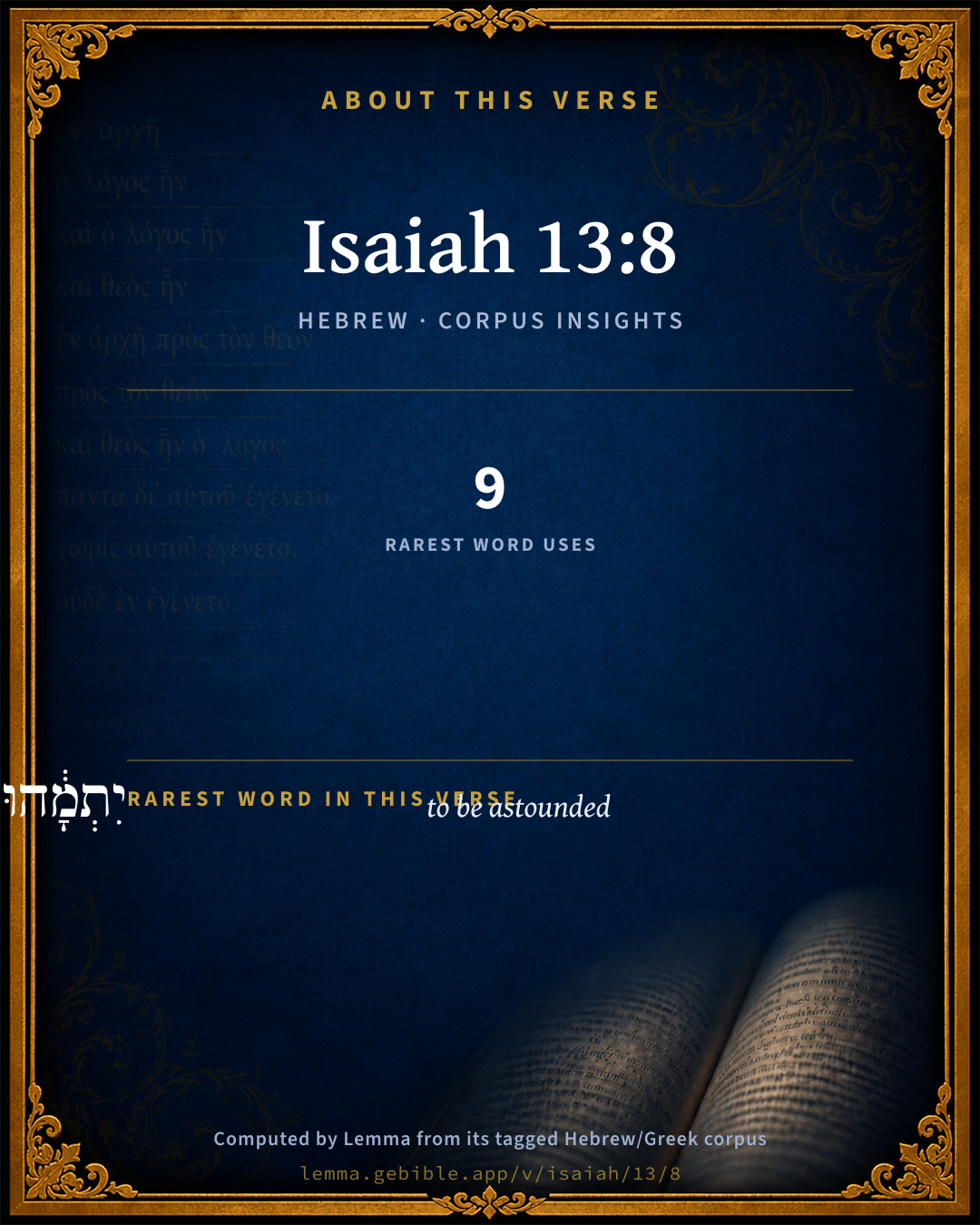
The rarest word here is יִתְמָ֔הוּ to be astounded H8539 — appearing just 9 times in the whole Hebrew Bible.

Shared distinctive vocabulary

יִתְמָ֔הוּ to be astounded H8539 occurs in 8 verses of the Hebrew Bible. Also found in:

Grammatical profile

  • 5 verbs
  • 7 nouns
  • 1 preposition

Verb forms

  • וְֽנִבְהָ֓לוּ Niphal · Sequential Perfect
  • יֹֽאחֵז֔וּן Qal · Imperfect
  • כַּיּוֹלֵדָ֖ה Qal · Participle Active
  • יְחִיל֑וּן Qal · Imperfect
  • יִתְמָ֔הוּ Qal · Imperfect

Repetition

A word recurs within this verse — often emphatic in Hebrew:

  • פְּנֵ֥י face H6440 ×2

Hebrew & Septuagint length

In English translation the verse runs 38 words from the Hebrew and 35 from the Septuagint (LXX English) — closely comparable.

A rough comparison of the two English renderings, which tokenize alike — not a word-level alignment.

Word counts can differ between the Hebrew and the Greek without any difference in meaning — e.g. the Hebrew direct-object marker אֵת has no separate Greek word, and Greek often adds the article ὁ.

Cross-references

11

Topical passages linked to Isaiah 13:8 in the Treasury of Scripture Knowledge — connected by theme and wording, ordered by reader-vote popularity; previews shown in the World English Bible.

  • Isaiah 26:17 Like as a woman with child, who draws near the time of her delivery, is in pain and cries out in her pangs; so we have been before you, Yahweh.
  • Nahum 2:10 She is empty, void, and waste. The heart melts, the knees knock together, their bodies and faces have grown pale.
  • 1 Thessalonians 5:3 For when they are saying, "Peace and safety," then sudden destruction will come on them, like birth pains on a pregnant woman; and they will in no way escape.
  • Isaiah 21:3–4 Therefore are my loins filled with anguish; pangs have taken hold on me, as the pangs of a woman in travail: I am pained so that I can't hear; I am dismayed so that I can't see.
  • Psalms 48:5–6 They saw it, then they were amazed. They were dismayed, They hurried away.
  • Jeremiah 4:31 For I have heard a voice as of a woman in travail, the anguish as of her who brings forth her first child, the voice of the daughter of Zion, who gasps for breath, who spreads her hands, [saying], Woe is me now! for my soul faints before the murderers.
  • Jeremiah 30:6 Ask now, and see whether a man does travail with child: why do I see every man with his hands on his loins, as a woman in travail, and all faces are turned into paleness?
  • Jeremiah 50:43 The king of Babylon has heard the news of them, and his hands wax feeble: anguish has taken hold of him, [and] pangs as of a woman in travail.
  • Daniel 5:5–6 In the same hour came forth the fingers of a man's hand, and wrote over against the lampstand on the plaster of the wall of the king's palace: and the king saw the part of the hand that wrote.
  • Joel 2:6 At their presence the peoples are in anguish. All faces have grown pale.
  • John 16:21 A woman, when she gives birth, has sorrow, because her time has come. But when she has delivered the child, she doesn't remember the anguish any more, for the joy that a human being is born into the world.

Cross-references courtesy of OpenBible.info (CC BY 4.0).

Hebrew and Greek witnesses Masoretic Hebrew ↔ Greek Septuagint

The same verse in the two great witnesses to the Old Testament, shown verse-for-verse.

These are two independent witnesses, not word-aligned to each other, and the Septuagint is shown in lemma (dictionary) form.

Hebrew Isaiah 13:8 Masoretic · Westminster Leningrad Codex

וְֽנִבְהָ֓לוּ צִירִ֤ים וַֽחֲבָלִים֙ יֹֽאחֵז֔וּן כַּיּוֹלֵדָ֖ה יְחִיל֑וּן אִ֤ישׁ אֶל רֵעֵ֨הוּ֙ יִתְמָ֔הוּ פְּנֵ֥י לְהָבִ֖ים פְּנֵיהֶֽם

and they shall be dismayed; pangs and sorrows shall take hold [of them]; they shall be in pain as a woman in travail: they shall look in amazement one at another; their faces [shall be] faces of flame.

World English Bible · Public Domain

Greek LXX Isaiah 13:8 Septuagint · lemma form

καί ταράσσω ὁ πρέσβυς καί ὠδίν αὐτός ἔχω ὡς γυνή τίκτω καί συνφοράζω ἕτερος πρός ὁ ἕτερος καί ἐκἵστημι καί ὁ πρόσωπον αὐτός ὡς φλόξ μεταβάλλω

The elders shall be troubled, and pangs shall seize them, as of a woman in travail: and they shall mourn one to another, and shall be amazed, and shall change their countenance as a flame.

LXX2012 (modern English Septuagint) · Public Domain

On this verse, Jamieson, Fausset & Brown discusses the Septuagint’s reading. Read the note in Commentary ↓

Hebrew: Westminster Leningrad Codex (CC BY 4.0). Greek: Septuagint (public domain); English from LXX2012 (modern English Septuagint) (Public Domain). How the Septuagint differs from the Hebrew →

Targum (Aramaic paraphrase)

1

The Targum is the ancient Jewish Aramaic paraphrase of the Hebrew Scriptures — an interpretive translation, not the Hebrew text itself. Onkelos (literal) and Pseudo-Jonathan (expansive) render the Torah, and Jonathan the Prophets. Coverage is partial: where no permissively-licensed English translation exists for a verse, only the Aramaic is shown. This is verse-level text, not a word-by-word alignment to the Hebrew.

  1. Targum Jonathan Prophets (Joshua–Malachi)
    וְיִתְבַּהֲלוּן עָקָא וְחֶבְלִין יֶחְדוּנוּנוּן זִיעַ כְּלֵידָתָא יְזוּעוּן גְבַר לְחַבְרֵיהּ יִתְמְהוּן אַפֵּי שַׁלְהוֹבִין אַפֵּיהוֹן:

    They shall be struck with consternation; distress and pangs shall take hold of them; they shall tremble as with the trembling of a woman that travaileth: they shall be amazed one at another; their countenances shall be like flames of fire.

    Targum Jonathan — Aramaic: “Mikraot Gedolot” (public domain). English: “Sefaria Community Translation” (CC0 1.0 (public-domain dedication)); “London "Chaldee Paraphrase," 1871” (public domain). Text via Sefaria.

Commentary

Notes on Isaiah 13:8 from classic Christian and Jewish commentators (each source and its license shown beneath its notes). The classic Christian expositions comment on the surrounding passage and are grouped to its opening verse, so a note may address several verses; the Jewish commentaries on the Tanakh (Rashi and others) are per-verse, so they appear only where the commentator wrote on this verse.

Lemma curates 59 commentaries, every one of them public domain or Creative Commons licensed, each selected and text-cleaned for this edition rather than reprinted as found. About our sources →

Trapp's Complete Commentary

John Trapp

Isa 13:8 And they shall be afraid: pangs and sorrows shall take hold of them; they shall be in pain as a woman that travaileth: they shall be amazed one at another; their faces [shall be as] flames.

Ver. 8. And they shall be afraid.]

“ Conturbabuntur -

Innumerabilibus sollicitudinibus. ”

They shall be amazed one at another.] Amused, amazed, amated, as being at their wits’ ends.

Their faces shall be as flames.] So Jer 30:5-6, a voice of fear and trembling, every man with his hands on his loins, the posture of a travailling woman, and all faces turned into paleness. The prophet here alludeth, saith Musculus, to the face of a smith at dark night, when he standeth blowing his fire, for his face appears as if it had no blood in it, most wan and pale. Or, as others think, to a man frightened, who first looketh pale, the blood running to the heart to relieve it, afterwards, upon the return of the blood to the outward parts, he looketh red, and of a flame colour.

John Trapp, A Commentary or Exposition upon All the Books of the Old and New Testament (1647–1656) — public domain. Text from a community e-Sword module.

Tyndale Open Study Notes

Tyndale Open Resources

13:8 Pangs . . . like those of a woman in labor: The day of the Lord brings sudden and overpowering pain and fear for the wicked (see also Jer 30:6; Hos 13:13; Mic 4:9, 10; 5:3).

Tyndale Open Study Notes — © Tyndale Open Resources, licensed CC BY-SA 4.0. Text via the HelloAO Bible API.

Geneva Bible (1599)

Geneva Bible translators

The Babylonians’ anger and grief shall be so much, that their faces shall burn as fire.

Geneva Bible (1599) marginal notes — public domain. Text via Bolls.life.

Jamieson, Fausset & Brown

Robert Jamieson, A. R. Fausset & David Brown

pangs--The Hebrew means also a "messenger." HORSLEY, therefore, with the Septuagint translates, "The heralds (who bring word of the unexpected invasion) are terrified." MAURER agrees with English Version, literally, "they shall take hold of pangs and sorrows."

woman . . . travaileth-- (Th1 5:3).

amazed--the stupid, bewildered gaze of consternation.

faces . . . flames--"their visages have the livid hue of flame" [HORSLEY]; with anguish and indignation.

Jamieson, Fausset & Brown — Commentary Critical and Explanatory on the Whole Bible (1871) — public domain (CC PDM 1.0). Text via the HelloAO Bible API.

Adam Clarke's Commentary

Verse 8. And they shall be afraid - "And they shall be terrified"] I join this verb, ונבהלו venibhalu, to the preceding verse, with the Syriac and Vulgate.

Pangs and sorrows shall take hold on them - "Pangs shall seize them"] The Septuagint, Syriac, and Chaldee read יאחזום yochezum, instead of יאחזון yochezun, which does not express the pronoun them, necessary to the sense.

Adam Clarke's Commentary on the Bible (1810–1826) — public domain. Text from a community e-Sword/MySword module.

The Cambridge Bible for Schools and Colleges

gen. ed. J. J. S. Perowne

8. they shall be amazed one at another] i.e. “look in horror on each other.”

their faces shall be as flames] Lit. faces of flames are their faces, burning with feverish excitement, or perhaps with shame (Eze_7:18). There are no exact parallels to the expression; cf. Joe_2:6; Nah_2:10.

The Cambridge Bible for Schools and Colleges (gen. ed. J. J. S. Perowne; Cambridge University Press, 1878–1918) — public domain. Text from a community e-Sword module.

John Gill's Exposition

And they shall be afraid,.... Troubled, dismayed, frightened, at the sudden taking of the city, and at the sight of Cyrus's troops marching up into the very heart of it, and to the king's palace:

pangs and sorrow shall take hold of them; as convulsions, pains in the bowels, &c. more fully explained in the next clause:

they shall be in pain, as a woman that travaileth; that is in labour, and ready to bring forth her child, whose pains are very sharp, and agonies great; the same is said of the king of Babylon, Jer 50:43,

they shall be amazed one at another; that so great a city should be so surprised, and so suddenly taken; and that they shall not be able to help one another; and that such as were so famous for courage and valour should be at once so dispirited:

their faces shall be as flames; not red with blushing, through shame, as Kimchi; but pale with fear, as the colour of flame, or, as the faces of smiths, that work at a forge: the words may be rendered, "their faces are as the faces of Lehabim" (d); the name of a people mentioned in Gen 10:13 the same with the Libians, which were of a blackish or tawny colour; so Jarchi interprets it, and says they were a people of a yellow complexion: and Aben Ezra observes, that some interpret it of a nation like the Ethiopians; and so it denotes, that the Babylonians, their faces should be black with distress and anguish; see Joe 2:6.

(d) "ut facies Lehabim, sive Lybiorum facies eorum", Gataker.

John Gill's Exposition of the Whole Bible (1746–1763) — public domain (CC PDM 1.0). Text via the HelloAO Bible API.

Albert Barnes' Notes on the Bible

They shall be in pain as a woman that travaileth - This comparison is often used in the Scriptures to denote the deepest possible pain and sorrow, as well as the suddenness with which any calamity comes upon a people Psa 48:6; Isa 21:3; Isa 42:14; Jer 6:24; Jer 13:21; Jer 22:23; Jer 49:24; Jer 50:43; Hos 13:13; Mic 4:9-10; Joh 16:21; Gal 4:19; 1Th 5:3.

They shall be amazed one at another - They shall stare with a stupid gaze on one another, indicating a state of great distress, anxiety, and alarm. They shall look to each other for aid, and shall meet in the countenances of others the same expressions of wonder and consternation.

Their faces shall be as flames - Their faces shall glow or burn like fire. When grief and anguish come upon us, the face becomes inflamed. The face in fear is usually pale. But the idea here is not so much that of fear as of anguish; and, perhaps, there is mingled also here the idea of indignation against their invaders.

Albert Barnes' Notes on the Bible (1834–1885) — public domain. Text from a community e-Sword/MySword module.

Haydock's Catholic Bible Commentary

Burnt. Black with despair, Nahum ii. 10., and Joel ii. 6.

George Leo Haydock (1774–1849), Haydock's Catholic Family Bible and Commentary, 1859 edition — public domain. Excludes Psalms (Douay-Rheims chapter numbering differs from Protestant) and Deuterocanonical books (Catholic canon only).

Matthew Poole's English Annotations

They shall be amazed one at another, to see so populous and impregnable a city as Babylon was, so easily and unexpectedly taken.

Flames, Heb. faces of flame; either pale with fear, or inflamed with rage and torment, as men in misery frequently are. Some render it the faces of Lehabim, a people descending from Mizraim, Gen 10:13; 1Ch 1:11, i.e. black with pain, as men use to be; of which see Joe 2:6; Nah 2:10.

Matthew Poole's English Annotations on the Holy Bible (1683–1685) — public domain. Text from a community e-Sword/MySword module.

Whedon's Commentary on the Bible

Daniel D. Whedon

8. Afraid — Dismayed. Poetic power is manifest in the figures here used, which are to the effect that contortions from agonizing pain fall on the people; men stare at each other in helpless fright; their faces are faces of flame — red as fire.

Daniel D. Whedon (gen. ed.), Commentary on the Old and New Testaments (1874–1909) — public domain. Text from a community e-Sword module.

The Pulpit Commentary

They shall be afraid; rather, dismayed. Pangs and sorrows shall take hold of them; literally, they shall take hold of pangs and sorrows. They shall be amazed; rather, look aghast. Their faces shall be as flames. I know no better explanation than that of Dr. Kay, that a sudden transition is intended flora despondency to extreme excitement.

The Pulpit Commentary (1880–1919), ed. H.D.M. Spence-Jones & Joseph S. Exell — public domain. Text from a community e-Sword module.

J. A. Alexander on Isaiah

Joseph Addison Alexander

“And they (the Babylonians) shall be confounded, pangs and throes shall seize (them), like the travailing (woman) they shall writhe, each at his neighbor, they shall wonder, faces of flames (shall be) their faces.” The expression ‘wonder at each other’ occurs once in historical prose (Gen 43:33). It seems here to denote not simply consternation and dismay, but stupefaction at each other’s aspect and condition, q. d. each man at his friend shall stand aghast. The last clause is a continued description of the terror and distress of the Chaldeans. In the expression faces of flame, the point of comparison according to some is redness, here referred to as a natural symptom of confusion and shame. But as this seems inappropriate in the case before us, others understand the aspect indicated to be one of paleness, as produced by fear. Others understand the glow or flush produced by anguish and despair to be intended.

Joseph Addison Alexander, The Prophecies of Isaiah (1846–1847; New York: Scribner, 1870–1878) — public domain. Text from a community e-Sword module.

Rashi

Rabbi Shlomo Yitzchaki (Rashi)

pangs and throes (צִירִים וַחֲבָלִים) These are expressions of pains of a woman who kneels to give birth, for the hinges (צִירִים) of her womb break apart to open.

they shall writhe Heb. יְחִילוּן. חִיל, חַלְחָלָה are expressions of shivering.

each man shall be amazed at his fellow The Babylonians will be amazed at those who advanced against them, for they are peculiar.

their faces are faces of flames A nation whose faces are red and very frightful, [or alternatively, because they are a pensive people, and he compares the Babylonians to them because of the amazement.]

Rashi on the Tanakh — English translations: “The Judaica Press complete Tanach with Rashi, translated by A. J. Rosenberg” (CC BY 4.0); “Pentateuch with Rashi's commentary by M. Rosenbaum and A.M. Silbermann, 1929-1934” (public domain); “The Metsudah Tanach series, Lakewood, N.J” (CC BY 4.0); and “The Book of Joshua, Metsudah Publications, 1997” (CC BY 4.0). Text via Sefaria.

Ibn Ezra

Rabbi Abraham ibn Ezra

פני להבים A face of flames. A face burnt by the intensity of the pains. According to others: The face of the Lehabim; Lehabim being the name of a nation similar to the Ethiopians.

Ibn Ezra on the Tanakh — English translations: “Sefaria Community Translation” (CC0 1.0 (public-domain dedication)); “Yalkut, Sifsei Chachomim Chumash, Metsudah Publications, 2009” (CC BY 4.0); and “Commentary of Ibn Ezra on Isaiah - trans. by M. Friedlander, 1873” (public domain). Text via Sefaria.

Lesson kit

Teaching starters — assembled from the data on this page, not authored interpretation. Every prompt links to the verse data it draws on. Edit before teaching.

Isaiah, in the Prophets, opens this verse with 13 words (12 distinct Hebrew lemmas). Its most distinctive word is tâmahh (“to be astounded”). A historical commentator’s framing appears above. Read the whole chapter for the surrounding context.

Discussion questions

  1. How does “to be astounded” (tâmahh) shape what this verse is saying?
  2. How does Genesis 43:33, which shares the word «to be astounded», read alongside this verse?
  3. What does the repetition of “face” (2× in this one verse) do in this verse?
  4. These translations render this verse differently; the difference is in the English rendering, not the original. What questions does that raise?
  5. «וְֽנִבְהָ֓לוּ» is a Niphal Sequential Perfect verb. How does that grammatical form shape the action described?
  6. Compare how Trapp's Complete Commentary and Tyndale Open Study Notes read this verse. Where do they agree or differ?

Things to notice

Reading settings

Reading text

Shown beneath each verse's original-language words.

Old Testament
Old Testament edition

Read the OT as the Masoretic Hebrew (MT) or the Greek Septuagint (LXX).

English shown for the Greek Septuagint (in the Hebrew ↔ Greek comparison).

Comparing translations? Open the Compare panel on any verse page to stack up to four side by side.