
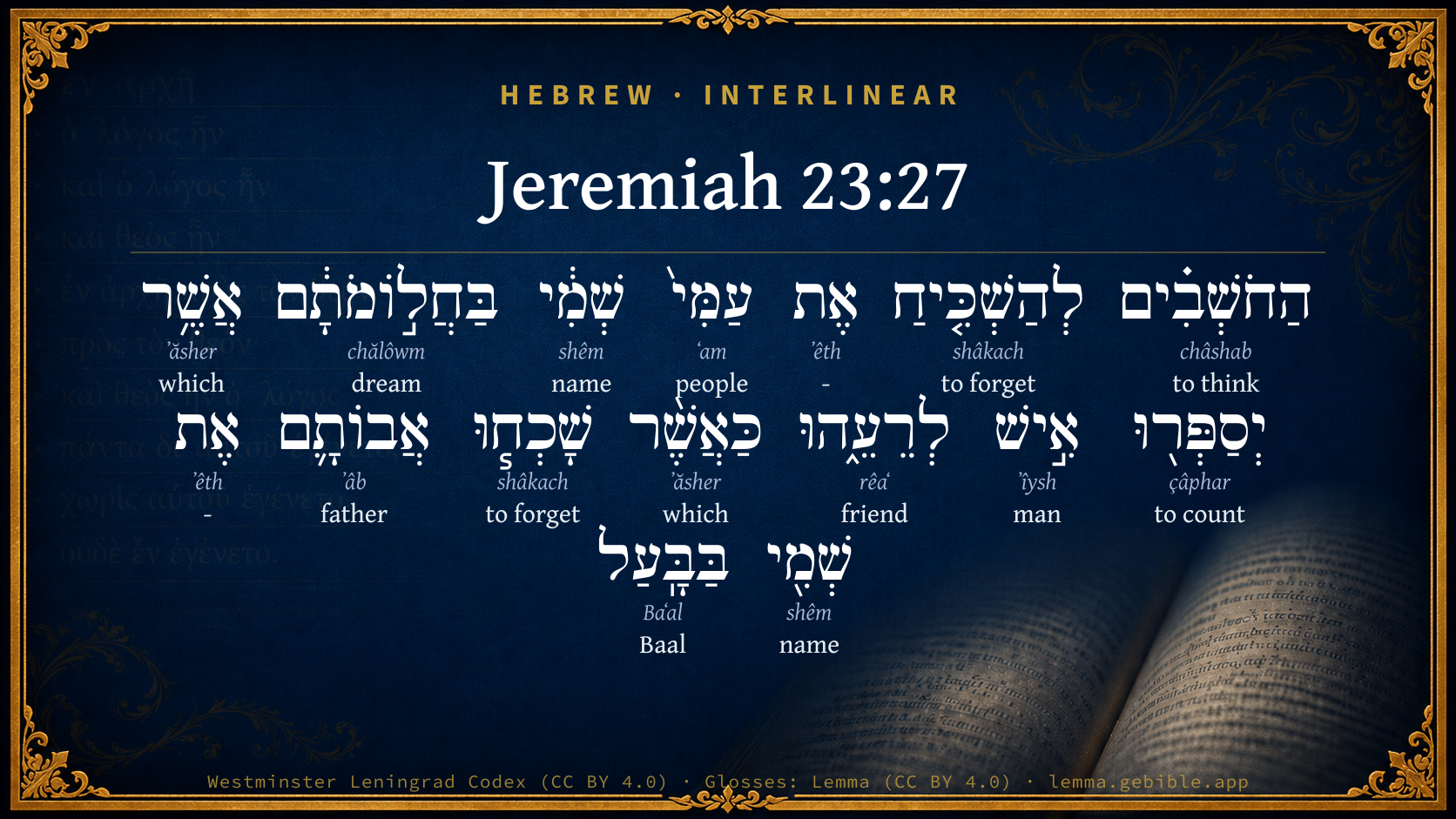
Jeremiah 23:27

Hebrew (Westminster Leningrad Codex) Jeremiah 23:27 appears in the Hebrew Old Testament. The text above is from the Westminster Leningrad Codex. Each word links to its Strong’s number, a concise gloss, and parsing drawn from the Open Scriptures Hebrew Bible morphology. Click any word for its full Brown-Driver-Briggs (BDB) entry.
Download image
Cite this verse

Jeremiah 23:27 (World English Bible). Public Domain. Lemma interlinear Bible study tool, https://lemma.gebible.app/v/jeremiah/23/27.

Show BibTeX & RIS
BibTeX
RIS
English Translation
who think to cause my people to forget my name by their dreams which they tell every man to his neighbor, as their fathers forgot my name for Baal.
World English Bible · Public Domain
Download a study sheet

One document with this verse’s original text, its word-by-word gloss line, the meaning frame, cross-references with their text, attributed commentary, and full source and license credits — printable, and it pastes into notes with its structure intact.

This verse Autodidact and up

Study sheet (.html) Plain text (.txt)

A passage Seminary Student

Up to 50 verses in one chapter. A passage sheet keeps up to 6 commentary sources and 12 cross-references per verse, in the order this page ranks them, and says so on the sheet whenever that leaves anything out. Ask for a single verse and you get the Autodidact verse sheet above.

Everything on this page stays free to read, with no account — the sheet is a download of what is already on screen, not access to it.

Want to remove ads? Support Godless Engineer
Compare translations 3

The same verse in 3 English versions, stacked beneath the original-language interlinear above. Click any original word for its lexicon entry.

Each is an independent rendering of the whole verse — the interlinear is not word-aligned to these translations.

Highlighted words mark where these versions differ — a whole-verse word diff, not a word-by-word alignment.

  • World English Bible Public Domain
    who think to cause my people to forget my name by their dreams which they tell every man to his neighbor, as their fathers forgot my name for Baal.
  • King James Version Public Domain
    Which think to cause my people to forget my name by their dreams which they tell every man to his neighbour, as their fathers have forgotten my name for Baal.
  • unfoldingWord Literal Text CC BY-SA 4.0
    The ones planning to make my people forget my name by their dreams which they recount, a man to his neighbor, just as their fathers forgot my name on account of Baal. p

unfoldingWord Literal Text — © unfoldingWord, licensed CC BY-SA 4.0. Word-aligned USFM3 via Door43 (git.door43.org/unfoldingWord/en_ult).

Versions to compare (up to 4)

3 of 4 selected

Show all 18 translations

Every available English version of this verse, each an independent rendering of the whole verse.

  • World English Bible Public Domain
    who think to cause my people to forget my name by their dreams which they tell every man to his neighbor, as their fathers forgot my name for Baal.
  • Berean Standard Bible Public Domain
    They suppose the dreams that they tell one another will make My people forget My name, just as their fathers forgot My name through the worship of Baal.
  • Majority Standard Bible Public Domain
    They suppose the dreams that they tell one another will make My people forget My name, just as their fathers forgot My name through the worship of Baal.
  • King James Version Public Domain
    Which think to cause my people to forget my name by their dreams which they tell every man to his neighbour, as their fathers have forgotten my name for Baal.
  • American Standard Version (1901) Public Domain
    that think to cause my people to forget my name by their dreams which they tell every man to his neighbor, as their fathers forgat my name for Baal.
  • Revised Version (1885) Public Domain
    which think to cause my people to forget my name by their dreams which they tell every man to his neighbour, as their fathers forgat my name for Baal.
  • Geneva Bible (1599) Public Domain
    Thinke they to cause my people to forget my Name by their dreames, which they tell euery man to his neyghbour, as their forefathers haue forgotten my Name for Baal?
  • Douay-Rheims (1899) Public Domain
    Who seek to make my people forget my name through their dreams, which they tell every man to his neighbor: as their fathers forgot my name for Baal.
  • Young's Literal Translation Public Domain
    Who are devising to cause My people To forget My name by their dreams, That they recount each to his neighbour, As their fathers forgot my name for Baal.
  • Literal Standard Version CC BY-SA 4.0
    Who are devising to cause My people || To forget My Name by their dreams, || That they each recount to his neighbor, || As their fathers forgot My Name for Ba‘al.
  • Unlocked Literal Bible CC BY-SA 4.0
    They are planning on making my people forget my name with the dreams that they report, each one to his neighbor, just as their ancestors forgot my name in favor of Baal's name.
  • unfoldingWord Literal Text CC BY-SA 4.0
    The ones planning to make my people forget my name by their dreams which they recount, a man to his neighbor, just as their fathers forgot my name on account of Baal. p
  • Darby Bible Public Domain
    who think to cause my people to forget my name by their dreams which they tell every man to his neighbour: as their fathers have forgotten my name for Baal.
  • World Messianic Bible Public Domain
    They intend to cause my people to forget my name by their dreams which they each tell his neighbor, as their fathers forgot my name because of Baal.
  • Webster's Bible Public Domain
    Who think to cause my people to forget my name by their dreams which they tell every man to his neighbor, as their fathers have forgotten my name for Baal.
  • Free Bible Version CC BY-SA 4.0
    They think the dreams that they repeat to one another will lead my people to forget me, just like their forefathers forgot me by worshiping Baal.
  • Bible in Basic English Public Domain
    Whose purpose is to take away the memory of my name from my people by their dreams, of which every man is talking to his neighbour, as their fathers gave up the memory of my name for the Baal.
  • JPS Tanakh (1917) Public Domain
    That think to cause My people to forget My name by their dreams which they tell every man to his neighbour, as their fathers forgot My name for Baal.

Literal Standard Version (2020), Covenant Press — licensed CC BY-SA 4.0. Text via the HelloAO Bible API (eBible.org). Unlocked Literal Bible (unfoldingWord) — licensed CC BY-SA 4.0. Text via the HelloAO Bible API (eBible.org). unfoldingWord Literal Text — © unfoldingWord, licensed CC BY-SA 4.0. Word-aligned USFM3 via Door43 (git.door43.org/unfoldingWord/en_ult). Free Bible Version, Dr. Jonathan Gallagher — licensed CC BY-SA 4.0. Text via the HelloAO Bible API (eBible.org).

Word by word

More ways to search: Search by grammar → Find every occurrence → Compare this word →

Practice this passage: Drill this verse → Learn its vocabulary →

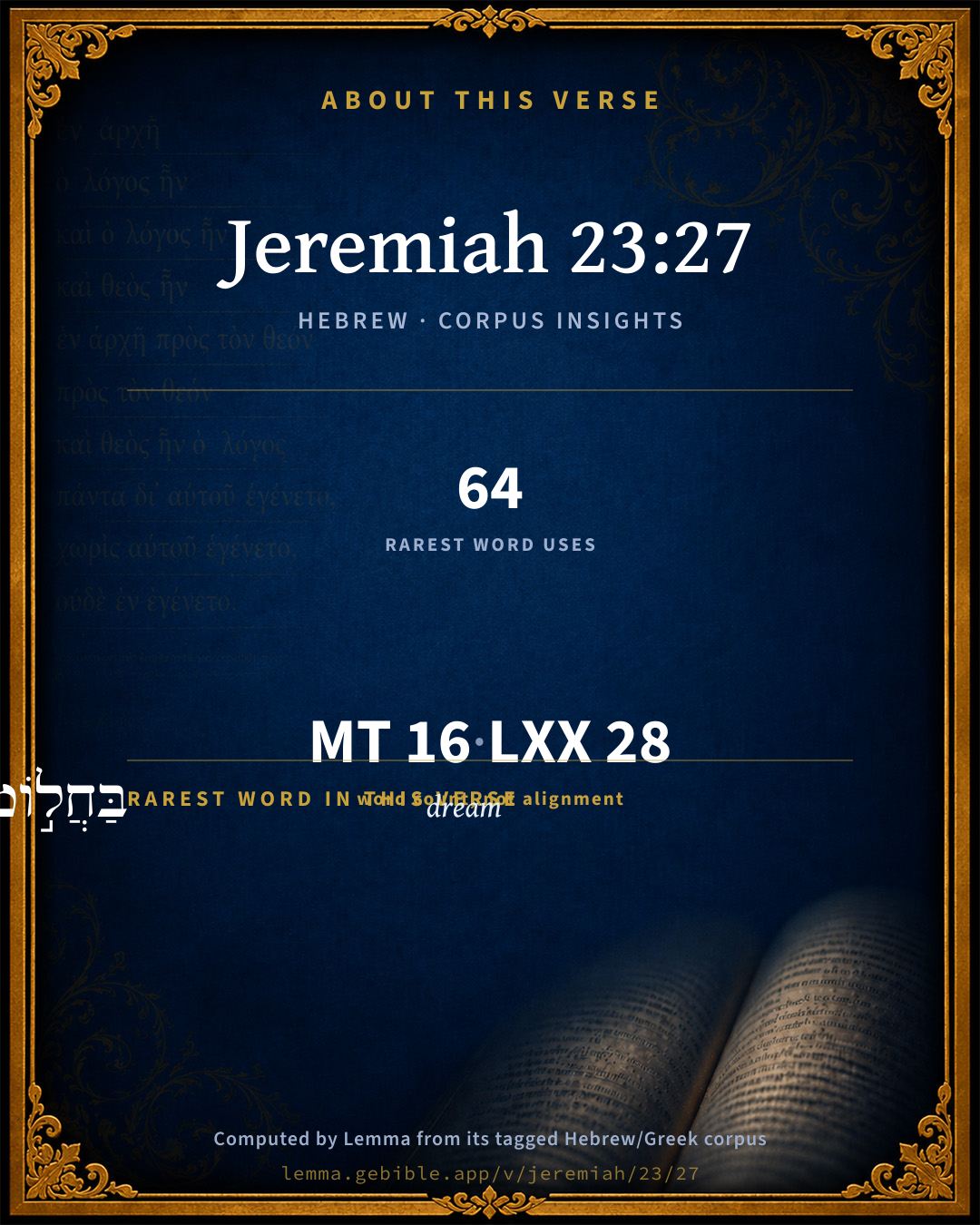
בַּחֲל֣וֹמֹתָ֔ם
chălôwm
H2472
“in/at · dreams · their”
Preposition + Noun, Common, Masculine, Plural, Construct + Suffix, Personal, 3rd Person, Masculine, Plural
Part of Speech
Preposition + Noun
Type
Common
Gender
Masculine
Number
Plural
State
Construct
Full BDB Definition

Origin: from H2492

TWOT: 663a

dream - dream (ordinary) - dream (with prophetic meaning)
  1. הַחֹשְׁבִ֗ים châshab H2803 “the · thinking” Particle, Definite Article + Verb, Qal, Participle Active, Masculine, Plural, Absolute
  2. לְהַשְׁכִּ֤יחַ shâkach H7911 “to forget” Preposition + Verb, Hiphil, Infinitive Construct
  3. אֶת ʼêth H853 “-” Particle, Direct Object
  4. עַמִּי֙ ʻam H5971 “people · my” Noun, Common, Masculine, Singular, Construct + Suffix, Personal, 1st Person, Common, Singular
  5. שְׁמִ֔י shêm H8034 “name · my” Noun, Common, Masculine, Singular, Construct + Suffix, Personal, 1st Person, Common, Singular
  6. אֲשֶׁ֥ר ʼăsher H834 “which” Particle, Relative
  7. יְסַפְּר֖וּ çâphar H5608 “to count” Verb, Piel, Imperfect, 3rd Person, Masculine, Plural
  8. אִ֣ישׁ ʼîysh H376 “man” Noun, Common, Masculine, Singular, Absolute
  9. לְרֵעֵ֑הוּ rêaʻ H7453 “to/for · friend · his” Preposition + Noun, Common, Masculine, Singular, Construct + Suffix, Personal, 3rd Person, Masculine, Singular
  10. כַּאֲשֶׁ֨ר ʼăsher H834 “like/as · which” Preposition + Particle, Relative
  11. שָׁכְח֧וּ shâkach H7911 “to forget” Verb, Qal, Perfect, 3rd Person, Common, Plural
  12. אֲבוֹתָ֛ם ʼâb H1 “fathers · their” Noun, Common, Masculine, Plural, Construct + Suffix, Personal, 3rd Person, Masculine, Plural
  13. אֶת ʼêth H853 “-” Particle, Direct Object
  14. שְׁמִ֖י shêm H8034 “name · my” Noun, Common, Masculine, Singular, Construct + Suffix, Personal, 1st Person, Common, Singular
  15. בַּבָּֽעַל Baʻal H1168 “in/at the · Baal” Preposition, Determined + Noun, Proper

About this verse

These counts appear in no published source. They are computed here, from the morphology-tagged text and Lemma’s own curated glosses. What Lemma adds →

16
words
12
distinct lemmas
Prophets
section

Grammatical profile

  • 4 verbs
  • 8 nouns
  • 4 particles

Verb forms

  • הַחֹשְׁבִ֗ים Qal · Participle Active
  • לְהַשְׁכִּ֤יחַ Hiphil · Infinitive Construct
  • יְסַפְּר֖וּ Piel · Imperfect
  • שָׁכְח֧וּ Qal · Perfect

Repetition

Words recur within this verse — often emphatic in Hebrew:

  • לְהַשְׁכִּ֤יחַ to forget H7911 ×2
  • שְׁמִ֔י name H8034 ×2
  • אֲשֶׁ֥ר which H834 ×2

Hebrew & Septuagint length

In the original languages it is 16 Hebrew tokens and 28 Greek tokens — but the two are counted differently (Hebrew bundles its prefixes and suffixes into one token; the Greek is in lemma form), so that isn’t a like-for-like length.

Cross-references

9

Topical passages linked to Jeremiah 23:27 in the Treasury of Scripture Knowledge — connected by theme and wording, ordered by reader-vote popularity; previews shown in the World English Bible.

  • Judges 8:33–34 It happened, as soon as Gideon was dead, that the children of Israel turned again, and played the prostitute after the Baals, and made Baal Berith their god.
  • Judges 3:7 The children of Israel did that which was evil in the sight of Yahweh, and forgot Yahweh their God, and served the Baals and the Asheroth.
  • Deuteronomy 13:1–5 If there arise in the midst of you a prophet, or a dreamer of dreams, and he give you a sign or a wonder,
  • Judges 10:6 The children of Israel again did that which was evil in the sight of Yahweh, and served the Baals, and the Ashtaroth, and the gods of Syria, and the gods of Sidon, and the gods of Moab, and the gods of the children of Ammon, and the gods of the Philistines; and they forsook Yahweh, and didn't serve him.
  • 2 Kings 21:3 For he built again the high places which Hezekiah his father had destroyed; and he reared up altars for Baal, and made an Asherah, as did Ahab king of Israel, and worshiped all the host of the sky, and served them.
  • Jeremiah 29:8 For thus says Yahweh of hosts, the God of Israel: Don't let your prophets who are in the midst of you, and your diviners, deceive you; neither listen you to your dreams which you cause to be dreamed.
  • Acts 13:8 But Elymas the sorcerer (for so is his name by interpretation) withstood them, seeking to turn aside the proconsul from the faith.
  • 2 Timothy 2:17–18 and their word will consume like gangrene, of whom is Hymenaeus and Philetus;
  • 2 Timothy 3:6–8 For of these are those who creep into houses, and take captive gullible women loaded down with sins, led away by various lusts,

Cross-references courtesy of OpenBible.info (CC BY 4.0).

Hebrew and Greek witnesses Masoretic Hebrew ↔ Greek Septuagint

The same verse in the two great witnesses to the Old Testament, shown verse-for-verse.

These are two independent witnesses, not word-aligned to each other, and the Septuagint is shown in lemma (dictionary) form.

Hebrew Jeremiah 23:27 Masoretic · Westminster Leningrad Codex

הַחֹשְׁבִ֗ים לְהַשְׁכִּ֤יחַ אֶת עַמִּי֙ שְׁמִ֔י בַּחֲל֣וֹמֹתָ֔ם אֲשֶׁ֥ר יְסַפְּר֖וּ אִ֣ישׁ לְרֵעֵ֑הוּ כַּאֲשֶׁ֨ר שָׁכְח֧וּ אֲבוֹתָ֛ם אֶת שְׁמִ֖י בַּבָּֽעַל

who think to cause my people to forget my name by their dreams which they tell every man to his neighbor, as their fathers forgot my name for Baal.

World English Bible · Public Domain

Greek LXX Structure differs

In the Septuagint, Jeremiah is about an eighth shorter than the Hebrew and arranges its material differently — the Oracles Against the Nations (Hebrew chapters 46–51) appear in the middle of the Greek book, after 25:13. Because the chapter and verse boundaries do not line up, a verse-for-verse comparison with the Hebrew is not shown.

A verse-for-verse comparison isn’t shown here because the chapters and verses don’t line up. Switch to the LXX edition with the MT / LXX toggle above to read the Greek directly.

On this verse, John Gill's Exposition discusses the Septuagint’s reading. Read the note in Commentary ↓

Hebrew: Westminster Leningrad Codex (CC BY 4.0). Greek: Septuagint (public domain); English from a public-domain English Septuagint. How the Septuagint differs from the Hebrew →

Targum (Aramaic paraphrase)

1

The Targum is the ancient Jewish Aramaic paraphrase of the Hebrew Scriptures — an interpretive translation, not the Hebrew text itself. Onkelos (literal) and Pseudo-Jonathan (expansive) render the Torah, and Jonathan the Prophets. Coverage is partial: where no permissively-licensed English translation exists for a verse, only the Aramaic is shown. This is verse-level text, not a word-by-word alignment to the Hebrew.

  1. Targum Jonathan Prophets (Joshua–Malachi)
    דִמְחַשְׁבִין לְאַנְשָׁאָה יַת עַמִי שְׁמִי בְּחֶלְמְהוֹן דִמְשְׁתְּעַן גְבַר לְחַבְרֵיהּ כְּמָה דִשְׁבָק אֲבָהַתְהוֹן יַת פּוּלְחַן שְׁמִי וּמְקַיְמִין בְּשׁוּם טַעֲוָתָא:

    (no public-domain English translation for this verse)

    Targum Jonathan — Aramaic: “Mikraot Gedolot” (public domain). English: “Sefaria Community Translation” (CC0 1.0 (public-domain dedication)); “London "Chaldee Paraphrase," 1871” (public domain). Text via Sefaria.

Commentary

Notes on Jeremiah 23:27 from classic Christian and Jewish commentators (each source and its license shown beneath its notes). The classic Christian expositions comment on the surrounding passage and are grouped to its opening verse, so a note may address several verses; the Jewish commentaries on the Tanakh (Rashi and others) are per-verse, so they appear only where the commentator wrote on this verse.

Lemma curates 59 commentaries, every one of them public domain or Creative Commons licensed, each selected and text-cleaned for this edition rather than reprinted as found. About our sources →

Trapp's Complete Commentary

John Trapp

Jer 23:27 Which think to cause my people to forget my name by their dreams which they tell every man to his neighbour, as their fathers have forgotten my name for Baal.

Ver. 27. Which think to cause my people to forget my name.] To drive them to atheism, which sometimes creepeth in at the back door of a reformation, "by the sleight of seducers and their cunning craftiness, whereby they lie in wait to deceive." Our Church is at this day pestered with atheists (who first have been Seekers, Ranters, Antinomians, Antiscripturists, &c.), and is even dark with them, as Egypt once was with the grasshoppers. They seemed to speak with judgment that said formerly, As Antichristianism decreaseth, so atheism prevaileth. And they seem still not to judge amiss that say that the Jesuits are acting vigorously by our sectaries to bring in Popery again - quasi postilimino - upon us. It hath been long the opinion and fear of some grave divines that Antichrist, before his abolition, shall once again overflow the whole face of the West, and suppress the whole Protestant churches - quod Deus avertat. Take we heed that these sect makers make us not forget God’s name by their fopperies, as our fathers forgot his name for Baal.

John Trapp, A Commentary or Exposition upon All the Books of the Old and New Testament (1647–1656) — public domain. Text from a community e-Sword module.

Geneva Bible (1599)

Geneva Bible translators

He showeth that Satan raiseth up false prophets to bring the people from God.

Geneva Bible (1599) marginal notes — public domain. Text via Bolls.life.

Jamieson, Fausset & Brown

Robert Jamieson, A. R. Fausset & David Brown

They "think" to make My people utterly to forget Me. But I will oppose to those dreamers my true prophets.

fathers . . . for Baal-- (Jdg 3:7; Jdg 8:33-34).

Jamieson, Fausset & Brown — Commentary Critical and Explanatory on the Whole Bible (1871) — public domain (CC PDM 1.0). Text via the HelloAO Bible API.

Adam Clarke's Commentary

Verse 27. By their dreams] Dreams were anciently reputed as a species of inspiration; see Nu 12:6; 1Sa 28:6; Joe 3:1; Da 7:1. In the Book of Genesis we find many examples; and although many mistook the workings of their own vain imaginations in sleep for revelations from God, yet he has often revealed himself in this way: but such dreams were easily distinguished from the others. They were always such as had no connexion with the gratification of the flesh; they were such as contained warnings against sin, and excitements to holiness; they were always consecutive-well connected, with a proper beginning and ending; such as possessed the intellect more than the imagination. Of such dreams the Lord says, (Jer 23:28:) The prophet that hath a dream, let him tell a dream-permit him to show what he has thus received from the Lord: but let him tell it as a dream, and speak my word faithfully, lest he may have been deceived.

Adam Clarke's Commentary on the Bible (1810–1826) — public domain. Text from a community e-Sword/MySword module.

John Calvin's Commentaries

Then follows a clearer definition, that they made his people to forget his name by their dreams, as their fathers had forgotten it through Baal. We may infer from this verse, that those with whom Jeremiah contended were not openly the enemies of the Law; for they held many principles of true religion. They maintained in common with the true and sincere worshippers of God this truth, — that the only true God ought to be worshipped; and also this, — that there was only one legitimate altar on which sacrifices according to the Law were to be offered. On these points, then, there was no controversy. But yet they deceived the people by their flatteries; for they made gain of their prophetic office. Hence Jeremiah condemns them, because they made God’s name to be forgotten by their dreams, as their fathers had forgotten it through Baal; as though he had said, “These dreams are like the fictitious and spurious forms of worship, by which true religion was formerly subverted; for their fathers worshipped Baal and Baalim: they set up for themselves these false gods, and thus subverted the glory of God by their own devices.” The impiety of the false prophets, who lived in the time of Jeremiah, was not indeed so gross; and yet it was an indirect defection, for they brought forward their dreams, and falsely professed that. they were God’s servants, though he had not commissioned them.

We have said elsewhere (Jeremiah 23:21) that their crime was twofold; first, they ran when not called nor sent; and secondly, they brought forward their own fancies and not the word of God. And this passage ought to be carefully noticed; for we here learn, that not only open defection cannot be endured by God, but also indirect depravations, which stealthily withdraw us from the fear of God. Then these two evils must be carefully avoided in the Church, if we desire to continue entire in our obedience to God. One evil is sufficiently known, that is, when truth is openly turned into falsehood, when men are drawn away into idolatry and filthy superstitions, or when the ancient people, as Jeremiah says, forgat the name of God through Baal. But the other evil is more hidden, and therefore more dangerous, that is, when some appearance of true religion is retained, and men are yet insidiously drawn away from the fear of God and his true worship, and from pure doctrine, as we see to be the case at this day in the Churches, which profess to have separated from the Papacy that they might embrace the doctrine of the Gospel: there are many among them who insidiously corrupt the simple and genuine doctrine of the Gospel. We see how many curious men there are at this time, who disturb all things by their own inventions, and how absurdly many seek refinements, and how confidently also do many propound their own inventions as oracles! It behoves us then to be watchful, not only that we may shun open abominations, but that we may also retain the pure and true word of God, so as not to allow false workers insidiously to corrupt and vitiate anything. It follows, —

John Calvin's Commentaries (1540-1563) — public domain. Text from the Calvin Translation Society English edition (1840s-50s) via the Christian Classics Ethereal Library (ccel.org). Calvin's coverage is partial (roughly two-thirds of the Bible); uncommented books and verses are honest gaps, never fabricated. The 19th-century editor's footnotes and remarks are omitted so the notes are faithfully Calvin's own voice.

Ellicott's Commentary for English Readers

(27) As their fathers have forgotten . . .—The two evils of open idolatry and of false claims to prophecy stood, the prophet seems to say, on the same footing. The misuse of the name of Jehovah by the false prophets was as bad as the older worship of Baal and the prophesying in his name. (Comp. Jer_23:13-14.)

A Bible Commentary for English Readers, edited by Charles John Ellicott (1878–1897) — public domain. Text from a community e-Sword module.

The Cambridge Bible for Schools and Colleges

gen. ed. J. J. S. Perowne

27. to forget my name] not literally, but to forget the essential character of Him who bears the name. So their fathers confused Baal with Jehovah. See on Jer_2:23. The nature of the sin was the same.

every man to his neighbour] one to another, each prophet to those who will listen.

The Cambridge Bible for Schools and Colleges (gen. ed. J. J. S. Perowne; Cambridge University Press, 1878–1918) — public domain. Text from a community e-Sword module.

John Gill's Exposition

Which think to cause my people to forget my name,.... The Septuagint and Arabic versions render it, "my law". The word and worship of God; from which men are drawn off by false teachers, and are in a fair way to be brought to atheism, and to forget that there is a God; for when once men are turned from the word of God to believe lies, and from the pure worship of God to a false religion, there is no knowing where things will end; and, indeed, it was the design of these false prophets, a scheme and device of theirs, in which they hoped to succeed

by their dreams; which, says the Lord,

they tell every man to his neighbour; privately from house to house, as well as publicly, to take off the people from all thoughts of God and his worship:

as their fathers have forgotten my name for Baal: or, by Baal (k); by means of Baal's prophets in Samaria before mentioned; who seduced Israel from the pure worship of God, and made them forget him; having the name of Baal more in their minds and mouths than the name of God. The Syriac version is, "as their fathers forgot my name, and worshipped Baal"; and so the Targum,

"as their fathers forsook the worship of my name, and swore by the name of idols.''

(k) "per Baalem", Junius & Tremellius, Piscator, Cocceius, Schmidt.

John Gill's Exposition of the Whole Bible (1746–1763) — public domain (CC PDM 1.0). Text via the HelloAO Bible API.

Albert Barnes' Notes on the Bible

To his neighbor - i. e., to one another, to the people about him, to anyone.

As their fathers ... - Rather, “as their fathers forgot My name through Baal.” The superstition which attaches importance to dreams keeps God as entirely out of men’s minds as absolute idolatry.

Albert Barnes' Notes on the Bible (1834–1885) — public domain. Text from a community e-Sword/MySword module.

Haydock's Catholic Bible Commentary

Dreams, as if God had favoured them with his revelations. (Haydock) --- Fathers; the false prophets of Baal, whom these imitate.

George Leo Haydock (1774–1849), Haydock's Catholic Family Bible and Commentary, 1859 edition — public domain. Excludes Psalms (Douay-Rheims chapter numbering differs from Protestant) and Deuterocanonical books (Catholic canon only).

Matthew Poole's English Annotations

To forget my name; that is, to forget me, and those things by which I have made myself known unto them, my word and my works.

By their dreams which they tell abroad every one to his neighbour, as if they were revelations which I had in their sleep made unto them; but they are indeed lies, and nothing but the deceits of their own hearts.

As their fathers have forgotten my name for Baal; so that in effect they are Baal’s priests: for as Baal’s prophets, by publishing their pretended revelations from Baal, seduced the people from the service and obedience of the true God; so these, by telling their pretended dreams, seduced men from their obedience to God in what he revealed to them by the true prophets: they agreed in the end, the seducing of the people from God, though they differed in the mean, the one pretending relations from Baal, the other from the true God by their dreams.

Matthew Poole's English Annotations on the Holy Bible (1683–1685) — public domain. Text from a community e-Sword/MySword module.

The Pulpit Commentary

Every man to his neighbor. Not merely one prophet to another prophet, for it is "my people" whom they cause to forget my Name (comp. ver. 32), but the prophet to his fellow man. Have forgotten my name for Baal; or , forgot my name through Baal.

The Pulpit Commentary (1880–1919), ed. H.D.M. Spence-Jones & Joseph S. Exell — public domain. Text from a community e-Sword module.

Lesson kit

Teaching starters — assembled from the data on this page, not authored interpretation. Every prompt links to the verse data it draws on. Edit before teaching.

Jeremiah, in the Prophets, opens this verse with 16 words (12 distinct Hebrew lemmas). Its most distinctive word is chălôwm (“dream”). A historical commentator’s framing appears above. Read the whole chapter for the surrounding context.

Discussion questions

  1. The word chălôwm carries the sense “dream.” How does it shape the verse?
  2. How does Judges 8:33–34, which shares this passage’s theme, read alongside this verse?
  3. What does the repetition of “to forget” (2× in this one verse) do in this verse?
  4. These translations render this verse differently; the difference is in the English rendering, not the original. What questions does that raise?
  5. «הַחֹשְׁבִ֗ים» is a Qal Participle Active verb. How does that grammatical form shape the action described?
  6. Compare how Trapp's Complete Commentary and Geneva Bible (1599) read this verse. Where do they agree or differ?

Things to notice

Reading settings

Reading text

Shown beneath each verse's original-language words.

Old Testament
Old Testament edition

Read the OT as the Masoretic Hebrew (MT) or the Greek Septuagint (LXX).

English shown for the Greek Septuagint (in the Hebrew ↔ Greek comparison).

Comparing translations? Open the Compare panel on any verse page to stack up to four side by side.