
Isaiah 3:5

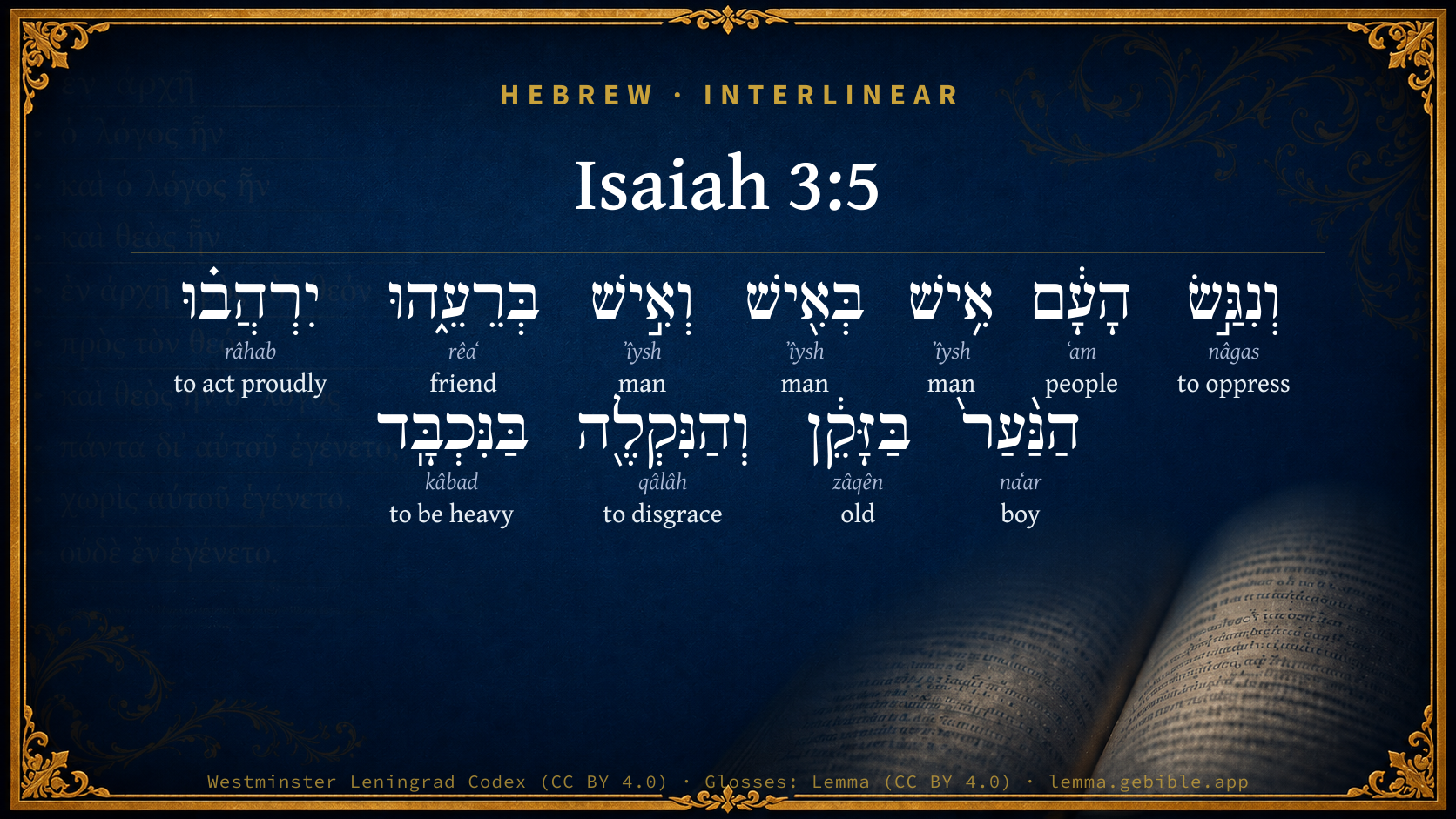
Hebrew (Westminster Leningrad Codex) Isaiah 3:5 appears in the Hebrew Old Testament. The text above is from the Westminster Leningrad Codex. Each word links to its Strong’s number, a concise gloss, and parsing drawn from the Open Scriptures Hebrew Bible morphology. Click any word for its full Brown-Driver-Briggs (BDB) entry.
Download image
Cite this verse

Isaiah 3:5 (World English Bible). Public Domain. Lemma interlinear Bible study tool, https://lemma.gebible.app/v/isaiah/3/5.

Show BibTeX & RIS
BibTeX
RIS
English Translation
The people will be oppressed, Everyone by another, And everyone by his neighbor. The child will behave himself proudly against the old man, And the base against the honorable.
World English Bible · Public Domain
Download a study sheet

One document with this verse’s original text, its word-by-word gloss line, the meaning frame, cross-references with their text, attributed commentary, and full source and license credits — printable, and it pastes into notes with its structure intact.

This verse Autodidact and up

Study sheet (.html) Plain text (.txt)

A passage Seminary Student

Up to 50 verses in one chapter. A passage sheet keeps up to 6 commentary sources and 12 cross-references per verse, in the order this page ranks them, and says so on the sheet whenever that leaves anything out. Ask for a single verse and you get the Autodidact verse sheet above.

Everything on this page stays free to read, with no account — the sheet is a download of what is already on screen, not access to it.

Want to remove ads? Support Godless Engineer
Compare translations 3

The same verse in 3 English versions, stacked beneath the original-language interlinear above. Click any original word for its lexicon entry.

Each is an independent rendering of the whole verse — the interlinear is not word-aligned to these translations.

Highlighted words mark where these versions differ — a whole-verse word diff, not a word-by-word alignment.

  • World English Bible Public Domain
    The people will be oppressed, Everyone by another, And everyone by his neighbor. The child will behave himself proudly against the old man, And the base against the honorable.
  • King James Version Public Domain
    And the people shall be oppressed, every one by another, and every one by his neighbour: the child shall behave himself proudly against the ancient, and the base against the honourable.
  • unfoldingWord Literal Text CC BY-SA 4.0
    And the people will be oppressed, a man by a man and a man by his neighbor. The youth will act insolently against the elderly, and the despised against the honored.

unfoldingWord Literal Text — © unfoldingWord, licensed CC BY-SA 4.0. Word-aligned USFM3 via Door43 (git.door43.org/unfoldingWord/en_ult).

Versions to compare (up to 4)

3 of 4 selected

Show all 18 translations

Every available English version of this verse, each an independent rendering of the whole verse.

  • World English Bible Public Domain
    The people will be oppressed, Everyone by another, And everyone by his neighbor. The child will behave himself proudly against the old man, And the base against the honorable.
  • Berean Standard Bible Public Domain
    The people will oppress one another, man against man, neighbor against neighbor; the young will rise up against the old, and the base against the honorable.
  • Majority Standard Bible Public Domain
    The people will oppress one another, man against man, neighbor against neighbor; the young will rise up against the old, and the base against the honorable.
  • King James Version Public Domain
    And the people shall be oppressed, every one by another, and every one by his neighbour: the child shall behave himself proudly against the ancient, and the base against the honourable.
  • American Standard Version (1901) Public Domain
    And the people shall be oppressed, every one by another, and every one by his neighbor: the child shall behave himself proudly against the old man, and the base against the honorable.
  • Revised Version (1885) Public Domain
    And the people shall be oppressed, every one by another, and every one by his neighbour: the child shall behave himself proudly against the ancient, and the base against the honourable.
  • Geneva Bible (1599) Public Domain
    The people shalbe oppressed one of another, and euery one by his neighbour: the children shall presume against the ancient, and the vile against the honourable.
  • Douay-Rheims (1899) Public Domain
    And the people shall rush one upon another, and every man against his neighbour: the child shall make it tumult against the ancient, and the base against the honourable.
  • Young's Literal Translation Public Domain
    And the people hath exacted -- man upon man, Even a man on his neighbour, Enlarge themselves do the youths against the aged, And the lightly esteemed against the honoured.
  • Literal Standard Version CC BY-SA 4.0
    And the people has exacted—man on man, || Even a man on his neighbor, || The youths enlarge themselves against the aged, || And the lightly esteemed against the honored.
  • Unlocked Literal Bible CC BY-SA 4.0
    The people will be oppressed, every one by another, and every one by his neighbor; the child will insult the elderly, and the degraded will challenge the honorable.
  • unfoldingWord Literal Text CC BY-SA 4.0
    And the people will be oppressed, a man by a man and a man by his neighbor. The youth will act insolently against the elderly, and the despised against the honored.
  • Darby Bible Public Domain
    And the people shall be oppressed one by the other, and each by his neighbour; the child will be insolent against the elder, and the base against the honourable.
  • World Messianic Bible Public Domain
    The people will be oppressed, everyone by another, and everyone by his neighbor. The child will behave himself proudly against the old man, and the wicked against the honorable.
  • Webster's Bible Public Domain
    And the people shall be oppressed, every one by another, and every one by his neighbor: the child shall behave himself proudly against the elder, and the base against the honorable.
  • Free Bible Version CC BY-SA 4.0
    People will mistreat one another, person against person, neighbor against neighbor; the young will assault the old, and the dregs of society will attack those who are reputable.
  • Bible in Basic English Public Domain
    And the people will be crushed, every one by his neighbour; the young will be full of pride against the old, and those of low position will be lifted up against the noble.
  • JPS Tanakh (1917) Public Domain
    And the people shall oppress one another, every man his fellow, and every man his neighbour; the child shall behave insolently against the aged, and the base against the honourable,

Literal Standard Version (2020), Covenant Press — licensed CC BY-SA 4.0. Text via the HelloAO Bible API (eBible.org). Unlocked Literal Bible (unfoldingWord) — licensed CC BY-SA 4.0. Text via the HelloAO Bible API (eBible.org). unfoldingWord Literal Text — © unfoldingWord, licensed CC BY-SA 4.0. Word-aligned USFM3 via Door43 (git.door43.org/unfoldingWord/en_ult). Free Bible Version, Dr. Jonathan Gallagher — licensed CC BY-SA 4.0. Text via the HelloAO Bible API (eBible.org).

Word by word

More ways to search: Search by grammar → Find every occurrence → Compare this word →

Practice this passage: Drill this verse → Learn its vocabulary →

יִרְהֲב֗וּ
râhab
H7292
“to act proudly”
Verb, Qal, Imperfect, 3rd Person, Masculine, Plural
Part of Speech
Verb
Stem
Qal
Form
Imperfect
Person
3rd Person
Gender
Masculine
Number
Plural
Full BDB Definition

Origin: a primitive root

TWOT: 2125

to behave proudly, act stormily or boisterously or arrogantly - (Qal) to act insolently, storm against, beset, importune - (Hiphil) to disturb, alarm, awe, confuse, make bold or proud
  1. וְנִגַּ֣שׂ nâgas H5065 “and · to oppress” Conjunction + Verb, Niphal, Sequential Perfect, 3rd Person, Masculine, Singular
  2. הָעָ֔ם ʻam H5971 “the · people” Particle, Definite Article + Noun, Common, Masculine, Singular, Absolute
  3. אִ֥ישׁ ʼîysh H376 “man” Noun, Common, Masculine, Singular, Absolute
  4. בְּאִ֖ישׁ ʼîysh H376 “in/at · man” Preposition + Noun, Common, Masculine, Singular, Absolute
  5. וְאִ֣ישׁ ʼîysh H376 “and · man” Conjunction + Noun, Common, Masculine, Singular, Absolute
  6. בְּרֵעֵ֑הוּ rêaʻ H7453 “in/at · friend · his” Preposition + Noun, Common, Masculine, Singular, Construct + Suffix, Personal, 3rd Person, Masculine, Singular
  7. הַנַּ֨עַר֙ naʻar H5288 “the · boy” Particle, Definite Article + Noun, Common, Masculine, Singular, Absolute
  8. בַּזָּקֵ֔ן zâqên H2205 “in/at the · old” Preposition, Determined + Adjective, Adjective, Masculine, Singular, Absolute
  9. וְהַנִּקְלֶ֖ה qâlâh H7034 “and · the · disgracing” Conjunction + Particle, Definite Article + Verb, Niphal, Participle Active, Masculine, Singular, Absolute
  10. בַּנִּכְבָּֽד kâbad H3513 “in/at the · heavy” Preposition, Determined + Verb, Niphal, Participle Passive, Masculine, Singular, Absolute

About this verse

These counts appear in no published source. They are computed here, from the morphology-tagged text and Lemma’s own curated glosses. What Lemma adds →

11
words
9
distinct lemmas
Prophets
section

Notable vocabulary

The rarest word here is יִרְהֲב֗וּ to act proudly H7292 — appearing just 4 times in the whole Hebrew Bible.

Shared distinctive vocabulary

יִרְהֲב֗וּ to act proudly H7292 occurs in 4 verses of the Hebrew Bible. Also found in:

Grammatical profile

  • 4 verbs
  • 6 nouns
  • 1 adjective

Verb forms

  • וְנִגַּ֣שׂ Niphal · Sequential Perfect
  • יִרְהֲב֗וּ Qal · Imperfect
  • וְהַנִּקְלֶ֖ה Niphal · Participle Active
  • בַּנִּכְבָּֽד Niphal · Participle Passive

Repetition

A word recurs within this verse — often emphatic in Hebrew:

  • אִ֥ישׁ man H376 ×3

Hebrew & Septuagint length

In English translation the verse runs 29 words from the Hebrew and 26 from the Septuagint (LXX English) — closely comparable.

A rough comparison of the two English renderings, which tokenize alike — not a word-level alignment.

Word counts can differ between the Hebrew and the Greek without any difference in meaning — e.g. the Hebrew direct-object marker אֵת has no separate Greek word, and Greek often adds the article ὁ.

Cross-references

24

Topical passages linked to Isaiah 3:5 in the Treasury of Scripture Knowledge — connected by theme and wording, ordered by reader-vote popularity; previews shown in the World English Bible.

  • Jeremiah 9:3–8 They bend their tongue, [as it were] their bow, for falsehood; and they are grown strong in the land, but not for truth: for they proceed from evil to evil, and they don't know me, says Yahweh.
  • Malachi 3:5 I will come near to you to judgment; and I will be a swift witness against the sorcerers, and against the adulterers, and against the perjurers, and against those who oppress the hireling in his wages, the widow, and the fatherless, and who deprive the foreigner of justice, and don't fear me," says Yahweh of Hosts.
  • Leviticus 19:32 You shall rise up before the gray head, and honor the face of an old man, and you shall fear your God. I am Yahweh.
  • 2 Samuel 16:5–9 When king David came to Bahurim, behold, a man of the family of the house of Saul came out, whose name was Shimei, the son of Gera. He came out, and cursed still as he came.
  • 2 Kings 2:23 He went up from there to Bethel; and as he was going up by the way, there came forth young lads out of the city, and mocked him, and said to him, Go up, you baldy; go up, you baldhead.
  • Job 30:1–12 "But now those who are younger than I, have me in derision, Whose fathers I would have disdained to put with my sheep dogs.
  • Ecclesiastes 10:5–7 There is an evil which I have seen under the sun, the sort of error which proceeds from the ruler.
  • Isaiah 1:4 Ah sinful nation, A people loaded with iniquity, A seed of evil-doers, Children who deal corruptly! They have forsaken Yahweh. They have despised the Holy One of Israel. They are estranged and backward.
  • Isaiah 9:19–21 Through the wrath of Yahweh of hosts is the land burnt up; and the people are as the fuel of fire: no man spares his brother.
  • Isaiah 11:13 The envy also of Ephraim shall depart, and those who vex Judah shall be cut off: Ephraim shall not envy Judah, and Judah shall not vex Ephraim.
  • Jeremiah 22:17 But your eyes and your heart are not but for your covetousness, and for shedding innocent blood, and for oppression, and for violence, to do it.
  • Ezekiel 22:6–7 Behold, the princes of Israel, everyone according to his power, have been in you to shed blood.
  • Ezekiel 22:12 In you have they taken bribes to shed blood; you have taken interest and increase, and you have greedily gained of your neighbors by oppression, and have forgotten me, says the Lord Yahweh.
  • Amos 4:1 Listen to this word, you cows of Bashan, who are on the mountain of Samaria, who oppress the poor, who crush the needy, who tell their lords, "Bring, and let us drink."
  • Micah 3:1–3 I said, "Please listen, you heads of Jacob, And rulers of the house of Israel: Isn't it for you to know justice?
  • Micah 3:11 Her leaders judge for bribes, And her priests teach for a price, And her prophets of it tell forturnes for money: Yet they lean on Yahweh, and say, Isn't Yahweh in the midst of us? No disaster will come on us.
  • Zechariah 7:9–11 "Thus has Yahweh of Hosts spoken, saying, 'Execute true judgment, and show kindness and compassion every man to his brother.
  • Matthew 26:67 Then they spit in his face and beat him with their fists, and some slapped him,
  • Matthew 27:28–30 They stripped him, and put a scarlet robe on him.
  • Mark 14:65 Some began to spit on him, and to cover his face, and to beat him with fists, and to tell him, "Prophesy!" The officers struck him with the palms of their hands.
  • Luke 22:64 Having blindfolded him, they struck him on the face and asked him, "Prophesy! Who is the one who struck you?"
  • James 2:6 But you have dishonored the poor man. Don't the rich oppress you, and personally drag you before the courts?
  • James 5:4 Behold, the wages of the laborers who mowed your fields, which you have kept back by fraud, cry out, and the cries of those who reaped have entered into the ears of the Lord of Hosts.
  • Micah 7:3–6 Their hands are on that which is evil to do it diligently. The ruler and judge ask for a bribe; And the powerful man dictates the evil desire of his soul. Thus they conspire together.

Cross-references courtesy of OpenBible.info (CC BY 4.0).

Hebrew and Greek witnesses Masoretic Hebrew ↔ Greek Septuagint

The same verse in the two great witnesses to the Old Testament, shown verse-for-verse.

These are two independent witnesses, not word-aligned to each other, and the Septuagint is shown in lemma (dictionary) form.

Hebrew Isaiah 3:5 Masoretic · Westminster Leningrad Codex

וְנִגַּ֣שׂ הָעָ֔ם אִ֥ישׁ בְּאִ֖ישׁ וְאִ֣ישׁ בְּרֵעֵ֑הוּ יִרְהֲב֗וּ הַנַּ֨עַר֙ בַּזָּקֵ֔ן וְהַנִּקְלֶ֖ה בַּנִּכְבָּֽד

The people will be oppressed, Everyone by another, And everyone by his neighbor. The child will behave himself proudly against the old man, And the base against the honorable.

World English Bible · Public Domain

Greek LXX Isaiah 3:5 Septuagint · lemma form

καί συνπίπτω ὁ λαός ἄνθρωπος πρός ἄνθρωπος καί ἄνθρωπος πρός ὁ πλησίον αὐτός προςκόπτω ὁ παιδίον πρός ὁ πρεσβύτης ὁ ἄτιμος πρός ὁ ἔντιμος

And the people shall fall, man upon man, and every man upon his neighbor: the child shall insult the elder man, and the base the honorable.

LXX2012 (modern English Septuagint) · Public Domain

On this verse, Keil & Delitzsch discusses the Septuagint’s reading. Read the note in Commentary ↓

Hebrew: Westminster Leningrad Codex (CC BY 4.0). Greek: Septuagint (public domain); English from LXX2012 (modern English Septuagint) (Public Domain). How the Septuagint differs from the Hebrew →

Targum (Aramaic paraphrase)

1

The Targum is the ancient Jewish Aramaic paraphrase of the Hebrew Scriptures — an interpretive translation, not the Hebrew text itself. Onkelos (literal) and Pseudo-Jonathan (expansive) render the Torah, and Jonathan the Prophets. Coverage is partial: where no permissively-licensed English translation exists for a verse, only the Aramaic is shown. This is verse-level text, not a word-by-word alignment to the Hebrew.

  1. Targum Jonathan Prophets (Joshua–Malachi)
    וְיִתְגָרוּן עַמָא גְבַר בִּגְבַר וּגְבַר בְּחַבְרֵיהּ יִשְׁלְטוּן עוּלֵימַיָא בְּסָבָא וּדְשַׁיִט בִּדְיַקִיר:

    The nations shall wage war, man against man, and a man against his neighbour; children shall rule over the ancient, and the base over the honourable.

    Targum Jonathan — Aramaic: “Mikraot Gedolot” (public domain). English: “Sefaria Community Translation” (CC0 1.0 (public-domain dedication)); “London "Chaldee Paraphrase," 1871” (public domain). Text via Sefaria.

Commentary

Notes on Isaiah 3:5 from classic Christian and Jewish commentators (each source and its license shown beneath its notes). The classic Christian expositions comment on the surrounding passage and are grouped to its opening verse, so a note may address several verses; the Jewish commentaries on the Tanakh (Rashi and others) are per-verse, so they appear only where the commentator wrote on this verse.

Lemma curates 59 commentaries, every one of them public domain or Creative Commons licensed, each selected and text-cleaned for this edition rather than reprinted as found. About our sources →

Trapp's Complete Commentary

John Trapp

Isa 3:5 And the people shall be oppressed, every one by another, and every one by his neighbour: the child shall behave himself proudly against the ancient, and the base against the honourable.

Ver. 5. And the people shall be oppressed, one by another.] The greater devouring the lesser, as fishes do. How should it be otherwise, when there is either no government, or not that which is good; but all things turned, as here, topsy turvy, without any respect to age, order, or dignity, and

“ Scinditur ineertum studia in contraria vulgus. ” - Virg.

This dissension is the mother of dissolution, saith Nazianzen. This dissipation and perversion of order and manners is the forerunner of utter desolation and subversion.

John Trapp, A Commentary or Exposition upon All the Books of the Old and New Testament (1647–1656) — public domain. Text from a community e-Sword module.

The Biblical Illustrator

Joseph S. Exell

Isa_3:5

And the people shall be oppressed

Tyranny

The dissolution of good order and political confusion.

Oppression and pride everywhere prevail. (R. Macculloch.)

State chaos

There is a natural relation of classes. Whilst all that is purely mechanical and arbitrary is to be viewed with suspicion, yet there is a natural sequence in things; there is, indeed, what is called a fitness or harmony of things; and when society is rightly inspired the base man knows that he is base, and his baseness is his weakness, and his weakness defines his position; and the child knows himself to be but a child, and therefore he behaves himself with discretion, and is limited by circumstances which he cannot control. Once let the moral centre be lost, and then you have lost all arithmetical counting, all geometrical relationship, all figure and form and mechanism and security, and the foursquare is thrown out of its parallel, and that which was right is numbered with that which is forbidden, (J. Parker, D. D.)

An evil spirit in the nation

It is here threatened that God would send an evil spirit among them (Jdg_9:23), which would make them--

1. Injurious and unneighbourly one towards another. The people shall be oppressed everyone by his neighbour, and their princes, being children, take no care to restrain the oppressors, or relieve the oppressed. Nor is it to any purpose to appeal to them.

2. Insolent and disorderly towards their superiors. It is as ill an omen to a people as can be, when the rising generation among them is generally untractable, rude, and ungovernable, when the child behaves himself proudly against the ancient; whereas he should rise up before the hoary head, and honour the face of the old man (Lev_19:32). When young people are conceited and pert, and carry it scornfully towards their superiors, it is not only a reproach to themselves, but of ill consequence to the public; it slackens the reins of government, and weakens the hands that hold them. It is likewise ill with a people when persons of honour cannot support their authority, but are affronted by the base and beggarly; when judges are insulted by the mob, and their power set at defiance. (M. Henry.)

A lamentable state of society

Homo homini lupus--man becomes a wolf to man;

jusque datum sceleri--wickedness receives the stamp of law;

nec hospes ab hospite tutus--the guest and the host are in danger from each other. (M. Henry.)

The Biblical Illustrator, edited by Joseph S. Exell (c. 1880s–1900s) — public domain. Text from a community e-Sword module.

Geneva Bible (1599)

Geneva Bible translators

For lack of good regiment and order.

Geneva Bible (1599) marginal notes — public domain. Text via Bolls.life.

Jamieson, Fausset & Brown

Robert Jamieson, A. R. Fausset & David Brown

The anarchy resulting under such imbecile rulers (Isa 3:4); unjust exactions mutually; the forms of respect violated (Lev 19:32).

base--low-born. Compare the marks of "the last days" (Ti2 3:2).

Jamieson, Fausset & Brown — Commentary Critical and Explanatory on the Whole Bible (1871) — public domain (CC PDM 1.0). Text via the HelloAO Bible API.

Ellicott's Commentary for English Readers

(5) The people shall be oppressed . . .—The words paint the worst form of the decadence of an Eastern kingdom. All is chaotic and anarchic; a fierce struggle for existence; the established order of society subverted; the experience of age derided by the petulance of youth. The picture of the corruption of a monarchy is as vivid and complete in its way as that which Thucydides (3:82-84) draws of the corruption of a democracy. It might seem to have been drawn from the Turkey or the Egypt of our own time.

A Bible Commentary for English Readers, edited by Charles John Ellicott (1878–1897) — public domain. Text from a community e-Sword module.

The Cambridge Bible for Schools and Colleges

gen. ed. J. J. S. Perowne

5. A general description of the state of anarchy; “the bonds of discipline and order are loosed, all authority disappears” (Dillmann).

The Cambridge Bible for Schools and Colleges (gen. ed. J. J. S. Perowne; Cambridge University Press, 1878–1918) — public domain. Text from a community e-Sword module.

John Gill's Exposition

And the people shall be oppressed, everyone by another, and everyone by his neighbour,.... There being no governors, or such as were unfit for government, no decorum was kept and observed, but a mere anarchy; and so everyone did as he pleased, as when there was no king in Israel; and everyone rushed into the house of his neighbour, and plundered his goods; this was the case of Jerusalem, at the time of the siege, it abounding with robbers and spoilers:

the child shall behave himself proudly against the ancient; show no respect to them, nor honour them, as the law requires in Lev 19:32 but behave insolently towards them; and so the Jews say (d), that when the son of David is come, as he now would be, young men shall make ashamed the faces of old men, and old men shall stand before young men:

and the base against the honourable; persons of a mean birth and extract would rise up against and insult such as were men of families and fortune, of noble birth and of high degree.

(d) T. Bab. Sanhedrin, fol. 97. 1.

John Gill's Exposition of the Whole Bible (1746–1763) — public domain (CC PDM 1.0). Text via the HelloAO Bible API.

Albert Barnes' Notes on the Bible

And the people shall be oppressed - This describes the state of anarchy and confusion which would exist under the reign of children and babes Isa 3:4, when all law would be powerless, and all rights violated, and when the feeble would be oppressed and borne down by the strong. The word used here, properly denotes that “unjust exactions or demands” would be made, or that the people would be “urged” to fulfill them.

Every one by another - In turn they shall oppress and vex one another. Hebrew ‘man by man; and man by his neighbor’ - a strong mode of expression, denoting that there would be a state of mutual strife, and violation of rights; compare 1Ki 20:20.

The child ... - All ranks of society shall be broken up. All respect due from one rank in life to another shall be violated.

Shall behave himself proudly - The word used here means rather to “urge,” or “press on.” The child shall “crowd on” the old man. This was particularly descriptive of a state of anarchy and disorder, from the fact that the Jews inculcated so much respect and deference for age; see the note at Isa 3:2.

The ancient - The old man.

And the base - The man of low rank in life. The word properly means the man that is despised, the vile, the ignoble; 1Sa 18:23; Pro 7:9.

The honorable - All the forms of respect in life would be broken up; all the proper rules of deference between man and man would be violated. Neither dignity, age, nor honor would be respected.

Albert Barnes' Notes on the Bible (1834–1885) — public domain. Text from a community e-Sword/MySword module.

Haydock's Catholic Bible Commentary

People. They were divided, whether they should continue to obey Nabuchodonosor, or listen to the Egyptians. Ismael slew Godolias, Jeremias xli.

George Leo Haydock (1774–1849), Haydock's Catholic Family Bible and Commentary, 1859 edition — public domain. Excludes Psalms (Douay-Rheims chapter numbering differs from Protestant) and Deuterocanonical books (Catholic canon only).

Matthew Poole's English Annotations

The people shall be oppressed, by the command or connivance of such childish rulers.

The child shall behave himself proudly against the ancient, and the base against the honourable; foolish and unworthy men shall by wicked arts gain the favour and abuse the power of the prince, and thereby behave themselves insolently towards their betters.

Matthew Poole's English Annotations on the Holy Bible (1683–1685) — public domain. Text from a community e-Sword/MySword module.

The Pulpit Commentary

And the people shall be oppressed, etc.; rather, shall oppress each man his fellow, and each man his companion. This would be no new thing, (see Isa_1:17, Isa_1:21, Isa_1:23) but perhaps might be more widely spread, having passed from the upper classes to the lower ones, as is usual with vices. The child; rather, the youth. Shall behave himself proudly; or, insolently. The respect for age inculcated by the Law (Lev_19:32) shall disappear. Youths shall set at naught the counsel of the aged. The spirit of Rehoboam shall prevail over that of Solomon, with the usual result rashness, recklessness, and failure. And the base , etc. Respect for station shall likewise disappear. The dregs of the people shall grow insolent towards those above them in the social scale; and thus the old social order shall be inverted.

The Pulpit Commentary (1880–1919), ed. H.D.M. Spence-Jones & Joseph S. Exell — public domain. Text from a community e-Sword module.

John Wesley's Explanatory Notes

Oppressed - By thy command or permission of such childish rulers.

John Wesley, Explanatory Notes Upon the Whole Bible (1754–1765) — public domain. Text via the GEBible commentary corpus.

Keil & Delitzsch

C. F. Keil & F. Delitzsch

"And the people oppress one another, one this and another that; the boy breaks out violently upon the old man, and the despised upon the honoured." Niggas is the reciprocal niphal, as the clause depicting the reciprocity clearly shows (cf., nilcham, Isa 19:2); nagas followed by Beth means to treat as a tyrant or taskmaster (Isa 9:3). The commonest selfishness would then stifle every nobler motive; one would become the tyrant of another, and ill-mannered insolence would take the place of that reverence, which is due to the old and esteemed from boys and those who are below them in position, whether we regard the law of nature, the Mosaic law (Lev 19:32), or the common custom of society. Nikleh (from kâlâh, the synonym of הקל, Isa 9:1; Isa 23:9; cf., Isa 16:14, kal, to be light or insignificant) was a term used to denote whoever belonged to the lowest stratum of society (Sa1 18:23). It was the opposite of nichâd (from Cabed, to be heavy or of great importance). The Septuagint rendering, ὁ ἄτιμος πρὸς τὸν ἔντιμον is a very good one (as the Semitic languages have no such antithetical formations with ἃ στερητικόν). With such contempt of the distinctions arising from age and position, the state would very soon become a scene of the wildest confusion.

Keil & Delitzsch — Biblical Commentary on the Old Testament (1861–1891) — public domain (CC PDM 1.0). Text via the HelloAO Bible API. (Old Testament only.)

J. A. Alexander on Isaiah

Joseph Addison Alexander

As the preceding verse describes bad government, so this describes anarchy, the suspension of all government, and a consequent disorder in the relations of society, betraying itself in mutual violence, and in the disregard of natural and artificial claims to deference. “And the people shall act tyrannically, man against man, and man against his fellow. They shall be insolent, the youth to the old man, and the mean man to the noble.” On contempt of old age, as a sign of barbarism, see (Lam 4:16; Deu 28:50).

Joseph Addison Alexander, The Prophecies of Isaiah (1846–1847; New York: Scribner, 1870–1878) — public domain. Text from a community e-Sword module.

Rashi

Rabbi Shlomo Yitzchaki (Rashi)

And the people shall be oppressed They shall be pressed and oppressing each other with competition and strife.

they shall behave haughtily, the youth against the elder The youth will raise himself over the elder.

and the base against the honorable [This is to be interpreted] according to its simple meaning. The exegetical meaning is as follows: Let one to whom grave interdicts seem light come and raise himself over one to whom light interdicts seem grave.

Rashi on the Tanakh — English translations: “The Judaica Press complete Tanach with Rashi, translated by A. J. Rosenberg” (CC BY 4.0); “Pentateuch with Rashi's commentary by M. Rosenbaum and A.M. Silbermann, 1929-1934” (public domain); “The Metsudah Tanach series, Lakewood, N.J” (CC BY 4.0); and “The Book of Joshua, Metsudah Publications, 1997” (CC BY 4.0). Text via Sefaria.

Ibn Ezra

Rabbi Abraham ibn Ezra

וְנִנַּשׂ And shall be oppressed. Niphal; like נִצָּב (3:13), he is standing up. According to some, and shall oppress; the נ being radical, and נִנַּשׁ piel.

ירהבו They will have power or dominion; comp. רהב power (51:9)

Ibn Ezra on the Tanakh — English translations: “Sefaria Community Translation” (CC0 1.0 (public-domain dedication)); “Yalkut, Sifsei Chachomim Chumash, Metsudah Publications, 2009” (CC BY 4.0); and “Commentary of Ibn Ezra on Isaiah - trans. by M. Friedlander, 1873” (public domain). Text via Sefaria.

Lesson kit

Teaching starters — assembled from the data on this page, not authored interpretation. Every prompt links to the verse data it draws on. Edit before teaching.

Isaiah, in the Prophets, opens this verse with 11 words (9 distinct Hebrew lemmas). Its most distinctive word is râhab (“to act proudly”). A historical commentator’s framing appears above. Read the whole chapter for the surrounding context.

Discussion questions

  1. The word râhab carries the sense “to act proudly.” How does it shape the verse?
  2. How does Psalms 138:3, which shares the word «to act proudly», read alongside this verse?
  3. What does the repetition of “man” (3× in this one verse) do in this verse?
  4. These translations render this verse differently. What is at stake in choosing one wording over another?
  5. «וְנִגַּ֣שׂ» is a Niphal Sequential Perfect verb. How does that grammatical form shape the action described?
  6. Compare how Trapp's Complete Commentary and The Biblical Illustrator read this verse. Where do they agree or differ?

Things to notice

Reading settings

Reading text

Shown beneath each verse's original-language words.

Old Testament
Old Testament edition

Read the OT as the Masoretic Hebrew (MT) or the Greek Septuagint (LXX).

English shown for the Greek Septuagint (in the Hebrew ↔ Greek comparison).

Comparing translations? Open the Compare panel on any verse page to stack up to four side by side.