
Jeremiah 34:17

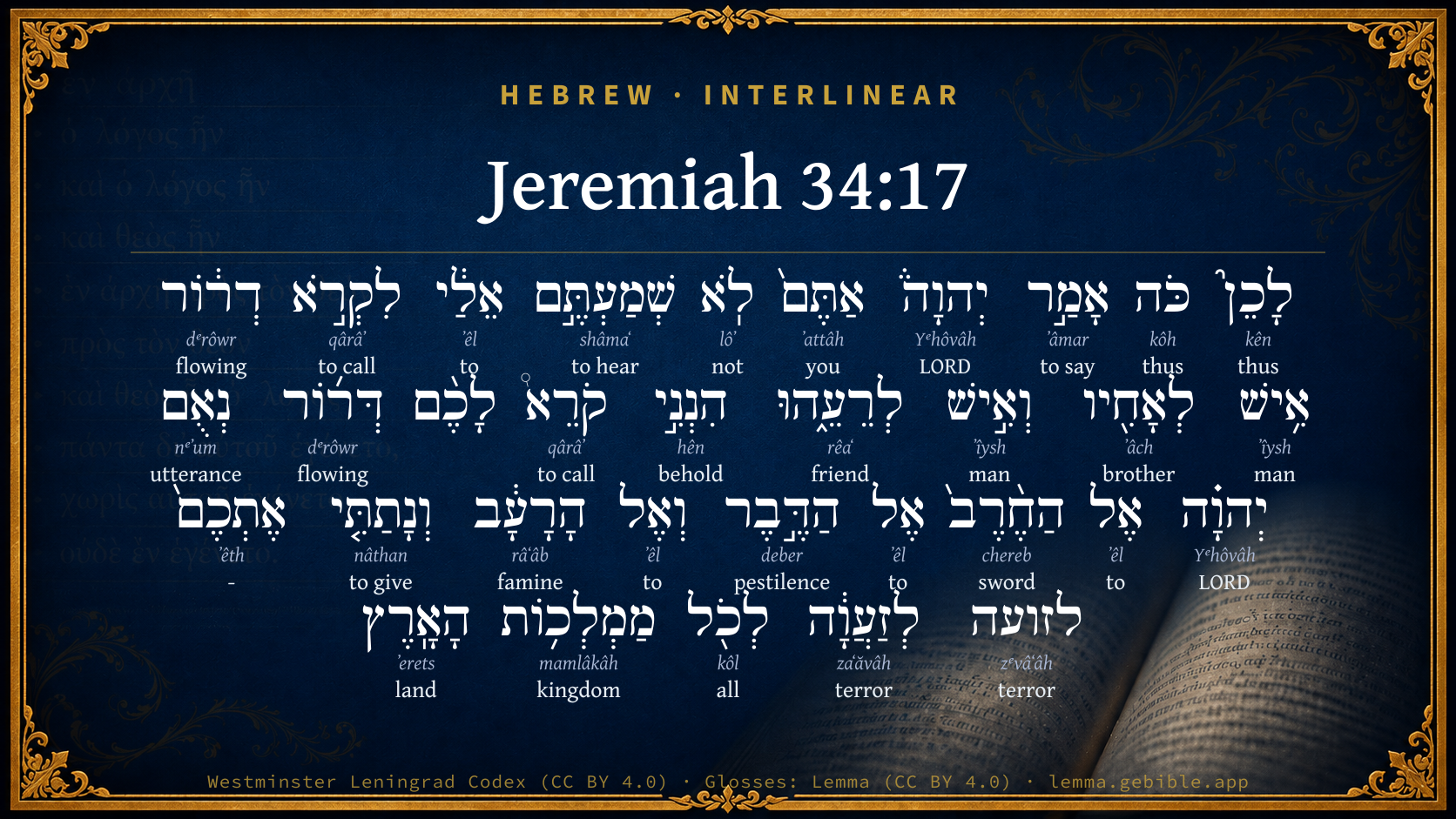
Hebrew (Westminster Leningrad Codex) Jeremiah 34:17 appears in the Hebrew Old Testament. The text above is from the Westminster Leningrad Codex. Each word links to its Strong’s number, a concise gloss, and parsing drawn from the Open Scriptures Hebrew Bible morphology. Click any word for its full Brown-Driver-Briggs (BDB) entry.
Download image
Cite this verse

Jeremiah 34:17 (World English Bible). Public Domain. Lemma interlinear Bible study tool, https://lemma.gebible.app/v/jeremiah/34/17.

Show BibTeX & RIS
BibTeX
RIS
English Translation
Therefore thus says Yahweh: you have not listened to me, to proclaim liberty, every man to his brother, and every man to his neighbor: behold, I proclaim to you a liberty, says Yahweh, to the sword, to the pestilence, and to the famine; and I will make you to be tossed back and forth among all the kingdoms of the earth.
World English Bible · Public Domain
Download a study sheet

One document with this verse’s original text, its word-by-word gloss line, the meaning frame, cross-references with their text, attributed commentary, and full source and license credits — printable, and it pastes into notes with its structure intact.

This verse Autodidact and up

Study sheet (.html) Plain text (.txt)

A passage Seminary Student

Up to 50 verses in one chapter. A passage sheet keeps up to 6 commentary sources and 12 cross-references per verse, in the order this page ranks them, and says so on the sheet whenever that leaves anything out. Ask for a single verse and you get the Autodidact verse sheet above.

Everything on this page stays free to read, with no account — the sheet is a download of what is already on screen, not access to it.

Want to remove ads? Support Godless Engineer
Compare translations 3

The same verse in 3 English versions, stacked beneath the original-language interlinear above. Click any original word for its lexicon entry.

Each is an independent rendering of the whole verse — the interlinear is not word-aligned to these translations.

Highlighted words mark where these versions differ — a whole-verse word diff, not a word-by-word alignment.

  • World English Bible Public Domain
    Therefore thus says Yahweh: you have not listened to me, to proclaim liberty, every man to his brother, and every man to his neighbor: behold, I proclaim to you a liberty, says Yahweh, to the sword, to the pestilence, and to the famine; and I will make you to be tossed back and forth among all the kingdoms of the earth.
  • King James Version Public Domain
    Therefore thus saith the LORD; Ye have not hearkened unto me, in proclaiming liberty, every one to his brother, and every man to his neighbour: behold, I proclaim a liberty for you, saith the LORD, to the sword, to the pestilence, and to the famine; and I will make you to be removed into all the kingdoms of the earth.
  • unfoldingWord Literal Text CC BY-SA 4.0
    Therefore Yahweh says this, ‘You yourselves have not listened to me. You should have proclaimed freedom, every one of you, to your brothers and fellow Israelites. So look! I am about to proclaim freedom to you—this is Yahweh’s declaration—freedom for the sword, the plague, and famine, for I am going to make you a horrible thing in the sight of every kingdom on earth.

unfoldingWord Literal Text — © unfoldingWord, licensed CC BY-SA 4.0. Word-aligned USFM3 via Door43 (git.door43.org/unfoldingWord/en_ult).

Versions to compare (up to 4)

3 of 4 selected

Show all 18 translations

Every available English version of this verse, each an independent rendering of the whole verse.

  • World English Bible Public Domain
    Therefore thus says Yahweh: you have not listened to me, to proclaim liberty, every man to his brother, and every man to his neighbor: behold, I proclaim to you a liberty, says Yahweh, to the sword, to the pestilence, and to the famine; and I will make you to be tossed back and forth among all the kingdoms of the earth.
  • Berean Standard Bible Public Domain
    Therefore this is what the LORD says: You have not obeyed Me; you have not proclaimed freedom, each man for his brother and for his neighbor. So now I proclaim freedom for you, declares the LORD—freedom to fall by sword, by plague, and by famine! I will make you a horror to all the kingdoms of the earth.
  • Majority Standard Bible Public Domain
    Therefore this is what the LORD says: You have not obeyed Me; you have not proclaimed freedom, each man for his brother and for his neighbor. So now I proclaim freedom for you, declares the LORD—freedom to fall by sword, by plague, and by famine! I will make you a horror to all the kingdoms of the earth.
  • King James Version Public Domain
    Therefore thus saith the LORD; Ye have not hearkened unto me, in proclaiming liberty, every one to his brother, and every man to his neighbour: behold, I proclaim a liberty for you, saith the LORD, to the sword, to the pestilence, and to the famine; and I will make you to be removed into all the kingdoms of the earth.
  • American Standard Version (1901) Public Domain
    Therefore thus saith Jehovah: ye have not hearkened unto me, to proclaim liberty, every man to his brother, and every man to his neighbor: behold, I proclaim unto you a liberty, saith Jehovah, to the sword, to the pestilence, and to the famine; and I will make you to be tossed to and fro among all the kingdoms of the earth.
  • Revised Version (1885) Public Domain
    Therefore thus saith the LORD: Ye have not hearkened unto me, to proclaim liberty, every man to his brother, and every man to his neighbour: behold, I proclaim unto you a liberty, saith the LORD, to the sword, to the pestilence, and to the famine; and I will make you to be tossed to and fro among all the kingdoms of the earth.
  • Geneva Bible (1599) Public Domain
    Therefore thus saith the Lord, Ye haue not obeyed mee, in proclayming freedome euery man to his brother, and euery man to his neighbour: beholde, I proclaime a libertie for you, saith the Lord, to the sworde, to the pestilence, and to the famine, and I will make you a terrour to all the kingdomes of the earth.
  • Douay-Rheims (1899) Public Domain
    Therefore thus saith the Lord: You have not hearkened to me, in proclaiming liberty every man to his brother and every man to his friend: behold I proclaim a liberty for you, saith the Lord, to the sword, to the pestilence, and to the famine: and I will cause you to be removed to all the kingdoms of the earth.
  • Young's Literal Translation Public Domain
    `Therefore, thus said Jehovah: Ye have not hearkened unto Me to proclaim freedom, each to his brother, and each to his neighbour; lo, I am proclaiming to you liberty -- an affirmation of Jehovah -- unto the sword, unto the pestilence, and unto the famine, and I have given you for a trembling to all kingdoms of the earth.
  • Literal Standard Version CC BY-SA 4.0
    Therefore, thus said YHWH: “You have not listened to Me to proclaim freedom, each to his brother, and each to his neighbor; behold, I am proclaiming to you liberty,” a declaration of YHWH, “to the sword, to the pestilence, and to the famine, and I have given you for a trembling to all kingdoms of the earth.
  • Unlocked Literal Bible CC BY-SA 4.0
    Therefore Yahweh says this, 'You yourselves have not listened to me. You should have proclaimed freedom, every one of you, to your brothers and fellow Israelites. So look! I am about to proclaim freedom to you—this is Yahweh's declaration—freedom for the sword, the plague, and famine, for I am going to make you a horrible thing in the sight of every kingdom on earth.
  • unfoldingWord Literal Text CC BY-SA 4.0
    Therefore Yahweh says this, ‘You yourselves have not listened to me. You should have proclaimed freedom, every one of you, to your brothers and fellow Israelites. So look! I am about to proclaim freedom to you—this is Yahweh’s declaration—freedom for the sword, the plague, and famine, for I am going to make you a horrible thing in the sight of every kingdom on earth.
  • Darby Bible Public Domain
    Therefore thus saith Jehovah: Ye have not hearkened unto me, in proclaiming liberty, every man to his brother, and every man to his neighbour: behold, I proclaim a liberty for you, saith Jehovah, to the sword, to the pestilence, and to the famine; and I will give you over to be driven hither and thither among all the kingdoms of the earth.
  • World Messianic Bible Public Domain
    Therefore the LORD says: “You have not listened to me, to proclaim liberty, every man to his brother, and every man to his neighbor. Behold, I proclaim to you a liberty,” says the LORD, “to the sword, to the pestilence, and to the famine. I will make you be tossed back and forth among all the kingdoms of the earth.
  • Webster's Bible Public Domain
    Therefore thus saith the LORD; Ye have not hearkened to me, in proclaiming liberty, every one to his brother, and every man to his neighbor: behold, I proclaim a liberty for you, saith the LORD, to the sword, to the pestilence, and to the famine; and I will make you to be removed into all the kingdoms of the earth.
  • Free Bible Version CC BY-SA 4.0
    So this is what the Lord says: You haven't obeyed me. You haven't announced freedom for your slaves, your own people. So now I announce “Freedom” for you, declares the Lord: Freedom to be killed by war, by disease, and by famine! I will make all the kingdoms of the world horrified by you.
  • Bible in Basic English Public Domain
    And so the Lord has said, You have not given ear to me and undertaken publicly, every man to let loose his countryman and his neighbour: see, I undertake to let loose against you the sword and disease and need of food; and I will send you wandering among all the kingdoms of the earth.
  • JPS Tanakh (1917) Public Domain
    Therefore thus saith the LORD: Ye have not hearkened unto Me, to proclaim liberty, every man to his brother, and every man to his neighbour; behold, I proclaim for you a liberty, saith the LORD, unto the sword, unto the pestilence, and unto the famine; and I will make you a horror unto all the kingdoms of the earth.

Literal Standard Version (2020), Covenant Press — licensed CC BY-SA 4.0. Text via the HelloAO Bible API (eBible.org). Unlocked Literal Bible (unfoldingWord) — licensed CC BY-SA 4.0. Text via the HelloAO Bible API (eBible.org). unfoldingWord Literal Text — © unfoldingWord, licensed CC BY-SA 4.0. Word-aligned USFM3 via Door43 (git.door43.org/unfoldingWord/en_ult). Free Bible Version, Dr. Jonathan Gallagher — licensed CC BY-SA 4.0. Text via the HelloAO Bible API (eBible.org).

Word by word

More ways to search: Search by grammar → Find every occurrence → Compare this word →

Practice this passage: Drill this verse → Learn its vocabulary →

לְזַעֲוָ֔ה
zaʻăvâh
H2189
“to/for · terror”
Preposition + Noun, Common, Feminine, Singular, Absolute
Part of Speech
Preposition + Noun
Type
Common
Gender
Feminine
Number
Singular
State
Absolute
Full BDB Definition

Origin: by transposition for H2113

TWOT: 540a

a horror, trembling, object of terror or trembling
  1. לָכֵן֮ kên H3651 “to/for · thus” Preposition + Adverb
  2. כֹּה kôh H3541 “thus” Adverb
  3. אָמַ֣ר ʼâmar H559 “to say” Verb, Qal, Perfect, 3rd Person, Masculine, Singular
  4. יְהוָה֒ Yᵉhôvâh H3068 “LORD” Noun, Proper
  5. אַתֶּם֙ ʼattâh H859 “you” Pronoun, Personal, 2nd Person, Masculine, Plural
  6. לֹֽא lôʼ H3808 “not” Particle, Negative
  7. שְׁמַעְתֶּ֣ם shâmaʻ H8085 “to hear” Verb, Qal, Perfect, 2nd Person, Masculine, Plural
  8. אֵלַ֔י ʼêl H413 “to · me” Preposition + Suffix, Personal, 1st Person, Common, Singular
  9. לִקְרֹ֣א qârâʼ H7121 “to call” Preposition + Verb, Qal, Infinitive Construct
  10. דְר֔וֹר dᵉrôwr H1865 “flowing” Noun, Common, Masculine, Singular, Absolute
  11. אִ֥ישׁ ʼîysh H376 “man” Noun, Common, Masculine, Singular, Absolute
  12. לְאָחִ֖יו ʼâch H251 “to/for · brother · his” Preposition + Noun, Common, Masculine, Singular, Construct + Suffix, Personal, 3rd Person, Masculine, Singular
  13. וְאִ֣ישׁ ʼîysh H376 “and · man” Conjunction + Noun, Common, Masculine, Singular, Absolute
  14. לְרֵעֵ֑הוּ rêaʻ H7453 “to/for · friend · his” Preposition + Noun, Common, Masculine, Singular, Construct + Suffix, Personal, 3rd Person, Masculine, Singular
  15. הִנְנִ֣י hên H2005 “behold · me” Particle, Demonstrative + Suffix, Personal, 1st Person, Common, Singular
  16. קֹרֵא֩ qârâʼ H7121 “calling” Verb, Qal, Participle Active, Masculine, Singular, Absolute
  17. דְּר֜וֹר dᵉrôwr H1865 “flowing” Noun, Common, Masculine, Singular, Absolute
  18. נְאֻם nᵉʼum H5002 “utterance of” Noun, Common, Masculine, Singular, Construct
  19. יְהוָ֗ה Yᵉhôvâh H3068 “LORD” Noun, Proper
  20. אֶל ʼêl H413 “to” Preposition
  21. הַחֶ֨רֶב֙ chereb H2719 “the · sword” Particle, Definite Article + Noun, Common, Feminine, Singular, Absolute
  22. אֶל ʼêl H413 “to” Preposition
  23. הַדֶּ֣בֶר deber H1698 “the · pestilence” Particle, Definite Article + Noun, Common, Masculine, Singular, Absolute
  24. וְאֶל ʼêl H413 “and · to” Conjunction + Preposition
  25. הָרָעָ֔ב râʻâb H7458 “the · famine” Particle, Definite Article + Noun, Common, Masculine, Singular, Absolute
  26. וְנָתַתִּ֤י nâthan H5414 “and · to give” Conjunction + Verb, Qal, Sequential Perfect, 1st Person, Common, Singular
  27. אֶתְכֶם֙ ʼêth H853 “- · you” Particle, Direct Object + Suffix, Personal, 2nd Person, Masculine, Plural
  28. לזועה zᵉvâʻâh H2113 “to/for · terror” Preposition + Noun, Common, Feminine, Singular, Absolute
  29. לְכֹ֖ל kôl H3605 “to/for · all of” Preposition + Noun, Common, Masculine, Singular, Construct
  30. מַמְלְכ֥וֹת mamlâkâh H4467 “kingdoms of” Noun, Common, Feminine, Plural, Construct
  31. הָאָֽרֶץ ʼerets H776 “the · land” Particle, Definite Article + Noun, Common, Both, Singular, Absolute

About this verse

These counts appear in no published source. They are computed here, from the morphology-tagged text and Lemma’s own curated glosses. What Lemma adds →

33
words
25
distinct lemmas
Prophets
section

Notable vocabulary

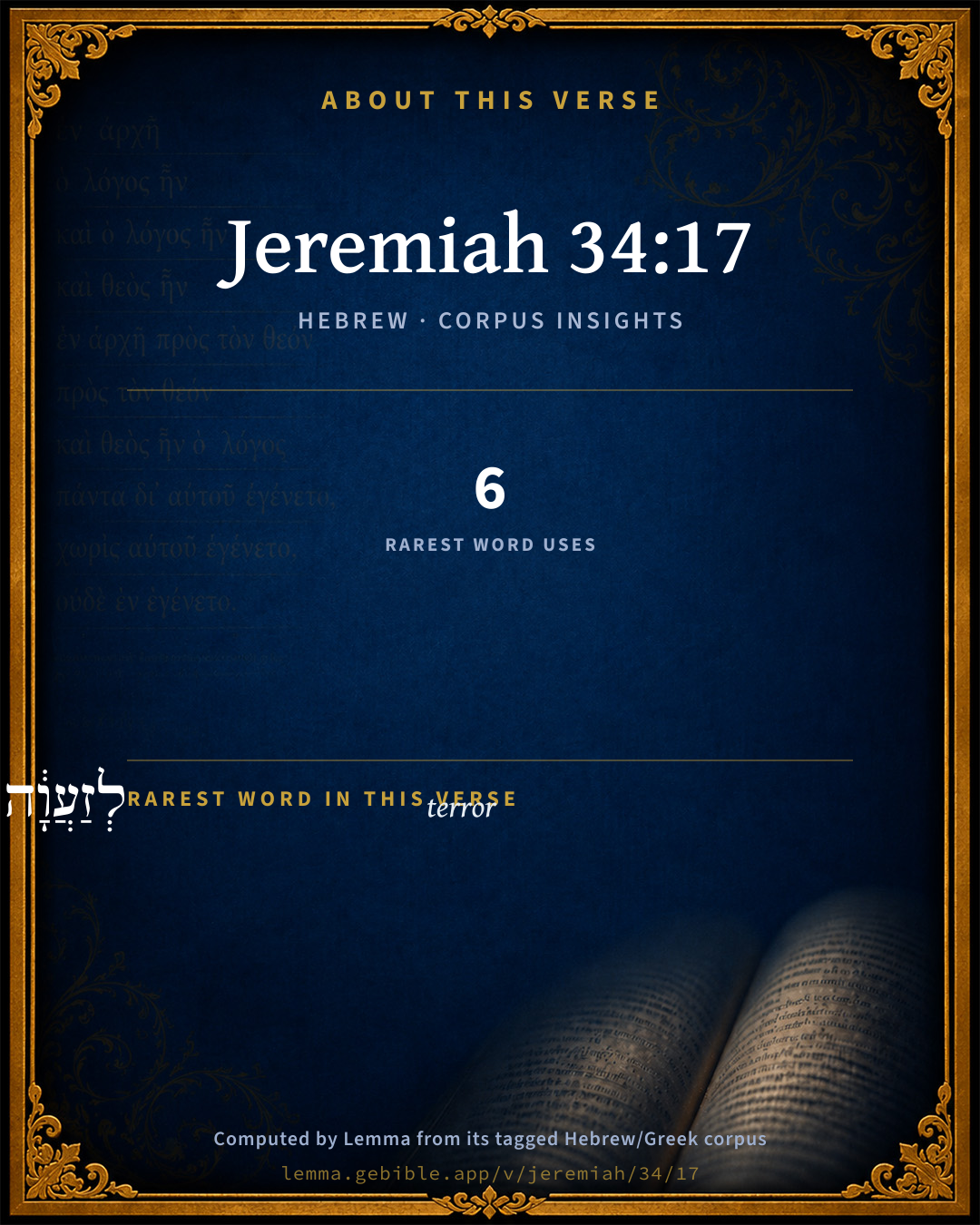
The rarest word here is לְזַעֲוָ֔ה terror H2189 — appearing just 6 times in the whole Hebrew Bible.

Shared distinctive vocabulary

לְזַעֲוָ֔ה terror H2189 occurs in 6 verses of the Hebrew Bible. Also found in:

Grammatical profile

  • 5 verbs
  • 17 nouns
  • 1 pronoun
  • 5 prepositions
  • 2 adverbs
  • 3 particles

Verb forms

  • אָמַ֣ר Qal · Perfect
  • שְׁמַעְתֶּ֣ם Qal · Perfect
  • לִקְרֹ֣א Qal · Infinitive Construct
  • קֹרֵא֩ Qal · Participle Active
  • וְנָתַתִּ֤י Qal · Sequential Perfect

Repetition

Words recur within this verse — often emphatic in Hebrew:

  • יְהוָה֒ LORD H3068 ×2
  • לִקְרֹ֣א to call H7121 ×2
  • דְר֔וֹר flowing H1865 ×2
  • אִ֥ישׁ man H376 ×2
  • אֵלַ֔י to H413 ×4

Cross-references

22

Topical passages linked to Jeremiah 34:17 in the Treasury of Scripture Knowledge — connected by theme and wording, ordered by reader-vote popularity; previews shown in the World English Bible.

  • Matthew 7:2 For with whatever judgment you judge, you will be judged; and with whatever measure you measure, it will be measured to you.
  • Deuteronomy 28:25 Yahweh will cause you to be struck before your enemies; you shall go out one way against them, and shall flee seven ways before them: and you shall be tossed back and forth among all the kingdoms of the earth.
  • Jeremiah 29:18 I will pursue after them with the sword, with the famine, and with the pestilence, and will deliver them to be tossed back and forth among all the kingdoms of the earth, to be an object of horror, and an astonishment, and a hissing, and a reproach, among all the nations where I have driven them;
  • Galatians 6:7 Don't be deceived. God is not mocked, for whatever a man sows, that will he also reap.
  • Leviticus 26:34–35 Then the land will enjoy its sabbaths as long as it lies desolate and you are in your enemies' land. Even then the land will rest and enjoy its sabbaths.
  • Deuteronomy 28:64 Yahweh will scatter you among all peoples, from the one end of the earth even to the other end of the earth; and there you shall serve other gods, which you have not known, you nor your fathers, even wood and stone.
  • Esther 7:10 So they hanged Haman on the gallows that he had prepared for Mordecai. Then was the king's wrath pacified.
  • Jeremiah 15:4 I will cause them to be tossed back and forth among all the kingdoms of the earth, because of Manasseh, the son of Hezekiah, king of Judah, for that which he did in Jerusalem.
  • Daniel 6:24 The king commanded, and they brought those men who had accused Daniel, and they cast them into the den of lions, them, their children, and their wives; and the lions had the mastery of them, and broke all their bones in pieces, before they came to the bottom of the den.
  • James 2:13 For judgment is without mercy to him who has shown no mercy. Mercy triumphs over judgment.
  • Deuteronomy 19:19 then shall you do to him, as he had thought to do to his brother: so shall you put away the evil from the midst of you.
  • Judges 1:6–7 But Adoni-bezek fled; and they pursued after him, and caught him, and cut off his thumbs and his great toes.
  • Jeremiah 15:2 It shall happen, when they tell you, Where shall we go forth? then you shall tell them, Thus says Yahweh: Such as are for death, to death; and such as are for the sword, to the sword; and such as are for the famine, to the famine; and such as are for captivity, to captivity.
  • Jeremiah 21:7 Afterward, says Yahweh, I will deliver Zedekiah king of Judah, and his servants, and the people, even such as are left in this city from the pestilence, from the sword, and from the famine, into the hand of Nebuchadrezzar king of Babylon, and into the hand of their enemies, and into the hand of those who seek their life: and he shall strike them with the edge of the sword; he shall not spare them, neither have pity, nor have mercy.
  • Jeremiah 24:9–10 I will even give them up to be tossed back and forth among all the kingdoms of the earth for evil; to be a reproach and a proverb, a taunt and a curse, in all places where I shall drive them.
  • Jeremiah 32:24 Behold, the mounds, they are come to the city to take it; and the city is given into the hand of the Chaldeans who fight against it, because of the sword, and of the famine, and of the pestilence; and what you have spoken has happened; and, behold, you see it.
  • Jeremiah 32:36 Now therefore thus says Yahweh, the God of Israel, concerning this city, about which you say, It is given into the hand of the king of Babylon by the sword, and by the famine, and by the pestilence:
  • Jeremiah 47:6–7 You sword of Yahweh, how long will it be before you be quiet? put up yourself into your scabbard; rest, and be still.
  • Lamentations 1:8 Jerusalem has grievously sinned; therefore she is become as an unclean thing; All who honored her despise her, because they have seen her nakedness: Yes, she sighs, and turns backward.
  • Ezekiel 14:17–21 Or if I bring a sword on that land, and say, Sword, go through the land; so that I cut off from it man and animal;
  • Luke 6:37–38 Don't judge, And you won't be judged. Don't condemn, And you won't be condemned. Set free, And you will be set free.
  • Revelation 16:6 For they poured out the blood of the saints and the prophets, and you have given them blood to drink. They deserve this."

Cross-references courtesy of OpenBible.info (CC BY 4.0).

Hebrew and Greek witnesses Masoretic Hebrew ↔ Greek Septuagint

The same verse in the two great witnesses to the Old Testament, shown verse-for-verse.

These are two independent witnesses, not word-aligned to each other, and the Septuagint is shown in lemma (dictionary) form.

Hebrew Jeremiah 34:17 Masoretic · Westminster Leningrad Codex

לָכֵן֮ כֹּה אָמַ֣ר יְהוָה֒ אַתֶּם֙ לֹֽא שְׁמַעְתֶּ֣ם אֵלַ֔י לִקְרֹ֣א דְר֔וֹר אִ֥ישׁ לְאָחִ֖יו וְאִ֣ישׁ לְרֵעֵ֑הוּ הִנְנִ֣י קֹרֵא֩ לָכֶ֨ם דְּר֜וֹר נְאֻם יְהוָ֗ה אֶל הַחֶ֨רֶב֙ אֶל הַדֶּ֣בֶר וְאֶל הָרָעָ֔ב וְנָתַתִּ֤י אֶתְכֶם֙ לזועה לְזַעֲוָ֔ה לְכֹ֖ל מַמְלְכ֥וֹת הָאָֽרֶץ

Therefore thus says Yahweh: you have not listened to me, to proclaim liberty, every man to his brother, and every man to his neighbor: behold, I proclaim to you a liberty, says Yahweh, to the sword, to the pestilence, and to the famine; and I will make you to be tossed back and forth among all the kingdoms of the earth.

World English Bible · Public Domain

Greek LXX Structure differs

In the Septuagint, Jeremiah is about an eighth shorter than the Hebrew and arranges its material differently — the Oracles Against the Nations (Hebrew chapters 46–51) appear in the middle of the Greek book, after 25:13. Because the chapter and verse boundaries do not line up, a verse-for-verse comparison with the Hebrew is not shown.

A verse-for-verse comparison isn’t shown here because the chapters and verses don’t line up. Switch to the LXX edition with the MT / LXX toggle above to read the Greek directly.

Hebrew: Westminster Leningrad Codex (CC BY 4.0). Greek: Septuagint (public domain); English from a public-domain English Septuagint. How the Septuagint differs from the Hebrew →

Targum (Aramaic paraphrase)

1

The Targum is the ancient Jewish Aramaic paraphrase of the Hebrew Scriptures — an interpretive translation, not the Hebrew text itself. Onkelos (literal) and Pseudo-Jonathan (expansive) render the Torah, and Jonathan the Prophets. Coverage is partial: where no permissively-licensed English translation exists for a verse, only the Aramaic is shown. This is verse-level text, not a word-by-word alignment to the Hebrew.

  1. Targum Jonathan Prophets (Joshua–Malachi)
    בְּכֵן כִּדְנַן אֲמַר יְיָ אַתּוּן לָא קַבֵּלְתּוּן לְמֵימְרִי לְמִקְרֵי חֵירוּ גְבַר לַאֲחוֹהִי וּגְבַר לְחַבְרֵיהּ הָא אֲנָא מַכְלֵי לְכוֹן חֵירוּ אֲמַר יְיָ מִן חַרְבָּא וּמִן מוֹתָא וּמִן כַּפְנָא וְאֶתֵּן יַתְכוֹן לְזִיעַ לְכָל מַלְכְּוַת אַרְעָא:

    (no public-domain English translation for this verse)

    Targum Jonathan — Aramaic: “Mikraot Gedolot” (public domain). English: “Sefaria Community Translation” (CC0 1.0 (public-domain dedication)); “London "Chaldee Paraphrase," 1871” (public domain). Text via Sefaria.

Commentary

Notes on Jeremiah 34:17 from classic Christian and Jewish commentators (each source and its license shown beneath its notes). The classic Christian expositions comment on the surrounding passage and are grouped to its opening verse, so a note may address several verses; the Jewish commentaries on the Tanakh (Rashi and others) are per-verse, so they appear only where the commentator wrote on this verse.

Lemma curates 59 commentaries, every one of them public domain or Creative Commons licensed, each selected and text-cleaned for this edition rather than reprinted as found. About our sources →

Trapp's Complete Commentary

John Trapp

Jer 34:17 Therefore thus saith the LORD; Ye have not hearkened unto me, in proclaiming liberty, every one to his brother, and every man to his neighbour: behold, I proclaim a liberty for you, saith the LORD, to the sword, to the pestilence, and to the famine; and I will make you to be removed into all the kingdoms of the earth.

Ver. 17. Ye have not hearkened unto me in proclaiming liberty.] Ye have not done it, because ye have not continued to do it; ye have lost the things that you had wrought.

Behold, I proclaim a liberty for you.] God loves to retaliate. Here he abandoneth these apostates to the plagues instanced. Let them use you at their pleasure, saith God; I have no mercy for such merciless wretches, neither care I what becomes of you.

John Trapp, A Commentary or Exposition upon All the Books of the Old and New Testament (1647–1656) — public domain. Text from a community e-Sword module.

The Biblical Illustrator

Joseph S. Exell

Jer_34:17

Ye have not hearkened unto Me, in proclaiming liberty.

The liberty of sin

The Word of the Lord came unto Jeremiah that all bondservants in Israel should be forthwith emancipated. At first the princes obeyed, and the enslaved were allowed to go free. But eventually the princes played falsely, and once more brought their old servants into bondage. Then comes the text with its terrible irony.

I. The mutiny against the law. In the first instance the governors felt the reasonableness of the commandment, they agreed to it, but at length they resisted it, violated it. And this spirit of revolt against the higher law is ever working in us and displaying itself in some form of disobedience.

1. There is a theoretical repudiation of the law. Literary men are ever urging upon us that the moral law as given in revelation is unphilosophical, and the sooner it is renounced by all educated people the better. One by one they ingeniously find us a way out of all the ten great precepts. In our simplicity we thought the Saviour taught us that heaven and earth might pass away, but that the moral commandments should persist in absolute authority and force, but eloquent writers affect to show that the commandments are mere bye-laws, ripe for repeal.

2. And if there is a theoretical repudiation of the law on the part of the literary few, is there not a personal, practical mutiny against it on the part of us all? In manifold ways we criticise the law, fret at it, evade it, violate it. We spurn the circumscriptions which deny us so much, and in blind passion break into forbidden ground. And yet how gracious and beautiful is the law! How generous is the law referred to in the text enjoining upon the rich and great mercy and brotherliness! And the whole of the moral law as expressed in revelation is equally rational and benign. The commandments are not grievous. No, indeed, they are gracious. Every commandment is an illumination, a light shining in a dark place to guide our feet in a dim and perilous way. Every commandment is a salvation. The commandment enjoining love is to save us from the damnation of selfishness; enjoining meekness to save us from the devil of pride; enjoining purity to save us from the hell of lust. Every commandment is a benediction. Scientists are always descanting on the grandeur of natural law, the law which builds the sky, which transfigures the flower, which rules the stars. The scientist, the mathematician, the musician will tell you that law is good, that the secret of the worlds beauty is to be found in the wonderful laws which God wrote in tables of stone long before Moses came. And ii natural law, which rules things, is so sublime, how much does that moral law, which rules spirits, excel in glory! And yet how blindly do we mutiny against the great words of light and love! Some time ago it was told in the paper that a herd of cows was being driven through a long, dark, wooden tubular bridge. Here and there in the woodwork were knotholes, which let in the sun in bars of light. The animals were afraid of these sun-bars; they shied at them, were terrified at them, and then, leaping over them, made a painful hurdle-race of it, coming out at the other end palpitating and exhausted. We are just like them. The laws of God are golden rays in a dark path, they are for our guidance and infinite perfecting and consolation. But they irritate us, they enrage us, we count them despotic barriers to our liberty and happiness, and too often we put them under our feet. So foolish was I, and ignorant, I was as a beast before Thee.

II. The liberty of licence. Behold, I proclaim a liberty for you, saith the Lord. These nobles wished to be free themselves in enslaving their brethren, but in doing this they gave themselves away into servitude; they wished to enrich themselves, and they lost everything; they sought personal indulgence at the expense of their neighbours, and they suffered sword and famine and pestilence. Disobedience always means bondage, disgrace, suffering, death. A liberty to the sword, the famine, and the pestilence! Most awful is the liberty of unrighteousness; who can express the fulness of its woe! Some of you have visited the Castle of Chillon on the Lake of Geneva. In that castle is a dungeon which contains a shaft, at the bottom of which you see the waters of the lake; that shaft is called the way of liberty. Tradition says that in the old days the jailor in the darkness of the dungeon would whisper to the prisoner, Three steps and liberty, and the poor dupe, hastily stepping forward, fell down this shaft, which was planted full of knives and spikes, the mutilated, bloody corpse finally dropping into the depths. That is precisely the liberty of sin. The dupe of sin takes a leap in the dark, he is forthwith pierced through with many sorrows, and mangled and bleeding falls into the gulf. There is a way that seemeth right unto a man, but the end thereof are the ways of death.

1. I want you to feel the madness of contending with God, for that is exactly what sin means.

2. I want you to believe that only through self-limitation can you find the highest liberty and blessedness. All civilisation is the giving up of liberty to find a nobler liberty.

3. If you are to keep the law, you must seek the strength of God in Christ. Born of God, living in fellowship with Him, full of faith, of love, of hope, we shall find the yoke of the law easy, and its burden light. The inner force is equal to the outward duty. (W. L. Watkinson.)

.

The Biblical Illustrator, edited by Joseph S. Exell (c. 1880s–1900s) — public domain. Text from a community e-Sword module.

Tyndale Open Study Notes

Tyndale Open Resources

34:17-20 Because of their sin in breaking the terms of their covenant, the Lord would cut them apart and separate them from his protective care. This expression relates to the covenant ceremony of killing and cutting a calf sacrifice into two parts from head to tail. Those making a covenant walked between the laid-out portions to indicate their willingness to be similarly cut apart if they violated the covenant (see Gen 15:9-18). All classes of people in Judah had broken their oath, so they would all receive the punishment to which they had agreed.

Tyndale Open Study Notes — © Tyndale Open Resources, licensed CC BY-SA 4.0. Text via the HelloAO Bible API.

Geneva Bible (1599)

Geneva Bible translators

That is, I give the sword liberty to destroy you.

Geneva Bible (1599) marginal notes — public domain. Text via Bolls.life.

Jamieson, Fausset & Brown

Robert Jamieson, A. R. Fausset & David Brown

not . . . proclaiming liberty--Though the Jews had ostensibly emancipated their bond-servants, they virtually did not do so by revoking the liberty which they had granted. God looks not to outward appearances, but to the sincere intention.

I proclaim a liberty--retribution answering to the offense (Mat 7:2; Mat 18:32-33; Gal 6:7; Jam 2:13). The Jews who would not give liberty to their brethren shall themselves receive "a liberty" calamitous to them. God will manumit them from His happy and safe service (Psa 121:3), which is real "liberty" (Psa 119:45; Joh 8:36; Co2 3:17), only to pass under the terrible bondage of other taskmasters, the "sword," &c.

to be removed--The Hebrew expresses agitation (see on Jer 15:4). Compare Deu 28:25, Deu 28:48, Deu 28:64-65, as to the restless agitation of the Jews in their ceaseless removals from place to place in their dispersion.

Jamieson, Fausset & Brown — Commentary Critical and Explanatory on the Whole Bible (1871) — public domain (CC PDM 1.0). Text via the HelloAO Bible API.

Adam Clarke's Commentary

Verse 17. I proclaim a liberty for you] Ye proclaimed liberty to your slaves, and afterward resumed your authority over them; and I had in consequence restrained the sword from cutting you off: but now I give liberty to the sword, to the pestilence, and to the famine, and to the captivity, to destroy and consume you, and enslave you: for ye shall be removed to all the kingdoms of the earth. The prophet loves to express the conformity between the crime and its punishment. You promised to give liberty to your enslaved brethren; I was pleased, and bound the sword in its sheath. You broke your promise, and brought them again into bondage; I gave liberty to the sword, pestilence, and famine, to destroy multitudes of you, and captivity to take the rest. Thus you are punished according to your crimes, and in the punishment you may see the crime. Sword, pestilence, and famine are frequently joined together, as being often the effects of each other. The sword or war produces famine; famine, the pestilence.

Adam Clarke's Commentary on the Bible (1810–1826) — public domain. Text from a community e-Sword/MySword module.

John Calvin's Commentaries

Here the Prophet shews that a just reward was prepared for the Jews, who robbed their brethren of the privilege of freedom, for they also would have in their turn to serve after the Lord had made them free. But he alludes to the way then in use in which they had granted freedom, and says, Ye have not proclaimed liberty They had indeed proclaimed it, as we have seen; but not in sincerity, for they who had been for a short time made free, were soon afterwards constrained to serve. God then makes here no reference to the outward act which the Jews had performed, but shews that faithfulness and integrity are so pleasing to him, that he makes no account of what is merely done outwardly. Hence the promulgation of liberty is not before God the verbal one, but that which is carried into effect. With men it is enough to profess a thing, but God regards as nothing all false professions. He therefore complains that the Jews did not obey his word. We have already said that it was not right according to the law to retain servants longer than six years; for in the seventh year the law ordered those who had given themselves up to servitude to be set free. But God restored this law as it were by way of recovery, as it had become almost obsolete. And this is the reason why he says that they hearkened not For he had not only taught by Moses what was right, but had also shewn by Jeremiah that the Jews impiously and wickedly disregarded this humane command. We hence learn what it is to obey God’s word, even when we not only embrace what he declares, but also persevere in obedience to him: for it is not enough to exhibit some kind of a right feeling for a short time, except we continue to obey God. The Jews had with their mouth made a profession, and gave some evidence of a disposition to obey; the servants were allowed their liberty; but as the masters shortly after returned to their previous injustice, we see the reason why God says that they had not hearkened to him

It is added, that he would proclaim liberty to them, that is, against them. If we read, “Behold, I proclaim liberty to you,” then the meaning is, “I will emancipate you,” that is, “I shall have nothing more to do with you; go and enjoy your own liberty; but ye shall immediately become a prey to other masters, even to the sword, to the pestilence, and to famine.” This meaning is not unsuitable; for it was the happiness of the ancient people alone to be under the protection of God: but when they became disobedient, he dismissed them, and would not have them under his guardianship. But nothing can be more miserable than such emancipation, that is, when God rejects those over whom he had been pleased to rule, and whose patron he had for a time been; for all kinds of evils will soon come upon them, and God will not interpose his hand. This, then, is the liberty of those who are not willing to bear, as it becomes them, the yoke of obedience to God, even to be exposed to all evils, for it is only by him we can be defended. We hence see that the meaning is very suitable, when we read “Behold, I proclaim to you liberty, but it is to the sword, to the pestilence, and to the famine.”

We may, however, take another view, “Behold, I proclaim liberty for you,” that is, against you; for ל, lamed, has this sense: “I proclaim liberty against you,” — how? to the sword, etc., that is, “I order the sword to exercise power against you, and I will permit also the same right to the pestilence, and I will permit a like dominion to the famine: the sword, then, and the pestilence, and the famine, shall rule over you, for ye cannot bear my authority.” For though the Jews boasted that they were God’s chosen people, yet as they were so refractory as to despise the Law and the Prophet, it is quite evident that what they wished was unbridled licentiousness. God then renounces here his own right, and says that it was their fault that they were not free, for he would no more defend them, as an advocate his clients, or as a master his servants. So also it is said in the Psalms,

“Behold, our eyes are to God, as the eyes of servants who look to their masters, as the eyes of a maid to her mistress.” (Psalm 123:1, 2)

We indeed know that servants formerly were exposed to all sorts of wrongs; they dared not move a finger, when grievously treated; but if any servant was wronged by another man, his master would undertake his cause and defend him. Then the Psalmist compares the people to servants and slaves, and says that their whole safety depended on the help of God. But God now declares that he will be no longer their guardian; and when he dismissed them, all kinds of evils, as we have said, would come upon them, even the sword, the pestilence, and the famine.

He at length adds, And I will give you for a commotion to all the kingdoms of the earth The words may mean two things. Some take them as though God threatened that they should become unsettled, and vagrants through all the kingdoms of the world; and others, that they would be for a commotion, for every one either seeing or hearing of their miserable state would tremble. The passage is taken from Deuteronomy 28:25, where we read,

“I will give thee for a commotion.”

The latter meaning is what I mostly approve, — that the Jews would be for a commotion; for the vengeance which God would take on them would be so dreadful, that all would be greatly moved or affected, according to what is said by Isaiah,

“The, commotion shall be for amazement.” (Isaiah 28:19)

We then perceive what the Prophet means, — that God would so severely punish perjury and treachery, that the Jews would become an example to all people; for it would be a sad spectacle for all nations to see the children of Abraham, whom God had adopted, the most miserable of human beings. Their condition, then, would be an object of horror; and this is what the Prophet now declares and threatens. It follows, —

John Calvin's Commentaries (1540-1563) — public domain. Text from the Calvin Translation Society English edition (1840s-50s) via the Christian Classics Ethereal Library (ccel.org). Calvin's coverage is partial (roughly two-thirds of the Bible); uncommented books and verses are honest gaps, never fabricated. The 19th-century editor's footnotes and remarks are omitted so the notes are faithfully Calvin's own voice.

Ellicott's Commentary for English Readers

(17) Behold, I proclaim a liberty for you . . . The phrase “proclaim liberty,” prominent in connexion with the law which had been broken (Lev_25:10; Isa_61:1), is emphasised with an indignant irony. They had refused to act “as the servants of Jehovah” (Lev_25:55) under His protection, finding in that service their perfect freedom; and He, therefore, in His righteous wrath, would punish them by giving them the emancipation which they denied to others. He would set them free from His service, and therefore from His protection, and leave them to their fate—to the sword, to the famine, to exile. They had refused the obedience which was freedom: they should have the freedom which would be bondage.

A Bible Commentary for English Readers, edited by Charles John Ellicott (1878–1897) — public domain. Text from a community e-Sword module.

The Cambridge Bible for Schools and Colleges

gen. ed. J. J. S. Perowne

17. I proclaim unto you a liberty] The people, hitherto God’s servants, and secure in that service, shall be cast oft by Him, and shall accordingly, being no longer under His protection as their Owner, become subject to the perils which follow.

tossed to and fro] better, as mg. a terror unto. See on Jer_15:4.

17–22. See introd. summary to section.

The Cambridge Bible for Schools and Colleges (gen. ed. J. J. S. Perowne; Cambridge University Press, 1878–1918) — public domain. Text from a community e-Sword module.

John Gill's Exposition

Therefore thus saith the Lord,.... This being the case, and this their crime, which was provoking to the Lord;

ye have not hearkened unto me in proclaiming liberty everyone to his brother, and everyone to his neighbour; for though they did proclaim liberty, they did not act according to it; they did not give the liberty they proclaimed, at least they did not continue so to do; as soon almost as they had granted the favour, they took it away again; and because they did not persevere in well doing, it is reckoned by the Lord as not done at all:

behold, I proclaim liberty for you, saith the Lord; or rather against them; he dismissed them from his service, care, and protection, and consigned them to other lords and masters: he gave them up

to the sword, to the pestilence, and to the famine; to rule over them; and gave them liberty to make havoc of them, and destroy them, that what was left by the one might be seized on by the other:

and I will make you to be removed into all the kingdoms of the earth: or, "for a commotion" (t); to be moved, and wander from place to place in great fear and terror, not knowing where to settle or live comfortably. This was a liberty to go about in foreign countries where they could, for relief and shelter, being banished from their own land; but this was a liberty very miserable and uncomfortable; and indeed no other than captivity and bondage; and so it is threatened that what remained of them, who were not destroyed with the sword of the Chaldeans, or perished not by pestilence and famine, should be carried captive, and be miserable vagabonds in each of the kingdoms and nations of the world.

(t) "in commotionem", Vatablus, Cocceius, Schmidt, "commotioni", Junius & Tremellius, Piscator.

John Gill's Exposition of the Whole Bible (1746–1763) — public domain (CC PDM 1.0). Text via the HelloAO Bible API.

Haydock's Catholic Bible Commentary

For you. I acknowledge you no longer as my servant. I will let loose the sword, &c., against you.

George Leo Haydock (1774–1849), Haydock's Catholic Family Bible and Commentary, 1859 edition — public domain. Excludes Psalms (Douay-Rheims chapter numbering differs from Protestant) and Deuterocanonical books (Catholic canon only).

Matthew Poole's English Annotations

They had turned and given a liberty, Jer 34:20; how doth God say here they had not? So God accounteth none to have done those good acts which they do in a fit, or merely to serve themselves of God; he saith they had not done it, because they did not persist to do it; in such a case men’s righteousness shall by God never be remembered, but they shall die in the sins they have committed. Seeing you have refused to manumise your servants at my command, I will manumise you, and set you free from my protection and care. You shall perish by the sword, famine, and pestilence; and those of you who escape them shall see how pleasant a thing it is to be slaves, and in servitude, for you shall be dispersed in many nations, and be servants to the rulers of them.

Matthew Poole's English Annotations on the Holy Bible (1683–1685) — public domain. Text from a community e-Sword/MySword module.

Whedon's Commentary on the Bible

Daniel D. Whedon

17. I proclaim a liberty for you — I will punish you according to your offence. I will set you free from my care and guidance — will manumit you from my safe and happy service — will substitute a liberty to calamity and death for a service of prosperity and life. Make you to be removed, etc. — Make you to be a dread unto. Others translate, make you an agitation.

Keil, make you a tossing hither and thither. According to these last there is here predicted the condition of unrest in which the Jewish people have been.

Daniel D. Whedon (gen. ed.), Commentary on the Old and New Testaments (1874–1909) — public domain. Text from a community e-Sword module.

The Pulpit Commentary

I proclaim a liberty for you. Judah is henceforth to be "lord of himself that heritage of woe;" or rather, he is to become the slave of Sword, Pestilence, and Famine. The "liberty" now proclaimed does not profit Judah, who so much desires it. I will make you to be removed; rather, I will make you a shuddering. (as Jer_15:4)

Liberal punishment for illiberal conduct.

The Jews will not set free their enslaved fellow citizens; God therefore liberates sword, pestilence, and famine upon them. If they are illiberal in their conduct, God will not be stinted in his punishment of them.

I THE EVILS OF LIFE ARE UNDER THE RESTRAINT OF GOD. They appear to be uncontrolled, but they are really God"s slaves. He holds in the hounds of retribution with his leash. They would fain tear their victim. But they vent their rage in vain till their Master lets them loose.

Men can only be tormented by Satan when they are delivered over to Satan. (1Co_5:5)

II OUR CONDUCT DETERMINES OUR FATE. The terrible doom is no chance accident, nor is it a cruel act of despotism. It depends upon our behaviour whether or no God will liberate the powers of evil to do their fell work upon us.

III ILLIBERAL CONDUCT WILL LEAD TO PERSONAL LOSS, The mean man overreaches himself. "There is that withholdeth more than is meet, but it tendeth to poverty". (Pro_11:24) History has proved that slavery is a commercial failure. Slave labour is most expensive. But beyond this it may bring upon itself justly earned calamities. Slavery was the curse of the ancient world the scene of its blackest iniquity, and the root of its direst misery. Few things are more terrible in the history of Rome than the social wars rising out of slavery. The persistent clinging to slavery by the Southern States of America caused the evils of war to be set free amongst them.

Slavery.

"Ye have not hearkened unto me," etc. The Jews had become shamefully guilty of this sin of enslaving their brethren. They who had once been slaves themselves, but redeemed by God; they whose whole Law was a protest against it in its real forms of permanence and cruelty; they who were on no higher level than those they enslaved, all being on the same equality with God, members of the same race, worshippers of the same God; the slavery they were now practising was abhorrent indeed. Concerning slavery the permanent and absolute possession of a fellow man, to buy and sell and do with him as he please this is ever a great sin.

I NATURE CONDEMNS IT.

1. We have a moral nature, a conscience, and this plainly condemns the degradation of a human being to a mere chattel,

2. Think of ourselves as slatted, and then how prompt we are to condemn. But if one man may be so held, then every man may.

3. All are on an equality before God, and have equal rights and responsibilities.

4. And chiefly because man is made in the imagine of God. Dare we make a chattel of him who bears the image and superscription of Deity? At once our heart condemns.

II THE WORD OF GOD CONDEMNS IT.

1. Not by direct prohibition. Enough is known in the circumstances of the ages of the Bible to show abundant reason wherefore the servants of God were not commissioned to go and everywhere denounce this practice.

2. Nor by the absence of examples of good men who kept slaves. It was the universal practice.

3. Nor by absence of implied sanctions of this relationship. These facts have been urged in its favour, but we may urge:

(1) That if everything not distinctly prohibited in the Bible be right, then many very wrong things would be justified. For very few detailed rules for definite acts are given, but principles from which the mind of God may be easily inferred and his Law applied to all the minutiae of daily life.

(2) Paul no more sanctioned slavery than he did the vilest despotism, for if he told slaves to obey their masters, he bade all men be subject to the higher powers. Now, Nero was on the throne at that time. What the Word of God and experience alike teach is that the violent subversion of evil almost always inflicts greater evil than it removes.

(3) And the sacred writers had faith in the sure, even if silent, spread of the great principles of Christ which taught "All things whatsoever ye would that men should do to you, do ye even so to them.

(4) And as to the Old Testament slavery and the Mosaic laws in regard to it, it is to be noted that it was a far milder and more genial thing than aught that modern times have known; and next, that the laws of Moses were given on this matter "for the hardness of men"s hearts," so that, as with the law of divorce, what could not wisely be at once put down should be so limited and controlled as to be divested of its greater evils. But no greater slander or falsehood can be maintained than to say that the Bible upholds slavery. Its tone and teaching and its universal influence have been to put an end everywhere to the accursed thing.

III EXPERIENCE CONDEMNS IT. Its influence on the slave, on the master, on the nation, the Church; its moral, domestic, political influence, all are disastrous and deadly. It is the prolific parent of the worst vices selfishness, cruelty, licentiousness, tyranny. It has sealed the doom of all nations that have adhered to it, and must ever do so; whilst justice and freedom have ever had resting on them the manifest blessing of God. Christ came to preach liberty to the captives; his gospel is the Magna Charta of the human race. C.

The Pulpit Commentary (1880–1919), ed. H.D.M. Spence-Jones & Joseph S. Exell — public domain. Text from a community e-Sword module.

John Wesley's Explanatory Notes

Behold - You shall perish by the sword, famine and pestilence, and those of you who escape them, shall be slaves, in many nations.

John Wesley, Explanatory Notes Upon the Whole Bible (1754–1765) — public domain. Text via the GEBible commentary corpus.

unfoldingWord translationNotes

Door43 World Missions Community

So look!

"Listen!" or "Pay attention to the important thing I am going to tell you!"

I am about to proclaim freedom to you ... freedom for the sword, the plague, and famine

Jeremiah uses irony to say that the "freedom" the people will enjoy will actually be suffering. AT: "I will proclaim misery to you ... misery from the sword, the plague, and famine" (See: Irony)

proclaim freedom to you

"proclaim that you are free"

this is Yahweh's declaration

Yahweh speaks of himself by name to express the certainty of what he is declaring. See how you translated this in Jeremiah 1:8. AT: "this is what Yahweh has declared" or "this is what I, Yahweh, have declared" (See: First, Second, or Third Person)

sword

This is a metonym for soldiers who carry swords. AT: "enemy soldiers to kill you" (See: Metonymy)

am going to make you a horrible thing in the sight of every kingdom on earth

Here "sight" represents judgment or evaluation. The word "kingdom" is a metonym for the people who live in the kingdom. AT: "I am going to make the people in every kingdom on earth think that you are horrible" (See: Metaphor and Metonymy)

when they cut a bull ... walked ... walked between the parts of the bull

This passage describes how the people established the covenant. (See: Background Information)

established before me

"agreed to with me" or "established while I was watching"

translationWords

Yahweh

brother

Israel

sword

plague

famine

earth

transgress

cow

eunuch

priest

unfoldingWord translationNotes — © Distant Shores Media and the Door43 World Missions Community, licensed CC BY-SA 4.0. Source: git.door43.org/Door43/en_tn.

Rashi

Rabbi Shlomo Yitzchaki (Rashi)

behold I proclaim freedom to you from Me, that I am not your master to save you, and you shall be free to the sword and to the famine.

Rashi on the Tanakh — English translations: “The Judaica Press complete Tanach with Rashi, translated by A. J. Rosenberg” (CC BY 4.0); “Pentateuch with Rashi's commentary by M. Rosenbaum and A.M. Silbermann, 1929-1934” (public domain); “The Metsudah Tanach series, Lakewood, N.J” (CC BY 4.0); and “The Book of Joshua, Metsudah Publications, 1997” (CC BY 4.0). Text via Sefaria.

Lesson kit

Teaching starters — assembled from the data on this page, not authored interpretation. Every prompt links to the verse data it draws on. Edit before teaching.

Jeremiah, in the Prophets, opens this verse with 33 words (25 distinct Hebrew lemmas). Its most distinctive word is zaʻăvâh (“terror”). A historical commentator’s framing appears above. Read the whole chapter for the surrounding context.

Discussion questions

  1. What does “terror” (zaʻăvâh) contribute to the verse as a whole?
  2. Deuteronomy 28:25 shares the word «terror» with this verse. How do the two illuminate each other?
  3. “LORD” occurs 2× in this one verse. What is the effect of the repetition?
  4. The translations on this page render this verse differently — a whole-verse word diff, not a word-by-word alignment. What might account for the different wordings?
  5. The verb «אָמַ֣ר» is Qal Perfect. How does its form color the action?
  6. Reading how Trapp's Complete Commentary and The Biblical Illustrator read this verse, where do the two commentators agree and where do they part?

Things to notice

Reading settings

Reading text

Shown beneath each verse's original-language words.

Old Testament
Old Testament edition

Read the OT as the Masoretic Hebrew (MT) or the Greek Septuagint (LXX).

English shown for the Greek Septuagint (in the Hebrew ↔ Greek comparison).

Comparing translations? Open the Compare panel on any verse page to stack up to four side by side.