

Proverbs 24:28

Hebrew (Westminster Leningrad Codex) Proverbs 24:28 appears in the Hebrew Old Testament. The text above is from the Westminster Leningrad Codex. Each word links to its Strong’s number, a concise gloss, and parsing drawn from the Open Scriptures Hebrew Bible morphology. Click any word for its full Brown-Driver-Briggs (BDB) entry.
Download image
Cite this verse

Proverbs 24:28 (World English Bible). Public Domain. Lemma interlinear Bible study tool, https://lemma.gebible.app/v/proverbs/24/28.

Show BibTeX & RIS
BibTeX
RIS
English Translation
Don't be a witness against your neighbor without cause. Don't deceive with your lips.
World English Bible · Public Domain
Download a study sheet

One document with this verse’s original text, its word-by-word gloss line, the meaning frame, cross-references with their text, attributed commentary, and full source and license credits — printable, and it pastes into notes with its structure intact.

This verse Autodidact and up

Study sheet (.html) Plain text (.txt)

A passage Seminary Student

Up to 50 verses in one chapter. A passage sheet keeps up to 6 commentary sources and 12 cross-references per verse, in the order this page ranks them, and says so on the sheet whenever that leaves anything out. Ask for a single verse and you get the Autodidact verse sheet above.

Everything on this page stays free to read, with no account — the sheet is a download of what is already on screen, not access to it.

Want to remove ads? Support Godless Engineer
Compare translations 3

The same verse in 3 English versions, stacked beneath the original-language interlinear above. Click any original word for its lexicon entry.

Each is an independent rendering of the whole verse — the interlinear is not word-aligned to these translations.

Highlighted words mark where these versions differ — a whole-verse word diff, not a word-by-word alignment.

  • World English Bible Public Domain
    Don't be a witness against your neighbor without cause. Don't deceive with your lips.
  • King James Version Public Domain
    Be not a witness against thy neighbour without cause; and deceive not with thy lips.
  • unfoldingWord Literal Text CC BY-SA 4.0
    Do not be a witness without cause against your neighbor. And would you deceive with your lips?

unfoldingWord Literal Text — © unfoldingWord, licensed CC BY-SA 4.0. Word-aligned USFM3 via Door43 (git.door43.org/unfoldingWord/en_ult).

Versions to compare (up to 4)

3 of 4 selected

Show all 18 translations

Every available English version of this verse, each an independent rendering of the whole verse.

  • World English Bible Public Domain
    Don't be a witness against your neighbor without cause. Don't deceive with your lips.
  • Berean Standard Bible Public Domain
    Do not testify against your neighbor without cause, and do not deceive with your lips.
  • Majority Standard Bible Public Domain
    Do not testify against your neighbor without cause, and do not deceive with your lips.
  • King James Version Public Domain
    Be not a witness against thy neighbour without cause; and deceive not with thy lips.
  • American Standard Version (1901) Public Domain
    Be not a witness against thy neighbor without cause; And deceive not with thy lips.
  • Revised Version (1885) Public Domain
    Be not a witness against thy neighbour without cause; and deceive not with thy lips.
  • Geneva Bible (1599) Public Domain
    Be not a witnes against thy neighbour without cause: for wilt thou deceiue with thy lippes?
  • Douay-Rheims (1899) Public Domain
    Be not witness without cause against thy neighbour: and deceive not any man with thy lips.
  • Young's Literal Translation Public Domain
    Be not a witness for nought against thy neighbour, Or thou hast enticed with thy lips.
  • Literal Standard Version CC BY-SA 4.0
    Do not be a witness against your neighbor for nothing, || Or you have enticed with your lips.
  • Unlocked Literal Bible CC BY-SA 4.0
    Do not bear witness against your neighbor without cause and do not deceive with your lips.
  • unfoldingWord Literal Text CC BY-SA 4.0
    Do not be a witness without cause against your neighbor. And would you deceive with your lips?
  • Darby Bible Public Domain
    Be not a witness against thy neighbour without cause; and wouldest thou deceive with thy lips?
  • World Messianic Bible Public Domain
    Don’t be a witness against your neighbor without cause. Don’t deceive with your lips.
  • Webster's Bible Public Domain
    Be not a witness against thy neighbor without cause; and deceive not with thy lips.
  • Free Bible Version CC BY-SA 4.0
    Don't testify against your neighbors without having a good reason, and don't tell lies.
  • Bible in Basic English Public Domain
    Do not be a violent witness against your neighbour, or let your lips say what is false.
  • JPS Tanakh (1917) Public Domain
    Be not a witness against thy neighbour without cause; and deceive not with thy lips.

Literal Standard Version (2020), Covenant Press — licensed CC BY-SA 4.0. Text via the HelloAO Bible API (eBible.org). Unlocked Literal Bible (unfoldingWord) — licensed CC BY-SA 4.0. Text via the HelloAO Bible API (eBible.org). unfoldingWord Literal Text — © unfoldingWord, licensed CC BY-SA 4.0. Word-aligned USFM3 via Door43 (git.door43.org/unfoldingWord/en_ult). Free Bible Version, Dr. Jonathan Gallagher — licensed CC BY-SA 4.0. Text via the HelloAO Bible API (eBible.org).

Word by word

More ways to search: Search by grammar → Find every occurrence → Compare this word →

Practice this passage: Drill this verse → Learn its vocabulary →

וַ֝הֲפִתִּ֗יתָ
pâthâh
H6601
“and · to deceive”
Conjunction + Particle, Interrogative + Verb, Piel, Perfect, 2nd Person, Masculine, Singular
Part of Speech
Conjunction + Particle + Verb
Stem
Piel
Form
Perfect
Person
2nd Person
Gender
Masculine
Number
Singular
Full BDB Definition

Origin: a primitive root

TWOT: 1853

to be spacious, be open, be wide - (Qal) to be spacious or open or wide - (Hiphil) to make spacious, make open - to be simple, entice, deceive, persuade - (Qal) - to be open-minded, be simple, be naive - to be enticed, be deceived - (Niphal) to be deceived, be gullible - (Piel) - to persuade, seduce - to deceive - (Pual) - to be persuaded - to be deceived
  1. אַל ʼal H408 “not” Particle, Negative
  2. תְּהִ֣י hâyâh H1961 “to be” Verb, Qal, Jussive, 2nd Person, Masculine, Singular
  3. עֵד ʻêd H5707 “witness” Noun, Common, Masculine, Singular, Absolute
  4. חִנָּ֣ם chinnâm H2600 “freely” Adverb
  5. בְּרֵעֶ֑ךָ rêaʻ H7453 “in/at · friend · your” Preposition + Noun, Common, Masculine, Singular, Construct + Suffix, Personal, 2nd Person, Masculine, Singular
  6. בִּשְׂפָתֶֽיךָ sâphâh H8193 “in/at · lips · your” Preposition + Noun, Common, Feminine, Dual, Construct + Suffix, Personal, 2nd Person, Masculine, Singular

About this verse

These counts appear in no published source. They are computed here, from the morphology-tagged text and Lemma’s own curated glosses. What Lemma adds →

7
words
7
distinct lemmas
Wisdom
section

Shared distinctive vocabulary

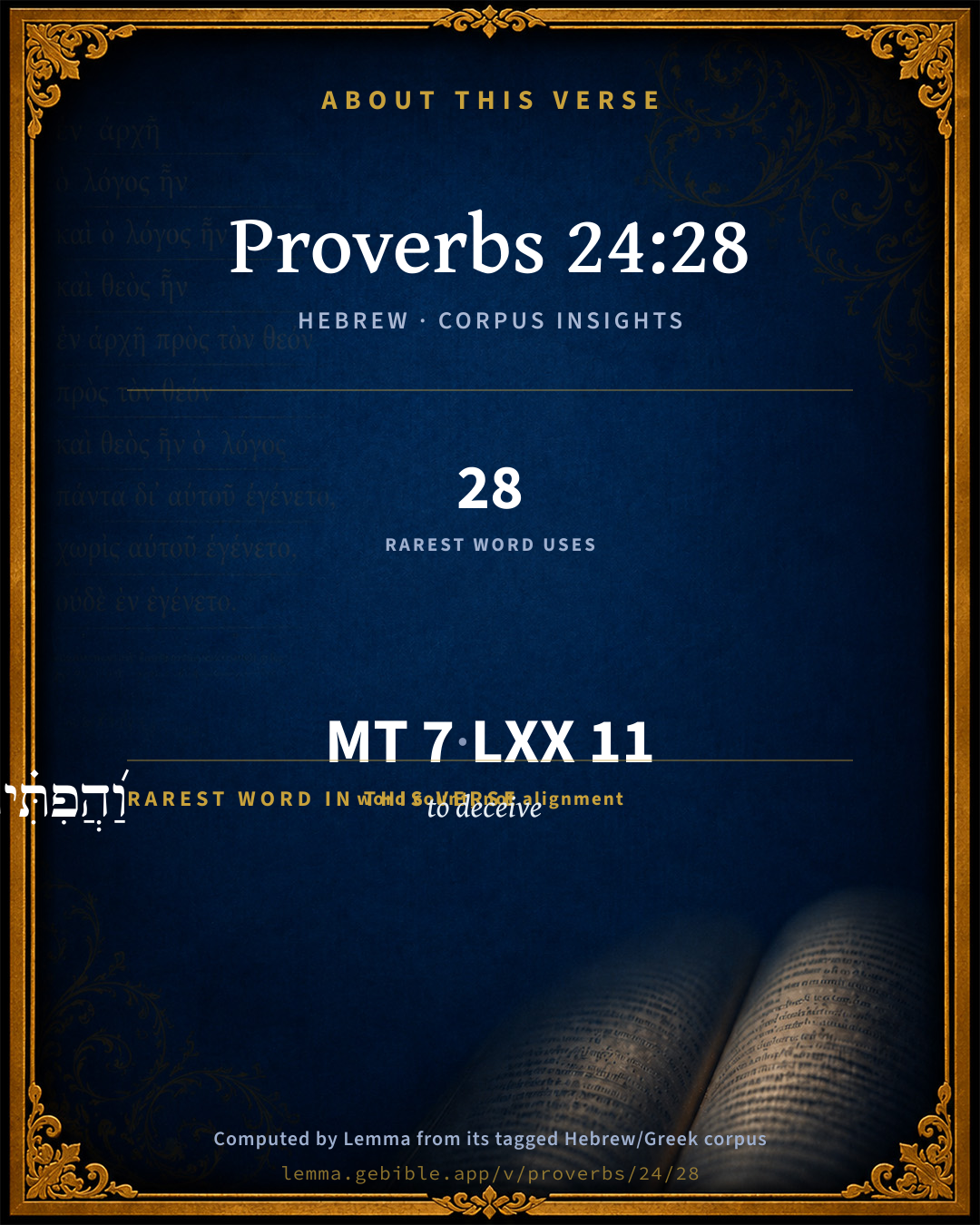
וַ֝הֲפִתִּ֗יתָ to deceive H6601 occurs in 26 verses of the Hebrew Bible. Also found in:

Grammatical profile

  • 2 verbs
  • 3 nouns
  • 1 adverb
  • 1 particle

Verb forms

  • תְּהִ֣י Qal · Jussive
  • וַ֝הֲפִתִּ֗יתָ Piel · Perfect

Hebrew & Septuagint length

In English translation the verse runs 14 words from the Hebrew and 14 from the Septuagint (LXX English) — the same length.

A rough comparison of the two English renderings, which tokenize alike — not a word-level alignment.

Word counts can differ between the Hebrew and the Greek without any difference in meaning — e.g. the Hebrew direct-object marker אֵת has no separate Greek word, and Greek often adds the article ὁ.

In the original languages it is 7 Hebrew tokens and 11 Greek tokens — but the two are counted differently (Hebrew bundles its prefixes and suffixes into one token; the Greek is in lemma form), so that isn’t a like-for-like length.

Cross-references

20

Topical passages linked to Proverbs 24:28 in the Treasury of Scripture Knowledge — connected by theme and wording, ordered by reader-vote popularity; previews shown in the World English Bible.

  • Ephesians 4:25 Therefore, putting away falsehood, speak truth each one with his neighbor. For we are members one of another.
  • Proverbs 25:18 A man who gives false testimony against his neighbor Is like a club, a sword, or a sharp arrow.
  • Matthew 26:59–60 Now the chief priests, the elders, and the whole council sought false testimony against Jesus, that they might put him to death;
  • Exodus 20:16 "You shall not give false testimony against your neighbor.
  • Exodus 23:1 "You shall not spread a false report. Don't join your hand with the wicked to be a malicious witness.
  • 1 Samuel 22:9–10 Then answered Doeg the Edomite, who stood by the servants of Saul, and said, I saw the son of Jesse coming to Nob, to Ahimelech the son of Ahitub.
  • 1 Kings 21:9–13 She wrote in the letters, saying, Proclaim a fast, and set Naboth on high among the people:
  • Job 2:3 Yahweh said to Satan, "Have you considered my servant Job? For there is none like him in the earth, a blameless and an upright man, one who fears God, and turns away from evil. He still maintains his integrity, although you incited me against him, to ruin him without cause."
  • Psalms 35:7 For without cause they have hidden their net in a pit for me. Without cause they have dug a pit for my soul.
  • Psalms 35:11 Unrighteous witnesses rise up. They ask me about things that I don't know about.
  • Psalms 52:1 Why do you boast of mischief, mighty man? God's loving kindness endures continually.
  • Proverbs 14:5 A truthful witness will not lie, But a false witness pours out lies.
  • Proverbs 19:5 A false witness shall not be unpunished. He who pours out lies shall not go free.
  • Proverbs 19:9 A false witness shall not be unpunished. He who utters lies shall perish.
  • Proverbs 21:28 A false witness will perish, And a man who listens speaks to eternity.
  • Matthew 27:23 But the governor said, "Why? What evil has he done?" But they cried out exceedingly, saying, "Let him be crucified!"
  • John 15:25 But this happened so that the word may be fulfilled which was written in their law, 'They hated me without a cause.'
  • Colossians 3:9 Don't lie to one another, seeing that you have put off the old man with his doings,
  • Revelation 21:8 But for the cowardly, unbelieving, sinners, abominable, murderers, sexually immoral, sorcerers, idolaters, and all liars, their part is in the lake that burns with fire and sulfur, which is the second death."
  • Revelation 22:15 Outside are the dogs, the sorcerers, the sexually immoral, the murderers, the idolaters, and everyone who loves and practices falsehood.

Cross-references courtesy of OpenBible.info (CC BY 4.0).

Hebrew and Greek witnesses Masoretic Hebrew ↔ Greek Septuagint

The same verse in the two great witnesses to the Old Testament, shown verse-for-verse.

These are two independent witnesses, not word-aligned to each other, and the Septuagint is shown in lemma (dictionary) form.

Hebrew Proverbs 24:28 Masoretic · Westminster Leningrad Codex

אַל תְּהִ֣י עֵד חִנָּ֣ם בְּרֵעֶ֑ךָ וַ֝הֲפִתִּ֗יתָ בִּשְׂפָתֶֽיךָ

Don't be a witness against your neighbor without cause. Don't deceive with your lips.

World English Bible · Public Domain

Greek LXX Proverbs 24:28 Septuagint · lemma form

μή εἰμί ψευδής μάρτυς ἐπί σός πολίτης μηδέ πλατύνω σός χεῖλος

Be not a false witness against your fellow citizen, neither exaggerate with your lips.

LXX2012 (modern English Septuagint) · Public Domain

On this verse, Haydock's Catholic Bible Commentary discusses the Septuagint’s reading. Read the note in Commentary ↓

Hebrew: Westminster Leningrad Codex (CC BY 4.0). Greek: Septuagint (public domain); English from LXX2012 (modern English Septuagint) (Public Domain). How the Septuagint differs from the Hebrew →

Commentary

Notes on Proverbs 24:28 from classic Christian and Jewish commentators (each source and its license shown beneath its notes). The classic Christian expositions comment on the surrounding passage and are grouped to its opening verse, so a note may address several verses; the Jewish commentaries on the Tanakh (Rashi and others) are per-verse, so they appear only where the commentator wrote on this verse.

Lemma curates 59 commentaries, every one of them public domain or Creative Commons licensed, each selected and text-cleaned for this edition rather than reprinted as found. About our sources →

Trapp's Complete Commentary

John Trapp

Pro 24:28 Be not a witness against thy neighbour without cause; and deceive [not] with thy lips.

Ver. 28. Be not a witness against thy neighbour without cause.] That is, Without calling, being not thereunto required; for this would speak thee spiteful, rash, and revengeful, as in the next verse.

And deceive not with thy lips.] When called to be a witness, speak thy mind simply and plainly, without preface or passion, {a} without varnish of fine words, whereby to mislead the judge, or deceive the jurors, to bolster out a bad cause, or outface a good.

{a} ανευ προοιμιων και παθων.

John Trapp, A Commentary or Exposition upon All the Books of the Old and New Testament (1647–1656) — public domain. Text from a community e-Sword module.

The Biblical Illustrator

Joseph S. Exell

Pro_24:28-29

Be not a witness against thy neighbour without cause.

The nature and extent of false witness

There is nothing more dear and valuable to men than their reputation or good name. It is a mark of an abandoned spirit to have no regard to it. Men have always been very tender in preserving it in themselves, and they ought to make great conscience of taking it wrongfully from others. So much reputation is so much power, and according to mens esteem and credit in the world, so much proportionably is their influence and the weight they have in it. For the same reasons that we are obliged not to injure our neighbour in his person or property, we ought to be very tender of his good name and reputation. Then always have a just regard to truth and charity, and the benefit and advantage of the public. Our neighbour is whomsoever it happens at any time to be in our power either to injure or do kindness to; whosoever can, in any respect, become the better or the worse, or receive any hurt or any benefit, by our behaviour towards them. The word which we render deceive signifies in the original, any damage or inconvenience brought upon a man in the way of slander, calumny, backbiting, or any other injurious manner of presenting him.

I. The nature and extent of the sin here forbidden. The highest form of the sin is deliberately giving false evidence in judicial matters. Another degree of the vice is when men bear false testimony against their brethren, after a secret manner, in private conversation. Whether revenge, or anything else, be the temptation to the practice, the nature of the sin itself is of the deepest dye. There are still lower degrees of the fault. The careless and rash custom of spreading censorious reports to the disadvantage of our neighbour, without caring to inquire into the truth of the accusation. Under this head come innumerable sorts of calumny, detraction, slander, evil-speaking, backbiting, tale-bearing, rash judgment, etc.. Men in such matters are often faulty through negligence and want of care and attention. That person is a very perfect man indeed who can be continually upon his guard against this error. The lowest degree of this fault is when men are censorious towards their brethren, spreading abroad things that are true needlessly, and contrary to the laws of charity. It is a breach of Christian charity to take delight in spreading even true reports needlessly, to the damage, or disadvantage, of our neighbour.

II. Reasons or motives which ought to influence our practice in this matter. From the nature and constitution of human society there arises a strong argument why men ought to govern their words as well as actions. By injurious speech, mutual trust and good-will are destroyed, on which depends the welfare and happiness of mankind. Mischief comes to the man himself. The natural punishment of a licentious and unbridled tongue is the inconveniences it is very apt to bring, in the course of things, upon the person himself. But worse is the secret damage done to others. Slander and uncharitable defamation is a pestilence that walketh in darkness. Another motive obliging men to restrain licentious speech is the consideration of the inconsistency of it with a due sense of religion. A principal part of pure religion is that men approve themselves by a good conversation, with meekness of wisdom. Another argument against calumny is the consideration that we are ourselves subject to error. He that is infallibly secured against all errors himself, let him be as censorious as he pleases upon the mistakes of others. Our Saviour forbids this censoriousness towards others, under the penalty of being more strictly judged ourselves. (S. Clarke, D.D.)

Wrong testimony against neighbours

The verses suggest three kinds of wrong testimony.

I. A causeless one. Be not s witness against thy neighbour without cause. There are those who are, for no service, either to themselves or to society, testifying of the defects and infirmities of their neighbours.

II. A false one. And deceive not with thy lips.

III. A revengeful one. Say not, I will do so to him as he hath done to me: I will render to the man according to his work. (Homilist.)

Revenging injuries

These words are a direct prohibition of revenging injuries and recompensing evil for evil, and give us a rule of duty in ease of wrong done to us.

I. Was revenge allowed to the jews? In Lev_19:18 it is said, Thou shalt not avenge or bear any grudge against the children of thy people. This has been taken to imply that a Jew might kill a stranger, and consequently take any inferior degree of revenge on him. But compare the injunctions respecting the treatment of the stranger in Exo_22:1-31; Exo_23:1-33; Lev_19:9-10; Deu_10:1-22, etc. As to the retaliation granted (Exo_21:24), this allowance was not made to the party injured, so that he might satisfy and distribute justice to himself; but to the judge, so that he might allot compensation for the wrong done.

II. Enforce the great duty of forgiveness.

1. From the reasonableness of this duty in itself. Reasonable men must allow its force and truth. By corrupt and undisciplined natures only is revenge counted as a mark of a noble and brave spirit. But it is a sign of superiority of mind to forgive the trespass. We ought to make our forgiveness as useful to the trespasser as possibly we can. Prudence should arrest the forwardness of charity in granting pardons.

2. The great weight our Saviour lays upon our forgiving others, in order to our title to our own forgiveness. There is no proportion in number betwixt our offences against God and those of the most offensive of our brethren against us.

3. We have great reason to forgive them, because of the good use and advantage we may make of our enemies. Charity is the greatest manager in the world.

III. Mistakes which mislead men in their judgments concerning their own forgiveness.

1. The mistake of those who think they have paid a fair obedience to the law of charity, when they strike the offender only with the impartial hand of that of the law.

2. The mistake of those who think they may consign the trespasser to the judgment of God.

3. The mistake of judging the truth of our forgiveness on a principle of sloth. Some men are too ready to move themselves to resentment.

4. The mistake of thinking we have forgiven, when the fact is that the impressions have only worn off our minds. This is forgetting, not forgiving, since forgiveness is properly our own work, and not one of time. (George Wallis, D.D.)

Retaliation repudiated

An incident well worth relating is told of General Robert Lee, the Confederate officer during the American Civil War. Jefferson Davis once asked him what he thought of a certain officer in the army, as he had an important place he wanted filled by a trustworthy man. Lee gave the officer an excellent recommendation, and he was immediately promoted to the position. Some of Lees friends told him that the officer had said some very bitter things against him, and were surprised at the Generals recommendation. I was not asked, said Lee, for the officers opinion of me, but my opinion of him. Only a noble heart could prompt such action. In praying, we are told to love our enemies, but in our every-day life we too often love only those who love us.

The Biblical Illustrator, edited by Joseph S. Exell (c. 1880s–1900s) — public domain. Text from a community e-Sword module.

Joseph Benson's Commentary

Pro 24:28-29. Be not witness against thy neighbour — Either in judgment or in private conversation; without cause — Rashly or falsely, without just and sufficient cause; and deceive not with thy lips — Neither thy neighbour, nor the judge, nor any other hearers, with false information. Or, this clause forbids flattering him to his face, as the former forbids slandering him behind his back. Say not — Within thyself: give not way to any such thoughts or passions; I will render, &c., according to his works — I will repay him all his calumnies and injuries.

Joseph Benson's Commentary on the Old and New Testaments (1811–1818) — public domain. Text from a community e-Sword module.

The Preacher's Complete Homiletical Commentary

Joseph S. Exell (gen. ed.)

MAIN HOMILETICS OF Pro_24:28-29

AN UNCALLED-FOR TESTIMONY

I. There are times and circumstances in which it is our duty to witness against our neighbour. When the interests of right and truth are at stake, it is wrong for any man to be silent when by declaring what he knows, he could establish those interests, even although by so doing he brings punishment upon a fellow-man. It is often indispensable to the safety of innocent people that the wrong-doer should be exposed and brought to justice, and every man in such a case is not only blameless when he witnesses against such a “neighbour,” but blameworthy when he does not do so. This is not witnessing against him “without cause,” for there is a good and sufficient reason for the action.

II. Such witness-bearing is of quite a different character from that which springs from malice. There are men in society who seem to live like beasts of prey. As the lion or the tiger is ever watching his opportunity to spring upon some defenceless creature at an unguarded moment, so these men seem to make it their business to watch their fellow-creatures for opportunities to injure their reputation and mangle their character. And in a world of faulty human beings, it is not difficult for such men to find food for their malicious appetites, without transgressing the limits of truth. In most men there is enough imperfection, and in many of actual sin, to render it easy to make out a case against them. But if no actual good can come to anybody by exposing their failings, much harm will come to the man who thus bears witness against them without a cause. The evil tendencies of his own evil nature will be strengthened by the act, and he will be exposing himself to the danger of having a causeless testimony borne against himself in his turn.

III. There are circumstances in which there is a strong temptation to bear a causeless testimony. It is against this temptation that the proverb is especially directed. When a man has spoken evil of us without cause, when he has made public some hidden infirmity, or some secret fall, there is a great temptation to retaliate if opportunity offers—to tell what we know about him that will lower him in the estimation of his fellow-men. But this temptation must be resisted, both for our own sake and for his, and for this reason among others, that we are in the worst possible condition for bearing a truthful testimony. A man under the influence of intoxicating drink would be altogether unfit to bear witness for or against another. But the passion of revenge is as intoxicating to the human soul as the most potent liquor is to the human brain. It distorts the judgment, and dethrones the reason, and tramples under foot all the noblest emotions of our nature. A man under its sway would be very unlikely to be just to the object to whom he sought to return evil for evil; nay, he would be unable to confine himself within the limits of strict truth and pure justice. And, therefore, one who has wronged us is the man above all other men of whose faults we should never speak, unless there is an overwhelming moral necessity for it.

OUTLINES AND SUGGESTIVE COMMENTS

Pro_24:28. “And mayhap, deceive with thy lips.” This is expressed by a little particle before the verb. It helps in the ancillary thought, that not only is speaking evil wicked if it can do no good, but also it may prove actually unjust. All statement has a hazard of mistake. If it can do some good, we may risk something so as to witness; but if there can be no good, we should risk nothing.—Miller.

Pro_24:29. It is a great wickedness, when God is made a pattern for wickedness; and it is a strong temptation to wickedness, when the example of the Lord seemeth to countenance that which is proposed to be done. It is therefore against this that the wise man adviseth in this verse. For though God say, I will render to everyone according to his works, thou mayest not say, I will render to the man according to his works. God speaketh as a Judge to whom it belongeth to consider the works of everyone, and accordingly to reward them; but no man may be a judge in his own cause, no particular man may do that for himself which a judge may do for him. Wherefore it is a bad imitation thus to imitate the Lord, for we are not to do all things that the Lord doth, but all things that the Lord commandeth us to do.—Jermin.

The Preacher's Complete Homiletical Commentary (gen. ed. Joseph S. Exell; Funk & Wagnalls, c. 1892) — public domain (pre-1929). A full-Bible homiletical/sermon-outline anthology covering 65 of 66 books (2 John is absent from the source module). Text from a community e-Sword module.

The Expositor's Bible

CHAPTER 25

FORGIVING

"Be not a witness against thy neighbor without cause, and deceive not with thy lips. Say not, I will do so to him as he hath done to me; I will render to the man according to his work,"- Pro_24:28-29

"Rejoice not when thine enemy falleth, and let not thy heart be glad when he is overthrown, lest the Lord see it and it displease Him, and He turn away His wrath from him."- Pro_24:17-18.

"He that is glad at calamity shall not be unpunished."- Pro_17:5

"If thine enemy be hungry, give him bread to eat, and if he be thirsty give him water to drink; for thou shalt heap coals of fire upon his head, and the Lord shall reward thee."- Pro_25:21-22

THERE is no subject on which the teaching of the Proverbs more strikingly anticipates the morality of the New Testament than that of forgiveness to our enemies. Our Lord Jesus Christ could take some of these sayings and incorporate them unchanged into the law of His kingdom, for indeed it is not possible to surpass the power and beauty and truth of the command to feed those who have injured us if they are hungry, to give them drink when they are thirsty, and in this Divine way to kindle in them repentance for the injury which they have done. This is the high-water mark of moral excellence. No better state can be desired. When a human spirit is habitually in this tender and forgiving mood, it is already united with the Father of spirits, and lives.

It is almost superfluous to point out that even the saints of the Old Testament fall very far short of the lofty standard which is here set before us. The Psalmist, for example, is thinking of coals of a quite different sort when he exclaims: "As for the head of those that compass me about, let the mischief of their own lips cover them. Let burning coals fall upon them; let them be cast into the fire; into deep pits that they rise not up again." {Psa_140:9-10} That is the old elemental hate of human nature, the passionate, indignant appeal to a righteous God against those who have been guilty of a wrong or an injury. Even Jeremiah, one of the latest, and certainly not the least holy, of the prophets, could cry out concerning his enemies: "Yet, Lord, Thou knowest all their counsel against me to slay me; forgive not their iniquity, neither blot out their sin from Thy sight; but let them be overthrown before Thee; deal Thou with them in the time of Thine anger." {Jer_18:23} Words painfully natural, words echoed by many. a persecuted man of God, but yet quite inconsistent with the teaching of the Savior in the Sermon on the Mount, the teaching already foreshadowed in this beautiful proverb.

But it may not be superfluous to notice that the Proverbs themselves, even those which stand at the head of this chapter, do not all touch the high-water mark of Pro_25:21. Thus, for example, the motive which is suggested in Pro_24:18 for not rejoicing in the fall of an enemy is none of the highest. The idea seems to be, if you see your enemy undergoing punishment, if calamity is falling upon him from the Lord, then do not indulge in any insolent exultation, lest the Lord should be offended with you, and, in order to chastise your malignity, should cease to plague and trouble him. In such a view of the question, God is still regarded as a Nemesis that will resent any unseemly rejoicing in the calamity of another; {Pro_17:5 b} in proportion therefore as you wish to see your enemy punished, you must abstain from that joy in his punishment which would lead to its diminution. From a precept of that kind there is a vast moral stride to the simple prohibition of retaliation, announced without any reason given or suggested in Pro_24:29 -"Say not, I will do so to him as he hath done to me, I will render to the man according to his work." And from this again there is an incalculable stride to the positive spirit of love, which, not content with simply abstaining from vindictiveness, actually turns the tables, and repays good for evil, looking with quiet assurance to the Lord, and the Lord alone, for recognition and reward. Our wonder is occasioned not because all the Proverbs do not reach the moral altitude of this one, but rather that this one should be so high. When an ideal is set up far in advance of the general practice and even of the general thoughts of the time, we can ascribe it only to the promptings of the Holy Spirit.

It needs no proof that forgiveness is better than revenge. We all know that-

"Revenge at first though sweet,

Bitter ere long back on itself recoils."

We all know that the immediate effect of forgiving our enemy is a sweet flow of tenderness in the soul, which surpasses in delight all the imagined joys of vindictiveness; and that the next effect is to soften and win the foe himself; the scornful look relents, the tears of passion give place to those of penitence, the moved heart is eager to make amends. We all know that nothing more powerfully affects our fellow-men than the exhibition of this placable temper. We all know that in forgiving we share Gods prerogative, and come into harmony with His Spirit.

Yet here is the melancholy fact that notwithstanding this proverbial truth, taken up into the teaching of our Savior, and echoed in the writings of His Apostles, even in a Christian society, forgiveness is almost as rare as it was in the days of King Solomon. Men are not ashamed-even professing Christians are not ashamed-to say about their enemies, "I will do so to him as he has done to me, I will render to the man according to his work." We even have a lurking admiration for such retaliatory conduct, calling it spirited, and we still are inclined to contemn one who acts on the Christly principle as weak or visionary. Still the old bad delight in seeing evil fall on the head of our enemies glows in our hearts; still the act of vengeance is performed, the bitter retort is given, the abusive letter is written, with the old sense of unhallowed pride and triumph. How is this? Ah, the simple truth is that it is a small matter to get right principles recognized, the whole difficulty lies in getting them practiced. We need a power which can successfully contend against the storm of passion and self-will in those terrible moments when all the calm lights of reason are quenched by the blinding surf of passion, and all the gentle voices of goodness are drowned by its roaring waves.

Sometimes we hear it said that the moral teaching of Christ is not original, but that all His precepts may be found in the words and writings of ancient sages, just as His teaching about forgiveness is anticipated by the proverb. Yes, but His claim does not rest upon His teaching, but upon the Divine and supernatural power which He has at His command to carry out His doctrines in the conduct of His disciples. This is the point which we must realize if this sweet and beautiful ideal is to be worked out in our lives. We have but touched the fringe of the question when we have conned His words, or shaped conceptions of what a life would be passed in conformity to them. The center of Christian doctrine is power, the power of Christ, the fountain of living waters opened in the heart, the grafting of the withering branches upon a living stock, the indwelling of Christ Himself, as the spring and principle of every holy action, and the effectual restraint on all our ungovernable passions.

But before looking more closely at this, we ought to pay some attention to the constant motive which our Lord, even in His teaching, presents for the practice of a forgiving disposition. He always bases the duty of forgiveness on the need which we have of Gods forgiveness; He teaches us to pray, "Forgive us our trespasses, as we forgive them that trespass against us"; and in the moving story of the unmerciful servant, who demanded the full payment from his fellow-servant just when his lord had pitifully remitted his own debt, He tells us that forgiveness of our enemies is an indispensable condition of our being forgiven by God. "His lord was wroth, and delivered him to the tormentors, till he should pay all that was due. So shall also My Heavenly Father do unto you, if ye forgive not everyone his brother from your hearts." {Mat_18:35} It is not therefore only, as it is sometimes stated, that we ought to be moved to pity by remembering what God has done for us. No, there is a much sterner thought in our Lords mind; it is that if we do not forgive we shall not and cannot be forgiven. The forgiving spirit manifested to our fellow-men is that without which it is vain for us to come near and to ask God for pardon. If we have come, and are just about to offer our prayer, and if we then remember that we have aught against a brother, we must go first and be reconciled to him, before our prayer can be so much as heard.

Here is certainly a motive of a very powerful kind. Which of us would dare to cherish the bitter thought, or proceed with our plan of vengeance, if we remembered and realized that our vindictiveness would make our own pardon at the hands of God impossible? Which of the countless deeds of retaliation that stain with blood the pages of history would have been perpetrated, and which of the perpetrators would not have tremblingly relinquished all thought of reprisals, if they had seen that in those savage acts of vengeance they were not, as they supposed, executing lawful justice, but actually cutting off their own hope of pardon before the throne of God?

If we avenge ourselves, if society is constantly torn by the quarrels and the mutual recriminations of hostile men whose one thought is to give as good as they have got, it can only be because we do not believe, or do not realize, this solemn teaching of the Lord. He seems a faint and doubtful voice compared with the loud tumult of passion within; His authority seems weak and ineffectual compared with the mighty domination of the evil disposition. Powerful, therefore, as the motive is to which He constantly appeals, if He had left us nothing but His teaching on the subject we should not be materially better off than they who listened with attention to the teaching of the wise authors of these ancient Proverbs. What more has He left us?

It is His prerogative to give to those who believe in Him a changed heart. How much is meant by that, which only the changed heart can know! Outwardly we seem much alike; outwardly, there is little sign of an inward transformation; but far as the east is from the west is the unregenerate heart from the regenerate, the Christless heart from one which He has taken in His hands, and by His great redemption created anew. Now without stopping to follow the processes of faith by which this mighty change is effected, let us simply mark the characteristics of the change so far as it affects the matter in hand.

The first and most radical result of the New Birth is that God takes the place which self has occupied. All the thoughts which have clustered about your own being now turn to His Being, as stray fragments of iron turn to the magnet. Consequently, all the emotions and passions which are stimulated by self-love give place to those which are stimulated by the love of God. It is as if the pipes of your aqueduct had been changed at the fountain head, disconnected from the malarious waters of the marsh, and connected with the pure and sparkling water of the hills. Gods ways of regarding men, Gods feelings towards men, His yearning over them, His pity for them, flow into the changed heart, and so preoccupy it that resentment, hatred, and malice are washed out like the sour dregs in a cup which is rinsed in a running stream.

There is the man who did you the wrong-very cruel and unpardonable it was!-but, as all personal elements are quite out of the question, you regard him just as if you were not the injured being. You see him only as God sees him; you trace all the malignant workings of his mind; you know how the fire of his hate is a fire which burns the heart that entertains it. You see clearly how tormenting those revengeful passions are, how the poor soul mastered by them is diseased, how the very action in which it is triumphing now must become one day a source of bitter regret and implacable self-reproach; you soon begin to regard the ill deed as a shocking wound inflicted on the doer of it, and the wells of pity are opened. As if this enemy of yours had been quite innocent of all ill-will, and had been overtaken by some terrible calamity, your one instinctive thought is to help him and relieve him. Out of the fullness of your heart, without any sense of being magnanimous, or any thought of a further end, -simply for the pity of it, -you come to proffer him bread in his hunger and water in his thirst.

Yes, it is in the atmosphere of pity that personal resentment dies away, and it is only by the power of the Son of Man that the heart can be filled with a pity large enough to pardon all the sins of our kind.

It is this thought-though without any definite statement of the means by which it is produced-that finds expression in Whittiers touching lines:-

"My heart was heavy, for its trust had been

Abused, its kindness answered with foul wrong;

So turning gloomily from my fellow-men,

One summer Sabbath day I strolled among

The green mounds of the village burying-place;

Where pondering how all human love and hate

Find one sad level; and how, soon or late,

Wronged and wrongdoer, each with meekened face!

And cold hands folded over a still heart,

Pass the green threshold of a common grave,

Whither all footsteps tend, whence none depart,

Awed for myself, and pitying my race,

Our common sorrow, like a mighty wave,

Swept all my pride away, and, trembling, I forgave."

Yes, one who is touched by the spirit of the Son of Man finds too much to pity in the great sorrowing world, and in its fleeting and uncertain life, to cherish vengeful feelings. Himself redeemed by the untold love of His Father, by the undeserved and freely offered pardon in Christ Jesus his Lord, he can feel for his enemies nothing but forbearance and love; if they too are Christians, he longs to win them back to the peace and joy from which their evil passion must have driven them; and if they are not, his eyes must fill with tears as he remembers how brief is their apparent triumph, how unsubstantial their gleam of joy. The desire to save them immediately masters the transitory wish to punish them. The pity of men, for the sake of the Son of Man, wins the day.

And now we may just glance at the effect which the Christly conduct has upon the offender, and the reward which God has attached to its exercise.

It is one of the most beautiful traces of Gods likeness, in even bad men, a characteristic to which there is no parallel in the animal creation, that though passion awakes passion, wrath, and vengeance revenge-so that savages pass their whole time in an unbroken series of blood feuds, the hideous retaliation bandied from tribe to tribe and from man to man, generation after generation-the spirit of meekness, proceeding not from cowardice, but from love, disarms passion, soothes wrath, and changes vengeance into reconciliation. The gleam of forgiveness in the eye of the injured is so obviously the light of God that the wrongdoer is cowed and softened before it. It kindles a fire in his spirit, his heart melts, his uplifted hand falls, his angry voice grows tender. When men are so dehumanized as to be insensible to this softening effect, when they interpret the gentleness as weakness, and are moved by the forgiving spirit simply to further injury and more shameless wrong, then we may know that they are possessed, -they are no longer men, -they are passing into the category of the lost spirits, whom the forbearance of God Himself leads not to repentance but only to added sin.

But if you have ever by the sweet spirit of Christ so mastered your natural impulse as to return good for evil lovingly and whole-heartedly, and if you have seen the regenerating effect in the beautiful subjugation of your foe and his transformation into a friend, it is not necessary to say much of the reward which God has in store for you. Do you not already possess it?

Yet the reward is certainly greater than you are able at once to apprehend. For what a secret is this which you possess, the secret of turning even the malignity of foes into the sweetest affection, the secret which lay in the heart of God as the spring and the means of mans redemption. The highest reward that God can give to His creatures is to make them partakers of His nature as He has made them in His own image. When we share in a Divine attribute we enter so far into the Divine bliss; and in proportion as this attribute seems removed from our common human nature, our spirit must exult to find that it has been really appropriated. What further reward, then, can he who avenges not himself desire? The pulse of the Divine heart beats in him; the tides of the Divine life flow through him. He is like God-God who opposes to mans ingratitude the ocean of His pardoning love; he is conscious of that which is the fountain of joy in the Divine Being; surely a man must be satisfied when he awakes in Gods likeness! And that satisfaction comes to everyone who has heaped coals of fire on his enemys head by feeding him in his hunger, and giving him water when athirst. Say not, "I will do so to him as he has done to me, I will render to the man according to his work." Love your enemies; pray for them which despitefully use you.

William Robertson Nicoll, ed., The Expositor's Bible (London: Hodder & Stoughton, 1887–1910) — public domain. 65 of 66 books (1 Corinthians is not separately keyed, as that volume carries no machine-parseable verse references); section-level commentary keyed to the opening verse. Introductory and overview sections not keyed to a specific passage are excluded.

Tyndale Open Study Notes

Tyndale Open Resources

24:28-29 Saying 4: The truth should not be bent, not even for revenge (see 6:19; 12:17; 14:25; 19:28; 24:23-24; 25:18).

Tyndale Open Study Notes — © Tyndale Open Resources, licensed CC BY-SA 4.0. Text via the HelloAO Bible API.

Matthew Henry's Commentary

We are here forbidden to be in any thing injurious to our neighbour, particularly in and by the forms of law, either, 1. As a witness: "Never bear a testimony against any man without cause, unless what thou sayest thou knowest to be punctually true and thou hast a clear call to testify it. Never bear a false testimony against any one;" for it follows, "Deceive not with thy lips; deceive not the judge and jury, deceive not those whom thou conversest with, into an ill opinion of thy neighbour. When thou speakest of thy neighbour do not only speak that which is true, but take heed lest, in the manner of thy speaking, thou insinuate any thing that is otherwise and so shouldst deceive by innuendos or hyperboles." Or, 2. As a plaintiff or prosecutor. If there be occasion to bring an action or information against thy neighbour, let it not be from a spirit of revenge. "Say not, I am resolved I will be even with him: I will do so to him as he had done to me." Even a righteous cause becomes unrighteous when it is thus prosecuted with malice. Say not, I will render to the man according to his work, and make him pay dearly for it; for it is God's prerogative to do so, and we must leave it to him, and not step into his throne, or take his work out of his hands. If we will needs be our own carvers, and judges in our own cause, we forfeit the benefit of an appeal to God's tribunal; therefore we must not avenge ourselves, because he has said, Vengeance is mine.

Matthew Henry's Commentary on the Whole Bible (1708–1710) — public domain (CC PDM 1.0). Text via the HelloAO Bible API.

Jamieson, Fausset & Brown

Robert Jamieson, A. R. Fausset & David Brown

Do not speak even truth needlessly against any, and never falsehood.

Jamieson, Fausset & Brown — Commentary Critical and Explanatory on the Whole Bible (1871) — public domain (CC PDM 1.0). Text via the HelloAO Bible API.

Adam Clarke's Commentary

Verse 28. Be not a witness] Do not be forward to offer thyself to bear testimony against a neighbour, in a matter which may prejudice him, where the essential claims of justice do not require such interference; and especially do not do this in a spirit of revenge, because he has injured thee before.

Adam Clarke's Commentary on the Bible (1810–1826) — public domain. Text from a community e-Sword/MySword module.

Ellicott's Commentary for English Readers

(28) Without cause—i.e., do not mention thy neighbour’s faults unless for some good reason, not for malice or love of gossip.

A Bible Commentary for English Readers, edited by Charles John Ellicott (1878–1897) — public domain. Text from a community e-Sword module.

The Cambridge Bible for Schools and Colleges

gen. ed. J. J. S. Perowne

28. deceive not] Lit. and perhaps more forcibly, And wouldest thou deceive with thy lips?

The Cambridge Bible for Schools and Colleges (gen. ed. J. J. S. Perowne; Cambridge University Press, 1878–1918) — public domain. Text from a community e-Sword module.

John Gill's Exposition

I went by the field of the slothful,.... This very probably was a real matter of fact; King Solomon's way lay at a certain time by the field of a slothful man, who never went into it himself, there being a lion in the way; and which he took no care of to manure and till, to plough and sow, but let it lie waste and uncultivated; an emblem of a carnal and worldly professor, and especially an unregenerate man, neglecting the affairs of his soul, his heart remaining like the fallow field unopened and unbroken, hard, obdurate, and impenitent; nothing sown in it, no seed of grace; nor has the seed of the word any place in it, but falling on it lies like seed by the wayside, caught up by every bird;

and by the vineyard of the man void of understanding; as the slothful man is, that takes no care to plant and dress it, that it may bring forth fruit to his own profit and advantage; and as every unregenerate man is, who is unconcerned about his soul, and the welfare of it; whatever understanding he may have of things natural and civil, he has no knowledge of spiritual things, of God in Christ, of himself, his state and condition; of Christ, and the way of peace, life, and salvation by him; of the Spirit, and his work of grace upon the heart; and of the Gospel, and the mysteries of it; and so has no regard to the vineyard of his soul, and the plantation and fruitfulness of it; see Sol 1:6.

John Gill's Exposition of the Whole Bible (1746–1763) — public domain (CC PDM 1.0). Text via the HelloAO Bible API.

Albert Barnes' Notes on the Bible

Deceive not with thy lips - Better, wilt thou deceive with thy lips?

Albert Barnes' Notes on the Bible (1834–1885) — public domain. Text from a community e-Sword/MySword module.

Haydock's Catholic Bible Commentary

Cause, and necessity. Septuagint, "be not a false witness against thy fellow-citizen."

George Leo Haydock (1774–1849), Haydock's Catholic Family Bible and Commentary, 1859 edition — public domain. Excludes Psalms (Douay-Rheims chapter numbering differs from Protestant) and Deuterocanonical books (Catholic canon only).

Matthew Poole's English Annotations

Be not a witness against thy neighbour, either in judgment or in private conversation, without cause; rashly or falsely, without just and sufficient cause.

Deceive not neither thy neighbour, to whom thou hast made a show of friendship, nor the judge, nor any other bearers, with false information. Or this clause forbids flattering him to his face, as the former forbids slandering him behind his back.

Matthew Poole's English Annotations on the Holy Bible (1683–1685) — public domain. Text from a community e-Sword/MySword module.

Whedon's Commentary on the Bible

Daniel D. Whedon

28, 29. Be not a witness… without cause — The sense is: Do not be forward to accuse or bear witness against thy neighbour, where the claims of justice do not require it; nor deceive others into a false opinion of him by evil insinuations: especially beware of doing so in revenge for his former misdeeds against thyself. Compare Pro_20:22; Pro_23:29.

Daniel D. Whedon (gen. ed.), Commentary on the Old and New Testaments (1874–1909) — public domain. Text from a community e-Sword module.

The Pulpit Commentary

Be not a witness against thy neighbour without cause (chinnam); gratuitously, (Pro_3:30 Pro_23:29 Pro_26:2) when you are not obliged in the performance of a plain duty. Persons are not to put themselves forward to give testimony to a neighbour"s discredit, either officiously as busybodies, or maliciously as slanderers. The maxim is expressed in general terms and is not to be confined to one category, as the Syriac and Septuagint render, "Be not a false witness against thy fellow citizen." And deceive not with thy lips. The Hebrew is really interrogative, "And wouldest thou deceive with thy lips?". (Psa_78:36) The deceit is not so much intentional falsehood as misrepresentation arising from haste and inconsiderateness consequent on this unnecessary eagerness to push forward testimony unsought. Septuagint, "Neither exaggerate (platunou ) with thy lips."

The Pulpit Commentary (1880–1919), ed. H.D.M. Spence-Jones & Joseph S. Exell — public domain. Text from a community e-Sword module.

Keil & Delitzsch

C. F. Keil & F. Delitzsch

Warning against unnecessary witnessing to the disadvantage of another:

Never be a causeless witness against thy neighbour;

And shouldest thou use deceit with thy lips?

The phrase עד־חנּם does not mean a witness who appears against his neighbour without knowledge of the facts of the case, but one who has no substantial reason for his giving of testimony; חנּם means groundless, with reference to the occasion and motive, Pro 3:30; Pro 23:29; Pro 26:2. Other designations stood for false witnesses (lxx, Syr., Targ.). Rightly Jerome, the Venet., and Luther, without, however, rendering the gen. connection עד־חנם, as it might have been by the adj.

In 28b, Chajg derives והפתּית from פּתת, to break in pieces, to crumble; for he remarks it might stand, with the passing over of into , for והפתּות [and thou wilt whisper]. But the ancients had no acquaintance with the laws of sound, and therefore with naive arbitrariness regarded all as possible; and Bttcher, indeed, maintains that the Hiphil of פתת may be הפתּית as well as הפתּות; but the former of these forms with could only be metaplastically possible, and would be הפתּית (vid., Hitzig under Jer 11:20). And what can this Hiph. of פתת mean? "To crumble" one's neighbours (Chajg) is an unheard of expression; and the meanings, to throw out crumbs, viz., crumbs of words (Bttcher), or to speak with a broken, subdued voice (Hitzig), are extracted from the rare Arab. fatâfit (faṭafiṭ), for which the lexicographers note the meaning of a secret, moaning sound. When we see והפתית standing along with בּשׂפתיך, then before all we are led to think of פתה [to open], Pro 20:19; Ps. 73:36. But we stumble at the interrog. ה, which nowhere else appears connected with ו. Ewald therefore purposes to read והפתּית [and will open wide] (lxx μηδὲ πλατύνου): "that thou usest treachery with thy lips;" but from הפתה, to make wide open, Gen 9:27, "to use treachery" is, only for the flight of imagination, not too wide a distance. On וה, et num, one need not stumble; והלוא, Sa2 15:35, shows that the connection of a question by means of ו is not inadmissible; Ewald himself takes notice that in the Arab. the connection of the interrogatives 'a and hal with w and f is quite common;

(Note: We use the forms âwa, âba, âthûmm, for we suppose the interrogative to the copula; we also say fahad, vid., Mufaṣsal, p. 941.)

and thus he reaches the explanation: wilt thou befool then by thy lips, i.e., pollute by deceit, by inconsiderate, wanton testimony against others? This is the right explanation, which Ewald hesitates about only from the fact that the interrog. ה comes in between the ו consec. and its perf., a thing which is elsewhere unheard of. But this difficulty is removed by the syntactic observation, that the perf. after interrogatives has often the modal colouring of a conj. or optative, e.g., after the interrog. pronoun, Gen 21:7, quis dixerit, and after the interrogative particle, as here and at Kg2 20:9, iveritne, where it is to be supplied (vid., at Isa 38:8). Thus: et num persuaseris (deceperis) labiis tuis, and shouldest thou practise slander with thy lips, for thou bringest thy neighbour, without need, by thy uncalled for rashness, into disrepute? "It is a question, âl'nakar (cf. Pro 23:5), for which 'a (not hal), in the usual Arab. interrogative: how, thou wouldest? one then permits the inquirer to draw the negative answer: "No, I will not do it" (Fleischer).

Keil & Delitzsch — Biblical Commentary on the Old Testament (1861–1891) — public domain (CC PDM 1.0). Text via the HelloAO Bible API. (Old Testament only.)

Bridges on Proverbs

Charles Bridges

The welfare of society may sometimes constrain to be witness against a neighbor. But never let it be without cause. Yet when compelled to this revolting duty, whatever be the temptation or consequence, deceive not with thy lips. Speak plainly, truthfully, the whole truth. Doeg’s witness against his neighbor was without cause; not from conscience, but from malice. The main fact also was concealed of David’s imposition upon Abimelech, which would have cleared him from the suspicion of treason, and saved his life. (1Sa 22:9-10 ; 1Sa 21:1-2 .) This garbled witness thus far deceived with his lips, and bears the black stamp of "a deceitful tongue." (Psa 52:3-4 ; Psa 120:2-4 .)

Profit is the bait to the thief, lust to the adulterer, revenge to the murderer. But it is difficult to say, what advantage redounds to this evil witness, or what allurement belongs to the sin, save that which Satan himself feels — the love of sin for its own sake, or for the satisfaction that is vainly anticipated from the commission. Should we however be clear from the grosser forms of this sin; yet do we resist the unkind witness against our neighbor, in magnifying his failings, and measuring them with a far stricter basis than our own; rashly censuring his indifferent or doubtful actions; and censuring even his sins with an unchristian intention?

And then — as to indulging personal resentment — it is natural to say, though only in the heart — I will do as he hath done to me. But shall we dare thus to take the sword out of God’s hands, and place ourselves upon his tribunal? "Vengeance belongeth unto me; I will repay — saith the Lord."†1 ’Let wisdom and grace be set to work to extinguish the fire from hell, before it gets head.’†2 Far sweeter will be the recollection of injuries forgotten than revenged. But grace alone can enable us to "forgive from the heart."†3 And yet too often its exercise is so feebly cherished, that natural feelings gain the ascendancy; and, if there be not an actual recompense of evil, there is merely a negative obedience to the rule, a refraining from the ebullition, rather than an active exercise of the opposite principle. The wise man sets out in this book the true rule,†4 more lovely, more constraining, as enforced by the divine example.†5 Humility and tenderness mark the self-knowing Christian, who forgives himself little, his neighbor much.

Footnotes:

†1 Rom 12:19. Compare Gen 50:16-19 .

†2 Matthew Henry’s Works, p. 459.

†3 Mat 18:35, with Luk 17:3-5 . ’The excellency of the duty is sufficiently proclaimed by the difficulty of the practice. For how hard is it, when the passions are high, and the sense of an injury quick, and the power ready, for a man to deny himself in that luscious morsel of revenge! To do violence to himself, instead of doing it to his enemy!’ — South’s Sermon on Mat 5:44

†4 Pro 20:22; Pro 25:21-22 .

†5 Mat 5:44, with Luk 23:34 . 1Pe 2:21-23 .

Charles Bridges, An Exposition of the Book of Proverbs (1846) — public domain. Text from a community e-Sword module.

Kretzmann's Popular Commentary

Paul E. Kretzmann

v. 28. Be not a witness against thy neighbor without cause, without reason and need, out of pure animosity; and deceive not with thy lips, rather in the form of a question, "And shouldest thou practice deception with thy lips?" a very emphatic way of reproving such an intention.

Paul E. Kretzmann, Popular Commentary of the Bible (1921–1924) — public domain. Text from a community e-Sword module.

unfoldingWord translationNotes

Door43 World Missions Community

with your lips

The lips are a metonym for the words a person speaks. AT: "by what you say" (See: Metonymy)

pay him back

This is an idiom. "take revenge against him" (See: Idiom)

translationWords

testimony

neighbor

deceive

unfoldingWord translationNotes — © Distant Shores Media and the Door43 World Missions Community, licensed CC BY-SA 4.0. Source: git.door43.org/Door43/en_tn.

Rashi

Rabbi Shlomo Yitzchaki (Rashi)

that you should be enticed with your lips You should be enticed by your friend with your speech.

Rashi on the Tanakh — English translations: “The Judaica Press complete Tanach with Rashi, translated by A. J. Rosenberg” (CC BY 4.0); “Pentateuch with Rashi's commentary by M. Rosenbaum and A.M. Silbermann, 1929-1934” (public domain); “The Metsudah Tanach series, Lakewood, N.J” (CC BY 4.0); and “The Book of Joshua, Metsudah Publications, 1997” (CC BY 4.0). Text via Sefaria.

Lesson kit

Teaching starters — assembled from the data on this page, not authored interpretation. Every prompt links to the verse data it draws on. Edit before teaching.

Proverbs, in the Wisdom, opens this verse with 7 words (7 distinct Hebrew lemmas). Its most distinctive word is pâthâh (“to deceive”). A historical commentator’s framing appears above. Read the whole chapter for the surrounding context.

Discussion questions

  1. What does “to deceive” (pâthâh) contribute to the verse as a whole?
  2. How does Genesis 9:27, which shares the word «to deceive», read alongside this verse?
  3. These translations render this verse differently; the difference is in the English rendering, not the original. What questions does that raise?
  4. «תְּהִ֣י» is a Qal Jussive verb. How does that grammatical form shape the action described?
  5. Compare how Trapp's Complete Commentary and The Biblical Illustrator read this verse. Where do they agree or differ?

Things to notice

Reading settings

Reading text

Shown beneath each verse's original-language words.

Old Testament
Old Testament edition

Read the OT as the Masoretic Hebrew (MT) or the Greek Septuagint (LXX).

English shown for the Greek Septuagint (in the Hebrew ↔ Greek comparison).

Comparing translations? Open the Compare panel on any verse page to stack up to four side by side.