
Proverbs 25:9

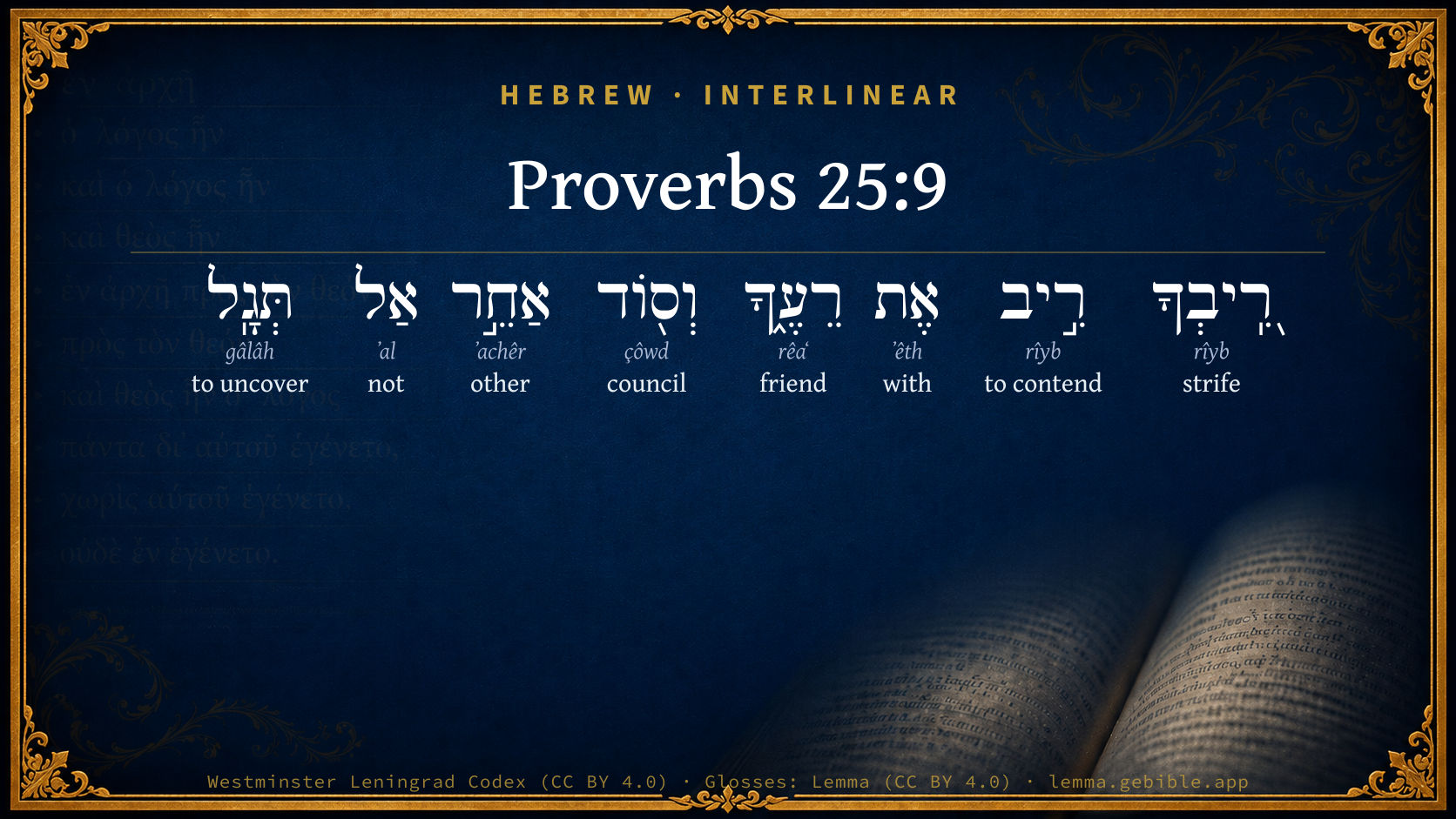
Hebrew (Westminster Leningrad Codex) Proverbs 25:9 appears in the Hebrew Old Testament. The text above is from the Westminster Leningrad Codex. Each word links to its Strong’s number, a concise gloss, and parsing drawn from the Open Scriptures Hebrew Bible morphology. Click any word for its full Brown-Driver-Briggs (BDB) entry.
Download image
Cite this verse

Proverbs 25:9 (World English Bible). Public Domain. Lemma interlinear Bible study tool, https://lemma.gebible.app/v/proverbs/25/9.

Show BibTeX & RIS
BibTeX
RIS
English Translation
Debate your case with your neighbor, And don't betray the confidence of another;
World English Bible · Public Domain
Download a study sheet

One document with this verse’s original text, its word-by-word gloss line, the meaning frame, cross-references with their text, attributed commentary, and full source and license credits — printable, and it pastes into notes with its structure intact.

This verse Autodidact and up

Study sheet (.html) Plain text (.txt)

A passage Seminary Student

Up to 50 verses in one chapter. A passage sheet keeps up to 6 commentary sources and 12 cross-references per verse, in the order this page ranks them, and says so on the sheet whenever that leaves anything out. Ask for a single verse and you get the Autodidact verse sheet above.

Everything on this page stays free to read, with no account — the sheet is a download of what is already on screen, not access to it.

Want to remove ads? Support Godless Engineer
Compare translations 3

The same verse in 3 English versions, stacked beneath the original-language interlinear above. Click any original word for its lexicon entry.

Each is an independent rendering of the whole verse — the interlinear is not word-aligned to these translations.

Highlighted words mark where these versions differ — a whole-verse word diff, not a word-by-word alignment.

  • World English Bible Public Domain
    Debate your case with your neighbor, And don't betray the confidence of another;
  • King James Version Public Domain
    Debate thy cause with thy neighbour himself; and discover not a secret to another:
  • unfoldingWord Literal Text CC BY-SA 4.0
    Dispute your dispute your neighbor and the secret of another do not uncover,

unfoldingWord Literal Text — © unfoldingWord, licensed CC BY-SA 4.0. Word-aligned USFM3 via Door43 (git.door43.org/unfoldingWord/en_ult).

Versions to compare (up to 4)

3 of 4 selected

Show all 18 translations

Every available English version of this verse, each an independent rendering of the whole verse.

  • World English Bible Public Domain
    Debate your case with your neighbor, And don't betray the confidence of another;
  • Berean Standard Bible Public Domain
    Argue your case with your neighbor without betraying another’s confidence,
  • Majority Standard Bible Public Domain
    Argue your case with your neighbor without betraying another’s confidence,
  • King James Version Public Domain
    Debate thy cause with thy neighbour himself; and discover not a secret to another:
  • American Standard Version (1901) Public Domain
    Debate thy cause with thy neighbor `himself', And disclose not the secret of another;
  • Revised Version (1885) Public Domain
    Debate thy cause with thy neighbour himself, and disclose not the secret of another:
  • Geneva Bible (1599) Public Domain
    Debate thy matter with thy neighbour, and discouer not the secret to another,
  • Douay-Rheims (1899) Public Domain
    Treat thy cause with thy friend, and discover not the secret to a stranger:
  • Young's Literal Translation Public Domain
    Thy cause plead with thy neighbour, And the secret counsel of another reveal not,
  • Literal Standard Version CC BY-SA 4.0
    Plead your cause with your neighbor, || And do not reveal the secret counsel of another,
  • Unlocked Literal Bible CC BY-SA 4.0
    Argue your case between you and your neighbor himself and do not disclose another's secret,
  • unfoldingWord Literal Text CC BY-SA 4.0
    Dispute your dispute your neighbor and the secret of another do not uncover,
  • Darby Bible Public Domain
    Debate thy cause with thy neighbour, but reveal not the secret of another;
  • World Messianic Bible Public Domain
    Debate your case with your neighbor, and don’t betray the confidence of another,
  • Webster's Bible Public Domain
    Debate thy cause with thy neighbor himself; and reveal not a secret to another:
  • Free Bible Version CC BY-SA 4.0
    Discuss the case with your neighbor himself, and don't betray someone else's secret,
  • Bible in Basic English Public Domain
    Have a talk with your neighbour himself about your cause, but do not give away the secret of another:
  • JPS Tanakh (1917) Public Domain
    Debate thy cause with thy neighbour, but reveal not the secret of another;

Literal Standard Version (2020), Covenant Press — licensed CC BY-SA 4.0. Text via the HelloAO Bible API (eBible.org). Unlocked Literal Bible (unfoldingWord) — licensed CC BY-SA 4.0. Text via the HelloAO Bible API (eBible.org). unfoldingWord Literal Text — © unfoldingWord, licensed CC BY-SA 4.0. Word-aligned USFM3 via Door43 (git.door43.org/unfoldingWord/en_ult). Free Bible Version, Dr. Jonathan Gallagher — licensed CC BY-SA 4.0. Text via the HelloAO Bible API (eBible.org).

Word by word

More ways to search: Search by grammar → Find every occurrence → Compare this word →

Practice this passage: Drill this verse → Learn its vocabulary →

About this verse

These counts appear in no published source. They are computed here, from the morphology-tagged text and Lemma’s own curated glosses. What Lemma adds →

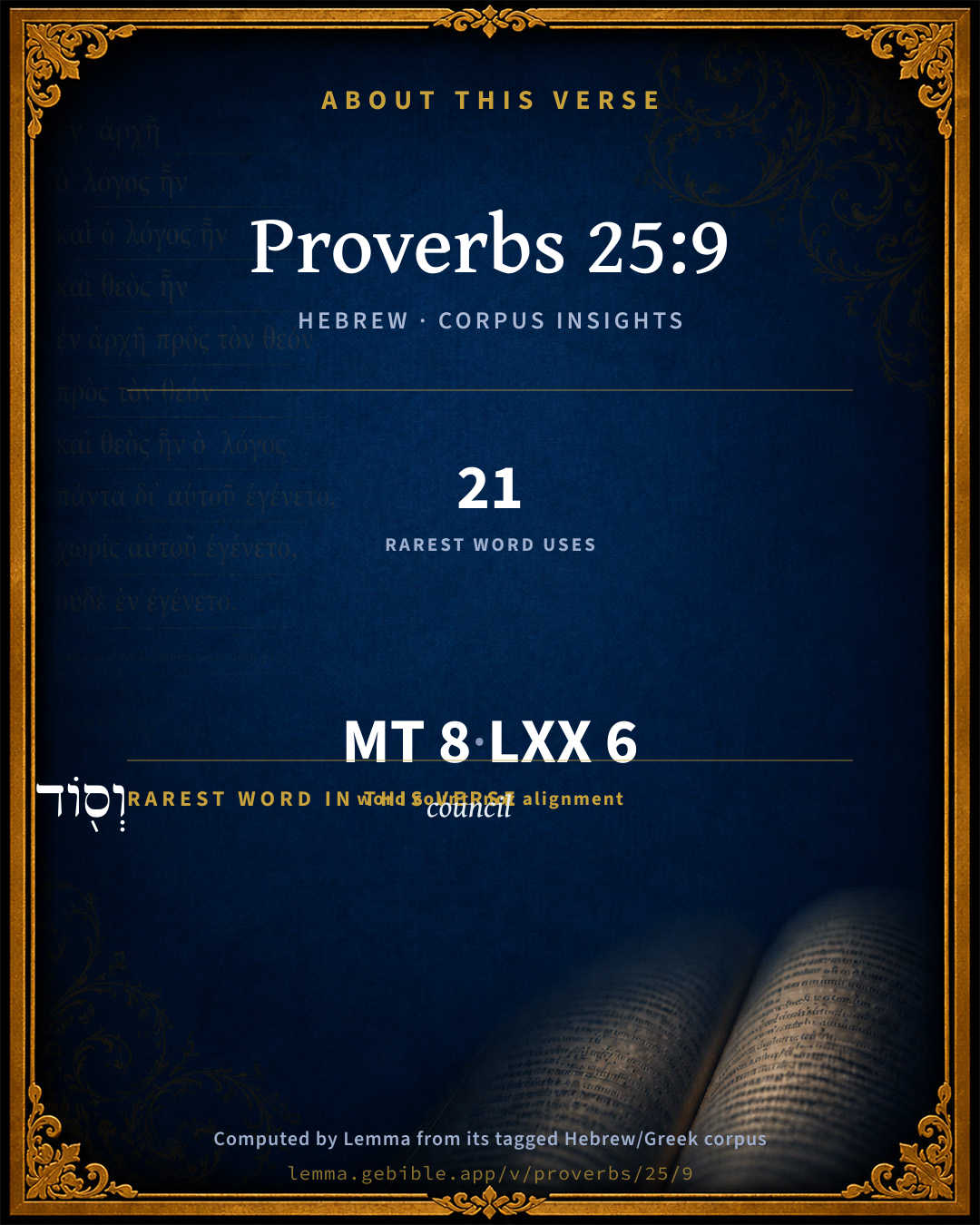
8
words
8
distinct lemmas
Wisdom
section

Notable vocabulary

The rarest word here is וְס֖וֹד council H5475 — appearing just 21 times in the whole Hebrew Bible.

Shared distinctive vocabulary

וְס֖וֹד council H5475 occurs in 21 verses of the Hebrew Bible. Also found in:

Grammatical profile

  • 2 verbs
  • 3 nouns
  • 1 adjective
  • 1 preposition
  • 1 particle

Verb forms

  • רִ֣יב Qal · Imperative
  • תְּגָֽל Piel · Jussive

Hebrew & Septuagint length

In English translation the verse runs 13 words from the Hebrew and 11 from the Septuagint (LXX English) — closely comparable.

A rough comparison of the two English renderings, which tokenize alike — not a word-level alignment.

Word counts can differ between the Hebrew and the Greek without any difference in meaning — e.g. the Hebrew direct-object marker אֵת has no separate Greek word, and Greek often adds the article ὁ.

In the original languages it is 8 Hebrew tokens and 6 Greek tokens — but the two are counted differently (Hebrew bundles its prefixes and suffixes into one token; the Greek is in lemma form), so that isn’t a like-for-like length.

Cross-references

3

Topical passages linked to Proverbs 25:9 in the Treasury of Scripture Knowledge — connected by theme and wording, ordered by reader-vote popularity; previews shown in the World English Bible.

  • Proverbs 11:13 One who brings gossip betrays a confidence, But one who is of a trustworthy spirit is one who keeps a secret.
  • Matthew 18:5–17 Whoever receives one such little child in my name receives me,
  • Proverbs 20:19 He who goes about as a tale-bearer reveals secrets; Therefore don't keep company with him who opens wide his lips.

Cross-references courtesy of OpenBible.info (CC BY 4.0).

Hebrew and Greek witnesses Masoretic Hebrew ↔ Greek Septuagint

The same verse in the two great witnesses to the Old Testament, shown verse-for-verse.

These are two independent witnesses, not word-aligned to each other, and the Septuagint is shown in lemma (dictionary) form.

Hebrew Proverbs 25:9 Masoretic · Westminster Leningrad Codex

רִֽ֭יבְךָ רִ֣יב אֶת רֵעֶ֑ךָ וְס֖וֹד אַחֵ֣ר אַל תְּגָֽל

Debate your case with your neighbor, And don't betray the confidence of another;

World English Bible · Public Domain

Greek LXX Proverbs 25:9 Septuagint · lemma form

ἀναχωρέω εἰς ὁ ὀπίσω μή καταφρονέω

Whenever your friend shall reproach you, retreat backward, despise him not;

LXX2012 (modern English Septuagint) · Public Domain

Hebrew: Westminster Leningrad Codex (CC BY 4.0). Greek: Septuagint (public domain); English from LXX2012 (modern English Septuagint) (Public Domain). How the Septuagint differs from the Hebrew →

Commentary

Notes on Proverbs 25:9 from classic Christian and Jewish commentators (each source and its license shown beneath its notes). The classic Christian expositions comment on the surrounding passage and are grouped to its opening verse, so a note may address several verses; the Jewish commentaries on the Tanakh (Rashi and others) are per-verse, so they appear only where the commentator wrote on this verse.

Lemma curates 59 commentaries, every one of them public domain or Creative Commons licensed, each selected and text-cleaned for this edition rather than reprinted as found. About our sources →

Trapp's Complete Commentary

John Trapp

Pro 25:9 Debate thy cause with thy neighbour [himself]; and discover not a secret to another:

Ver. 9. Debate thy cause with thy neighbour, &c.] What shall I do then, may some say, if I may not right myself by law? You may, saith he, so you do it deliberately, and have first privately debated the cause out of desire of agreement, and moved for a compromise. See Mat 18:15.

And discover not the secret of another.] Merely to be revenged on him for some supposed injury. There are those who in their rage care not what they disclose to the prejudice of another. Charity chargeth the contrary. {1Co 13:1-13} It claps a plaster on the sore, and then covers it with her hand, as surgeons use to do, that the world may be never the wiser.

John Trapp, A Commentary or Exposition upon All the Books of the Old and New Testament (1647–1656) — public domain. Text from a community e-Sword module.

Tyndale Open Study Notes

Tyndale Open Resources

25:9-10 See 11:13; 20:19.

Tyndale Open Study Notes — © Tyndale Open Resources, licensed CC BY-SA 4.0. Text via the HelloAO Bible API.

Jamieson, Fausset & Brown

Robert Jamieson, A. R. Fausset & David Brown

(Compare Mat 5:25, Margin).

secret--that is, of your opponent, for his disadvantage, and so you be disgraced, not having discussed your difficulties with him.

Jamieson, Fausset & Brown — Commentary Critical and Explanatory on the Whole Bible (1871) — public domain (CC PDM 1.0). Text via the HelloAO Bible API.

Adam Clarke's Commentary

Verse 9. Debate thy cause with thy neighbour] Take the advice of friends. Let both sides attend to their counsels; but do not tell the secret of thy business to any. After squandering your money away upon lawyers, both they and the judge will at last leave it to be settled by twelve of your fellow citizens! O the folly of going to law! O the blindness of men, and the rapacity of unprincipled lawyers!

On this subject I cannot but give the following extract from Sir John Hawkins's Life of Dr. Johnson, which he quotes from Mr. Selwin, of London: "A man who deliberates about going to law should have,

1. A good cause;

2. A good purse;

3. A good skilful attorney;

4. Good evidence;

5. Good able counsel;

6. A good upright judge;

7. A good intelligent jury; and with all these on his side, if he have not,

8. Good luck, it is odds but he miscarries in his suit." O the glorious uncertainty of the law!

Adam Clarke's Commentary on the Bible (1810–1826) — public domain. Text from a community e-Sword/MySword module.

Ellicott's Commentary for English Readers

(9) Debate thy cause with thy neighbour.—As our Lord says, “If thy brother trespass against thee, go and tell him his fault between thee and him alone” (Mat_18:15). Or it may mean, “If you must go to law with another, do not drag others into the matter by disclosing their secrets in order to help your cause.

A Bible Commentary for English Readers, edited by Charles John Ellicott (1878–1897) — public domain. Text from a community e-Sword module.

The Cambridge Bible for Schools and Colleges

gen. ed. J. J. S. Perowne

9. a secret to] Rather, the secret of, A.V. marg. and R.V.

The warning would seem to be against being betrayed by a litigious spirit into dishonourable conduct, and incurring the indelible shame of betraying confidence through eagerness to win your suit.

The Cambridge Bible for Schools and Colleges (gen. ed. J. J. S. Perowne; Cambridge University Press, 1878–1918) — public domain. Text from a community e-Sword module.

John Gill's Exposition

Debate thy cause with thy neighbour himself,.... Between thee and him alone; lay the matter before him, and hear what he has to say for himself, by which you will better judge of the nature of the cause; try to compromise things, and make up the difference between you, which is much better than to commence a lawsuit; at least such a step should be taken first; see Mat 5:25;

and discover not a secret to another; if the thing in controversy is a secret, do not acquaint another person with it; keep it among yourselves, if the affair can be made up without bringing it into a court of judicature; besides, by communicating it to others, you may have bad counsel given, and be led to take indirect methods: or, "the secret of another", or, "another secret do not discover" (b); if you know anything scandalous and reproachful of your neighbour and his family, you are contending with, which does not concern the cause in hand, do not divulge it, as persons from a spirit of revenge are apt to do, when they are quarrelling or litigating a point with each other.

(b) "secretum alterius", Pagninus, Montanus; "arcanum alterius", Tigurine version, Junius & Tremellius, Piscator, Mercerus, Michaelis, Schultens, so Cocceius, Gejerus; "arcanum aliud", Munster; "alienum", Syriac version.

John Gill's Exposition of the Whole Bible (1746–1763) — public domain (CC PDM 1.0). Text via the HelloAO Bible API.

Albert Barnes' Notes on the Bible

An anticipation of the highest standard of ethical refinement Mat 18:15, but with a difference. Here the motive is prudential, the risk of shame, the fear of the irretrievable infamy of the betrayer of secrets. In the teaching of Christ the precept rests upon the divine authority and the perfect example.

Albert Barnes' Notes on the Bible (1834–1885) — public domain. Text from a community e-Sword/MySword module.

Haydock's Catholic Bible Commentary

Stranger. It sometimes happens that friends fall out; but if either disclose the secret of the other, he will be deemed infamous. (Calmet) (Josephus, contra Apion 2.) --- St. Ambrose says of his brother Satyrus, "though we had all things in common, yet the secret of our friends was not so."

George Leo Haydock (1774–1849), Haydock's Catholic Family Bible and Commentary, 1859 edition — public domain. Excludes Psalms (Douay-Rheims chapter numbering differs from Protestant) and Deuterocanonical books (Catholic canon only).

Matthew Poole's English Annotations

Debate thy cause with thy neighbour himself; if thou hast any quarrel with him, first try to compose it by private discourse with him. Compare Mat 5:25; 18:15; Luk 12:58.

Discover not a secret; any secret. Let no heat of contention provoke thee to divulge any of his secret counsels committed to thy trust, or to reproach him with any of his secret faults, as is usual in lawsuits and other contentions. Or, the secret; any secret difference between thee and him, which therefore is fittest to be ended secretly between you, and not to be imparted to any other.

Matthew Poole's English Annotations on the Holy Bible (1683–1685) — public domain. Text from a community e-Sword/MySword module.

Whedon's Commentary on the Bible

Daniel D. Whedon

9, 10. Debate thy cause… neighbour — Reason with him — plead with him.

Discover not a secret — Do not suffer any angry feeling against thy neighbour, growing out of a contest, to induce thee to take vengeance on him by causelessly revealing a secret to his injury. This would be dishonourable, and get thee a bad name. “Make no third person a party to difficulties that can be settled between thee and him.” — Conant. Comp. Mat_18:15.

Daniel D. Whedon (gen. ed.), Commentary on the Old and New Testaments (1874–1909) — public domain. Text from a community e-Sword module.

The Pulpit Commentary

Vers. 9, 10. A tetrastich without parallelism, connected with the preceding maxim.

Debate thy cause with thy neighbour himself. (Mat_18:15; see on ver. 8) If you have any quarrel with a neighbour, or are drawn into a controversy with him, deal with him privately in a friendly manner. And discover not a secret to another; rather, the secret of another. Do not bring in a third party, or make use of anything entrusted to you by another person, or of which you have become privately informed, in order to support your cause.

The Pulpit Commentary (1880–1919), ed. H.D.M. Spence-Jones & Joseph S. Exell — public domain. Text from a community e-Sword module.

John Wesley's Explanatory Notes

Debate - If thou hast any quarrel with him, first try to compose it by private discourse with him. Discover not - Let not heat of contention provoke thee to divulge any of his secrets committed to thy trust.

John Wesley, Explanatory Notes Upon the Whole Bible (1754–1765) — public domain. Text via the GEBible commentary corpus.

unfoldingWord translationNotes

Door43 World Missions Community

your case

"your disagreement"

do not disclose another's secret

"do not share your neighbor's secret with other people"

an evil report about you that cannot be silenced

Here "evil report" refers to harmful things that the person will tell others. The phrase "cannot be silenced" can be stated in active form. AT: "you will not be able to stop him from telling other people harmful things about you" or "he will tell people evil things about you and you will never have a good reputation again" (See: Active or Passive)

translationWords

neighbor

shame

evil

unfoldingWord translationNotes — © Distant Shores Media and the Door43 World Missions Community, licensed CC BY-SA 4.0. Source: git.door43.org/Door43/en_tn.

Rashi

Rabbi Shlomo Yitzchaki (Rashi)

Have your quarrel with your friend But if, perforce, you must quarrel and debate with your friend, in any event, do not divulge another’s secret Do not mention to him the disgrace of his ancestors, which not everyone knows, and you are revealing it.

Rashi on the Tanakh — English translations: “The Judaica Press complete Tanach with Rashi, translated by A. J. Rosenberg” (CC BY 4.0); “Pentateuch with Rashi's commentary by M. Rosenbaum and A.M. Silbermann, 1929-1934” (public domain); “The Metsudah Tanach series, Lakewood, N.J” (CC BY 4.0); and “The Book of Joshua, Metsudah Publications, 1997” (CC BY 4.0). Text via Sefaria.

Lesson kit

Teaching starters — assembled from the data on this page, not authored interpretation. Every prompt links to the verse data it draws on. Edit before teaching.

Proverbs, in the Wisdom, opens this verse with 8 words (8 distinct Hebrew lemmas). Its most distinctive word is çôwd (“council”). A historical commentator’s framing appears above. Read the whole chapter for the surrounding context.

Discussion questions

  1. The word çôwd carries the sense “council.” How does it shape the verse?
  2. How does Genesis 49:6, which shares the word «council», read alongside this verse?
  3. These translations render this verse differently; the difference is in the English rendering, not the original. What questions does that raise?
  4. «רִ֣יב» is a Qal Imperative verb. How does that grammatical form shape the action described?
  5. Compare how Trapp's Complete Commentary and Tyndale Open Study Notes read this verse. Where do they agree or differ?

Things to notice

Reading settings

Reading text

Shown beneath each verse's original-language words.

Old Testament
Old Testament edition

Read the OT as the Masoretic Hebrew (MT) or the Greek Septuagint (LXX).

English shown for the Greek Septuagint (in the Hebrew ↔ Greek comparison).

Comparing translations? Open the Compare panel on any verse page to stack up to four side by side.