
Deuteronomy 13:6

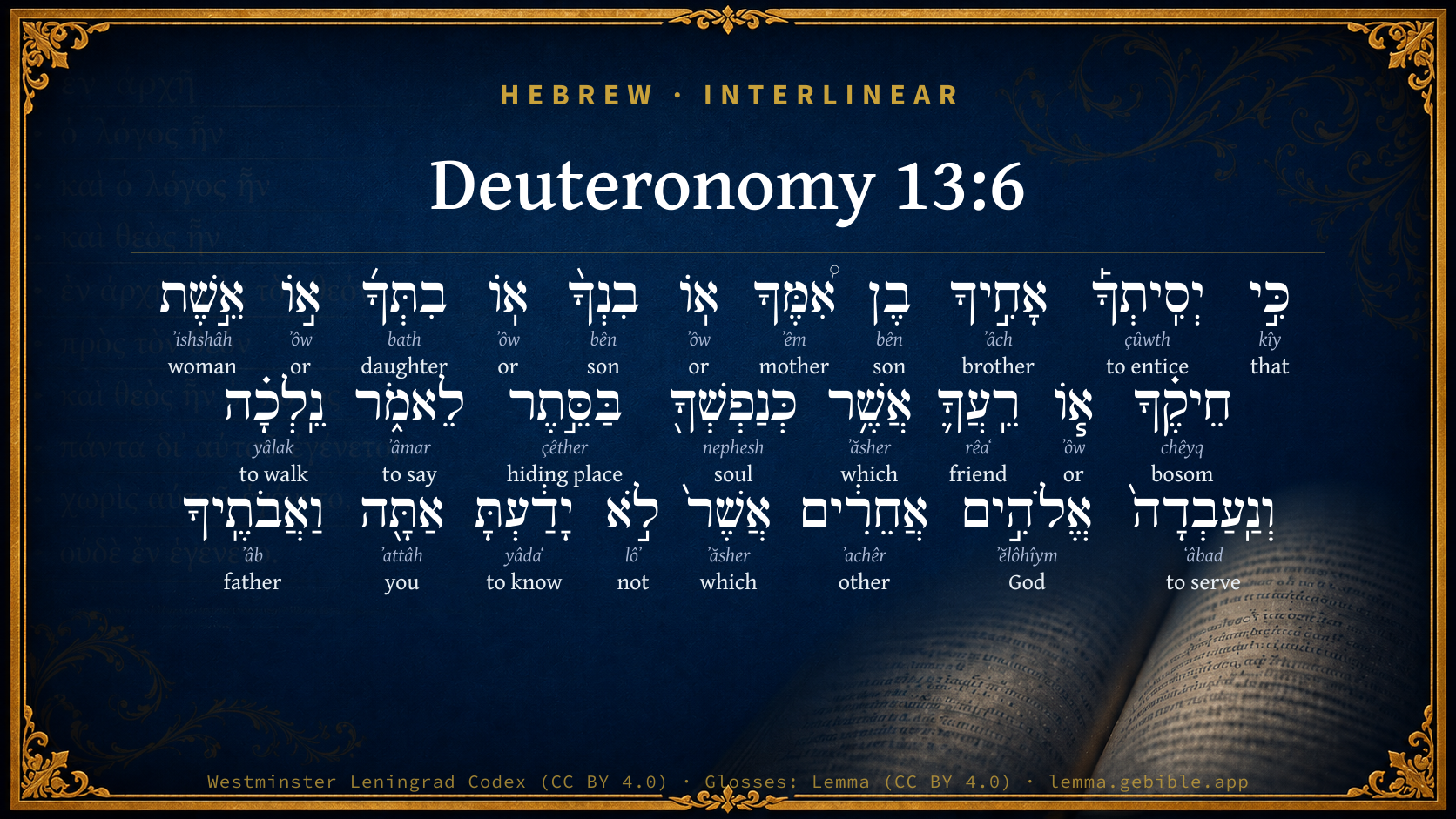
Hebrew (Westminster Leningrad Codex) Deuteronomy 13:6 appears in the Hebrew Old Testament. The text above is from the Westminster Leningrad Codex. Each word links to its Strong’s number, a concise gloss, and parsing drawn from the Open Scriptures Hebrew Bible morphology. Click any word for its full Brown-Driver-Briggs (BDB) entry.
Download image
Cite this verse

Deuteronomy 13:6 (World English Bible). Public Domain. Lemma interlinear Bible study tool, https://lemma.gebible.app/v/deuteronomy/13/6.

Show BibTeX & RIS
BibTeX
RIS
English Translation
If your brother, the son of your mother, or your son, or your daughter, or the wife of your bosom, or your friend, who is as your own soul, entice you secretly, saying, Let us go and serve other gods, which you have not known, you, nor your fathers;
World English Bible · Public Domain
Highlights
  • 2 first appearances in the Hebrew Bible
Full analysis ↓
Download a study sheet

One document with this verse’s original text, its word-by-word gloss line, the meaning frame, cross-references with their text, attributed commentary, and full source and license credits — printable, and it pastes into notes with its structure intact.

This verse Autodidact and up

Study sheet (.html) Plain text (.txt)

A passage Seminary Student

Up to 50 verses in one chapter. A passage sheet keeps up to 6 commentary sources and 12 cross-references per verse, in the order this page ranks them, and says so on the sheet whenever that leaves anything out. Ask for a single verse and you get the Autodidact verse sheet above.

Everything on this page stays free to read, with no account — the sheet is a download of what is already on screen, not access to it.

Want to remove ads? Support Godless Engineer
Compare translations 3

The same verse in 3 English versions, stacked beneath the original-language interlinear above. Click any original word for its lexicon entry.

Each is an independent rendering of the whole verse — the interlinear is not word-aligned to these translations.

Highlighted words mark where these versions differ — a whole-verse word diff, not a word-by-word alignment.

  • World English Bible Public Domain
    If your brother, the son of your mother, or your son, or your daughter, or the wife of your bosom, or your friend, who is as your own soul, entice you secretly, saying, Let us go and serve other gods, which you have not known, you, nor your fathers;
  • King James Version Public Domain
    If thy brother, the son of thy mother, or thy son, or thy daughter, or the wife of thy bosom, or thy friend, which is as thine own soul, entice thee secretly, saying, Let us go and serve other gods, which thou hast not known, thou, nor thy fathers;
  • unfoldingWord Literal Text CC BY-SA 4.0
    If your brother, the son of your mother or your son or your daughter or the wife of your bosom or your friend who like your life, secretly entices you, saying, ‘Let us go and serve other gods’ (that you have not known, you nor your fathers,

unfoldingWord Literal Text — © unfoldingWord, licensed CC BY-SA 4.0. Word-aligned USFM3 via Door43 (git.door43.org/unfoldingWord/en_ult).

Versions to compare (up to 4)

3 of 4 selected

Show all 18 translations

Every available English version of this verse, each an independent rendering of the whole verse.

  • World English Bible Public Domain
    If your brother, the son of your mother, or your son, or your daughter, or the wife of your bosom, or your friend, who is as your own soul, entice you secretly, saying, Let us go and serve other gods, which you have not known, you, nor your fathers;
  • Berean Standard Bible Public Domain
    If your very own brother, or your son or daughter, or the wife you embrace, or your closest friend secretly entices you, saying, “Let us go and worship other gods” (which neither you nor your fathers have known,
  • Majority Standard Bible Public Domain
    If your very own brother, or your son or daughter, or the wife you embrace, or your closest friend secretly entices you, saying, “Let us go and worship other gods” (which neither you nor your fathers have known,
  • King James Version Public Domain
    If thy brother, the son of thy mother, or thy son, or thy daughter, or the wife of thy bosom, or thy friend, which is as thine own soul, entice thee secretly, saying, Let us go and serve other gods, which thou hast not known, thou, nor thy fathers;
  • American Standard Version (1901) Public Domain
    If thy brother, the son of thy mother, or thy son, or thy daughter, or the wife of thy bosom, or thy friend, that is as thine own soul, entice thee secretly, saying, Let us go and serve other gods, which thou hast not known, thou, nor thy fathers;
  • Revised Version (1885) Public Domain
    If thy brother, the son of thy mother, or thy son, or thy daughter, or the wife of thy bosom, or thy friend, which is as thine own soul, entice thee secretly, saying, Let us go and serve other gods, which thou hast not known, thou, nor thy fathers;
  • Geneva Bible (1599) Public Domain
    If thy brother, the sonne of thy mother, or thine owne sonne, or thy daughter, or the wife, that lyeth in thy bosome, or thy friend, which is as thine owne soule, intice thee secretly, saying, Let vs goe and serue other gods, (which thou hast not knowen, thou, I say, nor thy fathers)
  • Douay-Rheims (1899) Public Domain
    If thy brother the son of thy mother, or thy son, or daughter, or thy wife that is in thy bosom, or thy friend, whom thou lovest as thy own soul, would persuade thee secretly, saying: Let us go, and serve strange gods, which thou knowest not, nor thy fathers,
  • Young's Literal Translation Public Domain
    `When thy brother -- son of thy mother, or thy son, or thy daughter, or the wife of thy bosom, or thy friend who `is' as thine own soul -- doth move thee, in secret, saying, Let us go and serve other gods -- (which thou hast not known, thou and thy fathers,
  • Literal Standard Version CC BY-SA 4.0
    When your brother, son of your mother, or your son, or your daughter, or the wife of your bosom, or your friend who [is] as your own soul, moves you in secret, saying, Let us go and serve other gods (which you have not known, you and your fathers,
  • Unlocked Literal Bible CC BY-SA 4.0
    Suppose that your brother, the son of your mother, or your son, or your daughter, or the wife of your bosom, or your friend who is to you like your own soul, secretly entices you and says, 'Let us go and worship other gods that you have not known, neither you nor your ancestors—
  • unfoldingWord Literal Text CC BY-SA 4.0
    If your brother, the son of your mother or your son or your daughter or the wife of your bosom or your friend who like your life, secretly entices you, saying, ‘Let us go and serve other gods’ (that you have not known, you nor your fathers,
  • Darby Bible Public Domain
    If thy brother, the son of thy mother, or thy son, or thy daughter, or the wife of thy bosom, or thy friend, who is to thee as thy soul, entice thee secretly, saying, Let us go and serve other gods (whom thou hast not known, thou, nor thy fathers;
  • World Messianic Bible Public Domain
    If your brother, the son of your mother, or your son, or your daughter, or the wife of your bosom, or your friend who is as your own soul, entices you secretly, saying, “Let’s go and serve other gods”—which you have not known, you, nor your fathers;
  • Webster's Bible Public Domain
    If thy brother, the son of thy mother, or thy son, or thy daughter, or the wife of thy bosom, or thy friend, who is as thy own soul, shall entice thee secretly, saying, Let us go and serve other gods, which thou hast not known, thou, nor thy fathers;
  • Free Bible Version CC BY-SA 4.0
    Even if your own brother, or your son or daughter, or the wife you love, or your best friend secretly encourages you, saying, “Let's go and worship other gods” unfamiliar to you and your forefathers,
  • Bible in Basic English Public Domain
    If your brother, the son of your mother, or your son or your daughter or the wife of your heart, or the friend who is as dear to you as your life, working on you secretly says to you, Let us go and give worship to other gods, strange to you and to your fathers;
  • JPS Tanakh (1917) Public Domain
    (13-7) If thy brother, the son of thy mother, or thy son, or thy daughter, or the wife of thy bosom, or thy friend, that is as thine own soul, entice thee secretly, saying: 'Let us go and serve other gods,' which thou hast not known, thou, nor thy fathers;

Literal Standard Version (2020), Covenant Press — licensed CC BY-SA 4.0. Text via the HelloAO Bible API (eBible.org). Unlocked Literal Bible (unfoldingWord) — licensed CC BY-SA 4.0. Text via the HelloAO Bible API (eBible.org). unfoldingWord Literal Text — © unfoldingWord, licensed CC BY-SA 4.0. Word-aligned USFM3 via Door43 (git.door43.org/unfoldingWord/en_ult). Free Bible Version, Dr. Jonathan Gallagher — licensed CC BY-SA 4.0. Text via the HelloAO Bible API (eBible.org).

Word by word

More ways to search: Search by grammar → Find every occurrence → Compare this word →

Practice this passage: Drill this verse → Learn its vocabulary →

יְסִֽיתְךָ֡
çûwth
H5496
“to entice · you”
Verb, Hiphil, Imperfect, 3rd Person, Masculine, Singular + Suffix, Personal, 2nd Person, Masculine, Singular
Part of Speech
Verb
Stem
Hiphil
Form
Imperfect
Person
3rd Person
Gender
Masculine
Number
Singular
Full BDB Definition

Origin: perhaps denominative from H7898

TWOT: 1481

to incite, allure, instigate, entice - (Hiphil) - to incite (to a request) - to allure, lure - to instigate (bad sense)
  1. כִּ֣י kîy H3588 “that” Conjunction
  2. אָחִ֣יךָ ʼâch H251 “brother · your” Noun, Common, Masculine, Singular, Construct + Suffix, Personal, 2nd Person, Masculine, Singular
  3. בֶן bên H1121 “son of” Noun, Common, Masculine, Singular, Construct
  4. אִ֠מֶּךָ ʼêm H517 “mother · your” Noun, Common, Feminine, Singular, Construct + Suffix, Personal, 2nd Person, Masculine, Singular
  5. אֽוֹ ʼôw H176 “or” Conjunction
  6. בִנְךָ֨ bên H1121 “son · your” Noun, Common, Masculine, Singular, Construct + Suffix, Personal, 2nd Person, Masculine, Singular
  7. אֽוֹ ʼôw H176 “or” Conjunction
  8. בִתְּךָ֜ bath H1323 “daughter · your” Noun, Common, Feminine, Singular, Construct + Suffix, Personal, 2nd Person, Masculine, Singular
  9. א֣וֹ ʼôw H176 “or” Conjunction
  10. אֵ֣שֶׁת ʼishshâh H802 “woman of” Noun, Common, Feminine, Singular, Construct
  11. חֵיקֶ֗ךָ chêyq H2436 “bosom · your” Noun, Common, Masculine, Singular, Construct + Suffix, Personal, 2nd Person, Masculine, Singular
  12. א֧וֹ ʼôw H176 “or” Conjunction
  13. רֵֽעֲךָ֛ rêaʻ H7453 “friend · your” Noun, Common, Masculine, Singular, Construct + Suffix, Personal, 2nd Person, Masculine, Singular
  14. אֲשֶׁ֥ר ʼăsher H834 “which” Particle, Relative
  15. כְּנַפְשְׁךָ֖ nephesh H5315 “like/as · soul · your” Preposition + Noun, Common, Both, Singular, Construct + Suffix, Personal, 2nd Person, Masculine, Singular
  16. בַּסֵּ֣תֶר çêther H5643 “in/at the · hiding place” Preposition, Determined + Noun, Common, Masculine, Singular, Absolute
  17. לֵאמֹ֑ר ʼâmar H559 “to say” Preposition + Verb, Qal, Infinitive Construct
  18. נֵֽלְכָ֗ה yâlak H3212 “to walk” Verb, Qal, Cohortative, 1st Person, Common, Plural
  19. וְנַֽעַבְדָה֙ ʻâbad H5647 “and · to serve” Conjunction + Verb, Qal, Cohortative, 1st Person, Common, Plural
  20. אֱלֹהִ֣ים ʼĕlôhîym H430 “God(s)” Noun, Common, Masculine, Plural, Absolute
  21. אֲחֵרִ֔ים ʼachêr H312 “other” Adjective, Adjective, Masculine, Plural, Absolute
  22. אֲשֶׁר֙ ʼăsher H834 “which” Particle, Relative
  23. לֹ֣א lôʼ H3808 “not” Particle, Negative
  24. יָדַ֔עְתָּ yâdaʻ H3045 “to know” Verb, Qal, Perfect, 2nd Person, Masculine, Singular
  25. אַתָּ֖ה ʼattâh H859 “you” Pronoun, Personal, 2nd Person, Masculine, Singular
  26. וַאֲבֹתֶֽיךָ ʼâb H1 “and · fathers · your” Conjunction + Noun, Common, Masculine, Plural, Construct + Suffix, Personal, 2nd Person, Masculine, Singular

About this verse

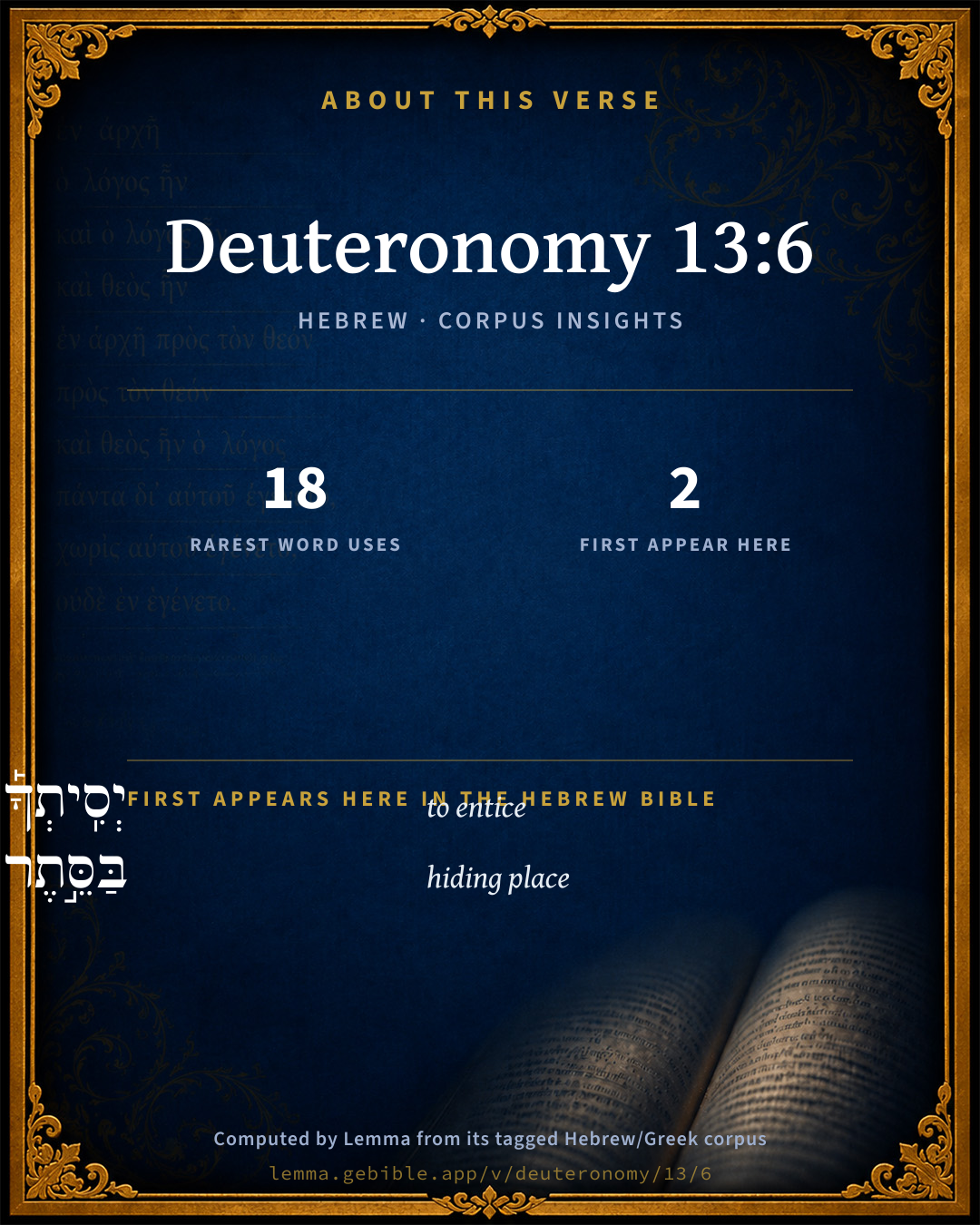
These counts appear in no published source. They are computed here, from the morphology-tagged text and Lemma’s own curated glosses. What Lemma adds →

27
words
22
distinct lemmas
Pentateuch
section

Notable vocabulary

The rarest word here is יְסִֽיתְךָ֡ to entice H5496 — appearing just 18 times in the whole Hebrew Bible.

First appearance in Scripture

These words make their first canonical appearance in the Hebrew Bible here:

  • יְסִֽיתְךָ֡ to entice H5496
  • בַּסֵּ֣תֶר hiding place H5643

Shared distinctive vocabulary

יְסִֽיתְךָ֡ to entice H5496 occurs in 18 verses of the Hebrew Bible. Also found in:

Grammatical profile

  • 5 verbs
  • 12 nouns
  • 1 adjective
  • 1 pronoun
  • 5 conjunctions
  • 3 particles

Verb forms

  • יְסִֽיתְךָ֡ Hiphil · Imperfect
  • לֵאמֹ֑ר Qal · Infinitive Construct
  • נֵֽלְכָ֗ה Qal · Cohortative
  • וְנַֽעַבְדָה֙ Qal · Cohortative
  • יָדַ֔עְתָּ Qal · Perfect

Repetition

Words recur within this verse — often emphatic in Hebrew:

  • בֶן son H1121 ×2
  • אֽוֹ or H176 ×4
  • אֲשֶׁ֥ר which H834 ×2

Hebrew & Septuagint length

In English translation the verse runs 49 words from the Hebrew and 48 from the Septuagint (LXX English) — closely comparable.

A rough comparison of the two English renderings, which tokenize alike — not a word-level alignment.

Word counts can differ between the Hebrew and the Greek without any difference in meaning — e.g. the Hebrew direct-object marker אֵת has no separate Greek word, and Greek often adds the article ὁ.

Cross-references

28

Topical passages linked to Deuteronomy 13:6 in the Treasury of Scripture Knowledge — connected by theme and wording, ordered by reader-vote popularity; previews shown in the World English Bible.

  • Deuteronomy 17:2–7 If there be found in the midst of you, within any of your gates which Yahweh your God gives you, man or woman, who does that which is evil in the sight of Yahweh your God, in transgressing his covenant,
  • Ephesians 4:14 that we may no longer be children, tossed back and forth and carried about with every wind of doctrine, by the trickery of men, in craftiness, after the wiles of error;
  • 2 Peter 2:1 But there also arose false prophets among the people, as among you also there will be false teachers, who will secretly bring in destructive heresies, denying even the Master who bought them, bringing on themselves swift destruction.
  • 1 John 2:26–27 These things I have written to you concerning those who would lead you astray.
  • Proverbs 18:24 A man of many companions may be ruined, But there is a friend who sticks closer than a brother.
  • Micah 7:5–7 Don't trust in a neighbor. Don't put confidence in a friend. With the woman lying in your embrace, Be careful of the words of your mouth!
  • Deuteronomy 28:54 The man who is tender among you, and very delicate, his eye shall be evil toward his brother, and toward the wife of his bosom, and toward the remnant of his children whom he has remaining;
  • Deuteronomy 29:18 lest there should be among you man, or woman, or family, or tribe, whose heart turns away this day from Yahweh our God, to go to serve the gods of those nations; lest there should be among you a root that bears gall and wormwood;
  • 1 Samuel 18:1 It happened, when he had made an end of speaking to Saul, that the soul of Jonathan was knit with the soul of David, and Jonathan loved him as his own soul.
  • 1 Samuel 18:3 Then Jonathan and David made a covenant, because he loved him as his own soul.
  • 1 Samuel 20:17 Jonathan caused David to swear again, for the love that he had to him; for he loved him as he loved his own soul.
  • 1 Kings 11:5–7 For Solomon went after Ashtoreth the goddess of the Sidonians, and after Milcom the abomination of the Ammonites.
  • Matthew 12:48–50 But he answered him who spoke to him, "Who is my mother? Who are my brothers?"
  • Revelation 12:9 The great dragon was thrown down, the old serpent, he who is called the devil and Satan, the deceiver of the whole world. He was thrown down to the earth, and his angels were thrown down with him.
  • Revelation 20:3 and cast him into the abyss, and shut it, and sealed it over him, that he should deceive the nations no more, until the thousand years were finished. After this, he must be freed for a short time.
  • Genesis 16:5 Sarai said to Abram, "This wrong is your fault. I gave my handmaid into your bosom, and when she saw that she had conceived, I was despised in her eyes. Yahweh judge between me and you."
  • Deuteronomy 32:16–18 They moved him to jealousy with strange [gods]; With abominations provoked they him to anger.
  • Judges 2:13 They forsook Yahweh, and served Baal and the Ashtaroth.
  • Judges 5:8 They chose new gods; Then was war in the gates: Was there a shield or spear seen Among forty thousand in Israel?
  • Judges 10:6 The children of Israel again did that which was evil in the sight of Yahweh, and served the Baals, and the Ashtaroth, and the gods of Syria, and the gods of Sidon, and the gods of Moab, and the gods of the children of Ammon, and the gods of the Philistines; and they forsook Yahweh, and didn't serve him.
  • 2 Kings 17:30–31 The men of Babylon made Succoth-benoth, and the men of Cuth made Nergal, and the men of Hamath made Ashima,
  • Job 31:27 And my heart has been secretly enticed, My hand threw a kiss from my mouth:
  • 2 Corinthians 5:16 Therefore we know no one after the flesh from now on. Even though we have known Christ after the flesh, yet now we know him so no more.
  • Galatians 2:4 This was because of the false brothers secretly brought in, who stole in to spy out our liberty which we have in Christ Jesus, that they might bring us into bondage;
  • Colossians 2:4 Now this I say that no one may delude you with persuasiveness of speech.
  • Revelation 13:14 He deceives my own people who dwell on the earth because of the signs he was granted to do in front of the beast; saying to those who dwell on the earth, that they should make an image to the beast who had the sword wound and lived.
  • 2 Samuel 1:26 I am distressed for you, my brother Jonathan: Very pleasant have you been to me: Your love to me was wonderful, Passing the love of women.
  • Proverbs 5:20 For why should you, my son, be captivated with an adulteress? Why embrace the bosom of another?

Cross-references courtesy of OpenBible.info (CC BY 4.0).

Hebrew and Greek witnesses Masoretic Hebrew ↔ Greek Septuagint

The same verse in the two great witnesses to the Old Testament, shown verse-for-verse.

These are two independent witnesses, not word-aligned to each other, and the Septuagint is shown in lemma (dictionary) form.

Hebrew Deuteronomy 13:6 Masoretic · Westminster Leningrad Codex

כִּ֣י יְסִֽיתְךָ֡ אָחִ֣יךָ בֶן אִ֠מֶּךָ אֽוֹ בִנְךָ֨ אֽוֹ בִתְּךָ֜ א֣וֹ אֵ֣שֶׁת חֵיקֶ֗ךָ א֧וֹ רֵֽעֲךָ֛ אֲשֶׁ֥ר כְּנַפְשְׁךָ֖ בַּסֵּ֣תֶר לֵאמֹ֑ר נֵֽלְכָ֗ה וְנַֽעַבְדָה֙ אֱלֹהִ֣ים אֲחֵרִ֔ים אֲשֶׁר֙ לֹ֣א יָדַ֔עְתָּ אַתָּ֖ה וַאֲבֹתֶֽיךָ

If your brother, the son of your mother, or your son, or your daughter, or the wife of your bosom, or your friend, who is as your own soul, entice you secretly, saying, Let us go and serve other gods, which you have not known, you, nor your fathers;

World English Bible · Public Domain

Greek LXX Deuteronomy 13:6 Septuagint · lemma form

καί ὁ προφήτης ἐκεῖνος ἤ ὁ ὁ ἐνύπνιον ἐνὑπνιάζω ἐκεῖνος ἀποθνήσκω λαλέω γάρ πλανάω σύ ἀπό κύριος ὁ θεός σύ ὁ ἐκἄγω σύ ἐκ γῆ αἴγυπτος ὁ λυτρόω σύ ἐκ ὁ δουλεία ἐκὠθέω σύ ἐκ ὁ ὁδός ὅς ἐντέλλομαι σύ κύριος ὁ θεός σύ πορεύομαι ἐν αὐτός καί ἀπο ἀναἵζω ὁ πονηρός ἐκ σύ αὐτός

And if your brother by your father or mother, or your son, or daughter, or your wife in your bosom, or friend who is equal to your own soul, entreat you secretly, saying, Let us go and serve other gods, which neither you nor your fathers have known,

LXX2012 (modern English Septuagint) · Public Domain

On this verse, The Cambridge Bible for Schools and Colleges discusses the Septuagint’s reading. Read the note in Commentary ↓

Hebrew: Westminster Leningrad Codex (CC BY 4.0). Greek: Septuagint (public domain); English from LXX2012 (modern English Septuagint) (Public Domain). How the Septuagint differs from the Hebrew →

Targum (Aramaic paraphrase)

2

The Targum is the ancient Jewish Aramaic paraphrase of the Hebrew Scriptures — an interpretive translation, not the Hebrew text itself. Onkelos (literal) and Pseudo-Jonathan (expansive) render the Torah, and Jonathan the Prophets. Coverage is partial: where no permissively-licensed English translation exists for a verse, only the Aramaic is shown. This is verse-level text, not a word-by-word alignment to the Hebrew.

  1. Targum Onkelos Torah (Genesis–Deuteronomy)
    וּנְבִיָא הַהוּא אוֹ חָלֵם חֶלְמָא הַהוּא יִתְקְטֵּל אֲרֵי מַלִיל סַטְיָא עַל יְיָ אֱלָהֲכוֹן דִי אַפֵּיק יָתְכוֹן מֵאַרְעָא דְמִצְרַיִם וּדְפָרְקָךְ מִבֵּית עַבְדוּתָא לְאַטְעֲיוּתָךְ מִן אָרְחָא דִי פַקְדָךְ יְיָ אֱלָהָךְ לִמְהַךְ בַּהּ וּתְפַלֵי עָבֵד דְבִישׁ מִבֵּינָךְ

    (no public-domain English translation for this verse)

    Targum Onkelos — Aramaic: “Onkelos Genesis” (public domain); “Onkelos Exodus” (public domain); “Onkelos Leviticus” (public domain); “Onkelos Numbers” (public domain); “Onkelos Deuteronomy” (public domain). English: “Sefaria Community Translation” (CC0 1.0 (public-domain dedication)); “J.W. Etheridge. The Targums of Onkelos and Jonathan Ben Uzziel on the Pentateuch. London: Longmans, Green, 1862” (public domain). Text via Sefaria.

  2. Targum Pseudo-Jonathan Torah (Genesis–Deuteronomy)
    וּנְבִי שִׁקְרָא הַהוּא אוֹ חֲלִים חֵילְמָא זְדָנָא הַהוּא יִתְקְטֵל בְּסַיְיפָא אֲרוּם מַלֵּיל סַטְיָא עַל יְיָ אֱלָהָכוֹן דְּאַפֵּיק יַתְכוֹן מֵאַרְעָא דְמִצְרָאֵי וְדִי פְרַקְכוֹן מִבֵּית שִׁעְבּוּד עַבְדַיָא לְאַטְעֲיוּתְכוֹן מִן אָרְחָא דְפַקֵּידְכוֹן יְיָ אֱלָהָכוֹן לִמְהַלְכָא בָּהּ וּתְפַלּוּן עַבְדֵי בִישְׁתָּא מִבֵּינֵיכוֹן

    And that prophet of lies, or that dreamer of dreams, shall be slain with the sword, because he had spoken perversity against the Lord your God who brought you out from the land of the Mizraee, and redeemed you from the house of the affliction of slaves to make you to go astray from the path which the Lord your God hath commanded you to walk in: so shall you bring down the doers of evil among you.

    Targum Pseudo-Jonathan — Aramaic: “Targum Jonathan on Genesis” (public domain); “Targum Jonathan on Exodus” (public domain); “Targum Jonathan on Leviticus” (public domain); “Targum Jonathan on Numbers” (public domain); “Targum Jonathan on Deuteronomy” (public domain). English: “The Targum of Jonathan ben Uzziel, trans. J. W. Etheridge, London, 1862” (public domain). Text via Sefaria.

Commentary

Notes on Deuteronomy 13:6 from classic Christian and Jewish commentators (each source and its license shown beneath its notes). The classic Christian expositions comment on the surrounding passage and are grouped to its opening verse, so a note may address several verses; the Jewish commentaries on the Tanakh (Rashi and others) are per-verse, so they appear only where the commentator wrote on this verse.

Lemma curates 59 commentaries, every one of them public domain or Creative Commons licensed, each selected and text-cleaned for this edition rather than reprinted as found. About our sources →

Matthew Henry's Commentary

Further provision is made by this branch of the statute against receiving the infection of idolatry from those that are near and dear to us.

I. It is the policy of the tempter to send his solicitations by the hand of those whom we love, whom we least suspect of any ill design upon us, and whom we are desirous to please and apt to conform ourselves to. The enticement here is supposed to come from a brother or child that are near by nature, from a wife or friend that are near by choice, and are to us as our own souls, Deu 13:6. Satan tempted Adam by Eve and Christ by Peter. We are therefore concerned to stand upon our guard against a bad proposal when the person that makes it can pretend to an interest in us, that we many never sin against God in compliment to the best friend we have in the world. The temptation is supposed to be private: he will entice thee secretly, implying that idolatry is a work of darkness, which dreads the light and covets to be concealed, and in which the sinner promises himself, and the tempter promises him, secrecy and security. Concerning the false gods proposed to be served, 1. The tempter suggests that the worshipping of these gods was the common practice of the world; and, if they limited their adorations to an invisible Deity, they were singular, and like nobody, for these gods were the gods of the people round about them, and indeed of all the nations of the earth, Deu 13:7. This suggestion draws many away from religion and godliness, that it is an unfashionable thing; and they make their court to the world and the flesh because these are the gods of the people that are round about them. 2. Moses suggests, in opposition to this, that it had not been the practice of their ancestors; they are gods which thou hast not known, thou nor thy fathers. Those that are born of godly parents, and have been educated in pious exercises, when they are enticed to a vain, loose, careless way of living should remember that those are ways which they have not known, they nor their fathers. And will they thus degenerate?

II. It is our duty to prefer God and religion before the best friends we have in the world. 1. We must not, in complaisance to our friends, break God's law (Deu 13:8): "Thou shalt not consent to him. nor go with him to his idolatrous worship, no, not for company, or curiosity, or to gain a better interest in is affections." It is a general rule, If sinners entice thee, consent thou not, Pro 1:10. 2. We must not, in compassion to our friends, obstruct the course of God's justice. He that attempts such a thing must not only be looked upon as an enemy, or dangerous person, whom one should be afraid of, and swear the peace against, but as a criminal or traitor, whom, in zeal for our sovereign Lord, his crown and dignity, we are bound to inform against, and cannot conceal without incurring the guilt of a great misprision (Deu 13:9): Thou shalt surely kill him. By this law the persons enticed were bound to the seducer, and to give evidence against him before the proper judges, that he might suffer the penalty of the law, and that without delay, which the Jews say is here intended in that phrase, as it is in the Hebrew, killing thou shalt kill him. Neither the prosecution nor the execution must be deferred; and he that was first in the former must be first in the latter, to show that he stood to his testimony: "Thy hand shall be first upon him, to mark him out as an anathema, and then the hands of all the people, to put him away as an accursed thing." The death he must die was that which was looked upon among the Jews as the severest of all deaths. He must be stoned: and his accusation written is that he has sought to thrust thee away, by a kind of violence, from the Lord they God, Deu 13:10. Those are certainly our worst enemies that would thrust us from God, our best friend; and whatever draws us to sin, separates between us and God, is a design upon our life, and to be resented accordingly, And, lastly, here is the good effect of this necessary execution (Deu 13:11): All Israel shall hear and fear. They ought to hear and fear; for the punishment of crimes committed is designed in terrorem - to terrify, and so to prevent their repetition. And it is to be hoped they will hear and fear, and by the severity of the punishment, especially when it is at the prosecution of a father, a brother, or a friend, will be made to conceive a horror of the sin, as exceedingly sinful, and to be afraid of incurring the like punishment themselves. Smite the scorner that sins presumptuously, and the simple, that is in danger of sinning carelessly, will beware.

Matthew Henry's Commentary on the Whole Bible (1708–1710) — public domain (CC PDM 1.0). Text via the HelloAO Bible API.

Jamieson, Fausset & Brown

Robert Jamieson, A. R. Fausset & David Brown

WITHOUT REGARD TO NEARNESS OF RELATION. (Deu 13:6-18)

If thy brother . . . entice thee secretly--This term being applied very loosely in all Eastern countries (Gen 20:13), other expressions are added to intimate that no degree of kindred, however intimate, should be allowed to screen an enticer to idolatry, to conceal his crime, or protect his person. Piety and duty must overcome affection or compassion, and an accusation must be lodged before a magistrate.

Jamieson, Fausset & Brown — Commentary Critical and Explanatory on the Whole Bible (1871) — public domain (CC PDM 1.0). Text via the HelloAO Bible API.

The Cambridge Bible for Schools and Colleges

gen. ed. J. J. S. Perowne

6–11 (7–12 in Heb.). Against Israelites, who entice to Strange Gods

A subtler source of seduction to idolatry may be found in one’s own kith and kin: one of the many proofs of D’s sympathy with, and understanding of, the influences of family life.

Deu_13:6. If thy brother, the son of thy mother] With Sam. and LXX, after brother add the son of thy father or; so that both full brother and half-brother are included.

or thy son, or thy daughter] Completing the blood relations (very significantly and characteristically father and mother are not mentioned as possible sources of temptation) only after whom we come to—

or the wife of thy bosom] Deu_28:54; Deu_28:56, cp. ‘Mi.’ Deu_7:5 : a tribute (cp. daughter) to the spiritual influence of women in D’s view. As a matter of fact the danger was as great here as anywhere else.

or thy friend, which is as thine own soul] or self. 1Sa_18:1; 1Sa_18:3; 1Sa_20:17.

entice] or allure, in D only here.

secretly] In contrast to the public enticements of the prophet.

saying, Let us go, etc.] See on Deu_13:2.

Deu_13:7. of the gods of the peoples which are round about you] The Pl. you (confirmed by LXX) shows that the words which are round-about-you are merely an editorial echo of Deu_6:14, and ought to be deleted; they are unnecessary and awkward with the following nigh unto thee, etc.

or far off from thee, etc.] By the 8th and 7th centuries (under Ahaz and Manasseh) the evil influence of cults of peoples at a distance had been added to those of the Canaanites, prevalent in the previous centuries.

Deu_13:8. consent] be willing, cp. Deu_1:26.

neither shalt thine eye pity him] Deu_7:16, Deu_19:13; Deu_19:21, Deu_25:12.

spare] In D only here.

conceal] That is by silence (Psa_32:5; Psa_40:11): cp. secretly, Deu_13:6.

Deu_13:9. thou shalt surely kill him] No such previous procedure as in Deu_17:4 is necessary in this case, for the persons commanded to slay are themselves witnesses of the fact. Note, however, that LXX has here, thou shalt report or denounce him (ἀναγγέλλων ἀναγγελεῖς περὶ αὐτοῦ) which is possible by a small change in the consonants of the Hebrew text.

thine hand shall be first upon him] As that of the witness of his crime and also because the family responsibility precedes that of the people. But—

afterwards the hand of all the people] For throughout D the people is the ultimate judiciary: see on Deu_1:13, Deu_16:18.

Deu_13:10. stone him with stones] Also in Deu_17:5, Deu_21:21, Deu_22:21; Deu_22:24 : cp. Jos_7:25. This form of capital punishment was natural because of the ready supply of stones on the soil of Palestine, because it was a form in which all the people responsible for its execution could share, and also because of the belief that by covering the corpses the spirits of the dead were also finally laid to rest. For a curious case of the stoning of women who had reviled (or blasphemed) the sun see Musil, Ethn. Ber. 312.

to draw thee away] See on Deu_13:5.

house of bondmen] See on Deu_13:5.

Deu_13:11. all Israel] D’s usual phrase for the people: see on Deu_4:44.

shall hear, and fear] Deu_17:13, Deu_19:20, Deu_21:21.

do no more] Sam., LXX add still or again.

There is no more reason for taking this verse as secondary (Steuern.) than for taking as such the corresponding clause in Deu_13:5 (q.v.).

The Cambridge Bible for Schools and Colleges (gen. ed. J. J. S. Perowne; Cambridge University Press, 1878–1918) — public domain. Text from a community e-Sword module.

Trapp's Complete Commentary

John Trapp

Deu 13:6 If thy brother, the son of thy mother, or thy son, or thy daughter, or the wife of thy bosom, or thy friend, which [is] as thine own soul, entice thee secretly, saying, Let us go and serve other gods, which thou hast not known, thou, nor thy fathers;

Ver. 6. Thy friend, which is as thine own soul.] Amicitia fit tantum inter binos qui sunt veri, et bonos qui sunt pauci.

Entice thee secretly, saying.] Christ found the devil in Peter, persuading him to spare himself. Cassianus reports of a young man that had given himself up to a Christian life, and his parents, misliking that way, wrote letters to him to dissuade him, which when he knew, he would not once open them, but threw them in the fire. Mention is also made in ecclesiastical history, of one Phileas, a nobleman and constant martyr, who going to execution, seemed as one deaf at the persuasions, and blind at the tears of his dearest friends: as the waters use to break themselves on a rock, so was he inflexible.

John Trapp, A Commentary or Exposition upon All the Books of the Old and New Testament (1647–1656) — public domain. Text from a community e-Sword module.

The Biblical Illustrator

Joseph S. Exell

Deu_13:6-11

If thy brother . . . entice thee.

Temptation to idolatry from kindred

I. It is the policy of the tempter to send his solicitations by the hand of those we love, whom we least suspect of any ill design upon us, and whom we are desirous to please, and apt to conform ourselves to. Satan tempted Adam by Eve and Christ by Peter. We are therefore concerned to stand upon our guard against an ill proposal, when the person that proposeth it can pretend to an interest in us, that we may never sin against God in compliment to the best friend we have in the world.

2. The temptation is supposed to be private: he will entice thee secretly; implying that idolatry is a work of darkness, which dreads the light and covets to be concealed; and which the sinner promiseth himself, and the tempter promiseth him, secrecy and security in.

II. It is our duty to prefer god and religion before the best friends we have in the world.

1. We must not in compliance to our friends break Gods law (Deu_13:8).

2. We must not in compassion to our friends obstruct the course of Gods justice (Deu_13:9). Those are certainly our worst enemies that would thrust us from God, our best friend; and whatever draws us to sin separates between us and God; it is a design upon our life, and to be resented accordingly. (Matthew Henry, D. D.)

The Biblical Illustrator, edited by Joseph S. Exell (c. 1880s–1900s) — public domain. Text from a community e-Sword module.

Joseph Benson's Commentary

Deu 13:6. The son of thy mother — This is added, to restrain the signification of the word brother, which is often used generally for one near akin, and to express the nearness of the relation, the mother’s side being usually the ground of the most fervent affection. Thy daughter — Thy piety must overcome both thy affection and thy compassion to the weaker sex. The father and mother are here omitted, because they are sufficiently contained in the former examples.

Joseph Benson's Commentary on the Old and New Testaments (1811–1818) — public domain. Text from a community e-Sword module.

Tyndale Open Study Notes

Tyndale Open Resources

13:6 neither you nor your ancestors have known: The Israelites had heard of these false gods before, but they had never worshiped them. Doing so would violate the first two commandments, the essence of the covenant.

Tyndale Open Study Notes — © Tyndale Open Resources, licensed CC BY-SA 4.0. Text via the HelloAO Bible API.

Geneva Bible (1599)

Geneva Bible translators

All natural affections must give place to God’s honor.

Whom thou lovest as thy life.

Geneva Bible (1599) marginal notes — public domain. Text via Bolls.life.

Adam Clarke's Commentary

Verse 6. If thy brother - or thy son] The teacher of idolatry was to be put to death; and so strict was this order that a man must neither spare nor conceal his brother, son, daughter, wife, nor friend, because this was the highest offence that could be committed against God, and the most destructive to society; hence the severest laws were enacted against it.

Adam Clarke's Commentary on the Bible (1810–1826) — public domain. Text from a community e-Sword/MySword module.

Ellicott's Commentary for English Readers

(6) If thy brother.—The substance of this law is that individual idolaters might be executed in Israel. It justifies Jehu and Jehoiada in destroying Baal out of Israel and Judah (2Ki_10:19-27; 2Ki_11:18). It also accounts for the covenant made in the time of Asa (2Ch_15:13), that whosoever would not serve the Lord God of Israel should be put to death whether man or woman.

The law may seem harsh, but its principle is reproduced in the Gospel: “He that loveth father or mother more than me is not worthy of me” (Mat_10:37). “If any man come to me, and hate not his father, and mother, and wife, and children, and brethren, and sisters, yea, and his own life also, he cannot be my disciple” (Luk_14:26).

It is impossible to deny or escape the identity of the Lord Jesus with the Jenovah of the Old Testament He does not always put the execution of His judgments into human hands, but He is the same for ever.

A Bible Commentary for English Readers, edited by Charles John Ellicott (1878–1897) — public domain. Text from a community e-Sword module.

John Gill's Exposition

If thy brother, the son of thy mother,.... A brother by mother's side, which is generally supposed to be the nearest relation, at least most out of question, so more liable to be regarded as being beloved:

or thy son, or thy daughter, or the wife of thy bosom; most dearly beloved by him, as indeed each of these relations are by a man, there being none nearer or dearer to him:

or thy friend, which is as thine own soul; as dear to him as himself, and so strictly united in friendship, as if one soul dwelt in two bodies; such close friends were Jonathan and David, Sa1 18:1. Some Jewish writers think the father is not mentioned, because of the reverence of him, with which all later dealings with him obliged to would seem inconsistent; but the reverence of God is to be preferred to the reverence of parents; and besides, if such near relations that are here mentioned, than which there are none nearer, are not to be spared if guilty of the sin after warned against, then not a father, who is in the same transgression:

entice thee secretly; when alone with him, which might be judged the most proper time to work upon him, there being none to oppose the enticer, or to assist the enticed; so Satan took the opportunity of Eve being alone when he attacked her with his temptation, and the same method is taken by his children:

saying, let me go and serve other gods which thou hast not known, thou nor thy fathers; not even their immediate ancestors, and so the calf was not of these gods; nor their more remote ancestors, as Abraham, Isaac, and Jacob, who were no idolaters; nor even Terah, though he was one, yet the gods of the Canaanites and of the neighbouring nations, which seem to be here meant, at least principally, were such that he knew not. This circumstance may seem to carry in it an argument rather why they should not than why they should serve such gods; wherefore the words of the enticer seem to be only these:

let us go and serve other gods, and what follows are the words of the Lord, descriptive of those gods, and so a dissuasive from serving them.

John Gill's Exposition of the Whole Bible (1746–1763) — public domain (CC PDM 1.0). Text via the HelloAO Bible API.

Albert Barnes' Notes on the Bible

If thy brother, the son of thy mother, or thy son, or thy daughter, or the wife of thy bosom, or thy friend, which is as thine own soul, entice thee secretly, saying, Let us go and serve other gods, which thou hast not known, thou, nor thy fathers;

Albert Barnes' Notes on the Bible (1834–1885) — public domain. Text from a community e-Sword/MySword module.

Haydock's Catholic Bible Commentary

If thy own brother, to distinguish him from the rest of the Jews, who were all styled brethren, as being descended from the same stock of the Patriarchs. (Menochius)

George Leo Haydock (1774–1849), Haydock's Catholic Family Bible and Commentary, 1859 edition — public domain. Excludes Psalms (Douay-Rheims chapter numbering differs from Protestant) and Deuterocanonical books (Catholic canon only).

Matthew Poole's English Annotations

The son of thy mother: this is added to restrain the signification of the word brother, which is oft used generally for one near akin, and to express the nearness of the relation, the mother’s side being the surest, and usually the ground of the truest and most fervent affection. See Gen 20:12.

Or thy daughter; thy piety must overcome both thy affection to thy nearest relation, and thy compassion to the weaker sex.

The wife of thy bosom; either,

1. That is near to thy heart, that hath thy dearest love. Or rather,

2. That lieth in thy bosom, as it is expressed, Mic 7:5. Compare Gen 16:5; Pro 5:20; Deu 28:54. So we read of the husband of her bosom, Deu 28:56.

As thine own soul; as dear to thee as thyself. The father and mother are here omitted, not, as some fancy, because children might not in this nor in any case accuse their parents, for certainly they owe more reverence and duty to God, who is injured in this case, than to their parents, and Levi is commended for neglecting

his father and mother in this case; but because they are sufficiently contained in the former examples; for since men’s love doth usually descend more strongly than it ascends, and thee relation of a with is and ought to be nearer and dearer than of a parent, that favour which is denied to wives and children cannot be thought fit to be allowed to parents.

Entice thee, though it be without success, because the very attempt of such all abominable crime deserved death, as it is judged in case of treason.

Other gods; unknown and obscure and new gods; which greatly aggravates the crime, to forsake a God whom thou and thy fathers have long known, and had great and good experience of, for such upstarts.

Matthew Poole's English Annotations on the Holy Bible (1683–1685) — public domain. Text from a community e-Sword/MySword module.

Whedon's Commentary on the Bible

Daniel D. Whedon

6. If thy brother, etc. — Should the enticement to idolatry come from the bosom of the family, the head of the household was to see that the law was administered. The seeming severity of the code is tempered when we consider the debasing influences of the heathenism of the nations that were in possession of the land. The great lawgiver guarded zealously the true interests of his people.

Daniel D. Whedon (gen. ed.), Commentary on the Old and New Testaments (1874–1909) — public domain. Text from a community e-Sword module.

The Pulpit Commentary

Vers. 6-11. A second case supposed is that of temptation to apostasy proceeding from some near relative or intimate friend. Not only was this to be resisted, but no consideration of affection or bend of friendship was to be allowed to interfere with the stern sentence which doomed the tempter to death; on the contrary, the person tempted was to be the first to lay hands on the tempter and put him to death. This was to be done by stoning, and the person he had tried to seduce was to cast the first stone.

Thy brother, the son of thy mother; thy full brother, allied to thee by the closest fraternal tie. The wife of thy Bosom; the object of thy tenderest affection, Whom it is thine to protect and cherish. (cf. Deu_28:54, Deu_28:56; Mic_7:5) Thy friend, which is as thine own soul; i.e. whom thou lovest as thyself. The word translated "friend" (re, for hore) is from a verb which signifies to delight in, and conveys primarily the idea not merely of a companion, but of a friend in whom one delights; and the definition of true friendship is the loving another as one"s self (Aristot., "Eth. Nic.," 9:5). As commonly used, however, the word designates any one with whom one has any dealing or intercourse; and so our Lord expounds it. (Luk_10:29, etc.) Secretly. If the temptation was in private, and so known only to thyself.

Vers. 6-12. God or our brother.

Terribly stern is the duty here laid on the person enticed to idolatry. The law is adapted to an age of stern deeds, and to a people living under a stern dispensation. Yet, reflecting on the nature of the crime, on the constitution of the Jewish state, and on the issues to mankind which hung on the slender thread of this one nation"s fidelity, it is difficult to see how it could well have been less stern than it is. Its severity was perhaps its mercy. Note, too, that the criminal could be executed only after formal impeachment, fair trial, and conclusively established guilt. (cf. ver. 14; Deu_17:2-8 Deu_19:15-21)

I GOD ALLOWS NO CLAIM OF NATURAL AFFECTION TO INTERFERE WITH HIGHER DUTY TO HIMSELF. It is the same stern voice which we hear even in the Gospels (Mat_8:21, 22 10:37; Luk_14:26) The demands of God on his people"s supreme and undivided allegiance are not now a whit less rigorous than they were of old.

II GOD WOULD HAVE US REGARD THOSE WHO DELIBERATELY ATTEMPT TO SEDUCE US FROM HIM AS OUR WORST FOES. They really are so, whether they think it or not. No language is strong enough to paint the crime of seeking to seduce a soul from its allegiance to its God. The guilt of the man who deliberately sets himself to counter-work a child"s affection for its parent, and to produce alienation of heart between them, is trivial in comparison with it. The crime is that of soul-murder. For in fidelity to God lies the happiness of life here, and salvation in the world to come. We are not, therefore, to allow any private affection to blind us to the enormity of this crime. Those whom we cherish as dearest are only the more guilty if they take advantage of our affection to betray us into deadly sin.

III GOD REQUIRES THAT WE DO NOT SPARE THOSE WHO ARE GUILTY OF THIS CRIME. We are no longer called upon and we may be thankful for it-to impeach our seducers, and lead them out to death. Our religion requires that we return good for evil, that we pray for those who injure us, that we seek their conversion and salvation. But it does not require of us that we do not abhor their conduct, and severely reprobate and denounce it. We fail in duty if there is not placed on all attempts at spiritual seduction the immediate brand of our strongest condemnation. J.O.

The Pulpit Commentary (1880–1919), ed. H.D.M. Spence-Jones & Joseph S. Exell — public domain. Text from a community e-Sword module.

John Wesley's Explanatory Notes

The son of thy mother - This is added, to restrain the signification of the word brother, which is often used generally for one near a-kin, and to express the nearness of the relation, the mother's, side being usually the ground of the most fervent affection. Thy daughter - Thy piety must overcome both thy affection, and thy compassion to the weaker sex. The father and mother are here omitted, because they are sufficiently contained in the former examples.

John Wesley, Explanatory Notes Upon the Whole Bible (1754–1765) — public domain. Text via the GEBible commentary corpus.

Kretzmann's Popular Commentary

Paul E. Kretzmann

Seducers Among Relatives

v. 6. If thy brother, the son of thy mother, one with whom a person is connected by the ties of the most intimate relationship, or thy son, or thy daughter, or the wife of thy bosom, the very nearest relative, or thy friend which is as thine own soul, with whom one shares secrets unknown even to the very nearest kinsman, Pro 17:17; Pro 18:24, entice thee secretly, saying, Let us go and serve other gods which thou hast not known, thou nor thy fathers;

v. 7. namely, of the gods of the people which are round about you, nigh unto thee, or far off from thee, from the one end of the earth even unto the other end of the earth, whether the idols mere those of their heathen neighbors or such as were worshiped by heathen in the remote places of the world;

v. 8. thou shalt not consent unto him nor hearken unto him, neither shall thine eye pity him, neither shalt thou spare, neither shalt thou conceal him, the accumulation of synonyms serving to emphasize the greater duty toward God, one which exceeded that of any obligation toward any human being;

v. 9. but thou shalt surely kill him, immediately take the steps which were necessary to bring the Lord’s punishment upon him; thine hand shall be first upon him to put him to death, as accuser, witness, and even first avenger, and afterwards the hand of all the people.

v. 10. And thou shalt stone him with stones that he die, because He hath sought to thrust thee away from the Lord, thy God, which brought thee out of the land of Egypt, from the house of bondage, from the place where they were bondmen, serfs, and slaves.

v. 11. And all Israel shall hear and fear, and shall do no more any such wickedness as this is among you; the severity of the punishment as meted out to the seducer should serve to keep them from indulging in similar attempts and, in so far at least, cause the Law to be observed. So far as the Christians are concerned, it is the will of God that they separate themselves from every open, idolater and sinner who seduces others, by excommunicating him. Here the ties of even the closest relationship must be set aside in the interest of God’s honor, 1Co 5:11-13.

Paul E. Kretzmann, Popular Commentary of the Bible (1921–1924) — public domain. Text from a community e-Sword module.

unfoldingWord translationNotes

Door43 World Missions Community

General Information:

Moses continues speaking to the people of Israel.

wife of your bosom

A bosom is a person's chest. This is a idiom that he holds close to his chest, which means he loves and cherishes her. AT: "wife you love" or "wife you dearly embrace" (See: Idiom)

friend who is to you like your own soul

Here "soul" represents the person's life. This means the person cares for his friend as much as he cares for his own life. AT: "your dearest friend" or "a friend you love as much as you love yourself" (See: Metonymy and Idiom)

secretly entices you and says, 'Let us go and worship ... other end of the earth.'

This can be translated as an indirect quotation. AT: "secretly tries to convince you to go and worship ... other end of the earth." (See: Direct and Indirect Quotations)

that are round about you

"that are around you"

from the one end of the earth to the other end of the earth

Here the reference to the two extremes of the earth means "everywhere on earth." AT: "throughout the entire earth" (See: Merism)

translationWords

soul

worship

false god

people group

earth

unfoldingWord translationNotes — © Distant Shores Media and the Door43 World Missions Community, licensed CC BY-SA 4.0. Source: git.door43.org/Door43/en_tn.

Rashi

Rabbi Shlomo Yitzchaki (Rashi)

סרה [BECAUSE HE HATH SPOKEN] סרה — i.e. something that is strange in the world (more lit., removed from the world), something which never existed and was never created (a pure invention), and which I never bade him say; detournure in O. F.

והפדך מבית עבדים AND WHO RELEASED YOU OUT OF THE HOUSE OF SERVANTS — even though he had no other claim on you but that He delivered you, it would be sufficient for Him to claim your obedience (Sifrei Devarim 86:5).

Rashi on the Tanakh — English translations: “The Judaica Press complete Tanach with Rashi, translated by A. J. Rosenberg” (CC BY 4.0); “Pentateuch with Rashi's commentary by M. Rosenbaum and A.M. Silbermann, 1929-1934” (public domain); “The Metsudah Tanach series, Lakewood, N.J” (CC BY 4.0); and “The Book of Joshua, Metsudah Publications, 1997” (CC BY 4.0). Text via Sefaria.

Lesson kit

Teaching starters — assembled from the data on this page, not authored interpretation. Every prompt links to the verse data it draws on. Edit before teaching.

Deuteronomy, in the Pentateuch, opens this verse with 27 words (22 distinct Hebrew lemmas). Its most distinctive word is çûwth (“to entice”). A historical commentator’s framing appears above. Read the whole chapter for the surrounding context.

Discussion questions

  1. What does “to entice” (çûwth) contribute to the verse as a whole?
  2. 2 words make their first appearance in Scripture here. What does this debut establish?
  3. How does Joshua 15:18, which shares the word «to entice», read alongside this verse?
  4. What does the repetition of “son” (2× in this one verse) do in this verse?
  5. These translations render this verse differently. What is at stake in choosing one wording over another?
  6. «יְסִֽיתְךָ֡» is a Hiphil Imperfect verb. How does that grammatical form shape the action described?
  7. Compare how Matthew Henry's Commentary and Jamieson, Fausset & Brown read this verse. Where do they agree or differ?

Things to notice

  • 2 words make their first canonical appearance in Scripture here.
  • These translations choose different wording for 10 words in this verse.
  • “son” occurs 2× in this single verse.
  • 22 distinct Hebrew lemmas span 27 words in this verse.

Reading settings

Reading text

Shown beneath each verse's original-language words.

Old Testament
Old Testament edition

Read the OT as the Masoretic Hebrew (MT) or the Greek Septuagint (LXX).

English shown for the Greek Septuagint (in the Hebrew ↔ Greek comparison).

Comparing translations? Open the Compare panel on any verse page to stack up to four side by side.