
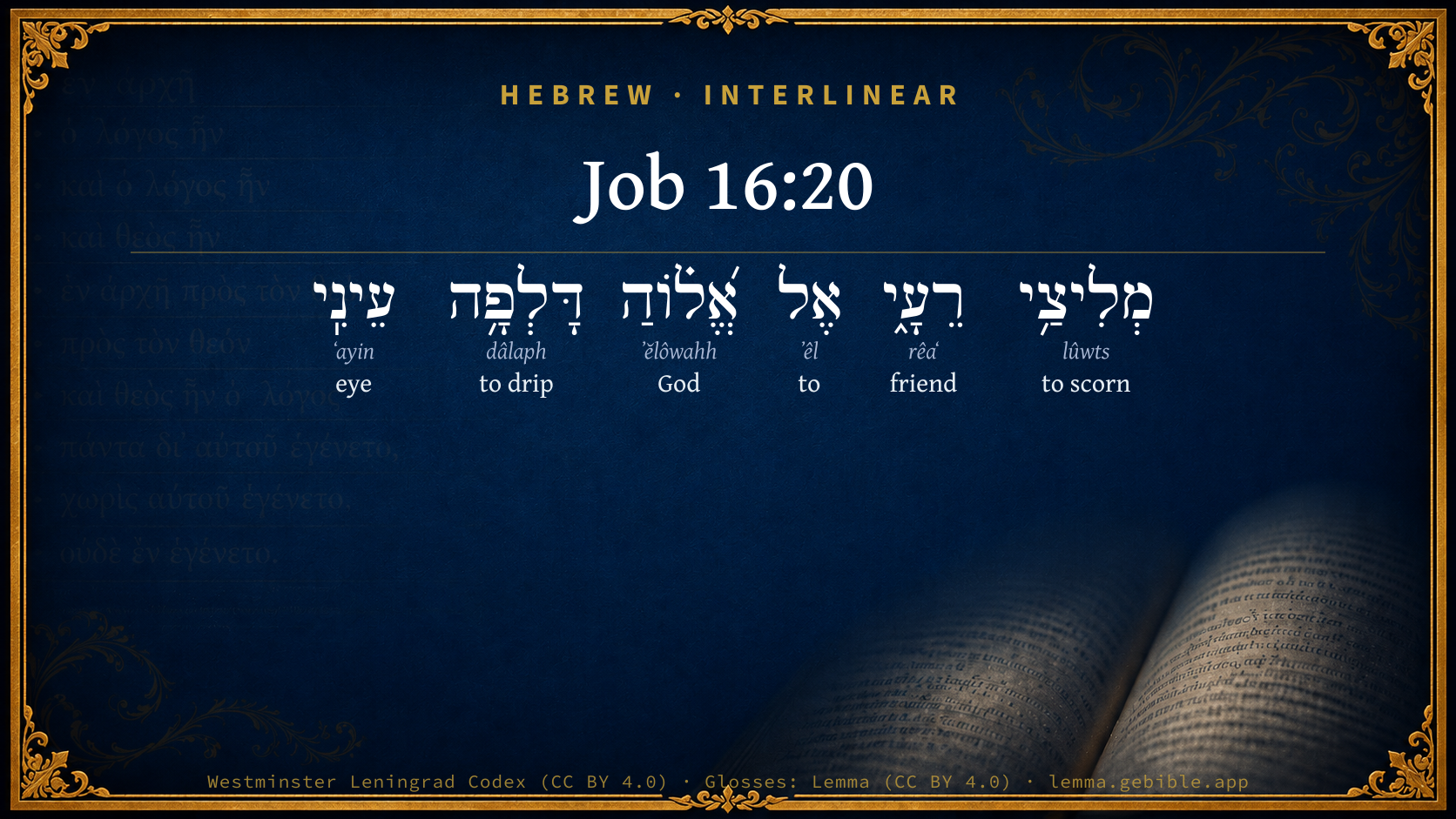
Job 16:20

Hebrew (Westminster Leningrad Codex) Job 16:20 appears in the Hebrew Old Testament. The text above is from the Westminster Leningrad Codex. Each word links to its Strong’s number, a concise gloss, and parsing drawn from the Open Scriptures Hebrew Bible morphology. Click any word for its full Brown-Driver-Briggs (BDB) entry.
Download image
Cite this verse

Job 16:20 (World English Bible). Public Domain. Lemma interlinear Bible study tool, https://lemma.gebible.app/v/job/16/20.

Show BibTeX & RIS
BibTeX
RIS
English Translation
My friends scoff at me. My eyes pour out tears to God,
World English Bible · Public Domain
Highlights
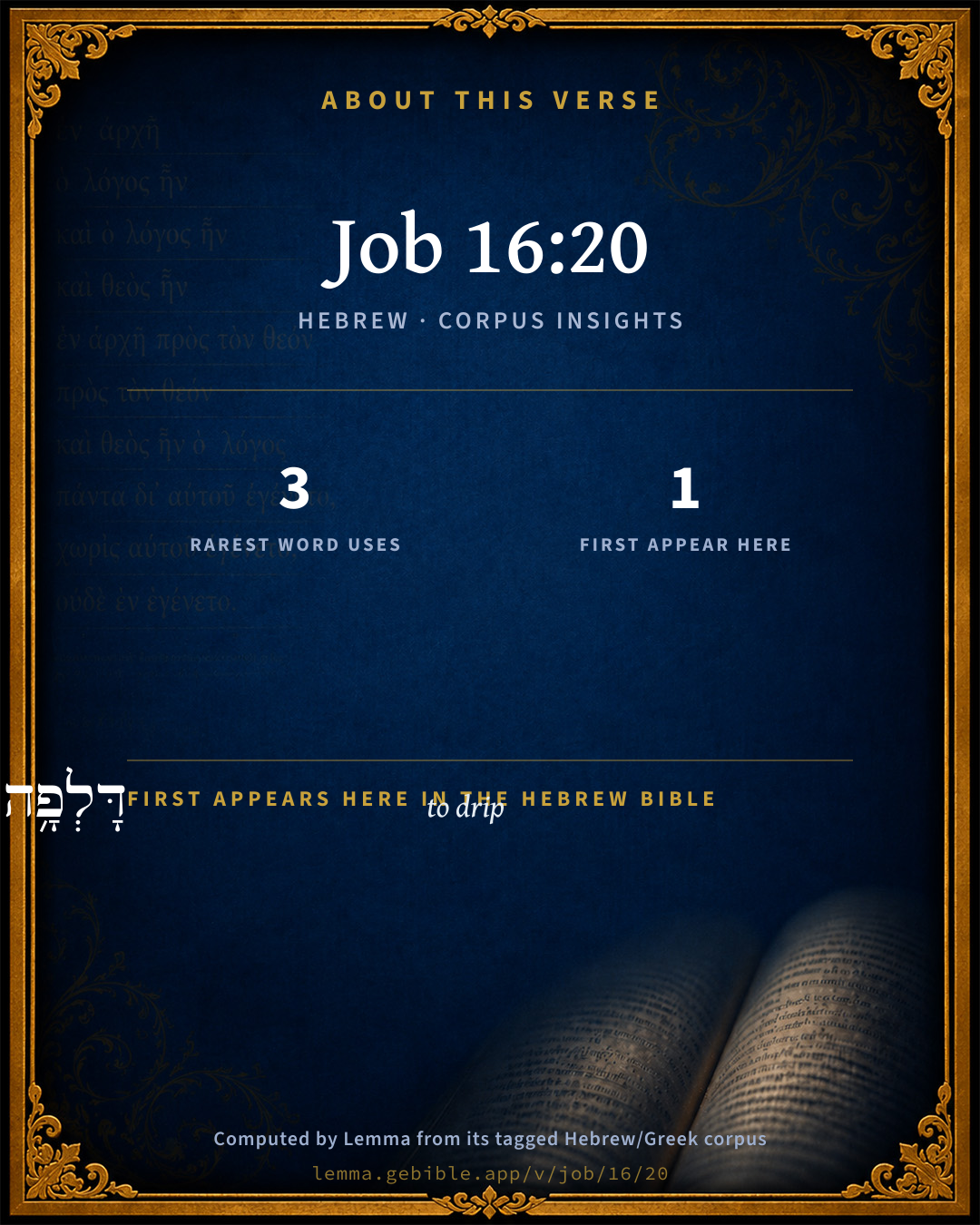
  • 1 first appearance in the Hebrew Bible
Full analysis ↓
Download a study sheet

One document with this verse’s original text, its word-by-word gloss line, the meaning frame, cross-references with their text, attributed commentary, and full source and license credits — printable, and it pastes into notes with its structure intact.

This verse Autodidact and up

Study sheet (.html) Plain text (.txt)

A passage Seminary Student

Up to 50 verses in one chapter. A passage sheet keeps up to 6 commentary sources and 12 cross-references per verse, in the order this page ranks them, and says so on the sheet whenever that leaves anything out. Ask for a single verse and you get the Autodidact verse sheet above.

Everything on this page stays free to read, with no account — the sheet is a download of what is already on screen, not access to it.

Want to remove ads? Support Godless Engineer
Compare translations 3

The same verse in 3 English versions, stacked beneath the original-language interlinear above. Click any original word for its lexicon entry.

Each is an independent rendering of the whole verse — the interlinear is not word-aligned to these translations.

Highlighted words mark where these versions differ — a whole-verse word diff, not a word-by-word alignment.

  • World English Bible Public Domain
    My friends scoff at me. My eyes pour out tears to God,
  • King James Version Public Domain
    My friends scorn me: but mine eye poureth out tears unto God.
  • unfoldingWord Literal Text CC BY-SA 4.0
    My intercessors my friends; my eye weeps to God.

unfoldingWord Literal Text — © unfoldingWord, licensed CC BY-SA 4.0. Word-aligned USFM3 via Door43 (git.door43.org/unfoldingWord/en_ult).

Versions to compare (up to 4)

3 of 4 selected

Show all 18 translations

Every available English version of this verse, each an independent rendering of the whole verse.

  • World English Bible Public Domain
    My friends scoff at me. My eyes pour out tears to God,
  • Berean Standard Bible Public Domain
    My friends are my scoffers as my eyes pour out tears to God.
  • Majority Standard Bible Public Domain
    My friends are my scoffers as my eyes pour out tears to God.
  • King James Version Public Domain
    My friends scorn me: but mine eye poureth out tears unto God.
  • American Standard Version (1901) Public Domain
    My friends scoff at me: `But' mine eye poureth out tears unto God,
  • Revised Version (1885) Public Domain
    My friends scorn me: but mine eye poureth out tears unto God;
  • Geneva Bible (1599) Public Domain
    My friends speake eloquently against me: but mine eye powreth out teares vnto God.
  • Douay-Rheims (1899) Public Domain
    For behold my witness is in heaven, and he that knoweth my conscience is on high.
  • Young's Literal Translation Public Domain
    My interpreter `is' my friend, Unto God hath mine eye dropped:
  • Literal Standard Version CC BY-SA 4.0
    My interpreter [is] my friend, || My eye has dropped to God;
  • Unlocked Literal Bible CC BY-SA 4.0
    My friends scoff at me, but my eye pours out tears to God.
  • unfoldingWord Literal Text CC BY-SA 4.0
    My intercessors my friends; my eye weeps to God.
  • Darby Bible Public Domain
    My friends are my mockers; mine eye poureth out tears unto +God.
  • World Messianic Bible Public Domain
    My friends scoff at me. My eyes pour out tears to God,
  • Webster's Bible Public Domain
    My friends scorn me: but my eye poureth out tears to God.
  • Free Bible Version CC BY-SA 4.0
    My friends scorn me, but my eyes pour out tears to God.
  • Bible in Basic English Public Domain
    My friends make sport of me; to God my eyes are weeping,
  • JPS Tanakh (1917) Public Domain
    Mine inward thoughts are my intercessors, mine eye poureth out tears unto God;

Literal Standard Version (2020), Covenant Press — licensed CC BY-SA 4.0. Text via the HelloAO Bible API (eBible.org). Unlocked Literal Bible (unfoldingWord) — licensed CC BY-SA 4.0. Text via the HelloAO Bible API (eBible.org). unfoldingWord Literal Text — © unfoldingWord, licensed CC BY-SA 4.0. Word-aligned USFM3 via Door43 (git.door43.org/unfoldingWord/en_ult). Free Bible Version, Dr. Jonathan Gallagher — licensed CC BY-SA 4.0. Text via the HelloAO Bible API (eBible.org).

Word by word

More ways to search: Search by grammar → Find every occurrence → Compare this word →

Practice this passage: Drill this verse → Learn its vocabulary →

About this verse

These counts appear in no published source. They are computed here, from the morphology-tagged text and Lemma’s own curated glosses. What Lemma adds →

6
words
6
distinct lemmas
Wisdom
section

Notable vocabulary

The rarest word here is דָּלְפָ֥ה to drip H1811 — appearing just 3 times in the whole Hebrew Bible.

First appearance in Scripture

This word makes its first canonical appearance in the Hebrew Bible here:

  • דָּלְפָ֥ה to drip H1811

Shared distinctive vocabulary

דָּלְפָ֥ה to drip H1811 occurs in 3 verses of the Hebrew Bible. Also found in:

Grammatical profile

  • 2 verbs
  • 3 nouns
  • 1 preposition

Verb forms

  • מְלִיצַ֥י Hiphil · Participle Active
  • דָּלְפָ֥ה Qal · Perfect

Hebrew & Septuagint length

In English translation the verse runs 12 words from the Hebrew and 14 from the Septuagint (LXX English) — closely comparable.

A rough comparison of the two English renderings, which tokenize alike — not a word-level alignment.

Word counts can differ between the Hebrew and the Greek without any difference in meaning — e.g. the Hebrew direct-object marker אֵת has no separate Greek word, and Greek often adds the article ὁ.

Cross-references

8

Topical passages linked to Job 16:20 in the Treasury of Scripture Knowledge — connected by theme and wording, ordered by reader-vote popularity; previews shown in the World English Bible.

  • Hebrews 5:7 He, in the days of his flesh, having offered up prayers and petitions with strong crying and tears to him who was able to save him from death, and having been heard for his godly fear,
  • Psalms 142:2 I pour out my complaint before him. I tell him my troubles.
  • Job 12:4–5 I am like one who is a joke to his neighbor, I, who called on God, and he answered. The just, the blameless man is a joke.
  • Job 16:4 I also could speak as you do. If your soul were in my soul's place, I could join words together against you, And shake my head at you.
  • Job 17:2 Surely there are mockers with me, My eye dwells on their provocation.
  • Psalms 109:4 In return for my love, they are my adversaries; But I am in prayer.
  • Luke 6:11–12 But they were filled with rage, and talked with one another about what they might do to Jesus.
  • Hosea 12:4–5 Indeed, he had power over the angel, and prevailed; He wept, and made supplication to him. He found him at Bethel, and there he spoke with us,

Cross-references courtesy of OpenBible.info (CC BY 4.0).

Hebrew and Greek witnesses Masoretic Hebrew ↔ Greek Septuagint

The same verse in the two great witnesses to the Old Testament, shown verse-for-verse.

These are two independent witnesses, not word-aligned to each other, and the Septuagint is shown in lemma (dictionary) form.

Hebrew Job 16:20 Masoretic · Westminster Leningrad Codex

מְלִיצַ֥י רֵעָ֑י אֶל אֱ֝ל֗וֹהַ דָּלְפָ֥ה עֵינִֽי

My friends scoff at me. My eyes pour out tears to God,

World English Bible · Public Domain

Greek LXX Job 16:20 Septuagint · lemma form

ἀποἱκνέομαι ἐγώ ὁ δέησις πρός κύριος ἔναντι δέ αὐτός στάζω ἐγώ ὁ ὀφθαλμός

And now, behold, my witness is in heaven, and my advocate is on high.

LXX2012 (modern English Septuagint) · Public Domain

Hebrew: Westminster Leningrad Codex (CC BY 4.0). Greek: Septuagint (public domain); English from LXX2012 (modern English Septuagint) (Public Domain). How the Septuagint differs from the Hebrew →

Commentary

Notes on Job 16:20 from classic Christian and Jewish commentators (each source and its license shown beneath its notes). The classic Christian expositions comment on the surrounding passage and are grouped to its opening verse, so a note may address several verses; the Jewish commentaries on the Tanakh (Rashi and others) are per-verse, so they appear only where the commentator wrote on this verse.

Lemma curates 59 commentaries, every one of them public domain or Creative Commons licensed, each selected and text-cleaned for this edition rather than reprinted as found. About our sources →

John Gill's Exposition

Oh that one might plead for a man with God,.... That is, that one might be appointed and allowed to plead with God on his account; or that he be admitted to plead with God for himself; or however, that there might be a hearing of his case before God, and that he would decide the thing in controversy between him and his friends, when he doubted not but it would be given on his side:

as a man pleadeth for his neighbour; using great freedom, and powerful arguments, and having no dread of the judge, nor fear of carrying the cause for his neighbour; so Job wishes, that either one for him, or he himself, might be freed from the dread of the divine Majesty, and might be suffered to speak as freely to his case as a counsellor at the bar does for his client. The words will admit of a more evangelic sense by observing that God, to whom Job says his eye poured out tears, at the close of Job 16:20, is to be understood of the second Person in the Godhead, Jehovah, the Son of God, the Messiah; and then read these words that follow thus, "and he will plead for a man with God, and the Son of man for his friend"; which last clause perhaps may be better rendered, "even the Son of man", &c. and so they are expressive of Job's faith, that though his friends despised him, yet he to whom he poured out his tears, and committed his case, would plead his cause with God for him, and thoroughly plead it, when he should be acquitted. The appellation, "the Son of man", is a well known name for the Messiah in the New Testament, and is not altogether unknown in the Old, see Psa 80:17; and one part of his work and office is to be an advocate with the Father for his friends, whom he makes, reckons, and uses as such, even all the Father has given him, and he has redeemed by his blood; for these he pleads his blood, righteousness, and sacrifice, to the satisfaction of the law, and justice of God, and against Satan, and all enemies whatever, and for every blessing they want; and for which work he is abundantly fit, because of the dignity of his person, his nearness to God his Father, and the interest he has in him. Gussetius (l) goes this way, and observes that this sense has not been taken notice of by interpreters, which he seems to wonder at; whereas our English annotator on the place had it long ago, and Mr. Caryll after him, though disapproved of by some modern interpreters.

(l) Ebr. Comment. p. 320, 321.

John Gill's Exposition of the Whole Bible (1746–1763) — public domain (CC PDM 1.0). Text via the HelloAO Bible API.

Trapp's Complete Commentary

John Trapp

Job 16:20 My friends scorn me: [but] mine eye poureth out [tears] unto God.

Ver. 20. My friends scorn me] Or, play the rhetoricians against me. David likewise complaineth of his rhetorical mockers at feasts, that made as it were set speeches against him. One rendereth it, My friends are interpreters, or rather misinterpreters, of my speeches. "For my love they are my adversaries: but I give myself unto prayer," Psa 109:4.

But mine eye poureth out tears unto God] Expletur lachrymis egeriturque dolor. The Hebrew hath it, Mine eye droppeth or distilleth to God. Prayers and tears are the weapons of the saints, whose eyes, glazed with tears, are fitly compared to the fishpools of Heshbon, Son 7:4. These tears have a voice, {Psa 39:12, "Hold not thy peace at my tears"} they are most powerful orators. Christ, going to suffer on the cross, could not but turn back and comfort those weeping women. God will pour out comforts into their bosoms who can pour out tears into his; they can never be at any loss who find out God to weep to.

John Trapp, A Commentary or Exposition upon All the Books of the Old and New Testament (1647–1656) — public domain. Text from a community e-Sword module.

Geneva Bible (1599)

Geneva Bible translators

Use painted words instead of true consolation.

Geneva Bible (1599) marginal notes — public domain. Text via Bolls.life.

Jamieson, Fausset & Brown

Robert Jamieson, A. R. Fausset & David Brown

Hebrew, "are my scorners"; more forcibly, "my mockers--my friends!" A heart-cutting paradox [UMBREIT]. God alone remains to whom he can look for attestation of his innocence; plaintively with tearful eye, he supplicates for this.

Jamieson, Fausset & Brown — Commentary Critical and Explanatory on the Whole Bible (1871) — public domain (CC PDM 1.0). Text via the HelloAO Bible API.

Adam Clarke's Commentary

Verse 20. My friends scorn me] They deride and insult me, but my eye is towards God; I look to him to vindicate my cause.

Adam Clarke's Commentary on the Bible (1810–1826) — public domain. Text from a community e-Sword/MySword module.

Ellicott's Commentary for English Readers

(20) My friends scorn me.—Or, as an apostrophe, “Ye my scorners who profess and ought to be my friends: mine eye poureth out tears unto God that He would maintain the right of man with God, and of the son of man with his neighbour;” or, “that one might plead for man with God as the son of man pleadeth for his neighbour”—this is what he has already longed for in Job_9:33.

A Bible Commentary for English Readers, edited by Charles John Ellicott (1878–1897) — public domain. Text from a community e-Sword module.

The Cambridge Bible for Schools and Colleges

gen. ed. J. J. S. Perowne

20. My friends scorn me:

Mine eye poureth out tears unto God,

20. scorn me] lit. are my scorners, or, mockers—instead of being my witnesses, cf. Job_12:4, Job_16:4-5. Because his friends mock him and no sympathy or insight is to be looked for from them (Job_16:7, Job_17:4), his eye droppeth—he appeals with tears to God; cf. Isa_38:14. What Job desires of his Witness is that he would see right done him both with God and with men—with God who wrongly held him guilty, and against men, his fellows, who founding on God’s dealing with him held him guilty also and were his mockers. On first clause of Job_16:21 cf. Job_13:15, Job_23:7. The “man” and “son of man” to whom Job refers is himself; there is nothing mystical in the phrase “son of man,” which means merely “man,” Hebrew poetry requiring for its parallelism such variety of expression.

20, 21. Job now names his Witness and states what he hopes for from Him.

The Cambridge Bible for Schools and Colleges (gen. ed. J. J. S. Perowne; Cambridge University Press, 1878–1918) — public domain. Text from a community e-Sword module.

Albert Barnes' Notes on the Bible

My friends scorn me - Margin “are my scorners.” That is, his friends had him in derision and mocked him, and he could only appeal with tears to God.

Mine eye poureth out tears unto God - Despised and mocked by his friends, he made his appeal to one who he knew would regard him with compassion. This shows that the heart of Job was substantially right. Notwithstanding, all his passionate exclamations; and notwithstanding, his expressions, when he was urged on by his sorrows to give vent to improper emotions in relation to God; yet he had a firm confidence in him, and always returned to right feelings and views. The heart may sometimes err. The best of people may sometimes give expression to improper feelings. But they will return to just views, and will ultimately evince unwavering confidence in God.

Albert Barnes' Notes on the Bible (1834–1885) — public domain. Text from a community e-Sword/MySword module.

Matthew Poole's English Annotations

My friends, who should defend me from the scorns and injuries of others,

scorn me; so this word is used Psa 119:51; Pro 3:34; 19:28. I pour forth my prayers and tears to God, that he would judge me according to my innocency, and plead my righteous cause against you.

Matthew Poole's English Annotations on the Holy Bible (1683–1685) — public domain. Text from a community e-Sword/MySword module.

Whedon's Commentary on the Bible

Daniel D. Whedon

20. My friends scorn me — מליצי רעיis almost invariably rendered, My scorners are my friends. But the word melits, in its root, signifies not only to “mock,” but “to speak in a foreign tongue,” (Gesenius,) whence the meaning of interpreter, intercessor, which is the rendering it bears in the other places where it occurs, (Gen_42:23; 2Ch_32:31 margin; Job_33:23, and Isa_43:27 margin;) also in the Targum peraklit, “advocate.” This leads Arnheim, Carey, and Prof. Lee to read it, “My interpreter is my friend,” and to argue, not so reasonably, that it refers to the promised mediator. To the objection that both words are in the plural, it is replied that this is an instance of the plural of majesty — the use of a word in the plural to express the idea of exaltation — as in Isa_54:5, “Thy Maker is thy husband,” where both words also are plural. The ever-ready assumption that the context demands “scorners” is not altogether satisfactory.

Daniel D. Whedon (gen. ed.), Commentary on the Old and New Testaments (1874–1909) — public domain. Text from a community e-Sword module.

The Pulpit Commentary

My friends scorn me; literally, my scorners are my companions; i.e. I have to live with those who scorn me. (comp. Job_30:1-13) But mine eye poureth out tears unto God. It is not to his "friends" or "companions," or "comforters," or any human aid, that Job turns in his distress. God alone is his Refuge. Forced by his woes to pass his time in weeping and mourning (see ver. 16), it is to God that his heart turns, to God that he "pours out his tears." Hardly as he thinks God to have used him, bitterly as he sometimes ventures to complain, yet the idea never crosses him of looking for help or sympathy to any other quarter, of having recourse to any other support or stay. "Though he slay me, yet will I trust in him", (Job_13:15) expresses the deepest feeling of his heart, the firmost principle of his nature. Nothing overrides it. Even "out of the depths" his soul cries to the Lord. (see Psa_130:1)

The Pulpit Commentary (1880–1919), ed. H.D.M. Spence-Jones & Joseph S. Exell — public domain. Text from a community e-Sword module.

unfoldingWord translationNotes

Door43 World Missions Community

scoff at

"scorn" or "ridicule"

my eye pours out tears

Job describes how strongly he feels his sorrow. Here he exaggerates how he often cries by saying that tears pour from his eyes. AT: "my eyes are full of tears while I cry out" (See: Hyperbole and Generalization)

for this man

"for me." Here Job refers to himself in the third person. (See: First, Second, or Third Person)

as a man does with his neighbor!

"as a man does for his neighbor." Job describes how he wants that one in heaven to plead for him. (See: Simile)

I will go to a place

Here Job is referring to himself dying. AT: "I will die and go to a place" (See: Assumed Knowledge and Implicit Information)

translationWords

God

testimony

heaven

neighbor

unfoldingWord translationNotes — © Distant Shores Media and the Door43 World Missions Community, licensed CC BY-SA 4.0. Source: git.door43.org/Door43/en_tn.

Rashi

Rabbi Shlomo Yitzchaki (Rashi)

pours out Heb. דלפה, tears and sprays tears, an expression of dripping (דלוף).

Rashi on the Tanakh — English translations: “The Judaica Press complete Tanach with Rashi, translated by A. J. Rosenberg” (CC BY 4.0); “Pentateuch with Rashi's commentary by M. Rosenbaum and A.M. Silbermann, 1929-1934” (public domain); “The Metsudah Tanach series, Lakewood, N.J” (CC BY 4.0); and “The Book of Joshua, Metsudah Publications, 1997” (CC BY 4.0). Text via Sefaria.

Lesson kit

Teaching starters — assembled from the data on this page, not authored interpretation. Every prompt links to the verse data it draws on. Edit before teaching.

Job, in the Wisdom, opens this verse with 6 words (6 distinct Hebrew lemmas). Its most distinctive word is dâlaph (“to drip”). A historical commentator’s framing appears above. Read the whole chapter for the surrounding context.

Discussion questions

  1. The word dâlaph carries the sense “to drip.” How does it shape the verse?
  2. The word “to drip” first appears here in Scripture. What is being introduced at this debut?
  3. Psalms 119:28 shares the word «to drip» with this verse. How do the two illuminate each other?
  4. These translations render this verse differently; the difference is in the English rendering, not the original. What questions does that raise?
  5. The verb «מְלִיצַ֥י» is Hiphil Participle Active. How does its form color the action?
  6. Reading how John Gill's Exposition and Trapp's Complete Commentary read this verse, where do the two commentators agree and where do they part?

Things to notice

Reading settings

Reading text

Shown beneath each verse's original-language words.

Old Testament
Old Testament edition

Read the OT as the Masoretic Hebrew (MT) or the Greek Septuagint (LXX).

English shown for the Greek Septuagint (in the Hebrew ↔ Greek comparison).

Comparing translations? Open the Compare panel on any verse page to stack up to four side by side.