
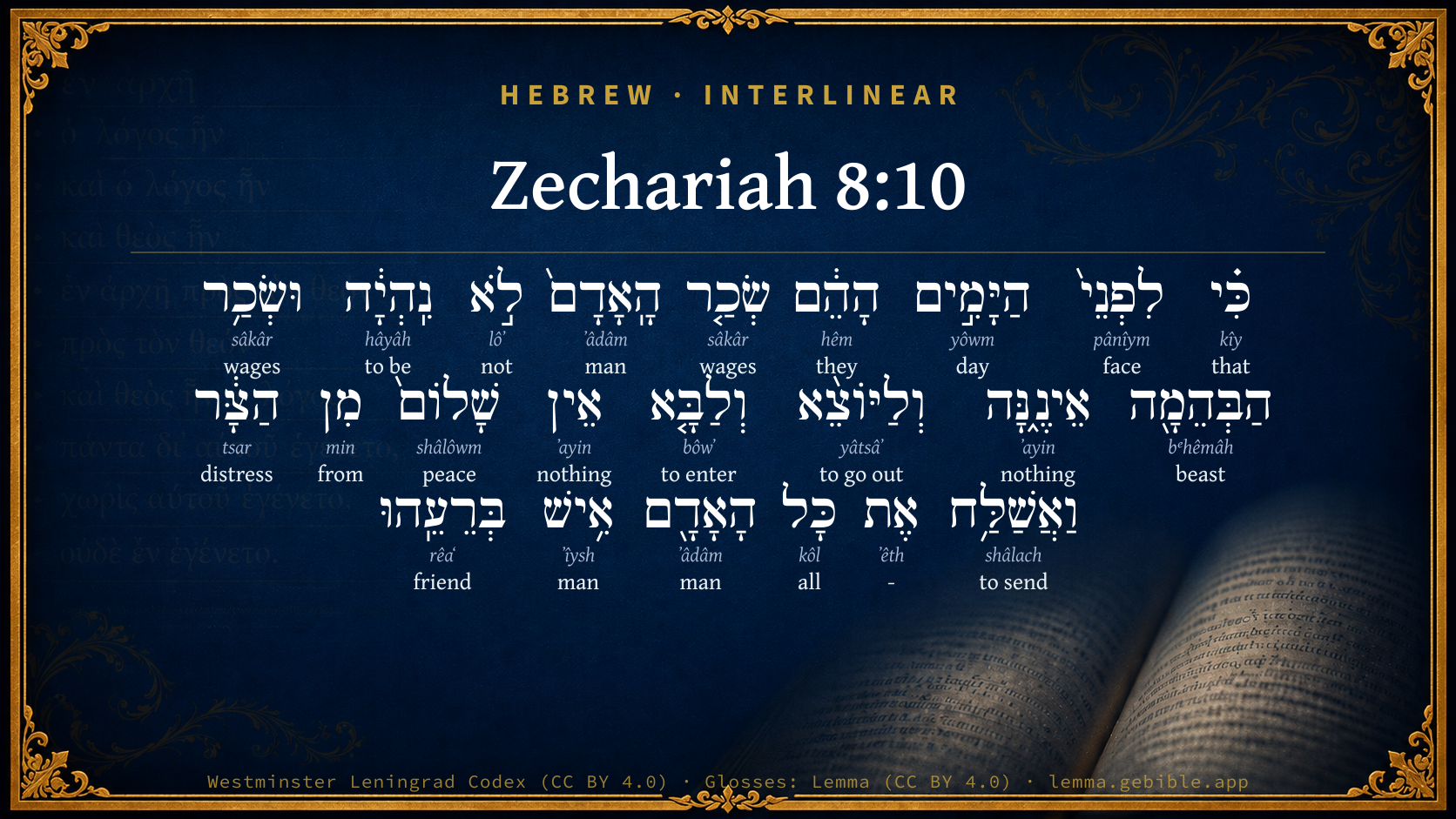
Zechariah 8:10

Hebrew (Westminster Leningrad Codex) Zechariah 8:10 appears in the Hebrew Old Testament. The text above is from the Westminster Leningrad Codex. Each word links to its Strong’s number, a concise gloss, and parsing drawn from the Open Scriptures Hebrew Bible morphology. Click any word for its full Brown-Driver-Briggs (BDB) entry.
Download image
Cite this verse

Zechariah 8:10 (World English Bible). Public Domain. Lemma interlinear Bible study tool, https://lemma.gebible.app/v/zechariah/8/10.

Show BibTeX & RIS
BibTeX
RIS
English Translation
For before those days there was no wages for man, nor any wages for an animal; neither was there any peace to him who went out or came in, because of the adversary. For I set all men everyone against his neighbor.
World English Bible · Public Domain
Download a study sheet

One document with this verse’s original text, its word-by-word gloss line, the meaning frame, cross-references with their text, attributed commentary, and full source and license credits — printable, and it pastes into notes with its structure intact.

This verse Autodidact and up

Study sheet (.html) Plain text (.txt)

A passage Seminary Student

Up to 50 verses in one chapter. A passage sheet keeps up to 6 commentary sources and 12 cross-references per verse, in the order this page ranks them, and says so on the sheet whenever that leaves anything out. Ask for a single verse and you get the Autodidact verse sheet above.

Everything on this page stays free to read, with no account — the sheet is a download of what is already on screen, not access to it.

Want to remove ads? Support Godless Engineer
Compare translations 3

The same verse in 3 English versions, stacked beneath the original-language interlinear above. Click any original word for its lexicon entry.

Each is an independent rendering of the whole verse — the interlinear is not word-aligned to these translations.

Highlighted words mark where these versions differ — a whole-verse word diff, not a word-by-word alignment.

  • World English Bible Public Domain
    For before those days there was no wages for man, nor any wages for an animal; neither was there any peace to him who went out or came in, because of the adversary. For I set all men everyone against his neighbor.
  • King James Version Public Domain
    For before these days there was no hire for man, nor any hire for beast; neither was there any peace to him that went out or came in because of the affliction: for I set all men every one against his neighbour.
  • unfoldingWord Literal Text CC BY-SA 4.0
    For before those days no crops were gathered in by anyone, there was no profit for either man or beast, and there was no peace from enemies for anyone going or coming. I had set every person each against his neighbor.

unfoldingWord Literal Text — © unfoldingWord, licensed CC BY-SA 4.0. Word-aligned USFM3 via Door43 (git.door43.org/unfoldingWord/en_ult).

Versions to compare (up to 4)

3 of 4 selected

Show all 18 translations

Every available English version of this verse, each an independent rendering of the whole verse.

  • World English Bible Public Domain
    For before those days there was no wages for man, nor any wages for an animal; neither was there any peace to him who went out or came in, because of the adversary. For I set all men everyone against his neighbor.
  • Berean Standard Bible Public Domain
    For before those days neither man nor beast received wages, nor was there safety from the enemy for anyone who came or went, for I had turned every man against his neighbor.
  • Majority Standard Bible Public Domain
    For before those days neither man nor beast received wages, nor was there safety from the enemy for anyone who came or went, for I had turned every man against his neighbor.
  • King James Version Public Domain
    For before these days there was no hire for man, nor any hire for beast; neither was there any peace to him that went out or came in because of the affliction: for I set all men every one against his neighbour.
  • American Standard Version (1901) Public Domain
    For before those days there was no hire for man, nor any hire for beast; neither was there any peace to him that went out or came in, because of the adversary: for I set all men every one against his neighbor.
  • Revised Version (1885) Public Domain
    For before those days there was no hire for man, nor any hire for beast; neither was there any peace to him that went out or came in because of the adversary: for I set all men every one against his neighbour.
  • Geneva Bible (1599) Public Domain
    For before these dayes there was no hire for man nor any hire for beast, neither was there any peace to him that went out or came in because of the affliction: for I set all men, euery one against his neighbour.
  • Douay-Rheims (1899) Public Domain
    For before those days there was no hire for men, neither was there hire for beasts, neither was there peace to him that came in, nor to him that went out, because of the tribulation: and I let all men go every one against his neighbour.
  • Young's Literal Translation Public Domain
    For, before those days there hath been no hiring of man, Yea, a hiring of beasts there is none; And to him who is going out, And to him who is coming in, There is no peace because of the adversary, And I send all men -- each against his neighbour.
  • Literal Standard Version CC BY-SA 4.0
    For before those days there has been no hiring of man, || Indeed, a hiring of beasts there is none; And to him who is going out, || And to him who is coming in, || There is no peace because of the adversary, || And I send all men—each against his neighbor.
  • Unlocked Literal Bible CC BY-SA 4.0
    For before those days no crops were gathered in by anyone, there was no profit for either man or beast, and there was no peace from enemies for anyone going or coming. I had set every person each against his neighbor.
  • unfoldingWord Literal Text CC BY-SA 4.0
    For before those days no crops were gathered in by anyone, there was no profit for either man or beast, and there was no peace from enemies for anyone going or coming. I had set every person each against his neighbor.
  • Darby Bible Public Domain
    For before those days there was no hire for man, nor any hire for beast; and there was no peace for him that went out or that came in, because of the distress: for I let loose all men, every one against his neighbour.
  • World Messianic Bible Public Domain
    For before those days there was no wages for man nor any wages for an animal, neither was there any peace to him who went out or came in, because of the adversary. For I set all men everyone against his neighbor.
  • Webster's Bible Public Domain
    For before these days there was no hire for man, nor any hire for beast; neither was there any peace to him that went out or came in because of the affliction: for I set all men every one against his neighbor.
  • Free Bible Version CC BY-SA 4.0
    Before that time there wasn't enough for people or for animals. No one could live normally because they were not safe from their enemies, and I set everyone against each other.
  • Bible in Basic English Public Domain
    For before those days there was no payment for a man's work, or for the use of a beast, and there was no peace for him who went out or him who came in, because of the attacker: for I had every man turned against his neighbour.
  • JPS Tanakh (1917) Public Domain
    For before those days there was no hire for man, nor any hire for beast; neither was there any peace to him that went out or came in because of the adversary; for I set all men every one against his neighbour.

Literal Standard Version (2020), Covenant Press — licensed CC BY-SA 4.0. Text via the HelloAO Bible API (eBible.org). Unlocked Literal Bible (unfoldingWord) — licensed CC BY-SA 4.0. Text via the HelloAO Bible API (eBible.org). unfoldingWord Literal Text — © unfoldingWord, licensed CC BY-SA 4.0. Word-aligned USFM3 via Door43 (git.door43.org/unfoldingWord/en_ult). Free Bible Version, Dr. Jonathan Gallagher — licensed CC BY-SA 4.0. Text via the HelloAO Bible API (eBible.org).

Word by word

More ways to search: Search by grammar → Find every occurrence → Compare this word →

Practice this passage: Drill this verse → Learn its vocabulary →

שְׂכַ֤ר
sâkâr
H7939
“wages of”
Noun, Common, Masculine, Singular, Construct
Part of Speech
Noun
Type
Common
Gender
Masculine
Number
Singular
State
Construct
Full BDB Definition

Origin: from H7936

TWOT: 2264 . 1b

hire, wages - wages - reward, pay - fare, fee, passage-money
  1. כִּ֗י kîy H3588 “that” Conjunction
  2. לִפְנֵי֙ pânîym H6440 “to/for · face(s) of” Preposition + Noun, Common, Both, Plural, Construct
  3. הַיָּמִ֣ים yôwm H3117 “the · days” Particle, Definite Article + Noun, Common, Masculine, Plural, Absolute
  4. הָהֵ֔ם hêm H1992 “the · they” Particle, Definite Article + Pronoun, Personal, 3rd Person, Masculine, Plural
  5. הָֽאָדָם֙ ʼâdâm H120 “the · man” Particle, Definite Article + Noun, Common, Masculine, Singular, Absolute
  6. לֹ֣א lôʼ H3808 “not” Particle, Negative
  7. נִֽהְיָ֔ה hâyâh H1961 “to be” Verb, Niphal, Perfect, 3rd Person, Masculine, Singular
  8. וּשְׂכַ֥ר sâkâr H7939 “and · wages of” Conjunction + Noun, Common, Masculine, Singular, Construct
  9. הַבְּהֵמָ֖ה bᵉhêmâh H929 “the · beast” Particle, Definite Article + Noun, Common, Feminine, Singular, Absolute
  10. אֵינֶ֑נָּה ʼayin H369 “nothing · her” Particle, Negative + Suffix, Personal, 3rd Person, Feminine, Singular
  11. וְלַיּוֹצֵ֨א yâtsâʼ H3318 “and · to/for the · going out” Conjunction + Preposition, Determined + Verb, Qal, Participle Active, Masculine, Singular, Absolute
  12. וְלַבָּ֤א bôwʼ H935 “and · to/for the · entering” Conjunction + Preposition, Determined + Verb, Qal, Participle Active, Masculine, Singular, Absolute
  13. אֵין ʼayin H369 “nothing” Particle, Negative
  14. שָׁלוֹם֙ shâlôwm H7965 “peace” Noun, Common, Masculine, Singular, Absolute
  15. מִן min H4480 “from” Preposition
  16. הַצָּ֔ר tsar H6862 “the · distress” Particle, Definite Article + Noun, Common, Masculine, Singular, Absolute
  17. וַאֲשַׁלַּ֥ח shâlach H7971 “and · to send” Conjunction + Verb, Piel, Imperfect, 1st Person, Common, Singular
  18. אֶת ʼêth H853 “-” Particle, Direct Object
  19. כָּל kôl H3605 “all of” Noun, Common, Masculine, Singular, Construct
  20. הָאָדָ֖ם ʼâdâm H120 “the · man” Particle, Definite Article + Noun, Common, Masculine, Singular, Absolute
  21. אִ֥ישׁ ʼîysh H376 “man” Noun, Common, Masculine, Singular, Absolute
  22. בְּרֵעֵֽהוּ rêaʻ H7453 “in/at · friend · his” Preposition + Noun, Common, Masculine, Singular, Construct + Suffix, Personal, 3rd Person, Masculine, Singular

About this verse

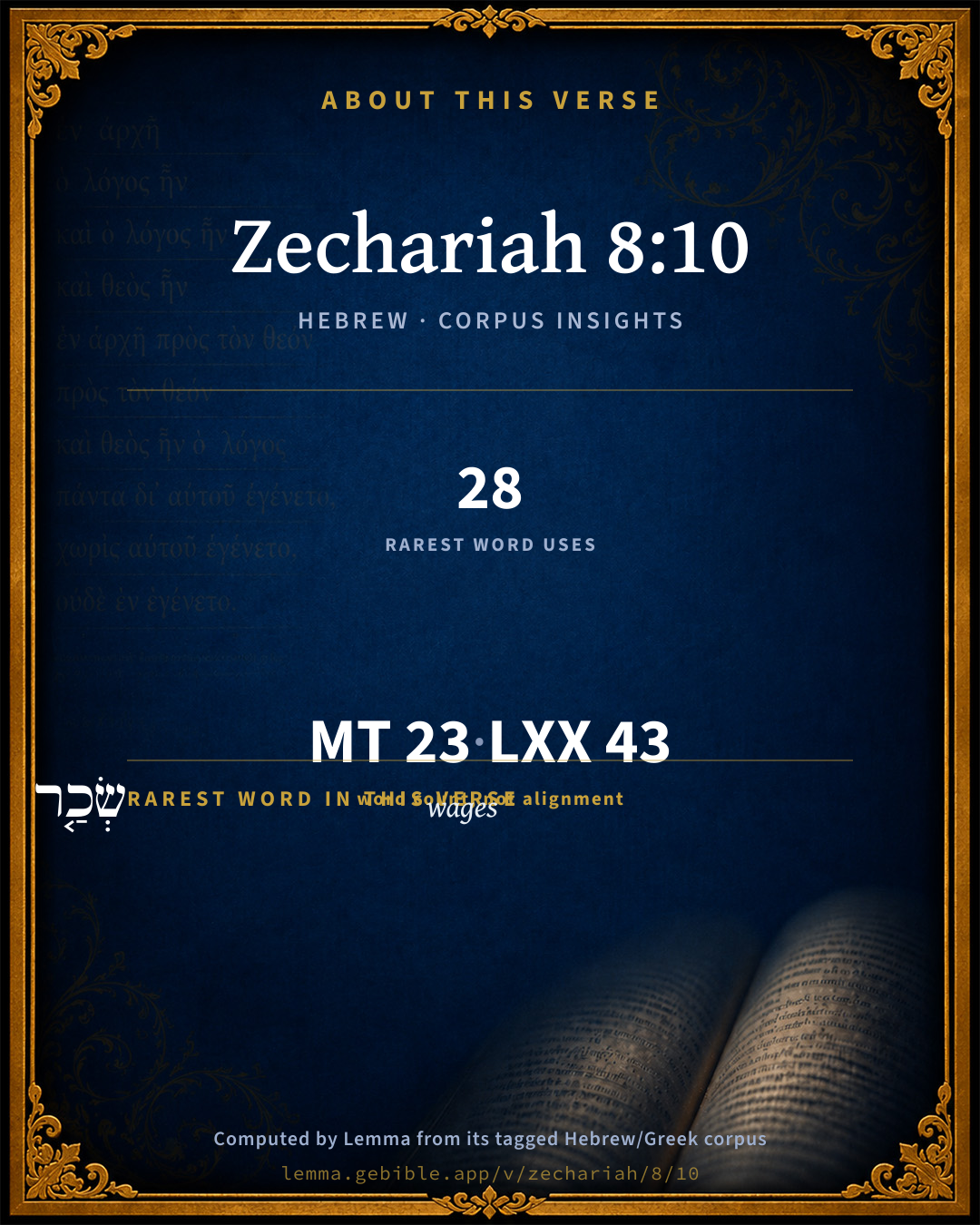
These counts appear in no published source. They are computed here, from the morphology-tagged text and Lemma’s own curated glosses. What Lemma adds →

23
words
20
distinct lemmas
Prophets
section

Shared distinctive vocabulary

שְׂכַ֤ר wages H7939 occurs in 25 verses of the Hebrew Bible. Also found in:

Grammatical profile

  • 4 verbs
  • 12 nouns
  • 1 pronoun
  • 1 preposition
  • 1 conjunction
  • 4 particles

Verb forms

  • נִֽהְיָ֔ה Niphal · Perfect
  • וְלַיּוֹצֵ֨א Qal · Participle Active
  • וְלַבָּ֤א Qal · Participle Active
  • וַאֲשַׁלַּ֥ח Piel · Imperfect

Repetition

Words recur within this verse — often emphatic in Hebrew:

  • שְׂכַ֤ר wages H7939 ×2
  • הָֽאָדָם֙ man H120 ×2
  • אֵינֶ֑נָּה nothing H369 ×2

Hebrew & Septuagint length

In English translation the verse runs 42 words from the Hebrew and 55 from the Septuagint (LXX English) — closely comparable.

A rough comparison of the two English renderings, which tokenize alike — not a word-level alignment.

Word counts can differ between the Hebrew and the Greek without any difference in meaning — e.g. the Hebrew direct-object marker אֵת has no separate Greek word, and Greek often adds the article ὁ.

In the original languages it is 23 Hebrew tokens and 43 Greek tokens — but the two are counted differently (Hebrew bundles its prefixes and suffixes into one token; the Greek is in lemma form), so that isn’t a like-for-like length.

Cross-references

10

Topical passages linked to Zechariah 8:10 in the Treasury of Scripture Knowledge — connected by theme and wording, ordered by reader-vote popularity; previews shown in the World English Bible.

  • Haggai 1:6–11 You have sown much, and bring in little. You eat, but you don't have enough. You drink, but you aren't filled with drink. You clothe yourselves, but no one is warm, and he who earns wages earns wages to put them into a bag with holes in it."
  • Isaiah 19:2 I will stir up the Egyptians against the Egyptians: and they shall fight everyone against his brother, and everyone against his neighbor; city against city, [and] kingdom against kingdom.
  • Amos 9:4 Though they go into captivity before their enemies, there I will command the sword, and it will kill them. I will set my eyes on them for evil, and not for good.
  • Amos 3:6 Does the trumpet alarm sound in a city, Without the people being afraid? Does evil happen to a city, And Yahweh hasn't done it?
  • Haggai 2:16–18 Through all that time, when one came to a heap of twenty measures, there were only ten. When one came to the wine vat to draw out fifty, there were only twenty.
  • Judges 5:6–7 In the days of Shamgar the son of Anath, In the days of Jael, the highways were unoccupied, The travelers walked through byways.
  • Judges 5:11 Far from the noise of archers, in the places of drawing water, There shall they rehearse the righteous acts of Yahweh, [Even] the righteous acts of his rule in Israel. Then the people of Yahweh went down to the gates.
  • Jeremiah 16:16 Behold, I will send for many fishermen, says Yahweh, and they shall fish them up; and afterward I will send for many hunters, and they shall hunt them from every mountain, and from every hill, and out of the clefts of the rocks.
  • Matthew 10:34–36 "Don't think that I came to send peace on the earth. I didn't come to send peace, but a sword.
  • 2 Chronicles 15:5–7 In those times there was no peace to him who went out, nor to him who came in; but great vexations were on all the inhabitants of the lands.

Cross-references courtesy of OpenBible.info (CC BY 4.0).

Hebrew and Greek witnesses Masoretic Hebrew ↔ Greek Septuagint

The same verse in the two great witnesses to the Old Testament, shown verse-for-verse.

These are two independent witnesses, not word-aligned to each other, and the Septuagint is shown in lemma (dictionary) form.

Hebrew Zechariah 8:10 Masoretic · Westminster Leningrad Codex

כִּ֗י לִפְנֵי֙ הַיָּמִ֣ים הָהֵ֔ם שְׂכַ֤ר הָֽאָדָם֙ לֹ֣א נִֽהְיָ֔ה וּשְׂכַ֥ר הַבְּהֵמָ֖ה אֵינֶ֑נָּה וְלַיּוֹצֵ֨א וְלַבָּ֤א אֵין שָׁלוֹם֙ מִן הַצָּ֔ר וַאֲשַׁלַּ֥ח אֶת כָּל הָאָדָ֖ם אִ֥ישׁ בְּרֵעֵֽהוּ

For before those days there was no wages for man, nor any wages for an animal; neither was there any peace to him who went out or came in, because of the adversary. For I set all men everyone against his neighbor.

World English Bible · Public Domain

Greek LXX Zechariah 8:10 Septuagint · lemma form

διότι πρό ὁ ἡμέρα ἐκεῖνος ὁ μισθός ὁ ἄνθρωπος οὐ εἰμί εἰς ὄνησις καί ὁ μισθός ὁ κτῆνος οὐ ὑποἄρχω καί ὁ ἐκπορεύομαι καί ὁ εἰςπορεύομαι οὐ εἰμί εἰρήνη ἀπό ὁ θλῖψις καί ἐκ ἀποστέλλω πᾶς ὁ ἄνθρωπος ἕκαστος ἐπί ὁ πλησίον αὐτός

For before those days the wages of men could not be profitable, and there could be no hire of cattle, and there could be no peace by reason of the affliction to him that went out or to him that came in: for I would have let loose all men, every one against his neighbor.

LXX2012 (modern English Septuagint) · Public Domain

On this verse, Whedon's Commentary on the Bible discusses the Septuagint’s reading. Read the note in Commentary ↓

Hebrew: Westminster Leningrad Codex (CC BY 4.0). Greek: Septuagint (public domain); English from LXX2012 (modern English Septuagint) (Public Domain). How the Septuagint differs from the Hebrew →

Targum (Aramaic paraphrase)

1

The Targum is the ancient Jewish Aramaic paraphrase of the Hebrew Scriptures — an interpretive translation, not the Hebrew text itself. Onkelos (literal) and Pseudo-Jonathan (expansive) render the Torah, and Jonathan the Prophets. Coverage is partial: where no permissively-licensed English translation exists for a verse, only the Aramaic is shown. This is verse-level text, not a word-by-word alignment to the Hebrew.

  1. Targum Jonathan Prophets (Joshua–Malachi)
    אֲרֵי קֳדָם מֵיתֵי יוֹמַיָא הָאִינוּן אַגְרָא דֶאֱנָשָׁא לָא הֲוָה וְאַגְרָא דִבְעִירָא לֵיתוֹהִי וּלְנַפְקַיָא וּלְעָלַיָא לֵית שְׁלָמָא מִן מְעִיקָא וַאֲגָרֵי יַת כָּל אֱנָשָׁא גְבַר בְּחַבְרֵיהּ:

    (no public-domain English translation for this verse)

    Targum Jonathan — Aramaic: “Mikraot Gedolot” (public domain). English: “Sefaria Community Translation” (CC0 1.0 (public-domain dedication)); “London "Chaldee Paraphrase," 1871” (public domain). Text via Sefaria.

Commentary

Notes on Zechariah 8:10 from classic Christian and Jewish commentators (each source and its license shown beneath its notes). The classic Christian expositions comment on the surrounding passage and are grouped to its opening verse, so a note may address several verses; the Jewish commentaries on the Tanakh (Rashi and others) are per-verse, so they appear only where the commentator wrote on this verse.

Lemma curates 59 commentaries, every one of them public domain or Creative Commons licensed, each selected and text-cleaned for this edition rather than reprinted as found. About our sources →

Trapp's Complete Commentary

John Trapp

Zec 8:10 For before these days there was no hire for man, nor any hire for beast; neither [was there any] peace to him that went out or came in because of the affliction: for I set all men every one against his neighbour.

Ver. 10. For before these days] sc. During those forty and four years, wherein they ceased from the work, minding only their own houses and managing their own affairs, their labour was unprofitable, their state unquiet through foreign foragers and homebred malcontents.

There was no hire for man, nor any hire for beast] Nulla emoluments laborum. Both man and beast did their parts, but to little purpose.

“ Ludit qui sterili semina mandat humo ”( Ovid).

They sowed much, and brought in little; they earned money, but put it into a bottomless bag, Hag 1:6; {See Trapp on "Heb 1:6"} the gains did not countervail the pains, the wages the work.

Neither was there any peace to him that went out or came in] Whether a man were within doors or without, he was in danger of the enemy (see the like 2Ch 15:5), he did eat the bread of his soul in the peril of his life, being wholly at the enemy’s mercy, which is mere cruelty. "For if a man find his enemy, will he let him go away?" said Saul, 1Sa 24:19; I think not, till he have his pennyworth of him; as that monster of Milan, as the bloody Papists in the massacre of Paris, as the merciless Spaniards on the harmless Indians (50,000,000 of whom they have murdered in 42 years, as Acosta, the Jesuit, testifieth), as Ptolemy Lathurus, King of Egypt, on these poor Jews, 30,000 of whom he cruelly killed, and compelled the living to feed upon the flesh of the dead; and, lastly, as the Jews themselves, of whom Tacitus takes notice, and gives them this character, that there was misericordia in promptu apud suos, sed contra omnes alios hostile odium, that they were kind enough to their own, but cruel to all others, whom they look upon as idolaters, and therefore think they may safely kill, as they did the Cyprians and Cyrenians in Trajan’s time to the number of 240,000; and as they still do Christians where they can without danger of being discovered; whom also they curse in their daily prayers with a Maledic Domine Nazaraeis; and by whom they are everywhere so contemned and hated, that they are exiled out of the world, cast out of many countries, and where they are suffered (as in Turkey) they are at every Easter in danger of death. For Biddulph telleth us that if they stir out of doors between Maundy Thursday at noon and Easter eve at night, the Christians among whom they dwell will stone them; because at that time they crucified our Saviour, derided and buffeted him.

For I set all men, every one against his neighbour] And I set, emisi or commisi, not permisi or dimisi, as the Vulgate hath it: I set on or sent out, not I let or suffered all men. God’s holy hand hath a special stroke in the Church’s afflictions, whosoever be the instrument. Herein his all disposing Providence is not only permissive, but active. "I make peace, and create evil," that is, war and contention, Isa 45:7; which is called evil by a specialty, as including all evils.

“ Omega nostrorum Mars est, Mars Alpha malorum. ”

But is there evil in a city, and I have not done it? Amo 3:6. He (for a punishment) sent an evil spirit of division and discord between Abimelech and the men of Shechem, Jdg 9:23, not by instilling any evil motions into their minds, but in a way of just revenge for their treachery and cruelty to Gideon’s family. This God doth, 1. By letting loose Satan upon them (that great coal kindler and mischief maker of the world) to raise jealousies, heart burnings, and discontents between them. 2. By giving them up to the lusts and corruptions of their own wicked hearts. 3. By giving occasions of enraging them more and more one against another. And here the wickedness of these factions and fallings out is wholly from their lusts that war in their members, Jas 4:1, and not at all of God, though his Providence do concur, like as the stench of the dunghill riseth not from the sun, though the sunshine upon it be the occasion of it.

Every one against his neighbour] A sad case, that common misery should not breed unity among them; that necessity had not made them lay down their private enmities; that being vexed so by the common adversary, they should yet vex and tear one another. Blows enough were not dealt by the Samaritans, Ammonites, and other malignants; but their own must add to the violence. Still Satan is thus busy, and Christians are thus malicious; that they must needs fall out by the way home, and give bloody noses, too, sometimes. St James, Jas 4:1; Jas 4:7, calls upon such to "resist the devil," that is, their unruly passions of rage and revenge, wherewith the devil empestereth and embroileth their spirits; and, like your cockmasters, sets one to kill another, that at night he may feed upon both.

John Trapp, A Commentary or Exposition upon All the Books of the Old and New Testament (1647–1656) — public domain. Text from a community e-Sword module.

Whedon's Commentary on the Bible

Daniel D. Whedon

10. Another ground for being of good courage may be found in the improvement in conditions which has taken place since the people began in earnest the rebuilding of the temple. How different is the present from the past.

Before these days — Better, R.V., “those.” Before the resumption of building operations.

No hire for man,… for beast — No returns were had from labors expended in the cultivation of the soil; there was not enough grown for fodder.

To him that went out or came in — In following his daily occupation (Deu_28:6; Psa_121:8).

Neither… any peace — From within or without. The last clause indicates that the prophet is thinking of troubles and dissensions within the community as well as of attacks from without (compare Ezr_4:4; Neh_6:1 ff.).

Affliction — R.V., “adversary.” A.V. is to be preferred. The affliction is the calamity described in Hag_1:6; Hag_1:9-11; Hag_2:16-17, and the troubles and dissensions mentioned in the Books of Ezra and Nehemiah.

11ff. A marvelous transformation is at hand, for Jehovah is about to change his attitude into one of mercy and loving-kindness (compare Zec_8:2-3).

The residue of this people — R.V., “the remnant.” As in Zec_8:6; or perhaps equivalent to this remnant of the people, that is, those who have escaped from exile.

The former days — Not the days before the exile, but the days before the resumption of the building enterprise (compare Zec_8:10). 12.

The seed shall be prosperous — An impossible rendering of the Hebrew. R.V., “there shall be the seed of peace.” Since peace implies prosperity, and since seed is sometimes equivalent to seedtime or sowing (Gen_8:22) or even to produce or harvest (Job_39:12), Perowne suggests as a free rendering, “the processes of agriculture shall prosper.” That this is the thought the prophet desired to express is not improbable; it seems doubtful, however, that he would express it in this ambiguous and obscure manner. This difficulty has been felt by many, and it has been proposed to take the words in apposition to “the vine,” which immediately follows — “the seed of peace, the vine, shall give its fruit,” equivalent to “the vine, which is the seed or plant of peace, shall give its fruit” (Jer_2:21; Eze_17:5-6). The vine is thought to be called the seed of peace because it can “flourish only in peaceful times and not when the land is laid waste by enemies” (1Ki_4:25; Mic_4:4). This translation also is not without its difficulties; it would certainly be unusual to have the appositional clause precede its noun; hence many commentators question the accuracy of the text. Klostermann emends it by transposing one letter from the beginning of the second word to the close of the first, by which he secures the following reading: “her seed shall be prosperous,” that is, the seed planted by the remnant (in Hebrew a feminine noun). The promise, then, means that the seed will no longer dry up in the ground, but will spring up and bear abundant fruit. Others, following LXX., read, “I will sow prosperity,” and they understand the rest of the verse as explaining how the prosperity is to be brought about. Whatever the exact meaning of the first clause, Zec_8:12 contains a promise of the restoration of the divine blessing. For the rest of the verse see on Hos_2:21-22 (compare Hag_1:10; Hag_2:19). Future abundance will compensate for the scarcity of the past, and all will be for the remnant of this people.

Dew — See on Hag_1:10.

13. As ye were a curse —On account of their afflictions they were regarded as cursed of God, and so they became objects of reproach and curses among the nations (compare Joe_2:17; Jer_24:9; Jer_25:9).

So will I save you — From the calamity and distress which made them a byword among the nations.

Ye shall be a blessing — The restoration of the prosperity will be an evidence of the divine favor, hence the people who in the hour of calamity cursed them will call them blessed. In both cases the noun is used in the place of the adjective for the sake of emphasis (G.-K., 141c). A somewhat different interpretation of the promise is suggested by Jer_29:22; Gen_48:20, namely, that while at one time their name served as a formula of cursing, in the future it will be used as a formula of benediction.

Judah… Israel — The future prosperity is not to be confined to the southern kingdom; all the tribes are to share it. Convinced that these glorious prospects will soon be realized, the prophet repeats his exhortation to be of good courage (Zec_8:9).

Zec_8:14-15 emphasize once more the change in the divine purpose, Zec_8:16-17 call attention to the conditions which must be met, in order to realize the blessings which are the result of this change of attitude on the part of Jehovah.

Punish — R.V., “do evil.” Not moral evil, but calamity (see on Amo_3:6). Jehovah determined to send calamities as punishment for their sins (Jer_31:28).

You — The houses of Israel and Judah (Zec_8:13). Primarily the reference cannot be to the contemporaries of the prophet, since the judgment is said to have been called forth by their fathers’ sins. The prophet has in mind the calamity of the exile, from which his contemporaries had not yet fully recovered.

I repented not — I allowed the judgment to take its course (see on Joe_2:13; compare Jer_4:28). As Jehovah purposed to execute judgment and firmly adhered to his purpose, so he purposes now to restore his favor, and he will just as firmly adhere to the new purpose.

Do well — The very opposite of do evil (Zec_8:14); he will restore blessing and prosperity.

Jerusalem… Judah — Though the blessings will reach all (Zec_8:13), the prophets always represent Jehovah as sustaining a peculiarly close relation to Jerusalem and Judah (compare Zec_1:17; Zec_2:12).

Fear ye not — With the divine good will assured, no one can harm them.

Daniel D. Whedon (gen. ed.), Commentary on the Old and New Testaments (1874–1909) — public domain. Text from a community e-Sword module.

Tyndale Open Study Notes

Tyndale Open Resources

8:10 enemies: The neighboring peoples opposed the rebuilding of the Temple (Ezra 4). Later, enemies opposed Nehemiah’s rebuilding of the wall around Jerusalem (Neh 4).

Tyndale Open Study Notes — © Tyndale Open Resources, licensed CC BY-SA 4.0. Text via the HelloAO Bible API.

Geneva Bible (1599)

Geneva Bible translators

For God cursed your work, so that neither man nor beast had profit of their labors.

Geneva Bible (1599) marginal notes — public domain. Text via Bolls.life.

Jamieson, Fausset & Brown

Robert Jamieson, A. R. Fausset & David Brown

before these days--before the time in which ye again proceeded with the building of the temple (Zac 8:9), namely, at the time that the temple lay neglected.

no hire for man . . . beast--that is, no produce of the field to repay the labor of man and beast on it (Hag 1:6, Hag 1:9-10; Hag 2:16).

neither . . . peace to him that went out or came in-- (Ch2 15:5). No one could in safety do his business at home or abroad, in the city or in the country, whether going or returning.

because of the affliction--so sorely pressed were they by the foe outside. MAURER translates, "Because of the foe" (Ezr 4:1).

every one against . . . neighbour--There was internal discord, as well as foes from without.

Jamieson, Fausset & Brown — Commentary Critical and Explanatory on the Whole Bible (1871) — public domain (CC PDM 1.0). Text via the HelloAO Bible API.

Adam Clarke's Commentary

Verse 10. For before these days there was no hire for man] Previously to this, ye had no prosperity; ye had nothing but civil divisions and domestic broils. I abandoned you to your own spirits, and to your own ways.

Adam Clarke's Commentary on the Bible (1810–1826) — public domain. Text from a community e-Sword/MySword module.

John Calvin's Commentaries

It follows, For before these days there was no hire for man, and no hire for beast, no peace to passengers, because I had sent forth all men, each one against his friend. The Prophet mentions here, as I have already said, evidences of God’s curse, by which the Jews might have learnt that he was displeased with their neglect in disregarding the building of the temple, for while omitting that they paid attention to their domestic affairs. He therefore reminds them of what might have made them to fear, lest they should go on still to provoke God; for they had been taught, to their great loss, not to excite in this manner his displeasure: and Zechariah, no doubt, as well as Haggai and Malachi, had often addressed the people on this subject; for we see how prone is the disposition of us all to relapse into forgetfulness when God in any measure relaxes in his discipline. We presently shake off every fear when exempt from evils. This is the reason why it is needful for us to be often reminded of those judgments of God which we have experienced, according to what is done here by Zechariah.

Before these days, he says, there was no hire for man, and no hire for beast; that is, there was no profit from the labor of men or of beasts. He takes it as granted, that men were not tardy in their work, and that beasts performed their labors, but that no fruit appeared. And whence was it the labor of men and of beasts was unprofitable, except from God’s curse, as the law testifies? (Deuteronomy 28:8.) For when the Prophets speak of God’s curse they refer to the law, and only apply to their present purpose what is stated generally in the law. As then God declares in the law that he will bless the work of the hands, Zechariah draws this inference that God was displeased when men and beasts toiled laboriously without any advantage.

He then adds, There was no peace. When men labor in vain, thirst and want of all things must follow; for though the labor of man, we know, is of itself of no value, yet when blessed by God it is the means of promoting fertility, so that the earth may supply us with food. On the other hand, when the labor of man is barren, even the earth itself refuses to bring forth fruit. It was then no light calamity when God visited the people with poverty and famine. But another evil is added, no less dreadful and even more grievous that the land was so harassed by enemies that no travelling was safe. Hence he says, that there was no peace to him who went out or to him who came in; that is, there was no free or peaceable travelling, but they were exposed to pillage and plunder. In a word, Zechariah teaches us here, that the Jews were under a curse both within and without, for the land disappointed those who cultivated it, as it yielded no fruit, and then they were exposed to hostile assaults.

With regard to the words, מן הצר, men etsar, some render them, on account of distress, “there was no peace on account of distress.” But we may retain the proper meaning of the preposition מן, mem, “there was no peace from distress;” that is, there were none safe from inconvenience and molestation.

The reason is added, Because God had sent forth all men, each one against his neighbor. The Prophet designedly subjoined this, that the Jews might know that these evils could not be ascribed to fortune, as though men did rise up thoughtlessly one against another. Hence he reminds them that their quietness was disturbed by the just and hidden judgment of God, for he can turn as he pleases the hearts of men; he now inclines them to humanity or to mercy, and then he turns them to madness and ferocity. That the Jews might know that they had to do with God, the Prophet declares here that men had been sent forth, that they might mutually rage and assault one another.

Hence they who use the word permit, not only take away from what the Prophet means, but wholly pervert his doctrine and extinguish its light altogether: for God does not say here that he was still when the Jews ill-treated one another; but he meant to have this attributed to his judgment. For when almost the whole world was hostile to a few men, and those related to one another, they ought surely to have been united among themselves; for necessity conciliates even the most alienated, and even pacifies those who have been previously the most violent enemies. Since, then, the Jews were assailed by foreign enemies, they ought to have been friends among themselves, or at least to have been so softened as not to be so hostile towards one another. As then they raged against their own bowels, so that no one spared his own friends, God more fully shows by this circumstance that he was the author of these confusions. And how God kindles the hearts of men to ferocity, and is yet free from all blame, has been explained elsewhere. God indeed executes his righteous judgments, when he sets men one against the other; and if we inquire into the cause and the end, we shall find that men are in this way justly punished. As then in God’s judgments there ever shines forth the highest equity, there is no reason for men to try to implicate him in their own perdition, or to devolve on him a part of the blame. God then justly excites the hearts of men into madness, and yet men themselves bear the whole blame, though God draws them here and there against their will, and makes use of them as his instruments; for the hidden purpose of God does not excuse them, while nothing is less their object than to obey his word, though they are guided by his hidden operation. We know that no work pleases God, but when there is a willing obedience, which none of the reprobate ever render; and we also know that all works are to be judged according to the end designed. We must therefore consider what was the reason that God thus set men against one another, and what end he had in view. But we have elsewhere discussed this subject at large.

Let us then now, in short, bear this in mind, that the Jews mutually harassed and distressed one another, not by chance, but because the Lord, who was their enemy and whose wrath they had provoked, had sent them forth as enemies among themselves.

John Calvin's Commentaries (1540-1563) — public domain. Text from the Calvin Translation Society English edition (1840s-50s) via the Christian Classics Ethereal Library (ccel.org). Calvin's coverage is partial (roughly two-thirds of the Bible); uncommented books and verses are honest gaps, never fabricated. The 19th-century editor's footnotes and remarks are omitted so the notes are faithfully Calvin's own voice.

Ellicott's Commentary for English Readers

(10) Before . . . there was no hire for man, or cattle, because the land was so unproductive (Hag_1:6, Hag_1:9-11); but “from the day that the foundation of the Lord’s temple was laid . . . from this day will I bless you” (Hag_2:18-19). LXX., ὁ μισθὸς . . . οὺκ ἔσται εἰς ὄνησιν, “the hire . . . would not be profitable,” reading the Hebrew verb, “was not,” as an Aramaic future, “will not be profitable.”

The affliction.—Better, the enemy. Not only were they oppressed by their neighbouring adversaries, but also during the time previous to their energetic resumption of the work of re-building, there took place the expedition of Cambyses against Egypt, when the march of the Persian hosts southwards through Palestine must have caused much distress to the Jews in their narrow circumstances.

A Bible Commentary for English Readers, edited by Charles John Ellicott (1878–1897) — public domain. Text from a community e-Sword module.

The Cambridge Bible for Schools and Colleges

gen. ed. J. J. S. Perowne

10. these days] Rather, those days, in which you began to build again.

hire] i.e. return for his labour. See Hag_1:6; Hag_1:9-11.

the affliction] Rather, the adversary. Ezr_4:4.

every one against his neighbour] This was the third evil which prevailed—dearth, harassing by their enemies, their own dissensions—in those days when the Temple lay neglected.

The Cambridge Bible for Schools and Colleges (gen. ed. J. J. S. Perowne; Cambridge University Press, 1878–1918) — public domain. Text from a community e-Sword module.

John Gill's Exposition

But now I will not be unto the residue of this people,.... The remnant brought out of captivity, settled in the land, and now rebuilding the temple:

as in the former days, saith the Lord of hosts; when they neglected the house of the Lord, caring only for their own cieled houses, Hag 1:2.

John Gill's Exposition of the Whole Bible (1746–1763) — public domain (CC PDM 1.0). Text via the HelloAO Bible API.

Albert Barnes' Notes on the Bible

There was no hire for man - Literally, “hire for man came not to pass.” It was longed for, waited for and came not. So little was the produce, that neither laborer nor beast of burden were employed to gather it in.

Neither was there peace to him who went out or came in because of the affliction, better, of the adversary - In such an empire as the Persian, there was large scope for actual hostility among the petty nations subject to it, so that they did not threaten revolt against itself, or interfere with the payment of tribute, as in the Turkish Empire now, or in the weak government of Greece. At the rebuilding of the walls, after this time, the Samaritans, “Arabians, Ammonites, Ashdodites conspired to fight against Jerusalem,” and to “slay them” Neh 4:7-11. They are summed up here in the general title used here, “our adversaries”.

For I set - Literally, “and I set.” Domestic confusions and strife were added to hostility from without. Nehemiah’s reformation was, in part, to stop the grinding usury in time of dearth or to lear the king’s taxes, through which men sold lands, vineyards, even their children Neh 5:1-12.

(literally) let them loose, each against his neighbor - in that He left them to their own ways and did not withhold them.

Albert Barnes' Notes on the Bible (1834–1885) — public domain. Text from a community e-Sword/MySword module.

Haydock's Catholic Bible Commentary

Hire, or "reward;" merces. (Haydock) --- All their toils proved useless: (Calmet) the land would not yield her fruit. (Haydock) See Aggeus ii. 16. --- The temple had now been building two years, and then God sent his prophets and many blessings. --- Neighbour. Civil broils and the enemy rendered all wretched, 1 Esdras iv.

George Leo Haydock (1774–1849), Haydock's Catholic Family Bible and Commentary, 1859 edition — public domain. Excludes Psalms (Douay-Rheims chapter numbering differs from Protestant) and Deuterocanonical books (Catholic canon only).

Matthew Poole's English Annotations

For before these days, for eighteen years together, there was no hire; reward or recompence, no profit by the labour of man or beast, sowing or planting: see Hag 1:6-11; 2:15-17; Mal 3:10,11. Or else, though the poor Jew laboured and received wages, it profiled him not, God blasted it.

Neither was there any peace; no safety, or content, and rest, at home or abroad; nothing prospered as might be hoped, in field or house; if they went out it was trouble to see all unprosperous there, if they came home it was not one whit better: perhaps it may intimate troubles by war, but I incline to interpret אֵין־שָׁלוֹם as I have done, with respect partly to the Hebrew, partly to the 12th verse.

Because of the affliction; distress, or straitness, and want, through such great barrenness as attended all their labour.

For I; God just and holy.

Set all men every one against his neighbour; let out or took off the restraints which kept men in some order; and when they were thus let out, they did discompose all, fell into seditions, and taking of parties, and breaking their own and others’ peace.

Matthew Poole's English Annotations on the Holy Bible (1683–1685) — public domain. Text from a community e-Sword/MySword module.

The Pulpit Commentary

The prophet reminds the people of the sad condition of affairs during the cessation of the good work, and how things began to improve directly they showed diligence and zeal. There was no hire for man, etc. Either the yield was so small that no labour of men or beasts was needed to gather it in, or the general poverty was so great that labourers could not get their wages nor the oxen their well earned share of provender. (Hag_1:11 Hag_2:17, Hag_2:18) Neither was there any peace...because of the affliction; rather, because of the adversary. They could not go about their usual occupations, or pass in safety from place to place, on account of the enemies that compassed them about. (Ezr_4:4) The rendering of the Authorized Version is supported by the Septuagint and Vulgate, but the word (tsar) is often used for the concrete, "adversary." So the Syriac here. I set all men every one against his neighbour. There were internal dissensions as well as outward opposition. God had allowed this for his own wise purposes.

The Pulpit Commentary (1880–1919), ed. H.D.M. Spence-Jones & Joseph S. Exell — public domain. Text from a community e-Sword module.

John Wesley's Explanatory Notes

Before these days - For eighteen years together. No hire - No profit by the labour of man or beast, no sowing or planting. Affliction - Distress, and want, through the barrenness, which attended all their labour.

John Wesley, Explanatory Notes Upon the Whole Bible (1754–1765) — public domain. Text via the GEBible commentary corpus.

Lesson kit

Teaching starters — assembled from the data on this page, not authored interpretation. Every prompt links to the verse data it draws on. Edit before teaching.

Zechariah, in the Prophets, opens this verse with 23 words (20 distinct Hebrew lemmas). Its most distinctive word is sâkâr (“wages”). A historical commentator’s framing appears above. Read the whole chapter for the surrounding context.

Discussion questions

  1. What does “wages” (sâkâr) contribute to the verse as a whole?
  2. Genesis 15:1 shares the word «wages» with this verse. How do the two illuminate each other?
  3. “wages” occurs 2× in this one verse. What is the effect of the repetition?
  4. These translations render this verse differently; the difference is in the English rendering, not the original. What questions does that raise?
  5. The verb «נִֽהְיָ֔ה» is Niphal Perfect. How does its form color the action?
  6. Reading how Trapp's Complete Commentary and Whedon's Commentary on the Bible read this verse, where do the two commentators agree and where do they part?

Things to notice

Reading settings

Reading text

Shown beneath each verse's original-language words.

Old Testament
Old Testament edition

Read the OT as the Masoretic Hebrew (MT) or the Greek Septuagint (LXX).

English shown for the Greek Septuagint (in the Hebrew ↔ Greek comparison).

Comparing translations? Open the Compare panel on any verse page to stack up to four side by side.