
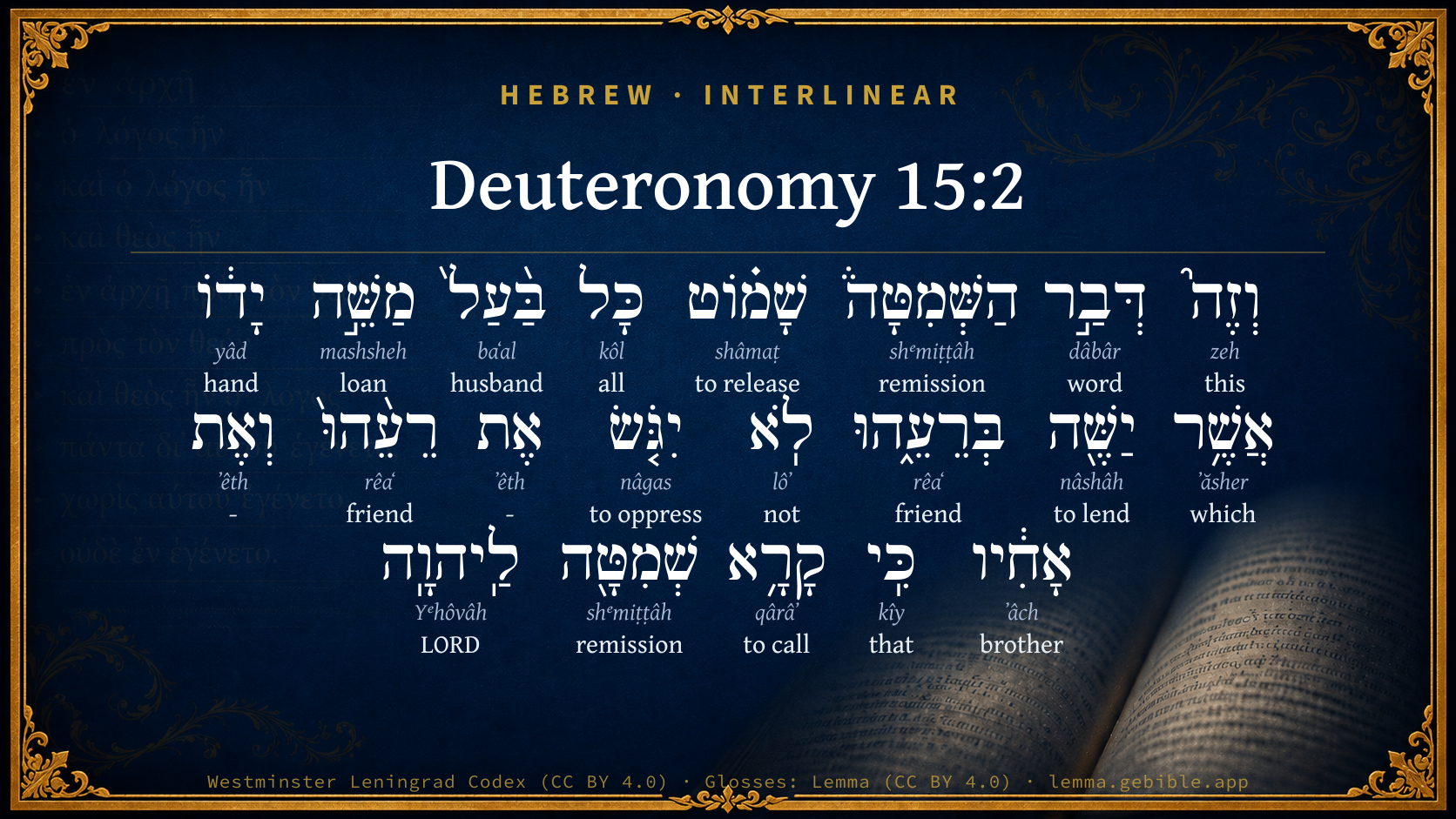
Deuteronomy 15:2

Hebrew (Westminster Leningrad Codex) Deuteronomy 15:2 appears in the Hebrew Old Testament. The text above is from the Westminster Leningrad Codex. Each word links to its Strong’s number, a concise gloss, and parsing drawn from the Open Scriptures Hebrew Bible morphology. Click any word for its full Brown-Driver-Briggs (BDB) entry.
Download image
Cite this verse

Deuteronomy 15:2 (World English Bible). Public Domain. Lemma interlinear Bible study tool, https://lemma.gebible.app/v/deuteronomy/15/2.

Show BibTeX & RIS
BibTeX
RIS
English Translation
This is the manner of the release: every creditor shall release that which he has lent to his neighbor; he shall not exact it of his neighbor and his brother; because Yahweh's release has been proclaimed.
World English Bible · Public Domain
Highlights
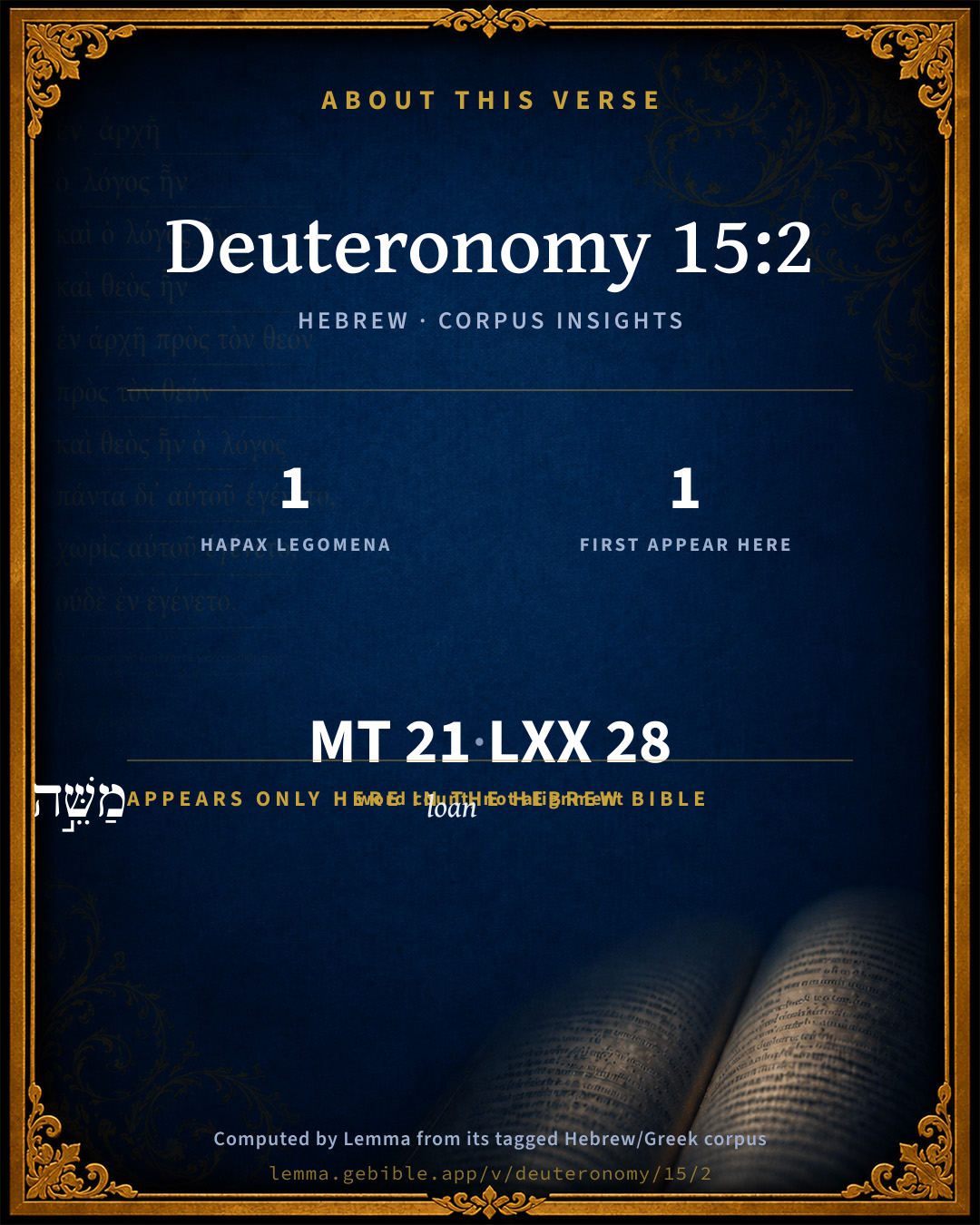
  • 1 hapax legomenon — only here in the Hebrew Bible
  • 1 first appearance in the Hebrew Bible
Full analysis ↓
Download a study sheet

One document with this verse’s original text, its word-by-word gloss line, the meaning frame, cross-references with their text, attributed commentary, and full source and license credits — printable, and it pastes into notes with its structure intact.

This verse Autodidact and up

Study sheet (.html) Plain text (.txt)

A passage Seminary Student

Up to 50 verses in one chapter. A passage sheet keeps up to 6 commentary sources and 12 cross-references per verse, in the order this page ranks them, and says so on the sheet whenever that leaves anything out. Ask for a single verse and you get the Autodidact verse sheet above.

Everything on this page stays free to read, with no account — the sheet is a download of what is already on screen, not access to it.

Want to remove ads? Support Godless Engineer
Compare translations 3

The same verse in 3 English versions, stacked beneath the original-language interlinear above. Click any original word for its lexicon entry.

Each is an independent rendering of the whole verse — the interlinear is not word-aligned to these translations.

Highlighted words mark where these versions differ — a whole-verse word diff, not a word-by-word alignment.

  • World English Bible Public Domain
    This is the manner of the release: every creditor shall release that which he has lent to his neighbor; he shall not exact it of his neighbor and his brother; because Yahweh's release has been proclaimed.
  • King James Version Public Domain
    And this is the manner of the release: Every creditor that lendeth ought unto his neighbor shall release it; he shall not exact it of his neighbor, or of his brother; because it is called the LORD's release.
  • unfoldingWord Literal Text CC BY-SA 4.0
    And this the word of the remission: Every owner of debt shall release his hand that he has loaned to his neighbor; he shall not oppress his neighbor and his brother, because the remission of Yahweh has been proclaimed.

unfoldingWord Literal Text — © unfoldingWord, licensed CC BY-SA 4.0. Word-aligned USFM3 via Door43 (git.door43.org/unfoldingWord/en_ult).

Versions to compare (up to 4)

3 of 4 selected

Show all 18 translations

Every available English version of this verse, each an independent rendering of the whole verse.

  • World English Bible Public Domain
    This is the manner of the release: every creditor shall release that which he has lent to his neighbor; he shall not exact it of his neighbor and his brother; because Yahweh's release has been proclaimed.
  • Berean Standard Bible Public Domain
    This is the manner of remission: Every creditor shall cancel what he has loaned to his neighbor. He is not to collect anything from his neighbor or brother, because the LORD’s time of release has been proclaimed.
  • Majority Standard Bible Public Domain
    This is the manner of remission: Every creditor shall cancel what he has loaned to his neighbor. He is not to collect anything from his neighbor or brother, because the LORD’s time of release has been proclaimed.
  • King James Version Public Domain
    And this is the manner of the release: Every creditor that lendeth ought unto his neighbor shall release it; he shall not exact it of his neighbor, or of his brother; because it is called the LORD's release.
  • American Standard Version (1901) Public Domain
    And this is the manner of the release: every creditor shall release that which he hath lent unto his neighbor; he shall not exact it of his neighbor and his brother; because Jehovah's release hath been proclaimed.
  • Revised Version (1885) Public Domain
    And this is the manner of the release: every creditor shall release that which he hath lent unto his neighbour; he shall not exact it of his neighbour and his brother; because the LORD’S release hath been proclaimed.
  • Geneva Bible (1599) Public Domain
    And this is the maner of the freedome: euery creditour shall quite ye lone of his hand which he hath lent to his neighbour: he shall not aske it againe of his neighbour, nor of his brother: for the yeere of the Lords freedome is proclaimed.
  • Douay-Rheims (1899) Public Domain
    Which shall be celebrated in this order. He to whom any thing is owing from his friend or neighbour or brother, cannot demand it again, because it is the year of remission of the Lord,
  • Young's Literal Translation Public Domain
    and this `is' the matter of the release: Every owner of a loan `is' to release his hand which he doth lift up against his neighbour, he doth not exact of his neighbour and of his brother, but hath proclaimed a release to Jehovah;
  • Literal Standard Version CC BY-SA 4.0
    and this [is] the matter of the release: every owner of a loan [is] to release his hand which he lifts up against his neighbor, he does not exact of his neighbor and of his brother, but has proclaimed a release to YHWH;
  • Unlocked Literal Bible CC BY-SA 4.0
    This is the manner of the release: Every creditor will cancel that which he has lent to his neighbor; he will not demand it from his neighbor or his brother because Yahweh's cancellation of debts has been proclaimed.
  • unfoldingWord Literal Text CC BY-SA 4.0
    And this the word of the remission: Every owner of debt shall release his hand that he has loaned to his neighbor; he shall not oppress his neighbor and his brother, because the remission of Yahweh has been proclaimed.
  • Darby Bible Public Domain
    and this is the manner of the release: Every creditor shall relax his hand from the loan which he hath lent unto his neighbour; he shall not demand it of his neighbour, or of his brother; for a release to Jehovah hath been proclaimed.
  • World Messianic Bible Public Domain
    This is the way it shall be done: every creditor shall release that which he has lent to his neighbor. He shall not require payment from his neighbor and his brother, because the LORD’s release has been proclaimed.
  • Webster's Bible Public Domain
    And this is the manner of the release: Every creditor that lendeth aught to his neighbor shall release it; he shall not exact it of his neighbor, or of his brother; because it is called the LORD'S release.
  • Free Bible Version CC BY-SA 4.0
    This is the way it will work: If you provided a loan to someone you must cancel it. You are not allowed to collect anything from another Israelite, because the Lord's time of debt cancelation has been announced.
  • Bible in Basic English Public Domain
    This is how it is to be done: every creditor is to give up his right to whatever he has let his neighbour have; he is not to make his neighbour, his countryman, give it back; because a general forgiveness has been ordered by the Lord.
  • JPS Tanakh (1917) Public Domain
    And this is the manner of the release: every creditor shall release that which he hath lent unto his neighbour; he shall not exact it of his neighbour and his brother; because the LORD'S release hath been proclaimed.

Literal Standard Version (2020), Covenant Press — licensed CC BY-SA 4.0. Text via the HelloAO Bible API (eBible.org). Unlocked Literal Bible (unfoldingWord) — licensed CC BY-SA 4.0. Text via the HelloAO Bible API (eBible.org). unfoldingWord Literal Text — © unfoldingWord, licensed CC BY-SA 4.0. Word-aligned USFM3 via Door43 (git.door43.org/unfoldingWord/en_ult). Free Bible Version, Dr. Jonathan Gallagher — licensed CC BY-SA 4.0. Text via the HelloAO Bible API (eBible.org).

Word by word

More ways to search: Search by grammar → Find every occurrence → Compare this word →

Practice this passage: Drill this verse → Learn its vocabulary →

מַשֵּׁ֣ה
mashsheh
H4874
“loan of”
Noun, Common, Masculine, Singular, Construct
Part of Speech
Noun
Type
Common
Gender
Masculine
Number
Singular
State
Construct
Full BDB Definition

Origin: from H5383

TWOT: 1427b

loan - of loan released in the 7th year
  1. וְזֶה֮ zeh H2088 “and · this” Conjunction + Pronoun, Demonstrative, Masculine, Singular
  2. דְּבַ֣ר dâbâr H1697 “word of” Noun, Common, Masculine, Singular, Construct
  3. הַשְּׁמִטָּה֒ shᵉmiṭṭâh H8059 “the · remission” Particle, Definite Article + Noun, Common, Feminine, Singular, Absolute
  4. שָׁמ֗וֹט shâmaṭ H8058 “to release” Verb, Qal, Infinitive Absolute
  5. כָּל kôl H3605 “all of” Noun, Common, Masculine, Singular, Construct
  6. בַּ֨עַל֙ baʻal H1167 “husband” Noun, Common, Masculine, Singular, Absolute
  7. יָד֔וֹ yâd H3027 “hand · his” Noun, Common, Both, Singular, Construct + Suffix, Personal, 3rd Person, Masculine, Singular
  8. אֲשֶׁ֥ר ʼăsher H834 “which” Particle, Relative
  9. יַשֶּׁ֖ה nâshâh H5383 “to lend” Verb, Hiphil, Imperfect, 3rd Person, Masculine, Singular
  10. בְּרֵעֵ֑הוּ rêaʻ H7453 “in/at · friend · his” Preposition + Noun, Common, Masculine, Singular, Construct + Suffix, Personal, 3rd Person, Masculine, Singular
  11. לֹֽא lôʼ H3808 “not” Particle, Negative
  12. יִגֹּ֤שׂ nâgas H5065 “to oppress” Verb, Qal, Imperfect, 3rd Person, Masculine, Singular
  13. אֶת ʼêth H853 “-” Particle, Direct Object
  14. רֵעֵ֨הוּ֙ rêaʻ H7453 “friend · his” Noun, Common, Masculine, Singular, Construct + Suffix, Personal, 3rd Person, Masculine, Singular
  15. וְאֶת ʼêth H853 “and · -” Conjunction + Particle, Direct Object
  16. אָחִ֔יו ʼâch H251 “brother · his” Noun, Common, Masculine, Singular, Construct + Suffix, Personal, 3rd Person, Masculine, Singular
  17. כִּֽי kîy H3588 “that” Conjunction
  18. קָרָ֥א qârâʼ H7121 “to call” Verb, Qal, Perfect, 3rd Person, Masculine, Singular
  19. שְׁמִטָּ֖ה shᵉmiṭṭâh H8059 “remission” Noun, Common, Feminine, Singular, Absolute
  20. לַֽיהוָֽה Yᵉhôvâh H3068 “to/for · LORD” Preposition + Noun, Proper

About this verse

These counts appear in no published source. They are computed here, from the morphology-tagged text and Lemma’s own curated glosses. What Lemma adds →

21
words
18
distinct lemmas
Pentateuch
section

Notable vocabulary

1 hapax legomenon — a word that appears only here in the entire Hebrew Bible:

  • מַשֵּׁ֣ה loan H4874

First appearance in Scripture

This word makes its first canonical appearance in the Hebrew Bible here:

  • מַשֵּׁ֣ה loan H4874

Shared distinctive vocabulary

הַשְּׁמִטָּה֒ remission H8059 occurs in 4 verses of the Hebrew Bible. Also found in:

Grammatical profile

  • 4 verbs
  • 11 nouns
  • 1 pronoun
  • 1 conjunction
  • 4 particles

Verb forms

  • שָׁמ֗וֹט Qal · Infinitive Absolute
  • יַשֶּׁ֖ה Hiphil · Imperfect
  • יִגֹּ֤שׂ Qal · Imperfect
  • קָרָ֥א Qal · Perfect

Repetition

Words recur within this verse — often emphatic in Hebrew:

  • הַשְּׁמִטָּה֒ remission H8059 ×2
  • בְּרֵעֵ֑הוּ friend H7453 ×2

Hebrew & Septuagint length

In English translation the verse runs 36 words from the Hebrew and 42 from the Septuagint (LXX English) — closely comparable.

A rough comparison of the two English renderings, which tokenize alike — not a word-level alignment.

Word counts can differ between the Hebrew and the Greek without any difference in meaning — e.g. the Hebrew direct-object marker אֵת has no separate Greek word, and Greek often adds the article ὁ.

In the original languages it is 21 Hebrew tokens and 28 Greek tokens — but the two are counted differently (Hebrew bundles its prefixes and suffixes into one token; the Greek is in lemma form), so that isn’t a like-for-like length.

Cross-references

9

Topical passages linked to Deuteronomy 15:2 in the Treasury of Scripture Knowledge — connected by theme and wording, ordered by reader-vote popularity; previews shown in the World English Bible.

  • Luke 7:42 When they couldn't pay, he forgave them both. Which of them therefore will love him most?"
  • James 2:13 For judgment is without mercy to him who has shown no mercy. Mercy triumphs over judgment.
  • Luke 6:34–38 If you lend to those from whom you hope to receive, what credit is that to you? Even sinners lend to sinners, to receive back as much.
  • Nehemiah 5:7–11 Then I consulted with myself, and contended with the nobles and the rulers, and said to them, You exact usury, everyone of his brother. I held a great assembly against them.
  • Matthew 18:25–35 But because he couldn't pay, his lord commanded him to be sold, with his wife, his children, and all that he had, and payment to be made.
  • Isaiah 58:3 Why have we fasted, [say they], and you don't see? [why] have we afflicted our soul, and you take no knowledge? Behold, in the day of your fast you find [your own] pleasure, and exact all your labors.
  • Amos 8:4–6 Hear this, you who desire to swallow up the needy, And cause the poor of the land to fail,
  • Matthew 6:12 Forgive us our debts, as we also forgive our debtors.
  • Matthew 6:14–15 "For if you forgive men their trespasses, your heavenly Father will also forgive you.

Cross-references courtesy of OpenBible.info (CC BY 4.0).

Hebrew and Greek witnesses Masoretic Hebrew ↔ Greek Septuagint

The same verse in the two great witnesses to the Old Testament, shown verse-for-verse.

These are two independent witnesses, not word-aligned to each other, and the Septuagint is shown in lemma (dictionary) form.

Hebrew Deuteronomy 15:2 Masoretic · Westminster Leningrad Codex

וְזֶה֮ דְּבַ֣ר הַשְּׁמִטָּה֒ שָׁמ֗וֹט כָּל בַּ֨עַל֙ מַשֵּׁ֣ה יָד֔וֹ אֲשֶׁ֥ר יַשֶּׁ֖ה בְּרֵעֵ֑הוּ לֹֽא יִגֹּ֤שׂ אֶת רֵעֵ֨הוּ֙ וְאֶת אָחִ֔יו כִּֽי קָרָ֥א שְׁמִטָּ֖ה לַֽיהוָֽה

This is the manner of the release: every creditor shall release that which he has lent to his neighbor; he shall not exact it of his neighbor and his brother; because Yahweh's release has been proclaimed.

World English Bible · Public Domain

Greek LXX Deuteronomy 15:2 Septuagint · lemma form

καί οὕτως ὁ πρόσταγμα ὁ ἄφεσις ἀποἵημι πᾶς χρέος ἴδιος ὅς ὀφείλω σύ ὁ πλησίον καί ὁ ἀδελφός σύ οὐ ἀποαἰτέω ὅτι ἐπικαλέω ἄφεσις κύριος ὁ θεός σύ

And this is the ordinance of the release: you shall remit every private debt which your neighbor owes you, and you shall not ask payment of it from your brother; for it has been called a release to the Lord your God.

LXX2012 (modern English Septuagint) · Public Domain

Hebrew: Westminster Leningrad Codex (CC BY 4.0). Greek: Septuagint (public domain); English from LXX2012 (modern English Septuagint) (Public Domain). How the Septuagint differs from the Hebrew →

Targum (Aramaic paraphrase)

2

The Targum is the ancient Jewish Aramaic paraphrase of the Hebrew Scriptures — an interpretive translation, not the Hebrew text itself. Onkelos (literal) and Pseudo-Jonathan (expansive) render the Torah, and Jonathan the Prophets. Coverage is partial: where no permissively-licensed English translation exists for a verse, only the Aramaic is shown. This is verse-level text, not a word-by-word alignment to the Hebrew.

  1. Targum Onkelos Torah (Genesis–Deuteronomy)
    וְדֵין פִּתְגַם שְׁמִטְתָא דְתַשְׁמֵט כָּל גְבַר מַרֵי רְשׁוּ דִי יַרְשֵׁי בְּחַבְרֵהּ לָא יִתְבַּע מִן חַבְרֵהּ וּמִן אֲחוּהִי אֲרֵי קְרָא שְׁמִטְתָא קֳדָם יְיָ

    (no public-domain English translation for this verse)

    Targum Onkelos — Aramaic: “Onkelos Genesis” (public domain); “Onkelos Exodus” (public domain); “Onkelos Leviticus” (public domain); “Onkelos Numbers” (public domain); “Onkelos Deuteronomy” (public domain). English: “Sefaria Community Translation” (CC0 1.0 (public-domain dedication)); “J.W. Etheridge. The Targums of Onkelos and Jonathan Ben Uzziel on the Pentateuch. London: Longmans, Green, 1862” (public domain). Text via Sefaria.

  2. Targum Pseudo-Jonathan Torah (Genesis–Deuteronomy)
    וְדֵין אַהֲוָויַת הִלְכַת שְׁמִיטָתָא אַשְׁמִיטוּ כָּל בַּר נַשׁ מָרֵי מְזוֹפְתָּא דְיִזוֹף בְּחַבְרֵיהּ לֵית לֵיהּ רְשׁוּ לִמְדַחֲקָא בְּחַבְרֵיהּ לְמִתְבּוֹעַ אוֹזְפוּתֵיהּ וְלָא מִן אָחוֹי בַּר יִשְרָאֵל אֲרוּם קָרָא בֵית דִּינָא שְׁמִיטָתָא קֳדָם יְיָ

    And this is the indication of the custom of the Release: Every man who is master of a loan, who lendeth to his neighbour, shall give remission. He shall not have power to coerce his neighbour in demanding his loan, nor of his brother, a son of Israel; because the beth din hath published the Release before the Lord.

    Targum Pseudo-Jonathan — Aramaic: “Targum Jonathan on Genesis” (public domain); “Targum Jonathan on Exodus” (public domain); “Targum Jonathan on Leviticus” (public domain); “Targum Jonathan on Numbers” (public domain); “Targum Jonathan on Deuteronomy” (public domain). English: “The Targum of Jonathan ben Uzziel, trans. J. W. Etheridge, London, 1862” (public domain). Text via Sefaria.

Commentary

Notes on Deuteronomy 15:2 from classic Christian and Jewish commentators (each source and its license shown beneath its notes). The classic Christian expositions comment on the surrounding passage and are grouped to its opening verse, so a note may address several verses; the Jewish commentaries on the Tanakh (Rashi and others) are per-verse, so they appear only where the commentator wrote on this verse.

Lemma curates 59 commentaries, every one of them public domain or Creative Commons licensed, each selected and text-cleaned for this edition rather than reprinted as found. About our sources →

Trapp's Complete Commentary

John Trapp

Deu 15:2 And this [is] the manner of the release: Every creditor that lendeth [ought] unto his neighbour shall release [it]; he shall not exact [it] of his neighbour, or of his brother; because it is called the LORD’S release.

Ver. 2. He shall not exact it.] For that seventh year at least, because there was neither sowing nor reaping that year; how then could the poor pay their debts? We must all "put on bowels of mercy, forbearing one another, and forgiving one another," &c. {Col 3:12-13}

John Trapp, A Commentary or Exposition upon All the Books of the Old and New Testament (1647–1656) — public domain. Text from a community e-Sword module.

Joseph Benson's Commentary

Deu 15:2. Every creditor that lendeth aught shall release it — This cannot be meant of money lent to those who had borrowed it for the purchase of lands, trade, or other improvements, and who were able to pay; for nothing could have been more absurd than to have extinguished such debts, whereby the borrower was enriched. But it must be understood of money lent to an Israelite who was in poor circumstances, as appears from verse

4. According to this law, every poor Israelite who had borrowed money, and had not been able to pay it before, should this year be released from it. And though, if he were able, he was bound in conscience to pay it afterward, yet it could not be recovered by law. His brother — This is added to limit the word neighbour, which is more general, unto a brother, in nation and religion, an Israelite. The Lord’s release — Or, a release for the Lord, in obedience to his command, for his honour, and as an acknowledgment of his right in your estates, and of his kindness in giving and continuing them to you.

Joseph Benson's Commentary on the Old and New Testaments (1811–1818) — public domain. Text from a community e-Sword module.

Tyndale Open Study Notes

Tyndale Open Resources

15:2 The time of release was to occur every seventh year across the nation (the Sabbath year, Lev 25:1-7). The time frame followed the calendar rather than the length of the loan arrangement. This meant that the year of release could fall as soon as a year after a loan was made.

Tyndale Open Study Notes — © Tyndale Open Resources, licensed CC BY-SA 4.0. Text via the HelloAO Bible API.

Geneva Bible (1599)

Geneva Bible translators

He shall only release his debtors, which are not able to pay for that year.

Geneva Bible (1599) marginal notes — public domain. Text via Bolls.life.

Jamieson, Fausset & Brown

Robert Jamieson, A. R. Fausset & David Brown

Every creditor that lendeth ought unto his neighbour shall release it--not by an absolute discharge of the debt, but by passing over that year without exacting payment. The relief was temporary and peculiar to that year during which there was a total suspension of agricultural labor.

he shall not exact it . . . of his brother--that is, an Israelite, so called in opposition to a stranger or foreigner.

because it is called the Lord's release--The reason for acquitting a debtor at that particular period proceeded from obedience to the command, and a regard for the honor, of God; an acknowledgment of holding their property of Him, and gratitude for His kindness.

Jamieson, Fausset & Brown — Commentary Critical and Explanatory on the Whole Bible (1871) — public domain (CC PDM 1.0). Text via the HelloAO Bible API.

The Cambridge Bible for Schools and Colleges

gen. ed. J. J. S. Perowne

2. And this is the manner of the release] Lit. the word or law (or as we might say text) of: cp. Deu_19:4 R.V. this is the case of. The following clause is a citation of an older law, as we see further from its phrasing.

every creditor] Lit. every owner (ba‘al cp. Exo_22:14) of a loan of his hand, of anything he has lifted or made over at his own hand.

neighbour] Heb. rçã‘, very seldom used with the Sg. address for fellow-Israelite, and possibly always, as here, in quotations, Deu_19:4 f., Deu_23:24 f., Deu_24:10. The synonymous term, brother, is used by the writer of the Sg. about 25 times, and has probably been inserted by him in this citation (Steuern.).

the Lord’s release] by His order, or for His sake.

hath been proclaimed] which shows that this year is the same for the whole nation.

The Cambridge Bible for Schools and Colleges (gen. ed. J. J. S. Perowne; Cambridge University Press, 1878–1918) — public domain. Text from a community e-Sword module.

John Gill's Exposition

And this is the manner of the release,.... Or the rules to be observed in making it:

every creditor that lendeth ought unto his neighbour shall release it; that is, forgive the debt, or free the debtor from any obligation to payment. Some think this was only a release of debts for this year, in which there was no ploughing nor sowing, and so a poor man could not be in any circumstances to pay his debts, but might be exacted afterwards; but it rather seems to be a full release, so as the payment of them might not be demanded, neither this year nor afterwards; indeed, if a person afterwards should be in a capacity to pay his debts, he would be obliged, in conscience, duty, and honour, to pay them, though no reserve was made in this law, which nowhere appears:

he shall not exact it of his neighbour, or of his brother: he might receive it, if payment was offered, but he might not demand it, or sue for it; or give his neighbour or brother, whether in a natural or religious sense, any trouble about it: the Targum of Jonathan paraphrases it,"his brother, an Israelite;''one of the same nation and religion with him, though he might not be related in the bonds of consanguinity:

because it is called the Lord's release; appointed and commanded by him, and was for his honour and glory, as a God gracious and merciful to the poor, and beneficent to those creditors; and which was proclaimed in his name, by the civil magistrate, according to his order; so the Targum of Jonathan,"because the house of judgment, or the sanhedrim, proclaimed it a release before the Lord.''Now this was typical of a release of debts, or of forgiveness of sins, which is an act of God's grace through Christ, and for his sake. Sins are called debts, not what men owe to God, for then it would be right to commit them, and they might be committed with impunity, yea, with praise, since it would be doing what is fit and right, and well pleasing to God; but men are debtors to fulfil the law, and in case of failure, or a breach of it, are bound to the debt of punishment; and these debts are very numerous, and men are incapable of paying them: and by a release of these is meant not a liberty of sinning, nor a freedom from the being or bondage of sin, but from the guilt of it, and from obligation to punishment for it; and is properly the forgiveness of sin, which is expressed by various phrases, as a non-imputation, a non-remembrance, a covering, blotting out, and removing of sin, and here typically a release of debts; see Mat 6:12, and God only can make it; he is the creditor, sin is committed against him, and he only can forgive it, which he does freely, fully, and at once, see Luk 7:41.

John Gill's Exposition of the Whole Bible (1746–1763) — public domain (CC PDM 1.0). Text via the HelloAO Bible API.

Haydock's Catholic Bible Commentary

Again. Hebrew does not mention friend. (Haydock) --- "He shall not exact it, (or urge) his neighbour or his brother, because," &c. Whence Cajetan gathers, that debts might be demanded after the expiration of the seventh year, on which the products of the earth did not enable the Jews to pay any thing. Grotius also asserts, that perpetual debts might be required; and Menoch, includes things lent under the same regulation. But all debts became extinct as soon as the seventh year commenced; (ver. 9.; Calmet) at least they could not be demanded till it was expired; though things merely lent, might be taken back. (Du Hamel)

George Leo Haydock (1774–1849), Haydock's Catholic Family Bible and Commentary, 1859 edition — public domain. Excludes Psalms (Douay-Rheims chapter numbering differs from Protestant) and Deuterocanonical books (Catholic canon only).

Matthew Poole's English Annotations

Shall release it; not absolutely and finally forgive it, but forbear it for that year, as may appear,

1. Because the word doth not signify a total dismission or acquitting, but an intermission for a time, as Exo 23:11. He shall not exact it, as it here follows, i.e. force it from him by course of law or otherwise, to wit, that year, which is easily understood out of the whole context.

2. Because the person releasing is called a creditor, and his communicating to him what he desires and needs is called lending here and Deu 15:8; whereas it were giving, and the person giving it were no creditor, but a donor, if it were to be wholly forgiven to him.

3. Because the reason of this law is temporary and peculiar to that year, wherein there being no sowing nor reaping, they were not in a capacity to pay their debts.

4. Because it seems unjust and unreasonable, and contrary to other scriptures, which require men to pay what they borrow, as Psa 37:21. Yet I deny not that in case of poverty the debt was to be forgiven; but that was not by virtue of this law, but of other commands of God.

Or of his brother: this is added to explain and limit the word

neighbour, which is more general, unto a brother, to wit, in nation and religion; to an Israelite, who is opposed to a foreigner, Deu 15:3, Heb. and a brother, for that is a brother, the particle and being oft so used, as Gen 13:15, &c.

The Lord’s release; or, a release to or for the Lord, in obedience to his command, for his honour, and as an acknowledgment of his right in your estates, and of his kindness in giving and continuing them to you. If you are unwilling to release this for your brother’s sake, yet do it for God’s sake, your Lord and the chief Creditor.

Matthew Poole's English Annotations on the Holy Bible (1683–1685) — public domain. Text from a community e-Sword/MySword module.

Whedon's Commentary on the Bible

Daniel D. Whedon

2. Every creditor… shall release — This must be understood as a release from compulsory payment for that year, not an entire remission of the debt.

Daniel D. Whedon (gen. ed.), Commentary on the Old and New Testaments (1874–1909) — public domain. Text from a community e-Sword module.

The Pulpit Commentary

Creditor; literally, master of the loan of his hand, equivalent to owner of what his hand has lent to another. Comp. the expression, "what was laid in his hand". (Lev_5:2; Authorized Version, "in fellowship,"; Lev_6:2 and Neh_10:32, "the debt of every hand" (Authorized Version), "the exaction of every debt Neighbor; here, fellow-Israelite. Exact it of his neighbor; literally, press or urge his neighbor, i.e . to pay. It is called the Lord"s release; rather, a release for Jehovah is proclaimed; the sabbatical year, like the year of jubilee, was proclaimed, and it was for Jehovah, in his honor, and in accordance with his ordinance.

The Pulpit Commentary (1880–1919), ed. H.D.M. Spence-Jones & Joseph S. Exell — public domain. Text from a community e-Sword module.

John Wesley's Explanatory Notes

Every creditor - Here is, a law for poor, insolvent debtors. Every seventh year was a year of release, when among other acts of grace, this was one, that every Israelite, who had borrowed money, and had not been able to pay it before, should this year be released from it. And tho' if he was able, he was bound in conscience to pay it afterwards, yet it could not be recovered by law. His brother - This is added to limit the word neighbour, which is more general, unto a brother, in nation and religion, an Israelite. The Lord's release - Or, a release for the Lord, in obedience to his command, for his honour, and as an acknowledgment of his right in your estates, and of his kindness in giving and continuing them to you.

John Wesley, Explanatory Notes Upon the Whole Bible (1754–1765) — public domain. Text via the GEBible commentary corpus.

Rashi

Rabbi Shlomo Yitzchaki (Rashi)

שמוט כל בעל משה ידו means as much as שמוט את ידו של כל בעל משה THERE SHALL BE A RELAXING OF THE HAND OF EVERY CREDITOR.

Rashi on the Tanakh — English translations: “The Judaica Press complete Tanach with Rashi, translated by A. J. Rosenberg” (CC BY 4.0); “Pentateuch with Rashi's commentary by M. Rosenbaum and A.M. Silbermann, 1929-1934” (public domain); “The Metsudah Tanach series, Lakewood, N.J” (CC BY 4.0); and “The Book of Joshua, Metsudah Publications, 1997” (CC BY 4.0). Text via Sefaria.

Lesson kit

Teaching starters — assembled from the data on this page, not authored interpretation. Every prompt links to the verse data it draws on. Edit before teaching.

Deuteronomy, in the Pentateuch, opens this verse with 21 words (18 distinct Hebrew lemmas). Its most distinctive word is mashsheh (“loan”). A historical commentator’s framing appears above. Read the whole chapter for the surrounding context.

Discussion questions

  1. What does “loan” (mashsheh) contribute to the verse as a whole?
  2. 1 word here appears nowhere else in the Hebrew Bible. Why might the author reach for such rare wording?
  3. This is the first place “loan” appears in Scripture (first appears here). What does its debut here establish?
  4. How does Deuteronomy 15:1, which shares the word «remission», read alongside this verse?
  5. What does the repetition of “remission” (2× in this one verse) do in this verse?
  6. The translations on this page render this verse differently — a whole-verse word diff, not a word-by-word alignment. What might account for the different wordings?
  7. «שָׁמ֗וֹט» is a Qal Infinitive Absolute verb. How does that grammatical form shape the action described?
  8. Compare how Trapp's Complete Commentary and Joseph Benson's Commentary read this verse. Where do they agree or differ?

Things to notice

  • 1 word in this verse appears nowhere else in the Hebrew Bible.
  • 1 word makes its first canonical appearance in Scripture here.
  • This verse counts 21 Hebrew ↔ 28 Greek words.
  • These translations choose different wording for 21 words in this verse.
  • “remission” occurs 2× in this single verse.

Reading settings

Reading text

Shown beneath each verse's original-language words.

Old Testament
Old Testament edition

Read the OT as the Masoretic Hebrew (MT) or the Greek Septuagint (LXX).

English shown for the Greek Septuagint (in the Hebrew ↔ Greek comparison).

Comparing translations? Open the Compare panel on any verse page to stack up to four side by side.