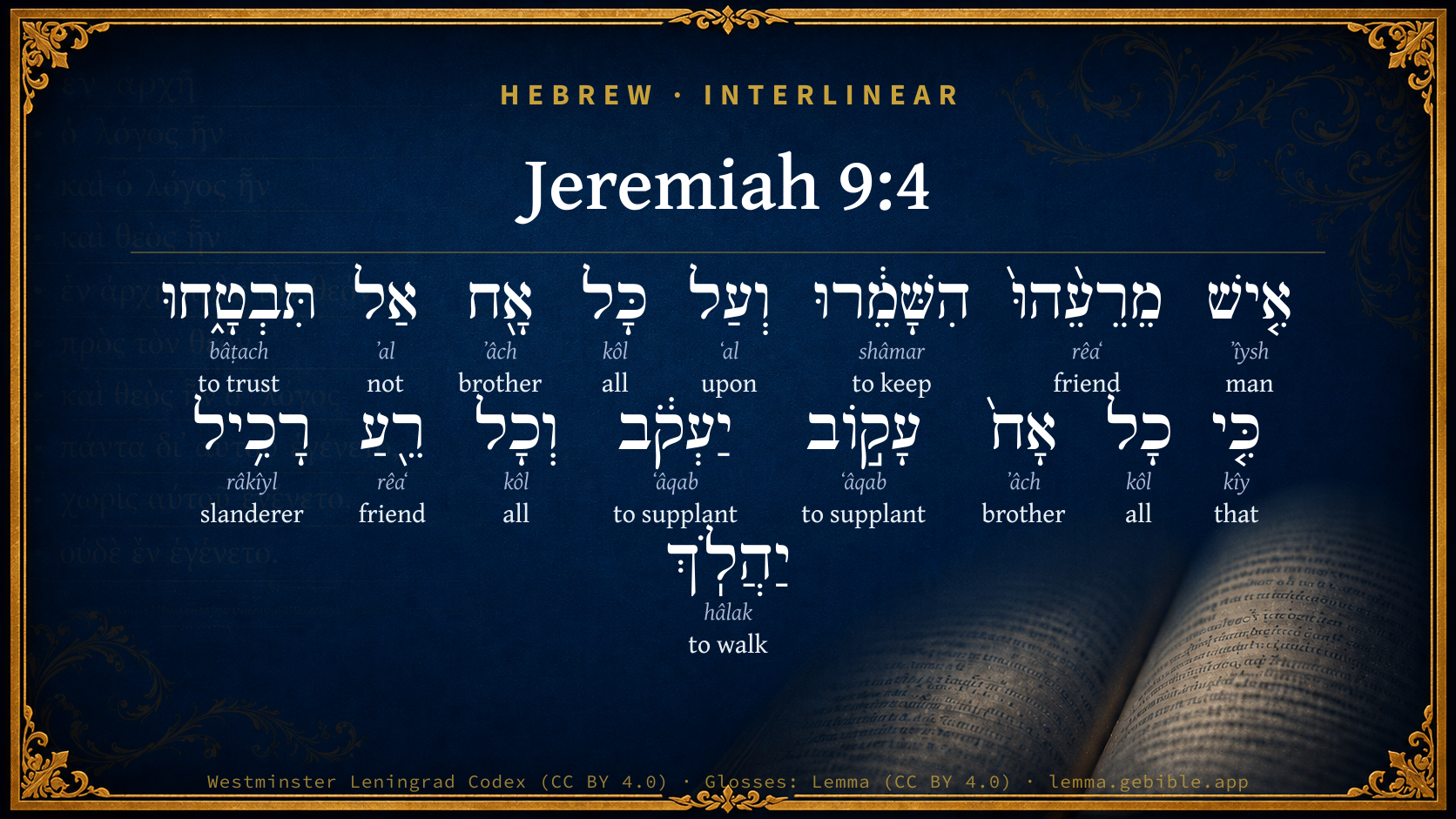
Jeremiah 9:4

Hebrew (Westminster Leningrad Codex) Jeremiah 9:4 appears in the Hebrew Old Testament. The text above is from the Westminster Leningrad Codex. Each word links to its Strong’s number, a concise gloss, and parsing drawn from the Open Scriptures Hebrew Bible morphology. Click any word for its full Brown-Driver-Briggs (BDB) entry.
Download image
Cite this verse

Jeremiah 9:4 (World English Bible). Public Domain. Lemma interlinear Bible study tool, https://lemma.gebible.app/v/jeremiah/9/4.

Show BibTeX & RIS
BibTeX
RIS
English Translation
Take you heed everyone of his neighbor, and don't you trust in any brother; for every brother will utterly supplant, and every neighbor will go about with slanders.
World English Bible · Public Domain
Download a study sheet

One document with this verse’s original text, its word-by-word gloss line, the meaning frame, cross-references with their text, attributed commentary, and full source and license credits — printable, and it pastes into notes with its structure intact.

This verse Autodidact and up

Study sheet (.html) Plain text (.txt)

A passage Seminary Student

Up to 50 verses in one chapter. A passage sheet keeps up to 6 commentary sources and 12 cross-references per verse, in the order this page ranks them, and says so on the sheet whenever that leaves anything out. Ask for a single verse and you get the Autodidact verse sheet above.

Everything on this page stays free to read, with no account — the sheet is a download of what is already on screen, not access to it.

Want to remove ads? Support Godless Engineer
Compare translations 3

The same verse in 3 English versions, stacked beneath the original-language interlinear above. Click any original word for its lexicon entry.

Each is an independent rendering of the whole verse — the interlinear is not word-aligned to these translations.

Highlighted words mark where these versions differ — a whole-verse word diff, not a word-by-word alignment.

  • World English Bible Public Domain
    Take you heed everyone of his neighbor, and don't you trust in any brother; for every brother will utterly supplant, and every neighbor will go about with slanders.
  • King James Version Public Domain
    Take ye heed every one of his neighbour, and trust ye not in any brother: for every brother will utterly supplant, and every neighbour will walk with slanders.
  • unfoldingWord Literal Text CC BY-SA 4.0
    Let each one take heed to his neighbor, and do not trust any brother, for every brother deceiving he deceives, and every neighbor walks slander.

unfoldingWord Literal Text — © unfoldingWord, licensed CC BY-SA 4.0. Word-aligned USFM3 via Door43 (git.door43.org/unfoldingWord/en_ult).

Versions to compare (up to 4)

3 of 4 selected

Show all 18 translations

Every available English version of this verse, each an independent rendering of the whole verse.

  • World English Bible Public Domain
    Take you heed everyone of his neighbor, and don't you trust in any brother; for every brother will utterly supplant, and every neighbor will go about with slanders.
  • Berean Standard Bible Public Domain
    “Let everyone guard against his neighbor; do not trust any brother, for every brother deals craftily, and every friend spreads slander.
  • Majority Standard Bible Public Domain
    “Let everyone guard against his neighbor; do not trust any brother, for every brother deals craftily, and every friend spreads slander.
  • King James Version Public Domain
    Take ye heed every one of his neighbour, and trust ye not in any brother: for every brother will utterly supplant, and every neighbour will walk with slanders.
  • American Standard Version (1901) Public Domain
    Take ye heed every one of his neighbor, and trust ye not in any brother; for every brother will utterly supplant, and every neighbor will go about with slanders.
  • Revised Version (1885) Public Domain
    Take ye heed every one of his neighbour, and trust ye not in any brother: for every brother will utterly supplant, and every neighbour will go about with slanders.
  • Geneva Bible (1599) Public Domain
    Let euery one take heede of his neighbour, and trust you not in any brother: for euery brother will vse deceite, and euery friend will deale deceitfully,
  • Douay-Rheims (1899) Public Domain
    Let every man take heed of his neighbor, and let his not trust in any brother of his: for every brother will utterly supplant, and every friend will walk deceitfully.
  • Young's Literal Translation Public Domain
    Each of his friend -- beware ye, And on any brother, do not trust, For every brother doth utterly supplant, For every friend slanderously doth walk,
  • Literal Standard Version CC BY-SA 4.0
    “You each beware of his friend, || And do not trust any brother, || For every brother utterly supplants, || For every friend slanderously walks,
  • Unlocked Literal Bible CC BY-SA 4.0
    Each of you, be on guard against your neighbor and do not trust in any brother. For every brother is certainly a deceiver, and every neighbor walks in slander.
  • unfoldingWord Literal Text CC BY-SA 4.0
    Let each one take heed to his neighbor, and do not trust any brother, for every brother deceiving he deceives, and every neighbor walks slander.
  • Darby Bible Public Domain
    Take ye heed every one of his friend, and confide not in any brother; for every brother only supplanteth, and every friend goeth about with slander.
  • World Messianic Bible Public Domain
    “Everyone beware of his neighbor, and don’t trust in any brother; for every brother will utterly supplant, and every neighbor will go around like a slanderer.
  • Webster's Bible Public Domain
    Take ye heed every one of his neighbor, and trust ye not in any brother: for every brother will utterly supplant, and every neighbor will walk with slanders.
  • Free Bible Version CC BY-SA 4.0
    Everyone, watch out for your friends! Don't even trust your brother! Every brother is deceitful, and every friend slanders other people.
  • Bible in Basic English Public Domain
    Let everyone keep watch on his neighbour, and put no faith in any brother: for every brother will certainly be tricking his brother, and every neighbour will go about saying evil.
  • JPS Tanakh (1917) Public Domain
    (9-3) Take ye heed every one of his neighbour, and trust ye not in any brother; for every brother acteth subtly, and every neighbour goeth about with slanders.

Literal Standard Version (2020), Covenant Press — licensed CC BY-SA 4.0. Text via the HelloAO Bible API (eBible.org). Unlocked Literal Bible (unfoldingWord) — licensed CC BY-SA 4.0. Text via the HelloAO Bible API (eBible.org). unfoldingWord Literal Text — © unfoldingWord, licensed CC BY-SA 4.0. Word-aligned USFM3 via Door43 (git.door43.org/unfoldingWord/en_ult). Free Bible Version, Dr. Jonathan Gallagher — licensed CC BY-SA 4.0. Text via the HelloAO Bible API (eBible.org).

Word by word

More ways to search: Search by grammar → Find every occurrence → Compare this word →

Practice this passage: Drill this verse → Learn its vocabulary →

עָק֣וֹב
ʻâqab
H6117
“to supplant”
Verb, Qal, Infinitive Absolute
Part of Speech
Verb
Stem
Qal
Form
Infinitive Absolute
Full BDB Definition

Origin: a primitive root

TWOT: 1676

to supplant, circumvent, take by the heel, follow at the heel, assail insidiously, overreach - (Qal) to supplant, overreach, attack at the heel - (Piel) to hold back
  1. אִ֤ישׁ ʼîysh H376 “man” Noun, Common, Masculine, Singular, Absolute
  2. מֵרֵעֵ֨הוּ֙ rêaʻ H7453 “from · friend · his” Preposition + Noun, Common, Masculine, Singular, Construct + Suffix, Personal, 3rd Person, Masculine, Singular
  3. הִשָּׁמֵ֔רוּ shâmar H8104 “keep” Verb, Niphal, Imperative, 2nd Person, Masculine, Plural
  4. וְעַל ʻal H5921 “and · upon” Conjunction + Preposition
  5. כָּל kôl H3605 “all of” Noun, Common, Masculine, Singular, Construct
  6. אָ֖ח ʼâch H251 “brother” Noun, Common, Masculine, Singular, Absolute
  7. אַל ʼal H408 “not” Particle, Negative
  8. תִּבְטָ֑חוּ bâṭach H982 “to trust” Verb, Qal, Jussive, 2nd Person, Masculine, Plural
  9. כִּ֤י kîy H3588 “that” Conjunction
  10. כָל kôl H3605 “all of” Noun, Common, Masculine, Singular, Construct
  11. אָח֙ ʼâch H251 “brother” Noun, Common, Masculine, Singular, Absolute
  12. יַעְקֹ֔ב ʻâqab H6117 “to supplant” Verb, Qal, Imperfect, 3rd Person, Masculine, Singular
  13. וְכָל kôl H3605 “and · all of” Conjunction + Noun, Common, Masculine, Singular, Construct
  14. רֵ֖עַ rêaʻ H7453 “friend” Noun, Common, Masculine, Singular, Absolute
  15. רָכִ֥יל râkîyl H7400 “slanderer” Noun, Common, Masculine, Singular, Absolute
  16. יַהֲלֹֽךְ hâlak H1980 “to walk” Verb, Qal, Imperfect, 3rd Person, Masculine, Singular

About this verse

These counts appear in no published source. They are computed here, from the morphology-tagged text and Lemma’s own curated glosses. What Lemma adds →

17
words
12
distinct lemmas
Prophets
section

Notable vocabulary

The rarest word here is עָק֣וֹב to supplant H6117 — appearing just 5 times in the whole Hebrew Bible.

Shared distinctive vocabulary

עָק֣וֹב to supplant H6117 occurs in 4 verses of the Hebrew Bible. Also found in:

Grammatical profile

  • 5 verbs
  • 9 nouns
  • 1 preposition
  • 1 conjunction
  • 1 particle

Verb forms

  • הִשָּׁמֵ֔רוּ Niphal · Imperative
  • תִּבְטָ֑חוּ Qal · Jussive
  • עָק֣וֹב Qal · Infinitive Absolute
  • יַעְקֹ֔ב Qal · Imperfect
  • יַהֲלֹֽךְ Qal · Imperfect

Repetition

Words recur within this verse — often emphatic in Hebrew:

  • כָּל all H3605 ×3
  • מֵרֵעֵ֨הוּ֙ friend H7453 ×2
  • אָ֖ח brother H251 ×2
  • עָק֣וֹב to supplant H6117 ×2

Hebrew & Septuagint length

In the original languages it is 17 Hebrew tokens and 22 Greek tokens — but the two are counted differently (Hebrew bundles its prefixes and suffixes into one token; the Greek is in lemma form), so that isn’t a like-for-like length.

Cross-references

21

Topical passages linked to Jeremiah 9:4 in the Treasury of Scripture Knowledge — connected by theme and wording, ordered by reader-vote popularity; previews shown in the World English Bible.

  • Micah 7:5–6 Don't trust in a neighbor. Don't put confidence in a friend. With the woman lying in your embrace, Be careful of the words of your mouth!
  • Proverbs 26:24–25 A malicious man disguises himself with his lips, But he harbors evil in his heart.
  • Psalms 12:2–3 Everyone lies to his neighbor. They speak with flattering lips, and with a double heart.
  • Leviticus 19:16 "'You shall not go up and down as a slanderer among your people; neither shall you stand against the life of your neighbor. I am Yahweh.
  • Proverbs 10:18 He who hides hatred has lying lips. He who utters a slander is a fool.
  • Proverbs 25:18 A man who gives false testimony against his neighbor Is like a club, a sword, or a sharp arrow.
  • Jeremiah 6:28 They are all grievous rebels, going about with slanders; they are brass and iron: they all of them deal corruptly.
  • Psalms 15:3 He who doesn't slander with his tongue, Nor does evil to his friend, Nor casts slurs against his fellow man;
  • Proverbs 6:16 There are six things which Yahweh hates; Yes, seven which are an abomination to him:
  • Matthew 10:21 "Brother will deliver up brother to death, and the father his child. Children will rise up against parents, and cause them to be put to death.
  • Genesis 27:35–36 He said, "Your brother came with deceit, and has taken away your blessing."
  • Genesis 32:28 He said, "Your name will no longer be called 'Jacob,' but, 'Israel,' for you have fought with God and with men, and have prevailed."
  • Proverbs 6:19 A false witness who utters lies, And he who sows discord among brothers.
  • Jeremiah 12:6 For even your brothers, and the house of your father, even they have dealt treacherously with you; even they have cried aloud after you: don't believe them, though they speak beautiful words to you.
  • Ezekiel 22:9 Slanderous men have been in you to shed blood; and in you they have eaten on the mountains: in the midst of you they have committed lewdness.
  • 1 Peter 2:1–2 Putting away therefore all wickedness, all deceit, hypocrisies, envies, and all evil speaking,
  • Psalms 55:11–12 Destructive forces are within her. Threats and lies don't depart from her streets.
  • Matthew 10:17 But beware of men: for they will deliver you up to councils, and in their synagogues they will scourge you.
  • Matthew 10:34–35 "Don't think that I came to send peace on the earth. I didn't come to send peace, but a sword.
  • Luke 21:16 You will be handed over even by parents, brothers, relatives, and friends. Some of you they will cause to be put to death.
  • 1 Thessalonians 4:6 that no one should take advantage of and wrong a brother or sister in this matter; because the Lord is an avenger in all these things, as also we forewarned you and testified.

Cross-references courtesy of OpenBible.info (CC BY 4.0).

Hebrew and Greek witnesses Masoretic Hebrew ↔ Greek Septuagint

The same verse in the two great witnesses to the Old Testament, shown verse-for-verse.

These are two independent witnesses, not word-aligned to each other, and the Septuagint is shown in lemma (dictionary) form.

Hebrew Jeremiah 9:4 Masoretic · Westminster Leningrad Codex

אִ֤ישׁ מֵרֵעֵ֨הוּ֙ הִשָּׁמֵ֔רוּ וְעַל כָּל אָ֖ח אַל תִּבְטָ֑חוּ כִּ֤י כָל אָח֙ עָק֣וֹב יַעְקֹ֔ב וְכָל רֵ֖עַ רָכִ֥יל יַהֲלֹֽךְ

Take you heed everyone of his neighbor, and don't you trust in any brother; for every brother will utterly supplant, and every neighbor will go about with slanders.

World English Bible · Public Domain

Greek LXX Structure differs

In the Septuagint, Jeremiah is about an eighth shorter than the Hebrew and arranges its material differently — the Oracles Against the Nations (Hebrew chapters 46–51) appear in the middle of the Greek book, after 25:13. Because the chapter and verse boundaries do not line up, a verse-for-verse comparison with the Hebrew is not shown.

A verse-for-verse comparison isn’t shown here because the chapters and verses don’t line up. Switch to the LXX edition with the MT / LXX toggle above to read the Greek directly.

Hebrew: Westminster Leningrad Codex (CC BY 4.0). Greek: Septuagint (public domain); English from a public-domain English Septuagint. How the Septuagint differs from the Hebrew →

Targum (Aramaic paraphrase)

1

The Targum is the ancient Jewish Aramaic paraphrase of the Hebrew Scriptures — an interpretive translation, not the Hebrew text itself. Onkelos (literal) and Pseudo-Jonathan (expansive) render the Torah, and Jonathan the Prophets. Coverage is partial: where no permissively-licensed English translation exists for a verse, only the Aramaic is shown. This is verse-level text, not a word-by-word alignment to the Hebrew.

  1. Targum Jonathan Prophets (Joshua–Malachi)
    וּגְבַר בְּחַבְרֵיהּ מְשַׁקְרִין וְקוּשְׁטָא לָא מְמַלְלִין אֲלִיפוּ לִישָׁנְהוֹן פִּתְגָמֵי שְׁקַר אִיטַפְשׁוּ טְעוֹ:

    (no public-domain English translation for this verse)

    Targum Jonathan — Aramaic: “Mikraot Gedolot” (public domain). English: “Sefaria Community Translation” (CC0 1.0 (public-domain dedication)); “London "Chaldee Paraphrase," 1871” (public domain). Text via Sefaria.

Commentary

Notes on Jeremiah 9:4 from classic Christian and Jewish commentators (each source and its license shown beneath its notes). The classic Christian expositions comment on the surrounding passage and are grouped to its opening verse, so a note may address several verses; the Jewish commentaries on the Tanakh (Rashi and others) are per-verse, so they appear only where the commentator wrote on this verse.

Lemma curates 59 commentaries, every one of them public domain or Creative Commons licensed, each selected and text-cleaned for this edition rather than reprinted as found. About our sources →

Trapp's Complete Commentary

John Trapp

Jer 9:4 Take ye heed every one of his neighbour, and trust ye not in any brother: for every brother will utterly supplant, and every neighbour will walk with slanders.

Ver. 4. Take ye heed every one of his neighbour.] Since there is scarce any to be trusted. The poets tell us, that when Pallas had taught people to build a house, Momus found this fault with it, that it was fixed to a place and not set upon wheels; to the end that if men liked not their neighbourhood, they might remove at pleasure. A good neighbour is a rare bird. {a}

And trust ye not in any brother.] See Mic 7:5-6, with the notes.

For every brother will utterly supplant.] {b} Singula verba hic habent pondus et pathos ingens. Here each word hath its weight, each syllable its substance.

{a} Non hospes ab hospite tutus. No guest is entertained by a host. - Ovid.

{b} Fratrum quoque gratia rata est. - Ovid.

John Trapp, A Commentary or Exposition upon All the Books of the Old and New Testament (1647–1656) — public domain. Text from a community e-Sword module.

Joseph Benson's Commentary

Jer 9:4-6. Take ye heed every one of his neighbour — Or, of his friend, as רעהוrather signifies; of him who pretends friendship to him, or whom he has befriended. And trust ye not in a brother — Against whom you must stand as much upon your guard as if you were dealing with a stranger. For every brother will utterly supplant — Will deceive, overreach, and take all possible advantage of his nearest relation; and every neighbour — Or friend, rather, as before; will walk with slanders — Will not care what ill he says of another, though never so false. The Hebrew, רכיל יהלךְ, is properly, will go about as a detracter, or calumniator, namely, carrying slanders with him from house to house. This is a strong description of the falsehood and calumny which universally prevailed among them. And weary themselves to commit iniquity — They are so inclined and enslaved to iniquity, that they not only commit it when they can do it easily, but when the commission of it is attended with difficulty; for they take more pains to carry on their ill designs than the practice of truth and integrity would cost them. Thy habitation is in the midst of deceit — That is, all about thee are addicted to it, therefore stand upon thy guard. They are God’s words to the prophet. If all around us are false and deceitful, it concerns us to beware of them, and to be wise as serpents. Through deceit they refuse to know me, saith the Lord — “The knowledge of God, which is true religion, is incompatible with the practice of any wickedness. And therefore it is natural enough for those that are resolved at all events to abide in their evil courses, to endeavour, if possible, to divest themselves of all religious principles, which, if insufficient to restrain, will be sure at least to be very troublesome to them.”

Joseph Benson's Commentary on the Old and New Testaments (1811–1818) — public domain. Text from a community e-Sword module.

Tyndale Open Study Notes

Tyndale Open Resources

9:4-6 The lie of idolatry was at the root of an entire culture of deceit. • The word brother, as a synonym for neighbor, indicates that even the closest relationships were polluted with fraud.

Tyndale Open Study Notes — © Tyndale Open Resources, licensed CC BY-SA 4.0. Text via the HelloAO Bible API.

Geneva Bible (1599)

Geneva Bible translators

Meaning, that all were corrupt, and none could find an honest man.

Geneva Bible (1599) marginal notes — public domain. Text via Bolls.life.

Jamieson, Fausset & Brown

Robert Jamieson, A. R. Fausset & David Brown

supplant--literally, "trip up by the heel" (Hos 12:3).

walk with slanders-- (Jer 6:28).

Jamieson, Fausset & Brown — Commentary Critical and Explanatory on the Whole Bible (1871) — public domain (CC PDM 1.0). Text via the HelloAO Bible API.

John Calvin's Commentaries

In this verse the Prophet describes the extreme wickedness of the people. For though sometimes thefts, robberies, frauds, slaughters, perjuries, sorceries prevail, yet some regard for near relations remains; but it is monstrous when all relative affections are destroyed. As then, even in the most wicked, there remain some natural affections, called storgoe by philosophers, it follows, that men depart wholly from nature and become wild beasts, when these no longer exist. This is the import of what is here said.

There is a similar passage in Micah 7:5, 6. The idea is there indeed more fully expanded; for the Prophet adds,

“From her who sleeps in thy bosom guard the doors of thy mouth; for the son lies in wait for his father, and the daughter delivers up her mother to death; and the chief enemies of man are his own domestics.”

The prophets then mainly agree in shewing, that there was no humanity left among flmm; for the son, forgetful of his duty, rose up against his father, and every one was perfidious towards his own friend, and a brother spared not his own brother.

Let a man then guard himself This is not an admonition, as though the Prophet exhorted men to be wary; but he only shews that there was no fidelity; for every one was perfidious and unfaithful towards his own friend, and even a brother acted unjustly towards his own brother. It hence follows, that the Jews are charged with being natural monsters; for they were deservedly objects of detestation, when they cast aside every care for their own blood, and as far as they could, destroyed everything like humanity. He says that brothers by supplanting supplanted, that is, craftily deceived and circumvented their own brothers. The verb עקבokob, is to be taken mttaphorically; it is derived from the heel of the foot, and means to oppress the simple by secret arts. He says also, that all friends acted fraudulently. Of this kind of speaking we have spoken on Jeremiah 6:28; for we found there the same complaint; and the Prophet then said the Jews were like iron and brass, because they had hardened themselves so as to be capable of any cruelty. This sort of speaking often occurs, when the word רכיל, rekil, is connected with the verb הלך elak; and they who are the most learned in the language say, that this word is never found in Scripture but in connection with the verb to go or to walk. They hence conclude that some particular person is meant, that is, one who goes about veiled or deceitfully, and rambles and runs here and there, that he may find some opportunity of deceiving and cheating. It cannot be taken here for slandering, as we have also stated on chapter the sixth: it is too unmeaning. It is found indeed in this sense in Leviticus 19:16,

“Go not about a slanderer among thy people;”

where some render it a whisperer. But the Prophet no doubt condemns here the frauds and deceitful crafts, by which they deceived and cheated one another: for רכל, recal signifies a merchant; and as it is often the case that traders act cunningly and practice crafty artifices, the Hebrews call that man רכיל racal, fraudulent and wickedly crafty, whose object is to deceive and cheat. And we see that this is the meaning in this place, as it designates those who circumvented one another: for the Prophet says, that they were foolish who trusted in brothers or friends; and he gives the reason, because brothers supplanted one another, and friends went about fraudulently. It follows —

John Calvin's Commentaries (1540-1563) — public domain. Text from the Calvin Translation Society English edition (1840s-50s) via the Christian Classics Ethereal Library (ccel.org). Calvin's coverage is partial (roughly two-thirds of the Bible); uncommented books and verses are honest gaps, never fabricated. The 19th-century editor's footnotes and remarks are omitted so the notes are faithfully Calvin's own voice.

Ellicott's Commentary for English Readers

(4) Take ye heed . . .—The extreme bitterness of the prophet’s words is explained in part by what we read afterwards of his personal history (Jer_12:6; Jer_18:18). Then, as at other times, a man’s foes were those of his own household (Mat_10:36).

Every brother will utterly supplant.—The word is that which gave the patriarch his significant name of Jacob, the supplanter (Gen_25:26; Gen_27:36). Jeremiah seems to say that the people have forfeited their claims to the name of the true Israel. Every brother Israelite is found to be a thorough-paced Jacob. The adverb “utterly” expresses the force of the Hebrew reduplication of the verb.

Will walk with slanders.—Better, walketh a slanderer.

A Bible Commentary for English Readers, edited by Charles John Ellicott (1878–1897) — public domain. Text from a community e-Sword module.

The Cambridge Bible for Schools and Colleges

gen. ed. J. J. S. Perowne

4. Cp. Mic_7:5 f. “The mutual distrust, which had already in the time of Hezekiah broken up families and divided the nearest friends, and made a man’s worst enemies those of his own household, had now reached the highest degree of intensity” (Stanley, J. Ch. II. 437).

will utterly supplant] The Hebrew verb emphasizes the allusion to Gen_27:36. We might render, “Every brother is a thorough Jacob.”

The Cambridge Bible for Schools and Colleges (gen. ed. J. J. S. Perowne; Cambridge University Press, 1878–1918) — public domain. Text from a community e-Sword module.

John Gill's Exposition

Take ye heed everyone of his neighbour,.... Take care of being imposed upon by them, since they are so given to lying and deceit; be not too credulous, or too easily believe what is said; or keep yourselves from them; have no company or conversation with them, since evil communications corrupt good manners:

and trust ye not in any brother; whether by blood or by marriage, or by religion, believe not his words; trust him not, neither with your money, nor with your mind; commit not your secrets to him, place no confidence in him; a people must be very corrupt indeed when this is the case: or, "trust ye not in every brother" (r); some may be trusted, but not all though the following clause seems to contradict this,

for every brother will utterly supplant; or, in supplanting supplant (s); play the Jacob, do as he did by his brother, who supplanted him twice; first got the birthright from him, and then the blessing; which was presignified by taking his brother by the heel in the womb, from whence he had his name; and the same word is here used, which signifies a secret, clandestine, and insidious way of circumventing another;

and every neighbour will walk with slanders; go about spreading lies and calumnies, as worshippers, backbiters, and tale bearers do. The word is used for a "merchant"; and because such persons went from place to place with their goods, and made use often times of fraudulent practices to deceive people, it is applied to one that is guilty of slander and calumny; Sol 3:8.

(r) "et omni fratri ne fidatis", Paganinus. (s) "supplantanto supplantat", Schmidt.

John Gill's Exposition of the Whole Bible (1746–1763) — public domain (CC PDM 1.0). Text via the HelloAO Bible API.

Haydock's Catholic Bible Commentary

Deceitfully. A man must guard against his relations and domestics, Micheas vii. 5., and Matthew viii. 35. (Calmet)

George Leo Haydock (1774–1849), Haydock's Catholic Family Bible and Commentary, 1859 edition — public domain. Excludes Psalms (Douay-Rheims chapter numbering differs from Protestant) and Deuterocanonical books (Catholic canon only).

Matthew Poole's English Annotations

Take ye heed every one of his neighbour; better rendered friend, or companion, as 2Sa 16:17, and in the next verse; showing the general corruption will be so malignant, that one friend will betray another; no faith in friends.

Will utterly supplant; wholly given to it; Heb. supplanting will supplant; or, treading down treadeth down; trampling them under their feet, noting their oppression, which they exercise all manner of ways, as in the next verse, both by fraud and force. Like the interpretation that Esau puts upon Jacob, Gen 27:36; not only such as are near in habitation, pretending neighbourhood and friendship; but near in relation, even a

brother will circumvent; no respect to blood, arguing them to be monstrous in nature, putting off humanity. The word is here in allusion to Jacob, who had his name from supplanting; a metaphor taken from the sole of the foot, Gen 25:26.

Walk with slanders; carrying tales and reports up and down, whether true or false, to the disturbance of the peace of neighbourhood, Jer 6:28, and against the law of God, Lev 19:16.

Matthew Poole's English Annotations on the Holy Bible (1683–1685) — public domain. Text from a community e-Sword/MySword module.

Whedon's Commentary on the Bible

Daniel D. Whedon

4-6. Every brother will utterly supplant, etc. — A terrible indictment! Just in the ratio in which truth is put down must the bonds of mutual confidence be relaxed. Such a state of things brought forward to its full result and made permanent, would be hell! No material flames would be needed. The fires of universal enmity and distrust would burn to the very core of the soul.

Daniel D. Whedon (gen. ed.), Commentary on the Old and New Testaments (1874–1909) — public domain. Text from a community e-Sword module.

The Pulpit Commentary

Take ye heed every one of his neighbor. Such was the result of clinging to an unprogressive religion one which refused to be spiritualized by the prophets. Certainly, if the established religion was so inefficacious, it was self-condemned. Hero we find the prophet depicting a state of society in which the elementary bonds are already dissolved, and suspicion becomes the natural attitude even of a good man. We find a very similar picture in the last chapter of Micah a chapter, it is true, which stands apart from the rest of the book, as it implies a greater development of wickedness than the rest of Micah and the contemporary prophecies of Isaiah would lead us to expect. Are these prophetic descriptions just and accurate? We may allow something, no doubt, for the warmth of feeling natural to every human preacher, even under the influence of inspiration; but we must not allow ourselves to explain away the obvious meaning of the prophets. The latter and their disciples were "the salt" of their country; and in proportion as their influence declined, the natural effects of a non moral, purely ritualistic religion showed themselves on a larger scale. Every brother; i.e. every fellow-tribesman or fellow-citizen. Will utterly supplant. There is nothing in the context to suggest an allusion to Gen_27:36 (Jacob). The verb has its common sense of deceiving. The tense should be the present, not the future, both here and in the next verse. Will walk; rather, goeth about. (see Jer_6:28)

Vers. 4-8. Falsehood.

I SIN CULMINATES IN UNIVERSAL FALSEHOOD. The intellectual aspect of sin is untruth. Every sin is a lie. The triumph of sin is the overthrow of all truth and trust.

II FALSE RELATIONS WITH GOD LEAN TO FALSE RELATIONS WITH MEN. Religion and morality mutually influence each other. The worship of a god known to be false develops a life of falseness. The hypocritical service of God is likely to be accompanied by dishonest dealings with men.

III HABITS OF FALSEHOOD ARE FATAL TO HUMAN WELFARE. Society reposes on trust. Commerce is impossible without good faith. Universal distrust must involve social disintegration. The state, the family, all mutual organization, must then fall to pieces. Falsehood only succeeds by abusing trust; but by so doing it tends to destroy trust; and when it has accomplished this end it will be ineffectual. Universal lying would be useless to everybody.

IV FALSEHOOD IS REGARDED BY GOD AS A PECULIARLY WICKED SIN. For this especially the people must be punished (Ver. 9). Deceit amongst men is a sin against God, who is the Truth eternal It is a spiritual sin, a sin most near to the diabolical. (Joh_8:34) It is a sin which is peculiarly injurious to the spiritual nature of the sinner, tending to destroy conscience. (Mat_6:23) It involves both injustice and cruelty towards men.

Vers. 4-8. The social bond a rope of sand.

This is very strong language for a man to use concerning the society in which he lives, but it harmonizes with the strength of the language which the prophet has been using with respect to himself in Vers. 1, 2. A very bad state of things cannot be described by mild words. Such descriptions as that in this passage make plain how just and necessary the impending desolation of Jerusalem was. He who has just expressed such wishes for himself must speak with words that startle when he comes to counsel all who, in the midst of many perils, would wish to act prudently.

I THERE IS AN IMPLICATION HERE AS TO WHAT SOCIETY IN ISRAEL MIGHT HAVE BEEN. Without looking for perfection, it was reasonable to expect something a great deal better than what the prophet saw. There is the strength and help coming from real friendship. The more men are brought together the more chances they have of making most precious friendships. Modern facilities of intercourse have probably done much to enlarge such relations. Men meet oftener and communicate more easily than they were once able to do. But it ought to be especially true of those living near one another that neighborhood and acquaintance, other things being equal, should lead on to friendship. The claim of friendship is recognized as something special beyond the claim of kindred, humanity, and common country. In time of trouble we look to friends as those to whom we have a right to look, and we must be ready for similar claims upon ourselves, the prophet indicates also the claim of brotherhood. Brother should help brother. Not, of course, that mere natural nearness can compensate for deeper differences of disposition and temperament; but the remembrance of a common parentage should have at least the negative effect of destroying all temptation to injure. Then there is general integrity in all dealings between man and man. It is one of the most reasonable of all expectations that we shall so live and act that our word shall be as good as our bend. That which is fair and just towards every one should be wished and provided for. The good name of each should be the care of all.

II THERE IS A VERY BOLD STATEMENT AS TO WHAT THE SOCIETY IN ISRAEL ACTUALLY WAS. The man who could speak thus must have been a man of great courage a man into whom God had put a spirit of resolution agreeing with the words he had to speak. Stern, unsparing words are only belied and made to look ridiculous when uttered by a faltering lip. If the prophet"s words here were true, this was a society only in name. Some may say that such words could not be true that things could not possibly be so bad. But, remember, these are the words of a prophet of God, and God is he who searches the heart and can tell exactly how far advanced in corruption a society is at any particular time. Note how a skilled physician will assert the existence of mortal mischief in a patient when as yet there is no sign of it to others, and also predict with tolerable correctness how long it will take the mischief to run its course. And shall not God be much more discerning? All doleful statements as to the rottenness of society have come to be called jeremiads, as if they were really in the same class as the statement of Jeremiah here. But very often such doleful statements are only the result of ignorance and partial views, coming from a defect in him who sees and not in the thing seen. Jeremiah stated the simple truth here. If there had been hopeful signs they would have been mentioned, for God never lacks in an encouraging recognition of the preservative elements in society. To one who notes the warnings of Isaiah it will be nothing wonderful that the evils perceptible in his time should have strengthened into the deplorable universality indicated here. And even now, in places where the outward signs of Christianity abound, there are proofs that society might, in no very long time, approach the description of Jeremiah. The same evils are continually present, though kept in check. No one trusts a stranger. He must first of all take the lowest place, and do such things as need the least amount of trust, and so gradually work himself into the highest place of esteem. No one complains that he cannot win confidence at the first. Family jars and disputings are proverbial. Jesus, we know, divides brother against brother; but it is nothing new that he thus brings into society, for Jacob is the supplanter of Esau, and brother complains against brother to this very Jesus, because he thinks himself defrauded of his rights in the inheritance. There were two couples of natural brethren in the company of the apostles, and in their carnal days they were found hotly embroiled in the dispute as to who should stand greatest in the kingdom. There are abundant seeds of evil in society which are mercifully prevented from having free scope, else the result might soon show us that Jeremiah was in no wise going beyond the essential truth in what is said here. Y.

The Pulpit Commentary (1880–1919), ed. H.D.M. Spence-Jones & Joseph S. Exell — public domain. Text from a community e-Sword module.

Scofield Reference Notes

C. I. Scofield

trust

(See Scofield "Psa 2:12").

The Scofield Reference Bible (1917 edition), notes by C. I. Scofield — public domain. Text from a community e-Sword module.

unfoldingWord translationNotes

Door43 World Missions Community

General Information:

Yahweh continues speaking with Jeremiah about the people of Judah.

Each of you

The word "you" refers to the people of Judah.

be on guard against your neighbor and do not trust in any brother

"be careful not to trust your fellow Israelites, and do not even trust your own brother"

every neighbor walks in slander

Here "walking" is an idiom for living. AT: "every neighbor slanders one another" or "every neighbor is a slanderer" (See: Idiom)

Each man mocks his neighbor and does not speak the truth

"All of the people mock each other, and they do not tell the truth"

Their tongues teach deceitful things

Here people are represented by their "tongues" to emphasize their speech. AT: "They teach deceitful things" (See: Synecdoche)

They are exhausted from committing iniquity

"They are tired from committing so much sin"

Your dwelling is in the midst of deception

Yahweh speaks of living among people who are liars as living in the middle of deception. AT: "Your dwelling is among the dwellings of liars" or "You dwell in the midst of liars" (See:Metaphor)

in their deceit

"By telling all of these lies"

this is Yahweh's declaration

Yahweh speaks of himself by name to express the certainty of what he is declaring. See how you translated this in Jeremiah 1:8. AT: "this is what Yahweh has declared" or "this is what I, Yahweh, have declared" (See: First, Second, or Third Person)

translationWords

neighbor

trust

brother

deceive

walk

slander

mock

true

iniquity

life

acknowledge

unfoldingWord translationNotes — © Distant Shores Media and the Door43 World Missions Community, licensed CC BY-SA 4.0. Source: git.door43.org/Door43/en_tn.

Rashi

Rabbi Shlomo Yitzchaki (Rashi)

they commit iniquity [until] they are weary They wearied themselves and toiled to pervert their way.

העוה is like (Exod. 8:11) “and making heavy (והכבּד) his heart,” to commit iniquity.

Rashi on the Tanakh — English translations: “The Judaica Press complete Tanach with Rashi, translated by A. J. Rosenberg” (CC BY 4.0); “Pentateuch with Rashi's commentary by M. Rosenbaum and A.M. Silbermann, 1929-1934” (public domain); “The Metsudah Tanach series, Lakewood, N.J” (CC BY 4.0); and “The Book of Joshua, Metsudah Publications, 1997” (CC BY 4.0). Text via Sefaria.

Lesson kit

Teaching starters — assembled from the data on this page, not authored interpretation. Every prompt links to the verse data it draws on. Edit before teaching.

Jeremiah, in the Prophets, opens this verse with 17 words (12 distinct Hebrew lemmas). Its most distinctive word is ʻâqab (“to supplant”). A historical commentator’s framing appears above. Read the whole chapter for the surrounding context.

Discussion questions

  1. How does “to supplant” (ʻâqab) shape what this verse is saying?
  2. Genesis 27:36 shares the word «to supplant» with this verse. How do the two illuminate each other?
  3. “all” occurs 3× in this one verse. What is the effect of the repetition?
  4. The translations on this page render this verse differently — a whole-verse word diff, not a word-by-word alignment. What might account for the different wordings?
  5. The verb «הִשָּׁמֵ֔רוּ» is Niphal Imperative. How does its form color the action?
  6. Reading how Trapp's Complete Commentary and Joseph Benson's Commentary read this verse, where do the two commentators agree and where do they part?

Things to notice

Reading settings

Reading text

Shown beneath each verse's original-language words.

Old Testament
Old Testament edition

Read the OT as the Masoretic Hebrew (MT) or the Greek Septuagint (LXX).

English shown for the Greek Septuagint (in the Hebrew ↔ Greek comparison).

Comparing translations? Open the Compare panel on any verse page to stack up to four side by side.