

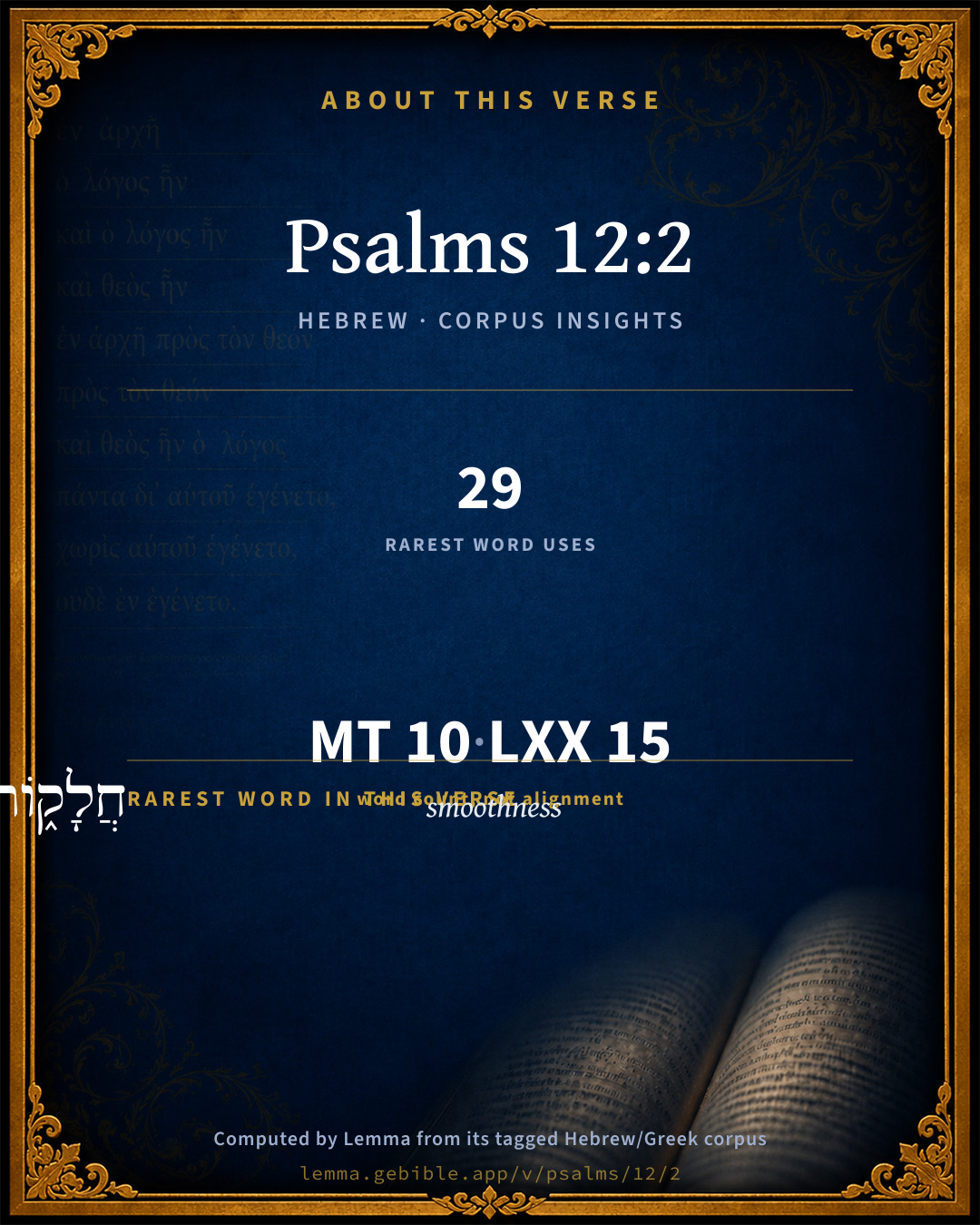
Psalms 12:2

Hebrew (Westminster Leningrad Codex) Psalms 12:2 appears in the Hebrew Old Testament. The text above is from the Westminster Leningrad Codex. Each word links to its Strong’s number, a concise gloss, and parsing drawn from the Open Scriptures Hebrew Bible morphology. Click any word for its full Brown-Driver-Briggs (BDB) entry.
Download image
Cite this verse

Psalms 12:2 (World English Bible). Public Domain. Lemma interlinear Bible study tool, https://lemma.gebible.app/v/psalms/12/2.

Show BibTeX & RIS
BibTeX
RIS
English Translation
Everyone lies to his neighbor. They speak with flattering lips, and with a double heart.
World English Bible · Public Domain
Download a study sheet

One document with this verse’s original text, its word-by-word gloss line, the meaning frame, cross-references with their text, attributed commentary, and full source and license credits — printable, and it pastes into notes with its structure intact.

This verse Autodidact and up

Study sheet (.html) Plain text (.txt)

A passage Seminary Student

Up to 50 verses in one chapter. A passage sheet keeps up to 6 commentary sources and 12 cross-references per verse, in the order this page ranks them, and says so on the sheet whenever that leaves anything out. Ask for a single verse and you get the Autodidact verse sheet above.

Everything on this page stays free to read, with no account — the sheet is a download of what is already on screen, not access to it.

Want to remove ads? Support Godless Engineer
Compare translations 3

The same verse in 3 English versions, stacked beneath the original-language interlinear above. Click any original word for its lexicon entry.

Each is an independent rendering of the whole verse — the interlinear is not word-aligned to these translations.

Highlighted words mark where these versions differ — a whole-verse word diff, not a word-by-word alignment.

  • World English Bible Public Domain
    Everyone lies to his neighbor. They speak with flattering lips, and with a double heart.
  • King James Version Public Domain
    They speak vanity every one with his neighbour: with flattering lips and with a double heart do they speak.
  • unfoldingWord Literal Text CC BY-SA 4.0
    Man, they speak falsehood with his neighbor; they speak lip of smoothness, with a heart and a heart.

unfoldingWord Literal Text — © unfoldingWord, licensed CC BY-SA 4.0. Word-aligned USFM3 via Door43 (git.door43.org/unfoldingWord/en_ult).

Versions to compare (up to 4)

3 of 4 selected

Show all 18 translations

Every available English version of this verse, each an independent rendering of the whole verse.

  • World English Bible Public Domain
    Everyone lies to his neighbor. They speak with flattering lips, and with a double heart.
  • Berean Standard Bible Public Domain
    They lie to one another; they speak with flattering lips and a double heart.
  • Majority Standard Bible Public Domain
    They lie to one another; they speak with flattering lips and a double heart.
  • King James Version Public Domain
    They speak vanity every one with his neighbour: with flattering lips and with a double heart do they speak.
  • American Standard Version (1901) Public Domain
    They speak falsehood every one with his neighbor: With flattering lip, and with a double heart, do they speak.
  • Revised Version (1885) Public Domain
    They speak vanity every one with his neighbour: with flattering lip, and with a double heart, do they speak.
  • Geneva Bible (1599) Public Domain
    They speake deceitfully euery one with his neighbour, flattering with their lips, and speake with a double heart.
  • Douay-Rheims (1899) Public Domain
    Save me, O Lord, for there is now no saint: truths are decayed from among the children of men.
  • Young's Literal Translation Public Domain
    Vanity they speak each with his neighbour, Lip of flattery! With heart and heart they speak.
  • Literal Standard Version CC BY-SA 4.0
    They each speak vanity with his neighbor, || Lip of flattery! With heart and heart they speak.
  • Unlocked Literal Bible CC BY-SA 4.0
    Everyone says empty words to his neighbor; everyone speaks with flattering lips and a double heart.
  • unfoldingWord Literal Text CC BY-SA 4.0
    Man, they speak falsehood with his neighbor; they speak lip of smoothness, with a heart and a heart.
  • Darby Bible Public Domain
    They speak falsehood every one with his neighbour: [with] flattering lip, with a double heart, do they speak.
  • World Messianic Bible Public Domain
    Everyone lies to his neighbor. They speak with flattering lips, and with a double heart.
  • Webster's Bible Public Domain
    \\12:1\\To the chief Musician upon Sheminith. A Psalm of David. Help, LORD; for the godly man ceaseth; for the faithful fail from among the children of men.
  • Free Bible Version CC BY-SA 4.0
    Everyone lies to their neighbors. They flatter with nice talk, but they don't mean what they say.
  • Bible in Basic English Public Domain
    Everyone says false words to his neighbour: their tongues are smooth in their talk, and their hearts are full of deceit.
  • JPS Tanakh (1917) Public Domain
    (12-3) They speak falsehood every one with his neighbour; with flattering lip, and with a double heart, do they speak.

Literal Standard Version (2020), Covenant Press — licensed CC BY-SA 4.0. Text via the HelloAO Bible API (eBible.org). Unlocked Literal Bible (unfoldingWord) — licensed CC BY-SA 4.0. Text via the HelloAO Bible API (eBible.org). unfoldingWord Literal Text — © unfoldingWord, licensed CC BY-SA 4.0. Word-aligned USFM3 via Door43 (git.door43.org/unfoldingWord/en_ult). Free Bible Version, Dr. Jonathan Gallagher — licensed CC BY-SA 4.0. Text via the HelloAO Bible API (eBible.org).

Word by word

More ways to search: Search by grammar → Find every occurrence → Compare this word →

Practice this passage: Drill this verse → Learn its vocabulary →

חֲלָק֑וֹת
chelqâh
H2513
“smoothness”
Adjective, Adjective, Feminine, Plural, Absolute
Part of Speech
Adjective
Type
Adjective
Gender
Feminine
Number
Plural
State
Absolute
Full BDB Definition

Origin: from H2506

TWOT: 670c

portion, parcel - of ground - smooth part, smoothness, flattery - smoothness, smooth part - slippery places - smoothness, flattery
  1. שָׁ֤וְא shâvᵉʼ H7723 “vanity” Noun, Common, Masculine, Singular, Absolute
  2. יְֽדַבְּרוּ֮ dâbar H1696 “to speak” Verb, Piel, Imperfect, 3rd Person, Masculine, Plural
  3. אִ֤ישׁ ʼîysh H376 “man” Noun, Common, Masculine, Singular, Absolute
  4. אֶת ʼêth H854 “with” Preposition
  5. רֵ֫עֵ֥הוּ rêaʻ H7453 “friend · his” Noun, Common, Masculine, Singular, Construct + Suffix, Personal, 3rd Person, Masculine, Singular
  6. שְׂפַ֥ת sâphâh H8193 “lip of” Noun, Common, Feminine, Singular, Construct
  7. בְּלֵ֖ב lêb H3820 “in/at · heart” Preposition + Noun, Common, Masculine, Singular, Absolute
  8. וָלֵ֣ב lêb H3820 “and · heart” Conjunction + Noun, Common, Masculine, Singular, Absolute
  9. יְדַבֵּֽרוּ dâbar H1696 “to speak” Verb, Piel, Imperfect, 3rd Person, Masculine, Plural

About this verse

These counts appear in no published source. They are computed here, from the morphology-tagged text and Lemma’s own curated glosses. What Lemma adds →

10
words
8
distinct lemmas
Wisdom
section

Shared distinctive vocabulary

חֲלָק֑וֹת smoothness H2513 occurs in 25 verses of the Hebrew Bible. Also found in:

Grammatical profile

  • 2 verbs
  • 6 nouns
  • 1 adjective
  • 1 preposition

Verb forms

  • יְֽדַבְּרוּ֮ Piel · Imperfect
  • יְדַבֵּֽרוּ Piel · Imperfect

Repetition

Words recur within this verse — often emphatic in Hebrew:

  • יְֽדַבְּרוּ֮ to speak H1696 ×2
  • בְּלֵ֖ב heart H3820 ×2

Hebrew & Septuagint length

In English translation the verse runs 15 words from the Hebrew and 19 from the Septuagint (LXX English) — closely comparable.

A rough comparison of the two English renderings, which tokenize alike — not a word-level alignment.

Word counts can differ between the Hebrew and the Greek without any difference in meaning — e.g. the Hebrew direct-object marker אֵת has no separate Greek word, and Greek often adds the article ὁ.

In the original languages it is 10 Hebrew tokens and 15 Greek tokens — but the two are counted differently (Hebrew bundles its prefixes and suffixes into one token; the Greek is in lemma form), so that isn’t a like-for-like length.

Cross-references

20

Topical passages linked to Psalms 12:2 in the Treasury of Scripture Knowledge — connected by theme and wording, ordered by reader-vote popularity; previews shown in the World English Bible.

  • Romans 16:18 For those who are such don't serve our Lord, Jesus Christ, but their own belly; and by their smooth and flattering speech, they deceive the hearts of the innocent.
  • Jeremiah 9:8 Their tongue is a deadly arrow; it speaks deceit: one speaks peaceably to his neighbor with his mouth, but in his heart he lays wait for him.
  • Psalms 41:6 If he comes to see me, he speaks falsehood. His heart gathers iniquity to itself. When he goes abroad, he tells it.
  • Psalms 5:9 For there is no faithfulness in their mouth. Their heart is destruction. Their throat is an open tomb. They flatter with their tongue.
  • Psalms 10:7 His mouth is full of cursing, deceit, and oppression. Under his tongue is mischief and iniquity.
  • Psalms 144:8 Whose mouths speak deceit, Whose right hand is a right hand of falsehood.
  • Psalms 28:3 Don't draw me away with the wicked, With the workers of iniquity who speak peace with their neighbors, But mischief is in their hearts.
  • James 1:8 He is a double-minded man, unstable in all his ways.
  • Psalms 52:1–4 Why do you boast of mischief, mighty man? God's loving kindness endures continually.
  • 1 Thessalonians 2:5 For neither were we at any time found using words of flattery, as you know, nor a cloak of covetousness (God is witness),
  • Psalms 55:21 His mouth was smooth as butter, But his heart was war. His words were softer than oil, Yet they were drawn swords.
  • Psalms 62:4 They fully intend to throw him down from his lofty place. They delight in lies. They bless with their mouth, but they curse inwardly. Selah.
  • Psalms 144:11 Rescue me, and deliver me out of the hands of foreigners, Whose mouths speak deceit, Whose right hand is a right hand of falsehood.
  • Proverbs 20:19 He who goes about as a tale-bearer reveals secrets; Therefore don't keep company with him who opens wide his lips.
  • Proverbs 29:5 A man who flatters his neighbor, Spreads a net for his feet.
  • Jeremiah 9:2–6 Oh that I had in the wilderness a lodging-place of wayfaring men; that I might leave my people, and go from them! for they are all adulterers, an assembly of treacherous men.
  • Ezekiel 12:24 For there shall be no more any false vision nor flattering divination within the house of Israel.
  • Psalms 59:12 For the sin of their mouth, and the words of their lips, Let them be caught in their pride, For the curses and lies which they utter.
  • 1 Chronicles 12:33 Of Zebulun, such as were able to go out in the host, who could set the battle in array, with all manner of instruments of war, fifty thousand, and who could order [the battle array, and were] not of double heart.
  • Psalms 36:3–4 The words of his mouth are iniquity and deceit. He has ceased to be wise and to do good.

Cross-references courtesy of OpenBible.info (CC BY 4.0).

Hebrew and Greek witnesses Masoretic Hebrew ↔ Greek Septuagint

The same verse in the two great witnesses to the Old Testament, shown verse-for-verse.

You’re reading Greek Psalm 11 (Hebrew Psalm 12). The Septuagint counts the superscription, so verse numbers can differ from the Hebrew — chapter-level alignment, not verse-by-verse. Numbering follows Rahlfs.

These are two independent witnesses, not word-aligned to each other, and the Septuagint is shown in lemma (dictionary) form.

Hebrew Psalms 12:2 Masoretic · Westminster Leningrad Codex

שָׁ֤וְא יְֽדַבְּרוּ֮ אִ֤ישׁ אֶת רֵ֫עֵ֥הוּ שְׂפַ֥ת חֲלָק֑וֹת בְּלֵ֖ב וָלֵ֣ב יְדַבֵּֽרוּ

Everyone lies to his neighbor. They speak with flattering lips, and with a double heart.

World English Bible · Public Domain

Greek LXX Greek Psalm 11:2 Septuagint · lemma form

σώζω ἐγώ κύριος ὅτι ἐκλείπω ὅσιος ὅτι ὀλιγόω ὁ ἀλήθεια ἀπό ὁ υἱός ὁ ἄνθρωπος

Every one has spoken vanity to his neighbor: their lips are deceitful, they have spoken with a double heart.

LXX2012 (modern English Septuagint) · Public Domain

Hebrew: Westminster Leningrad Codex (CC BY 4.0). Greek: Septuagint (public domain); English from LXX2012 (modern English Septuagint) (Public Domain). How the Septuagint differs from the Hebrew →

Commentary

Notes on Psalms 12:2 from classic Christian and Jewish commentators (each source and its license shown beneath its notes). The classic Christian expositions comment on the surrounding passage and are grouped to its opening verse, so a note may address several verses; the Jewish commentaries on the Tanakh (Rashi and others) are per-verse, so they appear only where the commentator wrote on this verse.

Lemma curates 59 commentaries, every one of them public domain or Creative Commons licensed, each selected and text-cleaned for this edition rather than reprinted as found. About our sources →

Trapp's Complete Commentary

John Trapp

Psa 12:2 They speak vanity every one with his neighbour: [with] flattering lips [and] with a double heart do they speak.

Ver. 2. They speak vanity every one with his neighbour] They speak falsely and fraudulently, and therein have an art, as Jer 9:4-5, such as the devil hath taught them.

With flattering lips] Blandientibus, vel dividentibus. The Syriac version hath it, with dividing lips, such as separate very friends.

With a double heart do theft speak] Heb. With a heart and a heart. So Horace saith of Ulysses (Ode. 6, Animus versutulus et versatilis).

Cursus doplicis per mare Ulyssei.

The prophet here meaneth that they had one heart in their body, and another in their mouth, being desperate dissemblers, such as the French are said to be. Those men of Zebulun were none such, 1Ch 12:33.

John Trapp, A Commentary or Exposition upon All the Books of the Old and New Testament (1647–1656) — public domain. Text from a community e-Sword module.

Joseph Benson's Commentary

Psa 12:2. They speak vanity — Or, falsehood, which is a vain thing, and wants the solidity of truth. With a double heart do they speak — See the margin. They speak as if they had two hearts, the one inclining them to hate their neighbour, and form designs against him, and the other to prompt the tongue to pretend a friendship for him. “When men cease to be faithful to their God, he who expects to find them so to each other will be much disappointed. The primitive sincerity will accompany the primitive piety in her flight from the earth; and then interest will succeed conscience in the regulation of human conduct, till one man cannot trust another further than he holds him by that tie.”

Joseph Benson's Commentary on the Old and New Testaments (1811–1818) — public domain. Text from a community e-Sword module.

J. A. Alexander on Psalms

Joseph Addison Alexander

3. (Psa 12:2). Vanity, i.e. falsehood, they will speak; as they now do, so will they persist in doing; (each) man with his neighbour, not merely with another man, but with his friend, his brother, towards whom he was particularly bound to act sincerely; compare Eph 4:25. A lip of smoothness, or of smooth things, i. e. flattering; see above, on Psa 5:10 (9). This may be connected either with what goes before or with what follows: "They speak falsehood, each to his neighbour, with a flattering lip;" or, "(with) a flattering lip (and) with a double heart will they speak." A heart and a heart, i.e. a double heart, as a stone and a stone means "divers weights." Deu 25:13. By a double heart we are probably to understand, not mere dissimulation or hypocrisy, but inconsistency and instability of temper, which leads men to entertain opposite feelings towards the same object. Compare the description of the "double-minded man" in Jas 1:8.

Joseph Addison Alexander, The Psalms Translated and Explained (1850) — public domain. Text from a community e-Sword module.

Geneva Bible (1599)

Geneva Bible translators

He meaneth the flatterers of the court which hurt him more with their tongues, than with their weapons.

Geneva Bible (1599) marginal notes — public domain. Text via Bolls.life.

Jamieson, Fausset & Brown

Robert Jamieson, A. R. Fausset & David Brown

The want of it is illustrated by the prevalence of deceit and instability.

Jamieson, Fausset & Brown — Commentary Critical and Explanatory on the Whole Bible (1871) — public domain (CC PDM 1.0). Text via the HelloAO Bible API.

Adam Clarke's Commentary

Verse 2. They speak vanity every one with his neighbour] They are false and hollow; they say one thing while they mean another; there is no trusting to what they say.

Flattering lips, and with a double heart do they speak] בלב ולב beleb valeb, "With a heart and a heart." They seem to have two hearts; one to speak fair words, and the other to invent mischief. The old MS. both translates and paraphrases curiously.

Trans. Dayn spak ilkan til his neghbur: swykil lippis in hert, and thurgh hert thai spak.

Par. - Sothfastnes es lessed, and falsed waxes: and al sa vayn spak ilkone to bygyle his neghbur: and many spendes thair tyme in vayne speche withoutyn profyte and gastely frute. And that er swyku lippis; that er jangelers berkand ogaynes sothfastnes. And swykel, for thai speke in hert and thurgh hert; that es in dubil hert, qwen a fals man thynkes ane, and sais another, to desaif hym that he spekes with.

This homely comment cannot be mended.

Adam Clarke's Commentary on the Bible (1810–1826) — public domain. Text from a community e-Sword/MySword module.

John Calvin's Commentaries

2. Every man speaketh deceit. David in this verse sets forth that part of unrighteousness which is contrary to truth. He says that there is no sincerity or uprightness in their speech, because the great object upon which they are bent is to deceive. He next describes the manner in which they deceive, namely, that every man endeavors to ensnare his neighbor by flattery Horsley reads “smooth lips.” “Not smooth,” says he, “with flattery, but with glossing lies, with ensnaring eloquence and specious arguments in support of the wretched cause which they espouse.”

“Pour se disguiser en diverses sortes.” — Fr.

John Calvin's Commentaries (1540-1563) — public domain. Text from the Calvin Translation Society English edition (1840s-50s) via the Christian Classics Ethereal Library (ccel.org). Calvin's coverage is partial (roughly two-thirds of the Bible); uncommented books and verses are honest gaps, never fabricated. The 19th-century editor's footnotes and remarks are omitted so the notes are faithfully Calvin's own voice.

Ellicott's Commentary for English Readers

(2) Vanity.—So in Psa_41:6 and Job_35:13. Literally, evil. “Falsehood” would be better. This verse may have been in St Paul’s mind (Eph_4:25).

Flattering lips.—Literally, lips of smoothness, (Comp. Note, Psa_5:9.)

With a double heart.—Literally, with a heart and a heart. (Comp. 1Ch_12:33.) “One for the Church, another for the Change; one for Sundays, another for working-days; one for the king, another for the Pope. A man without a heart is a wonder, but a man with two hearts is a monster.”—Thos. Adams, A.D. 1614.

A Bible Commentary for English Readers, edited by Charles John Ellicott (1878–1897) — public domain. Text from a community e-Sword module.

The Cambridge Bible for Schools and Colleges

gen. ed. J. J. S. Perowne

2. Hypocrisy and duplicity are universal. Men’s words are vanity, or falsehood, hollow and unreal. Their flatteries come from ‘a double heart,’ lit. a heart and a heart, which thinks one thing and utters another, and has no constancy or consistency, but thinks one thing today and another thing tomorrow. Cp. Pro_26:24 ff. For the opposite see 1Ch_12:33; 1Ch_12:38.

The Cambridge Bible for Schools and Colleges (gen. ed. J. J. S. Perowne; Cambridge University Press, 1878–1918) — public domain. Text from a community e-Sword module.

John Gill's Exposition

They speak vanity everyone with his neighbour,.... That which is false and a lie, either doctrinal or practical; what was not according to the word of God, and was vain and empty, frothy, filthy, and corrupt; and which no godly and faithful man would do. And this being done in common, by the generality of men, one with another, shows the degeneracy of the age, and supports the complaint before made. They speak even

with flattering lips; as Cain did to Abel, Joab to Amasa, the Herodians to Christ, Judas to his Master, false teachers to those that are simple, hypocrites to God himself, when they draw nigh to him only with their lips, and all formal professors to the churches of Christ, when they profess themselves to be what they are not. And this is a further proof of the justness of the above complaint;

and with a double heart do they speak: or "with an heart and an heart" (d); such are double minded men, who say one thing, and mean another; their words are not to be depended upon; there is no faithfulness in them. The Chinese (e) reckon a man of "two hearts", as they call him, a very wicked man, and none more remote from honesty.

(d) "in corde & corde", V. L. Pagninus, Montanus, Gejerus. (e) Martin. Sinic. Hist. p. 144. a heart having , a double meaning, as Pittacus says, Laert. in Vit. Pittac. l. 1. p. 53.

John Gill's Exposition of the Whole Bible (1746–1763) — public domain (CC PDM 1.0). Text via the HelloAO Bible API.

Albert Barnes' Notes on the Bible

They speak vanity - This is a statement of the “manner” in which the “godly” and the “faithful” fail, as stated in Psa 12:1. One of the ways was that there was a disregard of truth; that no confidence could be placed on the statements of those who professed to be pious; that they dealt falsely with their neighbors. The word “vanity” here is equivalent to “falsehood.” What they spoke was a vain and empty thing, instead of being the truth. It had no reality, and could not be depended on.

Every one with his neighbour - In his statements and promises. No reliance could be placed on his word.

With flattering lips - Hebrew, “Lips of smoothness.” The verb from which the word used here is derived - חלק chālaq - means properly to divide, to distribute; then, to make things equal or smooth; then, to make smooth or to shape, as an artisan does, as with a plane; and then, “to make things smooth with the tongue,” that is, “to flatter.” See Psa 5:9; Pro 5:3; Pro 26:28; Pro 28:23; Pro 29:5. The meaning is, that no confidence could be placed in the statements made. There was no certainty that they were founded on truth; none that they were not intended to deceive. Flattery is the ascribing of qualities to another which he is known not to possess - usually with some sinister or base design.

And with a double heart - Margin, as in Hebrew, “a heart and a heart;” that is, as it were, with two hearts, one that gives utterance to the words, and the other that retains a different sentiment. Thus, in Deu 25:13, the phrase in Hebrew, “a stone and a stone” means, as it is translated, “divers weights” - one stone or weight to buy with, and another to sell with. So the flatterer. He has one heart to give utterance to the words which he uses toward his neighbor, and another that conceals his real purpose or design. No confidence, therefore, could be placed in such persons. Compare the note at Job 32:22.

Albert Barnes' Notes on the Bible (1834–1885) — public domain. Text from a community e-Sword/MySword module.

Matthew Poole's English Annotations

Vanity; or, falsehood, which is a vain thing, and wants the solidity of truth.

With a double heart; pretending one heart, and that they speak from a kind and upright heart, when they really have another, even a cruel and deceitful heart.

Matthew Poole's English Annotations on the Holy Bible (1683–1685) — public domain. Text from a community e-Sword/MySword module.

The Treasury of David

Charles H. Spurgeon

Ver. 2. They speak vanity every one with his neighbour. They utter that which is vain to hear, because of its frivolous, foolish, want of worth; vain to believe, because it was false and lying; vain to trust to, since it was deceitful and flattering; vain to regard, for it lifted up the hearer, filling him with proud conceit of himself. It is a sad thing when it is the fashion to talk vanity. "Call me, and I will call thee." is the old Scotch proverb; give me a high sounding character, and I will give you one. Compliments and fawning congratulations are hateful to honest men; they know that if they take they must give them, and they scorn to do either. These accommodation bills are most admired by those who are bankrupt in character. Bad are the times when every man thus cajoles and cozens his neighbour.

With flattering lips and with a double heart do they speak. He who puffs up another's heart, has nothing better than wind in his own. If a man extols me to my face, he only shows me one side of his heart, and the other is black with contempt for me, or foul with intent to cheat me. Flattery is the sign of the tavern where duplicity is the host. The Chinese consider a man of two hearts to be a very base man, and we shall be safe in reckoning all flatteries to be such.

Ver. 2. They speak vanity every one with his neighbour: with flattering lips and with a double heart do they speak. The feigned zeal is just like a waterman, that looks one way and rows another way; for this man pretends one thing and intends another thing; as Jehu pretended the zeal of God's glory, but his aim was at his master's kingdom; and his zeal to God's service was but to bring him to the sceptre of the kingdom. So Demetrius professed great love unto Diana, but his drift was to maintain the honour of his profession; and so we have too many that make great show of holiness, and yet their hearts aim at other ends; but they may be sure, though they can deceive the world and destroy themselves, yet not God, who knoweth the secrets of all hearts. Gr. Williams, 1636.

Ver. 2. They speak vanity.

Faithless is earth, and faithless are the skies! Justice is fled, and truth is now no more!

Virgil's Aneid, IV. 373.

Ver. 2. With a double heart. Man is nothing but insincerity, falsehood, and hypocrisy, both in regard to himself and in regard to others. He does not wish that he should be told the truth, he shuns saying it to others; and all these moods, so inconsistent with justice and reason, have their roots in his heart. Blaise Pascal.

Ver. 2. With flattering lips and with a double heart do they speak. There is no such stuff to make a cloak of as religion; nothing so fashionable, nothing so profitable: it is a livery wherein a wise man may serve two masters, God and the world, and make a gainful service by either. I serve both, and in both myself, by prevaricating with both. Before man none serves his God with more devotion; for which, among the best of men, I work my own ends, and serve myself. In private, I serve the world; not with so strict devotion, but with more delight; where fulfilling of her servants' lusts, I work my end and serve myself. The house of prayer who more frequents than I? In all Christian duties who more forward than I? I fast with those who fast, that I may eat with those that eat. I mourn with those that mourn. No hand more open to the cause than mine, and in their families none prays longer and with louder zeal. Thus when the opinion of a holy life hath cried the goodness of my conscience up, my trade can lack no custom, my wares can want no price, my words can need no credit, my actions can lack no praise. If I am covetous, it is interpreted providence; if miserable, it is counted temperance; if melancholy, it is construed godly sorrow; if merry, it is voted spiritual joy; if I be rich, it is thought the blessing of a godly life; if poor, supposed the fruit of conscionable dealing; if I be well spoken of, it is the merit of holy conversation; if ill, it is the malice of malignants. Thus I sail with every wind, and have my end in all conditions. This cloak in summer keeps me cool, in winter warm, and hides the nasty bag of all my secret lusts. Under this cloak I walk in public fairly with applause, and in private sin securely without offence, and officiate wisely without discovery. I compass sea and land to make a proselyte; and no sooner made, but he makes me. At a fast I cry Geneva, and at a feast I cry Rome. If I be poor, I counterfeit abundance to save my credit; if rich, I dissemble poverty to save charges. I most frequent schismatic lectures, which I find most profitable; from thence learning to divulge and maintain new doctrines; they maintain me in suppers thrice a week. I use the help of a lie sometimes, as a new stratagem to uphold the gospel; and I colour oppression with God's judgments executed upon the wicked. Charity I hold an extraordinary duty, therefore not ordinarily to be performed. What I openly reprove abroad, for my own profit, that I secretly act at home, for my own pleasure. But stay, I see a handwriting in my heart which damps my soul. It is characterized in these sad words, "Woe be to you, hypocrites." Mt 23:13. Francis Quarle's "Hypocrite's Soliloquy."

Ver. 2. With flattering lips, etc. The world indeed says that society could not exist if there were perfect truthfulness and candour between man and man; and that the world's propriety would be as much disturbed if every man said what he pleased, as it was in those days of Israelitish history, when every man did that which was right in his own eyes. The world is assuredly the best judge of its own condition and mode of government, and therefore I will not say what a libel does such a remark contain, but oh, what a picture does it present of the social edifice, that its walls can be cemented and kept together only by flattery and falsehood! Barton Bouchier.

Ver. 2. Flattering lips. The philosopher Bion being asked what animal he though the most hurtful, replied, "That of wild creatures a tyrant, and of tame ones a flatterer." The flatterer is the most dangerous enemy we can have. Raleigh, himself a courtier, and therefore initiated into the whole art of flattery, who discovered in his own career and fate its dangerous and deceptive power, its deep artifice and deeper falsehood, says, "A flatterer is said to be a beast that biteth smiling. But it is hard to know them from friendsthey are so obsequious and full of protestations: for as a wolf resembles a dog, so doth a flatterer a friend." The Book of Symbols, 1844.

Ver. 2. They speak with a double heart. The original is, "A heart and a heart:" one for the church, another for the change; one for Sundays, another for working days; one for the king, another for the pope. A man without a heart is a wonder, but a man with two hearts is a monster. It is said of Judas, "There were many hearts in one man; " and we read of the saints, "There was one heart in many men." Ac 4:32. Dabo illis cor unum; a special blessing. Thomas Adams.

Ver. 2. When men cease to be faithful to their God, he who expects to find them so to each other, will be much disappointed. The primitive sincerity will accompany the primitive piety in her flight from the earth; and then interest will succeed conscience in the regulation of human conduct, till one man cannot trust another farther than he holds him by that tie. Hence, by the way, it is, that though many are infidels themselves, yet few choose to have their families and dependents such; as judging, and rightly judging, that true Christians are the only persons to be depended on for the exact discharge of social duties. George Horne.

Ver. 2. (first clause). A discourse upon the prevalence and perniciousness of vain talk.

Ver. 2. The whole verse. Connection between flattery and treachery.

Ver. 2. A double heart. Right and wrong kinds of hearts, and the disease of duplicity.

Psalms 12:3*

Charles H. Spurgeon's The Treasury of David (1869–1885) — public domain. Psalms only. Text from a community e-Sword/MySword module.

Whedon's Commentary on the Bible

Daniel D. Whedon

2. They speak vanity—That is, emptiness; their words are devoid of meaning, because they do not truly represent any thing, the speaker having no intention of fulfilling what is promised, or of stating things as they really exist.

Flattering lips—Slippery words.

A double heart—Literally, a heart and a heart; that is, a heart to make a given impression by his slippery words, and another heart to do the opposite to that impression. Opposed to a “perfect heart,” 1Ch_12:33; 1Ch_12:38

Daniel D. Whedon (gen. ed.), Commentary on the Old and New Testaments (1874–1909) — public domain. Text from a community e-Sword module.

The Pulpit Commentary

They speak vanity every one with his neighbour; rather, they speak falsehood (Kay, Cheyne). Contrast the injunction of the apostle. (Eph_4:25) With flattering lips and with a double heart do they speak; literally, with lips of smoothness, and with a heart and a heart do they speak. The Authorized Version gives the true meaning. (comp. 1Ch_12:33)

The Pulpit Commentary (1880–1919), ed. H.D.M. Spence-Jones & Joseph S. Exell — public domain. Text from a community e-Sword module.

unfoldingWord translationNotes

Door43 World Missions Community

Everyone says ... everyone speaks

The two occurrences of "everyone" are exaggerations, used to emphasize that this is true of very many people. (See: Hyperbole and Generalization)

everyone speaks with flattering lips and a double heart

Here "lips" is a metonym for what people say, and "a double heart" is a metaphor for deception. AT: "everyone speaks with flattering words and deception" or "everyone praises people falsely and tells lies" (See: Metonymy and Metaphor)

cut off all flattering lips

Here "flattering lips" is a metonym for people who flatter others. Possible meanings are 1) "cut off" is a metaphor for killing. AT: "kill all who flatter others" or 2) "cut off" is a metaphor for stopping something. AT: "stop all those who flatter others" (See: Metaphor and Metonymy)

every tongue declaring great things

Here "every tongue" represents every person who declares great things. AT: "every person who boasts" (See: Synecdoche)

With our tongues will we prevail

Here the word "tongues" represents what people say. AT: "We will prevail because of what we say" (See: Metonymy)

will we prevail

"we will succeed" or "we will win" or "we will be victorious"

When our lips speak

Here the "lips" represents the people who speak. AT: "When we speak" (See: Synecdoche)

who can be master over us?

This rhetorical question is asked to emphasize that they believed no one could rule over them. It can be translated as a statement. AT: "no one can rule over us!" (See: Rhetorical Question)

translationWords

word

neighbor

heart

Yahweh

cut off

tongue

lord

unfoldingWord translationNotes — © Distant Shores Media and the Door43 World Missions Community, licensed CC BY-SA 4.0. Source: git.door43.org/Door43/en_tn.

Rashi

Rabbi Shlomo Yitzchaki (Rashi)

are gone Heb. גמר, lit. finished, destroyed.

have vanished Heb. פסו, faylirt in Old French, to lack, fail.

for the faithful have vanished from the sons of men Everyone betrays me and spies out the places where I hide, and tells Saul (54:2): “Is not David hiding with us?”

Rashi on the Tanakh — English translations: “The Judaica Press complete Tanach with Rashi, translated by A. J. Rosenberg” (CC BY 4.0); “Pentateuch with Rashi's commentary by M. Rosenbaum and A.M. Silbermann, 1929-1934” (public domain); “The Metsudah Tanach series, Lakewood, N.J” (CC BY 4.0); and “The Book of Joshua, Metsudah Publications, 1997” (CC BY 4.0). Text via Sefaria.

Lesson kit

Teaching starters — assembled from the data on this page, not authored interpretation. Every prompt links to the verse data it draws on. Edit before teaching.

Psalms, in the Wisdom, opens this verse with 10 words (8 distinct Hebrew lemmas). Its most distinctive word is chelqâh (“smoothness”). A historical commentator’s framing appears above. Read the whole chapter for the surrounding context.

Discussion questions

  1. What does “smoothness” (chelqâh) contribute to the verse as a whole?
  2. How does Genesis 27:16, which shares the word «smoothness», read alongside this verse?
  3. What does the repetition of “to speak” (2× in this one verse) do in this verse?
  4. These translations render this verse differently. What is at stake in choosing one wording over another?
  5. «יְֽדַבְּרוּ֮» is a Piel Imperfect verb. How does that grammatical form shape the action described?
  6. Compare how Trapp's Complete Commentary and Joseph Benson's Commentary read this verse. Where do they agree or differ?

Things to notice

Reading settings

Reading text

Shown beneath each verse's original-language words.

Old Testament
Old Testament edition

Read the OT as the Masoretic Hebrew (MT) or the Greek Septuagint (LXX).

English shown for the Greek Septuagint (in the Hebrew ↔ Greek comparison).

Comparing translations? Open the Compare panel on any verse page to stack up to four side by side.