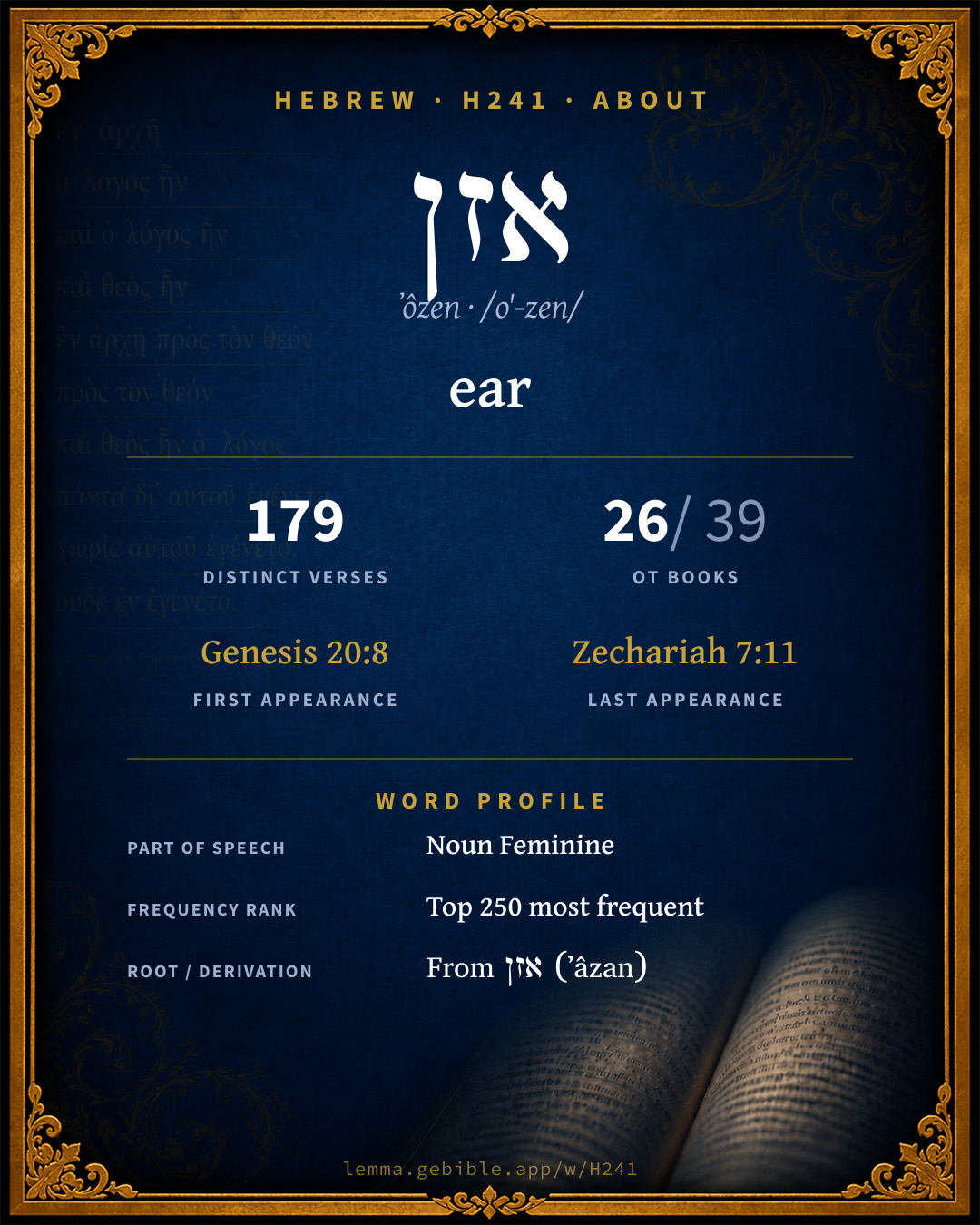
אֹ֫זֶן
ear
‘ear’ is one of 3 main senses fuller range ↓
Full lexicon entry — Brown-Driver-Briggs (BDB)
From Brown-Driver-Briggs (BDB)
Where this word appears
See every Construct-state word in the Hebrew Bible →
Grammar key — what these labels mean
Part of speech
- Noun
- A naming word — a person, place, thing, or idea.
Noun type
- Common
- A common noun — a general class of person, place, or thing (“king,” “city,” “water”), not a specific name.
State
- Construct
- A noun bound to a following noun in a possessive / “of” relationship (the construct chain).
- Absolute
- The independent form of a noun, not bound to a following word.
Gender
- Feminine
- Grammatically feminine.
Number
- Dual
- Exactly two — for natural pairs and some measures of time.
- Singular
- One.
Grammatical forms
- Noun, Common, Feminine, Dual, Construct 99 times (53%)
- Noun, Common, Feminine, Singular, Construct 66 times (35%)
- Noun, Common, Feminine, Singular, Absolute 14 times (7%)
- Noun, Common, Feminine, Dual, Absolute 9 times (5%)
Parsed forms decoded from the imported morphology (morphhb / Westminster Leningrad Codex — WLC text public domain, morphhb tagging CC BY 4.0), counted across 188 parsed occurrences — not distinct verses.
Every verse where H241 appears — 179 distinct verses across 26 books. Click any verse to open its interlinear word-by-word view. Verse text shown in the World English Bible for context — . Each verse’s Hebrew form is shown with its reference; the English is not keyword-highlighted, since the data carries no word-level English alignment. Use “Compare translations” on any verse to read it across multiple English versions. This concordance covers the Hebrew Bible; Septuagint (Greek Old Testament) occurrences are not indexed here.
Genesis 7 verses
- Genesis 20:8 בְּ/אָזְנֵי/הֶ֑ם prep + n c fd cs + sfx pers 3mp Abimelech rose early in the morning, and called all his servants, and told all these things in their ear. The men were very scared.
- Genesis 23:10 בְּ/אָזְנֵ֣י prep + n c fd cs Now Ephron was sitting in the midst of the children of Heth. Ephron the Hittite answered Abraham in the hearing of the children of Heth, even of all who went in at the gate of his city, saying,
- Genesis 23:13 בְּ/אָזְנֵ֤י prep + n c fd cs He spoke to Ephron in the audience of the people of the land, saying, "But if you will, please hear me. I will give the price of the field. Take it from me, and I will bury my dead there."
- Genesis 23:16 בְּ/אָזְנֵ֣י prep + n c fd cs Abraham listened to Ephron. Abraham weighed to Ephron the silver which he had named in the audience of the children of Heth, four hundred shekels of silver, according to the current merchants' standard.
- Genesis 35:4 בְּ/אָזְנֵי/הֶ֑ם prep + n c fd cs + sfx pers 3mp They gave to Jacob all the foreign gods which were in their hands, and the rings which were in their ears; and Jacob hid them under the oak which was by Shechem.
- Genesis 44:18 בְּ/אָזְנֵ֣י prep + n c fd cs Then Judah came near to him, and said, "Oh, my lord, please let your servant speak a word in my lord's ears, and don't let your anger burn against your servant; for you are even as Pharaoh.
- Genesis 50:4 בְּ/אָזְנֵ֥י prep + n c fd cs When the days of weeping for him were past, Joseph spoke to the house of Pharaoh, saying, "If now I have found favor in your eyes, please speak in the ears of Pharaoh, saying,
Exodus 8 verses
- Exodus 10:2 בְּ/אָזְנֵ֨י prep + n c fd cs and that you may tell in the hearing of your son, and of your son's son, what things I have done to Egypt, and my signs which I have done among them; that you may know that I am Yahweh."
- Exodus 11:2 בְּ/אָזְנֵ֣י prep + n c fd cs Speak now in the ears of the people, and let them ask every man of his neighbor, and every woman of her neighbor, jewels of silver, and jewels of gold."
- Exodus 17:14 בְּ/אָזְנֵ֣י prep + n c fd cs Yahweh said to Moses, "Write this for a memorial in a book, and rehearse it in the ears of Joshua: that I will utterly blot out the memory of Amalek from under the sky."
- Exodus 21:6 אָזְנ/וֹ֙ n c fs cs + sfx pers 3ms then his master shall bring him to God, and shall bring him to the door or to the door-post, and his master shall bore his ear through with an awl, and he shall serve him for ever.
- Exodus 24:7 בְּ/אָזְנֵ֣י prep + n c fd cs He took the book of the covenant and read it in the hearing of the people, and they said, "All that Yahweh has spoken will we do, and be obedient."
- Exodus 29:20 אֹ֨זֶן אֹ֤זֶן n c fs cs n c fs cs Then you shall kill the ram, and take some of its blood, and put it on the tip of the right ear of Aaron, and on the tip of the right ear of his sons, and on the thumb of their right hand, and on the big toe of their right foot, and sprinkle the blood on the altar round about.
- Exodus 32:2 בְּ/אָזְנֵ֣י prep + n c fd cs Aaron said to them, "Take off the golden rings, which are in the ears of your wives, of your sons, and of your daughters, and bring them to me."
- Exodus 32:3 בְּ/אָזְנֵי/הֶ֑ם prep + n c fd cs + sfx pers 3mp All the people took off the golden rings which were in their ears, and brought them to Aaron.
Leviticus 6 verses
- Leviticus 8:23 אֹֽזֶן n c fs cs He killed it; and Moses took some of its blood, and put it on the tip of Aaron's right ear, and on the thumb of his right hand, and on the great toe of his right foot.
- Leviticus 8:24 אָזְנָ/ם֙ n c fs cs + sfx pers 3mp He brought Aaron's sons; and Moses put some of the blood on the tip of their right ear, and on the thumb of their right hand, and on the great toe of their right foot; and Moses sprinkled the blood on the altar round about.
- Leviticus 14:14 אֹ֥זֶן n c fs cs The priest shall take some of the blood of the trespass offering, and the priest shall put it on the tip of the right ear of him who is to be cleansed, and on the thumb of his right hand, and on the big toe of his right foot.
- Leviticus 14:17 אֹ֤זֶן n c fs cs The priest shall put some of the rest of the oil that is in his hand on the tip of the right ear of him who is to be cleansed, and on the thumb of his right hand, and on the big toe of his right foot, upon the blood of the trespass offering.
- Leviticus 14:25 אֹֽזֶן n c fs cs He shall kill the lamb of the trespass offering. The priest shall take some of the blood of the trespass offering and put it on the tip of the right ear of him who is to be cleansed, and on the thumb of his right hand, and on the big toe of his right foot.
- Leviticus 14:28 אֹ֤זֶן n c fs cs Then the priest shall put some of the oil that is in his hand on the tip of the right ear of him who is to be cleansed, and on the thumb of his right hand, and on the big toe of his right foot, on the place of the blood of the trespass offering.
Numbers 3 verses
- Numbers 11:1 בְּ/אָזְנֵ֣י prep + n c fd cs The people were as murmurers, [speaking] evil in the ears of Yahweh: and when Yahweh heard it, his anger was kindled; and the fire of Yahweh burnt among them, and devoured in the uttermost part of the camp.
- Numbers 11:18 בְּ/אָזְנֵ֨י prep + n c fd cs Say you to the people, Sanctify yourselves against tomorrow, and you shall eat flesh; for you have wept in the ears of Yahweh, saying, Who shall give us flesh to eat? for it was well with us in Egypt: therefore Yahweh will give you flesh, and you shall eat.
- Numbers 14:28 בְּ/אָזְנָ֑/י prep + n c fd cs + sfx pers 1cs Tell them, As I live, says Yahweh, surely as you have spoken in my ears, so will I do to you:
Deuteronomy 7 verses
- Deuteronomy 5:1 בְּ/אָזְנֵי/כֶ֖ם prep + n c fd cs + sfx pers 2mp Moses called to all Israel, and said to them, Hear, Israel, the statutes and the ordinances which I speak in your ears this day, that you may learn them, and observe to do them.
- Deuteronomy 15:17 בְ/אָזְנ/וֹ֙ prep + n c fs cs + sfx pers 3ms then you shall take an awl, and thrust it through his ear to the door, and he shall be your servant forever. Also to your maid-servant you shall do likewise.
- Deuteronomy 29:4 וְ/אָזְנַ֣יִם conj + n c fd but Yahweh has not given you a heart to know, and eyes to see, and ears to hear, to this day.
- Deuteronomy 31:11 בְּ/אָזְנֵי/הֶֽם prep + n c fd cs + sfx pers 3mp when all Israel is come to appear before Yahweh your God in the place which he shall choose, you shall read this law before all Israel in their hearing.
- Deuteronomy 31:28 בְ/אָזְנֵי/הֶ֗ם prep + n c fd cs + sfx pers 3mp Assemble to me all the elders of your tribes, and your officers, that I may speak these words in their ears, and call heaven and earth to witness against them.
- Deuteronomy 31:30 בְּ/אָזְנֵי֙ prep + n c fd cs Moses spoke in the ears of all the assembly of Israel the words of this song, until they were finished.
- Deuteronomy 32:44 בְּ/אָזְנֵ֣י prep + n c fd cs Moses came and spoke all the words of this song in the ears of the people, he and Joshua the son of Nun.
Joshua 1 verse
Judges 4 verses
- Judges 7:3 בְּ/אָזְנֵ֤י prep + n c fd cs Now therefore proclaim in the ears of the people, saying, Whoever is fearful and trembling, let him return and depart from Mount Gilead. There returned of the people twenty-two thousand; and there remained ten thousand.
- Judges 9:2 בְּ/אָזְנֵ֨י prep + n c fd cs Please speak in the ears of all the men of Shechem, Whether is better for you, that all the sons of Jerubbaal, who are seventy persons, rule over you, or that one rule over you? Remember also that I am your bone and your flesh.
- Judges 9:3 בְּ/אָזְנֵי֙ prep + n c fd cs His mother's brothers spoke of him in the ears of all the men of Shechem all these words: and their hearts inclined to follow Abimelech; for they said, He is our brother.
- Judges 17:2 בְּ/אָזְנַ֔/י prep + n c fd cs + sfx pers 1cs He said to his mother, The eleven hundred [pieces] of silver that were taken from you, about which you did utter a curse, and did also speak it in my ears, behold, the silver is with me; I took it. His mother said, Blessed be my son of Yahweh.
Ruth 1 verse
1 Samuel 12 verses
- 1 Samuel 3:11 אָזְנָֽי/ו n c fd cs + sfx pers 3ms Yahweh said to Samuel, Behold, I will do a thing in Israel, at which both the ears of everyone who hears it shall tingle.
- 1 Samuel 8:21 בְּ/אָזְנֵ֥י prep + n c fd cs Samuel heard all the words of the people, and he rehearsed them in the ears of Yahweh.
- 1 Samuel 9:15 אֹ֣זֶן n c fs cs Now Yahweh had revealed to Samuel a day before Saul came, saying,
- 1 Samuel 11:4 בְּ/אָזְנֵ֣י prep + n c fd cs Then came the messengers to Gibeah of Saul, and spoke these words in the ears of the people: and all the people lifted up their voice, and wept.
- 1 Samuel 15:14 בְּ/אָזְנָ֑/י prep + n c fd cs + sfx pers 1cs Samuel said, What means then this bleating of the sheep in my ears, and the lowing of the oxen which I hear?
- 1 Samuel 18:23 בְּ/אָזְנֵ֣י prep + n c fd cs Saul's servants spoke those words in the ears of David. David said, Seems it to you a light thing to be the king's son-in-law, seeing that I am a poor man, and lightly esteemed?
- 1 Samuel 20:2 אָזְנִ֑/י n c fs cs + sfx pers 1cs He said to him, "Far from it; you shall not die: behold, my father does nothing either great or small, but that he discloses it to me; and why should my father hide this thing from me? It is not so."
- 1 Samuel 20:12 אָזְנֶֽ/ךָ n c fs cs + sfx pers 2ms Jonathan said to David, Yahweh, the God of Israel, [be witness]: when I have sounded my father about this time tomorrow, [or] the third day, behold, if there be good toward David, shall I not then send to you, and disclose it to you?
- 1 Samuel 20:13 אָזְנֶ֔/ךָ n c fs cs + sfx pers 2ms Yahweh do so to Jonathan, and more also, should it please my father to do you evil, if I don't disclose it to you, and send you away, that you may go in peace: and Yahweh be with you, as he has been with my father.
- 1 Samuel 22:8 אָזְנִ/י֙ אָזְנִ֑/י n c fs cs + sfx pers 1cs n c fs cs + sfx pers 1cs that all of you have conspired against me, and there is none who discloses to me when my son makes a league with the son of Jesse, and there is none of you who is sorry for me, or discloses to me that my son has stirred up my servant against me, to lie in wait, as at this day?
- 1 Samuel 22:17 אזנ/ו אָזְנִ֑/י n c fs cs + sfx pers 3ms n c fs cs + sfx pers 1cs The king said to the guard who stood about him, Turn, and kill the priests of Yahweh; because their hand also is with David, and because they knew that he fled, and didn't disclose it to me. But the servants of the king wouldn't put forth their hand to fall on the priests of Yahweh.
- 1 Samuel 25:24 בְּ/אָזְנֶ֔י/ךָ prep + n c fd cs + sfx pers 2ms She fell at his feet, and said, On me, my lord, on me be the iniquity; and please let your handmaid speak in your ears. Hear the words of your handmaid.
2 Samuel 6 verses
- 2 Samuel 3:19 בְּ/אָזְנֵ֣י בְּ/אָזְנֵ֤י prep + n c fd cs prep + n c fd cs Abner also spoke in the ears of Benjamin: and Abner went also to speak in the ears of David in Hebron all that seemed good to Israel, and to the whole house of Benjamin.
- 2 Samuel 7:22 בְּ/אָזְנֵֽי/נוּ prep + n c fd cs + sfx pers 1cp Therefore you are great, Yahweh God: for there is none like you, neither is there any God besides you, according to all that we have heard with our ears.
- 2 Samuel 7:27 אֹ֤זֶן n c fs cs For you, Yahweh of Hosts, the God of Israel, have revealed to your servant, saying, I will build you a house: therefore has your servant found in his heart to pray this prayer to you.
- 2 Samuel 18:12 בְ/אָזְנֵ֜י/נוּ prep + n c fd cs + sfx pers 1cp The man said to Joab, Though I should receive a thousand [pieces of] silver in my hand, I still wouldn't put forth my hand against the king's son; for in our hearing the king charged you and Abishai and Ittai, saying, Beware that none touch the young man Absalom.
- 2 Samuel 22:7 בְּ/אָזְנָֽי/ו prep + n c fd cs + sfx pers 3ms In my distress I called on Yahweh; Yes, I called to my God: He heard my voice out of his temple, My cry [came] into his ears.
- 2 Samuel 22:45 אֹ֖זֶן n c fs The foreigners shall submit themselves to me: As soon as they hear of me, they shall obey me.
2 Kings 5 verses
- 2 Kings 18:26 בְּ/אָזְנֵ֣י prep + n c fd cs Then said Eliakim the son of Hilkiah, and Shebnah, and Joah, to Rabshakeh, Please speak to your servants in the Syrian language; for we understand it: and don't speak with us in the Jews' language, in the ears of the people who are on the wall.
- 2 Kings 19:16 אָזְנְ/ךָ֙ n c fs cs + sfx pers 2ms Incline your ear, Yahweh, and hear; open your eyes, Yahweh, and see; and hear the words of Sennacherib, with which he has sent him to defy the living God.
- 2 Kings 19:28 בְ/אָזְנָ֑/י prep + n c fd cs + sfx pers 1cs Because of your raging against me, and because your arrogance is come up into my ears, therefore will I put my hook in your nose, and my bridle in your lips, and I will turn you back by the way by which you came.
- 2 Kings 21:12 אָזְנָֽי/ו n c fd cs + sfx pers 3ms therefore thus says Yahweh, the God of Israel, Behold, I bring such evil on Jerusalem and Judah, that whoever hears of it, both his ears shall tingle.
- 2 Kings 23:2 בְ/אָזְנֵי/הֶ֗ם prep + n c fd cs + sfx pers 3mp The king went up to the house of Yahweh, and all the men of Judah and all the inhabitants of Jerusalem with him, and the priests, and the prophets, and all the people, both small and great: and he read in their ears all the words of the book of the covenant which was found in the house of Yahweh.
1 Chronicles 3 verses
- 1 Chronicles 17:20 בְּ/אָזְנֵֽי/נוּ prep + n c fd cs + sfx pers 1cp Yahweh, there is none like you, neither is there any God besides you, according to all that we have heard with our ears.
- 1 Chronicles 17:25 אֹ֣זֶן n c fs cs For you, my God, have revealed to your servant that you will build him a house: therefore has your servant found [in his heart] to pray before you.
- 1 Chronicles 28:8 וּ/בְ/אָזְנֵ֣י conj + prep + n c fd cs Now therefore, in the sight of all Israel, the assembly of Yahweh, and in the audience of our God, observe and seek out all the commandments of Yahweh your God; that you may possess this good land, and leave it for an inheritance to your children after you forever.
2 Chronicles 3 verses
- 2 Chronicles 6:40 וְ/אָזְנֶ֖י/ךָ conj + n c fd cs + sfx pers 2ms Now, my God, let, I beg you, your eyes be open, and let your ears be attentive, to the prayer that is made in this place.
- 2 Chronicles 7:15 וְ/אָזְנַ֖/י conj + n c fd cs + sfx pers 1cs Now my eyes shall be open, and my ears attentive, to the prayer that is made in this place.
- 2 Chronicles 34:30 בְ/אָזְנֵי/הֶ֗ם prep + n c fd cs + sfx pers 3mp The king went up to the house of Yahweh, and all the men of Judah and the inhabitants of Jerusalem, and the priests, and the Levites, and all the people, both great and small: and he read in their ears all the words of the book of the covenant that was found in the house of Yahweh.
Nehemiah 4 verses
- Nehemiah 1:6 אָזְנְ/ךָֽ n c fs cs + sfx pers 2ms Let your ear now be attentive, and your eyes open, that you may listen to the prayer of your servant, which I pray before you at this time, day and night, for the children of Israel your servants while I confess the sins of the children of Israel, which we have sinned against you. Yes, I and my father's house have sinned:
- Nehemiah 1:11 אָזְנְ/ךָֽ n c fs cs + sfx pers 2ms Lord, I beg you, let now your ear be attentive to the prayer of your servant, and to the prayer of your servants, who delight to fear your name; and please prosper your servant this day, and grant him mercy in the sight of this man. Now I was cup bearer to the king.
- Nehemiah 8:3 וְ/אָזְנֵ֥י conj + n c fd cs He read therein before the broad place that was before the water gate from early morning until midday, in the presence of the men and the women, and of those who could understand; and the ears of all the people were [attentive] to the book of the law.
- Nehemiah 13:1 בְּ/אָזְנֵ֣י prep + n c fd cs On that day they read in the book of Moses in the audience of the people; and therein was found written, that an Ammonite and a Moabite should not enter into the assembly of God forever,
Job 13 verses
- Job 4:12 אָ֝זְנִ֗/י n c fs cs + sfx pers 1cs "Now a thing was secretly brought to me, My ear received a whisper of it.
- Job 12:11 אֹ֭זֶן n c fs Doesn't the ear try words, Even as the palate tastes its food?
- Job 13:1 אָ֝זְנִ֗/י n c fs cs + sfx pers 1cs "Behold, my eye has seen all this, My ear has heard and understood it.
- Job 13:17 בְּ/אָזְנֵי/כֶֽם prep + n c fd cs + sfx pers 2mp Hear diligently my speech. Let my declaration be in your ears.
- Job 15:21 בְּ/אָזְנָ֑י/ו prep + n c fd cs + sfx pers 3ms A sound of terrors is in his ears; In prosperity the destroyer shall come on him.
- Job 28:22 בְּ֝/אָזְנֵ֗י/נוּ prep + n c fd cs + sfx pers 1cp Destruction and Death say, 'We have heard a rumor of it with our ears.'
- Job 29:11 אֹ֣זֶן n c fs For when the ear heard me, then it blessed me; And when the eye saw me, it commended me:
- Job 33:8 בְ/אָזְנָ֑/י prep + n c fd cs + sfx pers 1cs "Surely you have spoken in my hearing, I have heard the voice of your words, saying,
- Job 33:16 אֹ֣זֶן n c fs cs Then he opens the ears of men, And seals their instruction,
- Job 34:3 אֹ֭זֶן n c fs For the ear tries words, As the palate tastes food.
- Job 36:10 אָ֭זְנָ/ם n c fs cs + sfx pers 3mp He also opens their ears to instruction, And commands that they return from iniquity.
- Job 36:15 אָזְנָֽ/ם n c fs cs + sfx pers 3mp He delivers the afflicted by their affliction, And opens their ear in oppression.
- Job 42:5 אֹ֥זֶן n c fs I had heard of you by the hearing of the ear, But now my eye sees you.
Psalms 22 verses
- Psalms 10:17 אָזְנֶֽ/ךָ n c fs cs + sfx pers 2ms Yahweh, you have heard the desire of the humble. You will prepare their heart. You will cause your ear to hear,
- Psalms 17:6 אָזְנְ/ךָ֥ n c fs cs + sfx pers 2ms I have called on you, for you will answer me, God: Turn your ear to me. Hear my speech.
- Psalms 18:6 בְ/אָזְנָֽי/ו prep + n c fd cs + sfx pers 3ms In my distress I called on Yahweh, And cried to my God. He heard my voice out of his temple, My cry before him came into his ears.
- Psalms 18:44 אֹ֭זֶן n c fs As soon as they hear of me they shall obey me. The foreigners shall submit themselves to me.
- Psalms 31:2 אָזְנְ/ךָ֮ n c fs cs + sfx pers 2ms Bow down your ear to me. Deliver me speedily. Be to me a strong rock, A house of defense to save me.
- Psalms 34:15 וְ֝/אָזְנָ֗י/ו conj + n c fd cs + sfx pers 3ms Yahweh's eyes are toward the righteous. His ears listen to their cry.
- Psalms 40:6 אָ֭זְנַיִם n c fd Sacrifice and offering you didn't desire. You have opened my ears: Burnt offering and sin offering you have not required.
- Psalms 44:1 בְּ/אָזְנֵ֬י/נוּ prep + n c fd cs + sfx pers 1cp We have heard with our ears, God; Our fathers have told us, What work you did in their days, In the days of old.
- Psalms 45:10 אָזְנֵ֑/ךְ n c fs cs + sfx pers 2fs Listen, daughter, consider, and turn your ear. Forget your own people, and also your father's house.
- Psalms 49:4 אָזְנִ֑/י n c fs cs + sfx pers 1cs I will incline my ear to a proverb. I will open my riddle on the harp.
- Psalms 58:4 אָזְנֽ/וֹ n c fs cs + sfx pers 3ms Their poison is like the poison of a snake; Like a deaf cobra that stops its ear,
- Psalms 71:2 אָ֝זְנְ/ךָ֗ n c fs cs + sfx pers 2ms Deliver me in your righteousness, and rescue me. Turn your ear to me, and save me.
- Psalms 78:1 אָ֝זְנְ/כֶ֗ם n c fs cs + sfx pers 2mp Hear my law, my people. Turn your ears to the words of my mouth.
- Psalms 86:1 אָזְנְ/ךָ֣ n c fs cs + sfx pers 2ms Hear, Yahweh, and answer me, For I am poor and needy.
- Psalms 88:2 אָ֝זְנְ/ךָ֗ n c fs cs + sfx pers 2ms Let my prayer enter into your presence. Turn your ear to my cry.
- Psalms 92:11 אָזְנָֽ/י n c fd cs + sfx pers 1cs My eye has also seen my enemies. My ears have heard of the wicked enemies who rise up against me.
- Psalms 94:9 אֹ֭זֶן n c fs He who implanted the ear, won't he hear? He who formed the eye, won't he see?
- Psalms 102:2 אָזְנֶ֑/ךָ n c fs cs + sfx pers 2ms Don't hide your face from me in the day of my distress. Turn your ear to me. Answer me quickly in the day when I call.
- Psalms 115:6 אָזְנַ֣יִם n c fd They have ears, but they don't hear; They have noses, but they don't smell;
- Psalms 116:2 אָזְנ֣/וֹ n c fs cs + sfx pers 3ms Because he has turned his ear to me, Therefore I will call on him as long as I live.
- Psalms 130:2 אָ֭זְנֶי/ךָ n c fd cs + sfx pers 2ms Lord, hear my voice. Let your ears be attentive to the voice of my petitions.
- Psalms 135:17 אָזְנַ֣יִם n c fd They have ears, but they can't hear; Neither is there any breath in their mouths.
Proverbs 14 verses
- Proverbs 2:2 אָזְנֶ֑/ךָ n c fs cs + sfx pers 2ms So as to turn your ear to wisdom, And apply your heart to understanding;
- Proverbs 4:20 אָזְנֶֽ/ךָ n c fs cs + sfx pers 2ms My son, attend to my words. Turn your ear to my sayings.
- Proverbs 5:1 אָזְנֶֽ/ךָ n c fs cs + sfx pers 2ms My son, pay attention to my wisdom. Turn your ear to my understanding:
- Proverbs 5:13 אָזְנִֽ/י n c fs cs + sfx pers 1cs Neither have I obeyed the voice of my teachers, Nor turned my ear to those who instructed me!
- Proverbs 15:31 אֹ֗זֶן n c fs The ear that listens to reproof lives, And will be at home among the wise.
- Proverbs 18:15 וְ/אֹ֥זֶן conj + n c fs cs The heart of the discerning gets knowledge. The ear of the wise seeks knowledge.
- Proverbs 20:12 אֹ֣זֶן n c fs The hearing ear, and the seeing eye, Yahweh has made even both of them.
- Proverbs 21:13 אָ֭זְנ/וֹ n c fs cs + sfx pers 3ms Whoever stops his ears at the cry of the poor, He will also cry out, but shall not be heard.
- Proverbs 22:17 אָזְנְ/ךָ֗ n c fs cs + sfx pers 2ms Turn your ear, and listen to the words of the wise. Apply your heart to my teaching.
- Proverbs 23:9 בְּ/אָזְנֵ֣י prep + n c fd cs Don't speak in the ears of a fool, For he will despise the wisdom of your words.
- Proverbs 23:12 וְ֝/אָזְנֶ֗/ךָ conj + n c fd cs + sfx pers 2ms Apply your heart to instruction, And your ears to the words of knowledge.
- Proverbs 25:12 אֹ֥זֶן n c fs As an ear-ring of gold, and an ornament of fine gold, So is a wise reprover to an obedient ear.
- Proverbs 26:17 בְּ/אָזְנֵי prep + n c fd cs Like one who grabs a dog's ears Is one who passes by and meddles in a quarrel not his own.
- Proverbs 28:9 אָ֭זְנ/וֹ n c fs cs + sfx pers 3ms He who turns away his ear from hearing the law, Even his prayer is an abomination.
Ecclesiastes 1 verse
Isaiah 19 verses
- Isaiah 5:9 בְּ/אָזְנָ֖/י prep + n c fd cs + sfx pers 1cs In my ears, Yahweh of Hosts says: "Surely many houses will be desolate, Even great and beautiful, unoccupied.
- Isaiah 6:10 וְ/אָזְנָ֥י/ו וּ/בְ/אָזְנָ֣י/ו conj + n c fd cs + sfx pers 3ms conj + prep + n c fd cs + sfx pers 3ms Make the heart of this people fat; Make their ears heavy, and shut their eyes; Lest they see with their eyes, And hear with their ears, And understand with their heart, And turn again, and be healed."
- Isaiah 11:3 אָזְנָ֖י/ו n c fd cs + sfx pers 3ms His delight shall be in the fear of Yahweh; and he shall not judge after the sight of his eyes, neither decide after the hearing of his ears;
- Isaiah 22:14 בְ/אָזְנָ֖/י prep + n c fd cs + sfx pers 1cs Yahweh of Hosts revealed himself in my ears, Surely this iniquity shall not be forgiven you until you die, says the Lord, Yahweh of Hosts.
- Isaiah 30:21 וְ/אָזְנֶ֨י/ךָ֙ conj + n c fd cs + sfx pers 2ms and your ears shall hear a word behind you, saying, This is the way, walk you in it; when you turn to the right hand, and when you turn to the left.
- Isaiah 32:3 וְ/אָזְנֵ֥י conj + n c fd cs The eyes of those who see shall not be dim, and the ears of those who hear shall listen.
- Isaiah 33:15 אָזְנ/וֹ֙ n c fs cs + sfx pers 3ms He who walks righteously, and speaks blamelessly; he who despises the gain of oppressions, who shakes his hands from taking a bribe, who stops his ears from hearing of blood, and shuts his eyes from looking on evil:
- Isaiah 35:5 וְ/אָזְנֵ֥י conj + n c fd cs Then the eyes of the blind shall be opened, and the ears of the deaf shall be unstopped.
- Isaiah 36:11 בְּ/אָזְנֵ֣י prep + n c fd cs Then said Eliakim and Shebna and Joah to Rabshakeh, Please speak, to your servants in the Syrian language; for we understand it: and don't speak to us in the Jews' language, in the ears of the people who are on the wall.
- Isaiah 37:17 אָזְנְ/ךָ֙ n c fs cs + sfx pers 2ms Turn your ear, Yahweh, and hear; open your eyes, Yahweh, and behold; and hear all the words of Sennacherib, who has sent to defy the living God.
- Isaiah 37:29 בְ/אָזְנָ֑/י prep + n c fd cs + sfx pers 1cs Because of your raging against me, and because your arrogance is come up into my ears, therefore will I put my hook in your nose, and my bridle in your lips, and I will turn you back by the way by which you came.
- Isaiah 42:20 אָזְנַ֖יִם n c fd You see many things, but don't observe. His ears are open, but he doesn't hear.
- Isaiah 43:8 וְ/אָזְנַ֥יִם conj + n c fd Bring forth the blind people who have eyes, and the deaf who have ears.
- Isaiah 48:8 אָזְנֶ֑/ךָ n c fs cs + sfx pers 2ms Yes, you didn't hear; yes, you didn't know; yes, from of old your ear was not opened: for I knew that you did deal very treacherously, and was called a transgressor from the womb.
- Isaiah 49:20 בְ/אָזְנַ֔יִ/ךְ prep + n c fd cs + sfx pers 2fs The children of your bereavement shall yet say in your ears, The place is too small for me; give place to me that I may dwell.
- Isaiah 50:4 אֹ֔זֶן n c fs The Lord Yahweh has given me the tongue of those who are taught, that I may know how to sustain with words him who is weary: he wakens morning by morning, he wakens my ear to hear as those who are taught.
- Isaiah 50:5 אֹ֔זֶן n c fs The Lord Yahweh has opened my ear, and I was not rebellious, neither turned away backward.
- Isaiah 55:3 אָזְנְ/כֶם֙ n c fs cs + sfx pers 2mp Turn your ear, and come to me; hear, and your soul shall live: and I will make an everlasting covenant with you, even the sure mercies of David.
- Isaiah 59:1 אָזְנ֖/וֹ n c fs cs + sfx pers 3ms Behold, Yahweh's hand is not shortened, that it can't save; neither his ear heavy, that it can't hear:
Jeremiah 24 verses
- Jeremiah 2:2 בְ/אָזְנֵ֨י prep + n c fd cs Go, and cry in the ears of Jerusalem, saying, Thus says Yahweh, I remember for you the kindness of your youth, the love of your weddings; how you went after me in the wilderness, in a land that was not sown.
- Jeremiah 5:21 אָזְנַ֥יִם n c fd Hear now this, foolish people, and without understanding; who have eyes, and don't see; who have ears, and don't hear:
- Jeremiah 6:10 אָזְנָ֔/ם n c fs cs + sfx pers 3mp To whom shall I speak and testify, that they may hear? behold, their ear is uncircumcised, and they can't listen: behold, the word of Yahweh is become to them a reproach; they have no delight in it.
- Jeremiah 7:24 אָזְנָ֔/ם n c fs cs + sfx pers 3mp But they didn't listen nor turn their ear, but walked in [their own] counsels [and] in the stubbornness of their evil heart, and went backward, and not forward.
- Jeremiah 7:26 אָזְנָ֑/ם n c fs cs + sfx pers 3mp yet they didn't listen to me, nor inclined their ear, but made their neck stiff: they did worse than their fathers.
- Jeremiah 9:20 אָזְנְ/כֶ֖ם n c fs cs + sfx pers 2mp Yet hear the word of Yahweh, you women, and let your ear receive the word of his mouth; and teach your daughters wailing, and everyone her neighbor lamentation.
- Jeremiah 11:8 אָזְנָ֔/ם n c fs cs + sfx pers 3mp Yet they didn't obey, nor turn their ear, but walked everyone in the stubbornness of their evil heart: therefore I brought on them all the words of this covenant, which I commanded them to do, but they didn't do them.
- Jeremiah 17:23 אָזְנָ֑/ם n c fs cs + sfx pers 3mp But they didn't listen, neither turn their ear, but made their neck stiff, that they might not hear, and might not receive instruction.
- Jeremiah 19:3 אָזְנָֽי/ו n c fd cs + sfx pers 3ms and say, Hear you the word of Yahweh, kings of Judah, and inhabitants of Jerusalem: thus says Yahweh of Hosts, the God of Israel, Behold, I will bring evil on this place, which whoever hears, his ears shall tingle.
- Jeremiah 25:4 אָזְנְ/כֶ֖ם n c fs cs + sfx pers 2mp Yahweh has sent to you all his servants the prophets, rising up early and sending them, (but you have not listened, nor inclined your ear to hear),
- Jeremiah 26:11 בְּ/אָזְנֵי/כֶֽם prep + n c fd cs + sfx pers 2mp Then spoke the priests and the prophets to the princes and to all the people, saying, This man is worthy of death; for he has prophesied against this city, as you have heard with your ears.
- Jeremiah 26:15 בְּ/אָזְנֵי/כֶ֔ם prep + n c fd cs + sfx pers 2mp Only know for certain that, if you put me to death, you will bring innocent blood on yourselves, and on this city, and on the inhabitants of it; for of a truth Yahweh has sent me to you to speak all these words in your ears.
- Jeremiah 28:7 בְּ/אָזְנֶ֑י/ךָ וּ/בְ/אָזְנֵ֖י prep + n c fd cs + sfx pers 2ms conj + prep + n c fd cs Nevertheless hear you now this word that I speak in your ears, and in the ears of all the people:
- Jeremiah 29:29 בְּ/אָזְנֵ֖י prep + n c fd cs Zephaniah the priest read this letter in the ears of Jeremiah the prophet.
- Jeremiah 34:14 אָזְנָֽ/ם n c fs cs + sfx pers 3mp At the end of seven years you shall let go every man his brother who is a Hebrew, who has been sold to you, and has served you six years, you shall let him go free from you: but your fathers didn't listen to me, neither inclined their ear.
- Jeremiah 35:15 אָזְנְ/כֶ֔ם n c fs cs + sfx pers 2mp I have sent also to you all my servants the prophets, rising up early and sending them, saying, Return you now every man from his evil way, and amend your doings, and don't go after other gods to serve them, and you shall dwell in the land which I have given to you and to your fathers: but you have not inclined your ear, nor listened to me.
- Jeremiah 36:6 בְּ/אָזְנֵ֥י בְּ/אָזְנֵ֧י prep + n c fd cs prep + n c fd cs therefore go you, and read in the scroll, which you have written from my mouth, the words of Yahweh in the ears of the people in Yahweh's house on the fast-day; and also you shall read them in the ears of all Judah who come out of their cities.
- Jeremiah 36:10 בְּ/אָזְנֵ֖י prep + n c fd cs Then read Baruch in the book the words of Jeremiah in the house of Yahweh, in the chamber of Gemariah the son of Shaphan, the scribe, in the upper court, at the entry of the new gate of Yahweh's house, in the ears of all the people.
- Jeremiah 36:13 בְּ/אָזְנֵ֥י prep + n c fd cs Then Micaiah declared to them all the words that he had heard, when Baruch read the book in the ears of the people.
- Jeremiah 36:14 בְּ/אָזְנֵ֣י prep + n c fd cs Therefore all the princes sent Jehudi the son of Nethaniah, the son of Shelemiah, the son of Cushi, to Baruch, saying, Take in your hand the scroll in which you have read in the ears of the people, and come. So Baruch the son of Neriah took the scroll in his hand, and came to them.
- Jeremiah 36:15 בְּ/אָזְנֵ֑י/נוּ בְּ/אָזְנֵי/הֶֽם prep + n c fd cs + sfx pers 1cp prep + n c fd cs + sfx pers 3mp They said to him, Sit down now, and read it in our ears. So Baruch read it in their ears.
- Jeremiah 36:20 בְּ/אָזְנֵ֣י prep + n c fd cs They went in to the king into the court; but they had laid up the scroll in the chamber of Elishama the scribe; and they told all the words in the ears of the king.
- Jeremiah 36:21 בְּ/אָזְנֵ֣י וּ/בְ/אָזְנֵי֙ prep + n c fd cs conj + prep + n c fd cs So the king sent Jehudi to get the scroll; and he took it out of the chamber of Elishama the scribe. Jehudi read it in the ears of the king, and in the ears of all the princes who stood beside the king.
- Jeremiah 44:5 אָזְנָ֔/ם n c fs cs + sfx pers 3mp But they didn't listen, nor inclined their ear to turn from their wickedness, to burn no incense to other gods.
Lamentations 1 verse
Ezekiel 11 verses
- Ezekiel 3:10 וּ/בְ/אָזְנֶ֥י/ךָ conj + prep + n c fd cs + sfx pers 2ms Moreover he said to me, Son of man, all my words that I shall speak to you receive in your heart, and hear with your ears.
- Ezekiel 8:18 בְ/אָזְנַ/י֙ prep + n c fd cs + sfx pers 1cs Therefore will I also deal in wrath; my eye shall not spare, neither will I have pity; and though they cry in my ears with a loud voice, yet will I not hear them.
- Ezekiel 9:1 בְ/אָזְנַ֗/י prep + n c fd cs + sfx pers 1cs Then he cried in my ears with a loud voice, saying, Cause you them that have charge over the city to draw near, every man with his destroying weapon in his hand.
- Ezekiel 9:5 בְּ/אָזְנַ֔/י prep + n c fd cs + sfx pers 1cs To the others he said in my hearing, Go you through the city after him, and strike: don't let your eye spare, neither have you pity;
- Ezekiel 10:13 בְּ/אָזְנָֽ/י prep + n c fd cs + sfx pers 1cs As for the wheels, they were called in my hearing, the whirling [wheels].
- Ezekiel 12:2 אָזְנַ֨יִם n c fd Son of man, you dwell in the midst of the rebellious house, who have eyes to see, and don't see, who have ears to hear, and don't hear; for they are a rebellious house.
- Ezekiel 16:12 אָזְנָ֑יִ/ךְ n c fd cs + sfx pers 2fs I put a ring on your nose, and ear-rings in your ears, and a beautiful crown on your head.
- Ezekiel 23:25 וְ/אָזְנַ֨יִ/ךְ֙ conj + n c fd cs + sfx pers 2fs I will set my jealousy against you, and they shall deal with you in fury; they shall take away your nose and your ears; and your residue shall fall by the sword: they shall take your sons and your daughters; and your residue shall be devoured by the fire.
- Ezekiel 24:26 אָזְנָֽיִם n c fd that in that day he who escapes shall come to you, to cause you to hear it with your ears?
- Ezekiel 40:4 וּ/בְ/אָזְנֶ֨י/ךָ conj + prep + n c fd cs + sfx pers 2ms The man said to me, Son of man, see with your eyes, and hear with your ears, and set your heart on all that I shall show you; for, to the intent that I may show them to you, are you brought here: declare all that you see to the house of Israel.
- Ezekiel 44:5 וּ/בְ/אָזְנֶ֣י/ךָ conj + prep + n c fd cs + sfx pers 2ms Yahweh said to me, Son of man, mark well, and see with your eyes, and hear with your ears all that I tell you concerning all the ordinances of the house of Yahweh, and all the laws of it; and mark well the entrance of the house, with every exit of the sanctuary.
Daniel 1 verse
Amos 1 verse
Micah 1 verse
Zechariah 1 verse
About this entry
At a glance — auto-summarized from this page’s data, not written by a person. Every figure links to its source below. This summary describes the numbers; it doesn’t interpret them.
At its core, אזן (ʼôzen) means “ear.” Scripture first uses it in Genesis 20:8. It appears 179 verses across 26 books of the Hebrew Bible, among its common vocabulary. Not a single-sense word: explore its full sense range. It clusters with אזן, אזן and אזן under a shared root. Each statement above links to its evidence; the full detail follows below.
Gloss history
Strong's 1890 vs modern scholarship

About this word
Strong's H241 catalogs a Hebrew word from the Hebrew Old Testament.
These counts are not copied from any lexicon or concordance. They are computed here, from the morphology-tagged Hebrew Old Testament. What Lemma adds →
- 179
- distinct verses
- The word appears in 179 distinct verses.
- 26 / 39
- OT books
- The word appears in 26 of 39 Old Testament books.
- #249
- by frequency
- Top 250 most frequent Hebrew words (rank 249 of 8,640 Hebrew words by occurrence).
View all 179 occurrences in the concordance →
By section of the Old Testament
By traditional corpus
Conventional, traditional groupings — biblical authorship is debated, so this is a traditional corpus grouping, not an authorship claim. Each share is this word’s portion of its verses in that division of the Hebrew canon. Each figure is a share of the word’s 179 distinct verses.
- Prophets (Nevi'im) 85 verses · 47%
- Writings (Ketuvim) 63 verses · 35%
- Torah (Pentateuch) 31 verses · 17%
How translations render this word
Counts come from each version’s own published word-to-Strong’s tagging or interlinear alignment — an approximate guide to how each version renders this word, not a word-level alignment the data otherwise carries. Because each total is that version’s own tagged count, the per-version totals vary from one another and need not match the appearance or distinct-verse counts above. These counts may also differ from a printed concordance because Lemma counts each distinctly tagged rendering and does not collapse phrase taggings into a single head-word total. This is a fixed set of word-tagged versions (KJV, ASV, BSB, ULT) and does not change with the reading translation you choose elsewhere. Each version’s license is shown beside its name below (and on Sources).
- King James Version: Ears 82×, Ear 53×, Audience 7×
- American Standard Version: Ears 69×, Ear 45×, Audience 6×
- Berean Standard Bible: Ears 45×, Ear 35×, Hearing 31×
- unfoldingWord Literal Text: Ear 61×, Ears 58×, Ears of 29×
King James Version Public Domain
Renders H241 across 175 tagged occurrences — most commonly:
Plus 17 renderings that appear only once — usually multi-word phrases or single function words the recovered tagging swept in, not distinct renderings. Not rendered by a distinct English word in 12 further occurrences.
American Standard Version Public Domain
Renders H241 across 176 tagged occurrences — most commonly:
Plus 29 renderings that appear only once — usually multi-word phrases or single function words the recovered tagging swept in, not distinct renderings.
Berean Standard Bible Public Domain
Renders H241 across 151 tagged occurrences — most commonly:
Plus 18 renderings that appear only once — usually multi-word phrases or single function words the recovered tagging swept in, not distinct renderings. Not rendered by a distinct English word in 35 further occurrences.
unfoldingWord Literal Text CC BY-SA 4.0
Renders H241 across 186 tagged occurrences — most commonly:
Plus 16 renderings that appear only once — usually multi-word phrases or single function words the recovered tagging swept in, not distinct renderings.
Senses in the full BDB
What do BDB’s symbols mean?
BDB uses these scholarly abbreviations:
| Symbol | Meaning |
|---|---|
| 𝔊 | the Septuagint (the ancient Greek translation, LXX) |
| 𝔙 | the Vulgate (the Latin translation) |
| 𝔖 | the Syriac version (the Peshitta) |
| 𝔗 | the Targum (the Aramaic translation) |
| ψ | the Psalms |
| √ | root (the underlying root or stem) |
| ‖ | parallel passage (a synonymous or contrasted parallel) |
| † | the dagger: every passage where the word occurs is cited |
The 5 senses and sub-senses the full Brown-Driver-Briggs lexicon distinguishes for this word, in lexicon order (not ranked by frequency), with BDB’s own verbatim wording and sub-sense lettering. Shown in Hebrew script with BDB’s own scholarly abbreviations. The condensed entry is in the Lexicon Entry tab. See also the Forms in the corpus table below.
- 1. ear, as part of body; of human being, as bearing earring Gn 35:4 Ex 32:2, 3 (all JE) Ez 16:12; pierced by a master Ex 21:6 (E) Dt 15:17; touched with blood in consecration (תְּנוּךְ א׳ tip of ear) Lv 8:23, 24; 14:14, 17, 25, 28; cut off by enemy Ez 23:25 (of אָהֳלִיבָה q.v.); ear of dog Pr 26:17 מַחֲזִיק בְּאָזְנֵי־כָ֑לֶב; of sheep Am 3:12 (fragment rescued from lion). e.g. Genesis 35:4
- 2. especially as organ of hearing,
- a. of man Dt 29:3 2 S 22:45 = ψ 18:45, Jb 42:5 Is 30:21; implanted (נטע) by י׳ ψ 94:9; of idols (do not hear) ψ 115:6; 135:17; שָׁמַע בא׳ 2 S 7:22 + 8 times; especially בְּא׳ after vb. of saying = in the ears, in the hearing of Gn 20:8 (E) 23:10, 13, 16 (P) 44:18; 50:4 (J) Dt 5:1; 31:11, 28, 30 + 44 times; cf. Is 5:9 (vb. om.); after noun of utterance, sound 1 S 15:14 Jb 13:17; 15:21; cf. א׳ after verbal noun Ez 24:26 (לְהַשְׁמָעוּת א׳) cf. Is 11:3; הִטָה א׳ incline the ear = give attention ψ 45:11 Pr 22:17 + 9 times; sq. ל ψ 49:5 + 4 times; so הִקְשִׁיב א׳ Is 32:3; Pr 2:2 (sq. ל); הֵבִיא א׳ ל׳ Pr 23:2; as receiving words א׳ תִּקַּח Jb 4:12 cf. Je 9:19; as tingling (צלל) at dreadful news 1 S 3:11 2 K 21:12 Je 19:3; as hearing with satisfaction, triumph ψ 92:12 תִּשְׁמַעְנָה אָזְנָ֑י (‖ וַתַּבֵּט עֵינִי בְּ׳) but Che del.; as intelligent (involving mental process) שָֽׁמְעָה א׳ וַתָּבֶן לָהּ Jb 13:1; א׳ מִלִּין תִּבְחָ֑ן Jb 12:11 cf. 34:3; as unsatisfied Ec 1:8 לֹא תִמָּלֵא א׳ מִשְּׁמֹעַ; as seeking (בקשׁ) knowledge Pr 18:15; as hearing & blessing Jb 29:11; cf. א׳ שֹׁמַעַת Pr 20:12; 25:12 a hearing (responsive, obedient) ear; cf. Pr 15:31 Is 43:8; opp. stopping the ears (wilful ignorance) אֹטֵם א׳ מִן־ Pr 21:13 cf. Is 33:15; also of adder in simile of wicked ψ 58:5 כְּמוֹ פֶתֶן חֵדֵשׁ יַאְטֵם אָוְנוֹ; מֵסִיר א׳ מִן־ Pr 28:9 so עֲרֵלָה א׳ their ear is uncircumcised Je 6:10; הִכְבִּיד א׳ Zc 7:11 cf. Is 48:8 Je 5:21 Ez 12:2; cf. also Is 42:20. e.g. Deuteronomy 29:3
- b. of Yahweh, בְּא׳ י׳ after vb. of utterance Nu 11:18 (J) 14:28 (P) 1 S 8:21 Ez 8:18; after עָלָה 2 K 19:28 = Is 37:29; after בּוֹא ψ 18:7 cf. 2 S 22:7 where vb. om.; so also (after noun without vb.) Nu 11:1 (J) בְּא׳ י׳ 1 Ch 28:8 nearly = in presence of; incline the ear הִטָּה א׳ 2 K 19:16 = Is 37:17 Dn 9:18 ψ 86:1; sq. לְ ψ 17:6; 88:3; 116:2; sq. אֶל־ ψ 31:3; 71:2; 102:3; הִקְשִׁיב א׳ ψ 10:17; א׳ קַשֻּׁבוֹת לְ 2 Ch 6:40; 7:15 ψ 80:2 cf. 130:2; id. sq. אֶל־ Ne 1:6, 11; vb. om. א׳ אֶל־ ψ 34:16; cf. Is 59:1 לֹא כָֽבְדָה א׳; La 3:56 אַל־תַּעְלֵם א׳ ל׳. e.g. Numbers 11:18
- 3. †גָּלָה א׳ open ears of, reveal to, subj. man 1 S 20:2, 12, 13; 22:8(×2), 17 Ru 4:4; subj. י׳ 1 S 9:15 2 S 7:27 1 Ch 17:25; גּ׳ א׳ לַמּוּסָד Jb 36:10, cf. v 15; כָּרָה א׳ ψ 40:7; יָעִירלִי א׳לִשְׁמֹעַ Is 50:4; פָּתַח־לִי א׳ Is 50:5; cf. וְא׳ חֵרְשִׁים תִּפָּתַחְנָה Is 35:5; opp. judicial deafness Mi 7:16 Is 6:10. e.g. 1 Samuel 20:2
Senses from the full Brown-Driver-Briggs lexicon (Brown, Driver, Briggs; Oxford 1906 — public domain), digitized via Sefaria, supplemented by the OpenScriptures HebrewLexicon (CC BY 4.0). Full attribution on Sources.
Word origin
n.f. Ex 29:20 ear (Arabic أُذْن, Aramaic ܐܶܕܢܳܐ, אוּדְנָא, Assyrian uznu, Ethiopic እዝን )—abs. 2 S 22:45 +; cstr. Ex 29:20 +; sf. אָזְנִי 1 S 20:2 +, etc.; du. אָזְנַיִם (נָ֑יִם) Dt 29:3 +; cstr. אָזְנֵי Gn 23:10 +; sf. אָזְנַי (־נָ֑י) Nu 14:28 +; (never with article).—
— Brown-Driver-Briggs (Oxford 1906, public domain), digitized via Sefaria, supplemented by the OpenScriptures HebrewLexicon (CC BY 4.0). See Sources.
Derived from אזן (ʼâzan) (H238) — to hear.
Jastrow Dictionary
A second Hebrew/Aramaic lexicon for comparison, covering Aramaic and post-biblical (Talmudic, Targumic, Midrashic) usage that the biblical-Hebrew BDB does not. Matched by lemma rather than by Strong’s number, so a lemma may carry more than one Jastrow headword (shown separately below), and the entries cover usage well beyond the Bible.
אֲזַן
- Targ. Is. XXXIII, 4, third pers. pl. of אֲזָא, v. אֲזִי
אֹזֶן
- to be pointed, cut, cmp. חז, גז. v. אוּדְנָא)
- 1. ear. B. Kam. 79ᵇ א׳ של מַטָּה human ear, opp. Divine perception. Y. Sabb. I, 3ᵇ top; a. fr.
- 2. handle. Cant. R. beg. ולא הי׳ לה א׳ וכ׳ but had no handle and could not be carried; a. fr.—Du. אָזְנַיִם 1) ears. Lev. R. s. 32, beg. א׳ לדרך the road has ears (be on your guard in speaking); a. fr.—2) handles. Kel. IV, 3, v. גיסטרא; a. fr.
- 3. אָזְנַיִם or בנות א׳ swollen glands of the throat (Rashi). Ab. Zar. 28ᵇ א׳; Y. ib. II, 40ᵈ top; Y. Sabb. XIV, 14ᵈ top בנות א׳.
A Dictionary of the Targumim, the Talmud Babli and Yerushalmi, and the Midrashic Literature (Marcus Jastrow; London, Luzac, 1903) — Public Domain. Digitized via Sefaria. Digitized via Sefaria. Full attribution on Sources.
Forms in the corpus
The 108 distinct written forms H241 takes in the Hebrew Bible, most frequent first — each parse links to that state’s occurrences in the concordance. Hebrew forms include their vowel points and cantillation, so a single lemma takes many written forms.
The 60 most common forms are shown; 48 rarer forms follow in the full concordance.
Same root — word family
Other BDB entries built from the same root as H241, grouped by Strong’s listed origin. These share a root / origin per the lexicon — not necessarily a shared meaning. Each links to that word’s own entry.
Derives from
Shares the same root
Proper names from this root
People and places named from this root — a name, not an additional meaning of the word.
- אזן שארה ʼUzzên Sheʼĕrâh H242 Uzzen Sherah
- אזנות תבור ʼAznôwth Tâbôwr H243 Aznoth Tabor
- אזניה ʼĂzanyâh H245 Azaniah
- יאזניה Yaʼăzanyâh H2970 Jaazaniah
- אזני ʼOznîy H244 Ozni
Compare all same-root words → Showing 4 of 9 — not the complete family. 5 of the same-root words are proper names (people or places). They share a root, not necessarily a meaning.
Septuagint verse parallels
This word appears in 169 verses that also exist in the Greek Old Testament (Septuagint), out of the 179 Hebrew verses it occurs in. You can read those verses in Greek by switching the Old Testament edition to the Septuagint.
Read these verses in the Septuagint
- Genesis 20:8
- Exodus 10:2
- Leviticus 8:23
- Numbers 11:1
- Deuteronomy 5:1
- Joshua 20:4
- Judges 7:3
- Ruth 4:4
- 1 Samuel 3:11
- 2 Samuel 3:19
- 2 Kings 18:26
- 1 Chronicles 17:20
This is a verse-level parallel only — the same verses exist in both the Hebrew and Greek Old Testaments. No word-level Hebrew↔Greek correspondence is claimed: the data carries no such alignment, so no Greek word is shown as this Hebrew word’s translation. Coverage is not total — the Septuagint omits the deuterocanon and renumbers the Psalms, so some Hebrew verses have no direct Greek parallel.