Micah 7:16

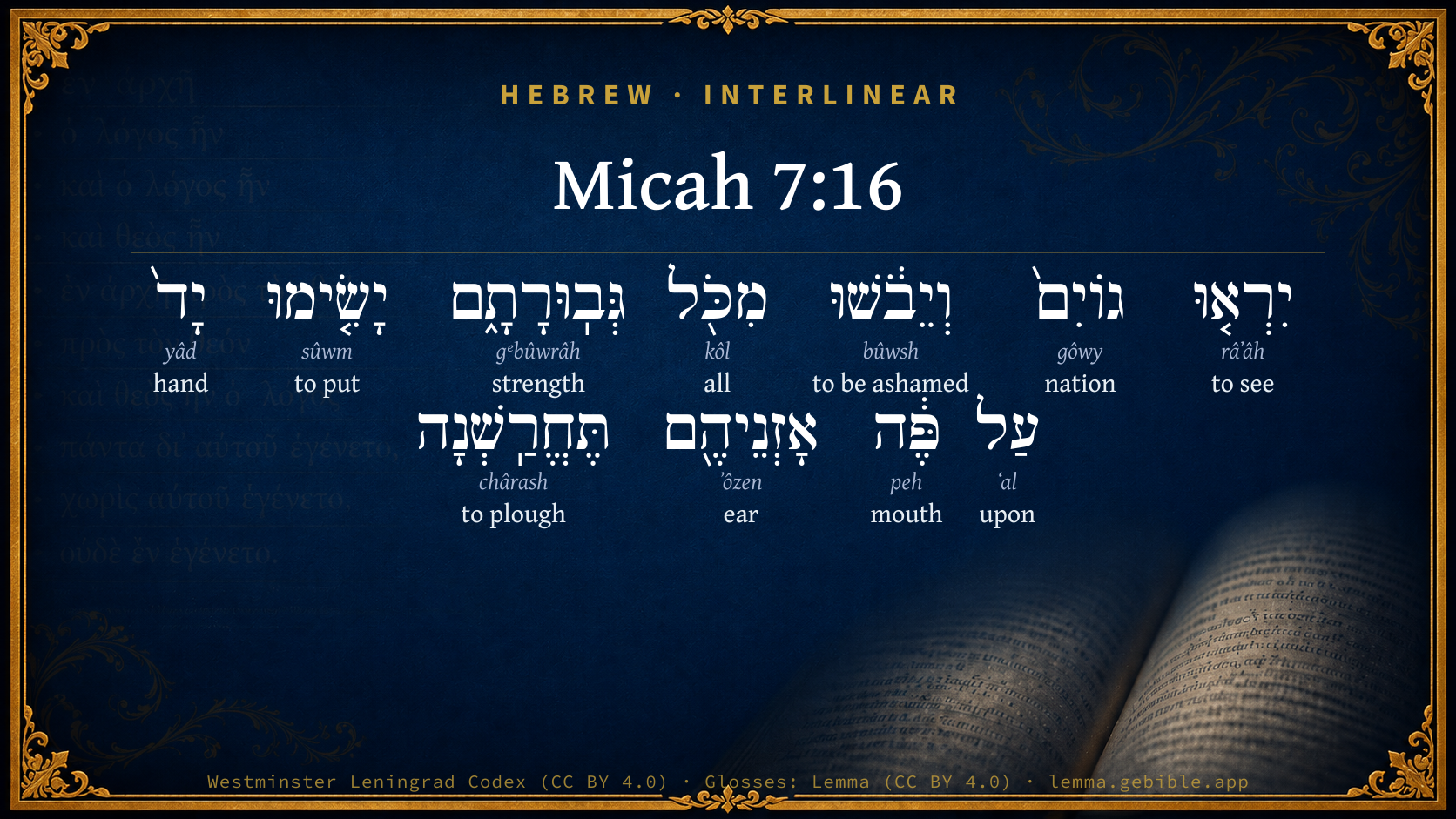
Hebrew (Westminster Leningrad Codex) Micah 7:16 appears in the Hebrew Old Testament. The text above is from the Westminster Leningrad Codex. Each word links to its Strong’s number, a concise gloss, and parsing drawn from the Open Scriptures Hebrew Bible morphology. Click any word for its full Brown-Driver-Briggs (BDB) entry.
Download image
Cite this verse

Micah 7:16 (World English Bible). Public Domain. Lemma interlinear Bible study tool, https://lemma.gebible.app/v/micah/7/16.

Show BibTeX & RIS
BibTeX
RIS
English Translation
The nations will see and be ashamed of all their might. They will lay their hand on their mouth. Their ears will be deaf.
World English Bible · Public Domain
Download a study sheet

One document with this verse’s original text, its word-by-word gloss line, the meaning frame, cross-references with their text, attributed commentary, and full source and license credits — printable, and it pastes into notes with its structure intact.

This verse Autodidact and up

Study sheet (.html) Plain text (.txt)

A passage Seminary Student

Up to 50 verses in one chapter. A passage sheet keeps up to 6 commentary sources and 12 cross-references per verse, in the order this page ranks them, and says so on the sheet whenever that leaves anything out. Ask for a single verse and you get the Autodidact verse sheet above.

Everything on this page stays free to read, with no account — the sheet is a download of what is already on screen, not access to it.

Want to remove ads? Support Godless Engineer
Compare translations 3

The same verse in 3 English versions, stacked beneath the original-language interlinear above. Click any original word for its lexicon entry.

Each is an independent rendering of the whole verse — the interlinear is not word-aligned to these translations.

Highlighted words mark where these versions differ — a whole-verse word diff, not a word-by-word alignment.

  • World English Bible Public Domain
    The nations will see and be ashamed of all their might. They will lay their hand on their mouth. Their ears will be deaf.
  • King James Version Public Domain
    The nations shall see and be confounded at all their might: they shall lay their hand upon their mouth, their ears shall be deaf.
  • unfoldingWord Literal Text CC BY-SA 4.0
    The nations will see and be ashamed of all their power. They will put their hands on their mouths; their ears will be deaf.

unfoldingWord Literal Text — © unfoldingWord, licensed CC BY-SA 4.0. Word-aligned USFM3 via Door43 (git.door43.org/unfoldingWord/en_ult).

Versions to compare (up to 4)

3 of 4 selected

Show all 18 translations

Every available English version of this verse, each an independent rendering of the whole verse.

  • World English Bible Public Domain
    The nations will see and be ashamed of all their might. They will lay their hand on their mouth. Their ears will be deaf.
  • Berean Standard Bible Public Domain
    Nations will see and be ashamed, deprived of all their might. They will put their hands over their mouths, and their ears will become deaf.
  • Majority Standard Bible Public Domain
    Nations will see and be ashamed, deprived of all their might. They will put their hands over their mouths, and their ears will become deaf.
  • King James Version Public Domain
    The nations shall see and be confounded at all their might: they shall lay their hand upon their mouth, their ears shall be deaf.
  • American Standard Version (1901) Public Domain
    The nations shall see and be ashamed of all their might; they shall lay their hand upon their mouth; their ears shall be deaf.
  • Revised Version (1885) Public Domain
    The nations shall see and be ashamed of all their might: they shall lay their hand upon their mouth, their ears shall be deaf.
  • Geneva Bible (1599) Public Domain
    The nations shall see, and be confounded for all their power: they shall lay their hande vpon their mouth: their eares shall be deafe.
  • Douay-Rheims (1899) Public Domain
    The nations shall see, and shall be confounded at all their strength: they shall put the hand upon the mouth, their ears shall be deaf.
  • Young's Literal Translation Public Domain
    See do nations, and they are ashamed of all their might, They lay a hand on the mouth, their ears are deaf.
  • Literal Standard Version CC BY-SA 4.0
    Nations see, and they are ashamed of all their might, || They lay a hand on the mouth, their ears are deaf.
  • Unlocked Literal Bible CC BY-SA 4.0
    The nations will see and be ashamed of all their power. They will put their hands on their mouths; their ears will be deaf.
  • unfoldingWord Literal Text CC BY-SA 4.0
    The nations will see and be ashamed of all their power. They will put their hands on their mouths; their ears will be deaf.
  • Darby Bible Public Domain
    -- The nations shall see, and be ashamed for all their might: they shall lay [their] hand upon [their] mouth, their ears shall be deaf.
  • World Messianic Bible Public Domain
    The nations will see and be ashamed of all their might. They will lay their hand on their mouth. Their ears will be deaf.
  • Webster's Bible Public Domain
    The nations shall see and be confounded at all their might: they shall lay their hand upon their mouth, their ears shall be deaf.
  • Free Bible Version CC BY-SA 4.0
    The nations will see, and they will be humiliated despite their strength. They will cover their mouths with their hands, and their ears shall become deaf.
  • Bible in Basic English Public Domain
    The nations will see and be shamed because of all their strength; they will put their hands on their mouths, their ears will be stopped.
  • JPS Tanakh (1917) Public Domain
    The nations shall see and be put to shame for all their might; they shall lay their hand upon their mouth, their ears shall be deaf.

Literal Standard Version (2020), Covenant Press — licensed CC BY-SA 4.0. Text via the HelloAO Bible API (eBible.org). Unlocked Literal Bible (unfoldingWord) — licensed CC BY-SA 4.0. Text via the HelloAO Bible API (eBible.org). unfoldingWord Literal Text — © unfoldingWord, licensed CC BY-SA 4.0. Word-aligned USFM3 via Door43 (git.door43.org/unfoldingWord/en_ult). Free Bible Version, Dr. Jonathan Gallagher — licensed CC BY-SA 4.0. Text via the HelloAO Bible API (eBible.org).

Word by word

More ways to search: Search by grammar → Find every occurrence → Compare this word →

Practice this passage: Drill this verse → Learn its vocabulary →

גְּבֽוּרָתָ֑ם
gᵉbûwrâh
H1369
“strength · their”
Noun, Common, Feminine, Singular, Construct + Suffix, Personal, 3rd Person, Masculine, Plural
Part of Speech
Noun
Type
Common
Gender
Feminine
Number
Singular
State
Construct
Full BDB Definition

Origin: pass. participle from the same as H1368

TWOT: 310c

strength, might - strength - might, valour, bravery - might, mighty deeds (of God)
  1. יִרְא֤וּ râʼâh H7200 “to see” Verb, Qal, Imperfect, 3rd Person, Masculine, Plural
  2. גוֹיִם֙ gôwy H1471 “nations” Noun, Common, Masculine, Plural, Absolute
  3. וְיֵבֹ֔שׁוּ bûwsh H954 “and · to be ashamed” Conjunction + Verb, Qal, Imperfect, 3rd Person, Masculine, Plural
  4. מִכֹּ֖ל kôl H3605 “from · all of” Preposition + Noun, Common, Masculine, Singular, Construct
  5. יָשִׂ֤ימוּ sûwm H7760 “to put” Verb, Qal, Imperfect, 3rd Person, Masculine, Plural
  6. יָד֙ yâd H3027 “hand” Noun, Common, Both, Singular, Absolute
  7. עַל ʻal H5921 “upon” Preposition
  8. פֶּ֔ה peh H6310 “mouth” Noun, Common, Masculine, Singular, Absolute
  9. אָזְנֵיהֶ֖ם ʼôzen H241 “ears · their” Noun, Common, Feminine, Dual, Construct + Suffix, Personal, 3rd Person, Masculine, Plural
  10. תֶּחֱרַֽשְׁנָה chârash H2790 “to plough” Verb, Qal, Imperfect, 3rd Person, Feminine, Plural

About this verse

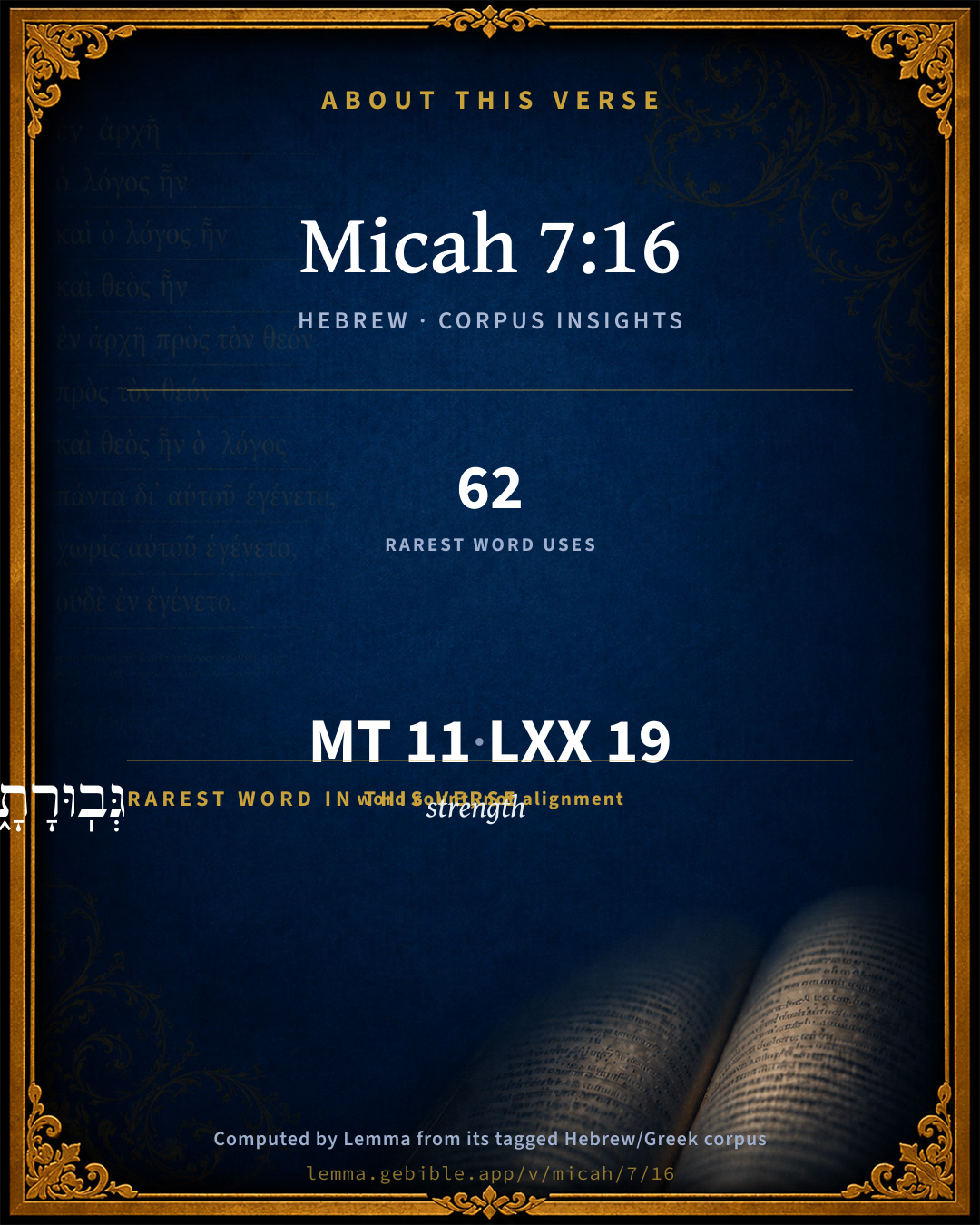
These counts appear in no published source. They are computed here, from the morphology-tagged text and Lemma’s own curated glosses. What Lemma adds →

11
words
11
distinct lemmas
Prophets
section

Grammatical profile

  • 4 verbs
  • 6 nouns
  • 1 preposition

Verb forms

  • יִרְא֤וּ Qal · Imperfect
  • וְיֵבֹ֔שׁוּ Qal · Imperfect
  • יָשִׂ֤ימוּ Qal · Imperfect
  • תֶּחֱרַֽשְׁנָה Qal · Imperfect

Hebrew & Septuagint length

In English translation the verse runs 24 words from the Hebrew and 25 from the Septuagint (LXX English) — closely comparable.

A rough comparison of the two English renderings, which tokenize alike — not a word-level alignment.

Word counts can differ between the Hebrew and the Greek without any difference in meaning — e.g. the Hebrew direct-object marker אֵת has no separate Greek word, and Greek often adds the article ὁ.

In the original languages it is 11 Hebrew tokens and 19 Greek tokens — but the two are counted differently (Hebrew bundles its prefixes and suffixes into one token; the Greek is in lemma form), so that isn’t a like-for-like length.

Cross-references

14

Topical passages linked to Micah 7:16 in the Treasury of Scripture Knowledge — connected by theme and wording, ordered by reader-vote popularity; previews shown in the World English Bible.

  • Isaiah 26:11 Yahweh, your hand is lifted up, yet they don't see: but they shall see [your] zeal for the people, and be disappointed; yes, fire shall devour your adversaries.
  • Isaiah 52:15 so shall he sprinkle many nations; kings shall shut their mouths at him: for that which had not been told them shall they see; and that which they had not heard shall they understand.
  • Job 29:9–10 The princes refrained from talking, And laid their hand on their mouth;
  • Job 40:4 "Behold, I am of small account. What shall I answer you? I lay my hand on my mouth.
  • Job 21:5 Look at me, and be astonished. Lay your hand on your mouth.
  • Psalms 126:2 Then our mouth was filled with laughter, And our tongue with singing. Then they said among the nations, "Yahweh has done great things for them."
  • Isaiah 66:18 For I [know] their works and their thoughts: [the time] comes, that I will gather all nations and languages; and they shall come, and shall see my glory.
  • Ezekiel 38:23 I will magnify myself, and sanctify myself, and I will make myself known in the eyes of many nations; and they shall know that I am Yahweh.
  • Ezekiel 39:17–21 You, son of man, thus says the Lord Yahweh: Speak to the birds of every sort, and to every animal of the field, Assemble yourselves, and come; gather yourselves on every side to my sacrifice that I do sacrifice for you, even a great sacrifice on the mountains of Israel, that you may eat flesh and drink blood.
  • Micah 5:8 The remnant of Jacob will be among the nations, In the midst of many peoples, Like a lion among the animals of the forest, Like a young lion among the flocks of sheep; Who, if he goes through, treads down and tears in pieces, And there is no one to deliver.
  • Zechariah 8:20–23 Thus says Yahweh of Hosts: "Many peoples, and the inhabitants of many cities will yet come;
  • Zechariah 12:9 It will happen in that day, that I will seek to destroy all the nations that come against Jerusalem.
  • Romans 3:19 Now we know that whatever things the law says, it speaks to those who are under the law, that every mouth may be closed, and all the world may be brought under the judgment of God.
  • Revelation 11:18 The nations were angry, and your wrath came, as did the time for the dead to be judged, and to give your bondservants the prophets, their reward, as well as to the saints, and those who fear your name, to the small and the great; and to destroy those who destroy the earth."

Cross-references courtesy of OpenBible.info (CC BY 4.0).

Hebrew and Greek witnesses Masoretic Hebrew ↔ Greek Septuagint

The same verse in the two great witnesses to the Old Testament, shown verse-for-verse.

These are two independent witnesses, not word-aligned to each other, and the Septuagint is shown in lemma (dictionary) form.

Hebrew Micah 7:16 Masoretic · Westminster Leningrad Codex

יִרְא֤וּ גוֹיִם֙ וְיֵבֹ֔שׁוּ מִכֹּ֖ל גְּבֽוּרָתָ֑ם יָשִׂ֤ימוּ יָד֙ עַל פֶּ֔ה אָזְנֵיהֶ֖ם תֶּחֱרַֽשְׁנָה

The nations will see and be ashamed of all their might. They will lay their hand on their mouth. Their ears will be deaf.

World English Bible · Public Domain

Greek LXX Micah 7:16 Septuagint · lemma form

ὁράω ἔθνος καί κατααἰσχύνω ἐκ πᾶς ὁ ἰσχύς αὐτός ἐπιτίθημι χείρ ἐπί ὁ στόμα αὐτός ὁ οὖς αὐτός ἀποκωφόω

The nations shall see and be ashamed; and at all their might they shall lay their hands upon their mouth, their ears shall be deafened.

LXX2012 (modern English Septuagint) · Public Domain

Hebrew: Westminster Leningrad Codex (CC BY 4.0). Greek: Septuagint (public domain); English from LXX2012 (modern English Septuagint) (Public Domain). How the Septuagint differs from the Hebrew →

Targum (Aramaic paraphrase)

1

The Targum is the ancient Jewish Aramaic paraphrase of the Hebrew Scriptures — an interpretive translation, not the Hebrew text itself. Onkelos (literal) and Pseudo-Jonathan (expansive) render the Torah, and Jonathan the Prophets. Coverage is partial: where no permissively-licensed English translation exists for a verse, only the Aramaic is shown. This is verse-level text, not a word-by-word alignment to the Hebrew.

  1. Targum Jonathan Prophets (Joshua–Malachi)
    יֶחֱזוּן עַמְמַיָא וְיִבְהֲתוּן מִכָּל גְבוּרְתְּהוּן יְשַׁווּן יְדֵיהוֹן עַל פּוּמְהוֹן וְאוּדְנֵיהוֹן יִתְחַרְשָׁן:

    (no public-domain English translation for this verse)

    Targum Jonathan — Aramaic: “Mikraot Gedolot” (public domain). English: “Sefaria Community Translation” (CC0 1.0 (public-domain dedication)); “London "Chaldee Paraphrase," 1871” (public domain). Text via Sefaria.

Commentary

Notes on Micah 7:16 from classic Christian and Jewish commentators (each source and its license shown beneath its notes). The classic Christian expositions comment on the surrounding passage and are grouped to its opening verse, so a note may address several verses; the Jewish commentaries on the Tanakh (Rashi and others) are per-verse, so they appear only where the commentator wrote on this verse.

Lemma curates 59 commentaries, every one of them public domain or Creative Commons licensed, each selected and text-cleaned for this edition rather than reprinted as found. About our sources →

Trapp's Complete Commentary

John Trapp

Mic 7:16 The nations shall see and be confounded at all their might: they shall lay [their] hand upon [their] mouth, their ears shall be deaf.

Ver. 16. The nations shall see and be confounded] Considering how I have defeated and befooled them, how I have made all their might to melt and moulder, they shall stand amazed, and be made a common table talk; as Belshazzar and the Babylonians were, when Cyrus (God’s servant) suddenly brake in upon them and surprised their city, which they held insuperable: and as the heathen emperors of Rome were, when the Christians, under the conduct of Constantine, carried it against them.

They shall lay their hand upon their mouth] Be struck dumb, as if they had seen Medusa’s head; they shall not be able to contradict the gospel, or to hinder the progress of it. Valens, the Arian Emperor, coming upon Basil while he was in holy duties, with an intent to do him harm, was not only silenced, but so terrified, that he reeled, and had fallen had he not been upheld by those that were with him.

Their ears shall be deaf] With the sudden bursting forth of God’s wonderful and terrible works, saith Mr Diodati.

John Trapp, A Commentary or Exposition upon All the Books of the Old and New Testament (1647–1656) — public domain. Text from a community e-Sword module.

Tyndale Open Study Notes

Tyndale Open Resources

7:16 The promise that all the nations would be blessed by the descendants of Abraham (Gen 12:3) would be fulfilled in this restoration of God’s special people.

Tyndale Open Study Notes — © Tyndale Open Resources, licensed CC BY-SA 4.0. Text via the HelloAO Bible API.

Geneva Bible (1599)

Geneva Bible translators

They shall be as dumb men, and dare brag no more.

They shall be astonished and afraid to hear men speak, lest they should hear of their destruction.

Geneva Bible (1599) marginal notes — public domain. Text via Bolls.life.

Jamieson, Fausset & Brown

Robert Jamieson, A. R. Fausset & David Brown

shall see--the "marvellous things" (Mic 7:15; Isa 26:11).

confounded at all their might--having so suddenly proved unavailing: that might wherewith they had thought that there is nothing which they could not effect against God's people.

lay . . . hand upon . . . mouth--the gesture of silence (Job 21:5; Job 40:4; Psa 107:42; Isa 52:15). They shall be struck dumb at Israel's marvellous deliverance, and no longer boast that God's people is destroyed.

ears . . . deaf--They shall stand astounded so as not to hear what shall be said [GROTIUS]. Once they had eagerly drunk in all rumors as so many messages of victories; but then they shall be afraid of hearing them, because they continually fear new disasters, when they see the God of Israel to be so powerful [CALVIN]. They shall close their ears so as not to be compelled to hear of Israel's successes.

Jamieson, Fausset & Brown — Commentary Critical and Explanatory on the Whole Bible (1871) — public domain (CC PDM 1.0). Text via the HelloAO Bible API.

Adam Clarke's Commentary

Verse 16. The nations shall see and be confounded] Whether the words in these verses (Mic 7:15-17) be applied to the return from the Babylonish captivity, or to the prosperity of the Jews under the Maccabees, they may be understood as ultimately applicable to the final restoration of this people, and their lasting prosperity under the Gospel.

Adam Clarke's Commentary on the Bible (1810–1826) — public domain. Text from a community e-Sword/MySword module.

John Calvin's Commentaries

Here again the Prophet shows, that though the Church should be assailed on every side and surrounded by innumerable enemies, no doubt ought yet to be entertained respecting the promised aid of God; for it is in his power to make all nations ashamed, that is, to cast down all the pride of the world, so as to make the unbelieving to acknowledge at length that they were elated by an empty confidence. Hence he says, that the nations shall see; as though he said, “I know what makes you anxious, for many enemies are intent on your ruin; and when any help appears, they are immediately prepared fiercely to resist; but their attempts and efforts will not prevent God from delivering you.”

They shall then see and be ashamed of all their strength By these words the Prophet means, that however strongly armed the unbelieving may think themselves to be to destroy the Church, and that how many obstacles soever they may have in their power to restrain the power of God in its behalf, yet the whole will be in vain, for God will, in fact, prove that the strength of men is mere nothing.

He adds, They shall lay their hand on their mouth; that is, they shall not dare to boast hereafter, as they have hitherto done; for this phrase in Hebrew means to be silent. Since then the enemies of the Church made great boastings and exulted with open mouth, as though the people of God were destroyed, the Prophet says, that when God would appear as the Redeemer of his people, they should become, as it were, mute. He subjoins, their ears shall become deaf; that is, they shall stand astounded; nay, they shall hardly dare to open their ears, lest the rumor, brought to them, should occasion to them new trembling. Proud men, we know, when matters succeed according to their wishes, not only boast of their good fortune with open mouths, but also greedily catch at all rumors; for as they think they are all so many messages of victories, — “What is from this place? or what is from that place?” They even expect that the whole world will come under their power. The Prophet, on the other hand, says, “They shall lay the hand on the mouth, and their ears shall become deaf; that is they shall tremblingly shun all rumors, for they shall continually dread new calamities, when they shall see that the God of Israel, against who they have hitherto fought, is armed with so much power.

Some apply this to the preaching of the Gospel; which I readily allow, provided the deliverance be made always to begin with the ancient people: for if any one would have this to be understood exclusively of Christ, such a strained and remote exposition would not be suitable. But if any one will consider the favor of God, as continued from the return of the people to the restoration effected by Christ, he will rightly comprehend the real design of the Prophet. Really fulfilled, then, is what the Prophet says here, when God spreads the doctrine of his Gospel through the whole world: for those who before boasted of their own inventions, begin then to close their mouth, that, being thus silent, they may become his disciples; and they also close their ears, for now they give not up themselves, as before, to foolish and puerile fables, but consecrate their whole hearing to the only true God, that they may attend only to his truth, and no more vacillate between contrary opinions. All this, I allow, is fulfilled under the preaching of the Gospel; but the Prophet, no doubt, connected together the whole time, from the return of the people from the Babylonian exile, to the manifestation of Christ.

John Calvin's Commentaries (1540-1563) — public domain. Text from the Calvin Translation Society English edition (1840s-50s) via the Christian Classics Ethereal Library (ccel.org). Calvin's coverage is partial (roughly two-thirds of the Bible); uncommented books and verses are honest gaps, never fabricated. The 19th-century editor's footnotes and remarks are omitted so the notes are faithfully Calvin's own voice.

The Cambridge Bible for Schools and Colleges

gen. ed. J. J. S. Perowne

16. confounded at all their might] Ashamed because all their might has come to nothing.

lay their hand upon their mouth] A mark of reverence; comp. Job_21:5, Isa_52:15.

The Cambridge Bible for Schools and Colleges (gen. ed. J. J. S. Perowne; Cambridge University Press, 1878–1918) — public domain. Text from a community e-Sword module.

John Gill's Exposition

The nations shall see and be confounded at all their might,.... The Chaldeans or Babylonians, when they shall see the wonderful things done by the Lord in the deliverance of his people out of their hands, shall be ashamed of their own power and might, in which they trusted, and of which they boasted; but now shall be baffled and defeated, and not able to stop the progress of the arms of Cyrus, or detain the Jews any longer their captives; or they shall be confounded at the power and strength the Jews will have to repossess their land, rebuild their city and temple, under the encouragement and protection of the king of Persia; and as this may refer to a further accomplishment in Gospel times, it may respect the confusion the Gentile world would be in at the mighty power and spread of the Gospel, in the conversion of such multitudes by it, and in the abolition of the Pagan religion. Kimchi interprets this of the nations that shall be gathered together with Gog and Magog against Jerusalem in the latter day; see Eze 38:15;

they shall lay their hand upon their mouth: be silent, and boast no more of themselves; nor blaspheme God and his word; nor insult his people; nor oppose his Gospel, or open their mouths any more against his truths and his ordinances:

their ears shall be deaf; hearing so much of the praises of God, of the success of his interest, and of the happiness of his peopled dinned in their ears, they will be stunned with it, and scarce know what they hear; become deaf with the continual noise of it, which will be disagreeable to them; and will choose to hear no more, and therefore through envy and grief will stop their ears at what is told them.

John Gill's Exposition of the Whole Bible (1746–1763) — public domain (CC PDM 1.0). Text via the HelloAO Bible API.

Albert Barnes' Notes on the Bible

The nations shall see - God had answered, what He would give to His own people, to see. Micah takes up the word, and says, what effect this sight should have upon the enemies of God and of His people. The world should still continue to be divided between the people of God and their adversaries. Those who are converted pass from the one to the other; but the contrast remains. Assyria, Babylon, Egypt, pass away or become subject to other powers; but the antagonism continues. The nations are they, who, at each time, waste, oppress, are arrayed against, the people of God. When the Gospel came into the world, the whole world was arrayed against it. These then, he says, “shall see”, that is, the marvelous works of God, which God should shew His people, and be ashamed at, that is, “because of all their might”, their own might. They put forth their whole might, and it failed them against the marvelous might of God. They should array might against might, and be ashamed at the failure of “all their might”.

The word all is very emphatic; it implies that they had put forth all, and that all had failed them, and proved to be weakness. So the pagan might was often put to shame and gnashed its teeth, when it could avail nothing against the strength to endure which God gave to His martyrs. Its strength to inflict and to crush was baffled before the hidden might of God’s Spirit. “They shall lay their hand upon their mouth”, in token that they were reduced to silence, having no more to say ; for He promised, “I will give you a mouth and wisdom, which all your adversaries shall not be able to gainsay nor resist” (Luk 21:15, compare Act 5:29); and they had to own, “indeed a notable miracle hath been done by them, and we cannot deny it. Their ears shall be deaf” Act 4:16; they shall be silent, as though they had heard nothing, as if they were both dumb and deaf .

Yet it seems too that they are willfully deaf, shutting their ears out of envy and hatred, that they might not hear what great things God had done for His people, nor hear the voice of truth and be converted and healed. Rup.: “The nations and the Emperors of the nations saw, Jews and Gentiles saw, and were ashamed at all their might, because their might, great as it was accounted, upheld by laws and arms, could not overcome the mighty works, which the Good Shepherd did among His people or flock by His rod, that is, by His power, through weak and despised persons, the aged, or oftentimes even by boys and girls. They were then ashamed at all their might which could only touch the “earthen vessels” 2Co 4:7, but could not take away the treasure which was in them. What shall I say of the wisdom of those same nations? Of this too they were ashamed, as he adds, “They shall put their hands upon their mouths”. For, in comparison with the heavenly wisdom, which spake by them and made their tongues eloquent, dumb was all secular eloquence, owning by its silence that it was convicted and confounded.”

Albert Barnes' Notes on the Bible (1834–1885) — public domain. Text from a community e-Sword/MySword module.

Haydock's Catholic Bible Commentary

CHAPTER VII.

Strength, because they cannot overcome the Hebrews or Christians. (Menochius) --- Deaf, being astonished, Job xxi. 5.

George Leo Haydock (1774–1849), Haydock's Catholic Family Bible and Commentary, 1859 edition — public domain. Excludes Psalms (Douay-Rheims chapter numbering differs from Protestant) and Deuterocanonical books (Catholic canon only).

Matthew Poole's English Annotations

The nations; the heathen, enemies to the Jews, as Psa 126:1-3.

Shall see and be confounded; amazed at what they see and know done amongst these nations for the deliverance of his people. The enemy shall neither be able to bear the sight, nor deny the certainly of the thing; it will make them enviously look on the prosperity of the good and godly among the Jews.

They shall lay their hand upon their mouth, their ears shall be deaf: as men seldom fail to hear the first report of what they desire, and as seldom open their ears to that they like not; so shall, it be here, though they will not speak of it, nor desire others should speak of it, yet they should, to their great grief, see their poor captives raised out of depth of shame to the height of honour, from a contemptible remnant to a mighty nation. As this had its typical complement in the reduction of Israel out of Babylon, so it had its antitypical completion in our redemption by Christ. As 1Co 2:9.

Matthew Poole's English Annotations on the Holy Bible (1683–1685) — public domain. Text from a community e-Sword/MySword module.

The Pulpit Commentary

Shall see. The heathen shall see these marvellous things. Be confounded at (ashamed of) all their might. Hostile nations shall be ashamed when they find the impotence of their boasted power. Compare the effect of the Exodus on contiguous nations. (Exo_15:14, etc.; Jos_2:9, Jos_2:10) They shall lay their hand upon their mouth. They shall be silent from awe and astonishment. (Jud_1:18:19 Job_21:5 Isa_52:15) Their ears shall be deaf. Their senses shall be stupefied by the wonders which they see that which Job (Job_26:14) calls "the thunder of his mighty deeds." There may also be an allusion to their wilful obstinacy, and unbelief.

The Pulpit Commentary (1880–1919), ed. H.D.M. Spence-Jones & Joseph S. Exell — public domain. Text from a community e-Sword module.

John Wesley's Explanatory Notes

Shall be deaf - They shall neither care to hear, nor to speak of it.

John Wesley, Explanatory Notes Upon the Whole Bible (1754–1765) — public domain. Text via the GEBible commentary corpus.

unfoldingWord translationNotes

Door43 World Missions Community

The nations

The word "nations" is a metonym for the people who live in many nations. AT: "The people of the nations nearby" (See: Metaphor)

They will put their hands on their mouths

They do this to show that they are ashamed of what they have done. (See: Symbolic Action)

their ears will be deaf

This is an idiom. Nothing anyone says will have any effect on them. (See: Idiom)

They will lick the dust like a snake

Snakes slither on the ground where dust gets on them, and here the people are being compared to snakes, though it is probably an exaggeration that they will lick the dust. Possible meanings are that these people 1) will literally lie on the ground in shame or 2) will be so ashamed and humbled that it will be as if they were lying on the ground. (See: Hyperbole and Generalization and Simile and Symbolic Action)

their dens

The people are spoken of as if they were animals, because animals live in "dens." AT: "their homes" or "their hiding places" (See: Metaphor)

translationWords

nation

shame

power

hand

serpent

fear

Yahweh

God

unfoldingWord translationNotes — © Distant Shores Media and the Door43 World Missions Community, licensed CC BY-SA 4.0. Source: git.door43.org/Door43/en_tn.

Lesson kit

Teaching starters — assembled from the data on this page, not authored interpretation. Every prompt links to the verse data it draws on. Edit before teaching.

Micah, in the Prophets, opens this verse with 11 words (11 distinct Hebrew lemmas). Its most distinctive word is gᵉbûwrâh (“strength”). A historical commentator’s framing appears above. Read the whole chapter for the surrounding context.

Discussion questions

  1. How does “strength” (gᵉbûwrâh) shape what this verse is saying?
  2. Isaiah 26:11 shares this passage’s theme. How do the two illuminate each other?
  3. The translations on this page render this verse differently — a whole-verse word diff, not a word-by-word alignment. What might account for the different wordings?
  4. The verb «יִרְא֤וּ» is Qal Imperfect. How does its form color the action?
  5. Reading how Trapp's Complete Commentary and Tyndale Open Study Notes read this verse, where do the two commentators agree and where do they part?

Things to notice

Reading settings

Reading text

Shown beneath each verse's original-language words.

Old Testament
Old Testament edition

Read the OT as the Masoretic Hebrew (MT) or the Greek Septuagint (LXX).

English shown for the Greek Septuagint (in the Hebrew ↔ Greek comparison).

Comparing translations? Open the Compare panel on any verse page to stack up to four side by side.