
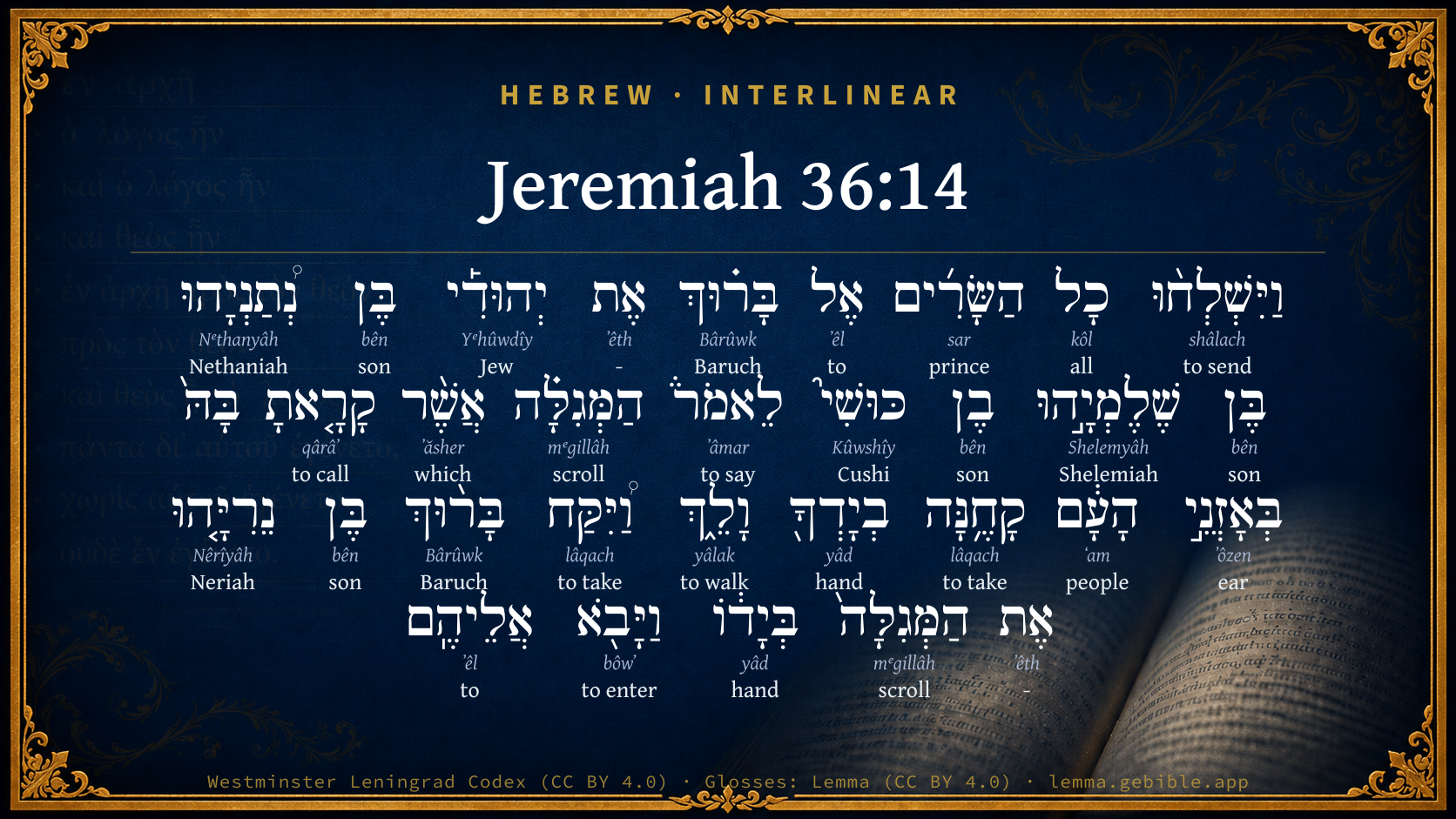
Jeremiah 36:14

Hebrew (Westminster Leningrad Codex) Jeremiah 36:14 appears in the Hebrew Old Testament. The text above is from the Westminster Leningrad Codex. Each word links to its Strong’s number, a concise gloss, and parsing drawn from the Open Scriptures Hebrew Bible morphology. Click any word for its full Brown-Driver-Briggs (BDB) entry.
Download image
Cite this verse

Jeremiah 36:14 (World English Bible). Public Domain. Lemma interlinear Bible study tool, https://lemma.gebible.app/v/jeremiah/36/14.

Show BibTeX & RIS
BibTeX
RIS
English Translation
Therefore all the princes sent Jehudi the son of Nethaniah, the son of Shelemiah, the son of Cushi, to Baruch, saying, Take in your hand the scroll in which you have read in the ears of the people, and come. So Baruch the son of Neriah took the scroll in his hand, and came to them.
World English Bible · Public Domain
Highlights
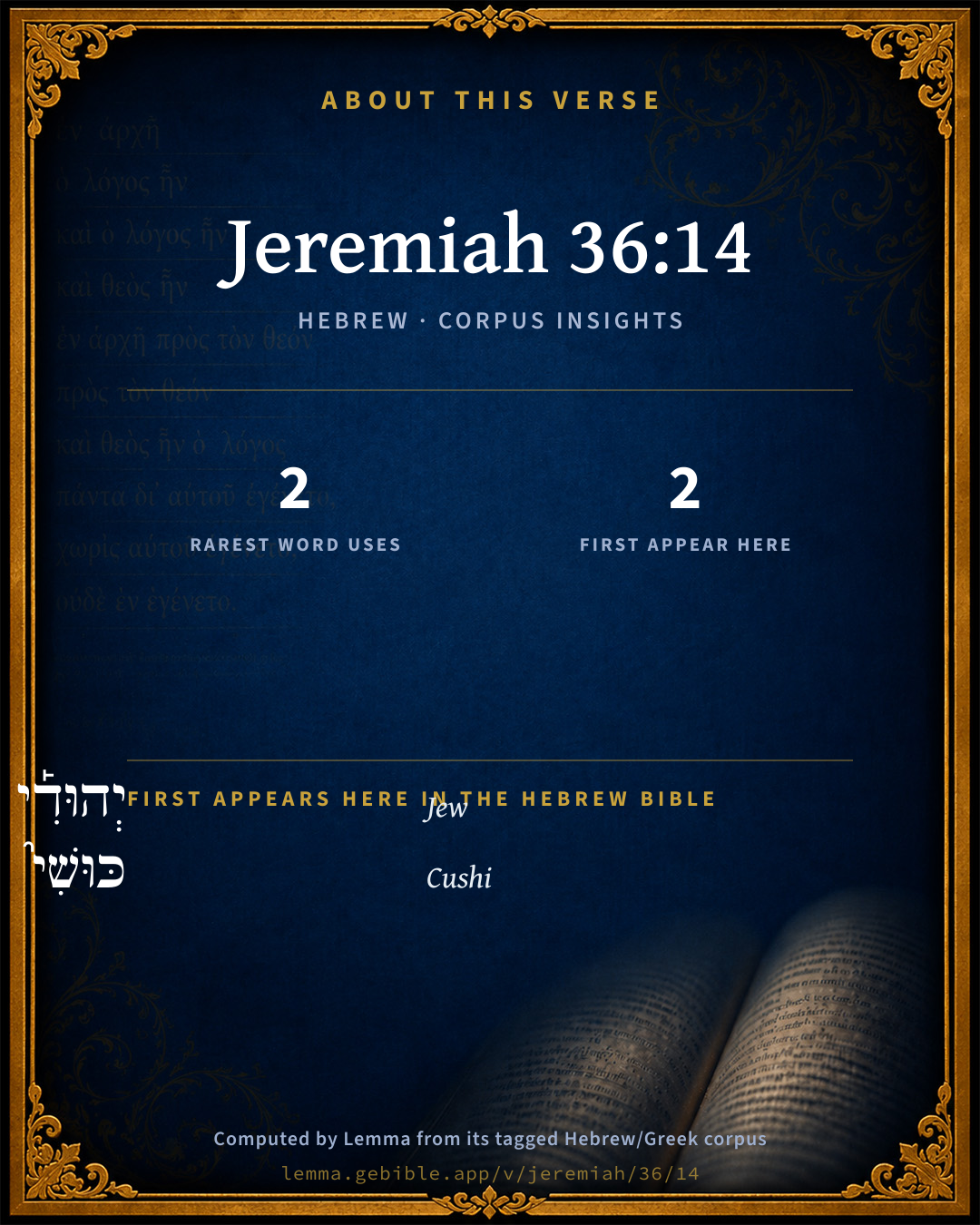
  • 2 first appearances in the Hebrew Bible
Full analysis ↓
Download a study sheet

One document with this verse’s original text, its word-by-word gloss line, the meaning frame, cross-references with their text, attributed commentary, and full source and license credits — printable, and it pastes into notes with its structure intact.

This verse Autodidact and up

Study sheet (.html) Plain text (.txt)

A passage Seminary Student

Up to 50 verses in one chapter. A passage sheet keeps up to 6 commentary sources and 12 cross-references per verse, in the order this page ranks them, and says so on the sheet whenever that leaves anything out. Ask for a single verse and you get the Autodidact verse sheet above.

Everything on this page stays free to read, with no account — the sheet is a download of what is already on screen, not access to it.

Want to remove ads? Support Godless Engineer
Compare translations 3

The same verse in 3 English versions, stacked beneath the original-language interlinear above. Click any original word for its lexicon entry.

Each is an independent rendering of the whole verse — the interlinear is not word-aligned to these translations.

Highlighted words mark where these versions differ — a whole-verse word diff, not a word-by-word alignment.

  • World English Bible Public Domain
    Therefore all the princes sent Jehudi the son of Nethaniah, the son of Shelemiah, the son of Cushi, to Baruch, saying, Take in your hand the scroll in which you have read in the ears of the people, and come. So Baruch the son of Neriah took the scroll in his hand, and came to them.
  • King James Version Public Domain
    Therefore all the princes sent Jehudi the son of Nethaniah, the son of Shelemiah, the son of Cushi, unto Baruch, saying, Take in thine hand the roll wherein thou hast read in the ears of the people, and come. So Baruch the son of Neriah took the roll in his hand, and came unto them.
  • unfoldingWord Literal Text CC BY-SA 4.0
    So all the officials sent Jehudi son of Nethaniah son of Shelemiah son of Cushi, to Baruch. Jehudi said to Baruch, “Take the scroll in your hand, the scroll from which you were reading in the hearing of the people, and come.” So Baruch son of Neriah took the scroll in his hand and went to the officials.

unfoldingWord Literal Text — © unfoldingWord, licensed CC BY-SA 4.0. Word-aligned USFM3 via Door43 (git.door43.org/unfoldingWord/en_ult).

Versions to compare (up to 4)

3 of 4 selected

Show all 18 translations

Every available English version of this verse, each an independent rendering of the whole verse.

  • World English Bible Public Domain
    Therefore all the princes sent Jehudi the son of Nethaniah, the son of Shelemiah, the son of Cushi, to Baruch, saying, Take in your hand the scroll in which you have read in the ears of the people, and come. So Baruch the son of Neriah took the scroll in his hand, and came to them.
  • Berean Standard Bible Public Domain
    Then all the officials sent word to Baruch through Jehudi son of Nethaniah, the son of Shelemiah, the son of Cushi, saying, “Bring the scroll that you read in the hearing of the people, and come here.” So Baruch son of Neriah took the scroll and went to them.
  • Majority Standard Bible Public Domain
    Then all the officials sent word to Baruch through Jehudi son of Nethaniah, the son of Shelemiah, the son of Cushi, saying, “Bring the scroll that you read in the hearing of the people, and come here.” So Baruch son of Neriah took the scroll and went to them.
  • King James Version Public Domain
    Therefore all the princes sent Jehudi the son of Nethaniah, the son of Shelemiah, the son of Cushi, unto Baruch, saying, Take in thine hand the roll wherein thou hast read in the ears of the people, and come. So Baruch the son of Neriah took the roll in his hand, and came unto them.
  • American Standard Version (1901) Public Domain
    Therefore all the princes sent Jehudi the son of Nethaniah, the son of Shelemiah, the son of Cushi, unto Baruch, saying, Take in thy hand the roll wherein thou hast read in the ears of the people, and come. So Baruch the son of Neriah took the roll in his hand, and came unto them.
  • Revised Version (1885) Public Domain
    Therefore all the princes sent Jehudi the son of Nethaniah, the son of Shelemiah, the son of Cushi, unto Baruch, saying, Take in thine hand the roll wherein thou hast read in the ears of the people, and come. So Baruch the son of Neriah took the roll in his hand, and came unto them.
  • Geneva Bible (1599) Public Domain
    Therefore all the princes sent Iehudi the sonne of Nethaniah, the sonne of Shelemiah, the sonne of Chushi, vnto Baruch, saying, Take in thine hande the roule, wherein thou hast read in the audience of the people, and come. So Baruch the sonne of Neriah, tooke the roule in his hand, and came vnto them.
  • Douay-Rheims (1899) Public Domain
    Therefore all the princes sent Judi the son of Nathanias, the son of Selemias, the son of Chusi, to Baruch, saying: Take in thy hand the volume in which thou hast read in the hearing of the people, and come. So Baruch the son of Nerias took the volume in his hand, and came to them.
  • Young's Literal Translation Public Domain
    and all the heads send unto Baruch, Jehudi son of Nethaniah, son of Shelemiah, son of Cushi, saying, `The roll in which thou hast read in the ears of the people take in thy hand, and come.' And Baruch son of Neriah taketh the roll in his hand and cometh in unto them,
  • Literal Standard Version CC BY-SA 4.0
    and all the heads send to Baruch, Jehudi son of Nethaniah, son of Shelemiah, son of Cushi, saying, “Take in your hand the scroll, which you have read in the ears of the people, and come.” And Baruch son of Neriah takes the scroll in his hand and comes to them,
  • Unlocked Literal Bible CC BY-SA 4.0
    So all the officials sent Jehudi son of Nethaniah son of Shelemiah son of Cushi, to Baruch. Jehudi said to Baruch, “Take the scroll in your hand, the scroll from which you were reading in the hearing of the people, and come.” So Baruch son of Neriah took the scroll in his hand and went to the officials.
  • unfoldingWord Literal Text CC BY-SA 4.0
    So all the officials sent Jehudi son of Nethaniah son of Shelemiah son of Cushi, to Baruch. Jehudi said to Baruch, “Take the scroll in your hand, the scroll from which you were reading in the hearing of the people, and come.” So Baruch son of Neriah took the scroll in his hand and went to the officials.
  • Darby Bible Public Domain
    And all the princes sent Jehudi the son of Nethaniah, the son of Shelemiah, the son of Cushi, unto Baruch, saying, Take in thy hand the roll in which thou hast read in the ears of the people, and come. And Baruch the son of Nerijah took the roll in his hand, and came unto them.
  • World Messianic Bible Public Domain
    Therefore all the princes sent Jehudi the son of Nethaniah, the son of Shelemiah, the son of Cushi, to Baruch, saying, “Take in your hand the scroll in which you have read in the ears of the people, and come.” So Baruch the son of Neriah took the scroll in his hand, and came to them.
  • Webster's Bible Public Domain
    Therefore all the princes sent Jehudi the son of Nethaniah, the son of Shelemiah, the son of Cushi, to Baruch, saying, Take in thy hand the roll in which thou hast read in the ears of the people, and come. So Baruch the son of Neriah took the roll in his hand, and came to them.
  • Free Bible Version CC BY-SA 4.0
    The officials sent Jehudi son of Nethaniah, son of Shelemiah, son of Cushi, to summon Baruch, telling him, “Bring the scroll that you read to the people, and come here.” So Baruch went to see them taking the scroll with him.
  • Bible in Basic English Public Domain
    So all the rulers sent Jehudi, the son of Nethaniah, the son of Shelemiah, the son of Cushi, to Baruch, saying, Take in your hand the book from which you have been reading to the people and come. So Baruch, the son of Neriah, took the book in his hand and came down to them.
  • JPS Tanakh (1917) Public Domain
    Therefore all the princes sent Jehudi the son of Nethaniah, the son of Shelemiah, the son of Cushi, unto Baruch, saying: 'Take in thy hand the roll wherein thou hast read in the ears of the people, and come.' So Baruch the son of Neriah took the roll in his hand, and came unto them.

Literal Standard Version (2020), Covenant Press — licensed CC BY-SA 4.0. Text via the HelloAO Bible API (eBible.org). Unlocked Literal Bible (unfoldingWord) — licensed CC BY-SA 4.0. Text via the HelloAO Bible API (eBible.org). unfoldingWord Literal Text — © unfoldingWord, licensed CC BY-SA 4.0. Word-aligned USFM3 via Door43 (git.door43.org/unfoldingWord/en_ult). Free Bible Version, Dr. Jonathan Gallagher — licensed CC BY-SA 4.0. Text via the HelloAO Bible API (eBible.org).

Word by word

More ways to search: Search by grammar → Find every occurrence → Compare this word →

Practice this passage: Drill this verse → Learn its vocabulary →

כּוּשִׁי֮
Kûwshîy
H3570
“Cushi”
Noun, Proper
Part of Speech
Noun
Type
Proper
Full BDB Definition

Origin: the same as H3569

TWOT: None

Cushi = "their blackness" - an ancestor of Jehudi ( Jer 36:14 ) - the father of the prophet Zephaniah ( Zep 1:1 )
  1. וַיִּשְׁלְח֨וּ shâlach H7971 “and · to send” Conjunction + Verb, Qal, Sequential Imperfect, 3rd Person, Masculine, Plural
  2. כָל kôl H3605 “all of” Noun, Common, Masculine, Singular, Construct
  3. הַשָּׂרִ֜ים sar H8269 “the · princes” Particle, Definite Article + Noun, Common, Masculine, Plural, Absolute
  4. אֶל ʼêl H413 “to” Preposition
  5. בָּר֗וּךְ Bârûwk H1263 “Baruch” Noun, Proper
  6. אֶת ʼêth H853 “-” Particle, Direct Object
  7. יְהוּדִ֡י Yᵉhûwdîy H3065 “Jew” Noun, Proper
  8. בֶּן bên H1121 “son of” Noun, Common, Masculine, Singular, Construct
  9. נְ֠תַנְיָהוּ Nᵉthanyâh H5418 “Nethaniah” Noun, Proper
  10. בֶּן bên H1121 “son of” Noun, Common, Masculine, Singular, Construct
  11. שֶׁלֶמְיָ֣הוּ Shelemyâh H8018 “Shelemiah” Noun, Proper
  12. בֶן bên H1121 “son of” Noun, Common, Masculine, Singular, Construct
  13. לֵאמֹר֒ ʼâmar H559 “to say” Preposition + Verb, Qal, Infinitive Construct
  14. הַמְּגִלָּ֗ה mᵉgillâh H4039 “the · scroll” Particle, Definite Article + Noun, Common, Feminine, Singular, Absolute
  15. אֲשֶׁ֨ר ʼăsher H834 “which” Particle, Relative
  16. קָרָ֤אתָ qârâʼ H7121 “to call” Verb, Qal, Perfect, 2nd Person, Masculine, Singular
  17. בְּאָזְנֵ֣י ʼôzen H241 “in/at · ears of” Preposition + Noun, Common, Feminine, Dual, Construct
  18. הָעָ֔ם ʻam H5971 “the · people” Particle, Definite Article + Noun, Common, Masculine, Singular, Absolute
  19. קָחֶ֥נָּה lâqach H3947 “take · her” Verb, Qal, Imperative, 2nd Person, Masculine, Singular + Suffix, Personal, 3rd Person, Feminine, Singular
  20. בְיָדְךָ֖ yâd H3027 “in/at · hand · your” Preposition + Noun, Common, Both, Singular, Construct + Suffix, Personal, 2nd Person, Masculine, Singular
  21. וָלֵ֑ךְ yâlak H3212 “and · walk” Conjunction + Verb, Qal, Imperative, 2nd Person, Masculine, Singular
  22. וַ֠יִּקַּח lâqach H3947 “and · to take” Conjunction + Verb, Qal, Sequential Imperfect, 3rd Person, Masculine, Singular
  23. בָּר֨וּךְ Bârûwk H1263 “Baruch” Noun, Proper
  24. בֶּן bên H1121 “son of” Noun, Common, Masculine, Singular, Construct
  25. נֵרִיָּ֤הוּ Nêrîyâh H5374 “Neriah” Noun, Proper
  26. אֶת ʼêth H853 “-” Particle, Direct Object
  27. הַמְּגִלָּה֙ mᵉgillâh H4039 “the · scroll” Particle, Definite Article + Noun, Common, Feminine, Singular, Absolute
  28. בְּיָד֔וֹ yâd H3027 “in/at · hand · his” Preposition + Noun, Common, Both, Singular, Construct + Suffix, Personal, 3rd Person, Masculine, Singular
  29. וַיָּבֹ֖א bôwʼ H935 “and · to enter” Conjunction + Verb, Qal, Sequential Imperfect, 3rd Person, Masculine, Singular
  30. אֲלֵיהֶֽם ʼêl H413 “to · them” Preposition + Suffix, Personal, 3rd Person, Masculine, Plural

About this verse

These counts appear in no published source. They are computed here, from the morphology-tagged text and Lemma’s own curated glosses. What Lemma adds →

32
words
22
distinct lemmas
Prophets
section

Notable vocabulary

The rarest word here is כּוּשִׁי֮ Cushi H3570 — appearing just 2 times in the whole Hebrew Bible.

First appearance in Scripture

These words make their first canonical appearance in the Hebrew Bible here:

  • יְהוּדִ֡י Jew H3065
  • כּוּשִׁי֮ Cushi H3570

Shared distinctive vocabulary

כּוּשִׁי֮ Cushi H3570 occurs in 2 verses of the Hebrew Bible. Also found in:

Grammatical profile

  • 7 verbs
  • 19 nouns
  • 3 prepositions
  • 3 particles

Verb forms

  • וַיִּשְׁלְח֨וּ Qal · Sequential Imperfect
  • לֵאמֹר֒ Qal · Infinitive Construct
  • קָרָ֤אתָ Qal · Perfect
  • קָחֶ֥נָּה Qal · Imperative
  • וָלֵ֑ךְ Qal · Imperative
  • וַ֠יִּקַּח Qal · Sequential Imperfect
  • וַיָּבֹ֖א Qal · Sequential Imperfect

Repetition

Words recur within this verse — often emphatic in Hebrew:

  • בֶּן son H1121 ×4
  • בָּר֗וּךְ Baruch H1263 ×2
  • הַמְּגִלָּ֗ה scroll H4039 ×2
  • קָחֶ֥נָּה to take H3947 ×2
  • בְיָדְךָ֖ hand H3027 ×2
  • אֶל to H413 ×2

Cross-references

11

Topical passages linked to Jeremiah 36:14 in the Treasury of Scripture Knowledge — connected by theme and wording, ordered by reader-vote popularity; previews shown in the World English Bible.

  • Jeremiah 36:2 Take a scroll of a book, and write therein all the words that I have spoken to you against Israel, and against Judah, and against all the nations, from the day I spoke to you, from the days of Josiah, even to this day.
  • 2 Kings 25:23 Now when all the captains of the forces, they and their men, heard that the king of Babylon had made Gedaliah governor, they came to Gedaliah to Mizpah, even Ishmael the son of Nethaniah, and Johanan the son of Kareah, and Seraiah the son of Tanhumeth the Netophathite, and Jaazaniah the son of the Maacathite, they and their men.
  • Jeremiah 36:21 So the king sent Jehudi to get the scroll; and he took it out of the chamber of Elishama the scribe. Jehudi read it in the ears of the king, and in the ears of all the princes who stood beside the king.
  • Jeremiah 40:8 then they came to Gedaliah to Mizpah, [to wit], Ishmael the son of Nethaniah, and Johanan and Jonathan the sons of Kareah, and Seraiah the son of Tanhumeth, and the sons of Ephai the Netophathite, and Jezaniah the son of the Maacathite, they and their men.
  • Jeremiah 41:1–2 Now it happened in the seventh month, that Ishmael the son of Nethaniah, the son of Elishama, of the seed royal and [one of] the chief officers of the king, and ten men with him, came to Gedaliah the son of Ahikam to Mizpah; and there they ate bread together in Mizpah.
  • Jeremiah 41:16 Then took Johanan the son of Kareah, and all the captains of the forces who were with him, all the remnant of the people whom he had recovered from Ishmael the son of Nethaniah, from Mizpah, after that he had killed Gedaliah the son of Ahikam, [to wit], the men of war, and the women, and the children, and the eunuchs, whom he had brought back from Gibeon:
  • Jeremiah 41:18 because of the Chaldeans; for they were afraid of them, because Ishmael the son of Nethaniah had killed Gedaliah the son of Ahikam, whom the king of Babylon made governor over the land.
  • Ezekiel 2:6–7 You, son of man, don't be afraid of them, neither be afraid of their words, though briers and thorns are with you, and you do dwell among scorpions: don't be afraid of their words, nor be dismayed at their looks, though they are a rebellious house.
  • Zephaniah 1:1 The word of Yahweh which came to Zephaniah, the son of Cushi, the son of Gedaliah, the son of Amariah, the son of Hezekiah, in the days of Josiah, the son of Amon, king of Judah.
  • Matthew 10:16 "Behold, I send you out as sheep in the midst of wolves. Therefore be wise as serpents, and harmless as doves.
  • Matthew 10:28 Don't be afraid of those who kill the body, but are not able to kill the soul. Rather, fear him who is able to destroy both soul and body in Gehenna.

Cross-references courtesy of OpenBible.info (CC BY 4.0).

Hebrew and Greek witnesses Masoretic Hebrew ↔ Greek Septuagint

The same verse in the two great witnesses to the Old Testament, shown verse-for-verse.

These are two independent witnesses, not word-aligned to each other, and the Septuagint is shown in lemma (dictionary) form.

Hebrew Jeremiah 36:14 Masoretic · Westminster Leningrad Codex

וַיִּשְׁלְח֨וּ כָל הַשָּׂרִ֜ים אֶל בָּר֗וּךְ אֶת יְהוּדִ֡י בֶּן נְ֠תַנְיָהוּ בֶּן שֶׁלֶמְיָ֣הוּ בֶן כּוּשִׁי֮ לֵאמֹר֒ הַמְּגִלָּ֗ה אֲשֶׁ֨ר קָרָ֤אתָ בָּהּ֙ בְּאָזְנֵ֣י הָעָ֔ם קָחֶ֥נָּה בְיָדְךָ֖ וָלֵ֑ךְ וַ֠יִּקַּח בָּר֨וּךְ בֶּן נֵרִיָּ֤הוּ אֶת הַמְּגִלָּה֙ בְּיָד֔וֹ וַיָּבֹ֖א אֲלֵיהֶֽם

Therefore all the princes sent Jehudi the son of Nethaniah, the son of Shelemiah, the son of Cushi, to Baruch, saying, Take in your hand the scroll in which you have read in the ears of the people, and come. So Baruch the son of Neriah took the scroll in his hand, and came to them.

World English Bible · Public Domain

Greek LXX Structure differs

In the Septuagint, Jeremiah is about an eighth shorter than the Hebrew and arranges its material differently — the Oracles Against the Nations (Hebrew chapters 46–51) appear in the middle of the Greek book, after 25:13. Because the chapter and verse boundaries do not line up, a verse-for-verse comparison with the Hebrew is not shown.

A verse-for-verse comparison isn’t shown here because the chapters and verses don’t line up. Switch to the LXX edition with the MT / LXX toggle above to read the Greek directly.

Hebrew: Westminster Leningrad Codex (CC BY 4.0). Greek: Septuagint (public domain); English from a public-domain English Septuagint. How the Septuagint differs from the Hebrew →

Targum (Aramaic paraphrase)

1

The Targum is the ancient Jewish Aramaic paraphrase of the Hebrew Scriptures — an interpretive translation, not the Hebrew text itself. Onkelos (literal) and Pseudo-Jonathan (expansive) render the Torah, and Jonathan the Prophets. Coverage is partial: where no permissively-licensed English translation exists for a verse, only the Aramaic is shown. This is verse-level text, not a word-by-word alignment to the Hebrew.

  1. Targum Jonathan Prophets (Joshua–Malachi)
    וּשְׁלָחוּ כָּל רַבְרְבַיָא לְוַת בָּרוּךְ יַת יְהוּדִי בַּר נְתַנְיָה בַּר שְׁלֶמְיָה בַּר כּוּשִׁי לְמֵימַר מְגִלָתָא דְקָרֵיתָא בָּהּ קֳדָם עַמָא סַבְהִי בִּידָךְ וֶאֱתָא וּנְסִיב בָּרוּךְ בַּר נֵרִיָה יַת מְגִלָתָא בְיָדֵיהּ וַאֲתָא לְוַתְהוֹן:

    (no public-domain English translation for this verse)

    Targum Jonathan — Aramaic: “Mikraot Gedolot” (public domain). English: “Sefaria Community Translation” (CC0 1.0 (public-domain dedication)); “London "Chaldee Paraphrase," 1871” (public domain). Text via Sefaria.

Commentary

Notes on Jeremiah 36:14 from classic Christian and Jewish commentators (each source and its license shown beneath its notes). The classic Christian expositions comment on the surrounding passage and are grouped to its opening verse, so a note may address several verses; the Jewish commentaries on the Tanakh (Rashi and others) are per-verse, so they appear only where the commentator wrote on this verse.

Lemma curates 59 commentaries, every one of them public domain or Creative Commons licensed, each selected and text-cleaned for this edition rather than reprinted as found. About our sources →

Trapp's Complete Commentary

John Trapp

Jer 36:14 Therefore all the princes sent Jehudi the son of Nethaniah, the son of Shelemiah, the son of Cushi, unto Baruch, saying, Take in thine hand the roll wherein thou hast read in the ears of the people, and come. So Baruch the son of Neriah took the roll in his hand, and came unto them.

Ver. 14. Therefore all the princes sent Jehudi.] Apparitorem regis, ut ex seguentibus constat. - Jun.

John Trapp, A Commentary or Exposition upon All the Books of the Old and New Testament (1647–1656) — public domain. Text from a community e-Sword module.

Tyndale Open Study Notes

Tyndale Open Resources

36:14-16 The palace officials acted quickly. When they heard Baruch reading Jeremiah’s messages, they were terrified and decided to report the situation to the king.

Tyndale Open Study Notes — © Tyndale Open Resources, licensed CC BY-SA 4.0. Text via the HelloAO Bible API.

Jamieson, Fausset & Brown

Robert Jamieson, A. R. Fausset & David Brown

Jehudi--of a good family, as appears from his pedigree being given so fully, but in a subordinate position.

come--Instead of requiring Baruch to come to them, they ought to have gone to the temple, and there professed their penitence. But pride forbade it [CALVIN].

Jamieson, Fausset & Brown — Commentary Critical and Explanatory on the Whole Bible (1871) — public domain (CC PDM 1.0). Text via the HelloAO Bible API.

John Calvin's Commentaries

They ought indeed to have gone up immediately into the Temple; but though they were not wholly irreligious, yet they shewed some pride, as they commonly do who are surrounded with splendor, being not disposed to humble themselves. We see that all courtiers are so inflated with pride, that they think it a disgrace to mingle with the common people. They wish some special honor to be reserved for themselves. This was the reason that they did not go up into the Temple that they might learn the message, but sent for Baruch to come to them. Now it was this that prevented them from the heart to repent.

We shall indeed see that they were smitten with fear, and filled with amazement; and we shall also see that they brought the matter before the king, and yet wished to provide for the safety of the Prophet and his servant; but they ought to have gone farther, even to join the people in the Temple, and make a public confession of their repentance. Why they did not we have explained: pride, vanity, and ambition always accompany wealth and power.

Baruch was then sent for, but in an honorable manner; for they did not send an obscure man; and hence his genealogy is given, and not only the name of his father is mentioned, but that of his grandfather and of his great-grand-father; and hence we conclude that he was a man of some eminence. They commanded him to come, and it is added, that having taken the roll he came to them; by which he manifested his firmness. His promptitude previously was commendable, that he ventured to go forth to the Temple and publicly to recite what tended to kindle the rage of the whole people. As in the beginning, he promptly undertook the office deputed to him, so now he persevered in the same course. He came to the princes; and he did not hide the roll, though he might have been carrying with him his own death, but he boldly went forth to them, for he knew that the whole business was under the direction of God. It follows, —

John Calvin's Commentaries (1540-1563) — public domain. Text from the Calvin Translation Society English edition (1840s-50s) via the Christian Classics Ethereal Library (ccel.org). Calvin's coverage is partial (roughly two-thirds of the Bible); uncommented books and verses are honest gaps, never fabricated. The 19th-century editor's footnotes and remarks are omitted so the notes are faithfully Calvin's own voice.

Ellicott's Commentary for English Readers

(14) Therefore all the princes sent Jehudi the son of Nethaniah. . . .—There must obviously have been some reason for the exceptionally long genealogy thus given. It is probably indicated by the first and last names on the list. Cushi ( = Ethiopian)—the name appears, probably with this sense, as that of a courier of Joab’s in 2Sa_18:21—was an alien by birth, who, like Ebed-melech the Ethiopian (Jer_38:7), had gained the favour of one of Jehoiakim’s predecessors, and had become a proselyte. The rule of Deu_23:8 did not admit of the full incorporation of the descendants of such proselytes—Edomite or Egyptian, the latter term being taken probably as including Ethiopian—till the third generation, and the name Jehudi ( = Jew) was naturally enough given to the child who first became entitled to that privilege. The part he takes in the proceedings, though not more than ministerial, indicates sympathy with the prophet, and we may perhaps connect this with the like sympathy shown by Ebed-melech in Jer_38:7. In Psa_87:4 (probably belonging to the reign of Hezekiah) we have, it may be noted, a record of the admission of such Ethiopian proselytes. The purpose of his mission was to bring Baruch to the council of princes, that they might judge, on hearing the contents of the roll, how far it corresponded with Michaiah’s report. He comes, the princes listen, and the impression made on them is given in Jer_36:16. We note a tone of respect in the request that Baruch would “sit down”—i.e., take the attitude of a teacher (Luk_4:20).

A Bible Commentary for English Readers, edited by Charles John Ellicott (1878–1897) — public domain. Text from a community e-Sword module.

The Cambridge Bible for Schools and Colleges

gen. ed. J. J. S. Perowne

14. Jehudi … the son of Cushi] Although the first of these names also means a Jew, and the second an Ethiopian, it is more probable that both are distinctly proper names here. There may, however, still be a reference to Ethiopian descent in the latter name. We may note that it is quite usual in mentioning persons of comparatively slight distinction to trace their descent back for three generations.

The Cambridge Bible for Schools and Colleges (gen. ed. J. J. S. Perowne; Cambridge University Press, 1878–1918) — public domain. Text from a community e-Sword module.

John Gill's Exposition

Therefore all the princes sent Jehudi,.... Who, according to Junius, was the king's apparitor: he is described by his descent,

the son of Nethaniah, the son of Shelemiah, the son of Cushi; him the princes sent, being not one of their body, but a servant at court:

to Baruch; who was very probably still in the temple, where Micaiah left him:

saying, take in thine hand the roll wherein thou hast read in the ears of the people, and come; that is, to the king's palace, to the secretary's office, where they were, and bring the roll along with him he had been reading to the people, and of which Micaiah had given them some account; and which had such an effect upon them, as to make them desirous of hearing it themselves;

so Baruch the son of Neriah took the roll in his hand, and came unto them; which showed great boldness and intrepidity in him, to go at once, without any hesitation, to court, and appear before the princes with his roll, which contained things so very disagreeable to the king and his ministry; but as he had not been afraid to read it publicly before the people in the temple, so neither was he afraid to read it before the princes at court.

John Gill's Exposition of the Whole Bible (1746–1763) — public domain (CC PDM 1.0). Text via the HelloAO Bible API.

Albert Barnes' Notes on the Bible

Jehudi signifies a Jew and Cushi an Ethiopian, but it seems reasonable to conclude that they are genuine, proper names.

Albert Barnes' Notes on the Bible (1834–1885) — public domain. Text from a community e-Sword/MySword module.

Matthew Poole's English Annotations

That is, all the princes that at that time sat there in council sent a messenger with a command to Baruch to appear before them: and to bring the roll which he had read in the ears of the people.

Matthew Poole's English Annotations on the Holy Bible (1683–1685) — public domain. Text from a community e-Sword/MySword module.

Whedon's Commentary on the Bible

Daniel D. Whedon

14. Take… the roll… and come — Had these princes been where they perhaps should have been, they would have heard the reading at the first. The man who is in the congregation of God’s worshippers is in the way of the best things; the man who is not there is without the circle of God’s choicest blessings.

Daniel D. Whedon (gen. ed.), Commentary on the Old and New Testaments (1874–1909) — public domain. Text from a community e-Sword module.

The Pulpit Commentary

Jehudi... the son of Cushi. A genealogy which contains a history. Jehudi is not a true proper name, any more than Gadi ("a Gadite"), the quasi-name of the father of Menahem, (2Ki_15:14) or than Cushi, the quasi-name of Jehudi"s great-grandfather. Cushi himself was, doubtless, an Ethiopian, and probably (like Ebed-melech, Jer_38:7) a eunuch, or at least chamberlain; his son and grandson were both worshippers of Jehovah (as their names indicate), but were not qualified to become Jewish citizens. The Egyptian was not, indeed, to be abhorred, but not until the third generation could his descendants be admitted into" the congregation". (Deu_23:8) Egypt and Ethiopia were historically connected (see Lenormant"s "Ancient History," index to vol. 1.). For the name of "Jehudi," comp. "Jehudith," daughter of Beeri the Hittite. (Gen_26:34)

The Pulpit Commentary (1880–1919), ed. H.D.M. Spence-Jones & Joseph S. Exell — public domain. Text from a community e-Sword module.

Lesson kit

Teaching starters — assembled from the data on this page, not authored interpretation. Every prompt links to the verse data it draws on. Edit before teaching.

Jeremiah, in the Prophets, opens this verse with 32 words (22 distinct Hebrew lemmas). Its most distinctive word is Kûwshîy (“Cushi”). A historical commentator’s framing appears above. Read the whole chapter for the surrounding context.

Discussion questions

  1. The word Kûwshîy carries the sense “Cushi.” How does it shape the verse?
  2. 2 words make their first appearance in Scripture here. What does this debut establish?
  3. How does Zephaniah 1:1, which shares the word «Cushi», read alongside this verse?
  4. What does the repetition of “son” (4× in this one verse) do in this verse?
  5. These translations render this verse differently. What is at stake in choosing one wording over another?
  6. «וַיִּשְׁלְח֨וּ» is a Qal Sequential Imperfect verb. How does that grammatical form shape the action described?
  7. Compare how Trapp's Complete Commentary and Tyndale Open Study Notes read this verse. Where do they agree or differ?

Things to notice

  • 2 words make their first canonical appearance in Scripture here.
  • These translations choose different wording for 17 words in this verse.
  • “son” occurs 4× in this single verse.
  • 22 distinct Hebrew lemmas span 32 words in this verse.

Reading settings

Reading text

Shown beneath each verse's original-language words.

Old Testament
Old Testament edition

Read the OT as the Masoretic Hebrew (MT) or the Greek Septuagint (LXX).

English shown for the Greek Septuagint (in the Hebrew ↔ Greek comparison).

Comparing translations? Open the Compare panel on any verse page to stack up to four side by side.