
2 Samuel 3:19

Hebrew (Westminster Leningrad Codex) 2 Samuel 3:19 appears in the Hebrew Old Testament. The text above is from the Westminster Leningrad Codex. Each word links to its Strong’s number, a concise gloss, and parsing drawn from the Open Scriptures Hebrew Bible morphology. Click any word for its full Brown-Driver-Briggs (BDB) entry.
Download image
Cite this verse

2 Samuel 3:19 (World English Bible). Public Domain. Lemma interlinear Bible study tool, https://lemma.gebible.app/v/2-samuel/3/19.

Show BibTeX & RIS
BibTeX
RIS
English Translation
Abner also spoke in the ears of Benjamin: and Abner went also to speak in the ears of David in Hebron all that seemed good to Israel, and to the whole house of Benjamin.
World English Bible · Public Domain
Download a study sheet

One document with this verse’s original text, its word-by-word gloss line, the meaning frame, cross-references with their text, attributed commentary, and full source and license credits — printable, and it pastes into notes with its structure intact.

This verse Autodidact and up

Study sheet (.html) Plain text (.txt)

A passage Seminary Student

Up to 50 verses in one chapter. A passage sheet keeps up to 6 commentary sources and 12 cross-references per verse, in the order this page ranks them, and says so on the sheet whenever that leaves anything out. Ask for a single verse and you get the Autodidact verse sheet above.

Everything on this page stays free to read, with no account — the sheet is a download of what is already on screen, not access to it.

Want to remove ads? Support Godless Engineer
Compare translations 3

The same verse in 3 English versions, stacked beneath the original-language interlinear above. Click any original word for its lexicon entry.

Each is an independent rendering of the whole verse — the interlinear is not word-aligned to these translations.

Highlighted words mark where these versions differ — a whole-verse word diff, not a word-by-word alignment.

  • World English Bible Public Domain
    Abner also spoke in the ears of Benjamin: and Abner went also to speak in the ears of David in Hebron all that seemed good to Israel, and to the whole house of Benjamin.
  • King James Version Public Domain
    And Abner also spake in the ears of Benjamin: and Abner went also to speak in the ears of David in Hebron all that seemed good to Israel, and that seemed good to the whole house of Benjamin.
  • unfoldingWord Literal Text CC BY-SA 4.0
    And Abner had also spoken in the ears of Benjamin. Then Abner went also to speak in the ears of David in Hebron all that good in the eyes of Israel and in the eyes of all of the house of Benjamin.

unfoldingWord Literal Text — © unfoldingWord, licensed CC BY-SA 4.0. Word-aligned USFM3 via Door43 (git.door43.org/unfoldingWord/en_ult).

Versions to compare (up to 4)

3 of 4 selected

Show all 18 translations

Every available English version of this verse, each an independent rendering of the whole verse.

  • World English Bible Public Domain
    Abner also spoke in the ears of Benjamin: and Abner went also to speak in the ears of David in Hebron all that seemed good to Israel, and to the whole house of Benjamin.
  • Berean Standard Bible Public Domain
    Abner also spoke to the Benjamites and went to Hebron to tell David all that seemed good to Israel and to the whole house of Benjamin.
  • Majority Standard Bible Public Domain
    Abner also spoke to the Benjamites. Then he went to Hebron to tell David all that seemed good to Israel and to the whole house of Benjamin.
  • King James Version Public Domain
    And Abner also spake in the ears of Benjamin: and Abner went also to speak in the ears of David in Hebron all that seemed good to Israel, and that seemed good to the whole house of Benjamin.
  • American Standard Version (1901) Public Domain
    And Abner also spake in the ears of Benjamin: and Abner went also to speak in the ears of David in Hebron all that seemed good to Israel, and to the whole house of Benjamin.
  • Revised Version (1885) Public Domain
    And Abner also spake in the ears of Benjamin: and Abner went also to speak in the ears of David in Hebron all that seemed good to Israel, and to the whole house of Benjamin.
  • Geneva Bible (1599) Public Domain
    Also Abner spake to Beniamin, and afterward Abner went to speake with Dauid in Hebron, concerning all that Israel was content with, and the whole house of Beniamin.
  • Douay-Rheims (1899) Public Domain
    And Abner spoke also to Benjamin. And he went to speak to David in Hebron all that seemed good to Israel, and to all Benjamin.
  • Young's Literal Translation Public Domain
    And Abner speaketh also in the ears of Benjamin, and Abner goeth also to speak in the ears of David in Hebron all that `is' good in the eyes of Israel, and in the eyes of all the house of Benjamin,
  • Literal Standard Version CC BY-SA 4.0
    And Abner also speaks in the ears of Benjamin, and Abner also goes to speak in the ears of David in Hebron all that [is] good in the eyes of Israel, and in the eyes of all the house of Benjamin,
  • Unlocked Literal Bible CC BY-SA 4.0
    Abner also spoke personally to the people of Benjamin. Then Abner went also to speak with David in Hebron to explain everything that Israel and the whole house of Benjamin desired to accomplish.
  • unfoldingWord Literal Text CC BY-SA 4.0
    And Abner had also spoken in the ears of Benjamin. Then Abner went also to speak in the ears of David in Hebron all that good in the eyes of Israel and in the eyes of all of the house of Benjamin.
  • Darby Bible Public Domain
    And Abner also spoke in the ears of Benjamin; and Abner went also to speak in the ears of David in Hebron all that seemed good to Israel, and that seemed good to the whole house of Benjamin.
  • World Messianic Bible Public Domain
    Abner also spoke in the ears of Benjamin; and Abner went also to speak in the ears of David in Hebron all that seemed good to Israel and to the whole house of Benjamin.
  • Webster's Bible Public Domain
    And Abner also spoke in the ears of Benjamin: and Abner went also to speak in the ears of David in Hebron all that seemed good to Israel, and that seemed good to the whole house of Benjamin.
  • Free Bible Version CC BY-SA 4.0
    Abner also talked to the people of Benjamin, and went to Hebron to let David know everything that the Israelites and the whole tribe of Benjamin had decided to do.
  • Bible in Basic English Public Domain
    And Abner said the same things to Benjamin: and he went to David in Hebron to make clear to him what seemed good to Israel and to all the people of Benjamin.
  • JPS Tanakh (1917) Public Domain
    And Abner also spoke in the ears of Benjamin; and Abner went also to speak in the ears of David in Hebron all that seemed good to Israel, and to the whole house of Benjamin.

Literal Standard Version (2020), Covenant Press — licensed CC BY-SA 4.0. Text via the HelloAO Bible API (eBible.org). Unlocked Literal Bible (unfoldingWord) — licensed CC BY-SA 4.0. Text via the HelloAO Bible API (eBible.org). unfoldingWord Literal Text — © unfoldingWord, licensed CC BY-SA 4.0. Word-aligned USFM3 via Door43 (git.door43.org/unfoldingWord/en_ult). Free Bible Version, Dr. Jonathan Gallagher — licensed CC BY-SA 4.0. Text via the HelloAO Bible API (eBible.org).

Word by word

More ways to search: Search by grammar → Find every occurrence → Compare this word →

Practice this passage: Drill this verse → Learn its vocabulary →

אַבְנֵ֖ר
ʼAbnêr
H74
“Abner”
Noun, Proper
Part of Speech
Noun
Type
Proper
Full BDB Definition

Origin: from H1 and H5216

TWOT: None

Abner = "my father is a lamp" - Saul's cousin and army captain, treacherously slain by Joab
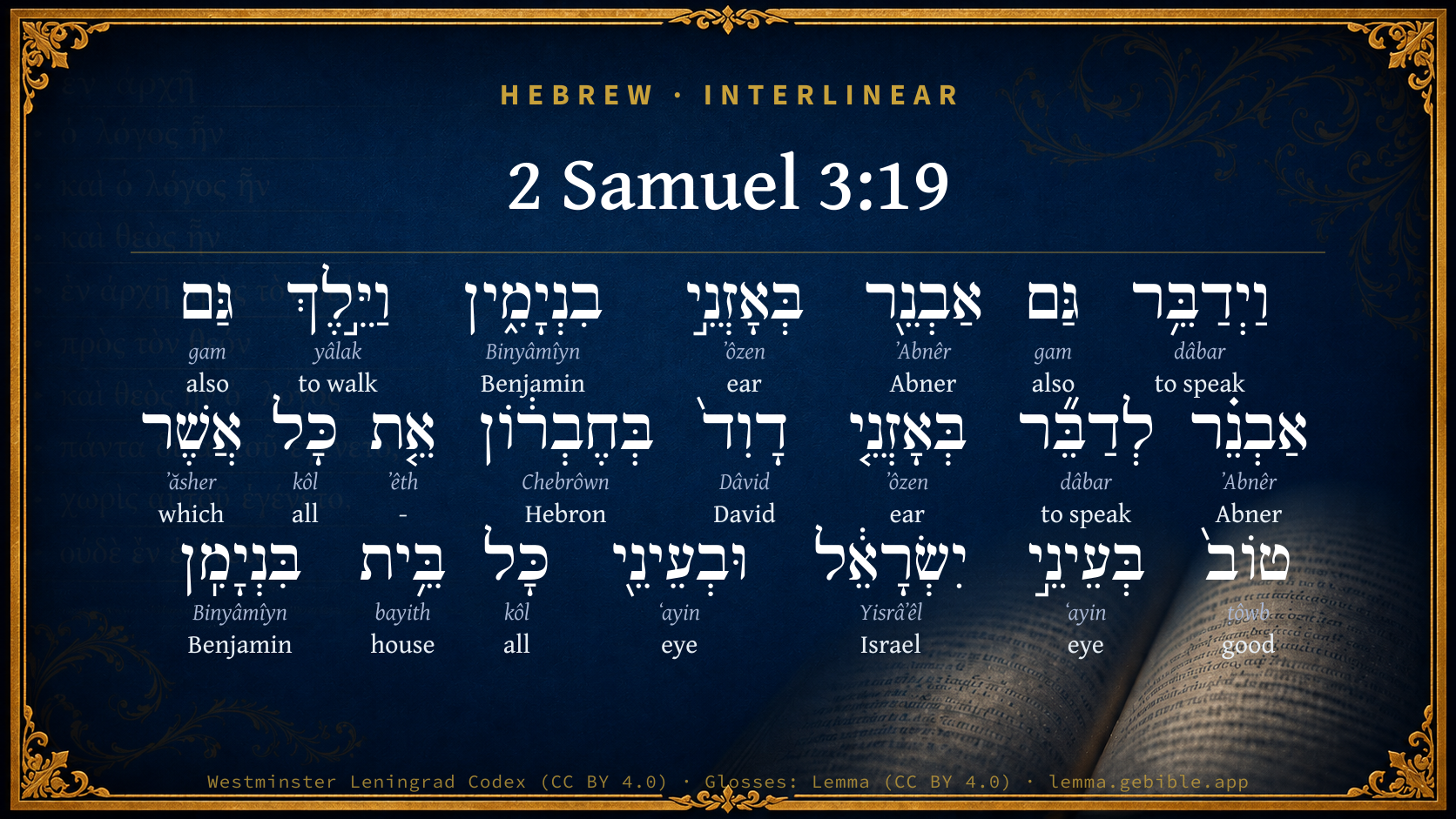
  1. וַיְדַבֵּ֥ר dâbar H1696 “and · to speak” Conjunction + Verb, Piel, Sequential Imperfect, 3rd Person, Masculine, Singular
  2. גַּם gam H1571 “also” Particle, Accusative
  3. בְּאָזְנֵ֣י ʼôzen H241 “in/at · ears of” Preposition + Noun, Common, Feminine, Dual, Construct
  4. בִנְיָמִ֑ין Binyâmîyn H1144 “Benjamin” Noun, Proper
  5. וַיֵּ֣לֶךְ yâlak H3212 “and · to walk” Conjunction + Verb, Qal, Sequential Imperfect, 3rd Person, Masculine, Singular
  6. גַּם gam H1571 “also” Particle, Accusative
  7. אַבְנֵ֗ר ʼAbnêr H74 “Abner” Noun, Proper
  8. לְדַבֵּ֞ר dâbar H1696 “to speak” Preposition + Verb, Piel, Infinitive Construct
  9. בְּאָזְנֵ֤י ʼôzen H241 “in/at · ears of” Preposition + Noun, Common, Feminine, Dual, Construct
  10. דָוִד֙ Dâvid H1732 “David” Noun, Proper
  11. בְּחֶבְר֔וֹן Chebrôwn H2275 “in/at · Hebron” Preposition + Noun, Proper
  12. אֵ֤ת ʼêth H853 “-” Particle, Direct Object
  13. כָּל kôl H3605 “all of” Noun, Common, Masculine, Singular, Construct
  14. אֲשֶׁר ʼăsher H834 “which” Particle, Relative
  15. טוֹב֙ ṭôwb H2896 “good” Verb, Qal, Perfect, 3rd Person, Masculine, Singular
  16. בְּעֵינֵ֣י ʻayin H5869 “in/at · eyes of” Preposition + Noun, Common, Both, Dual, Construct
  17. יִשְׂרָאֵ֔ל Yisrâʼêl H3478 “Israel” Noun, Proper
  18. וּבְעֵינֵ֖י ʻayin H5869 “and · in/at · eyes of” Conjunction + Preposition + Noun, Common, Both, Dual, Construct
  19. כָּל kôl H3605 “all of” Noun, Common, Masculine, Singular, Construct
  20. בֵּ֥ית bayith H1004 “house of” Noun, Common, Masculine, Singular, Construct
  21. בִּנְיָמִֽן Binyâmîyn H1144 “Benjamin” Noun, Proper

About this verse

These counts appear in no published source. They are computed here, from the morphology-tagged text and Lemma’s own curated glosses. What Lemma adds →

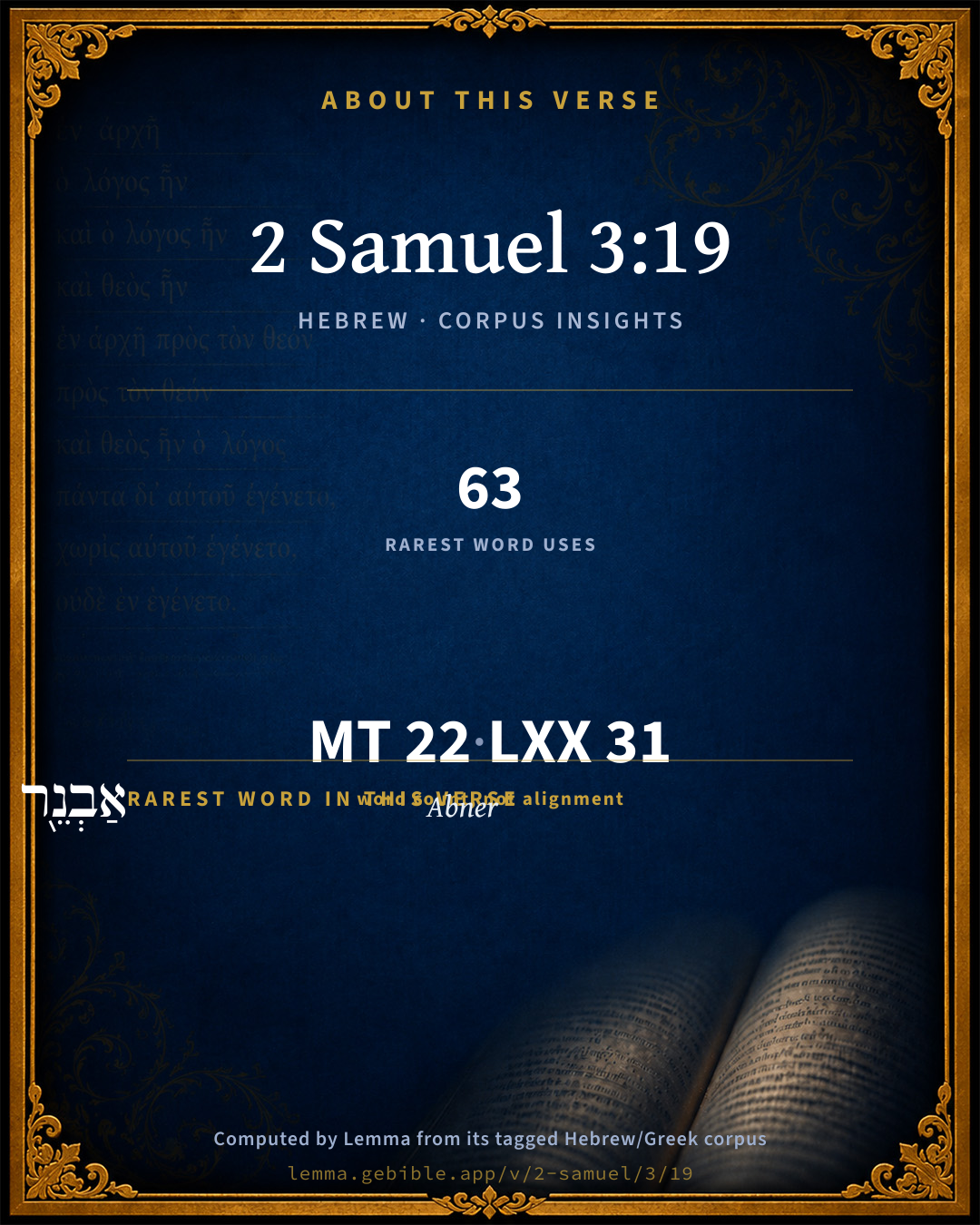
22
words
15
distinct lemmas
Historical
section

Grammatical profile

  • 4 verbs
  • 14 nouns
  • 4 particles

Verb forms

  • וַיְדַבֵּ֥ר Piel · Sequential Imperfect
  • וַיֵּ֣לֶךְ Qal · Sequential Imperfect
  • לְדַבֵּ֞ר Piel · Infinitive Construct
  • טוֹב֙ Qal · Perfect

Repetition

Words recur within this verse — often emphatic in Hebrew:

  • וַיְדַבֵּ֥ר to speak H1696 ×2
  • גַּם also H1571 ×2
  • אַבְנֵ֖ר Abner H74 ×2
  • בְּאָזְנֵ֣י ear H241 ×2
  • בִנְיָמִ֑ין Benjamin H1144 ×2
  • כָּל all H3605 ×2
  • בְּעֵינֵ֣י eye H5869 ×2

Hebrew & Septuagint length

In English translation the verse runs 34 words from the Hebrew and 38 from the Septuagint (LXX English) — closely comparable.

A rough comparison of the two English renderings, which tokenize alike — not a word-level alignment.

Word counts can differ between the Hebrew and the Greek without any difference in meaning — e.g. the Hebrew direct-object marker אֵת has no separate Greek word, and Greek often adds the article ὁ.

In the original languages it is 22 Hebrew tokens and 31 Greek tokens — but the two are counted differently (Hebrew bundles its prefixes and suffixes into one token; the Greek is in lemma form), so that isn’t a like-for-like length.

Cross-references

3

Topical passages linked to 2 Samuel 3:19 in the Treasury of Scripture Knowledge — connected by theme and wording, ordered by reader-vote popularity; previews shown in the World English Bible.

  • 1 Chronicles 12:29 Of the children of Benjamin, the brothers of Saul, three thousand: for hitherto the greatest part of them had kept their allegiance to the house of Saul.
  • 1 Samuel 10:20–21 So Samuel brought all the tribes of Israel near, and the tribe of Benjamin was taken.
  • Psalms 68:27 There is little Benjamin, their ruler, The princes of Judah, their council, The princes of Zebulun, and the princes of Naphtali.

Cross-references courtesy of OpenBible.info (CC BY 4.0).

Hebrew and Greek witnesses Masoretic Hebrew ↔ Greek Septuagint

The same verse in the two great witnesses to the Old Testament, shown verse-for-verse.

These are two independent witnesses, not word-aligned to each other, and the Septuagint is shown in lemma (dictionary) form.

Hebrew 2 Samuel 3:19 Masoretic · Westminster Leningrad Codex

וַיְדַבֵּ֥ר גַּם אַבְנֵ֖ר בְּאָזְנֵ֣י בִנְיָמִ֑ין וַיֵּ֣לֶךְ גַּם אַבְנֵ֗ר לְדַבֵּ֞ר בְּאָזְנֵ֤י דָוִד֙ בְּחֶבְר֔וֹן אֵ֤ת כָּל אֲשֶׁר טוֹב֙ בְּעֵינֵ֣י יִשְׂרָאֵ֔ל וּבְעֵינֵ֖י כָּל בֵּ֥ית בִּנְיָמִֽן

Abner also spoke in the ears of Benjamin: and Abner went also to speak in the ears of David in Hebron all that seemed good to Israel, and to the whole house of Benjamin.

World English Bible · Public Domain

Greek LXX 2 Samuel 3:19 Septuagint · lemma form

καί λαλέω αβεννηρ ἐν ὁ οὖς βενιαμίν καί πορεύομαι αβεννηρ ὁ λαλέω εἰς ὁ οὖς ὁ δαυίδ εἰς χεβρων πᾶς ὅσος ἀρέσκω ἐν ὀφθαλμός ἰσραήλ καί ἐν ὀφθαλμός πᾶς οἶκος βενιαμίν

And Abenner spoke in the ears of Benjamin: and Abenner went to speak in the ears of David at Chebron, all that seemed good in the eyes of Israel and in the eyes of the house of Benjamin.

LXX2012 (modern English Septuagint) · Public Domain

Hebrew: Westminster Leningrad Codex (CC BY 4.0). Greek: Septuagint (public domain); English from LXX2012 (modern English Septuagint) (Public Domain). How the Septuagint differs from the Hebrew →

Targum (Aramaic paraphrase)

1

The Targum is the ancient Jewish Aramaic paraphrase of the Hebrew Scriptures — an interpretive translation, not the Hebrew text itself. Onkelos (literal) and Pseudo-Jonathan (expansive) render the Torah, and Jonathan the Prophets. Coverage is partial: where no permissively-licensed English translation exists for a verse, only the Aramaic is shown. This is verse-level text, not a word-by-word alignment to the Hebrew.

  1. Targum Jonathan Prophets (Joshua–Malachi)
    וּמַלֵיל אַף אַבְנֵר קֳדָם דְבֵית בִּנְיָמִן וַאֲזַל אַף אַבְנֵר לְמַלָלָא קֳדָם דָוִד בְּחֶבְרוֹן יַת כָּל דְתַקֵן בְּעֵינֵי יִשְׂרָאֵל וּבְעֵינֵי כָּל דְבֵית בִּנְיָמִן:

    (no public-domain English translation for this verse)

    Targum Jonathan — Aramaic: “Mikraot Gedolot” (public domain). English: “Sefaria Community Translation” (CC0 1.0 (public-domain dedication)); “London "Chaldee Paraphrase," 1871” (public domain). Text via Sefaria.

Commentary

Notes on 2 Samuel 3:19 from classic Christian and Jewish commentators (each source and its license shown beneath its notes). The classic Christian expositions comment on the surrounding passage and are grouped to its opening verse, so a note may address several verses; the Jewish commentaries on the Tanakh (Rashi and others) are per-verse, so they appear only where the commentator wrote on this verse.

Lemma curates 59 commentaries, every one of them public domain or Creative Commons licensed, each selected and text-cleaned for this edition rather than reprinted as found. About our sources →

Trapp's Complete Commentary

John Trapp

2Sa 3:19 And Abner also spake in the ears of Benjamin: and Abner went also to speak in the ears of David in Hebron all that seemed good to Israel, and that seemed good to the whole house of Benjamin.

Ver. 19. And Abner also spake in the ears of Benjamin.] Who were Saul’s own kindred, and much addicted to his family. And although Abner thus spake to them, yet by 1Ch 12:29, it appeareth that the greatest part of Benjamin did yet follow Ishbosheth.

To the whole house of Benjamin.] If Abner may be believed.

John Trapp, A Commentary or Exposition upon All the Books of the Old and New Testament (1647–1656) — public domain. Text from a community e-Sword module.

Joseph Benson's Commentary

2Sa 3:19-20. Abner also spake in the ears of Benjamin — To these he particularly applies himself, because they might be thought most kind to Saul and his house, and most loath to let the kingdom go out of their own tribe; and therefore it was necessary that he should use all his art and power with them, to persuade them to a compliance with his design; and besides, they were a valiant tribe, and bordering upon Judah, and situate between them and the other tribes; and therefore the winning of them would be of mighty concernment to bring in all the rest. Abner also went to speak in the ears of David — To report to him privately the sense of all the people, and particularly how all Benjamin stood affected toward him; who were brought over so effectually that they did not forsake the house of David when all the rest of the tribes did. David made Abner a feast — Not merely as a token of kindness, but to make a league with him, as he had desired, and David had promised, 2Sa 3:12-13. For it was an ancient custom to enter into leagues by eating and drinking together: see Gen 26:30; Gen 31:44.

Joseph Benson's Commentary on the Old and New Testaments (1811–1818) — public domain. Text from a community e-Sword module.

Tyndale Open Study Notes

Tyndale Open Resources

3:19 Because Saul was from their tribe, the men of Benjamin no doubt viewed David, from Judah, as a usurper of Saul’s throne. However, Abner was well-respected in Saul’s regime and so was able to elicit support for David even among Saul’s own tribe.

Tyndale Open Study Notes — © Tyndale Open Resources, licensed CC BY-SA 4.0. Text via the HelloAO Bible API.

Geneva Bible (1599)

Geneva Bible translators

Who challenged the Kingdom, because of their father Saul.

Hebrew, in the ears of Benjamin.

Geneva Bible (1599) marginal notes — public domain. Text via Bolls.life.

Ellicott's Commentary for English Readers

(19) Spake in the ears of Benjamin.—Special and careful negotiations with the Benjamites were necessary, because they felt bound to their kinsmen of the house of Saul, and had hitherto enjoyed great advantages from their connection with their sovereign. Abner reported to David at Hebron the result of his negotiations both with Israel generally and with Benjamin in particular.

A Bible Commentary for English Readers, edited by Charles John Ellicott (1878–1897) — public domain. Text from a community e-Sword module.

The Cambridge Bible for Schools and Colleges

gen. ed. J. J. S. Perowne

19. And Abner also spake, &c.] And Abner also had spoken, &c. Beside the general communication with the elders of Israel a special and confidential negotiation had been entered into with the tribe of Benjamin, which was the most likely to offer opposition through fear of losing dignity and advantage by the transference of the royal house to the tribe of Judah.

all that seemed good to Israel] Their readiness to acknowledge David as king, as well as conditions and demands which they wished to make, for there was to be a “covenant” between him and the people (2Sa_3:21).

The Cambridge Bible for Schools and Colleges (gen. ed. J. J. S. Perowne; Cambridge University Press, 1878–1918) — public domain. Text from a community e-Sword module.

John Gill's Exposition

And Abner also spake in the ears of Benjamin,.... Of the inhabitants of the tribe of Benjamin, of which tribe he was, and among whom he had the greatest influence; and with whom it was necessary to take some pains, because of their attachment to the family of Saul, which was of that tribe; and being near to that of Judah, might give David a good deal of trouble, if they were not won over to him:

and Abner went also to speak in the ears of David in Hebron; having sounded the elders of Israel, and won their thoughts about the change of government, and found them well disposed to David, and had prevailed upon them to consent to make him king, and had gained the tribe of Benjamin on his side, went and reported to David the success he had:

all that seemed good to Israel, and that seemed good to the whole house of Benjamin; how agreeable it was to the elders of Israel, and particularly to the tribe of Benjamin, to have David king over them.

John Gill's Exposition of the Whole Bible (1746–1763) — public domain (CC PDM 1.0). Text via the HelloAO Bible API.

Haydock's Catholic Bible Commentary

Benjamin, which tribe was naturally most attached to Saul’s family. They followed, however, the example of the ten tribes, and 20 of them accompanied their general to Hebron. (Salien)

George Leo Haydock (1774–1849), Haydock's Catholic Family Bible and Commentary, 1859 edition — public domain. Excludes Psalms (Douay-Rheims chapter numbering differs from Protestant) and Deuterocanonical books (Catholic canon only).

Matthew Poole's English Annotations

In the ears of Benjamin; to these he particularly and applies himself. because they might be thought most kind to Saul his house, and most loth to let the kingdom go out of their own tribe; and therefore it was necessary that he should use all his art and power with them, to persuade them to a compliance with his design; and besides, they were a Valiant tribe, and bordering upon Judah, and situate between them and the other tribes; and therefore the winning of them would be of mighty concernment to bring in all the rest.

Matthew Poole's English Annotations on the Holy Bible (1683–1685) — public domain. Text from a community e-Sword/MySword module.

Whedon's Commentary on the Bible

Daniel D. Whedon

19. Spake in the ears of Benjamin — He took special care to secure this tribe to his purposes, for he had reason to fear that they would be tenacious in their adherence to the house of Saul.

Daniel D. Whedon (gen. ed.), Commentary on the Old and New Testaments (1874–1909) — public domain. Text from a community e-Sword module.

The Pulpit Commentary

In the ears of Benjamin. This tribe alone, probably, was really loyal to the house of Saul, their kinsman. But since the withdrawal of the court to Mahanaim, they got but little good from it, and were left to resist the predatory bands of the Philistines as best they could. So warlike a tribe too would despise Ishbosheth, and long for a braver man to aid them in fighting their enemies.

The Pulpit Commentary (1880–1919), ed. H.D.M. Spence-Jones & Joseph S. Exell — public domain. Text from a community e-Sword module.

John Wesley's Explanatory Notes

Benjamin - To these he particularly applies himself, because they might be thought most kind to Saul and his house, and most loath to let the kingdom go out of their own tribe; and therefore it was necessary that he should use all his art and power with them, to persuade them to a compliance with his design; and besides, they were a valiant tribe, and bordering upon Judah, and situate between them and the other tribes; and therefore the winning of them, would be of mighty concernment to bring in all the rest.

John Wesley, Explanatory Notes Upon the Whole Bible (1754–1765) — public domain. Text via the GEBible commentary corpus.

unfoldingWord translationNotes

Door43 World Missions Community

the people of Benjamin ... the whole house of Benjamin

Both of these statements refer to the descendants of Benjamin, who were one of the tribes of Israel. (See: Metonymy)

twenty of his men

The number of men who came with Abner. (See: Numbers)

translationWords

people group

Benjamin

Hebron

feast

unfoldingWord translationNotes — © Distant Shores Media and the Door43 World Missions Community, licensed CC BY-SA 4.0. Source: git.door43.org/Door43/en_tn.

Lesson kit

Teaching starters — assembled from the data on this page, not authored interpretation. Every prompt links to the verse data it draws on. Edit before teaching.

2 Samuel, in the Historical, opens this verse with 22 words (15 distinct Hebrew lemmas). Its most distinctive word is ʼAbnêr (“Abner”). A historical commentator’s framing appears above. Read the whole chapter for the surrounding context.

Discussion questions

  1. What does “Abner” (ʼAbnêr) contribute to the verse as a whole?
  2. 1 Chronicles 12:29 shares this passage’s theme. How do the two illuminate each other?
  3. “to speak” occurs 2× in this one verse. What is the effect of the repetition?
  4. These translations render this verse differently. What is at stake in choosing one wording over another?
  5. The verb «וַיְדַבֵּ֥ר» is Piel Sequential Imperfect. How does its form color the action?
  6. Reading how Trapp's Complete Commentary and Joseph Benson's Commentary read this verse, where do the two commentators agree and where do they part?

Things to notice

Reading settings

Reading text

Shown beneath each verse's original-language words.

Old Testament
Old Testament edition

Read the OT as the Masoretic Hebrew (MT) or the Greek Septuagint (LXX).

English shown for the Greek Septuagint (in the Hebrew ↔ Greek comparison).

Comparing translations? Open the Compare panel on any verse page to stack up to four side by side.