Psalms 18:6

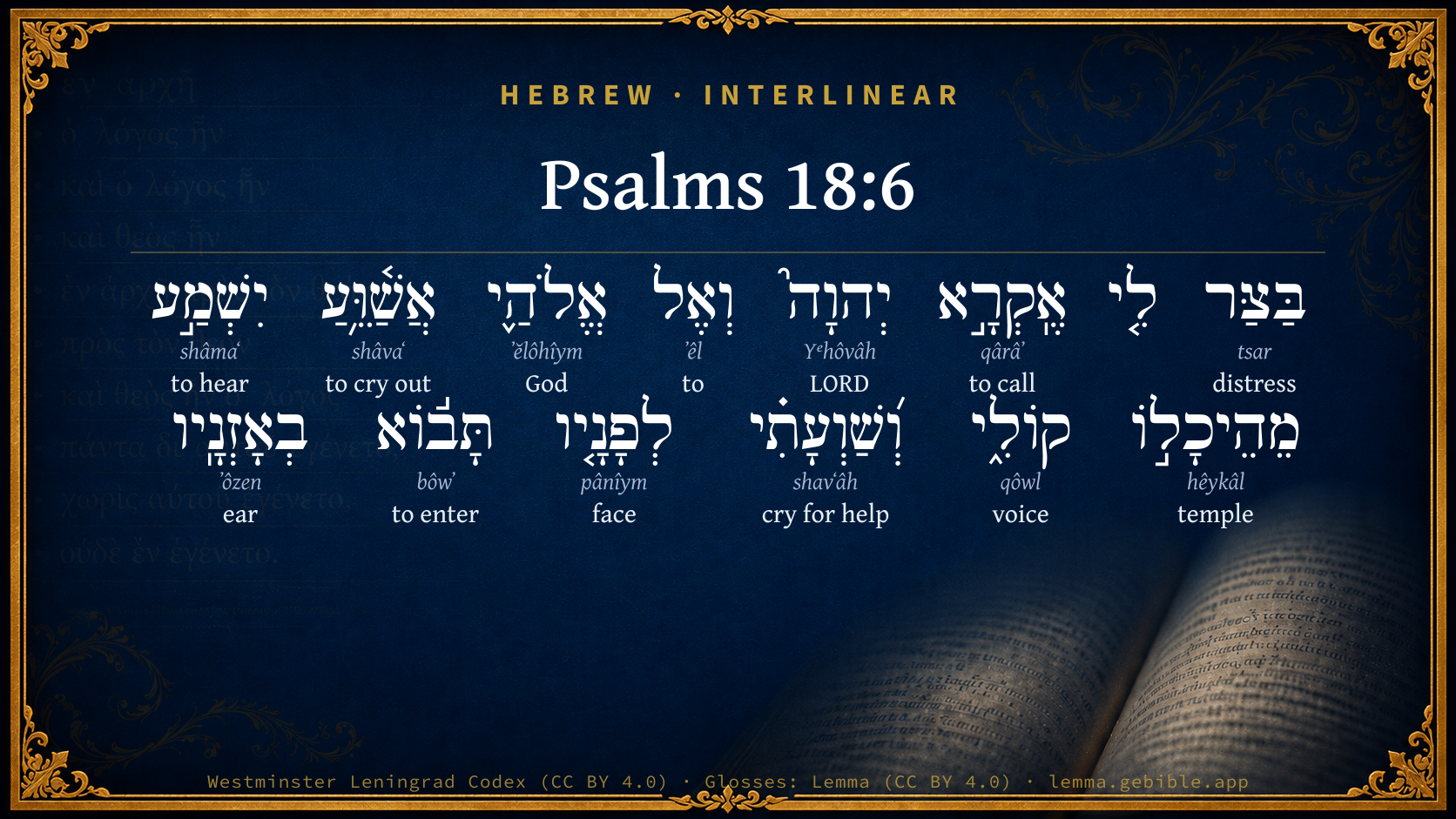
Hebrew (Westminster Leningrad Codex) Psalms 18:6 appears in the Hebrew Old Testament. The text above is from the Westminster Leningrad Codex. Each word links to its Strong’s number, a concise gloss, and parsing drawn from the Open Scriptures Hebrew Bible morphology. Click any word for its full Brown-Driver-Briggs (BDB) entry.
Download image
Cite this verse

Psalms 18:6 (World English Bible). Public Domain. Lemma interlinear Bible study tool, https://lemma.gebible.app/v/psalms/18/6.

Show BibTeX & RIS
BibTeX
RIS
English Translation
In my distress I called on Yahweh, And cried to my God. He heard my voice out of his temple, My cry before him came into his ears.
World English Bible · Public Domain
Download a study sheet

One document with this verse’s original text, its word-by-word gloss line, the meaning frame, cross-references with their text, attributed commentary, and full source and license credits — printable, and it pastes into notes with its structure intact.

This verse Autodidact and up

Study sheet (.html) Plain text (.txt)

A passage Seminary Student

Up to 50 verses in one chapter. A passage sheet keeps up to 6 commentary sources and 12 cross-references per verse, in the order this page ranks them, and says so on the sheet whenever that leaves anything out. Ask for a single verse and you get the Autodidact verse sheet above.

Everything on this page stays free to read, with no account — the sheet is a download of what is already on screen, not access to it.

Want to remove ads? Support Godless Engineer
Compare translations 3

The same verse in 3 English versions, stacked beneath the original-language interlinear above. Click any original word for its lexicon entry.

Each is an independent rendering of the whole verse — the interlinear is not word-aligned to these translations.

Highlighted words mark where these versions differ — a whole-verse word diff, not a word-by-word alignment.

  • World English Bible Public Domain
    In my distress I called on Yahweh, And cried to my God. He heard my voice out of his temple, My cry before him came into his ears.
  • King James Version Public Domain
    In my distress I called upon the LORD, and cried unto my God: he heard my voice out of his temple, and my cry came before him, even into his ears.
  • unfoldingWord Literal Text CC BY-SA 4.0
    In my distress, I called Yahweh, and to my God I cried out for help. He heard my voice from his temple, and my cry to his face went in his ears.

unfoldingWord Literal Text — © unfoldingWord, licensed CC BY-SA 4.0. Word-aligned USFM3 via Door43 (git.door43.org/unfoldingWord/en_ult).

Versions to compare (up to 4)

3 of 4 selected

Show all 18 translations

Every available English version of this verse, each an independent rendering of the whole verse.

  • World English Bible Public Domain
    In my distress I called on Yahweh, And cried to my God. He heard my voice out of his temple, My cry before him came into his ears.
  • Berean Standard Bible Public Domain
    In my distress I called upon the LORD; I cried to my God for help. From His temple He heard my voice, and my cry for His help reached His ears.
  • Majority Standard Bible Public Domain
    In my distress I called upon the LORD; I cried to my God for help. From His temple He heard my voice, and my cry for His help reached His ears.
  • King James Version Public Domain
    In my distress I called upon the LORD, and cried unto my God: he heard my voice out of his temple, and my cry came before him, even into his ears.
  • American Standard Version (1901) Public Domain
    In my distress I called upon Jehovah, And cried unto my God: He heard my voice out of his temple, And my cry before him came into his ears.
  • Revised Version (1885) Public Domain
    In my distress I called upon the LORD, and cried unto my God: he heard my voice out of his temple, and my cry before him came into his ears.
  • Geneva Bible (1599) Public Domain
    But in my trouble did I call vpon the Lord, and cryed vnto my God: he heard my voyce out of his Temple, and my crye did come before him, euen into his eares.
  • Douay-Rheims (1899) Public Domain
    The sorrows of hell encompassed me: and the snares of death prevented me.
  • Young's Literal Translation Public Domain
    In mine adversity I call Jehovah, And unto my God I cry. He heareth from His temple my voice, And My cry before Him cometh into His ears.
  • Literal Standard Version CC BY-SA 4.0
    In my adversity I call YHWH, || And I cry to my God. He hears my voice from His temple, || And My cry comes into His ears before Him.
  • Unlocked Literal Bible CC BY-SA 4.0
    In my distress I called to Yahweh; I called for help to my God. He heard my voice from his temple; my call for help went into his presence; it went into his ears.
  • unfoldingWord Literal Text CC BY-SA 4.0
    In my distress, I called Yahweh, and to my God I cried out for help. He heard my voice from his temple, and my cry to his face went in his ears.
  • Darby Bible Public Domain
    In my distress I called upon Jehovah, and I cried out to my God; he heard my voice out of his temple, and my cry came before him, into his ears.
  • World Messianic Bible Public Domain
    In my distress I called on the LORD, and cried to my God. He heard my voice out of his temple. My cry before him came into his ears.
  • Webster's Bible Public Domain
    \\18:5\\The sorrows of hell encompassed me: the snares of death seized me.
  • Free Bible Version CC BY-SA 4.0
    In my despair I called on the Lord—I cried out to my God for help. He heard my voice from his Temple—my cry for help reached his ears.
  • Bible in Basic English Public Domain
    In my trouble my voice went up to the Lord, and my cry to my God: my voice came to his hearing in his holy Temple, and my prayer came before him, even into his ears.
  • JPS Tanakh (1917) Public Domain
    (18-7) In my distress I called upon the LORD, and cried unto my God; out of His temple He heard my voice, and my cry came before Him unto His ears.

Literal Standard Version (2020), Covenant Press — licensed CC BY-SA 4.0. Text via the HelloAO Bible API (eBible.org). Unlocked Literal Bible (unfoldingWord) — licensed CC BY-SA 4.0. Text via the HelloAO Bible API (eBible.org). unfoldingWord Literal Text — © unfoldingWord, licensed CC BY-SA 4.0. Word-aligned USFM3 via Door43 (git.door43.org/unfoldingWord/en_ult). Free Bible Version, Dr. Jonathan Gallagher — licensed CC BY-SA 4.0. Text via the HelloAO Bible API (eBible.org).

Word by word

More ways to search: Search by grammar → Find every occurrence → Compare this word →

Practice this passage: Drill this verse → Learn its vocabulary →

וְ֝שַׁוְעָתִ֗י
shavʻâh
H7775
“and · cry for help · my”
Conjunction + Noun, Common, Feminine, Singular, Construct + Suffix, Personal, 1st Person, Common, Singular
Part of Speech
Conjunction + Noun
Type
Common
Gender
Feminine
Number
Singular
State
Construct
Full BDB Definition

Origin: from H7773

TWOT: 2348c

cry for help
  1. בַּצַּר tsar H6862 “in/at the · distress” Preposition, Determined + Adjective, Adjective, Masculine, Singular, Absolute
  2. אֶֽקְרָ֣א qârâʼ H7121 “to call” Verb, Qal, Imperfect, 1st Person, Common, Singular
  3. יְהוָה֮ Yᵉhôvâh H3068 “LORD” Noun, Proper
  4. וְאֶל ʼêl H413 “and · to” Conjunction + Preposition
  5. אֱלֹהַ֪י ʼĕlôhîym H430 “God(s) · my” Noun, Common, Masculine, Plural, Construct + Suffix, Personal, 1st Person, Common, Singular
  6. אֲשַׁ֫וֵּ֥עַ shâvaʻ H7768 “to cry out” Verb, Piel, Imperfect, 1st Person, Common, Singular
  7. יִשְׁמַ֣ע shâmaʻ H8085 “to hear” Verb, Qal, Imperfect, 3rd Person, Masculine, Singular
  8. מֵהֵיכָל֣וֹ hêykâl H1964 “from · temple · his” Preposition + Noun, Common, Masculine, Singular, Construct + Suffix, Personal, 3rd Person, Masculine, Singular
  9. קוֹלִ֑י qôwl H6963 “voice · my” Noun, Common, Masculine, Singular, Construct + Suffix, Personal, 1st Person, Common, Singular
  10. לְפָנָ֤יו pânîym H6440 “to/for · face(s) · his” Preposition + Noun, Common, Both, Plural, Construct + Suffix, Personal, 3rd Person, Masculine, Singular
  11. תָּב֬וֹא bôwʼ H935 “to enter” Verb, Qal, Imperfect, 3rd Person, Feminine, Singular
  12. בְאָזְנָֽיו ʼôzen H241 “in/at · ears · his” Preposition + Noun, Common, Feminine, Dual, Construct + Suffix, Personal, 3rd Person, Masculine, Singular

About this verse

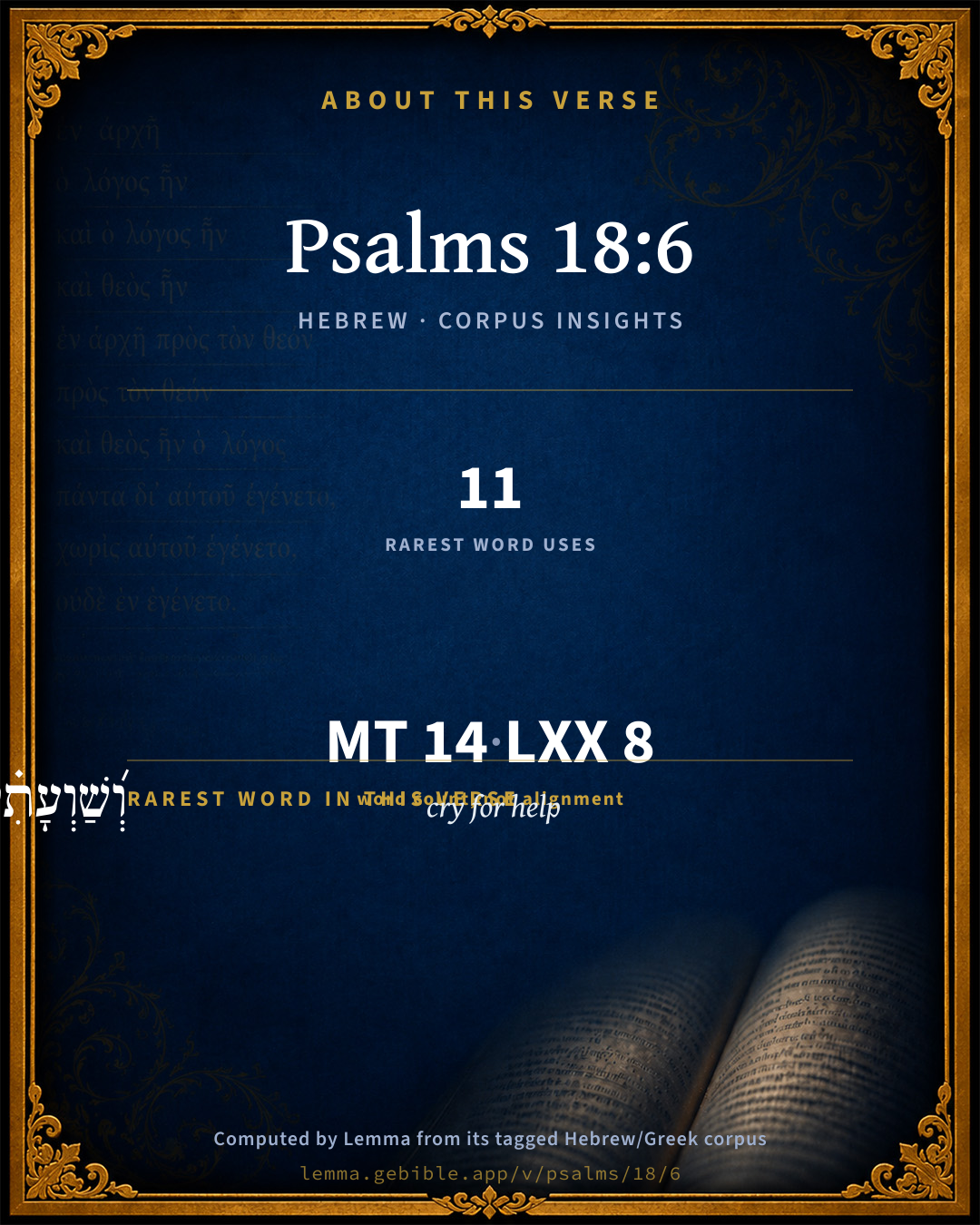
These counts appear in no published source. They are computed here, from the morphology-tagged text and Lemma’s own curated glosses. What Lemma adds →

14
words
13
distinct lemmas
Wisdom
section

Notable vocabulary

The rarest word here is וְ֝שַׁוְעָתִ֗י cry for help H7775 — appearing just 11 times in the whole Hebrew Bible.

Shared distinctive vocabulary

וְ֝שַׁוְעָתִ֗י cry for help H7775 occurs in 11 verses of the Hebrew Bible. Also found in:

Grammatical profile

  • 4 verbs
  • 7 nouns
  • 1 adjective
  • 2 prepositions

Verb forms

  • אֶֽקְרָ֣א Qal · Imperfect
  • אֲשַׁ֫וֵּ֥עַ Piel · Imperfect
  • יִשְׁמַ֣ע Qal · Imperfect
  • תָּב֬וֹא Qal · Imperfect

Hebrew & Septuagint length

In English translation the verse runs 28 words from the Hebrew and 35 from the Septuagint (LXX English) — closely comparable.

A rough comparison of the two English renderings, which tokenize alike — not a word-level alignment.

Word counts can differ between the Hebrew and the Greek without any difference in meaning — e.g. the Hebrew direct-object marker אֵת has no separate Greek word, and Greek often adds the article ὁ.

In the original languages it is 14 Hebrew tokens and 8 Greek tokens — but the two are counted differently (Hebrew bundles its prefixes and suffixes into one token; the Greek is in lemma form), so that isn’t a like-for-like length.

Cross-references

16

Topical passages linked to Psalms 18:6 in the Treasury of Scripture Knowledge — connected by theme and wording, ordered by reader-vote popularity; previews shown in the World English Bible.

  • Psalms 50:15 Call on me in the day of trouble. I will deliver you, and you will honor me."
  • 2 Samuel 22:7 In my distress I called on Yahweh; Yes, I called to my God: He heard my voice out of his temple, My cry [came] into his ears.
  • Psalms 34:15 Yahweh's eyes are toward the righteous. His ears listen to their cry.
  • Psalms 130:1–2 Out of the depths I have cried to you, Yahweh.
  • Psalms 120:1 In my distress, I cried to Yahweh. He answered me.
  • Psalms 18:3–4 I call on Yahweh, who is worthy to be praised; And I am saved from my enemies.
  • Psalms 27:4–5 One thing I have asked of Yahweh, that I will seek after, That I may dwell in the house of Yahweh all the days of my life, To see Yahweh's beauty, And to inquire in his temple.
  • 2 Chronicles 30:27 Then the priests the Levites arose and blessed the people: and their voice was heard, and their prayer came up to his holy habitation, even to heaven.
  • Exodus 2:23 It happened in the course of those many days, that the king of Egypt died, and the children of Israel sighed because of the bondage, and they cried, and their cry came up to God because of the bondage.
  • Acts 12:5 Peter therefore was kept in the prison, but constant prayer was made by the assembly to God for him.
  • Psalms 5:7 But as for me, in the abundance of your loving kindness I will come into your house: I will bow toward your holy temple in reverence of you.
  • Psalms 11:4 Yahweh is in his holy temple. Yahweh is on his throne in heaven. His eyes observe. His eyes examine the children of men.
  • Habakkuk 2:20 But Yahweh is in his holy temple. Let all the earth be silent before him!"
  • Revelation 11:19 God's temple that is in heaven was opened, and the ark of the Lord's covenant was seen in his temple. Lightnings, sounds, thunders, an earthquake, and great hail followed.
  • 1 Kings 8:27–30 But will God in very deed dwell on the earth? behold, heaven and the heaven of heavens can't contain you; how much less this house that I have built!
  • Mark 14:36 He said, "Abba, Father, all things are possible to you. Please remove this cup from me. However, not what I desire, but what you desire."

Cross-references courtesy of OpenBible.info (CC BY 4.0).

Hebrew and Greek witnesses Masoretic Hebrew ↔ Greek Septuagint

The same verse in the two great witnesses to the Old Testament, shown verse-for-verse.

You’re reading Greek Psalm 17 (Hebrew Psalm 18). The Septuagint counts the superscription, so verse numbers can differ from the Hebrew — chapter-level alignment, not verse-by-verse. Numbering follows Rahlfs.

These are two independent witnesses, not word-aligned to each other, and the Septuagint is shown in lemma (dictionary) form.

Hebrew Psalms 18:6 Masoretic · Westminster Leningrad Codex

בַּצַּר לִ֤י אֶֽקְרָ֣א יְהוָה֮ וְאֶל אֱלֹהַ֪י אֲשַׁ֫וֵּ֥עַ יִשְׁמַ֣ע מֵהֵיכָל֣וֹ קוֹלִ֑י וְ֝שַׁוְעָתִ֗י לְפָנָ֤יו תָּב֬וֹא בְאָזְנָֽיו

In my distress I called on Yahweh, And cried to my God. He heard my voice out of his temple, My cry before him came into his ears.

World English Bible · Public Domain

Greek LXX Greek Psalm 17:6 Septuagint · lemma form

ὠδίν ᾅδης περικυκλόω ἐγώ προφθάνω ἐγώ παγίς θάνατος

And when I was afflicted I called upon the Lord, and cried to my God: he heard my voice out of this holy temple, and my cry shall enter before him, even into his ears.

LXX2012 (modern English Septuagint) · Public Domain

Hebrew: Westminster Leningrad Codex (CC BY 4.0). Greek: Septuagint (public domain); English from LXX2012 (modern English Septuagint) (Public Domain). How the Septuagint differs from the Hebrew →

Commentary

Notes on Psalms 18:6 from classic Christian and Jewish commentators (each source and its license shown beneath its notes). The classic Christian expositions comment on the surrounding passage and are grouped to its opening verse, so a note may address several verses; the Jewish commentaries on the Tanakh (Rashi and others) are per-verse, so they appear only where the commentator wrote on this verse.

Lemma curates 59 commentaries, every one of them public domain or Creative Commons licensed, each selected and text-cleaned for this edition rather than reprinted as found. About our sources →

Trapp's Complete Commentary

John Trapp

Psa 18:6 In my distress I called upon the LORD, and cried unto my God: he heard my voice out of his temple, and my cry came before him, [even] into his ears.

Ver. 6. In my distress I called upon the Lord] This was David’s anchora sacra; sacred anchor, prayer, he knew, could never come too late, nor God want a way to deliver his distressed. The time of affliction is the time of supplication; and man’s extremity is God’s opportunity.

And cried unto my God] He grew more and more earnest. We must pray and not faint, Luk 18:1, but rise in our suits.

Out of his temple] i.e. Heaven, whereof the temple was a type, as being the place of God’s special presence, and of transcendent holiness.

John Trapp, A Commentary or Exposition upon All the Books of the Old and New Testament (1647–1656) — public domain. Text from a community e-Sword module.

Joseph Benson's Commentary

Psa 18:6-7. He heard out of his temple — Either, 1st, Out of his sanctuary, where he was represented as dwelling between the cherubim, in the most holy place, and where he promised to hear and answer the prayers of his people, which were either made in or directed to it. Or, 2d, Out of his heavenly habitation, which is often called his temple. Then the earth shook and trembled — Then God appeared on my behalf in a miraculous and glorious manner, and to the great terror and confusion of all mine enemies, as though they had been surprised with an earthquake, in which the earth was shaken from its foundations, and all its rocks and mountains trembled. David proceeds, in this and the eight following verses, to describe, by the sublimest expressions, the awful manner in which Jehovah came to his assistance. The imagery employed, Dr. Horne thinks, is borrowed from mount Sinai, and those tremendous circumstances which attended the delivery of the law from thence. When a monarch is angry and prepares for war, the whole kingdom is instantly in commotion. Thus universal nature is here represented as feeling the effects of its great Sovereign’s displeasure, and all the visible elements appear disordered. The description must be allowed, by all skilful and impartial judges, to be truly noble and sublime, and in the genuine spirit of poetry. “The majesty of God, and the manner in which he is represented as coming to the aid of his favourite king, surrounded with all the powers of nature as his attendants and ministers, and arming heaven and earth to fight his battles and execute his vengeance, are described in the loftiest and most striking terms. The shaking of the earth, the trembling of the mountains and pillars of heaven; the smoke that ascended out of his nostrils; the flames of devouring fire that flashed from his mouth; the heavens bending down to convey him to the battle; his riding upon a cherub, and rapidly flying on the wings of a whirlwind; his concealing his majesty in the thick clouds of heaven; the bursting of the lightnings from the horrid darkness; the uttering his voice in peals of thunder; the storm of fiery hail; the melting of the heavens, and their dissolving into floods of tempestuous rains; the cleaving of the earth, and disclosing the bottom of the hills, and the subterraneous channels, or torrents of water, by the very breath of the nostrils of the Almighty; are all of them circumstances which create admiration, excite a kind of horror, and exceed every thing of this nature that is to be found in any of the remains of heathen antiquity. The grandest pieces thereof will be found, upon comparison, infinitely short of this description of the psalmist; throughout the whole of which God is represented as a mighty warrior, going forth to fight the battles of David, and highly incensed at the opposition his enemies made to his power and authority. When he descended to the engagement, the very heavens bowed down to render his descent more awful; his military tent was substantial darkness; the voice of his thunder was the warlike alarm which sounded to the battle; the chariot in which he rode were the thick clouds of heaven, conducted by cherubs, and carried on by the irresistible force and rapid wings of an impetuous tempest; and the darts and weapons he employed were thunder-bolts, lightnings, fiery hail, deluging rains, and stormy winds! No wonder that when God thus arose, all his enemies should be scattered, and those who hated him should flee before him! It does not appear, from any part of David’s history, that there ever was literally such a storm as is here described, which proved destructive to his enemies, and salutary to himself. There might, indeed, have been such a one, though there be no particular mention of it.” But it is more probable that the whole passage is to be understood figuratively, and that by these metaphorical and lofty expressions, and this sublime description, David only meant to set forth that storm of wrath and vengeance which God had poured upon his enemies and the glorious deliverance he had thereby wrought for him. See Dodd and Chandler.

Joseph Benson's Commentary on the Old and New Testaments (1811–1818) — public domain. Text from a community e-Sword module.

J. A. Alexander on Psalms

Joseph Addison Alexander

7. (Psa 18:6). In my distress I will invoke Jehovah, and to my God will cry; he will hear from his palace my voice, and my prayer before him will come, into his ears. The verbs are in the future, because they express the feelings not of one looking back upon the danger as already past, but of one actually implicated in it. See above, on Psa 18:5 (4). The literal meaning of the words is, in distress to me. Compare the phrase, at times in distress, Psa 9:10 (9), Psa 10:1. My God implies a covenant relation and a hope of audience founded on it. The verb translated cry is specially appropriated to a cry for help. His palace here means heaven, as God's royal residence. See above, on Psa 11:4. Into his ears is a kind of after-thought, designed to strengthen the preceding expression. It shall not only reach his presence, but, as it were, shall penetrate his ears. The whole expresses an assured hope of being heard, and is really tantamount to an assertion that he was heard.

Joseph Addison Alexander, The Psalms Translated and Explained (1850) — public domain. Text from a community e-Sword module.

Tyndale Open Study Notes

Tyndale Open Resources

18:6 God dwells in his sanctuary, the heavenly temple (102:19; see 14:2-3). He knows everything, sees everyone, and will vindicate the godly (see 11:3-7).

Tyndale Open Study Notes — © Tyndale Open Resources, licensed CC BY-SA 4.0. Text via the HelloAO Bible API.

Jamieson, Fausset & Brown

Robert Jamieson, A. R. Fausset & David Brown

He relates his methods to procure relief when distressed, and his success.

temple--(Compare Psa 11:4).

Jamieson, Fausset & Brown — Commentary Critical and Explanatory on the Whole Bible (1871) — public domain (CC PDM 1.0). Text via the HelloAO Bible API.

Adam Clarke's Commentary

Verse 6. In my distress I called] His enemies had no hope of his destruction unless God should abandon him. They hoped that this was the case, and that therefore they should prevail. But God heard his cry and came down to his help; and this interference is most majestically described in the 7th and following verses. Dr. Dodd has collected some excellent observations on these verses from Chandler, Delaney, and others, which I shall transcribe, as I know not that any thing better can be offered on the subject.

Adam Clarke's Commentary on the Bible (1810–1826) — public domain. Text from a community e-Sword/MySword module.

John Calvin's Commentaries

6. In my distress, etc. It was a very evident proof of uncommon faith in David, when, being almost plunged into the gulf of death, he lifted up his heart to heaven by prayer. Let us therefore learn, that such an example is set before our eyes, that no calamities, however great and oppressive, may hinder us from praying, or create an aversion to it. It was prayer which brought to David the fruits or wonderful effects of which he speaks a little after, and from this it appears still more clearly that his deliverance was effected by the power of God. In saying that he cried, he means, as we have observed elsewhere, the ardor and earnestness of affection which he had in prayer. Again, by calling God his God, he separates himself from the gross despisers of God, or hypocrites, who, when constrained by necessity, call upon the Divine Majesty in a confused and tumultuous manner, but do not come to God familiarly and with a pure heart, as they know nothing of his fatherly favor and goodness. When, therefore, as we approach to God, faith goes before to illumine the way, giving us the full persuasion that He is our Father, then is the gate opened, and we may converse freely with Him and he with us. David, by calling God his God, and putting him on his side, also intimates that God was opposed to his enemies; and this serves to show that he was actuated by true piety and the fear of God. By the word temple we are not here to understand the sanctuary as in many other places, but heaven; for the description which immediately follows cannot be applied to the sanctuary. Accordingly, the sense is, that when David was forsaken and abandoned in the world, and all men shut their ears to his cry for help, God stretched forth his hand from heaven to save him.

John Calvin's Commentaries (1540-1563) — public domain. Text from the Calvin Translation Society English edition (1840s-50s) via the Christian Classics Ethereal Library (ccel.org). Calvin's coverage is partial (roughly two-thirds of the Bible); uncommented books and verses are honest gaps, never fabricated. The 19th-century editor's footnotes and remarks are omitted so the notes are faithfully Calvin's own voice.

Ellicott's Commentary for English Readers

(6) Out Of his temple.—Rather, Place—plainly, as in Psa_11:4; Psa_29:9, the heavenly abode of Jehovah.

My cry.—In Samuel only, “my cry in his ears.”

A Bible Commentary for English Readers, edited by Charles John Ellicott (1878–1897) — public domain. Text from a community e-Sword module.

The Cambridge Bible for Schools and Colleges

gen. ed. J. J. S. Perowne

6. called … cried] The tense in the original denotes frequent and repeated prayer. The text of 2 Sam. has called twice, no doubt by an error of transcription.

out of his temple] The palace-temple of heaven, where He sits enthroned. See on Psa_11:4. Cp. Psa_18:16.

and my cry &c.] R.V., and my cry before him came into his ears. But the terse vigour of the text in 2 Sam. is preferable: “and my cry was in his ears.” An alternative reading or an explanatory gloss has crept into the text here, to the detriment of the rhythm.

The Cambridge Bible for Schools and Colleges (gen. ed. J. J. S. Perowne; Cambridge University Press, 1878–1918) — public domain. Text from a community e-Sword module.

John Gill's Exposition

Then the earth shook and trembled,.... As it did quickly after Christ called upon the Lord, and cried to his God upon the cross, Mat 27:50; and so some time after, when his people were praying together, the place where they were assembled was shaken, Act 4:31; as a token of God's presence being with them: and the shaking and trembling of the earth is often used as a symbol of the presence of God, and of the greatness of his majesty; as when he brought the children of Israel through the Red sea, went before them in the wilderness, and descended on Mount Sinai, which mountain then moved and quaked exceedingly; see Psa 104:32; and it is easy to observe, that in this, and other parts of this majestic account of the appearance of God on the behalf of the person the subject of this psalm, and against his enemies, there are manifest allusions to the giving of the law on Mount Sinai; though it may be this shaking of the earth, and what follows, are to be understood in a figurative sense;

the foundations also of the hills moved and were shaken; and design the shaking of the earth and heavens, prophesied of in Hag 2:6; and which is explained in Heb 12:26; of the removing the ordinances of the ceremonial law, that Gospel ordinances might remain unshaken; for in Sa2 22:8; the words are, "the foundations of heaven moved and shook"; and the shaking and moving of the earth and mountains may denote the abolition and destruction of kingdoms and nations; and first of the civil polity of the Jews, and of their ecclesiastical state, which quickly ensued upon the death of Christ; and next of the ruin of Rome Pagan, and then of Rome Papal; which are both signified by an earthquake, and by the removal of mountains, Rev 6:12;

because he was wroth; with the people of the Jews, for disbelieving and rejecting the Messiah; for setting themselves, and taking counsel together against him, and putting him to death; for these things God was angry with them, and wrath came upon them to the uttermost, and their nation, city, and temple were destroyed, Psa 2:1; and with the Pagan empire and antichristian powers, Rev 6:16.

John Gill's Exposition of the Whole Bible (1746–1763) — public domain (CC PDM 1.0). Text via the HelloAO Bible API.

Albert Barnes' Notes on the Bible

In my distress - This refers, most probably, not to any particular case, but rather indicates his general habit of mind, that when he was in deep distress and danger he had uniformly called upon the Lord, and had found him ready to help.

I called upon the Lord - I prayed. That is, he invoked God to help him in his trouble. He relied not on his own strength; he looked not for human aid; he looked to God alone.

And cried unto my God - The word used here denotes an earnest cry for help. Compare Job 35:9; Job 36:13.

He heard my voice out of his temple - That is, he, being in his temple, heard my voice. The word rendered temple (compare the notes at Psa 5:7) cannot refer here to the temple at Jerusalem, for that was built after the death of David, but it refers either to heaven, considered as the temple, or dwelling-place of God, or to the tabernacle, considered as his abode on earth. The sense is not materially varied, whichever interpretation is adopted. Compare Psa 11:4.

And my cry came before him - He heard my cry. It was not intercepted on the way, but came up to him.

Even into his ears - Indicating that he certainly heard it. Compare Gen 23:10; Gen 44:18; Gen 50:4; Exo 10:2 : Psa 34:15.

Albert Barnes' Notes on the Bible (1834–1885) — public domain. Text from a community e-Sword/MySword module.

Matthew Poole's English Annotations

Out of his temple; either, 1. Out of his sanctuary; whence he promised to hear and answer the prayers of his people, which are either made there or directed thither. Or,

2. Out of his heavenly habitation, which is oft called his temple: See Poole "Psa 11:4".

Matthew Poole's English Annotations on the Holy Bible (1683–1685) — public domain. Text from a community e-Sword/MySword module.

The Treasury of David

Charles H. Spurgeon

Ver. 6. In my distress I called upon the Lord, and cried unto my God. Prayer is that postern gate which is left open even when the city is straitly besieged by the enemy; it is that way upward from the pit of despair to which the spiritual miner flies at once when the floods from beneath break forth upon him. Observe that he calls, and then cries; prayer grows in vehemence as it proceeds. Note also that he first invokes his God under the name of Jehovah, and then advances to a more familiar name,

my God; thus faith increases by exercise, and he whom we at first viewed as Lord is soon seen to be our God in covenant. It is never an ill time to pray; no distress should prevent us from using the divine remedy of supplication. Above the noise of the raging billows of death, or the barking dogs of hell, the feeblest cry of a true believer will be heard in heaven.

He heard my voice out of his temple, and my cry came before him, even into his ears. Far up within the bejewelled walls, and through the gates of pearl, the cry of the suffering suppliant was heard. Music of angels and harmony of seraphs availed not to drown or even to impair the voice of that humble call. The king heard it in his palace of light insufferable, and lent a willing ear to the cry of his own beloved child. O honoured prayer, to be able thus through Jesus' blood to penetrate the very ears and heart of Deity. The voice and the cry are themselves heard directly by the Lord, and not made to pass through the medium of saints and intercessors;

My cry came before Him; the operation of prayer with God is immediate and personal. We may cry with confident and familiar importunity, while our Father himself listens.

Ver. 6. In my distress. If you listen even to David's harp, you shall hear as many hearse like airs as carols; and the pencil of the Holy Spirit hath laboured more in describing the afflictions of Job than the felicities of Solomon. Prosperity is not without many fears and distastes; and adversity is not without comforts and hopes. We see, in needleworks and embroideries, it is more pleasing to have a lively work upon a sad and solemn ground, than to have a dark and melancholy work upon a lightsome ground; judge, therefore, of the pleasures of the heart by the pleasures of the eye. Certainly virtue is like precious odoursmost fragrant when they are crushed; for prosperity doth best discover vice, but adversity doth best discover virtue. Francis Bacon, Baron of Verulam, etc., 1561-1626.

Ver. 6. I called upon the Lord and cried. Prayer is not eloquence, but earnestness; not in the definition of helplessness, but the feeling of it; it is the cry of faith to the ear of mercy. Hannah Moore, 1745-1833.

Ver. 6. He heard my voice out of his temple, etc. The Aediles or chamberlains among the Romans, had ever their doors standing open for all who had occasion of request or complaint to have free access to them. "God's mercy doors are wide open to the prayers of his faithful people." The Persian kings held it a piece of their silly glory to deny an easy access to their greatest subjects. It was death to solicit them uncalled. Esther herself was afraid. But the king of heaven manifests himself to his people, he calls to his spouse, with, "Let me see thy face, let me hear thy voice, "etc., and assigns her negligence herein as the cause of her soul sickness. The door of the tabernacle was not of any hard or debarring matter, but a veil, which is easily penetrable. And whereas in the temple none came near to worship, but only the high priest, others stood without in the outer court. God's people are now a kingdom of priests, and are said to worship in the temple, and at the altar. Re 11:1. "Let us therefore draw near with a true heart in full assurance of faith:" "let us come boldly to the throne of grace, that we may obtain mercy, and find grace to help in time of need." Heb 10:22 4:16. Charles Bradbury's "Cabinet of Jewels, "1785.

Ver. 6. Oh! how true is that saying, that "Faith is safe when in danger, and in danger when secure; and prayer is fervent in straits, but in joyful and prosperous circumstances, if not quite cold and dead, at least lukewarm." Oh, happy straits, if they hinder the mind from flowing forth upon earthly objects, and mingling itself with the mire; if they favour our correspondence with heaven, and quicken our love to celestial objects, without which, what we call life, may more properly deserve the name of death! Robert Leighton, D.D.

Ver. 6-7. The prayer of a single saint is sometimes followed with wonderful effects; In my distress I called upon the Lord, and cried unto my God: he heard my voice out of his temple, and my cry came before him, even into his ears. Then the earth shook and trembled; the foundations also of the hills moved and were shaken, because he was wroth: what then can a thundering legion of such praying souls do? It was said of Luther, iste vir potuit cum Deo quicquid voluit, That man could have of God what he would; his enemies felt the weight of his prayers; and the church of God reaped the benefits thereof. The Queen of Scots professed she was more afraid of the prayers of Mr. Knox, than of an army of ten thousand men. These were mighty wrestlers with God, howsoever contemned and vilified among their enemies. There will a time come when God will hear the prayers of his people who are continually crying in his ears, "How long, Lord, how long?" John Flavel.

Ver. 6. The time, the manner, the hearing, and the answering of prayer.

Psalms 18:7*

Ver. 6-7. See Psalms on "Ps 19:6" for further information.

Charles H. Spurgeon's The Treasury of David (1869–1885) — public domain. Psalms only. Text from a community e-Sword/MySword module.

Whedon's Commentary on the Bible

Daniel D. Whedon

6. Heard… out of his temple—God heard and answered from his holy “temple.” Hearing prayer is often put for answering. To the Hebrew all oracles, or answers, proceeded from the holy of holies in the temple, the throne and dwelling of God.

Daniel D. Whedon (gen. ed.), Commentary on the Old and New Testaments (1874–1909) — public domain. Text from a community e-Sword module.

The Pulpit Commentary

In my distress I called upon the Lord, and cried unto my God. At this supreme moment, when he is entangled in the snares, and on the point of being slain, the psalmist represents himself as invoking the aid of the Almighty. As Hengstenberg notes, "While the manifold distresses are united in the beginning of the verse into one great "distress," so the manifold Divine hearings and helps are united into a single grand hearing and help and, we may add, the manifold cries into one great cry. He heard my voice out of his temple; i.e. his tabernacle, since the temple was not yet built; (comp. Psa_5:7 Psa_11:4) or perhaps, "out of heaven "(Cheyne). And my cry came before him, even into his ears. (comp. Exo_2:23, where the same word is used for the "cry" of the children of Israel in Egypt)

The Pulpit Commentary (1880–1919), ed. H.D.M. Spence-Jones & Joseph S. Exell — public domain. Text from a community e-Sword module.

John Wesley's Explanatory Notes

Temple - Out of his heavenly habitation.

John Wesley, Explanatory Notes Upon the Whole Bible (1754–1765) — public domain. Text via the GEBible commentary corpus.

unfoldingWord translationNotes

Door43 World Missions Community

In my distress

"In my great need" or "In my despair"

my call for help went into his presence

Here David speaks of his "call for help" as if it were a person who could come into the presence of Yahweh. AT: "I prayed to him" (See: Personification)

it went into his ears

Here David speaks of how Yahweh heard his cry for help. The idea is repeated for emphasis. AT: "he heard my appeal" (See: Parallelism)

translationWords

voice

temple

cry

unfoldingWord translationNotes — © Distant Shores Media and the Door43 World Missions Community, licensed CC BY-SA 4.0. Source: git.door43.org/Door43/en_tn.

Rashi

Rabbi Shlomo Yitzchaki (Rashi)

Bands of the nether world Like “bands of death,” camps of wicked men, and I - what did I do?

Rashi on the Tanakh — English translations: “The Judaica Press complete Tanach with Rashi, translated by A. J. Rosenberg” (CC BY 4.0); “Pentateuch with Rashi's commentary by M. Rosenbaum and A.M. Silbermann, 1929-1934” (public domain); “The Metsudah Tanach series, Lakewood, N.J” (CC BY 4.0); and “The Book of Joshua, Metsudah Publications, 1997” (CC BY 4.0). Text via Sefaria.

Lesson kit

Teaching starters — assembled from the data on this page, not authored interpretation. Every prompt links to the verse data it draws on. Edit before teaching.

Psalms, in the Wisdom, opens this verse with 14 words (13 distinct Hebrew lemmas). Its most distinctive word is shavʻâh (“cry for help”). A historical commentator’s framing appears above. Read the whole chapter for the surrounding context.

Discussion questions

  1. The word shavʻâh carries the sense “cry for help.” How does it shape the verse?
  2. How does Exodus 2:23, which shares the word «cry for help», read alongside this verse?
  3. The translations on this page render this verse differently — a whole-verse word diff, not a word-by-word alignment. What might account for the different wordings?
  4. «אֶֽקְרָ֣א» is a Qal Imperfect verb. How does that grammatical form shape the action described?
  5. Compare how Trapp's Complete Commentary and Joseph Benson's Commentary read this verse. Where do they agree or differ?

Things to notice

Reading settings

Reading text

Shown beneath each verse's original-language words.

Old Testament
Old Testament edition

Read the OT as the Masoretic Hebrew (MT) or the Greek Septuagint (LXX).

English shown for the Greek Septuagint (in the Hebrew ↔ Greek comparison).

Comparing translations? Open the Compare panel on any verse page to stack up to four side by side.