
Jeremiah 19:3

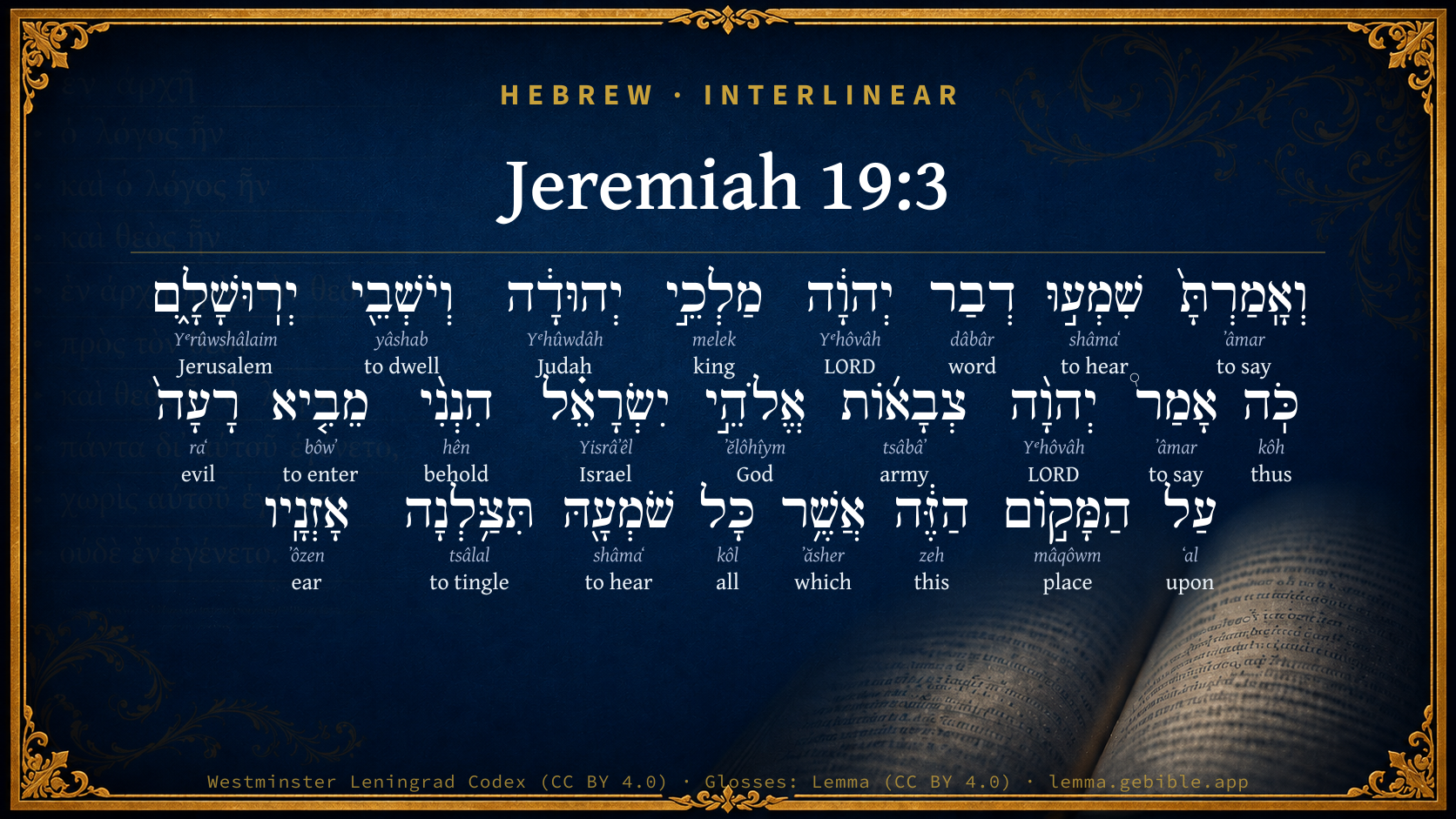
Hebrew (Westminster Leningrad Codex) Jeremiah 19:3 appears in the Hebrew Old Testament. The text above is from the Westminster Leningrad Codex. Each word links to its Strong’s number, a concise gloss, and parsing drawn from the Open Scriptures Hebrew Bible morphology. Click any word for its full Brown-Driver-Briggs (BDB) entry.
Download image
Cite this verse

Jeremiah 19:3 (World English Bible). Public Domain. Lemma interlinear Bible study tool, https://lemma.gebible.app/v/jeremiah/19/3.

Show BibTeX & RIS
BibTeX
RIS
English Translation
and say, Hear you the word of Yahweh, kings of Judah, and inhabitants of Jerusalem: thus says Yahweh of Hosts, the God of Israel, Behold, I will bring evil on this place, which whoever hears, his ears shall tingle.
World English Bible · Public Domain
Download a study sheet

One document with this verse’s original text, its word-by-word gloss line, the meaning frame, cross-references with their text, attributed commentary, and full source and license credits — printable, and it pastes into notes with its structure intact.

This verse Autodidact and up

Study sheet (.html) Plain text (.txt)

A passage Seminary Student

Up to 50 verses in one chapter. A passage sheet keeps up to 6 commentary sources and 12 cross-references per verse, in the order this page ranks them, and says so on the sheet whenever that leaves anything out. Ask for a single verse and you get the Autodidact verse sheet above.

Everything on this page stays free to read, with no account — the sheet is a download of what is already on screen, not access to it.

Want to remove ads? Support Godless Engineer
Compare translations 3

The same verse in 3 English versions, stacked beneath the original-language interlinear above. Click any original word for its lexicon entry.

Each is an independent rendering of the whole verse — the interlinear is not word-aligned to these translations.

Highlighted words mark where these versions differ — a whole-verse word diff, not a word-by-word alignment.

  • World English Bible Public Domain
    and say, Hear you the word of Yahweh, kings of Judah, and inhabitants of Jerusalem: thus says Yahweh of Hosts, the God of Israel, Behold, I will bring evil on this place, which whoever hears, his ears shall tingle.
  • King James Version Public Domain
    And say, Hear ye the word of the LORD, O kings of Judah, and inhabitants of Jerusalem; Thus saith the LORD of hosts, the God of Israel; Behold, I will bring evil upon this place, the which whosoever heareth, his ears shall tingle.
  • unfoldingWord Literal Text CC BY-SA 4.0
    And you shall say, ‘Hear the word of Yahweh, kings of Judah and dwellers of Jerusalem. Thus says Yahweh of hosts, the God of Israel: Behold me, bringing disaster on this place, that everyone hearing it, his ears will tingle.

unfoldingWord Literal Text — © unfoldingWord, licensed CC BY-SA 4.0. Word-aligned USFM3 via Door43 (git.door43.org/unfoldingWord/en_ult).

Versions to compare (up to 4)

3 of 4 selected

Show all 18 translations

Every available English version of this verse, each an independent rendering of the whole verse.

  • World English Bible Public Domain
    and say, Hear you the word of Yahweh, kings of Judah, and inhabitants of Jerusalem: thus says Yahweh of Hosts, the God of Israel, Behold, I will bring evil on this place, which whoever hears, his ears shall tingle.
  • Berean Standard Bible Public Domain
    saying, ‘Hear the word of the LORD, O kings of Judah and residents of Jerusalem. This is what the LORD of Hosts, the God of Israel, says: I am going to bring such disaster on this place that the ears of all who hear of it will ring,
  • Majority Standard Bible Public Domain
    saying, ‘Hear the word of the LORD, O kings of Judah and residents of Jerusalem. This is what the LORD of Hosts, the God of Israel, says: I am going to bring such disaster on this place that the ears of all who hear of it will ring,
  • King James Version Public Domain
    And say, Hear ye the word of the LORD, O kings of Judah, and inhabitants of Jerusalem; Thus saith the LORD of hosts, the God of Israel; Behold, I will bring evil upon this place, the which whosoever heareth, his ears shall tingle.
  • American Standard Version (1901) Public Domain
    and say, Hear ye the word of Jehovah, O kings of Judah, and inhabitants of Jerusalem: thus saith Jehovah of hosts, the God of Israel, Behold, I will bring evil upon this place, which whosoever heareth, his ears shall tingle.
  • Revised Version (1885) Public Domain
    and say, Hear ye the word of the LORD, O kings of Judah, and inhabitants of Jerusalem; thus saith the LORD of hosts, the God of Israel, Behold, I will bring evil upon this place, the which whosoever heareth, his ears shall tingle.
  • Geneva Bible (1599) Public Domain
    And shalt say, Heare yee the worde of the Lord, O Kings of Iudah, and inhabitantes of Ierusalem, Thus sayth the Lord of hostes, the God of Israel, Behold, I will bring a plague vpon this place, the which whosoeuer heareth, his eares shall tingle.
  • Douay-Rheims (1899) Public Domain
    And thou shalt say: Hear the word of the Lord, O ye kings of Juda, and ye inhabitants of Jerusalem: Thus saith the Lord of hosts, the God of Israel: Behold I will bring an affliction upon this place: so that whoever shall hear it, his ears shall tingle:
  • Young's Literal Translation Public Domain
    and hast said, Hear a word of Jehovah, ye kings of Judah, and inhabitants of Jerusalem, Thus said Jehovah of Hosts, God of Israel: `Lo, I am bringing in evil on this place, at which the ears of every one who is hearing it do tingle,
  • Literal Standard Version CC BY-SA 4.0
    and have said, Hear a word of YHWH, you kings of Judah, and inhabitants of Jerusalem!” Thus said YHWH of Hosts, God of Israel: “Behold, I am bringing in evil on this place, at which the ears of everyone who is hearing it tingles,
  • Unlocked Literal Bible CC BY-SA 4.0
    Say, 'Hear the word of Yahweh, kings of Judah and inhabitants of Jerusalem! Yahweh of hosts, God of Israel, says this, “See, I am about to bring disaster on this place, and the ears of everyone who hears of it will tingle.
  • unfoldingWord Literal Text CC BY-SA 4.0
    And you shall say, ‘Hear the word of Yahweh, kings of Judah and dwellers of Jerusalem. Thus says Yahweh of hosts, the God of Israel: Behold me, bringing disaster on this place, that everyone hearing it, his ears will tingle.
  • Darby Bible Public Domain
    and say, Hear the word of Jehovah, O kings of Judah, and inhabitants of Jerusalem. Thus saith Jehovah of hosts, the God of Israel: Behold, I will bring evil upon this place, the which whosoever heareth, his ears shall tingle;
  • World Messianic Bible Public Domain
    Say, ‘Hear the LORD’s word, kings of Judah and inhabitants of Jerusalem: The LORD of Hosts, the God of Israel says, “Behold, I will bring evil on this place, which whoever hears, his ears will tingle.
  • Webster's Bible Public Domain
    And say, Hear ye the word of the LORD, O kings of Judah, and inhabitants of Jerusalem; Thus saith the LORD of hosts, the God of Israel; Behold, I will bring evil upon this place, which whoever heareth, his ears shall tingle.
  • Free Bible Version CC BY-SA 4.0
    Tell them, Listen to what the Lord says, kings of Judah and people living in Jerusalem. This is what the Lord Almighty, the God of Israel, says: I am going to bring down on this place such a disaster that it will make the ears of anyone who hears about it ring.
  • Bible in Basic English Public Domain
    Say, Give ear to the word of the Lord, O kings of Judah and people of Jerusalem; the Lord of armies, the God of Israel, has said, See, I will send evil on this place which will be bitter to the ears of anyone hearing of it.
  • JPS Tanakh (1917) Public Domain
    and say: Hear ye the word of the LORD, O kings of Judah, and inhabitants of Jerusalem; thus saith the LORD of hosts, the God of Israel: Behold, I will bring evil upon this place, which whosoever heareth, his ears shall tingle;

Literal Standard Version (2020), Covenant Press — licensed CC BY-SA 4.0. Text via the HelloAO Bible API (eBible.org). Unlocked Literal Bible (unfoldingWord) — licensed CC BY-SA 4.0. Text via the HelloAO Bible API (eBible.org). unfoldingWord Literal Text — © unfoldingWord, licensed CC BY-SA 4.0. Word-aligned USFM3 via Door43 (git.door43.org/unfoldingWord/en_ult). Free Bible Version, Dr. Jonathan Gallagher — licensed CC BY-SA 4.0. Text via the HelloAO Bible API (eBible.org).

Word by word

More ways to search: Search by grammar → Find every occurrence → Compare this word →

Practice this passage: Drill this verse → Learn its vocabulary →

תִּצַּ֥לְנָה
tsâlal
H6750
“to tingle”
Verb, Qal, Imperfect, 3rd Person, Feminine, Plural
Part of Speech
Verb
Stem
Qal
Form
Imperfect
Person
3rd Person
Gender
Feminine
Number
Plural
Full BDB Definition

Origin: a primitive root [identical with H6749 through the idea of vibration]

TWOT: 1919

to tingle, quiver - (Qal) - to tingle (of ears) - to quiver (of fear)
  1. וְאָֽמַרְתָּ֙ ʼâmar H559 “and · to say” Conjunction + Verb, Qal, Sequential Perfect, 2nd Person, Masculine, Singular
  2. שִׁמְע֣וּ shâmaʻ H8085 “hear” Verb, Qal, Imperative, 2nd Person, Masculine, Plural
  3. דְבַר dâbâr H1697 “word of” Noun, Common, Masculine, Singular, Construct
  4. יְהוָ֔ה Yᵉhôvâh H3068 “LORD” Noun, Proper
  5. מַלְכֵ֣י melek H4428 “kings of” Noun, Common, Masculine, Plural, Construct
  6. יְהוּדָ֔ה Yᵉhûwdâh H3063 “Judah” Noun, Proper
  7. וְיֹשְׁבֵ֖י yâshab H3427 “and · dwelling” Conjunction + Verb, Qal, Participle Active, Masculine, Plural, Construct
  8. יְרֽוּשָׁלִָ֑ם Yᵉrûwshâlaim H3389 “Jerusalem” Noun, Proper
  9. כֹּֽה kôh H3541 “thus” Adverb
  10. אָמַר֩ ʼâmar H559 “to say” Verb, Qal, Perfect, 3rd Person, Masculine, Singular
  11. יְהוָ֨ה Yᵉhôvâh H3068 “LORD” Noun, Proper
  12. צְבָא֜וֹת tsâbâʼ H6635 “armies” Noun, Common, Both, Plural, Absolute
  13. אֱלֹהֵ֣י ʼĕlôhîym H430 “God(s) of” Noun, Common, Masculine, Plural, Construct
  14. יִשְׂרָאֵ֗ל Yisrâʼêl H3478 “Israel” Noun, Proper
  15. הִנְנִ֨י hên H2005 “behold · me” Particle, Demonstrative + Suffix, Personal, 1st Person, Common, Singular
  16. מֵבִ֤יא bôwʼ H935 “entering” Verb, Hiphil, Participle Active, Masculine, Singular, Absolute
  17. רָעָה֙ raʻ H7451 “evil” Noun, Common, Feminine, Singular, Absolute
  18. עַל ʻal H5921 “upon” Preposition
  19. הַמָּק֣וֹם mâqôwm H4725 “the · place” Particle, Definite Article + Noun, Common, Masculine, Singular, Absolute
  20. הַזֶּ֔ה zeh H2088 “the · this” Particle, Definite Article + Pronoun, Demonstrative, Masculine, Singular
  21. אֲשֶׁ֥ר ʼăsher H834 “which” Particle, Relative
  22. כָּל kôl H3605 “all of” Noun, Common, Masculine, Singular, Construct
  23. שֹׁמְעָ֖הּ shâmaʻ H8085 “hearing · her” Verb, Qal, Participle Active, Masculine, Singular, Construct + Suffix, Personal, 3rd Person, Feminine, Singular
  24. אָזְנָֽיו ʼôzen H241 “ears · his” Noun, Common, Feminine, Dual, Construct + Suffix, Personal, 3rd Person, Masculine, Singular

About this verse

These counts appear in no published source. They are computed here, from the morphology-tagged text and Lemma’s own curated glosses. What Lemma adds →

25
words
22
distinct lemmas
Prophets
section

Notable vocabulary

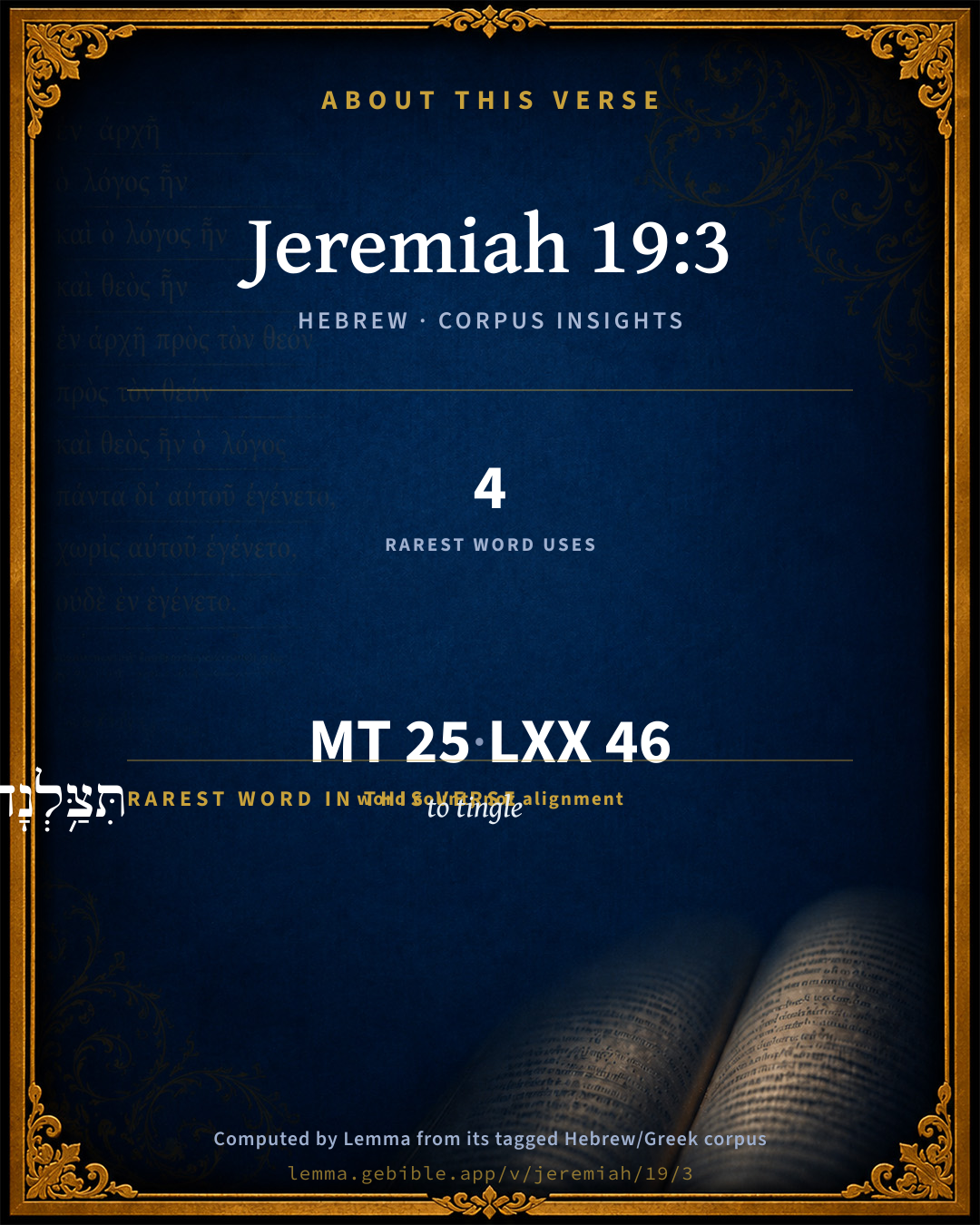
The rarest word here is תִּצַּ֥לְנָה to tingle H6750 — appearing just 4 times in the whole Hebrew Bible.

Shared distinctive vocabulary

תִּצַּ֥לְנָה to tingle H6750 occurs in 4 verses of the Hebrew Bible. Also found in:

Grammatical profile

  • 7 verbs
  • 13 nouns
  • 1 pronoun
  • 1 preposition
  • 1 adverb
  • 2 particles

Verb forms

  • וְאָֽמַרְתָּ֙ Qal · Sequential Perfect
  • שִׁמְע֣וּ Qal · Imperative
  • וְיֹשְׁבֵ֖י Qal · Participle Active
  • אָמַר֩ Qal · Perfect
  • מֵבִ֤יא Hiphil · Participle Active
  • שֹׁמְעָ֖הּ Qal · Participle Active
  • תִּצַּ֥לְנָה Qal · Imperfect

Repetition

Words recur within this verse — often emphatic in Hebrew:

  • וְאָֽמַרְתָּ֙ to say H559 ×2
  • שִׁמְע֣וּ to hear H8085 ×2
  • יְהוָ֔ה LORD H3068 ×2

Hebrew & Septuagint length

In the original languages it is 25 Hebrew tokens and 46 Greek tokens — but the two are counted differently (Hebrew bundles its prefixes and suffixes into one token; the Greek is in lemma form), so that isn’t a like-for-like length.

Cross-references

12

Topical passages linked to Jeremiah 19:3 in the Treasury of Scripture Knowledge — connected by theme and wording, ordered by reader-vote popularity; previews shown in the World English Bible.

  • 1 Samuel 3:11 Yahweh said to Samuel, Behold, I will do a thing in Israel, at which both the ears of everyone who hears it shall tingle.
  • Jeremiah 17:20 and tell them, Hear you the word of Yahweh, you kings of Judah, and all Judah, and all the inhabitants of Jerusalem, that enter in by these gates:
  • 2 Kings 21:12–13 therefore thus says Yahweh, the God of Israel, Behold, I bring such evil on Jerusalem and Judah, that whoever hears of it, both his ears shall tingle.
  • Isaiah 28:19 As often as it passes though, it shall take you; for morning by morning shall it pass through, by day and by night: and it shall be nothing but terror to understand the message.
  • Jeremiah 6:19 Hear, earth: behold, I will bring evil on this people, even the fruit of their thoughts, because they have not listened to my words; and as for my law, they have rejected it.
  • 1 Samuel 4:16–18 The man said to Eli, I am he who came out of the army, and I fled today out of the army. He said, How went the matter, my son?
  • Psalms 2:10 Now therefore be wise, you kings. Be instructed, you judges of the earth.
  • Psalms 102:15 So the nations will fear the name of Yahweh; All the kings of the earth your glory.
  • Psalms 110:5 The Lord is at your right hand. He will crush kings in the day of his wrath.
  • Jeremiah 13:18 Say you to the king and to the queen-mother, Humble yourselves, sit down; for your headdresses are come down, even the crown of your glory.
  • Matthew 10:18 Yes, and you will be brought before governors and kings for my sake, for a testimony to them and to the Gentiles.
  • Revelation 2:29 He who has an ear, let him hear what the Spirit says to the assemblies.

Cross-references courtesy of OpenBible.info (CC BY 4.0).

Hebrew and Greek witnesses Masoretic Hebrew ↔ Greek Septuagint

The same verse in the two great witnesses to the Old Testament, shown verse-for-verse.

These are two independent witnesses, not word-aligned to each other, and the Septuagint is shown in lemma (dictionary) form.

Hebrew Jeremiah 19:3 Masoretic · Westminster Leningrad Codex

וְאָֽמַרְתָּ֙ שִׁמְע֣וּ דְבַר יְהוָ֔ה מַלְכֵ֣י יְהוּדָ֔ה וְיֹשְׁבֵ֖י יְרֽוּשָׁלִָ֑ם כֹּֽה אָמַר֩ יְהוָ֨ה צְבָא֜וֹת אֱלֹהֵ֣י יִשְׂרָאֵ֗ל הִנְנִ֨י מֵבִ֤יא רָעָה֙ עַל הַמָּק֣וֹם הַזֶּ֔ה אֲשֶׁ֥ר כָּל שֹׁמְעָ֖הּ תִּצַּ֥לְנָה אָזְנָֽיו

and say, Hear you the word of Yahweh, kings of Judah, and inhabitants of Jerusalem: thus says Yahweh of Hosts, the God of Israel, Behold, I will bring evil on this place, which whoever hears, his ears shall tingle.

World English Bible · Public Domain

Greek LXX Structure differs

In the Septuagint, Jeremiah is about an eighth shorter than the Hebrew and arranges its material differently — the Oracles Against the Nations (Hebrew chapters 46–51) appear in the middle of the Greek book, after 25:13. Because the chapter and verse boundaries do not line up, a verse-for-verse comparison with the Hebrew is not shown.

A verse-for-verse comparison isn’t shown here because the chapters and verses don’t line up. Switch to the LXX edition with the MT / LXX toggle above to read the Greek directly.

On this verse, The Cambridge Bible for Schools and Colleges discusses the Septuagint’s reading. Read the note in Commentary ↓

Hebrew: Westminster Leningrad Codex (CC BY 4.0). Greek: Septuagint (public domain); English from a public-domain English Septuagint. How the Septuagint differs from the Hebrew →

Targum (Aramaic paraphrase)

1

The Targum is the ancient Jewish Aramaic paraphrase of the Hebrew Scriptures — an interpretive translation, not the Hebrew text itself. Onkelos (literal) and Pseudo-Jonathan (expansive) render the Torah, and Jonathan the Prophets. Coverage is partial: where no permissively-licensed English translation exists for a verse, only the Aramaic is shown. This is verse-level text, not a word-by-word alignment to the Hebrew.

  1. Targum Jonathan Prophets (Joshua–Malachi)
    וְתֵימַר קַבִּילוּ פִתְגָמָא דַייָ מַלְכַיָא דְבֵית יְהוּדָה וְיַתְבֵי יְרוּשְׁלֵם כִּדְנַן אֲמַר יְיָ צְבָאוֹת אֱלָהָא דְיִשְׂרָאֵל הָא אֲנָא מַיְתֵי בִישְׁתָא עַל אַתְרָא הָדֵין דְכָל דְיִשְׁמְעִינֵיהּ יִצְלַן אוּדְנוֹהִי:

    (no public-domain English translation for this verse)

    Targum Jonathan — Aramaic: “Mikraot Gedolot” (public domain). English: “Sefaria Community Translation” (CC0 1.0 (public-domain dedication)); “London "Chaldee Paraphrase," 1871” (public domain). Text via Sefaria.

Commentary

Notes on Jeremiah 19:3 from classic Christian and Jewish commentators (each source and its license shown beneath its notes). The classic Christian expositions comment on the surrounding passage and are grouped to its opening verse, so a note may address several verses; the Jewish commentaries on the Tanakh (Rashi and others) are per-verse, so they appear only where the commentator wrote on this verse.

Lemma curates 59 commentaries, every one of them public domain or Creative Commons licensed, each selected and text-cleaned for this edition rather than reprinted as found. About our sources →

The Cambridge Bible for Schools and Colleges

gen. ed. J. J. S. Perowne

3. his ears shall tingle] Cp. 2Ki_21:12.

3–9. These vv. are probably an editorial insertion, for (a) the message which God was to give the prophet in the valley of Ben-Hinnom (Jer_19:2) is here given him (Jer_19:3 ff.) before he goes there, (b) the subject-matter of the passage is drawn to a large extent from other portions of the Book, specially from the last part of ch. 7, (c) as Gi. has pointed out, the style of the LXX rendering differs from that employed elsewhere; so that the Greek was probably added by a later hand, the original translator not having the passage in his copy, (d) the use of the plural “kings” (Jer_19:3 and also in Jer_17:20) is strange.

The Cambridge Bible for Schools and Colleges (gen. ed. J. J. S. Perowne; Cambridge University Press, 1878–1918) — public domain. Text from a community e-Sword module.

Trapp's Complete Commentary

John Trapp

Jer 19:3 And say, Hear ye the word of the LORD, O kings of Judah, and inhabitants of Jerusalem; Thus saith the LORD of hosts, the God of Israel; Behold, I will bring evil upon this place, the which whosoever heareth, his ears shall tingle.

Ver. 3. Hear the word of the Lord, ye kings of Judah,] i.e., O king and thy counsellors, who are so many little kings, as King James was wont to say of the parliament men.

Behold, I bring evil upon this place.] This he spake to all, and with all authority; catholicam et miserabilem perniciem proclamans. It is credible that he spake it with as good a courage (or better), as Bishop Ridley, martyr, did those comminatory words of his to Queen Mary and her servants, when they refused to hear him preach. He uttered them with such vehemence, saith mine author, that some of the hearers afterwards confessed the hairs to stand upright on their heads. {a}

His ears shall tingle.] For grief and fear, as if he had been stonied with a thunder clap, or were ready to swoon.

{a} Acts and Mon., 1270.

John Trapp, A Commentary or Exposition upon All the Books of the Old and New Testament (1647–1656) — public domain. Text from a community e-Sword module.

Albert Barnes' Notes on the Bible

Kings - Plural because the message Jer 19:3-9, related not especially to the reigning king, but to the whole royal house.

Albert Barnes' Notes on the Bible (1834–1885) — public domain. Text from a community e-Sword/MySword module.

Joseph Benson's Commentary

Jer 19:3-5. Say, Hear, &c., O kings of Judah — See note on Jer 17:20. Behold, I will bring evil upon this place — That is, upon Judah and Jerusalem, so surprising and so dreadful that whosoever heareth, his ears shall tingle — The very report of it shall astonish the hearers. Because they have estranged this place — From me, should be supplied to make the sense clearer; the meaning, it seems, being that, by their worshipping other gods, and committing all sorts of crimes, they had caused God not to look any longer upon their city and country as his, but quite foreign from him. Or, as some interpret the expression, They had strangely abused, and alienated from their intended purposes both Jerusalem, the holy city, and the temple, God’s holy house, which were designed for his honour and the support of his kingdom among men. And have filled this place with the blood of innocents — Of the children sacrificed to Moloch: see note on Jer 2:34; and Isa 30:33. They have built also, rather, they have even built the high places of Baal — For the same sin is here expressed which was mentioned in the latter part of the foregoing verse, and the copulative particle, vau, is sometimes used by way of explication; to burn their sons with fire unto Baal — From this, as well as from some other places, it is plain that they slew and burned human victims to Baal as well as to Moloch, if these two names were not promiscuously given, as some suppose they were, to one and the same idol. Which I commanded not, &c. — It seems from this that there were not wanting some who maintained that human sacrifices were pleasing to God.

Joseph Benson's Commentary on the Old and New Testaments (1811–1818) — public domain. Text from a community e-Sword module.

Geneva Bible (1599)

Geneva Bible translators

Read of this phrase, 1 Sam. 3:11.

By Kings here and in other places are meant counselors and governors of the people: which he calleth the ancients, verse 1.

Geneva Bible (1599) marginal notes — public domain. Text via Bolls.life.

Jamieson, Fausset & Brown

Robert Jamieson, A. R. Fausset & David Brown

The scene of their guilt is chosen as the scene of the denunciation against them.

kings--the king and queen (Jer 13:18); or including the king's counsellors and governors under him.

tingle--as if struck by a thunder peal (Sa1 3:11; Kg2 21:12).

Jamieson, Fausset & Brown — Commentary Critical and Explanatory on the Whole Bible (1871) — public domain (CC PDM 1.0). Text via the HelloAO Bible API.

John Calvin's Commentaries

He now adds, Hear ye the word of Jehovah. This is a confirmation of the former sentence. We hence see why it was said, Cry, or, with a clear voice proclaim, what I shall say to thee; it was, that they might know that he spake not according to his own ideas as a man, but that he was a celestial herald to proclaim what God commanded. Hear, he says, ye kings of Judah and inhabitants of Jerusalem. We see how the Prophet did not spare even kings, according to what God had before commanded him, that he should act boldly and shew no respect of persons, (Jeremiah 1:8.) He then faithfully performed his office, as he did not flatter kings, and was not terrified by their dignity and power. But he addressed them first, and then the people, because they who had most grievously sinned, were made rightly to bear the first reproof. We hence see what the next passage means,

“Reprove mountains and chide hills,” (Micah 6:1)

and also this passage,

“I have set thee over nations and kingdoms,” (Jeremiah 1:10)

for heavenly truth ought to bring under subjection, as Paul says, everything high in the world, so that all the pride of man may be subdued. (2 Corinthians 10:5.) Kings indeed do very ill bear to be thus boldly treated; for they wish to be exempt from every law and to be free from every yoke. But if they now acknowledge not their subjection to God’s word, they must at last come before his tribunal; and then they shall find how perversely they have abused their power. As to teachers, they ought, small and great, to teach after the example of Jeremiah; they ought to reprove and to rebuke, when necessary, without shewing any respect of persons.

Thus saith Jehovah of hosts, and the God of Israel, Behold, I am bringing an evil on this place, of which whosoever shall hear, tingle shall his ears. The prophetic word had more power when the Jews were brought to the very place where the event was exhibited, he might have said the same thing in the Temple or in the gate or in the palace of the king but his prophecy would not have been so effectual. We indeed know how much tardiness there is in men in general; but so great was then the obstinacy of the Jews, that however forcibly the truth might have been set forth, yet it was received with so much indifference, that it was neglected. God then intended to shew to them, as it were, the event itself. He says, Jehovah of hosts and the God of Israel; and he used these words, that they might know, as we have stated elsewhere, that they had to do with God, whose power is dreaded even by angels. And in order to shake off their foolish boasting, that they were the children of Abraham, — “God,” he says, “has sufficient power to chastise you, and the same is the God of Israel, whose name ye falsely and absurdly pretend to profess.” These subjects I only in a brief manner handle, because I have explained them more fully elsewhere.

He says that such a calamity was nigh that place as would make the ears to tingle: when there is a violent noise, our ears are stunned, and there is at the same time a certain tingling or ringing. When a man is killed, or when ten or twelve men are slain, there is a dreadful cry; but in a great tumult occasioned by men perishing, such is the noise that it stuns in a manner the ears, like that which proceeds from cataracts; for the violent noise of the Nile, they say, causes some degree of deafness. So also the Prophet says here, I am bringing, says God, a calamity on this place, which shall not only terrify those who will hear of it, but also render them quite astonished, so that their ears shall tingle, as is the case when there is a violent and dreadful noise. The cause follows —

John Calvin's Commentaries (1540-1563) — public domain. Text from the Calvin Translation Society English edition (1840s-50s) via the Christian Classics Ethereal Library (ccel.org). Calvin's coverage is partial (roughly two-thirds of the Bible); uncommented books and verses are honest gaps, never fabricated. The 19th-century editor's footnotes and remarks are omitted so the notes are faithfully Calvin's own voice.

Ellicott's Commentary for English Readers

(3) O kings of Judah.—The plural seems used to include both the reigning king, Jehoiakim, and his heir-apparent or presumptive.

His ears shall tingle.—The phrase, occurring as it does in 1Sa_3:11, in the prophecy of the doom of the earlier sanctuary, seems intentionally used to remind those who heard it of the fate that had fallen on Shiloh. The destruction of the first sanctuary of Israel was to be the type of that of the second (Psa_78:60; Jer_7:14). The phrase had, however, been used more recently (2Ki_21:12).

A Bible Commentary for English Readers, edited by Charles John Ellicott (1878–1897) — public domain. Text from a community e-Sword module.

John Gill's Exposition

And say, hear ye the word of the Lord, O kings of Judah,.... The king and his queen; or the king and his sons; or the king and his princes, and nobles; for there was but one king reigning at a time in Judah, and the present king was Zedekiah; see Jer 21:1;

and inhabitants of Jerusalem; the elders of which, and of the priests, were now before him; to whom he said the following things, that they might tell them to the persons mentioned:

thus saith the Lord of hosts, the God of Israel; who is able to do whatsoever he pleases in the armies of the heavens, and among the inhabitants of the earth, and will do so among his own people, notwithstanding his being the God of Israel:

behold, I will bring evil upon this place; the evil of punishment for the evil of sin; such as the sword, famine, and captivity; meaning not on that spot of ground where the prophet with the elders were, but upon the city of Jerusalem, and on all the land of Judea:

the which whosoever heareth, his ears shall tingle; it shall be astonishing and surprising to him; it shall even stun him; he shall stand as one thunderstruck or be so affected with it as a man is at a violent clap of thunder, or at some exceeding vehement sound, which leaves such an impression upon him, and continues with him, that he cannot get rid of it; but seems to be continually sounding in his ears, and they even echo and ring with it; see Sa1 3:11. The phrase denotes the greatness of the calamity, and the surprise which the bare report of it would bring with it.

John Gill's Exposition of the Whole Bible (1746–1763) — public domain (CC PDM 1.0). Text via the HelloAO Bible API.

Haydock's Catholic Bible Commentary

Tingle, as if he had heard a sudden noise or clap of thunder. (Calmet)

George Leo Haydock (1774–1849), Haydock's Catholic Family Bible and Commentary, 1859 edition — public domain. Excludes Psalms (Douay-Rheims chapter numbering differs from Protestant) and Deuterocanonical books (Catholic canon only).

Matthew Poole's English Annotations

That is, a very great evil; it is a Hebrew way of expression, which we also find 1Sa 3:11; 2Ki 21:12. As a very great glaring light affects our eyes, and blindeth them, so a very great sound affecteth the ear, and makes it tingle, and for some time deaf. This God commandeth the prophet to proclaim, as particularly directed to all, both high and low, as well the

kings of Judah as the inhabitants of Jerusalem.

Matthew Poole's English Annotations on the Holy Bible (1683–1685) — public domain. Text from a community e-Sword/MySword module.

Whedon's Commentary on the Bible

Daniel D. Whedon

3. Kings of Judah — The plural is used, because the message of the prophet referred to more than the reigning king.

Ears… tingle — See 2Ki_21:12; 1Sa_3:21.

Daniel D. Whedon (gen. ed.), Commentary on the Old and New Testaments (1874–1909) — public domain. Text from a community e-Sword module.

The Pulpit Commentary

O kings of Judah; i.e. the numerous clan of royal princes, kings by courtesy. (see on Jer_17:20) His ears shall tingle. (so 2Ki_21:12; comp. 1Sa_3:11)

The Pulpit Commentary (1880–1919), ed. H.D.M. Spence-Jones & Joseph S. Exell — public domain. Text from a community e-Sword module.

Rashi

Rabbi Shlomo Yitzchaki (Rashi)

his ears will tingle (tinter in French), an expression similar to “cymbals” (מְצִלְתַּיִם) (Neh. 12: 27), “with loud sounding cymbals (בְּצִלְצְלֵי ֹשָמַע)” (Psalms 150:5).

Rashi on the Tanakh — English translations: “The Judaica Press complete Tanach with Rashi, translated by A. J. Rosenberg” (CC BY 4.0); “Pentateuch with Rashi's commentary by M. Rosenbaum and A.M. Silbermann, 1929-1934” (public domain); “The Metsudah Tanach series, Lakewood, N.J” (CC BY 4.0); and “The Book of Joshua, Metsudah Publications, 1997” (CC BY 4.0). Text via Sefaria.

Lesson kit

Teaching starters — assembled from the data on this page, not authored interpretation. Every prompt links to the verse data it draws on. Edit before teaching.

Jeremiah, in the Prophets, opens this verse with 25 words (22 distinct Hebrew lemmas). Its most distinctive word is tsâlal (“to tingle”). A historical commentator’s framing appears above. Read the whole chapter for the surrounding context.

Discussion questions

  1. The word tsâlal carries the sense “to tingle.” How does it shape the verse?
  2. 1 Samuel 3:11 shares the word «to tingle» with this verse. How do the two illuminate each other?
  3. “to say” occurs 2× in this one verse. What is the effect of the repetition?
  4. These translations render this verse differently; the difference is in the English rendering, not the original. What questions does that raise?
  5. The verb «וְאָֽמַרְתָּ֙» is Qal Sequential Perfect. How does its form color the action?
  6. Reading how The Cambridge Bible for Schools and Colleges and Trapp's Complete Commentary read this verse, where do the two commentators agree and where do they part?

Things to notice

Reading settings

Reading text

Shown beneath each verse's original-language words.

Old Testament
Old Testament edition

Read the OT as the Masoretic Hebrew (MT) or the Greek Septuagint (LXX).

English shown for the Greek Septuagint (in the Hebrew ↔ Greek comparison).

Comparing translations? Open the Compare panel on any verse page to stack up to four side by side.