
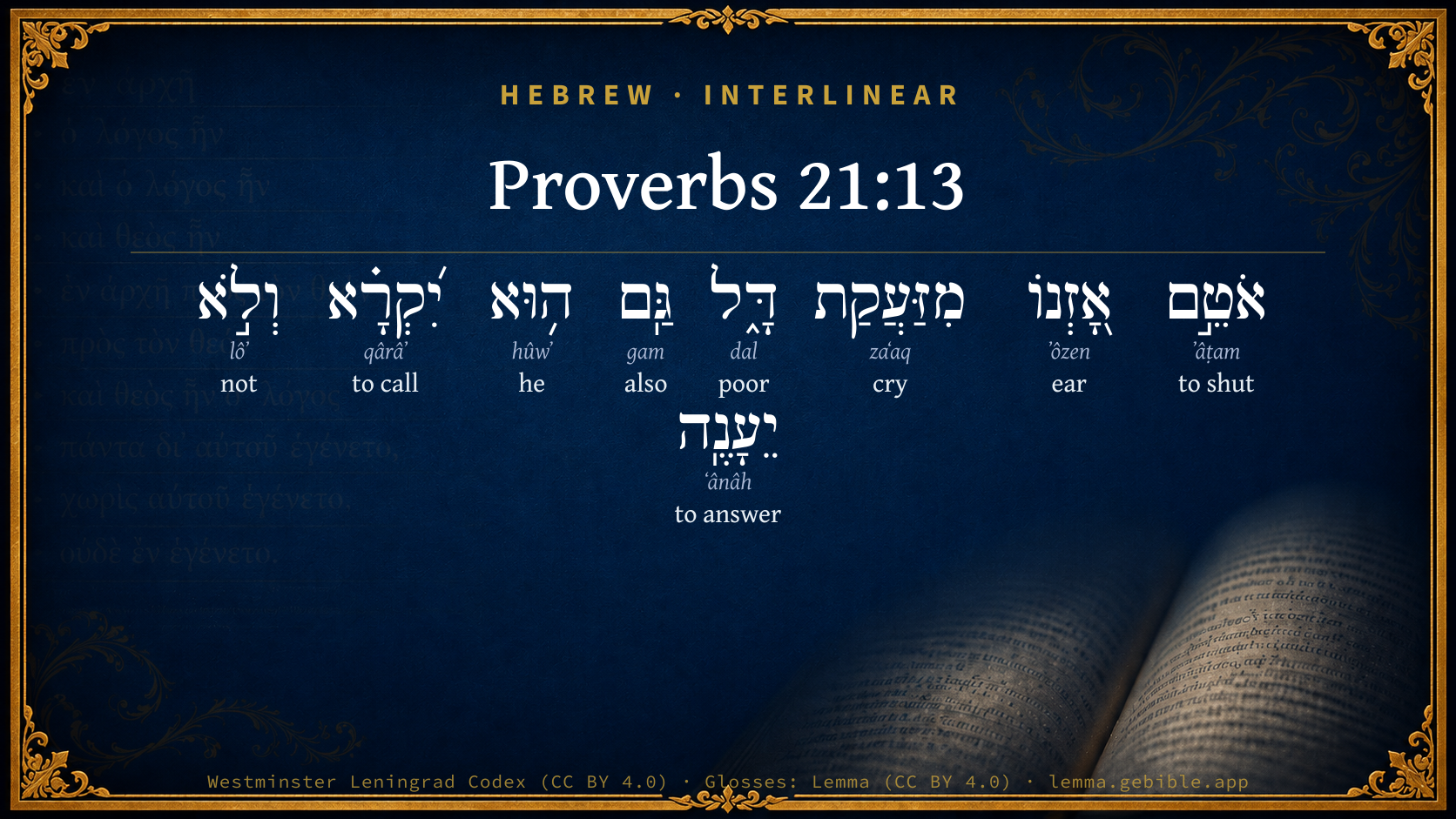
Proverbs 21:13

Hebrew (Westminster Leningrad Codex) Proverbs 21:13 appears in the Hebrew Old Testament. The text above is from the Westminster Leningrad Codex. Each word links to its Strong’s number, a concise gloss, and parsing drawn from the Open Scriptures Hebrew Bible morphology. Click any word for its full Brown-Driver-Briggs (BDB) entry.
Download image
Cite this verse

Proverbs 21:13 (World English Bible). Public Domain. Lemma interlinear Bible study tool, https://lemma.gebible.app/v/proverbs/21/13.

Show BibTeX & RIS
BibTeX
RIS
English Translation
Whoever stops his ears at the cry of the poor, He will also cry out, but shall not be heard.
World English Bible · Public Domain
Download a study sheet

One document with this verse’s original text, its word-by-word gloss line, the meaning frame, cross-references with their text, attributed commentary, and full source and license credits — printable, and it pastes into notes with its structure intact.

This verse Autodidact and up

Study sheet (.html) Plain text (.txt)

A passage Seminary Student

Up to 50 verses in one chapter. A passage sheet keeps up to 6 commentary sources and 12 cross-references per verse, in the order this page ranks them, and says so on the sheet whenever that leaves anything out. Ask for a single verse and you get the Autodidact verse sheet above.

Everything on this page stays free to read, with no account — the sheet is a download of what is already on screen, not access to it.

Want to remove ads? Support Godless Engineer
Compare translations 3

The same verse in 3 English versions, stacked beneath the original-language interlinear above. Click any original word for its lexicon entry.

Each is an independent rendering of the whole verse — the interlinear is not word-aligned to these translations.

Highlighted words mark where these versions differ — a whole-verse word diff, not a word-by-word alignment.

  • World English Bible Public Domain
    Whoever stops his ears at the cry of the poor, He will also cry out, but shall not be heard.
  • King James Version Public Domain
    Whoso stoppeth his ears at the cry of the poor, he also shall cry himself, but shall not be heard.
  • unfoldingWord Literal Text CC BY-SA 4.0
    One who shuts his ears from the outcry of a lowly one, he also will cry out but will not be answered.

unfoldingWord Literal Text — © unfoldingWord, licensed CC BY-SA 4.0. Word-aligned USFM3 via Door43 (git.door43.org/unfoldingWord/en_ult).

Versions to compare (up to 4)

3 of 4 selected

Show all 18 translations

Every available English version of this verse, each an independent rendering of the whole verse.

  • World English Bible Public Domain
    Whoever stops his ears at the cry of the poor, He will also cry out, but shall not be heard.
  • Berean Standard Bible Public Domain
    Whoever shuts his ears to the cry of the poor, he too shall cry out and receive no answer.
  • Majority Standard Bible Public Domain
    Whoever shuts his ears to the cry of the poor, he too shall cry out and receive no answer.
  • King James Version Public Domain
    Whoso stoppeth his ears at the cry of the poor, he also shall cry himself, but shall not be heard.
  • American Standard Version (1901) Public Domain
    Whoso stoppeth his ears at the cry of the poor, He also shall cry, but shall not be heard.
  • Revised Version (1885) Public Domain
    Whoso stoppeth his ears at the cry of the poor, he also shall cry, but shall not be heard.
  • Geneva Bible (1599) Public Domain
    He that stoppeth his eare at the crying of the poore, he shall also cry and not be heard.
  • Douay-Rheims (1899) Public Domain
    He that stoppeth his ear against the cry of the poor, shall also cry himself and shall not be heard.
  • Young's Literal Translation Public Domain
    Whoso is shutting his ear from the cry of the poor, He also doth cry, and is not answered.
  • Literal Standard Version CC BY-SA 4.0
    Whoever is shutting his ear from the cry of the poor, || He also cries, and is not answered.
  • Unlocked Literal Bible CC BY-SA 4.0
    The one who shuts his ears to the cry of the poor, he also will cry out, but he will not be answered.
  • unfoldingWord Literal Text CC BY-SA 4.0
    One who shuts his ears from the outcry of a lowly one, he also will cry out but will not be answered.
  • Darby Bible Public Domain
    Whoso stoppeth his ears at the cry of the poor, he also himself shall cry, and shall not be heard.
  • World Messianic Bible Public Domain
    Whoever stops his ears at the cry of the poor, he will also cry out, but shall not be heard.
  • Webster's Bible Public Domain
    Whoever stoppeth his ears at the cry of the poor, he also shall cry himself, but shall not be heard.
  • Free Bible Version CC BY-SA 4.0
    If you refuse to hear the cries of the poor, your cries won't be heard either.
  • Bible in Basic English Public Domain
    He whose ears are stopped at the cry of the poor, will himself get no answer to his cry for help.
  • JPS Tanakh (1917) Public Domain
    Whoso stoppeth his ears at the cry of the poor, he also shall cry himself, but shall not be answered.

Literal Standard Version (2020), Covenant Press — licensed CC BY-SA 4.0. Text via the HelloAO Bible API (eBible.org). Unlocked Literal Bible (unfoldingWord) — licensed CC BY-SA 4.0. Text via the HelloAO Bible API (eBible.org). unfoldingWord Literal Text — © unfoldingWord, licensed CC BY-SA 4.0. Word-aligned USFM3 via Door43 (git.door43.org/unfoldingWord/en_ult). Free Bible Version, Dr. Jonathan Gallagher — licensed CC BY-SA 4.0. Text via the HelloAO Bible API (eBible.org).

Word by word

More ways to search: Search by grammar → Find every occurrence → Compare this word →

Practice this passage: Drill this verse → Learn its vocabulary →

About this verse

These counts appear in no published source. They are computed here, from the morphology-tagged text and Lemma’s own curated glosses. What Lemma adds →

9
words
9
distinct lemmas
Wisdom
section

Notable vocabulary

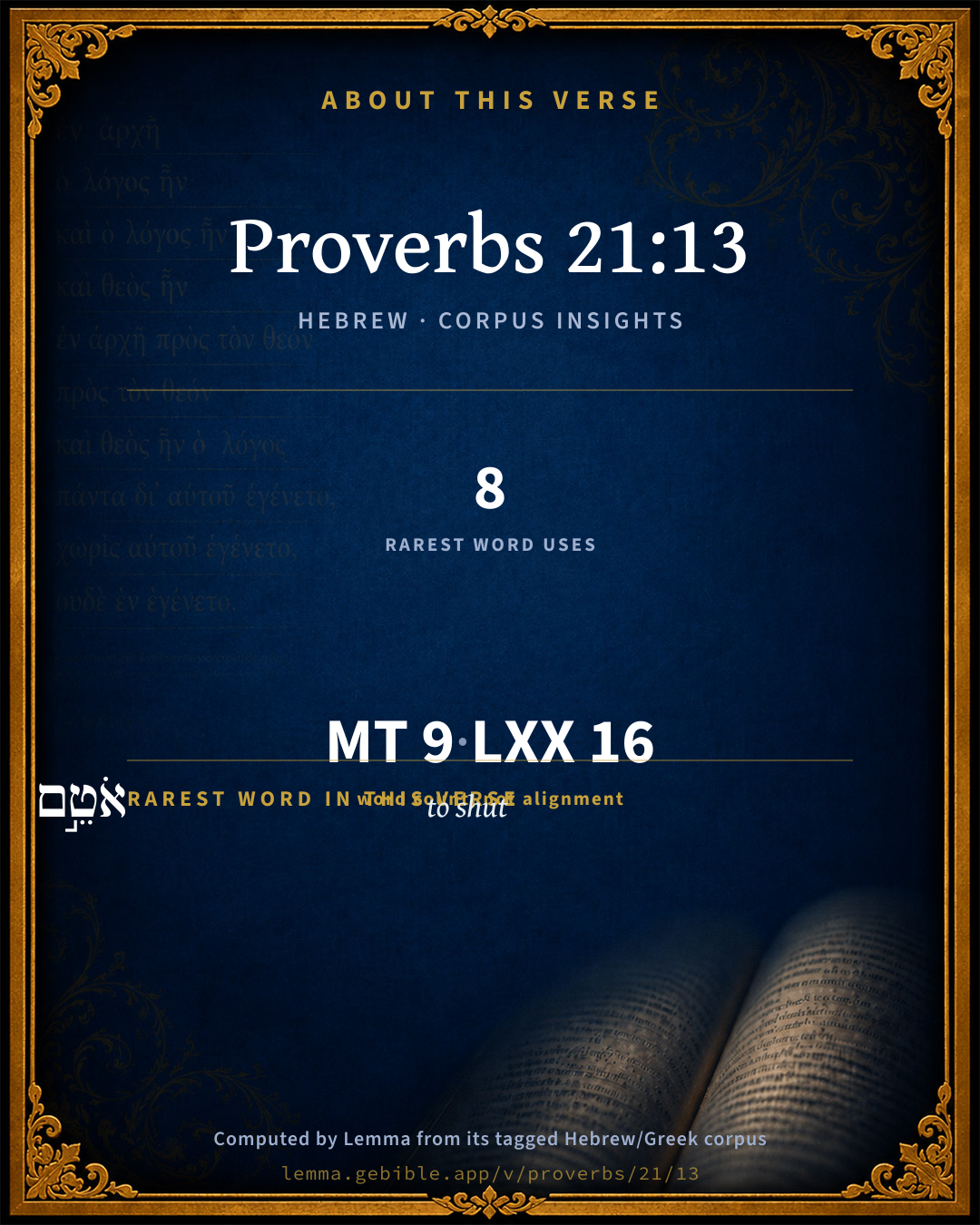
The rarest word here is אֹטֵ֣ם to shut H331 — appearing just 8 times in the whole Hebrew Bible.

Shared distinctive vocabulary

אֹטֵ֣ם to shut H331 occurs in 8 verses of the Hebrew Bible. Also found in:

Grammatical profile

  • 3 verbs
  • 2 nouns
  • 1 adjective
  • 1 pronoun
  • 2 particles

Verb forms

  • אֹטֵ֣ם Qal · Participle Active
  • יִ֝קְרָ֗א Qal · Imperfect
  • יֵעָנֶֽה Niphal · Imperfect

Hebrew & Septuagint length

In English translation the verse runs 20 words from the Hebrew and 21 from the Septuagint (LXX English) — closely comparable.

A rough comparison of the two English renderings, which tokenize alike — not a word-level alignment.

Word counts can differ between the Hebrew and the Greek without any difference in meaning — e.g. the Hebrew direct-object marker אֵת has no separate Greek word, and Greek often adds the article ὁ.

In the original languages it is 9 Hebrew tokens and 16 Greek tokens — but the two are counted differently (Hebrew bundles its prefixes and suffixes into one token; the Greek is in lemma form), so that isn’t a like-for-like length.

Cross-references

15

Topical passages linked to Proverbs 21:13 in the Treasury of Scripture Knowledge — connected by theme and wording, ordered by reader-vote popularity; previews shown in the World English Bible.

  • Proverbs 28:27 One who gives to the poor has no lack; But one who closes his eyes will have many curses.
  • Proverbs 1:28 Then will they call on me, but I will not answer. They will seek me diligently, but they will not find me;
  • Matthew 6:14 "For if you forgive men their trespasses, your heavenly Father will also forgive you.
  • Matthew 7:2 For with whatever judgment you judge, you will be judged; and with whatever measure you measure, it will be measured to you.
  • James 2:13–16 For judgment is without mercy to him who has shown no mercy. Mercy triumphs over judgment.
  • Jeremiah 34:16–17 but you turned and profaned my name, and caused every man his servant, and every man his handmaid, whom you had let go free at their pleasure, to return; and you brought them into subjection, to be to you for servants and for handmaids.
  • Matthew 18:30–35 He would not, but went and cast him into prison, until he should pay back that which was due.
  • Isaiah 1:15–17 When you spread forth your hands, I will hide my eyes from you; Yes, when you make many prayers, I will not hear. Your hands are full of blood.
  • Isaiah 58:6–9 Isn't this the fast that I have chosen: to loose the bonds of wickedness, to undo the bands of the yoke, and to let the oppressed go free, and that you break every yoke?
  • Psalms 18:41 They cried, but there was none to save; Even to Yahweh, but he didn't answer them.
  • Psalms 58:4 Their poison is like the poison of a snake; Like a deaf cobra that stops its ear,
  • Zechariah 7:9–13 "Thus has Yahweh of Hosts spoken, saying, 'Execute true judgment, and show kindness and compassion every man to his brother.
  • Matthew 25:41–46 Then he will say also to those on the left hand, 'Depart from me, you cursed, into the eternal fire which is prepared for the devil and his angels;
  • Deuteronomy 15:7–11 If there be with you a poor man, one of your brothers, within any of your gates in your land which Yahweh your God gives you, you shall not harden your heart, nor shut your hand from your poor brother;
  • Acts 7:57 But they cried out with a loud voice, and stopped their ears, and rushed at him with one accord.

Cross-references courtesy of OpenBible.info (CC BY 4.0).

Hebrew and Greek witnesses Masoretic Hebrew ↔ Greek Septuagint

The same verse in the two great witnesses to the Old Testament, shown verse-for-verse.

These are two independent witnesses, not word-aligned to each other, and the Septuagint is shown in lemma (dictionary) form.

Hebrew Proverbs 21:13 Masoretic · Westminster Leningrad Codex

אֹטֵ֣ם אָ֭זְנוֹ מִזַּעֲקַת דָּ֑ל גַּֽם ה֥וּא יִ֝קְרָ֗א וְלֹ֣א יֵעָנֶֽה

Whoever stops his ears at the cry of the poor, He will also cry out, but shall not be heard.

World English Bible · Public Domain

Greek LXX Proverbs 21:13 Septuagint · lemma form

ὅς φράσσω ὁ οὖς ὁ μή ἐπιἀκούω ἀσθενής καί αὐτός ἐπικαλέω καί οὐ εἰμί ὁ εἰςἀκούω

He that stops his ears from hearing the poor, himself also shall cry, and there shall be none to hear him.

LXX2012 (modern English Septuagint) · Public Domain

On this verse, John Gill's Exposition discusses the Septuagint’s reading. Read the note in Commentary ↓

Hebrew: Westminster Leningrad Codex (CC BY 4.0). Greek: Septuagint (public domain); English from LXX2012 (modern English Septuagint) (Public Domain). How the Septuagint differs from the Hebrew →

Commentary

Notes on Proverbs 21:13 from classic Christian and Jewish commentators (each source and its license shown beneath its notes). The classic Christian expositions comment on the surrounding passage and are grouped to its opening verse, so a note may address several verses; the Jewish commentaries on the Tanakh (Rashi and others) are per-verse, so they appear only where the commentator wrote on this verse.

Lemma curates 59 commentaries, every one of them public domain or Creative Commons licensed, each selected and text-cleaned for this edition rather than reprinted as found. About our sources →

Trapp's Complete Commentary

John Trapp

Pro 21:13 Whoso stoppeth his ears at the cry of the poor, he also shall cry himself, but shall not be heard.

Ver. 13. Whoso stoppeth his ear at the cry, &c.] This was fulfilled in Pharaoh; Haman; the rich glutton; Hatto, archbishop of Mentz; Mauricius, the emperor, and many others, who might have better provided for their own comfort in sickness, and other exigencies, had they been more pitiful to poor people. Whereas now, when they shall lie tossing and tumbling upon their sick beds, roaring as bulls, and "tabering upon their breasts," {Nah 2:7} God will not hear them; men will say, It is good enough for them. All hearts, by a divine hand, will be strangely set off from the merciless, as it befell Sejanus.

John Trapp, A Commentary or Exposition upon All the Books of the Old and New Testament (1647–1656) — public domain. Text from a community e-Sword module.

The Biblical Illustrator

Joseph S. Exell

Pro_21:13

Whoso stoppeth his ears at the cry of the poor, he also shall cry himself, but shall not be heard.

The cry of the poor

I. Social distress. The cry of the poor. The poor may be divided into two classes.

1. The deserving. There is a poverty that comes on men by circumstances over which they have no control: infirm bodies, diseased faculties, social oppression, untoward events. Such poverty is often associated not only with great intelligence, but with virtue and piety of a high order.

2. The undeserving.

II. Social heartlessness. Whoso stoppeth his ears.

1. The wealthy.

2. The legislating. In the name of heaven, what is the good of a government if it cannot overcome pauperism?

III. Social retribution. (D. Thomas, D. D.)

An unmerciful disposition

1. We may always expect, both in general society and in the Church of God, the rich and poor to meet together. Wherever there has been property it has been in various portions; and were there an equal division of property to-day, there would be a difference to-morrow. There are varieties of poverty; for poverty is a relative and comparative term. And among the indigent and dependent poor there are also varieties--the industrious and the indolent; the sober and the intemperate; the virtuous and the vicious, the deserving and the undeserving.

2. Nothing can be of greater consequence than marking this distinction, and regulating our charity accordingly. There is a stopping of the ears that is at times a virtue--requiring an effort of self-denying principle in opposition to the mere emotion and impulse of present pity. Charity must be exercised judiciously.

3. The sin here reproved is an unmerciful disposition; unfeeling hardness of heart; pitiless, avaricious, griping selfishness. This may be exemplified in beating down the wages of the poor labourer and artisan; in the denial of protection to the poor when it is pleaded for against oppression, and when we have it in our power to afford it. (R. Wardlaw, D. D.)

The Biblical Illustrator, edited by Joseph S. Exell (c. 1880s–1900s) — public domain. Text from a community e-Sword module.

Joseph Benson's Commentary

Pro 21:13. Whoso stoppeth his ears at the cry of the poor — When they cry out by reason of oppression or want, and beg relief from him; he also shall cry himself — Unto God or men, in his straits which God shall bring upon him; but shall not be heard — Shall be denied his requests.

Joseph Benson's Commentary on the Old and New Testaments (1811–1818) — public domain. Text from a community e-Sword module.

The Preacher's Complete Homiletical Commentary

Joseph S. Exell (gen. ed.)

MAIN HOMILETICS OF Pro_21:13

THE CRY OF THE POOR

I. The cry of the poor may always be heard. “The poor,” said the Saviour, “ye have always with you” (Joh_12:8), and so long as sin is in the world it must be so. There are many whom sickness and bereavement makes poor, and many who are in need because of the sin of others, besides those who have been brought to poverty by their own wrong-doings. And from all these creatures of need there comes a cry—a direct appeal, it may be, for help, or the voice of lamentation because of their distress. This cry may be around us even when no appeal comes from the lip, and when no word of complaint is uttered. The wrongs of the oppressed and the miseries of the needy cry still when there is no speech nor language, and when no voice is heard.

II. No human creature can afford to stop his ears to this cry. Not one of the millions who walk the earth can reckon upon being always independent of the pity and help of his fellow-creatures. He may be almost certain that he will not be so. He is not sure, however rich he is now, that he may not have to cry for bread, or he may have to cry for help in sickness or for sympathy in sorrow. It is quite certain that he will at some period of his existence cry to God for mercy. If, therefore, he is deaf to the cry of those whose distress he can relieve, he is as unwise as that servant of whom our Lord speaks in His parable, who refused to have compassion on his fellow-servant to the amount of a hundred pence, while he himself stood in need of the forgiveness of a far heavier debt. (Mat_18:23; Mat_18:35). He who stops his own ears at the cry of the poor stops the ears of God against his own, for in the day when the favour of the King of the universe will be more precious than the wealth of ten thousand worlds, the charge will be brought against him, “I was an hungred and ye gave Me no meat; I was thirsty and ye gave Me no drink,” etc. (Mat_25:42).

OUTLINES AND SUGGESTIVE COMMENTS

When we have reason to complain that we cry and shout, but God shutteth our prayer, let us consider our ways; perhaps we have shut our ears on some occasions against the cries of the poor. This was one reason why God accepted not the prayers and fasts of those people whom Isaiah speaks of in the fiftieth chapter of his book.—Lawson.

Did a rich man know for certain, that himself should be a beggar before he died, it would make him give to the poor when they cried, that others might give to him when he cried. Now the wise man here assureth every hard churl, that although now he be never so rich, yet shall he be a beggar.… The cries of the poor are but God’s proclamation, whereby He publisheth His pleasure for the relieving of them. It is God therefore Himself that is not heard when they are denied; it is God that is not heard in His command, as well as the poor in his necessity. And, therefore, being made deaf as it were with the loudness of His own crying, He doth not hear the uncharitable when they cry unto him.—Jermin.

The Preacher's Complete Homiletical Commentary (gen. ed. Joseph S. Exell; Funk & Wagnalls, c. 1892) — public domain (pre-1929). A full-Bible homiletical/sermon-outline anthology covering 65 of 66 books (2 John is absent from the source module). Text from a community e-Sword module.

Matthew Henry's Commentary

Here we have the description and doom of an uncharitable man. 1. His description: He stops his ears at the cry of the poor, at the cry of their wants and miseries (he resolves to take no cognizance of them), at the cry of their requests and supplications - he resolves he will not so much as give them the hearing, turns them away from his door, and forbids them to come near him, or, if he cannot avoid hearing them, he will not need them, nor be moved by their complaints, no be prevailed with by their importunities; he shuts up the bowels of his compassion, and that is equivalent to the stopping of his ears, Act 7:57. 2. His doom. He shall himself be reduced to straits, which will make him cry, and then he shall not be heard. Men will not hear him, but reward him as he has rewarded others. God will not hear him; for he that showed no mercy shall have judgment without mercy (Jam 2:13), and he that on earth denied a crumb of bread in hell was denied a drop of water. God will be deaf to the prayers of those who are deaf to the cries of the poor, which, if they be not heard by us, will be heard against us, Exo 22:23.

Matthew Henry's Commentary on the Whole Bible (1708–1710) — public domain (CC PDM 1.0). Text via the HelloAO Bible API.

Jamieson, Fausset & Brown

Robert Jamieson, A. R. Fausset & David Brown

The principles of retribution, often taught (compare Psa 18:26; Mat 7:1-12).

Jamieson, Fausset & Brown — Commentary Critical and Explanatory on the Whole Bible (1871) — public domain (CC PDM 1.0). Text via the HelloAO Bible API.

Adam Clarke's Commentary

Verse 13. Whoso stoppeth his ears] See the conduct of the priest and Levite to the man who fell among thieves; and let every man learn from this, that he who shuts his ear against the cry of the poor, shall have the ear of God shut against his cry. The words are quite plain; there is no difficulty here.

Adam Clarke's Commentary on the Bible (1810–1826) — public domain. Text from a community e-Sword/MySword module.

Ellicott's Commentary for English Readers

(13) He also shall cry himself, but shall not be heard.—Because he showed no mercy. (Comp. Mat_5:7; Mat_18:30; Jas_2:13.)

A Bible Commentary for English Readers, edited by Charles John Ellicott (1878–1897) — public domain. Text from a community e-Sword module.

John Gill's Exposition

Whoso stoppeth his ears at the cry of the poor,.... For want of bread; or, "of the weak", as the Septuagint and other versions; for want of help and protection, when in the greatest distress; and, with the most pressing importunity, entreats his assistance, and yet refuses to hear him out: or, if he does, will not relieve him, which is all one as if he heard him not, or denied him a hearing;

he also shall cry himself; the Targum and Syriac version add, "unto God". The sense is, that even such an one shall be brought into the like distressed circumstances, when he shall make application to God, and to his fellow creatures, for relief and assistance:

but shall not be heard; a deaf ear will be turned to him by both: the same measure he has measured shall be measured to him again; no mercy shall be shown to an unmerciful man, either by God or man; see Jam 2:13.

John Gill's Exposition of the Whole Bible (1746–1763) — public domain (CC PDM 1.0). Text via the HelloAO Bible API.

Matthew Poole's English Annotations

Whoso stoppeth his ears at the cry of the poor, when they cry out by reason of oppression or want, and beg relief from him, he also shall cry himself unto God or men, in his straits which God will bring upon him.

Matthew Poole's English Annotations on the Holy Bible (1683–1685) — public domain. Text from a community e-Sword/MySword module.

Whedon's Commentary on the Bible

Daniel D. Whedon

13. Whoso stoppeth his ears — Refuseth to listen to entreaty.

Shall not be heard — His “cry” shall not be answered. It is implied that this shall happen because of his stopping his ears. Compare Mat_18:23-35; Mat_25:41, et seq.

Daniel D. Whedon (gen. ed.), Commentary on the Old and New Testaments (1874–1909) — public domain. Text from a community e-Sword module.

The Pulpit Commentary

Whoso stoppeth his ears at the cry of the poor. A twofold retribution is threatened on the unmerciful man. He also shall cry himself, but shall not be heard. He himself shall tall into distress, and shall appeal to his neighbours for help in vain. "With the same measure that ye mete withal, it shall be measured to you again". (Luk_6:38) This is true also in spiritual matters and in the final judgment. (see on Pro_14:21 and Pro_19:17; and comp. Mat_18:28, etc.; Mat_25:41, etc.; Jam_2:13)

Ignoring the cry of the poor.

I THE SIN.

1. The cry of the poor is exceedingly bitter. It may not be clamorous, but it is grievous. There is no more pressing problem for society in the present day than the question how to deal with the wretched, overcrowded, poverty-stricken quarters of our great cities.

(1) The evil is widespread. It concerns the misery of tens of thousands of people.

(2) It is intense. No one who has not inquired into the subject can conceive of the depth of misery that it represents pale children crying for bread, weary women heartsick with despair, strong men enfeebled with hunger and embittered with the sight of wealth that seems to mock their misery. The wonder is that the poor bear their hard lot so patiently that the world of wealth scarcely heeds it.

(3) It is moral. Overcrowding, ignorance, and despair, lead to gross moral degradation, drunkenness, reckless animalism, brutality, hatred, and outrage.

1. It is our duty to bear this bitter cry. The very poor are our fellow men our brothers and sisters. Only the Caius among us can dare to ask, "Am I my brother"s keeper?" Christ has hidden us to love our neighbour as ourselves, and in the parable of the good Samaritan he has shown who is our neighbour. We cannot pass by on the other side without guilt in the sight of God.

2. The neglect of this bitter cry is willful. The sin is that of a man who "stoppeth his ears." It is true ha does not now hear the cry. But he is not the less guilty, for he refuses to hear it. There is a culpable ignorance. Well-to do people may say that they do not know of the miserable condition of their brethren. It is the more shameful that they are thus ignorant. It is their duty to inquire into it. If the West End luxuriates in pleasures while the East End toils and starves in misery, the more fortunate section of society has ample means of ascertaining the condition of the unhappy portion. Heedless indifference is cruel selfishness.

II THE PUNISHMENT. "He also shall cry himself, but shall not be heard.

1. His own circumstances may bring him into distress. We see strange reverses of fortune. Some of the most wretched denizens of the lowest quarters were once in affluent circumstances. The breaking of a bank, the failure of a mine, the losses of speculation, the ruin of gambling, may bring a wealthy man down to destitution. Then if he has encouraged the neglect of the poor by his conduct in more fortunate days, he will suffer from the bad social custom that he has helped to foster.

2. A social revolution may bring fearful punishment on the scornful who now neglect the cry of their brethren. So it was in France a hundred years ago. There are not wanting signs that the whole civilization of Europe may be endangered by a huge social upheaval. The scandalous inequality of lots is glaringly apparent to all, and the privileges of the few may be ruthlessly torn from them in the interest of the many. If the volcano, overflows there will be little respect for vested interests, abstract rights, or personal claims. But if we dread a violent revolution which might shatter the whole fabric of civilization, we must attend to the cry of poverty. To disregard this is to sit on the safety valve while we wait for the coming explosion.

3. In the future world the cry of the cruel and negligent will be unheeded. Dives in torment cries in vain for Lazarus to cool his burning tongue. He is the very type of those who stop their cars against the cry of the root. His punishment is to suffer from a similar neglect.

Sowing and reaping.

It is true, indeed, that as we sow we reap. It is not only true that God will in some way or other cause iniquity to suffer and righteousness to be recompensed, but we find that sin meets with its appropriate penalty, and worth with its appropriate reward. Whatsoever a man soweth, that shall he also reap." We have an illustration of this in the text, as we find many others elsewhere.

I INHUMANITY AND PITY. "Whoso stoppeth his ears," etc. Men will have no mercy on the merciless. Let a man be known to be hard-hearted, selfishly and cruelly indifferent to the distress of his neighbours, and when the time of his calamity comes he will discover that there is no eye to pity and no hand to help him. On the contrary, his misfortune will give a secret if not an open satisfaction. But let a man be pitiful and generous in the day of his prosperity, then when adversity overtakes him the hearts and the hands of many will open to sympathize and succour. The same principle, is applicable to an evil which is similar though not quite so serious, and to its corresponding virtue, viz.

II SEVERITY AND LENIENCY. Our fellow men will be sure to treat us with the same severity we impose on them. Austerity constantly begets austerity; it is not long before it hears the echo of its own harshness. Be down with rigid particularity on every offence you detect in your child, or your servant, or your neighbour, and you may reckon confidently on having the same unbending rigorousness of judgment applied to any deviation that can be discovered in yourself. But leniency brings forth leniency; charity is the beautiful mother of charity. Make every kind and just allowance as you judge your brother, and you shall have every extenuation granted you when your infirmity leads you into error. We have the same thing showing itself, the appropriateness and correspondence of the penalty or the reward to the offence or the virtue in

III GROSSNESS AND PURITY. "He that soweth to the flesh, of the flesh reaps corruption; and he that soweth to the Spirit, of the Spirit reaps life everlasting". (Gal_6:8) Bodily indulgence means bodily degeneration; spiritual culture means spiritual enlargement.

IV GODLESNESS AND GODLINESS. The man who lives without God has to do without God in life and at the end of life as well as he can. He has to dispense with all the comfort and support of the consciousness of God"s favour and that Divine indwelling which only comes with faith and love. But he who walks with God and lives unto him enjoys all the unspeakable and inestimable advantages of the near presence, the gracious power, the continual comfort and succour of the Divine Spirit. As he sows, he reaps. C.

The Pulpit Commentary (1880–1919), ed. H.D.M. Spence-Jones & Joseph S. Exell — public domain. Text from a community e-Sword module.

Keil & Delitzsch

C. F. Keil & F. Delitzsch

13 He that stoppeth his ear at the cry of the poor

he also calls and is not heard.

Only the merciful find mercy, Mat 5:7; the unmerciful rich man, who has no ear for the cry of the דל, i.e., of him who is without support and means of subsistence, thus of one who is needing support, will also remain unheard when he himself, in the time of need, calls upon God for help. Cf. the parable of the unmerciful servant of the merciful king, Mat 18:23. מן in מזּעקת, as Isa 23:15; Gen 4:13; Gen 27:1; no preposition of our [German] language [nor English] expresses, as Fleischer here remarks, such a fulness of meaning as this מן does, to which, after a verb of shutting up such as אטם (cf. Pro 17:28), the Arab. 'n would correspond, e.g., â'my 'n âltryḳ: blind, so that he does not see the way.

Keil & Delitzsch — Biblical Commentary on the Old Testament (1861–1891) — public domain (CC PDM 1.0). Text via the HelloAO Bible API. (Old Testament only.)

Bridges on Proverbs

Charles Bridges

If there were no poor, much of the word of God, applying to their comfort, and directing our obligations, would have been written in vain. The obligation implies not only an helping hand, but a feeling heart; hearing the cry of the poor with sympathy,†1 cheerfulness,†2 self-sacrifice.†3 The stopping the ears implies cruelty or insensibility;†4 turning away from real and known distress;†5 any kind of oppression; beating down "the hire of the laborer" (Jas 5:4 .) beyond the power of earning the necessaries of life; and neglecting, so far as is in our power, to defend them against oppression. (Luk 18:2-4 .)

Sometimes indeed it might be our duty to stop our ears. The law of God discountenances the trade of begging, with all its pathetic cries and appeals. (2Th 3:10 .) To retain therefore the poor in idleness, however compassionate or self-pleasing the motive, is to encourage, if not to participate in, sin. Considerate discretion, not feeling, should direct our charity. (Pro 29:7 .) Honest distress taxes most of us to the utmost of our power, considering our responsibility to put out all that we have, whether it be little or much, to the most profitable use. Yet ever let the withholding of charity be a constraint upon our feeling, not the indulgence of our selfishness. Count it a privilege, no less than an obligation, to minister to the poor. Ponder it as conformity to our Divine Master’s spirit and work. (Mat 14:14-21 .) Consider niggardliness in giving; the useless expenses that abridge our power of helping; luxuries, while our brethren are starving around us; restraining the full extent of what we ought and might give — all this as virtually stopping our ears against their cry. Covetousness and sensuality harden the heart; and when the heart is hard, the ear is deaf.†6 This sin was wrongfully charged upon Job.†7 But wherever it be found, the stamp of divine displeasure is fearfully marked;†8 and even the sin of omission the great day will openly mark as the ground of condemnation.†9

And now, as the selfish hardness shews the man has no love to God,†10 he will find no love from God. "With the same measure that he meted withal, it shall be measured to him again."†11 Did he stop his ears at the cry of the poor? God will stop his ears against his cry.†12 He that would not give a crumb on earth, was denied a drop of water in hell.†13 "He shall have judgment without mercy, that hath shewed no mercy." (Jas 2:13 .) Christian professor! study the character of thy God — "pitiful and of tender mercy" (Jas 5:11 ); and be like him. Remember — "bowels of mercies, kindness" are the ornament of "the elect of God." (Col 3:12 .)

Footnotes:

†1 Deu 15:7-11. Isa 58:6-9 .

†2 Rom 12:8. 2Co 9:7 .

†3 2Co 8:1-4 . Howard’s rule, so nobly expounded by his own self-denying devotedness — is a fine comment on this example. ’That our superfluities give way to other men’s convenience; that our conveniences give way to other men’s necessaries; and that even our necessaries sometimes give way to other men’s extremities.’ See his Life.

†4 Pro 29:7. Neh 5:1-8 .

†5 Luk 10:30-32.

†6 1Sa 25:10-11 .

†7 Job 22:5-7, with Job 29:16 ; Job 31:16-17, Job 31:20 .

†8 Pro 11:24, Pro 11:26 ; Pro 28:27 . Jer 34:10-22 . Mat 18:30-34 .

†9 Mat 25:41-45.

†10 1Jn 3:17 .

†11 Luk 6:38. Jdg 1:6-7 . 1Sa 15:33 .

†12 Job 34:24-28. Zec 7:9-13 . See Sir 4:4-6 .

†13 Luk 16:21, Luk 16:24-25 .

Charles Bridges, An Exposition of the Book of Proverbs (1846) — public domain. Text from a community e-Sword module.

Kretzmann's Popular Commentary

Paul E. Kretzmann

v. 13. Whoso stoppeth his ears at the cry of the poor, deliberately and hard-heartedly ignoring their appeals for help, he also shall cry himself, but shall not be heard, thus being punished in the manner in which he transgressed.

Paul E. Kretzmann, Popular Commentary of the Bible (1921–1924) — public domain. Text from a community e-Sword module.

unfoldingWord translationNotes

Door43 World Missions Community

The one who shuts his ears to the cry of the poor

This is an idiom. AT: "The one who will not listen when poor people ask for help" (See: Idiom)

he will not be answered

The word "answered" is a metonym for a person hearing another person ask for help and acting to help. This can be translated in active form. AT: "no one will do anything to help him" (See: Metonymy and Active or Passive)

appeases anger

"makes an angry person feel better so he is no longer angry"

translationWords

gift

anger

wrath

unfoldingWord translationNotes — © Distant Shores Media and the Door43 World Missions Community, licensed CC BY-SA 4.0. Source: git.door43.org/Door43/en_tn.

Lesson kit

Teaching starters — assembled from the data on this page, not authored interpretation. Every prompt links to the verse data it draws on. Edit before teaching.

Proverbs, in the Wisdom, opens this verse with 9 words (9 distinct Hebrew lemmas). Its most distinctive word is ʼâṭam (“to shut”). A historical commentator’s framing appears above. Read the whole chapter for the surrounding context.

Discussion questions

  1. What does “to shut” (ʼâṭam) contribute to the verse as a whole?
  2. 1 Kings 6:4 shares the word «to shut» with this verse. How do the two illuminate each other?
  3. These translations render this verse differently. What is at stake in choosing one wording over another?
  4. The verb «אֹטֵ֣ם» is Qal Participle Active. How does its form color the action?
  5. Reading how Trapp's Complete Commentary and The Biblical Illustrator read this verse, where do the two commentators agree and where do they part?

Things to notice

Reading settings

Reading text

Shown beneath each verse's original-language words.

Old Testament
Old Testament edition

Read the OT as the Masoretic Hebrew (MT) or the Greek Septuagint (LXX).

English shown for the Greek Septuagint (in the Hebrew ↔ Greek comparison).

Comparing translations? Open the Compare panel on any verse page to stack up to four side by side.