
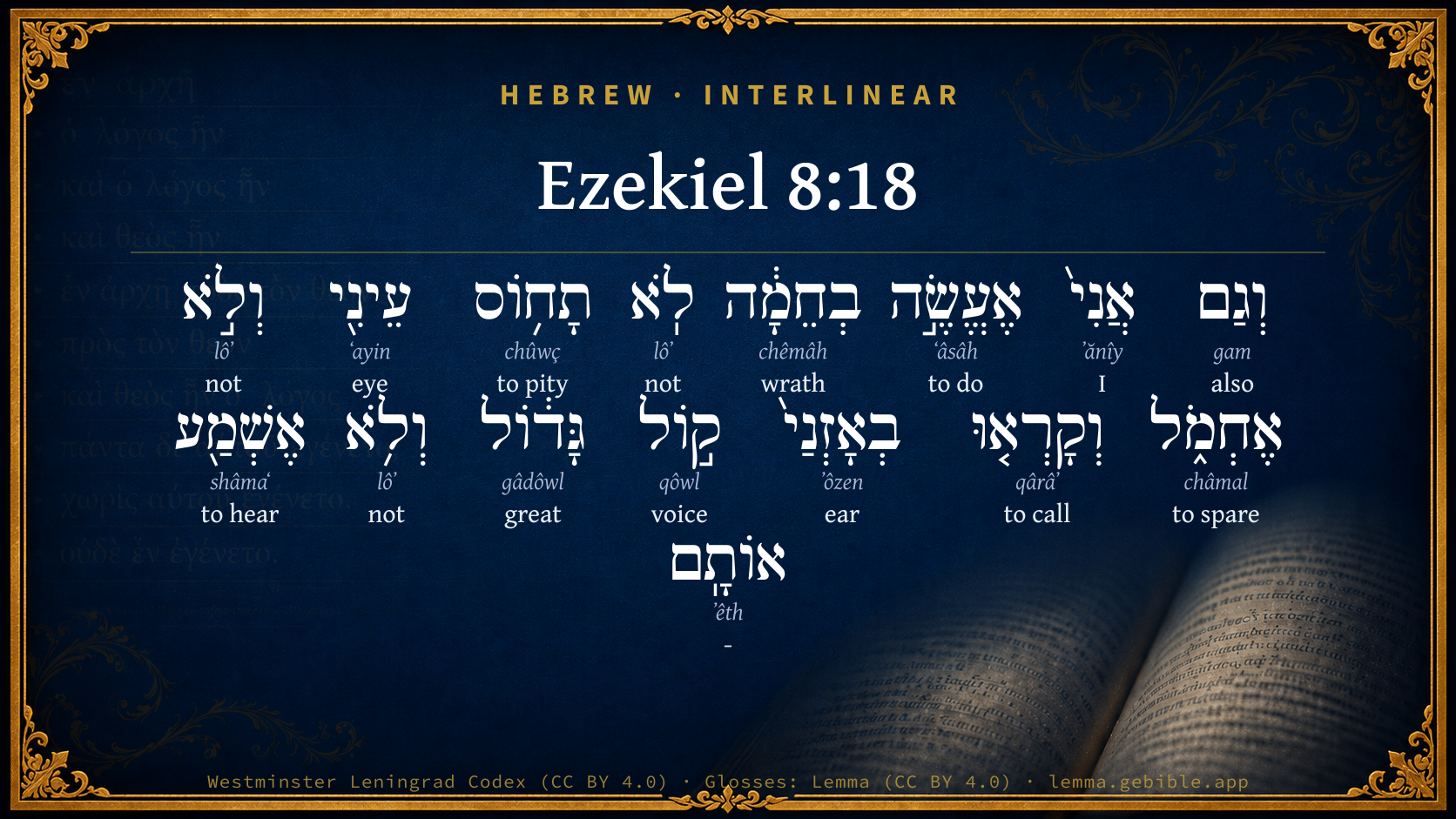
Ezekiel 8:18

Hebrew (Westminster Leningrad Codex) Ezekiel 8:18 appears in the Hebrew Old Testament. The text above is from the Westminster Leningrad Codex. Each word links to its Strong’s number, a concise gloss, and parsing drawn from the Open Scriptures Hebrew Bible morphology. Click any word for its full Brown-Driver-Briggs (BDB) entry.
Download image
Cite this verse

Ezekiel 8:18 (World English Bible). Public Domain. Lemma interlinear Bible study tool, https://lemma.gebible.app/v/ezekiel/8/18.

Show BibTeX & RIS
BibTeX
RIS
English Translation
Therefore will I also deal in wrath; my eye shall not spare, neither will I have pity; and though they cry in my ears with a loud voice, yet will I not hear them.
World English Bible · Public Domain
Download a study sheet

One document with this verse’s original text, its word-by-word gloss line, the meaning frame, cross-references with their text, attributed commentary, and full source and license credits — printable, and it pastes into notes with its structure intact.

This verse Autodidact and up

Study sheet (.html) Plain text (.txt)

A passage Seminary Student

Up to 50 verses in one chapter. A passage sheet keeps up to 6 commentary sources and 12 cross-references per verse, in the order this page ranks them, and says so on the sheet whenever that leaves anything out. Ask for a single verse and you get the Autodidact verse sheet above.

Everything on this page stays free to read, with no account — the sheet is a download of what is already on screen, not access to it.

Want to remove ads? Support Godless Engineer
Compare translations 3

The same verse in 3 English versions, stacked beneath the original-language interlinear above. Click any original word for its lexicon entry.

Each is an independent rendering of the whole verse — the interlinear is not word-aligned to these translations.

Highlighted words mark where these versions differ — a whole-verse word diff, not a word-by-word alignment.

  • World English Bible Public Domain
    Therefore will I also deal in wrath; my eye shall not spare, neither will I have pity; and though they cry in my ears with a loud voice, yet will I not hear them.
  • King James Version Public Domain
    Therefore will I also deal in fury: mine eye shall not spare, neither will I have pity: and though they cry in mine ears with a loud voice, yet will I not hear them.
  • unfoldingWord Literal Text CC BY-SA 4.0
    So I will also act among them; my eye will not have compassion, and I will not spare them. Though they cry in my ears with a loud voice, I will not hear them.”

unfoldingWord Literal Text — © unfoldingWord, licensed CC BY-SA 4.0. Word-aligned USFM3 via Door43 (git.door43.org/unfoldingWord/en_ult).

Versions to compare (up to 4)

3 of 4 selected

Show all 18 translations

Every available English version of this verse, each an independent rendering of the whole verse.

  • World English Bible Public Domain
    Therefore will I also deal in wrath; my eye shall not spare, neither will I have pity; and though they cry in my ears with a loud voice, yet will I not hear them.
  • Berean Standard Bible Public Domain
    Therefore I will respond with wrath. I will not look on them with pity, nor will I spare them. Although they shout loudly in My ears, I will not listen to them.”
  • Majority Standard Bible Public Domain
    Therefore I will respond with wrath. I will not look on them with pity, nor will I spare them. Although they shout loudly in My ears, I will not listen to them.”
  • King James Version Public Domain
    Therefore will I also deal in fury: mine eye shall not spare, neither will I have pity: and though they cry in mine ears with a loud voice, yet will I not hear them.
  • American Standard Version (1901) Public Domain
    Therefore will I also deal in wrath; mine eye shall not spare, neither will I have pity; and though they cry in mine ears with a loud voice, yet will I not hear them.
  • Revised Version (1885) Public Domain
    Therefore will I also deal in fury: mine eye shall not spare, neither will I have pity: and though they cry in mine ears with a loud voice, yet will I not hear them.
  • Geneva Bible (1599) Public Domain
    Therefore will I also execute my wrath: mine eye shall not spare them, neither will I haue pitie, and though they crie in mine eares with a loude voyce, yet will I not heare them.
  • Douay-Rheims (1899) Public Domain
    Therefore I also will deal with them in my wrath: my eye shall not spare them, neither will I shew mercy: and when they shall cry to my ears with a loud voice, I will not hear them.
  • Young's Literal Translation Public Domain
    And I also deal in fury, Mine eye doth not pity, nor do I spare, and they have cried in Mine ears -- a loud voice -- and I do not hear them.'
  • Literal Standard Version CC BY-SA 4.0
    And I also deal in fury, My eye does not pity, nor do I spare, and they have cried [with] a loud voice in My ears and I do not hear them.”
  • Unlocked Literal Bible CC BY-SA 4.0
    So I will also act among them; my eye will not have compassion, and I will not spare them. Though they cry in my ears with a loud voice, I will not hear them.”
  • unfoldingWord Literal Text CC BY-SA 4.0
    So I will also act among them; my eye will not have compassion, and I will not spare them. Though they cry in my ears with a loud voice, I will not hear them.”
  • Darby Bible Public Domain
    And I also will deal in fury: mine eye shall not spare, neither will I have pity; and though they cry in mine ears with a loud voice, I will not hear them.
  • World Messianic Bible Public Domain
    Therefore I will also deal in wrath. My eye won’t spare, neither will I have pity. Though they cry in my ears with a loud voice, yet I will not hear them.”
  • Webster's Bible Public Domain
    Therefore will I also deal in fury: my eye shall not spare, neither will I have pity: and though they cry in my ears with a loud voice, yet I will not hear them.
  • Free Bible Version CC BY-SA 4.0
    As a result I will respond in anger. I won't treat them kindly; I won't be merciful to them. Even though they shout loudly for my help, I won't listen to them.”
  • Bible in Basic English Public Domain
    For this reason I will let loose my wrath: my eye will not have mercy, and I will have no pity.
  • JPS Tanakh (1917) Public Domain
    Therefore will I also deal in fury; Mine eye shall not spare, neither will I have pity; and though they cry in Mine ears with a loud voice, yet will I not hear them.'

Literal Standard Version (2020), Covenant Press — licensed CC BY-SA 4.0. Text via the HelloAO Bible API (eBible.org). Unlocked Literal Bible (unfoldingWord) — licensed CC BY-SA 4.0. Text via the HelloAO Bible API (eBible.org). unfoldingWord Literal Text — © unfoldingWord, licensed CC BY-SA 4.0. Word-aligned USFM3 via Door43 (git.door43.org/unfoldingWord/en_ult). Free Bible Version, Dr. Jonathan Gallagher — licensed CC BY-SA 4.0. Text via the HelloAO Bible API (eBible.org).

Word by word

More ways to search: Search by grammar → Find every occurrence → Compare this word →

Practice this passage: Drill this verse → Learn its vocabulary →

תָח֥וֹס
chûwç
H2347
“to pity”
Verb, Qal, Imperfect, 3rd Person, Feminine, Singular
Part of Speech
Verb
Stem
Qal
Form
Imperfect
Person
3rd Person
Gender
Feminine
Number
Singular
Full BDB Definition

Origin: a primitive root

TWOT: 626

(Qal) to pity, have compassion, spare, look upon with compassion
  1. וְגַם gam H1571 “and · also” Conjunction + Particle, Accusative
  2. אֲנִי֙ ʼănîy H589 “I” Pronoun, Personal, 1st Person, Common, Singular
  3. אֶעֱשֶׂ֣ה ʻâsâh H6213 “to do” Verb, Qal, Imperfect, 1st Person, Common, Singular
  4. בְחֵמָ֔ה chêmâh H2534 “in/at · wrath” Preposition + Noun, Common, Feminine, Singular, Absolute
  5. לֹֽא lôʼ H3808 “not” Particle, Negative
  6. עֵינִ֖י ʻayin H5869 “eye · my” Noun, Common, Both, Singular, Construct + Suffix, Personal, 1st Person, Common, Singular
  7. וְלֹ֣א lôʼ H3808 “and · not” Conjunction + Particle, Negative
  8. אֶחְמֹ֑ל châmal H2550 “to spare” Verb, Qal, Imperfect, 1st Person, Common, Singular
  9. וְקָרְא֤וּ qârâʼ H7121 “and · to call” Conjunction + Verb, Qal, Sequential Perfect, 3rd Person, Common, Plural
  10. בְאָזְנַי֙ ʼôzen H241 “in/at · ears · my” Preposition + Noun, Common, Feminine, Dual, Construct + Suffix, Personal, 1st Person, Common, Singular
  11. ק֣וֹל qôwl H6963 “voice” Noun, Common, Masculine, Singular, Absolute
  12. גָּד֔וֹל gâdôwl H1419 “great” Adjective, Adjective, Masculine, Singular, Absolute
  13. וְלֹ֥א lôʼ H3808 “and · not” Conjunction + Particle, Negative
  14. אֶשְׁמַ֖ע shâmaʻ H8085 “to hear” Verb, Qal, Imperfect, 1st Person, Common, Singular
  15. אוֹתָֽם ʼêth H853 “- · them” Particle, Direct Object + Suffix, Personal, 3rd Person, Masculine, Plural

About this verse

These counts appear in no published source. They are computed here, from the morphology-tagged text and Lemma’s own curated glosses. What Lemma adds →

16
words
14
distinct lemmas
Prophets
section

Notable vocabulary

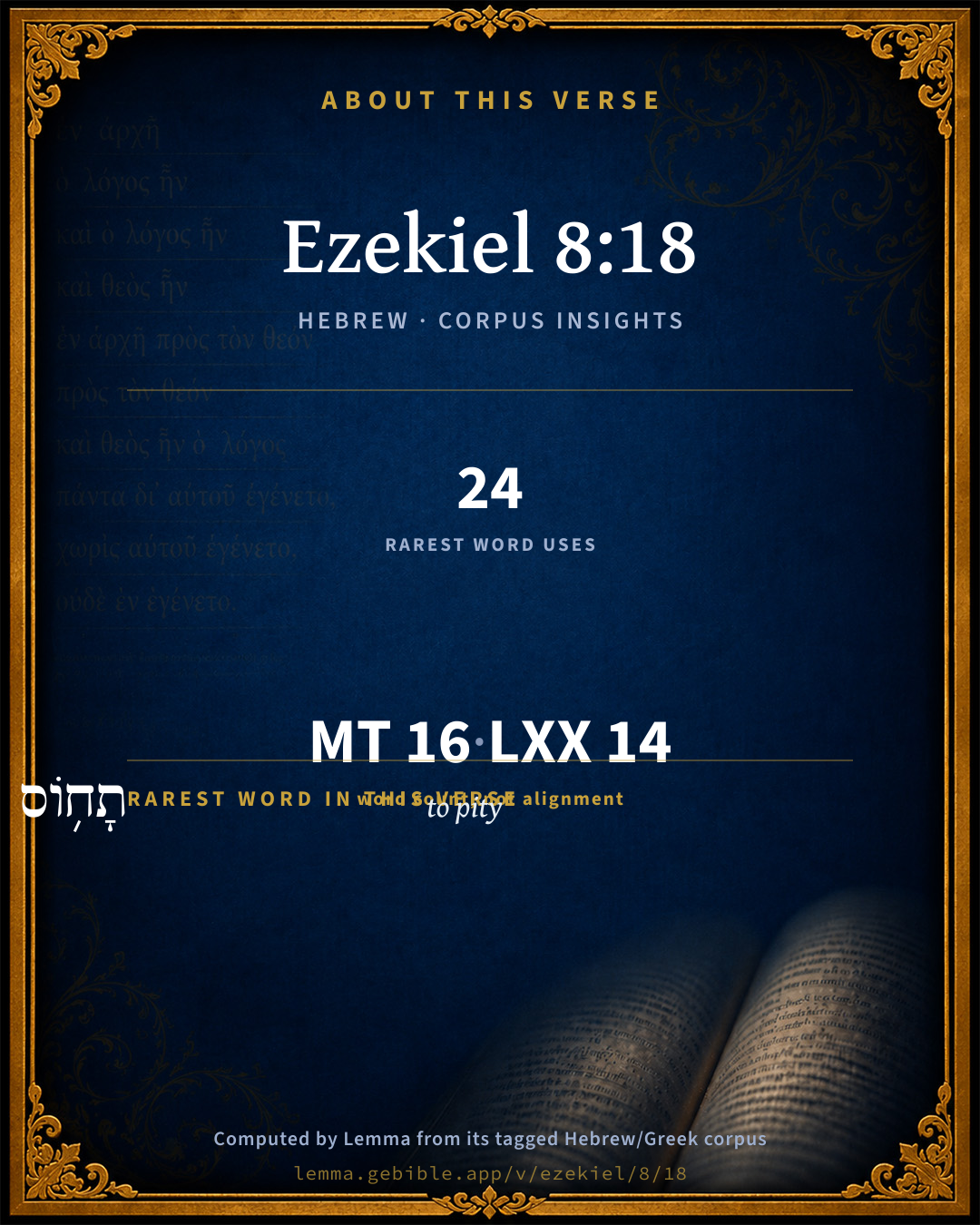
The rarest word here is תָח֥וֹס to pity H2347 — appearing just 24 times in the whole Hebrew Bible.

Shared distinctive vocabulary

תָח֥וֹס to pity H2347 occurs in 24 verses of the Hebrew Bible. Also found in:

Grammatical profile

  • 5 verbs
  • 4 nouns
  • 1 adjective
  • 1 pronoun
  • 5 particles

Verb forms

  • אֶעֱשֶׂ֣ה Qal · Imperfect
  • תָח֥וֹס Qal · Imperfect
  • אֶחְמֹ֑ל Qal · Imperfect
  • וְקָרְא֤וּ Qal · Sequential Perfect
  • אֶשְׁמַ֖ע Qal · Imperfect

Repetition

A word recurs within this verse — often emphatic in Hebrew:

Hebrew & Septuagint length

In English translation the verse runs 34 words from the Hebrew and 19 from the Septuagint (LXX English) — the Septuagint runs noticeably shorter here. See the side-by-side →

A rough comparison of the two English renderings, which tokenize alike — not a word-level alignment.

Word counts can differ between the Hebrew and the Greek without any difference in meaning — e.g. the Hebrew direct-object marker אֵת has no separate Greek word, and Greek often adds the article ὁ.

In the original languages it is 16 Hebrew tokens and 14 Greek tokens — but the two are counted differently (Hebrew bundles its prefixes and suffixes into one token; the Greek is in lemma form), so that isn’t a like-for-like length.

Cross-references

16

Topical passages linked to Ezekiel 8:18 in the Treasury of Scripture Knowledge — connected by theme and wording, ordered by reader-vote popularity; previews shown in the World English Bible.

  • Micah 3:4 Then they will cry to Yahweh, But he will not answer them. Yes, he will hide his face from them at that time, Because they made their deeds evil."
  • Isaiah 1:15 When you spread forth your hands, I will hide my eyes from you; Yes, when you make many prayers, I will not hear. Your hands are full of blood.
  • Jeremiah 11:11 Therefore thus says Yahweh, Behold, I will bring evil on them, which they shall not be able to escape; and they shall cry to me, but I will not listen to them.
  • Zechariah 7:13 It has come to pass that, as he called, and they refused to listen, so they will call, and I will not listen," said Yahweh of Hosts;
  • Judges 10:13–14 Yet you have forsaken me, and served other gods: therefore I will save you no more.
  • Proverbs 1:28 Then will they call on me, but I will not answer. They will seek me diligently, but they will not find me;
  • Ezekiel 7:4–9 My eye shall not spare you, neither will I have pity; but I will bring your ways on you, and your abominations shall be in the midst of you: and you shall know that I am Yahweh.
  • Ezekiel 9:10 As for me also, my eye shall not spare, neither will I have pity, but I will bring their way on their head.
  • Luke 13:25 When once the master of the house has risen up, and has shut the door, and you begin to stand outside, and to knock at the door, saying, 'Lord, Lord, open to us!' then he will answer and tell you, 'I don't know you or where you come from.'
  • Isaiah 59:2 but your iniquities have separated between you and your God, and your sins have hidden his face from you, so that he will not hear.
  • Jeremiah 14:12 When they fast, I will not hear their cry; and when they offer burnt offering and meal-offering, I will not accept them; but I will consume them by the sword, and by the famine, and by the pestilence.
  • Ezekiel 5:11–13 Therefore, as I live, says the Lord Yahweh, surely, because you have defiled my sanctuary with all your detestable things, and with all your abominations, therefore will I also diminish [you]; neither shall my eye spare, and I also will have no pity.
  • Ezekiel 9:5 To the others he said in my hearing, Go you through the city after him, and strike: don't let your eye spare, neither have you pity;
  • Ezekiel 16:42 So will I cause my wrath toward you to rest, and my jealousy shall depart from you, and I will be quiet, and will be no more angry.
  • Ezekiel 24:13 In your filthiness is lewdness: because I have cleansed you and you weren't cleansed, you shall not be cleansed from your filthiness any more, until I have caused my wrath toward you to rest.
  • Nahum 1:2 Yahweh is a jealous God and avenges. Yahweh avenges and is full of wrath. Yahweh takes vengeance on his adversaries, and he maintains wrath against his enemies.

Cross-references courtesy of OpenBible.info (CC BY 4.0).

Hebrew and Greek witnesses Masoretic Hebrew ↔ Greek Septuagint

The same verse in the two great witnesses to the Old Testament, shown verse-for-verse.

Here the Septuagint runs noticeably shorter than the Hebrew — LXX2012 (modern English Septuagint) 19 words vs World English Bible 34. A rough length comparison of the two English translations, not a word-level alignment — read both below.

These are two independent witnesses, not word-aligned to each other, and the Septuagint is shown in lemma (dictionary) form.

Hebrew Ezekiel 8:18 Masoretic · Westminster Leningrad Codex

וְגַם אֲנִי֙ אֶעֱשֶׂ֣ה בְחֵמָ֔ה לֹֽא תָח֥וֹס עֵינִ֖י וְלֹ֣א אֶחְמֹ֑ל וְקָרְא֤וּ בְאָזְנַי֙ ק֣וֹל גָּד֔וֹל וְלֹ֥א אֶשְׁמַ֖ע אוֹתָֽם

Therefore will I also deal in wrath; my eye shall not spare, neither will I have pity; and though they cry in my ears with a loud voice, yet will I not hear them.

World English Bible · Public Domain

Greek LXX Ezekiel 8:18 Septuagint · lemma form

καί ἐγώ ποιέω αὐτός μετά θυμός οὐ φείδομαι ὁ ὀφθαλμός ἐγώ οὐδέ μή ἐλεέω

Therefore will I deal with them in wrath: my eye shall not spare, nor will I have any mercy.

LXX2012 (modern English Septuagint) · Public Domain

Hebrew: Westminster Leningrad Codex (CC BY 4.0). Greek: Septuagint (public domain); English from LXX2012 (modern English Septuagint) (Public Domain). How the Septuagint differs from the Hebrew →

Targum (Aramaic paraphrase)

1

The Targum is the ancient Jewish Aramaic paraphrase of the Hebrew Scriptures — an interpretive translation, not the Hebrew text itself. Onkelos (literal) and Pseudo-Jonathan (expansive) render the Torah, and Jonathan the Prophets. Coverage is partial: where no permissively-licensed English translation exists for a verse, only the Aramaic is shown. This is verse-level text, not a word-by-word alignment to the Hebrew.

  1. Targum Jonathan Prophets (Joshua–Malachi)
    וְאַף אֲנָא אַעְבֵּיד בִּרְגַז לָא יָחוּס מֵימְרִי וְלָא אֶרְחַם וִיצַלוּן קֳדָמַי בְּקַל רָב וְלָא אֲקַבֵּל צְלוֹתְהוֹן:

    (no public-domain English translation for this verse)

    Targum Jonathan — Aramaic: “Mikraot Gedolot” (public domain). English: “Sefaria Community Translation” (CC0 1.0 (public-domain dedication)); “London "Chaldee Paraphrase," 1871” (public domain). Text via Sefaria.

Commentary

Notes on Ezekiel 8:18 from classic Christian and Jewish commentators (each source and its license shown beneath its notes). The classic Christian expositions comment on the surrounding passage and are grouped to its opening verse, so a note may address several verses; the Jewish commentaries on the Tanakh (Rashi and others) are per-verse, so they appear only where the commentator wrote on this verse.

Lemma curates 59 commentaries, every one of them public domain or Creative Commons licensed, each selected and text-cleaned for this edition rather than reprinted as found. About our sources →

Trapp's Complete Commentary

John Trapp

Eze 8:18 Therefore will I also deal in fury: mine eye shall not spare, neither will I have pity: and though they cry in mine ears with a loud voice, [yet] will I not hear them.

Ver. 18. Mine eye shall not spare.] Eze 5:11; Eze 7:4.

And though they cry in mine ears, &c.] Because it is the cry of the flesh for ease, and not of the spirit for grace.

John Trapp, A Commentary or Exposition upon All the Books of the Old and New Testament (1647–1656) — public domain. Text from a community e-Sword module.

Jamieson, Fausset & Brown

Robert Jamieson, A. R. Fausset & David Brown

though they cry . . . yet will I not hear-- (Pro 1:28; Isa 1:15).

Next: Ezekiel Chapter 9

Jamieson, Fausset & Brown — Commentary Critical and Explanatory on the Whole Bible (1871) — public domain (CC PDM 1.0). Text via the HelloAO Bible API.

John Calvin's Commentaries

This seems to me a confirmation of the last clause. For he had said, that they sent forth their boughs or east them forth, but yet to their destruction. He now repeats the same thing in other words. Therefore I will also act in, my turn — that is, as they now boldly increase their superstitions, and so continually provoke me, at length I will act, says he. There is a tacit contrast, since God forsooth had ceased for a long time, because there is a certain form of rest when he ceases from his judgments: God seems to rest when he does not take vengeance on man’s wickedness, when he indulges them and passes them by for a time. Since, therefore, he had so suspended his judgments against the Jews, he seemed to cultivate ease in heaven: with this view he says, that he would do it in his anger, and he adds, that his vengeance would be so dreadful that there would be no place for pity. This ought indeed to strike us when God pronounces himself implacable. For what is more formidable than to have God hostile, and to be verily without any hope of pardon? As often as God withdraws his mercy he shows us material for trembling, nor is it wonderful that he threatened the Jews so harshly, because he had proved by all methods that they were desperate in their wickedness. For truly nothing had been omitted towards curing them, unless they had been of an abandoned disposition and of most obstinate manners. Since, therefore, they were such, it is not surprising that God was extremely enraged against them, so that he left them no hope of pardon. But this ought to be referred generally to the whole body of the people: meanwhile it is by no means doubtful, as we shall afterwards see, that God excepts his elect from the ordinary multitude. If any one object, that God always hears prayers, I reply that he never rejects prayers which spring from faith: but here that tumultuous clamor is alluded to which necessity occasions to unbelievers. For although they fly to God as their natural sense impels them, yet they do not this with composed minds, nor even relying upon the promises of God: but because the torture of their minds does not suffer them to rest, so that by a natural impulse they are carried to God and cry to him without any faith or sincere affection. He speaks, therefore, concerning that kind of ejaculation which is described to us in the case of Esau, and hence he says with a loud voice, (Genesis 27:34; Psalm 3:4; Psalm 22:2; and Psalm 32:3, and elsewhere often.) Although the faithful also raise their voice: nay even cry out loudly, as David testifies of himself, yet it is peculiar to the incredulous to utter their clamor with full cheeks though the mind is void of faith, and is even obstinate in its wickedness. Hence they do not open the heart when they thus cry to God. Hence it is not wonderful if God rejects them and is deaf to their complaints. Now it follows —

John Calvin's Commentaries (1540-1563) — public domain. Text from the Calvin Translation Society English edition (1840s-50s) via the Christian Classics Ethereal Library (ccel.org). Calvin's coverage is partial (roughly two-thirds of the Bible); uncommented books and verses are honest gaps, never fabricated. The 19th-century editor's footnotes and remarks are omitted so the notes are faithfully Calvin's own voice.

Ellicott's Commentary for English Readers

(18) Will I not hear them.—The time for prayer was past. They had rejected God. and when His wrath came upon them it was too late to turn to Him. (See Pro_1:24-28; Mat_7:22-23.) The possibility of sinning beyond the term of the day of grace is one of the most important lessons of this chapter.

A Bible Commentary for English Readers, edited by Charles John Ellicott (1878–1897) — public domain. Text from a community e-Sword module.

The Cambridge Bible for Schools and Colleges

gen. ed. J. J. S. Perowne

18. These abominations will assuredly bring down the unsparing chastisements of heaven. The phrase “shall not spare nor pity” is common in the prophet, ch. Eze_5:11, Eze_7:4; Eze_7:9, Eze_9:5; Eze_9:10.

cry … with a loud voice] Comp. ch. Eze_11:13, and for the general idea of vain appeal to heaven, Isa_1:15; Jer_11:11; Pro_1:28.

This passage contains much that is difficult to estimate. The fact that the things described were seen in the “visions of God,” the symbolical form in which Jehovah appeared, and the analogy of ch. 9, 10, lead to the conclusion that there is at least an ideal and symbolical element in the representation of the idolatries practised in the temple. The view of Hitz., Kuen. (Onders. ii. 278) that the idolatrous practices are to be taken literally but referred to the time of Manasseh is not natural. The prophet would hardly be shewn things once but no longer in existence, though of course he might take a continuous view of Israel’s practice, as he often does. The tense in Eze_8:17 “which they have committed here” is scarcely evidence for a former generation. It is not easy to say how far the representation that the idolatrous usages were practised in the temple is to be taken literally. Such practices are not referred to by Jeremiah nor other prophets of the time. It is possible that the chambers and cells about the gateways, which appear in some cases to have belonged to private persons, may have been used for illegitimate purposes, but that sun-worship was actually practised between the temple and the altar has little probability. And the scene in the chamber of imagery is obviously ideal. The prophet certainly desires to shew that idolatry both public and in private was practised by all classes, the elders representing the nation, the women, and perhaps also the priests; and that at these idolatries were not only the old native ones of Israel, but new imports at this period from all the nations around. The representation, however, that such things were done in the temple may rather be ideal. The temple was the dwelling-place of Jehovah, and every impurity done not only there but in the land and in the houses of the people was felt in the place of his abode, which it defiled, causing him to withdraw from it (Eze_8:6, cf. Lev_15:31; Lev_20:3; Num_19:13; Num_19:20; and the elaborate precautions to guard against defilement adopted in ch. 40–48). On the other hand those privileged to dwell in the land or have access to the temple are spoken of as dwelling in the house, Psa_23:6; Psa_27:4; Psa_84:5 &c. See preliminary remarks to the chapter.

The Cambridge Bible for Schools and Colleges (gen. ed. J. J. S. Perowne; Cambridge University Press, 1878–1918) — public domain. Text from a community e-Sword module.

John Gill's Exposition

Therefore will I also deal in fury,.... Being provoked by such abominable idolatries, and such horrid insolence, and most contemptuous treatment:

mine eye shall not spare: neither will I have pity: see Eze 5:11;

and though they cry in mine ears with a loud voice; very pressingly and earnestly for help, being in great distress:

yet will I not hear them; as they turned their backs on him, he will turn a deaf ear to them, and not regard their cries. The Targum is,

"they shall pray before me, with a great voice, and I will not receive their prayer.''

Next: Ezekiel Chapter 9

John Gill's Exposition of the Whole Bible (1746–1763) — public domain (CC PDM 1.0). Text via the HelloAO Bible API.

Matthew Poole's English Annotations

What I will do is greater than to be expressed; they with a furious heat for their idols provoked me, and I will with a just indignation provoke them, nay, destroy them.

Mine eye shall not spare: see Eze 7:4,8,9.

Though they cry: the prophet doth not give it the name of praying, but it is a cry, a loud cry, after the manner of other idolaters, who think to be heard for the noise they make.

I will not hear them; yet doth not this at all prejudice the truth or the mercy of God to those that pray, nor may it discourage from the duty, but it should awaken us that we pray with heart, and not only cry loud with voice.

Matthew Poole's English Annotations on the Holy Bible (1683–1685) — public domain. Text from a community e-Sword/MySword module.

Whedon's Commentary on the Bible

Daniel D. Whedon

18. Mine eye shall not spare — See notes Eze_5:11; Eze_7:4; Eze_7:9; Eze_9:5; Eze_9:10. There comes a time when a cry to God for help is too late (Isa_1:15; Jer_11:11; Pro_1:28). The symbolic meaning of this vision of Israel’s sin is apparent. The prophet only visited Jerusalem “in the visions of God” (Eze_8:3). That these various abominable practices were literally taking place in the temple is difficult to believe. This vision may have been given to show to Ezekiel and his countrymen in exile the hopeless condition of the hearts of the whole nation, elders, women, priests. In their hearts they were idolaters, grasping every ancient and modern form of unbelief. Their presence defiled the temple and accounts for Jehovah’s leaving it (Eze_8:6; Lev_15:31; Lev_20:3; Num_19:13; Num_19:20).

Daniel D. Whedon (gen. ed.), Commentary on the Old and New Testaments (1874–1909) — public domain. Text from a community e-Sword module.

The Pulpit Commentary

The verse serves as a transition to ch. 9. The unpitying aspect of the Divine judgments is again prominent. Such sins deserved, and could only be expiated by, the judgments to which we now pass.

The Pulpit Commentary (1880–1919), ed. H.D.M. Spence-Jones & Joseph S. Exell — public domain. Text from a community e-Sword module.

John Wesley's Explanatory Notes

Will not hear - The time was, when God was ready to have heard, even before they cried: but now they cry aloud, and yet cry in vain. It is the upright heart which God regards, and not the loud voice.

John Wesley, Explanatory Notes Upon the Whole Bible (1754–1765) — public domain. Text via the GEBible commentary corpus.

Lesson kit

Teaching starters — assembled from the data on this page, not authored interpretation. Every prompt links to the verse data it draws on. Edit before teaching.

Ezekiel, in the Prophets, opens this verse with 16 words (14 distinct Hebrew lemmas). Its most distinctive word is chûwç (“to pity”). The Greek Septuagint runs shorter here. A historical commentator’s framing appears above. Read the whole chapter for the surrounding context.

Discussion questions

  1. What does “to pity” (chûwç) contribute to the verse as a whole?
  2. Genesis 45:20 shares the word «to pity» with this verse. How do the two illuminate each other?
  3. “not” occurs 3× in this one verse. What is the effect of the repetition?
  4. Compared with the Hebrew, the Septuagint runs shorter here. What questions does that raise?
  5. These translations render this verse differently; the difference is in the English rendering, not the original. What questions does that raise?
  6. The verb «אֶעֱשֶׂ֣ה» is Qal Imperfect. How does its form color the action?
  7. Reading how Trapp's Complete Commentary and Jamieson, Fausset & Brown read this verse, where do the two commentators agree and where do they part?

Things to notice

Reading settings

Reading text

Shown beneath each verse's original-language words.

Old Testament
Old Testament edition

Read the OT as the Masoretic Hebrew (MT) or the Greek Septuagint (LXX).

English shown for the Greek Septuagint (in the Hebrew ↔ Greek comparison).

Comparing translations? Open the Compare panel on any verse page to stack up to four side by side.