
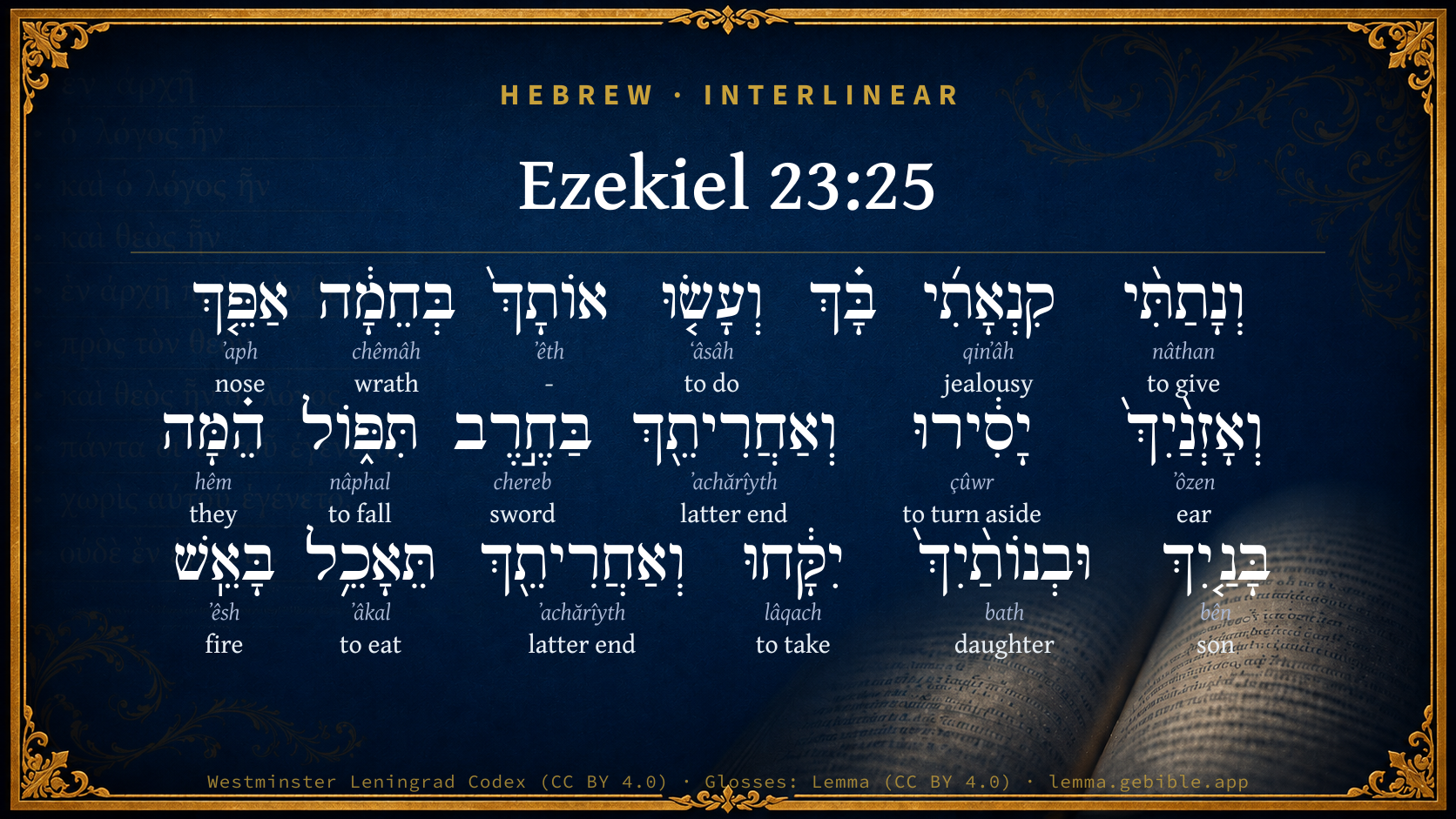
Ezekiel 23:25

Hebrew (Westminster Leningrad Codex) Ezekiel 23:25 appears in the Hebrew Old Testament. The text above is from the Westminster Leningrad Codex. Each word links to its Strong’s number, a concise gloss, and parsing drawn from the Open Scriptures Hebrew Bible morphology. Click any word for its full Brown-Driver-Briggs (BDB) entry.
Download image
Cite this verse

Ezekiel 23:25 (World English Bible). Public Domain. Lemma interlinear Bible study tool, https://lemma.gebible.app/v/ezekiel/23/25.

Show BibTeX & RIS
BibTeX
RIS
English Translation
I will set my jealousy against you, and they shall deal with you in fury; they shall take away your nose and your ears; and your residue shall fall by the sword: they shall take your sons and your daughters; and your residue shall be devoured by the fire.
World English Bible · Public Domain
Download a study sheet

One document with this verse’s original text, its word-by-word gloss line, the meaning frame, cross-references with their text, attributed commentary, and full source and license credits — printable, and it pastes into notes with its structure intact.

This verse Autodidact and up

Study sheet (.html) Plain text (.txt)

A passage Seminary Student

Up to 50 verses in one chapter. A passage sheet keeps up to 6 commentary sources and 12 cross-references per verse, in the order this page ranks them, and says so on the sheet whenever that leaves anything out. Ask for a single verse and you get the Autodidact verse sheet above.

Everything on this page stays free to read, with no account — the sheet is a download of what is already on screen, not access to it.

Want to remove ads? Support Godless Engineer
Compare translations 3

The same verse in 3 English versions, stacked beneath the original-language interlinear above. Click any original word for its lexicon entry.

Each is an independent rendering of the whole verse — the interlinear is not word-aligned to these translations.

Highlighted words mark where these versions differ — a whole-verse word diff, not a word-by-word alignment.

  • World English Bible Public Domain
    I will set my jealousy against you, and they shall deal with you in fury; they shall take away your nose and your ears; and your residue shall fall by the sword: they shall take your sons and your daughters; and your residue shall be devoured by the fire.
  • King James Version Public Domain
    And I will set my jealousy against thee, and they shall deal furiously with thee: they shall take away thy nose and thine ears; and thy remnant shall fall by the sword: they shall take thy sons and thy daughters; and thy residue shall be devoured by the fire.
  • unfoldingWord Literal Text CC BY-SA 4.0
    For I will set my jealous anger on you, and they will deal with you in fury. They will cut off your noses and your ears, and your survivors will fall by the sword. They will take away your sons and your daughters, and your survivors will be devoured by fire.

unfoldingWord Literal Text — © unfoldingWord, licensed CC BY-SA 4.0. Word-aligned USFM3 via Door43 (git.door43.org/unfoldingWord/en_ult).

Versions to compare (up to 4)

3 of 4 selected

Show all 18 translations

Every available English version of this verse, each an independent rendering of the whole verse.

  • World English Bible Public Domain
    I will set my jealousy against you, and they shall deal with you in fury; they shall take away your nose and your ears; and your residue shall fall by the sword: they shall take your sons and your daughters; and your residue shall be devoured by the fire.
  • Berean Standard Bible Public Domain
    And I will set My jealous rage against you, and they will deal with you in fury. They will cut off your noses and ears, and your survivors will fall by the sword. They will seize your sons and daughters, and your remnant will be consumed by fire.
  • Majority Standard Bible Public Domain
    And I will set My jealous rage against you, and they will deal with you in fury. They will cut off your noses and ears, and your survivors will fall by the sword. They will seize your sons and daughters, and your remnant will be consumed by fire.
  • King James Version Public Domain
    And I will set my jealousy against thee, and they shall deal furiously with thee: they shall take away thy nose and thine ears; and thy remnant shall fall by the sword: they shall take thy sons and thy daughters; and thy residue shall be devoured by the fire.
  • American Standard Version (1901) Public Domain
    And I will set my jealousy against thee, and they shall deal with thee in fury; they shall take away thy nose and thine ears; and thy residue shall fall by the sword: they shall take thy sons and thy daughters; and thy residue shall be devoured by the fire.
  • Revised Version (1885) Public Domain
    And I will set my jealousy against thee, and they shall deal with thee in fury: they shall take away thy nose and thine ears; and thy residue shall fall by the sword: they shall take thy sons and thy daughters; and thy residue shall be devoured by the fire.
  • Geneva Bible (1599) Public Domain
    And I wil lay mine indignation vpon thee, and they shall deale cruelly with thee: they shall cut off thy nose and thine eares, and thy remnant shall fall by the sword: they shall cary away thy sonnes and thy daughters, and thy residue shall be deuoured by the fire.
  • Douay-Rheims (1899) Public Domain
    And I will set my jealousy against thee, which they shall execute upon thee with fury: they shall cut off thy nose and thy ears: and what remains shall fall by the sword: they shall take thy sons, and thy daughters, and thy residue shall be devoured by fire.
  • Young's Literal Translation Public Domain
    And I have set My jealousy against thee, And they have dealt with thee in fury, Thy nose and thine ears they turn aside, And thy posterity by sword falleth, They, thy sons and thy daughters do take away, And thy posterity is devoured by fire.
  • Literal Standard Version CC BY-SA 4.0
    And I have set My jealousy against you, || And they have dealt with you in fury, || They turn aside your nose and your ears, || And your posterity falls by sword, || They take away your sons and your daughters, || And your posterity is devoured by fire.
  • Unlocked Literal Bible CC BY-SA 4.0
    For I will set my jealous anger on you, and they will deal with you in fury. They will cut off your noses and your ears, and your survivors will fall by the sword. They will take away your sons and your daughters, and your survivors will be devoured by fire.
  • unfoldingWord Literal Text CC BY-SA 4.0
    For I will set my jealous anger on you, and they will deal with you in fury. They will cut off your noses and your ears, and your survivors will fall by the sword. They will take away your sons and your daughters, and your survivors will be devoured by fire.
  • Darby Bible Public Domain
    And I will set my jealousy against thee, and they shall deal furiously with thee: they shall cut off thy nose and thine ears, and thy remnant shall fall by the sword; they shall take thy sons and thy daughters; and thy residue shall be devoured by the fire.
  • World Messianic Bible Public Domain
    I will set my jealousy against you, and they will deal with you in fury. They will take away your nose and your ears. Your remnant will fall by the sword. They will take your sons and your daughters; and the rest of you will be devoured by the fire.
  • Webster's Bible Public Domain
    And I will set my jealousy against thee, and they shall deal furiously with thee: they shall take away thy nose and thy ears; and thy remnant shall fall by the sword: they shall take thy sons and thy daughters; and thy residue shall be devoured by the fire.
  • Free Bible Version CC BY-SA 4.0
    I feel so strongly about what you've done that I will oppose you, and they will treat you very badly. They will cut off your noses and ears, and they will kill those of you who are left. They will take away your sons and daughters as prisoners, and those of you who are left will be destroyed by fire.
  • Bible in Basic English Public Domain
    And my bitter feeling will be working against you, and they will take you in hand with passion; they will take away your nose and your ears, and the rest of you will be put to the sword: they will take your sons and daughters, and the rest of you will be burned up in the fire.
  • JPS Tanakh (1917) Public Domain
    And I will set My jealousy against thee, and they shall deal with thee in fury; they shall take away thy nose and thine ears, and thy residue shall fall by the sword; they shall take thy sons and thy daughters, and thy residue shall be devoured by the fire.

Literal Standard Version (2020), Covenant Press — licensed CC BY-SA 4.0. Text via the HelloAO Bible API (eBible.org). Unlocked Literal Bible (unfoldingWord) — licensed CC BY-SA 4.0. Text via the HelloAO Bible API (eBible.org). unfoldingWord Literal Text — © unfoldingWord, licensed CC BY-SA 4.0. Word-aligned USFM3 via Door43 (git.door43.org/unfoldingWord/en_ult). Free Bible Version, Dr. Jonathan Gallagher — licensed CC BY-SA 4.0. Text via the HelloAO Bible API (eBible.org).

Word by word

More ways to search: Search by grammar → Find every occurrence → Compare this word →

Practice this passage: Drill this verse → Learn its vocabulary →

קִנְאָתִ֜י
qinʼâh
H7068
“jealousy · my”
Noun, Common, Feminine, Singular, Construct + Suffix, Personal, 1st Person, Common, Singular
Part of Speech
Noun
Type
Common
Gender
Feminine
Number
Singular
State
Construct
Full BDB Definition

Origin: from H7065

TWOT: 2038a

ardour, zeal, jealousy - ardour, jealousy, jealous disposition (of husband) - sexual passion - ardour of zeal (of religious zeal) - of men for God - of men for the house of God - of God for his people - ardour of anger - of men against adversaries - of God against men - envy (of man) - jealousy (resulting in the wrath of God)
  1. וְנָתַתִּ֨י nâthan H5414 “and · to give” Conjunction + Verb, Qal, Sequential Perfect, 1st Person, Common, Singular
  2. וְעָשׂ֤וּ ʻâsâh H6213 “and · to do” Conjunction + Verb, Qal, Sequential Perfect, 3rd Person, Common, Plural
  3. אוֹתָךְ֙ ʼêth H853 “- · you” Particle, Direct Object + Suffix, Personal, 2nd Person, Feminine, Singular
  4. בְּחֵמָ֔ה chêmâh H2534 “in/at · wrath” Preposition + Noun, Common, Feminine, Singular, Absolute
  5. אַפֵּ֤ךְ ʼaph H639 “nose · your” Noun, Common, Masculine, Singular, Construct + Suffix, Personal, 2nd Person, Feminine, Singular
  6. וְאָזְנַ֨יִךְ֙ ʼôzen H241 “and · ears · your” Conjunction + Noun, Common, Feminine, Dual, Construct + Suffix, Personal, 2nd Person, Feminine, Singular
  7. יָסִ֔ירוּ çûwr H5493 “to turn aside” Verb, Hiphil, Imperfect, 3rd Person, Masculine, Plural
  8. וְאַחֲרִיתֵ֖ךְ ʼachărîyth H319 “and · latter end · your” Conjunction + Noun, Common, Feminine, Singular, Construct + Suffix, Personal, 2nd Person, Feminine, Singular
  9. בַּחֶ֣רֶב chereb H2719 “in/at the · sword” Preposition, Determined + Noun, Common, Feminine, Singular, Absolute
  10. תִּפּ֑וֹל nâphal H5307 “to fall” Verb, Qal, Imperfect, 3rd Person, Feminine, Singular
  11. הֵ֗מָּה hêm H1992 “they” Pronoun, Personal, 3rd Person, Masculine, Plural
  12. בָּנַ֤יִךְ bên H1121 “sons · your” Noun, Common, Masculine, Plural, Construct + Suffix, Personal, 2nd Person, Feminine, Singular
  13. וּבְנוֹתַ֨יִךְ֙ bath H1323 “and · daughters · your” Conjunction + Noun, Common, Feminine, Plural, Construct + Suffix, Personal, 2nd Person, Feminine, Singular
  14. יִקָּ֔חוּ lâqach H3947 “to take” Verb, Qal, Imperfect, 3rd Person, Masculine, Plural
  15. וְאַחֲרִיתֵ֖ךְ ʼachărîyth H319 “and · latter end · your” Conjunction + Noun, Common, Feminine, Singular, Construct + Suffix, Personal, 2nd Person, Feminine, Singular
  16. תֵּאָכֵ֥ל ʼâkal H398 “to eat” Verb, Niphal, Imperfect, 3rd Person, Feminine, Singular
  17. בָּאֵֽשׁ ʼêsh H784 “in/at the · fire” Preposition, Determined + Noun, Common, Both, Singular, Absolute

About this verse

These counts appear in no published source. They are computed here, from the morphology-tagged text and Lemma’s own curated glosses. What Lemma adds →

19
words
17
distinct lemmas
Prophets
section

Shared distinctive vocabulary

קִנְאָתִ֜י jealousy H7068 occurs in 41 verses of the Hebrew Bible. Also found in:

Grammatical profile

  • 6 verbs
  • 10 nouns
  • 1 pronoun
  • 1 preposition
  • 1 particle

Verb forms

  • וְנָתַתִּ֨י Qal · Sequential Perfect
  • וְעָשׂ֤וּ Qal · Sequential Perfect
  • יָסִ֔ירוּ Hiphil · Imperfect
  • תִּפּ֑וֹל Qal · Imperfect
  • יִקָּ֔חוּ Qal · Imperfect
  • תֵּאָכֵ֥ל Niphal · Imperfect

Repetition

A word recurs within this verse — often emphatic in Hebrew:

  • וְאַחֲרִיתֵ֖ךְ latter end H319 ×2

Hebrew & Septuagint length

In English translation the verse runs 49 words from the Hebrew and 49 from the Septuagint (LXX English) — the same length.

A rough comparison of the two English renderings, which tokenize alike — not a word-level alignment.

Word counts can differ between the Hebrew and the Greek without any difference in meaning — e.g. the Hebrew direct-object marker אֵת has no separate Greek word, and Greek often adds the article ὁ.

Cross-references

15

Topical passages linked to Ezekiel 23:25 in the Treasury of Scripture Knowledge — connected by theme and wording, ordered by reader-vote popularity; previews shown in the World English Bible.

  • Ezekiel 23:47 The company shall stone them with stones, and dispatch them with their swords; they shall kill their sons and their daughters, and burn up their houses with fire.
  • Exodus 34:14 for you shall worship no other god: for Yahweh, whose name is Jealous, is a jealous God.
  • Ezekiel 5:13 Thus shall my anger be accomplished, and I will cause my wrath toward them to rest, and I shall be comforted; and they shall know that I, Yahweh, have spoken in my zeal, when I have accomplished my wrath on them.
  • Ezekiel 8:1–18 It happened in the sixth year, in the sixth [month], in the fifth [day] of the month, as I sat in my house, and the elders of Judah sat before me, that the hand of the Lord Yahweh fell there on me.
  • Ezekiel 15:6–7 Therefore thus says the Lord Yahweh: As the vine tree among the trees of the forest, which I have given to the fire for fuel, so will I give the inhabitants of Jerusalem.
  • Ezekiel 16:38–42 I will judge you, as women who break wedlock and shed blood are judged; and I will bring on you the blood of wrath and jealousy.
  • Ezekiel 20:47–48 and tell the forest of the South, Hear the word of Yahweh: Thus says the Lord Yahweh, Behold, I will kindle a fire in you, and it shall devour every green tree in you, and every dry tree: the flaming flame shall not be quenched, and all faces from the south to the north shall be burnt thereby.
  • Hosea 2:4–5 Indeed, on her children I will have no mercy; For they are children of unfaithfulness;
  • Deuteronomy 29:20 Yahweh will not pardon him, but then the anger of Yahweh and his jealousy will smoke against that man, and all the curse that is written in this book shall lie on him, and Yahweh will blot out his name from under the sky.
  • Deuteronomy 32:21–22 They have moved me to jealousy with that which is not God; They have provoked me to anger with their vanities: I will move them to jealousy with those who are not a people; I will provoke them to anger with a foolish nation.
  • Proverbs 6:34 For jealousy arouses the fury of the husband. He won't spare in the day of vengeance.
  • Song of Solomon 8:6 Set me as a seal on your heart, As a seal on your arm; For love is strong as death. Jealousy is as cruel as Sheol; Its flashes are flashes of fire, A very flame of Yahweh.
  • Ezekiel 22:18–22 Son of man, the house of Israel is become dross to me: all of them are brass and tin and iron and lead, in the midst of the furnace; they are the dross of silver.
  • Zephaniah 1:18 Neither their silver nor their gold will be able to deliver them in the day of Yahweh's wrath, but the whole land will be devoured by the fire of his jealousy; for he will make an end, yes, a terrible end, of all those who dwell in the land.
  • Revelation 18:8 Therefore in one day her plagues will come: death, mourning, and famine; and she will be utterly burned with fire; for the Lord God who has judged her is strong.

Cross-references courtesy of OpenBible.info (CC BY 4.0).

Hebrew and Greek witnesses Masoretic Hebrew ↔ Greek Septuagint

The same verse in the two great witnesses to the Old Testament, shown verse-for-verse.

These are two independent witnesses, not word-aligned to each other, and the Septuagint is shown in lemma (dictionary) form.

Hebrew Ezekiel 23:25 Masoretic · Westminster Leningrad Codex

וְנָתַתִּ֨י קִנְאָתִ֜י בָּ֗ךְ וְעָשׂ֤וּ אוֹתָךְ֙ בְּחֵמָ֔ה אַפֵּ֤ךְ וְאָזְנַ֨יִךְ֙ יָסִ֔ירוּ וְאַחֲרִיתֵ֖ךְ בַּחֶ֣רֶב תִּפּ֑וֹל הֵ֗מָּה בָּנַ֤יִךְ וּבְנוֹתַ֨יִךְ֙ יִקָּ֔חוּ וְאַחֲרִיתֵ֖ךְ תֵּאָכֵ֥ל בָּאֵֽשׁ

I will set my jealousy against you, and they shall deal with you in fury; they shall take away your nose and your ears; and your residue shall fall by the sword: they shall take your sons and your daughters; and your residue shall be devoured by the fire.

World English Bible · Public Domain

Greek LXX Ezekiel 23:25 Septuagint · lemma form

καί δίδωμι ὁ ζῆλος ἐγώ ἐν σύ καί ποιέω μετά σύ ἐν ὀργή θυμός μυκτήρ σύ καί οὖς σύ ἀποαἱρέω καί ὁ κατάλοιπος σύ ἐν ῥομφαία καταβάλλω αὐτός υἱός σύ καί θυγάτηρ σύ λαμβάνω καί ὁ κατάλοιπος σύ πῦρ καταἐσθίω

And I will bring upon you my jealousy, and they shall deal with you in great wrath: they shall take away your nose and your ears; and shall cast down your remnant with the sword: they shall take your sons and your daughters; and your remnant fire shall devour.

LXX2012 (modern English Septuagint) · Public Domain

Hebrew: Westminster Leningrad Codex (CC BY 4.0). Greek: Septuagint (public domain); English from LXX2012 (modern English Septuagint) (Public Domain). How the Septuagint differs from the Hebrew →

Targum (Aramaic paraphrase)

1

The Targum is the ancient Jewish Aramaic paraphrase of the Hebrew Scriptures — an interpretive translation, not the Hebrew text itself. Onkelos (literal) and Pseudo-Jonathan (expansive) render the Torah, and Jonathan the Prophets. Coverage is partial: where no permissively-licensed English translation exists for a verse, only the Aramaic is shown. This is verse-level text, not a word-by-word alignment to the Hebrew.

  1. Targum Jonathan Prophets (Joshua–Malachi)
    וְאֶתֵּן פּוּרְעֲנוּתִי בִּיךְ וְיִתְפַּרְעוּן מִנִיךְ בִּרְגַז רַבְרְבַיִךְ וְיַקִירַיִךְ יִגְלוֹן וְעַמִיךְ בְּחַרְבָּא יִתְקַטְלוּן אִינוּן בְּנָךְ וּבְנָתָךְ יִשְׁבּוּן וּשְׁפַר אַרְעִיךְ יִתּוֹקַד בְּנוּרָא:

    (no public-domain English translation for this verse)

    Targum Jonathan — Aramaic: “Mikraot Gedolot” (public domain). English: “Sefaria Community Translation” (CC0 1.0 (public-domain dedication)); “London "Chaldee Paraphrase," 1871” (public domain). Text via Sefaria.

Commentary

Notes on Ezekiel 23:25 from classic Christian and Jewish commentators (each source and its license shown beneath its notes). The classic Christian expositions comment on the surrounding passage and are grouped to its opening verse, so a note may address several verses; the Jewish commentaries on the Tanakh (Rashi and others) are per-verse, so they appear only where the commentator wrote on this verse.

Lemma curates 59 commentaries, every one of them public domain or Creative Commons licensed, each selected and text-cleaned for this edition rather than reprinted as found. About our sources →

Trapp's Complete Commentary

John Trapp

Eze 23:25 And I will set my jealousy against thee, and they shall deal furiously with thee: they shall take away thy nose and thine ears; and thy remnant shall fall by the sword: they shall take thy sons and thy daughters; and thy residue shall be devoured by the fire.

Ver. 25. And they shall take away thy nose and thine ears.] He seemeth to allude to the custom of the Egyptians, which was to cut off the nose and the ears of the adulteress. {a} John, a certain antipope, was served in like sort by the Romans. {b} Paul II deserved to be so served; of whom it is recorded that he was so proud that he painted his face to please his concubine; and that he was once in a mind to have taken to himself the name of Formosus, but that he thought it was ominous because his predecessor of that name came to so ill an end. {c}

{a} Rhodigin., lib. xxiv. cap. 45.

{b} Pet. Damian, lib. i. cap. 21.

{c} Jacob. Revius, De. Vit, Pont.

John Trapp, A Commentary or Exposition upon All the Books of the Old and New Testament (1647–1656) — public domain. Text from a community e-Sword module.

Joseph Benson's Commentary

Eze 23:25-27. I will set my jealousy against thee, &c. — I will be against thee, as a jealous man is against his wife; and they shall deal furiously — And they, as the executioners of my wrath, shall act toward thee as persons provoked to great fury. And they shall take away thy nose, &c. — A punishment of adultery which rage sometimes dictated. As husbands in that case render those women deformed whose beauty hath been too pleasing to strangers, so shall the Chaldeans deface all the glories and ornaments of Jerusalem, and after they have slain and carried captive its inhabitants, shall set the city on fire, and reduce it to a heap of ashes. The mutilations mentioned in this verse were common among the Chaldeans. St. Jerome assures us, that they frequently cut off the nose and the ears of adulterers. And this was practised toward adulteresses in Egypt. They shall also strip thee, &c. — As lewd, disgraced harlots and captives were used chap. Eze 16:39. And take away thy fair jewels — All thy rich, beautiful ornaments, which shall be a prey to the enemy. Thus will I make thy lewdness to cease — “These severe judgments shall effectually deter thee from idolatry, and make thee abhor the least approaches toward it. Accordingly we find that after the captivity the Jews never returned to their former idolatrous practices.” — Lowth. And thy whoredom brought from the land of Egypt — Thy idolatries which thou broughtest with thee from Egypt, where thou didst first learn idolatry, and ever hast had an inclination to it.

Joseph Benson's Commentary on the Old and New Testaments (1811–1818) — public domain. Text from a community e-Sword module.

Tyndale Open Study Notes

Tyndale Open Resources

23:25-29 Stripping an adulterous wife naked—to expose in public what she had done in private—was a punishment for adultery (see study note on 16:35-38). The Babylonians similarly stripped Jerusalem and Judah of everything valuable and exposed them to their own shame.

Tyndale Open Study Notes — © Tyndale Open Resources, licensed CC BY-SA 4.0. Text via the HelloAO Bible API.

Geneva Bible (1599)

Geneva Bible translators

They shall destroy thy princes and priests with the rest of thy people.

Geneva Bible (1599) marginal notes — public domain. Text via Bolls.life.

Jamieson, Fausset & Brown

Robert Jamieson, A. R. Fausset & David Brown

take away thy nose . . . ears--Adulteresses were punished so among the Egyptians and Chaldeans. Oriental beauties wore ornaments in the ear and nose. How just the retribution, that the features most bejewelled should be mutilated! So, allegorically as to Judah, the spiritual adulteress.

Jamieson, Fausset & Brown — Commentary Critical and Explanatory on the Whole Bible (1871) — public domain (CC PDM 1.0). Text via the HelloAO Bible API.

Adam Clarke's Commentary

Verse 25. Shall take away thy nose] A punishment frequent among the Persians and Chaldeans, as ancient authors tell. Adulteries were punished in this way; and to this Martial refers: -

Quis tibi persuasit nares abscindere moecho?

"Who has counselled thee to cut off the adulterer's nose?"

Women were thus treated in Egypt. See Calmet.

Adam Clarke's Commentary on the Bible (1810–1826) — public domain. Text from a community e-Sword/MySword module.

Ellicott's Commentary for English Readers

(25) Take away thy nose and thine ears.—The barbarous custom of mutilating prisoners prevailed in the East from the earliest times; it is here mentioned with especial reference to the destruction of the attractiveness of the adulteress Aholibah, and the particulars of Eze_23:26 have the same purpose. (Comp. Eze_16:39.) In Egypt adultery was punished by cutting off the nose and ears.

A Bible Commentary for English Readers, edited by Charles John Ellicott (1878–1897) — public domain. Text from a community e-Sword module.

The Cambridge Bible for Schools and Colleges

gen. ed. J. J. S. Perowne

25. “Jealousy” differs little from fury, ch. Eze_16:38.

take away thy nose] Reference is either to the ancient practice (as in Egypt) of mutilating the adulteress, or to the habit of disfiguring the captives, cf. Eze_12:13; Eze_16:40.

The Cambridge Bible for Schools and Colleges (gen. ed. J. J. S. Perowne; Cambridge University Press, 1878–1918) — public domain. Text from a community e-Sword module.

John Gill's Exposition

And I will set my jealousy against thee, and they shall deal furiously with thee,.... As a jealous husband, enraged against his adulterous wife, falls upon her in his fury, and uses her with great severity; so the Jews having committed spiritual fornication, that is, idolatry, and departed from the Lord, he threatens to stir up the fury of his jealousy, and punish them severely by the Chaldeans, as follows:

they shall take away thy nose and thine ears, and thy remnant shall fall by the sword; as gallants use their harlots when they leave them, or jealous husbands their adulterous wives, disfiguring them, that they may be marked and known what they are, and be despised by others; and as has been the custom in some countries, particularly with the Egyptians, to cut off the noses of adulterous persons; here it is to be understood figuratively: by the "nose", according to Jarchi, Kimchi, and Ben Melech, is meant the king, who is higher than his people, as the nose is the highest part in a man's face; and by the "ears" the priest, who caused a noise to be heard when he entered into the temple with his bells; or rather because it was the priest's office to attend to the word of God, and teach it the people; in general, these denote everything that was excellent among the Jews, their city, temple, king, kingdom, princes, priests, and prophets, which should be demolished and removed; and by the remnant is meant the common people, that should come into the hands of the Chaldeans, and fall by their sword. So the Targum paraphrases it,

"thy princes and thy nobles shall go into captivity, and thy people shall be killed with the sword:''

they shall take thy sons and thy daughters, and thy residue shall be devoured by the fire; take and carry their sons and daughters captive, and burn with fire the city left by them. Thus the Targum,

"they shall carry thy sons and daughters captive, and the beauty of thy land shall be burnt with fire;''

that is, the city of Jerusalem, the temple, the king's palaces, the houses of the great men, and others in it, which were all burnt with fire when taken by the Chaldeans, Jer 52:13.

John Gill's Exposition of the Whole Bible (1746–1763) — public domain (CC PDM 1.0). Text via the HelloAO Bible API.

Albert Barnes' Notes on the Bible

Take away thy nose and thine ears - Alluding to the barbarous custom of mutilating prisoners in the east Dan 2:5. An Egyptian law prescribed this punishment for an adulteress.

Fire - A mode of capital punishment Jer 29:22; Dan. 3.

Albert Barnes' Notes on the Bible (1834–1885) — public domain. Text from a community e-Sword/MySword module.

Haydock's Catholic Bible Commentary

Jealousy, the most violent of passions. (Calmet) --- So the Chaldeans are styled, as Assur is the rod, Isaias x. 5. (Worthington) --- Ears, the punishment of adulteresses: both king and priests suffer. (St. Jerome) --- Thus the captives were probably treated. (Calmet) See Seneca, Ira. iii. 20. --- Fire, by Ismahel, chap. xix. 14.

George Leo Haydock (1774–1849), Haydock's Catholic Family Bible and Commentary, 1859 edition — public domain. Excludes Psalms (Douay-Rheims chapter numbering differs from Protestant) and Deuterocanonical books (Catholic canon only).

Matthew Poole's English Annotations

I will set my jealousy against thee; as a jealous provoked husband, I will be as much against thee as they are, their fury shall avenge my quarrel.

They shall deal furiously with thee; their disposition naturally is to furious wrath, my jealousy shall enkindle it more.

They shall take away thy nose and thine ears; as thou hast prostituted thy beauty like a harlot, so they shall use thee as such, and mar thy beauty, and brand thee for ever, as thou deservest, and that thou mayst be as loathsome in thy deformity as ever thou wast thought lovely in thy beauty. This punishment of adulteresses is known to have been used, and is yet in use.

Thy remnant shall fall by the sword; or else, at last thy latter end shall be to fall by the sword, those that do not live under such reproach shall die by the sword of the enemy.

They shall take thy sons and thy daughters for captives and slaves for work, and somewhat a thousand times worse.

Thy residue; either the people who did hide themselves in vaults and cellars, and came not out; or else what remains of that the Chaldeans cannot carry away; all this shall be devoured by fire, as when the city was burnt.

Matthew Poole's English Annotations on the Holy Bible (1683–1685) — public domain. Text from a community e-Sword/MySword module.

Whedon's Commentary on the Bible

Daniel D. Whedon

25. I will set my jealousy against thee — See note Eze_5:13.

They shall take away thy nose and thine ears — So Babylonian captives were often mutilated (for example, Zedekiah, Jer_52:11). It was also the practice among some ancient peoples to mutilate the adulteress.

Thy remnant… thy residue — The same word in both cases. The picture of the adulteress gives way for a moment to the picture of Jerusalem in flames and her inhabitants falling by the sword (compare 5-7).

Daniel D. Whedon (gen. ed.), Commentary on the Old and New Testaments (1874–1909) — public domain. Text from a community e-Sword module.

The Pulpit Commentary

They shall take away thy nose and thine ears, etc. (For instances of this or like mutilation, in the case of prisoners of war, see the case of Zedekiah. (Jer_52:11; Herod., 3:69, 154.) Possibly it may have been known to Ezekiel as a punishment for the adulterer or adulteress in Egypt and other countries, and if so, he might have selected it as specially appropriate to his parable (Martial, "Epigr.," 2:83; 3:85). Thy residue shall be consumed with fire. The Hebrew word for "residue" (not that usually so translated) is the same as that previously translated "remnant." In the first clause it clearly points to the men of Jerusalem who are left after the capture. In the second its meaning is determined by the fact that it follows after the deportation of the sons and daughters. All that was left in the parable, of the mutilated trunk of the adulteress, in the history, of the devastated city, sc. the empty houses should be destroyed by fire.

The Pulpit Commentary (1880–1919), ed. H.D.M. Spence-Jones & Joseph S. Exell — public domain. Text from a community e-Sword module.

John Wesley's Explanatory Notes

I will set my jealousy - As a jealous provoked husband, I will be as much against thee as they are. Thy residue - Either the people, who hid themselves in vaults and cellars, or what the Chaldeans cannot carry away, all this shall be devoured by fire.

John Wesley, Explanatory Notes Upon the Whole Bible (1754–1765) — public domain. Text via the GEBible commentary corpus.

Rashi

Rabbi Shlomo Yitzchaki (Rashi)

your nose and your ears They are the beauty of the countenance, and to them he compared the priesthood and the kingship.

and your survivors The rest of the people.

and your residue will be consumed by fire And the best of your land, which is the security upon which to rely for a livelihood.

Rashi on the Tanakh — English translations: “The Judaica Press complete Tanach with Rashi, translated by A. J. Rosenberg” (CC BY 4.0); “Pentateuch with Rashi's commentary by M. Rosenbaum and A.M. Silbermann, 1929-1934” (public domain); “The Metsudah Tanach series, Lakewood, N.J” (CC BY 4.0); and “The Book of Joshua, Metsudah Publications, 1997” (CC BY 4.0). Text via Sefaria.

Lesson kit

Teaching starters — assembled from the data on this page, not authored interpretation. Every prompt links to the verse data it draws on. Edit before teaching.

Ezekiel, in the Prophets, opens this verse with 19 words (17 distinct Hebrew lemmas). Its most distinctive word is qinʼâh (“jealousy”). A historical commentator’s framing appears above. Read the whole chapter for the surrounding context.

Discussion questions

  1. How does “jealousy” (qinʼâh) shape what this verse is saying?
  2. How does Numbers 5:14, which shares the word «jealousy», read alongside this verse?
  3. What does the repetition of “latter end” (2× in this one verse) do in this verse?
  4. These translations render this verse differently; the difference is in the English rendering, not the original. What questions does that raise?
  5. «וְנָתַתִּ֨י» is a Qal Sequential Perfect verb. How does that grammatical form shape the action described?
  6. Compare how Trapp's Complete Commentary and Joseph Benson's Commentary read this verse. Where do they agree or differ?

Things to notice

Reading settings

Reading text

Shown beneath each verse's original-language words.

Old Testament
Old Testament edition

Read the OT as the Masoretic Hebrew (MT) or the Greek Septuagint (LXX).

English shown for the Greek Septuagint (in the Hebrew ↔ Greek comparison).

Comparing translations? Open the Compare panel on any verse page to stack up to four side by side.