Ezekiel 3:10

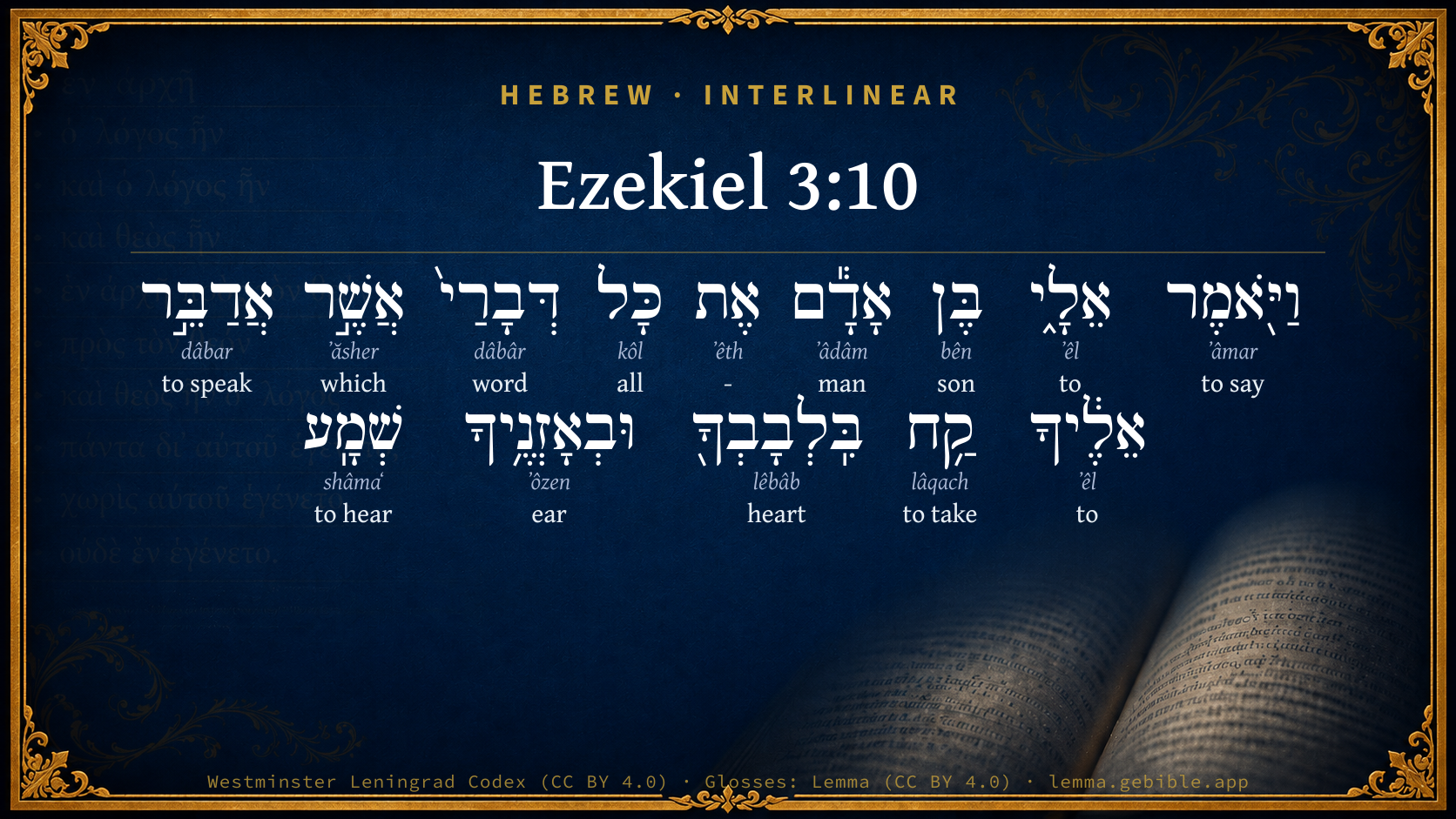
Hebrew (Westminster Leningrad Codex) Ezekiel 3:10 appears in the Hebrew Old Testament. The text above is from the Westminster Leningrad Codex. Each word links to its Strong’s number, a concise gloss, and parsing drawn from the Open Scriptures Hebrew Bible morphology. Click any word for its full Brown-Driver-Briggs (BDB) entry.
Download image
Cite this verse

Ezekiel 3:10 (World English Bible). Public Domain. Lemma interlinear Bible study tool, https://lemma.gebible.app/v/ezekiel/3/10.

Show BibTeX & RIS
BibTeX
RIS
English Translation
Moreover he said to me, Son of man, all my words that I shall speak to you receive in your heart, and hear with your ears.
World English Bible · Public Domain
Download a study sheet

One document with this verse’s original text, its word-by-word gloss line, the meaning frame, cross-references with their text, attributed commentary, and full source and license credits — printable, and it pastes into notes with its structure intact.

This verse Autodidact and up

Study sheet (.html) Plain text (.txt)

A passage Seminary Student

Up to 50 verses in one chapter. A passage sheet keeps up to 6 commentary sources and 12 cross-references per verse, in the order this page ranks them, and says so on the sheet whenever that leaves anything out. Ask for a single verse and you get the Autodidact verse sheet above.

Everything on this page stays free to read, with no account — the sheet is a download of what is already on screen, not access to it.

Want to remove ads? Support Godless Engineer
Compare translations 3

The same verse in 3 English versions, stacked beneath the original-language interlinear above. Click any original word for its lexicon entry.

Each is an independent rendering of the whole verse — the interlinear is not word-aligned to these translations.

Highlighted words mark where these versions differ — a whole-verse word diff, not a word-by-word alignment.

  • World English Bible Public Domain
    Moreover he said to me, Son of man, all my words that I shall speak to you receive in your heart, and hear with your ears.
  • King James Version Public Domain
    Moreover he said unto me, Son of man, all my words that I shall speak unto thee receive in thine heart, and hear with thine ears.
  • unfoldingWord Literal Text CC BY-SA 4.0
    Then he said to me, “Son of man, all the words that I announce to you—take them into your heart and hear them with your ears!

unfoldingWord Literal Text — © unfoldingWord, licensed CC BY-SA 4.0. Word-aligned USFM3 via Door43 (git.door43.org/unfoldingWord/en_ult).

Versions to compare (up to 4)

3 of 4 selected

Show all 18 translations

Every available English version of this verse, each an independent rendering of the whole verse.

  • World English Bible Public Domain
    Moreover he said to me, Son of man, all my words that I shall speak to you receive in your heart, and hear with your ears.
  • Berean Standard Bible Public Domain
    “Son of man,” He added, “listen carefully to all the words I speak to you, and take them to heart.
  • Majority Standard Bible Public Domain
    “Son of man,” He added, “listen carefully to all the words I speak to you, and take them to heart.
  • King James Version Public Domain
    Moreover he said unto me, Son of man, all my words that I shall speak unto thee receive in thine heart, and hear with thine ears.
  • American Standard Version (1901) Public Domain
    Moreover he said unto me, Son of man, all my words that I shall speak unto thee receive in thy heart, and hear with thine ears.
  • Revised Version (1885) Public Domain
    Moreover he said unto me, Son of man, all my words that I shalt speak unto thee receive in thine heart, and hear with thine ears.
  • Geneva Bible (1599) Public Domain
    He said moreouer vnto me, Sonne of man, receiue in thine heart al my words that I speake vnto thee, and heare them with thine eares,
  • Douay-Rheims (1899) Public Domain
    And he said to me: Son of man, receive in thy heart, and hear with thy ears, all the words that I speak to thee:
  • Young's Literal Translation Public Domain
    And He saith unto me, `Son of man, all My words, that I speak unto thee, receive with thy heart, and with thine ears hear;
  • Literal Standard Version CC BY-SA 4.0
    And He says to me, “Son of man, all My words that I speak to you, receive with your heart, and hear with your ears;
  • Unlocked Literal Bible CC BY-SA 4.0
    Then he said to me, “Son of man, all the words that I announce to you—take them into your heart and hear them with your ears!
  • unfoldingWord Literal Text CC BY-SA 4.0
    Then he said to me, “Son of man, all the words that I announce to you—take them into your heart and hear them with your ears!
  • Darby Bible Public Domain
    And he said unto me, Son of man, all my words which I shall speak unto thee, receive in thy heart, and hear with thine ears;
  • World Messianic Bible Public Domain
    Moreover he said to me, “Son of man, receive in your heart and hear with your ears all my words that I speak to you.
  • Webster's Bible Public Domain
    Moreover he said to me, Son of man, all my words that I shall speak to thee receive in thy heart, and hear with thy ears.
  • Free Bible Version CC BY-SA 4.0
    “Son of man,” he added, “pay close attention to everything I tell you, and think deeply about it yourself.
  • Bible in Basic English Public Domain
    Then he said to me, Son of man, take into your heart all my words which I am about to say to you, and let your ears be open to them.
  • JPS Tanakh (1917) Public Domain
    Moreover He said unto me: 'Son of man, all My words that I shall speak unto thee receive in thy heart, and hear with thine ears.

Literal Standard Version (2020), Covenant Press — licensed CC BY-SA 4.0. Text via the HelloAO Bible API (eBible.org). Unlocked Literal Bible (unfoldingWord) — licensed CC BY-SA 4.0. Text via the HelloAO Bible API (eBible.org). unfoldingWord Literal Text — © unfoldingWord, licensed CC BY-SA 4.0. Word-aligned USFM3 via Door43 (git.door43.org/unfoldingWord/en_ult). Free Bible Version, Dr. Jonathan Gallagher — licensed CC BY-SA 4.0. Text via the HelloAO Bible API (eBible.org).

Word by word

More ways to search: Search by grammar → Find every occurrence → Compare this word →

Practice this passage: Drill this verse → Learn its vocabulary →

וּבְאָזְנֶ֥יךָ
ʼôzen
H241
“and · in/at · ears · your”
Conjunction + Preposition + Noun, Common, Feminine, Dual, Construct + Suffix, Personal, 2nd Person, Masculine, Singular
Part of Speech
Conjunction + Preposition + Noun
Type
Common
Gender
Feminine
Number
Dual
State
Construct
Full BDB Definition

Origin: from H238

TWOT: 57a

ear, as part of the body - ear, as organ of hearing - (subjective) to uncover the ear to reveal; the receiver of divine revelation
  1. וַיֹּ֖אמֶר ʼâmar H559 “and · to say” Conjunction + Verb, Qal, Sequential Imperfect, 3rd Person, Masculine, Singular
  2. אֵלָ֑י ʼêl H413 “to · me” Preposition + Suffix, Personal, 1st Person, Common, Singular
  3. בֶּן bên H1121 “son of” Noun, Common, Masculine, Singular, Construct
  4. אָדָ֕ם ʼâdâm H120 “man” Noun, Common, Masculine, Singular, Absolute
  5. אֶת ʼêth H853 “-” Particle, Direct Object
  6. כָּל kôl H3605 “all of” Noun, Common, Masculine, Singular, Construct
  7. דְּבָרַי֙ dâbâr H1697 “words · my” Noun, Common, Masculine, Plural, Construct + Suffix, Personal, 1st Person, Common, Singular
  8. אֲשֶׁ֣ר ʼăsher H834 “which” Particle, Relative
  9. אֲדַבֵּ֣ר dâbar H1696 “to speak” Verb, Piel, Imperfect, 1st Person, Common, Singular
  10. אֵלֶ֔יךָ ʼêl H413 “to · you” Preposition + Suffix, Personal, 2nd Person, Masculine, Singular
  11. קַ֥ח lâqach H3947 “take” Verb, Qal, Imperative, 2nd Person, Masculine, Singular
  12. בִּֽלְבָבְךָ֖ lêbâb H3824 “in/at · heart · your” Preposition + Noun, Common, Masculine, Singular, Construct + Suffix, Personal, 2nd Person, Masculine, Singular
  13. שְׁמָֽע shâmaʻ H8085 “hear” Verb, Qal, Imperative, 2nd Person, Masculine, Singular

About this verse

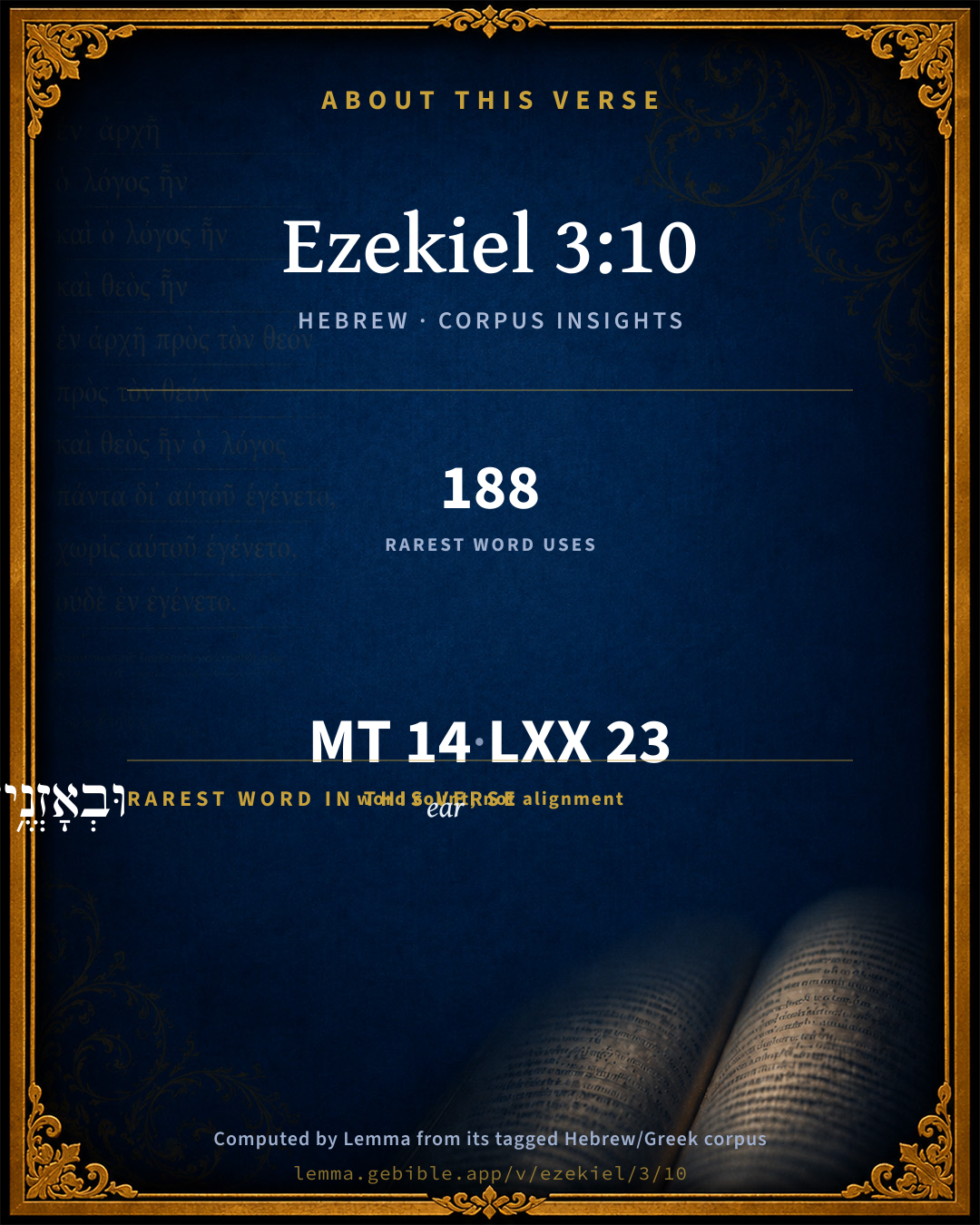
These counts appear in no published source. They are computed here, from the morphology-tagged text and Lemma’s own curated glosses. What Lemma adds →

14
words
13
distinct lemmas
Prophets
section

Grammatical profile

  • 4 verbs
  • 6 nouns
  • 2 prepositions
  • 2 particles

Verb forms

  • וַיֹּ֖אמֶר Qal · Sequential Imperfect
  • אֲדַבֵּ֣ר Piel · Imperfect
  • קַ֥ח Qal · Imperative
  • שְׁמָֽע Qal · Imperative

Repetition

A word recurs within this verse — often emphatic in Hebrew:

  • אֵלָ֑י to H413 ×2

Hebrew & Septuagint length

In English translation the verse runs 26 words from the Hebrew and 27 from the Septuagint (LXX English) — closely comparable.

A rough comparison of the two English renderings, which tokenize alike — not a word-level alignment.

Word counts can differ between the Hebrew and the Greek without any difference in meaning — e.g. the Hebrew direct-object marker אֵת has no separate Greek word, and Greek often adds the article ὁ.

In the original languages it is 14 Hebrew tokens and 23 Greek tokens — but the two are counted differently (Hebrew bundles its prefixes and suffixes into one token; the Greek is in lemma form), so that isn’t a like-for-like length.

Cross-references

9

Topical passages linked to Ezekiel 3:10 in the Treasury of Scripture Knowledge — connected by theme and wording, ordered by reader-vote popularity; previews shown in the World English Bible.

  • Job 22:22 Please receive instruction from his mouth, And lay up his words in your heart.
  • Psalms 119:11 I have hidden your word in my heart, That I might not sin against you.
  • Luke 8:15 That in the good ground, these are such as in an honest and good heart, having heard the word, hold it tightly, and bring forth fruit with patience.
  • Ezekiel 2:8 But you, son of man, hear what I tell you; don't be you rebellious like that rebellious house: open your mouth, and eat that which I give you.
  • Ezekiel 3:1–3 He said to me, Son of man, eat that which you find; eat this scroll, and go, speak to the house of Israel.
  • Proverbs 8:10 Receive my instruction rather than silver; Knowledge rather than choice gold.
  • Proverbs 19:20 Listen to counsel and receive instruction, That you may be wise in your latter end.
  • 1 Thessalonians 2:13 For this cause we also thank God without ceasing, that, when you received from us the word of the message of God, you accepted it not as the word of men, but, as it is in truth, the word of God, which also works in you who believe.
  • 1 Thessalonians 4:1 Finally then, brothers, we beg and exhort you in the Lord Jesus, that as you received from us how you ought to walk and to please God, that you abound more and more.

Cross-references courtesy of OpenBible.info (CC BY 4.0).

Hebrew and Greek witnesses Masoretic Hebrew ↔ Greek Septuagint

The same verse in the two great witnesses to the Old Testament, shown verse-for-verse.

These are two independent witnesses, not word-aligned to each other, and the Septuagint is shown in lemma (dictionary) form.

Hebrew Ezekiel 3:10 Masoretic · Westminster Leningrad Codex

וַיֹּ֖אמֶר אֵלָ֑י בֶּן אָדָ֕ם אֶת כָּל דְּבָרַי֙ אֲשֶׁ֣ר אֲדַבֵּ֣ר אֵלֶ֔יךָ קַ֥ח בִּֽלְבָבְךָ֖ וּבְאָזְנֶ֥יךָ שְׁמָֽע

Moreover he said to me, Son of man, all my words that I shall speak to you receive in your heart, and hear with your ears.

World English Bible · Public Domain

Greek LXX Ezekiel 3:10 Septuagint · lemma form

καί εἶπον πρός ἐγώ υἱός ἄνθρωπος πᾶς ὁ λόγος ὅς λαλέω μετά σύ λαμβάνω εἰς ὁ καρδία σύ καί ὁ οὖς σύ ἀκούω

And he said to me, Son of man, receive into your heart all the words that I have spoken to you, and hear them with your ears.

LXX2012 (modern English Septuagint) · Public Domain

Hebrew: Westminster Leningrad Codex (CC BY 4.0). Greek: Septuagint (public domain); English from LXX2012 (modern English Septuagint) (Public Domain). How the Septuagint differs from the Hebrew →

Targum (Aramaic paraphrase)

1

The Targum is the ancient Jewish Aramaic paraphrase of the Hebrew Scriptures — an interpretive translation, not the Hebrew text itself. Onkelos (literal) and Pseudo-Jonathan (expansive) render the Torah, and Jonathan the Prophets. Coverage is partial: where no permissively-licensed English translation exists for a verse, only the Aramaic is shown. This is verse-level text, not a word-by-word alignment to the Hebrew.

  1. Targum Jonathan Prophets (Joshua–Malachi)
    וַאֲמַר לִי בַּר אָדָם יַת כָּל פִּתְגָמֵי דַאֲמַלֵיל עִמָךְ קַבֵּיל בְּלִבָּךְ וּבְאוּדְנָךְ שְׁמַע:

    (no public-domain English translation for this verse)

    Targum Jonathan — Aramaic: “Mikraot Gedolot” (public domain). English: “Sefaria Community Translation” (CC0 1.0 (public-domain dedication)); “London "Chaldee Paraphrase," 1871” (public domain). Text via Sefaria.

Commentary

Notes on Ezekiel 3:10 from classic Christian and Jewish commentators (each source and its license shown beneath its notes). The classic Christian expositions comment on the surrounding passage and are grouped to its opening verse, so a note may address several verses; the Jewish commentaries on the Tanakh (Rashi and others) are per-verse, so they appear only where the commentator wrote on this verse.

Lemma curates 59 commentaries, every one of them public domain or Creative Commons licensed, each selected and text-cleaned for this edition rather than reprinted as found. About our sources →

The Cambridge Bible for Schools and Colleges

gen. ed. J. J. S. Perowne

10–15. The Prophet’s Particular Mission to the Exiles at Tel Abib

Though Ezekiel’s mission, like that of all the prophets, was to the house of Israel as a whole (Eze_3:5), yet immediately his work lay among the captives in the midst of whom he lived. It is remarkable, however, how little reference is made in his prophecies to the particular circumstances of the exiles. The attention of the prophet, as well as those around him in captivity, seems to have been engrossed by the events occurring in Palestine, and especially in the capital. And the truths spoken by him, though uttered in the ears of the exiles, bear reference to all Israel. Though he occasionally draws a distinction between those left in the land and the exiles carried away with Jehoiachin, of whom he was one (ch. Eze_11:15), in general he regards the exiles as representatives of Israel, and feels when addressing them that he is speaking to the whole house of Israel. In the gradual defining of his task more clearly these exiles are now referred to. He is bidden go to them of the captivity (Eze_3:11), and he came to them of the captivity to Tel Abib. And now that he is entering upon his ministry there comes to him: (1) the command anew to hear and receive into his heart the words that God shall speak to him (Eze_3:10). (2) next the command to announce himself as a prophet of the Lord: thus saith the Lord (Eze_3:11). And (3) with this command comes the sense of the divine impulse carrying him forward to his service: then the spirit lifted me up … and I came to them of the captivity (Eze_3:12; Eze_3:14-15).

The Cambridge Bible for Schools and Colleges (gen. ed. J. J. S. Perowne; Cambridge University Press, 1878–1918) — public domain. Text from a community e-Sword module.

Trapp's Complete Commentary

John Trapp

Eze 3:10 Moreover he said unto me, Son of man, all my words that I shall speak unto thee receive in thine heart, and hear with thine ears.

Ver. 10. Son of man, all my words receive in thine heart, &c.] This is to eat the roll, to turn it in succum et sanguinem, that it may surely nourish. See on Eze 3:1-3.

John Trapp, A Commentary or Exposition upon All the Books of the Old and New Testament (1647–1656) — public domain. Text from a community e-Sword module.

The Biblical Illustrator

Joseph S. Exell

Eze_3:10

All My words . . . receive in thine heart.

The heart the treasury of truth

What is in the head may soon be lost, but what is in the heart abides. Books locked up in the closet are safe, and truths laid up in the heart are secure (Jam_1:21). They must first put out of their hearts filthiness, malice, wrath, whatever had possession of the heart, and kept out the Word, and open their hearts to entertain the Word. The heart is the ground this seed will grow in. David knew this, and therefore hid the Word of God in his heart (Psa_119:11): and why there? that I might not sin against thee. This corn will not let the weeds grow: when the Word is in the heart, it keeps under all corruptions, it makes them languish and come to nothing. (W. Greenhill, M. A.)

The Biblical Illustrator, edited by Joseph S. Exell (c. 1880s–1900s) — public domain. Text from a community e-Sword module.

Tyndale Open Study Notes

Tyndale Open Resources

3:10 Ezekiel first had to internalize God’s messages himself before delivering them to the exiles among whom he lived.

Tyndale Open Study Notes — © Tyndale Open Resources, licensed CC BY-SA 4.0. Text via the HelloAO Bible API.

Geneva Bible (1599)

Geneva Bible translators

He showeth what is meant by the eating of the book, which is that the ministers of God may speak nothing as of themselves, but that only, which they have received of the Lord.

Geneva Bible (1599) marginal notes — public domain. Text via Bolls.life.

Jamieson, Fausset & Brown

Robert Jamieson, A. R. Fausset & David Brown

receive in . . . heart . . . ears--The transposition from the natural order, namely, first receiving with the ears, then in the heart, is designed. The preparation of the heart for God's message should precede the reception of it with the ears (compare Pro 16:1; Psa 10:17).

Jamieson, Fausset & Brown — Commentary Critical and Explanatory on the Whole Bible (1871) — public domain (CC PDM 1.0). Text via the HelloAO Bible API.

John Calvin's Commentaries

This is a repetition of the same doctrine; for we said that our Prophet is more verbose than Isaiah, and even than Jeremiah, because he had accustomed himself to the form of speech which was then customary among the exiles, he is not, therefore, either so restricted or so polished; but we must understand that he accommodated his language to learners, because he had to do with a people not only rude and dull, but also obstinate. And then they had degenerated as much from the purity of their language as from that of their faith; hence the Prophet purposely bends aside from elegance of language. Whatever repetition he might use with men so dull and slothful, it was not superfluous. He says, therefore, what we have formerly seen, that he was commanded to speak all the words, but he previously says, that he was commanded to receive them in his heart, and to perceive them with his ears The order is inverted, because we must perceive with the ear before we receive in the heart. And they philosophize with more subtlety than truth who say, that the interior hearing precedes, inasmuch as the ears are struck by the sound in vain, unless the heart was already docile. For although God prepares his elect for hearing, and gives them ears for that purpose, yet his teaching does not penetrate to their minds before it has been received by the car. There is no doubt, then, that here one thing is put before the other, by what we call a ὕστερον πρότερον The result is, that; the Prophet, as he is sure of his calling, hears God speaking to him. But this was not said for his sake, but that he might securely boast himself to be a servant of God, and bring forward nothing but what he had heard from the mouth of God himself. As, therefore, in this confidence, he was to contend against the people’s impiety, so he was commanded to hear the words of God We hear, then, a repetition of what we formerly saw, namely, that the Prophet freely boasts that he did not bring forward merely windy eloquence, as profane men do, who have no other object than to obtain the applause of men.

The Prophet, therefore, here says, that he was commanded to receive the words of God in his heart.

John Calvin's Commentaries (1540-1563) — public domain. Text from the Calvin Translation Society English edition (1840s-50s) via the Christian Classics Ethereal Library (ccel.org). Calvin's coverage is partial (roughly two-thirds of the Bible); uncommented books and verses are honest gaps, never fabricated. The 19th-century editor's footnotes and remarks are omitted so the notes are faithfully Calvin's own voice.

John Gill's Exposition

Moreover he said unto me, son of man,.... The same glorious Person as before continued speaking to him, and added, as follows:

all my words that I shall speak unto thee; not only what he had spoken to him, but what he should hereafter; for he did not tell all at once what he should say, but gradually, revealing his mind to him by little and little; but then he was to receive all that he should say, and reject nothing, nor shun to declare the whole counsel of God:

receive in thine heart, and hear with thine ears; what the Lord says should not only be diligently attended to, and heard with eagerness, but should be received, in the love of it, into the heart, and laid, up in the mind and memory, in order to be delivered out to others at a proper time.

John Gill's Exposition of the Whole Bible (1746–1763) — public domain (CC PDM 1.0). Text via the HelloAO Bible API.

Matthew Poole's English Annotations

This verse is a repetition of the charge given to the prophet, to deal faithfully and undauntedly in the delivering his message, to deliver always what God should speak, to speak nothing else, and to speak all that. These repetitions in the abundance of the same words, are from the usage and custom of the people of those countries in which the Jews were now captive.

Receive in thine heart: this explains the visionary eating, of which Eze 3:3. Hearing is first, and receiving into the heart follows; but with the Jews such transpositions are very usual.

Matthew Poole's English Annotations on the Holy Bible (1683–1685) — public domain. Text from a community e-Sword/MySword module.

Whedon's Commentary on the Bible

Daniel D. Whedon

10, 11. The repetition of the commands Receive… hear… go shows the hesitancy of the prophet. The repetition of the statement Thus saith the Lord is both a warning and an encouragement. It warns the prophet of the awful sin of disobedience; it encourages him: because any message that comes directly from the Lord Jehovah a man ought to be willing to deliver to the people, whether they will listen to it or not.

Daniel D. Whedon (gen. ed.), Commentary on the Old and New Testaments (1874–1909) — public domain. Text from a community e-Sword module.

The Pulpit Commentary

All my words, etc. The stress lies on the first word. The prophet was not to pick and choose out of the message, but was to deliver "all the counsel of God". (Act_20:27) Take into thine heart, etc. An inverted order of the two commands would, perhaps, have seemed more natural. What we actually find, however, is sufficiently suggestive. The message of Jehovah is first received into the inner depths of the soul, but in that stage it is vague, undefined, incommunicable. It needs to be clothed in articulate speech before it can be heard with the mental ear and passed on to others. The mouth speaks out of the fulness of the heart.

The inpouring of Divine fulness.

A great and strong nature is sometimes observed to obtain a vast ascendancy over others, to communicate opinion, to exercise influence, to control, to impel, to restrain, to inspire. Now, the prophet is the man to whom the Lord, who is the eternal Truth and Wisdom and Authority, stands in such a relation. As is strikingly described in the text, God pours into the ears and the heart of the prophet the words which are the expression of his infinite mind and will, and thus fits him to stand as his own representative before his fellow men. There was no doubt a special immediateness in this relation between God and the ancient prophets such as Ezekiel; yet the remarkable language of this passage may justly be taken as describing the intercourse which exists between the Father of spirits and those whom he has made partakers of his nature and of his truth and life and love.

I THE ABUNDANCE OF DIVINE COMMUNICATIONS. There is grandeur in the language here attributed to the Eternal: "All my words that I shall speak unto thee." How can we gather up into one apprehension all the communications, the words, addressed by God to man?

1. All nature may fairly be regarded as the speech of him who, being at once the Father of spirits and the Author of the universe, makes use of the works of his hands as the medium by which to communicate with the beings whom he has endowed with capacities for knowing himself and for sharing in his character.

2. Man"s moral nature is in an especial manner the organ by which the Creator reveals his most venerable and admirable attributes; unless man had a heart to feel, he would remain forever a stranger to the glorious character of his God.

3. The text refers undoubtedly to a special revelation accorded to selected individuals for definite purposes. And although there are those who would admit the manifestations of God previously described, and yet would question the reality of a supernatural revelation, there are good reasons for believing that we are indebted to such special provision for not a little of our most precious knowledge of our God.

II THE OBSTACLES TO HUMAN RECEPTIVENESS, These are not so much intellectual as moral. It is the worldly nature, engrossed with the pursuits of earth and the pleasures of sense, that repels Divine communications. The atmosphere is too dense and foggy for the rays of Divine righteousness and purity to pierce. It is sin which makes the ear deaf and the heart impenetrable so that the words of wisdom and of love die away unheeded and upheard.

III THE PENETRATION AND OCCUPATION OF HUMAN NATURE BY THE IMPARTING OF DIVINE COMMUNICATIONS: The purpose of the Eternal was that the whole being of the "son of man" should be taken up and occupied by the words to be uttered. And surely this is the intention of God regarding, not Ezekiel alone, but every child of man. There is no obstacle upon the Divine side. On the contrary, the purpose of infinite benevolence is that our humanity may be receptive of Divine blessing.

1. Divine truth is intended to fill the intelligence. In God"s light it is for us re see light. Truth regarding God and man, and regarding God"s relation to man, is communicated in wonderful and abundant measure to the truth-seeking soul, and especially by him who is "the Truth.

2. Divine love is intended to fill the heart.

3. Divine authority is intended to control the will the active nature of man.

4. And Divine service is intended to fill man"s life, so that the words of God may produce their perfect fruit in the actions and the habits of man. T.

The Pulpit Commentary (1880–1919), ed. H.D.M. Spence-Jones & Joseph S. Exell — public domain. Text from a community e-Sword module.

unfoldingWord translationNotes

Door43 World Missions Community

take them into your heart and hear them with your ears

Here "heart" represents a person's mind. AT: "remember them and listen carefully" (See: Metonymy)

Then go to the captives

The word "captives" refers to the people of Israel who were living in Babylon.

your people

"your people group." Ezekiel had lived in Judah before the Babylonians took him to Babylon.

Lord Yahweh

See how you translated this in Ezekiel 2:4.

translationWords

captive

Lord Yahweh

unfoldingWord translationNotes — © Distant Shores Media and the Door43 World Missions Community, licensed CC BY-SA 4.0. Source: git.door43.org/Door43/en_tn.

Lesson kit

Teaching starters — assembled from the data on this page, not authored interpretation. Every prompt links to the verse data it draws on. Edit before teaching.

Ezekiel, in the Prophets, opens this verse with 14 words (13 distinct Hebrew lemmas). Its most distinctive word is ʼôzen (“ear”). A historical commentator’s framing appears above. Read the whole chapter for the surrounding context.

Discussion questions

  1. How does “ear” (ʼôzen) shape what this verse is saying?
  2. How does Job 22:22, which shares this passage’s theme, read alongside this verse?
  3. What does the repetition of “to” (2× in this one verse) do in this verse?
  4. These translations render this verse differently; the difference is in the English rendering, not the original. What questions does that raise?
  5. «וַיֹּ֖אמֶר» is a Qal Sequential Imperfect verb. How does that grammatical form shape the action described?
  6. Compare how The Cambridge Bible for Schools and Colleges and Trapp's Complete Commentary read this verse. Where do they agree or differ?

Things to notice

Reading settings

Reading text

Shown beneath each verse's original-language words.

Old Testament
Old Testament edition

Read the OT as the Masoretic Hebrew (MT) or the Greek Septuagint (LXX).

English shown for the Greek Septuagint (in the Hebrew ↔ Greek comparison).

Comparing translations? Open the Compare panel on any verse page to stack up to four side by side.