Exodus 32:2

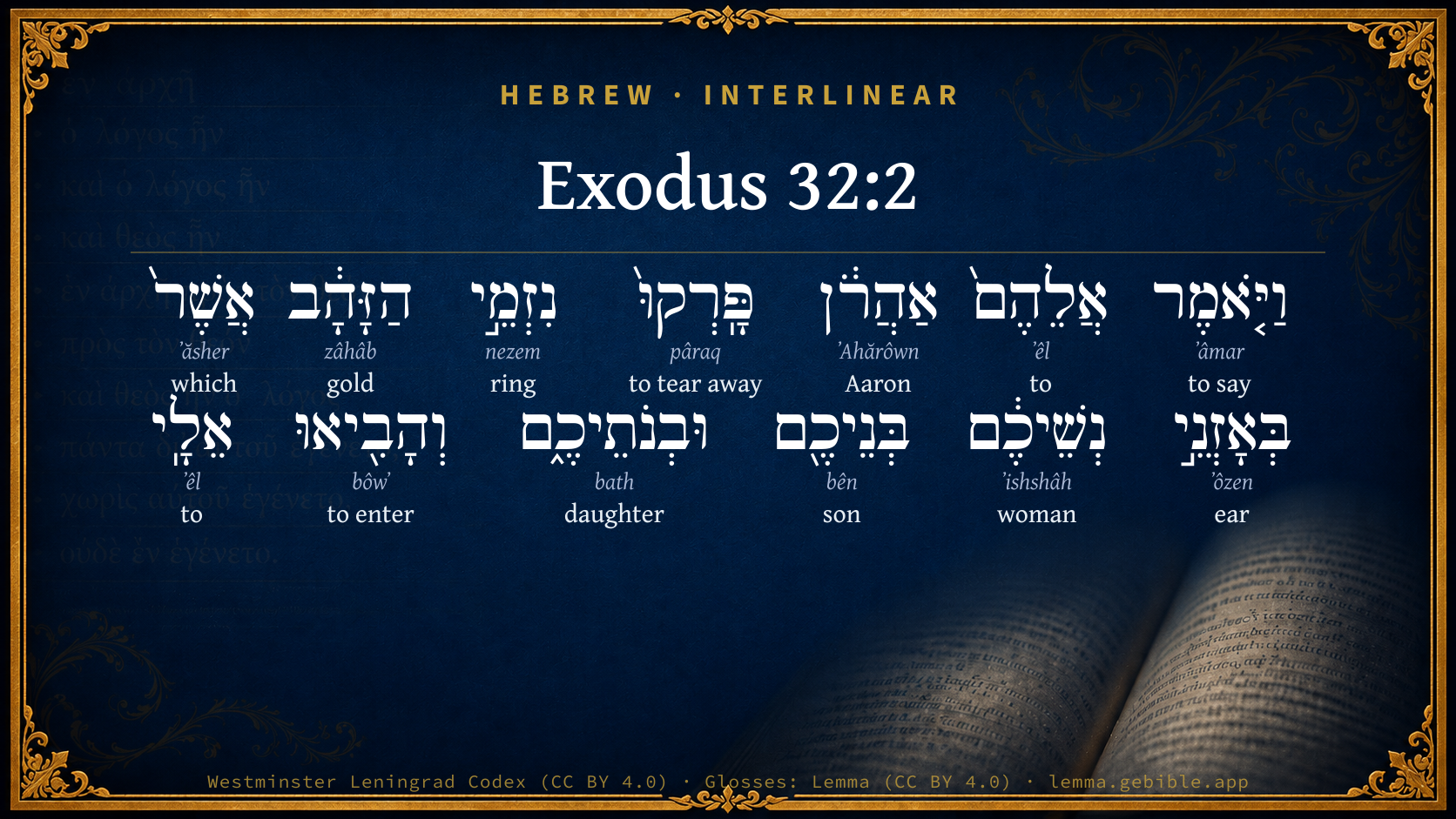
Hebrew (Westminster Leningrad Codex) Exodus 32:2 appears in the Hebrew Old Testament. The text above is from the Westminster Leningrad Codex. Each word links to its Strong’s number, a concise gloss, and parsing drawn from the Open Scriptures Hebrew Bible morphology. Click any word for its full Brown-Driver-Briggs (BDB) entry.
Download image
Cite this verse

Exodus 32:2 (World English Bible). Public Domain. Lemma interlinear Bible study tool, https://lemma.gebible.app/v/exodus/32/2.

Show BibTeX & RIS
BibTeX
RIS
English Translation
Aaron said to them, "Take off the golden rings, which are in the ears of your wives, of your sons, and of your daughters, and bring them to me."
World English Bible · Public Domain
Download a study sheet

One document with this verse’s original text, its word-by-word gloss line, the meaning frame, cross-references with their text, attributed commentary, and full source and license credits — printable, and it pastes into notes with its structure intact.

This verse Autodidact and up

Study sheet (.html) Plain text (.txt)

A passage Seminary Student

Up to 50 verses in one chapter. A passage sheet keeps up to 6 commentary sources and 12 cross-references per verse, in the order this page ranks them, and says so on the sheet whenever that leaves anything out. Ask for a single verse and you get the Autodidact verse sheet above.

Everything on this page stays free to read, with no account — the sheet is a download of what is already on screen, not access to it.

Want to remove ads? Support Godless Engineer
Compare translations 3

The same verse in 3 English versions, stacked beneath the original-language interlinear above. Click any original word for its lexicon entry.

Each is an independent rendering of the whole verse — the interlinear is not word-aligned to these translations.

Highlighted words mark where these versions differ — a whole-verse word diff, not a word-by-word alignment.

  • World English Bible Public Domain
    Aaron said to them, "Take off the golden rings, which are in the ears of your wives, of your sons, and of your daughters, and bring them to me."
  • King James Version Public Domain
    And Aaron said unto them, Break off the golden earrings, which are in the ears of your wives, of your sons, and of your daughters, and bring them unto me.
  • unfoldingWord Literal Text CC BY-SA 4.0
    And Aaron said to them, “Tear off the rings of gold that are on the ears of your wives, your sons, and your daughters and bring them to me.”

unfoldingWord Literal Text — © unfoldingWord, licensed CC BY-SA 4.0. Word-aligned USFM3 via Door43 (git.door43.org/unfoldingWord/en_ult).

Versions to compare (up to 4)

3 of 4 selected

Show all 18 translations

Every available English version of this verse, each an independent rendering of the whole verse.

  • World English Bible Public Domain
    Aaron said to them, "Take off the golden rings, which are in the ears of your wives, of your sons, and of your daughters, and bring them to me."
  • Berean Standard Bible Public Domain
    So Aaron told them, “Take off the gold earrings that are on your wives and sons and daughters, and bring them to me.”
  • Majority Standard Bible Public Domain
    So Aaron told them, “Take off the gold earrings that are on your wives and sons and daughters, and bring them to me.”
  • King James Version Public Domain
    And Aaron said unto them, Break off the golden earrings, which are in the ears of your wives, of your sons, and of your daughters, and bring them unto me.
  • American Standard Version (1901) Public Domain
    And Aaron said unto them, Break off the golden rings, which are in the ears of your wives, of your sons, and of your daughters, and bring them unto me.
  • Revised Version (1885) Public Domain
    And Aaron said unto them, Break off the golden rings, which are in the ears of your wives, of your sons, and of your daughters, and bring them unto me.
  • Geneva Bible (1599) Public Domain
    And Aaron said vnto them, Plucke off the golden earings, which are in the eares of your wiues, of your sonnes, and of your daughters, and bring them vnto me.
  • Douay-Rheims (1899) Public Domain
    And Aaron said to them: Take the golden earrings from the ears of your wives, and your sons and daughters, and bring them to me.
  • Young's Literal Translation Public Domain
    And Aaron saith unto them, `Break off the rings of gold which `are' in the ears of your wives, your sons, and your daughters, and bring in unto me;'
  • Literal Standard Version CC BY-SA 4.0
    And Aaron says to them, “Break off the rings of gold which [are] in the ears of your wives, your sons, and your daughters, and bring [them] to me”;
  • Unlocked Literal Bible CC BY-SA 4.0
    So Aaron said to them, “Take off the golden rings that are on your wives' ears, and the ears of your sons and daughters, and bring them to me.”
  • unfoldingWord Literal Text CC BY-SA 4.0
    And Aaron said to them, “Tear off the rings of gold that are on the ears of your wives, your sons, and your daughters and bring them to me.”
  • Darby Bible Public Domain
    And Aaron said to them, Break off the golden rings that are in the ears of your wives, of your sons, and of your daughters, and bring [them] to me.
  • World Messianic Bible Public Domain
    Aaron said to them, “Take off the golden rings, which are in the ears of your wives, of your sons, and of your daughters, and bring them to me.”
  • Webster's Bible Public Domain
    And Aaron said to them, Break off the golden ear-rings which are in the ears of your wives, of your sons, and of your daughters, and bring them to me.
  • Free Bible Version CC BY-SA 4.0
    “Bring to me the gold earrings that your wives, sons, and daughters are wearing,” Aaron replied.
  • Bible in Basic English Public Domain
    Then Aaron said to them, Take off the gold rings which are in the ears of your wives and your sons and your daughters, and give them to me.
  • JPS Tanakh (1917) Public Domain
    And Aaron said unto them: 'Break off the golden rings, which are in the ears of your wives, of your sons, and of your daughters, and bring them unto me.'

Literal Standard Version (2020), Covenant Press — licensed CC BY-SA 4.0. Text via the HelloAO Bible API (eBible.org). Unlocked Literal Bible (unfoldingWord) — licensed CC BY-SA 4.0. Text via the HelloAO Bible API (eBible.org). unfoldingWord Literal Text — © unfoldingWord, licensed CC BY-SA 4.0. Word-aligned USFM3 via Door43 (git.door43.org/unfoldingWord/en_ult). Free Bible Version, Dr. Jonathan Gallagher — licensed CC BY-SA 4.0. Text via the HelloAO Bible API (eBible.org).

Word by word

More ways to search: Search by grammar → Find every occurrence → Compare this word →

Practice this passage: Drill this verse → Learn its vocabulary →

פָּֽרְקוּ֙
pâraq
H6561
“tear away”
Verb, Piel, Imperative, 2nd Person, Masculine, Plural
Part of Speech
Verb
Stem
Piel
Form
Imperative
Person
2nd Person
Gender
Masculine
Number
Plural
Full BDB Definition

Origin: a primitive root

TWOT: 1828

to tear apart or away, tear off, break away - (Qal) to tear away, snatch, rescue - (Piel) to tear off - (Hithpael) to tear off from oneself, be broken off, be broken in pieces
  1. וַיֹּ֤אמֶר ʼâmar H559 “and · to say” Conjunction + Verb, Qal, Sequential Imperfect, 3rd Person, Masculine, Singular
  2. אֲלֵהֶם֙ ʼêl H413 “to · them” Preposition + Suffix, Personal, 3rd Person, Masculine, Plural
  3. אַהֲרֹ֔ן ʼAhărôwn H175 “Aaron” Noun, Proper
  4. נִזְמֵ֣י nezem H5141 “rings of” Noun, Common, Masculine, Plural, Construct
  5. הַזָּהָ֔ב zâhâb H2091 “the · gold” Particle, Definite Article + Noun, Common, Masculine, Singular, Absolute
  6. אֲשֶׁר֙ ʼăsher H834 “which” Particle, Relative
  7. בְּאָזְנֵ֣י ʼôzen H241 “in/at · ears of” Preposition + Noun, Common, Feminine, Dual, Construct
  8. נְשֵׁיכֶ֔ם ʼishshâh H802 “women · your” Noun, Common, Feminine, Plural, Construct + Suffix, Personal, 2nd Person, Masculine, Plural
  9. בְּנֵיכֶ֖ם bên H1121 “sons · your” Noun, Common, Masculine, Plural, Construct + Suffix, Personal, 2nd Person, Masculine, Plural
  10. וּבְנֹתֵיכֶ֑ם bath H1323 “and · daughters · your” Conjunction + Noun, Common, Feminine, Plural, Construct + Suffix, Personal, 2nd Person, Masculine, Plural
  11. וְהָבִ֖יאוּ bôwʼ H935 “and · enter” Conjunction + Verb, Hiphil, Imperative, 2nd Person, Masculine, Plural
  12. אֵלָֽי ʼêl H413 “to · me” Preposition + Suffix, Personal, 1st Person, Common, Singular

About this verse

These counts appear in no published source. They are computed here, from the morphology-tagged text and Lemma’s own curated glosses. What Lemma adds →

13
words
12
distinct lemmas
Pentateuch
section

Notable vocabulary

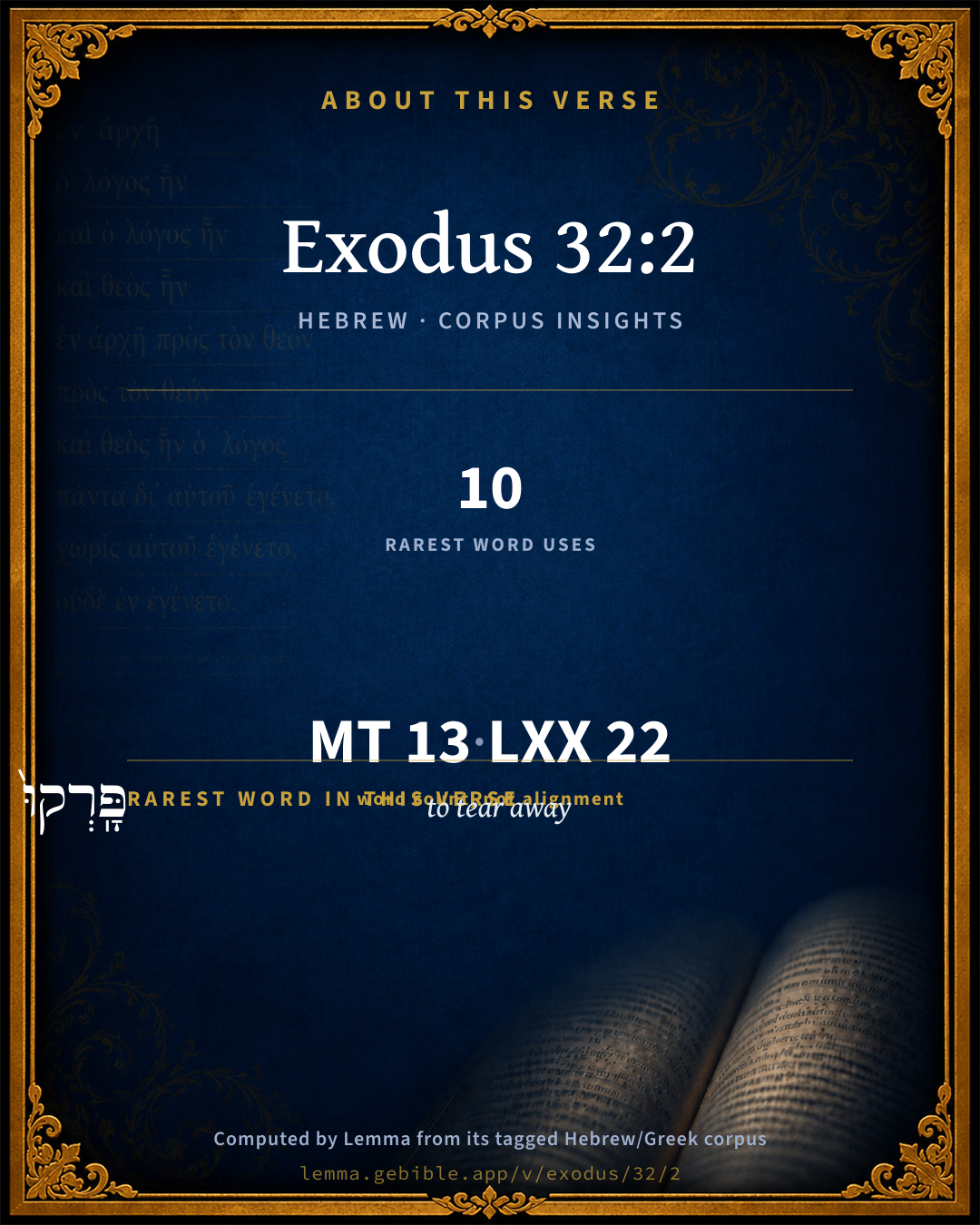
The rarest word here is פָּֽרְקוּ֙ to tear away H6561 — appearing just 10 times in the whole Hebrew Bible.

Shared distinctive vocabulary

פָּֽרְקוּ֙ to tear away H6561 occurs in 10 verses of the Hebrew Bible. Also found in:

Grammatical profile

  • 3 verbs
  • 7 nouns
  • 2 prepositions
  • 1 particle

Verb forms

  • וַיֹּ֤אמֶר Qal · Sequential Imperfect
  • פָּֽרְקוּ֙ Piel · Imperative
  • וְהָבִ֖יאוּ Hiphil · Imperative

Repetition

A word recurs within this verse — often emphatic in Hebrew:

  • אֲלֵהֶם֙ to H413 ×2

Hebrew & Septuagint length

In English translation the verse runs 29 words from the Hebrew and 25 from the Septuagint (LXX English) — closely comparable.

A rough comparison of the two English renderings, which tokenize alike — not a word-level alignment.

Word counts can differ between the Hebrew and the Greek without any difference in meaning — e.g. the Hebrew direct-object marker אֵת has no separate Greek word, and Greek often adds the article ὁ.

In the original languages it is 13 Hebrew tokens and 22 Greek tokens — but the two are counted differently (Hebrew bundles its prefixes and suffixes into one token; the Greek is in lemma form), so that isn’t a like-for-like length.

Cross-references

8

Topical passages linked to Exodus 32:2 in the Treasury of Scripture Knowledge — connected by theme and wording, ordered by reader-vote popularity; previews shown in the World English Bible.

  • Exodus 12:35–36 The children of Israel did according to the word of Moses; and they asked of the Egyptians jewels of silver, and jewels of gold, and clothing.
  • Judges 8:24–27 Gideon said to them, I would make a request of you, that you would give me every man the ear-rings of his spoil. (For they had golden ear-rings, because they were Ishmaelites.)
  • Ezekiel 16:11–12 I decked you with ornaments, and I put bracelets on your hands, and a chain on your neck.
  • Ezekiel 16:17 You also took your beautiful jewels of my gold and of my silver, which I had given you, and made for yourself images of men, and played the prostitute with them;
  • Hosea 2:8 For she did not know that I gave her the grain, the new wine, and the oil, And multiplied to her silver and gold, which they used for Baal.
  • Genesis 24:47 I asked her, and said, 'Whose daughter are you?' She said, 'The daughter of Bethuel, Nahor's son, whom Milcah bare to him.' I put the ring on her nose, and the bracelets on her hands.
  • Exodus 35:22 They came, both men and women, as many as were willing-hearted, and brought brooches, ear-rings, signet-rings, and armlets, all jewels of gold; even every man who offered an offering of gold to Yahweh.
  • Genesis 24:22 It happened, as the camels had done drinking, that the man took a golden ring of half a shekel weight, and two bracelets for her hands of ten shekels weight of gold,

Cross-references courtesy of OpenBible.info (CC BY 4.0).

Hebrew and Greek witnesses Masoretic Hebrew ↔ Greek Septuagint

The same verse in the two great witnesses to the Old Testament, shown verse-for-verse.

These are two independent witnesses, not word-aligned to each other, and the Septuagint is shown in lemma (dictionary) form.

Hebrew Exodus 32:2 Masoretic · Westminster Leningrad Codex

וַיֹּ֤אמֶר אֲלֵהֶם֙ אַהֲרֹ֔ן פָּֽרְקוּ֙ נִזְמֵ֣י הַזָּהָ֔ב אֲשֶׁר֙ בְּאָזְנֵ֣י נְשֵׁיכֶ֔ם בְּנֵיכֶ֖ם וּבְנֹתֵיכֶ֑ם וְהָבִ֖יאוּ אֵלָֽי

Aaron said to them, "Take off the golden rings, which are in the ears of your wives, of your sons, and of your daughters, and bring them to me."

World English Bible · Public Domain

Greek LXX Exodus 32:2 Septuagint · lemma form

καί λέγω αὐτός ααρων περιαἱρέω ὁ ἐνώτιον ὁ χρυσοῦς ὁ ἐν ὁ οὖς ὁ γυνή σύ καί θυγάτηρ καί φέρω πρός ἐγώ

And Aaron says to them, Take off the golden ear-rings which are in the ears of your wives and daughters, and bring them to me.

LXX2012 (modern English Septuagint) · Public Domain

On this verse, Haydock's Catholic Bible Commentary discusses the Septuagint’s reading. Read the note in Commentary ↓

Hebrew: Westminster Leningrad Codex (CC BY 4.0). Greek: Septuagint (public domain); English from LXX2012 (modern English Septuagint) (Public Domain). How the Septuagint differs from the Hebrew →

Targum (Aramaic paraphrase)

2

The Targum is the ancient Jewish Aramaic paraphrase of the Hebrew Scriptures — an interpretive translation, not the Hebrew text itself. Onkelos (literal) and Pseudo-Jonathan (expansive) render the Torah, and Jonathan the Prophets. Coverage is partial: where no permissively-licensed English translation exists for a verse, only the Aramaic is shown. This is verse-level text, not a word-by-word alignment to the Hebrew.

  1. Targum Onkelos Torah (Genesis–Deuteronomy)
    וַאֲמַר לְהוֹן אַהֲרֹן פְּרִיקוּ קָדָשֵׁי דְדַהֲבָא דִי בְאוּדְנֵי נְשֵׁיכוֹן בְּנֵיכוֹן וּבְנָתֵיכוֹן וְאַיְתִיוּ לְוָתִי:

    (no public-domain English translation for this verse)

    Targum Onkelos — Aramaic: “Onkelos Genesis” (public domain); “Onkelos Exodus” (public domain); “Onkelos Leviticus” (public domain); “Onkelos Numbers” (public domain); “Onkelos Deuteronomy” (public domain). English: “Sefaria Community Translation” (CC0 1.0 (public-domain dedication)); “J.W. Etheridge. The Targums of Onkelos and Jonathan Ben Uzziel on the Pentateuch. London: Longmans, Green, 1862” (public domain). Text via Sefaria.

  2. Targum Pseudo-Jonathan Torah (Genesis–Deuteronomy)
    וַאֲמַר לְהוֹן אַהֲרן פְּרִיקוּ קָדָשֵׁי דְדַהֲבָא דִבְאוּדְנֵי נְשֵׁיכוֹן בְּנֵיכוֹן וּבְנָתֵיכוֹן וְאַיְיתוּ לְוָתִי

    And Aharon said to them, Deliver the golden rings that are in the ears of your wives, your sons, and your daughters, and bring them to me.

    Targum Pseudo-Jonathan — Aramaic: “Targum Jonathan on Genesis” (public domain); “Targum Jonathan on Exodus” (public domain); “Targum Jonathan on Leviticus” (public domain); “Targum Jonathan on Numbers” (public domain); “Targum Jonathan on Deuteronomy” (public domain). English: “The Targum of Jonathan ben Uzziel, trans. J. W. Etheridge, London, 1862” (public domain). Text via Sefaria.

Commentary

Notes on Exodus 32:2 from classic Christian and Jewish commentators (each source and its license shown beneath its notes). The classic Christian expositions comment on the surrounding passage and are grouped to its opening verse, so a note may address several verses; the Jewish commentaries on the Tanakh (Rashi and others) are per-verse, so they appear only where the commentator wrote on this verse.

Lemma curates 59 commentaries, every one of them public domain or Creative Commons licensed, each selected and text-cleaned for this edition rather than reprinted as found. About our sources →

Trapp's Complete Commentary

John Trapp

Exo 32:2 And Aaron said unto them, Break off the golden earrings, which [are] in the ears of your wives, of your sons, and of your daughters, and bring [them] unto me.

Ver. "2. Brake off the golden ear-rings.] Hereby he hoped to break their design; but all in vain for they were "mad upon their idols." {Jer 50:38}

John Trapp, A Commentary or Exposition upon All the Books of the Old and New Testament (1647–1656) — public domain. Text from a community e-Sword module.

Joseph Benson's Commentary

Exo 32:2. Break off the golden ear-rings — These were probably some of the jewels which they had of the Egyptians. From the ears of your sons — Men wore these ornaments in the eastern countries as well as the women, Jdg 8:24. Some suppose that when Aaron gave this direction he did it with a design to crush the proposal, believing, that if their covetousness did not hinder them from giving up their ear-rings, their pride, at least, would prevent their parting with them. He says, therefore, Which are in the ears of your wives and daughters — Thinking them most fond of their jewels, and most unlikely to part with them.

Joseph Benson's Commentary on the Old and New Testaments (1811–1818) — public domain. Text from a community e-Sword module.

Tyndale Open Study Notes

Tyndale Open Resources

32:2-4 The religious professional, Aaron, demanded a specific contribution of gold rings and then excluded the people from any further involvement in the process. This is very different from what God had commanded regarding the construction of the Tabernacle, where the people were invited to bring many different kinds of things as they felt led (25:1-9; 35:4–36:7) and to share in the work under the guidance of a Spirit-filled layperson (31:1-6; 36:1-2).

Tyndale Open Study Notes — © Tyndale Open Resources, licensed CC BY-SA 4.0. Text via the HelloAO Bible API.

Geneva Bible (1599)

Geneva Bible translators

Thinking that they would rather forego idolatry, than to resign their most precious jewels.

Geneva Bible (1599) marginal notes — public domain. Text via Bolls.life.

Jamieson, Fausset & Brown

Robert Jamieson, A. R. Fausset & David Brown

Aaron said, . . . Break off . . . earrings--It was not an Egyptian custom for young men to wear earrings, and the circumstance, therefore, seems to point out "the mixed rabble," who were chiefly foreign slaves, as the ringleaders in this insurrection. In giving direction to break their earrings, Aaron probably calculated on gaining time; or, perhaps, on their covetousness and love of finery proving stronger than their idolatrous propensity. If such were his expectations, they were doomed to signal disappointment. Better to have calmly and earnestly remonstrated with them, or to have preferred duty to expediency, leaving the issue in the hands of Providence.

Jamieson, Fausset & Brown — Commentary Critical and Explanatory on the Whole Bible (1871) — public domain (CC PDM 1.0). Text via the HelloAO Bible API.

Adam Clarke's Commentary

Verse 2. Golden ear-rings] Both men and women wore these ornaments, and we may suppose that these were a part of the spoils which they brought out of Egypt. How strange, that the very things which were granted them by an especial influence and providence of God, should be now abused to the basest idolatrous purposes! But it is frequently the case that the gifts of God become desecrated by being employed in the service of sin; I will curse your blessings, saith the Lord, Mal 2:2.

Adam Clarke's Commentary on the Bible (1810–1826) — public domain. Text from a community e-Sword/MySword module.

Ellicott's Commentary for English Readers

(2) And Aaron said . . . Break off the golden earrings.—It is a reasonable conjecture that Aaron thought to prevent the projected idolatry by this requirement. Not having the courage to meet the demand of the people with a direct negative, he may have aimed at diverting them from their purpose by requiring a sacrifice which they would be unwilling to make, viz., the personal ornaments of their wives and children. The women might reasonably have been expected to resist, and the men to yield before such resistance; but the event proved otherwise.

Your sons.—Earrings are worn in the East almost as much by men as by women. Most Assyrian and some Egyptian monarchs are represented with them.

A Bible Commentary for English Readers, edited by Charles John Ellicott (1878–1897) — public domain. Text from a community e-Sword module.

The Cambridge Bible for Schools and Colleges

gen. ed. J. J. S. Perowne

2. of your sons] earrings are not elsewhere in the OT. described as worn by males (unless indeed, by implication, in Gen_35:4).

The Cambridge Bible for Schools and Colleges (gen. ed. J. J. S. Perowne; Cambridge University Press, 1878–1918) — public domain. Text from a community e-Sword module.

John Gill's Exposition

And all the people brake off the golden earrings, which were in their ears,.... The men took off their earrings, and persuaded their wives and children, or obliged them to part with theirs; though the Targum of Jonathan says the women refused to give their ornaments to their husbands, therefore all the people immediately broke off all the golden ornaments which were in their ears (x), so intent were they upon idolatry. This is to be understood not of every individual, but of the greatest part of the people; so apostle explains it of some of them, Co1 10:7. Idolaters spare no cost nor pains to support their worship, and will strip themselves, their wives, and children, of their ornaments, to deck their idols; which may shame the worshippers of the true God, who are oftentimes too backward to contribute towards the maintenance of his worship and service:

and brought them unto Aaron: presently, the selfsame day; they soon forgot the commands enjoined them to have no other gods, save one, and to make no graven image to bow down to it, and their own words, Exo 24:7.

(x) So Pirke Eliezer, c. 45.

John Gill's Exposition of the Whole Bible (1746–1763) — public domain (CC PDM 1.0). Text via the HelloAO Bible API.

Haydock's Catholic Bible Commentary

And your sons. The Septuagint omit this. But in the East, it was fashionable for men also to wear ear-rings. (Pliny, [Natural History?] xi. 37; Judges viii. 24; Ezechiel vii. 20. Aaron hoped the people would relent at this proposal. (St. Augustine, q. 141.)

George Leo Haydock (1774–1849), Haydock's Catholic Family Bible and Commentary, 1859 edition — public domain. Excludes Psalms (Douay-Rheims chapter numbering differs from Protestant) and Deuterocanonical books (Catholic canon only).

Matthew Poole's English Annotations

The golden earrings were of good value and common use among the eastern people, who seem to have used them superstitiously, Gen 35:4; Jdg 8:24; and therefore Aaron demands these, partly that he might take away one vice, or occasion of vice, whilst the people were intent upon another; and partly that the proposed loss of their precious earrings might cool their idolatrous desires.

In the ears of your wives, whom he thought most fond of their jewels, and most unlikely to part with them.

Matthew Poole's English Annotations on the Holy Bible (1683–1685) — public domain. Text from a community e-Sword/MySword module.

Whedon's Commentary on the Bible

Daniel D. Whedon

2. Break off the golden earrings — A strong expression, as if implying that the act involved some measure of violence, or, at least, an effort and sacrifice on their part. The prevailing view has been that Aaron, anxious to dissuade the people from their purpose, proposed this great sacrifice on their part in hope that they would thereupon withdraw their demand upon him to make them a god. This is not an improbable view, and is favoured by Aaron’s apology before Moses in Exo_32:22-24. But the facts here recorded, as well as Numbers 12, exhibit the moral weakness of Aaron. He did well as Moses’s spokesman, (Exo_4:14-16,) but sadly lacked the sterling qualities of a great spiritual leader. Specimens of ancient earrings are shown in the annexed cut.

Daniel D. Whedon (gen. ed.), Commentary on the Old and New Testaments (1874–1909) — public domain. Text from a community e-Sword module.

The Pulpit Commentary

Break off. "Take off" would perhaps be a better translation. The ear-rings would not require any breaking. They were penannular, and could be removed by a smart pull. Your wives, your sons, and your daughters. See the comment on Exo_3:22. It is implied that the men did not wear earrings. At an earlier date the household of Jacob, chiefly men, had worn them. (Gen_35:4)

The Pulpit Commentary (1880–1919), ed. H.D.M. Spence-Jones & Joseph S. Exell — public domain. Text from a community e-Sword module.

John Wesley's Explanatory Notes

And Aaron said break off the golden ear-rings - We do not find that he said one word to discountenance their proposal. Some suppose, that when Aaron bid them break off their ear-rings, he did it with design to crush the proposal, believing that, though their covetousness would have let them do it, yet their pride would not have suffered them to part with them.

John Wesley, Explanatory Notes Upon the Whole Bible (1754–1765) — public domain. Text via the GEBible commentary corpus.

Rashi

Rabbi Shlomo Yitzchaki (Rashi)

באזני נשיכם [BREAK OFF THE GOLDEN PENDANTS], WHICH ARE IN THE EARS OF YOUR WIVES — Aaron said to himself: women and children have a love for their ornaments; perhaps the matter will be delayed because they will hesitate to give their ornaments, and in the meantime Moses may arrive. They (the men), however, did not wait until the women and children made up their minds but they took the ornaments off themselves (cf. v. 3: they took off the pendants which were in their ears; there is no reference to the pendants belonging to the women) (Midrash Tanchuma, Ki Tisa 21).

פרקו is an imperative plural derived from פרק which is used for the singular, just as בָּרְכוּ is derived from בָּרֵךְ‎ (פרקו and ברכו are both masculine imperative Piel).

Rashi on the Tanakh — English translations: “The Judaica Press complete Tanach with Rashi, translated by A. J. Rosenberg” (CC BY 4.0); “Pentateuch with Rashi's commentary by M. Rosenbaum and A.M. Silbermann, 1929-1934” (public domain); “The Metsudah Tanach series, Lakewood, N.J” (CC BY 4.0); and “The Book of Joshua, Metsudah Publications, 1997” (CC BY 4.0). Text via Sefaria.

Ramban (Nachmanides)

Rabbi Moshe ben Nachman (Ramban / Nachmanides)

PULL OFF THE GOLDEN RINGS. He selected gold and not silver, because gold indicates the attribute of justice, its appearance being as the appearance of fire, just as the Rabbis have said, ) is found in II Chronicles 3:6. “gold of parvayim, gold which is like the blood of bullocks.” It is for this reason that the House where the sacrifices were brought was made wholly of gold, as also the altar of incense and the cherubim, 25:18. and the Rabbis have interpreted [the verses to mean], 20:23. that “if they made them of silver [and not of gold] they are like gods of silver and gods of gold.” Even the form for the calf they made of gold rather than of silver.

Ramban (Nachmanides) on the Tanakh — English translation: “Commentary on the Torah by Ramban (Nachmanides). Translated and annotated by Charles B. Chavel. New York, Shilo Pub. House, 1971-1976” (CC BY 4.0). Text via Sefaria.

Lesson kit

Teaching starters — assembled from the data on this page, not authored interpretation. Every prompt links to the verse data it draws on. Edit before teaching.

Exodus, in the Pentateuch, opens this verse with 13 words (12 distinct Hebrew lemmas). Its most distinctive word is pâraq (“to tear away”). A historical commentator’s framing appears above. Read the whole chapter for the surrounding context.

Discussion questions

  1. What does “to tear away” (pâraq) contribute to the verse as a whole?
  2. How does Genesis 27:40, which shares the word «to tear away», read alongside this verse?
  3. What does the repetition of “to” (2× in this one verse) do in this verse?
  4. The translations on this page render this verse differently — a whole-verse word diff, not a word-by-word alignment. What might account for the different wordings?
  5. «וַיֹּ֤אמֶר» is a Qal Sequential Imperfect verb. How does that grammatical form shape the action described?
  6. Compare how Trapp's Complete Commentary and Joseph Benson's Commentary read this verse. Where do they agree or differ?

Things to notice

Reading settings

Reading text

Shown beneath each verse's original-language words.

Old Testament
Old Testament edition

Read the OT as the Masoretic Hebrew (MT) or the Greek Septuagint (LXX).

English shown for the Greek Septuagint (in the Hebrew ↔ Greek comparison).

Comparing translations? Open the Compare panel on any verse page to stack up to four side by side.