Zechariah 7:11

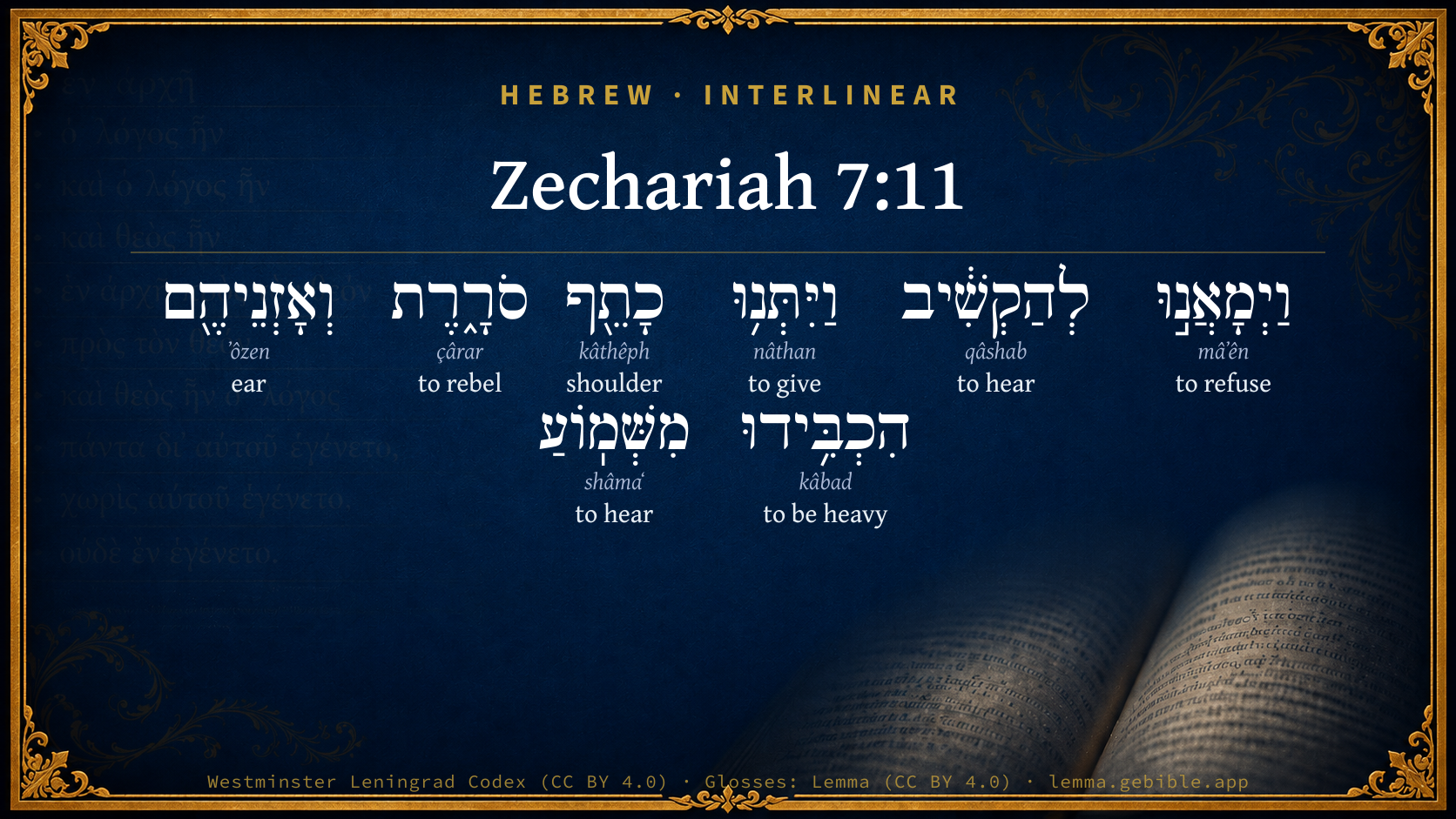
Hebrew (Westminster Leningrad Codex) Zechariah 7:11 appears in the Hebrew Old Testament. The text above is from the Westminster Leningrad Codex. Each word links to its Strong’s number, a concise gloss, and parsing drawn from the Open Scriptures Hebrew Bible morphology. Click any word for its full Brown-Driver-Briggs (BDB) entry.
Download image
Cite this verse

Zechariah 7:11 (World English Bible). Public Domain. Lemma interlinear Bible study tool, https://lemma.gebible.app/v/zechariah/7/11.

Show BibTeX & RIS
BibTeX
RIS
English Translation
But they refused to listen, and turned their backs, and stopped their ears, that they might not hear.
World English Bible · Public Domain
Download a study sheet

One document with this verse’s original text, its word-by-word gloss line, the meaning frame, cross-references with their text, attributed commentary, and full source and license credits — printable, and it pastes into notes with its structure intact.

This verse Autodidact and up

Study sheet (.html) Plain text (.txt)

A passage Seminary Student

Up to 50 verses in one chapter. A passage sheet keeps up to 6 commentary sources and 12 cross-references per verse, in the order this page ranks them, and says so on the sheet whenever that leaves anything out. Ask for a single verse and you get the Autodidact verse sheet above.

Everything on this page stays free to read, with no account — the sheet is a download of what is already on screen, not access to it.

Want to remove ads? Support Godless Engineer
Compare translations 3

The same verse in 3 English versions, stacked beneath the original-language interlinear above. Click any original word for its lexicon entry.

Each is an independent rendering of the whole verse — the interlinear is not word-aligned to these translations.

Highlighted words mark where these versions differ — a whole-verse word diff, not a word-by-word alignment.

  • World English Bible Public Domain
    But they refused to listen, and turned their backs, and stopped their ears, that they might not hear.
  • King James Version Public Domain
    But they refused to hearken, and pulled away the shoulder, and stopped their ears, that they should not hear.
  • unfoldingWord Literal Text CC BY-SA 4.0
    But they refused to pay attention, and they gave a stubborn shoulder, and their ears they made heavy from hearing.

unfoldingWord Literal Text — © unfoldingWord, licensed CC BY-SA 4.0. Word-aligned USFM3 via Door43 (git.door43.org/unfoldingWord/en_ult).

Versions to compare (up to 4)

3 of 4 selected

Show all 18 translations

Every available English version of this verse, each an independent rendering of the whole verse.

  • World English Bible Public Domain
    But they refused to listen, and turned their backs, and stopped their ears, that they might not hear.
  • Berean Standard Bible Public Domain
    But they refused to pay attention and turned a stubborn shoulder; they stopped up their ears from hearing.
  • Majority Standard Bible Public Domain
    But they refused to pay attention and turned a stubborn shoulder; they stopped up their ears from hearing.
  • King James Version Public Domain
    But they refused to hearken, and pulled away the shoulder, and stopped their ears, that they should not hear.
  • American Standard Version (1901) Public Domain
    But they refused to hearken, and pulled away the shoulder, and stopped their ears, that they might not hear.
  • Revised Version (1885) Public Domain
    But they refused to hearken, and pulled away the shoulder, and stopped their ears, that they should not hear.
  • Geneva Bible (1599) Public Domain
    But they refused to hearken, and pulled away the shoulder, and stopped their eares, that they should not heare.
  • Douay-Rheims (1899) Public Domain
    But they would not hearken, and they turned away the shoulder to depart: and they stopped their ears, not to hear.
  • Young's Literal Translation Public Domain
    And they refuse to attend, And they give a refractory shoulder, And their ears have made heavy against hearing.
  • Literal Standard Version CC BY-SA 4.0
    And they refuse to attend, || And they give a stubborn shoulder, || And their ears are made heavy against hearing.
  • Unlocked Literal Bible CC BY-SA 4.0
    But they refused to pay attention and set their shoulders stubbornly. They stopped up their ears so they would not hear.
  • unfoldingWord Literal Text CC BY-SA 4.0
    But they refused to pay attention, and they gave a stubborn shoulder, and their ears they made heavy from hearing.
  • Darby Bible Public Domain
    But they refused to hearken, and turned a rebellious shoulder, and made their ears heavy, that they should not hear.
  • World Messianic Bible Public Domain
    But they refused to listen, and turned their backs, and stopped their ears, that they might not hear.
  • Webster's Bible Public Domain
    But they refused to hearken, and withdrew the shoulder, and stopped their ears, that they should not hear.
  • Free Bible Version CC BY-SA 4.0
    But they refused to listen. They were obstinate, turning their backs and closing their ears.
  • Bible in Basic English Public Domain
    But they would not give attention, turning their backs and stopping their ears from hearing;
  • JPS Tanakh (1917) Public Domain
    But they refused to attend, and turned a stubborn shoulder, and stopped their ears, that they might not hear.

Literal Standard Version (2020), Covenant Press — licensed CC BY-SA 4.0. Text via the HelloAO Bible API (eBible.org). Unlocked Literal Bible (unfoldingWord) — licensed CC BY-SA 4.0. Text via the HelloAO Bible API (eBible.org). unfoldingWord Literal Text — © unfoldingWord, licensed CC BY-SA 4.0. Word-aligned USFM3 via Door43 (git.door43.org/unfoldingWord/en_ult). Free Bible Version, Dr. Jonathan Gallagher — licensed CC BY-SA 4.0. Text via the HelloAO Bible API (eBible.org).

Word by word

More ways to search: Search by grammar → Find every occurrence → Compare this word →

Practice this passage: Drill this verse → Learn its vocabulary →

סֹרָ֑רֶת
çârar
H5637
“rebelling”
Verb, Qal, Participle Active, Feminine, Singular, Absolute
Part of Speech
Verb
Stem
Qal
Form
Participle Active
Gender
Feminine
Number
Singular
State
Absolute
Full BDB Definition

Origin: a primitive root

TWOT: 1549

to rebel, be stubborn, be rebellious, be refractory - (Qal) - to be stubborn - stubborn, rebel (substantive)
  1. וַיְמָאֲנ֣וּ mâʼên H3985 “and · to refuse” Conjunction + Verb, Piel, Sequential Imperfect, 3rd Person, Masculine, Plural
  2. לְהַקְשִׁ֔יב qâshab H7181 “to hear” Preposition + Verb, Hiphil, Infinitive Construct
  3. וַיִּתְּנ֥וּ nâthan H5414 “and · to give” Conjunction + Verb, Qal, Sequential Imperfect, 3rd Person, Masculine, Plural
  4. כָתֵ֖ף kâthêph H3802 “shoulder” Noun, Common, Feminine, Singular, Absolute
  5. וְאָזְנֵיהֶ֖ם ʼôzen H241 “and · ears · their” Conjunction + Noun, Common, Feminine, Dual, Construct + Suffix, Personal, 3rd Person, Masculine, Plural
  6. הִכְבִּ֥ידוּ kâbad H3513 “to be heavy” Verb, Hiphil, Perfect, 3rd Person, Common, Plural
  7. מִשְּׁמֽוֹעַ shâmaʻ H8085 “from · to hear” Preposition + Verb, Qal, Infinitive Construct

About this verse

These counts appear in no published source. They are computed here, from the morphology-tagged text and Lemma’s own curated glosses. What Lemma adds →

8
words
8
distinct lemmas
Prophets
section

Notable vocabulary

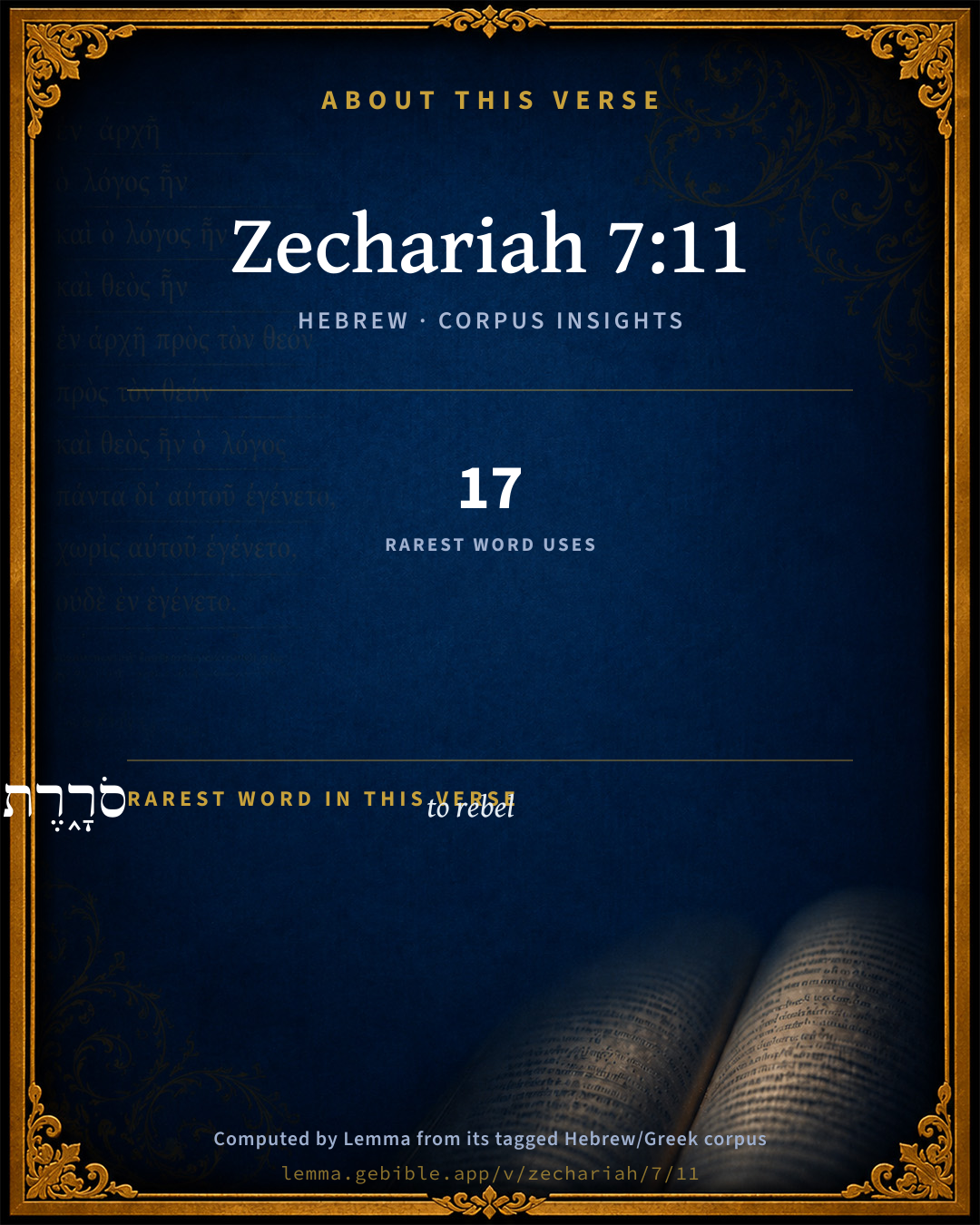
The rarest word here is סֹרָ֑רֶת to rebel H5637 — appearing just 17 times in the whole Hebrew Bible.

Shared distinctive vocabulary

סֹרָ֑רֶת to rebel H5637 occurs in 16 verses of the Hebrew Bible. Also found in:

Grammatical profile

  • 6 verbs
  • 2 nouns

Verb forms

  • וַיְמָאֲנ֣וּ Piel · Sequential Imperfect
  • לְהַקְשִׁ֔יב Hiphil · Infinitive Construct
  • וַיִּתְּנ֥וּ Qal · Sequential Imperfect
  • סֹרָ֑רֶת Qal · Participle Active
  • הִכְבִּ֥ידוּ Hiphil · Perfect
  • מִשְּׁמֽוֹעַ Qal · Infinitive Construct

Hebrew & Septuagint length

In English translation the verse runs 18 words from the Hebrew and 21 from the Septuagint (LXX English) — closely comparable.

A rough comparison of the two English renderings, which tokenize alike — not a word-level alignment.

Word counts can differ between the Hebrew and the Greek without any difference in meaning — e.g. the Hebrew direct-object marker אֵת has no separate Greek word, and Greek often adds the article ὁ.

Cross-references

29

Topical passages linked to Zechariah 7:11 in the Treasury of Scripture Knowledge — connected by theme and wording, ordered by reader-vote popularity; previews shown in the World English Bible.

  • Nehemiah 9:29 and testified against them, that you might bring them again to your law. Yet they dealt proudly, and didn't listen to your commandments, but sinned against your ordinances, (which if a man do, he shall live in them), and withdrew the shoulder, and hardened their neck, and would not hear.
  • Jeremiah 8:5 Why then is this people of Jerusalem slidden back by a perpetual backsliding? they hold fast deceit, they refuse to return.
  • Hosea 4:16 For Israel has behaved extremely stubbornly, like a stubborn heifer. Then how will Yahweh feed them like a lamb in a meadow.
  • Jeremiah 35:15 I have sent also to you all my servants the prophets, rising up early and sending them, saying, Return you now every man from his evil way, and amend your doings, and don't go after other gods to serve them, and you shall dwell in the land which I have given to you and to your fathers: but you have not inclined your ear, nor listened to me.
  • Ezekiel 3:7 But the house of Israel will not listen to you; for they will not listen to me: for all the house of Israel are of hard forehead and of a stiff heart.
  • Zechariah 1:4 Don't you be like your fathers, to whom the former prophets proclaimed, saying: Thus says Yahweh of hosts, 'Return now from your evil ways, and from your evil doings;' but they did not hear, nor listen to me, says Yahweh.
  • Acts 7:57 But they cried out with a loud voice, and stopped their ears, and rushed at him with one accord.
  • Exodus 10:3 Moses and Aaron went in to Pharaoh, and said to him, "This is what Yahweh, the God of the Hebrews, says: 'How long will you refuse to humble yourself before me? Let my people go, that they may serve me.
  • 2 Kings 17:13–15 Yet Yahweh testified to Israel, and to Judah, by every prophet, and every seer, saying, Turn you from your evil ways, and keep my commandments and my statutes, according to all the law which I commanded your fathers, and which I sent to you by my servants the prophets.
  • 2 Chronicles 33:10 Yahweh spoke to Manasseh, and to his people; but they gave no heed.
  • Nehemiah 9:17 and refused to obey, neither were mindful of your wonders that you did among them, but hardened their neck, and in their rebellion appointed a captain to return to their bondage. But you are a God ready to pardon, gracious and merciful, slow to anger, and abundant in loving kindness, and didn't forsake them.
  • Nehemiah 9:26 Nevertheless they were disobedient, and rebelled against you, and cast your law behind their back, and killed your prophets that testified against them to turn them again to you, and they committed awful blasphemies.
  • Psalms 58:4–5 Their poison is like the poison of a snake; Like a deaf cobra that stops its ear,
  • Proverbs 1:24–32 Because I have called, and you have refused; I have stretched out my hand, and no one has paid attention;
  • Isaiah 1:19–20 If you are willing and obedient, You shall eat the good of the land;
  • Isaiah 6:10 Make the heart of this people fat; Make their ears heavy, and shut their eyes; Lest they see with their eyes, And hear with their ears, And understand with their heart, And turn again, and be healed."
  • Jeremiah 6:16–17 Thus says Yahweh, Stand you in the ways and see, and ask for the old paths, where is the good way; and walk therein, and you shall find rest for your souls: but they said, We will not walk [therein].
  • Jeremiah 7:24 But they didn't listen nor turn their ear, but walked in [their own] counsels [and] in the stubbornness of their evil heart, and went backward, and not forward.
  • Jeremiah 11:10 They are turned back to the iniquities of their forefathers, who refused to hear my words; and they are gone after other gods to serve them: the house of Israel and the house of Judah have broken my covenant which I made with their fathers.
  • Jeremiah 13:10 This evil people, who refuse to hear my words, who walk in the stubbornness of their heart, and are gone after other gods to serve them, and to worship them, shall even be as this belt, which is profitable for nothing.
  • Jeremiah 17:23 But they didn't listen, neither turn their ear, but made their neck stiff, that they might not hear, and might not receive instruction.
  • Jeremiah 26:5–6 to listen to the words of my servants the prophets, whom I send to you, even rising up early and sending them, but you have not listened;
  • Jeremiah 36:31 I will punish him and his seed and his servants for their iniquity; and I will bring on them, and on the inhabitants of Jerusalem, and on the men of Judah, all the evil that I have pronounced against them, but they didn't listen.
  • Jeremiah 44:16 As for the word that you have spoken to us in the name of Yahweh, we will not listen to you.
  • Daniel 9:5 we have sinned, and have dealt perversely, and have done wickedly, and have rebelled, even turning aside from your precepts and from your ordinances;
  • Zephaniah 3:2 She didn't obey the voice. She didn't receive correction. She didn't trust in Yahweh. She didn't draw near to her God.
  • Acts 7:51 "You stiff-necked and uncircumcised in heart and ears, you always resist the Holy Spirit! As your fathers did, so you do.
  • Hebrews 10:38–39 But the righteous will live by faith. If he shrinks back, my soul has no pleasure in him."
  • Hebrews 12:25 See that you don't refuse him who speaks. For if they didn't escape when they refused him who warned on the Earth, how much more will we not escape who turn away from him who warns from heaven,

Cross-references courtesy of OpenBible.info (CC BY 4.0).

Hebrew and Greek witnesses Masoretic Hebrew ↔ Greek Septuagint

The same verse in the two great witnesses to the Old Testament, shown verse-for-verse.

These are two independent witnesses, not word-aligned to each other, and the Septuagint is shown in lemma (dictionary) form.

Hebrew Zechariah 7:11 Masoretic · Westminster Leningrad Codex

וַיְמָאֲנ֣וּ לְהַקְשִׁ֔יב וַיִּתְּנ֥וּ כָתֵ֖ף סֹרָ֑רֶת וְאָזְנֵיהֶ֖ם הִכְבִּ֥ידוּ מִשְּׁמֽוֹעַ

But they refused to listen, and turned their backs, and stopped their ears, that they might not hear.

World English Bible · Public Domain

Greek LXX Zechariah 7:11 Septuagint · lemma form

καί ἀπειθέω ὁ προςἔχω καί δίδωμι νῶτον παραφρονέω καί ὁ οὖς αὐτός ἐβάρυναν ὁ μή εἰςἀκούω

But they refused to attend, and madly turned their back, and made their ears heavy, so that they should not hear.

LXX2012 (modern English Septuagint) · Public Domain

On this verse, Haydock's Catholic Bible Commentary discusses the Septuagint’s reading. Read the note in Commentary ↓

Hebrew: Westminster Leningrad Codex (CC BY 4.0). Greek: Septuagint (public domain); English from LXX2012 (modern English Septuagint) (Public Domain). How the Septuagint differs from the Hebrew →

Targum (Aramaic paraphrase)

1

The Targum is the ancient Jewish Aramaic paraphrase of the Hebrew Scriptures — an interpretive translation, not the Hebrew text itself. Onkelos (literal) and Pseudo-Jonathan (expansive) render the Torah, and Jonathan the Prophets. Coverage is partial: where no permissively-licensed English translation exists for a verse, only the Aramaic is shown. This is verse-level text, not a word-by-word alignment to the Hebrew.

  1. Targum Jonathan Prophets (Joshua–Malachi)
    וְסָרִיבוּ לְקַבְּלָא וִיהָבוּ כַתְפֵיהוֹן מָרִיד וְאוּדְנֵיהוֹן יַקִירוּ מִלְמִשְׁמַע:

    (no public-domain English translation for this verse)

    Targum Jonathan — Aramaic: “Mikraot Gedolot” (public domain). English: “Sefaria Community Translation” (CC0 1.0 (public-domain dedication)); “London "Chaldee Paraphrase," 1871” (public domain). Text via Sefaria.

Commentary

Notes on Zechariah 7:11 from classic Christian and Jewish commentators (each source and its license shown beneath its notes). The classic Christian expositions comment on the surrounding passage and are grouped to its opening verse, so a note may address several verses; the Jewish commentaries on the Tanakh (Rashi and others) are per-verse, so they appear only where the commentator wrote on this verse.

Lemma curates 59 commentaries, every one of them public domain or Creative Commons licensed, each selected and text-cleaned for this edition rather than reprinted as found. About our sources →

Trapp's Complete Commentary

John Trapp

Zec 7:11 But they refused to hearken, and pulled away the shoulder, and stopped their ears, that they should not hear.

Ver. 11. But they refused to hearken] Being a nation void of counsel, Deu 32:28, not willing to know what they should do, lest they should do what they would not. Nay (said they once, when they had nothing else to say), but we will have a king.

And pulled away the shoulder] As untamed heifers do from the yoke, or untoward porters from the burden. The Vulgate rendereth it: Averterunt scapulam recedentem, making it a metaphor from those that scornfully turn their backs upon their betters when they like not their commands; as the Earl of Essex did once upon Queen Elizabeth; whereat she, waxing impatient, gave him a cuff on the ear, bidding him be gone with a mischief. Sides and shoulders should be set to God’s work, Zep 3:9.

And stopped their ears] Heb. They made heavy their ears. See here how they proceeded by fit degrees from bad to worse (for Nemo repente fit turpissimus), noted in the many "ands" here used. There is a concatenation of vices as well as of graces; and he that is one step down the ladder of hell knoweth not where he shall stop, till he break his neck at the very bottom. Wherefore principiis obsta. Meddle not with sin; it is modest and maidenlike at first, but who knows what it may come to? We have heard of virgins so modest at first as to blush at the motions of an honest love, who, being once corrupt and debauched, have grown boldly lascivious so as to solicit others, so as to prostitute themselves to all comers. Keep thee, therefore, far from an evil matter, Exo 23:7; have nothing to do with the unfruitful works of darkness, Eph 5:11. Circa serpentis antrum positus non eris diu illaesus (Isidore). He that plays upon the hole of the asp may be suddenly stung.

John Trapp, A Commentary or Exposition upon All the Books of the Old and New Testament (1647–1656) — public domain. Text from a community e-Sword module.

Tyndale Open Study Notes

Tyndale Open Resources

7:11 Your ancestors refused to listen: They ignored God’s commands (see Jer 11:10). • stubbornly turned away (or set a defiant shoulder): The idiom signifies haughty stubbornness (see Neh 9:29). • Put their fingers in their ears places full responsibility upon the people for their obstinacy (cp. Isa 6:10). The same expression is used of Pharaoh when he “became stubborn” (or “hardened his heart”) against God and refused to release the Hebrews (Exod 8:32).

Tyndale Open Study Notes — © Tyndale Open Resources, licensed CC BY-SA 4.0. Text via the HelloAO Bible API.

Geneva Bible (1599)

Geneva Bible translators

And would not carry the Lord’s burden, which was sweet and easy, but would bear their own, which was heavy and grievous to the flesh, thinking to merit thereby: which similitude is taken of oxen, which shrink at the yoke, Neh. 9:29.

Geneva Bible (1599) marginal notes — public domain. Text via Bolls.life.

Jamieson, Fausset & Brown

Robert Jamieson, A. R. Fausset & David Brown

pulled away the shoulder--literally, "presented a refractory shoulder"; an image from beasts refusing to bear the yoke (Neh 9:29, Margin).

stopped . . . ears-- (Isa 6:10; Jer 7:26; Act 7:57).

Jamieson, Fausset & Brown — Commentary Critical and Explanatory on the Whole Bible (1871) — public domain (CC PDM 1.0). Text via the HelloAO Bible API.

Adam Clarke's Commentary

Verse 11. Pulled away the shoulder] From under the yoke of the law, like an unbroken or restive bullock in the plough.

Adam Clarke's Commentary on the Bible (1810–1826) — public domain. Text from a community e-Sword/MySword module.

John Calvin's Commentaries

The Prophet here by referring to the fathers more sharply reproves the Jews of his age; for he saw that they differed but little from their fathers. The sum of what he says is, that the Jews in all ages dealt unfaithfully and perversely with God; for how much soever they boasted of their care and zeal for religion they yet sought to satisfy God only by vain trifles. This then was the Prophet’s object. For it is certain that there ever had been some pretense to religion in that nation but it was mere dissimulation for they were in the mean time intent on their ceremonies and when God seriously remonstrated with them their obstinacy and perverseness before concealed instantly appeared.

He therefore says that they refused to hear. He does not now accuse the dead except for this purpose to teach the people of his acre. He saw that they were solicitous about fasting at appointed seasons, while at the same time they regarded almost as nothing the main requirements of the law, even mercy, and justice, and uprightness. These are indeed the three things, which Christ mentions. (Matthew 23:23.) He then intimates that this doctrine was not new, and that their fathers had been sufficiently warned and instructed, but that they wilfully, and as it were designedly rebelled against God. In short, he pulls off their mask of ignorance; for as men for the most part seek to extenuate their sins by the plea, that they had not been clearly or seasonably taught, the Prophet declares that there was not any excuse of this kind, because they had been refractory and untameable, they had refused to hear

To set forth more fully this perverseness, he afterwards says, that the shoulder of withdrawing had been presented by them. The Hebrews say that men serve with the shoulder, when they are submissive, and tractable, and willingly undergo the burden laid on them, according to what we have seen in Zephaniah 3:1. The Prophet now, on the contrary, says that the Jews had a refractory shoulder, as they refused to bear the yoke, but shook off every fear of God. The reason for the metaphor is this — that as burdens are carried on the shoulder, so the Lord lays the law on our shoulders, that the flesh may not lasciviate at pleasure, but be kept under restraint. He hence says, that they had presented a rebellious shoulder. The word סררת, sarret, is properly rendered declining; but some render it perverse, and others contumacious: since the meaning is the same, I contend not about the word. It is enough to know that the contumacy of the Jews is what is here condemned; for they had been wholly unteachable, and had refused to submit to God and to his word.

He afterwards mentions their ears, They made heavy their ears, lest they should hear. In short, the Prophet sought by all means to prove the Jews guilty, that they might not adduce anything to extenuate their sin: for they had in every way, with the most determined wickedness, refused to obey God, when his teaching was sufficiently clear and intelligible.

John Calvin's Commentaries (1540-1563) — public domain. Text from the Calvin Translation Society English edition (1840s-50s) via the Christian Classics Ethereal Library (ccel.org). Calvin's coverage is partial (roughly two-thirds of the Bible); uncommented books and verses are honest gaps, never fabricated. The 19th-century editor's footnotes and remarks are omitted so the notes are faithfully Calvin's own voice.

Ellicott's Commentary for English Readers

(11) Pulled away the shoulder.—Better, offered a stubborn shoulder (Neh_9:29), as an ox that refuses to receive the yoke.

A Bible Commentary for English Readers, edited by Charles John Ellicott (1878–1897) — public domain. Text from a community e-Sword module.

The Cambridge Bible for Schools and Colleges

gen. ed. J. J. S. Perowne

11. pulled away the shoulder] Neh_9:29; Hos_4:16.

stopped] Lit. made heavy, i.e. dull. Comp. Isa_6:10. The same word is used of the eyes, Gen_48:10, and of the tongue, Exo_4:10.

The Cambridge Bible for Schools and Colleges (gen. ed. J. J. S. Perowne; Cambridge University Press, 1878–1918) — public domain. Text from a community e-Sword module.

John Gill's Exposition

Therefore it is come to pass, that as he cried,.... The Lord by the former prophets called them to repentance and obedience:

and they would not hear; his words, nor obey his voice:

so they cried: when they were besieged in Jerusalem, and were carried captive into Babylon:

and I would not hear, saith the Lord of hosts; so as to deliver them out of the hands of their enemies; see Pro 1:24.

John Gill's Exposition of the Whole Bible (1746–1763) — public domain (CC PDM 1.0). Text via the HelloAO Bible API.

Albert Barnes' Notes on the Bible

But they gave a backsliding shoulder - Like a restive animal, which would not endure the yoke, dull and stupid as the beasts: as Hosea says, “Israel slideth back like a backsliding heifer” Hos 4:16. Nehemiah confesses the same; “they gave a backsliding shoulder and hardened their neck and would not hear” Neh 9:29.

And made heavy their ears - Fulfilling in themselves what God foretold to Isaiah would be the result of his preaching, “make their ears heavy.” The heart, which will not hearken, becomes duller by the outward hearing, as Paul says, “The earth which drinketh in the rain that cometh oft upon it, and bringeth forth herbs meet for them by whom it is dressed, receiveth blessing from God; but that which beareth thorns and briars is rejected” Heb 6:7-8.

Albert Barnes' Notes on the Bible (1834–1885) — public domain. Text from a community e-Sword/MySword module.

Haydock's Catholic Bible Commentary

Depart, so to leave the burden on their partner. (Hebrew) (Calmet) --- Literally, "giving way;" recedentem. Pope Sixtus V, recedentes. Septuagint, "they gave a contemptuous back," (Haydock) like a slave, whom the whip cannot correct.

George Leo Haydock (1774–1849), Haydock's Catholic Family Bible and Commentary, 1859 edition — public domain. Excludes Psalms (Douay-Rheims chapter numbering differs from Protestant) and Deuterocanonical books (Catholic canon only).

Matthew Poole's English Annotations

But they refused to hearken; they wilfully were ignorant, ant, would not consider nor understand.

Pulled away the shoulder; next they shift from doing their duty, withdraw their shoulder from the yoke of the law, Neh 9:29; Hos 4:16.

And stopped their ears; and to make it highest contempt, they act the deaf man, stop their ears, and so turn their backs on God.

That they should not hear; all this out of an obstinate resolution to be unacquainted with God’s will and their own duty.

Matthew Poole's English Annotations on the Holy Bible (1683–1685) — public domain. Text from a community e-Sword/MySword module.

The Pulpit Commentary

Pulled away the shoulder; they gave a stubborn, refractory shoulder, like an ox which refuses to have the yoke put on his neck, or draws hack when it feels the weight. (Neh_9:29 Hos_4:16) Stopped their ears. Made their ears heavy. Ta wta autwn ebarunan (Septuagint); Isa_6:10 Isa_59:1. Three degrees of obduracy are named in this verse: they refused to listen; they resisted the warners; they exhibited open contempt for them. The full climax is given in the next verse.

The history of ungodliness.

I GERM. The question is Self or God, our own will or God"s will. Must be settled. Pressed by prophet after prophet. The answer shows the state of the heart. "Refused to hear.

II PROGRESS. There is growth in evil, as in good Stages. "First the blade, then the ear, then the full corn in the ear.

1. Wilful refusal. "Pulled away the shoulder." Sinners will not submit to be guided by the higher will. Angry and fretted, they will not bow to God"s yoke.

2. Insolent rejection. "Stopped their ears." Warnings and counsels are in vain. Pride rises to insolence. Refusal, to determined opposition and rebellion.

3. Settled obduracy. (Ver. 12) This implies a steady process. The bad is more and more gaining the mastery. Every fresh victory brings the time nearer when the evil becomes "unconquerable" (Greek adhamas).

III CONSUMMATION. (Ver. 13) The end is come.

1. Ruined character.

2. Blasted life.

3. Hopeless future.

Oh! where is that mysterious bourne, By which our path is crossed, Beyond which God himself hath sworn That he who goes is lost? "How far may we go on in sin? How long will God forbear? Where does hope end, and where begin The confines of despair? "An answer from the skies is sent, "Ye that from God depart, While it is called today, repent, And harden not your heart. (Alexander) F.

The Pulpit Commentary (1880–1919), ed. H.D.M. Spence-Jones & Joseph S. Exell — public domain. Text from a community e-Sword module.

John Wesley's Explanatory Notes

Pulled away - Withdrew their shoulder from the yoke of the law.

John Wesley, Explanatory Notes Upon the Whole Bible (1754–1765) — public domain. Text via the GEBible commentary corpus.

unfoldingWord translationNotes

Door43 World Missions Community

set their shoulders stubbornly

This is an image of an ox refusing to allow its owner to put a yoke on its shoulders. This metaphor represents the people being stubborn. AT: "became stubborn" (See: Metaphor)

They stopped up their ears so they would not hear

This is an image of people putting something into their ears so they would not hear the message from Yahweh. This metaphor represents the people not being willing to hear and obey. AT: "They refused to listen" (See: Metaphor)

They made their hearts as hard as rock so they would not hear the law or the words of Yahweh of hosts

The people refusing to hear and obey Yahweh are compared to their being as unyielding as rock. Here the heart represents the will of a person. AT: "They stubbornly refused to hear the law or the words of Yahweh of hosts" (See: Simile)

in earlier times

"in the past"

by the mouth of the prophets

Here the "mouth of the prophets" is a metonym for the words that the prophets speak. AT: "through the words of the prophets" (See: Metonymy)

translationWords

heart

law

Yahweh of hosts

send

Holy Spirit

anger

unfoldingWord translationNotes — © Distant Shores Media and the Door43 World Missions Community, licensed CC BY-SA 4.0. Source: git.door43.org/Door43/en_tn.

Lesson kit

Teaching starters — assembled from the data on this page, not authored interpretation. Every prompt links to the verse data it draws on. Edit before teaching.

Zechariah, in the Prophets, opens this verse with 8 words (8 distinct Hebrew lemmas). Its most distinctive word is çârar (“to rebel”). A historical commentator’s framing appears above. Read the whole chapter for the surrounding context.

Discussion questions

  1. How does “to rebel” (çârar) shape what this verse is saying?
  2. Deuteronomy 21:18 shares the word «to rebel» with this verse. How do the two illuminate each other?
  3. The translations on this page render this verse differently — a whole-verse word diff, not a word-by-word alignment. What might account for the different wordings?
  4. The verb «וַיְמָאֲנ֣וּ» is Piel Sequential Imperfect. How does its form color the action?
  5. Reading how Trapp's Complete Commentary and Tyndale Open Study Notes read this verse, where do the two commentators agree and where do they part?

Things to notice

Reading settings

Reading text

Shown beneath each verse's original-language words.

Old Testament
Old Testament edition

Read the OT as the Masoretic Hebrew (MT) or the Greek Septuagint (LXX).

English shown for the Greek Septuagint (in the Hebrew ↔ Greek comparison).

Comparing translations? Open the Compare panel on any verse page to stack up to four side by side.