Isaiah 5:9

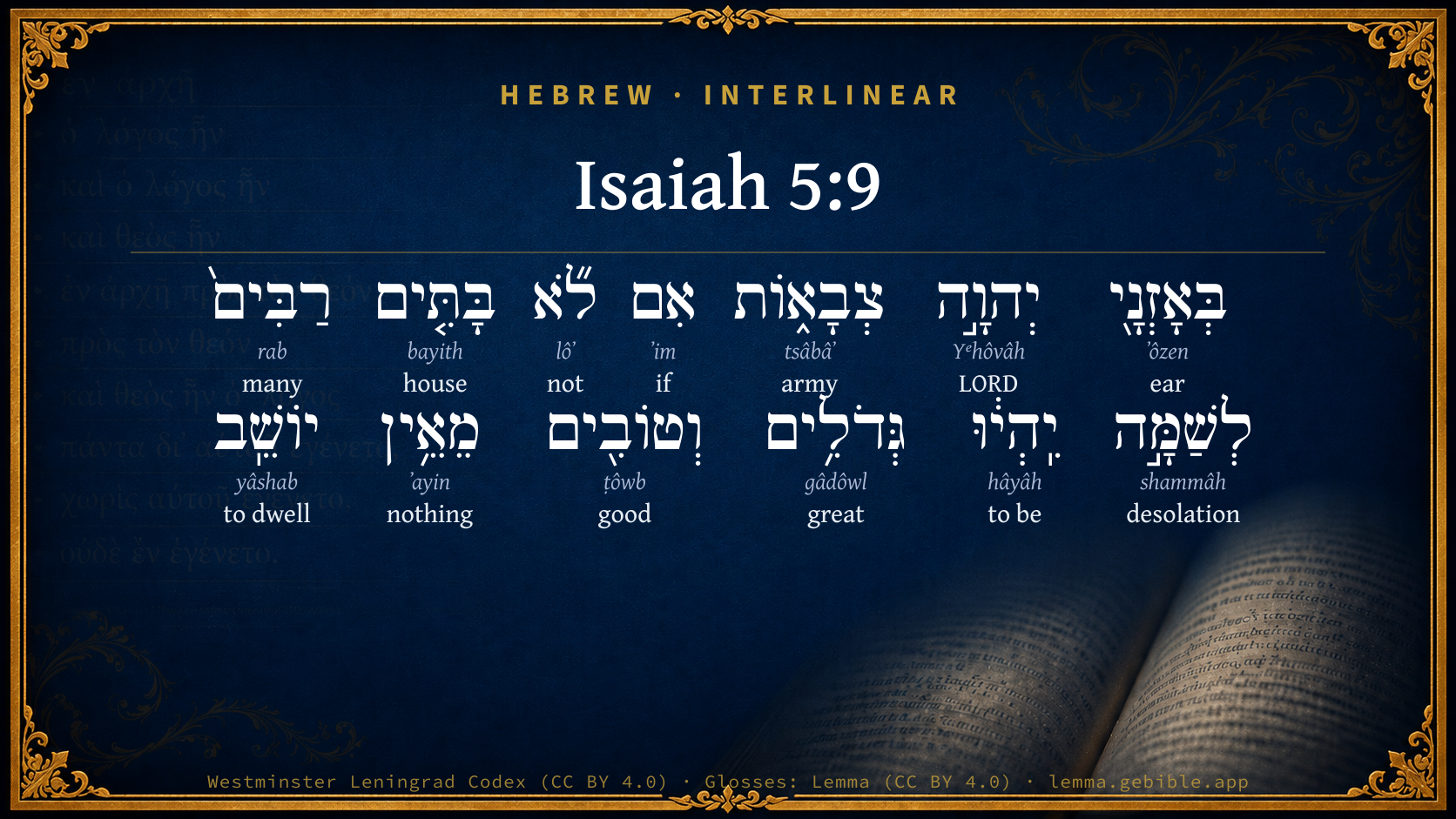
Hebrew (Westminster Leningrad Codex) Isaiah 5:9 appears in the Hebrew Old Testament. The text above is from the Westminster Leningrad Codex. Each word links to its Strong’s number, a concise gloss, and parsing drawn from the Open Scriptures Hebrew Bible morphology. Click any word for its full Brown-Driver-Briggs (BDB) entry.
Download image
Cite this verse

Isaiah 5:9 (World English Bible). Public Domain. Lemma interlinear Bible study tool, https://lemma.gebible.app/v/isaiah/5/9.

Show BibTeX & RIS
BibTeX
RIS
English Translation
In my ears, Yahweh of Hosts says: "Surely many houses will be desolate, Even great and beautiful, unoccupied.
World English Bible · Public Domain
Download a study sheet

One document with this verse’s original text, its word-by-word gloss line, the meaning frame, cross-references with their text, attributed commentary, and full source and license credits — printable, and it pastes into notes with its structure intact.

This verse Autodidact and up

Study sheet (.html) Plain text (.txt)

A passage Seminary Student

Up to 50 verses in one chapter. A passage sheet keeps up to 6 commentary sources and 12 cross-references per verse, in the order this page ranks them, and says so on the sheet whenever that leaves anything out. Ask for a single verse and you get the Autodidact verse sheet above.

Everything on this page stays free to read, with no account — the sheet is a download of what is already on screen, not access to it.

Want to remove ads? Support Godless Engineer
Compare translations 3

The same verse in 3 English versions, stacked beneath the original-language interlinear above. Click any original word for its lexicon entry.

Each is an independent rendering of the whole verse — the interlinear is not word-aligned to these translations.

Highlighted words mark where these versions differ — a whole-verse word diff, not a word-by-word alignment.

  • World English Bible Public Domain
    In my ears, Yahweh of Hosts says: "Surely many houses will be desolate, Even great and beautiful, unoccupied.
  • King James Version Public Domain
    In mine ears said the LORD of hosts, Of a truth many houses shall be desolate, even great and fair, without inhabitant.
  • unfoldingWord Literal Text CC BY-SA 4.0
    In my ears, Yahweh of Armies, “If many houses will not become a desolation, great and good, without a dweller!

unfoldingWord Literal Text — © unfoldingWord, licensed CC BY-SA 4.0. Word-aligned USFM3 via Door43 (git.door43.org/unfoldingWord/en_ult).

Versions to compare (up to 4)

3 of 4 selected

Show all 17 translations

Every available English version of this verse, each an independent rendering of the whole verse.

  • World English Bible Public Domain
    In my ears, Yahweh of Hosts says: "Surely many houses will be desolate, Even great and beautiful, unoccupied.
  • Berean Standard Bible Public Domain
    I heard the LORD of Hosts declare: “Surely many houses will become desolate, great mansions left unoccupied.
  • Majority Standard Bible Public Domain
    I heard the LORD of Hosts declare: “Surely many houses will become desolate, great mansions left unoccupied.
  • King James Version Public Domain
    In mine ears said the LORD of hosts, Of a truth many houses shall be desolate, even great and fair, without inhabitant.
  • American Standard Version (1901) Public Domain
    In mine ears `saith' Jehovah of hosts, Of a truth many houses shall be desolate, even great and fair, without inhabitant.
  • Revised Version (1885) Public Domain
    In mine ears saith the LORD of hosts, Of a truth many houses shall be desolate, even great and fair, without inhabitant.
  • Geneva Bible (1599) Public Domain
    This is in mine cares, saith the Lord of hostes. Surely many houses shall be desolate, euen great, and faire without inhabitant.
  • Young's Literal Translation Public Domain
    By the weapons of Jehovah of Hosts Do not many houses a desolation become? Great and good without inhabitant!
  • Literal Standard Version CC BY-SA 4.0
    Do many houses not become a desolation by the weapons of YHWH of Hosts? Great and good without inhabitant!
  • Unlocked Literal Bible CC BY-SA 4.0
    Yahweh of hosts told me, many houses will be empty, even great and impressive ones, without any inhabitant.
  • unfoldingWord Literal Text CC BY-SA 4.0
    In my ears, Yahweh of Armies, “If many houses will not become a desolation, great and good, without a dweller!
  • Darby Bible Public Domain
    In mine ears Jehovah of hosts [hath said], Many houses shall assuredly become a desolation, great and excellent ones, without inhabitant.
  • World Messianic Bible Public Domain
    In my ears, the LORD of Hosts says: “Surely many houses will be desolate, even great and beautiful, unoccupied.
  • Webster's Bible Public Domain
    In my ears said the LORD of hosts, Of a truth many houses shall be desolate, even great and fair, without inhabitant.
  • Free Bible Version CC BY-SA 4.0
    I heard the Lord Almighty declare: You can be sure that many houses are destined to become ruins, and beautiful mansions destined to become uninhabited.
  • Bible in Basic English Public Domain
    The Lord of armies has said to me secretly, Truly, numbers of great and fair houses will be waste, with no one living in them.
  • JPS Tanakh (1917) Public Domain
    In mine ears said the LORD of hosts: of a truth many houses shall be desolate, even great and fair, without inhabitant.

Literal Standard Version (2020), Covenant Press — licensed CC BY-SA 4.0. Text via the HelloAO Bible API (eBible.org). Unlocked Literal Bible (unfoldingWord) — licensed CC BY-SA 4.0. Text via the HelloAO Bible API (eBible.org). unfoldingWord Literal Text — © unfoldingWord, licensed CC BY-SA 4.0. Word-aligned USFM3 via Door43 (git.door43.org/unfoldingWord/en_ult). Free Bible Version, Dr. Jonathan Gallagher — licensed CC BY-SA 4.0. Text via the HelloAO Bible API (eBible.org).

Word by word

More ways to search: Search by grammar → Find every occurrence → Compare this word →

Practice this passage: Drill this verse → Learn its vocabulary →

לְשַׁמָּ֣ה
shammâh
H8047
“to/for · desolation”
Preposition + Noun, Common, Feminine, Singular, Absolute
Part of Speech
Preposition + Noun
Type
Common
Gender
Feminine
Number
Singular
State
Absolute
Full BDB Definition

Origin: from H8074

TWOT: 2409d

waste, horror, appalment - a waste (of land, city, etc) - appalment, horror
  1. בְּאָזְנָ֖י ʼôzen H241 “in/at · ears · my” Preposition + Noun, Common, Feminine, Dual, Construct + Suffix, Personal, 1st Person, Common, Singular
  2. יְהוָ֣ה Yᵉhôvâh H3068 “LORD” Noun, Proper
  3. צְבָא֑וֹת tsâbâʼ H6635 “armies” Noun, Common, Both, Plural, Absolute
  4. אִם ʼim H518 “if” Conjunction
  5. לֹ֞א lôʼ H3808 “not” Particle, Negative
  6. בָּתִּ֤ים bayith H1004 “houses” Noun, Common, Masculine, Plural, Absolute
  7. רַבִּים֙ rab H7227 “many” Adjective, Adjective, Masculine, Plural, Absolute
  8. יִֽהְי֔וּ hâyâh H1961 “to be” Verb, Qal, Imperfect, 3rd Person, Masculine, Plural
  9. גְּדֹלִ֥ים gâdôwl H1419 “great” Adjective, Adjective, Masculine, Plural, Absolute
  10. וְטוֹבִ֖ים ṭôwb H2896 “and · good” Conjunction + Adjective, Adjective, Masculine, Plural, Absolute
  11. מֵאֵ֥ין ʼayin H369 “from · nothing” Preposition + Particle, Negative
  12. יוֹשֵֽׁב yâshab H3427 “dwelling” Verb, Qal, Participle Active, Masculine, Singular, Absolute

About this verse

These counts appear in no published source. They are computed here, from the morphology-tagged text and Lemma’s own curated glosses. What Lemma adds →

13
words
13
distinct lemmas
Prophets
section

Shared distinctive vocabulary

לְשַׁמָּ֣ה desolation H8047 occurs in 39 verses of the Hebrew Bible. Also found in:

Grammatical profile

  • 2 verbs
  • 5 nouns
  • 3 adjectives
  • 1 conjunction
  • 2 particles

Verb forms

  • יִֽהְי֔וּ Qal · Imperfect
  • יוֹשֵֽׁב Qal · Participle Active

Hebrew & Septuagint length

In English translation the verse runs 18 words from the Hebrew and 34 from the Septuagint (LXX English) — the Septuagint runs noticeably longer here. See the side-by-side →

A rough comparison of the two English renderings, which tokenize alike — not a word-level alignment.

Word counts can differ between the Hebrew and the Greek without any difference in meaning — e.g. the Hebrew direct-object marker אֵת has no separate Greek word, and Greek often adds the article ὁ.

Cross-references

10

Topical passages linked to Isaiah 5:9 in the Treasury of Scripture Knowledge — connected by theme and wording, ordered by reader-vote popularity; previews shown in the World English Bible.

  • Matthew 23:38 Behold, your house is left to you desolate.
  • Isaiah 22:14 Yahweh of Hosts revealed himself in my ears, Surely this iniquity shall not be forgiven you until you die, says the Lord, Yahweh of Hosts.
  • Amos 3:7 Surely the Lord Yahweh will do nothing, Unless he reveals his secret to his servants the prophets.
  • Amos 5:11 Forasmuch therefore as you trample on the poor, And take taxes from him of wheat: You have built houses of hewn stone, But you will not dwell in them. You have planted pleasant vineyards, But you shall not drink their wine.
  • 2 Chronicles 36:21 to fulfill the word of Yahweh by the mouth of Jeremiah, until the land had enjoyed its Sabbaths: [for] as long as it lay desolate it kept Sabbath, to fulfill seventy years.
  • Isaiah 5:6 I will lay it a wasteland. It won't be pruned nor hoed, But it will grow briers and thorns. I will also command the clouds that they rain no rain on it."
  • Isaiah 6:11–12 Then I said, "Lord, how long?" He answered, "Until cities are waste without inhabitant, And houses without man, And the land becomes utterly waste,
  • Isaiah 27:10 For the fortified city is solitary, a habitation deserted and forsaken, like the wilderness: there shall the calf feed, and there shall he lie down, and consume the branches of it.
  • Amos 6:11 "For, behold, Yahweh commands, and the great house will be smashed to pieces, And the little house into bits.
  • Matthew 22:7 When the king heard that, he was angry, and he sent his armies, destroyed those murderers, and burned their city.

Cross-references courtesy of OpenBible.info (CC BY 4.0).

Hebrew and Greek witnesses Masoretic Hebrew ↔ Greek Septuagint

The same verse in the two great witnesses to the Old Testament, shown verse-for-verse.

Here the Septuagint runs noticeably longer than the Hebrew — LXX2012 (modern English Septuagint) 34 words vs World English Bible 18. A rough length comparison of the two English translations, not a word-level alignment — read both below.

These are two independent witnesses, not word-aligned to each other, and the Septuagint is shown in lemma (dictionary) form.

Hebrew Isaiah 5:9 Masoretic · Westminster Leningrad Codex

בְּאָזְנָ֖י יְהוָ֣ה צְבָא֑וֹת אִם לֹ֞א בָּתִּ֤ים רַבִּים֙ לְשַׁמָּ֣ה יִֽהְי֔וּ גְּדֹלִ֥ים וְטוֹבִ֖ים מֵאֵ֥ין יוֹשֵֽׁב

In my ears, Yahweh of Hosts says: "Surely many houses will be desolate, Even great and beautiful, unoccupied.

World English Bible · Public Domain

Greek LXX Isaiah 5:9 Septuagint · lemma form

ἀκούω γάρ εἰς ὁ οὖς κύριος σαβαωθ οὗτος ἐάν γάρ γίγνομαι οἰκία πολύς εἰς ἔρημος εἰμί μέγας καί καλός καί οὐ εἰμί ὁ ἐνοἰκέω ἐν αὐτός

For these things have reached the ears of the Lord of hosts: for though many houses should be built, many and fair houses shall be desolate, and there shall be no inhabitants in them.

LXX2012 (modern English Septuagint) · Public Domain

On this verse, Adam Clarke's Commentary discusses the Septuagint’s reading. Read the note in Commentary ↓

Hebrew: Westminster Leningrad Codex (CC BY 4.0). Greek: Septuagint (public domain); English from LXX2012 (modern English Septuagint) (Public Domain). How the Septuagint differs from the Hebrew →

Targum (Aramaic paraphrase)

1

The Targum is the ancient Jewish Aramaic paraphrase of the Hebrew Scriptures — an interpretive translation, not the Hebrew text itself. Onkelos (literal) and Pseudo-Jonathan (expansive) render the Torah, and Jonathan the Prophets. Coverage is partial: where no permissively-licensed English translation exists for a verse, only the Aramaic is shown. This is verse-level text, not a word-by-word alignment to the Hebrew.

  1. Targum Jonathan Prophets (Joshua–Malachi)
    אֲמַר נְבִיָא בְּאוּדְנַי הֲוֵיתִי שָׁמַע כַּד אִתְגְזָרֵית דָא מִן קֳדָם יְיָ צְבָאוֹת אִם לָא בָּתִּין סַגִיאִין לְצָדוּ יְהוֹן רַבְרְבִין וְטָבִין מִבְּלִי יָתֵיב:

    The prophet said, With mine ears I have heard when this was decreed from before the Lord of hosts, Of a truth many houses shall be desolate, even the great and the fair, without inhabitant.

    Targum Jonathan — Aramaic: “Mikraot Gedolot” (public domain). English: “Sefaria Community Translation” (CC0 1.0 (public-domain dedication)); “London "Chaldee Paraphrase," 1871” (public domain). Text via Sefaria.

Commentary

Notes on Isaiah 5:9 from classic Christian and Jewish commentators (each source and its license shown beneath its notes). The classic Christian expositions comment on the surrounding passage and are grouped to its opening verse, so a note may address several verses; the Jewish commentaries on the Tanakh (Rashi and others) are per-verse, so they appear only where the commentator wrote on this verse.

Lemma curates 59 commentaries, every one of them public domain or Creative Commons licensed, each selected and text-cleaned for this edition rather than reprinted as found. About our sources →

Trapp's Complete Commentary

John Trapp

Isa 5:9 In mine ears [said] the LORD of hosts, Of a truth many houses shall be desolate, [even] great and fair, without inhabitant.

Ver. 9. In mine ears, said the Lord of hosts.] Or, In the ears of the Lord of hosts - q.d., God well heareth and knoweth all your cunning contrivances, your coloured and cloaked covetousness, as it is called {1Th 2:5 2Pe 1:3} The cries also of those poor whom you have by fraud or force unroosted and undone, is come into God’s ears, {Deu 15:9; Deu 24:15} and he will reckon with you, though by your greatness you can bear out your wrong dealing, because it is facinus maioris abollae. Yet God will arraign you one day for an Abaddon; and in the meanwhile,

Of a truth many houses shall be desolate.] You shall be driven out of your great and fair houses, aut a milite, aut a morte, either by the enemy or by death, who shall come upon you with a firmae eiectione, forceful ejection and then the place of your habitation shall know you no more; a poor fool God will make of you. {Jer 17:11 Luk 12:20} If many houses be not desolate, never trust him more - if they be not left for caddows and jackdaws {a} to dwell in.

{a} The common name of the daw (Corvus monedula), one of the smallest of the crow family, which frequents old buildings, church towers, etc.; it is easily tamed and taught to imitate the sound of words, and is noted for its loquacity and thievish propensities.

John Trapp, A Commentary or Exposition upon All the Books of the Old and New Testament (1647–1656) — public domain. Text from a community e-Sword module.

The Biblical Illustrator

Joseph S. Exell

Isa_5:9

Many houses shall be desolate, even great and fair, without inhabitant

Empty houses

(To children):--Empty houses! We all know what they look like.

From afar we can see the bills in the windows--This house to let, or To be let, or, still more curtly, To let; and when we come nearer, the black windows, without blinds or curtains, gape and yawn at us. In the garden the long matted grass has overrun the lawn, and covered nearly all the beds. The door creaks on its hinges as we enter, as though it had been asleep and did not wish to be wakened. There are other houses that are not quite empty. They are comfortably furnished; but the family has gone to the seaside. A servant or an old lady has been kept in the house as caretaker, and as she usually lives in the back part of the house she is often not seen from one weeks end to the other.

I. This world is like a house comfortably and beautifully furnished, and in which we men and women have been placed to dress it and to keep it. But THE WORLD WITHOUT GOD IS LIKE AN EMPTY HOUSE. God is the builder of this house; and He is the tenant too. Cowper, in his Task, speaks of some men who untenant the Creator of His universe. There are some who say that God made this house, and put us in it as caretakers, and then went to live in His own grand mansion in heaven; and there He sits, receiving our letters, which are our prayers, and sending His servants to do His commands. But we believe that God always lives in this house. He is in every room, in England, and in the Continent, and in Africa, and in America. It is Gods name that is woven into the beautiful carpet of grass and flowers, that is carved into the rocks, and worked into the mossy couches, and painted in the beautiful landscape pictures, and reflected in the mirror-like lakes and ponds and rivers. If God were not in the world it would be like a desolate house, though great and fair.

II.

But there is another kind of house that is sometimes found to be empty.

Life is like a house. Its length, however, is measured, not by feet and yards, but by days and months and years. Some lives are long and some are very short. Its breadth is measured by its sympathy and influence. Sometimes the tenant is not a good one. A selfish purpose takes possession, and then the house is like the house of a miser, long, and narrow, and low. And sometimes the house is like a house of feasting, from which there comes the sound of music and dancing, and the clink of glasses and of plates. That is when the desire for pleasure becomes a tenant. But there are some of these houses that are without an inhabitant. For A LIFE WITHOUT A PURPOSE IS LIKE AN EMPTY HOUSE. Some people do not know why they live. They eat and drink and sleep; but they have no great aims, no noble purposes. Their lives are like empty houses. Take Christ with you into your life. And then your life will grow up like a grand temple, upon which there will be inscribed: Holiness unto the Lord; in which there will be perpetual peace and happiness; and from which there will ever come the sound of holy chant and psalm.

III. And then there is another house of which I thought. It was a small house, but large enough to accommodate one man. It was built in the face of a rock, and a great stone door was placed before it. It belonged to a man named Joseph; but another tenant was put in. He did not remain there long: it was too dark, and cold, and dreary. That house was the tomb of Jesus. And A TOMB WITHOUT A SAVIOUR IS LIKE AN EMPTY HOUSE. There are many houses of that kind built in these days; and they are all full. But a time is coming when a trumpet shall sound, and the doors of these dreary houses shall be opened, and the tenants shall all come out. And then their houses shall be empty like the tomb of Jesus. (W. V. Robinson, B. A.)

The Biblical Illustrator, edited by Joseph S. Exell (c. 1880s–1900s) — public domain. Text from a community e-Sword module.

Keil & Delitzsch

C. F. Keil & F. Delitzsch

And the denunciation of punishment is made by him in very similar terms to those which we find here in Isa 5:9, Isa 5:10 : "Into mine ears Jehovah of hosts: Of a truth many houses shall become a wilderness, great and beautiful ones deserted. For ten yokes of vineyard will yield one pailful, and a quarter of seed-corn will produce a bushel." We may see from Isa 22:14 in what sense the prophet wrote the substantive clause, "Into mine ears," or more literally, "In mine ears is Jehovah Zebaoth," viz., He is here revealing Himself to me. In the pointing, בּאזני is written with tiphchah as a pausal form, to indicate to the reader that the boldness of the expression is to be softened down by the assumption of an ellipsis. In Hebrew, "to say into the ears" did not mean to "speak softly and secretly," as Gen 23:10, Gen 23:16; Job 33:8, and other passages, clearly show; but to speak in a distinct and intelligible manner, which precludes the possibility of any misunderstanding. The prophet, indeed, had not Jehovah standing locally beside him; nevertheless, he had Him objectively over against his own personality, and was well able to distinguish very clearly the thoughts and words of his own personality, from the words of Jehovah which arose audibly within him. These words informed him what would be the fate of the rich and insatiable landowners. "Of a truth:" אם־לא (if not) introduces an oath of an affirmative character (the complete formula is Chai ani 'im-lo', "as I live if not"), just as 'im (if) alone introduces a negative oath (e.g., Num 14:23). The force of the expression 'im-lo' extends not only to rabbim, as the false accentuation with gershayim (double-geresh) would make it appear, but to the whole of the following sentence, as it is correctly accentuated with rebia in the Venetian (1521) and other early editions. A universal desolation would ensue: rabbim (many) does not mean less than all; but the houses (bâttim, as the word should be pronounced, notwithstanding Ewald's objection to Khler's remarks on Zac 14:2; cf., Job 2:1-13 :31) constituted altogether a very large number (compare the use of the word "many" in Isa 2:3; Mat 20:28, etc.). מאין is a double, and therefore an absolute, negation (so that there is not, no inhabitant, i.e., not any inhabitant at all). Isa 5:10, which commences, with Ci, explains how such a desolation of the houses would be brought about: failure of crops produces famine, and this is followed by depopulation. "Ten zimdē (with dagesh lene, Ewald) of vineyard" are either ten pieces of the size that a man could plough in one day with a yoke of oxen, or possibly ten portions of yoke-like espaliers of vines, i.e., of vines trained on cross laths (the vina jugata of Varro), which is the explanation adopted by Biesenthal. But if we compare Sa1 14:14, the former is to be preferred, although the links are wanting which would enable us to prove that the early Israelites had one and the same system of land measure as the Romans;

(Note: On the jugerum, see Hultsch, Griechische und rmische Metrologie, 1862. The Greek plethron, which was smaller by two and a half, corresponded to some extent to this; also the Homeric tetraguon, which cannot be more precisely defined (according to Eustathius, it was a piece of land which a skilful labourer could plough in one day). According to Herod. ii. 168, in the Egyptian square-measure an a'roura was equal to 150 cubits square. The Palestinian, according to the tables of Julian the Ashkalonite, was the plethron. "The plethron," he says, "was ten perches, or fifteen fathoms, or thirty paces, sixty cubits, ninety feet" (for the entire text, see L. F. V. Fennersberg's Untersuchungen ber alte Langen-, Feld-, und Wegemaase, 1859). Fennersberg's conclusion is, that the tzemed was a plethron, equal in length to ten perches of nine feet each. But the meaning of the word tzemed is of more importance in helping to determine the measure referred to, than the tables of long measure of the architect of Ashkalon, which have been preserved in the imperial collection of laws of Constantine Harmenopulos, and which probably belong to a much later period.)

nevertheless Arab. fddân (in Hauran) is precisely similar, and this word signifies primarily a yoke of oxen, and then a yoke (jugerum) regarded as a measure of land. Ten days' work would only yield a single bath. This liquid measure, which was first introduced in the time of the kings, corresponded to the ephah in dry measure (Eze 45:11). According to Josephus (Ant. viii. 2, 9), it was equal to seventy-two Roman sextarii, i.e., a little more than thirty-three Berlin quarts; but in the time of Isaiah it was probably smaller. The homer, a dry measure, generally called a Cor after the time of the kings, was equal to ten Attic medimnoi;

(Note: Or rather 7 1/2 Attic medimnoi = 10 Attic metretoi = 45 Roman modia (see Bckh, Metrologische Untersuchungen, p. 259).)

a medimnos being (according to Josephus, Ant. xv 9, 2) about 15-16ths of a Berlin bushel, and therefore a little more than fifteen pecks. Even if this quantity of corn should be sown, they would not reap more than an ephah.The harvest, therefore, would only yield the tenth part of the sowing, since an ephah was the tenth part of a homer, or three seahs, the usual minimum for one baking (vid., Mat 13:33). It is, of course, impossible to give the relative measure exactly in our translation.

Keil & Delitzsch — Biblical Commentary on the Old Testament (1861–1891) — public domain (CC PDM 1.0). Text via the HelloAO Bible API. (Old Testament only.)

Geneva Bible (1599)

Geneva Bible translators

I have heard the complaint and cry of the poor.

Geneva Bible (1599) marginal notes — public domain. Text via Bolls.life.

Jamieson, Fausset & Brown

Robert Jamieson, A. R. Fausset & David Brown

In mine ears . . . the Lord--namely, has revealed it, as in Isa 22:14.

desolate--literally, "a desolation," namely, on account of the national sins.

great and fair--houses.

Jamieson, Fausset & Brown — Commentary Critical and Explanatory on the Whole Bible (1871) — public domain (CC PDM 1.0). Text via the HelloAO Bible API.

Adam Clarke's Commentary

Verse 9. In mine ears. - "To mine ear"] The sentence in the Hebrew text seems to be imperfect in this place; as likewise in Isa 22:14, where the very same sense seems to be required as here. See the note there; and compare 1Sa 9:15. In this place the Septuagint supply the word ηκουσθη, and the Syriac אשתמע eshtama, auditus est JEHOVAH in auribus meis, i.e., נגלה niglah, as in Isa 22:14.

Many houses] This has reference to what was said in the preceding verse: "In vain are ye so intent upon joining house to house, and field to field; your houses shall be left uninhabited, and your fields shall become desolate and barren; so that a vineyard of ten acres shall produce but one bath (not eight gallons) of wine, and the husbandman shall reap but a tenth part of the seed which he has sown." Kimchi says this means such an extent of vineyard as would require ten yoke of oxen to plough in one day.

Adam Clarke's Commentary on the Bible (1810–1826) — public domain. Text from a community e-Sword/MySword module.

Ellicott's Commentary for English Readers

(9) In mine ears said the Lord.—The italics show that there is no verb in the Hebrew, the text, if it be correct, giving the emphasis of abruptness; but it is rightly supplied in the Authorised Version. The sentence that follows is one of a righteous retribution: There shall be no profit or permanence in the property thus unjustly gained.

A Bible Commentary for English Readers, edited by Charles John Ellicott (1878–1897) — public domain. Text from a community e-Sword module.

The Cambridge Bible for Schools and Colleges

gen. ed. J. J. S. Perowne

9. In mine ears said the Lord of hosts] The verb is to be supplied as in Isa_22:14 : In my ears (hath revealed himself) Jehovah.… It is a prophetic “audition”; the words which follow seem actually to sound in his ears. The great houses shall be uninhabited, because—

9, 10. The divine judgment on this evil. Cf. Amo_5:11.

The Cambridge Bible for Schools and Colleges (gen. ed. J. J. S. Perowne; Cambridge University Press, 1878–1918) — public domain. Text from a community e-Sword module.

John Gill's Exposition

In mine ears, said the Lord of hosts,.... This may be understood either of the ears of the Lord of hosts, into which came the cry of the sins of covetousness and ambition before mentioned; these were taken notice of by the Lord, and he was determined to punish them; or of the ears of the prophet, in whose hearing the Lord said what follows: so the Targum,

"the prophet said, with mine ears I have heard, when this was decreed from before the Lord of hosts:''

of a truth many houses shall be desolate; or "great" ones (z); such as the houses of the king, of the princes, and nobles, judges, counsellors, and great men of the earth; not only the house of God, the temple, but a multitude of houses in Jerusalem and elsewhere; which was true not only at the taking of Jerusalem by the Chaldeans, but at the destruction of it by the Romans, to which this prophecy belongs, Mat 23:38 the words are a strong asseveration, and in the form of an oath, as Jarchi and Kimchi observe; , "if not"; if many houses are not left desolate, let it be so or so, I swear they shall:

even great and fair, without inhabitants: houses of large and beautiful building shall be laid in such a ruinous condition, that they will not be fit for any to dwell in, nor shall any dwell in them: and this is the judgment upon them for joining house to house; that for laying field to field follows.

(z) "domus magnificae, sive sumptuosae", Vatablus.

John Gill's Exposition of the Whole Bible (1746–1763) — public domain (CC PDM 1.0). Text via the HelloAO Bible API.

Albert Barnes' Notes on the Bible

In mine ears - This probably refers to the prophet. As if he had said, ‘God has revealed it to me,’ or ‘God has said in my ears,’ i. e, to me. The Septuagint reads it, ‘These things are heard in the ears of the Lord of hosts,’ that is, the wishes” of the man of avarice. The Chaldee, ‘The prophet said, In my ears I have heard; a decree has gone from the Lord of hosts,’ etc.

Many houses shall be desolate - Referring to the calamities that should come upon the nation for its crimes.

Albert Barnes' Notes on the Bible (1834–1885) — public domain. Text from a community e-Sword/MySword module.

Haydock's Catholic Bible Commentary

Things. Unjust practices. --- Inhabitant. What will your avarice avail, (Haydock) since you must abandon all? (Calmet)

George Leo Haydock (1774–1849), Haydock's Catholic Family Bible and Commentary, 1859 edition — public domain. Excludes Psalms (Douay-Rheims chapter numbering differs from Protestant) and Deuterocanonical books (Catholic canon only).

Matthew Poole's English Annotations

In mine ears said the Lord; I heard God speak what I now about to utter. Heb. In the ears of the Lord; may relate either,

1. To the foregoing words; The cry of your sins, and of the oppressed, as come into God’s he hears and sees it, and will certainly punish it.

2. To the following clause, which being of great importance, he ushers in with an oath; I speak it in God’s as well as in yours; I call God to witness the truth of what I say. My houses shall be desolate; the houses you have so greedily coveted shall cast you out, and become desolate.

Matthew Poole's English Annotations on the Holy Bible (1683–1685) — public domain. Text from a community e-Sword/MySword module.

Whedon's Commentary on the Bible

Daniel D. Whedon

9, 10. Many houses shall be desolate — Without occupant, desolation dwelling there, because of the invasion invoked below, in Isa_5:26-30.

Great and fair — Aristocratic though they be.

Ten acres — An acre was a space of ground ploughed by a man with a yoke of oxen in one day, about three fourths of an English acre. Ten acres of vineyard, it is estimated, (Kay,) might be expected ordinarily to produce 32,000 pints of wine, or 500 baths, instead of which it is here said they shall produce but one.

A homer — About ten bushels, enough to sow ten acres, but here only one bushel is promised. A bath was a liquid measure, in capacity one tenth of a “homer,” a dry measure. Eze_45:11-14. God directly permits devastation like this as a punishment for these specified sins. Compare Lev_26:20 with Isa_24:7 and Joe_1:10-12.

Daniel D. Whedon (gen. ed.), Commentary on the Old and New Testaments (1874–1909) — public domain. Text from a community e-Sword module.

The Pulpit Commentary

Either something has fallen out in the first clause of this verse, or there is a most unusual ellipse of the verb said" which our translators have supplied, very properly. There seems to be nothing emphatic in the words, "on mine ears". (see Isa_22:14 Eze_9:1, 5 10:13) Many houses shall be desolate. The greed of adding house to house will be punished by the death of those who have so sinned, and the extinction of their families, either through war, or through a more direct divine judgment.

The Pulpit Commentary (1880–1919), ed. H.D.M. Spence-Jones & Joseph S. Exell — public domain. Text from a community e-Sword module.

John Wesley's Explanatory Notes

In mine ears - I heard God speak what I am about to utter.

John Wesley, Explanatory Notes Upon the Whole Bible (1754–1765) — public domain. Text via the GEBible commentary corpus.

J. A. Alexander on Isaiah

Joseph Addison Alexander

The inordinate desire of lands and houses shall be punished by the loss of them, vs. 9, 10. And first, he threatens that the valuable houses which they coveted, and gained by fraud or violence, shall one day be left empty, an event implying the death, captivity, or degradation of their owners. “In my ears Jehovah of Hosts is saying,” as if His voice were still ringing in the Prophet’s ears, “of a truth” (literally, if not, being part of an old formula of swearing, ‘may it be so and so if’ etc.; so that the negative form conveys the strongest affirmation, surely, certainly) “many houses shall become a desolation, great and good (houses), for want of an inhabitant.”

Joseph Addison Alexander, The Prophecies of Isaiah (1846–1847; New York: Scribner, 1870–1878) — public domain. Text from a community e-Sword module.

Rashi

Rabbi Shlomo Yitzchaki (Rashi)

In my ears [spoke] the Lord of Hosts Said the prophet, Both my ears heard when the decree was decreed upon them by the Lord, and with an oath, “Truly, because of this thing, great houses will become desolate, yea, large ones and good ones, without inhabitants.”

Rashi on the Tanakh — English translations: “The Judaica Press complete Tanach with Rashi, translated by A. J. Rosenberg” (CC BY 4.0); “Pentateuch with Rashi's commentary by M. Rosenbaum and A.M. Silbermann, 1929-1934” (public domain); “The Metsudah Tanach series, Lakewood, N.J” (CC BY 4.0); and “The Book of Joshua, Metsudah Publications, 1997” (CC BY 4.0). Text via Sefaria.

Ibn Ezra

Rabbi Abraham ibn Ezra

באזנָי באזנֵי יי ═ באזני יי To mine ears, the ears of the Lord, has come the report of the injustice which you have committed; comp. נביאכם יי Your prophet, the prophet of the Lord (Num. 12:6); or, referring באזני to the prophet, supply אמר said, or קול came the voice of.

Ibn Ezra on the Tanakh — English translations: “Sefaria Community Translation” (CC0 1.0 (public-domain dedication)); “Yalkut, Sifsei Chachomim Chumash, Metsudah Publications, 2009” (CC BY 4.0); and “Commentary of Ibn Ezra on Isaiah - trans. by M. Friedlander, 1873” (public domain). Text via Sefaria.

Lesson kit

Teaching starters — assembled from the data on this page, not authored interpretation. Every prompt links to the verse data it draws on. Edit before teaching.

Isaiah, in the Prophets, opens this verse with 13 words (13 distinct Hebrew lemmas). Its most distinctive word is shammâh (“desolation”). The Greek Septuagint runs longer here. A historical commentator’s framing appears above. Read the whole chapter for the surrounding context.

Discussion questions

  1. How does “desolation” (shammâh) shape what this verse is saying?
  2. How does Deuteronomy 28:37, which shares the word «desolation», read alongside this verse?
  3. The Septuagint runs longer here than the Hebrew. What might account for the difference?
  4. These translations render this verse differently. What is at stake in choosing one wording over another?
  5. «יִֽהְי֔וּ» is a Qal Imperfect verb. How does that grammatical form shape the action described?
  6. Compare how Trapp's Complete Commentary and The Biblical Illustrator read this verse. Where do they agree or differ?

Things to notice

Reading settings

Reading text

Shown beneath each verse's original-language words.

Old Testament
Old Testament edition

Read the OT as the Masoretic Hebrew (MT) or the Greek Septuagint (LXX).

English shown for the Greek Septuagint (in the Hebrew ↔ Greek comparison).

Comparing translations? Open the Compare panel on any verse page to stack up to four side by side.