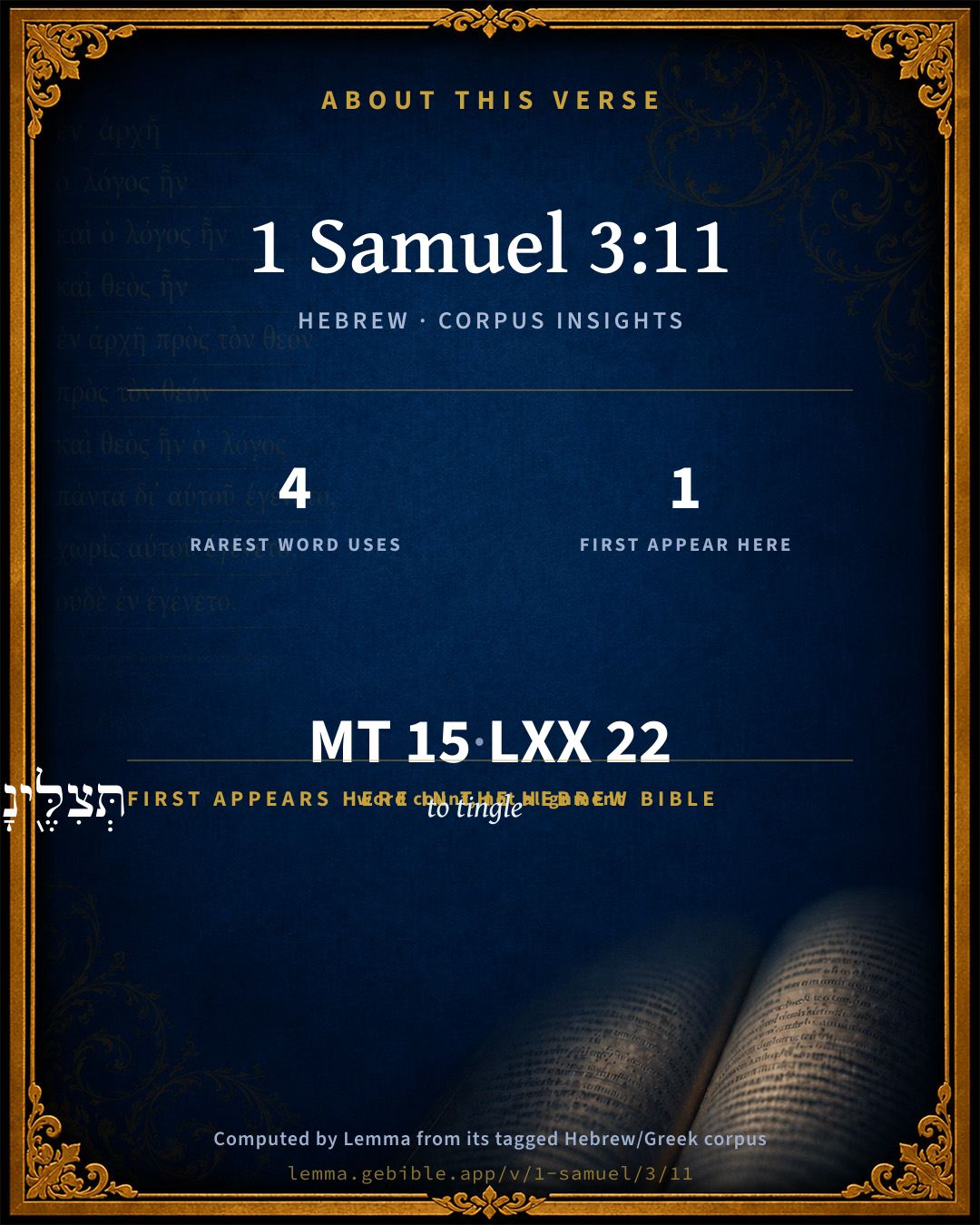
1 Samuel 3:11

Hebrew (Westminster Leningrad Codex) 1 Samuel 3:11 appears in the Hebrew Old Testament. The text above is from the Westminster Leningrad Codex. Each word links to its Strong’s number, a concise gloss, and parsing drawn from the Open Scriptures Hebrew Bible morphology. Click any word for its full Brown-Driver-Briggs (BDB) entry.
Download image
Cite this verse

1 Samuel 3:11 (World English Bible). Public Domain. Lemma interlinear Bible study tool, https://lemma.gebible.app/v/1-samuel/3/11.

Show BibTeX & RIS
BibTeX
RIS
English Translation
Yahweh said to Samuel, Behold, I will do a thing in Israel, at which both the ears of everyone who hears it shall tingle.
World English Bible · Public Domain
Highlights
  • 1 first appearance in the Hebrew Bible
Full analysis ↓
Download a study sheet

One document with this verse’s original text, its word-by-word gloss line, the meaning frame, cross-references with their text, attributed commentary, and full source and license credits — printable, and it pastes into notes with its structure intact.

This verse Autodidact and up

Study sheet (.html) Plain text (.txt)

A passage Seminary Student

Up to 50 verses in one chapter. A passage sheet keeps up to 6 commentary sources and 12 cross-references per verse, in the order this page ranks them, and says so on the sheet whenever that leaves anything out. Ask for a single verse and you get the Autodidact verse sheet above.

Everything on this page stays free to read, with no account — the sheet is a download of what is already on screen, not access to it.

Want to remove ads? Support Godless Engineer
Compare translations 3

The same verse in 3 English versions, stacked beneath the original-language interlinear above. Click any original word for its lexicon entry.

Each is an independent rendering of the whole verse — the interlinear is not word-aligned to these translations.

Highlighted words mark where these versions differ — a whole-verse word diff, not a word-by-word alignment.

  • World English Bible Public Domain
    Yahweh said to Samuel, Behold, I will do a thing in Israel, at which both the ears of everyone who hears it shall tingle.
  • King James Version Public Domain
    And the LORD said to Samuel, Behold, I will do a thing in Israel, at which both the ears of every one that heareth it shall tingle.
  • unfoldingWord Literal Text CC BY-SA 4.0
    And Yahweh said to Samuel, “Behold, I am doing a thing in Israel that everyone hearing it, the two of his ears will tingle.

unfoldingWord Literal Text — © unfoldingWord, licensed CC BY-SA 4.0. Word-aligned USFM3 via Door43 (git.door43.org/unfoldingWord/en_ult).

Versions to compare (up to 4)

3 of 4 selected

Show all 18 translations

Every available English version of this verse, each an independent rendering of the whole verse.

  • World English Bible Public Domain
    Yahweh said to Samuel, Behold, I will do a thing in Israel, at which both the ears of everyone who hears it shall tingle.
  • Berean Standard Bible Public Domain
    Then the LORD said to Samuel, “I am about to do something in Israel at which the ears of all who hear it will tingle.
  • Majority Standard Bible Public Domain
    Then the LORD said to Samuel, “I am about to do something in Israel at which the ears of all who hear it will tingle.
  • King James Version Public Domain
    And the LORD said to Samuel, Behold, I will do a thing in Israel, at which both the ears of every one that heareth it shall tingle.
  • American Standard Version (1901) Public Domain
    And Jehovah said to Samuel, Behold, I will do a thing in Israel, at which both the ears of every one that heareth it shall tingle.
  • Revised Version (1885) Public Domain
    And the LORD said to Samuel, Behold, I will do a thing in Israel, at which both the ears of every one that heareth it shall tingle.
  • Geneva Bible (1599) Public Domain
    Then the Lord said to Samuel, Beholde, I wil doe a thing in Israel, whereof whosoeuer shall heare, his two eares shall tingle.
  • Douay-Rheims (1899) Public Domain
    And the Lord said to Samuel: Behold I do a thing in Israel: and whosoever shall hear it, both his ears shall tingle.
  • Young's Literal Translation Public Domain
    And Jehovah saith unto Samuel, `Lo, I am doing a thing in Israel, at which the two ears of every one hearing it do tingle.
  • Literal Standard Version CC BY-SA 4.0
    And YHWH says to Samuel, “Behold, I am doing a thing in Israel, at which the two ears of everyone hearing it tingle.
  • Unlocked Literal Bible CC BY-SA 4.0
    Yahweh said to Samuel, “See, I am about to do something in Israel at which the ears of everyone who hears it will tingle.
  • unfoldingWord Literal Text CC BY-SA 4.0
    And Yahweh said to Samuel, “Behold, I am doing a thing in Israel that everyone hearing it, the two of his ears will tingle.
  • Darby Bible Public Domain
    And Jehovah said to Samuel, Behold, I do a thing in Israel, at which both the ears of every one that heareth it shall tingle.
  • World Messianic Bible Public Domain
    The LORD said to Samuel, “Behold, I will do a thing in Israel at which both the ears of everyone who hears it will tingle.
  • Webster's Bible Public Domain
    And the LORD said to Samuel, Behold, I will do a thing in Israel, at which both the ears of every one that heareth it shall tingle.
  • Free Bible Version CC BY-SA 4.0
    The Lord told Samuel: “Pay attention, because I'm going to do something in Israel that will surprise everyone who hears it.
  • Bible in Basic English Public Domain
    And the Lord said to Samuel, See, I will do a thing in Israel at which the ears of everyone hearing of it will be burning.
  • JPS Tanakh (1917) Public Domain
    And the LORD said to Samuel: 'Behold, I will do a thing in Israel, at which both the ears of every one that heareth it shall tingle.

Literal Standard Version (2020), Covenant Press — licensed CC BY-SA 4.0. Text via the HelloAO Bible API (eBible.org). Unlocked Literal Bible (unfoldingWord) — licensed CC BY-SA 4.0. Text via the HelloAO Bible API (eBible.org). unfoldingWord Literal Text — © unfoldingWord, licensed CC BY-SA 4.0. Word-aligned USFM3 via Door43 (git.door43.org/unfoldingWord/en_ult). Free Bible Version, Dr. Jonathan Gallagher — licensed CC BY-SA 4.0. Text via the HelloAO Bible API (eBible.org).

Word by word

More ways to search: Search by grammar → Find every occurrence → Compare this word →

Practice this passage: Drill this verse → Learn its vocabulary →

תְּצִלֶּ֖ינָה
tsâlal
H6750
“to tingle”
Verb, Hiphil, Imperfect, 3rd Person, Feminine, Plural
Part of Speech
Verb
Stem
Hiphil
Form
Imperfect
Person
3rd Person
Gender
Feminine
Number
Plural
Full BDB Definition

Origin: a primitive root [identical with H6749 through the idea of vibration]

TWOT: 1919

to tingle, quiver - (Qal) - to tingle (of ears) - to quiver (of fear)
  1. וַיֹּ֤אמֶר ʼâmar H559 “and · to say” Conjunction + Verb, Qal, Sequential Imperfect, 3rd Person, Masculine, Singular
  2. יְהוָה֙ Yᵉhôvâh H3068 “LORD” Noun, Proper
  3. אֶל ʼêl H413 “to” Preposition
  4. שְׁמוּאֵ֔ל Shᵉmûwʼêl H8050 “Samuel” Noun, Proper
  5. הִנֵּ֧ה hinnêh H2009 “behold” Particle, Demonstrative
  6. אָנֹכִ֛י ʼânôkîy H595 “I” Pronoun, Personal, 1st Person, Common, Singular
  7. עֹשֶׂ֥ה ʻâsâh H6213 “doing” Verb, Qal, Participle Active, Masculine, Singular, Absolute
  8. דָבָ֖ר dâbâr H1697 “word” Noun, Common, Masculine, Singular, Absolute
  9. בְּיִשְׂרָאֵ֑ל Yisrâʼêl H3478 “in/at · Israel” Preposition + Noun, Proper
  10. אֲשֶׁר֙ ʼăsher H834 “which” Particle, Relative
  11. כָּל kôl H3605 “all of” Noun, Common, Masculine, Singular, Construct
  12. שֹׁ֣מְע֔וֹ shâmaʻ H8085 “hearing · him” Verb, Qal, Participle Active, Masculine, Singular, Construct + Suffix, Personal, 3rd Person, Masculine, Singular
  13. שְׁתֵּ֥י shᵉnayim H8147 “two” Adjective, Cardinal number, Feminine, Dual, Construct
  14. אָזְנָֽיו ʼôzen H241 “ears · his” Noun, Common, Feminine, Dual, Construct + Suffix, Personal, 3rd Person, Masculine, Singular

About this verse

These counts appear in no published source. They are computed here, from the morphology-tagged text and Lemma’s own curated glosses. What Lemma adds →

15
words
15
distinct lemmas
Historical
section

Notable vocabulary

The rarest word here is תְּצִלֶּ֖ינָה to tingle H6750 — appearing just 4 times in the whole Hebrew Bible.

First appearance in Scripture

This word makes its first canonical appearance in the Hebrew Bible here:

  • תְּצִלֶּ֖ינָה to tingle H6750

Shared distinctive vocabulary

תְּצִלֶּ֖ינָה to tingle H6750 occurs in 4 verses of the Hebrew Bible. Also found in:

Grammatical profile

  • 4 verbs
  • 6 nouns
  • 1 adjective
  • 1 pronoun
  • 1 preposition
  • 2 particles

Verb forms

  • וַיֹּ֤אמֶר Qal · Sequential Imperfect
  • עֹשֶׂ֥ה Qal · Participle Active
  • שֹׁ֣מְע֔וֹ Qal · Participle Active
  • תְּצִלֶּ֖ינָה Hiphil · Imperfect

Hebrew & Septuagint length

In English translation the verse runs 24 words from the Hebrew and 21 from the Septuagint (LXX English) — closely comparable.

A rough comparison of the two English renderings, which tokenize alike — not a word-level alignment.

Word counts can differ between the Hebrew and the Greek without any difference in meaning — e.g. the Hebrew direct-object marker אֵת has no separate Greek word, and Greek often adds the article ὁ.

In the original languages it is 15 Hebrew tokens and 22 Greek tokens — but the two are counted differently (Hebrew bundles its prefixes and suffixes into one token; the Greek is in lemma form), so that isn’t a like-for-like length.

Cross-references

8

Topical passages linked to 1 Samuel 3:11 in the Treasury of Scripture Knowledge — connected by theme and wording, ordered by reader-vote popularity; previews shown in the World English Bible.

  • Habakkuk 1:5 "Look among the nations, watch, and wonder marvelously; for I am working a work in your days, which you will not believe though it is told you.
  • 2 Kings 21:12 therefore thus says Yahweh, the God of Israel, Behold, I bring such evil on Jerusalem and Judah, that whoever hears of it, both his ears shall tingle.
  • Jeremiah 19:3 and say, Hear you the word of Yahweh, kings of Judah, and inhabitants of Jerusalem: thus says Yahweh of Hosts, the God of Israel, Behold, I will bring evil on this place, which whoever hears, his ears shall tingle.
  • Acts 13:41 'Behold, you scoffers, and wonder, and perish; For I work a work in your days, A work which you will in no way believe, if one declares it to you.'"
  • Amos 3:6–7 Does the trumpet alarm sound in a city, Without the people being afraid? Does evil happen to a city, And Yahweh hasn't done it?
  • Luke 21:26 men fainting for fear, and for expectation of the things which are coming on the world: for the powers of the heavens will be shaken.
  • Isaiah 28:19 As often as it passes though, it shall take you; for morning by morning shall it pass through, by day and by night: and it shall be nothing but terror to understand the message.
  • Isaiah 29:14 therefore, behold, I will proceed to do a marvelous work among this people, even a marvelous work and a wonder; and the wisdom of their wise men shall perish, and the understanding of their prudent men shall be hid.

Cross-references courtesy of OpenBible.info (CC BY 4.0).

Hebrew and Greek witnesses Masoretic Hebrew ↔ Greek Septuagint

The same verse in the two great witnesses to the Old Testament, shown verse-for-verse.

These are two independent witnesses, not word-aligned to each other, and the Septuagint is shown in lemma (dictionary) form.

Hebrew 1 Samuel 3:11 Masoretic · Westminster Leningrad Codex

וַיֹּ֤אמֶר יְהוָה֙ אֶל שְׁמוּאֵ֔ל הִנֵּ֧ה אָנֹכִ֛י עֹשֶׂ֥ה דָבָ֖ר בְּיִשְׂרָאֵ֑ל אֲשֶׁר֙ כָּל שֹׁ֣מְע֔וֹ תְּצִלֶּ֖ינָה שְׁתֵּ֥י אָזְנָֽיו

Yahweh said to Samuel, Behold, I will do a thing in Israel, at which both the ears of everyone who hears it shall tingle.

World English Bible · Public Domain

Greek LXX 1 Samuel 3:11 Septuagint · lemma form

καί εἶπον κύριος πρός σαμουηλ ἰδού ἐγώ ποιέω ὁ ῥῆμα ἐγώ ἐν ἰσραήλ ὥστε πᾶς ἀκούω αὐτός ἠχέω ἀμφότεροι ὁ οὖς αὐτός

And the Lord said to Samuel, Behold, I execute my words in Israel; whoever hears them, both his ears shall tingle.

LXX2012 (modern English Septuagint) · Public Domain

Hebrew: Westminster Leningrad Codex (CC BY 4.0). Greek: Septuagint (public domain); English from LXX2012 (modern English Septuagint) (Public Domain). How the Septuagint differs from the Hebrew →

Targum (Aramaic paraphrase)

1

The Targum is the ancient Jewish Aramaic paraphrase of the Hebrew Scriptures — an interpretive translation, not the Hebrew text itself. Onkelos (literal) and Pseudo-Jonathan (expansive) render the Torah, and Jonathan the Prophets. Coverage is partial: where no permissively-licensed English translation exists for a verse, only the Aramaic is shown. This is verse-level text, not a word-by-word alignment to the Hebrew.

  1. Targum Jonathan Prophets (Joshua–Malachi)
    וַאֲמַר יְיָ לִשְׁמוּאֵל הָא אֲנָא עָבִיד פִתְגָמָא בְּיִשְׂרָאֵל דְכָל דְיִשְׁמְעִינֵיהּ יִצְלָן תַּרְתֵּין אוּדְנוֹהִי:

    (no public-domain English translation for this verse)

    Targum Jonathan — Aramaic: “Mikraot Gedolot” (public domain). English: “Sefaria Community Translation” (CC0 1.0 (public-domain dedication)); “London "Chaldee Paraphrase," 1871” (public domain). Text via Sefaria.

Commentary

Notes on 1 Samuel 3:11 from classic Christian and Jewish commentators (each source and its license shown beneath its notes). The classic Christian expositions comment on the surrounding passage and are grouped to its opening verse, so a note may address several verses; the Jewish commentaries on the Tanakh (Rashi and others) are per-verse, so they appear only where the commentator wrote on this verse.

Lemma curates 59 commentaries, every one of them public domain or Creative Commons licensed, each selected and text-cleaned for this edition rather than reprinted as found. About our sources →

Matthew Henry's Commentary

Here is, I. The message which, after all this introduction, God delivered to Samuel concerning Eli's house. God did not come to him now to tell him how great a man he should be in his day, what a figure he should make, and what a blessing he should be in Israel. Young people have commonly a great curiosity to be told their fortune, but God came to Samuel, not to gratify his curiosity, but to employ him in his service and send him on an errand to another person, which was much better; and yet the matter of this first message, which no doubt made a very great impression upon him, might be of good use to him afterwards, when his own sons proved, though not so bad as Eli's, yet not so good as they should have been, Sa1 8:3. The message is short, not nearly so long as that which the man of God brought, Sa1 2:27. For, Samuel being a child, it could not be expected that he should remember a long message, and God considered his frame. The memories of children must not be overcharged, no, not with divine things. But it is a sad message, a message of wrath, to ratify the message in the former chapter, and to bind on the sentence there pronounced, because perhaps Eli did not give so much regard to that as he ought to have done. Divine threatenings, the less they are heeded, the surer they will come and the heavier they will fall. Reference is here had to what was there said concerning both the sin and the punishment.

1. Concerning the sin: it is the iniquity that he knoweth, Sa1 3:13. The man of God told him of it, and many a time his own conscience had told him of it. O what a great deal of guilt and corruption is there in us concerning which we may say, "It is the iniquity which our own heart knoweth, we are conscious to ourselves of it!" In short, the iniquity was this: His sons made themselves vile, and he restrained them not. Or, as it is in the Hebrew, he frowned not upon them. If he did show his dislike of their wicked courses, yet not to that degree that he ought to have done: he did reprove them, but he did not punish them, for the mischief they did, nor deprive them of their power to do mischief, which as a father, high priest, and judge, he might have done. Note, (1.) Sinners do by their own wickedness make themselves vile. They debauch themselves (for every man is tempted when he is drawn aside of his own lusts, Jam 1:14) and thereby they debase themselves, and make themselves not only mean, but odious to the holy God and holy men and angels. Sin is a vile thing, and degrades men more than any thing, Psa 15:4. Eli's sons made light of God, and made his offerings vile in the people's eyes; but the shame returned into their own bosom: they made themselves vile. (2.) Those that do not restrain the sins of others, when it is in the power of their hand to do it, make themselves partakers of the guilt, and will be charged as accessaries: Those in authority will have a great deal to answer for if they make not the sword they bear a terror to evil workers.

2. Concerning the punishment: it is that which I have spoken concerning his house, Sa1 3:12 and Sa1 3:13. I have told him that I will judge his house for ever, that is, that a curse should be entailed upon his family from generation to generation. The particulars of this curse we had before; they are not here repeated, but it is added, (1.) That when that sentence began to be executed it would be very dreadful and amazing to all Israel (Sa1 3:11): Both the ears of every one that hears it shall tingle. Every Israelite would be struck with terror and astonishment to hear of the slaying of Eli's sons, the breaking of Eli's neck, and the dispersion of Eli's family. Lord, how terrible art thou in thy judgments! If this be done in a green tree, what shall be done in the dry? Note, God's judgments upon others should affect us with a holy fear, Psa 119:120. (2.) That these direful first-fruits of the execution would be certain earnests of the progress and full accomplishment of it: When I begin I will proceed and make an end of all that I have threatened, Sa1 3:12. It is intimated that it might possibly be some time before he would begin, but let them not call that forbearance an acquittance, nor that reprieve a pardon; for when at length he does begin he will make thorough work of it, and, though he stay long, he will strike home. (3.) That no room should be left for hope that this sentence might be reversed and the execution stayed or mitigated, Sa1 3:14. [1.] God would not revoke the sentence, for he backed it with an oath: I have sworn to the house of Eli; and God will not go back from what he has sworn either in mercy or judgment. [2.] He would never come to a composition for the forfeiture: "The iniquity of Eli's house shall not be purged with sacrifice nor offering for ever. No atonement shall be made for the sin, nor any abatement of the punishment." This was the imperfection of the legal sacrifices, that there were iniquities which they did not reach, which they would not purge; but the blood of Christ cleanseth from all sin, and secures all those that by faith are interested in it from that eternal death which is the wages of sin.

II. The delivery of this message to Eli. Observe,

1. Samuel's modest concealment of it, Sa1 3:15. (1.) He lay till the morning, and we may well suppose he lay awake pondering on what he had heard, repeating it to himself, and considering what use he must make of it. After we have received the spiritual food of God's word, it is good to compose ourselves, and give it time to digest. (2.) He opened the doors of the house of the Lord, in the morning, as he used to do, being up first in the tabernacle. That he should do so at other times was an instance of extraordinary towardliness in a child, but that he should do so this morning was an instance of great humility. God had highly honoured him above all the children of his people, yet he was not proud of the honour, nor puffed up with it, did not think himself too great and too good to be employed in these mean and servile offices, but, as cheerfully as ever, went and opened the doors of the tabernacle. Note, Those to whom God manifests himself he makes and keeps low in their own eyes, and willing to stoop to any thing by which they may be serviceable to his glory, though but as door-keepers in his house. One would have expected that Samuel would be so full of his vision as to forget his ordinary service, that he would go among his companions, as one in an ecstasy, to tell them what converse he had had with God this night; but he modestly keeps it to himself, tells the vision to no man, but silently goes on in his business. Our secret communion with God is not to be proclaimed upon the house-tops. (3.) He feared to show Eli the vision. If he was afraid Eli would be angry with him and chide him, then we have cause to suspect that Eli used to be as severe with this towardly child as he was indulgent to his own wicked sons, and this will bear hard upon him. But we will suppose it was rather because he was afraid to grieve and trouble the good old man that he was so shy. If he had run immediately with the tidings to Eli, this would have looked as if he desired the woeful day and hoped to build his own family upon the ruin of Eli's; therefore it became him not to be forward to declare the vision. No good man can take pleasure in bringing evil tidings, especially not Samuel to Eli, the pupil to the tutor whom he loves and honours.

2. Eli's careful enquiry into it, Sa1 3:16, Sa1 3:17. As soon as ever he heard Samuel stirring he called for him, probably to his bed-side; and, having before perceived that God had spoken to him, he obliged him, not only by importunity (I pray thee, hide it not from me), but, finding him timorous and backward, by an adjuration likewise - God do so to thee, and more also, if thou hide any thing from me! He had reason enough to fear that the message prophesied no good concerning him, but evil; and yet, because it was a message from God, he could not contentedly be ignorant of it. A good man desires to be acquainted with all the will of God, whether it make for him or against him. His adjuration - God do so to thee, if thou hide any thing from me - may intimate the fearful doom of unfaithful watchmen; if they warn not sinners, they bring upon themselves that wrath and curse which they should have denounced, in God's name, against those that go on still in their trespasses.

3. Samuel's faithful delivery of his message at last (Sa1 3:18): He told him every whit. When he saw that he must tell him he never minced the matter, nor offered to make it better than it was, to blunt that which was sharp, or to gild the bitter pill, but delivered the message as plainly and fully as he received it, not shunning to declare the whole counsel of God. Christ's ministers must deal thus faithfully.

4. Eli's pious acquiescence in it. He did not question Samuel's integrity, was not cross with him, nor had he any thing to object against the equity of the sentence. He did not complain of the punishment, as Cain did, that it was greater than he either deserved or could bear, but patiently submitted, and accepted the punishment of his iniquity. It is the Lord, let him do what seemeth him good. He understood the sentence to intend only a temporal punishment, and the entail of disgrace and poverty upon his posterity, and not a final separation of them from the favour of God, and therefore he cheerfully submitted, did not repine, because he knew the demerits of his family; nor did he now intercede for the reversing of the sentence, because God had ratified it with a solemn oath, of which he would not repent. He therefore composes himself into a humble resignation to God's will, as Aaron, in a case not much unlike. Lev 10:3, He held his peace. In a few words, (1.) He lays down this satisfying truth, "It is the Lord; it is he that pronounces the judgment, from whose bar there lies no appeal and against whose sentence there lies no exception. It is he that will execute the judgment, whose power cannot be resisted, his justice arraigned, nor his sovereignty contested. It is the Lord, who will thus sanctify and glorify himself, and it is highly fit he should. It is the Lord, with whom there is no unrighteousness, who never did nor ever will do any wrong to any of his creatures, nor exact more than their iniquity deserves." (2.) He infers from it this satisfying conclusion: "Let him do what seemeth him good. I have nothing to say against his proceedings. He is righteous in all his ways and holy in all his works, and therefore his will be done. I will bear the indignation of the Lord, because I have sinned against him." Thus we ought to quiet ourselves under God's rebuke, and never to strive with our Maker.

Matthew Henry's Commentary on the Whole Bible (1708–1710) — public domain (CC PDM 1.0). Text via the HelloAO Bible API.

Trapp's Complete Commentary

John Trapp

1Sa 3:11 And the LORD said to Samuel, Behold, I will do a thing in Israel, at which both the ears of every one that heareth it shall tingle.

Ver. 11. I will do a thing in Israel.] All the people are threatened, as well us those priests; because for their faults they abhorred the Lord’s sacrifice, and from the priests "profaneness was gone forth into all the land," {Jer 23:15} so that there was "like priest, like people."

At which both the ears of every one that heareth it shall tingle.] Through horror and amazement, as useth to fall out upon some sudden thunder clap, or the roaring of great ordnance, or the fall of those huge heaps of snow in the Alps, called by the inhabitants Labinae. {a}

{a} Lavat., in Judic., pp. 18,31. Vatab.

John Trapp, A Commentary or Exposition upon All the Books of the Old and New Testament (1647–1656) — public domain. Text from a community e-Sword module.

The Biblical Illustrator

Joseph S. Exell

1Sa_3:11-16

I will do a thing in Israel, at which both the ears of every one that heareth it shall tingle.

Causes of Elis overthrow

There are several impressive lessons urged by Gods treatment of Eli.

I. First of all it is clear--and it ought to be made most distinct, because of a great practical delusion which exists upon this point--that it is not enough that there be many good points in a character. Character ought not to be a mere question of points at all. Character ought not to be viewed in sections and departments, in aspects and occasional moods. Character should have about it the distinctness of wholeness, entirety. Our goodness is not to be an occasional impulse or a transitory appearance of moral conscience and moral concern for others. Out of our character there is to stream continuous and beneficent influence. When our moral training is perfected we shall not have points of excellence; our whole character will be massive, indivisible, and out of it will go an influence that will constrain men to believe that we have been with God, and that we have imbibed the very spirit of his righteousness. Eli was amiable. A great many mistakes are made about amiability. A man may be amiable simply through mere want of interest or force; he may be so constituted that really he does not much care who is who, or what is what. Eli had religious impulses. What then? There is a sense in which religious impulse may be but constitutional. We must not overlook the constitutional condition. Let us clearly understand, therefore, that mere religious sensibility, religious impulse and religious susceptibility, must not be understood as proclaiming and certifying sound religiousness of character. Eli treated Samuel without official envy or jealousy. So far so good. But absence of envy may come of mere easy good nature. There are men in the world who do not care one pinpoint who is at the head of affairs. That is not magnanimity; that is not nobleness.

2. The second lesson that is urged upon us by this view of Elis position is--that divine discipline is keen--intensely spiritual. The inquiry is, Can you point out any vulgar sin in Eli? Sin is not measurable by vulgarity. Some men seem incapable of seeing sin until it clothes itself in the most hideous forms. Forms have nothing to do with sin. Herein we see the keenness, the spirituality of Divine discipline.

3. See further, in this case, the terribleness of Gods displeasure. But the way of the transgressor is hard; he is making a hard pillow for his head. Be he high priest or doorkeeper; be he mighty in gift or obscure in talent--God will not spare him. If judgment begin at the house of God, where shall the ungodly and the sinner appear? (J. Parker, D. D.)

The causes of Elis overthrow

Can you find one vulgar sin in the venerable high priest? We cannot see, looking at the page in the light of merely literary critics, where the great lapse was. We know not but that if Eli, as portrayed in the inspired book, were set up as the standard of determination, a great many would fall short of his lofty altitude. These considerations justify the interest of the question how Eli came to be dispossessed of the priesthood. Look at his noble treatment of the child Samuel. When did he chide the young prophet? When did he superciliously snub the child? Look at the unpriestliness of his tone when he talks to the child. Looking at some aspect of Elis character, what reverence we feel for the old man! We see that he was a fine interpreter of the supernatural section of life. He was not self-obtrusive; he was no mere priest; he introduced men immediately to God; he did not claim any power of exclusive or tyrannic mediation. Look, again, at the submissiveness of his tone when his doom was pronounced. Then look at the mans interest in the ark of the Lord. Down to the very last, we see that Eli was an intensely religious man, from whom God withdrew His covenant, and on whom He pronounced such severe judgments. We would, therefore, repeat with fervour and with emphasis, that the conscience of universal man asks: Lord of heaven and earth, is this right? In looking at the failure of Eli as involving a moral question between the Creator and the creature, we are prepared to teach that the obligations of character must always control the obligations of covenants. All Gods covenants are founded upon a moral basis. A covenant is but a form; a covenant is merely an arrangement, if it be not established upon moral conditions. There are circumstances in which Gods faithfulness and Gods unchangeableness are seen, not in fulfilling, but actually in the annulling, of covenants. God will never maintain the letter at the expense of the spirit. There is a pedantic morality amongst men which says, The bond must be kept to the letter, and which cares nothing for the spirit of the engagement. Gods morality is not a morality of ink and seals and witnesses. It involves life, spirit, motive, purpose. Were God to keep to the letter at the expense of the spirit, He would be no longer God. His unchangeableness is in His righteousness, not in His formality. Our confidence in Him is this:--That He will set aside His oldest servants, His first-chosen men, His most princely vice-regents and interpreters--he will utterly destroy them from the face of the earth, and hurl after them the written covenants He has made with them--if they trifle with eternal truth, with infinite purity! To cover a corrupt life with the blessing of His approbation, simply because there is a literal covenant to be carried out, would be to deny every element which makes Him God. (J. Parker, D. D.)

The Biblical Illustrator, edited by Joseph S. Exell (c. 1880s–1900s) — public domain. Text from a community e-Sword module.

Joseph Benson's Commentary

1Sa 3:11. Both the ears of every one shall tingle — Or, as we would express it, It shall stun all that hear it. This was awfully fulfilled, when the doleful news came that the ark was taken, and both Eli’s sons were slain, and when Eli himself fell down and broke his neck.

Joseph Benson's Commentary on the Old and New Testaments (1811–1818) — public domain. Text from a community e-Sword module.

Tyndale Open Study Notes

Tyndale Open Resources

3:11 The phrase a shocking thing conveys the magnitude and severity of God’s judgment. God’s actions would also be of national significance for Israel (cp. 2 Kgs 21:12; Jer 19:3).

Tyndale Open Study Notes — © Tyndale Open Resources, licensed CC BY-SA 4.0. Text via the HelloAO Bible API.

Geneva Bible (1599)

Geneva Bible translators

God declareth what sudden fear shall come upon men, when they shall hear that the Ark is taken, and also see Eli’s house destroyed.

Geneva Bible (1599) marginal notes — public domain. Text via Bolls.life.

Adam Clarke's Commentary

Verse 11. The Lord said to Samuel] He probably saw nothing, and only heard the voice; for it was not likely that any extraordinary representation could have been made to the eyes of a person so young. He heard a voice, but saw no similitude.

The ears - shall tingle.] It shall be a piercing word to all Israel; it shall astound them all; and, after having heard it, it will still continue to resound in their ears.

Adam Clarke's Commentary on the Bible (1810–1826) — public domain. Text from a community e-Sword/MySword module.

Ellicott's Commentary for English Readers

(11) The ears of every one that heareth it shall tingle.—The calamity which is here referred to was the capture of the Ark of the Covenant. Neither the death of the warrior priests, Hophni and Phinehas, nor the crushing defeat of the Hebrew army, would have so powerfully affected the people; but that the sacred symbol of the presence and protection of the invisible King should be allowed to fall into the hands of the uncircumcised Philistines, the hereditary foes of the chosen race, was a calamity unparalleled in their annals.

It seemed to say that God had indeed forsaken them.

The expression is a very singular one, and re-occurs in 2Ki_21:12, and Jer_19:3, on the occasion of the destruction of Jerusalem by Nebuchadnezzar.

A Bible Commentary for English Readers, edited by Charles John Ellicott (1878–1897) — public domain. Text from a community e-Sword module.

The Cambridge Bible for Schools and Colleges

gen. ed. J. J. S. Perowne

11–14. Announcement of the Doom of Eli’s House

11. I will do] I am doing. The catastrophe is certain. With God the future is as the present.

at which both the ears of every one that heareth it shall tingle] This expression is found again in 2Ki_21:12, and Jer_19:3. In the latter passage there may be a tacit reference to this passage, suggesting a comparison between the destruction of Shiloh and the destruction of Jerusalem, such as is found elsewhere in Jeremiah (1Sa_7:12-14, 1Sa_26:6).

The appalling catastrophe thus predicted was the impending defeat of Israel by the Philistines, the death of Eli’s sons and Eli himself, the capture of the Ark, and the desolation of the national Sanctuary.

The Cambridge Bible for Schools and Colleges (gen. ed. J. J. S. Perowne; Cambridge University Press, 1878–1918) — public domain. Text from a community e-Sword module.

John Gill's Exposition

And the Lord said to Samuel,.... The voice of the Lord continued speaking to him: behold:

I will do a thing in Israel; which may be particularly interpreted of the taking of the ark, and the slaying of the two sons of Eli; and which is elsewhere represented as the Lord's doing, for the sins of Eli's family, Psa 78:61.

at which both the ears of everyone that heareth it shall tingle; be struck with horror and amazement, and quite stunned, and know not what to think or say, like persons surprised with a violent clap of thunder, which strikes their ears so strongly, that the noise of it is not soon gone from them; this was verified in Eli, and in his daughter-in-law particularly, who, at the news of the above things, the one fell backwards and broke his neck, and the other fell into labour and died; and all Israel were struck with astonishment at these things.

John Gill's Exposition of the Whole Bible (1746–1763) — public domain (CC PDM 1.0). Text via the HelloAO Bible API.

Albert Barnes' Notes on the Bible

More accurately, “the which whosoever heareth both his ears shall tingle.” This expressive phrase occurs again twice (marginal references) with reference to the destruction of Jerusalem by Nebuchadnezzar. It is remarkable that Jeremiah repeatedly compares the destruction of Jerusalem with the destruction of Shiloh (Jer 7:12, Jer 7:14; Jer 26:6, Jer 26:9; Compare Psa 78:60-64).

Albert Barnes' Notes on the Bible (1834–1885) — public domain. Text from a community e-Sword/MySword module.

Haydock's Catholic Bible Commentary

Tingle, through astonishment and fright, Jeremias xix. 3., and 4 Kings xxi. 12.

George Leo Haydock (1774–1849), Haydock's Catholic Family Bible and Commentary, 1859 edition — public domain. Excludes Psalms (Douay-Rheims chapter numbering differs from Protestant) and Deuterocanonical books (Catholic canon only).

Matthew Poole's English Annotations

I will do a thing: those things which are related in the next chapter, which though done by the Philistines, God here ascribes to himself, because he was the first and chief cause of it, by withdrawing his helping hand from Israel, and by delivering the ark, and Eli’s two sons, and the rest of people, into his and their enemies’ hands.

Both the ears of every one that heareth it shall tingle; which will be so terrible, that not only those that feel it shall groan under it, but those that only hear the report of it shall be struck with such amazement and horror, which will make their heads and hearts ache. A metaphor from him, who being surprised with some great and hideous noise, such as thunder or great guns, his head is much affected with it, and the sound or tingling of it abides in his ears a good while after it. This phrase is used also 2Ki 21:12; Jer 19:3.

Matthew Poole's English Annotations on the Holy Bible (1683–1685) — public domain. Text from a community e-Sword/MySword module.

Whedon's Commentary on the Bible

Daniel D. Whedon

11. Shall tingle — With horror and alarm. As a loud, sharp, discordant note thrills one’s ears with pain, so the bitter tidings of Israel’s woe in the judgment about to fall on Eli’s house would shock all Israel. Compare the similar use of this proverbial saying in 2Ki_21:12; Jer_19:3.

Daniel D. Whedon (gen. ed.), Commentary on the Old and New Testaments (1874–1909) — public domain. Text from a community e-Sword module.

The Pulpit Commentary

THE MESSAGE TO ELI (vers. 11-18).

Behold, I will do. Rather, I do, I am now doing. Though the threatened ruin may be delayed for a few years, yet is it already in actual progress, and the fall of Eli"s house will be but the consummation of causes already now at work. At which both the ears of every one that heareth it shall tingle. This implies the announcement of some event so frightful and unlooked for that the news shall, as it were, slap both ears at once, and make them smart with pain. And such an event was the capture of the ark, and the barbarous destruction of the priests and sanctuary at Shiloh. The phrase is again used of the destruction of Jerusalem by Nebuchadnezzar (2Ki_21:12; Jer_19:3) a calamity which Jeremiah compares to the fall of Shiloh, (Jer_7:12, 14 26:6, 9) inasmuch as both of these events in-valved the ruin of the central seat of the Jewish religion, and were both accompanied by revolting cruelties.

Vers. 11-14.

Privileges and cares.

The one great fact here set forth is that God reveals to Samuel

1. The judgment impending over the house of Eli, and its reasons.

2. That Eli had been already informed of its nature.

3. That the judgment when it comes will cause the most intenseconsternation in Israel.

I An ENTRANCE ON SUPERIOR PRIVILEGES. Hitherto Samuel had waited on man. Now he is honoured to hear the voice of God, and wait directly on the Divine presence. His acquaintance with the history of his race acquired from his mother, and the conversation of Eli, and possibly records in the tabernacle must have caused him to know that, in being thus called to listen to the voice of God, he was about to take rank among the distinguished in Israel. The honour would be esteemed in proportion to the purity of his nature and sense of unworthiness in the sight of God. The question as to why God should raise a mere child to a position of such importance may admit of partial answer in this instance, though there is always in the Divine choice an element of wisdom which we cannot unfold. If the regular officials of Israel are unfaithful, God may teach men by using the feeblest of instruments, and out of the ordinary course. And it might be important for the new prophet to be properly installed and authenticated before the aged judge passed away, and the ark of God fell into the hand of the foe. It is always a season of solemn importance when a servant of God enters on higher privileges, and becomes a special medium for reaching the world with Divine truth. It may be, as in this case, in quietude, without the knowledge of the restless world. In any instance is it a marked era in a personal life.

II An UNWELCOME DISCOVERY. Throughout the ten or twelve years of Samuel"s service in the sanctuary he had been to Eli as a loving, dutiful, reverent son. To his awakening piety and simple nature the aged high priest would be the most august personage in the world, the representative of the Most High. The quiet good nature of Eli in relation to himself would impress the youthful mind very favourably. There would be in Samuel"s deportment a tenderness and deference suited to age. It would therefore be a terrible discovery to learn from the mouth of God that this revered man was so guilty as to deserve chastisement most severe. The surface of life was removed, and the object of love and reverence stood condemned. The shock to a child"s sensibilities could not but be great at first. When honoured character is found to be blasted, the first impulse of the heart is to give up faith in men and things. But well balanced holy minds, as was Samuel"s, soon recover themselves. He felt that God must do right. His horror of sin was in proportion to his purity of life. Therefore, with all the awe, silent and loving, of a true child of God, he would grieve, yet feel that God was wise and good. In more ordinary forms the same discovery is sometimes made. Children have to learn now and then all at once that the father is discovered to have lived a life of secret sin. The Church is occasionally astounded by discoveries of character not suspected. Even the disciples were unaware of the presence of a thief and traitor as their friend and companion. How many characters have yet to be unveiled

III A PREMONITION OF COMING CARES. If we search further for reasons why so terrible a revelation was made to the child prophet, one might be found in the preparation it gave him for future anxieties. It is well for youth and men to go forth to their career remembering that troubles will come. Samuel"s knowledge that disasters of most painful character were close at hand would be morally good and useful. For when cares gather around the soul flees more earnestly to God. The same thing occurred in the instance of the apostles. The honour conferred on them in receiving the truth was weighted with the knowledge that "in the world" they would "have tribulation." Every one who enters on a new course of service must look for cares as part of the lot assigned; and the prospect will not daunt the true heart, but bring it more into contact with the Source of strength.

IV A REVELATION OF DIVINE PROCEDURE. Samuel, if at all reflective, must have been struck with the exceeding deliberateness of the Divine judgments. Here was a case of vile conduct long manifested, and wicked irresolution to put it down; yet, instead of sudden and swift punishment coming on father and sons, there is first a declaration to the father that the judgment is coming, and that all is in train for it; then a lapse of some little time, and a declaration to Samuel that the judgment is fixed and sure; and after that a succession of events that must have occupied a considerable time before the execution of the judgment. (1Sa_4:1-11) This calm deliberateness of God is an awful thing for the guilty, and may inspire the patience and hope of the righteous. It is to be seen in the predictions and preparations for the destruction of Jerusalem; in the steady wave of desolation and woe he in due time causes to sweep over apostate nations; in the slow and sure approach of disaster on all who make wealth by fraud, or barter his truth for gain; as, also, in the calm, orderly arrangement of laws by which all who have despised the only Saviour reap the fruit of their ways.

The Pulpit Commentary (1880–1919), ed. H.D.M. Spence-Jones & Joseph S. Exell — public domain. Text from a community e-Sword module.

Kretzmann's Popular Commentary

Paul E. Kretzmann

The Prophecy Against Eli

v. 11. And the Lord said to Samuel, in a Revelation which was his call to the office of prophet in Israel, Behold, I will do a thing in Israel at which both the ears of every one that heareth it shall tingle, with sudden dread and horror, which almost cause a person to lose his senses over the fearfulness of the impending doom.

v. 12. In that day I will perform against Eli all things which I have spoken concerning his house, the destruction foretold by the prophet, 1Sa 2:27-36; when I begin, I will also make an end, He would both begin and also conclude what He had decided upon as punishment.

v. 13. For I have told him that I will judge his house forever for the iniquity which he knoweth, punish him and his entire family on account of the transgression of his sons, of whose guilt he had become a partaker; because his sons made themselves vile, deliberately placed themselves under the curse of the Law, and he restrained them not, made no serious, emphatic move to interfere with them.

v. 14. And therefore I have sworn unto the house of Eli, by an oath which made the sentence of punishment irrevocable, that the iniquity of Eli’s house shall not be purged with sacrifice nor offering forever. It was no longer a warning, but a definite statement of a curse which was about to descend upon Eli and his house for his neglect of the duty which he should have performed to his sons as father, high priest, and judge, by employing severe chastisement und punishment upon them. The harm done by the crimes of the priests affected the whole family, even their descendants. This story should be heeded more in our days, when mawkish sentimentality is making a farce of bringing up children.

v. 15. And Samuel lay until the morning, sleeping in his bed, untroubled by an evil conscience, and opened the doors of the house of the Lord, those of the entrance to the court, so the people might come in for the morning worship. And Samuel feared to tell Eli the vision, the Revelation which he had received, since it. threatened evil to the house of his master.

v. 16. Then Eli called Samuel and said. Samuel, my son! And he answered, Here am I. Even the divine Revelation which had been vouchsafed him did not change the simple obedience of Samuel.

v. 17. And he, Eli, said. What is the thing that the Lord hath said unto thee? He felt that the Revelation concerned him, and he was eager to know it. I pray thee hide it not from me; God do so to thee, and more also, in a severe punishment, if thou hide anything from me of all the things that He said unto thee. Eli’s excitement is seen in the climax formed by his words. "He asks for the word of the Lord; he demands an exact and complete statement; he adjures Samuel not to conceal anything from him. " (Lange. )

v. 18. And Samuel told him every whit, placing the pathetic demand of Eli above his own fear and sorrow, and hid nothing from him. Thus Samuel entered upon his prophetic office. And he, Eli, said, It is the Lord; let Him do what seemeth Him good. He expressed his humble submission to the will of the Lord, for with all his weakness and in spite of his transgression he was a believer in Jehovah of Israel, and he realized the justice of the punishment.

v. 19. And Samuel grew, he reached full manhood, and the Lord was with him, not only by general manifestations of His goodness and mercy, but also by special Revelation s and gifts of the Spirit which the Lord imparted to him as His prophet, and did let none of his words fall to the ground, what he prophetically announced as the Word of Jehovah was fulfilled.

v. 20. And all Israel from Dan, on the extreme northern boundary, even to Beersheba, the city in the extreme south, knew that Samuel was established to be a prophet of the Lord, throughout all Israel, in the entire land of Canaan, Samuel was known as a faithful, trustworthy prophet, upon whose words one could depend.

v. 21. And the Lord appeared again in Shiloh, He continued to manifest Himself there; for the Lord revealed Himself to Samuel in Shiloh by the Word of the Lord. God made known His will to the people by the Revelation of His Word to Samuel, who was thus the first exponent of the permanent prophetic order. It has happened repeatedly in history that the Lord graciously visited His people after a season of spiritual drought and gave them His Gospel in rich measure.

Paul E. Kretzmann, Popular Commentary of the Bible (1921–1924) — public domain. Text from a community e-Sword module.

Rashi

Rabbi Shlomo Yitzchaki (Rashi)

To do something. This refers to the capture of the Ark by the Philistines.

Will ring. An expression similar to [צִלְצָלִים], cymbals, tintiner, in O. F.

Rashi on the Tanakh — English translations: “The Judaica Press complete Tanach with Rashi, translated by A. J. Rosenberg” (CC BY 4.0); “Pentateuch with Rashi's commentary by M. Rosenbaum and A.M. Silbermann, 1929-1934” (public domain); “The Metsudah Tanach series, Lakewood, N.J” (CC BY 4.0); and “The Book of Joshua, Metsudah Publications, 1997” (CC BY 4.0). Text via Sefaria.

Lesson kit

Teaching starters — assembled from the data on this page, not authored interpretation. Every prompt links to the verse data it draws on. Edit before teaching.

1 Samuel, in the Historical, opens this verse with 15 words (15 distinct Hebrew lemmas). Its most distinctive word is tsâlal (“to tingle”). A historical commentator’s framing appears above. Read the whole chapter for the surrounding context.

Discussion questions

  1. How does “to tingle” (tsâlal) shape what this verse is saying?
  2. This is the first place “to tingle” appears in Scripture (first appears here). What does its debut here establish?
  3. How does 2 Kings 21:12, which shares the word «to tingle», read alongside this verse?
  4. The translations on this page render this verse differently — a whole-verse word diff, not a word-by-word alignment. What might account for the different wordings?
  5. «וַיֹּ֤אמֶר» is a Qal Sequential Imperfect verb. How does that grammatical form shape the action described?
  6. Compare how Matthew Henry's Commentary and Trapp's Complete Commentary read this verse. Where do they agree or differ?

Things to notice

Reading settings

Reading text

Shown beneath each verse's original-language words.

Old Testament
Old Testament edition

Read the OT as the Masoretic Hebrew (MT) or the Greek Septuagint (LXX).

English shown for the Greek Septuagint (in the Hebrew ↔ Greek comparison).

Comparing translations? Open the Compare panel on any verse page to stack up to four side by side.