
Isaiah 37:29

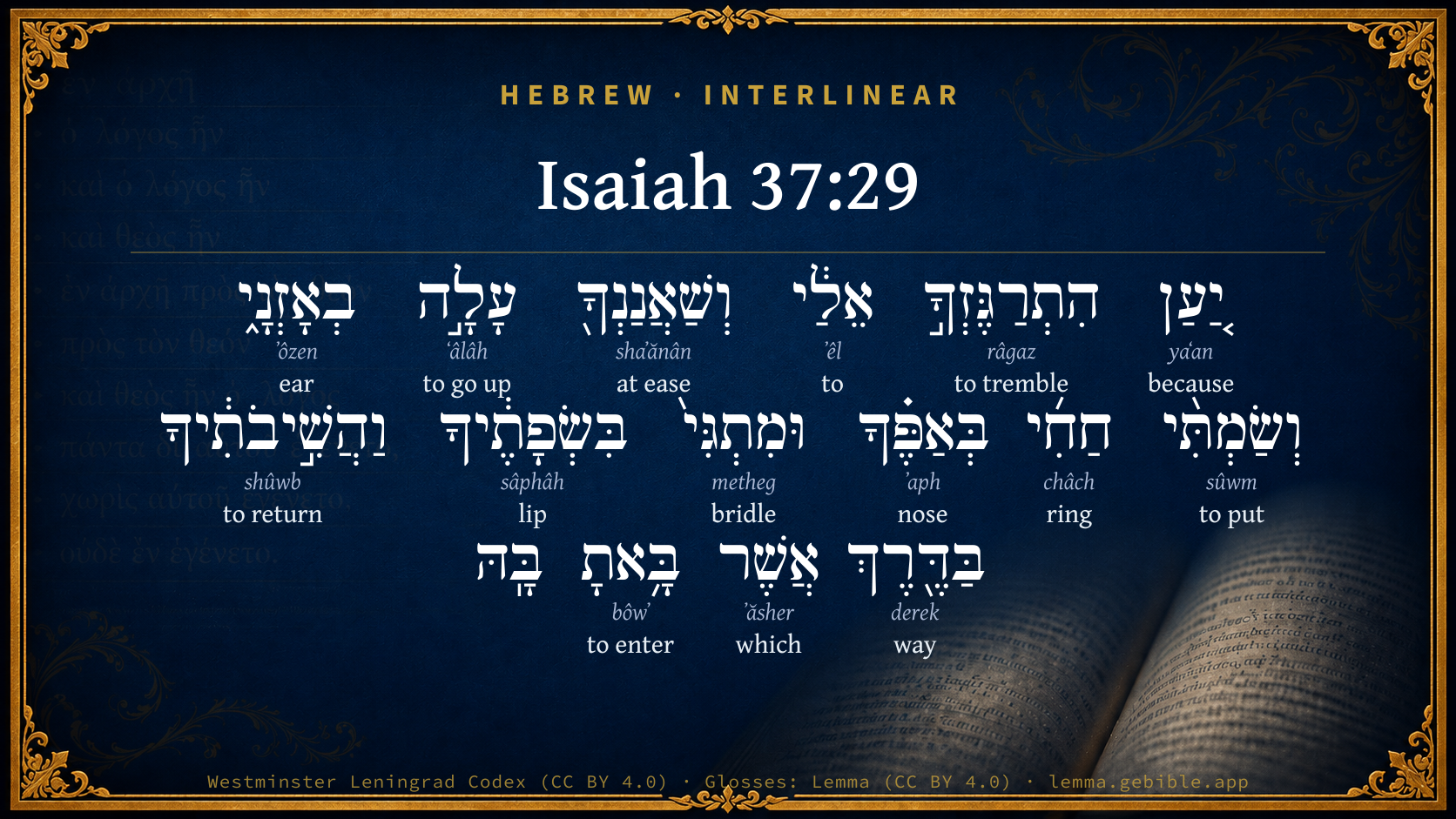
Hebrew (Westminster Leningrad Codex) Isaiah 37:29 appears in the Hebrew Old Testament. The text above is from the Westminster Leningrad Codex. Each word links to its Strong’s number, a concise gloss, and parsing drawn from the Open Scriptures Hebrew Bible morphology. Click any word for its full Brown-Driver-Briggs (BDB) entry.
Download image
Cite this verse

Isaiah 37:29 (World English Bible). Public Domain. Lemma interlinear Bible study tool, https://lemma.gebible.app/v/isaiah/37/29.

Show BibTeX & RIS
BibTeX
RIS
English Translation
Because of your raging against me, and because your arrogance is come up into my ears, therefore will I put my hook in your nose, and my bridle in your lips, and I will turn you back by the way by which you came.
World English Bible · Public Domain
Download a study sheet

One document with this verse’s original text, its word-by-word gloss line, the meaning frame, cross-references with their text, attributed commentary, and full source and license credits — printable, and it pastes into notes with its structure intact.

This verse Autodidact and up

Study sheet (.html) Plain text (.txt)

A passage Seminary Student

Up to 50 verses in one chapter. A passage sheet keeps up to 6 commentary sources and 12 cross-references per verse, in the order this page ranks them, and says so on the sheet whenever that leaves anything out. Ask for a single verse and you get the Autodidact verse sheet above.

Everything on this page stays free to read, with no account — the sheet is a download of what is already on screen, not access to it.

Want to remove ads? Support Godless Engineer
Compare translations 3

The same verse in 3 English versions, stacked beneath the original-language interlinear above. Click any original word for its lexicon entry.

Each is an independent rendering of the whole verse — the interlinear is not word-aligned to these translations.

Highlighted words mark where these versions differ — a whole-verse word diff, not a word-by-word alignment.

  • World English Bible Public Domain
    Because of your raging against me, and because your arrogance is come up into my ears, therefore will I put my hook in your nose, and my bridle in your lips, and I will turn you back by the way by which you came.
  • King James Version Public Domain
    Because thy rage against me, and thy tumult, is come up into mine ears, therefore will I put my hook in thy nose, and my bridle in thy lips, and I will turn thee back by the way by which thou camest.
  • unfoldingWord Literal Text CC BY-SA 4.0
    Because of your raging against me, and your arrogance has come up into my ears, I will put my hook in your nose and my bit in your lips, and I will make you return on the way by which you came.’

unfoldingWord Literal Text — © unfoldingWord, licensed CC BY-SA 4.0. Word-aligned USFM3 via Door43 (git.door43.org/unfoldingWord/en_ult).

Versions to compare (up to 4)

3 of 4 selected

Show all 18 translations

Every available English version of this verse, each an independent rendering of the whole verse.

  • World English Bible Public Domain
    Because of your raging against me, and because your arrogance is come up into my ears, therefore will I put my hook in your nose, and my bridle in your lips, and I will turn you back by the way by which you came.
  • Berean Standard Bible Public Domain
    Because your rage and arrogance against Me have reached My ears, I will put My hook in your nose and My bit in your mouth; I will send you back the way you came.’
  • Majority Standard Bible Public Domain
    Because your rage and arrogance against Me have reached My ears, I will put My hook in your nose and My bit in your mouth; I will send you back the way you came.’
  • King James Version Public Domain
    Because thy rage against me, and thy tumult, is come up into mine ears, therefore will I put my hook in thy nose, and my bridle in thy lips, and I will turn thee back by the way by which thou camest.
  • American Standard Version (1901) Public Domain
    Because of thy raging against me, and because thine arrogancy is come up into mine ears, therefore will I put my hook in thy nose, and my bridle in thy lips, and I will turn thee back by the way by which thou camest.
  • Revised Version (1885) Public Domain
    Because of thy raging against me, and for that thine arrogancy is come up into mine ears, therefore will I put my hook in thy nose, and my bridle in thy lips, and I will turn thee back by the way by which thou camest.
  • Geneva Bible (1599) Public Domain
    Because thou ragest against me, and thy tumult is come vnto mine eares, therefore will I put mine hooke in thy nostrels, and my bridle in thy lips, and wil bring thee backe againe the same way thou camest.
  • Douay-Rheims (1899) Public Domain
    When thou wast mad against me, thy pride came up to my ears: therefore I will put a ring in thy nose, and a bit between thy lips, and I will turn thee back by the way by which thou camest.
  • Young's Literal Translation Public Domain
    Because of thy anger towards Me, And thy noise -- it came up into Mine ears, I have put My hook in thy nose, And My bridle in thy lips, And I have caused thee to turn back In the way in which thou camest.
  • Literal Standard Version CC BY-SA 4.0
    Because of your anger toward Me, || And your noise—it came up into My ears, || I have put My hook in your nose, || And My bridle in your lips, || And I have caused you to turn back || In the way in which you came.
  • Unlocked Literal Bible CC BY-SA 4.0
    Because of your raging against me, and because your arrogance has reached my ears, I will put my hook in your nose, and my bit in your mouth; I will turn you back the way you came.”
  • unfoldingWord Literal Text CC BY-SA 4.0
    Because of your raging against me, and your arrogance has come up into my ears, I will put my hook in your nose and my bit in your lips, and I will make you return on the way by which you came.’
  • Darby Bible Public Domain
    Because thy raging against me and thine arrogance is come up into mine ears, I will put my ring in thy nose, and my bridle in thy lips, and I will make thee go back by the way by which thou camest.
  • World Messianic Bible Public Domain
    Because of your raging against me, and because your arrogance has come up into my ears, therefore I will put my hook in your nose and my bridle in your lips, and I will turn you back by the way by which you came.
  • Webster's Bible Public Domain
    Because thy rage against me, and thy tumult, is come up into my ears, therefore I will put my hook in thy nose, and my bridle in thy lips, and I will turn thee back by the way by which thou camest.
  • Free Bible Version CC BY-SA 4.0
    Because of your furious anger against me, and because I know how you disrespect me, I'm going to put my hook in your nose and my bit in your mouth, and I will force you to return the same way you came.
  • Bible in Basic English Public Domain
    Because your wrath against me and your pride have come to my ears, I will put my hook in your nose and my cord in your lips, and I will make you go back by the way you came.
  • JPS Tanakh (1917) Public Domain
    Because of thy raging against Me, and for that thine uproar is come up into Mine ears, therefore will I put My hook in thy nose, and My bridle in thy lips, and I will turn thee back by the way by which thou camest.

Literal Standard Version (2020), Covenant Press — licensed CC BY-SA 4.0. Text via the HelloAO Bible API (eBible.org). Unlocked Literal Bible (unfoldingWord) — licensed CC BY-SA 4.0. Text via the HelloAO Bible API (eBible.org). unfoldingWord Literal Text — © unfoldingWord, licensed CC BY-SA 4.0. Word-aligned USFM3 via Door43 (git.door43.org/unfoldingWord/en_ult). Free Bible Version, Dr. Jonathan Gallagher — licensed CC BY-SA 4.0. Text via the HelloAO Bible API (eBible.org).

Word by word

More ways to search: Search by grammar → Find every occurrence → Compare this word →

Practice this passage: Drill this verse → Learn its vocabulary →

וּמִתְגִּי֙
metheg
H4964
“and · bridle · my”
Conjunction + Noun, Common, Masculine, Singular, Construct + Suffix, Personal, 1st Person, Common, Singular
Part of Speech
Conjunction + Noun
Type
Common
Gender
Masculine
Number
Singular
State
Construct
Full BDB Definition

Origin: from an unused root meaning to curb

TWOT: 1264a

bridle - bridle (for animals) - control, authority (figuratively)
  1. יַ֚עַן yaʻan H3282 “because” Conjunction
  2. הִתְרַגֶּזְךָ֣ râgaz H7264 “to tremble · you” Verb, Hithpael, Infinitive Construct + Suffix, Personal, 2nd Person, Masculine, Singular
  3. אֵלַ֔י ʼêl H413 “to · me” Preposition + Suffix, Personal, 1st Person, Common, Singular
  4. וְשַׁאֲנַנְךָ֖ shaʼănân H7600 “and · at ease · your” Conjunction + Adjective, Adjective, Masculine, Singular, Construct + Suffix, Personal, 2nd Person, Masculine, Singular
  5. עָלָ֣ה ʻâlâh H5927 “to go up” Verb, Qal, Perfect, 3rd Person, Masculine, Singular
  6. בְאָזְנָ֑י ʼôzen H241 “in/at · ears · my” Preposition + Noun, Common, Feminine, Dual, Construct + Suffix, Personal, 1st Person, Common, Singular
  7. וְשַׂמְתִּ֨י sûwm H7760 “and · to put” Conjunction + Verb, Qal, Sequential Perfect, 1st Person, Common, Singular
  8. חַחִ֜י châch H2397 “ring · my” Noun, Common, Masculine, Singular, Construct + Suffix, Personal, 1st Person, Common, Singular
  9. בְּאַפֶּ֗ךָ ʼaph H639 “in/at · nose · your” Preposition + Noun, Common, Masculine, Singular, Construct + Suffix, Personal, 2nd Person, Masculine, Singular
  10. בִּשְׂפָתֶ֔יךָ sâphâh H8193 “in/at · lips · your” Preposition + Noun, Common, Feminine, Dual, Construct + Suffix, Personal, 2nd Person, Masculine, Singular
  11. וַהֲשִׁ֣יבֹתִ֔יךָ shûwb H7725 “and · to return · you” Conjunction + Verb, Hiphil, Sequential Perfect, 1st Person, Common, Singular + Suffix, Personal, 2nd Person, Masculine, Singular
  12. בַּדֶּ֖רֶךְ derek H1870 “in/at the · way” Preposition, Determined + Noun, Common, Both, Singular, Absolute
  13. אֲשֶׁר ʼăsher H834 “which” Particle, Relative
  14. בָּ֥אתָ bôwʼ H935 “to enter” Verb, Qal, Perfect, 2nd Person, Masculine, Singular

About this verse

These counts appear in no published source. They are computed here, from the morphology-tagged text and Lemma’s own curated glosses. What Lemma adds →

16
words
15
distinct lemmas
Prophets
section

Notable vocabulary

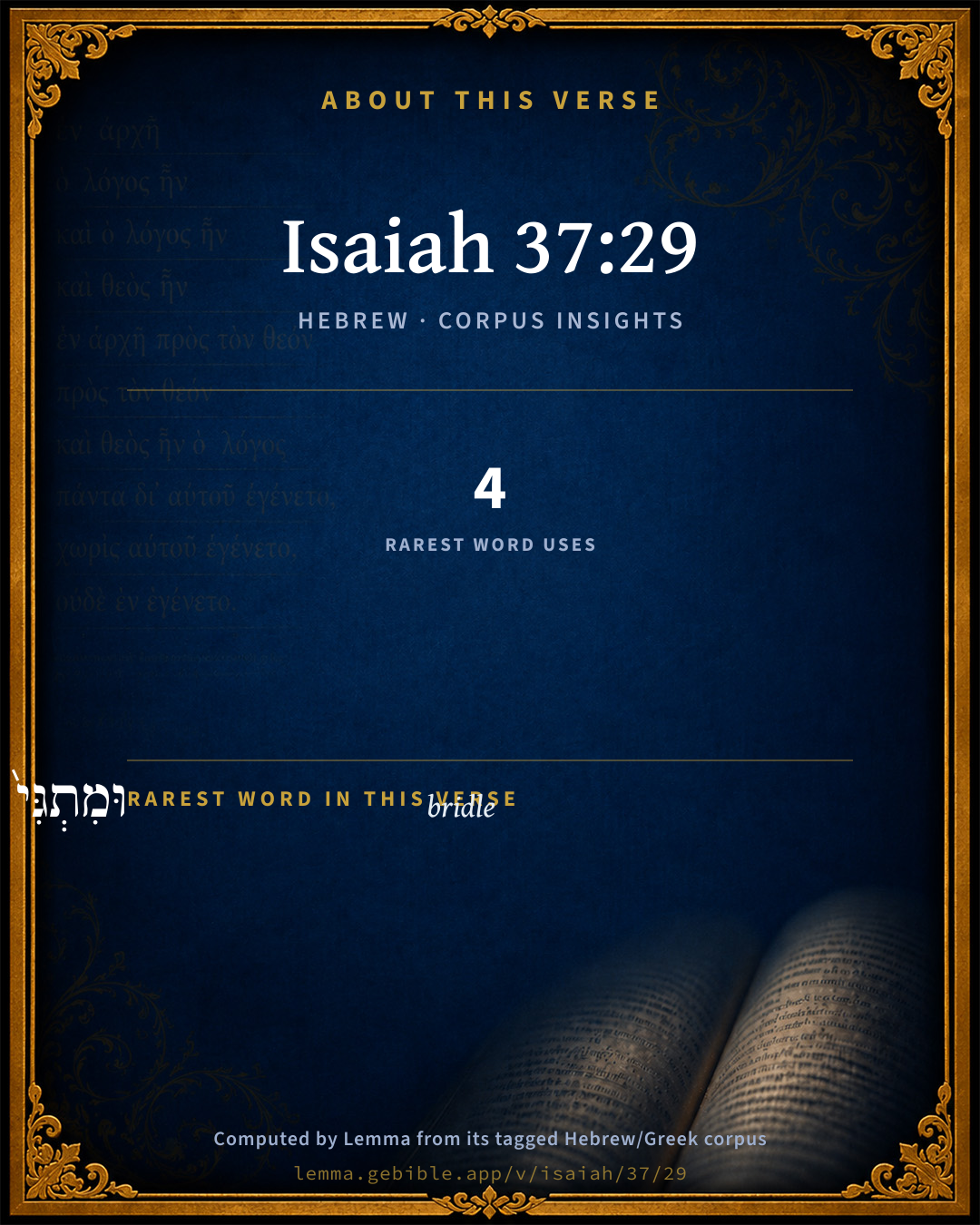
The rarest word here is וּמִתְגִּי֙ bridle H4964 — appearing just 4 times in the whole Hebrew Bible.

Shared distinctive vocabulary

וּמִתְגִּי֙ bridle H4964 occurs in 4 verses of the Hebrew Bible. Also found in:

Grammatical profile

  • 5 verbs
  • 6 nouns
  • 1 adjective
  • 2 prepositions
  • 1 conjunction
  • 1 particle

Verb forms

  • הִתְרַגֶּזְךָ֣ Hithpael · Infinitive Construct
  • עָלָ֣ה Qal · Perfect
  • וְשַׂמְתִּ֨י Qal · Sequential Perfect
  • וַהֲשִׁ֣יבֹתִ֔יךָ Hiphil · Sequential Perfect
  • בָּ֥אתָ Qal · Perfect

Hebrew & Septuagint length

In English translation the verse runs 44 words from the Hebrew and 43 from the Septuagint (LXX English) — closely comparable.

A rough comparison of the two English renderings, which tokenize alike — not a word-level alignment.

Word counts can differ between the Hebrew and the Greek without any difference in meaning — e.g. the Hebrew direct-object marker אֵת has no separate Greek word, and Greek often adds the article ὁ.

Cross-references

24

Topical passages linked to Isaiah 37:29 in the Treasury of Scripture Knowledge — connected by theme and wording, ordered by reader-vote popularity; previews shown in the World English Bible.

  • Isaiah 10:12 Therefore it shall happen that, when the Lord has performed his whole work on Mount Zion and on Jerusalem, I will punish the fruit of the stout heart of the king of Assyria, and the glory of his high looks.
  • Isaiah 30:28 and his breath is as an overflowing stream, that reaches even to the neck, to sift the nations with the sieve of destruction: and a bridle that causes to err [shall be] in the jaws of the peoples.
  • Isaiah 37:34 By the way that he came, by the same shall he return, and he shall not come to this city, says Yahweh.
  • Ezekiel 38:4 and I will turn you about, and put hooks into your jaws, and I will bring you forth, and all your army, horses and horsemen, all of them clothed in full armor, a great company with buckler and shield, all of them handling swords;
  • Ezekiel 29:4 I will put hooks in your jaws, and I will cause the fish of your rivers to stick to your scales; and I will bring you up out of the midst of your rivers, with all the fish of your rivers which stick to your scales.
  • 2 Kings 19:27–28 But I know your sitting down, and your going out, and your coming in, and your raging against me.
  • Job 15:25–26 Because he has stretched out his hand against God, And behaves himself proudly against the Almighty;
  • Job 41:2 Can you put a rope into his nose? Or pierce his jaw through with a hook?
  • Psalms 2:1–3 Why do the nations rage, And the peoples plot a vain thing?
  • Psalms 32:9 Don't be like the horse, or like the mule, which have no understanding, Who are controlled by bit and bridle, or else they will not come near to you.
  • Psalms 46:6 The nations raged. The kingdoms were moved. He lifted his voice, and the earth melted.
  • Psalms 74:4 Your adversaries have roared in the midst of your assembly. They have set up their standards as signs.
  • Psalms 74:23 Don't forget the voice of your adversaries. The tumult of those who rise up against you ascends continually.
  • Psalms 83:2 For, behold, your enemies are stirred up. Those who hate you have lifted up their heads.
  • Psalms 93:3–4 The floods have lifted up, Yahweh, The floods have lifted up their voice. The floods lift up their waves.
  • Isaiah 36:4 Rabshakeh said to them, Say you now to Hezekiah, Thus says the great king, the king of Assyria, What confidence is this in which you trust?
  • Isaiah 36:10 Am I now come up without Yahweh against this land to destroy it? Yahweh said to me, Go up against this land, and destroy it.
  • Isaiah 37:10 Thus shall you speak to Hezekiah king of Judah, saying, Don't let your God in whom you trust deceive you, saying, Jerusalem shall not be given into the hand of the king of Assyria.
  • Amos 4:2 The Lord Yahweh has sworn by his holiness that behold, "The days shall come on you that they will take you away with hooks, And the last of you with fish hooks.
  • Nahum 1:9–11 What do you plot against Yahweh? He will make a full end. Affliction won't rise up the second time.
  • Matthew 27:24 So when Pilate saw that nothing was being gained, but rather that a disturbance was starting, he took water, and washed his hands before the multitude, saying, "I am innocent of the blood of this righteous person. You see to it."
  • Acts 9:4 He fell on the earth, and heard a voice saying to him, "Saul, Saul, why do you persecute me?"
  • Acts 22:22 They listened to him until he said that; then they lifted up their voice, and said, "Rid the earth of this fellow, for he isn't fit to live!"
  • John 15:22–23 If I had not come and spoken to them, they would not have had sin; but now they have no excuse for their sin.

Cross-references courtesy of OpenBible.info (CC BY 4.0).

Hebrew and Greek witnesses Masoretic Hebrew ↔ Greek Septuagint

The same verse in the two great witnesses to the Old Testament, shown verse-for-verse.

These are two independent witnesses, not word-aligned to each other, and the Septuagint is shown in lemma (dictionary) form.

Hebrew Isaiah 37:29 Masoretic · Westminster Leningrad Codex

יַ֚עַן הִתְרַגֶּזְךָ֣ אֵלַ֔י וְשַׁאֲנַנְךָ֖ עָלָ֣ה בְאָזְנָ֑י וְשַׂמְתִּ֨י חַחִ֜י בְּאַפֶּ֗ךָ וּמִתְגִּי֙ בִּשְׂפָתֶ֔יךָ וַהֲשִׁ֣יבֹתִ֔יךָ בַּדֶּ֖רֶךְ אֲשֶׁר בָּ֥אתָ בָּֽהּ

Because of your raging against me, and because your arrogance is come up into my ears, therefore will I put my hook in your nose, and my bridle in your lips, and I will turn you back by the way by which you came.

World English Bible · Public Domain

Greek LXX Isaiah 37:29 Septuagint · lemma form

ὁ δέ θυμός σύ ὅς θυμόω καί ὁ πικρία σύ ἀναβαίνω πρός ἐγώ καί ἐνβάλλω φιμός εἰς ὁ ῥίς σύ καί χαλινός εἰς ὁ χεῖλος σύ καί ἀποστρέφω σύ ὁ ὁδός ὅς ἔρχομαι ἐν αὐτός

And your wrath wherewith you have been enraged, and your rancour has come up to me; therefore I will put a hook in your nose, and a bit in your lips, and will turn you back by the way by which you came.

LXX2012 (modern English Septuagint) · Public Domain

Hebrew: Westminster Leningrad Codex (CC BY 4.0). Greek: Septuagint (public domain); English from LXX2012 (modern English Septuagint) (Public Domain). How the Septuagint differs from the Hebrew →

Targum (Aramaic paraphrase)

1

The Targum is the ancient Jewish Aramaic paraphrase of the Hebrew Scriptures — an interpretive translation, not the Hebrew text itself. Onkelos (literal) and Pseudo-Jonathan (expansive) render the Torah, and Jonathan the Prophets. Coverage is partial: where no permissively-licensed English translation exists for a verse, only the Aramaic is shown. This is verse-level text, not a word-by-word alignment to the Hebrew.

  1. Targum Jonathan Prophets (Joshua–Malachi)
    חֲלַף דְאַרְגֵזְתָּא עַל מֵימְרִי וְאִתְרְגוּשְׁתָּךְ סְלִיקַת לִקֳדָמָי וַאֲשַׁוֵי שֵׁירִין בְּלִיסָתָךְ וּזְמַם בְּסִפְוָתָךְ וַאֲתֵיבִנָךְ בְּאוֹרְחָא דַאֲתֵיתָא בָהּ:

    Because thou art enraged against my WORD, and thy tumultuous noise hath come up before me: therefore I will put a ring in thy nostril, and a bridle in thy lips, and I will turn thee back by the way by which thou camest.

    Targum Jonathan — Aramaic: “Mikraot Gedolot” (public domain). English: “Sefaria Community Translation” (CC0 1.0 (public-domain dedication)); “London "Chaldee Paraphrase," 1871” (public domain). Text via Sefaria.

Commentary

Notes on Isaiah 37:29 from classic Christian and Jewish commentators (each source and its license shown beneath its notes). The classic Christian expositions comment on the surrounding passage and are grouped to its opening verse, so a note may address several verses; the Jewish commentaries on the Tanakh (Rashi and others) are per-verse, so they appear only where the commentator wrote on this verse.

Lemma curates 59 commentaries, every one of them public domain or Creative Commons licensed, each selected and text-cleaned for this edition rather than reprinted as found. About our sources →

Tyndale Open Study Notes

Tyndale Open Resources

37:29 my hook . . . my bit: The Assyrians would be led away like animals, just as they had led so many of their captives away.

Tyndale Open Study Notes — © Tyndale Open Resources, licensed CC BY-SA 4.0. Text via the HelloAO Bible API.

Geneva Bible (1599)

Geneva Bible translators

Because Sennacherib showed himself, as a devouring fish and furious beast, he useth these similitudes, to teach how he will take him and guide him.

Thou shalt lose thy labor.

Geneva Bible (1599) marginal notes — public domain. Text via Bolls.life.

Jamieson, Fausset & Brown

Robert Jamieson, A. R. Fausset & David Brown

tumult--insolence.

hook in . . . nose--Like a wild beast led by a ring through the nose, he shall be forced back to his own country (compare Job 41:1-2; Eze 19:4; Eze 29:4; Eze 38:4). In a bas-relief of Khorsabad, captives are led before the king by a cord attached to a hook, or ring, passing through the under lip or the upper lip, and nose.

Jamieson, Fausset & Brown — Commentary Critical and Explanatory on the Whole Bible (1871) — public domain (CC PDM 1.0). Text via the HelloAO Bible API.

Adam Clarke's Commentary

Verse 29. Will I put my hook in thy nose] Et fraenum meum: Jonathan vocem מתג metheg, interpretatus est זמם zemam, i.e., annulum, sive uncum, eumque ferreum, quem infigunt naribus camelae: eoque trahitur, quoniam illa feris motibus agitur: et hoc est, quod discimus in Talmude; et camela cum annulo narium: scilicet, egreditur die sabbathi. "And my bridle: Jonathan interprets the word metheg by zemam, a ring, or that iron hook which they put in the nostrils of a camel to lead her about, check her in her restiveness, c. And this is what we mean in the Talmud, when we say, And the camel with the ring of her nostrils shall go out on the Sabbath day." - Jarchi in 2Kg 19:28. Ponam circulum in naribus tuis. "I will put a ring in thy nostrils." - Jerome. Just as at this day they put a ring into the nose of the bear, the buffalo, and other wild beasts, to lead them, and to govern them when they are unruly. Bulls are often ringed thus in several parts of England. The Hindoos compare a person who is the slave of his wife to a cow led by the ring in her nose.

Adam Clarke's Commentary on the Bible (1810–1826) — public domain. Text from a community e-Sword/MySword module.

Ellicott's Commentary for English Readers

(29) Therefore will I put my hook in thy nose . . .—The Assyrian sculptures represent both beasts and men as dragged in this way (Eze_38:4). (Comp. the same image in Isa_30:28.)

A Bible Commentary for English Readers, edited by Charles John Ellicott (1878–1897) — public domain. Text from a community e-Sword module.

The Cambridge Bible for Schools and Colleges

gen. ed. J. J. S. Perowne

29. For tumult render with R.V. marg. careless ease. “Raging” and “careless ease” form a contrast, like “rising up” and “sitting down” in the previous verse.

therefore will I put my hook in thy nose] Cf. Eze_19:4; Eze_29:4; Eze_38:4.

I will turn thee back …] See Isa_37:7; Isa_37:34.

The Cambridge Bible for Schools and Colleges (gen. ed. J. J. S. Perowne; Cambridge University Press, 1878–1918) — public domain. Text from a community e-Sword module.

John Gill's Exposition

And the remnant that is escaped of the house of Judah,.... The few that escaped out of the cities of Judah, upon Sennacherib's invasion of the land, and besieging and taking the fenced cities thereof, who fled to Jerusalem for safety; these were a type of the remnant, according to the election of grace, the few that are chosen of God, the special people redeemed by Christ, the little flock of his, the small number that enter in at the strait gate, and are saved; and who escape, not the fall of Adam, nor the imputation of his sin, nor the corruption of nature, nor the pollutions of the world in a state of nature; but who escape the vengeance of divine justice, the curse of a righteous law, wrath to come, and the damnation of hell; which is owing to the love of God, the covenant of his grace, the suretyship engagements of Christ, and his performance of them; these are the household of faith, God's confessing and professing people, who are Jews inwardly, of whom there are but a few; of these it is said, they

shall again take root downward, and bear fruit upward. The Targum is,

"as a tree which sends forth its roots below, and lifts up its branches above.''

The sense is, that those people that fled from their own habitations to Jerusalem should return thither again upon the breaking up of the siege, and be firmly settled, and live peaceably and prosperously, abounding with all good things, which may be applied, mystically, to true believers taking root again in the love of God, which is a hidden root, and is the source of salvation, and all the blessings of it, and is in itself immovable; and though the saints are secured in it, and by it, and nothing can root them out of it, yet they are sometimes shaken with doubts and fears about their interest in it; when there is again a fresh taking root in it, and that is, when they have a strong and lively persuasion of it, which produces fruitfulness in the exercise of faith, hope, and love, and in Gospel obedience; and also to their taking root in Christ, who is as a root unto them, hidden, and out of sight to the world, mean and abject, yet the source of all happiness to the saints, who have a being in him, are born by him, and receive sap and nourishment from him; and though their faith of interest in him may be sometimes shaken, yet there is a fresh taking root by new acts of faith upon him, which produce fruitfulness; the fruits brought forth by such are good works, which spring from the seed of grace, are owing to divine goodness, to the dews of grace, are pleasant and acceptable to God through Christ, and profitable unto men; these are called the fruits of the Spirit, and of righteousness, and are meet for repentance, and are brought forth openly and publicly, which may be signified by being bore upwards.

John Gill's Exposition of the Whole Bible (1746–1763) — public domain (CC PDM 1.0). Text via the HelloAO Bible API.

Albert Barnes' Notes on the Bible

Because thy rage and thy tumult - Or rather, thy pride, thy insolence, thy vain boasting.

Therefore will I put my hook in thy nose - This is a most striking expression, denoting the complete control which God had over the haughty monarch, and his ability to direct him as he pleased. The language is taken from the custom of putting a ring or hook in the nose of a wild animal for the purpose of governing and guiding it. The most violent animals may be thus completely governed, and this is often done with those animals that are fierce and untameable. The Arabs often pursue this course in regard to the camel; and thus have it under entire control. A similar image is used in respect to the king of Egypt Eze 29:4. The idea is, that God would control and govern the wild and ambitious spirit of the Assyrian, and that with infinite ease he could conduct him again to his own land.

And my bridle - (See the note at Isa 30:28).

And I will turn thee back - (See Isa 37:37).

Albert Barnes' Notes on the Bible (1834–1885) — public domain. Text from a community e-Sword/MySword module.

Haydock's Catholic Bible Commentary

Lips, and treat thee like some ungovernable beast. (Haydock) (Ezechiel xxix. 4., and xxxviii. 4.) (Calmet)

George Leo Haydock (1774–1849), Haydock's Catholic Family Bible and Commentary, 1859 edition — public domain. Excludes Psalms (Douay-Rheims chapter numbering differs from Protestant) and Deuterocanonical books (Catholic canon only).

Whedon's Commentary on the Bible

Daniel D. Whedon

29. Because thy rage — Thy violent carrying out of thine own will. This gives the hithpael sense of the word — a moving to and fro, an active insolence.

Thy tumult — Arrogant self-confidence.

Is come up into mine ears — Denoting good knowledge from hearing.

Hook in thy nose — The figure of the nose-ring (Eze_38:4) for leading wild, intractable animals, is applied to this untamed man, showing to what humiliations he is to be subjected. The Assyrian is to be led home like a wild beast, without having conquered either Jerusalem or Egypt.

Daniel D. Whedon (gen. ed.), Commentary on the Old and New Testaments (1874–1909) — public domain. Text from a community e-Sword module.

The Pulpit Commentary

Therefore will I put my hook in thy nose. (comp. Eze_29:4 Eze_38:4 2Ch_33:11) The Assyrians were in the habit of passing "hooks" or "rings" through the noses or lips of their more distinguished prisoners, and attaching a thong to the hook or ring, by which they led the prisoners into the royal presence ("Ancient Monarchies," vol. 1. p. 304; vol. 3. p. 436). The expressions used derive their force from these practices, but are not in the present place to be understood literally. God "turned Sennacherib back" and reconducted him to Nineveh. not with an actual "hook" or "thong," but by the "bridle" of necessity.

The Pulpit Commentary (1880–1919), ed. H.D.M. Spence-Jones & Joseph S. Exell — public domain. Text from a community e-Sword module.

J. A. Alexander on Isaiah

Joseph Addison Alexander

“Because of thy raging against me, and (because) thy arrogance has come up into my ears, I will put my hook in thy nose, and my bridle in thy lips, and I will cause thee to return by the way by which thou camest.” The figures in the last clause are drawn from the customary method of controlling horses, and from a less familiar mode of treating buffaloes and other wild animals, still practiced in the east and in menageries. (Compare Eze 19:4; Eze 29:4; Eze 38:4; Job 41:1). The figure may be taken in a general sense as signifying failure and defeat, or more specifically as referring to Sennacherib’s hasty flight.

Joseph Addison Alexander, The Prophecies of Isaiah (1846–1847; New York: Scribner, 1870–1878) — public domain. Text from a community e-Sword module.

Rashi

Rabbi Shlomo Yitzchaki (Rashi)

you have raged against Me Your raging and your becoming overpowering toward Me (acc. to Parshandatha).

and your tumult (וְשַׁאֲנַנְךָ) like וּשְׁאוֹנְךָ.

My ring (חַחִי in Heb.) It is a kind of ring that is inserted into the lip of an unruly animal by which to pull it.

and My bit Jonathan renders וּזְמַם, which is made of iron, and which they insert into the nostrils of a female camel. This is what we learned, “and the female camel with a nose ring” in Tractate Shabbath (5:1). (This is difficult in view of the wording of the verse, which places חַח in the nose and מֶתֶג in the lips.)

Rashi on the Tanakh — English translations: “The Judaica Press complete Tanach with Rashi, translated by A. J. Rosenberg” (CC BY 4.0); “Pentateuch with Rashi's commentary by M. Rosenbaum and A.M. Silbermann, 1929-1934” (public domain); “The Metsudah Tanach series, Lakewood, N.J” (CC BY 4.0); and “The Book of Joshua, Metsudah Publications, 1997” (CC BY 4.0). Text via Sefaria.

Lesson kit

Teaching starters — assembled from the data on this page, not authored interpretation. Every prompt links to the verse data it draws on. Edit before teaching.

Isaiah, in the Prophets, opens this verse with 16 words (15 distinct Hebrew lemmas). Its most distinctive word is metheg (“bridle”). A historical commentator’s framing appears above. Read the whole chapter for the surrounding context.

Discussion questions

  1. How does “bridle” (metheg) shape what this verse is saying?
  2. 2 Kings 19:28 shares the word «bridle» with this verse. How do the two illuminate each other?
  3. These translations render this verse differently; the difference is in the English rendering, not the original. What questions does that raise?
  4. The verb «הִתְרַגֶּזְךָ֣» is Hithpael Infinitive Construct. How does its form color the action?
  5. Reading how Tyndale Open Study Notes and Geneva Bible (1599) read this verse, where do the two commentators agree and where do they part?

Things to notice

Reading settings

Reading text

Shown beneath each verse's original-language words.

Old Testament
Old Testament edition

Read the OT as the Masoretic Hebrew (MT) or the Greek Septuagint (LXX).

English shown for the Greek Septuagint (in the Hebrew ↔ Greek comparison).

Comparing translations? Open the Compare panel on any verse page to stack up to four side by side.