
1 Samuel 22:17

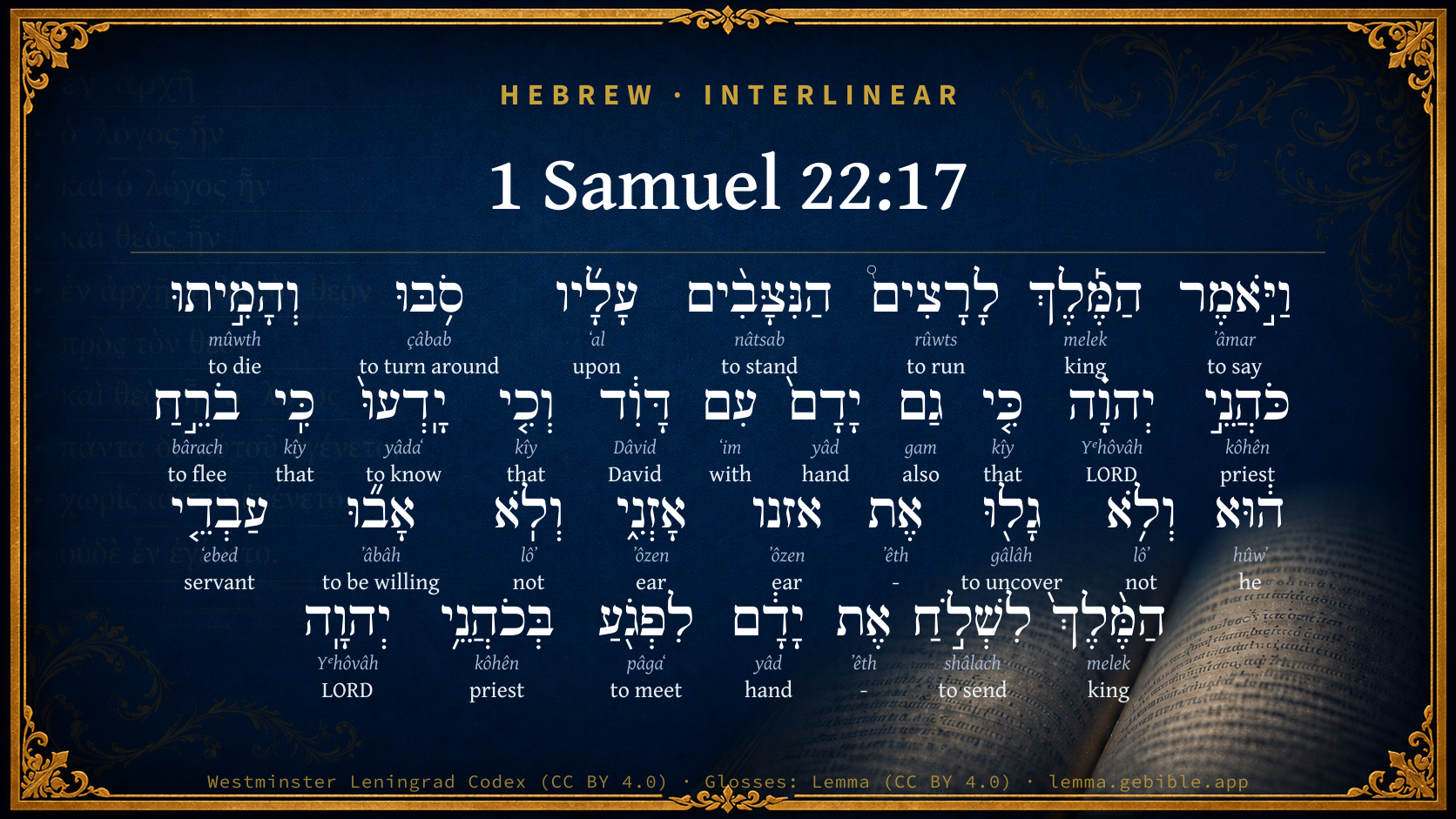
Hebrew (Westminster Leningrad Codex) 1 Samuel 22:17 appears in the Hebrew Old Testament. The text above is from the Westminster Leningrad Codex. Each word links to its Strong’s number, a concise gloss, and parsing drawn from the Open Scriptures Hebrew Bible morphology. Click any word for its full Brown-Driver-Briggs (BDB) entry.
Download image
Cite this verse

1 Samuel 22:17 (World English Bible). Public Domain. Lemma interlinear Bible study tool, https://lemma.gebible.app/v/1-samuel/22/17.

Show BibTeX & RIS
BibTeX
RIS
English Translation
The king said to the guard who stood about him, Turn, and kill the priests of Yahweh; because their hand also is with David, and because they knew that he fled, and didn't disclose it to me. But the servants of the king wouldn't put forth their hand to fall on the priests of Yahweh.
World English Bible · Public Domain
Download a study sheet

One document with this verse’s original text, its word-by-word gloss line, the meaning frame, cross-references with their text, attributed commentary, and full source and license credits — printable, and it pastes into notes with its structure intact.

This verse Autodidact and up

Study sheet (.html) Plain text (.txt)

A passage Seminary Student

Up to 50 verses in one chapter. A passage sheet keeps up to 6 commentary sources and 12 cross-references per verse, in the order this page ranks them, and says so on the sheet whenever that leaves anything out. Ask for a single verse and you get the Autodidact verse sheet above.

Everything on this page stays free to read, with no account — the sheet is a download of what is already on screen, not access to it.

Want to remove ads? Support Godless Engineer
Compare translations 3

The same verse in 3 English versions, stacked beneath the original-language interlinear above. Click any original word for its lexicon entry.

Each is an independent rendering of the whole verse — the interlinear is not word-aligned to these translations.

Highlighted words mark where these versions differ — a whole-verse word diff, not a word-by-word alignment.

  • World English Bible Public Domain
    The king said to the guard who stood about him, Turn, and kill the priests of Yahweh; because their hand also is with David, and because they knew that he fled, and didn't disclose it to me. But the servants of the king wouldn't put forth their hand to fall on the priests of Yahweh.
  • King James Version Public Domain
    And the king said unto the footmen that stood about him, Turn, and slay the priests of the LORD: because their hand also is with David, and because they knew when he fled, and did not show it to me. But the servants of the king would not put forth their hand to fall upon the priests of the LORD.
  • unfoldingWord Literal Text CC BY-SA 4.0
    And the king said to the runners having stationed themselves beside him, “Turn and kill the priests of Yahweh, because their hand also with David, and because they knew that he was fleeing but they did not uncover my ear.” But the servants of the king were not willing to stretch out their hand to attack the priests of Yahweh.

unfoldingWord Literal Text — © unfoldingWord, licensed CC BY-SA 4.0. Word-aligned USFM3 via Door43 (git.door43.org/unfoldingWord/en_ult).

Versions to compare (up to 4)

3 of 4 selected

Show all 18 translations

Every available English version of this verse, each an independent rendering of the whole verse.

  • World English Bible Public Domain
    The king said to the guard who stood about him, Turn, and kill the priests of Yahweh; because their hand also is with David, and because they knew that he fled, and didn't disclose it to me. But the servants of the king wouldn't put forth their hand to fall on the priests of Yahweh.
  • Berean Standard Bible Public Domain
    Then the king ordered the guards at his side, “Turn and kill the priests of the LORD, because they too sided with David. For they knew he was fleeing, but they did not tell me.” But the king’s servants would not lift a hand to strike the priests of the LORD.
  • Majority Standard Bible Public Domain
    Then the king ordered the guards at his side, “Turn and kill the priests of the LORD, because they too sided with David. For they knew he was fleeing, but they did not tell me.” But the king’s servants would not lift a hand to strike the priests of the LORD.
  • King James Version Public Domain
    And the king said unto the footmen that stood about him, Turn, and slay the priests of the LORD: because their hand also is with David, and because they knew when he fled, and did not show it to me. But the servants of the king would not put forth their hand to fall upon the priests of the LORD.
  • American Standard Version (1901) Public Domain
    And the king said unto the guard that stood about him, Turn, and slay the priests of Jehovah; because their hand also is with David, and because they knew that he fled, and did not disclose it to me. But the servants of the king would not put forth their hand to fall upon the priests of Jehovah.
  • Revised Version (1885) Public Domain
    And the king said unto the guard that stood about him, Turn, and slay the priests of the LORD; because their hand also is with David, and because they knew that he fled, and did not disclose it to me. But the servants of the king would not put forth their hand to fall upon the priests of the LORD.
  • Geneva Bible (1599) Public Domain
    And the King sayde vnto the sergeantes that stoode about him, Turne, and slay the Priestes of the Lord, because their hand also is with Dauid, and because they knewe when he fled, and shewed it not vnto mee. But the seruantes of the King would not moue their hands to fall vpon the Priests of the Lord.
  • Douay-Rheims (1899) Public Domain
    And the king said to the messengers that stood about him: Turn, and kill the priests of the Lord, for their hand is with David, because they knew that he was fled, and they told it not to me. And the king's servants would not put forth their hands against the priests of the Lord.
  • Young's Literal Translation Public Domain
    And the king saith to runners, those standing by him, `Turn round, and put to death the priests of Jehovah, because their hand also `is' with David, and because they have known that he is fleeing, and have not uncovered mine ear;' and the servants of the king have not been willing to put forth their hand to come against the priests of Jehovah.
  • Literal Standard Version CC BY-SA 4.0
    And the king says to the runners, those standing by him, “Turn around, and put the priests of YHWH to death, because their hand [is] also with David, and because they have known that he is fleeing, and have not uncovered my ear”; and the servants of the king have not been willing to put forth their hand to come against the priests of YHWH.
  • Unlocked Literal Bible CC BY-SA 4.0
    The king said to the guard that stood around him, “Turn and kill the priests of Yahweh. Because their hand also is with David, and because they knew that he fled, but did not reveal it to me.” But the servants of the king would not put out their hand to kill the priests of Yahweh.
  • unfoldingWord Literal Text CC BY-SA 4.0
    And the king said to the runners having stationed themselves beside him, “Turn and kill the priests of Yahweh, because their hand also with David, and because they knew that he was fleeing but they did not uncover my ear.” But the servants of the king were not willing to stretch out their hand to attack the priests of Yahweh.
  • Darby Bible Public Domain
    And the king said to the couriers that stood about him, Turn and put the priests of Jehovah to death; because their hand also is with David, and because they knew when he fled, and did not inform me. But the servants of the king were not willing to put forth their hand to fall on the priests of Jehovah.
  • World Messianic Bible Public Domain
    The king said to the guard who stood about him, “Turn and kill the priests of the LORD, because their hand also is with David, and because they knew that he fled and didn’t disclose it to me.” But the servants of the king wouldn’t put out their hand to fall on the priests of the LORD.
  • Webster's Bible Public Domain
    And the king said to the footmen that stood about him, Turn, and slay the priests of the LORD: because their hand also is with David, and because they knew when he fled, and did not show it to me. But the servants of the king would not put forth their hand to fall upon the priests of the LORD.
  • Free Bible Version CC BY-SA 4.0
    Then the king turned to his bodyguards standing there and ordered them, “Kill these priests of the Lord, because they're on David's side! They knew he was a fugitive and yet they didn't tell me!” But the king's guards refused to attack the priests of the Lord.
  • Bible in Basic English Public Domain
    Then the king said to the runners who were waiting near him, Put the priests of the Lord to death; because they are on David's side, and having knowledge of his flight, did not give me word of it. But the king's servants would not put out their hands to make an attack on the Lord's priests.
  • JPS Tanakh (1917) Public Domain
    And the king said unto the guard that stood about him: 'Turn, and slay the priests of the LORD; because their hand also is with David, and because they knew that he fled, and did not disclose it to me.' But the servants of the king would not put forth their hand to fall upon the priests of the LORD.

Literal Standard Version (2020), Covenant Press — licensed CC BY-SA 4.0. Text via the HelloAO Bible API (eBible.org). Unlocked Literal Bible (unfoldingWord) — licensed CC BY-SA 4.0. Text via the HelloAO Bible API (eBible.org). unfoldingWord Literal Text — © unfoldingWord, licensed CC BY-SA 4.0. Word-aligned USFM3 via Door43 (git.door43.org/unfoldingWord/en_ult). Free Bible Version, Dr. Jonathan Gallagher — licensed CC BY-SA 4.0. Text via the HelloAO Bible API (eBible.org).

Word by word

More ways to search: Search by grammar → Find every occurrence → Compare this word →

Practice this passage: Drill this verse → Learn its vocabulary →

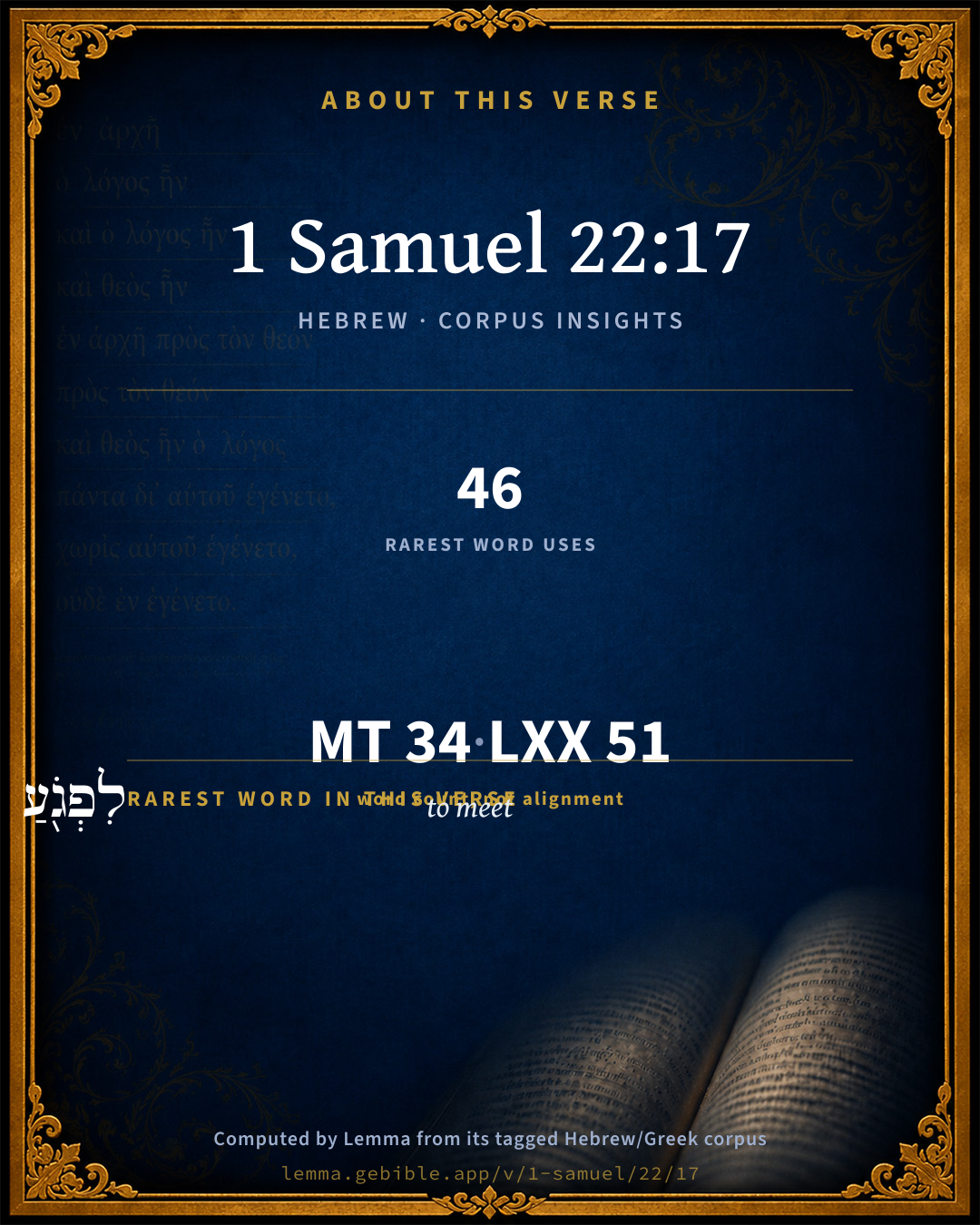
לִפְגֹ֖עַ
pâgaʻ
H6293
“to meet”
Preposition + Verb, Qal, Infinitive Construct
Part of Speech
Preposition + Verb
Stem
Qal
Form
Infinitive Construct
Full BDB Definition

Origin: a primitive root

TWOT: 1731

to encounter, meet, reach, entreat, make intercession - (Qal) - to meet, light upon, join - to meet (of kindness) - to encounter, fall upon (of hostility) - to encounter, entreat (of request) - to strike, touch (of boundary) - (Hiphil) - to cause to light upon - to cause to entreat - to make entreaty, interpose - to make attack - to reach the mark
  1. וַיֹּ֣אמֶר ʼâmar H559 “and · to say” Conjunction + Verb, Qal, Sequential Imperfect, 3rd Person, Masculine, Singular
  2. הַמֶּ֡לֶךְ melek H4428 “the · king” Particle, Definite Article + Noun, Common, Masculine, Singular, Absolute
  3. לָרָצִים֩ rûwts H7323 “to/for the · running” Preposition, Determined + Verb, Qal, Participle Active, Masculine, Plural, Absolute
  4. הַנִּצָּבִ֨ים nâtsab H5324 “the · standing” Particle, Definite Article + Verb, Niphal, Participle Active, Masculine, Plural, Absolute
  5. עָלָ֜יו ʻal H5921 “upon · him” Preposition + Suffix, Personal, 3rd Person, Masculine, Singular
  6. סֹ֥בּוּ çâbab H5437 “turn around” Verb, Qal, Imperative, 2nd Person, Masculine, Plural
  7. וְהָמִ֣יתוּ mûwth H4191 “and · die” Conjunction + Verb, Hiphil, Imperative, 2nd Person, Masculine, Plural
  8. כֹּהֲנֵ֣י kôhên H3548 “priests of” Noun, Common, Masculine, Plural, Construct
  9. יְהוָ֗ה Yᵉhôvâh H3068 “LORD” Noun, Proper
  10. כִּ֤י kîy H3588 “that” Conjunction
  11. גַם gam H1571 “also” Adverb
  12. יָדָם֙ yâd H3027 “hand · their” Noun, Common, Both, Singular, Construct + Suffix, Personal, 3rd Person, Masculine, Plural
  13. עִם ʻim H5973 “with” Preposition
  14. דָּוִ֔ד Dâvid H1732 “David” Noun, Proper
  15. וְכִ֤י kîy H3588 “and · that” Conjunction + Conjunction
  16. יָֽדְעוּ֙ yâdaʻ H3045 “to know” Verb, Qal, Perfect, 3rd Person, Common, Plural
  17. כִּֽי kîy H3588 “that” Conjunction
  18. בֹרֵ֣חַ bârach H1272 “fleeing” Verb, Qal, Participle Active, Masculine, Singular, Absolute
  19. ה֔וּא hûwʼ H1931 “he” Pronoun, Personal, 3rd Person, Masculine, Singular
  20. וְלֹ֥א lôʼ H3808 “and · not” Conjunction + Particle, Negative
  21. גָל֖וּ gâlâh H1540 “to uncover” Verb, Qal, Perfect, 3rd Person, Common, Plural
  22. אֶת ʼêth H853 “-” Particle, Direct Object
  23. אזנו ʼôzen H241 “ear · his” Noun, Common, Feminine, Singular, Construct + Suffix, Personal, 3rd Person, Masculine, Singular
  24. אָזְנִ֑י ʼôzen H241 “ear · my” Noun, Common, Feminine, Singular, Construct + Suffix, Personal, 1st Person, Common, Singular
  25. וְלֹֽא lôʼ H3808 “and · not” Conjunction + Particle, Negative
  26. אָב֞וּ ʼâbâh H14 “to be willing” Verb, Qal, Perfect, 3rd Person, Common, Plural
  27. עַבְדֵ֤י ʻebed H5650 “servants of” Noun, Common, Masculine, Plural, Construct
  28. הַמֶּ֨לֶךְ֙ melek H4428 “the · king” Particle, Definite Article + Noun, Common, Masculine, Singular, Absolute
  29. לִשְׁלֹ֣חַ shâlach H7971 “to send” Preposition + Verb, Qal, Infinitive Construct
  30. אֶת ʼêth H853 “-” Particle, Direct Object
  31. יָדָ֔ם yâd H3027 “hand · their” Noun, Common, Both, Singular, Construct + Suffix, Personal, 3rd Person, Masculine, Plural
  32. בְּכֹהֲנֵ֥י kôhên H3548 “in/at · priests of” Preposition + Noun, Common, Masculine, Plural, Construct
  33. יְהוָֽה Yᵉhôvâh H3068 “LORD” Noun, Proper

About this verse

These counts appear in no published source. They are computed here, from the morphology-tagged text and Lemma’s own curated glosses. What Lemma adds →

34
words
25
distinct lemmas
Historical
section

Shared distinctive vocabulary

לִפְגֹ֖עַ to meet H6293 occurs in 43 verses of the Hebrew Bible. Also found in:

Grammatical profile

  • 11 verbs
  • 12 nouns
  • 1 pronoun
  • 2 prepositions
  • 3 conjunctions
  • 1 adverb
  • 4 particles

Verb forms

  • וַיֹּ֣אמֶר Qal · Sequential Imperfect
  • לָרָצִים֩ Qal · Participle Active
  • הַנִּצָּבִ֨ים Niphal · Participle Active
  • סֹ֥בּוּ Qal · Imperative
  • וְהָמִ֣יתוּ Hiphil · Imperative
  • יָֽדְעוּ֙ Qal · Perfect
  • בֹרֵ֣חַ Qal · Participle Active
  • גָל֖וּ Qal · Perfect
  • אָב֞וּ Qal · Perfect
  • לִשְׁלֹ֣חַ Qal · Infinitive Construct
  • לִפְגֹ֖עַ Qal · Infinitive Construct

Repetition

Words recur within this verse — often emphatic in Hebrew:

  • הַמֶּ֡לֶךְ king H4428 ×2
  • כֹּהֲנֵ֣י priest H3548 ×2
  • יְהוָ֗ה LORD H3068 ×2
  • יָדָם֙ hand H3027 ×2
  • אזנו ear H241 ×2
  • כִּ֤י that H3588 ×3
  • וְלֹ֥א not H3808 ×2

Hebrew & Septuagint length

In English translation the verse runs 55 words from the Hebrew and 58 from the Septuagint (LXX English) — closely comparable.

A rough comparison of the two English renderings, which tokenize alike — not a word-level alignment.

Word counts can differ between the Hebrew and the Greek without any difference in meaning — e.g. the Hebrew direct-object marker אֵת has no separate Greek word, and Greek often adds the article ὁ.

In the original languages it is 34 Hebrew tokens and 51 Greek tokens — but the two are counted differently (Hebrew bundles its prefixes and suffixes into one token; the Greek is in lemma form), so that isn’t a like-for-like length.

Cross-references

12

Topical passages linked to 1 Samuel 22:17 in the Treasury of Scripture Knowledge — connected by theme and wording, ordered by reader-vote popularity; previews shown in the World English Bible.

  • Exodus 1:17 But the midwives feared God, and didn't do what the king of Egypt commanded them, but saved the baby boys alive.
  • 1 Samuel 14:45 The people said to Saul, Shall Jonathan die, who has worked this great salvation in Israel? Far from it: as Yahweh lives, there shall not one hair of his head fall to the ground; for he has worked with God this day. So the people rescued Jonathan, that he didn't die.
  • 2 Kings 1:13–14 Again he sent the captain of a third fifty with his fifty. The third captain of fifty went up, and came and fell on his knees before Elijah, and begged him, and said to him, man of God, please let my life, and the life of these fifty your servants, be precious in your sight.
  • 1 Samuel 8:11 He said, This will be the manner of the king who shall reign over you: he will take your sons, and appoint them to him, for his chariots, and to be his horsemen; and they shall run before his chariots;
  • 1 Samuel 20:33 Saul cast his spear at him to strike him. By this Jonathan knew that his father was determined to put David to death.
  • 1 Samuel 22:13 Saul said to him, Why have you conspired against me, you and the son of Jesse, in that you have given him bread, and a sword, and have inquired of God for him, that he should rise against me, to lie in wait, as at this day?
  • 1 Samuel 25:17 Now therefore know and consider what you will do; for evil is determined against our master, and against all his house: for he is such a worthless fellow that one can't speak to him.
  • 2 Samuel 15:1 It happened after this, that Absalom prepared him a chariot and horses, and fifty men to run before him.
  • 1 Kings 1:5 Then Adonijah the son of Haggith exalted himself, saying, I will be king: and he prepared him chariots and horsemen, and fifty men to run before him.
  • 1 Kings 18:4 for it was so, when Jezebel cut off the prophets of Yahweh, that Obadiah took one hundred prophets, and hid them by fifty in a cave, and fed them with bread and water.)
  • 2 Kings 10:25 It happened, as soon as he had made an end of offering the burnt offering, that Jehu said to the guard and to the captains, Go in, and kill them; let none come forth. They struck them with the edge of the sword; and the guard and the captains cast them out, and went to the city of the house of Baal.
  • Acts 4:19 But Peter and John answered them, "Whether it is right in the sight of God to listen to you rather than to God, judge for yourselves,

Cross-references courtesy of OpenBible.info (CC BY 4.0).

Hebrew and Greek witnesses Masoretic Hebrew ↔ Greek Septuagint

The same verse in the two great witnesses to the Old Testament, shown verse-for-verse.

These are two independent witnesses, not word-aligned to each other, and the Septuagint is shown in lemma (dictionary) form.

Hebrew 1 Samuel 22:17 Masoretic · Westminster Leningrad Codex

וַיֹּ֣אמֶר הַמֶּ֡לֶךְ לָרָצִים֩ הַנִּצָּבִ֨ים עָלָ֜יו סֹ֥בּוּ וְהָמִ֣יתוּ כֹּהֲנֵ֣י יְהוָ֗ה כִּ֤י גַם יָדָם֙ עִם דָּוִ֔ד וְכִ֤י יָֽדְעוּ֙ כִּֽי בֹרֵ֣חַ ה֔וּא וְלֹ֥א גָל֖וּ אֶת אזנו אָזְנִ֑י וְלֹֽא אָב֞וּ עַבְדֵ֤י הַמֶּ֨לֶךְ֙ לִשְׁלֹ֣חַ אֶת יָדָ֔ם לִפְגֹ֖עַ בְּכֹהֲנֵ֥י יְהוָֽה

The king said to the guard who stood about him, Turn, and kill the priests of Yahweh; because their hand also is with David, and because they knew that he fled, and didn't disclose it to me. But the servants of the king wouldn't put forth their hand to fall on the priests of Yahweh.

World English Bible · Public Domain

Greek LXX 1 Samuel 22:17 Septuagint · lemma form

καί εἶπον ὁ βασιλεύς ὁ παρατρέχω ὁ ἐπιἵστημι ἐπί αὐτός προςἄγω καί θανατόω ὁ ἱερεύς ὁ κύριος ὅτι ὁ χείρ αὐτός μετά δαυίδ καί ὅτι γιγνώσκω ὅτι φεύγω αὐτός καί οὐ ἀποκαλύπτω ὁ ὠτίον ἐγώ καί οὐ βούλομαι ὁ παῖς ὁ βασιλεύς ἐπιφέρω ὁ χείρ αὐτός ἀποἀντάω εἰς ὁ ἱερεύς κύριος

And the king said to the footmen that attended on him, Draw near and kill the priests of the Lord, because their hand is with David, and because they knew that he fled, and they did not inform me. But the servants of the king would not lift their hands to fall upon the priest of the Lord.

LXX2012 (modern English Septuagint) · Public Domain

Hebrew: Westminster Leningrad Codex (CC BY 4.0). Greek: Septuagint (public domain); English from LXX2012 (modern English Septuagint) (Public Domain). How the Septuagint differs from the Hebrew →

Targum (Aramaic paraphrase)

1

The Targum is the ancient Jewish Aramaic paraphrase of the Hebrew Scriptures — an interpretive translation, not the Hebrew text itself. Onkelos (literal) and Pseudo-Jonathan (expansive) render the Torah, and Jonathan the Prophets. Coverage is partial: where no permissively-licensed English translation exists for a verse, only the Aramaic is shown. This is verse-level text, not a word-by-word alignment to the Hebrew.

  1. Targum Jonathan Prophets (Joshua–Malachi)
    וַאֲמַר מַלְכָּא לִרְהָטַיָא דְקַיְמִין עֲלוֹהִי אִסְתְּחָרוּ וּקְטֻלוּ כַּהֲנַיָא דַייָ אֲרֵי אַף יְדֵיהוֹן עִם דָוִד וַאֲרֵי יְדָעוּ אֲרֵי עֲרִיק הוּא וְלָא חַווּ לִי וְלָא אֲבוֹ עַבְדֵי מַלְכָּא לְאוֹשָׁטָא יַת יְדֵיהוֹן לְמִשְׁלַט בְּכַהֲנַיָא דַיָי:

    (no public-domain English translation for this verse)

    Targum Jonathan — Aramaic: “Mikraot Gedolot” (public domain). English: “Sefaria Community Translation” (CC0 1.0 (public-domain dedication)); “London "Chaldee Paraphrase," 1871” (public domain). Text via Sefaria.

Commentary

Notes on 1 Samuel 22:17 from classic Christian and Jewish commentators (each source and its license shown beneath its notes). The classic Christian expositions comment on the surrounding passage and are grouped to its opening verse, so a note may address several verses; the Jewish commentaries on the Tanakh (Rashi and others) are per-verse, so they appear only where the commentator wrote on this verse.

Lemma curates 59 commentaries, every one of them public domain or Creative Commons licensed, each selected and text-cleaned for this edition rather than reprinted as found. About our sources →

Jamieson, Fausset & Brown

Robert Jamieson, A. R. Fausset & David Brown

SAUL COMMANDS TO KILL THE PRIESTS. (Sa1 22:17-19)

the footmen that stood about him--his bodyguard, or his runners (Sa1 8:11; Sa2 15:1; Kg1 1:5; Kg1 14:28), who held an important place at court (Ch2 12:10). But they chose rather to disobey the king than to offend God by imbruing their hands in the blood of his ministering servants. A foreigner alone (Psa 52:1-3) could be found willing to be the executioner of this bloody and sacrilegious sentence. Thus was the doom of the house of Eli fulfilled [Sa1 2:30-36].

Jamieson, Fausset & Brown — Commentary Critical and Explanatory on the Whole Bible (1871) — public domain (CC PDM 1.0). Text via the HelloAO Bible API.

Trapp's Complete Commentary

John Trapp

1Sa 22:17 And the king said unto the footmen that stood about him, Turn, and slay the priests of the LORD; because their hand also [is] with David, and because they knew when he fled, and did not shew it to me. But the servants of the king would not put forth their hand to fall upon the priests of the LORD.

Ver. 17. And the king said unto the footmen.] Heb., The runners: who had run to fetch the priests from Nob to Saul, saith A. Lapide.

Turn, and slay the priests of the Lord.] His anger was bent against the Lord himself, for taking away his kingdom, and giving it to another: and because he could not come at the Lord, therefore he wreaketh his rage upon his priests; like as the devil smote Job’s servants when he might not meddle with Job’s self. This seemeth to have been the very sin against the Holy Ghost.

Because their hand also is with David.] This he speaketh, that he may not seem to have been mad without reason. In the Vatican hall, at Rome, is pictured the massacre of Paris: under one side of the picture is written, Coligni et sociorum caedes: on the other, Rex Coligni caedem probat. { a} Money, also, was thereupon coined in France, in the forepart whereof, together with the king’s picture, was this inscription, Virtus in rebelles: and on the other side, Pietas excitavit Iustitiam, Piety hath stirred up justice., {b}

But the servants of the king would not.] This was well, but not all. Chrysostom {c} blameth them, because they did not positively and effectually plead the cause of the priests before Saul, &c.

{a} Il Mercurio Italico, p. 42.

{b} Camden’s Elisab.

{c} In Ps. cxxxiv.

John Trapp, A Commentary or Exposition upon All the Books of the Old and New Testament (1647–1656) — public domain. Text from a community e-Sword module.

Geneva Bible (1599)

Geneva Bible translators

Or, footmen.

For they knew that they ought not to obey the wicked commandment of the king in slaying the innocents.

Geneva Bible (1599) marginal notes — public domain. Text via Bolls.life.

Adam Clarke's Commentary

Verse 17. But the servants of the king would not] They dared to disobey the commands of the king in a case of such injustice, inhumanity, and irreligion.

Adam Clarke's Commentary on the Bible (1810–1826) — public domain. Text from a community e-Sword/MySword module.

Ellicott's Commentary for English Readers

(17) The footmen.—“Footmen,” literally runners. These “guards,” or “lictors,” were men who ran by the royal chariot as an escort. They are still the usual attendants of any great man in the East. From long habit they were able to maintain a great speed for a long time. (See 1Sa_8:11, where Samuel tells the children of Israel how the king of the future, whom they asked for, would take some of them to “run before his chariot.” See, too, for an example of the power of running in old times, 1Ki_18:46, when Elijah outstripped the chariot of Ahab.)

But the servants of the king would not put forth their hand.—“And thus they were more faithful to Saul than if they had obeyed his order, which was against the commandment of the Lord, whose servant the king was no less than they.”—Wordsworth.

A Bible Commentary for English Readers, edited by Charles John Ellicott (1878–1897) — public domain. Text from a community e-Sword module.

The Cambridge Bible for Schools and Colleges

gen. ed. J. J. S. Perowne

17. the footmen] Lit. “the runners.” See on ch. 1Sa_8:11; and for their employment as executioners comp. 2Ki_10:25 (E. V. guard).

would not put forth their hand] They shrank from executing a command at once so cold-blooded and sacrilegious.

The Cambridge Bible for Schools and Colleges (gen. ed. J. J. S. Perowne; Cambridge University Press, 1878–1918) — public domain. Text from a community e-Sword module.

John Gill's Exposition

And the king said unto the footmen that stood about him,.... Or the "runners" (f); the running footmen, that used to run before him when he went out from place to place, and were here waiting on him, ready to set out whenever he should give the orders to go elsewhere. The tradition of the Jews is, that these were Abner and Amasa (g); but, as Kimchi observes, they were not footmen, but princes, captains in the army, and the first of them the general of it:

turn and slay the priests of the Lord; he owns them to be the priests of the Lord, and calls them so, and yet gave orders to put them to death, though innocent; one would have thought this their character would have flown in his face, and stung his conscience, and deterred him from so foul a fact:

because their hand also is with David; as well as Ahimelech; which did not at all appear, nor that they had so much as seen him at Nob, only Ahimelech; and still less that they had entered into a conspiracy with him:

and because they knew when he fled, and did not show it to me; which also was false; they knew nothing of the flight of David, and therefore could not discover it to the king:

but the servants of the king would not put forth their hand to fall upon the priests of the Lord; their consciences would not suffer them to do it; they refused to obey the king's orders, and chose rather to expose themselves to his resentment, than to be guilty of such a crime. Saul's footmen had more sense of honour, justice, and truth, than he himself had, and were worthy of praise; but they would have been deserving of more, if they could not have prevailed upon him by entreaties and remonstrances to have forborne such a bloody execution, instead of being the tame spectators of it, they had taken him, and bound him as a madman, and so facilitated the escape of the priests, and prevented this shocking scene of wickedness.

(f) "cursoribus", Pagninus, Montanus, Junius & Tremellius, Piscator. (g) Midrash Tillim apud Abarbinel. in loc.

John Gill's Exposition of the Whole Bible (1746–1763) — public domain (CC PDM 1.0). Text via the HelloAO Bible API.

Haydock's Catholic Bible Commentary

Messengers. Hebrew, "runners." These officers remained at court and were people of great account, (Calmet) like the king’s guards, 2 Kings xv. 1., and 3 Kings i. 5. (Haydock) --- Lord, out of reverence, and being convinced of their innocence. (Menochius) --- The obedience which we owe to superiors is subordinate to that which we must always shew towards God and justice. (Calmet) --- Saul unjustly condemned them as the abettors of his competitor. (Worthington)

George Leo Haydock (1774–1849), Haydock's Catholic Family Bible and Commentary, 1859 edition — public domain. Excludes Psalms (Douay-Rheims chapter numbering differs from Protestant) and Deuterocanonical books (Catholic canon only).

Matthew Poole's English Annotations

Choosing rather to offend the king, by disobeying his wicked and bloody command, than to offend God, by shedding the blood of such innocent and sacred persons.

Matthew Poole's English Annotations on the Holy Bible (1683–1685) — public domain. Text from a community e-Sword/MySword module.

Whedon's Commentary on the Bible

Daniel D. Whedon

17. The footmen — Runners; halberdiers; members of the king’s body guard, who ran or walked before him to guard his way.

The servants of the king would not — An act so sacrilegious they shuddered at the thought of doing. Perhaps they regarded the order as another freak of the king’s madness.

Daniel D. Whedon (gen. ed.), Commentary on the Old and New Testaments (1874–1909) — public domain. Text from a community e-Sword module.

The Pulpit Commentary

Vers. 17-19. Footmen. Hebrew, "runners." They were the men who ran by the side of the king"s horse or chariot as his escort. (see on 1Sa_8:11) In constant training, they were capable of maintaining a great speed for a very long time. Here they were present at the king"s council as his bodyguard, but when commanded to commit this horrid deed not one of them stirred from his place. Saul might have seen by this that he was alienating the hearts of all right minded men from him; but, unabashed, he next orders Doeg to slay the priests, and he, aided probably by his servants, slew in that day fourscore and five persons that did wear a linen ephod. The fact that they were thus clad in their official dress added not to the wickedness, but to the impiety of this revolting act. And, not satisfied with thus wreaking his rage on innocent men, he next destroyed the city of the priests, barbarously massacring their whole families, both men and women, children and sucklings, and even their oxen, asses, and sheep, as if Nob was a city placed under the ban. It is a deed in strange contrast with the pretended mercy that spared Agag and the best of the Amaleklte spoil on the pretext of religion. Only once before had so terrible a calamity befallen the descendants of Aaron, and that was when the Philistines destroyed Shiloh. But they were enemies, and provoked by the people bringing the ark to the battle, and even then women and children escaped. It was left to the anointed king, who had himself settled the priests at Nob and restored Jehovah"s worship there, to perpetrate an act unparalleled in Jewish history for its barbarity. Nor was it an act of barbarity only, but also of insane and wanton stupidity. The heart of every thoughtful person must now have turned away in horror from the king whom they had desired; and no wonder that when, two or three years afterwards, war came Saul found himself a king without an army, and fell into that deep, despondent melancholy which drove him, in need of some human sympathy, to seek it from a reputed witch.

Vers. 17-23.

The tragedy at Nob.

The facts are

1. Saul commands his guards to slay the priests of Nob, but they refuse.

2. Thereupon he commands Doeg to effect their death, who slays eighty-five priests, and procures the destruction of the entire city.

3. Abiathar, escaping to David, makes known to him what has happened.

4. David perceives that his presence at Nob was the occasion of this sad calamity, and admits that he feared the course Doeg would take.

5. He encourages Abiathar to remain with him, and assures him of safety. This section sets forth Saul"s conduct in the darkest characters, and brings out a turn in the course of events of great consequence to David, while at the same time illustrating several important truths.

I SINFUL MEN ARE SOMETIMES THE INSTRUMENTS OF FULFILLING DIVINE PREDICTIONS OF JUDGMENT. It had been declared as a judgment on the house of Eli that terrible things should befall his descendants. (1Sa_2:31-36 1Sa_3:11-14) In the fearful destruction at Nob this prediction was partly fulfilled. The sins of Saul brought on retribution for the sins of Eli and his sons. In this we have an instance of frequent occurrence in human history, both of nations and individuals. The savage ambition of Rome realised the truth of our Saviour"s words concerning the judgment due to impenitent Jerusalem. (Mat_23:34 Luk_21:20-24) The untruthful conduct of Jacob was most severely chastised by the lying tongues of his sons who conspired against his favourite Joseph; just as now the judgment due to a parent for irreligious example in the home is often realised in the open vices of his children, which perhaps ruin his health and fortune. In all these cases we have to distinguish between the just purpose of God to visit sin by future retribution, and the free action of the men who are the means of bringing it to pass. Had pestilence, or plagues, or earthquakes bean more in the line of natural order just then, these would have conserved the Divine purpose. But man"s sinful action, free, responsible, was the agency used, thus illustrating the statement which sometimes perplexes superficial students of the Bible wicked, which is thy sword". (Psa_17:13) The metaphysical question, involved in this conjunction of a righteous retribution with the free agency of man in the perpetration of crimes for which alone they are responsible, may be beyond present solution, but the fact is plain. Philosophical difficulties are inherent in common facts, and are not peculiar to theological truth.

II IN ORDINARY MEN RELIGIOUS INSTINCTS ARE STRONGER THAN POLITICAL AND SOCIAL CONSIDERATIONS. We need not be surprised that Saul"s Hebrew guards declined to obey his command to slay the "priests of the Lord." No doubt strong reasons were present to prove their loyalty to their king. Not only is loyalty a first principle of action with good subjects, but the fact that he was of their own tribe, and had been their choice out of all Israel, (1Sa_10:19-24) must have made them anxious to sustain his authority against all comers. Even the very weaknesses of a monarch will induce some men to put down with strong hand all charged with conspiracy against him, whether or not the charge he fully established. Yet these men had been wont to recognise a higher authority than Saul"s. They belonged to a race whose vocation in the world was of God. All the sanctities of religious worship and ritual, all the rich instruction of their marvellous history, strengthened and purified the instinct that leads man to fear God. To them the high priest and his subordinates were representatives of a sacred order, the exponents of a spiritual power, and it would therefore be violence to all that was sacred, inexpressible, and most influential in their nature were they, out of loyalty to the king or from tribal considerations, to touch the "priests of the Lord." The religious instincts of men are a great power. They not only prompt to actions more or less good according to the degree of enlightenment, but we cannot calculate the vast benefits resulting to mankind by their restraining power. The fact is worthy of much study, and the wide world furnishes ample illustrations of its importance. On the nation, the family, and the individual it acts as a conservator of good and a represser of much that would destroy. It is often the only barrier against the tide of passion and ignorance. The wise know how to appeal to it and turn it to their own uses. It is this in men, among other things, which renders null and void all efforts to exterminate Christianity. Men may call reverence for sacred persons and offices superstition, and in extravagant forms the term is fitly applied, yet it is the indication of a governing influence in human affairs superior to all the advances of civilisation. Man must be remade if his life is permanently to be regulated by any principles or opinions at variance with the natural religiousness of his spirit.

III ACTIONS INNOCENT IN INTENTION MAY BE FRAUGHT WITH SERIOUS CONSEQUENCES TO OTHERS. It can scarcely be charged on David that he was guilty of sin in visiting the tabernacle at Nob, seeking there food and shelter, though it may have been an indiscretion. The false representation by reason of which Ahimelech was induced to give him bread and a sword was the real wrong. On a wider survey of facts, and with a juster estimate of the risks of compromising the officials of the sanctuary, he would probably have sought food in some other quarter, or have cried out to God for special deliverance. As it was, his device of being on Saul"s business was evidently intended to save the high priest from the political sin of aiding one outlawed by the king. But his good motives were entirely useless because the overt act was witnessed by an enemy, who, David felt sure, would put on it a construction inconsistent with his own wishes and the knowledge of the high priest. His conduct, therefore, pure in intentions and fenced with precaution, did compromise a band of innocent men, and was, owing to the wickedness of the parties he had to contend with, and not to the natural justice of the case, the occasion of the fearful slaughter of the priests and entire population of the city. The guilt of the slaughter rested on Saul; the occasion for the exercise of the murderous malice was unwittingly created by David. With a sorrowful heart he admits the great woe to have had its origin incidentally in his own action. It is a truism that every action carries with it consequences into the future, in which we ourselves and others are concerned. One of the effects of our action is to prompt the action of other men, or to modify the course which otherwise they would have taken. And as the interests of many may depend not on what we do directly, but on the conduct of others whom we directly affect, it is obvious that it is often possible for us to perform deeds or pursue courses which shall give occasion for other men to perpetrate great wrongs on those we would gladly shield. In that case we are not responsible for their crimes or follies, but we are responsible for any indiscretions which may have given plausible ground for their procedure, or have rendered it possible. But it is only where indiscretions are possible that blame really rests. The wise men from the East, inquiring with all simplicity of purpose for the newborn king, were the occasion of the slaughter of the children of Bethlehem; but though they no doubt were pained, if ever they knew the fact, they were not guilty of any wrong. We cannot always refuse to act because evil men exist. Indiscretion is chargeable where a knowledge of facts and of the probable uses men will make of our deeds is presumably possible. The practical bearing of the risks attendant on our actions is to induce extreme caution, to awaken watchfulness, lest by our well intentioned deeds we should compromise others, or give an appearance of reason for wicked men to manifest their wickedness. In the memory of many a man there are records of deeds unwise and out of season, which have left a fatal mark on the world in spite of subsequent efforts of wisdom and goodness. Like David men can say, "I have occasioned" all this.

IV THE DESIGNS OF THE WICKED DEFEAT THEMSELVES. The conflict waged by Saul was, as we have seen, really against the decree of God, but its ostensible object was a plot on the part of David against the throne. Whatever fears Saul may have had concerning Samuel"s sympathy with David, there was no public ground for them in any positive action taken by the prophet in concert with David. What he dreaded most of all was the open espousal of David"s cause by the spiritual power; for the priesthood had immense influence with the people. It was to crush out by one terrible blow any supposed concert that he caused the slaughter at Nob; and it is instructive to observe how this very attempt to deprive David of the official support of the spiritual power really put it on his side. The deeds of bad men are never complete enough for insuring a final triumph; some oversight, some weakness, some so called accident gives occasion for the ultimate frustration of their purpose. By some chance, as men say, Abiathar escaped and went over to David. Saul fell into the pit he had prepared for David. (Psa_52:6) There is now a Christian spiritual power, and the truth thus exemplified is especially seen in the great conflict of men against it. The same interests in higher form are still in conflict with opposing forces. Every effort to subvert or crush out the kingdom of God, though it should be a great "slaughter" either of bodies or of characters, develops more life, leads to closer union, throws the Church more on the power and guidance of God, and so prepares the way for a new movement of a higher spiritual character before which the powers of evil must yield. Give time, and the spiritual will triumph.

General lessons:

1. In matters of doubt, where evil consequences may possibly ensue from our conduct it is best to abstain from action; for it is a good rule to bar the way to evil by every possible contrivance.

2. Where the reputation of others is affected by our conduct we shouldeither seek their consent or avoid a possible compromise of their character.

3. Any false step in life is greatly embittered in review if it has beenattended with untruthfulness.

4. We may confidently appeal to the religious feelings of men in ourdefence of Christian truth even when by bare argument we cannot touch them.

5. In the frequent historical illustrations of the impossibility of mencrushing out the spiritual power, whether in Jewish or Christian form, we see a prophecy of the time when Christ shall have "put down all rule and all authority and power". (1Co_15:24)

The Pulpit Commentary (1880–1919), ed. H.D.M. Spence-Jones & Joseph S. Exell — public domain. Text from a community e-Sword module.

Rashi

Rabbi Shlomo Yitzchaki (Rashi)

To the runners who stood near him. Referring to Avneir and Amoso.

Did not want. They expounded [Scripture's] "but's and only's." Scripture states: "Every man who rebels against your command [shall be put to death]." One may think that this means even [if "your command" was] to commit a sin; Scripture, therefore states: "Only" [to exclude this condition].

Rashi on the Tanakh — English translations: “The Judaica Press complete Tanach with Rashi, translated by A. J. Rosenberg” (CC BY 4.0); “Pentateuch with Rashi's commentary by M. Rosenbaum and A.M. Silbermann, 1929-1934” (public domain); “The Metsudah Tanach series, Lakewood, N.J” (CC BY 4.0); and “The Book of Joshua, Metsudah Publications, 1997” (CC BY 4.0). Text via Sefaria.

Lesson kit

Teaching starters — assembled from the data on this page, not authored interpretation. Every prompt links to the verse data it draws on. Edit before teaching.

1 Samuel, in the Historical, opens this verse with 34 words (25 distinct Hebrew lemmas). Its most distinctive word is pâgaʻ (“to meet”). A historical commentator’s framing appears above. Read the whole chapter for the surrounding context.

Discussion questions

  1. How does “to meet” (pâgaʻ) shape what this verse is saying?
  2. Genesis 23:8 shares the word «to meet» with this verse. How do the two illuminate each other?
  3. “king” occurs 2× in this one verse. What is the effect of the repetition?
  4. These translations render this verse differently. What is at stake in choosing one wording over another?
  5. The verb «וַיֹּ֣אמֶר» is Qal Sequential Imperfect. How does its form color the action?
  6. Reading how Jamieson, Fausset & Brown and Trapp's Complete Commentary read this verse, where do the two commentators agree and where do they part?

Things to notice

Reading settings

Reading text

Shown beneath each verse's original-language words.

Old Testament
Old Testament edition

Read the OT as the Masoretic Hebrew (MT) or the Greek Septuagint (LXX).

English shown for the Greek Septuagint (in the Hebrew ↔ Greek comparison).

Comparing translations? Open the Compare panel on any verse page to stack up to four side by side.