Isaiah 49:20

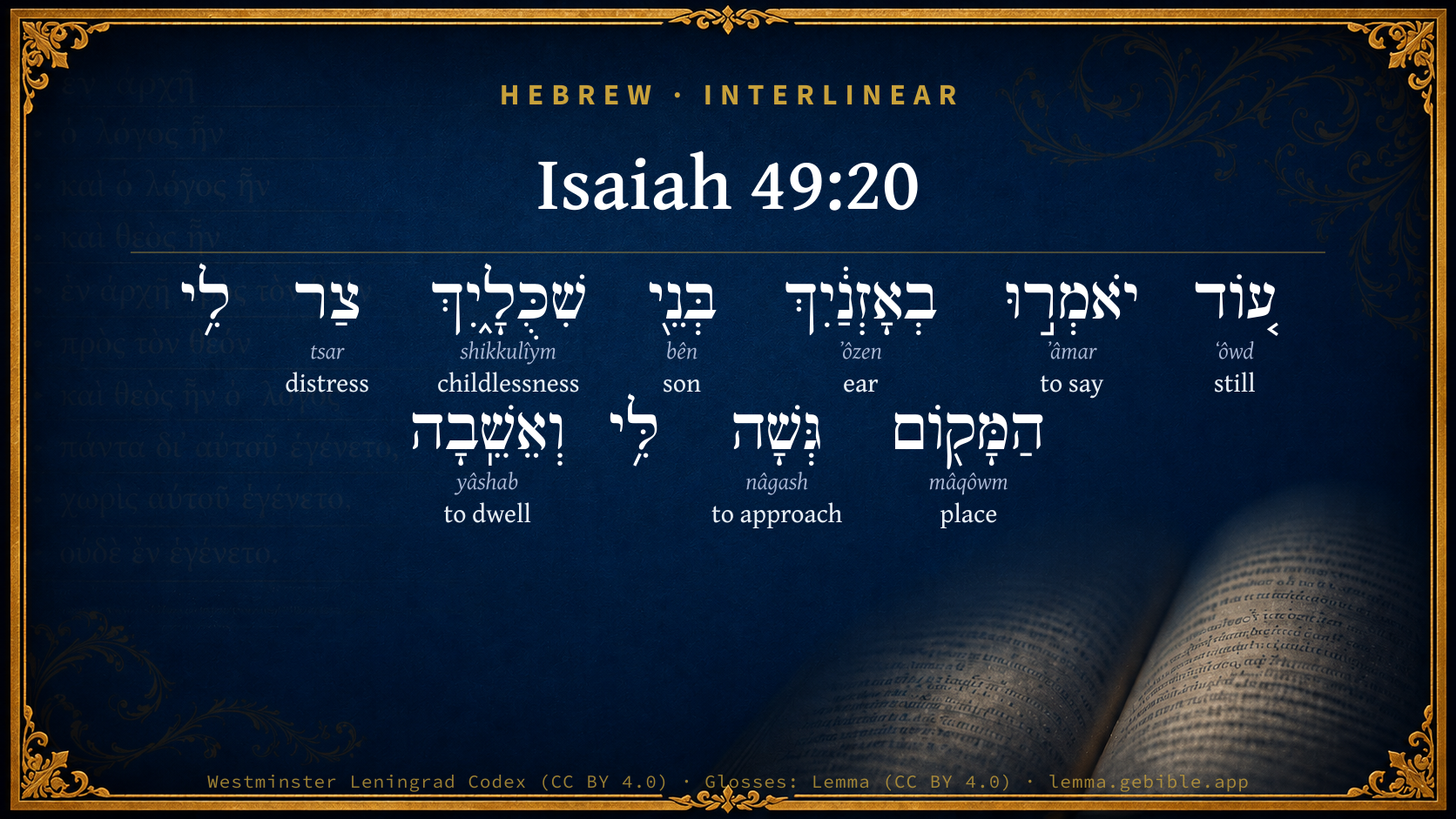
Hebrew (Westminster Leningrad Codex) Isaiah 49:20 appears in the Hebrew Old Testament. The text above is from the Westminster Leningrad Codex. Each word links to its Strong’s number, a concise gloss, and parsing drawn from the Open Scriptures Hebrew Bible morphology. Click any word for its full Brown-Driver-Briggs (BDB) entry.
Download image
Cite this verse

Isaiah 49:20 (World English Bible). Public Domain. Lemma interlinear Bible study tool, https://lemma.gebible.app/v/isaiah/49/20.

Show BibTeX & RIS
BibTeX
RIS
English Translation
The children of your bereavement shall yet say in your ears, The place is too small for me; give place to me that I may dwell.
World English Bible · Public Domain
Highlights
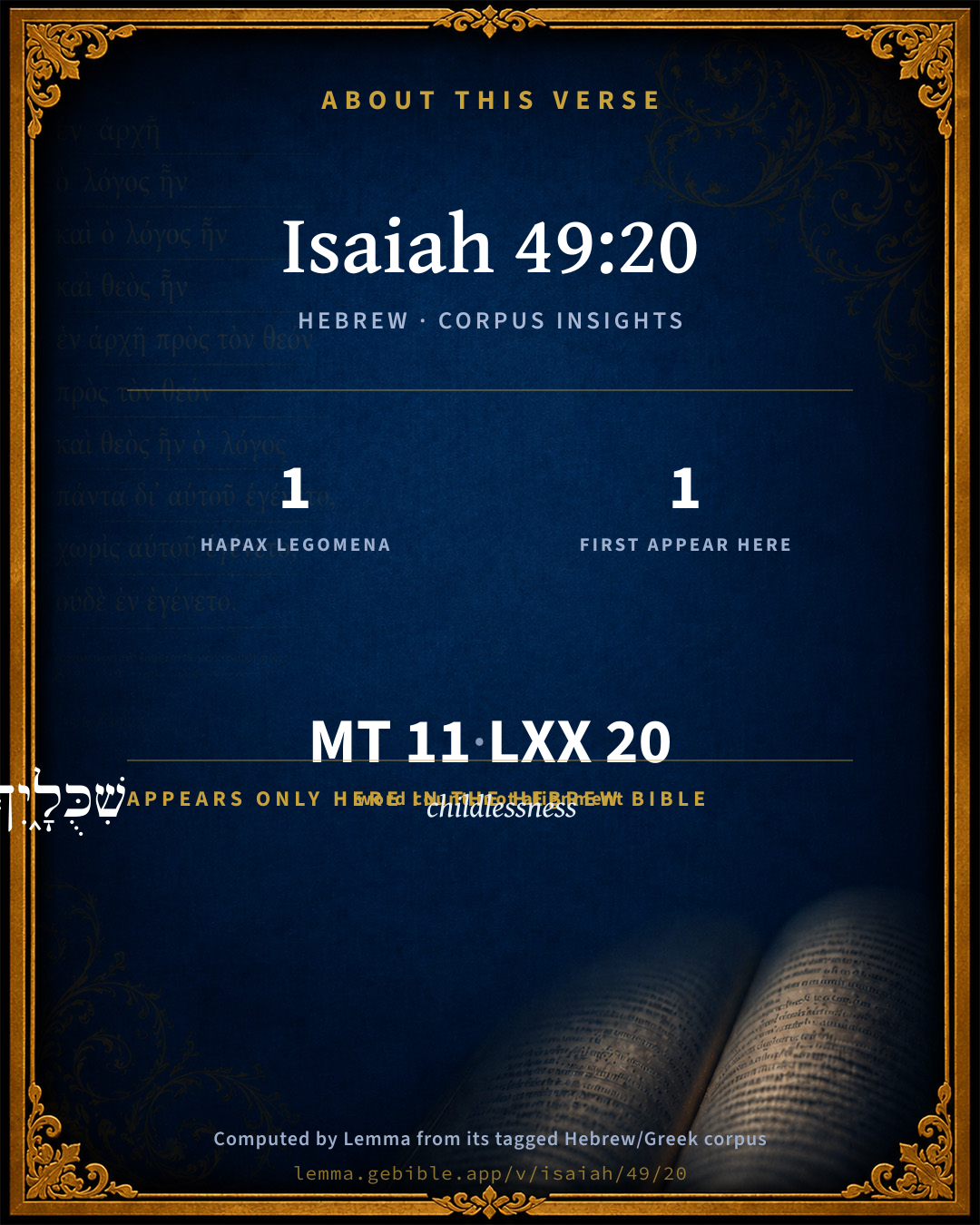
  • 1 hapax legomenon — only here in the Hebrew Bible
  • 1 first appearance in the Hebrew Bible
Full analysis ↓
Download a study sheet

One document with this verse’s original text, its word-by-word gloss line, the meaning frame, cross-references with their text, attributed commentary, and full source and license credits — printable, and it pastes into notes with its structure intact.

This verse Autodidact and up

Study sheet (.html) Plain text (.txt)

A passage Seminary Student

Up to 50 verses in one chapter. A passage sheet keeps up to 6 commentary sources and 12 cross-references per verse, in the order this page ranks them, and says so on the sheet whenever that leaves anything out. Ask for a single verse and you get the Autodidact verse sheet above.

Everything on this page stays free to read, with no account — the sheet is a download of what is already on screen, not access to it.

Want to remove ads? Support Godless Engineer
Compare translations 3

The same verse in 3 English versions, stacked beneath the original-language interlinear above. Click any original word for its lexicon entry.

Each is an independent rendering of the whole verse — the interlinear is not word-aligned to these translations.

Highlighted words mark where these versions differ — a whole-verse word diff, not a word-by-word alignment.

  • World English Bible Public Domain
    The children of your bereavement shall yet say in your ears, The place is too small for me; give place to me that I may dwell.
  • King James Version Public Domain
    The children which thou shalt have, after thou hast lost the other, shall say again in thine ears, The place is too strait for me: give place to me that I may dwell.
  • unfoldingWord Literal Text CC BY-SA 4.0
    Yet the sons of your bereavements will say in your ears, ‘The place too narrow for me; draw near to me, I may dwell.’

unfoldingWord Literal Text — © unfoldingWord, licensed CC BY-SA 4.0. Word-aligned USFM3 via Door43 (git.door43.org/unfoldingWord/en_ult).

Versions to compare (up to 4)

3 of 4 selected

Show all 18 translations

Every available English version of this verse, each an independent rendering of the whole verse.

  • World English Bible Public Domain
    The children of your bereavement shall yet say in your ears, The place is too small for me; give place to me that I may dwell.
  • Berean Standard Bible Public Domain
    Yet the children of your bereavement will say in your hearing, ‘This place is too small for us; make room for us to live here.’
  • Majority Standard Bible Public Domain
    Yet the children of your bereavement will say in your hearing, ‘This place is too small for us; make room for us to live here.’
  • King James Version Public Domain
    The children which thou shalt have, after thou hast lost the other, shall say again in thine ears, The place is too strait for me: give place to me that I may dwell.
  • American Standard Version (1901) Public Domain
    The children of thy bereavement shall yet say in thine ears, The place is too strait for me; give place to me that I may dwell.
  • Revised Version (1885) Public Domain
    The children of thy bereavement shall yet say in thine ears, The place is too strait for me: give place to me that I may dwell.
  • Geneva Bible (1599) Public Domain
    The children of thy barennesse shall say againe in thine eares, The place is straict for mee: giue place to me that I may dwell.
  • Douay-Rheims (1899) Public Domain
    The children of thy barrenness shall still say in thy ears: The place is too strait for me, make me room to dwell in.
  • Young's Literal Translation Public Domain
    Again do the sons of thy bereavement say in thine ears: `The place is too strait for me, Come nigh to me -- and I dwell.'
  • Literal Standard Version CC BY-SA 4.0
    Again the sons of your bereavement say in your ears: The place is too narrow for me, || Come near to me—and I dwell.
  • Unlocked Literal Bible CC BY-SA 4.0
    The children born during the time of your bereavement will say in your hearing, 'The place is too cramped for us, make room for us, so we may live here.'
  • unfoldingWord Literal Text CC BY-SA 4.0
    Yet the sons of your bereavements will say in your ears, ‘The place too narrow for me; draw near to me, I may dwell.’
  • Darby Bible Public Domain
    The children of thy bereavement shall yet say in thine ears, The place is too narrow for me: make room for me, that I may dwell.
  • World Messianic Bible Public Domain
    The children of your bereavement will say in your ears, ‘This place is too small for me. Give me a place to live in.’
  • Webster's Bible Public Domain
    The children which thou shalt have, after thou hast lost the other, shall say again in thy ears, The place is too narrow for me: give place to me that I may dwell.
  • Free Bible Version CC BY-SA 4.0
    The children born during your time of mourning in exile will say, “This place is too crowded for me! Make room so I have a place to live!”
  • Bible in Basic English Public Domain
    The children to whom you gave birth in other lands will say in your ears, The place is not wide enough for me: make room for me to have a resting-place.
  • JPS Tanakh (1917) Public Domain
    The children of thy bereavement shall yet say in thine ears: 'The place is too strait for me; give place to me that I may dwell.'

Literal Standard Version (2020), Covenant Press — licensed CC BY-SA 4.0. Text via the HelloAO Bible API (eBible.org). Unlocked Literal Bible (unfoldingWord) — licensed CC BY-SA 4.0. Text via the HelloAO Bible API (eBible.org). unfoldingWord Literal Text — © unfoldingWord, licensed CC BY-SA 4.0. Word-aligned USFM3 via Door43 (git.door43.org/unfoldingWord/en_ult). Free Bible Version, Dr. Jonathan Gallagher — licensed CC BY-SA 4.0. Text via the HelloAO Bible API (eBible.org).

Word by word

More ways to search: Search by grammar → Find every occurrence → Compare this word →

Practice this passage: Drill this verse → Learn its vocabulary →

שִׁכֻּלָ֑יִךְ
shikkulîym
H7923
“childlessness · your”
Noun, Common, Masculine, Plural, Construct + Suffix, Personal, 2nd Person, Feminine, Singular
Part of Speech
Noun
Type
Common
Gender
Masculine
Number
Plural
State
Construct
Full BDB Definition

Origin: pl. from H7921

TWOT: 2385d

childlessness, bereavement
  1. ע֚וֹד ʻôwd H5750 “still” Adverb
  2. יֹאמְר֣וּ ʼâmar H559 “to say” Verb, Qal, Imperfect, 3rd Person, Masculine, Plural
  3. בְאָזְנַ֔יִךְ ʼôzen H241 “in/at · ears · your” Preposition + Noun, Common, Feminine, Dual, Construct + Suffix, Personal, 2nd Person, Feminine, Singular
  4. בְּנֵ֖י bên H1121 “sons of” Noun, Common, Masculine, Plural, Construct
  5. צַר tsar H6862 “distress” Adjective, Adjective, Masculine, Singular, Absolute
  6. הַמָּק֖וֹם mâqôwm H4725 “the · place” Particle, Definite Article + Noun, Common, Masculine, Singular, Absolute
  7. גְּשָׁה nâgash H5066 “approach” Verb, Qal, Imperative, 2nd Person, Masculine, Singular + Suffix, h
  8. וְאֵשֵֽׁבָה yâshab H3427 “and · to dwell” Conjunction + Verb, Qal, Cohortative, 1st Person, Common, Singular

About this verse

These counts appear in no published source. They are computed here, from the morphology-tagged text and Lemma’s own curated glosses. What Lemma adds →

11
words
9
distinct lemmas
Prophets
section

Notable vocabulary

1 hapax legomenon — a word that appears only here in the entire Hebrew Bible:

  • שִׁכֻּלָ֑יִךְ childlessness H7923

First appearance in Scripture

This word makes its first canonical appearance in the Hebrew Bible here:

  • שִׁכֻּלָ֑יִךְ childlessness H7923

Grammatical profile

  • 3 verbs
  • 4 nouns
  • 1 adjective
  • 2 prepositions
  • 1 adverb

Verb forms

  • יֹאמְר֣וּ Qal · Imperfect
  • גְּשָׁה Qal · Imperative
  • וְאֵשֵֽׁבָה Qal · Cohortative

Hebrew & Septuagint length

In English translation the verse runs 26 words from the Hebrew and 27 from the Septuagint (LXX English) — closely comparable.

A rough comparison of the two English renderings, which tokenize alike — not a word-level alignment.

Word counts can differ between the Hebrew and the Greek without any difference in meaning — e.g. the Hebrew direct-object marker אֵת has no separate Greek word, and Greek often adds the article ὁ.

In the original languages it is 11 Hebrew tokens and 20 Greek tokens — but the two are counted differently (Hebrew bundles its prefixes and suffixes into one token; the Greek is in lemma form), so that isn’t a like-for-like length.

Cross-references

8

Topical passages linked to Isaiah 49:20 in the Treasury of Scripture Knowledge — connected by theme and wording, ordered by reader-vote popularity; previews shown in the World English Bible.

  • Joshua 17:14–16 The children of Joseph spoke to Joshua, saying, Why have you given me but one lot and one part for an inheritance, seeing I am a great people, because hitherto Yahweh has blessed me?
  • 2 Kings 6:1 The sons of the prophets said to Elisha, See now, the place where we dwell before you is too strait for us.
  • Isaiah 51:3 For Yahweh has comforted Zion; he has comforted all her waste places, and has made her wilderness like Eden, and her desert like the garden of Yahweh; joy and gladness shall be found therein, thanksgiving, and the voice of melody.
  • Isaiah 54:1–3 Sing, barren, you who didn't bear; break forth into singing, and cry aloud, you who did not travail with child: for more are the children of the desolate than the children of the married wife, says Yahweh.
  • Isaiah 60:4 Lift up your eyes round about, and see: they all gather themselves together, they come to you; your sons shall come from far, and your daughters shall be carried in the arms.
  • Hosea 1:10 Yet the number of the children of Israel will be as the sand of the sea, which can't be measured nor numbered; and it will come to pass that, in the place where it was said to them, 'You are not my people,' they will be called 'sons of the living God.'
  • Matthew 3:9 Don't think to yourselves, 'We have Abraham for our father,' for I tell you that God is able to raise up children to Abraham from these stones.
  • Galatians 4:26–28 But the Jerusalem that is above is free, which is the mother of us all.

Cross-references courtesy of OpenBible.info (CC BY 4.0).

Hebrew and Greek witnesses Masoretic Hebrew ↔ Greek Septuagint

The same verse in the two great witnesses to the Old Testament, shown verse-for-verse.

These are two independent witnesses, not word-aligned to each other, and the Septuagint is shown in lemma (dictionary) form.

Hebrew Isaiah 49:20 Masoretic · Westminster Leningrad Codex

ע֚וֹד יֹאמְר֣וּ בְאָזְנַ֔יִךְ בְּנֵ֖י שִׁכֻּלָ֑יִךְ צַר לִ֥י הַמָּק֖וֹם גְּשָׁה לִּ֥י וְאֵשֵֽׁבָה

The children of your bereavement shall yet say in your ears, The place is too small for me; give place to me that I may dwell.

World English Bible · Public Domain

Greek LXX Isaiah 49:20 Septuagint · lemma form

εἶπον γάρ εἰς ὁ οὖς σύ ὁ υἱός σύ ὅς ἀποὀλλύω στενός ἐγώ ὁ τόπος ποιέω ἐγώ τόπος ἵνα κατοικέω

For your sons whom you have lost shall say in your ears, The place is too narrow for me: make room for me that I may dwell.

LXX2012 (modern English Septuagint) · Public Domain

Hebrew: Westminster Leningrad Codex (CC BY 4.0). Greek: Septuagint (public domain); English from LXX2012 (modern English Septuagint) (Public Domain). How the Septuagint differs from the Hebrew →

Targum (Aramaic paraphrase)

1

The Targum is the ancient Jewish Aramaic paraphrase of the Hebrew Scriptures — an interpretive translation, not the Hebrew text itself. Onkelos (literal) and Pseudo-Jonathan (expansive) render the Torah, and Jonathan the Prophets. Coverage is partial: where no permissively-licensed English translation exists for a verse, only the Aramaic is shown. This is verse-level text, not a word-by-word alignment to the Hebrew.

  1. Targum Jonathan Prophets (Joshua–Malachi)
    מִכְּעַן יֵימְרוּן חַד חַד בְּגַוִיךְ בְּנֵי עַם גַלְוָתִיךְ עָק לִי אַתְרָא רְוַח לִי וְאֵיתִיב:

    Henceforth shall each of the children of thy captivity in the midst of thee say: The place is too strait for me: make room for me that I may dwell.

    Targum Jonathan — Aramaic: “Mikraot Gedolot” (public domain). English: “Sefaria Community Translation” (CC0 1.0 (public-domain dedication)); “London "Chaldee Paraphrase," 1871” (public domain). Text via Sefaria.

Commentary

Notes on Isaiah 49:20 from classic Christian and Jewish commentators (each source and its license shown beneath its notes). The classic Christian expositions comment on the surrounding passage and are grouped to its opening verse, so a note may address several verses; the Jewish commentaries on the Tanakh (Rashi and others) are per-verse, so they appear only where the commentator wrote on this verse.

Lemma curates 59 commentaries, every one of them public domain or Creative Commons licensed, each selected and text-cleaned for this edition rather than reprinted as found. About our sources →

Trapp's Complete Commentary

John Trapp

Isa 49:20 The children which thou shalt have, after thou hast lost the other, shall say again in thine ears, The place [is] too strait for me: give place to me that I may dwell.

Ver. 20. The children.] Heb., The children of thine orbity; such as are not yet received into the Church.

Give place to me that I may.] People shall offer violence to heaven, and the "violent shall take it by force": valde avide et quasi ambitiose accessuri sunt. Ezekiel describeth the Church of the New Testament to be very large and spacious, and yet she shall be so crowded as is a bee hive, out of the mouth whereof the bees oft hang in heaps for want of room within.

John Trapp, A Commentary or Exposition upon All the Books of the Old and New Testament (1647–1656) — public domain. Text from a community e-Sword module.

The Biblical Illustrator

Joseph S. Exell

Isa_49:20-21

The children which thou shalt have.

--

The Church a mother

I. THE CHURCH IS A MOTHER.

1. Because it is her privilege to bring forth into the world the spiritual children of the Lord Jesus Christ.

2. When these little ones are born, the Churchs business is to feed them.

3. It is her endeavour to train up her children.

4. She will be always ready to nurse her children when they become sick.

II. THE CHURCH IS SOMETIMES BEREAVED.

1. Some of her nominal children she loses by spiritual death. They are not really her children at all. They looked so much like hers that she could hardly tell them.

2. She loses many by death temporal

3. Sometimes by a trying providence.

III. THE CHURCH HAS SOMETIMES TO BE CARRIED AWAY CAPTIVE. How often has this happened to the Church of God in the olden times! The Church has been carried into foreign countries. Sometimes she has been cruelly persecuted. Often, too, the Church has been compelled to seek a refuge in foreign countries. Days of slumber have come over the Church, and days of heresy too.

IV. THE CHURCH HAS HAD A MARVELLOUS INCREASE AFTER ALL HER CAPTIVITIES, and all her bereavements have hitherto always worked for her good. Never has the Church lost her children without obtaining many more.

1. The first thing which astonishes the Church when she opens her eyes after her captivity is to notice the number of her children.

2. Also their character--these. (C. H. Spurgeon.)

Church increase

I. THERE IS A DECREASE GOING ON IN THE CHURCH OF GOD ON EARTH. Zion is represented here as mourning for the children that she had lost. The Jewish Church in the olden times saw her sons and daughters slain with the sword, or carried away captive. Afterwards, she saw the great majority of the nation refusing Christ, and turning away from Him, and thus the Jewish Church was minished and brought very low. The same thing has happened in many other eases. We must naturally expect to see, in each separate Church of Jesus Christ, a certain process and measure of decrease.

1. Some are being drafted from us to supply the choirs of heaven with fresh minstrelsy.

2. Each separate Church will also have a measure of decrease through the removal of Gods servants from one place to another.

3. There is another source of decrease over which we must greatly grieve, and that is the backsliding of many professor.

4. The sifting process by which the chaff is removed from the wheat.

II. THERE IS AN INCREASE TO BE EXPECTED IN THE CHURCH OF GOD. There are new converts yet to come in, these children which Zion is to have, after she has lost the others.

1. These new converts are needful No Church can be healthy without the constant in fusion of fresh blood.

2. Therefore, she ought to have every preparation for their reception.

3. All who love the Lord should labour earnestly on their behalf.

4. When we are all pleading and labouring for an increase to the Church, it will come; and when it comes, it is probable that we shall be astonished at the number of those that come. The children which thou shalt have, &c.

5. The next thing that was a subject for astonishment to Zion was how those converts came to be born at all Who hath begotten me these?

6. But what Zion wondered at next was, how they had been nurtured, for she says, Who hath brought up these?

7. A further cause of wonder was, the sudden appearance of this great increase. Zion inquires, These, where had they been? Shall I tell you where they had been? Some of them had been in godly families with fathers and mothers praying for them. Some of them had been in the Sunday school, in crosses where brethren and sisters love their children, and never rest till they bring them to decision for Christ. They had been under the influence of Christian wives, Christian children, sometimes Christian brothers and sisters; and so, at last, the gracious influence took effect upon them, by the power of Gods Spirit, and out they came. There are great numbers still under those sacred influences, for they also are sure to come in due time, and say, We are on the Lords side. Then there were some others. Where had they been? They had long been listening to the Gospel, regularly sitting in their pews. But there were others about whom I might well ask, These, where had they been? On the Lords day, at home in their shirt-sleeves; on week-nights, at the theatre or the music-hall, finding enjoyment in the lowest form of amusement. Where had they been? Never troubling church or chapel; but God, in His providence, brought them for once to hear the Word, and, as one said to me, I laid hold of something, and something laid hold of me, and I shall never part with it, for it will never part with me. These, where had they been? I cannot tell you where they had all been; some had been at deaths dark door, buried in sorrow and in sin, in poverty and in vice.

III. ALL THINGS SHOULD ENCOURAGE THE CHURCH TO SEEK LARGER INCREASE.

1. There is the same power to convert ten thousand as there is to convert one.

2. We ought to be encouraged by the fact that the converts come in answer to prayer.

3. Further, since the converts come from all sorts of places, let us carry the Gospel into all sorts of places. (C. H. Spurgeon.)

The Biblical Illustrator, edited by Joseph S. Exell (c. 1880s–1900s) — public domain. Text from a community e-Sword module.

Jamieson, Fausset & Brown

Robert Jamieson, A. R. Fausset & David Brown

children . . . after . . . other--rather, "the children of thy widowhood," that is, the children of whom thou hast been bereft during their dispersion in other lands (see on Isa 47:8) [MAURER].

again--rather, "yet."

give place--rather, "stand close to me," namely, in order that we may be the more able to dwell in in the narrow place [HORSLEY]. Compare as to Israel's spiritual children, and the extension of the gospel sphere, Rom 15:19, Rom 15:24; Co2 10:14-16. But Isa 49:22 (compare Isa 66:20) shows that her literal children are primarily meant. GESENIUS translates, "Make room."

Jamieson, Fausset & Brown — Commentary Critical and Explanatory on the Whole Bible (1871) — public domain (CC PDM 1.0). Text via the HelloAO Bible API.

Ellicott's Commentary for English Readers

(20) The children which thou shalt have . . .—Better, the children of thy bereavement (i.e., born when Zion thought herself bereaved) shall yet say . . .

A Bible Commentary for English Readers, edited by Charles John Ellicott (1878–1897) — public domain. Text from a community e-Sword module.

The Cambridge Bible for Schools and Colleges

gen. ed. J. J. S. Perowne

20. The children … other] Lit. the sons of thy bereavement, i.e. those born to thee in the time of thy bereavement (see Isa_49:21).

shall yet say in thine ears] The mother overhears the talk of her vigorous and enterprising offspring.

the place is too strait for me] Cf. 2Ki_6:1.

Give place to me] This peculiar sense of the verb (usually “draw near”) finds an exact parallel in Gen_19:9. Comp. Isa_65:5, “draw near to thyself” = “stand off,”—a different, but synonymous verb.

The Cambridge Bible for Schools and Colleges (gen. ed. J. J. S. Perowne; Cambridge University Press, 1878–1918) — public domain. Text from a community e-Sword module.

John Gill's Exposition

The children which thou shalt have, after thou hast lost the other,.... Which "other lost" are not the Jews, the broken branches, rejected and cut off for unbelief; and the "children after" them not the Gentiles converted, which took their place; but "the other" are such who have been destroyed by the Heathen persecutions, and especially by the antichristian cruelties; and the "children after", the great numbers of converts upon the fall of antichrist. The words may be rendered, "the children of thine orbity" (o), or "childless state"; such as were born unto her in an uncommon, extraordinary, and unexpected way, when the church seemed to be in a widowhood estate, or like a woman that is past bearing children:

shall say again in thine ears; or, "shall yet say" (p); that is, hereafter, in time to come: for this is a prophecy of what should be said in the church's hearing, and such as had never been said before; and therefore improperly rendered "again"; for there never has been as yet such a time as this, or such a large number of converts, as to say,

the place is too strait for me to dwell in; there is not room enough for us, as in Kg2 6:1,

give place to me that I may dwell; one and another of the children or converts should say, make room for me, that I may have a name and a place among you, and dwell with you, and abide in the house of the Lord, and partake of the privileges and ordinances of it: but the word used signifies drawing nigh, and not giving way or removing; and should rather be rendered, "draw nigh to me that I may dwell"; or "and I shall dwell" (q), or "sit"; come close to one another, and we shall all sit and dwell comfortably together; just as when a house is well filled with agreeable company, and there is an unwillingness to part with or lose any, they are desired to sit close together, that there may be room for all: and this is, and will be, the case with the church and her members; they will be desirous to sit regularly, and close together, in Gospel order, that everyone may be comfortable, and partake of the benefit of communion, and none be obliged to depart: and to this sense Gussetius (r) interprets the phrase.

(o) "filii orbitatis tuae", Junius & Tremellius, Piscator, Vitringa; "orbitatum tuarum", Pagninus, Montanus; "tui orbati", Munster. (The word "orbity" means "childless" or "without parents", Webster's 1828 Dictionary, Editor) (p) "adhuc dicent", Gataker, Junius & Tremellius, Piscator, Vitringa. q) "accede mihi & habitabo", Montanus; "contrahe te mea causa ut sedeam", Cocceius. (r) Ebr. Comment. p. 496.

John Gill's Exposition of the Whole Bible (1746–1763) — public domain (CC PDM 1.0). Text via the HelloAO Bible API.

Albert Barnes' Notes on the Bible

The children which thou shalt have - The increase of the population shall be so great.

After thou hast lost the other - Hebrew, ‘The sons of thy widowhood.’ That is, after thou hast lost those that have been killed in the wars, and those that have died in captivity in a distant land, there shall be again a great increase as if they were given to a widowed mother. And perhaps the general truth is taught here, that the persecution of the people of God will be attended ultimately with a vast increase; and that all the attempts to obliterate the church will only tend finally to enlarge and strengthen it.

Shall say again in thy ears - Or, shall say to thee.

The place is too strait for me - There is not room for us all. The entire language here denotes a vast accession to the church of God. It is indicative of such an increase as took place when the gospel was proclaimed by the apostles to the Gentiles, and of such an increase as shall Yet more abundantly take place when the whole world shall become converted to God.

Albert Barnes' Notes on the Bible (1834–1885) — public domain. Text from a community e-Sword/MySword module.

Haydock's Catholic Bible Commentary

Barrenness, of which thou complainest. He alludes to the captives who returned, and to Christian converts. (Menochius)

George Leo Haydock (1774–1849), Haydock's Catholic Family Bible and Commentary, 1859 edition — public domain. Excludes Psalms (Douay-Rheims chapter numbering differs from Protestant) and Deuterocanonical books (Catholic canon only).

Matthew Poole's English Annotations

The children which thou shalt have, after thou hast lost the other, Heb. The children of thine orbity or barren and childless state. Those children which thou shalt have when thou art grown past the ordinary age and state of childbearing, as Sarah was made the mother of a most numerous posterity; . to which he seems here to allude. Those Gentiles which shall be begotten by thee, to wit, by the ministry of thy children, Christ and his apostles, when thou shalt be deprived of thine own natural children, when thou shalt become barren and unfruitful as to conversion of natural Jews, when the generality of the Jews shall cut themselves off from God, and from his true church, by their apostacy from God, and by their unbelief and obstinate refusal of their Messiah.

Shall say again, or rather,

shall yet say, though for the present it be otherwise.

Matthew Poole's English Annotations on the Holy Bible (1683–1685) — public domain. Text from a community e-Sword/MySword module.

Whedon's Commentary on the Bible

Daniel D. Whedon

20. The place is too strait — So full of happy dwellers this place shall be, that thy children, as they come to thee with sympathy on occasion of some lost one, shall say over and over in thy hearing, to one and another, “Give me room, too crowded is this place.” Zion overhears this language, not of complaint, but of inconvenience for lack of space.

Daniel D. Whedon (gen. ed.), Commentary on the Old and New Testaments (1874–1909) — public domain. Text from a community e-Sword module.

The Pulpit Commentary

The children which thou shalt have, after thou hast lost the other; literally, the children of thy bereavement; i.e. the Gentiles who shall replace those many faithless Israelites who refused to return when Cyrus issued his edict, and became lost to the Church of God. The place is too strait for me (see the comment on ver. 19).

The Pulpit Commentary (1880–1919), ed. H.D.M. Spence-Jones & Joseph S. Exell — public domain. Text from a community e-Sword module.

John Wesley's Explanatory Notes

The children - Those Gentiles which shall be begotten by thee, when thou shalt be deprived of thine own natural children, when the generality of the Jews cut themselves off from God.

John Wesley, Explanatory Notes Upon the Whole Bible (1754–1765) — public domain. Text via the GEBible commentary corpus.

J. A. Alexander on Isaiah

Joseph Addison Alexander

“Again (or still) shall they say in thine ears, the sons of thy childlessness, (Too) narrow for me is the place; come near for me, and I will dwell (or that I may dwell).” The ‘again’ may simply indicate that something more is to be said than had been said before, in which case it is nearly equivalent to ‘over and above this’ or ‘moreover’. Or it may have its true sense as a particle of time, and intimate that these words shall be uttered more than once, again and again, or ‘still’, (i.e., continually, as the necessity becomes more urgent). The relative position of the verb and its subject is retained in the translation, as it causes no obscurity, and exhibits more exactly the characteristic form of the original. By the sons of thy childlessness we may understand ‘the sons of thee a childless one’, or, ‘thy sons oh childless one’. The apparent contradiction is intentional, as appears from what follows. She who was deemed by others, and who deemed herself, a childless mother, hears the voices of her children, complaining that they have not a sufficient space to dwell in. ‘In thy ears’ means ‘in thy hearing, although not addressed to thee.’ (Compare 2Sa 18:12). Even in Isa 5:9, the idea seems to be not merely that of hearing, but of overhearing. The idea of excess (too narrow) is not expressed but implied, the strict translation being: simply this, the place is narrow for me. All interpreters agree that the first verb in the last clause means ‘make room for me’, but they differ in explaining how this sense may be extracted from the Hebrew words. Some explain the phrase to mean, ‘Come near to me, that there may be more room’, but the sense thus given to the words is inappropriate, because the person speaking demands room not for others but for himself, which he could not possibly secure by calling on his neighbor to come close to him. The whole difficulty seems to have arisen from assuming that the preposition means ‘to’, and denotes the direction of the motion, in opposition to the fact that it is never so used after this verb, but always indicates the purpose or design. This usage fully justifies the explanation of the phrase before us as meaning, ‘approach to one side for me or on my account’ leaving the precise direction of the motion undetermined. The sense ‘for me’ is the more probable, because it is precisely that which it has in the first clause of this verse and the first clause of the next.

Joseph Addison Alexander, The Prophecies of Isaiah (1846–1847; New York: Scribner, 1870–1878) — public domain. Text from a community e-Sword module.

Rashi

Rabbi Shlomo Yitzchaki (Rashi)

Your children of whom you were bereaved [lit. the children of your bereavements.] The children of whom you were bereaved.

move over for me [lit. approach for me.] Draw closer to another side for me, and I will dwell.

Rashi on the Tanakh — English translations: “The Judaica Press complete Tanach with Rashi, translated by A. J. Rosenberg” (CC BY 4.0); “Pentateuch with Rashi's commentary by M. Rosenbaum and A.M. Silbermann, 1929-1934” (public domain); “The Metsudah Tanach series, Lakewood, N.J” (CC BY 4.0); and “The Book of Joshua, Metsudah Publications, 1997” (CC BY 4.0). Text via Sefaria.

Ibn Ezra

Rabbi Abraham ibn Ezra

גשה לי Give place unto me. Lit. Go thither for my sake. Comp. גש הלאה stand back (Gen. 19:9)

Ibn Ezra on the Tanakh — English translations: “Sefaria Community Translation” (CC0 1.0 (public-domain dedication)); “Yalkut, Sifsei Chachomim Chumash, Metsudah Publications, 2009” (CC BY 4.0); and “Commentary of Ibn Ezra on Isaiah - trans. by M. Friedlander, 1873” (public domain). Text via Sefaria.

Lesson kit

Teaching starters — assembled from the data on this page, not authored interpretation. Every prompt links to the verse data it draws on. Edit before teaching.

Isaiah, in the Prophets, opens this verse with 11 words (9 distinct Hebrew lemmas). Its most distinctive word is shikkulîym (“childlessness”). A historical commentator’s framing appears above. Read the whole chapter for the surrounding context.

Discussion questions

  1. The word shikkulîym carries the sense “childlessness.” How does it shape the verse?
  2. This verse holds 1 word here found nowhere else in the Hebrew Bible. What might the rare word draw attention to?
  3. The word “childlessness” first appears here in Scripture. What is being introduced at this debut?
  4. Joshua 17:14–16 shares this passage’s theme. How do the two illuminate each other?
  5. The translations on this page render this verse differently — a whole-verse word diff, not a word-by-word alignment. What might account for the different wordings?
  6. The verb «יֹאמְר֣וּ» is Qal Imperfect. How does its form color the action?
  7. Reading how Trapp's Complete Commentary and The Biblical Illustrator read this verse, where do the two commentators agree and where do they part?

Things to notice

Reading settings

Reading text

Shown beneath each verse's original-language words.

Old Testament
Old Testament edition

Read the OT as the Masoretic Hebrew (MT) or the Greek Septuagint (LXX).

English shown for the Greek Septuagint (in the Hebrew ↔ Greek comparison).

Comparing translations? Open the Compare panel on any verse page to stack up to four side by side.