Ezekiel 9:5

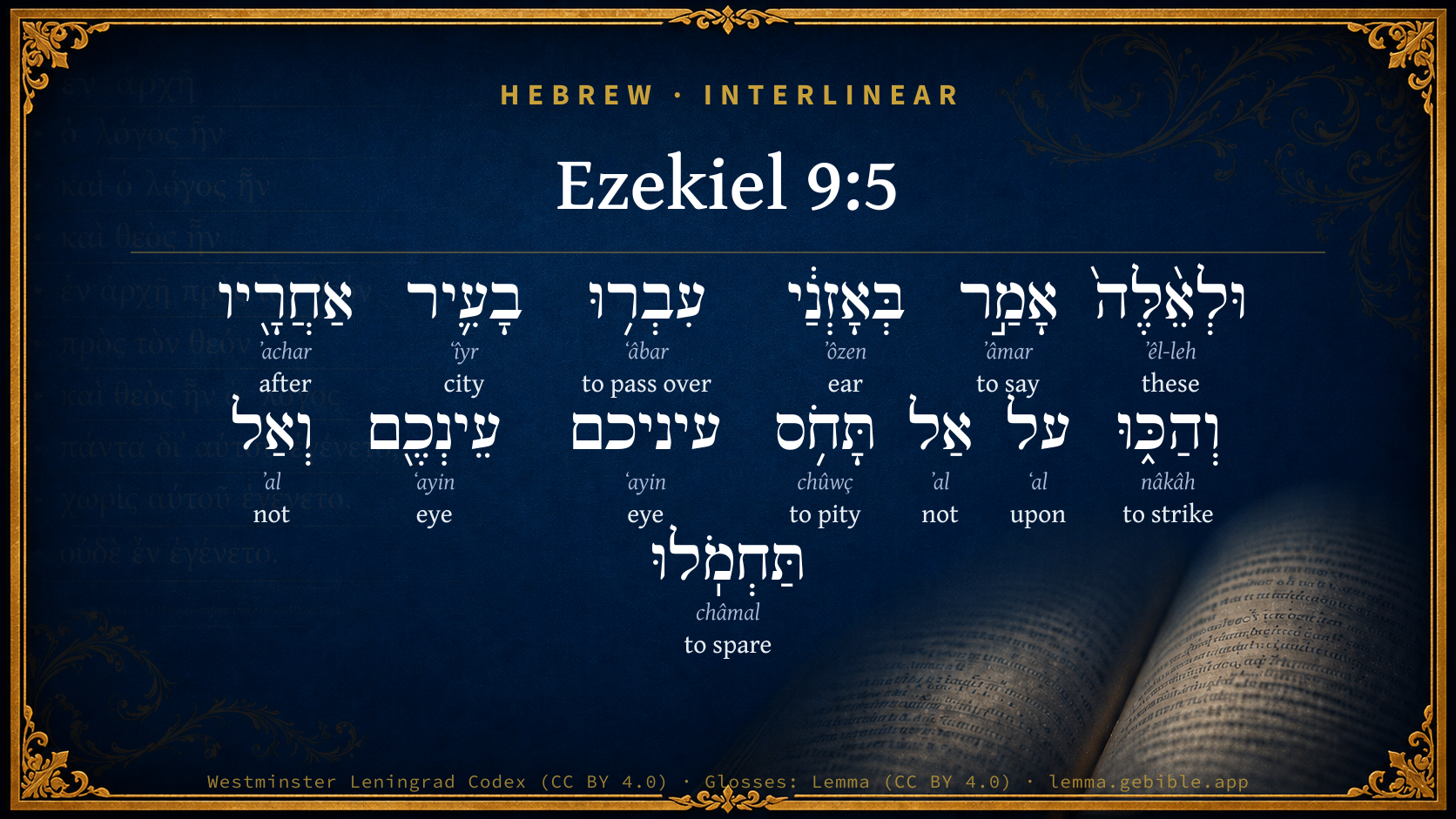
Hebrew (Westminster Leningrad Codex) Ezekiel 9:5 appears in the Hebrew Old Testament. The text above is from the Westminster Leningrad Codex. Each word links to its Strong’s number, a concise gloss, and parsing drawn from the Open Scriptures Hebrew Bible morphology. Click any word for its full Brown-Driver-Briggs (BDB) entry.
Download image
Cite this verse

Ezekiel 9:5 (World English Bible). Public Domain. Lemma interlinear Bible study tool, https://lemma.gebible.app/v/ezekiel/9/5.

Show BibTeX & RIS
BibTeX
RIS
English Translation
To the others he said in my hearing, Go you through the city after him, and strike: don't let your eye spare, neither have you pity;
World English Bible · Public Domain
Download a study sheet

One document with this verse’s original text, its word-by-word gloss line, the meaning frame, cross-references with their text, attributed commentary, and full source and license credits — printable, and it pastes into notes with its structure intact.

This verse Autodidact and up

Study sheet (.html) Plain text (.txt)

A passage Seminary Student

Up to 50 verses in one chapter. A passage sheet keeps up to 6 commentary sources and 12 cross-references per verse, in the order this page ranks them, and says so on the sheet whenever that leaves anything out. Ask for a single verse and you get the Autodidact verse sheet above.

Everything on this page stays free to read, with no account — the sheet is a download of what is already on screen, not access to it.

Want to remove ads? Support Godless Engineer
Compare translations 3

The same verse in 3 English versions, stacked beneath the original-language interlinear above. Click any original word for its lexicon entry.

Each is an independent rendering of the whole verse — the interlinear is not word-aligned to these translations.

Highlighted words mark where these versions differ — a whole-verse word diff, not a word-by-word alignment.

  • World English Bible Public Domain
    To the others he said in my hearing, Go you through the city after him, and strike: don't let your eye spare, neither have you pity;
  • King James Version Public Domain
    And to the others he said in mine hearing, Go ye after him through the city, and smite: let not your eye spare, neither have ye pity:
  • unfoldingWord Literal Text CC BY-SA 4.0
    Then he spoke to the others within my hearing, “Pass through the city after him and kill. Do not let your eyes have compassion, and do not spare

unfoldingWord Literal Text — © unfoldingWord, licensed CC BY-SA 4.0. Word-aligned USFM3 via Door43 (git.door43.org/unfoldingWord/en_ult).

Versions to compare (up to 4)

3 of 4 selected

Show all 18 translations

Every available English version of this verse, each an independent rendering of the whole verse.

  • World English Bible Public Domain
    To the others he said in my hearing, Go you through the city after him, and strike: don't let your eye spare, neither have you pity;
  • Berean Standard Bible Public Domain
    And as I listened, He said to the others, “Follow him through the city and start killing; do not show pity or spare anyone!
  • Majority Standard Bible Public Domain
    And as I listened, He said to the others, “Follow him through the city and start killing; do not show pity or spare anyone!
  • King James Version Public Domain
    And to the others he said in mine hearing, Go ye after him through the city, and smite: let not your eye spare, neither have ye pity:
  • American Standard Version (1901) Public Domain
    And to the others he said in my hearing, Go ye through the city after him, and smite: let not your eye spare, neither have ye pity;
  • Revised Version (1885) Public Domain
    And to the others he said in mine hearing, Go ye through the city after him, and smite: let not your eye spare, neither have ye pity:
  • Geneva Bible (1599) Public Domain
    And to the other he said, that I might heare, Goe ye after him through the citie, and smite: let your eye spare none, neither haue pitie.
  • Douay-Rheims (1899) Public Domain
    And to the others he said in my hearing: Go ye after him through the city, and strike: let not your eyes spare, nor be ye moved with pity.
  • Young's Literal Translation Public Domain
    And to the others he said in mine ears, `Pass on into the city after him, and smite; your eye doth not pity, nor do ye spare;
  • Literal Standard Version CC BY-SA 4.0
    And to the others he said in my ears, “Pass on into the city after him, and strike; your eye does not pity, nor do you spare;
  • Unlocked Literal Bible CC BY-SA 4.0
    Then he spoke to the others within my hearing, “Pass through the city after him and kill. Do not let your eyes have compassion, and do not spare
  • unfoldingWord Literal Text CC BY-SA 4.0
    Then he spoke to the others within my hearing, “Pass through the city after him and kill. Do not let your eyes have compassion, and do not spare
  • Darby Bible Public Domain
    And to the others he said in my hearing, Go after him through the city, and smite: let not your eye spare, neither have pity.
  • World Messianic Bible Public Domain
    To the others he said in my hearing, “Go through the city after him, and strike. Don’t let your eye spare, neither have pity.
  • Webster's Bible Public Domain
    And to the others he said in my hearing, Go ye after him through the city, and smite: let not your eye spare, neither have ye pity:
  • Free Bible Version CC BY-SA 4.0
    Then I heard him tell the others, “Follow him all through the city and start killing people. Don't be kind or merciful to anyone!
  • Bible in Basic English Public Domain
    And to these he said in my hearing, Go through the town after him using your axes: do not let your eyes have mercy, and have no pity:
  • JPS Tanakh (1917) Public Domain
    And to the others He said in my hearing: 'Go ye through the city after him, and smite; let not your eye spare, neither have ye pity;

Literal Standard Version (2020), Covenant Press — licensed CC BY-SA 4.0. Text via the HelloAO Bible API (eBible.org). Unlocked Literal Bible (unfoldingWord) — licensed CC BY-SA 4.0. Text via the HelloAO Bible API (eBible.org). unfoldingWord Literal Text — © unfoldingWord, licensed CC BY-SA 4.0. Word-aligned USFM3 via Door43 (git.door43.org/unfoldingWord/en_ult). Free Bible Version, Dr. Jonathan Gallagher — licensed CC BY-SA 4.0. Text via the HelloAO Bible API (eBible.org).

Word by word

More ways to search: Search by grammar → Find every occurrence → Compare this word →

Practice this passage: Drill this verse → Learn its vocabulary →

תָּחֹ֥ס
chûwç
H2347
“to pity”
Verb, Qal, Jussive, 3rd Person, Feminine, Singular
Part of Speech
Verb
Stem
Qal
Form
Jussive
Person
3rd Person
Gender
Feminine
Number
Singular
Full BDB Definition

Origin: a primitive root

TWOT: 626

(Qal) to pity, have compassion, spare, look upon with compassion
  1. וּלְאֵ֨לֶּה֙ ʼêl-leh H428 “and · to/for · these” Conjunction + Preposition + Pronoun, Demonstrative, Common, Plural
  2. אָמַ֣ר ʼâmar H559 “to say” Verb, Qal, Perfect, 3rd Person, Masculine, Singular
  3. בְּאָזְנַ֔י ʼôzen H241 “in/at · ears · my” Preposition + Noun, Common, Feminine, Dual, Construct + Suffix, Personal, 1st Person, Common, Singular
  4. עִבְר֥וּ ʻâbar H5674 “pass over” Verb, Qal, Imperative, 2nd Person, Masculine, Plural
  5. בָעִ֛יר ʻîyr H5892 “in/at the · city” Preposition, Determined + Noun, Common, Feminine, Singular, Absolute
  6. אַחֲרָ֖יו ʼachar H310 “after · him” Preposition + Suffix, Personal, 3rd Person, Masculine, Singular
  7. וְהַכּ֑וּ nâkâh H5221 “and · strike” Conjunction + Verb, Hiphil, Imperative, 2nd Person, Masculine, Plural
  8. על ʻal H5921 “upon” Preposition
  9. אַל ʼal H408 “not” Particle, Negative
  10. עיניכם ʻayin H5869 “eyes · your” Noun, Common, Both, Dual, Construct + Suffix, Personal, 2nd Person, Masculine, Plural
  11. עֵינְכֶ֖ם ʻayin H5869 “eye · your” Noun, Common, Both, Singular, Construct + Suffix, Personal, 2nd Person, Masculine, Plural
  12. וְאַל ʼal H408 “and · not” Conjunction + Particle, Negative
  13. תַּחְמֹֽלוּ châmal H2550 “to spare” Verb, Qal, Jussive, 2nd Person, Masculine, Plural

About this verse

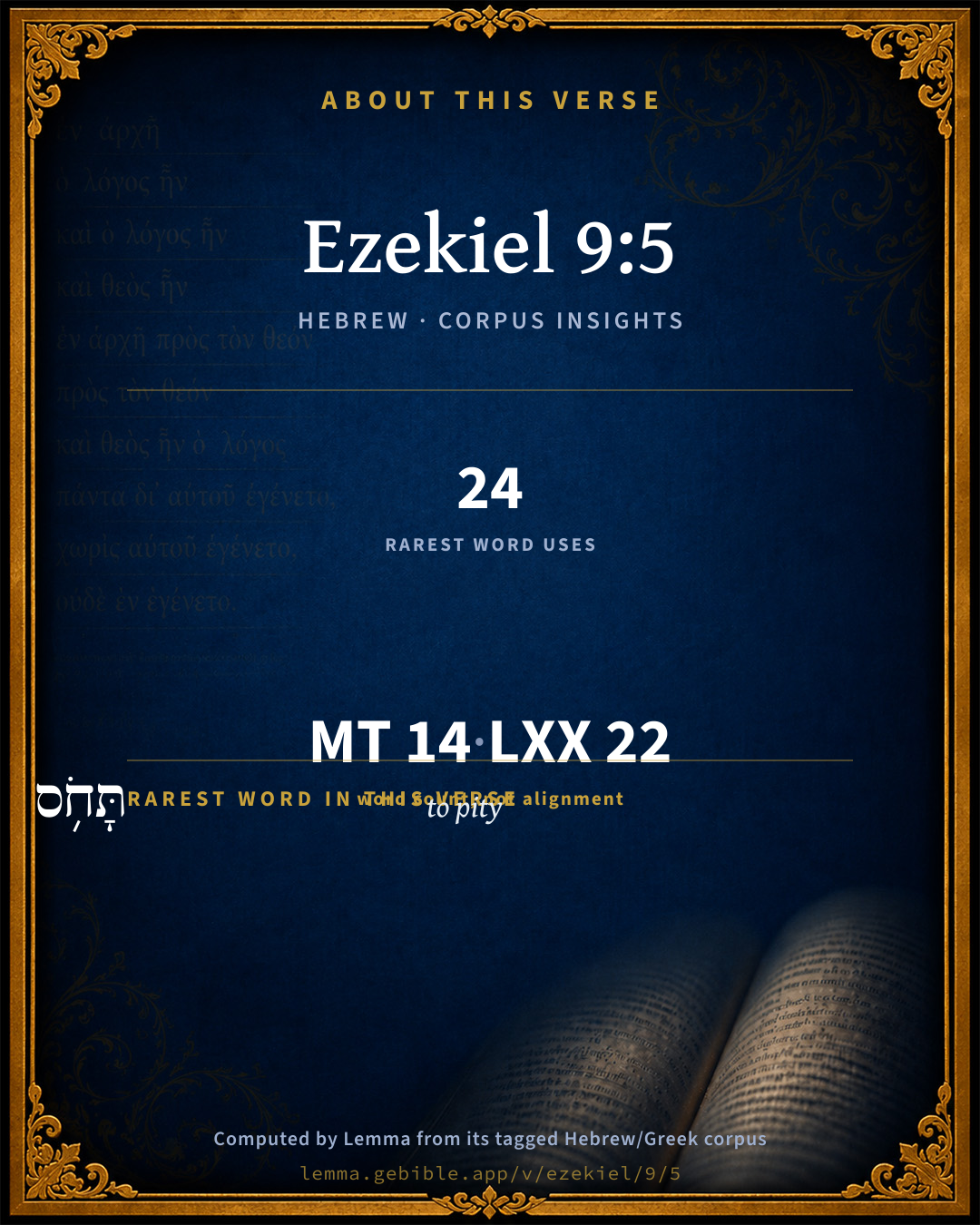
These counts appear in no published source. They are computed here, from the morphology-tagged text and Lemma’s own curated glosses. What Lemma adds →

14
words
12
distinct lemmas
Prophets
section

Notable vocabulary

The rarest word here is תָּחֹ֥ס to pity H2347 — appearing just 24 times in the whole Hebrew Bible.

Shared distinctive vocabulary

תָּחֹ֥ס to pity H2347 occurs in 24 verses of the Hebrew Bible. Also found in:

Grammatical profile

  • 5 verbs
  • 4 nouns
  • 1 pronoun
  • 2 prepositions
  • 2 particles

Verb forms

  • אָמַ֣ר Qal · Perfect
  • עִבְר֥וּ Qal · Imperative
  • וְהַכּ֑וּ Hiphil · Imperative
  • תָּחֹ֥ס Qal · Jussive
  • תַּחְמֹֽלוּ Qal · Jussive

Repetition

Words recur within this verse — often emphatic in Hebrew:

  • עיניכם eye H5869 ×2
  • אַל not H408 ×2

Hebrew & Septuagint length

In English translation the verse runs 26 words from the Hebrew and 27 from the Septuagint (LXX English) — closely comparable.

A rough comparison of the two English renderings, which tokenize alike — not a word-level alignment.

Word counts can differ between the Hebrew and the Greek without any difference in meaning — e.g. the Hebrew direct-object marker אֵת has no separate Greek word, and Greek often adds the article ὁ.

In the original languages it is 14 Hebrew tokens and 22 Greek tokens — but the two are counted differently (Hebrew bundles its prefixes and suffixes into one token; the Greek is in lemma form), so that isn’t a like-for-like length.

Cross-references

13

Topical passages linked to Ezekiel 9:5 in the Treasury of Scripture Knowledge — connected by theme and wording, ordered by reader-vote popularity; previews shown in the World English Bible.

  • Ezekiel 5:11 Therefore, as I live, says the Lord Yahweh, surely, because you have defiled my sanctuary with all your detestable things, and with all your abominations, therefore will I also diminish [you]; neither shall my eye spare, and I also will have no pity.
  • Exodus 32:27 He said to them, "Thus says Yahweh, the God of Israel, 'Every man put his sword on his thigh, and go back and forth from gate to gate throughout the camp, and every man kill his brother, and every man his companion, and every man his neighbor."
  • Numbers 25:7–8 When Phinehas, the son of Eleazar, the son of Aaron the priest, saw it, he rose up from the midst of the congregation, and took a spear in his hand;
  • Deuteronomy 32:39–42 See now that I, even I, am he, There is no god with me: I kill, and I make alive; I wound, and I heal; There is none who can deliver out of my hand.
  • 1 Samuel 9:15 Now Yahweh had revealed to Samuel a day before Saul came, saying,
  • 1 Kings 18:40 and Elijah said to them, Take the prophets of Baal; don't let one of them escape. They took them; and Elijah brought them down to the brook Kishon, and killed them there.
  • Isaiah 5:9 In my ears, Yahweh of Hosts says: "Surely many houses will be desolate, Even great and beautiful, unoccupied.
  • Isaiah 22:14 Yahweh of Hosts revealed himself in my ears, Surely this iniquity shall not be forgiven you until you die, says the Lord, Yahweh of Hosts.
  • Ezekiel 7:4 My eye shall not spare you, neither will I have pity; but I will bring your ways on you, and your abominations shall be in the midst of you: and you shall know that I am Yahweh.
  • Ezekiel 7:9 My eye shall not spare, neither will I have pity: I will bring on you according to your ways; and your abominations shall be in the midst of you; and you shall know that I, Yahweh, do strike.
  • Ezekiel 8:18 Therefore will I also deal in wrath; my eye shall not spare, neither will I have pity; and though they cry in my ears with a loud voice, yet will I not hear them.
  • Ezekiel 9:10 As for me also, my eye shall not spare, neither will I have pity, but I will bring their way on their head.
  • Ezekiel 24:14 I, Yahweh, have spoken it: it shall happen, and I will do it: I will not go back, neither will I spare, neither will I repent; according to your ways, and according to your doings, shall they judge you, says the Lord Yahweh.

Cross-references courtesy of OpenBible.info (CC BY 4.0).

Hebrew and Greek witnesses Masoretic Hebrew ↔ Greek Septuagint

The same verse in the two great witnesses to the Old Testament, shown verse-for-verse.

These are two independent witnesses, not word-aligned to each other, and the Septuagint is shown in lemma (dictionary) form.

Hebrew Ezekiel 9:5 Masoretic · Westminster Leningrad Codex

וּלְאֵ֨לֶּה֙ אָמַ֣ר בְּאָזְנַ֔י עִבְר֥וּ בָעִ֛יר אַחֲרָ֖יו וְהַכּ֑וּ על אַל תָּחֹ֥ס עיניכם עֵינְכֶ֖ם וְאַל תַּחְמֹֽלוּ

To the others he said in my hearing, Go you through the city after him, and strike: don't let your eye spare, neither have you pity;

World English Bible · Public Domain

Greek LXX Ezekiel 9:5 Septuagint · lemma form

καί οὗτος εἶπον ἀκούω ἐγώ πορεύομαι ὀπίσω αὐτός εἰς ὁ πόλις καί κόπτω καί μή φείδομαι ὁ ὀφθαλμός σύ καί μή ἐλεέω

And he said to the first in my hearing, Go after him into the city, and strike: and let not your eyes spare, and have no mercy.

LXX2012 (modern English Septuagint) · Public Domain

Hebrew: Westminster Leningrad Codex (CC BY 4.0). Greek: Septuagint (public domain); English from LXX2012 (modern English Septuagint) (Public Domain). How the Septuagint differs from the Hebrew →

Targum (Aramaic paraphrase)

1

The Targum is the ancient Jewish Aramaic paraphrase of the Hebrew Scriptures — an interpretive translation, not the Hebrew text itself. Onkelos (literal) and Pseudo-Jonathan (expansive) render the Torah, and Jonathan the Prophets. Coverage is partial: where no permissively-licensed English translation exists for a verse, only the Aramaic is shown. This is verse-level text, not a word-by-word alignment to the Hebrew.

  1. Targum Jonathan Prophets (Joshua–Malachi)
    וּלְאִילֵן אֲמַר וַאֲנָא שָׁמַע עֲבָרוּ בְּקַרְתָּא בַּתְרוֹהִי וּקְטוּלוּ לָא תֶחוּס עֵינֵיכוֹן וְלָא תְרַחֲמוּן:

    (no public-domain English translation for this verse)

    Targum Jonathan — Aramaic: “Mikraot Gedolot” (public domain). English: “Sefaria Community Translation” (CC0 1.0 (public-domain dedication)); “London "Chaldee Paraphrase," 1871” (public domain). Text via Sefaria.

Commentary

Notes on Ezekiel 9:5 from classic Christian and Jewish commentators (each source and its license shown beneath its notes). The classic Christian expositions comment on the surrounding passage and are grouped to its opening verse, so a note may address several verses; the Jewish commentaries on the Tanakh (Rashi and others) are per-verse, so they appear only where the commentator wrote on this verse.

Lemma curates 59 commentaries, every one of them public domain or Creative Commons licensed, each selected and text-cleaned for this edition rather than reprinted as found. About our sources →

Matthew Henry's Commentary

In these verses we have,

I. A command given to the destroyers to do execution according to their commission. They stood by the brazen altar, waiting for orders; and orders are here given them to cut off and destroy all that were either guilty of, or accessory to, the abominations of Jerusalem, and that did not sigh and cry for them. Note, When God has gathered his wheat into his garner nothing remains but to burn up the chaff, Mat 3:12.

1. They are ordered to destroy all, (1.) Without exception. They must go through the city, and smite; they must slay utterly, slay to destruction, give them their death's wound. They must make no distinction of age or sex, but cut off old and young; neither the beauty of the virgins, nor the innocency of the babes, shall secure them. This was fulfilled in the death of multitudes by famine and pestilence, especially by the sword of the Chaldeans, as far as the military execution went. Sometimes even such bloody work as this has been God's work. But what an evil thing is sin, then, which provokes the God of infinite mercy to such severity! (2.) Without compassion: "Let not your eye spare, neither have you pity (Eze 9:5); you must not save any whom God has doomed to destruction, as Saul did Agag and the Amalekites, for that is doing the work of God deceitfully, Jer 48:10. None need to be more merciful than God is; and he had said (Eze 8:18), My eye shall not spare, neither will I have pity." Note, Those that live in sin, and hate to be reformed, will perish in sin, and deserve not to be pitied; for they might easily have prevented the ruin, and would not.

2. They are warned not to do the least hurt to those that were marked for salvation: "Come not near any man upon whom is the mark; do not so much as threaten or frighten any of them; it is promised them that there shall no evil come nigh them, and therefore you must keep at a distance from them." The king of Babylon gave particular orders that Jeremiah should be protected. Baruch and Ebed-melech were secured, and, it is likely, others of Jeremiah's friends, for his sake. God had promised that it should go well with his remnant and they should be well treated (Jer 15:11); and we have reason to think that none of the mourning praying remnant fell by the sword of the Chaldeans, but that God found out some way or other to secure them all, as, in the last destruction of Jerusalem by the Romans, the Christians were all secured in a city called Pella, and none of them perished with the unbelieving Jews. Note, None of those shall be lost whom God has marked for life and salvation; for the foundation of God stands sure.

3. They are directed to begin at the sanctuary (Eze 9:6), that sanctuary which, in the chapter before, he had seen the horrid profanation of; they must begin there because there the wickedness began which provoked God to send these judgments. The debaucheries of the priests were the poisoning of the springs, to which all the corruption of the streams was owing. The wickedness of the sanctuary was of all wickedness the most offensive to God, and therefore there the slaughter must begin: "Begin there, to try if the people will take warning by the judgments of God upon their priests, and will repent and reform; begin there, that all the world may see and know that the Lord, whose name is Jealous, is a jealous God, and hates sin most in those that are nearest to him." Note, When judgements are abroad they commonly begin at the house of God, Pe1 4:17. You only have I known, and therefore I will punish you, Amo 3:2. God's temple is a sanctuary, a refuge and protection for penitent sinners, but not for any that go on still in their trespasses; neither the sacredness of the place nor the eminency of their place in it will be their security. It should seem the destroyers made some difficulty of putting men to death in the temple, but God bids them not to hesitate at that, but (Eze 9:7), Defile the house, and fill the courts with slain. They will not be taken from the altar (as was appointed by the law, Exo 21:14), but think to secure themselves by keeping hold of the horns of it, like Joab, and therefore, like him, let them die there, Kg1 2:30, Kg1 2:31. There the blood of one of God's prophets had been shed (Mat 23:35) and therefore let their blood be shed. Note, If the servants of God's house defile it with their idolatries, God will justly suffer the enemies of it to defile it with their violences, Psa 79:1. But these acts of necessary justice were really, whatever they were ceremonially, rather a purification than a pollution of the sanctuary; it was putting away evil from among them. 4. They are appointed to go forth into the city, Eze 9:6, Eze 9:7. Note, Wherever sin has gone before judgement will follow after; and, though judgement begins at the house of God, yet it shall not end there. The holy city shall be no more a protection to the wicked people then the holy house was to the wicked priests.

II. Here is execution done accordingly. They observed their orders, and, 1. They began at the elders, the ancient men that were before the house, and slew them first, either those seventy ancients who worshipped idols in their chambers (Eze 8:12) or those twenty-five who worshipped the sun between the porch and the altar, who might more properly be said to be before the house. Note, Ringleaders in sin may expect to be first met with by the judgements of God; and the sins of those who are in the most eminent and public stations call for the most exemplary punishments. 2. They proceeded to the common people: They went forth and slew in the city; for, when the decree has gone forth, there shall be no delay; if God begin, he will make an end.

III. Here is the prophet's intercession for a mitigation of the judgement, and a reprieve for some (Eze 9:8): While they were slaying them, and I was left, I fell upon my face. Observe here, 1. How sensible the prophet was of God's mercy to him, in that he was spared when so many round about him were cut off. Thousands fell on his right hand, and on his left, and yet the destruction did not come nigh him; only with his eyes did he behold the just reward of the wicked, Psa 91:7, Psa 91:8. He speaks as one that narrowly escaped the destruction, attributing it to God's goodness, not his own deserts. Note, The best saints must acknowledge themselves indebted to sparing mercy that they are not consumed. And when desolating judgements are abroad, and multitudes fall by them, it ought to be accounted a great favor if we have our lives given us for a prey; for we might justly have perished with those that perished. 2. Observe how he improved this mercy; he looked upon it that therefore he was left that he might stand in the gap to turn away the wrath of God. Note, We must look upon it that for this reason we are spared, that we may do good in our places, may do good by our prayers. Ezekiel did not triumph in the slaughter he made, but his flesh trembled for the fear of God, (as David's, Psa 119:120); he fell on his face, and cried, not in fear for himself (he was one of those that were marked), but in compassion to his fellow-creatures. Those that sigh and cry for the sins of sinners cannot but sigh and cry for their miseries too; yet the day is coming when all this concern will be entirely swallowed up in a full satisfaction in this, that God is glorified; and those that now fall on their faces, and cry, Ah! Lord God, will lift up their heads, and sing, Hallelujah, Rev 19:1, Rev 19:3. The prophet humbly expostulates with God: "Wilt thou destroy all the residue of Israel, and shall there be none left but the few that are marked? Shall the Israel of God be destroyed, utterly destroyed? When there are but a few left shall those be cut off, who might have been the seed of another generation? And will the God of Israel be himself their destroyer? Wilt thou now destroy Israel, who wast wont to protect and deliver Israel? Wilt thou so pour out thy fury upon Jerusalem as by the total destruction of the city to ruin the whole country too? Surely thou wilt not!" Note, Though we acknowledge that God is righteous, yet we have leave to plead with him concerning his judgements, Jer 12:1.

IV. Here is God's denial of the prophet's request for a mitigation of the judgement and his justification of himself in that denial, Eze 9:9, Eze 9:10. 1. Nothing could be said in extenuation of this sin. God was willing to show mercy as the prophet could desire; he always is so. But here the case will not admit of it; it is such that mercy cannot be granted without wrong to justice; and it is not fit that one attribute of God should be glorified at the expense of another. Is it any pleasure to the Almighty that he should destroy, especially that he should destroy Israel? By no means. But the truth is their crimes are so flagrant that the reprieve of the sinners would be a connivance at the sin: "The iniquity of the house of Judah and Israel is exceedingly great; there is no suffering them to go on at this rate. The land is filled with the innocent blood, and, when the city courts are appealed to for the defence of injured innocency, the remedy is as bad as the disease, for the city is full of perverseness, or wrestling of judgement; and that which they support themselves with in this iniquity is the same atheistical profane principle with which they flattered themselves in their idolatry, Eze 8:12. The Lord has forsaken the earth, and left it to us to do what we will in it; he will not intermeddle in the affairs of it; and, whatever wrong we do, he sees not; he either knows it not, or will not take cognizance of it." Now how can those expect benefit by the mercy of God who thus bid defiance to his justice? No; nothing can be offered by an advocate in excuse of the crimes while the criminal puts in such a plea as this in his own vindication; and therefore. 2. Nothing can be done to mitigate the sentence (Eze 9:10): "Whatever thou thinkest of it, as for me, my eye shall not spare, neither will I have pity; I have borne with them as long as it was fit that such impudent sinners should be borne with; and therefore now I will recompense their way on their head." Note, Sinners sink and perish under the weight of their own sins; it is their own way, which they deliberately chose rather than the way of God, and which they obstinately persisted in, in contempt of the word of God, that is recompensed on them. Great iniquities justify God in great severities; nay, he is ready to justify himself, as he does here to the prophet, for he will be clear when he judges.

V. Here is a return made of the writ of protection which was issued out for the securing of those that mourned in Zion (Eze 9:11): The man clothed with linen reported the matter, gave an account of what he had done in pursuance of his commission; he had found out all that mourned in secret for the sins of the land, and cried out against them by a public testimony, and had marked them all in the forehead. Lord, I have done as thou hast commanded me. We do not find that those who were commissioned to destroy reported what destruction they had made, but he who was appointed to protect reported his matter; for it would be more pleasing both to God and to the prophet to hear of those that were saved than of those that perished. Or this report was made now because the thing was finished, whereas the destroying work would be a work of time, and when it was brought to an end then the report should be made. See how faithful Christ is to the trust reposed in him. Is he commanded to secure eternal life to the chosen remnant? He has done as was commanded him. Of all that thou hast given me I have lost none.

Matthew Henry's Commentary on the Whole Bible (1708–1710) — public domain (CC PDM 1.0). Text via the HelloAO Bible API.

Trapp's Complete Commentary

John Trapp

Eze 9:5 And to the others he said in mine hearing, Go ye after him through the city, and smite: let not your eye spare, neither have ye pity:

Ver. 5. Go ye after him.] Go not till he hath marked the mourners, so chary and choice is God of his jewels. Mercy is his firstborn, saith one, and visits the saints ere judgments break out. {Isa 26:20-21}

John Trapp, A Commentary or Exposition upon All the Books of the Old and New Testament (1647–1656) — public domain. Text from a community e-Sword module.

Joseph Benson's Commentary

Eze 9:5-7. To the others he said, Go ye after him and smite — That is, cut off and destroy all that are either guilty of, or accessory to the abominations of Jerusalem, and even all that do not sigh and cry for them, or that are not affected with grief and sorrow on account of them. Let not your eyes spare — You must not save any whom God has doomed to destruction. None needs to be more merciful than God is, and he had said, Eze 8:18, My eye shall not spare, neither will I have pity. Take notice, reader, those that live in sin, and hate to be reformed, shall perish in sin, and deserve not to be pitied; for they might easily have prevented their ruin, but would not. Slay utterly old and young, &c. — Make no distinction of age or sex. This was awfully fulfilled, partly by the sword of the Chaldeans, 2Ch 36:17, and partly by famine and pestilence, each of which calamities swept away multitudes. And begin at my sanctuary — That sanctuary, the horrid profanation of which Ezekiel had seen, as is described in the former chapter; they must begin there, because there the wickedness began which provoked God to send these judgments: the debaucheries of the priests were the poisoning of the springs from which all the corruption of the streams flowed. The wickedness of the sanctuary was of all other the most offensive to God, and therefore there the slaughter must begin. Begin there to try if the people will take warning by the judgments of God upon their priests, and will repent and reform: begin there, that all the world may see and know that the Lord, whose name is Jehovah, is a jealous God, and hates sin most in those that are nearest to him. Indeed when judgments are abroad in the earth, they commonly begin at the house of God, 1Pe 4:17, because such persons sin against greater light and clearer convictions, and abuse greater privileges than others. You only have I known, and therefore will I punish you, Amo 3:2. God’s temple is a sanctuary, a place of refuge and protection for penitent sinners, but not for any that go on still in their trespasses; neither the sacredness of the place, nor the eminence of any one’s office or station in it, will be their security. But come not near any man upon whom is the mark — Do not harm, nay, do not so much as threaten, or put in fear, any one of these. The sense is, I will so order it by my providence, that none whom I have designed for preservation shall be destroyed. This prediction was remarkably fulfilled. Nebuchadnezzar gave particular orders that Jeremiah should be protected, Baruch and Ebed- melech were secured, and it is likely others of Jeremiah’s friends for his sake; God had promised that it should go well with his remnant, and that they should be well treated, Jer 15:11; and we have reason to think that none of the mourning, praying remnant fell by the sword of the Chaldeans, but God found out some way or other to secure them all; as in the last destruction of Jerusalem by the Romans, the Christians were all secured in a city on the mountains, called Pella, and none of them perished with the unbelieving Jews. Then they began at the ancient men which were before the house — Namely, those who committed idolatry in the several courts and apartments belonging to the temple; that is, they strictly observed the orders given them, and began at God’s sanctuary, as they were commanded. And he said, Defile the house, and fill the courts with slain — God, abhorring the temple, as having been polluted with idolatry, here not only declares that he will no longer own it for his place of residence, but delivers up both the inner and outward courts belonging to it to be polluted with blood and slaughter. Let us observe well, that if the servants of God’s house defile it with their sins, God will justly suffer its enemies to defile it with their acts of violence. If the ministers and members of God’s church pollute it with their errors and impieties, God will take away its wall of defence, and expose it to the ravages of persecutors. And they went forth and slew in the city — So it was represented to the prophet in his vision, which was still continued, as a prediction of what should shortly be done in reality.

Joseph Benson's Commentary on the Old and New Testaments (1811–1818) — public domain. Text from a community e-Sword module.

Jamieson, Fausset & Brown

Robert Jamieson, A. R. Fausset & David Brown

the others--the six officers of judgment (Eze 9:2).

Jamieson, Fausset & Brown — Commentary Critical and Explanatory on the Whole Bible (1871) — public domain (CC PDM 1.0). Text via the HelloAO Bible API.

John Calvin's Commentaries

Now the Prophet adds, that the Chaldeans were sent to destroy the city and its inhabitants, but the order must be observed, because they are ordered to go behind the angel. The grace of God therefore precedes to the safety of all the pious: then he opened the gate, and made a way open for his wrath, long and wide, after he had removed the faithful from all danger: for this reason it is said, that he went through the city yet after him. And Patti also signifies this, when he says, after that your obedience has been fulfilled, then wrath is at hand against all rebels and proud ones. (2 Corinthians 10:6.) God therefore first cares for his own; but after he has received them into his keeping, and hid them as it were under his wings, then he permits the flame of his wrath to burn against all the wicked. In fine, we see that as often as God revenges man’s wickedness, he regards his Church, and treats all as worthy of peculiar care who are endued with true and serious piety.

Then he orders them to strike, so that their eye should not spare; what God had taken to himself he transfers to the Chaldees, because there ought to be an agreement between God and all his servants, even those who are not voluntary agents, but whom he bends every way by his secret instinct. Then he expresses more clearly, that they should not spare either old men or young men or boys or girls; as if he said, that he must rage against all promiscuously, without any choice of age or sex. He here opposes women to men, because that sex bends even the most cruel to pity, and we know that when men are slain, women are preserved. Now girls seem to hold a better position and boys also: and decrepit old men, because nothing is to be feared from them, are preserved safe. But God wishes the Chaldeans so to attack the whole city, that they respect neither age nor sex. Meanwhile he excepts the faithful of whom he had spoken, upon whomsoever the mark shall be, do not approach him. Here it is asked, were all the good preserved free from slaughter? for we know that Jeremiah was drawn into Egypt, to whom Chaldaea would have been a preferable place of banishment. Already Daniel and his companions had been snatched away before him, many were faithful in that multitude. On the other hand, we see many despisers of God either escaped or left in the land, as Nebuchadnezzar wished the dregs of the people to remain there. But we saw of what sort they were in Jeremiah. It follows therefore that God neither spared all the elect, nor made a difference in consequence of the mark, because the wicked obtained safety as well as the faithful. (Jeremiah 39:10; Jeremiah 43:2, 3, 4; Jeremiah 44:15, 16.) But we must observe, although God apparently afflicts his people with the ungodly, yet they are so separated, that nothing happens which does not tend to the safety of the righteous. When therefore God forbids the Chaldeans to approach them, he does not mean them to be free from all injury or disadvantage, but he promises that they should be so separated from the ungodly, that they should acknowledge by sure experience that God was never forgetful of his faith and promise. Now therefore we see how that difficulty must be solved, since God does not so spare his own as not to exercise their faith and patience, but he does spare them so that no destruction happens to them, while he is always their protector. But when he seems to give license to the impious, he grants this to their destruction, because they are rendered more and more inexcusable. And this daily experience teaches us. For we see that the very best are so afflicted, that God’s judgment begins with them. We see meanwhile that many reprobate exult with joy, even when they wantonly rage against God. But God has the care of his own as if they had been sealed, and separates them from the ungodly; but their own destruction remains for the ungodly, and they are already held within its folds, although it is not yet perceptible by the eye.

It follows, begin at my sanctuary. By the word “sanctuary” the priests and Levites are doubtless intended, and their fault was clearly greater. There was indeed a small number who worshipped God purely, and stood firm in their duty, but the greater part had revolted from the worship of God. Hence this passage ought to be understood of those impious priests who had despised God and his servants. Nor is it surprising that God’s wrath should begin with them. For they sin doubly; because if any private man fall away, his example is not so injurious as that of the eminent, who thus draw all men into the same ruin. For we know that the eyes of the multitude are turned towards their superiors. Since therefore the priests sinned more severely than all the rest, it is not surprising if God should punish them in the first place. Those who interpret this sentence generally, as if God ordered the Chaldeans to begin from his Church, extenuate the sense of the Prophet too much. For this is not a comparison between the Church of God and profane nations, but God rather compares the ministers of his temple with the people in general, and a clearer explanation follows directly after, that the Chaldeans began from the men, the elders who were before the house; that is, who were set over the temple Now it follows —

John Calvin's Commentaries (1540-1563) — public domain. Text from the Calvin Translation Society English edition (1840s-50s) via the Christian Classics Ethereal Library (ccel.org). Calvin's coverage is partial (roughly two-thirds of the Bible); uncommented books and verses are honest gaps, never fabricated. The 19th-century editor's footnotes and remarks are omitted so the notes are faithfully Calvin's own voice.

Ellicott's Commentary for English Readers

(5) Go ye after him.—No interval is allowed. Here, as in the corresponding visions in Revelation referred to above, judgment waits only until those whom mercy will spare have been protected. (Comp. the deliverance of Lot, Gen_19:22-25.) The destruction was to be utter and complete, and was to begin at the sanctuary, where the gross sin of the people had culminated. This is one of those many important passages in Scripture (comp. Mat_25:41; Luk_23:30; Rev_6:16, &c.) in which God reveals Himself as one who will ultimately take vengeance without pity upon those who have rejected and insulted His mercy and long-suffering kindness. The revelation of future wrath is no less clear and distinct than that of love to those who trust in Him.

A Bible Commentary for English Readers, edited by Charles John Ellicott (1878–1897) — public domain. Text from a community e-Sword module.

The Cambridge Bible for Schools and Colleges

gen. ed. J. J. S. Perowne

5. The other executioners were to follow the footsteps of the seventh man, and slay without discrimination all not marked by him.

The Cambridge Bible for Schools and Colleges (gen. ed. J. J. S. Perowne; Cambridge University Press, 1878–1918) — public domain. Text from a community e-Sword module.

John Gill's Exposition

And, to the others he said in mine hearing,.... To the other six men that had the slaughter weapons in their hands:

go ye after him through the city; that is, after the man clothed with linen; for he was sent out first to take care of the righteous, and preserve them; and the rest were not suffered to stir till he was gone; and then they are bid to go after him. The Syriac version is,

"to them that were with him he said to them before me, go through the city after me;''

as if these were the words of the man clothed with linen to the other six; and so the Arabic version; of it the other is the true reading, and gives the right sense, as the following words show:

and smite; the inhabitants of the city:

let not your eye spare, neither have ye pity; not that the Chaldeans were inclined to mercy and pity, for they were a cruel and barbarous people; but this is said to show the resentment of God against the sins of the Jews; and that it was his will they should act the severe part they did.

John Gill's Exposition of the Whole Bible (1746–1763) — public domain (CC PDM 1.0). Text via the HelloAO Bible API.

Matthew Poole's English Annotations

The others; the six slaughtermen.

He said; the God of glory, or Christ, who appeared in great glory.

In my hearing; a note of certainty of the thing.

Go ye after him; linger not ere you set forward against the wicked, yet still go after, that you destroy none that are to be sealed; so also Rev 7:3.

Through the city; this order must be observed through the whole city, and through the whole execution. Smite; strike each with his weapon of perdition, so let every one fall by the sword, or famine, &c.

Let not your eye spare; do all with severity, act the Chaldeans’ part indeed, and without remorse execute my just displeasure by your cruelty.

Matthew Poole's English Annotations on the Holy Bible (1683–1685) — public domain. Text from a community e-Sword/MySword module.

Whedon's Commentary on the Bible

Daniel D. Whedon

5. Let not your eye spare — See notes Eze_7:4; Eze_8:18.

Daniel D. Whedon (gen. ed.), Commentary on the Old and New Testaments (1874–1909) — public domain. Text from a community e-Sword module.

John Wesley's Explanatory Notes

The others - The six slaughter-men.

John Wesley, Explanatory Notes Upon the Whole Bible (1754–1765) — public domain. Text via the GEBible commentary corpus.

unfoldingWord translationNotes

Door43 World Missions Community

he spoke to the others within my hearing

The word "others" refers to the guards (Ezekiel 9:1).

Do not let your eyes have compassion

The eye is a synecdoche for the person whose eye it is. AT: "Do not have compassion" (See: and Synecdoche)

do not spare

"do not refrain from killing"

mark on his head

These were the people who groaned about the abominations happening in Jerusalem. See how you translated "mark" in Ezekiel 9:4.

Begin at my sanctuary

You may need to make explicit what the people are to begin to do at the sanctuary. AT: "Begin to kill the ones who do not have the mark at my sanctuary" (See: Assumed Knowledge and Implicit Information)

the elders

Possible meanings are 1) the "seventy elders of the house of Israel" (Ezekiel 8:11) or 2) any "old man" (see the beginning of the verse).

translationWords

compassion

virgin

children

sanctuary

unfoldingWord translationNotes — © Distant Shores Media and the Door43 World Missions Community, licensed CC BY-SA 4.0. Source: git.door43.org/Door43/en_tn.

Rashi

Rabbi Shlomo Yitzchaki (Rashi)

And to these, He said in my ears To these six destroyers.

Rashi on the Tanakh — English translations: “The Judaica Press complete Tanach with Rashi, translated by A. J. Rosenberg” (CC BY 4.0); “Pentateuch with Rashi's commentary by M. Rosenbaum and A.M. Silbermann, 1929-1934” (public domain); “The Metsudah Tanach series, Lakewood, N.J” (CC BY 4.0); and “The Book of Joshua, Metsudah Publications, 1997” (CC BY 4.0). Text via Sefaria.

Lesson kit

Teaching starters — assembled from the data on this page, not authored interpretation. Every prompt links to the verse data it draws on. Edit before teaching.

Ezekiel, in the Prophets, opens this verse with 14 words (12 distinct Hebrew lemmas). Its most distinctive word is chûwç (“to pity”). A historical commentator’s framing appears above. Read the whole chapter for the surrounding context.

Discussion questions

  1. The word chûwç carries the sense “to pity.” How does it shape the verse?
  2. How does Genesis 45:20, which shares the word «to pity», read alongside this verse?
  3. What does the repetition of “eye” (2× in this one verse) do in this verse?
  4. These translations render this verse differently. What is at stake in choosing one wording over another?
  5. «אָמַ֣ר» is a Qal Perfect verb. How does that grammatical form shape the action described?
  6. Compare how Matthew Henry's Commentary and Trapp's Complete Commentary read this verse. Where do they agree or differ?

Things to notice

Reading settings

Reading text

Shown beneath each verse's original-language words.

Old Testament
Old Testament edition

Read the OT as the Masoretic Hebrew (MT) or the Greek Septuagint (LXX).

English shown for the Greek Septuagint (in the Hebrew ↔ Greek comparison).

Comparing translations? Open the Compare panel on any verse page to stack up to four side by side.