
Ezekiel 16:12

Hebrew (Westminster Leningrad Codex) Ezekiel 16:12 appears in the Hebrew Old Testament. The text above is from the Westminster Leningrad Codex. Each word links to its Strong’s number, a concise gloss, and parsing drawn from the Open Scriptures Hebrew Bible morphology. Click any word for its full Brown-Driver-Briggs (BDB) entry.
Download image
Cite this verse

Ezekiel 16:12 (World English Bible). Public Domain. Lemma interlinear Bible study tool, https://lemma.gebible.app/v/ezekiel/16/12.

Show BibTeX & RIS
BibTeX
RIS
English Translation
I put a ring on your nose, and ear-rings in your ears, and a beautiful crown on your head.
World English Bible · Public Domain
Download a study sheet

One document with this verse’s original text, its word-by-word gloss line, the meaning frame, cross-references with their text, attributed commentary, and full source and license credits — printable, and it pastes into notes with its structure intact.

This verse Autodidact and up

Study sheet (.html) Plain text (.txt)

A passage Seminary Student

Up to 50 verses in one chapter. A passage sheet keeps up to 6 commentary sources and 12 cross-references per verse, in the order this page ranks them, and says so on the sheet whenever that leaves anything out. Ask for a single verse and you get the Autodidact verse sheet above.

Everything on this page stays free to read, with no account — the sheet is a download of what is already on screen, not access to it.

Want to remove ads? Support Godless Engineer
Compare translations 3

The same verse in 3 English versions, stacked beneath the original-language interlinear above. Click any original word for its lexicon entry.

Each is an independent rendering of the whole verse — the interlinear is not word-aligned to these translations.

Highlighted words mark where these versions differ — a whole-verse word diff, not a word-by-word alignment.

  • World English Bible Public Domain
    I put a ring on your nose, and ear-rings in your ears, and a beautiful crown on your head.
  • King James Version Public Domain
    And I put a jewel on thy forehead, and earrings in thine ears, and a beautiful crown upon thine head.
  • unfoldingWord Literal Text CC BY-SA 4.0
    I put a nose ring in your nostrils and earrings in your ears, and a beautiful crown on your head.

unfoldingWord Literal Text — © unfoldingWord, licensed CC BY-SA 4.0. Word-aligned USFM3 via Door43 (git.door43.org/unfoldingWord/en_ult).

Versions to compare (up to 4)

3 of 4 selected

Show all 18 translations

Every available English version of this verse, each an independent rendering of the whole verse.

  • World English Bible Public Domain
    I put a ring on your nose, and ear-rings in your ears, and a beautiful crown on your head.
  • Berean Standard Bible Public Domain
    I put a ring in your nose, earrings on your ears, and a beautiful crown upon your head.
  • Majority Standard Bible Public Domain
    I put a ring in your nose, earrings on your ears, and a beautiful crown upon your head.
  • King James Version Public Domain
    And I put a jewel on thy forehead, and earrings in thine ears, and a beautiful crown upon thine head.
  • American Standard Version (1901) Public Domain
    And I put a ring upon thy nose, and ear-rings in thine ears, and a beautiful crown upon thy head.
  • Revised Version (1885) Public Domain
    And I put a ring upon thy nose, and earrings in thine ears, and a beautiful crown upon thine head.
  • Geneva Bible (1599) Public Domain
    And I put a frontlet vpon thy face, and earings in thine eares, and a beautifull crowne vpon thine head.
  • Douay-Rheims (1899) Public Domain
    And I put a jewel upon thy forehead and earrings in thy ears, and a beautiful crown upon thy head.
  • Young's Literal Translation Public Domain
    And I give a ring for thy nose, And rings for thine ears, And a crown of beauty on thy head.
  • Literal Standard Version CC BY-SA 4.0
    And I give a ring for your nose, || And rings for your ears, || And a crown of beauty on your head.
  • Unlocked Literal Bible CC BY-SA 4.0
    I put a nose ring in your nostrils and earrings in your ears, and a beautiful crown on your head.
  • unfoldingWord Literal Text CC BY-SA 4.0
    I put a nose ring in your nostrils and earrings in your ears, and a beautiful crown on your head.
  • Darby Bible Public Domain
    and I put a ring on thy nose, and earrings in thine ears, and a beautiful crown upon thy head.
  • World Messianic Bible Public Domain
    I put a ring on your nose, earrings in your ears, and a beautiful crown on your head.
  • Webster's Bible Public Domain
    And I put a jewel on thy forehead, and ear-rings in thy ears, and a beautiful crown upon thy head.
  • Free Bible Version CC BY-SA 4.0
    I put a ring in your nose and earrings on your ears, and placed a beautiful crown on your head.
  • Bible in Basic English Public Domain
    And I put a ring in your nose and ear-rings in your ears and a beautiful crown on your head.
  • JPS Tanakh (1917) Public Domain
    And I put a ring upon thy nose, and earrings in thine ears, and a beautiful crown upon thy head.

Literal Standard Version (2020), Covenant Press — licensed CC BY-SA 4.0. Text via the HelloAO Bible API (eBible.org). Unlocked Literal Bible (unfoldingWord) — licensed CC BY-SA 4.0. Text via the HelloAO Bible API (eBible.org). unfoldingWord Literal Text — © unfoldingWord, licensed CC BY-SA 4.0. Word-aligned USFM3 via Door43 (git.door43.org/unfoldingWord/en_ult). Free Bible Version, Dr. Jonathan Gallagher — licensed CC BY-SA 4.0. Text via the HelloAO Bible API (eBible.org).

Word by word

More ways to search: Search by grammar → Find every occurrence → Compare this word →

Practice this passage: Drill this verse → Learn its vocabulary →

וַעֲגִילִ֖ים
ʻâgîyl
H5694
“and · rings”
Conjunction + Noun, Common, Masculine, Plural, Absolute
Part of Speech
Conjunction + Noun
Type
Common
Gender
Masculine
Number
Plural
State
Absolute
Full BDB Definition

Origin: from the same as H5696

TWOT: 1560e

hoop, ring, earring - adornment for men or women
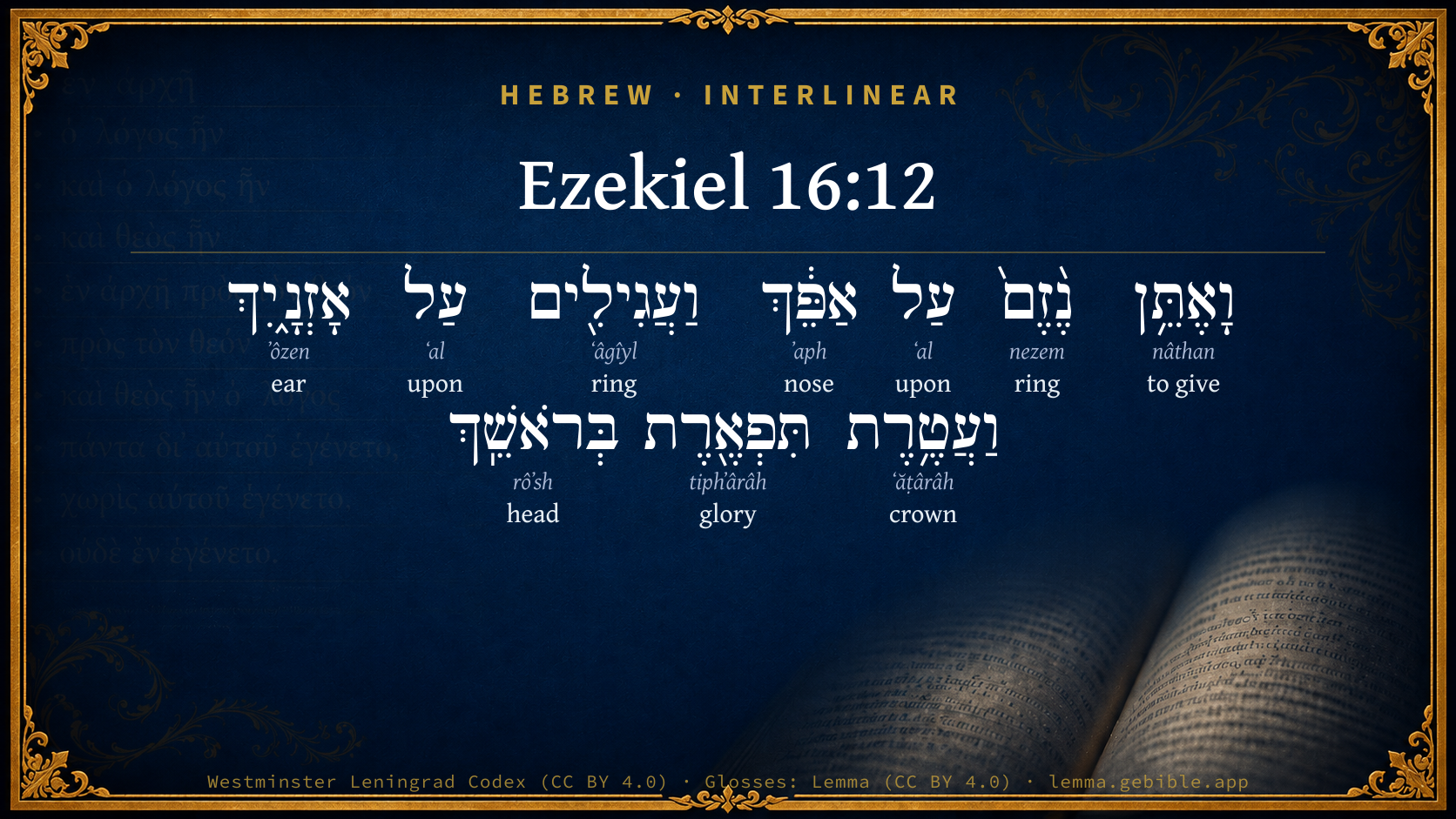
  1. וָאֶתֵּ֥ן nâthan H5414 “and · to give” Conjunction + Verb, Qal, Sequential Imperfect, 1st Person, Common, Singular
  2. נֶ֨זֶם֙ nezem H5141 “ring” Noun, Common, Masculine, Singular, Absolute
  3. עַל ʻal H5921 “upon” Preposition
  4. אַפֵּ֔ךְ ʼaph H639 “nose · your” Noun, Common, Masculine, Singular, Construct + Suffix, Personal, 2nd Person, Feminine, Singular
  5. עַל ʻal H5921 “upon” Preposition
  6. אָזְנָ֑יִךְ ʼôzen H241 “ears · your” Noun, Common, Feminine, Dual, Construct + Suffix, Personal, 2nd Person, Feminine, Singular
  7. וַעֲטֶ֥רֶת ʻăṭârâh H5850 “and · crown of” Conjunction + Noun, Common, Feminine, Singular, Construct
  8. תִּפְאֶ֖רֶת tiphʼârâh H8597 “glory” Noun, Common, Feminine, Singular, Absolute
  9. בְּרֹאשֵֽׁךְ rôʼsh H7218 “in/at · head · your” Preposition + Noun, Common, Masculine, Singular, Construct + Suffix, Personal, 2nd Person, Feminine, Singular

About this verse

These counts appear in no published source. They are computed here, from the morphology-tagged text and Lemma’s own curated glosses. What Lemma adds →

10
words
9
distinct lemmas
Prophets
section

Notable vocabulary

The rarest word here is וַעֲגִילִ֖ים ring H5694 — appearing just 2 times in the whole Hebrew Bible.

Shared distinctive vocabulary

וַעֲגִילִ֖ים ring H5694 occurs in 2 verses of the Hebrew Bible. Also found in:

Grammatical profile

  • 1 verb
  • 7 nouns
  • 2 prepositions

Verb forms

  • וָאֶתֵּ֥ן Qal · Sequential Imperfect

Repetition

A word recurs within this verse — often emphatic in Hebrew:

Hebrew & Septuagint length

In English translation the verse runs 19 words from the Hebrew and 21 from the Septuagint (LXX English) — closely comparable.

A rough comparison of the two English renderings, which tokenize alike — not a word-level alignment.

Word counts can differ between the Hebrew and the Greek without any difference in meaning — e.g. the Hebrew direct-object marker אֵת has no separate Greek word, and Greek often adds the article ὁ.

Cross-references

2

Topical passages linked to Ezekiel 16:12 in the Treasury of Scripture Knowledge — connected by theme and wording, ordered by reader-vote popularity; previews shown in the World English Bible.

  • Isaiah 3:21 the signet rings, the nose rings,
  • Isaiah 28:5 In that day will Yahweh of Hosts become a crown of glory, and a diadem of beauty, to the residue of his people;

Cross-references courtesy of OpenBible.info (CC BY 4.0).

Hebrew and Greek witnesses Masoretic Hebrew ↔ Greek Septuagint

The same verse in the two great witnesses to the Old Testament, shown verse-for-verse.

These are two independent witnesses, not word-aligned to each other, and the Septuagint is shown in lemma (dictionary) form.

Hebrew Ezekiel 16:12 Masoretic · Westminster Leningrad Codex

וָאֶתֵּ֥ן נֶ֨זֶם֙ עַל אַפֵּ֔ךְ וַעֲגִילִ֖ים עַל אָזְנָ֑יִךְ וַעֲטֶ֥רֶת תִּפְאֶ֖רֶת בְּרֹאשֵֽׁךְ

I put a ring on your nose, and ear-rings in your ears, and a beautiful crown on your head.

World English Bible · Public Domain

Greek LXX Ezekiel 16:12 Septuagint · lemma form

καί δίδωμι ἐνώτιον περί ὁ μυκτήρ σύ καί τροχίσκος ἐπί ὁ οὖς σύ καί στέφανος καύχησις ἐπί ὁ κεφαλή σύ

And I put a pendant on your nostril, and rings in your ears, and a crown of glory on your head.

LXX2012 (modern English Septuagint) · Public Domain

On this verse, The Pulpit Commentary discusses the Septuagint’s reading. Read the note in Commentary ↓

Hebrew: Westminster Leningrad Codex (CC BY 4.0). Greek: Septuagint (public domain); English from LXX2012 (modern English Septuagint) (Public Domain). How the Septuagint differs from the Hebrew →

Targum (Aramaic paraphrase)

1

The Targum is the ancient Jewish Aramaic paraphrase of the Hebrew Scriptures — an interpretive translation, not the Hebrew text itself. Onkelos (literal) and Pseudo-Jonathan (expansive) render the Torah, and Jonathan the Prophets. Coverage is partial: where no permissively-licensed English translation exists for a verse, only the Aramaic is shown. This is verse-level text, not a word-by-word alignment to the Hebrew.

  1. Targum Jonathan Prophets (Joshua–Malachi)
    וִיהָבֵית אֲרוֹן קְיָמִי בֵּינֵיכוֹן וַעֲנַן יְקָרִי מַטַל עֲלַוֵיכוֹן וּמַלְאַךְ שְׁלִיחַ מִן קֳדָמַי מְדַבֵּר בְּרֵישֵׁיכוֹן:

    And I gave you the ark of My covenant among you, and the could have My glory went over you, and an angel sent from before Me leading ahead of you.

    Targum Jonathan — Aramaic: “Mikraot Gedolot” (public domain). English: “Sefaria Community Translation” (CC0 1.0 (public-domain dedication)); “London "Chaldee Paraphrase," 1871” (public domain). Text via Sefaria.

Commentary

Notes on Ezekiel 16:12 from classic Christian and Jewish commentators (each source and its license shown beneath its notes). The classic Christian expositions comment on the surrounding passage and are grouped to its opening verse, so a note may address several verses; the Jewish commentaries on the Tanakh (Rashi and others) are per-verse, so they appear only where the commentator wrote on this verse.

Lemma curates 59 commentaries, every one of them public domain or Creative Commons licensed, each selected and text-cleaned for this edition rather than reprinted as found. About our sources →

Trapp's Complete Commentary

John Trapp

Eze 16:12 And I put a jewel on thy forehead, and earrings in thine ears, and a beautiful crown upon thine head.

Ver. 12. And I put a jewel on thy forehead.] Heb., On thy nose. See on Gen 24:47.

John Trapp, A Commentary or Exposition upon All the Books of the Old and New Testament (1647–1656) — public domain. Text from a community e-Sword module.

Geneva Bible (1599)

Geneva Bible translators

Hereby he showeth how he saved his Church, enriched it, and gave it power and dominion to reign.

Geneva Bible (1599) marginal notes — public domain. Text via Bolls.life.

Jamieson, Fausset & Brown

Robert Jamieson, A. R. Fausset & David Brown

jewel on thy forehead--rather, "a ring in thy nose" (Isa 3:21).

a crown--at once the badge of a bride, and of her being made a queen, as being consort of the King; the very name Israel meaning "a prince of God." So they are called "a kingdom of priests" (Exo 19:6; compare Rev 1:6). Though the external blessings bestowed on Israel were great, yet not these, but the internal and spiritual, form the main reference in the kingly marriage to which Israel was advanced.

Jamieson, Fausset & Brown — Commentary Critical and Explanatory on the Whole Bible (1871) — public domain (CC PDM 1.0). Text via the HelloAO Bible API.

Adam Clarke's Commentary

Verse 12. I put a jewel on thy forehead] על אפך al appech, upon thy nose. This is one of the most common ornaments among ladies in the east. European translators, not knowing what to make of a ring in the nose, have rendered it, a jewel on thy forehead or mouth, (though they have sometimes a piece of gold or jewel fastened to the centre of their forehead.) I have already spoken of this Asiatic custom, so often referred to in the sacred writings: see Ge 24:22; Ge 24:42; Ex 32:2; Job 42:11; Pr 11:22; Isa 3:21; Ho 2:13.

Adam Clarke's Commentary on the Bible (1810–1826) — public domain. Text from a community e-Sword/MySword module.

Ellicott's Commentary for English Readers

(12) A jewel on thy forehead.—Literally, a nose-ring on thy nostril, the custom of the time sanctioning this mode of ornament.

In contrast to God’s kindness and abundant blessing, Israel’s grievous sin is now described (Eze_16:15-34). It is to be remembered that however this extraordinary sin was the natural fruit of neglected grace, it yet was extraordinary. It is not by mere hyperbole that Israel is represented as worse than others. The grace which does not elevate always reacts by directing to a lower depth. (See Excursus at end of this Book on Eze_5:7).

A Bible Commentary for English Readers, edited by Charles John Ellicott (1878–1897) — public domain. Text from a community e-Sword module.

The Cambridge Bible for Schools and Colleges

gen. ed. J. J. S. Perowne

12. on thy forehead] Rather: a ring on thy nose, Isa_3:21. The nose-ring was a jewel placed on the outside of the nostril. Cf. Jdg_8:24 (where read, nose-rings). Gen_24:47. On earrings, Num_31:50.

a beautiful crown] so ch. Eze_23:42; in Isa_62:3 rendered “a crown of glory.” The word does not suggest royalty (Eze_23:42).

The Cambridge Bible for Schools and Colleges (gen. ed. J. J. S. Perowne; Cambridge University Press, 1878–1918) — public domain. Text from a community e-Sword module.

John Gill's Exposition

Thus wast thou decked with gold and silver,.... The Targum interprets it of the tabernacle adorned with gold and silver, and linen curtains, of various dies and colours; but it refers to the ornaments, bracelets, chain, earrings, and crown before, mentioned; see Psa 45:9;

and thy raiment was of fine linen, and silk, and broidered work; See Gill on Eze 16:10; with this compare Rev 19:8;

thou didst eat fine flour, and honey, and oil; which did not a little contribute to her beauty and comeliness; see Dan 1:15; this the Targum explains of the manna with which the Lord fed the Israelites in the wilderness, and was good, like fine flour, and honey, and oil; and had, as Jarchi says, the taste of them all: but may be better applied to spiritual provisions believers are fed with; to the Gospel, and the doctrines of it, which are as nourishing and strengthening as bread of fine flour; as sweet as honey to the taste; and which make fat and plump, and cause the face to shine as oil:

and thou wast exceeding beautiful, and thou didst prosper into a kingdom; the Targum is,

"and ye became rich, and were greatly strengthened, and prospered, and ruled over all kingdoms;''

and had its accomplishment, as Kimchi observes, when the time of the kingdom of the house of David came: land is true of all believers, who are a kingdom of priests, a royal priesthood, kings and priests unto God; have a kingdom of grace; now, which can never be moved, and lies in righteousness, peace, and joy, in the Holy Ghost; and are heirs of a kingdom of glory hereafter.

John Gill's Exposition of the Whole Bible (1746–1763) — public domain (CC PDM 1.0). Text via the HelloAO Bible API.

Albert Barnes' Notes on the Bible

A jewel on thy forehead - literally, “a nose-ring on thy nostril” (Gen 24:22 note).

Albert Barnes' Notes on the Bible (1834–1885) — public domain. Text from a community e-Sword/MySword module.

Haydock's Catholic Bible Commentary

Forehead. Literally, "mouth." Hebrew, "nose." (Haydock) --- Women wore rings where spectacles are placed, and had others hung at their noses, so as to touch the mouth. People who are not acquainted with this odd custom, which is still prevalent in Africa and Asia, suppose that the ornament hung upon the forehead, as St. Jerome does. See Genesis xxiv. 22. (Calmet)

George Leo Haydock (1774–1849), Haydock's Catholic Family Bible and Commentary, 1859 edition — public domain. Excludes Psalms (Douay-Rheims chapter numbering differs from Protestant) and Deuterocanonical books (Catholic canon only).

Matthew Poole's English Annotations

A jewel; it was many times of silver, but most commonly of gold, and was of circular figure, hanging by a string fastened above the forehead in such a manner that it lay or rested on the nose, much esteemed among the Eastern people, though of no account with us.

Earrings; golden ornaments hanging in the fleshy part of the ear.

A beautiful crown; a very rich and beautiful crown; as virgins espoused and married had crowns set on their heads, Son 3:11, so, to complete the solemnity, and make the magnificence of these nuptials full, a crown of beauty is set on the head of this Jewish nation now married to God.

Matthew Poole's English Annotations on the Holy Bible (1683–1685) — public domain. Text from a community e-Sword/MySword module.

Whedon's Commentary on the Bible

Daniel D. Whedon

12. A jewel on thy forehead — Literally, ring upon thy nose. (See Isa_3:21; Gen_24:47; Hos_2:13.) For other articles of jewelry mentioned see Gen_24:22; Gen_24:47; Gen_41:42; Num_31:50; Pro_1:9; Pro_3:3.

A beautiful crown — This has reference probably to the marriage crown. It is even yet used in Palestine. It is the wife’s dowry, and the treasures of which it is composed cannot be touched by any creditor.

Daniel D. Whedon (gen. ed.), Commentary on the Old and New Testaments (1874–1909) — public domain. Text from a community e-Sword module.

The Pulpit Commentary

A jewel on thy forehead; better, with the Revised Version, a ring upon thy nose. The word has the same meaning in Gen_24:47 ("earring" in the Authorized Version) Isa_3:21 (where the Authorized Version gives "nose jewels") Pro_11:22. Jerome, however, notes (in loc. ) that the Syrian women of his time wore pendants or lockets that hung from the forehead to the nostrils. The crown, or diadem (LXX, stefanov kauchsewv), the thin circlet of gold confining the hair, completed the catalogue of ornaments. The Chaldee Targum continues its spiritual interpretation: "I gave the ark of my covenant to be among you, and the cloud of my glory overshadowed you, and the angel of my presence led you in the way." And, if we assume, as we legitimately may assume, that Ezekiel, above all others, the prophet of symbolism, did not fill up his picture with details which were only meant to fill it up, this seems a not unfitting interpretation.

The Pulpit Commentary (1880–1919), ed. H.D.M. Spence-Jones & Joseph S. Exell — public domain. Text from a community e-Sword module.

Rashi

Rabbi Shlomo Yitzchaki (Rashi)

And I put a nose ring on your nose [Jonathan renders:] And I placed the ark of My covenant among you.

and earrings on your ears Heb. וַעֲגִילִים, a word for an earring. [Jonathan interprets:] And the cloud of My glory covering over you. [The clouds of glory are called וַעֲגִילִים] because they surrounded them in a circle (עִגּוּל).

and a crown of glory on your head [Jonathan renders:] And an angel was sent from before Me leading at your head, as it is said (Micah 2:13): “and their king passed before them, and the Lord was at their head.”

Rashi on the Tanakh — English translations: “The Judaica Press complete Tanach with Rashi, translated by A. J. Rosenberg” (CC BY 4.0); “Pentateuch with Rashi's commentary by M. Rosenbaum and A.M. Silbermann, 1929-1934” (public domain); “The Metsudah Tanach series, Lakewood, N.J” (CC BY 4.0); and “The Book of Joshua, Metsudah Publications, 1997” (CC BY 4.0). Text via Sefaria.

Lesson kit

Teaching starters — assembled from the data on this page, not authored interpretation. Every prompt links to the verse data it draws on. Edit before teaching.

Ezekiel, in the Prophets, opens this verse with 10 words (9 distinct Hebrew lemmas). Its most distinctive word is ʻâgîyl (“ring”). A historical commentator’s framing appears above. Read the whole chapter for the surrounding context.

Discussion questions

  1. The word ʻâgîyl carries the sense “ring.” How does it shape the verse?
  2. How does Numbers 31:50, which shares the word «ring», read alongside this verse?
  3. What does the repetition of “upon” (2× in this one verse) do in this verse?
  4. These translations render this verse differently. What is at stake in choosing one wording over another?
  5. «וָאֶתֵּ֥ן» is a Qal Sequential Imperfect verb. How does that grammatical form shape the action described?
  6. Compare how Trapp's Complete Commentary and Geneva Bible (1599) read this verse. Where do they agree or differ?

Things to notice

  • These translations choose different wording for 8 words in this verse.
  • “upon” occurs 2× in this single verse.
  • 9 distinct Hebrew lemmas span 10 words in this verse.

Reading settings

Reading text

Shown beneath each verse's original-language words.

Old Testament
Old Testament edition

Read the OT as the Masoretic Hebrew (MT) or the Greek Septuagint (LXX).

English shown for the Greek Septuagint (in the Hebrew ↔ Greek comparison).

Comparing translations? Open the Compare panel on any verse page to stack up to four side by side.