
Exodus 21:6

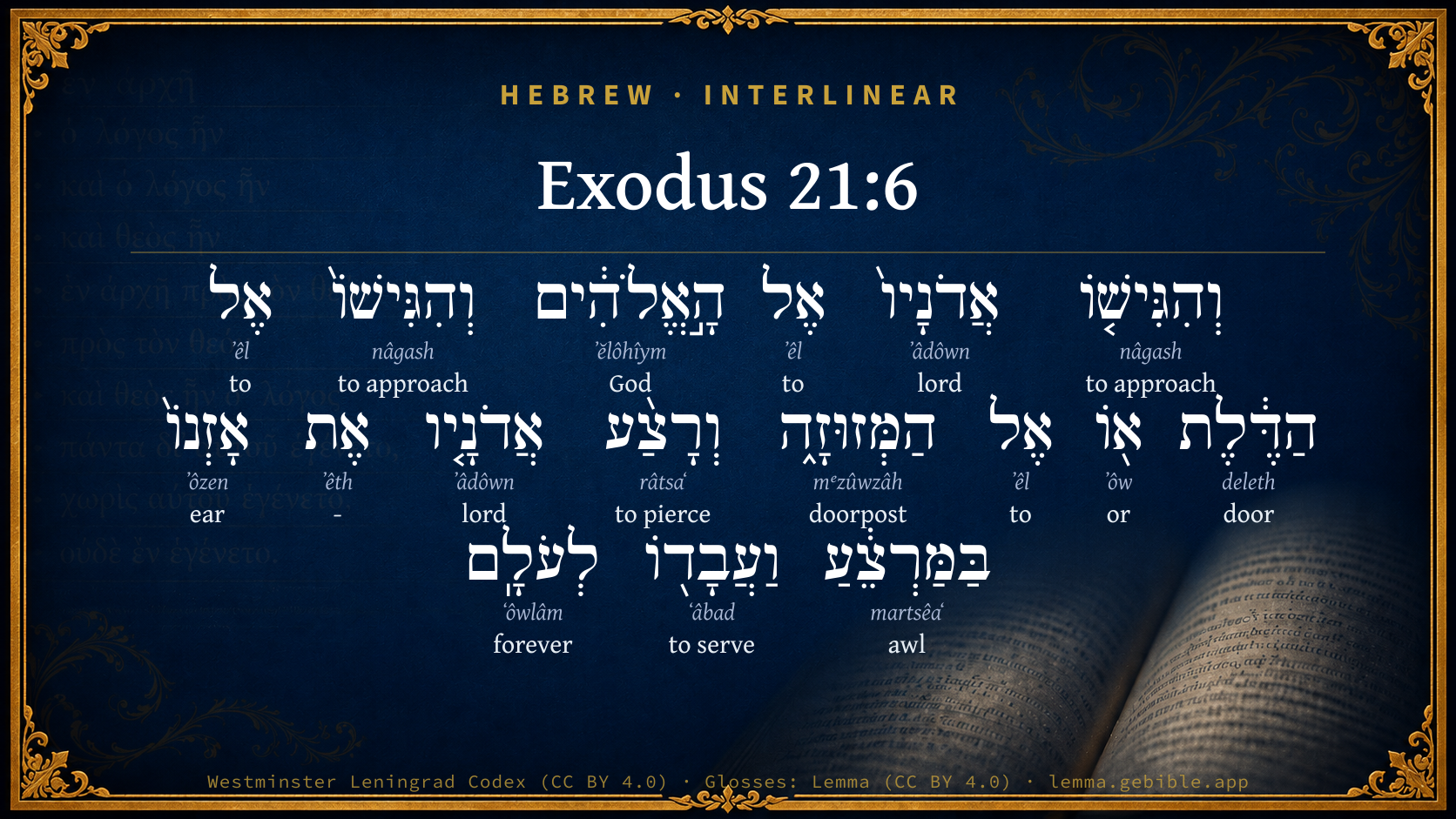
Hebrew (Westminster Leningrad Codex) Exodus 21:6 appears in the Hebrew Old Testament. The text above is from the Westminster Leningrad Codex. Each word links to its Strong’s number, a concise gloss, and parsing drawn from the Open Scriptures Hebrew Bible morphology. Click any word for its full Brown-Driver-Briggs (BDB) entry.
Download image
Cite this verse

Exodus 21:6 (World English Bible). Public Domain. Lemma interlinear Bible study tool, https://lemma.gebible.app/v/exodus/21/6.

Show BibTeX & RIS
BibTeX
RIS
English Translation
then his master shall bring him to God, and shall bring him to the door or to the door-post, and his master shall bore his ear through with an awl, and he shall serve him for ever.
World English Bible · Public Domain
Highlights
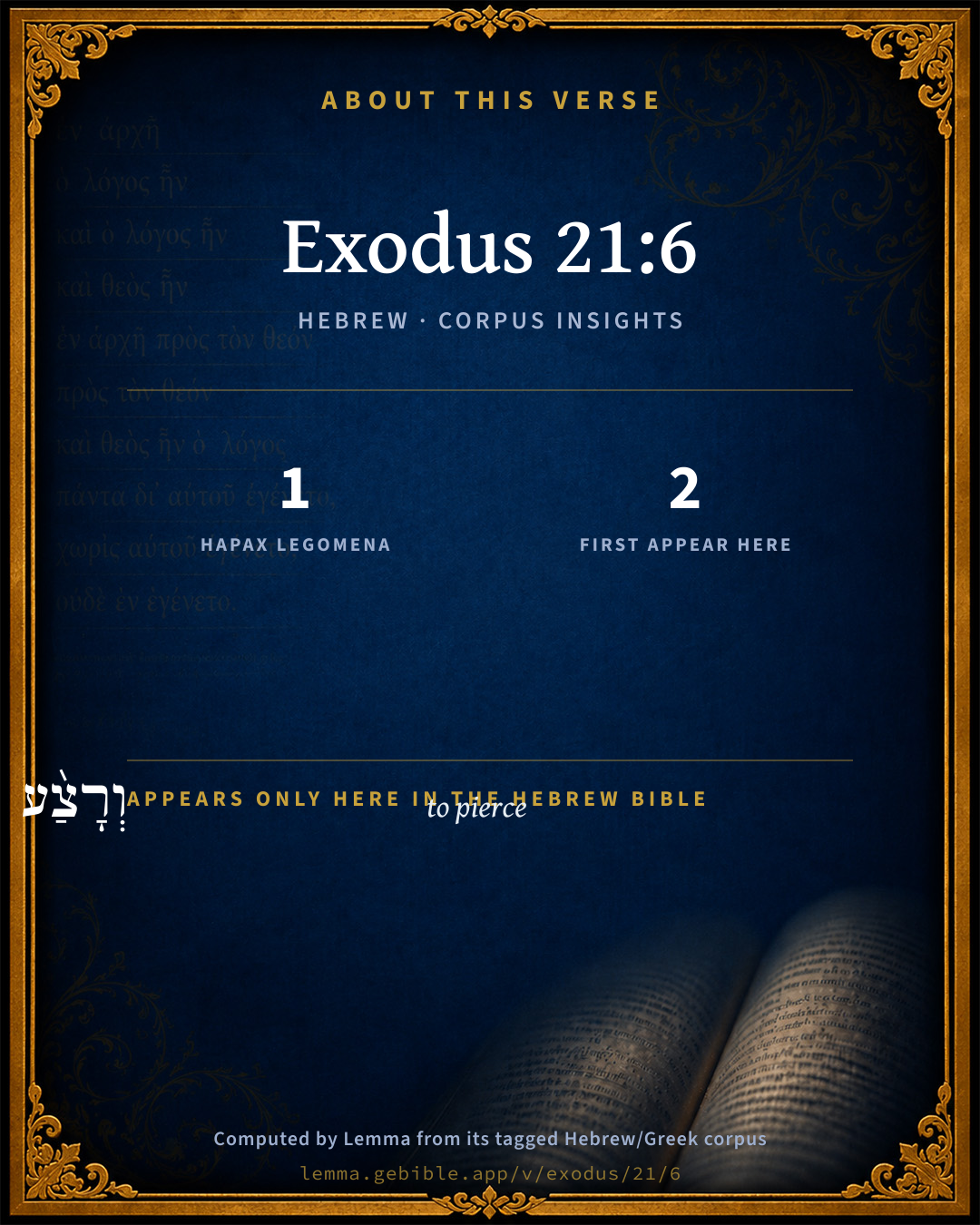
  • 1 hapax legomenon — only here in the Hebrew Bible
  • 2 first appearances in the Hebrew Bible
Full analysis ↓
Download a study sheet

One document with this verse’s original text, its word-by-word gloss line, the meaning frame, cross-references with their text, attributed commentary, and full source and license credits — printable, and it pastes into notes with its structure intact.

This verse Autodidact and up

Study sheet (.html) Plain text (.txt)

A passage Seminary Student

Up to 50 verses in one chapter. A passage sheet keeps up to 6 commentary sources and 12 cross-references per verse, in the order this page ranks them, and says so on the sheet whenever that leaves anything out. Ask for a single verse and you get the Autodidact verse sheet above.

Everything on this page stays free to read, with no account — the sheet is a download of what is already on screen, not access to it.

Want to remove ads? Support Godless Engineer
Compare translations 3

The same verse in 3 English versions, stacked beneath the original-language interlinear above. Click any original word for its lexicon entry.

Each is an independent rendering of the whole verse — the interlinear is not word-aligned to these translations.

Highlighted words mark where these versions differ — a whole-verse word diff, not a word-by-word alignment.

  • World English Bible Public Domain
    then his master shall bring him to God, and shall bring him to the door or to the door-post, and his master shall bore his ear through with an awl, and he shall serve him for ever.
  • King James Version Public Domain
    Then his master shall bring him unto the judges; he shall also bring him to the door, or unto the door post; and his master shall bore his ear through with an awl; and he shall serve him for ever.
  • unfoldingWord Literal Text CC BY-SA 4.0
    then his master shall bring him to God. He shall bring him to a door or to a doorpost, and his master shall bore his ear through with an awl. Then he shall serve him forever.

unfoldingWord Literal Text — © unfoldingWord, licensed CC BY-SA 4.0. Word-aligned USFM3 via Door43 (git.door43.org/unfoldingWord/en_ult).

Versions to compare (up to 4)

3 of 4 selected

Show all 18 translations

Every available English version of this verse, each an independent rendering of the whole verse.

  • World English Bible Public Domain
    then his master shall bring him to God, and shall bring him to the door or to the door-post, and his master shall bore his ear through with an awl, and he shall serve him for ever.
  • Berean Standard Bible Public Domain
    then his master is to bring him before the judges. And he shall take him to the door or doorpost and pierce his ear with an awl. Then he shall serve his master for life.
  • Majority Standard Bible Public Domain
    then his master is to bring him before the judges. And he shall take him to the door or doorpost and pierce his ear with an awl. Then he shall serve his master for life.
  • King James Version Public Domain
    Then his master shall bring him unto the judges; he shall also bring him to the door, or unto the door post; and his master shall bore his ear through with an awl; and he shall serve him for ever.
  • American Standard Version (1901) Public Domain
    then his master shall bring him unto God, and shall bring him to the door, or unto the door-post; and his master shall bore his ear through with an awl; and he shall serve him for ever.
  • Revised Version (1885) Public Domain
    then his master shall bring him unto God, and shall bring him to the door, or unto the door post; and his master shall bore his ear through with an awl; and he shall serve him for ever.
  • Geneva Bible (1599) Public Domain
    Then his master shall bring him vnto the Iudges, and set him to the dore, or to the poste, and his master shall bore his eare through with a nawle, and he shall serue him for euer.
  • Douay-Rheims (1899) Public Domain
    His master shall bring him to the gods, and he shall be set to the door and the posts, and he shall bore his ear through with an awl: and he shall be his servant for ever.
  • Young's Literal Translation Public Domain
    then hath his lord brought him nigh unto God, and hath brought him nigh unto the door, or unto the side-post, and his lord hath bored his ear with an awl, and he hath served him -- to the age.
  • Literal Standard Version CC BY-SA 4.0
    then his lord has brought him near to God, and has brought him near to the door, or to the doorpost, and his lord has bored his ear with an awl, and he has served him for all time.
  • Unlocked Literal Bible CC BY-SA 4.0
    then his master must bring him to God. The master must bring him to a door or doorpost, and his master must bore his ear through with an awl. Then the servant will serve him for life.
  • unfoldingWord Literal Text CC BY-SA 4.0
    then his master shall bring him to God. He shall bring him to a door or to a doorpost, and his master shall bore his ear through with an awl. Then he shall serve him forever.
  • Darby Bible Public Domain
    then his master shall bring him before the judges, and shall bring him to the door, or to the door-post; and his master shall bore his ear through with an awl; and he shall be his bondman for ever.
  • World Messianic Bible Public Domain
    then his master shall bring him to God, and shall bring him to the door or to the doorpost, and his master shall bore his ear through with an awl, and he shall serve him forever.
  • Webster's Bible Public Domain
    Then his master shall bring him to the judges; he shall also bring him to the door, or to the door-post: and his master shall bore his ear through with an awl; and he shall serve him for ever.
  • Free Bible Version CC BY-SA 4.0
    then his master is to take him before the judges. Then he shall have him stand against the door or doorpost and use a metal tool to make a hole in his ear. Then he shall work for his master for life.
  • Bible in Basic English Public Domain
    Then his master is to take him to the gods of the house, and at the door, or at its framework, he is to make a hole in his ear with a sharp-pointed instrument; and he will be his servant for ever.
  • JPS Tanakh (1917) Public Domain
    then his master shall bring him unto God, and shall bring him to the door, or unto the door-post; and his master shall bore his ear through with an awl; and he shall serve him for ever.

Literal Standard Version (2020), Covenant Press — licensed CC BY-SA 4.0. Text via the HelloAO Bible API (eBible.org). Unlocked Literal Bible (unfoldingWord) — licensed CC BY-SA 4.0. Text via the HelloAO Bible API (eBible.org). unfoldingWord Literal Text — © unfoldingWord, licensed CC BY-SA 4.0. Word-aligned USFM3 via Door43 (git.door43.org/unfoldingWord/en_ult). Free Bible Version, Dr. Jonathan Gallagher — licensed CC BY-SA 4.0. Text via the HelloAO Bible API (eBible.org).

Word by word

More ways to search: Search by grammar → Find every occurrence → Compare this word →

Practice this passage: Drill this verse → Learn its vocabulary →

וְרָצַ֨ע
râtsaʻ
H7527
“and · to pierce”
Conjunction + Verb, Qal, Sequential Perfect, 3rd Person, Masculine, Singular
Part of Speech
Conjunction + Verb
Stem
Qal
Form
Sequential Perfect
Person
3rd Person
Gender
Masculine
Number
Singular
Full BDB Definition

Origin: a primitive root

TWOT: 2209

(Qal) to bore, pierce - of the ear
  1. וְהִגִּישׁ֤וֹ nâgash H5066 “and · to approach · him” Conjunction + Verb, Hiphil, Sequential Perfect, 3rd Person, Masculine, Singular + Suffix, Personal, 3rd Person, Masculine, Singular
  2. אֲדֹנָיו֙ ʼâdôwn H113 “lords · his” Noun, Common, Masculine, Plural, Construct + Suffix, Personal, 3rd Person, Masculine, Singular
  3. אֶל ʼêl H413 “to” Preposition
  4. הָ֣אֱלֹהִ֔ים ʼĕlôhîym H430 “the · God(s)” Particle, Definite Article + Noun, Common, Masculine, Plural, Absolute
  5. וְהִגִּישׁוֹ֙ nâgash H5066 “and · to approach · him” Conjunction + Verb, Hiphil, Sequential Perfect, 3rd Person, Masculine, Singular + Suffix, Personal, 3rd Person, Masculine, Singular
  6. אֶל ʼêl H413 “to” Preposition
  7. הַדֶּ֔לֶת deleth H1817 “the · door” Particle, Definite Article + Noun, Common, Feminine, Singular, Absolute
  8. א֖וֹ ʼôw H176 “or” Conjunction
  9. אֶל ʼêl H413 “to” Preposition
  10. הַמְּזוּזָ֑ה mᵉzûwzâh H4201 “the · doorpost” Particle, Definite Article + Noun, Common, Feminine, Singular, Absolute
  11. אֲדֹנָ֤יו ʼâdôwn H113 “lords · his” Noun, Common, Masculine, Plural, Construct + Suffix, Personal, 3rd Person, Masculine, Singular
  12. אֶת ʼêth H853 “-” Particle, Direct Object
  13. אָזְנוֹ֙ ʼôzen H241 “ear · his” Noun, Common, Feminine, Singular, Construct + Suffix, Personal, 3rd Person, Masculine, Singular
  14. בַּמַּרְצֵ֔עַ martsêaʻ H4836 “in/at the · awl” Preposition, Determined + Noun, Common, Masculine, Singular, Absolute
  15. וַעֲבָד֖וֹ ʻâbad H5647 “and · to serve · him” Conjunction + Verb, Qal, Sequential Perfect, 3rd Person, Masculine, Singular + Suffix, Personal, 3rd Person, Masculine, Singular
  16. לְעֹלָֽם ʻôwlâm H5769 “to/for · forever” Preposition + Noun, Common, Masculine, Singular, Absolute

About this verse

These counts appear in no published source. They are computed here, from the morphology-tagged text and Lemma’s own curated glosses. What Lemma adds →

17
words
13
distinct lemmas
Pentateuch
section

Notable vocabulary

1 hapax legomenon — a word that appears only here in the entire Hebrew Bible:

  • וְרָצַ֨ע to pierce H7527

First appearance in Scripture

These words make their first canonical appearance in the Hebrew Bible here:

  • וְרָצַ֨ע to pierce H7527
  • בַּמַּרְצֵ֔עַ awl H4836

Shared distinctive vocabulary

בַּמַּרְצֵ֔עַ awl H4836 occurs in 2 verses of the Hebrew Bible. Also found in:

Grammatical profile

  • 4 verbs
  • 8 nouns
  • 3 prepositions
  • 1 conjunction
  • 1 particle

Verb forms

  • וְהִגִּישׁ֤וֹ Hiphil · Sequential Perfect
  • וְהִגִּישׁוֹ֙ Hiphil · Sequential Perfect
  • וְרָצַ֨ע Qal · Sequential Perfect
  • וַעֲבָד֖וֹ Qal · Sequential Perfect

Repetition

Words recur within this verse — often emphatic in Hebrew:

  • וְהִגִּישׁ֤וֹ to approach H5066 ×2
  • אֲדֹנָיו֙ lord H113 ×2
  • אֶל to H413 ×3

Hebrew & Septuagint length

In English translation the verse runs 37 words from the Hebrew and 40 from the Septuagint (LXX English) — closely comparable.

A rough comparison of the two English renderings, which tokenize alike — not a word-level alignment.

Word counts can differ between the Hebrew and the Greek without any difference in meaning — e.g. the Hebrew direct-object marker אֵת has no separate Greek word, and Greek often adds the article ὁ.

Cross-references

20

Topical passages linked to Exodus 21:6 in the Treasury of Scripture Knowledge — connected by theme and wording, ordered by reader-vote popularity; previews shown in the World English Bible.

  • Deuteronomy 15:17 then you shall take an awl, and thrust it through his ear to the door, and he shall be your servant forever. Also to your maid-servant you shall do likewise.
  • Leviticus 25:40 As a hired servant, and as a sojourner, he shall be with you; he shall serve with you until the Year of Jubilee:
  • Deuteronomy 19:17–18 then both the men, between whom the controversy is, shall stand before Yahweh, before the priests and the judges who shall be in those days;
  • 1 Samuel 28:2 David said to Achish, Therefore you shall know what your servant will do. Achish said to David, Therefore will I make you keeper of my head for ever.
  • Exodus 12:12 For I will go through the land of Egypt in that night, and will strike all the firstborn in the land of Egypt, both man and animal. Against all the gods of Egypt I will execute judgments: I am Yahweh.
  • Exodus 18:21–26 Moreover you shall provide out of all the people able men, such as fear God: men of truth, hating unjust gain; and place such over them, to be rulers of thousands, rulers of hundreds, rulers of fifties, and rulers of tens.
  • Exodus 21:22 "If men fight and hurt a pregnant woman so that she gives birth prematurely, and yet no harm follows, he shall be surely fined as much as the woman's husband demands and the judges allow.
  • Exodus 22:8–9 If the thief isn't found, then the master of the house shall come near to God, to find out if he hasn't put his hand to his neighbor's goods.
  • Exodus 22:28 "You shall not blaspheme God, nor curse a ruler of your people.
  • Leviticus 25:23 "'The land shall not be sold in perpetuity, for the land is mine; for you are strangers and live as foreigners with me.
  • Numbers 25:5–8 Moses said to the judges of Israel, Kill you everyone his men who have joined themselves to Baal Peor.
  • Deuteronomy 1:16 I charged your judges at that time, saying, Hear [the causes] between your brothers, and judge righteously between a man and his brother, and the foreigner who is living with him.
  • Deuteronomy 16:18 Judges and officers shall you make you in all your gates, which Yahweh your God gives you, according to your tribes; and they shall judge the people with righteous judgment.
  • 1 Samuel 1:22 But Hannah didn't go up; for she said to her husband, [I will not go up] until the child be weaned; and then I will bring him, that he may appear before Yahweh, and there abide forever.
  • 1 Samuel 8:1–2 It happened, when Samuel was old, that he made his sons judges over Israel.
  • 1 Samuel 27:12 Achish believed David, saying, He has made his people Israel utterly to abhor him; therefore he shall be my servant forever.
  • 1 Kings 12:7 They spoke to him, saying, If you will be a servant to this people this day, and will serve them, and answer them, and speak good words to them, then they will be your servants forever.
  • Psalms 40:6–8 Sacrifice and offering you didn't desire. You have opened my ears: Burnt offering and sin offering you have not required.
  • Zephaniah 3:3 Her princes in the midst of her are roaring lions. Her judges are evening wolves. They leave nothing until the next day.
  • Isaiah 1:26 I will restore your judges as at the first, And your counselors as at the beginning. Afterward you shall be called 'The city of righteousness, A faithful town.'

Cross-references courtesy of OpenBible.info (CC BY 4.0).

Hebrew and Greek witnesses Masoretic Hebrew ↔ Greek Septuagint

The same verse in the two great witnesses to the Old Testament, shown verse-for-verse.

These are two independent witnesses, not word-aligned to each other, and the Septuagint is shown in lemma (dictionary) form.

Hebrew Exodus 21:6 Masoretic · Westminster Leningrad Codex

וְהִגִּישׁ֤וֹ אֲדֹנָיו֙ אֶל הָ֣אֱלֹהִ֔ים וְהִגִּישׁוֹ֙ אֶל הַדֶּ֔לֶת א֖וֹ אֶל הַמְּזוּזָ֑ה וְרָצַ֨ע אֲדֹנָ֤יו אֶת אָזְנוֹ֙ בַּמַּרְצֵ֔עַ וַעֲבָד֖וֹ לְעֹלָֽם

then his master shall bring him to God, and shall bring him to the door or to the door-post, and his master shall bore his ear through with an awl, and he shall serve him for ever.

World English Bible · Public Domain

Greek LXX Exodus 21:6 Septuagint · lemma form

προςἄγω αὐτός ὁ κύριος αὐτός πρός ὁ κριτήριον ὁ θεός καί τότε προςἄγω αὐτός ἐπί ὁ θύρα ἐπί ὁ σταθμός καί τρυπάω αὐτός ὁ κύριος ὁ οὖς ὁ ὀπήτιον καί δουλεύω αὐτός εἰς ὁ αἰών

his master shall bring him to the judgment-seat of God, and then shall he bring him to the door, —to the door-post, and his master shall bore his ear through with an awl, and he shall serve him for ever.

LXX2012 (modern English Septuagint) · Public Domain

On this verse, Joseph Benson's Commentary discusses the Septuagint’s reading. Read the note in Commentary ↓

Hebrew: Westminster Leningrad Codex (CC BY 4.0). Greek: Septuagint (public domain); English from LXX2012 (modern English Septuagint) (Public Domain). How the Septuagint differs from the Hebrew →

Targum (Aramaic paraphrase)

2

The Targum is the ancient Jewish Aramaic paraphrase of the Hebrew Scriptures — an interpretive translation, not the Hebrew text itself. Onkelos (literal) and Pseudo-Jonathan (expansive) render the Torah, and Jonathan the Prophets. Coverage is partial: where no permissively-licensed English translation exists for a verse, only the Aramaic is shown. This is verse-level text, not a word-by-word alignment to the Hebrew.

  1. Targum Onkelos Torah (Genesis–Deuteronomy)
    וִיקָרְבִנֵהּ רִבּוֹנֵהּ לִקֳדָם דַיָנַיָא וִיקָרְבִנֵהּ לְוָת דָשָׁא אוֹ לְוָת (נ״‎א דִילְוָת) מְזְזֶתָּא וְיַרְצַע רִבּוֹנֵהּ יָת אוּדְנֵהּ בְּמַרְצְעָא וִיהֵי לֵהּ עֲבַד פָּלַח לְעָלָם:

    (no public-domain English translation for this verse)

    Targum Onkelos — Aramaic: “Onkelos Genesis” (public domain); “Onkelos Exodus” (public domain); “Onkelos Leviticus” (public domain); “Onkelos Numbers” (public domain); “Onkelos Deuteronomy” (public domain). English: “Sefaria Community Translation” (CC0 1.0 (public-domain dedication)); “J.W. Etheridge. The Targums of Onkelos and Jonathan Ben Uzziel on the Pentateuch. London: Longmans, Green, 1862” (public domain). Text via Sefaria.

  2. Targum Pseudo-Jonathan Torah (Genesis–Deuteronomy)
    וִיקַרְבִינֵיהּ רִבּוֹנֵיהּ לִקְדָם דַּיָּינַיָא וְיִסַּב מִנְהוֹן רְשׁוּתָא וִיקַרְבִינֵיהּ לְוַת דָּשָׁא דְּלוּחַ מְזוּזְתָא וִיחַיֵּיט רִבּוֹנֵיהּ יַת אוּדְנֵיהּ יַמִּינָא בְּמַחְטָא וִיהֵי לֵיהּ עָבַד פְּלַח עַד יוּבְלָא

    then his master shall bring him before the judges, and shall receive from them the power, and bring him to the door that hath posts; and his master shall pierce his right ear with an awl; and he shall be a servant to serve him until the jubela.

    Targum Pseudo-Jonathan — Aramaic: “Targum Jonathan on Genesis” (public domain); “Targum Jonathan on Exodus” (public domain); “Targum Jonathan on Leviticus” (public domain); “Targum Jonathan on Numbers” (public domain); “Targum Jonathan on Deuteronomy” (public domain). English: “The Targum of Jonathan ben Uzziel, trans. J. W. Etheridge, London, 1862” (public domain). Text via Sefaria.

Commentary

Notes on Exodus 21:6 from classic Christian and Jewish commentators (each source and its license shown beneath its notes). The classic Christian expositions comment on the surrounding passage and are grouped to its opening verse, so a note may address several verses; the Jewish commentaries on the Tanakh (Rashi and others) are per-verse, so they appear only where the commentator wrote on this verse.

Lemma curates 59 commentaries, every one of them public domain or Creative Commons licensed, each selected and text-cleaned for this edition rather than reprinted as found. About our sources →

Trapp's Complete Commentary

John Trapp

Exo 21:6 Then his master shall bring him unto the judges; he shall also bring him to the door, or unto the door post; and his master shall bore his ear through with an aul; and he shall serve him for ever.

Ver. 6. And he shall serve him.] Being υπερετης και οργανον και ολως εκεινου, as Aristotle hath it; the master’s instrument, underling, and wholly his. He doeth his own, and not his master’s will, that doeth no more than himself will: this is a holiday servant, as they say.

John Trapp, A Commentary or Exposition upon All the Books of the Old and New Testament (1647–1656) — public domain. Text from a community e-Sword module.

Joseph Benson's Commentary

Exo 21:6. His master shall bring him to the judges — In the original, gods, magistrates being often so called as the visible representatives of God upon earth. In the Septuagint it is προς το κριτηριον θεου, to the tribunal of God, meaning probably the sanctuary. The sense seems evidently to be, that the master was to bring his slave to the temporal judges, that they might take cognizance of the case, and that the agreement, being publicly and solemnly confirmed, might be irrevocable. He shall bring him to the door — To wit, of his master’s house, as is expressed Deu 15:17, in token that he was fixed there, and must no more go out free. Shall bore his ear through with an awl — We find from Juvenal and Petronius that this continued to be a custom in Syria and Arabia many ages after this. And it fitly represented the servant’s perpetual obligation to abide in that house, and there to hear and obey his master’s commands, Psa 40:6. For ever — As long as he lives, or till the year of jubilee.

Joseph Benson's Commentary on the Old and New Testaments (1811–1818) — public domain. Text from a community e-Sword module.

Geneva Bible (1599)

Geneva Bible translators

Where the judges sat.

Hebrew, gods.

That is, to the year of Jubilee, which was every fiftieth year.

Geneva Bible (1599) marginal notes — public domain. Text via Bolls.life.

Adam Clarke's Commentary

Verse 6. Shall bring him unto the judges] אל האלהים el haelohim, literally, to God; or, as the Septuagint have it, προς το κριτηριον Θεου, to the judgment of God; who condescended to dwell among his people; who determined all their differences till he had given them laws for all cases, and who, by his omniscience, brought to light the hidden things of dishonesty. See Ex 22:8.

Bore his ear through with an awl] This was a ceremony sufficiently significant, as it implied,

1. That he was closely attached to that house and family.

2. That he was bound to hear all his master's orders, and to obey them punctually. Boring of the ear was an ancient custom in the east.

It is referred to by Juvenal: -

Prior, inquit, ego adsum.

Cur timeam, dubitemve locum defendere? quamvis

Natus ad Euphraten, MOLLES quod in AURE FENESTRAE

Arguerint, licet ipse negem.

Sat. i. 102.

"First come, first served, he cries; and I, in spite

Of your great lordships, will maintain my right:

Though born a slave, though my torn EARS are BORED, 'Tis not the birth, 'tis money makes the lord."

DRYDEN.

Calmet quotes a saying from Petronius as attesting the same thing; and one from Cicero, in which he rallies a Libyan who pretended he did not hear him: "It is not," said he, "because your ears are not sufficiently bored;" alluding to his having been a slave.

Adam Clarke's Commentary on the Bible (1810–1826) — public domain. Text from a community e-Sword/MySword module.

Ellicott's Commentary for English Readers

(6) His master shall bring him unto the judges.—A formal act was necessary. The State must sanction the passing of a citizen into the slave condition, and so the “judges” were called in. The change was to be made by a significant ceremony. In order to mark that henceforth the volunteer bondman became attached to the household, he was to be physically attached to the house by having an awl forced through his ear, and then driven into the door or door-post. Hence “opening the ear” became a synonym for assigning a man to the slave condition in perpetuity (Psa_40:6). The word used for “judges” is ha-Elohim, “the gods,” or “the exalted ones,” which has the same sense in Exo_22:8-9.

A Bible Commentary for English Readers, edited by Charles John Ellicott (1878–1897) — public domain. Text from a community e-Sword module.

The Cambridge Bible for Schools and Colleges

gen. ed. J. J. S. Perowne

6. unto God] i.e. (if the rend. be correct: see below) to the nearest sanctuary (for the expression, comp. especially 1Sa_10:3), in order that he might there affirm solemnly before God his intention to remain with his master. ‘God’ is resorted to here, not for a judicial decision (see on Exo_18:15-16), but for the slave’s declaration to be solemnly ratified: still, as this would be done in the presence of God’s human representatives, the priests or judges, RVm. (= AV.), following Targ., Pesh., and Jewish interpreters (cf. LXX. τό κριτήριον τοῦ θεοῦ, ‘the tribunal of God’), renders the judges. This, however, is only a paraphrase; for though God, in cases such as the present, may be conceived as acting through a judge, as His representative or mouth-piece, that does not make ‘Elohim’ mean ‘judge,’ or ‘judges.’ ‘God’ is used in the same sense in Exo_22:8-9, and 1Sa_2:25.

and he shall bring him] i.e (Di.) the judge at the sanctuary: better, perhaps, one shall bring him = he shall be brought (G.-K. §144d).

the door] not, as has been supposed, of the sanctuary, but, if the ceremony is to bear any relation to the thing which it is intended to signify, of his master’s house. The ear, as the organ of hearing, is naturally that of obedience as well; and its attachment (Deu_15:17) to the door of the house would signify the perpetual attachment of the slave to that particular household. Probably it was the right ear which was pierced: for the preference shewn for this, comp. Lev_8:23 f., Exo_14:14; Exo_14:17. The connexion ‘bring him to God (or the gods),’ and ‘bring him to the door’ seems, however, to suggest that both were in the same place: hence, as the ‘door’ of the sanctuary seems out of the question, Bä. and others render hâ-’ĕlôhîm (as is perfectly possible: cf. Gen_3:5 RVm.) by the gods, supposing the reference to be to the household gods, or Penates, of the master’s house, kept and worshipped near the door: the ceremony would then have the effect of bringing the give into a relation of dependence on the gods of his master’s family, and of admitting him to the full religious privileges of the family (cf. Eerdmans Expositor, Aug. 1909, p. 163 f.). Kautzsch, on the other hand, supposes an image of Jehovah to be referred to (DB. v. 642b).

bore his ear] Whether a hole in the ear was really among other nations a mark of slavery, or even of dependence, is very doubtful: the passages cited by Di. from Kn. (cf. Now. Arch. i. 177) do not seem to shew more than that it was a mark of nationality: the ear was often bored (for ear-rings) among Africans and Orientals in general, but not specifically by slaves. See esp. Mayor’s note on Juv. i. 104 (‘Natus ad Euphraten, molles quod in aure fenestrae Arguerint’), Macrob. Saturn, vii. 3, Plin. H.N. xi. § 136: on Plaut. Poen. v. 2. 21 (‘aures anulatae’), see Ussing’s note.

for ever] i.e. till his life’s end: cf. ‘for ever’ in 1Sa_1:22, and esp. in the expression, ‘servant for ever,’ Exo_27:12, Job_41:4 [Exo_40:28 Heb.]. The explanation ‘till the next jubilee’ (Jos. Ant. iv. 8. 28, and others), which has been adopted for harmonistic reasons (see Lev_25:39-41), is exegetically impossible: as Di. says, the difference between the two laws must be frankly recognized; they spring, it is evident, out of different periods of the history.

The Cambridge Bible for Schools and Colleges (gen. ed. J. J. S. Perowne; Cambridge University Press, 1878–1918) — public domain. Text from a community e-Sword module.

John Gill's Exposition

Then his master shall bring him unto the judges,.... To Elohim, to God, to the judgment seat of God, according to the Septuagint; to some person or persons to inquire of God what is to be done in such a case; but this seems needless, since it is here declared: no doubt civil magistrates or judges are meant by Elohim, or the gods, as in Psa 82:1, and so Jarchi interprets it of the house of judgment, or sanhedrim, the court that had convicted the servant of theft, and had sold him to him, it was proper he should acquaint them with it, have their opinion about it; and especially it was proper to have him to them, that he might before them, even in open court, declare his willingness to abide in his master's service; and from whom, as the Targum of Jonathan, he was to receive power and authority to retain him in his service:

he shall also bring him to the door, or to the doorpost; either of the gate of the city, where the judges were sitting, before whom what follows was to be done, as Aben Ezra suggests; or rather the door of his master, or any other man's, as Maimonides (l):

and his master shall bore his ear through with an awl; or with a needle, as the Targum of Jonathan, which also says it was the right ear; and so Jarchi; and the upper part of it, as says Maimonides, who likewise observes, that that with which it is bored must be of metal; and moreover, that it is the master himself that must do it, and not his son, nor his messenger, nor a messenger of the sanhedrim (m): the ear is an hieroglyphic of obedience, and the boring of it through to the doorpost denotes the strict and close obedience of such a servant to his master, and how he is, and ought to be, addicted to his service, and be constantly employed in it, and never stir from it, nor so much as go over the threshold of his master's house. This custom of boring a servant's ear continued in Syria till the times of Juvenal, as appears by some lines of his: (n).

and he shall serve him for ever; as long as he lives (o); however, until the year of jubilee, as the Targum of Jonathan, and so Jarchi; if there was one before his death, for nothing else could free him; denoting freedom by Christ in his acceptable year, and day of salvation.

(l) Hilchot Abadim, c. 3. sect. 9. (m) Ibid. (n) "----Molles quod in aure fenestrae Arguerint, licet ipse negem?" Satyr. 1. (o) "Serviet in aeternum, qui parvo nesciet uti". Horat.

John Gill's Exposition of the Whole Bible (1746–1763) — public domain (CC PDM 1.0). Text via the HelloAO Bible API.

Albert Barnes' Notes on the Bible

Forever - That is, most probably, until the next Jubilee, when every Hebrew was set free. See Lev 25:40, Lev 25:50. The custom of boring the ear as a mark of slavery appears to have been a common one in ancient times, observed in many nations.

Unto the judges - Literally, “before the gods אלהים 'ĕlohı̂ym.” The word does not denote “judges” in a direct way, but it is to be understood as the name of God, in its ordinary plural form, God being the source of all justice. The name in this connection always has the definite article prefixed. See the marginal references. Compare Psa 82:1, Psa 82:6; Joh 10:34.

Albert Barnes' Notes on the Bible (1834–1885) — public domain. Text from a community e-Sword/MySword module.

Haydock's Catholic Bible Commentary

To the gods: Elohim. That is, to the judges, or magistrates, authorized by God. (Challoner) --- In a matter of such consequence, great deliberation was requisite. --- Posts, of his own house. This ceremony tended to punish the slave for neglecting his liberty, and shewed, that he should not pass the threshold any more without his master’s leave. --- For ever; till the year of Jubilee, when all the Hebrews were to be set free, Leviticus xxv. 40. (Menochius)

George Leo Haydock (1774–1849), Haydock's Catholic Family Bible and Commentary, 1859 edition — public domain. Excludes Psalms (Douay-Rheims chapter numbering differs from Protestant) and Deuterocanonical books (Catholic canon only).

Matthew Poole's English Annotations

Shall bring him unto the judges; partly, that it may appear he chooseth this freely, and is not overawed nor overreached by his master; and partly, that the agreement being so publicly and solemnly confirmed, might be irrevocable.

He shall also bring him to the door, to wit, of his master’s house, as it is expressed, Deu 15:17; a token that he was fixed there, and never to go a freeman out of these doors.

His master shall bore his ear through with an awl, as a note of a servant; as it continued to be long after this in Syria and Arabia, as Juvenal and Petpontus Arbiter affirm; and it did fitly represent his settled and perpetual obligation to abide in that house, and there to hear and obey his master’s commands. See Psa 40:6.

For ever, i.e. not only for six years more, but without any limitation of time, as long as he lives, until the jubilee, which is an exception made by God to this law, Lev 25:40; Deu 15:17. The Hebrew word olam, here used, oft signifies not eternity, but only a long time. See Exo 12:14.

Matthew Poole's English Annotations on the Holy Bible (1683–1685) — public domain. Text from a community e-Sword/MySword module.

Whedon's Commentary on the Bible

Daniel D. Whedon

6. Unto the judges — Hebrews, unto the gods: here meaning the local magistrates. Comp. Psa_82:6; Joh_10:34.

His master shall bore his ear — On this Michaelis has the following observations: “In order to guard against all abuse, it was necessary that the transaction should be gone about judicially, and that the magistrate should know it. It was the intention of Moses that every Hebrew who wished to continue a servant for life should, with the magistrate’s previous knowledge, bear a given token thereof in his own body. He thus guarded against the risk of a master having it in his power either to pretend that his servant had promised to serve him during his life, when he had not, or, by ill usage, during the period that he had him in his service, to extort any such promise from him. The statute of Moses made the boring of the ears in some degree ignominious to a freeman; because it became the sign whereby a perpetual slave was to be known. And if the Israelites had, for this reason, abandoned the practice, Moses would not have been displeased. Indeed, this was probably the very object which he had in view to get imperceptibly effected by this law: for in the wearing of earrings superstition was deeply concerned.” — Commentaries on the Laws of Moses, vol. ii, p. 178. London, 1814.

Daniel D. Whedon (gen. ed.), Commentary on the Old and New Testaments (1874–1909) — public domain. Text from a community e-Sword module.

John Wesley's Explanatory Notes

For ever - As long as he lives, or till the year of Jubilee.

John Wesley, Explanatory Notes Upon the Whole Bible (1754–1765) — public domain. Text via the GEBible commentary corpus.

Rashi

Rabbi Shlomo Yitzchaki (Rashi)

אל האלהים means to the court. He (the slave) should take counsel with his vendors (the court) because it was they who sold him to him (the master) (Mekhilta).

אל הדלת או אל המזוזה TO THE DOOR OR TO THE DOORPOST — From this statement you might think that the doorpost is also a proper thing upon which the servant’s ear may be pierced! Scripture, however, states, (Deuteronomy 15:17) “[Then thou shalt take an awl], and thrust it through his ear and into the door” — into the door but not into the doorpost. If this be so, what is the purpose of Scripture stating here “[to the door] or to the doorpost”? By this juxtaposition it only compares the door with the doorpost. What is the characteristic of the doorpost? It is something perpendicular! So, too, the door must during the act of performation be in a perpendicular position (on its hinges), not detached as, for instance, lying on the ground (Mekhilta; Kiddushin 22b).

ורצע אדניו את אזנו במרצע AND HIS LORD SHALL BORE HIS EAR THROUGH WITH THE AWL — “His ear” means his right ear. Or perhaps this is not so, but Scripture means his left ear? Scripture however uses the term אזן here and it uses אזן in another passage, thereby suggesting an analogy based upon verbal similarity; viz., here it is said “and his lord shall bore his ear (אזנו) through”, and of the leper it is said, (Leviticus 14:25) “and the priest shall put it upon the tip of the right ear (אזנו הימית) of him that is to be cleansed”. — How is it in that latter passage? It is the right ear! So here, too, it is the right ear. — What is the reason that the ear had to be pierced rather than any other limb of the servant’s body? Rabban Jochanan ben Zaccai said: That ear which heard on Mount Sinai, (Exodus 20:13) “Thou shalt not steal” and yet its owner went and stole and was therefore sold as a slave — let it be pierced! Or, in the case of him who sold himself from destitution, having committed no theft, the reason is: That ear which heard on Mount Sinai what I said, (Leviticus 25:55) “For unto Me the children Israel are servants” and yet its owner went and procured for himself another master — let it be pierced! (Mekhilta; Kiddushin 22b). Rabbi Simeon interpreted this verse like a jewel (i. e. giving it an ethical signification): In what respect are door and doorpost different from all other objects in the house that they should be singled out for this purpose? God, in effect, said: door and doorpost that were eye-witnesses in Egypt when I passed over the lintel and the two doorposts, freeing Israel from slavery, and when I said, (Leviticus 25:55) “For unto Me the children of Israel are servants” — servants to Me but not servants of servants (of human beings), and yet this man went and procured another master for himself — let him be pieced in their presence (i. e. let them be eye-witnesses now when this man voluntarily prolongs his state of slavery)! (Kiddushin 22b.)

ועבדו לעלם AND HE SHALL SERVE HIM FOR EVER — This means until the Jubilee. Or, perhaps this is not so, but לעולם means for ever as is its usual meaning? Scripture however, states, (Leviticus 25:10) “[And ye shall sanctify the fiftieth year and proclaim liberty throughout all the land unto all the inhabitants thereof] and ye shall return every man unto his family”. A comparison of these two passages tells us that a period of fifty years is termed עולם. This does not, however, imply that he has to serve him a whole period of fifty years, but that he has to serve him until the year of the Jubilee (the fiftieth year) whether this be close at hand or far ahead (Kiddushin 15a; Mekhilta).

Rashi on the Tanakh — English translations: “The Judaica Press complete Tanach with Rashi, translated by A. J. Rosenberg” (CC BY 4.0); “Pentateuch with Rashi's commentary by M. Rosenbaum and A.M. Silbermann, 1929-1934” (public domain); “The Metsudah Tanach series, Lakewood, N.J” (CC BY 4.0); and “The Book of Joshua, Metsudah Publications, 1997” (CC BY 4.0). Text via Sefaria.

Ramban (Nachmanides)

Rabbi Moshe ben Nachman (Ramban / Nachmanides)

THEN HIS MASTER SHALL BRING HIM UNTO ‘HA’ELOHIM’ — “to the court. The servant must take counsel with those who sold him.” [Thus is the language of Rashi.] And Rabbi Abraham ibn Ezra wrote that the judges are called elohim because they uphold the laws of G-d on earth.In my opinion Scripture uses these expressions: Then his master shall bring him unto ‘ha’elohim;’ the cause of both parties shall come before ‘ha’elohim,’ in order to indicate that G-d will be with the judges in giving their judgment. It is He Who declares who is just, and it is He Who declares who is wicked. It is with reference to this that Scripture says, he whom ‘Elokim’ (G-d) shall condemn. And so did Moses say, for the judgment is G-d’s; so also did Jehoshaphat say, for ye judge not for man, but for the Eternal, and He is with you in giving judgment. Similarly Scripture says, G-d standeth in the congregation of G-d; in the midst of ‘elohim’ (the judges) He judgeth, that is to say, in the midst of a congregation of judges He judges, for it is G-d Who is the Judge. And so also it says, Then both men, between whom the controversy is, shall stand before the Eternal. And this is the purport of the verse, For I will not justify the wicked, according to the correct interpretation. In Eileh Shemoth Rabbah I have seen it said: “But when the judge sits and renders judgment in truth, the Holy One, blessed be He, leaves, as it were, the supreme heavens and causes His Presence to dwell next to him, for it is said, When the Eternal raised them up judges, then the Eternal was with the judge.

AND HE SHALL SERVE HIM ‘L’OLAM’ (FOREVER). Our Rabbis interpreted this to mean until the jubilee year. And Rabbi Abraham ibn Ezra wrote that “the meaning of olam in the Sacred Language is ‘time.’ It hath been already, ‘l’olamim’ which were before us means ‘the times’ [or ‘the ages’] which were before us. And there he may abide ‘ad olam’ [cannot mean ‘forever,’ for Samuel did not stay all his life in Shiloh; it must therefore mean ‘until a certain time,’ i.e., until he comes of age]. This is why the Rabbis have said, and he shall serve him l’olam means up to the time of the jubilee year, for of all appointed seasons in Israel the jubilee year is the most remote, and the going out to freedom is as if the world was made anew for him. The sense of the verse is then, that he should return to his status in his first time, when he was free.” The student learned [in the mystic lore of the Cabala] will understand that l’olam is to be taken in its usual sense [i.e., forever], for he who works until the jubilee year has worked all the days of old. In the words of the Mechilta: “Rabbi, “Our holy teacher,” or simply “Rabbi.” says: Come and see that olam cannot mean more than fifty years, for it is said and he shall serve him ‘l’olam,’ which means until the jubilee year.” Now Rabbi Abraham ibn Ezra forgot that which he wrote with understanding in another place.: “This is what the Rabbis have received by tradition concerning the verse, and he shall serve him ‘l’olam,” meaning that he is to serve him until the jubilee year.” Thus Ibn Ezra did understand the verses there and found in them Scriptural proof that olam means fifty years, whilst here he wrote that it means “time.” Apparently, “he forgot” — as Ramban puts it — “what he wrote with understanding elsewhere.”

Ramban (Nachmanides) on the Tanakh — English translation: “Commentary on the Torah by Ramban (Nachmanides). Translated and annotated by Charles B. Chavel. New York, Shilo Pub. House, 1971-1976” (CC BY 4.0). Text via Sefaria.

Lesson kit

Teaching starters — assembled from the data on this page, not authored interpretation. Every prompt links to the verse data it draws on. Edit before teaching.

Exodus, in the Pentateuch, opens this verse with 17 words (13 distinct Hebrew lemmas). Its most distinctive word is râtsaʻ (“to pierce”). A historical commentator’s framing appears above. Read the whole chapter for the surrounding context.

Discussion questions

  1. How does “to pierce” (râtsaʻ) shape what this verse is saying?
  2. 1 word here appears nowhere else in the Hebrew Bible. Why might the author reach for such rare wording?
  3. 2 words make their first appearance in Scripture here. What does this debut establish?
  4. How does Deuteronomy 15:17, which shares the word «awl», read alongside this verse?
  5. What does the repetition of “to approach” (2× in this one verse) do in this verse?
  6. These translations render this verse differently; the difference is in the English rendering, not the original. What questions does that raise?
  7. «וְהִגִּישׁ֤וֹ» is a Hiphil Sequential Perfect verb. How does that grammatical form shape the action described?
  8. Compare how Trapp's Complete Commentary and Joseph Benson's Commentary read this verse. Where do they agree or differ?

Things to notice

  • 1 word in this verse appears nowhere else in the Hebrew Bible.
  • 2 words make their first canonical appearance in Scripture here.
  • These translations choose different wording for 8 words in this verse.
  • “to approach” occurs 2× in this single verse.
  • 13 distinct Hebrew lemmas span 17 words in this verse.

Reading settings

Reading text

Shown beneath each verse's original-language words.

Old Testament
Old Testament edition

Read the OT as the Masoretic Hebrew (MT) or the Greek Septuagint (LXX).

English shown for the Greek Septuagint (in the Hebrew ↔ Greek comparison).

Comparing translations? Open the Compare panel on any verse page to stack up to four side by side.