
Lamentations 3:56

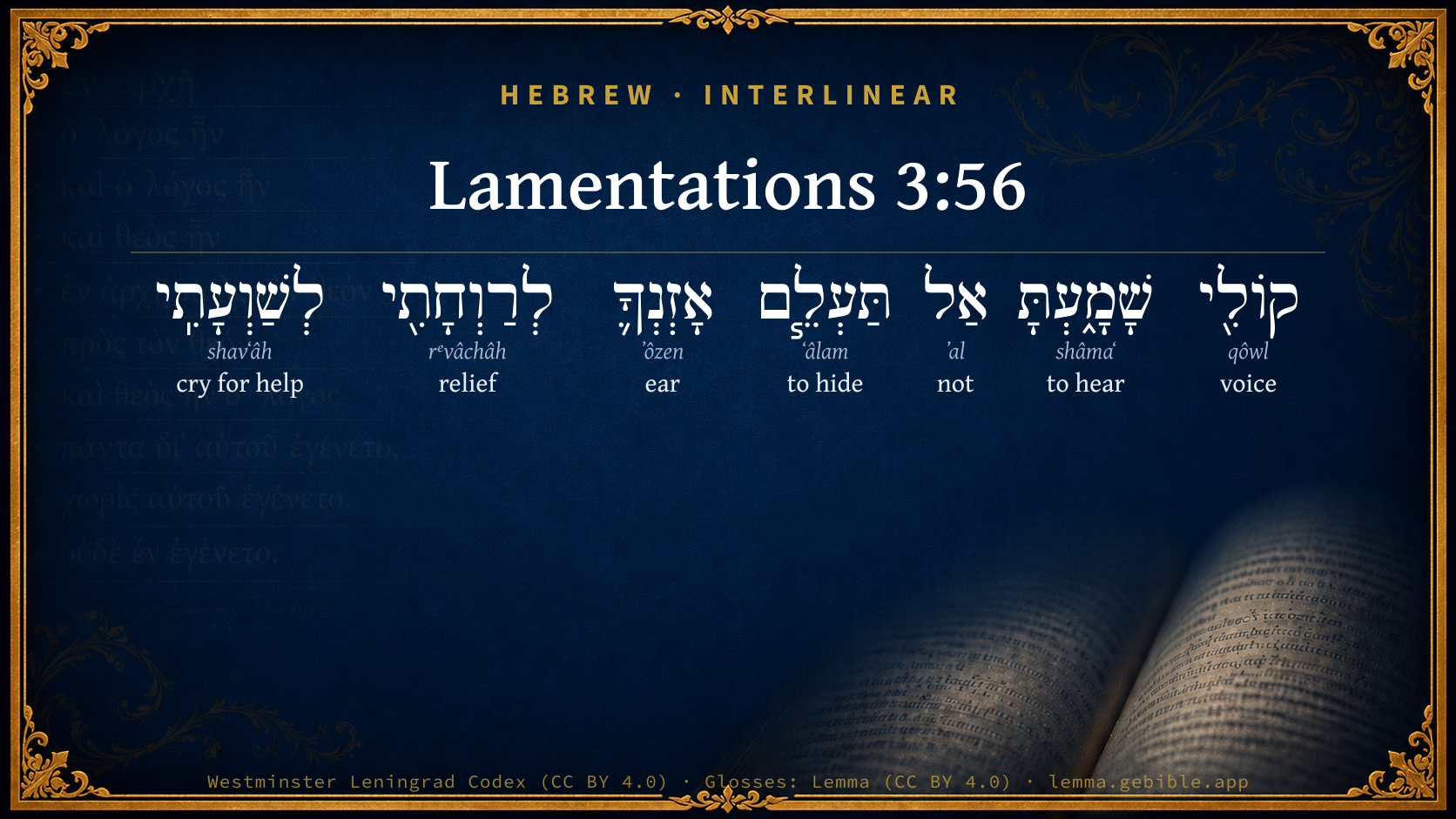
Hebrew (Westminster Leningrad Codex) Lamentations 3:56 appears in the Hebrew Old Testament. The text above is from the Westminster Leningrad Codex. Each word links to its Strong’s number, a concise gloss, and parsing drawn from the Open Scriptures Hebrew Bible morphology. Click any word for its full Brown-Driver-Briggs (BDB) entry.
Download image
Cite this verse

Lamentations 3:56 (World English Bible). Public Domain. Lemma interlinear Bible study tool, https://lemma.gebible.app/v/lamentations/3/56.

Show BibTeX & RIS
BibTeX
RIS
English Translation
You heard my voice; don't hide your ear at my breathing, at my cry.
World English Bible · Public Domain
Download a study sheet

One document with this verse’s original text, its word-by-word gloss line, the meaning frame, cross-references with their text, attributed commentary, and full source and license credits — printable, and it pastes into notes with its structure intact.

This verse Autodidact and up

Study sheet (.html) Plain text (.txt)

A passage Seminary Student

Up to 50 verses in one chapter. A passage sheet keeps up to 6 commentary sources and 12 cross-references per verse, in the order this page ranks them, and says so on the sheet whenever that leaves anything out. Ask for a single verse and you get the Autodidact verse sheet above.

Everything on this page stays free to read, with no account — the sheet is a download of what is already on screen, not access to it.

Want to remove ads? Support Godless Engineer
Compare translations 3

The same verse in 3 English versions, stacked beneath the original-language interlinear above. Click any original word for its lexicon entry.

Each is an independent rendering of the whole verse — the interlinear is not word-aligned to these translations.

Highlighted words mark where these versions differ — a whole-verse word diff, not a word-by-word alignment.

  • World English Bible Public Domain
    You heard my voice; don't hide your ear at my breathing, at my cry.
  • King James Version Public Domain
    Thou hast heard my voice: hide not thine ear at my breathing, at my cry.
  • unfoldingWord Literal Text CC BY-SA 4.0
    You heard my voice; do not hide your ear to my relief, to my cry for help.

unfoldingWord Literal Text — © unfoldingWord, licensed CC BY-SA 4.0. Word-aligned USFM3 via Door43 (git.door43.org/unfoldingWord/en_ult).

Versions to compare (up to 4)

3 of 4 selected

Show all 18 translations

Every available English version of this verse, each an independent rendering of the whole verse.

  • World English Bible Public Domain
    You heard my voice; don't hide your ear at my breathing, at my cry.
  • Berean Standard Bible Public Domain
    You heard my plea: “Do not ignore my cry for relief.”
  • Majority Standard Bible Public Domain
    You heard my plea: “Do not ignore my cry for relief.”
  • King James Version Public Domain
    Thou hast heard my voice: hide not thine ear at my breathing, at my cry.
  • American Standard Version (1901) Public Domain
    Thou heardest my voice; hide not thine ear at my breathing, at my cry.
  • Revised Version (1885) Public Domain
    Thou heardest my voice; hide not thine ear at my breathing, at my cry.
  • Geneva Bible (1599) Public Domain
    Thou hast heard my voyce: stoppe not thine eare from my sigh and from my cry.
  • Douay-Rheims (1899) Public Domain
    Coph. Thou hast heard my voice: turn not away thy ear from my sighs, and cries.
  • Young's Literal Translation Public Domain
    My voice Thou hast heard, Hide not Thine ear at my breathing -- at my cry.
  • Literal Standard Version CC BY-SA 4.0
    You have heard my voice, do not hide Your ear at my breathing—at my cry.
  • Unlocked Literal Bible CC BY-SA 4.0
    You heard my voice when I said, 'Do not close your ear to my cry for help.'
  • unfoldingWord Literal Text CC BY-SA 4.0
    You heard my voice; do not hide your ear to my relief, to my cry for help.
  • Darby Bible Public Domain
    Thou hast heard my voice: hide not thine ear at my sighing, at my cry.
  • World Messianic Bible Public Domain
    You heard my voice: “Don’t hide your ear from my sighing, and my cry.”
  • Webster's Bible Public Domain
    Thou hast heard my voice: hide not thy ear at my breathing, at my cry.
  • Free Bible Version CC BY-SA 4.0
    You heard me when I prayed, “Please don't ignore my cry for help.”
  • Bible in Basic English Public Domain
    My voice came to you; let not your ear be shut to my breathing, to my cry.
  • JPS Tanakh (1917) Public Domain
    Thou heardest my voice; hide not Thine ear at my sighing, at my cry.

Literal Standard Version (2020), Covenant Press — licensed CC BY-SA 4.0. Text via the HelloAO Bible API (eBible.org). Unlocked Literal Bible (unfoldingWord) — licensed CC BY-SA 4.0. Text via the HelloAO Bible API (eBible.org). unfoldingWord Literal Text — © unfoldingWord, licensed CC BY-SA 4.0. Word-aligned USFM3 via Door43 (git.door43.org/unfoldingWord/en_ult). Free Bible Version, Dr. Jonathan Gallagher — licensed CC BY-SA 4.0. Text via the HelloAO Bible API (eBible.org).

Word by word

More ways to search: Search by grammar → Find every occurrence → Compare this word →

Practice this passage: Drill this verse → Learn its vocabulary →

לְרַוְחָתִ֖י
rᵉvâchâh
H7309
“to/for · relief · my”
Preposition + Noun, Common, Feminine, Singular, Construct + Suffix, Personal, 1st Person, Common, Singular
Part of Speech
Preposition + Noun
Type
Common
Gender
Feminine
Number
Singular
State
Construct
Full BDB Definition

Origin: from H7305

TWOT: 2132b

respite, relief
  1. קוֹלִ֖י qôwl H6963 “voice · my” Noun, Common, Masculine, Singular, Construct + Suffix, Personal, 1st Person, Common, Singular
  2. שָׁמָ֑עְתָּ shâmaʻ H8085 “to hear” Verb, Qal, Perfect, 2nd Person, Masculine, Singular
  3. אַל ʼal H408 “not” Particle, Negative
  4. תַּעְלֵ֧ם ʻâlam H5956 “to hide” Verb, Hiphil, Jussive, 2nd Person, Masculine, Singular
  5. אָזְנְךָ֛ ʼôzen H241 “ear · your” Noun, Common, Feminine, Singular, Construct + Suffix, Personal, 2nd Person, Masculine, Singular
  6. לְשַׁוְעָתִֽי shavʻâh H7775 “to/for · cry for help · my” Preposition + Noun, Common, Feminine, Singular, Construct + Suffix, Personal, 1st Person, Common, Singular

About this verse

These counts appear in no published source. They are computed here, from the morphology-tagged text and Lemma’s own curated glosses. What Lemma adds →

7
words
7
distinct lemmas
Prophets
section

Notable vocabulary

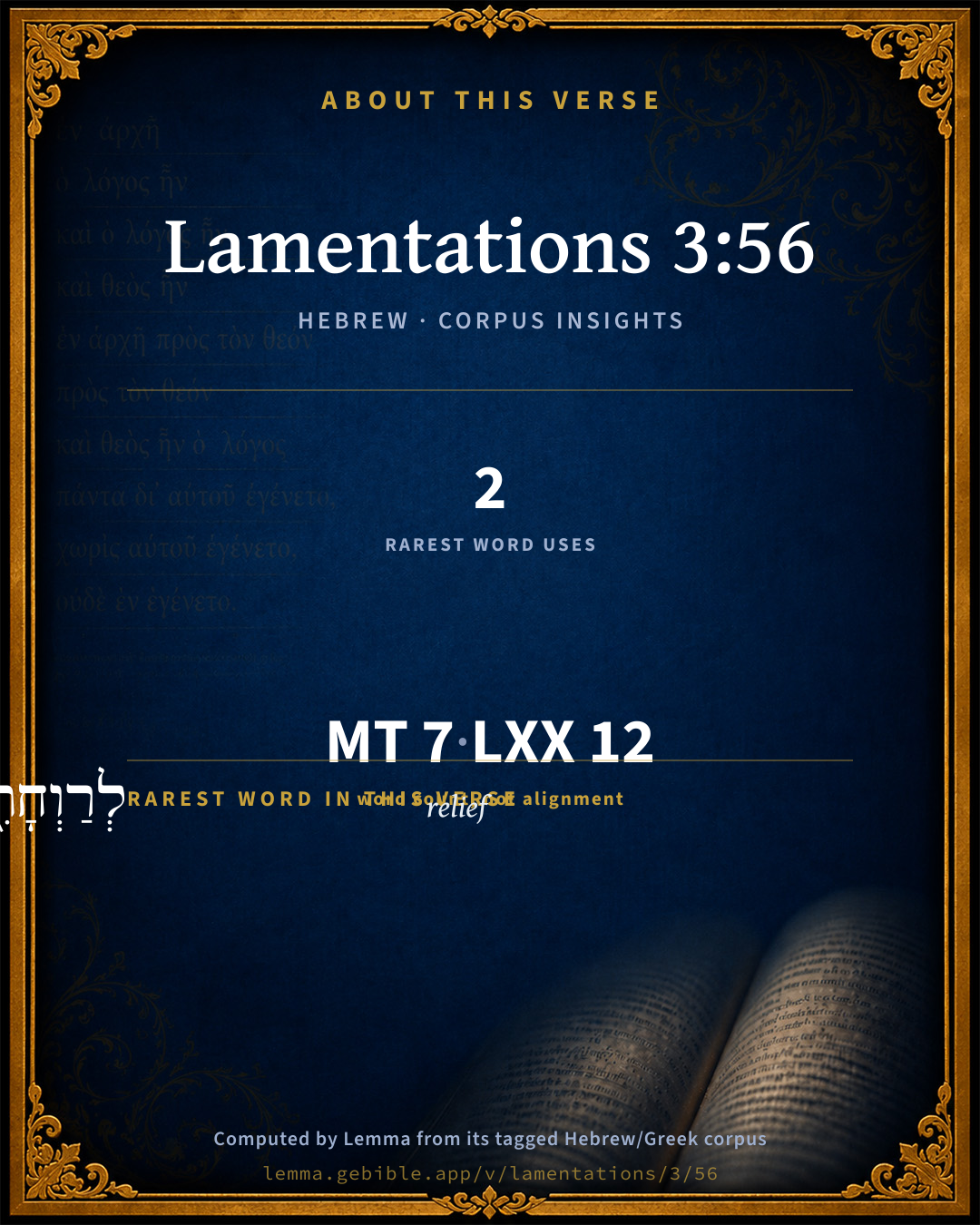
The rarest word here is לְרַוְחָתִ֖י relief H7309 — appearing just 2 times in the whole Hebrew Bible.

Shared distinctive vocabulary

לְרַוְחָתִ֖י relief H7309 occurs in 2 verses of the Hebrew Bible. Also found in:

Grammatical profile

  • 2 verbs
  • 4 nouns
  • 1 particle

Verb forms

  • שָׁמָ֑עְתָּ Qal · Perfect
  • תַּעְלֵ֧ם Hiphil · Jussive

Hebrew & Septuagint length

In English translation the verse runs 14 words from the Hebrew and 11 from the Septuagint (LXX English) — closely comparable.

A rough comparison of the two English renderings, which tokenize alike — not a word-level alignment.

Word counts can differ between the Hebrew and the Greek without any difference in meaning — e.g. the Hebrew direct-object marker אֵת has no separate Greek word, and Greek often adds the article ὁ.

In the original languages it is 7 Hebrew tokens and 12 Greek tokens — but the two are counted differently (Hebrew bundles its prefixes and suffixes into one token; the Greek is in lemma form), so that isn’t a like-for-like length.

Cross-references

12

Topical passages linked to Lamentations 3:56 in the Treasury of Scripture Knowledge — connected by theme and wording, ordered by reader-vote popularity; previews shown in the World English Bible.

  • Job 34:28 So that they caused the cry of the poor to come to him, He heard the cry of the afflicted.
  • Isaiah 38:5 Go, and tell Hezekiah, Thus says Yahweh, the God of David your father, I have heard your prayer, I have seen your tears: behold, I will add to your days fifteen years.
  • Psalms 6:8–9 Depart from me, all you workers of iniquity, For Yahweh has heard the voice of my weeping.
  • Psalms 34:6 This poor man cried, and Yahweh heard him, And saved him out of all his troubles.
  • Psalms 55:1 Listen to my prayer, God. Don't hide yourself from my supplication.
  • Psalms 88:13–14 But to you, Yahweh, I have cried. In the morning, my prayer comes before you.
  • 2 Chronicles 33:13 He prayed to him; and he was entreated of him, and heard his supplication, and brought him again to Jerusalem into his kingdom. Then Manasseh knew that Yahweh he was God.
  • Psalms 3:4 I cry to Yahweh with my voice, And he answers me out of his holy hill. Selah.
  • Psalms 66:19 But most assuredly, God has listened. He has heard the voice of my prayer.
  • Psalms 116:1–2 I love Yahweh, because he listens to my voice, And my cries for mercy.
  • Romans 8:26 In the same way, the Spirit also helps our weaknesses, for we don't know how to pray as we ought. But the Spirit himself makes intercession for us with groanings which can't be uttered.
  • 2 Chronicles 33:19 His prayer also, and how [God] was entreated of him, and all his sin and his trespass, and the places in which he built high places, and set up the Asherim and the engraved images, before he humbled himself: behold, they are written in the history of Hozai.

Cross-references courtesy of OpenBible.info (CC BY 4.0).

Hebrew and Greek witnesses Masoretic Hebrew ↔ Greek Septuagint

The same verse in the two great witnesses to the Old Testament, shown verse-for-verse.

These are two independent witnesses, not word-aligned to each other, and the Septuagint is shown in lemma (dictionary) form.

Hebrew Lamentations 3:56 Masoretic · Westminster Leningrad Codex

קוֹלִ֖י שָׁמָ֑עְתָּ אַל תַּעְלֵ֧ם אָזְנְךָ֛ לְרַוְחָתִ֖י לְשַׁוְעָתִֽי

You heard my voice; don't hide your ear at my breathing, at my cry.

World English Bible · Public Domain

Greek LXX Lamentations 3:56 Septuagint · lemma form

φωνή ἐγώ ἀκούω μή κρύπτω ὁ οὖς σύ εἰς ὁ δέησις ἐγώ

You heard my voice: close not your ears to my supplication.

LXX2012 (modern English Septuagint) · Public Domain

Hebrew: Westminster Leningrad Codex (CC BY 4.0). Greek: Septuagint (public domain); English from LXX2012 (modern English Septuagint) (Public Domain). How the Septuagint differs from the Hebrew →

Commentary

Notes on Lamentations 3:56 from classic Christian and Jewish commentators (each source and its license shown beneath its notes). The classic Christian expositions comment on the surrounding passage and are grouped to its opening verse, so a note may address several verses; the Jewish commentaries on the Tanakh (Rashi and others) are per-verse, so they appear only where the commentator wrote on this verse.

Lemma curates 59 commentaries, every one of them public domain or Creative Commons licensed, each selected and text-cleaned for this edition rather than reprinted as found. About our sources →

Trapp's Complete Commentary

John Trapp

Lam 3:56 Thou hast heard my voice: hide not thine ear at my breathing, at my cry.

Ver. 56. Thou hast heard my voice.] Seem a man’s case never so desperate, if he can but find a praying heart, God will find a pitying heart. Prayer is the best lever at a dead lift.

Hide not thine ear at my breathing.] As breathing is a proof of animal life, so is prayer, though never so weak, of spiritual. If therefore you cannot speak, weep - fietu saepe agitur non affatu, tears also have a voice; {Psa 39:12} if you cannot weep, sigh - a storm of sighs may do as much as a shower of tears; if you cannot sigh, yet breathe, as here. God feels breath; and happy is he that can say, In te spero et respiro, In thee I hope, Lord, and after thee I breathe or pant.

John Trapp, A Commentary or Exposition upon All the Books of the Old and New Testament (1647–1656) — public domain. Text from a community e-Sword module.

Jamieson, Fausset & Brown

Robert Jamieson, A. R. Fausset & David Brown

Thou hast heard--namely formerly (so in Lam 3:57-58).

breathing . . . cry--two kinds of prayer; the sigh of a prayer silently breathed forth, and the loud, earnest cry (compare "prayer," "secret speech," Isa 26:16, Margin; with "cry aloud," Psa 55:17).

Jamieson, Fausset & Brown — Commentary Critical and Explanatory on the Whole Bible (1871) — public domain (CC PDM 1.0). Text via the HelloAO Bible API.

Adam Clarke's Commentary

Verse 56. Hide not thine ear at my breathing] He dared not even to complain, nor to cry, nor to pray aloud: he was obliged to whisper his prayer to God. It was only a breathing.

Adam Clarke's Commentary on the Bible (1810–1826) — public domain. Text from a community e-Sword/MySword module.

John Calvin's Commentaries

When the Prophet says that God heard, it is the same as though he said, that he had so prayed that God became a witness of his earnestness and solicitude; for many boast in high terms of their earnestness and fervor and constancy in prayer, but their boastings are all empty and vain. But the Prophet summons God as a witness of his crying, as though he had said that he was not so overwhelmed by his adversity, but that he always fled to God.

He then says, Close not, etc.; it is properly, “hide not;” but as this is not quite suitable to ears, I am disposed to give this version, Close not thine ear to my cry. The verb רוח ruch, means to dilate, to respire; hence almost all render the noun here, “breathing;” but what follows cannot admit of this sense, to my prayer or cry. I have no doubt but that these two words mean crying; for in groaning the spirit of man dilates itself, and the soul, compressed by grief, expands. But when we cast our cares and troubles into the bosom of God, then the spirit forcibly emerges. This, then, is what the Prophet means, when he asks God not to close his ear to his dilation or groaning, and to his cry. It follows, —

John Calvin's Commentaries (1540-1563) — public domain. Text from the Calvin Translation Society English edition (1840s-50s) via the Christian Classics Ethereal Library (ccel.org). Calvin's coverage is partial (roughly two-thirds of the Bible); uncommented books and verses are honest gaps, never fabricated. The 19th-century editor's footnotes and remarks are omitted so the notes are faithfully Calvin's own voice.

Ellicott's Commentary for English Readers

(56) Thou hast heard . . . hide not thine . . .—There is something eminently suggestive in the sequence of the two clauses. The recollection that prayer was answered in the past, prompts its utterance in the present. Historically, the words may point to the intervention of Ebed-melech in Jer_38:7.

At my breathing—i.e., the “sighs” or “sobs” of the mourner.

A Bible Commentary for English Readers, edited by Charles John Ellicott (1878–1897) — public domain. Text from a community e-Sword module.

The Cambridge Bible for Schools and Colleges

gen. ed. J. J. S. Perowne

56. The word rendered “breathing” occurs but once elsewhere (Exo_8:15 [Heb. Lam_3:11]), and has there the sense of respite, relief. Accordingly Ewald proposes (by a change of one consonant) to render my cry, and consider “at my cry” to be a gloss.

The Cambridge Bible for Schools and Colleges (gen. ed. J. J. S. Perowne; Cambridge University Press, 1878–1918) — public domain. Text from a community e-Sword module.

John Gill's Exposition

Thou hast heard their reproach, O Lord,.... Their reproachful words uttered against the prophet and his people, against God himself; their spiteful language, their taunts, and scoffs and jeers:

and all their imaginations against me; those he not only saw, as they appeared in their actions; but heard them, as they were expressed by their words; yea, they were manifest to him, while they only were in silent thought forming in the mind.

John Gill's Exposition of the Whole Bible (1746–1763) — public domain (CC PDM 1.0). Text via the HelloAO Bible API.

Matthew Poole's English Annotations

I in former great afflictions applied myself unto thee, and thou didst hear me; show me now the same favour. Our former experiences of God’s goodness to us in hearing our prayers ought to hold up our hands in prayer, mid beget a confidence in us that we, persisting in our duty, shall find God the same God, yesterday, this day, and for ever.

Matthew Poole's English Annotations on the Holy Bible (1683–1685) — public domain. Text from a community e-Sword/MySword module.

Whedon's Commentary on the Bible

Daniel D. Whedon

56. Hide not, etc. — Literally, hide not thine ear to my relief, to my cry: that is, turn not away from my cry.

Daniel D. Whedon (gen. ed.), Commentary on the Old and New Testaments (1874–1909) — public domain. Text from a community e-Sword module.

The Pulpit Commentary

At my breathing; rather, at my sighing; literally, at my relieving myself.

The Pulpit Commentary (1880–1919), ed. H.D.M. Spence-Jones & Joseph S. Exell — public domain. Text from a community e-Sword module.

John Wesley's Explanatory Notes

Heard - In former afflictions. Hide not - Shew me now the same favour.

John Wesley, Explanatory Notes Upon the Whole Bible (1754–1765) — public domain. Text via the GEBible commentary corpus.

Lesson kit

Teaching starters — assembled from the data on this page, not authored interpretation. Every prompt links to the verse data it draws on. Edit before teaching.

Lamentations, in the Prophets, opens this verse with 7 words (7 distinct Hebrew lemmas). Its most distinctive word is rᵉvâchâh (“relief”). A historical commentator’s framing appears above. Read the whole chapter for the surrounding context.

Discussion questions

  1. How does “relief” (rᵉvâchâh) shape what this verse is saying?
  2. How does Exodus 8:15, which shares the word «relief», read alongside this verse?
  3. These translations render this verse differently. What is at stake in choosing one wording over another?
  4. «שָׁמָ֑עְתָּ» is a Qal Perfect verb. How does that grammatical form shape the action described?
  5. Compare how Trapp's Complete Commentary and Jamieson, Fausset & Brown read this verse. Where do they agree or differ?

Things to notice

Reading settings

Reading text

Shown beneath each verse's original-language words.

Old Testament
Old Testament edition

Read the OT as the Masoretic Hebrew (MT) or the Greek Septuagint (LXX).

English shown for the Greek Septuagint (in the Hebrew ↔ Greek comparison).

Comparing translations? Open the Compare panel on any verse page to stack up to four side by side.