
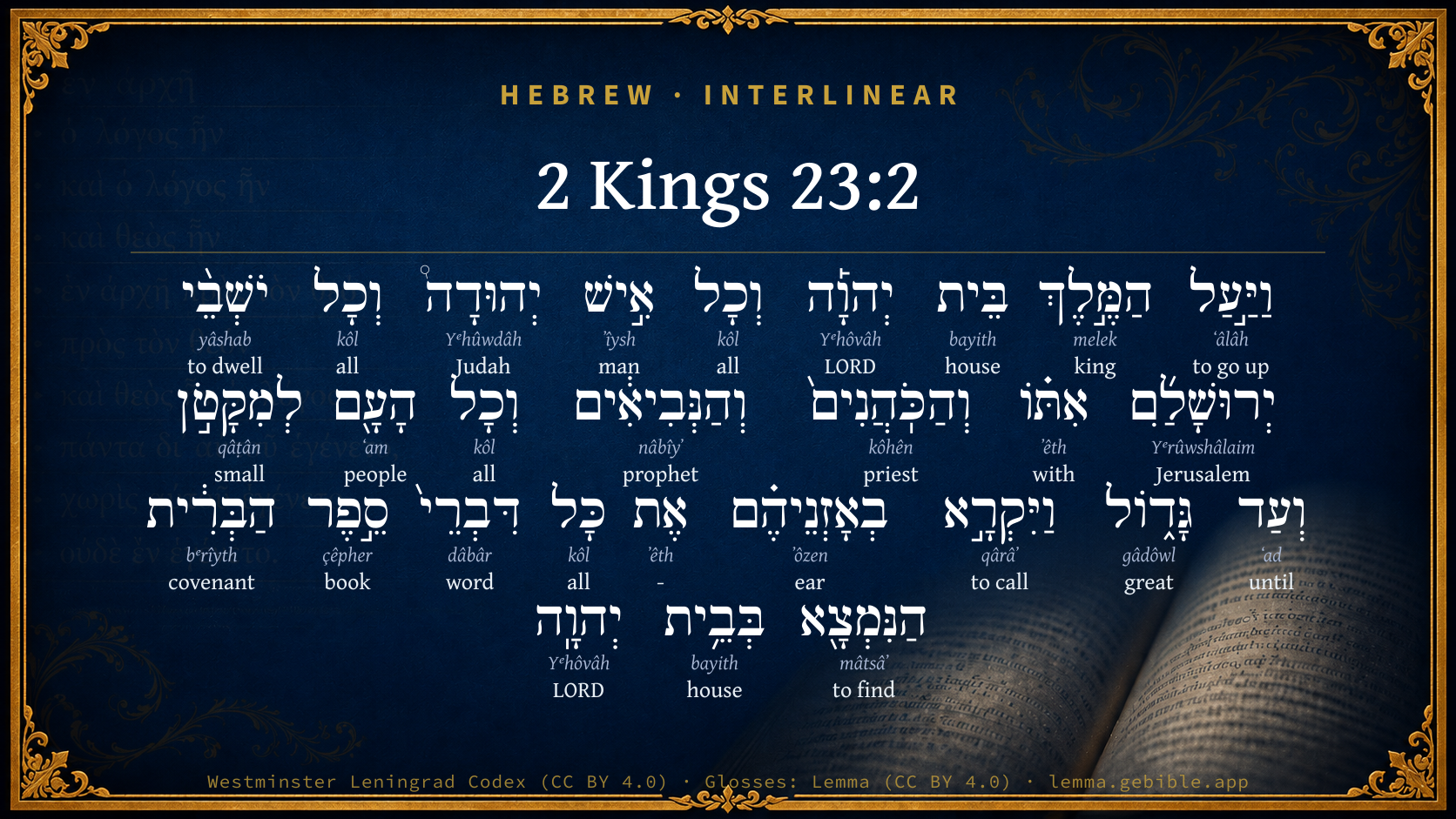
2 Kings 23:2

Hebrew (Westminster Leningrad Codex) 2 Kings 23:2 appears in the Hebrew Old Testament. The text above is from the Westminster Leningrad Codex. Each word links to its Strong’s number, a concise gloss, and parsing drawn from the Open Scriptures Hebrew Bible morphology. Click any word for its full Brown-Driver-Briggs (BDB) entry.
Download image
Cite this verse

2 Kings 23:2 (World English Bible). Public Domain. Lemma interlinear Bible study tool, https://lemma.gebible.app/v/2-kings/23/2.

Show BibTeX & RIS
BibTeX
RIS
English Translation
The king went up to the house of Yahweh, and all the men of Judah and all the inhabitants of Jerusalem with him, and the priests, and the prophets, and all the people, both small and great: and he read in their ears all the words of the book of the covenant which was found in the house of Yahweh.
World English Bible · Public Domain
Download a study sheet

One document with this verse’s original text, its word-by-word gloss line, the meaning frame, cross-references with their text, attributed commentary, and full source and license credits — printable, and it pastes into notes with its structure intact.

This verse Autodidact and up

Study sheet (.html) Plain text (.txt)

A passage Seminary Student

Up to 50 verses in one chapter. A passage sheet keeps up to 6 commentary sources and 12 cross-references per verse, in the order this page ranks them, and says so on the sheet whenever that leaves anything out. Ask for a single verse and you get the Autodidact verse sheet above.

Everything on this page stays free to read, with no account — the sheet is a download of what is already on screen, not access to it.

Want to remove ads? Support Godless Engineer
Compare translations 3

The same verse in 3 English versions, stacked beneath the original-language interlinear above. Click any original word for its lexicon entry.

Each is an independent rendering of the whole verse — the interlinear is not word-aligned to these translations.

Highlighted words mark where these versions differ — a whole-verse word diff, not a word-by-word alignment.

  • World English Bible Public Domain
    The king went up to the house of Yahweh, and all the men of Judah and all the inhabitants of Jerusalem with him, and the priests, and the prophets, and all the people, both small and great: and he read in their ears all the words of the book of the covenant which was found in the house of Yahweh.
  • King James Version Public Domain
    And the king went up into the house of the LORD, and all the men of Judah and all the inhabitants of Jerusalem with him, and the priests, and the prophets, and all the people, both small and great: and he read in their ears all the words of the book of the covenant which was found in the house of the LORD.
  • unfoldingWord Literal Text CC BY-SA 4.0
    And the king went up the house of Yahweh, and every man of Judah and all of the dwellers of Jerusalem with him, and the priests and the prophets, and all of the people from small and to great. And he read in their ears all of the words of the scroll of the covenant having been found in the house of Yahweh.

unfoldingWord Literal Text — © unfoldingWord, licensed CC BY-SA 4.0. Word-aligned USFM3 via Door43 (git.door43.org/unfoldingWord/en_ult).

Versions to compare (up to 4)

3 of 4 selected

Show all 18 translations

Every available English version of this verse, each an independent rendering of the whole verse.

  • World English Bible Public Domain
    The king went up to the house of Yahweh, and all the men of Judah and all the inhabitants of Jerusalem with him, and the priests, and the prophets, and all the people, both small and great: and he read in their ears all the words of the book of the covenant which was found in the house of Yahweh.
  • Berean Standard Bible Public Domain
    And he went up to the house of the LORD with all the people of Judah and Jerusalem, as well as the priests and the prophets—all the people small and great—and in their hearing he read all the words of the Book of the Covenant that had been found in the house of the LORD.
  • Majority Standard Bible Public Domain
    And he went up to the house of the LORD with all the people of Judah and Jerusalem, as well as the priests and the prophets—all the people small and great—and in their hearing he read all the words of the Book of the Covenant that had been found in the house of the LORD.
  • King James Version Public Domain
    And the king went up into the house of the LORD, and all the men of Judah and all the inhabitants of Jerusalem with him, and the priests, and the prophets, and all the people, both small and great: and he read in their ears all the words of the book of the covenant which was found in the house of the LORD.
  • American Standard Version (1901) Public Domain
    And the king went up to the house of Jehovah, and all the men of Judah and all the inhabitants of Jerusalem with him, and the priests, and the prophets, and all the people, both small and great: and he read in their ears all the words of the book of the covenant which was found in the house of Jehovah.
  • Revised Version (1885) Public Domain
    And the king went up to the house of the LORD, and all the men of Judah and all the inhabitants of Jerusalem with him, and the priests, and the prophets, and all the people, both small and great: and he read in their ears all the words of the book of the covenant which was found in the house of the LORD.
  • Geneva Bible (1599) Public Domain
    And the King went vp into the house of the Lord, with all the men of Iudah and all the inhabitants of Ierusalem with him, and the Priests and Prophets, and all the people both small and great: and he reade in their eares all the wordes of the booke of the couenant, which was found in the house of the Lord.
  • Douay-Rheims (1899) Public Domain
    And the king went up to the temple of the Lord, and all the men of Juda, and all the inhabitants of Jerusalem with him, the priests and the prophets, and all the people both little and great: and in the hearing of them all he read all the words of the book of the covenant, which was found in the house of the Lord.
  • Young's Literal Translation Public Domain
    and the king goeth up to the house of Jehovah, and every man of Judah, and all the inhabitants of Jerusalem, with him, and the priests, and the prophets, and all the people, from small unto great, and he readeth in their ears all the words of the book of the covenant that is found in the house of Jehovah.
  • Literal Standard Version CC BY-SA 4.0
    and the king goes up to the house of YHWH, and every man of Judah, and all the inhabitants of Jerusalem, with him, and the priests, and the prophets, and all the people, from small to great, and he reads in their ears all the words of the Scroll of the Covenant that is found in the house of YHWH.
  • Unlocked Literal Bible CC BY-SA 4.0
    Then the king went up to the house of Yahweh, and all the men of Judah and all the inhabitants of Jerusalem with him, and the priests, prophets, and all the people, from small to great. He then read in their hearing all the words of the book of the Covenant that had been found in the house of Yahweh.
  • unfoldingWord Literal Text CC BY-SA 4.0
    And the king went up the house of Yahweh, and every man of Judah and all of the dwellers of Jerusalem with him, and the priests and the prophets, and all of the people from small and to great. And he read in their ears all of the words of the scroll of the covenant having been found in the house of Yahweh.
  • Darby Bible Public Domain
    And the king went up into the house of Jehovah, and all the men of Judah and all the inhabitants of Jerusalem with him, and the priests and the prophets, and all the people, both small and great; and he read in their ears all the words of the book of the covenant which had been found in the house of Jehovah.
  • World Messianic Bible Public Domain
    The king went up to the LORD’s house, and all the men of Judah and all the inhabitants of Jerusalem with him—with the priests, the prophets, and all the people, both small and great; and he read in their hearing all the words of the book of the covenant which was found in the LORD’s house.
  • Webster's Bible Public Domain
    And the king went up into the house of the LORD, and all the men of Judah and all the inhabitants of Jerusalem with him, and the priests, and the prophets, and all the people, both small and great: and he read in their ears all the words of the book of the covenant which was found in the house of the LORD.
  • Free Bible Version CC BY-SA 4.0
    He went to the Lord's Temple with all the people of Judah and Jerusalem, together with the priests and the Levites, all the people from the least to the greatest, and he read to them the whole Book of the Agreement that had been discovered in the Lord's Temple.
  • Bible in Basic English Public Domain
    And the king went up to the house of the Lord, with all the men of Judah and all the people of Jerusalem, and the priests and the prophets and all the people, small and great; and they were present at his reading of the book of the law which had come to light in the house of the Lord.
  • JPS Tanakh (1917) Public Domain
    And the king went up to the house of the LORD, and all the men of Judah and all the inhabitants of Jerusalem with him, and the priests, and the prophets, and all the people, both small and great; and he read in their ears all the words of the book of the covenant which was found in the house of the LORD.

Literal Standard Version (2020), Covenant Press — licensed CC BY-SA 4.0. Text via the HelloAO Bible API (eBible.org). Unlocked Literal Bible (unfoldingWord) — licensed CC BY-SA 4.0. Text via the HelloAO Bible API (eBible.org). unfoldingWord Literal Text — © unfoldingWord, licensed CC BY-SA 4.0. Word-aligned USFM3 via Door43 (git.door43.org/unfoldingWord/en_ult). Free Bible Version, Dr. Jonathan Gallagher — licensed CC BY-SA 4.0. Text via the HelloAO Bible API (eBible.org).

Word by word

More ways to search: Search by grammar → Find every occurrence → Compare this word →

Practice this passage: Drill this verse → Learn its vocabulary →

לְמִקָּטֹ֣ן
qâṭân
H6996
“to/for · from · small”
Preposition + Preposition + Adjective, Adjective, Masculine, Singular, Absolute
Part of Speech
Preposition + Preposition + Adjective
Type
Adjective
Gender
Masculine
Number
Singular
State
Absolute
Full BDB Definition

Origin: from H6962

TWOT: 2009a , 2009b

young, small, insignificant, unimportant - small - insignificant - young - unimportant
  1. וַיַּ֣עַל ʻâlâh H5927 “and · to go up” Conjunction + Verb, Qal, Sequential Imperfect, 3rd Person, Masculine, Singular
  2. הַמֶּ֣לֶךְ melek H4428 “the · king” Particle, Definite Article + Noun, Common, Masculine, Singular, Absolute
  3. בֵּית bayith H1004 “house of” Noun, Common, Masculine, Singular, Construct
  4. יְהוָ֡ה Yᵉhôvâh H3068 “LORD” Noun, Proper
  5. וְכָל kôl H3605 “and · all of” Conjunction + Noun, Common, Masculine, Singular, Construct
  6. אִ֣ישׁ ʼîysh H376 “man of” Noun, Common, Masculine, Singular, Construct
  7. יְהוּדָה֩ Yᵉhûwdâh H3063 “Judah” Noun, Proper
  8. וְכָל kôl H3605 “and · all of” Conjunction + Noun, Common, Masculine, Singular, Construct
  9. יֹשְׁבֵ֨י yâshab H3427 “dwelling” Verb, Qal, Participle Active, Masculine, Plural, Construct
  10. יְרוּשָׁלִַ֜ם Yᵉrûwshâlaim H3389 “Jerusalem” Noun, Proper
  11. אִתּ֗וֹ ʼêth H854 “with · him” Preposition + Suffix, Personal, 3rd Person, Masculine, Singular
  12. וְהַכֹּֽהֲנִים֙ kôhên H3548 “and · the · priests” Conjunction + Particle, Definite Article + Noun, Common, Masculine, Plural, Absolute
  13. וְהַנְּבִיאִ֔ים nâbîyʼ H5030 “and · the · prophets” Conjunction + Particle, Definite Article + Noun, Common, Masculine, Plural, Absolute
  14. וְכָל kôl H3605 “and · all of” Conjunction + Noun, Common, Masculine, Singular, Construct
  15. הָעָ֖ם ʻam H5971 “the · people” Particle, Definite Article + Noun, Common, Masculine, Singular, Absolute
  16. וְעַד ʻad H5704 “and · until” Conjunction + Preposition
  17. גָּד֑וֹל gâdôwl H1419 “great” Adjective, Adjective, Masculine, Singular, Absolute
  18. וַיִּקְרָ֣א qârâʼ H7121 “and · to call” Conjunction + Verb, Qal, Sequential Imperfect, 3rd Person, Masculine, Singular
  19. בְאָזְנֵיהֶ֗ם ʼôzen H241 “in/at · ears · their” Preposition + Noun, Common, Feminine, Dual, Construct + Suffix, Personal, 3rd Person, Masculine, Plural
  20. אֶת ʼêth H853 “-” Particle, Direct Object
  21. כָּל kôl H3605 “all of” Noun, Common, Masculine, Singular, Construct
  22. דִּבְרֵי֙ dâbâr H1697 “words of” Noun, Common, Masculine, Plural, Construct
  23. סֵ֣פֶר çêpher H5612 “book of” Noun, Common, Masculine, Singular, Construct
  24. הַבְּרִ֔ית bᵉrîyth H1285 “the · covenant” Particle, Definite Article + Noun, Common, Feminine, Singular, Absolute
  25. הַנִּמְצָ֖א mâtsâʼ H4672 “the · finding” Particle, Definite Article + Verb, Niphal, Participle Active, Masculine, Singular, Absolute
  26. בְּבֵ֥ית bayith H1004 “in/at · house of” Preposition + Noun, Common, Masculine, Singular, Construct
  27. יְהוָֽה Yᵉhôvâh H3068 “LORD” Noun, Proper

About this verse

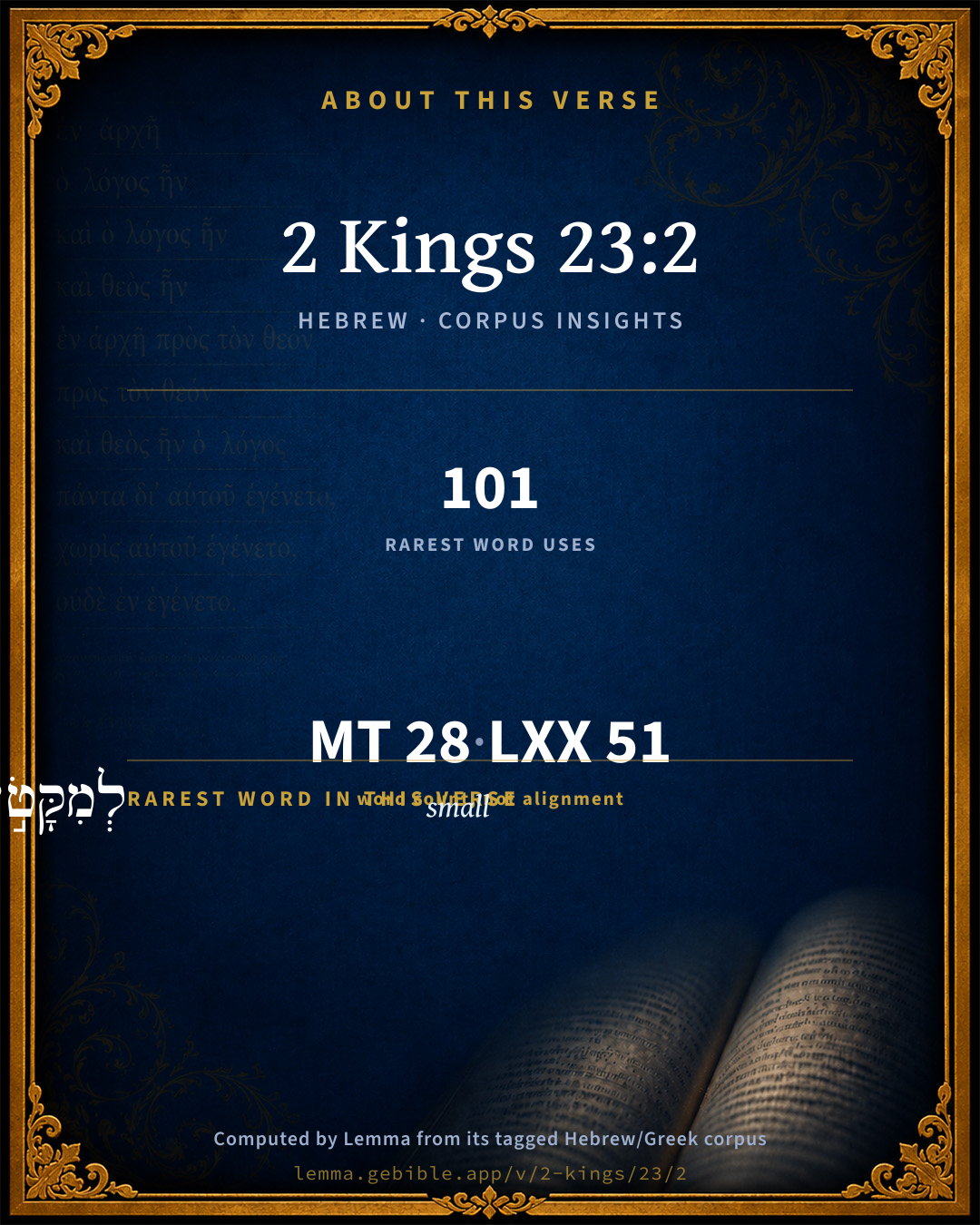
These counts appear in no published source. They are computed here, from the morphology-tagged text and Lemma’s own curated glosses. What Lemma adds →

28
words
23
distinct lemmas
Historical
section

Grammatical profile

  • 4 verbs
  • 19 nouns
  • 2 adjectives
  • 2 prepositions
  • 1 particle

Verb forms

  • וַיַּ֣עַל Qal · Sequential Imperfect
  • יֹשְׁבֵ֨י Qal · Participle Active
  • וַיִּקְרָ֣א Qal · Sequential Imperfect
  • הַנִּמְצָ֖א Niphal · Participle Active

Repetition

Words recur within this verse — often emphatic in Hebrew:

  • וְכָל all H3605 ×4
  • בֵּית house H1004 ×2
  • יְהוָ֡ה LORD H3068 ×2

Hebrew & Septuagint length

In English translation the verse runs 60 words from the Hebrew and 61 from the Septuagint (LXX English) — closely comparable.

A rough comparison of the two English renderings, which tokenize alike — not a word-level alignment.

Word counts can differ between the Hebrew and the Greek without any difference in meaning — e.g. the Hebrew direct-object marker אֵת has no separate Greek word, and Greek often adds the article ὁ.

In the original languages it is 28 Hebrew tokens and 51 Greek tokens — but the two are counted differently (Hebrew bundles its prefixes and suffixes into one token; the Greek is in lemma form), so that isn’t a like-for-like length.

Cross-references

17

Topical passages linked to 2 Kings 23:2 in the Treasury of Scripture Knowledge — connected by theme and wording, ordered by reader-vote popularity; previews shown in the World English Bible.

  • 2 Kings 22:8 Hilkiah the high priest said to Shaphan the scribe, I have found the book of the law in the house of Yahweh. Hilkiah delivered the book to Shaphan, and he read it.
  • Deuteronomy 31:10–13 Moses commanded them, saying, At the end of [every] seven years, in the set time of the year of release, in the feast of tents,
  • Revelation 20:12 I saw the dead, the great and the small, standing before the throne, and they opened books. Another book was opened, which is the book of life. The dead were judged out of the things which were written in the books, according to their works.
  • Genesis 19:11 They struck the men who were at the door of the house with blindness, both small and great, so that they wearied themselves to find the door.
  • Deuteronomy 31:26 Take this book of the law, and put it by the side of the ark of the covenant of Yahweh your God, that it may be there for a witness against you.
  • 1 Samuel 5:9 It was so, that after they had carried it about, the hand of Yahweh was against the city with a very great confusion: and he struck the men of the city, both small and great; and tumors broke out on them.
  • 1 Samuel 30:2 and had taken captive the women [and all] who were therein, both small and great: they didn't kill any, but carried them off, and went their way.
  • 1 Kings 8:9 There was nothing in the ark save the two tables of stone which Moses put there at Horeb, when Yahweh made a covenant with the children of Israel, when they came out of the land of Egypt.
  • 2 Chronicles 15:13 and that whoever would not seek Yahweh, the God of Israel, should be put to death, whether small or great, whether man or woman.
  • 2 Chronicles 17:9 They taught in Judah, having the book of the law of Yahweh with them; and they went about throughout all the cities of Judah, and taught among the people.
  • Nehemiah 8:1–8 All the people gathered themselves together as one man into the broad place that was before the water gate; and they spoke to Ezra the scribe to bring the book of the law of Moses, which Yahweh had commanded to Israel.
  • Nehemiah 9:3 They stood up in their place, and read in the book of the law of Yahweh their God a fourth part of the day; and [another] fourth part they confessed, and worshiped Yahweh their God.
  • Nehemiah 13:1 On that day they read in the book of Moses in the audience of the people; and therein was found written, that an Ammonite and a Moabite should not enter into the assembly of God forever,
  • Esther 1:5 When these days were fulfilled, the king made a feast to all the people who were present in Shushan the palace, both great and small, seven days, in the court of the garden of the king's palace.
  • Job 3:19 The small and the great are there. The servant is free from his master.
  • Psalms 115:13 He will bless those who fear Yahweh, Both small and great.
  • Acts 26:22 Having therefore obtained the help that is from God, I stand to this day testifying both to small and great, saying nothing but what the prophets and Moses said would happen,

Cross-references courtesy of OpenBible.info (CC BY 4.0).

Hebrew and Greek witnesses Masoretic Hebrew ↔ Greek Septuagint

The same verse in the two great witnesses to the Old Testament, shown verse-for-verse.

These are two independent witnesses, not word-aligned to each other, and the Septuagint is shown in lemma (dictionary) form.

Hebrew 2 Kings 23:2 Masoretic · Westminster Leningrad Codex

וַיַּ֣עַל הַמֶּ֣לֶךְ בֵּית יְהוָ֡ה וְכָל אִ֣ישׁ יְהוּדָה֩ וְכָל יֹשְׁבֵ֨י יְרוּשָׁלִַ֜ם אִתּ֗וֹ וְהַכֹּֽהֲנִים֙ וְהַנְּבִיאִ֔ים וְכָל הָעָ֖ם לְמִקָּטֹ֣ן וְעַד גָּד֑וֹל וַיִּקְרָ֣א בְאָזְנֵיהֶ֗ם אֶת כָּל דִּבְרֵי֙ סֵ֣פֶר הַבְּרִ֔ית הַנִּמְצָ֖א בְּבֵ֥ית יְהוָֽה

The king went up to the house of Yahweh, and all the men of Judah and all the inhabitants of Jerusalem with him, and the priests, and the prophets, and all the people, both small and great: and he read in their ears all the words of the book of the covenant which was found in the house of Yahweh.

World English Bible · Public Domain

Greek LXX 2 Kings 23:2 Septuagint · lemma form

καί ἀναβαίνω ὁ βασιλεύς εἰς οἶκος κύριος καί πᾶς ἀνήρ ιουδα καί πᾶς ὁ καταοἰκέω ἐν ἰερουσαλήμ μετά αὐτός καί ὁ ἱερεύς καί ὁ προφήτης καί πᾶς ὁ λαός ἀπό μικρός καί ἕως μέγας καί ἀναγιγνώσκω ἐν οὖς αὐτός πᾶς ὁ λόγος ὁ βιβλίον ὁ διαθήκη ὁ εὑρίσκω ἐν οἶκος κύριος

And the king went up to the house of the Lord, and every man of Juda and all who lived in Jerusalem with him, and the priests, and the prophets, and all the people small and great; and he read in their ears all the words of the book of the covenant that was found in the house of the Lord.

LXX2012 (modern English Septuagint) · Public Domain

Hebrew: Westminster Leningrad Codex (CC BY 4.0). Greek: Septuagint (public domain); English from LXX2012 (modern English Septuagint) (Public Domain). How the Septuagint differs from the Hebrew →

Targum (Aramaic paraphrase)

1

The Targum is the ancient Jewish Aramaic paraphrase of the Hebrew Scriptures — an interpretive translation, not the Hebrew text itself. Onkelos (literal) and Pseudo-Jonathan (expansive) render the Torah, and Jonathan the Prophets. Coverage is partial: where no permissively-licensed English translation exists for a verse, only the Aramaic is shown. This is verse-level text, not a word-by-word alignment to the Hebrew.

  1. Targum Jonathan Prophets (Joshua–Malachi)
    וּסְלֵיק מַלְכָּא לְבֵית מַקְדְשָׁא דַייָ וְכָל אֱנַשׁ יְהוּדָה וְיַתְבֵי יְרוּשְׁלֵם עִמֵיהּ וְכַהֲנַיָא וְסַפְרַיָא וְכָל עַמָא לְמִזְעֵירָא וְעַד רַבָּא וּקְרָא קֳדָמֵיהוֹן יַת כָּל פִּתְגָמָא סַפְרָא דִקְיָמָא דְאִשְׁתְּכַח בְּבֵית מַקְדְשָׁא דַיָי:

    (no public-domain English translation for this verse)

    Targum Jonathan — Aramaic: “Mikraot Gedolot” (public domain). English: “Sefaria Community Translation” (CC0 1.0 (public-domain dedication)); “London "Chaldee Paraphrase," 1871” (public domain). Text via Sefaria.

Commentary

Notes on 2 Kings 23:2 from classic Christian and Jewish commentators (each source and its license shown beneath its notes). The classic Christian expositions comment on the surrounding passage and are grouped to its opening verse, so a note may address several verses; the Jewish commentaries on the Tanakh (Rashi and others) are per-verse, so they appear only where the commentator wrote on this verse.

Lemma curates 59 commentaries, every one of them public domain or Creative Commons licensed, each selected and text-cleaned for this edition rather than reprinted as found. About our sources →

Trapp's Complete Commentary

John Trapp

2Ki 23:2 And the king went up into the house of the LORD, and all the men of Judah and all the inhabitants of Jerusalem with him, and the priests, and the prophets, and all the people, both small and great: and he read in their ears all the words of the book of the covenant which was found in the house of the LORD.

Ver. 2. And the king went up … and all the men of Judah.] Solemnly to renew their covenant with God; a course ever found to be of singular avail in case of any common calamity felt or feared.

John Trapp, A Commentary or Exposition upon All the Books of the Old and New Testament (1647–1656) — public domain. Text from a community e-Sword module.

The Biblical Illustrator

Joseph S. Exell

2Ki_23:2

And the King went up into the house of the Lord.

Spiritual idolatry

Why should there be such a gathering as this? why should all the mighty, all the good, and all the wise, all the great with all the small, make such a point of going into the house of the Lord on this occasion? Why should they make such a public display about an ordinary duty, such as assembling in the house of the Lord? For two reasons.

1. Because that duty had become an extraordinary one, through the long neglect of it.

2. And the other reason was, because they were desirous to hear the Word of the Lord. These were indeed two good reasons for this solemn assembly of all the people in the Lords house. But what a terrible lesson does it read to us! We read of a wonderful deliverance of His people by Almighty God out of the hands of their enemies, when to the eye of man their situation was utterly hopeless. We should expect that this would have awakened them, especially as God had performed it on their turning back, under the pious Hezekiah, from their false gods to the true and living God; yet here, in the third generation from that time, we find the altars and temples of the false gods up again, and the Word of God lost, not only out of the hearts, but of the very sight and ears of the people. Once again, however, and, alas! for the last, time, both the temple and that Word were restored under the care of the pious Josiah; and the people of God once again, and for the last time, showed themselves as the people of God. Such is the example before us; the example of a people, too, in whose place we are standing, being grafted in as a wild olive, in place of the branches which had been broken off because of unbelief. And their example is our example, as we have been told by St. Paul. Let us review, then, some of the plainest applications of this example.

(1) St. Paul warns us, saying, Neither be ye idolaters, as were some of them (1Co_10:7). But it may he said that we are not in the least danger of being idolaters. We are thoroughly convinced of its besotted folly and desperate wickedness. But then, there are always two things to all our dealings with God,--there is the spirit, and there is the deed; and the deed depends upon the spirit for its quality, as the fruit depends upon the nature of the tree for its kind. Although, therefore, we bow not down before the work of our own hands, putting it in the place of God, we may bow down before the work of our own hearts, and put that in the place of God. And this idolatry may go on while the other is scorned and mocked at. For what is the worship of God? Is it not in lifting up the thoughts and affections of the heart unto God on His throne in heaven, and acknowledging Him as our maker and continual keeper? Thus God is the first and last object of the heart; but an idol is a thing of this world, put in the place of God. Oh how is the heart in its devotion to the things of this world full of images, which it worships, in the place of the Maker of this world and all therein, with the kiss of affection, with the bowing of the spirit, with the adoration of the soul! But of one image only will God allow in the heart for worship, and not reckon it idolatry; in one image will He allow Himself to be honoured, and in one only; and what is that? It is the image of Himself. But how shall we possibly have the image of God, whom no man hath seen, neither can see, in our hearts? He hath given us this image of Himself in our Lord Jesus Christ, of whom St. Paul says, that He is the image of the invisible God (Col_1:15); the brightness of His glory, the express image of His person (Heb_1:3); and who says concerning Himself, He that hath seen Me hath seen the Father (Joh_14:9); if, therefore He shall be dwelling in our hearts by faith, then we have there the image of God, and we are worshipping Him in spirit and in truth. And this, therefore, is necessary to our worship, the keeping His image there, not letting the things of this world to take its place, but looking upon Him crucified by crucifying the flesh with its affections and lusts; looking upon Him dead, by our death urge sin; looking upon Him as risen again, by our new life unto righteousness; looking upon Him ascended into heaven, by setting the affections on things above; looking on Him as coming again, through the denial of all ungodliness and worldly lusts, and in the blessed hope of His glorious appearing. To this worship we have all been called, and to this all must turn from the vain idols of worldly desires.

(2) That the Word of God should be lost out of the hands and hearts of idolaters, who can wonder? It expressly forbids idolatry of every kind, both within and without the heart: it says, Thou shalt worship the Lord thy God, and Him only shalt thou serve; and it is full from beginning to end of severe rebuke and awful threats against all that are holding the truth in unrighteousness, knowing that the Lord God is a jealous God, that will not share His honour with another, and yet preferring to his worship and service the devotion to the world, and the service of the flesh. And the first token of sincere repentance is now, as it was in the days of Josiah: men go up to the house of the Lord to hear the Word of God; they go to His house in the place of the public assembly of His people; they go to His house in the inner chamber of their hearts; for then being bent on amendment, they desire reproof, they wish to forsake the wrong way for the right, they long to understand the will of God that they may do it; to hear His sentence upon sin, that they may justly dread and abhor it; to listen to His promise of pardon, that they may lay fast hold of it; to hear the call to repentance, that they may instantly and sincerely obey it; thus the Word which was before full only of rebuke, now abounds to them wire consolation; that which smote their consciences now soothes them. (R. W. Evans, B. D.)

The Biblical Illustrator, edited by Joseph S. Exell (c. 1880s–1900s) — public domain. Text from a community e-Sword module.

Joseph Benson's Commentary

2Ki 23:2. The king went up into the house of the Lord — For as this great meeting was called for a religious purpose, it was to be conducted in a religious manner; and whatever was done in it was to be done as in the presence of God. And all the men of Judah — A very great number of them; for it cannot be supposed that the court of the Lord’s house could contain all the inhabitants of the land at once. And the prophets — Either Jeremiah, Zephaniah, Urijah, Huldah, or the sons of the prophets. The people, both small and great — High and low, rich and poor, young and old: for persons of all ranks, conditions, and ages, were present. And he read in their ears, &c. — Josiah himself, for he did not think it beneath him to be a reader, any more than Solomon did to be a preacher, and David even a door-keeper, in the house of God. All people are concerned to know the Scriptures, and all in authority to spread the knowledge of them.

Joseph Benson's Commentary on the Old and New Testaments (1811–1818) — public domain. Text from a community e-Sword module.

Jamieson, Fausset & Brown

Robert Jamieson, A. R. Fausset & David Brown

he read in their ears--that is, "caused to be read."

Jamieson, Fausset & Brown — Commentary Critical and Explanatory on the Whole Bible (1871) — public domain (CC PDM 1.0). Text via the HelloAO Bible API.

Adam Clarke's Commentary

Verse 2. The king went up into the house of the Lord] Here is another very singular circumstance. The high priest, scribes, priest, and prophets, are gathered together, with all the elders of the people, and the king himself reads the book of the covenant which had been lately found! It is strange that either the high priest, Jeremiah, Zephaniah, or some other of the prophets, who were certainly there present, did not read the sacred book! It is likely that the king considered himself a mediator between God and them, and therefore read and made the covenant.

Adam Clarke's Commentary on the Bible (1810–1826) — public domain. Text from a community e-Sword/MySword module.

Ellicott's Commentary for English Readers

(2) And the prophets.—That is, the numerous members of the prophetic order, who at this time formed a distinct class, repeatedly mentioned in the writings of Jeremiah (e.g., Jer_2:8; Jer_5:31; Jer_6:13), as well as of older prophets. The Targum has the scribes, the γραμματεύς of the New Testament, a class which hardly existed so early. Chron. and some MSS. reads the Levites. (See Note on 2Ch_34:30.)

All the men of Judah . . . inhabitants of Jerusalem . . . the people.—A natural hyperbole, Of course the Temple court would not contain the entire population.

And he read.—Perhaps the king himself; but not necessarily. (Comp., e.g., 2Ki_22:10; 2Ki_22:16.) Qui facit per alium facit per se. The priests were charged to read the Law to the people (Deu_31:9, seq.) at the end of every seven years.

Small and great—i.e., high and low. (Comp. Psa_49:2.)

A Bible Commentary for English Readers, edited by Charles John Ellicott (1878–1897) — public domain. Text from a community e-Sword module.

The Cambridge Bible for Schools and Colleges

gen. ed. J. J. S. Perowne

2. and the priests, and the prophets, and all the people] These were the elders spoken of in the previous verse, the representative men of the principal classes from every part of the kingdom. In the parallel place in 2Ch_34:30, the ‘prophets’ are not mentioned in this enumeration, but in their place the ‘Levites’ appear. This variation is no doubt due to the different state of things which existed when the two books were compiled. In the days of the compiler of Kings, the effect of the schools of the prophets had not died away, and he could understand that men who had belonged to them would in Josiah’s time form a considerable class, and be mentioned as such in the original record. When the Chronicler lived things were very different. Prophets, as a class of men trained in religious societies with a view to future work among the people, had ceased to exist, while the Levites had come into considerable prominence. Meaning therefore to represent the influential persons of the time as present at Josiah’s solemn gathering, he mentions ‘Levites’ who in his own time were a distinguished body, omitting ‘prophets’ as they were no longer found in the same numbers, nor constituted so distinct a class, when this assembly was collected in Josiah’s reign.

small and great] i.e. The poor and the rich.

the book of the covenant] The expression is found in Exo_24:7, and there seems to refer to the contents of the chapters Exodus 20-23. But there is little doubt that, however brief the first form of statutes may have been to which this name was given, it came in time to include the additional laws of Leviticus and Deuteronomy, and that to some such expanded set of laws the name is here applied.

The Cambridge Bible for Schools and Colleges (gen. ed. J. J. S. Perowne; Cambridge University Press, 1878–1918) — public domain. Text from a community e-Sword module.

John Gill's Exposition

And the king stood by a pillar,.... As the manner of kings was, Kg2 11:14 and is thought to be the brasen scaffold erected by Solomon, on which he stood at the dedication of the temple, and now Josiah at the reading of the law, Ch2 6:13, it is said to be his place, Ch2 34:31; see Gill on Kg2 11:14.

and made a covenant before the Lord: agreed and promised in the presence of God, both he and his people:

to walk after the Lord: the worship of the Lord, as the Targum; closely to attend to that:

and to keep his commandments, and his testimonies, and his statutes: all the laws of God, moral, civil, and ceremonial:

with all their heart, and all their soul: cordially and sincerely:

to perform the words of the covenant that were written in this book: lately found, and now read unto them:

and all the people stood to the covenant: agreed to it, and promised to keep it; so the Targum,"all the people took upon them the covenant,''engaged to observe it.

John Gill's Exposition of the Whole Bible (1746–1763) — public domain (CC PDM 1.0). Text via the HelloAO Bible API.

Albert Barnes' Notes on the Bible

The prophets - The suggestion to regard this word an error of the pen for “Levites,” which occurs in Chronicles (marginal reference), is unnecessary. For though Zephaniah, Urijah, and Jeremiah are all that we can name as belonging to the order at the time, there is no reason to doubt that Judaea contained others whom we cannot name. “Schools of the prophets” were as common in Judah as in Israel.

He read - The present passage is strong evidence that the Jewish kings could read. The solemn reading of the Law - a practice commanded in the Law itself once in seven years Deu 31:10-13 - had been intermitted, at least for the last 75 years, from the date of the accession of Manasseh.

Albert Barnes' Notes on the Bible (1834–1885) — public domain. Text from a community e-Sword/MySword module.

Haydock's Catholic Bible Commentary

Prophets. Chaldean, "scribes." But there were many prophets at this time, who were ordered to come and renew the covenant with God. --- He read, in person, acting as a mediator, in imitation of Moses, Josue, Samuel, Joiada, and Ezechias. (Calmet)

George Leo Haydock (1774–1849), Haydock's Catholic Family Bible and Commentary, 1859 edition — public domain. Excludes Psalms (Douay-Rheims chapter numbering differs from Protestant) and Deuterocanonical books (Catholic canon only).

Matthew Poole's English Annotations

The prophets; either Jeremiah, Zephaniah, Urijah; or the sons or disciples of the prophets.

He read; He caused to be read.

Matthew Poole's English Annotations on the Holy Bible (1683–1685) — public domain. Text from a community e-Sword/MySword module.

Whedon's Commentary on the Bible

Daniel D. Whedon

2. Priests… prophets… people — All classes were thus represented.

Small and great — All ranks as well as classes were present. No one was too great, no one too small, to be interested in the law of Jehovah.

He read — Or caused to be read. The public reading was probably done by the Levites, priests, and prophets, and was done in various parts of the temple and its courts at the same time.

All the words of the book — The entire law was read, and probably occupied several days.

Daniel D. Whedon (gen. ed.), Commentary on the Old and New Testaments (1874–1909) — public domain. Text from a community e-Sword module.

The Pulpit Commentary

And the king went up into the house of the Lord. No place could be so suitable for the renewal of the covenant between God and his people as the house of God, where God was in a peculiar way present, and the ground was, like the ground at Horeb, holy. Josiah "went up" to the temple from the royal palace, which was on a lower level. (comp. 1Ki_10:5) And all the men of Judah and all the inhabitants of Jerusalem with him. Not only the "elders," who had been summoned, but of the people, as many as chose to attend, besides. The gathering was no doubt great; but the expressions used are (as with the Orientals generally) hyperbolical. And the priests, and the prophets. The representation would have been incomplete without these two classes the priests, the ordinary and regular readers (Deu_31:11) and teachers (Deu_33:10) of the Law; and the prophets, the extraordinary and occasional teachers, inspired from time to time, and commissioned to enforce the Law, and futile to declare God"s will to the people. And all the people, both small and great; i.e. without distinction of classes all ranks of the people, high and low, rich and poor, noble and base-born. All were concerned, nay, concerned equally, in a matter which touched the national life and the prospects of each individual. And he read in their ears. There is no reason for translating, with Keil, "he caused to be read in their ears," as though either the Jewish kings could not read, or would be usurping the functions of the priests in publicly reading the Law to the people. If a king might, like Solomon, (1Ki_8:22-61) lead the prayers of the congregation of Israel in the temple, much more might he read the Law to them. The readers in the Jewish synagogues are ordinarily lay people. All the words of the book of the covenant. Perhaps there is here some exaggeration, as in the phrases, all the men of Judah," and all the inhabitants of Jerusalem." The entire Pentateuch could scarcely be read through in less than ten hours. Possibly, the Book of Deuteronomy was alone read. Which was found in the house of the Lord. (see above, 2Ki_22:8)

The Pulpit Commentary (1880–1919), ed. H.D.M. Spence-Jones & Joseph S. Exell — public domain. Text from a community e-Sword module.

John Wesley's Explanatory Notes

Prophets - Either Jeremiah, Zephaniah, Urijah: or, the sons of the prophets. It seems he read it himself. Josiah did not think it beneath him, to be a reader, any more than Solomon did to be a preacher, and David to be even a door keeper in the house of God. All people are concerned to know the scripture, and all in authority, to spread the knowledge of it.

John Wesley, Explanatory Notes Upon the Whole Bible (1754–1765) — public domain. Text via the GEBible commentary corpus.

Lesson kit

Teaching starters — assembled from the data on this page, not authored interpretation. Every prompt links to the verse data it draws on. Edit before teaching.

2 Kings, in the Historical, opens this verse with 28 words (23 distinct Hebrew lemmas). Its most distinctive word is qâṭân (“small”). A historical commentator’s framing appears above. Read the whole chapter for the surrounding context.

Discussion questions

  1. What does “small” (qâṭân) contribute to the verse as a whole?
  2. How does 2 Kings 22:8, which shares this passage’s theme, read alongside this verse?
  3. What does the repetition of “all” (4× in this one verse) do in this verse?
  4. These translations render this verse differently. What is at stake in choosing one wording over another?
  5. «וַיַּ֣עַל» is a Qal Sequential Imperfect verb. How does that grammatical form shape the action described?
  6. Compare how Trapp's Complete Commentary and The Biblical Illustrator read this verse. Where do they agree or differ?

Things to notice

Reading settings

Reading text

Shown beneath each verse's original-language words.

Old Testament
Old Testament edition

Read the OT as the Masoretic Hebrew (MT) or the Greek Septuagint (LXX).

English shown for the Greek Septuagint (in the Hebrew ↔ Greek comparison).

Comparing translations? Open the Compare panel on any verse page to stack up to four side by side.