

Psalms 18:44

Hebrew (Westminster Leningrad Codex) Psalms 18:44 appears in the Hebrew Old Testament. The text above is from the Westminster Leningrad Codex. Each word links to its Strong’s number, a concise gloss, and parsing drawn from the Open Scriptures Hebrew Bible morphology. Click any word for its full Brown-Driver-Briggs (BDB) entry.
Download image
Cite this verse

Psalms 18:44 (World English Bible). Public Domain. Lemma interlinear Bible study tool, https://lemma.gebible.app/v/psalms/18/44.

Show BibTeX & RIS
BibTeX
RIS
English Translation
As soon as they hear of me they shall obey me. The foreigners shall submit themselves to me.
World English Bible · Public Domain
Download a study sheet

One document with this verse’s original text, its word-by-word gloss line, the meaning frame, cross-references with their text, attributed commentary, and full source and license credits — printable, and it pastes into notes with its structure intact.

This verse Autodidact and up

Study sheet (.html) Plain text (.txt)

A passage Seminary Student

Up to 50 verses in one chapter. A passage sheet keeps up to 6 commentary sources and 12 cross-references per verse, in the order this page ranks them, and says so on the sheet whenever that leaves anything out. Ask for a single verse and you get the Autodidact verse sheet above.

Everything on this page stays free to read, with no account — the sheet is a download of what is already on screen, not access to it.

Want to remove ads? Support Godless Engineer
Compare translations 3

The same verse in 3 English versions, stacked beneath the original-language interlinear above. Click any original word for its lexicon entry.

Each is an independent rendering of the whole verse — the interlinear is not word-aligned to these translations.

Highlighted words mark where these versions differ — a whole-verse word diff, not a word-by-word alignment.

  • World English Bible Public Domain
    As soon as they hear of me they shall obey me. The foreigners shall submit themselves to me.
  • King James Version Public Domain
    As soon as they hear of me, they shall obey me: the strangers shall submit themselves unto me.
  • unfoldingWord Literal Text CC BY-SA 4.0
    At the hearing of an ear, they hear me; sons of the foreigner cringe to me.

unfoldingWord Literal Text — © unfoldingWord, licensed CC BY-SA 4.0. Word-aligned USFM3 via Door43 (git.door43.org/unfoldingWord/en_ult).

Versions to compare (up to 4)

3 of 4 selected

Show all 18 translations

Every available English version of this verse, each an independent rendering of the whole verse.

  • World English Bible Public Domain
    As soon as they hear of me they shall obey me. The foreigners shall submit themselves to me.
  • Berean Standard Bible Public Domain
    When they hear me, they obey me; foreigners cower before me.
  • Majority Standard Bible Public Domain
    When they hear me, they obey me; foreigners cower before me.
  • King James Version Public Domain
    As soon as they hear of me, they shall obey me: the strangers shall submit themselves unto me.
  • American Standard Version (1901) Public Domain
    As soon as they hear of me they shall obey me; The foreigners shall submit themselves unto me.
  • Revised Version (1885) Public Domain
    As soon as they hear of me they shall obey me: the strangers shall submit themselves unto me.
  • Geneva Bible (1599) Public Domain
    As soone as they heare, they shall obey me: the strangers shall be in subiection to me.
  • Douay-Rheims (1899) Public Domain
    Thou wilt deliver me from the contradictions of the people: thou wilt make me head of the Gentiles.
  • Young's Literal Translation Public Domain
    At the hearing of the ear they hearken to me, Sons of a stranger feign obedience to me,
  • Literal Standard Version CC BY-SA 4.0
    At the hearing of the ear they listen to me, || Sons of a stranger feign obedience to me,
  • Unlocked Literal Bible CC BY-SA 4.0
    As soon as they heard of me, they obeyed me; foreigners were forced to bow to me.
  • unfoldingWord Literal Text CC BY-SA 4.0
    At the hearing of an ear, they hear me; sons of the foreigner cringe to me.
  • Darby Bible Public Domain
    At the hearing of the ear, they obey me: strangers come cringing unto me.
  • World Messianic Bible Public Domain
    As soon as they hear of me they shall obey me. The foreigners shall submit themselves to me.
  • Webster's Bible Public Domain
    \\18:43\\Thou hast delivered me from the strivings of the people; and thou hast made me the head of the heathen: a people whom I have not known shall serve me.
  • Free Bible Version CC BY-SA 4.0
    As soon as they hear of me, they obey; foreigners cringe before me.
  • Bible in Basic English Public Domain
    From the time when my name comes to their ears they will be ruled by me: men of other countries will, with false hearts, put themselves under my authority.
  • JPS Tanakh (1917) Public Domain
    (18-45) As soon as they hear of me, they obey me; the sons of the stranger dwindle away before me.

Literal Standard Version (2020), Covenant Press — licensed CC BY-SA 4.0. Text via the HelloAO Bible API (eBible.org). Unlocked Literal Bible (unfoldingWord) — licensed CC BY-SA 4.0. Text via the HelloAO Bible API (eBible.org). unfoldingWord Literal Text — © unfoldingWord, licensed CC BY-SA 4.0. Word-aligned USFM3 via Door43 (git.door43.org/unfoldingWord/en_ult). Free Bible Version, Dr. Jonathan Gallagher — licensed CC BY-SA 4.0. Text via the HelloAO Bible API (eBible.org).

Word by word

More ways to search: Search by grammar → Find every occurrence → Compare this word →

Practice this passage: Drill this verse → Learn its vocabulary →

About this verse

These counts appear in no published source. They are computed here, from the morphology-tagged text and Lemma’s own curated glosses. What Lemma adds →

8
words
6
distinct lemmas
Wisdom
section

Notable vocabulary

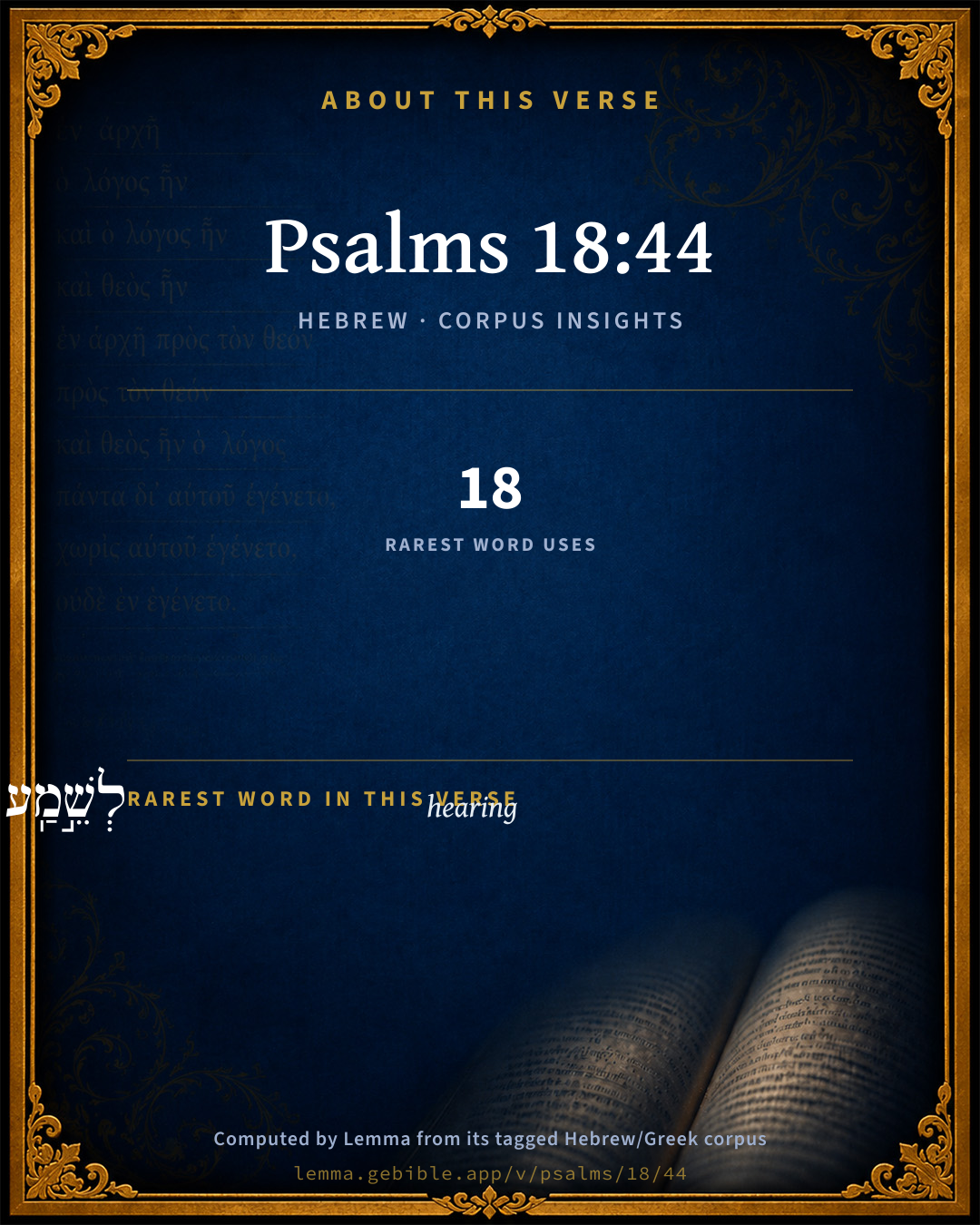
The rarest word here is לְשֵׁ֣מַֽע hearing H8088 — appearing just 18 times in the whole Hebrew Bible.

Shared distinctive vocabulary

לְשֵׁ֣מַֽע hearing H8088 occurs in 17 verses of the Hebrew Bible. Also found in:

Grammatical profile

  • 2 verbs
  • 4 nouns
  • 2 prepositions

Verb forms

  • יִשָּׁ֣מְעוּ Niphal · Imperfect
  • יְכַחֲשׁוּ Piel · Imperfect

Hebrew & Septuagint length

In English translation the verse runs 18 words from the Hebrew and 15 from the Septuagint (LXX English) — closely comparable.

A rough comparison of the two English renderings, which tokenize alike — not a word-level alignment.

Word counts can differ between the Hebrew and the Greek without any difference in meaning — e.g. the Hebrew direct-object marker אֵת has no separate Greek word, and Greek often adds the article ὁ.

Cross-references

9

Topical passages linked to Psalms 18:44 in the Treasury of Scripture Knowledge — connected by theme and wording, ordered by reader-vote popularity; previews shown in the World English Bible.

  • Psalms 66:3 Tell God, "How awesome are your deeds! Through the greatness of your power, your enemies submit themselves to you.
  • Psalms 81:15 The haters of Yahweh would cringe before him, And their punishment would last forever.
  • Deuteronomy 33:29 Happy are you, Israel: Who is like you, a people saved by Yahweh, The shield of your help, The sword of your excellency! Your enemies shall submit themselves to you; You shall tread on their high places.
  • 2 Samuel 22:44–46 You also have delivered me from the strivings of my people; You have kept me to be the head of the nations: A people whom I have not known shall serve me.
  • 2 Samuel 1:13 David said to the young man who told him, Whence are you? He answered, I am the son of a foreigner, an Amalekite.
  • Psalms 68:30 Rebuke the wild animal of the reeds, The multitude of the bulls, with the calves of the peoples. Being humbled, may it bring bars of silver. Scatter the nations that delight in war.
  • Isaiah 62:8 Yahweh has sworn by his right hand, and by the arm of his strength, Surely I will no more give your grain to be food for your enemies; and foreigners shall not drink your new wine, for which you have labored:
  • Ezekiel 44:7 in that you have brought in foreigners, uncircumcised in heart and uncircumcised in flesh, to be in my sanctuary, to profane it, even my house, when you offer my bread, the fat and the blood, and they have broken my covenant, [to add] to all your abominations.
  • Romans 10:16–17 But they didn't all listen to the glad news. For Isaiah says, "Lord, who has believed our report?"

Cross-references courtesy of OpenBible.info (CC BY 4.0).

Hebrew and Greek witnesses Masoretic Hebrew ↔ Greek Septuagint

The same verse in the two great witnesses to the Old Testament, shown verse-for-verse.

You’re reading Greek Psalm 17 (Hebrew Psalm 18). The Septuagint counts the superscription, so verse numbers can differ from the Hebrew — chapter-level alignment, not verse-by-verse. Numbering follows Rahlfs.

These are two independent witnesses, not word-aligned to each other, and the Septuagint is shown in lemma (dictionary) form.

Hebrew Psalms 18:44 Masoretic · Westminster Leningrad Codex

לְשֵׁ֣מַֽע אֹ֭זֶן יִשָּׁ֣מְעוּ לִ֑י בְּנֵֽי נֵ֝כָ֗ר יְכַחֲשׁוּ לִֽי

As soon as they hear of me they shall obey me. The foreigners shall submit themselves to me.

World English Bible · Public Domain

Greek LXX Greek Psalm 17:44 Septuagint · lemma form

ῥύομαι ἐγώ ἐκ ἀντιλογία λαός καταἵστημι ἐγώ εἰς κεφαλή ἔθνος λαός ὅς οὐ γιγνώσκω δουλεύω ἐγώ

at the hearing of the ear they obeyed me: the strange children lied to me.

LXX2012 (modern English Septuagint) · Public Domain

Hebrew: Westminster Leningrad Codex (CC BY 4.0). Greek: Septuagint (public domain); English from LXX2012 (modern English Septuagint) (Public Domain). How the Septuagint differs from the Hebrew →

Commentary

Notes on Psalms 18:44 from classic Christian and Jewish commentators (each source and its license shown beneath its notes). The classic Christian expositions comment on the surrounding passage and are grouped to its opening verse, so a note may address several verses; the Jewish commentaries on the Tanakh (Rashi and others) are per-verse, so they appear only where the commentator wrote on this verse.

Lemma curates 59 commentaries, every one of them public domain or Creative Commons licensed, each selected and text-cleaned for this edition rather than reprinted as found. About our sources →

Trapp's Complete Commentary

John Trapp

Psa 18:44 As soon as they hear of me, they shall obey me: the strangers shall submit themselves unto me.

Ver. 44. As soon as they hear of me] Heb. At the hearing of the ear; that is, by the preaching of the gospel they shall be brought to yield the obedience of faith.

The strangers shall submit] Heb. falsely, deny or dissemble with me; their submission is forced and feigned, they dare do no less; they receive my yoke, but their hearts I have not, Subiectio fucosa et hypocritica. Christ hath many such false hearted subjects, fawning and feigning profligate professors, carnal gospellers, &c.

John Trapp, A Commentary or Exposition upon All the Books of the Old and New Testament (1647–1656) — public domain. Text from a community e-Sword module.

J. A. Alexander on Psalms

Joseph Addison Alexander

45, 46. (Psa 18:44-45). At the hearing of the ear they will obey me, the sons of outland will lie to me; the sons of outland will decay, and tremble out of their enclosures. The meaning of the first words of this verse is clear from Job 42:5, where the hearing of the ear is put in opposition to the sight of the eye, report or hearsay to personal and ocular inspection. The verb translated will obey, whenever it occurs elsewhere, is a simple passive of the where verb to hear, and accordingly some render it here, they who have only been heard of by the hearing of the ear, i.e. those whom I have only heard of, but have never seen, will feign obedience. But as the corresponding form of the verb to lie is used by Moses actively in Deu 33:29, to which place there is an obvious allusion here. the first translation above given is entitled to the preference, and the sense is, that as soon as foreign nations hear of him they will lie to him, i.e. yield a feigned obedience through the influence of fear, in which sense another form of the same verb is used, not only in the passage of the Pentateuch just cited, but in Psa 66:3; Psa 81:16 (15).—The old word outland, which may still be traced in its derivative adjective outlandish, has been here employed to represent a Here Hebrew word for which we have no equivalent in modern English, and of his which means foreign parts indefinitely or collectively. The marginal version in the English Bible (sons of the stranger) is only an inexact approximation to the form of the original. The verb decay, which properly denotes the withering of plants (see above, Psa 1:3), is applied to the wasting of the human subject, and indeed of whole communities, in Exo 18:18. To tremble from, or out of, is a pregnant phrase, involving the idea of a verb of motion, and meaning to come forth with fear. The same form of expression may be found in Mic 7:17, and analogous ones in 1Sa 16:4, Hos 11:11.—Their enclosures, their retreats or refuges, perhaps with made special reference to military enclosures, such as fortresses and camps.

Joseph Addison Alexander, The Psalms Translated and Explained (1850) — public domain. Text from a community e-Sword module.

Geneva Bible (1599)

Geneva Bible translators

Or, lie: signifying a subjection constrained and not voluntary.

Geneva Bible (1599) marginal notes — public domain. Text via Bolls.life.

Jamieson, Fausset & Brown

Robert Jamieson, A. R. Fausset & David Brown

submit, &c.--(compare Margin)--that is, show a forced subjection.

Jamieson, Fausset & Brown — Commentary Critical and Explanatory on the Whole Bible (1871) — public domain (CC PDM 1.0). Text via the HelloAO Bible API.

Adam Clarke's Commentary

Verse 44. As soon as they hear of me] His victories were so rapid and splendid over powerful enemies, that they struck a general terror among the people, and several submitted without a contest.

Strangers shall submit themselves unto me.] Some translate this: "The children of the foreign woman have lied unto me." This has been understood two ways: My own people, who have sworn fealty to me, have broken their obligation, and followed my rebellious son. Or, The heathens, who have been brought under my yoke, have promised the most cordial obedience, and flattered me with their tongues, while their hearts felt enmity against me and my government. Nevertheless, even in this unwilling subjection I was secure, my police being so efficient, and my kingdom so strong.

Adam Clarke's Commentary on the Bible (1810–1826) — public domain. Text from a community e-Sword/MySword module.

John Calvin's Commentaries

44. At the simple fame of my name they shall obey me. This is of the same import with the last clause of the preceding verse. Although David, by his victories, had acquired such reputation and renown, that many laid down their arms and came voluntarily to surrender themselves to him; yet, as they also had been subdued through the dread of the power of his arms, which they saw their neighbors had experienced to their smart, it cannot be said, properly speaking, that at the simple fame of the name of David they submitted themselves to him. This applies more truly to the person of Christ, who, by means of his word, subdues the world to himself, and, at the simple hearing of his name, makes those obedient to him who before had been rebels against him. As David was intended to be a type of Christ, God subjected to his authority distant nations, and such as before had been unknown to Israel in so far as familiar intercourse was concerned. But that was only a prelude, and, as it were, preparatory to the dominion promised to Christ, the boundaries of which must be extended to the uttermost ends of the earth. In like manner, David had acquired to himself so great a name by arms and warlike prowess, that many of his enemies, subdued by fear, submitted themselves to him. And in this God exhibited a type of the conquest which Christ would make of the Gentiles, who, by the preaching of the Gospel alone, were subdued, and brought voluntarily to submit to his dominion; for the obedience of faith in which the dominion of Christ is founded “cometh by hearing,” (Romans 10:17.)

The children of strangers shall lie to me. Here there is described what commonly happens in new dominions acquired by conquest, namely, that those who have been vanquished pay homage with great reverence to their conqueror; but it is by a reigned and forced humility. They obey in a slavish manner, and not willingly or cheerfully. This is evidently the sense. Some interpreters, indeed, give a different explanation of the word lie, viewing David as meaning by it that his enemies had either been disappointed in their expectation, or that, in order to escape the punishment which they were afraid he might inflict upon them, they had lied in declaring that they had never devised any thing hostile against him; but it appears to me, that this does not sufficiently express what David intended. In my opinion, therefore, the words to lie are here to be understood generally as in other places, for to be humbled after a slavish manner. The Hebrew word כהש, cachash, here used, which signifies to lie, is sometimes to be understood metaphorically for to be humbled, to submit to, to take upon one’s self the yoke of subjection; The Syriac version reads, “They shall submit themselves to me;” meaning a forced, and so a feigned and hypocritical subjection.

“fellow-citizens with the saints, and of the household of God,” (Ephesians 2:19.)

John Calvin's Commentaries (1540-1563) — public domain. Text from the Calvin Translation Society English edition (1840s-50s) via the Christian Classics Ethereal Library (ccel.org). Calvin's coverage is partial (roughly two-thirds of the Bible); uncommented books and verses are honest gaps, never fabricated. The 19th-century editor's footnotes and remarks are omitted so the notes are faithfully Calvin's own voice.

Ellicott's Commentary for English Readers

(44) As soon as—i.e., at the bare mention of my victories. An actual instance is recorded (2Sa_8:9, seq.). For the expression, comp. Job_42:5.

The strangers shall.—See margin. More literally, come with flattery. In Samuel the two clauses are transposed and slightly varied.

A Bible Commentary for English Readers, edited by Charles John Ellicott (1878–1897) — public domain. Text from a community e-Sword module.

The Cambridge Bible for Schools and Colleges

gen. ed. J. J. S. Perowne

44. As soon as they heard of me they offered me obedience,

Strangers came cringing unto me.

At the mere report of David’s victories foreign nations offered their allegiance, as for example Toi of Hamath. See 2Sa_8:9 ff. The word rendered submit themselves, marg. yield feigned obedience, denotes originally the unwilling homage paid by the vanquished to their conqueror. Cp. Deu_33:29; Psa_66:3; Psa_81:15.

In 2 Sam. the order of the clauses is inverted.

The Cambridge Bible for Schools and Colleges (gen. ed. J. J. S. Perowne; Cambridge University Press, 1878–1918) — public domain. Text from a community e-Sword module.

John Gill's Exposition

The strangers shall fade away,.... Like the leaves of trees in autumn, when they fall and perish; to which hypocrites and nominal professors are compared, Jde 1:12;

and be afraid out of their close places; their towers and fortified places, or the rocks and mountains to which they betake themselves for shelter; but, as not thinking themselves safe enough, through fear and dread, come out of them; see Mic 7:17. Some Jewish writers (q) interpret the words, they shall halt or be lame; that is, because of the chains put upon their feet: and so they are expressive of the conquest made of them. The word in the Arabic language signifies to "come out"; and may be so rendered here, and "come out": in Sa2 22:46; it is, "they shall gird themselves", or "come out girt".

(q) R. Donesh apud Jarchi & Abendana not. in Miclol Yophi in loc. to Apollinar. Metaphras.

John Gill's Exposition of the Whole Bible (1746–1763) — public domain (CC PDM 1.0). Text via the HelloAO Bible API.

Albert Barnes' Notes on the Bible

As soon as they hear of me, they shall obey me - Margin, as in Hebrew, At the hearing of the ear. That is, their submission will be prompt and immediate. The fame of my victories will be such as to render resistance hopeless; my fame, as at the head of a mighty empire, will be such as to lead them to desire my friendship and protection.

The strangers - Margin, as in Hebrew, The sons of the stranger. The word refers to foreigners, to those of other nations. His name and deeds would inspire such respect, or create such a dread of his power, that they would be glad to seek his friendship, and would readily submit to his dominion.

Shall submit themselves unto me - Margin, yield feigned obedience. The Hebrew word used here - כחשׁ kâchash - means properly to lie, to speak lies; then, to deceive, or disappoint; then, to feign, to flatter, to play the hypocrite. It is manifestly used in this sense here, as referring to those who, awed by the terror of his name and power, would come and profess subjection to him as a conqueror. Yet the use of the word here implies that he was aware that, in many cases, this would be only a feigned submission, or that the homage would be hypocritical; homage inspired by terror, not by love. Undoubtedly, much of the professed subjection of conquered nations is of this kind, and it would be well if all conquerors understood this as David did. He accepted, indeed, the acquiescence and the submission, but he understood the cause; and this knowledge would only tend to make his throne more secure, as it would save him from putting confidence or trust where there was no certainty that it would be well placed.

Toward David as a sovereign there was much real loyalty, but there was also much professed allegiance that was false and hollow; allegiance which would endure only while his power lasted, and which would only wait for an opportunity to throw off the yoke. In respect to God, also, there are not a few who “feignedly submit” to him, or who yield feigned obedience. They, too, are awed by his power. They know that he is able to destroy. They see the tokens of his greatness and majesty, and they come and profess submission to him - a submission founded on terror, not on love; a submission which would cease at once could they be assured of safety if they should renounce their allegiance to him. And as David was not ignorant of the fact that not a little of the professed submission to him was false and feigned - so, in a much higher sense - in a much more accurate manner - God is aware of the fact that many who profess to be subject to him are subject in profession only; that if they could do it with safety, they would throw off the very appearance of loyalty, and carry out in reality what exists in their hearts. It must have been sad for David to reflect how greatly the number of his professed subjects might have been diminished, if none had been retained but those who truly loved his reign, and respected him as a sovereign; it is sad to reflect how greatly the number of the professed friends of God would be diminished, if all those should withdraw who have yielded only reigned obedience to him! Yet the Church would be the better and the stronger for it.

Albert Barnes' Notes on the Bible (1834–1885) — public domain. Text from a community e-Sword/MySword module.

Matthew Poole's English Annotations

As soon as they hear of me; either,

1. At the fame of my name and victorious arms. Or,

2. At the first tidings of my coming towards them. Or rather,

3. As soon as they understand my will and pleasure, they shall instantly comply with it.

Submit themselves unto me, Heb. shall lie unto me, i.e. shall submit themselves to me not willingly and cheerfullly, as they will pretend, but only out of fear, and by constraint; by which it appears that this is spoken with reference to David, and not (as some would have it) to Christ, because Christ’s people are a willing people, Psa 110:3, and those whom he conquers do freely obey him.

Matthew Poole's English Annotations on the Holy Bible (1683–1685) — public domain. Text from a community e-Sword/MySword module.

Whedon's Commentary on the Bible

Daniel D. Whedon

44. Strangers shall submit themselves—The verb kahash, to submit, in Piel takes the signification of feign, flatter, and denotes an insincere or feigned submission, such as a captive gives to a conqueror. But this indicates the amazing power of David’s name. No sooner will the people dwelling beyond the subjugated kingdoms hear the news of his conquests, than, however unwillingly, they will hasten to acknowledge his superiority and conciliate his favour. Such was the effect upon the nations of the exodus miracles. Exo_15:14-16. And thus did the fame of the miracles of Christ and his apostles everywhere precede them, and prepare the way for further conquests.

Daniel D. Whedon (gen. ed.), Commentary on the Old and New Testaments (1874–1909) — public domain. Text from a community e-Sword module.

The Pulpit Commentary

As soon as they hear of me, they shall obey me; literally, at the hearing of the ear. But the meaning is that given in the Authorized Version. The words aptly describe the conversion of the Gentiles. (see Act_10:34-48 Act_13:48 Act_17:11 Act_18:8, etc.) The strangers shall submit themselves unto me; literally, the sons of the stranger shall pay court to me not necessarily a false court, as Hengstenberg and others suppose, but, as Dr. Kay explains, an "obsequious and servile homage."

The Pulpit Commentary (1880–1919), ed. H.D.M. Spence-Jones & Joseph S. Exell — public domain. Text from a community e-Sword module.

John Wesley's Explanatory Notes

Hear - As soon as they understand my will and pleasure, they shall instantly comply with it.

John Wesley, Explanatory Notes Upon the Whole Bible (1754–1765) — public domain. Text via the GEBible commentary corpus.

Rashi

Rabbi Shlomo Yitzchaki (Rashi)

You allowed me to escape from the contenders of the people so that I should not be punished according to Jewish law, for perverting justice or for subjugating an Israelite more than is permitted.

You shall make me the head over nations for whom there is no punishment.

Rashi on the Tanakh — English translations: “The Judaica Press complete Tanach with Rashi, translated by A. J. Rosenberg” (CC BY 4.0); “Pentateuch with Rashi's commentary by M. Rosenbaum and A.M. Silbermann, 1929-1934” (public domain); “The Metsudah Tanach series, Lakewood, N.J” (CC BY 4.0); and “The Book of Joshua, Metsudah Publications, 1997” (CC BY 4.0). Text via Sefaria.

Lesson kit

Teaching starters — assembled from the data on this page, not authored interpretation. Every prompt links to the verse data it draws on. Edit before teaching.

Psalms, in the Wisdom, opens this verse with 8 words (6 distinct Hebrew lemmas). Its most distinctive word is shêmaʻ (“hearing”). A historical commentator’s framing appears above. Read the whole chapter for the surrounding context.

Discussion questions

  1. How does “hearing” (shêmaʻ) shape what this verse is saying?
  2. How does Genesis 29:13, which shares the word «hearing», read alongside this verse?
  3. These translations render this verse differently; the difference is in the English rendering, not the original. What questions does that raise?
  4. «יִשָּׁ֣מְעוּ» is a Niphal Imperfect verb. How does that grammatical form shape the action described?
  5. Compare how Trapp's Complete Commentary and J. A. Alexander on Psalms read this verse. Where do they agree or differ?

Things to notice

Reading settings

Reading text

Shown beneath each verse's original-language words.

Old Testament
Old Testament edition

Read the OT as the Masoretic Hebrew (MT) or the Greek Septuagint (LXX).

English shown for the Greek Septuagint (in the Hebrew ↔ Greek comparison).

Comparing translations? Open the Compare panel on any verse page to stack up to four side by side.