
Jeremiah 26:11

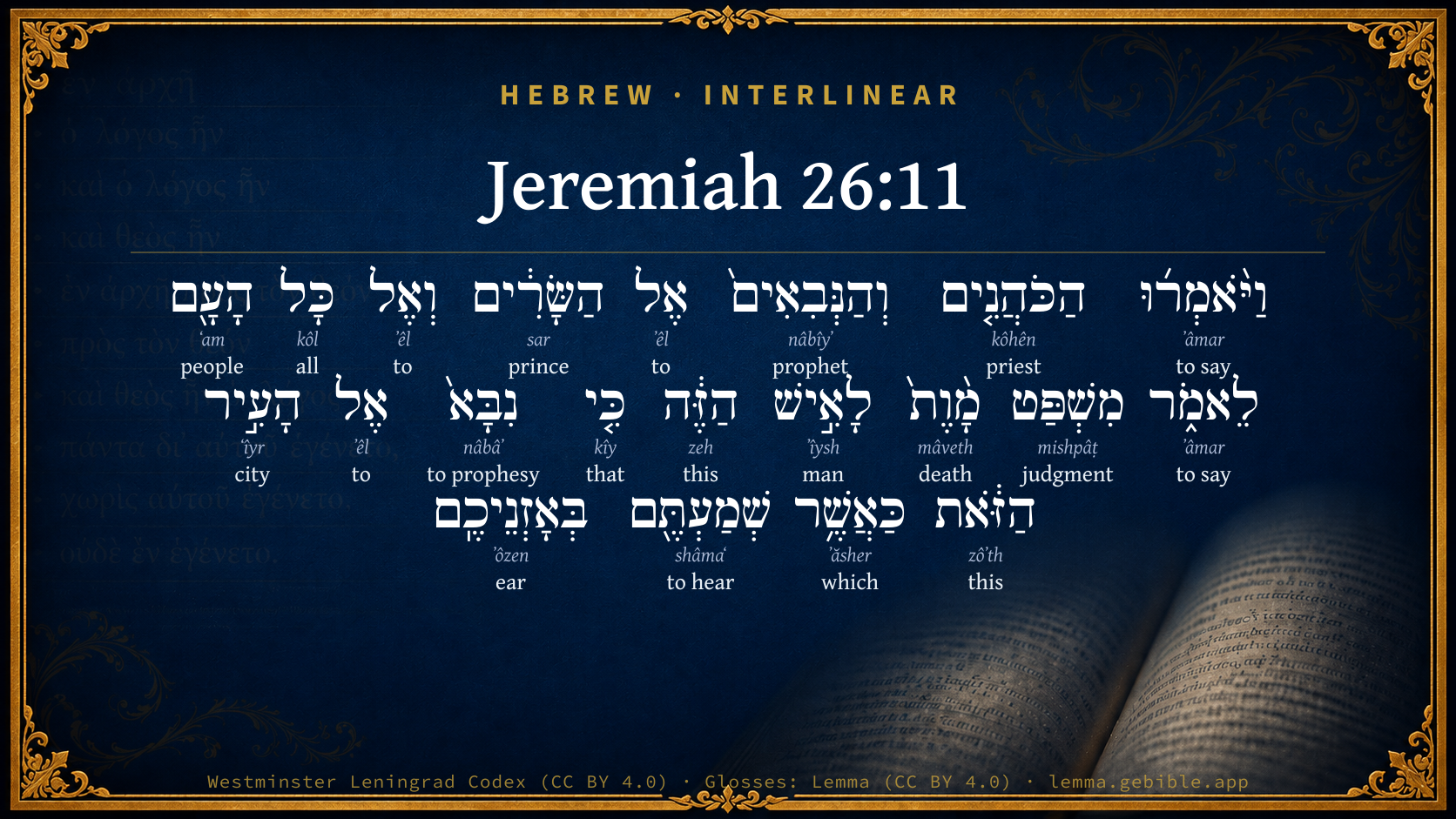
Hebrew (Westminster Leningrad Codex) Jeremiah 26:11 appears in the Hebrew Old Testament. The text above is from the Westminster Leningrad Codex. Each word links to its Strong’s number, a concise gloss, and parsing drawn from the Open Scriptures Hebrew Bible morphology. Click any word for its full Brown-Driver-Briggs (BDB) entry.
Download image
Cite this verse

Jeremiah 26:11 (World English Bible). Public Domain. Lemma interlinear Bible study tool, https://lemma.gebible.app/v/jeremiah/26/11.

Show BibTeX & RIS
BibTeX
RIS
English Translation
Then spoke the priests and the prophets to the princes and to all the people, saying, This man is worthy of death; for he has prophesied against this city, as you have heard with your ears.
World English Bible · Public Domain
Download a study sheet

One document with this verse’s original text, its word-by-word gloss line, the meaning frame, cross-references with their text, attributed commentary, and full source and license credits — printable, and it pastes into notes with its structure intact.

This verse Autodidact and up

Study sheet (.html) Plain text (.txt)

A passage Seminary Student

Up to 50 verses in one chapter. A passage sheet keeps up to 6 commentary sources and 12 cross-references per verse, in the order this page ranks them, and says so on the sheet whenever that leaves anything out. Ask for a single verse and you get the Autodidact verse sheet above.

Everything on this page stays free to read, with no account — the sheet is a download of what is already on screen, not access to it.

Want to remove ads? Support Godless Engineer
Compare translations 3

The same verse in 3 English versions, stacked beneath the original-language interlinear above. Click any original word for its lexicon entry.

Each is an independent rendering of the whole verse — the interlinear is not word-aligned to these translations.

Highlighted words mark where these versions differ — a whole-verse word diff, not a word-by-word alignment.

  • World English Bible Public Domain
    Then spoke the priests and the prophets to the princes and to all the people, saying, This man is worthy of death; for he has prophesied against this city, as you have heard with your ears.
  • King James Version Public Domain
    Then spake the priests and the prophets unto the princes and to all the people, saying, This man is worthy to die; for he hath prophesied against this city, as ye have heard with your ears.
  • unfoldingWord Literal Text CC BY-SA 4.0
    And the priests and the prophets said to the officials and to all the people, saying, “A judgment of death to this man, because he has prophesied against this city, just as you have heard with your ears.”

unfoldingWord Literal Text — © unfoldingWord, licensed CC BY-SA 4.0. Word-aligned USFM3 via Door43 (git.door43.org/unfoldingWord/en_ult).

Versions to compare (up to 4)

3 of 4 selected

Show all 18 translations

Every available English version of this verse, each an independent rendering of the whole verse.

  • World English Bible Public Domain
    Then spoke the priests and the prophets to the princes and to all the people, saying, This man is worthy of death; for he has prophesied against this city, as you have heard with your ears.
  • Berean Standard Bible Public Domain
    Then the priests and prophets said to the officials and all the people, “This man is worthy of death, for he has prophesied against this city, as you have heard with your own ears!”
  • Majority Standard Bible Public Domain
    Then the priests and prophets said to the officials and all the people, “This man is worthy of death, for he has prophesied against this city, as you have heard with your own ears!”
  • King James Version Public Domain
    Then spake the priests and the prophets unto the princes and to all the people, saying, This man is worthy to die; for he hath prophesied against this city, as ye have heard with your ears.
  • American Standard Version (1901) Public Domain
    Then spake the priests and the prophets unto the princes and to all the people, saying, This man is worthy of death; for he hath prophesied against this city, as ye have heard with your ears.
  • Revised Version (1885) Public Domain
    Then spake the priests and the prophets unto the princes and to all the people, saying, This man is worthy of death; for he hath prophesied against this city, as ye have heard with your ears.
  • Geneva Bible (1599) Public Domain
    Then spake the Priestes, and the prophets vnto the princes, and to all the people, saying, This man is worthie to die: for he hath prophecied against this citie, as ye haue heard with your eares.
  • Douay-Rheims (1899) Public Domain
    And the priests and the prophets spoke to the princes, and to all the people, saying: The judgement of death is for this man: because he hath prophesied against this city, as you have heard with your ears.
  • Young's Literal Translation Public Domain
    And the priests and the prophets speak unto the heads, and unto all the people, saying, `Judgment of death `is' for this man, for he hath prophesied against this city, as ye have heard with your ears.'
  • Literal Standard Version CC BY-SA 4.0
    And the priests and the prophets speak to the heads, and to all the people, saying, “Judgment of death [is] for this man, for he has prophesied against this city, as you have heard with your ears.”
  • Unlocked Literal Bible CC BY-SA 4.0
    The priests and the prophets spoke to the officials and to all the people. They said, “It is right for this man to die, for he prophesied against this city, just as you heard with your own ears!”
  • unfoldingWord Literal Text CC BY-SA 4.0
    And the priests and the prophets said to the officials and to all the people, saying, “A judgment of death to this man, because he has prophesied against this city, just as you have heard with your ears.”
  • Darby Bible Public Domain
    And the priests and the prophets spoke unto the princes and to all the people, saying, This man is worthy to die, for he hath prophesied against this city, as ye have heard with your ears.
  • World Messianic Bible Public Domain
    Then the priests and the prophets spoke to the princes and to all the people, saying, “This man is worthy of death, for he has prophesied against this city, as you have heard with your ears.”
  • Webster's Bible Public Domain
    Then the priests and the prophets spoke to the princes and to all the people, saying, This man is worthy to die; for he hath prophesied against this city, as ye have heard with your ears.
  • Free Bible Version CC BY-SA 4.0
    The priests and prophets complained to the leaders and all the people, “This man deserves the death penalty because he has committed treason by prophesying against this city. You heard it yourselves!”
  • Bible in Basic English Public Domain
    Then the priests and the prophets said to the rulers and to all the people, The right fate for this man is death; for he has said words against this town in your hearing.
  • JPS Tanakh (1917) Public Domain
    Then spoke the priests and the prophets unto the princes and to all the people, saying: 'This man is worthy of death; for he hath prophesied against this city, as ye have heard with your ears.'

Literal Standard Version (2020), Covenant Press — licensed CC BY-SA 4.0. Text via the HelloAO Bible API (eBible.org). Unlocked Literal Bible (unfoldingWord) — licensed CC BY-SA 4.0. Text via the HelloAO Bible API (eBible.org). unfoldingWord Literal Text — © unfoldingWord, licensed CC BY-SA 4.0. Word-aligned USFM3 via Door43 (git.door43.org/unfoldingWord/en_ult). Free Bible Version, Dr. Jonathan Gallagher — licensed CC BY-SA 4.0. Text via the HelloAO Bible API (eBible.org).

Word by word

More ways to search: Search by grammar → Find every occurrence → Compare this word →

Practice this passage: Drill this verse → Learn its vocabulary →

נִבָּא֙
nâbâʼ
H5012
“to prophesy”
Verb, Niphal, Perfect, 3rd Person, Masculine, Singular
Part of Speech
Verb
Stem
Niphal
Form
Perfect
Person
3rd Person
Gender
Masculine
Number
Singular
Full BDB Definition

Origin: a primitive root

TWOT: 1277

to prophesy - (Niphal) - to prophesy - under influence of divine spirit - of false prophets - (Hithpael) - to prophesy - under influence of divine spirit - of false prophets
  1. וַיֹּ֨אמְר֜וּ ʼâmar H559 “and · to say” Conjunction + Verb, Qal, Sequential Imperfect, 3rd Person, Masculine, Plural
  2. הַכֹּהֲנִ֤ים kôhên H3548 “the · priests” Particle, Definite Article + Noun, Common, Masculine, Plural, Absolute
  3. וְהַנְּבִאִים֙ nâbîyʼ H5030 “and · the · prophets” Conjunction + Particle, Definite Article + Noun, Common, Masculine, Plural, Absolute
  4. אֶל ʼêl H413 “to” Preposition
  5. הַשָּׂרִ֔ים sar H8269 “the · princes” Particle, Definite Article + Noun, Common, Masculine, Plural, Absolute
  6. וְאֶל ʼêl H413 “and · to” Conjunction + Preposition
  7. כָּל kôl H3605 “all of” Noun, Common, Masculine, Singular, Construct
  8. הָעָ֖ם ʻam H5971 “the · people” Particle, Definite Article + Noun, Common, Masculine, Singular, Absolute
  9. לֵאמֹ֑ר ʼâmar H559 “to say” Preposition + Verb, Qal, Infinitive Construct
  10. מִשְׁפַּט mishpâṭ H4941 “judgment of” Noun, Common, Masculine, Singular, Construct
  11. מָ֨וֶת֙ mâveth H4194 “death” Noun, Common, Masculine, Singular, Absolute
  12. לָאִ֣ישׁ ʼîysh H376 “to/for the · man” Preposition, Determined + Noun, Common, Masculine, Singular, Absolute
  13. הַזֶּ֔ה zeh H2088 “the · this” Particle, Definite Article + Pronoun, Demonstrative, Masculine, Singular
  14. כִּ֤י kîy H3588 “that” Conjunction
  15. אֶל ʼêl H413 “to” Preposition
  16. הָעִ֣יר ʻîyr H5892 “the · city” Particle, Definite Article + Noun, Common, Feminine, Singular, Absolute
  17. הַזֹּ֔את zôʼth H2063 “the · this” Particle, Definite Article + Pronoun, Demonstrative, Feminine, Singular
  18. כַּאֲשֶׁ֥ר ʼăsher H834 “like/as · which” Preposition + Particle, Relative
  19. שְׁמַעְתֶּ֖ם shâmaʻ H8085 “to hear” Verb, Qal, Perfect, 2nd Person, Masculine, Plural
  20. בְּאָזְנֵיכֶֽם ʼôzen H241 “in/at · ears · your” Preposition + Noun, Common, Feminine, Dual, Construct + Suffix, Personal, 2nd Person, Masculine, Plural

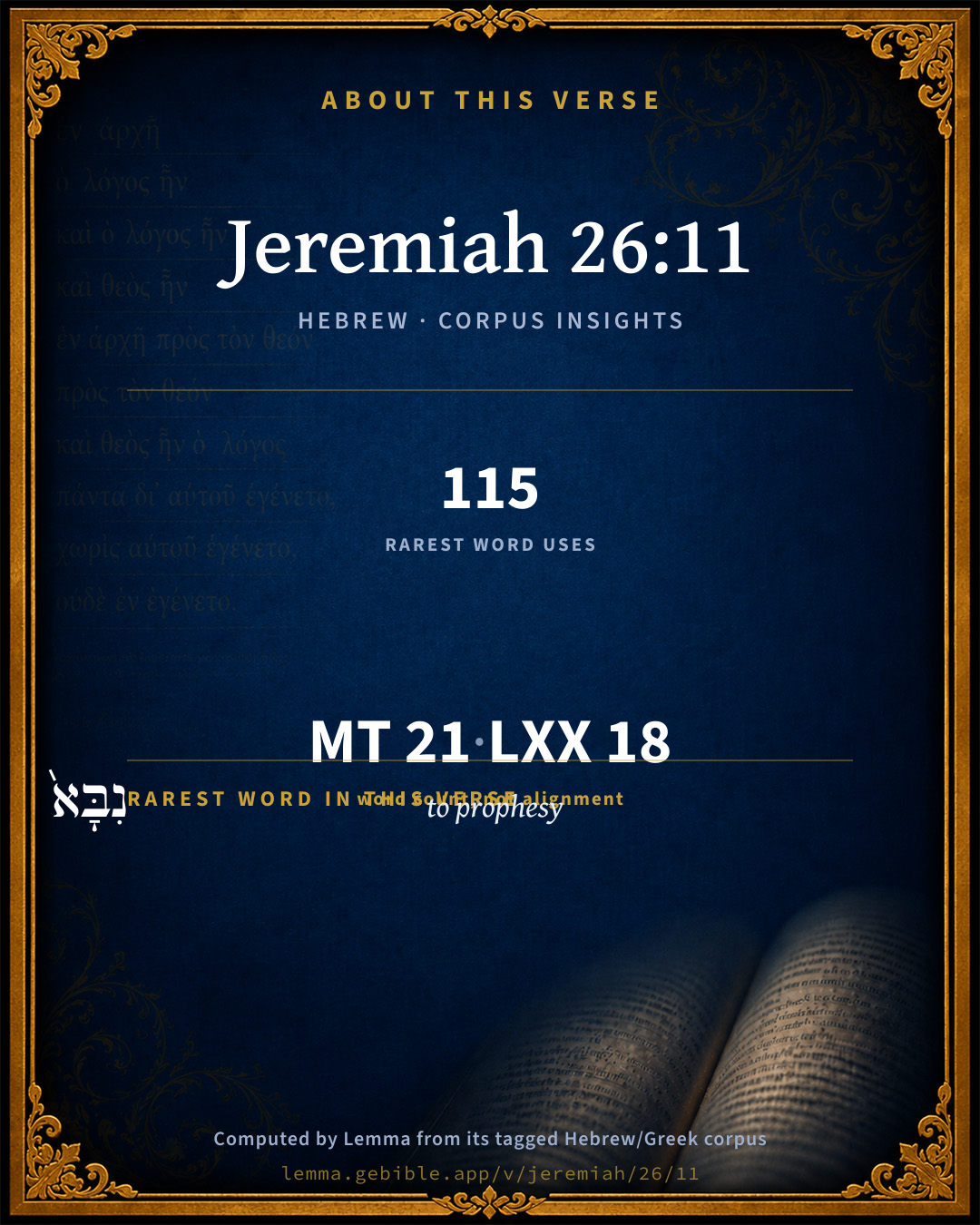
About this verse

These counts appear in no published source. They are computed here, from the morphology-tagged text and Lemma’s own curated glosses. What Lemma adds →

21
words
18
distinct lemmas
Prophets
section

Grammatical profile

  • 4 verbs
  • 10 nouns
  • 2 pronouns
  • 3 prepositions
  • 1 conjunction
  • 1 particle

Verb forms

  • וַיֹּ֨אמְר֜וּ Qal · Sequential Imperfect
  • לֵאמֹ֑ר Qal · Infinitive Construct
  • נִבָּא֙ Niphal · Perfect
  • שְׁמַעְתֶּ֖ם Qal · Perfect

Repetition

Words recur within this verse — often emphatic in Hebrew:

  • וַיֹּ֨אמְר֜וּ to say H559 ×2
  • אֶל to H413 ×3

Hebrew & Septuagint length

In the original languages it is 21 Hebrew tokens and 18 Greek tokens — but the two are counted differently (Hebrew bundles its prefixes and suffixes into one token; the Greek is in lemma form), so that isn’t a like-for-like length.

Cross-references

11

Topical passages linked to Jeremiah 26:11 in the Treasury of Scripture Knowledge — connected by theme and wording, ordered by reader-vote popularity; previews shown in the World English Bible.

  • Jeremiah 38:4 Then the princes said to the king, Let this man, we pray you, be put to death; because he weakens the hands of the men of war who remain in this city, and the hands of all the people, in speaking such words to them: for this man doesn't seek the welfare of this people, but the hurt.
  • Deuteronomy 18:20 But the prophet, who shall speak a word presumptuously in my name, which I have not commanded him to speak, or who shall speak in the name of other gods, that same prophet shall die.
  • Matthew 26:66 What do you think?" They answered, "He is worthy of death!"
  • Acts 6:11–14 Then they secretly induced men to say, "We have heard him speak blasphemous words against Moses and God."
  • Jeremiah 18:23 Yet, Yahweh, you know all their counsel against me to kill me; don't forgive their iniquity, neither blot out their sin from your sight; but let them be overthrown before you; deal you with them in the time of your anger.
  • Luke 23:1–5 The whole company of them rose up and brought him before Pilate.
  • John 18:30 They answered him, "If this man weren't an evildoer, we wouldn't have delivered him up to you."
  • John 19:7 The Jews answered him, "We have a law, and by our law he ought to die, because he made himself the Son of God."
  • Acts 22:22 They listened to him until he said that; then they lifted up their voice, and said, "Rid the earth of this fellow, for he isn't fit to live!"
  • Acts 24:4–9 But, that I don't delay you, I entreat you to bear with us and hear a few words.
  • Acts 25:2–13 Then the high priest and the principal men of the Jews informed him against Paul, and they begged him,

Cross-references courtesy of OpenBible.info (CC BY 4.0).

Hebrew and Greek witnesses Masoretic Hebrew ↔ Greek Septuagint

The same verse in the two great witnesses to the Old Testament, shown verse-for-verse.

These are two independent witnesses, not word-aligned to each other, and the Septuagint is shown in lemma (dictionary) form.

Hebrew Jeremiah 26:11 Masoretic · Westminster Leningrad Codex

וַיֹּ֨אמְר֜וּ הַכֹּהֲנִ֤ים וְהַנְּבִאִים֙ אֶל הַשָּׂרִ֔ים וְאֶל כָּל הָעָ֖ם לֵאמֹ֑ר מִשְׁפַּט מָ֨וֶת֙ לָאִ֣ישׁ הַזֶּ֔ה כִּ֤י נִבָּא֙ אֶל הָעִ֣יר הַזֹּ֔את כַּאֲשֶׁ֥ר שְׁמַעְתֶּ֖ם בְּאָזְנֵיכֶֽם

Then spoke the priests and the prophets to the princes and to all the people, saying, This man is worthy of death; for he has prophesied against this city, as you have heard with your ears.

World English Bible · Public Domain

Greek LXX Structure differs

In the Septuagint, Jeremiah is about an eighth shorter than the Hebrew and arranges its material differently — the Oracles Against the Nations (Hebrew chapters 46–51) appear in the middle of the Greek book, after 25:13. Because the chapter and verse boundaries do not line up, a verse-for-verse comparison with the Hebrew is not shown.

A verse-for-verse comparison isn’t shown here because the chapters and verses don’t line up. Switch to the LXX edition with the MT / LXX toggle above to read the Greek directly.

Hebrew: Westminster Leningrad Codex (CC BY 4.0). Greek: Septuagint (public domain); English from a public-domain English Septuagint. How the Septuagint differs from the Hebrew →

Targum (Aramaic paraphrase)

1

The Targum is the ancient Jewish Aramaic paraphrase of the Hebrew Scriptures — an interpretive translation, not the Hebrew text itself. Onkelos (literal) and Pseudo-Jonathan (expansive) render the Torah, and Jonathan the Prophets. Coverage is partial: where no permissively-licensed English translation exists for a verse, only the Aramaic is shown. This is verse-level text, not a word-by-word alignment to the Hebrew.

  1. Targum Jonathan Prophets (Joshua–Malachi)
    וַאֲמָרוּ כַּהֲנַיָא וְסַפְרַיָא לְרַבְרְבַיָא וּלְכָל עַמָא לְמֵימַר חוֹבַת דִין דִקְטוֹל לְגַבְרָא הָדֵין אֲרֵי אִתְנַבֵּי עַל קַרְתָּא הָדָא כְּמָה דִשְׁמַעְתּוּן בְּאוּדְנֵיכוֹן:

    (no public-domain English translation for this verse)

    Targum Jonathan — Aramaic: “Mikraot Gedolot” (public domain). English: “Sefaria Community Translation” (CC0 1.0 (public-domain dedication)); “London "Chaldee Paraphrase," 1871” (public domain). Text via Sefaria.

Commentary

Notes on Jeremiah 26:11 from classic Christian and Jewish commentators (each source and its license shown beneath its notes). The classic Christian expositions comment on the surrounding passage and are grouped to its opening verse, so a note may address several verses; the Jewish commentaries on the Tanakh (Rashi and others) are per-verse, so they appear only where the commentator wrote on this verse.

Lemma curates 59 commentaries, every one of them public domain or Creative Commons licensed, each selected and text-cleaned for this edition rather than reprinted as found. About our sources →

Trapp's Complete Commentary

John Trapp

Jer 26:11 Then spake the priests and the prophets unto the princes and to all the people, saying, This man [is] worthy to die; for he hath prophesied against this city, as ye have heard with your ears.

Ver. 11. Then spake the priests and the prophets.] Against a priest and a prophet; but he had earnestly inveighed against them, {Jer 23:1-2; Jer 23:14-15; Jer 23:33-34} and hence the hatred. As Erasmus told the Duke of Saxony that Luther had been too busy with the Pope’s triple crown and with the priests’ fat paunches, and was therefore so generally set against.

Saying, This man is worthy to die.] Sic Papicolae nostri saeculi. These are the very words of Popish persecutors.

For he hath prophesied against this city.] This holy, and therefore, it must be believed, inviolable city. Novum crimen, C. Caesar, &c. These sinners against their own souls, traitors also to the state, will neither see their evil condition, nor hear of it from others, as having gall in their ears, as they say of some kinds of creatures.

John Trapp, A Commentary or Exposition upon All the Books of the Old and New Testament (1647–1656) — public domain. Text from a community e-Sword module.

Geneva Bible (1599)

Geneva Bible translators

Hebrew, judgments of death belongeth to this man.

Geneva Bible (1599) marginal notes — public domain. Text via Bolls.life.

John Calvin's Commentaries

We hence conclude, that the people in assenting to the sentence of the priests and prophets, had done nothing according to their own judgment, but that all of every rank through a violent feeling condemned Jeremiah. And as the priests and prophets directed also their discourse to the people, it appears clear, that they were guided by them, so that they thoughtlessly and inconsiderately gave their consent; for it often happens in a mob that the people exclaim, “Be it so, be it so; amen, amen.” Jeremiah has indeed said, that he was condemned by the whole people; but it must be observed, that the people are like the sea, which of itself is calm and tranquil; but as soon as any wind arises, there is a great commotion, and waves dash one against another; so also it is with the people, who without being excited are quiet and peaceable; but a sedition is easily raised, when any one stirs up men who are thoughtless and changeable, and who, to retain the same simile, are fluid like water. This, then, is what Jeremiah now intimates.

But there is another thing to be noticed, — that the common people suffer themselves to be drawn in all directions; but they may also be easily restored, as it has been said, to a right mind. “When they see,” says Virgil, “a man remarkable for piety and good works, they become silent and attend with listening ears.” He there describes (Aeneid, 1) a popular commotion, which he compares to a tempest; and he rightly speaks of a tempest; but he added this simile according to common usage. The same thing is now set before us by the Prophet; the priests and prophets, who thought that they alone could boast of their power and speak with authority, in a manner constrained the people apparently to consent. The king’s counsellors being now present, the people became as it were mute; the priests perceived this, and we shall see by the issue that what the same poet mentions took place, “By his words he rules their hearts and softens their breasts.” For it became easy for the king’s counsellors even by a word to calm this foolish violence of the people. We shall indeed soon see, that they unhesitantly said, “There is no judgment of death against this man.” It is hence evident how easily ignorant men may be made inconsistent with themselves; but this is to be ascribed to their inconstancy; and noticed also ought to be what I have said, that there was no real consent, because there was no judgment exercised. The authority of the priests overpowered them; and then they servilely confessed what they saw pleased their princes, like an ass, who nods with his ears.

Now, when the subject is duly considered, it appears, that the priests and the prophets alone spoke both to the princes and to the whole people, that Jeremiah was guilty of death, because he had prophesied against the city. We have said that they relied on those promises, which they absurdly applied for the purpose of confirming their own impiety, even that God had chosen that city that he might be there worshipped. It was a false principle, and whence proceeded their error? not from mere ignorance, but rather from presumption, for hypocrites are never deceived, except when they determine not to obey God, and as far as they can to reject his judgments. When, therefore, they are carried away by a perverse and wicked impulse, they ever find out some plausible pretext; but it is nothing but a disguise, as we clearly see from this narrative. It follows, —

John Calvin's Commentaries (1540-1563) — public domain. Text from the Calvin Translation Society English edition (1840s-50s) via the Christian Classics Ethereal Library (ccel.org). Calvin's coverage is partial (roughly two-thirds of the Bible); uncommented books and verses are honest gaps, never fabricated. The 19th-century editor's footnotes and remarks are omitted so the notes are faithfully Calvin's own voice.

Ellicott's Commentary for English Readers

(11) This man is worthy to die.—Literally, A judgment of death for this man. The phrase seems to have been in current forensic use. (See Deu_19:6; Deu_21:22.) Among the accusers we may think of Pashur, the son of Immer (Jer_20:1). Personal rancour mingles with the class feeling which animates the whole body of the priesthood. They appeal to what, in later language, would be known as the secular arm, to be the instrument of their vindictiveness against the heretic and blasphemer.

A Bible Commentary for English Readers, edited by Charles John Ellicott (1878–1897) — public domain. Text from a community e-Sword module.

The Cambridge Bible for Schools and Colleges

gen. ed. J. J. S. Perowne

11. hath prophesied against this city] Cp. Act_6:12 ff.

The Cambridge Bible for Schools and Colleges (gen. ed. J. J. S. Perowne; Cambridge University Press, 1878–1918) — public domain. Text from a community e-Sword module.

John Gill's Exposition

Then spake the priests and the prophets unto the princes, and to all the people,.... The priests and the prophets they were the accusers; the princes were the court before whom the cause was brought; and the people were the hearers of it; though it does not seem as if they were a sort of jury, or had any vote in determining; though they sometimes had in instigating a court, and the judges of it, to take on the side of the question they were for:

saying, this man is worthy to die; or, "the judgment of death is to this man" (f); he is guilty of a capital crime, and judgment ought to be given against him, and he condemned to die:

for he hath prophesied against this city; the city of Jerusalem; saying that it should be a curse to other nations; or, as they interpreted it, that it should be utterly destroyed, and become desolate, and none should inhabit it:

as ye have heard with your ears; this must be directed to the people only; for the princes did not hear Jeremiah's prophecy.

(f) "judieium mortis est viro huic", V. L. Vatablus, Pagninus, Montanus; "reatus mortis", &c. Schmidt.

John Gill's Exposition of the Whole Bible (1746–1763) — public domain (CC PDM 1.0). Text via the HelloAO Bible API.

Albert Barnes' Notes on the Bible

This man is worthy to die - literally, A sentence of death is to this man, i. e., is his desert.

Albert Barnes' Notes on the Bible (1834–1885) — public domain. Text from a community e-Sword/MySword module.

Matthew Poole's English Annotations

In the corrupt state of all kingdoms and cities, the ecclesiastical officers always were the greatest enemies to the faithful ministers of God, as we shall find in the whole story both of the Old and New Testament. They speak to the members of the great court, who are called princes, and also to the people who were in the court, charging Jeremiah with sedition, by prophesying falsely, which was a capital crime. It was the charge against Stephen, Act 6:13, that he spake blasphemous words against the holy place. To prove this they appeal to those of the people that had heard him.

Matthew Poole's English Annotations on the Holy Bible (1683–1685) — public domain. Text from a community e-Sword/MySword module.

The Pulpit Commentary

This man is worthy to die; literally, a sentence of death (belongs) to this man.

HOMILIES BY D. YOUNG Ver. 11. Jeremiah reckoned worthy of death.

I WHO THEY WERE THAT PRONOUNCED THIS JUDGMENT. There is already a statement in ver. 8 that priests, prophets, and people had laid hold on Jeremiah with a threatening of death; but we must allow something for the feelings produced on the first reception of an exasperating and humiliating message. The case is worse when the priests and prophets, having had some time for consideration, however short, press upon the princes and people a demand for the death of Jeremiah. The lead the priests and prophets here take goes a long way in showing who were mostly responsible for the deplorable state of things in the land. If things were to be put right, these two classes of men must be conspicuous in repentance. Those who were so ready to sentence Jeremiah to death were really most of all deserving of death themselves. He had simply spoken words against the city and the temple, words which were not his own; those who condemned him had so lived that their life had been a sedulous undermining of all that constituted the prosperity and glory of their country.

II WHAT IT WAS THAT PROVOKED THE JUDGMENT. Jeremiah had prophesied against the city. Observe, not simply that he had spoken blasphemous and contemptuous words against the city; but that he had prophesied against it. Thus did the priests and prophets show how little they understood the nature of true prophecy. They did not understand that when the Lord sends forth a man to speak, he puts a word in his mouth which shall commend itself to all who love truth and certainty. To the mind of these priests and prophets everything began with this postulate, that nothing must be said against Jerusalem and the temple. And to them it was no sort of answer that the sins of Jerusalem deserved and demanded that something should be said against it. The good name of Jerusalem, however lacking in any sort of correspondence with reality, had become a sort of point of honor. Thus we see how the pride of men goes before their destruction. A conventional sense of honor leads them into paths thickly strewn with stumbling-blocks. These men had become so stuffed with spurious patriotism that they could not bear to have Jerusalem spoken against. Hence they are logically compelled to imply that Jeremiah is a false prophet, and that God has not spoken at all. They were as those who shut their eyes, and then say there is nothing to be seen.

III THE DOOM THEY INVOKED. The man who speaks against Jerusalem is reckoned worthy of death. We must not, of course, measure this judgment by our notions of what may require the death penalty. To speak against a parent was by the Law of Moses to incur the death penalty. As the Apostle James uses many forcible expressions to illustrate, great is the power of the tongue; and a bad man may do mischief with his tongue worthy of the severest punishment men can inflict. If Jeremiah had gone about among the people stirring them up to rebellion and national discord, there would have been nothing very astonishing in an attempt to put him to death. But he gave no exhortation to the people save what each one could carry into effect without the slightest injury to any one; nay, rather the obedience of each would be to the real and abiding advantage of all. He spoke not of anything he himself intended to bring about, but of what was going to happen altogether irrespective of him. His death, supposing he were slain, would make no difference; nay, it would only help to proclaim his message louder and more abidingly. Those who feel themselves attacked by the truth, strike out recklessly with the first instrument they can get hold of; but though they may seem thus to destroy God"s agencies, it is found in the end that they are efficiently promoting his work. They that were scattered abroad by the great persecution which arose at the time of Stephen s death, "went everywhere preaching the Word. Y.

The Pulpit Commentary (1880–1919), ed. H.D.M. Spence-Jones & Joseph S. Exell — public domain. Text from a community e-Sword module.

John Wesley's Explanatory Notes

The priests - "In the corrupt state of all kingdoms, the ecclesiastical officers always were the greatest enemies to the faithful ministers of God." They speak to the members of the court who are called princes, and to the people who were in the court.

John Wesley, Explanatory Notes Upon the Whole Bible (1754–1765) — public domain. Text via the GEBible commentary corpus.

Scofield Reference Notes

C. I. Scofield

this man

(See Scofield "Jer 38:4").

The Scofield Reference Bible (1917 edition), notes by C. I. Scofield — public domain. Text from a community e-Sword module.

Lesson kit

Teaching starters — assembled from the data on this page, not authored interpretation. Every prompt links to the verse data it draws on. Edit before teaching.

Jeremiah, in the Prophets, opens this verse with 21 words (18 distinct Hebrew lemmas). Its most distinctive word is nâbâʼ (“to prophesy”). A historical commentator’s framing appears above. Read the whole chapter for the surrounding context.

Discussion questions

  1. What does “to prophesy” (nâbâʼ) contribute to the verse as a whole?
  2. How does Jeremiah 38:4, which shares this passage’s theme, read alongside this verse?
  3. What does the repetition of “to say” (2× in this one verse) do in this verse?
  4. These translations render this verse differently. What is at stake in choosing one wording over another?
  5. «וַיֹּ֨אמְר֜וּ» is a Qal Sequential Imperfect verb. How does that grammatical form shape the action described?
  6. Compare how Trapp's Complete Commentary and Geneva Bible (1599) read this verse. Where do they agree or differ?

Things to notice

Reading settings

Reading text

Shown beneath each verse's original-language words.

Old Testament
Old Testament edition

Read the OT as the Masoretic Hebrew (MT) or the Greek Septuagint (LXX).

English shown for the Greek Septuagint (in the Hebrew ↔ Greek comparison).

Comparing translations? Open the Compare panel on any verse page to stack up to four side by side.