
Isaiah 43:8

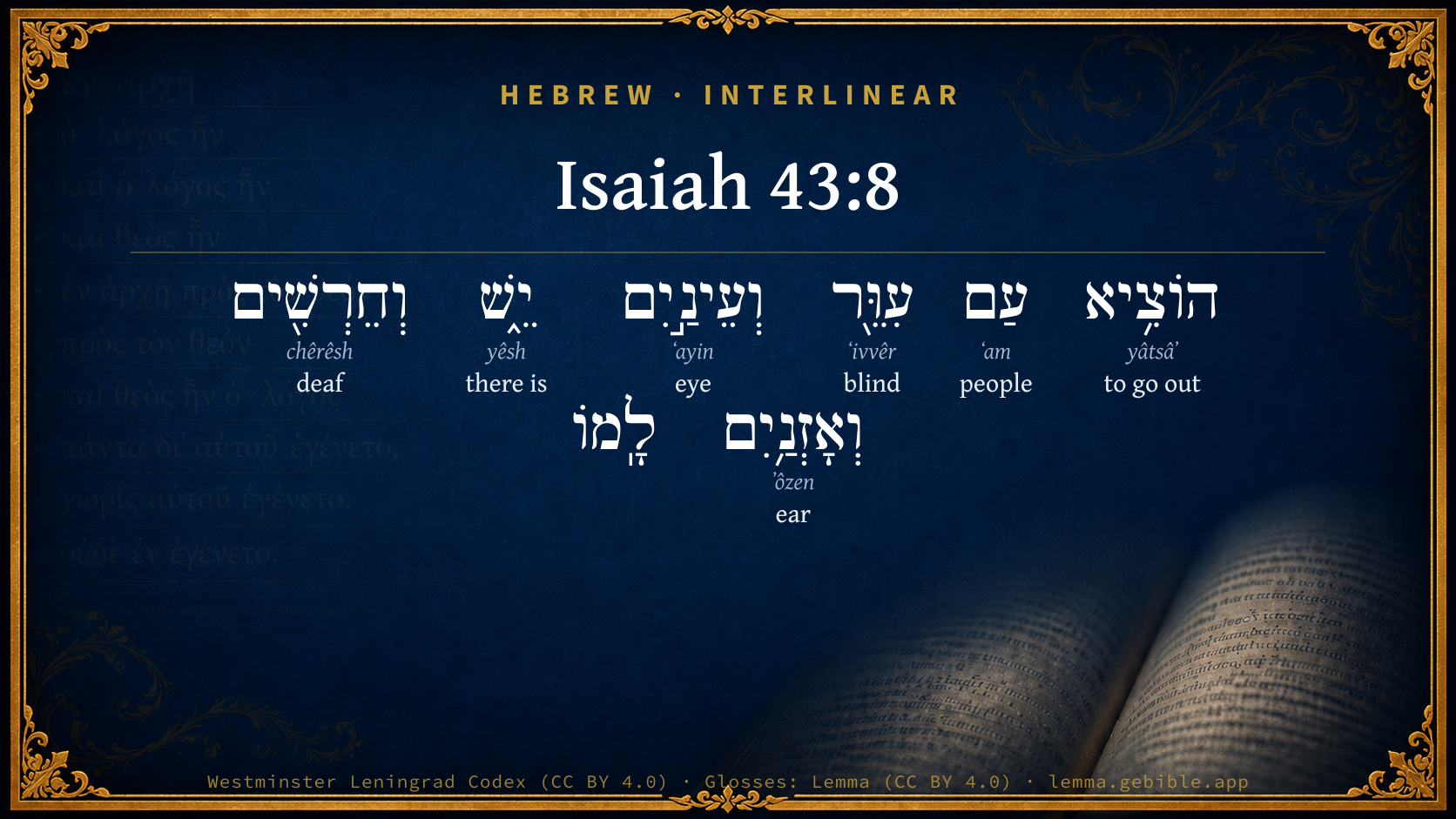
Hebrew (Westminster Leningrad Codex) Isaiah 43:8 appears in the Hebrew Old Testament. The text above is from the Westminster Leningrad Codex. Each word links to its Strong’s number, a concise gloss, and parsing drawn from the Open Scriptures Hebrew Bible morphology. Click any word for its full Brown-Driver-Briggs (BDB) entry.
Download image
Cite this verse

Isaiah 43:8 (World English Bible). Public Domain. Lemma interlinear Bible study tool, https://lemma.gebible.app/v/isaiah/43/8.

Show BibTeX & RIS
BibTeX
RIS
English Translation
Bring forth the blind people who have eyes, and the deaf who have ears.
World English Bible · Public Domain
Download a study sheet

One document with this verse’s original text, its word-by-word gloss line, the meaning frame, cross-references with their text, attributed commentary, and full source and license credits — printable, and it pastes into notes with its structure intact.

This verse Autodidact and up

Study sheet (.html) Plain text (.txt)

A passage Seminary Student

Up to 50 verses in one chapter. A passage sheet keeps up to 6 commentary sources and 12 cross-references per verse, in the order this page ranks them, and says so on the sheet whenever that leaves anything out. Ask for a single verse and you get the Autodidact verse sheet above.

Everything on this page stays free to read, with no account — the sheet is a download of what is already on screen, not access to it.

Want to remove ads? Support Godless Engineer
Compare translations 3

The same verse in 3 English versions, stacked beneath the original-language interlinear above. Click any original word for its lexicon entry.

Each is an independent rendering of the whole verse — the interlinear is not word-aligned to these translations.

Highlighted words mark where these versions differ — a whole-verse word diff, not a word-by-word alignment.

  • World English Bible Public Domain
    Bring forth the blind people who have eyes, and the deaf who have ears.
  • King James Version Public Domain
    Bring forth the blind people that have eyes, and the deaf that have ears.
  • unfoldingWord Literal Text CC BY-SA 4.0
    Bring forth a people blind, yet there are eyes, and the deaf, yet ears to them.

unfoldingWord Literal Text — © unfoldingWord, licensed CC BY-SA 4.0. Word-aligned USFM3 via Door43 (git.door43.org/unfoldingWord/en_ult).

Versions to compare (up to 4)

3 of 4 selected

Show all 18 translations

Every available English version of this verse, each an independent rendering of the whole verse.

  • World English Bible Public Domain
    Bring forth the blind people who have eyes, and the deaf who have ears.
  • Berean Standard Bible Public Domain
    Bring out a people who have eyes but are blind, and who have ears but are deaf.
  • Majority Standard Bible Public Domain
    Bring out a people who have eyes but are blind, and who have ears but are deaf.
  • King James Version Public Domain
    Bring forth the blind people that have eyes, and the deaf that have ears.
  • American Standard Version (1901) Public Domain
    Bring forth the blind people that have eyes, and the deaf that have ears.
  • Revised Version (1885) Public Domain
    Bring forth the blind people that have eyes, and the deaf that have ears.
  • Geneva Bible (1599) Public Domain
    I will bring foorth the blinde people, and they shall haue eyes, and the deafe, and they shall haue eares.
  • Douay-Rheims (1899) Public Domain
    Bring forth the people that are blind, and have eyes: that are deaf, and have ears.
  • Young's Literal Translation Public Domain
    He brought out a blind people who have eyes, And deaf ones who have ears.
  • Literal Standard Version CC BY-SA 4.0
    He brought out a blind people who have eyes, || And deaf ones who have ears.
  • Unlocked Literal Bible CC BY-SA 4.0
    Bring out the people who are blind, even though they have eyes, and the deaf, even though they have ears.
  • unfoldingWord Literal Text CC BY-SA 4.0
    Bring forth a people blind, yet there are eyes, and the deaf, yet ears to them.
  • Darby Bible Public Domain
    Bring forth the blind people that have eyes, and the deaf that have ears.
  • World Messianic Bible Public Domain
    Bring out the blind people who have eyes, and the deaf who have ears.
  • Webster's Bible Public Domain
    Bring forth the blind people that have eyes, and the deaf that have ears.
  • Free Bible Version CC BY-SA 4.0
    Bring back those who have eyes but are blind, those who have ears but are deaf.
  • Bible in Basic English Public Domain
    Send out the blind people who have eyes, and those who have ears, but they are shut.
  • JPS Tanakh (1917) Public Domain
    The blind people that have eyes shall be brought forth, and the deaf that have ears.

Literal Standard Version (2020), Covenant Press — licensed CC BY-SA 4.0. Text via the HelloAO Bible API (eBible.org). Unlocked Literal Bible (unfoldingWord) — licensed CC BY-SA 4.0. Text via the HelloAO Bible API (eBible.org). unfoldingWord Literal Text — © unfoldingWord, licensed CC BY-SA 4.0. Word-aligned USFM3 via Door43 (git.door43.org/unfoldingWord/en_ult). Free Bible Version, Dr. Jonathan Gallagher — licensed CC BY-SA 4.0. Text via the HelloAO Bible API (eBible.org).

Word by word

More ways to search: Search by grammar → Find every occurrence → Compare this word →

Practice this passage: Drill this verse → Learn its vocabulary →

About this verse

These counts appear in no published source. They are computed here, from the morphology-tagged text and Lemma’s own curated glosses. What Lemma adds →

8
words
7
distinct lemmas
Prophets
section

Notable vocabulary

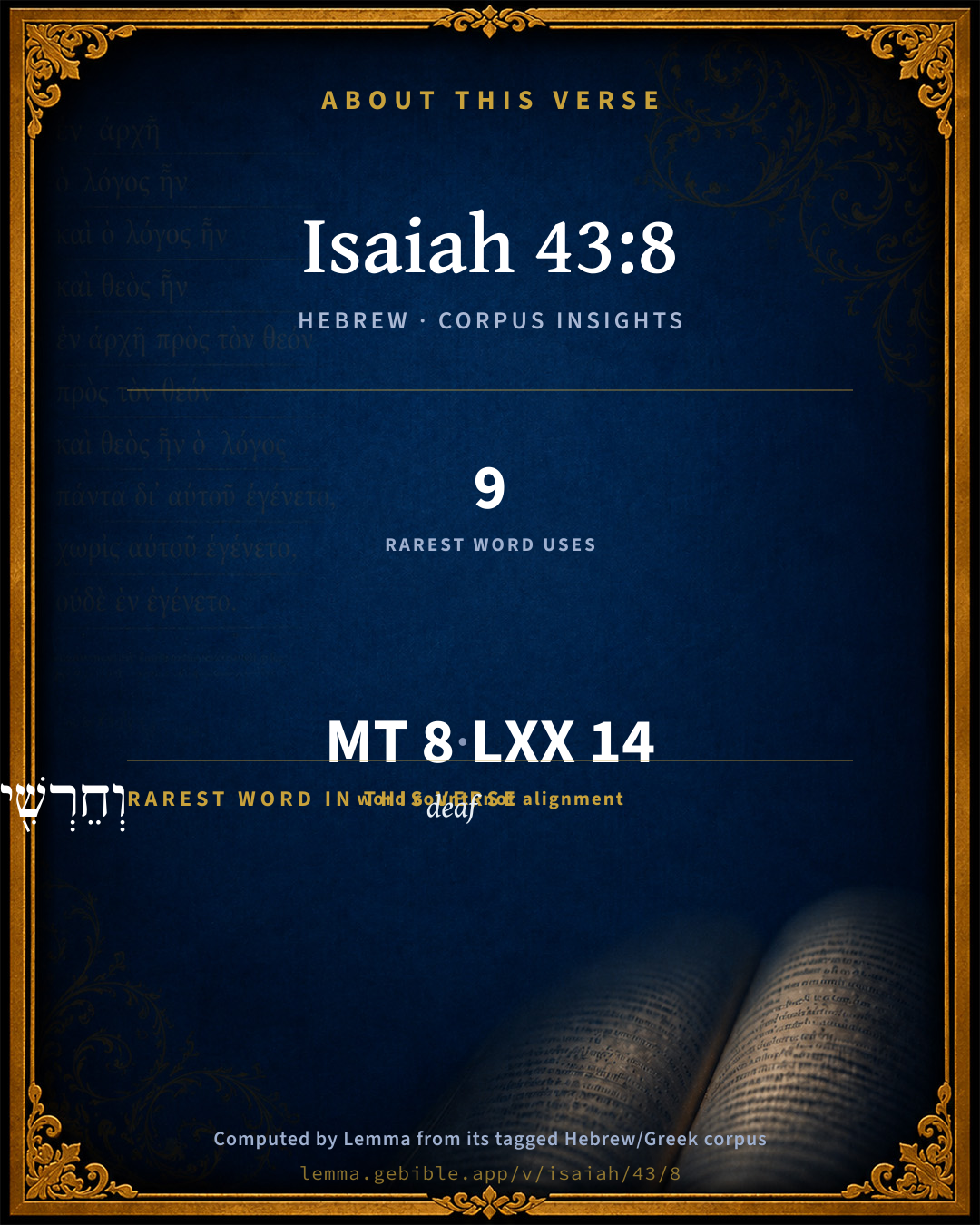
The rarest word here is וְחֵרְשִׁ֖ים deaf H2795 — appearing just 9 times in the whole Hebrew Bible.

Shared distinctive vocabulary

וְחֵרְשִׁ֖ים deaf H2795 occurs in 9 verses of the Hebrew Bible. Also found in:

Grammatical profile

  • 1 verb
  • 3 nouns
  • 2 adjectives
  • 1 preposition
  • 1 particle

Verb forms

  • הוֹצִ֥יא Hiphil · Imperative

Hebrew & Septuagint length

In English translation the verse runs 14 words from the Hebrew and 21 from the Septuagint (LXX English) — the Septuagint runs noticeably longer here. See the side-by-side →

A rough comparison of the two English renderings, which tokenize alike — not a word-level alignment.

Word counts can differ between the Hebrew and the Greek without any difference in meaning — e.g. the Hebrew direct-object marker אֵת has no separate Greek word, and Greek often adds the article ὁ.

In the original languages it is 8 Hebrew tokens and 14 Greek tokens — but the two are counted differently (Hebrew bundles its prefixes and suffixes into one token; the Greek is in lemma form), so that isn’t a like-for-like length.

Cross-references

7

Topical passages linked to Isaiah 43:8 in the Treasury of Scripture Knowledge — connected by theme and wording, ordered by reader-vote popularity; previews shown in the World English Bible.

  • Isaiah 6:9 He said, "Go, and tell this people, 'You hear indeed, But don't understand; And you see indeed, But don't perceive.'
  • Ezekiel 12:2 Son of man, you dwell in the midst of the rebellious house, who have eyes to see, and don't see, who have ears to hear, and don't hear; for they are a rebellious house.
  • Deuteronomy 29:2–4 Moses called to all Israel, and said to them, You have seen all that Yahweh did before your eyes in the land of Egypt to Pharaoh, and to all his servants, and to all his land;
  • Isaiah 42:18–20 Hear, you deaf; and look, you blind, that you may see.
  • 2 Corinthians 4:4–6 in whom the god of this world has blinded the minds of the unbelieving, that the light of the Gospel of the glory of Christ, who is the image of God, should not dawn on them.
  • Jeremiah 5:21 Hear now this, foolish people, and without understanding; who have eyes, and don't see; who have ears, and don't hear:
  • Isaiah 44:18–20 They don't know, neither do they consider: for he has shut their eyes, that they can't see; and their hearts, that they can't understand.

Cross-references courtesy of OpenBible.info (CC BY 4.0).

Hebrew and Greek witnesses Masoretic Hebrew ↔ Greek Septuagint

The same verse in the two great witnesses to the Old Testament, shown verse-for-verse.

Here the Septuagint runs noticeably longer than the Hebrew — LXX2012 (modern English Septuagint) 21 words vs World English Bible 14. A rough length comparison of the two English translations, not a word-level alignment — read both below.

These are two independent witnesses, not word-aligned to each other, and the Septuagint is shown in lemma (dictionary) form.

Hebrew Isaiah 43:8 Masoretic · Westminster Leningrad Codex

הוֹצִ֥יא עַם עִוֵּ֖ר וְעֵינַ֣יִם יֵ֑שׁ וְחֵרְשִׁ֖ים וְאָזְנַ֥יִם לָֽמוֹ

Bring forth the blind people who have eyes, and the deaf who have ears.

World English Bible · Public Domain

Greek LXX Isaiah 43:8 Septuagint · lemma form

καί ἐκἄγω λαός τυφλός καί ὀφθαλμός εἰμί ὡσαύτως τυφλός καί κωφός ὁ οὖς ἔχω

and I have brought forth the blind people; for their eyes are alike blind, and they that have ears are deaf.

LXX2012 (modern English Septuagint) · Public Domain

Hebrew: Westminster Leningrad Codex (CC BY 4.0). Greek: Septuagint (public domain); English from LXX2012 (modern English Septuagint) (Public Domain). How the Septuagint differs from the Hebrew →

Targum (Aramaic paraphrase)

1

The Targum is the ancient Jewish Aramaic paraphrase of the Hebrew Scriptures — an interpretive translation, not the Hebrew text itself. Onkelos (literal) and Pseudo-Jonathan (expansive) render the Torah, and Jonathan the Prophets. Coverage is partial: where no permissively-licensed English translation exists for a verse, only the Aramaic is shown. This is verse-level text, not a word-by-word alignment to the Hebrew.

  1. Targum Jonathan Prophets (Joshua–Malachi)
    דְאַפֵּיק עַמָא מִמִצְרַיִם דְאִינוּן כְּסָמִי וְעַיְנִין לְהוֹן וּכְחַרְשִׁין וְאוּדְנִין לְהוֹן:

    When I brought forth my people from Egypt, they were like the blind, although they had eyes; and like the deaf, although they had ears.

    Targum Jonathan — Aramaic: “Mikraot Gedolot” (public domain). English: “Sefaria Community Translation” (CC0 1.0 (public-domain dedication)); “London "Chaldee Paraphrase," 1871” (public domain). Text via Sefaria.

Commentary

Notes on Isaiah 43:8 from classic Christian and Jewish commentators (each source and its license shown beneath its notes). The classic Christian expositions comment on the surrounding passage and are grouped to its opening verse, so a note may address several verses; the Jewish commentaries on the Tanakh (Rashi and others) are per-verse, so they appear only where the commentator wrote on this verse.

Lemma curates 59 commentaries, every one of them public domain or Creative Commons licensed, each selected and text-cleaned for this edition rather than reprinted as found. About our sources →

Matthew Henry's Commentary

God here challenges the worshippers of idols to produce such proofs of the divinity of their false gods as even this very instance (to go no further) of the redemption of the Jews out of Babylon furnished the people of Israel with, to prove that their God is the true and living God, and he only.

I. The patrons of idolatry are here called to appear, and say what they have to say in defence of their idols, Isa 43:8, Isa 43:9. Their gods have eyes and see not, ears and hear not, and those that make them and trust in them are like unto them; so David had said (Psa 115:8), to which the prophet seems here to refer when he calls idolaters blind people that have eyes, and deaf people that have ears. They have the shape, capacities, and faculties, of men; but they are, in effect, destitute of reason and common sense, or they would never worship gods of their own making. "Let all the nations therefore be gathered together, let them help one another, and with a combined force plead the cause of their dunghill gods; and, if they have nothing to say in their own justification, let them hear what the God of Israel has to say for their conviction and confutation."

II. God's witnesses are subpoenaed, or summoned to appear, and give in evidence for him (Isa 43:10): "You, O Israelites! all you that are called by my name, you are all my witnesses, and so is my servant whom I have chosen." It was Christ himself that was so described (Isa 42:1), My servant and my elect. Observe,

1. All the prophets that testified to Christ, and Christ himself, the great prophet, are here appealed to as God's witnesses. (1.) God's people are witnesses for him, and can attest, upon their own knowledge and experience, concerning the power of his grace, the sweetness of his comforts, the tenderness of his providence, and the truth of his promise. They will be forward to witness for him that he is gracious and that no word of his has fallen to the ground. (2.) His prophets are in a particular manner witnesses for him, with whom his secret is, and who know more of him than others do. But the Messiah especially is given to be a witness for him to the people; having lain in his bosom from eternity, he has declared him. Now,

2. Let us see what the point is which these witnesses are called to prove (Isa 43:12): You are my witnesses, saith the Lord, that I am God. Note, Those who do themselves acknowledge that the Lord is God should be ready to testify what they know of him to others, that they also may be brought to the acknowledgement of it. I believed, therefore have I spoken. Particularly, "Since you cannot but know, and believe, and understand, you must be ready to bear record, (1.) That I am he, the only true God, that I am a being self-existent and self-sufficient; I am he whom you are to fear, and worship, and trust in. Nay (Isa 43:13), before the day was (before the first day of time, before the creation of the light, and, consequently, from eternity) I am he." The idols were but of yesterday, new gods that came newly up (Deu 32:17); but the God of Israel was from everlasting. (2.) That there was no God formed before me, nor shall be after me. The idols were gods formed (dii facti - made gods, or rather fictitii - fictitious); by nature they were no gods, Gal 4:8. But God has a being from eternity, yea, and a religion in this world before there were either idols or idolaters (truth is more ancient than error); and he will have a being to eternity, and will be worshipped and glorified when idols are famished and abolished and idolatry shall be no more. True religion will keep its ground, and survive all opposition and competition. Great is the truth, and will prevail. (3.) That I, even I, am the Lord, the great Jehovah, who is, and was, and is to come; and besides me there is no Saviour, Isa 43:11. See what it is that the great God glories in, not so much that he is the only ruler as that he is the only Saviour; for he delights to do good: he is the Saviour of all men, Ti1 4:10.

3. Let us see what the proofs are which are produced for the confirmation of this point. It appears,

(1.) That the Lord is God, by two proofs: [1.] He has an infinite and infallible knowledge, as is evident from the predictions of his word (Isa 43:12): "I have declared and I have shown that which has without fail come to pass; nay, I never declared nor showed any thing but it has been accomplished. I showed when there was no strange god among you, that is, when you pretended not to consult any oracles but mine, nor to have any prophets but mine." It is said, when they came out of Egypt, that the Lord alone did lead him, and there was no strange god with him. [2.] He has an infinite and irresistible power, as is evident from the performances of his providence. He pleads not only, I have shown, but, I have saved, not only foretold what none else could foresee, but done what none else could do; for (Isa 43:13), "None can deliver out of my hand those whom I will punish; not only no man can, but none of all the gods of the heathen can protect." It is therefore a fearful thing to fall into the hands of the living God, because there is no getting out of them again. "I will work what I have designed, both in mercy and judgment, and who shall either oppose or retard it?"

(2.) That the gods of the heathen, who are rivals with him, are not only inferior to him, but no gods at all, which is proved (Isa 43:9) by a challenge: Who among them can declare this that I now declare? Who can foretel things to come? Nay, which of them can show us former things? Isa 41:22. They cannot so much as inspire an historian, much less a prophet. They are challenged to join issue upon this: Let them bring forth their witnesses, to prove their omniscience and omnipotence. And, [1.] If they do prove them, they shall be justified, the idols in demanding homage and the idolaters in paying it. [2.] If they do not prove them, let them say, It is truth; let them own the true God, and receive the truth concerning him, that he is God alone. The cause of God is not afraid to stand a fair trial; but it may reasonably be expected that those who cannot justify themselves in their irreligion should submit to the power of the truth and true religion.

Matthew Henry's Commentary on the Whole Bible (1708–1710) — public domain (CC PDM 1.0). Text via the HelloAO Bible API.

Trapp's Complete Commentary

John Trapp

Isa 43:8 Bring forth the blind people that have eyes, and the deaf that have ears.

Ver. 8. Bring forth the blind people.] Such as were blind and ignorant, but now are enlightened.

And the deaf.] Such as were cross and rebellious, but now are tractable and obsequious. {Isa 42:7; Isa 42:16}

John Trapp, A Commentary or Exposition upon All the Books of the Old and New Testament (1647–1656) — public domain. Text from a community e-Sword module.

Albert Barnes' Notes on the Bible

Bring forth the blind people - Many have understood this of the Jews. So Vitringa, Rosenmuller, Grotius, and others understand it. But Lowth, more correctly, regards it as referring to the Gentiles. It is designed as an argument to show the superiority of God over all idols, and to demonstrate that he was able to deliver his people from captivity and exile. He appeals, therefore Isa 43:9, to his own people in proof of his divinity and power. None of the pagan Isa 43:8 had been able to predict future events, none of the pagan gods, therefore, could save; but Yahweh, who had so often foretold events that were fulfilled, was able to deliver, and of that fact his own people had had abundant evidence.

That have eyes - They had natural faculties to see and know God (compare Rom 1:20), but they had not improved them, and they had, therefore, run into the sin and folly of idolatry. The phrase ‘bring forth,’ implies a solemn appeal made by God to them to enter into an argument on the subject (compare the note at Isa 41:1).

Albert Barnes' Notes on the Bible (1834–1885) — public domain. Text from a community e-Sword/MySword module.

Joseph Benson's Commentary

Isa 43:8-10. Bring forth the blind people, &c. — O ye idolatrous Gentiles, bring forth your false gods, which have eyes but see not, and ears but hear not. Let the people be assembled — To plead the cause of their idols with me. Who among them can declare this — This wonderful work of mine in bringing my people out of captivity. And show us former things — Such things as shall happen long before the return from the captivity, which yet your blind idols cannot foresee. See on Isa 41:22. Let them bring forth their witnesses — Who can testify the truth of any such predictions of theirs, that they may be owned for true gods; or if they can produce no evidence of any such thing, let them confess that what I say is truth, that I am the only true God. Ye are my witnesses — They can produce no witnesses for themselves; but you, my people, are able to witness for me, that I have given you many plain demonstrations of my certain foreknowledge of future events. And my servant whom I have chosen — Either Isaiah and other prophets, the singular word being put collectively, or, the Messiah, as not only Christians, but the Chaldee paraphrast understands it; who was thus described, (Isa 42:1,) and who is the most eminent witness in this cause; and that on two accounts; 1st, As he was the chief subject of prophecy, and the various particulars foretold concerning him came exactly to pass; and, 2d, As many future things were predicted by him, of which we have many examples in the New Testament. That I am he — He whom I have affirmed myself to be, namely, the true God. Before me there was no God formed — The gods of the heathen neither had a being before me, nor shall continue after me. Wherein more is understood than is expressed; that whereas Jehovah is God from everlasting to everlasting, these false pretenders to deity were but of yesterday, and should shortly be abolished. And withal he calls them formed gods, by way of contempt, and to show the ridiculousness of their pretensions to divinity, who are formed by the hands of men.

Joseph Benson's Commentary on the Old and New Testaments (1811–1818) — public domain. Text from a community e-Sword module.

Keil & Delitzsch

C. F. Keil & F. Delitzsch

We come now to the third turn in the second half of this prophecy. It is linked on to the commencement of the first turn ("Hear, ye deaf, and look, ye blind, that ye may see"), the summons being now addressed to some one to bring forth the Israel, which has eyes and ears without seeing or hearing; whilst, on the other hand, the nations are all to come together, and this time not for the purpose of convincing them, but of convincing Israel. "Bring out a blind people, and it has eyes; and deaf people, and yet furnished with ears! All ye heathen, gather yourselves together, and let peoples assemble! Who among you can proclaim such a thing? And let them cause former things to be heard, appoint their witnesses, and be justified. Let these hear, and say, True! Ye are my witnesses, saith Jehovah, and my servant whom I have chosen; that ye may know and believe me, and see that it is I: before me was no God formed, and there will be none after me." "Bring out" does not refer here to bringing out of captivity, as in Eze 20:34, Eze 20:41; Eze 34:13, since the names by which Israel is called are hardly applicable to this, but rather to bringing to the place appointed for judicial proceedings. The verb is in the imperative. The heathen are also to gather together en masse; נקבּצוּ is also an imperative here, as in Joe 3:11 = הקּבצוּ (cf., נלווּ, Jer 50:5; Ewald, 226, c). In Isa 43:9 we have the commencement of the evidence adduced by Jehovah in support of His own divine right: Who among the gods of the nations can proclaim this? i.e., anything like my present announcement of the restoration of Israel? To prove that they can, let them cause "former things" to be heard, i.e., any former events which they had foretold, and which had really taken place; and let them appoint witnesses of such earlier prophecies, and so prove themselves to be gods, that is to say, by the fact that these witnesses have publicly heard their declaration and confirm the truth thereof. The subject to וגו וישׁמעוּ (they may hear, etc.) is the witnesses, not as now informing themselves for the first time, but as making a public declaration. The explanation, "that men may hear," changes the subject without any necessity. But whereas the gods are dumb and lifeless, and therefore cannot call any witnesses for themselves, and not one of all the assembled multitude can come forward as their legitimate witness, or as one able to vindicate them, Jehovah can call His people as witnesses, since they have had proofs in abundance that He possesses infallible knowledge of the future. It is generally assumed that "and my servant" introduces a second subject: "Ye, and (especially) my servant whom I have chosen." In this case, "my servant" would denote that portion of the nation which was so, not merely like the mass of the people according to its divine calling, but also by its own fidelity to that calling; that is to say, the kernel of the nation, which was in the midst of the mass, but had not the manners of the mass. At the same time, the sentence which follows is much more favourable to the unity of the subject; and why should not "my servant" be a second predicate? The expression "ye" points to the people, who were capable of seeing and hearing, and yet both blind and deaf, and who had been brought out to the forum, according to Isa 43:8. Ye, says Jehovah, are my witnesses, and ye are my servant whom I have chosen; I can appeal to what I have enabled you to experience and to perceive, and to the relation in which I have in mercy caused you to stand to myself, that ye may thereby be brought to consider the great difference that there is between what ye have in your God and that which the heathen (here present with you) have in their idols. "I am He," i.e., God exclusively, and God for ever. His being has no beginning and no end; so that any being apart from His, which could have gone before or could follow after, so as to be regarded as divine (in other words, the deity of the artificial and temporal images which are called gods by the heathen), is a contradiction in itself.

Keil & Delitzsch — Biblical Commentary on the Old Testament (1861–1891) — public domain (CC PDM 1.0). Text via the HelloAO Bible API. (Old Testament only.)

Tyndale Open Study Notes

Tyndale Open Resources

43:8-13 The Lord here called on Israel, his blind servant, to be his star witness in a mock trial against idols and false gods. Israel knew that the Lord alone is God, and the people had experienced his salvation.

Tyndale Open Study Notes — © Tyndale Open Resources, licensed CC BY-SA 4.0. Text via the HelloAO Bible API.

Jamieson, Fausset & Brown

Robert Jamieson, A. R. Fausset & David Brown

Solemn challenge given by God to the nations to argue with Him the question of His superiority to their idols, and His power to deliver Israel (Isa 41:1).

blind people--the Gentiles, who also, like Israel (Isa 42:19), are blind (spiritually), though having eyes; that is, natural faculties, whereby they might know God (Rom 1:20-21) [LOWTH]. Or else, the Jews [VITRINGA].

Jamieson, Fausset & Brown — Commentary Critical and Explanatory on the Whole Bible (1871) — public domain (CC PDM 1.0). Text via the HelloAO Bible API.

Adam Clarke's Commentary

Verse 8. Bring forth the blind people that have eyes - "Bring forth the people, blind, although they have eyes"] I understand this of the Gentiles, as the verse following, not of the Jews. Their natural faculties, if they had made a proper use of them, must have led them to the knowledge of the being and attributes of the one true God; "for his eternal power and Godhead," if well attended to, are clearly seen in his works, (Ro 1:20,) and would have preserved them from running into the folly and absurdity of worshipping idols. They are here challenged to produce the evidence of the power and foreknowledge of their idol gods; and the Jews are just afterwards, Isa 43:10, appealed to as witnesses for God in this cause, therefore these latter cannot here be meant by the people blind with eyes and deaf with ears.

Adam Clarke's Commentary on the Bible (1810–1826) — public domain. Text from a community e-Sword/MySword module.

Ellicott's Commentary for English Readers

(8) Bring forth the blind people . . .—The command comes abruptly, as from a Divine voice, and is, as it were, a reversed echo of Isa_42:18-20. There Israel saw but did not observe, had eyes and yet was blind. Here the blind and deaf—i.e., the heathen, or the Israel that had fallen into heathenism—are spoken of as having capacities for sight and hearing which will one day be developed.

A Bible Commentary for English Readers, edited by Charles John Ellicott (1878–1897) — public domain. Text from a community e-Sword module.

The Cambridge Bible for Schools and Colleges

gen. ed. J. J. S. Perowne

8. Bring forth] i.e. not “from exile,” but “before the tribunal.” The sense demands an imperat., and the Heb. pointing (which gives a perf.) must be altered accordingly.

a blind people that have eyes …] “a people which is blind and yet has eyes &c.” This cannot mean “a people once blind and deaf, but now in possession of sight and hearing”; and it scarcely means anything so subtle as “a people which though blind and deaf yet possesses the organs of sight and hearing,” and therefore can be made to see and hear (Isa_43:10). The paradox is the same as in ch. Isa_42:20 (“thou hast seen many things but thou observest not,” &c.) and goes back to ch. Isa_6:9 ff.; the sense being that while Israel lacks insight into the divine meaning of its own history, it is nevertheless a perfectly competent witness to the bare external facts; it has heard the predictions and seen them fulfilled.

8–13. Another imaginary judgement scene (cf. ch. Isa_41:1-4; Isa_41:21-28), in which Israel appears as Jehovah’s witness to the truth of His prophecies.

The Cambridge Bible for Schools and Colleges (gen. ed. J. J. S. Perowne; Cambridge University Press, 1878–1918) — public domain. Text from a community e-Sword module.

John Gill's Exposition

Bring forth the blind people that have eyes, and the deaf that have ears,.... The Targum applies this to the bringing of the people of Israel out of Egypt; and others understand it of their deliverance from the Babylonish captivity; and some of the exclusion of them from the kingdom of heaven, and casting them into outward darkness, according to Mat 8:12, but it is rather to be understood of the conviction of them; though better of the Gentiles, and of the enlightening of them, who before were blind; and causing them to hear, who before were deaf to spiritual things, agreeably to what goes before. It seems best to consider the words as a summons to the Heathens uncalled, to the Roman Pagan empire, to come forth and appear, who were as blind and deaf as the idols they worshipped, and plead their cause, agreeably to what follows.

, but it is rather to be understood of the conviction of them; though better of the Gentiles, and of the enlightening of them, who before were blind; and causing them to hear, who before were deaf to spiritual things, agreeably to what goes before. It seems best to consider the words as a summons to the Heathens uncalled, to the Roman Pagan empire, to come forth and appear, who were as blind and deaf as the idols they worshipped, and plead their cause, agreeably to what follows.

Isaiah 43:9

isa 43:9

isa 43:9

isa 43:9Let all the nations be gathered together, and let the people be assembled,.... In one place, if it could be, in an open court of judicature; that their whole strength might be united together, and the most cogent arguments any of them are able to produce might be brought out; and that all might have an opportunity of hearing the cause fairly argued, and the point decided, and judge for themselves on which side truth lies:

who among them can declare this, and show us former things? what god or prophet of theirs can declare any future event, such as this, the redemption of the Jews by Cyrus, foretold from the mouth of the Lord by Isaiah, so long before the accomplishment of it, or anything whatever before it comes to pass? for this does not regard things past, which might be shown and declared; but the things they are challenged with are things future, to declare them first, before they come into being, which would be a proof of deity; for none but God, who is omniscient, can foretell future events with certainty:

let them bring forth their witnesses, that they may be justified; let them produce witnesses that their gods spoke of things before they came to pass, and that they came to pass just as they foretold they would; that their cause may appear a just one, and that they, their worshippers, are right in serving them:

let them hear, and say, it is truth; or let them hearken to the evidence against them, and acknowledge that what I say is true, and that I am the true God, and there is no other.

John Gill's Exposition of the Whole Bible (1746–1763) — public domain (CC PDM 1.0). Text via the HelloAO Bible API.

Haydock's Catholic Bible Commentary

Ears. Yet will not hear, (Calmet) or who are miraculously healed. (Haydock) --- It seems rather to mean idolatrous nations, (ver. 9.; Calmet) or rebellious Jews. (Forerius) (Houbigant)

George Leo Haydock (1774–1849), Haydock's Catholic Family Bible and Commentary, 1859 edition — public domain. Excludes Psalms (Douay-Rheims chapter numbering differs from Protestant) and Deuterocanonical books (Catholic canon only).

Matthew Poole's English Annotations

The sense is either,

1. Bring out of captivity my people who were blind and deaf, but now have their eyes and cars opened by my grace. So this verse relates to the foregoing passages. Or rather,

2. O ye idolatrous Gentiles, produce and bring forth your false gods, which have eyes, but see not; and ears, but hear not, as is said, Psa 115:5,6. So this verse belongs to the following context, in which God reneweth his contest with idols; which in this verse he calleth blind, and in the next verse proveth them so to be.

Matthew Poole's English Annotations on the Holy Bible (1683–1685) — public domain. Text from a community e-Sword/MySword module.

Whedon's Commentary on the Bible

Daniel D. Whedon

8, 9. An excellent view, is that of Lowth’s. Opposed to interpreters who follow Vitringa, Lowth supposes the heathen world summoned to a grand convocation to test the claims of Jehovah against idols. The point to decide upon is, that of predictive power, as in Isa_41:20-24.

Blind people that have eyes… ears — Such heathen as have improved natural faculties according to the light they have, (Rom_1:20,) let them be the judges as to whether idols can predict.

Former things — A phrase not quite clear, but probably a list of fulfilled predictions.

Let them bring… their witnesses — Their documents attesting such fulfilment, that they may be verified, or that they may be held veracious. If they have not such, let them hear from testimony or documents from the other side, and confess their own failure.

But why is this subject brought up again, having already occupied two chapters? Because the prophet’s soul has not a little fear that tenderness to the supposed obsolete idolatry will be the means of reviving it again. He aspires for the last traces of this old evil to be utterly gone. He aspires for its burial out of sight for ever.

Daniel D. Whedon (gen. ed.), Commentary on the Old and New Testaments (1874–1909) — public domain. Text from a community e-Sword module.

The Pulpit Commentary

Vers. 8-13. A RENEWED CHALLENGE TO THE NATIONS. The nations are once more challenged (comp. Isa_41:1, Isa_41:21-26) to setforth the claims of their gods against those of Jehovah. Israel is summoned on the one hand (ver. 8); the nations on the other (ver. 9). What prophecy can the nations produce, either old or new? The Israelites can abundantly witness on behalf of Jehovah (ver. 10). Jehovah adds a further witness of himself (vers. 11-13).

Bring forth the blind people that have eyes. A tribunal is supposed to have been prepared, before which the contending parties are summoned to appear and plead. Israel is first summoned, as "a blind people that have eyes;" i.e. a people long blind, (Isa_29:18 Isa_35:5 Isa_42:7, Isa_42:18, Isa_42:19) who have now, to some extent, recovered their sight, (Isa_32:3 Isa_35:5) and are ready to witness for God. Next, the nations are summoned (see the following verse).

Vers. 8-11. Witnesses for God and against him.

On the side of God, witnesses for him, assertors of his existence, his unity, his omnipotence, his providential direction of human affairs, are

I HIS CHURCH IN ALL AGES, WHETHER JEWISH OR CHRISTIAN.

1. It was the object of God, in calling the Israelites and tasking them his"peculiar people," to secure the result that he should not be "left without witness". (Act_14:17) Monotheists from the first, the children of Israel stood up for ages a light in a dark world, giving a clear and unmistakable testimony for God, asserting him to be One, intelligent, possessed of will, the Creator of the world and of man, omnipotent, omniscient. "This august doctrine began with them; and they have been its witnesses and confessors, even to torture and death" (Newman, "Grammar of Assent," p. 428). From the time of the old empire in Egypt to the present day, a uniform consistent witness has been borne by all orthodox Jews to these great and fundamental truths, the necessary bases of all true religion, the only safeguards for the continuance among men of law, order, or morality.

2. The Christian Church is at one on all these points with the Jewish Church, and bears the same testimony for God, only with additions to it. Christianity teaches that within the Unity of the Divine Substance there is a Trinity of Persons. Christianity maintains that the most essential attribute of the Divinity is love. (1Jn_4:8, 1Jn_4:16) Christianity has much to tell of the

Second and Third Persons of the Trinity, of which Judaism knows nothing. Thus, at the present day, it forms a second witness for God, and gives a wider, fuller, and deeper testimony.

II THE LORD CHRIST HIMSELF. "Ye are my witnesses,... and my Servant whom I have chosen" (ver. 10). The Lord Jesus witnessed for God in many ways; and his utterances, placed on record by the evangelists, are testimonies of inestimable value, infallibly declaring to us the true nature of God. "God so loved the world, that he gave his only begotten Son"; (Joh_3:16) "God sent not his Son into the world to condemn the world; but that the world through him might be saved"; (Joh_3:17) "God is true"; (Joh_3:33) "God is a Spirit"; (Joh_4:24) "The Father raiseth up the dead, and quickeneth them"; (Joh_5:21) "If a man love me, he will keep my words: and my Father will love him, and we will come unto him, and make our abode with him"; (Joh_14:23) "Whatsoever ye shall ask the Father in my Name, he will give it you". (Joh_16:23) Or, to take another class of utterances, "God clotheth the grass of the field"; (Mat_6:30) God "sendeth his rain on the just and on the unjust"; (Mat_5:45) "My Father worketh hitherto, and I (Joh_5:17) The witness of the Son to the Father is far beyond the witness of men, and is inexpressibly touching, being pervaded by a spirit of such tender love and reverence as we shall vainly seek for elsewhere.

III THE FATHER IN HIS OWN PERSON. In the present chapter of Isaiah, Jehovah, while citing as witnesses the Jewish Church, and his Servant, i.e. Christ (ver. 10), goes on to bear his own testimony to his own greatness and unapproachableness. "I am he: before me there was no God formed, neither shall there be after me. I, even I, am Jehovah; and beside me there is no Saviour... Yea, before the day was, I am he; there is none that can deliver out of my hand: I will work, and who shall reverse it?" (vers. 10-13). And does not the Father bear the same testimony to himself in the soul of each of us.? Is the general recognition of something high and holy external to us, "making for righteousness," anything but the Father speaking in us and bearing witness of himself in our heart of hearts? Has he not thus spoken always to all the teachable ones of his myriads upon myriads of human creatures, besides providing external testimony, making himself also an internal witness to his own Being?

Witnesses against God are, unfortunately, also many, as appears by the present passage. Among them may be mentioned

I THE IDOLATROUS, OR IN ANY WAY IRRELIGIOUS, NATIONS AND PEOPLES. Idolatry is either a negation of God or an utter misrepresentation and degradation of him. Polytheism is in a certain sense atheism, since a "god," limited and conditioned by a host of other gods, is in very truth no "God" at all. And the gods of idolaters had rarely such a character as enlightened Christians would willingly assign even to a low grade of angels. The "nations" of Isaiah"s time, and of later ages, "because they did not like to retain God in their knowledge," had been given over by him to" a reprobate mind," and had lost the power of forming in their minds the conception of a pure, holy, all-perfect, spiritual existence. When such a conception was presented to them, they ejected it, preferring their own familiar ideas of gods more nearly on a level with themselves to so transcendental a Being.

II THE SCEPTICAL THINKERS AND PHILOSOPHERS EVERYWHERE..At all times there have been "fools" who have "said in their hearts," or even proclaimed to the world at large, "There is no God". (Psa_14:1) Democritus, as early as B.C. 440, and Leucippus still earlier, taught that the universe had come into being without the help of a God, by evolution from lifeless and shameless matter. Practical atheism was as ancient in China as the time of Confucius. Soi-disant philosophers have been in every age among the most forward to witness against the Being from whom they derive their whole power to speak, think, or act. In the present day, atheism, though still bold and blatant in some places, for the most part bates its breath, and modestly shrouds itself under the agnostic veil.

III THE PRACTICALLY IRRELIGIOUS AMONG THE NOMINAL SERVANTS OF GOD. The witnesses against God whose testimony is most dishonouring to him, and at the same time most injurious to mankind, are the unworthy professors of belief in him. To confess God with the lips while denying him in the life, is to do him the greatest disservice that is possible. It is to cast a doubt upon the value of all the human testimony borne in his favour, since who shall say how much of it is insincere? It is to insult God by a mock acknowledgment, a lip-service, in which the heart has no part. It is to admit his claim to allegiance and to cast off our allegiance in the same breath. The Christian religion would, it is probable, have, long ere this, overspread the world, had it not been for the vicious lives of professing Christians. The testimony of their acts takes away all its force from the testimony of their words, and changes them from witnesses for God into most persuasive witnesses against him.

Vers. 8-13. The great controversy.

The challenge of Isaiah 41. is renewed, and Jehovah"s claims are contrasted with those of the false gods.

I ASSEMBLING OF THE NATIONS. Israel is first brought forth by the ministers of justice. The people were once blind and deaf, but now are in possession of their faculties. And then, over against this small company of the faithful, the vast host of the heathen appears. And the challenge is issued What god of the nations can produce predictions such as those in vers. 1-7? If this can be done, let them name former things appeal to past events correctly foretold, and establish this by testimony. But the appeal is met by silence, by impotence. There are no witnesses forthcoming. And so once more idol-power is convicted and exposed as being "nothing in the world.

II THE WITNESS TO JEHOVAH Israel is now called upon. She has known again and again the power of Jehovah to foresee and foretell the future. Let their faith, then, be wholly given to hima faith founded on evidence, a faith rooted in intelligence. This faith cleaves to Jehovah as the Eternal. He is both before and after all created things. These idols have been the objects of an illusory worship formed and fashioned things. Their power breaks with the decay of the nations of whom they have been the imagined patrons. In the hour of adversity they have seemed, like Baal, asleep or gone on a journey have lifted no arm to save. Jehovah remains the sole able God, the exclusive Deliverer. No "stranger," no foreign God had power for good or evil in Israel. To this test of ability to meet the wants of the times, true and false religions must ultimately be brought. The doctrine or the institution which visibly is saving men from evil, emancipating them from bondage to vice, must have a Divine element in it. And Christianity seems to need no other apology than the witness of what it has done and is doing to purify, save, and bless mankind.

III His IRREVERSIBLE WORK. "I work, and who can turn it back?" Messengers of his vengeance have been sent to Babylonia, and all the mixed multitude will be brought down into their proud ships, hopelessly overwhelmed. The great deliverance from Egypt eternally monumental of Jehovah"s power to deliver shall itself be surpassed by the coming deliverance of Israel from the recesses of the earth. It is seen already "shooting forth," and a blissful picture of the future, peaceful, abundant, victorious over savagery, closes the representation.

1. God is Eternal.

2. He is unchangeably the same. And this is the sure foundation of the security of his people. None can trust a fickle and a vacillating being.

3. He can deliver his people from all enemies, amidst every variety of circumstances.

4. None whether man, demon, or god can resist him. Opposition to him is both wicked and vain. The condition of happiness is to comply with his plans, and become servants in the furtherance of his designs. J.

The Pulpit Commentary (1880–1919), ed. H.D.M. Spence-Jones & Joseph S. Exell — public domain. Text from a community e-Sword module.

John Wesley's Explanatory Notes

Bring - O ye idolatrous Gentiles, bring forth your false gods, which have eyes but see not, and ears but hear not.

John Wesley, Explanatory Notes Upon the Whole Bible (1754–1765) — public domain. Text via the GEBible commentary corpus.

J. A. Alexander on Isaiah

Joseph Addison Alexander

“He hath brought out the blind people, and there are eyes (to them); and the deaf, and (there are) ears to them.” The two clauses are so constructed as to supply one another’s ellipses. On the whole, the most satisfactory interpretation of the verse is that which understands it as descriptive of the change wrought or to be wrought in the condition of mankind by Jehovah, through the agency of His people, whether the latter be expressly mentioned here or not. He (i.e., God, or Israel as His messenger) hath brought out a people (once) blind, and (now) they have eyes, and (once) deaf, and (now) they have ears, (i.e., seeing eyes and hearing ears). This agrees perfectly with all that goes before and follows as to the mission and vocation of God’s people.

Joseph Addison Alexander, The Prophecies of Isaiah (1846–1847; New York: Scribner, 1870–1878) — public domain. Text from a community e-Sword module.

Kretzmann's Popular Commentary

Paul E. Kretzmann

Jehovah The True God And Only Savior

v. 8. Bring forth the blind people that have eyes and the deaf that have ears, namely, to appear before the tribunal; for in spite of their spiritual blindness the children of Israel have had the opportunity to observe certain facts with their senses, to which they may now testify.

v. 9. Let all the nations be gathered together and let the people be assembled, the Gentiles from all over the world; who among them can declare this and show us former things? The heathen are challenged either to prophesy in the same manner as the Lord or to bring proof of the fact that events have come to pass according to their prediction. Let them bring forth their witnesses that they may be justified, namely, by submitting adequate proofs which others would be bound to acknowledge; or, in case they are unable to do this, let them hear and say, It is truth, namely, that presented on the Lord’s side.

v. 10. Ye are My witnesses, saith the Lord, and My Servant whom I have chosen, for the purpose of bringing Israel to the knowledge of the only true God, that ye may know and believe Me, by virtue of the testimony of their own eyes, and understand that I am He, have a clear and convincing comprehension. Before Me there was no god formed, He alone was God from eternity, neither shall there be after Me, since He is in exclusive possession of the deity.

v. 11. I, even I, am the Lord, the isolation of the sentence bringing out its emphasis all the more strongly, and beside Me there is no savior, He is the only one who can bestow deliverance from sin, death, and the power of the devil, the one in whom the salvation of mankind is found.

v. 12. I have declared, announced in advance, and have saved, in accordance with His prophecy, and I have showed, let them hear another prediction, when there was no strange god among you; therefore ye are My witnesses, saith the Lord, that I am God, they had had a sufficient number of incontrovertible proofs and could testify accordingly.

v. 13. Yea, before the day was, I am He, literally, "from this day," that is, He would be the same unchangeable God in the future as in the past, and there is none that can deliver out of My hand; I will work, and who shall let it? Who would be strong enough to hinder or frustrate His plans? The works of the Lord speak for Him, reveal Him, as in the past, so in the future.

Paul E. Kretzmann, Popular Commentary of the Bible (1921–1924) — public domain. Text from a community e-Sword module.

unfoldingWord translationNotes

Door43 World Missions Community

the people who are blind ... the deaf

Yahweh speaks of those who do not listen to him or obey him as if they were blind and deaf. (See: Metaphor)

Who among them could have declared this and announced to us earlier events?

This rhetorical question applies to the gods whom the people of the nations worship. The implied answer is that none of them could do this. This question can be translated as a statement. AT: "None of their gods could have declared this or announced to us earlier events." (See: Assumed Knowledge and Implicit Information and Rhetorical Question)

announced to us earlier events

This phrase refers to their ability to tell about events that happened in the past before they happened. AT: "announced to us earlier events before they happened" (See: Assumed Knowledge and Implicit Information)

Let them bring their witnesses to prove themselves right, let them listen and affirm, 'It is true.'

Yahweh challenges the gods whom the nations worship to provide witnesses who will testify that they have been able to do these things, although he knows that they cannot do so. AT: "These gods have no witnesses who will prove them right, witnesses who will listen and affirm, 'It is true'" (See: Irony)

translationWords

nation

people group

declare

testimony

true

unfoldingWord translationNotes — © Distant Shores Media and the Door43 World Missions Community, licensed CC BY-SA 4.0. Source: git.door43.org/Door43/en_tn.

Rashi

Rabbi Shlomo Yitzchaki (Rashi)

To bring out a blind people Heb. הוֹצִיא, like לְהוֹצִיא to bring out of the exile those who were exiled because they became like blind; although they had eyes, they did not see.

Rashi on the Tanakh — English translations: “The Judaica Press complete Tanach with Rashi, translated by A. J. Rosenberg” (CC BY 4.0); “Pentateuch with Rashi's commentary by M. Rosenbaum and A.M. Silbermann, 1929-1934” (public domain); “The Metsudah Tanach series, Lakewood, N.J” (CC BY 4.0); and “The Book of Joshua, Metsudah Publications, 1997” (CC BY 4.0). Text via Sefaria.

Ibn Ezra

Rabbi Abraham ibn Ezra

הוציא To bring forth, It is infinitive.

A blind people, that were blind formerly, although they had eyes. Thus there is a connection between this and the preceding chapters.

Ibn Ezra on the Tanakh — English translations: “Sefaria Community Translation” (CC0 1.0 (public-domain dedication)); “Yalkut, Sifsei Chachomim Chumash, Metsudah Publications, 2009” (CC BY 4.0); and “Commentary of Ibn Ezra on Isaiah - trans. by M. Friedlander, 1873” (public domain). Text via Sefaria.

Lesson kit

Teaching starters — assembled from the data on this page, not authored interpretation. Every prompt links to the verse data it draws on. Edit before teaching.

Isaiah, in the Prophets, opens this verse with 8 words (7 distinct Hebrew lemmas). Its most distinctive word is chêrêsh (“deaf”). The Greek Septuagint runs longer here. A historical commentator’s framing appears above. Read the whole chapter for the surrounding context.

Discussion questions

  1. How does “deaf” (chêrêsh) shape what this verse is saying?
  2. Exodus 4:11 shares the word «deaf» with this verse. How do the two illuminate each other?
  3. Compared with the Hebrew, the Septuagint runs longer here. What questions does that raise?
  4. The translations on this page render this verse differently — a whole-verse word diff, not a word-by-word alignment. What might account for the different wordings?
  5. The verb «הוֹצִ֥יא» is Hiphil Imperative. How does its form color the action?
  6. Reading how Matthew Henry's Commentary and Trapp's Complete Commentary read this verse, where do the two commentators agree and where do they part?

Things to notice

Reading settings

Reading text

Shown beneath each verse's original-language words.

Old Testament
Old Testament edition

Read the OT as the Masoretic Hebrew (MT) or the Greek Septuagint (LXX).

English shown for the Greek Septuagint (in the Hebrew ↔ Greek comparison).

Comparing translations? Open the Compare panel on any verse page to stack up to four side by side.