
Jeremiah 9:20

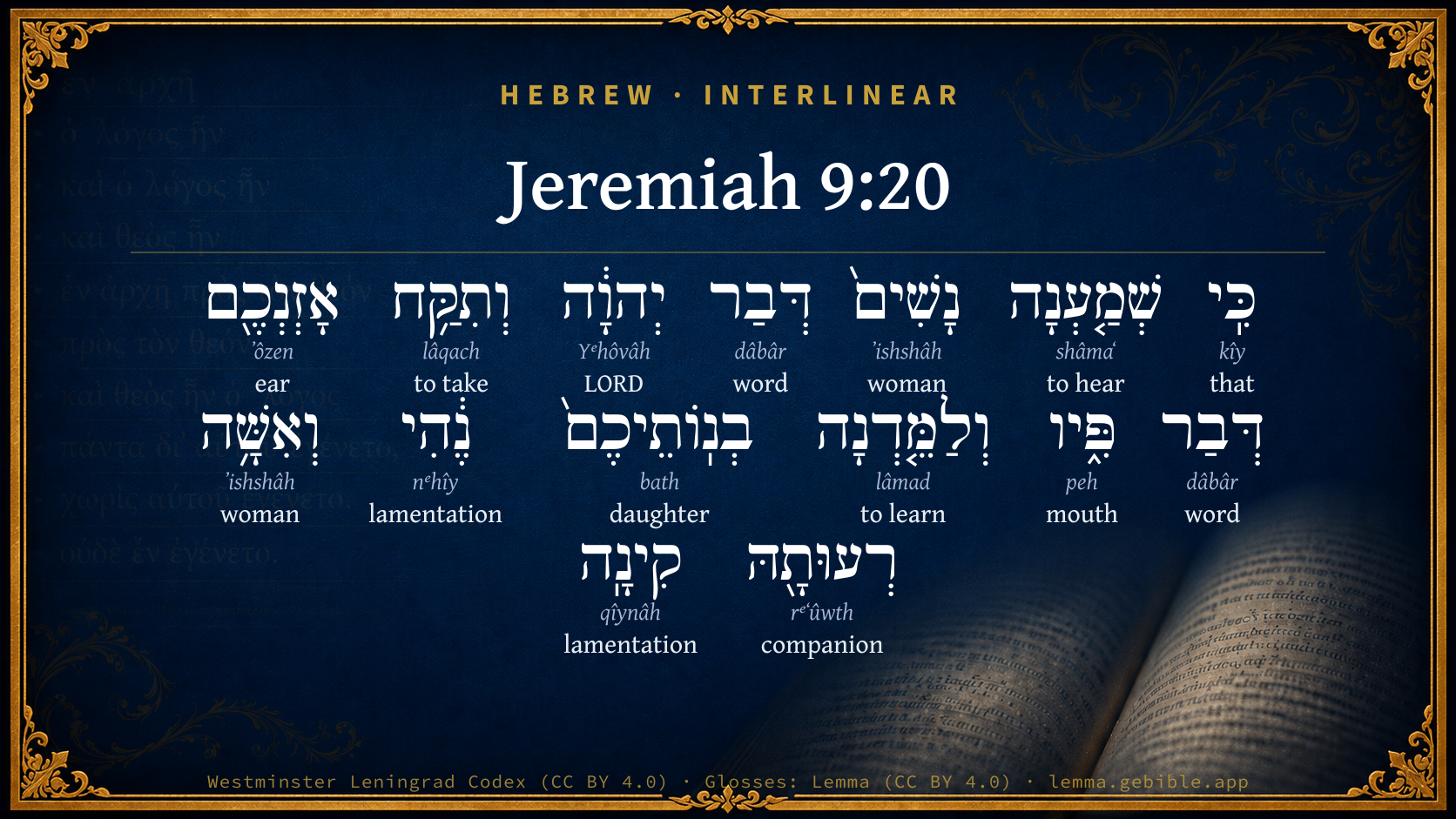
Hebrew (Westminster Leningrad Codex) Jeremiah 9:20 appears in the Hebrew Old Testament. The text above is from the Westminster Leningrad Codex. Each word links to its Strong’s number, a concise gloss, and parsing drawn from the Open Scriptures Hebrew Bible morphology. Click any word for its full Brown-Driver-Briggs (BDB) entry.
Download image
Cite this verse

Jeremiah 9:20 (World English Bible). Public Domain. Lemma interlinear Bible study tool, https://lemma.gebible.app/v/jeremiah/9/20.

Show BibTeX & RIS
BibTeX
RIS
English Translation
Yet hear the word of Yahweh, you women, and let your ear receive the word of his mouth; and teach your daughters wailing, and everyone her neighbor lamentation.
World English Bible · Public Domain
Download a study sheet

One document with this verse’s original text, its word-by-word gloss line, the meaning frame, cross-references with their text, attributed commentary, and full source and license credits — printable, and it pastes into notes with its structure intact.

This verse Autodidact and up

Study sheet (.html) Plain text (.txt)

A passage Seminary Student

Up to 50 verses in one chapter. A passage sheet keeps up to 6 commentary sources and 12 cross-references per verse, in the order this page ranks them, and says so on the sheet whenever that leaves anything out. Ask for a single verse and you get the Autodidact verse sheet above.

Everything on this page stays free to read, with no account — the sheet is a download of what is already on screen, not access to it.

Want to remove ads? Support Godless Engineer
Compare translations 3

The same verse in 3 English versions, stacked beneath the original-language interlinear above. Click any original word for its lexicon entry.

Each is an independent rendering of the whole verse — the interlinear is not word-aligned to these translations.

Highlighted words mark where these versions differ — a whole-verse word diff, not a word-by-word alignment.

  • World English Bible Public Domain
    Yet hear the word of Yahweh, you women, and let your ear receive the word of his mouth; and teach your daughters wailing, and everyone her neighbor lamentation.
  • King James Version Public Domain
    Yet hear the word of the LORD, O ye women, and let your ear receive the word of his mouth, and teach your daughters wailing, and every one her neighbour lamentation.
  • unfoldingWord Literal Text CC BY-SA 4.0
    Now hear women, the word of Yahweh, and let your ear receive the word of his mouth, and teach your daughters wailing and each woman, her neighbor a lament.

unfoldingWord Literal Text — © unfoldingWord, licensed CC BY-SA 4.0. Word-aligned USFM3 via Door43 (git.door43.org/unfoldingWord/en_ult).

Versions to compare (up to 4)

3 of 4 selected

Show all 18 translations

Every available English version of this verse, each an independent rendering of the whole verse.

  • World English Bible Public Domain
    Yet hear the word of Yahweh, you women, and let your ear receive the word of his mouth; and teach your daughters wailing, and everyone her neighbor lamentation.
  • Berean Standard Bible Public Domain
    Now, O women, hear the word of the LORD. Open your ears to the word of His mouth. Teach your daughters to wail, and one another to lament.
  • Majority Standard Bible Public Domain
    Now, O women, hear the word of the LORD. Open your ears to the word of His mouth. Teach your daughters to wail, and one another to lament.
  • King James Version Public Domain
    Yet hear the word of the LORD, O ye women, and let your ear receive the word of his mouth, and teach your daughters wailing, and every one her neighbour lamentation.
  • American Standard Version (1901) Public Domain
    Yet hear the word of Jehovah, O ye women, and let your ear receive the word of his mouth; and teach your daughters wailing, and every one her neighbor lamentation.
  • Revised Version (1885) Public Domain
    Yet hear the word of the LORD, O ye women, and let your ear receive the word of his mouth, and teach your daughters wailing, and every one her neighbour lamentation.
  • Geneva Bible (1599) Public Domain
    Therefore heare the worde of the Lord, O ye women, and let your eares regard the words of his mouth, and teach your daughters to mourne, and euery one her neighbour to lament.
  • Douay-Rheims (1899) Public Domain
    Hear therefore, ye women, the word of the Lord: and let your ears receive the word of his mouth: and teach your daughters wailing: and every one her neighbor mourning.
  • Young's Literal Translation Public Domain
    But hear, ye women, a word of Jehovah, And your ear receiveth a word of His mouth, And teach ye your daughters wailing, and each her neighbour lamentation.
  • Literal Standard Version CC BY-SA 4.0
    But hear, you women, a word of YHWH, || And your ear receives a word of His mouth, || And teach your daughters wailing, || And each her neighbor lamentation.
  • Unlocked Literal Bible CC BY-SA 4.0
    So you women, hear Yahweh's word; pay attention to the messages that come from his mouth. Then teach your daughters a mourning song, and each neighbor woman a funeral song.
  • unfoldingWord Literal Text CC BY-SA 4.0
    Now hear women, the word of Yahweh, and let your ear receive the word of his mouth, and teach your daughters wailing and each woman, her neighbor a lament.
  • Darby Bible Public Domain
    Hear then the word of Jehovah, ye women, and let your ear receive the word of his mouth, and teach your daughters wailing, and each one her companion lamentation.
  • World Messianic Bible Public Domain
    Yet hear the LORD’s word, you women. Let your ear receive the word of his mouth. Teach your daughters wailing. Everyone teach her neighbor a lamentation.
  • Webster's Bible Public Domain
    Yet hear the word of the LORD, O ye women, and let your ear receive the word of his mouth, and teach your daughters wailing, and every one her neighbor lamentation.
  • Free Bible Version CC BY-SA 4.0
    Women, listen to the Lord's message, hear what he has to say. Teach your daughters to mourn and sing songs of sadness.
  • Bible in Basic English Public Domain
    But even now, give ear to the word of the Lord, O you women; let your ears be open to the word of his mouth, training your daughters to give cries of sorrow, everyone teaching her neighbour a song of grief.
  • JPS Tanakh (1917) Public Domain
    (9-19) Yea, hear the word of the LORD, O ye women, and let your ear receive the word of His mouth, and teach your daughters wailing, and every one her neighbour lamentation:

Literal Standard Version (2020), Covenant Press — licensed CC BY-SA 4.0. Text via the HelloAO Bible API (eBible.org). Unlocked Literal Bible (unfoldingWord) — licensed CC BY-SA 4.0. Text via the HelloAO Bible API (eBible.org). unfoldingWord Literal Text — © unfoldingWord, licensed CC BY-SA 4.0. Word-aligned USFM3 via Door43 (git.door43.org/unfoldingWord/en_ult). Free Bible Version, Dr. Jonathan Gallagher — licensed CC BY-SA 4.0. Text via the HelloAO Bible API (eBible.org).

Word by word

More ways to search: Search by grammar → Find every occurrence → Compare this word →

Practice this passage: Drill this verse → Learn its vocabulary →

רְעוּתָ֖הּ
rᵉʻûwth
H7468
“companion · her”
Noun, Common, Feminine, Singular, Construct + Suffix, Personal, 3rd Person, Feminine, Singular
Part of Speech
Noun
Type
Common
Gender
Feminine
Number
Singular
State
Construct
Full BDB Definition

Origin: from H7462 in the sense of H7453

TWOT: 2186e

female companion, mate, neighbour woman
  1. כִּֽי kîy H3588 “that” Conjunction
  2. שְׁמַ֤עְנָה shâmaʻ H8085 “hear” Verb, Qal, Imperative, 2nd Person, Feminine, Plural
  3. נָשִׁים֙ ʼishshâh H802 “women” Noun, Common, Feminine, Plural, Absolute
  4. דְּבַר dâbâr H1697 “word of” Noun, Common, Masculine, Singular, Construct
  5. יְהוָ֔ה Yᵉhôvâh H3068 “LORD” Noun, Proper
  6. וְתִקַּ֥ח lâqach H3947 “and · to take” Conjunction + Verb, Qal, Imperfect, 3rd Person, Feminine, Singular
  7. אָזְנְכֶ֖ם ʼôzen H241 “ear · your” Noun, Common, Feminine, Singular, Construct + Suffix, Personal, 2nd Person, Masculine, Plural
  8. דְּבַר dâbâr H1697 “word of” Noun, Common, Masculine, Singular, Construct
  9. פִּ֑יו peh H6310 “mouth · his” Noun, Common, Masculine, Singular, Construct + Suffix, Personal, 3rd Person, Masculine, Singular
  10. וְלַמֵּ֤דְנָה lâmad H3925 “and · learn” Conjunction + Verb, Piel, Imperative, 2nd Person, Feminine, Plural
  11. בְנֽוֹתֵיכֶם֙ bath H1323 “daughters · your” Noun, Common, Feminine, Plural, Construct + Suffix, Personal, 2nd Person, Masculine, Plural
  12. נֶ֔הִי nᵉhîy H5092 “lamentation” Noun, Common, Masculine, Singular, Absolute
  13. וְאִשָּׁ֥ה ʼishshâh H802 “and · woman” Conjunction + Noun, Common, Feminine, Singular, Absolute
  14. קִינָֽה qîynâh H7015 “lamentation” Noun, Common, Feminine, Singular, Absolute

About this verse

These counts appear in no published source. They are computed here, from the morphology-tagged text and Lemma’s own curated glosses. What Lemma adds →

15
words
13
distinct lemmas
Prophets
section

Notable vocabulary

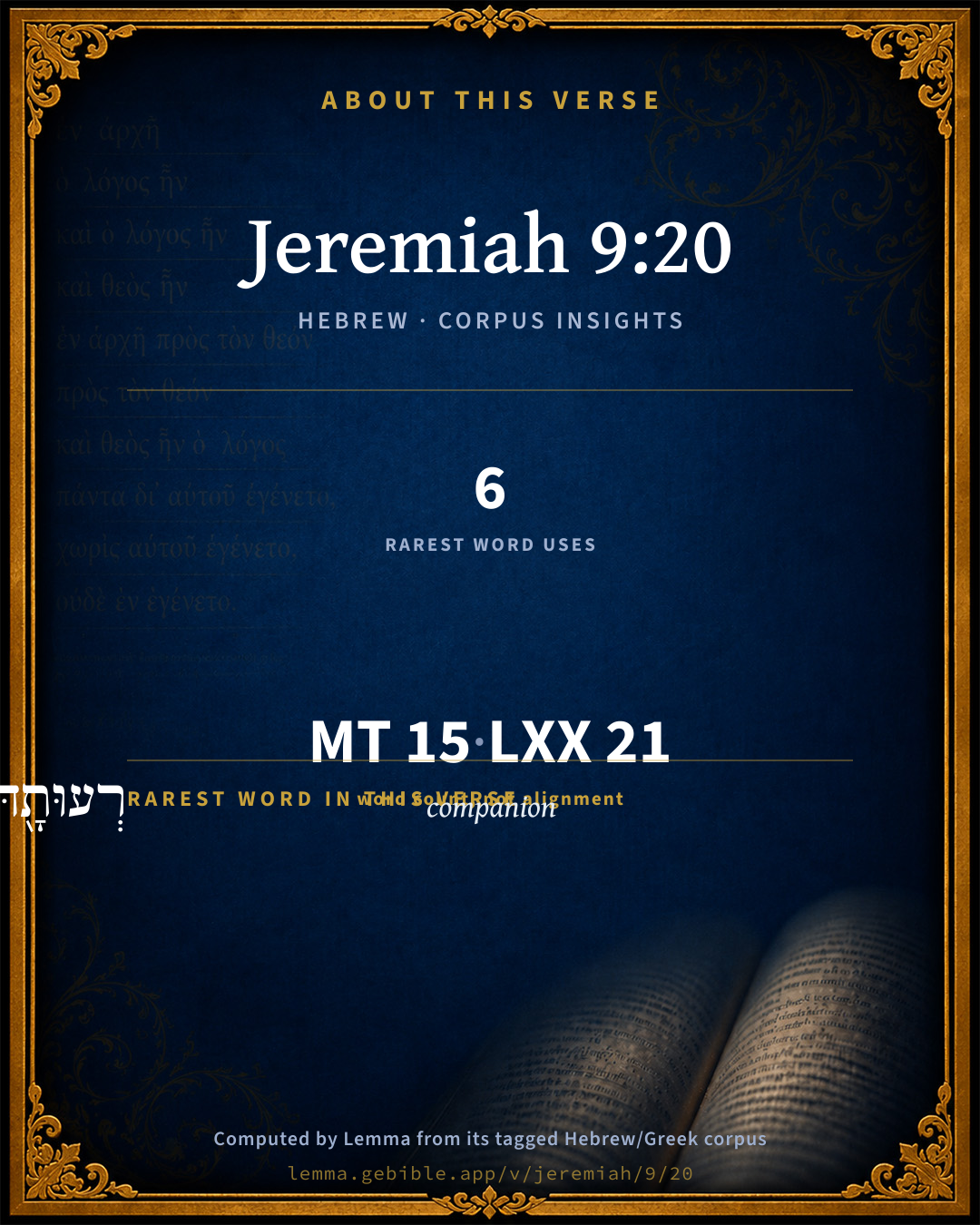
The rarest word here is רְעוּתָ֖הּ companion H7468 — appearing just 6 times in the whole Hebrew Bible.

Shared distinctive vocabulary

רְעוּתָ֖הּ companion H7468 occurs in 6 verses of the Hebrew Bible. Also found in:

Grammatical profile

  • 3 verbs
  • 11 nouns
  • 1 conjunction

Verb forms

  • שְׁמַ֤עְנָה Qal · Imperative
  • וְתִקַּ֥ח Qal · Imperfect
  • וְלַמֵּ֤דְנָה Piel · Imperative

Repetition

Words recur within this verse — often emphatic in Hebrew:

  • נָשִׁים֙ woman H802 ×2
  • דְּבַר word H1697 ×2

Hebrew & Septuagint length

In the original languages it is 15 Hebrew tokens and 21 Greek tokens — but the two are counted differently (Hebrew bundles its prefixes and suffixes into one token; the Greek is in lemma form), so that isn’t a like-for-like length.

Cross-references

6

Topical passages linked to Jeremiah 9:20 in the Treasury of Scripture Knowledge — connected by theme and wording, ordered by reader-vote popularity; previews shown in the World English Bible.

  • Luke 23:27–30 A great multitude of the people followed him, including women who also mourned and lamented him.
  • Isaiah 32:9–13 Rise up, you women who are at ease, [and] hear my voice; you careless daughters, give ear to my speech.
  • Job 22:22 Please receive instruction from his mouth, And lay up his words in your heart.
  • Isaiah 3:16 Moreover Yahweh said, "Because the daughters of Zion are haughty, And walk with outstretched necks and flirting eyes, Walking to trip as they go, Jingling ornaments on their feet;
  • Jeremiah 9:17–18 Thus says Yahweh of Hosts, Consider you, and call for the mourning women, that they may come; and send for the skillful women, that they may come:
  • Isaiah 3:4 I will give boys to be their princes, And children shall rule over them.

Cross-references courtesy of OpenBible.info (CC BY 4.0).

Hebrew and Greek witnesses Masoretic Hebrew ↔ Greek Septuagint

The same verse in the two great witnesses to the Old Testament, shown verse-for-verse.

These are two independent witnesses, not word-aligned to each other, and the Septuagint is shown in lemma (dictionary) form.

Hebrew Jeremiah 9:20 Masoretic · Westminster Leningrad Codex

כִּֽי שְׁמַ֤עְנָה נָשִׁים֙ דְּבַר יְהוָ֔ה וְתִקַּ֥ח אָזְנְכֶ֖ם דְּבַר פִּ֑יו וְלַמֵּ֤דְנָה בְנֽוֹתֵיכֶם֙ נֶ֔הִי וְאִשָּׁ֥ה רְעוּתָ֖הּ קִינָֽה

Yet hear the word of Yahweh, you women, and let your ear receive the word of his mouth; and teach your daughters wailing, and everyone her neighbor lamentation.

World English Bible · Public Domain

Greek LXX Structure differs

In the Septuagint, Jeremiah is about an eighth shorter than the Hebrew and arranges its material differently — the Oracles Against the Nations (Hebrew chapters 46–51) appear in the middle of the Greek book, after 25:13. Because the chapter and verse boundaries do not line up, a verse-for-verse comparison with the Hebrew is not shown.

A verse-for-verse comparison isn’t shown here because the chapters and verses don’t line up. Switch to the LXX edition with the MT / LXX toggle above to read the Greek directly.

Hebrew: Westminster Leningrad Codex (CC BY 4.0). Greek: Septuagint (public domain); English from a public-domain English Septuagint. How the Septuagint differs from the Hebrew →

Targum (Aramaic paraphrase)

1

The Targum is the ancient Jewish Aramaic paraphrase of the Hebrew Scriptures — an interpretive translation, not the Hebrew text itself. Onkelos (literal) and Pseudo-Jonathan (expansive) render the Torah, and Jonathan the Prophets. Coverage is partial: where no permissively-licensed English translation exists for a verse, only the Aramaic is shown. This is verse-level text, not a word-by-word alignment to the Hebrew.

  1. Targum Jonathan Prophets (Joshua–Malachi)
    אֲרֵי סְלֵיק מוֹתָא בַּחֲרַכָּנָא עַל בְבִרְנְיָתָנָא לְשֵׁיצָאָה יַנְקִין מִשׁוֹקָא עוּלֵימִין מֵרְחוֹבִין:

    (no public-domain English translation for this verse)

    Targum Jonathan — Aramaic: “Mikraot Gedolot” (public domain). English: “Sefaria Community Translation” (CC0 1.0 (public-domain dedication)); “London "Chaldee Paraphrase," 1871” (public domain). Text via Sefaria.

Commentary

Notes on Jeremiah 9:20 from classic Christian and Jewish commentators (each source and its license shown beneath its notes). The classic Christian expositions comment on the surrounding passage and are grouped to its opening verse, so a note may address several verses; the Jewish commentaries on the Tanakh (Rashi and others) are per-verse, so they appear only where the commentator wrote on this verse.

Lemma curates 59 commentaries, every one of them public domain or Creative Commons licensed, each selected and text-cleaned for this edition rather than reprinted as found. About our sources →

John Gill's Exposition

Yet hear the word of the Lord, O ye women,.... Not the mourning women, but others who had lost their husbands and their children, and had just reason for real mourning; and therefore they are called upon to it, not only because they were more tenderhearted than men, as Kimchi observes; or because they were more attentive to the hearing of the word of God than men; but because of the paucity of men, such numbers being slain in the siege, and by the sword; and of the loss the women had sustained, see Jer 9:22,

and let your ear receive the word of his mouth; by his prophets; so the Targum,

"let your ear hearken to the words of his prophets:''

and teach your daughters wailing. The Arabic version, "a mournful song"; but not the daughters of the mourning women are meant; but the real daughters of those who had lost their husbands or children; since it follows:

and everyone her neighbour lamentation; signifying that the mortality among them would be very universal, not a family escaping; which is described in the next verses. This wailing and lamentation was made by responses, according to the Jews; for they say (d),

"what is lamentation? when one speaks, and all the rest answer after her, as it is written in Jer 9:20.''

(d) Misn. Moed Katon, c. 3. sect. 9.

John Gill's Exposition of the Whole Bible (1746–1763) — public domain (CC PDM 1.0). Text via the HelloAO Bible API.

Trapp's Complete Commentary

John Trapp

Jer 9:20 Yet hear the word of the LORD, O ye women, and let your ear receive the word of his mouth, and teach your daughters wailing, and every one her neighbour lamentation.

Ver. 20. Yet hear the word of the Lord, O ye women.] For souls have no sexes, and ye are likely to have your share as deep as any in the common calamity. You also are mostly more apt to weep than men, and may sooner work your men to godly sorrow than those lamentations.

John Trapp, A Commentary or Exposition upon All the Books of the Old and New Testament (1647–1656) — public domain. Text from a community e-Sword module.

Tyndale Open Study Notes

Tyndale Open Resources

9:20-21 Because of the many deaths in the city, not enough professional mourners were available. The women were urged to quickly teach their daughters to be skilled mourners.

Tyndale Open Study Notes — © Tyndale Open Resources, licensed CC BY-SA 4.0. Text via the HelloAO Bible API.

Geneva Bible (1599)

Geneva Bible translators

He derideth the superstition of the women which made an art of mourning, and taught to weep with feigned tears.

Geneva Bible (1599) marginal notes — public domain. Text via Bolls.life.

Jamieson, Fausset & Brown

Robert Jamieson, A. R. Fausset & David Brown

Yet--rather, "Only" [HENDERSON]. This particle calls attention to what follows.

teach . . . daughters wailing--The deaths will be so many that there will be a lack of mourning women to bewail them. The mothers, therefore, must teach their daughters the science to supply the want.

Jamieson, Fausset & Brown — Commentary Critical and Explanatory on the Whole Bible (1871) — public domain (CC PDM 1.0). Text via the HelloAO Bible API.

Adam Clarke's Commentary

Verse 20. Teach your daughters] This is not a common dirge that shall last only till the body is consigned to the earth; it must last longer; teach it to your children, that it may be continued through every generation, till God turn again your captivity.

Adam Clarke's Commentary on the Bible (1810–1826) — public domain. Text from a community e-Sword/MySword module.

John Calvin's Commentaries

He proceeds with the same subject, but adopts another figure. He then somewhat changes the comparison; for he had bidden them before to hire women to excite to mourning by fictitious tears, but he now addresses women in general; as though he had said, that such would be the mourning, that hired lamentations would not be sufficient, for the calamity would touch all hearts, and that mercenary wailing would not be real. Hear, he says, ye women

Why he addresses women may be accounted for in two ways: the softness of women more easily leads them to weep; there may be also here an indirect condemnation of the men, that they were deaf and so hardened that no threatenings terrified them. But the first seems to be the most suitable reason here, provided we still understand that real mourning is opposed to reigned mourning. Then Jeremiah passes from the particular to the general; that is, after having spoken of hired women, he now includes all women; for lamentation would prevail in every city, and also in every house: Hear then, ye women, the word of Jehovah

And he adds, and let your ears receive the word of his mouth He mentions on the one hand the mouth of God, and on the other the ears of women. It seems indeed a redundancy, but the repetition is not superfluous. Had he said only, “Let your ears hear the word of his mouth,” there would have been a redundancy; but he spoke before only of the word of God, and hear ye; now he adds, the mouth of God, and the ears of women. The Prophet no doubt intended to rebuke that hardness which we have often noticed. The word of God was deemed of no moment; hence he says, the mouth of God: as though he had said, “God speaks with you as it were from mouth to mouth: for though he employs my labor, I am yet but his instrument; so that you may easily find out that I declare nothing presumptuously, but faithfully deliver what I have received from him.” We hence see how emphatical is this repetition, which may seem at first sight to be superfluous. The same emphasis belongs to the ears of women; it is as though he had said, that they had been hitherto extremely indifferent, and that it was time for their ears to be attentive.

He adds, And teach your daughters; as though he had said, that such would be the wailing, that it would reach not only the old and the middle-aged, but even young girls, as yet rude and ignorant. And let every one, he says, teach her neighbor lamentation In short, the meaning is, that no women, old or young, would be exempt from this mourning, as all would be implicated in a common sorrow; for God’s judgment would reach every age, sex, and order of men, and would also penetrate into every house.

John Calvin's Commentaries (1540-1563) — public domain. Text from the Calvin Translation Society English edition (1840s-50s) via the Christian Classics Ethereal Library (ccel.org). Calvin's coverage is partial (roughly two-thirds of the Bible); uncommented books and verses are honest gaps, never fabricated. The 19th-century editor's footnotes and remarks are omitted so the notes are faithfully Calvin's own voice.

Ellicott's Commentary for English Readers

(20) Teach your daughters wailing.—The thought of Jer_9:9 is continued. The words rest upon the idea that wailing was an art, its cries and tones skilfully adapted to the special sorrows of which it was in theory the expression. They perhaps imply also that death would do its work so terribly that the demand for mourners would be greater than the supply, and that supernumeraries must be trained to meet it. Looking to the many other coincidences between our Lord’s teaching and that of Jeremiah, it is not too much to see in His words to the daughter of Jerusalem, “Weep for yourselves and for your children” (Luk_23:27-28), a parallel to what we read here.

A Bible Commentary for English Readers, edited by Charles John Ellicott (1878–1897) — public domain. Text from a community e-Sword module.

The Cambridge Bible for Schools and Colleges

gen. ed. J. J. S. Perowne

20. No traditional formula will suffice; Jehovah will dictate a dirge, and it shall be for universal use.

The Cambridge Bible for Schools and Colleges (gen. ed. J. J. S. Perowne; Cambridge University Press, 1878–1918) — public domain. Text from a community e-Sword module.

Matthew Poole's English Annotations

Yet, or therefore, hear the word of the Lord, i.e. do not think I speak words out of my own mind or fancy, but what I speak is from the Lord.

O ye women; either those hired women mentioned before, or rather the women of the land; for God would have it not a mercenary, but a real mourning; and he mentioneth women,

1. To upbraid the men with their stupidity.

2. As being more apt to grieve, thereby to express the readiness that he would have the land to be in for mourning.

3. Because of the decay and want there would be of men, as is expressed in the next verse, by reason partly of the slaughter, and partly of the captivity; therefore here is mention of women with reference to children in the next verse, after whom their bowels would yearn; and daughters, either the scholars of the mourning women, or rather, with reference to young men, unto whom they might be given in marriage.

4. Because the female sex is least able to help themselves in a common calamity. Or,

5. Because they would be least solicitous, but would indulge their delicacies, pride, sloth, and wantonness, Isa 32:9,11. Every one her neighbour, Heb. a woman her friend; namely, that the grief might spread the further, and become deeper; for affections and passions, of what kind soever, are augmented by company: it notes how large and universal the mourning shall be, Amo 5:16.

Matthew Poole's English Annotations on the Holy Bible (1683–1685) — public domain. Text from a community e-Sword/MySword module.

The Pulpit Commentary

Yet hear; rather, for hear.

The Pulpit Commentary (1880–1919), ed. H.D.M. Spence-Jones & Joseph S. Exell — public domain. Text from a community e-Sword module.

John Wesley's Explanatory Notes

Everyone - It denotes how large and universal the mourning shall be.

John Wesley, Explanatory Notes Upon the Whole Bible (1754–1765) — public domain. Text via the GEBible commentary corpus.

Keil & Delitzsch

C. F. Keil & F. Delitzsch

Death comes in through (in at) the windows, not because the doors are to be thought of as barricaded (Hitz.), but as a thief in the night, i.e., suddenly, in an unexpected way. Perhaps Jeremiah was here thinking of Joe 2:9. And comes into the palaces, i.e., spares no house, but carries off high and low. The second clause is not to be very closely joined with the first, thus: Death comes into the houses and palaces, to sweep the children from off the streets; this would be self-contradictory. We must rather repeat "comes" from the first clause: He comes to sweep off the streets the child at play. That is: In the houses and palaces, as upon the streets and highways, he will seize his prey.

Keil & Delitzsch — Biblical Commentary on the Old Testament (1861–1891) — public domain (CC PDM 1.0). Text via the HelloAO Bible API. (Old Testament only.)

Rashi

Rabbi Shlomo Yitzchaki (Rashi)

from the streets Heb. מחוץ, from the street. Comp. (I Kings 20:34) “And you shall make yourself streets in Damascus.”

Rashi on the Tanakh — English translations: “The Judaica Press complete Tanach with Rashi, translated by A. J. Rosenberg” (CC BY 4.0); “Pentateuch with Rashi's commentary by M. Rosenbaum and A.M. Silbermann, 1929-1934” (public domain); “The Metsudah Tanach series, Lakewood, N.J” (CC BY 4.0); and “The Book of Joshua, Metsudah Publications, 1997” (CC BY 4.0). Text via Sefaria.

Lesson kit

Teaching starters — assembled from the data on this page, not authored interpretation. Every prompt links to the verse data it draws on. Edit before teaching.

Jeremiah, in the Prophets, opens this verse with 15 words (13 distinct Hebrew lemmas). Its most distinctive word is rᵉʻûwth (“companion”). A historical commentator’s framing appears above. Read the whole chapter for the surrounding context.

Discussion questions

  1. How does “companion” (rᵉʻûwth) shape what this verse is saying?
  2. Exodus 11:2 shares the word «companion» with this verse. How do the two illuminate each other?
  3. “woman” occurs 2× in this one verse. What is the effect of the repetition?
  4. These translations render this verse differently; the difference is in the English rendering, not the original. What questions does that raise?
  5. The verb «שְׁמַ֤עְנָה» is Qal Imperative. How does its form color the action?
  6. Reading how John Gill's Exposition and Trapp's Complete Commentary read this verse, where do the two commentators agree and where do they part?

Things to notice

Reading settings

Reading text

Shown beneath each verse's original-language words.

Old Testament
Old Testament edition

Read the OT as the Masoretic Hebrew (MT) or the Greek Septuagint (LXX).

English shown for the Greek Septuagint (in the Hebrew ↔ Greek comparison).

Comparing translations? Open the Compare panel on any verse page to stack up to four side by side.