
Jeremiah 36:21

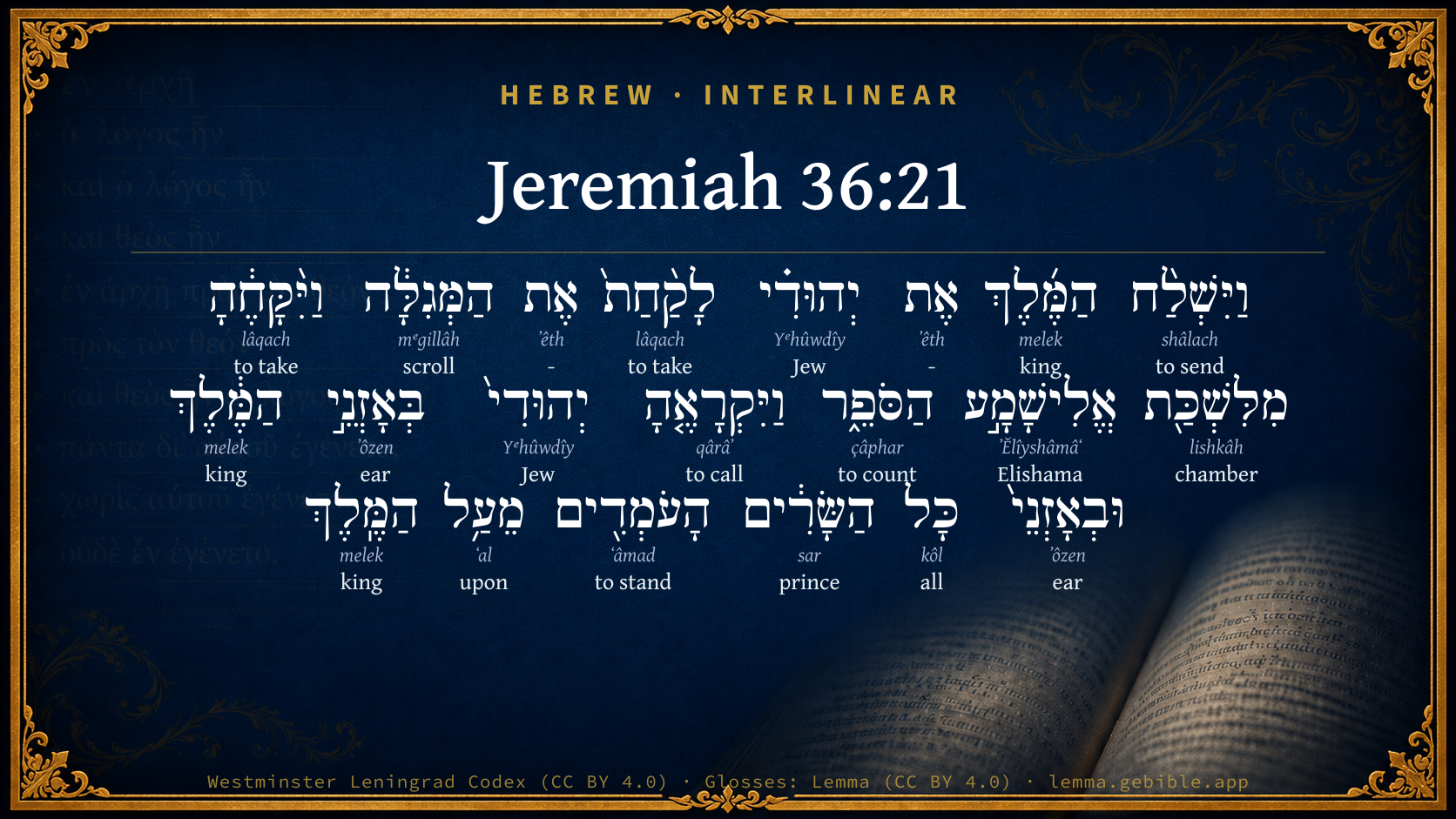
Hebrew (Westminster Leningrad Codex) Jeremiah 36:21 appears in the Hebrew Old Testament. The text above is from the Westminster Leningrad Codex. Each word links to its Strong’s number, a concise gloss, and parsing drawn from the Open Scriptures Hebrew Bible morphology. Click any word for its full Brown-Driver-Briggs (BDB) entry.
Download image
Cite this verse

Jeremiah 36:21 (World English Bible). Public Domain. Lemma interlinear Bible study tool, https://lemma.gebible.app/v/jeremiah/36/21.

Show BibTeX & RIS
BibTeX
RIS
English Translation
So the king sent Jehudi to get the scroll; and he took it out of the chamber of Elishama the scribe. Jehudi read it in the ears of the king, and in the ears of all the princes who stood beside the king.
World English Bible · Public Domain
Download a study sheet

One document with this verse’s original text, its word-by-word gloss line, the meaning frame, cross-references with their text, attributed commentary, and full source and license credits — printable, and it pastes into notes with its structure intact.

This verse Autodidact and up

Study sheet (.html) Plain text (.txt)

A passage Seminary Student

Up to 50 verses in one chapter. A passage sheet keeps up to 6 commentary sources and 12 cross-references per verse, in the order this page ranks them, and says so on the sheet whenever that leaves anything out. Ask for a single verse and you get the Autodidact verse sheet above.

Everything on this page stays free to read, with no account — the sheet is a download of what is already on screen, not access to it.

Want to remove ads? Support Godless Engineer
Compare translations 3

The same verse in 3 English versions, stacked beneath the original-language interlinear above. Click any original word for its lexicon entry.

Each is an independent rendering of the whole verse — the interlinear is not word-aligned to these translations.

Highlighted words mark where these versions differ — a whole-verse word diff, not a word-by-word alignment.

  • World English Bible Public Domain
    So the king sent Jehudi to get the scroll; and he took it out of the chamber of Elishama the scribe. Jehudi read it in the ears of the king, and in the ears of all the princes who stood beside the king.
  • King James Version Public Domain
    So the king sent Jehudi to fetch the roll: and he took it out of Elishama the scribe's chamber. And Jehudi read it in the ears of the king, and in the ears of all the princes which stood beside the king.
  • unfoldingWord Literal Text CC BY-SA 4.0
    Then the king sent Jehudi to get the scroll. Jehudi took it from the room of Elishama the secretary. Then he read it in the hearing of the king and all the officials who were standing beside him.

unfoldingWord Literal Text — © unfoldingWord, licensed CC BY-SA 4.0. Word-aligned USFM3 via Door43 (git.door43.org/unfoldingWord/en_ult).

Versions to compare (up to 4)

3 of 4 selected

Show all 18 translations

Every available English version of this verse, each an independent rendering of the whole verse.

  • World English Bible Public Domain
    So the king sent Jehudi to get the scroll; and he took it out of the chamber of Elishama the scribe. Jehudi read it in the ears of the king, and in the ears of all the princes who stood beside the king.
  • Berean Standard Bible Public Domain
    Then the king sent Jehudi to get the scroll, and he took it from the chamber of Elishama the scribe. And Jehudi read it in the hearing of the king and all the officials who were standing beside him.
  • Majority Standard Bible Public Domain
    Then the king sent Jehudi to get the scroll, and he took it from the chamber of Elishama the scribe. And Jehudi read it in the hearing of the king and all the officials who were standing beside him.
  • King James Version Public Domain
    So the king sent Jehudi to fetch the roll: and he took it out of Elishama the scribe's chamber. And Jehudi read it in the ears of the king, and in the ears of all the princes which stood beside the king.
  • American Standard Version (1901) Public Domain
    So the king sent Jehudi to fetch the roll; and he took it out of the chamber of Elishama the scribe. And Jehudi read it in the ears of the king, and in the ears of all the princes that stood beside the king.
  • Revised Version (1885) Public Domain
    So the king sent Jehudi to fetch the roll: and he took it out of the chamber of Elishama the scribe. And Jehudi read it in the ears of the king, and in the ears of all the princes which stood beside the king.
  • Geneva Bible (1599) Public Domain
    So the King sent Iehudi to fet the roule, and he tooke it out of Elishama the Chancellours chamber, and Iehudi read it in the audience of the King, and in the audience of all the princes, which stoode beside the King.
  • Douay-Rheims (1899) Public Domain
    And the king sent Judi that he should take the volume: who bringing it out of the chamber of Elisama the scribe, read it in the hearing of the king, and of all the princes that stood about the king.
  • Young's Literal Translation Public Domain
    And the king sendeth Jehudi to take the roll, and he taketh it out of the chamber of Elishama the scribe, and Jehudi readeth it in the ears of the king, and in the ears of all the heads who are standing by the king;
  • Literal Standard Version CC BY-SA 4.0
    And the king sends Jehudi to take the scroll, and he takes it out of the chamber of Elishama the scribe, and Jehudi reads it in the ears of the king, and in the ears of all the heads who are standing by the king;
  • Unlocked Literal Bible CC BY-SA 4.0
    Then the king sent Jehudi to get the scroll. Jehudi took it from the room of Elishama the secretary. Then he read it in the hearing of the king and all the officials who were standing beside him.
  • unfoldingWord Literal Text CC BY-SA 4.0
    Then the king sent Jehudi to get the scroll. Jehudi took it from the room of Elishama the secretary. Then he read it in the hearing of the king and all the officials who were standing beside him.
  • Darby Bible Public Domain
    And the king sent Jehudi to fetch the roll, and he fetched it out of the chamber of Elishama the scribe. And Jehudi read it in the ears of the king, and in the ears of all the princes that stood beside the king.
  • World Messianic Bible Public Domain
    So the king sent Jehudi to get the scroll, and he took it out of the room of Elishama the scribe. Jehudi read it in the hearing of the king, and in the hearing of all the princes who stood beside the king.
  • Webster's Bible Public Domain
    So the king sent Jehudi to bring the roll: and he took it out of the chamber of Elishama, the scribe. And Jehudi read it in the ears of the king, and in the ears of all the princes who stood beside the king.
  • Free Bible Version CC BY-SA 4.0
    The king sent Jehudi to fetch the scroll. He went and got it from Elishama the secretary's room. Then Jehudi read it to the king and all the officials who were there standing next to him.
  • Bible in Basic English Public Domain
    So the king sent Jehudi to get the book, and he took it from the room of Elishama the scribe. And Jehudi gave a reading of it in the hearing of the king and all the rulers who were by the king's side.
  • JPS Tanakh (1917) Public Domain
    So the king sent Jehudi to fetch the roll; and he took it out of the chamber of Elishama the scribe. And Jehudi read it in the ears of the king, and in the ears of all the princes that stood beside the king.

Literal Standard Version (2020), Covenant Press — licensed CC BY-SA 4.0. Text via the HelloAO Bible API (eBible.org). Unlocked Literal Bible (unfoldingWord) — licensed CC BY-SA 4.0. Text via the HelloAO Bible API (eBible.org). unfoldingWord Literal Text — © unfoldingWord, licensed CC BY-SA 4.0. Word-aligned USFM3 via Door43 (git.door43.org/unfoldingWord/en_ult). Free Bible Version, Dr. Jonathan Gallagher — licensed CC BY-SA 4.0. Text via the HelloAO Bible API (eBible.org).

Word by word

More ways to search: Search by grammar → Find every occurrence → Compare this word →

Practice this passage: Drill this verse → Learn its vocabulary →

יְהוּדִ֗י
Yᵉhûwdîy
H3065
“Jew”
Noun, Proper
Part of Speech
Noun
Type
Proper
Full BDB Definition

Origin: the same as H3064

TWOT: None

Jehudi = "Jew" - son of Nethaniah and servant of king Jehoiakim
  1. וַיִּשְׁלַ֨ח shâlach H7971 “and · to send” Conjunction + Verb, Qal, Sequential Imperfect, 3rd Person, Masculine, Singular
  2. הַמֶּ֜לֶךְ melek H4428 “the · king” Particle, Definite Article + Noun, Common, Masculine, Singular, Absolute
  3. אֶת ʼêth H853 “-” Particle, Direct Object
  4. לָקַ֨חַת֙ lâqach H3947 “to take” Preposition + Verb, Qal, Infinitive Construct
  5. אֶת ʼêth H853 “-” Particle, Direct Object
  6. הַמְּגִלָּ֔ה mᵉgillâh H4039 “the · scroll” Particle, Definite Article + Noun, Common, Feminine, Singular, Absolute
  7. וַיִּ֨קָּחֶ֔הָ lâqach H3947 “and · to take · her” Conjunction + Verb, Qal, Sequential Imperfect, 3rd Person, Masculine, Singular + Suffix, Personal, 3rd Person, Feminine, Singular
  8. מִלִּשְׁכַּ֖ת lishkâh H3957 “from · chamber of” Preposition + Noun, Common, Feminine, Singular, Construct
  9. אֱלִישָׁמָ֣ע ʼĔlîyshâmâʻ H476 “Elishama” Noun, Proper
  10. הַסֹּפֵ֑ר çâphar H5608 “the · scribe” Particle, Definite Article + Noun, Common, Masculine, Singular, Absolute
  11. וַיִּקְרָאֶ֤הָ qârâʼ H7121 “and · to call · her” Conjunction + Verb, Qal, Sequential Imperfect, 3rd Person, Masculine, Singular + Suffix, Personal, 3rd Person, Feminine, Singular
  12. יְהוּדִי֙ Yᵉhûwdîy H3065 “Jew” Noun, Proper
  13. בְּאָזְנֵ֣י ʼôzen H241 “in/at · ears of” Preposition + Noun, Common, Feminine, Dual, Construct
  14. הַמֶּ֔לֶךְ melek H4428 “the · king” Particle, Definite Article + Noun, Common, Masculine, Singular, Absolute
  15. וּבְאָזְנֵי֙ ʼôzen H241 “and · in/at · ears of” Conjunction + Preposition + Noun, Common, Feminine, Dual, Construct
  16. כָּל kôl H3605 “all of” Noun, Common, Masculine, Singular, Construct
  17. הַשָּׂרִ֔ים sar H8269 “the · princes” Particle, Definite Article + Noun, Common, Masculine, Plural, Absolute
  18. הָעֹמְדִ֖ים ʻâmad H5975 “the · standing” Particle, Definite Article + Verb, Qal, Participle Active, Masculine, Plural, Absolute
  19. מֵעַ֥ל ʻal H5921 “from · upon” Preposition + Preposition
  20. הַמֶּֽלֶךְ melek H4428 “the · king” Particle, Definite Article + Noun, Common, Masculine, Singular, Absolute

About this verse

These counts appear in no published source. They are computed here, from the morphology-tagged text and Lemma’s own curated glosses. What Lemma adds →

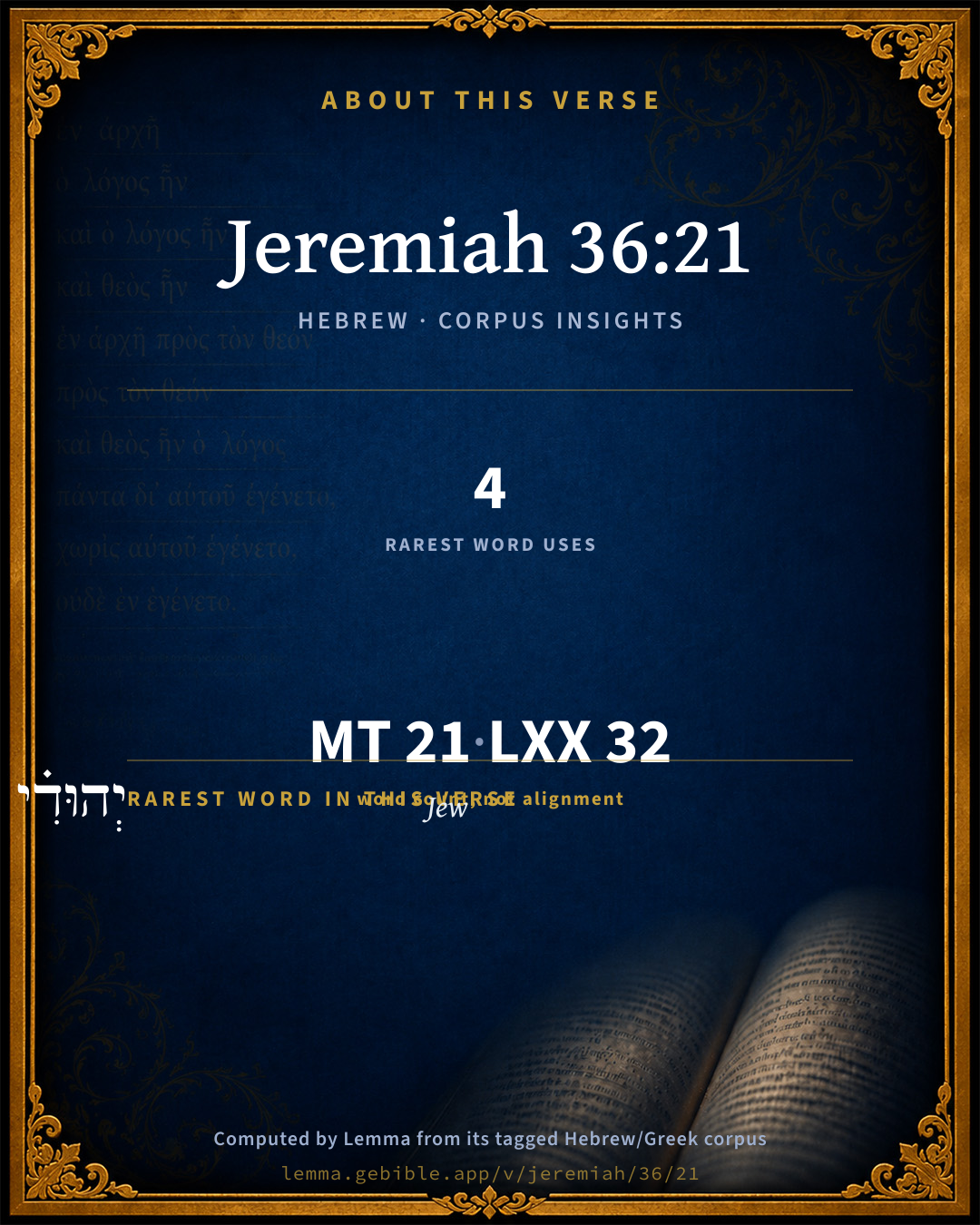
21
words
15
distinct lemmas
Prophets
section

Notable vocabulary

The rarest word here is יְהוּדִ֗י Jew H3065 — appearing just 4 times in the whole Hebrew Bible.

Shared distinctive vocabulary

יְהוּדִ֗י Jew H3065 occurs in 3 verses of the Hebrew Bible. Also found in:

Grammatical profile

  • 5 verbs
  • 13 nouns
  • 1 preposition
  • 2 particles

Verb forms

  • וַיִּשְׁלַ֨ח Qal · Sequential Imperfect
  • לָקַ֨חַת֙ Qal · Infinitive Construct
  • וַיִּ֨קָּחֶ֔הָ Qal · Sequential Imperfect
  • וַיִּקְרָאֶ֤הָ Qal · Sequential Imperfect
  • הָעֹמְדִ֖ים Qal · Participle Active

Repetition

Words recur within this verse — often emphatic in Hebrew:

  • הַמֶּ֜לֶךְ king H4428 ×3
  • יְהוּדִ֗י Jew H3065 ×2
  • לָקַ֨חַת֙ to take H3947 ×2
  • בְּאָזְנֵ֣י ear H241 ×2

Hebrew & Septuagint length

In the original languages it is 21 Hebrew tokens and 32 Greek tokens — but the two are counted differently (Hebrew bundles its prefixes and suffixes into one token; the Greek is in lemma form), so that isn’t a like-for-like length.

Cross-references

6

Topical passages linked to Jeremiah 36:21 in the Treasury of Scripture Knowledge — connected by theme and wording, ordered by reader-vote popularity; previews shown in the World English Bible.

  • 2 Kings 22:10 Shaphan the scribe told the king, saying, Hilkiah the priest has delivered me a book. Shaphan read it before the king.
  • 2 Chronicles 34:18 Shaphan the scribe told the king, saying, Hilkiah the priest has delivered me a book. Shaphan read therein before the king.
  • Ezekiel 2:4–5 The children are impudent and stiff-hearted: I do sent you to them; and you shall tell them, Thus says the Lord Yahweh.
  • Jeremiah 23:28 The prophet who has a dream, let him tell a dream; and he who has my word, let him speak my word faithfully. What is the straw to the wheat? says Yahweh.
  • Jeremiah 26:2 Thus says Yahweh: Stand in the court of Yahweh's house, and speak to all the cities of Judah, which come to worship in Yahweh's house, all the words that I command you to speak to them; don't diminish a word.
  • Jeremiah 36:15 They said to him, Sit down now, and read it in our ears. So Baruch read it in their ears.

Cross-references courtesy of OpenBible.info (CC BY 4.0).

Hebrew and Greek witnesses Masoretic Hebrew ↔ Greek Septuagint

The same verse in the two great witnesses to the Old Testament, shown verse-for-verse.

These are two independent witnesses, not word-aligned to each other, and the Septuagint is shown in lemma (dictionary) form.

Hebrew Jeremiah 36:21 Masoretic · Westminster Leningrad Codex

וַיִּשְׁלַ֨ח הַמֶּ֜לֶךְ אֶת יְהוּדִ֗י לָקַ֨חַת֙ אֶת הַמְּגִלָּ֔ה וַיִּ֨קָּחֶ֔הָ מִלִּשְׁכַּ֖ת אֱלִישָׁמָ֣ע הַסֹּפֵ֑ר וַיִּקְרָאֶ֤הָ יְהוּדִי֙ בְּאָזְנֵ֣י הַמֶּ֔לֶךְ וּבְאָזְנֵי֙ כָּל הַשָּׂרִ֔ים הָעֹמְדִ֖ים מֵעַ֥ל הַמֶּֽלֶךְ

So the king sent Jehudi to get the scroll; and he took it out of the chamber of Elishama the scribe. Jehudi read it in the ears of the king, and in the ears of all the princes who stood beside the king.

World English Bible · Public Domain

Greek LXX Structure differs

In the Septuagint, Jeremiah is about an eighth shorter than the Hebrew and arranges its material differently — the Oracles Against the Nations (Hebrew chapters 46–51) appear in the middle of the Greek book, after 25:13. Because the chapter and verse boundaries do not line up, a verse-for-verse comparison with the Hebrew is not shown.

A verse-for-verse comparison isn’t shown here because the chapters and verses don’t line up. Switch to the LXX edition with the MT / LXX toggle above to read the Greek directly.

Hebrew: Westminster Leningrad Codex (CC BY 4.0). Greek: Septuagint (public domain); English from a public-domain English Septuagint. How the Septuagint differs from the Hebrew →

Targum (Aramaic paraphrase)

1

The Targum is the ancient Jewish Aramaic paraphrase of the Hebrew Scriptures — an interpretive translation, not the Hebrew text itself. Onkelos (literal) and Pseudo-Jonathan (expansive) render the Torah, and Jonathan the Prophets. Coverage is partial: where no permissively-licensed English translation exists for a verse, only the Aramaic is shown. This is verse-level text, not a word-by-word alignment to the Hebrew.

  1. Targum Jonathan Prophets (Joshua–Malachi)
    וּשְׁלַח מַלְכָּא יַת יְהוּדִי לְמֵיסַב יַת מְגִילָתָא וְנַסְבָהּ מִלִשְׁכַּת אֱלִישָׁמָע סַפְרָא וּקְרָהָא יְהוּדִי קֳדָם מַלְכָּא וְקָדָם כָּל רַבְרְבַיָא דְקַיְמִין מֵעִלַוֵי מַלְכָּא:

    (no public-domain English translation for this verse)

    Targum Jonathan — Aramaic: “Mikraot Gedolot” (public domain). English: “Sefaria Community Translation” (CC0 1.0 (public-domain dedication)); “London "Chaldee Paraphrase," 1871” (public domain). Text via Sefaria.

Commentary

Notes on Jeremiah 36:21 from classic Christian and Jewish commentators (each source and its license shown beneath its notes). The classic Christian expositions comment on the surrounding passage and are grouped to its opening verse, so a note may address several verses; the Jewish commentaries on the Tanakh (Rashi and others) are per-verse, so they appear only where the commentator wrote on this verse.

Lemma curates 59 commentaries, every one of them public domain or Creative Commons licensed, each selected and text-cleaned for this edition rather than reprinted as found. About our sources →

Trapp's Complete Commentary

John Trapp

Jer 36:21 So the king sent Jehudi to fetch the roll: and he took it out of Elishama the scribe’s chamber. And Jehudi read it in the ears of the king, and in the ears of all the princes which stood beside the king.

Ver. 21. So the king sent Jehudi.] See on Jer 36:14.

John Trapp, A Commentary or Exposition upon All the Books of the Old and New Testament (1647–1656) — public domain. Text from a community e-Sword module.

Tyndale Open Study Notes

Tyndale Open Resources

36:21 Jehudi was well educated, and was perhaps a scribe. Only the elite were trained to read and write.

Tyndale Open Study Notes — © Tyndale Open Resources, licensed CC BY-SA 4.0. Text via the HelloAO Bible API.

Jamieson, Fausset & Brown

Robert Jamieson, A. R. Fausset & David Brown

sent Jehudi--Note how unbelievers flee from God, and yet seek Him through some kind of involuntary impulse [CALVIN]. Jehudi seems to have been the king's ready tool for evil.

Jamieson, Fausset & Brown — Commentary Critical and Explanatory on the Whole Bible (1871) — public domain (CC PDM 1.0). Text via the HelloAO Bible API.

John Calvin's Commentaries

It now follows, that the king sent Jehudi to fetch the roll from the chamber of Elishama the scribe In the person of Jehoiakim we see how the unbelieving shun and seek God at the same time, but with a confused mind, as they know not what they seek. The king might have heedlessly despised what had been related to him, for if he wished to be free from all trouble, why did he order the roll to be brought to him, and a part of it to be read? We hence see that the unbelieving, though they wish to go as far as possible from God, yet run to him in a sort of blind manner; but this they do not of their own accord; for God by his secret impulse draws them to himself, so as to render them more inexcusable. Hence it comes, that curiosity leads many to hear the truth, and some madly ask, what is the truth to them? like wild beasts when they run against swords. Such was the disposition of Jehoiakim, for he wished all the prophecies of Jeremiah to be buried; and yet he could not restrain himself, but would know the substance or some part of them. He therefore sent Jehudi to fetch the roll

It is then added, that Jehudi read the roll before the king and before his counsellors. Hence it was that his impiety became more evident, as he was not moved by the predictions read to him. He could not indeed endure the recitation, but after some chapters had been finished, he became so enraged, as we shall see, that he threw the roll into the fire and burnt it. It was, however, God’s purpose to take away from the king as well as from his counsellors every pretext, that they might not afterwards allege that they had fallen through ignorance, for after the roll had been presented to them, it was their own fault if they were not restored to that state of safety from which they had fallen. He now adds —

John Calvin's Commentaries (1540-1563) — public domain. Text from the Calvin Translation Society English edition (1840s-50s) via the Christian Classics Ethereal Library (ccel.org). Calvin's coverage is partial (roughly two-thirds of the Bible); uncommented books and verses are honest gaps, never fabricated. The 19th-century editor's footnotes and remarks are omitted so the notes are faithfully Calvin's own voice.

Ellicott's Commentary for English Readers

(21) So the king sent Jehudi . . .—The prudence ci the counsellors was foiled by the king’s impatience. He was not satisfied with hearing a general report. He would have the words themselves.

A Bible Commentary for English Readers, edited by Charles John Ellicott (1878–1897) — public domain. Text from a community e-Sword module.

The Cambridge Bible for Schools and Colleges

gen. ed. J. J. S. Perowne

21–26. See introd. summary to the ch.

The Cambridge Bible for Schools and Colleges (gen. ed. J. J. S. Perowne; Cambridge University Press, 1878–1918) — public domain. Text from a community e-Sword module.

John Gill's Exposition

So the king sent Jehudi to fetch the roll,.... The same person the princes sent to Baruch to come to them, and bring the roll with him, Jer 36:14. This the king did, out of curiosity, and to satisfy himself of the truth of what the princes said; and by this it appears they had told him of the roll, which contained what they had given him a summary of, and where it was:

and he took it out of Elishama the scribe's chamber; or, "out of the chamber of Elishama the scribe"; who knew where it was, being present at the reading of it in the secretary's office, and saw where it was laid; or, however, was directed by the secretary where it was, and might have the key of the chest or scrutoire given him in which it was laid:

and Jehudi read it in the ears of the king, and in the ears of all the princes that stood by the king: as he doubtless was ordered; and which he did so loudly, clearly, and distinctly, that the king and all the princes could hear; which princes were those who had heard it before, and were come to the king to acquaint him with the substance of it; and who stood by the side of the king, or about him, in honour to him; though there might be also others besides them, who were before with the king, and waiting on him; and Abarbinel thinks that other princes distinct from those that went to the king are meant. When it is said that Jehudi read the roll in the hearing of the king and princes, it mast be understood of a part of it only, and not the whole; as Jer 36:23 shows.

John Gill's Exposition of the Whole Bible (1746–1763) — public domain (CC PDM 1.0). Text via the HelloAO Bible API.

Haydock's Catholic Bible Commentary

Read it. This was the third time. It was in vain afterwards to destroy the book.

George Leo Haydock (1774–1849), Haydock's Catholic Family Bible and Commentary, 1859 edition — public domain. Excludes Psalms (Douay-Rheims chapter numbering differs from Protestant) and Deuterocanonical books (Catholic canon only).

Matthew Poole's English Annotations

It appeareth by Jer 36:14 that this

Jehudi was a messenger commonly employed by the king and council; him the king sends

to fetch the roll, ( before called a book,) then he employeth him to read it.

Matthew Poole's English Annotations on the Holy Bible (1683–1685) — public domain. Text from a community e-Sword/MySword module.

The Pulpit Commentary

Which stood beside the king; literally,... above the king. The standing courtiers, of course, rose above the king; comp. Isa_6:2, "Seraphim stood above him."

The Pulpit Commentary (1880–1919), ed. H.D.M. Spence-Jones & Joseph S. Exell — public domain. Text from a community e-Sword module.

Lesson kit

Teaching starters — assembled from the data on this page, not authored interpretation. Every prompt links to the verse data it draws on. Edit before teaching.

Jeremiah, in the Prophets, opens this verse with 21 words (15 distinct Hebrew lemmas). Its most distinctive word is Yᵉhûwdîy (“Jew”). A historical commentator’s framing appears above. Read the whole chapter for the surrounding context.

Discussion questions

  1. How does “Jew” (Yᵉhûwdîy) shape what this verse is saying?
  2. How does Jeremiah 36:14, which shares the word «Jew», read alongside this verse?
  3. What does the repetition of “king” (3× in this one verse) do in this verse?
  4. These translations render this verse differently. What is at stake in choosing one wording over another?
  5. «וַיִּשְׁלַ֨ח» is a Qal Sequential Imperfect verb. How does that grammatical form shape the action described?
  6. Compare how Trapp's Complete Commentary and Tyndale Open Study Notes read this verse. Where do they agree or differ?

Things to notice

Reading settings

Reading text

Shown beneath each verse's original-language words.

Old Testament
Old Testament edition

Read the OT as the Masoretic Hebrew (MT) or the Greek Septuagint (LXX).

English shown for the Greek Septuagint (in the Hebrew ↔ Greek comparison).

Comparing translations? Open the Compare panel on any verse page to stack up to four side by side.